Curated collectionAnswer keys includedPrint-ready PDFs
Tutoring Worksheets With Answer Keys
Use one-to-one think-alouds, immediate error interpretation and a session-to-session note trail instead of assigning an undifferentiated packet.
Start with a real resource
Browse this worksheet collection
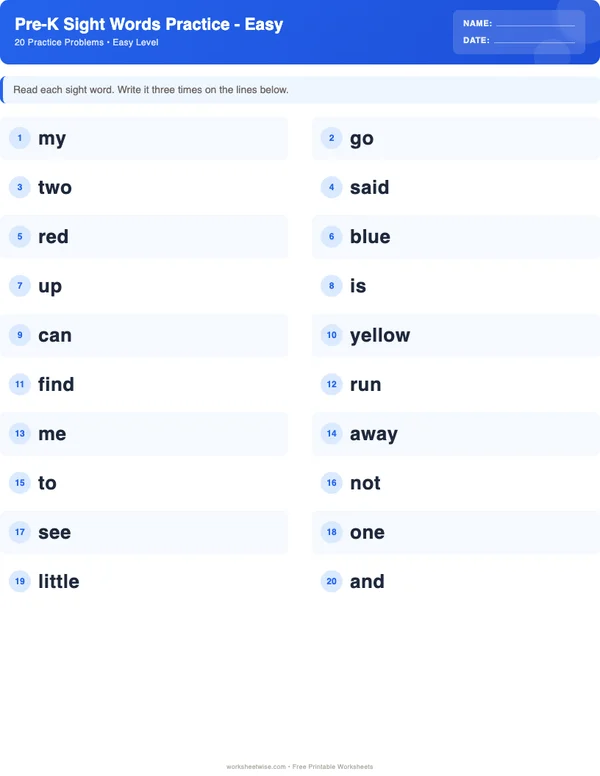
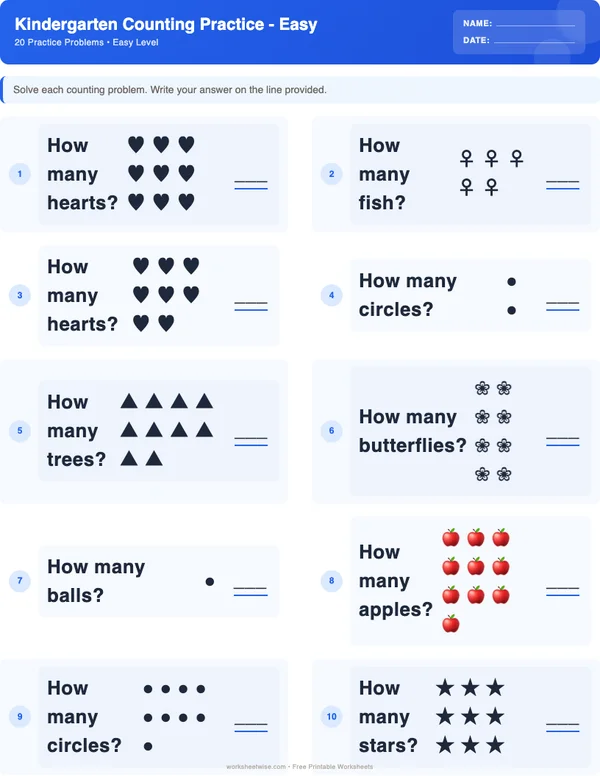
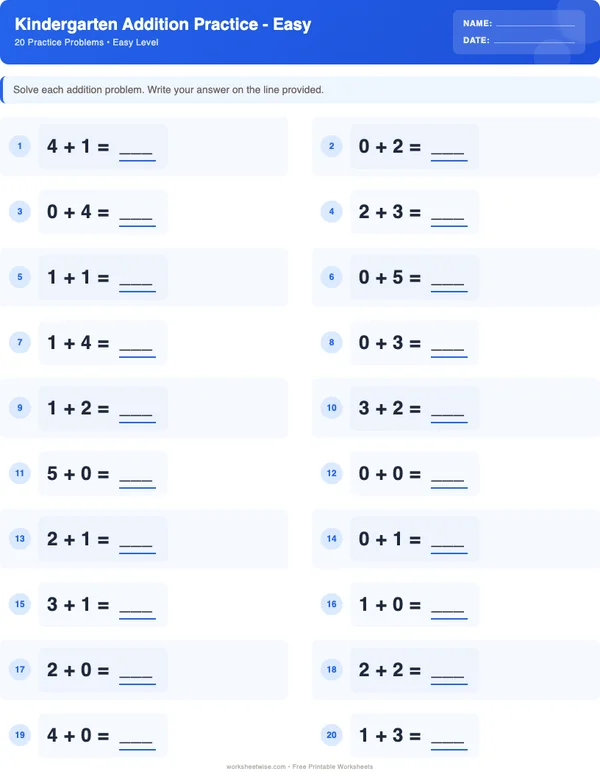
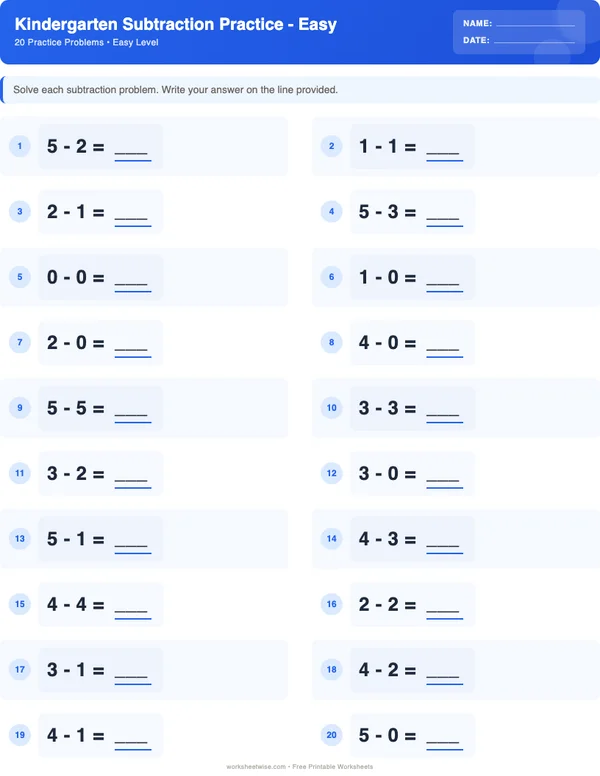
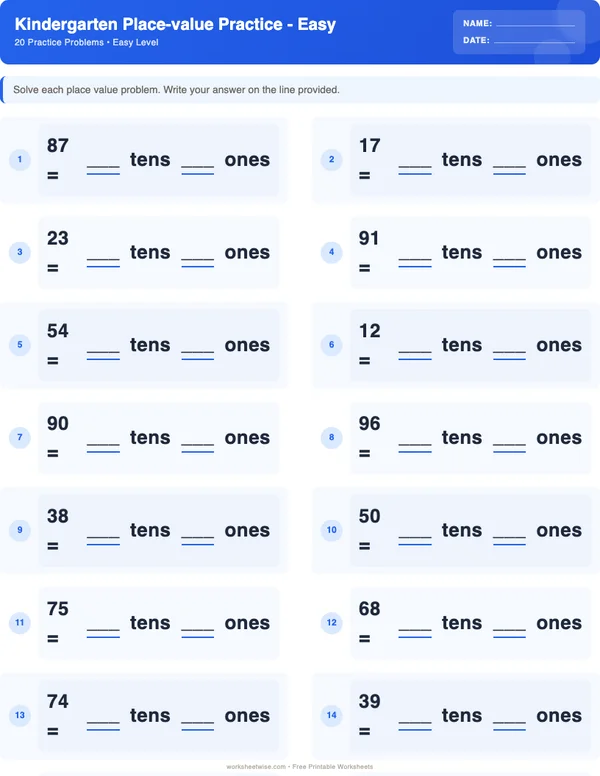
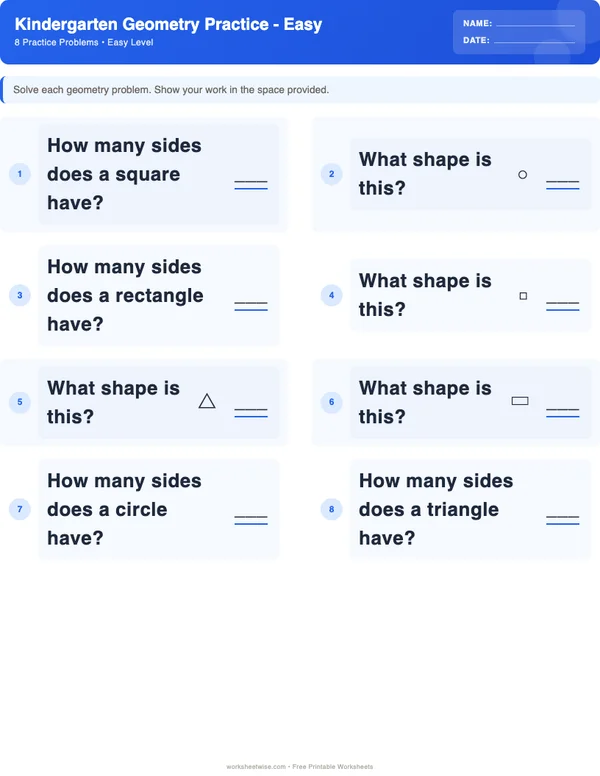
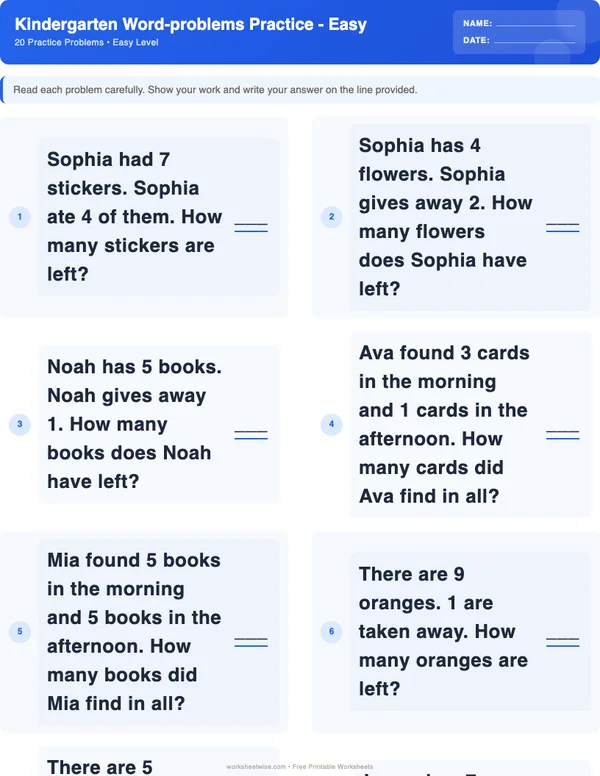
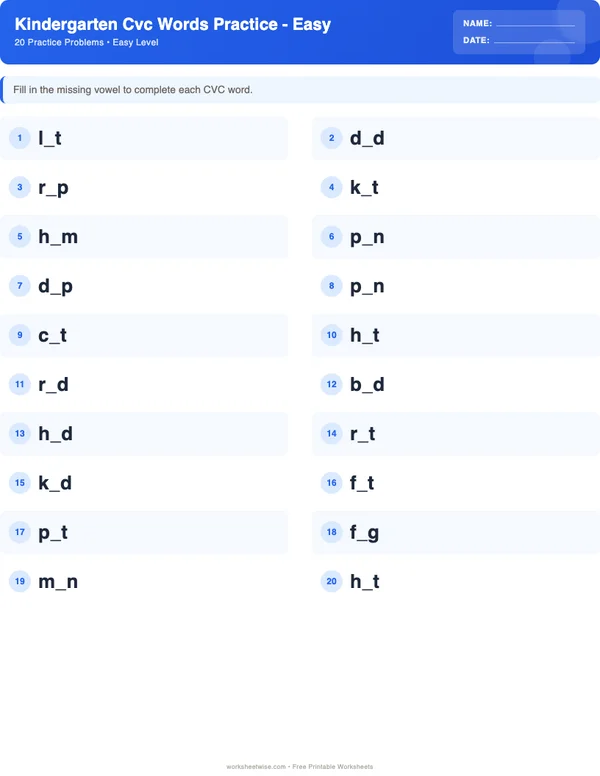
107 relevant free entry points are available. Each one includes a printable learner PDF and separate answer key.
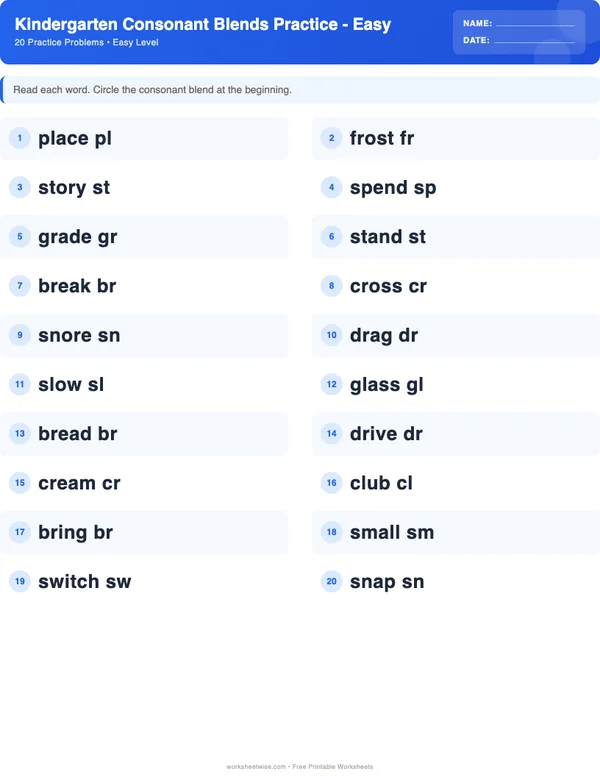
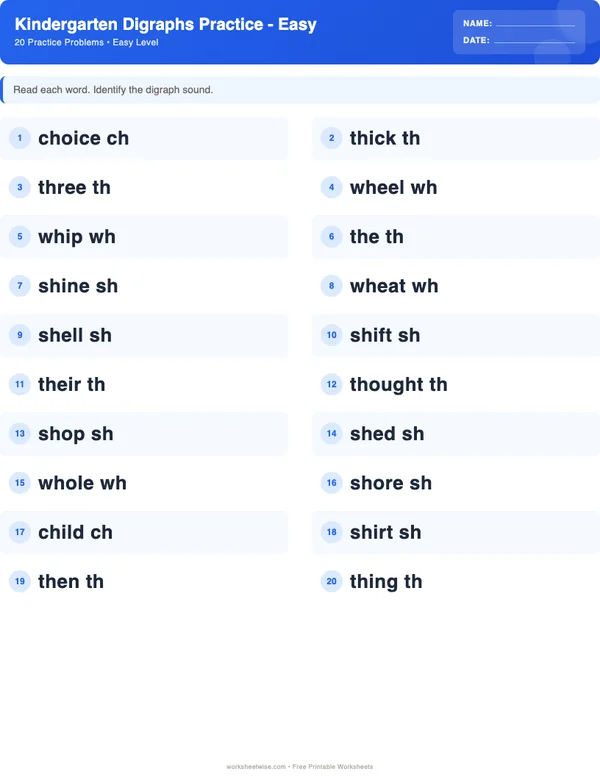
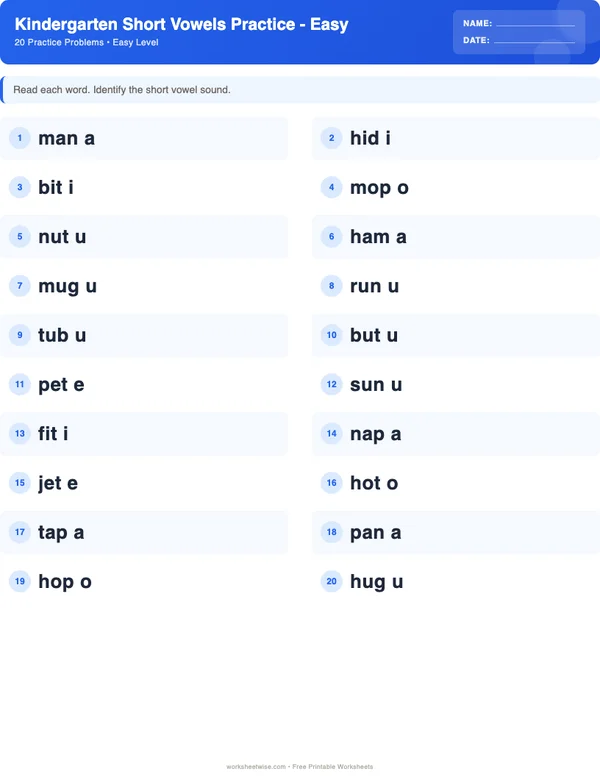
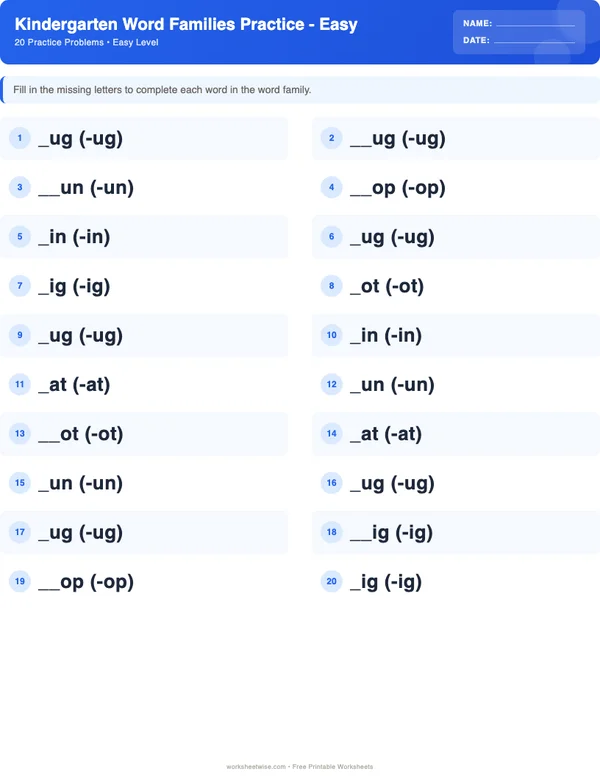
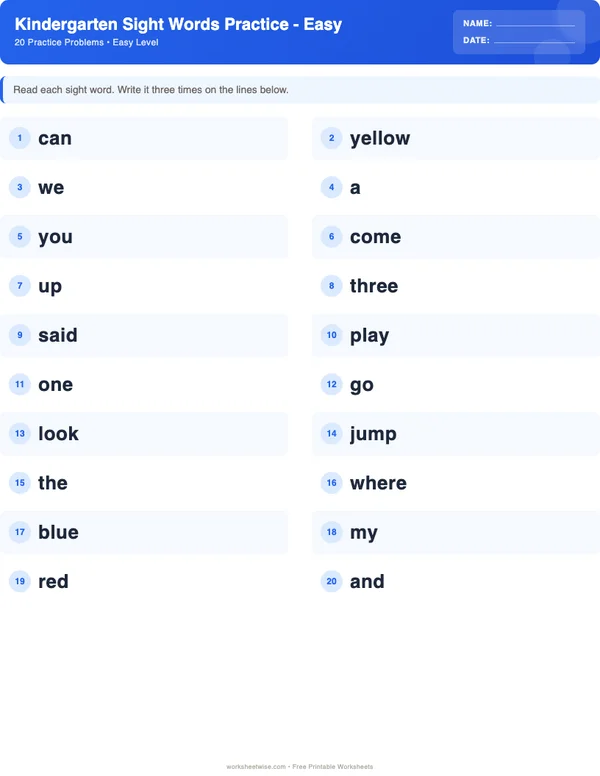
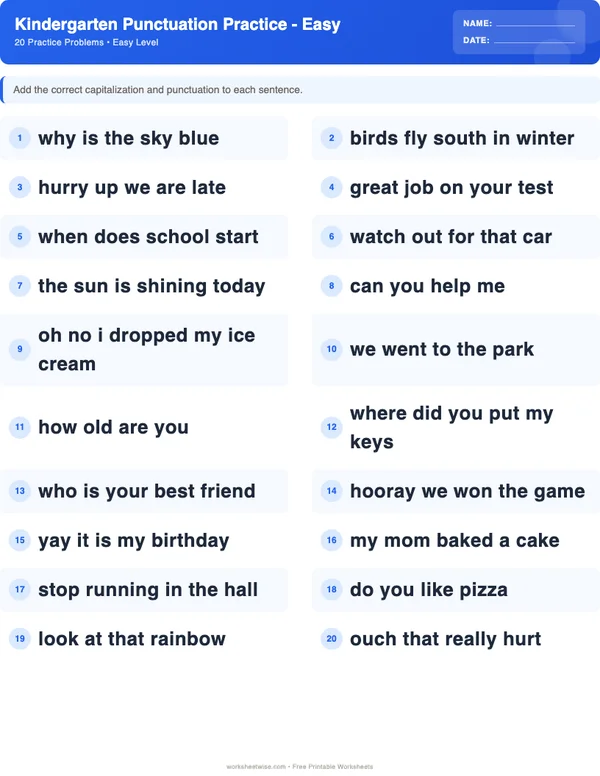
A useful practice loop
Print less. Observe more.
- Choose one skill and model the first item aloud.
- Use a short set and notice the learner’s strategy.
- Change the next task from the work you can see.
Need more than the free sheet?
Plus includes all 1926 matching catalogue variations where available, plus saved deterministic generators and the worksheet designer.
See Plus membershipExplore tutoring worksheets with answer keys by subject or level
Complete guide
How to teach and practise tutoring worksheets
3,471 words Updated 6 instructional visuals
Turn one worksheet into a tutoring conversation
A tutoring worksheet works best as a shared thinking surface, not an assignment packet. Select one narrow skill, ask the learner to think aloud through a few items, interpret each error immediately, and leave a short note that determines the next session. The answer key confirms the result; the learner’s explanation reveals what to teach.
A practical 25–35 minute session looks like this:
- Revisit one note from the previous session.
- State today’s skill in learner-friendly language.
- Model one item while thinking aloud.
- Solve one item together.
- Watch the learner attempt two or three items independently.
- Respond to the reasoning behind errors.
- End with one fresh item and record the next step.
This is an editorial routine for using WorksheetWise resources, not a research finding about the site. It is informed by authoritative guidance where noted below. It also scales down: a young child may work orally with objects for eight minutes, while an older learner may spend 35 minutes analyzing sentences or decimal representations.
WorksheetWise currently catalogs 1,926 worksheet variants across eight grade labels, four subjects, and 23 topics, including 107 free resources. Those numbers provide choice, but more choice does not justify a larger packet. In one-to-one tutoring, the useful unit is usually a short, observable slice of work.
Prepare around one decision, not one topic name
“Practice decimals” is too broad. “Determine whether the learner compares decimal values by place value or by counting digits” is teachable. Before printing, write the decision you need the session to answer.
Define the target and the evidence
Use this planning sentence:
By the end of the session, the learner will [perform an action] on [a defined item type], and I will listen or look for [specific evidence].
Examples:
- Count a scattered set once, touching or moving each object, without skipping or recounting.
- Blend three-sound CVC words and identify the middle vowel sound.
- Represent a money amount with coins, then write the matching value.
- Compare decimals by naming the value of the first unequal place.
- Revise sentence fragments by adding the missing subject or complete predicate.
The evidence must be visible or audible. “Understand decimals” is not observable. “Explains that 0.7 is greater than 0.65 because seven tenths is greater than six tenths” is.
Inspect the worksheet before the learner sees it
Work every selected item yourself. Check that:
- the directions match what the items actually require;
- pictures, labels, and answer choices are unambiguous;
- the answer key agrees with your own calculation or reading;
- the page does not introduce an untaught format while supposedly assessing a skill;
- there is enough writing space for the response you want;
- the item order does not reveal answers mechanically;
- any word problem contains all necessary information.
Mark three items in advance: one to model, one to solve together, and one to use as an independent check. Circle any item that could produce a useful contrast. For decimal comparison, 0.8 versus 0.75 is more revealing than 0.8 versus 0.2 because the first pair exposes the mistaken “more digits means greater” rule.
The answer key is a preparation tool and a checking tool. Do not place it where the learner can use it to avoid reasoning.
Select by task features rather than labels alone
Grade and age labels help adults discover plausible material. They are not placement decisions. Grade labels describe the intended practice level, and local curriculum sequences differ. Start from what the learner has already been taught, the representation they recognize, and the exact response the page demands.
Catalogue difficulty labels should also be translated into observable task features. An “easy” sheet might use one-step directions, familiar pictures, small quantities, a stable item format, or direct recall. A more demanding task might remove visual support, mix item types, increase the number of steps, place the unknown in different positions, or require an explanation. These words describe the page, not the learner. Never call a child “easy,” “developing,” or “advanced.”
Use five selection checks:
- Skill fit: Does nearly every chosen item practice today’s target?
- Representation fit: Does the page use objects, pictures, number lines, words, or symbols the learner can interpret?
- Language load: Could reading complexity hide the target skill?
- Volume fit: Can the learner complete a useful sample while still explaining decisions?
- Transfer fit: Is there time to try one new item without copying the model?
A 20-problem free sheet need not become a 20-problem session. Cover unused rows, cut a working strip, or choose five item numbers. Preserve the original answer key and record which items were used.
Launch with a think-aloud that exposes choices
A strong launch takes two or three minutes. Name the target, remove the threat of “getting the whole page done,” and explain what you will listen for.
Try:
“Today I care about how you decide, not how many boxes you finish. I’ll solve the first one and say every choice aloud. Then we’ll do one together. On the next one, you’ll talk and I’ll listen.”
Keep the model brief. A think-aloud should reveal a decision that the learner can reuse, not narrate every pencil movement.
Checked example: first-grade money from concrete to written value
Suppose the worked item shows one dime and three pennies. Count and verify it yourself: the dime is 10 cents; three pennies are 3 cents; 10 + 3 = 13, so the amount is 13 cents.
Model:
“I will not count four coins and call the answer four. I need each coin’s value. The dime contributes ten cents. I count on for the pennies: eleven, twelve, thirteen. I write 13¢.”
Then change only one feature. Use one dime and four pennies and ask the learner to build, count, and write 14¢. This example belongs in tutoring because the adult can watch whether the learner confuses the number of coins with their total value and can return immediately to real or play coins.
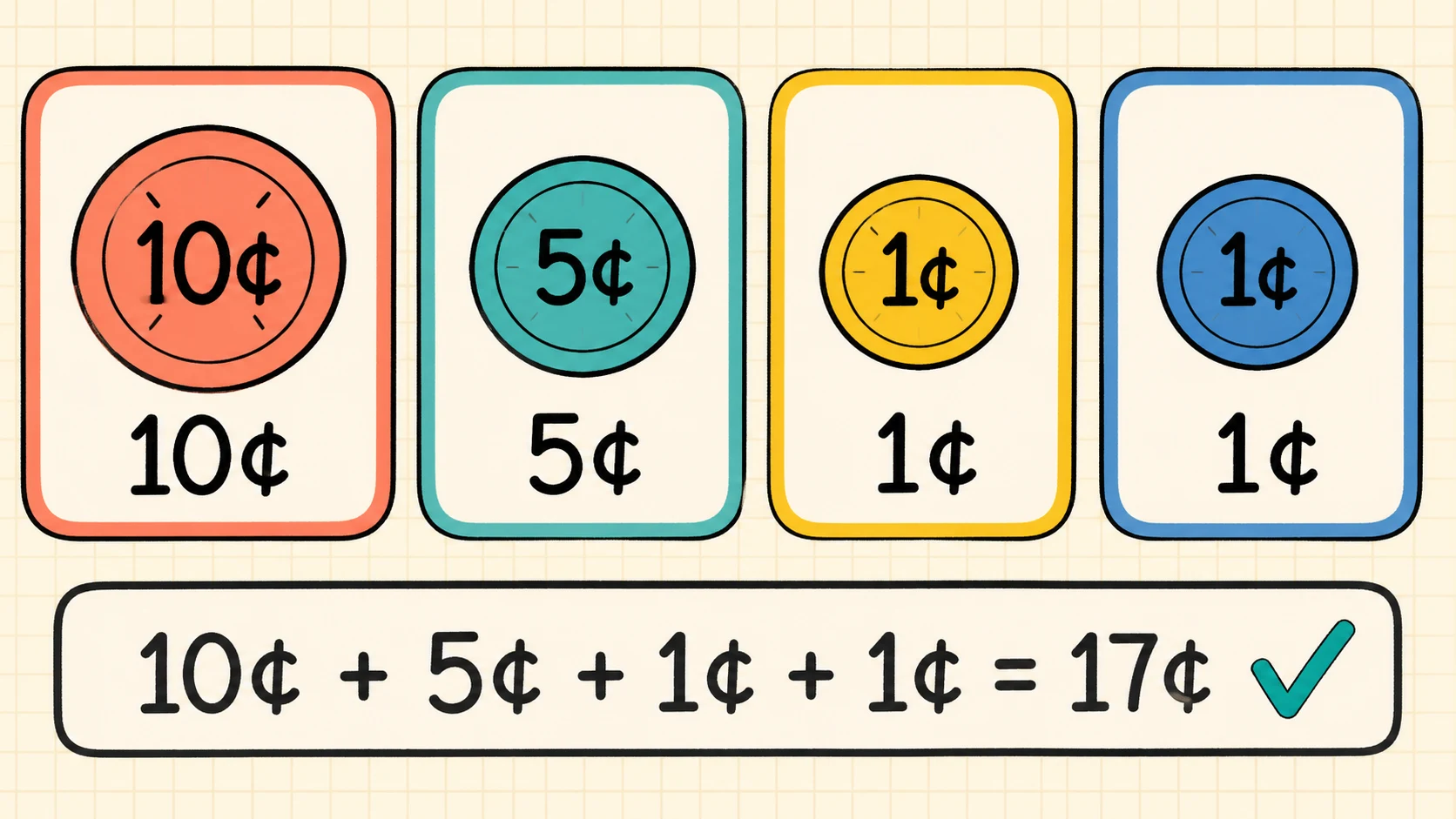
Use the written answer only after the learner has connected each coin to its value.
This concrete-to-representation-to-symbol sequence is consistent with the IES elementary mathematics intervention guide, which recommends well-chosen concrete and semi-concrete representations as part of systematic instruction. That is sourced guidance. Choosing one dime and three pennies as the tutoring probe is a page-specific editorial suggestion.
Observe a small sample before teaching again
Once the learner begins, resist filling every silence. Give enough wait time for an actual choice to emerge. For two or three items, record what the learner says and does rather than only whether the answer is correct.
Watch for:
- where the eyes, finger, or pencil move;
- whether the learner starts before reading the full direction;
- which representation is used voluntarily;
- whether an error repeats in the same way;
- whether the learner can detect an unreasonable answer;
- whether a correct answer came from reasoning, recall, copying, or guessing.
Use neutral prompts that do not reveal the method:
- “What are you noticing?”
- “Show me where that value came from.”
- “What will you do first?”
- “How could you check it another way?”
- “Read the answer back in the context of the question.”
Avoid “Are you sure?” as a default response. It can cause a learner to replace a correct answer merely because the tutor sounded doubtful.
Checked example: Pre-K counting as an oral and manipulative task
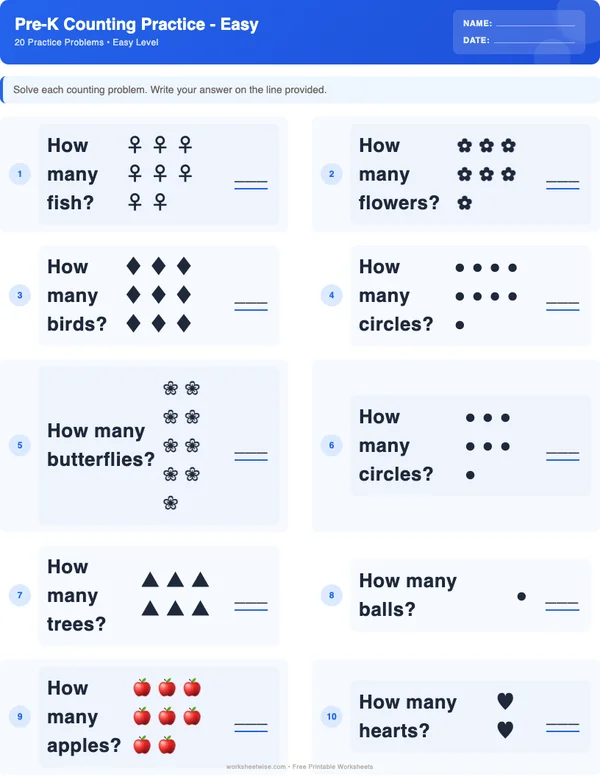
Place seven buttons in a scattered arrangement. Ask, “How many are there?” If the child points without moving them and counts 1, 2, 3, 4, 5, 6, 7, ask the child to slide each button into a cup while counting again. Seven buttons moved once still produce seven. If the second count becomes eight because one button is counted twice, the problem is not necessarily knowledge of the spoken sequence; the observable issue is coordinating one count word with one object.
This example belongs because the live catalogue includes a 20-problem Pre-K Counting sheet and describes practice with sets, sequences, and missing numbers. For children ages three and four, however, prioritize brief adult-led oral, matching, manipulative, and movement work over desk work. Age is a discovery aid rather than a placement decision. The worksheet can supply a picture or later record; it should not displace handling objects.
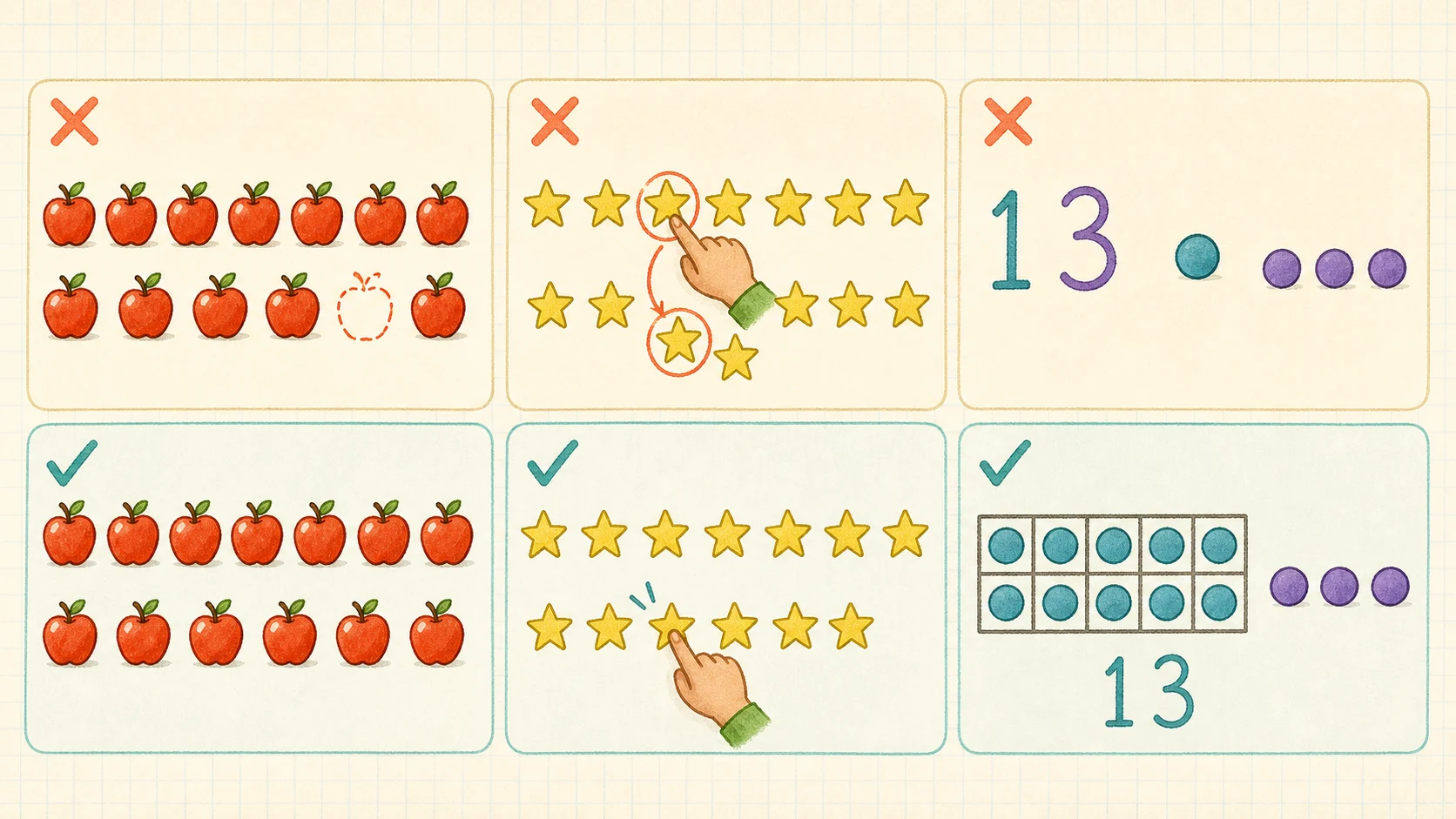
Treat a wrong count as evidence about tracking, sequence, or quantity—not as one generic counting mistake.
The IES guide to teaching math to young children recommends developmental progressions and progress monitoring that builds from what a child already knows. It does not prescribe this exact button-and-cup activity or evaluate WorksheetWise.
For suitable follow-up material, compare the Pre-K Counting guide and free sheet with the Kindergarten Counting guide and free sheet. Choose between them by task features such as quantity range, picture support, and response mode—not by birthday alone.
Interpret the error before correcting the answer
An answer key sorts responses into matches and mismatches. A tutor must go further: identify the smallest plausible decision that produced the mismatch, test that interpretation with one prompt, and respond without changing the target.
Use this sequence:
- Describe: Record exactly what happened.
- Hypothesize: Name one possible reasoning rule.
- Probe: Give a contrast item or ask for a representation.
- Respond: Model or cue the missing decision.
- Recheck: Use a fresh item with the same structure.
Do not infer a diagnosis from worksheet performance. Fatigue, unfamiliar wording, visual layout, missing prior instruction, haste, and misconceptions can produce similar marks on paper. A repeated pattern tells you what to teach next; it does not establish why the learner has that pattern.
Checked example: third-grade decimal comparison
Ask the learner to compare 0.6 and 0.54. The checked comparison is 0.60 > 0.54: six tenths equals sixty hundredths, and sixty hundredths is greater than fifty-four hundredths.
If the learner says 0.54 is greater “because 54 is bigger than 6,” do not merely point to the answer key. Write 0.6 = 0.60, align the decimal points, and ask for the tenths digits. The first unequal place contains 6 tenths versus 5 tenths, so the comparison is decided there.
Now probe with 0.4 and 0.39. A correct explanation should compare four tenths with three tenths or forty hundredths with thirty-nine hundredths. If the learner instead memorizes “add a zero,” use a hundred grid or base-ten representation so the equality 0.4 = 0.40 has meaning.
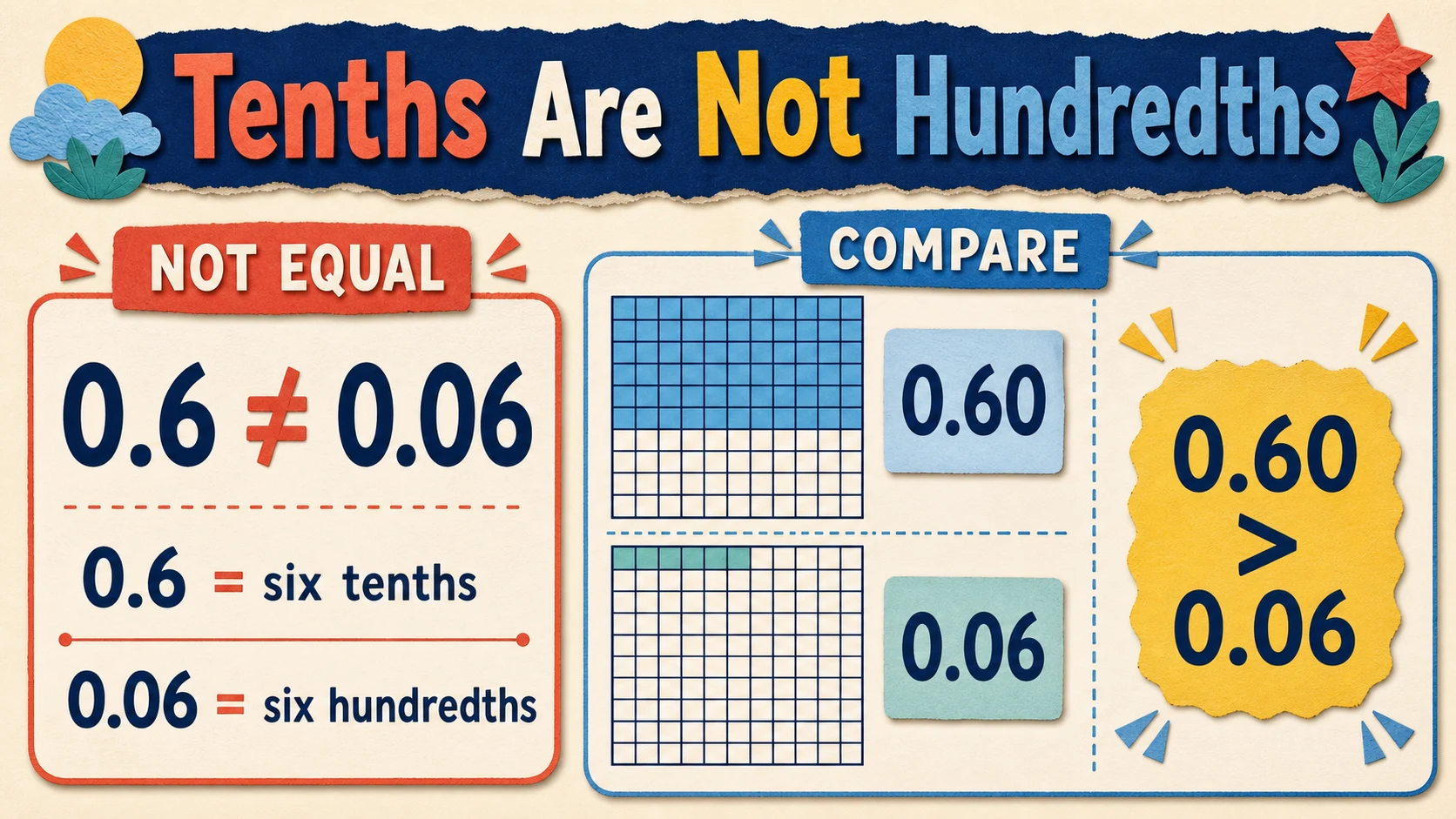
Pair each repeated decimal error with a prompt that tests the learner’s place-value decision.
This example belongs because the page’s tutoring visuals identify third-grade decimals and specifically support error diagnosis. The grade label indicates intended practice level only; confirm that decimal comparison and the chosen representation occur in the learner’s local sequence.
Give feedback that leaves the thinking with the learner
Immediate feedback does not mean immediately supplying the answer. Match the response to the type of evidence.
When the method is sound but execution slips
Name the successful decision first, then point to the exact place to check:
“You aligned the decimal points correctly. Recalculate the hundredths subtraction.”
Do not restart the entire explanation when one arithmetic slip caused the mismatch.
When the learner applies an unreliable rule
Create a contrast that makes the rule fail:
“Your rule says the decimal with more digits is greater. Test it on 0.8 and 0.75 using tenths and hundredths.”
Let the learner revise the rule aloud. Record the new wording in the learner’s language if it is mathematically accurate.
When the learner does not yet have an entry point
Reduce support gradually: model one, complete one together, provide a partial cue, then ask for an independent attempt. Keep the target stable. If the target is decimal comparison, do not “simplify” the task into comparing whole numbers only. Instead, preserve decimal comparison while adding a place-value chart, aligned digits, or a visual model.
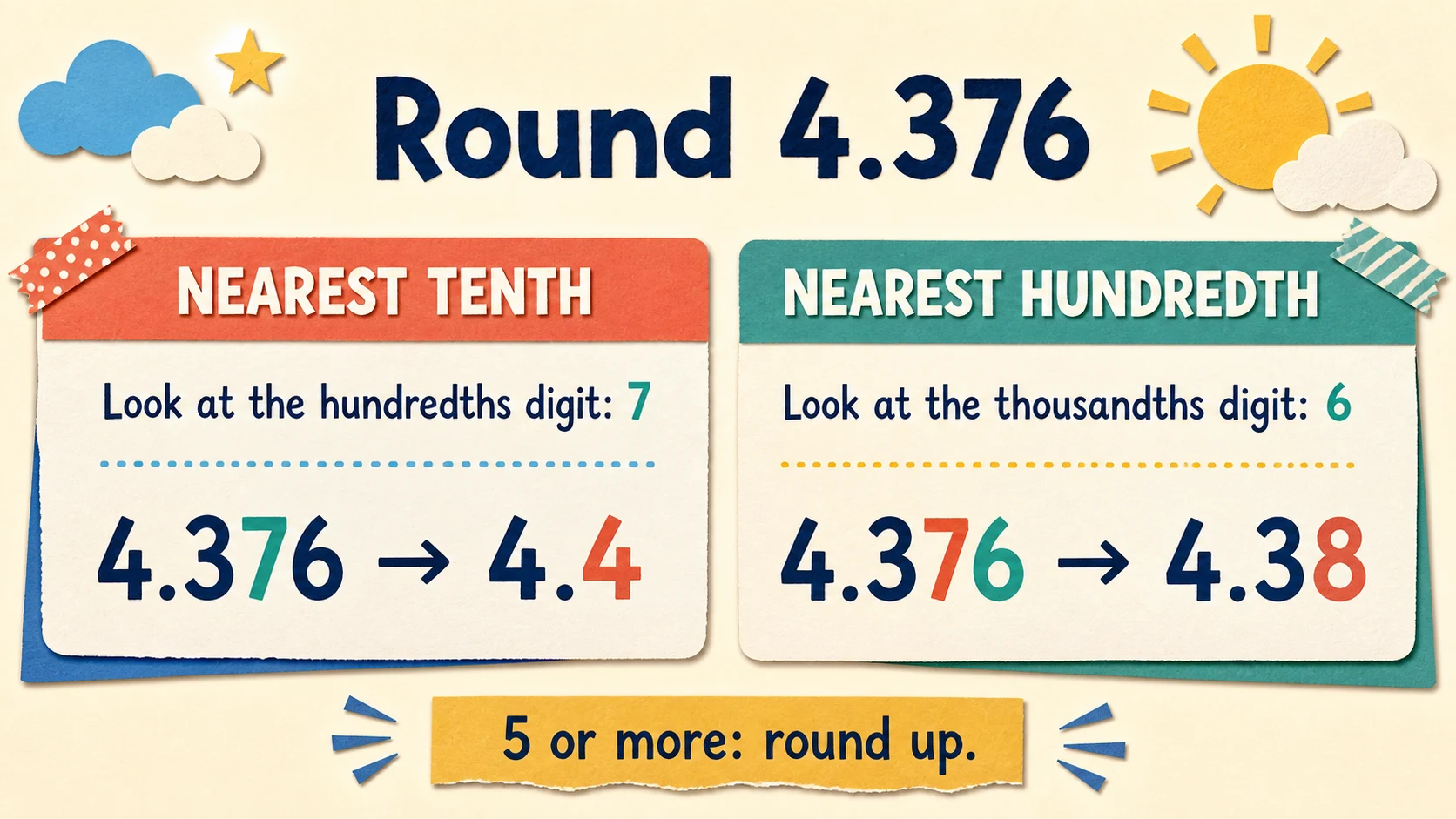
Repeat the same explain–practice–check structure while changing the decimal values.
The IES mathematics intervention guide supports systematic instruction, precise mathematical language, representations, number lines, and deliberate word-problem teaching. Those are sourced recommendations. The feedback scripts and support sequence here are practical applications, not claims that one script guarantees progress.
Adapt across subjects without replacing the target skill
A useful adaptation changes access, response mode, quantity, or support. It does not quietly substitute a different learning goal.
Phonics: keep decoding central
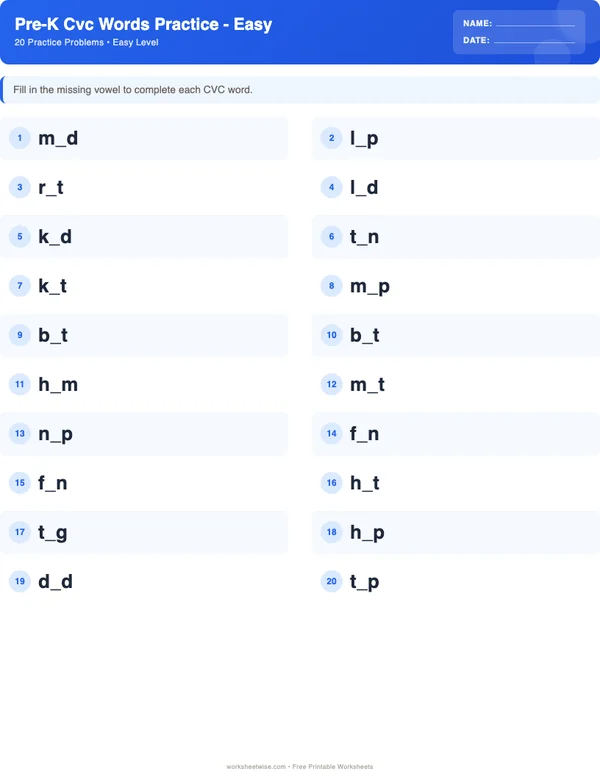
If the target is blending CVC words, a picture-match page may reduce memory demands, but the learner should still produce and blend the sounds. For map, verify the sound sequence /m/ /ă/ /p/, then blend it as a word. If the learner chooses the map picture from the initial sound alone, cover the pictures and ask for the whole blend.
A checked word chain is cat → mat → map. Only one letter changes at each step: c to m, then final t to p. Have the learner build the words with three letter tiles, say each sound, sweep a finger under the tiles, and read the word. This belongs because the live catalogue’s Pre-K CVC Words resource includes word building, picture matching, and reading with all five short-vowel families.
For ages three and four, make this brief and adult-led. Use oral sound matching, three tokens, magnetic letters, and movement before expecting sustained pencil work. Age remains a discovery aid, not a placement decision.
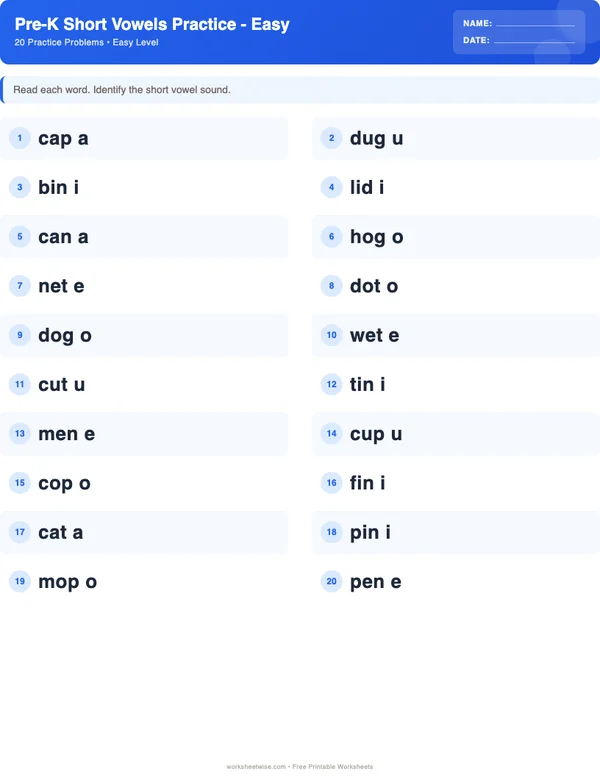
The IES foundational reading guide recommends connecting speech sounds to letters, teaching decoding and word analysis, and ensuring daily work with connected text. Therefore, isolated worksheet words should lead into a short decodable phrase or sentence rather than becoming the entire reading lesson. Browse the Pre-K CVC Words guide and free sheet or the Pre-K Short Vowels guide and free sheet according to the precise sound contrast needed.
Writing: preserve composition and revision
If the target is complete sentences, reading directions aloud can remove an unrelated decoding barrier. It should not remove the need to construct or revise a sentence.
Check a fragment such as Because the rain stopped. It begins with a dependent word and does not express a complete thought by itself. One valid revision is We went outside because the rain stopped. The subject is We; the complete predicate is went outside because the rain stopped.
For The spotted dog near the gate., a valid revision is The spotted dog waited near the gate. Adding waited supplies the action and completes the thought. Other answers may also work, so the tutor must evaluate meaning and structure rather than demand one answer-key sentence.
These examples belong because the page’s visual identifies a sixth-grade sentence-structure routine. They are useful in elementary tutoring when the actual target is recognizing and repairing fragments, but the grade label should not override the learner’s taught curriculum.
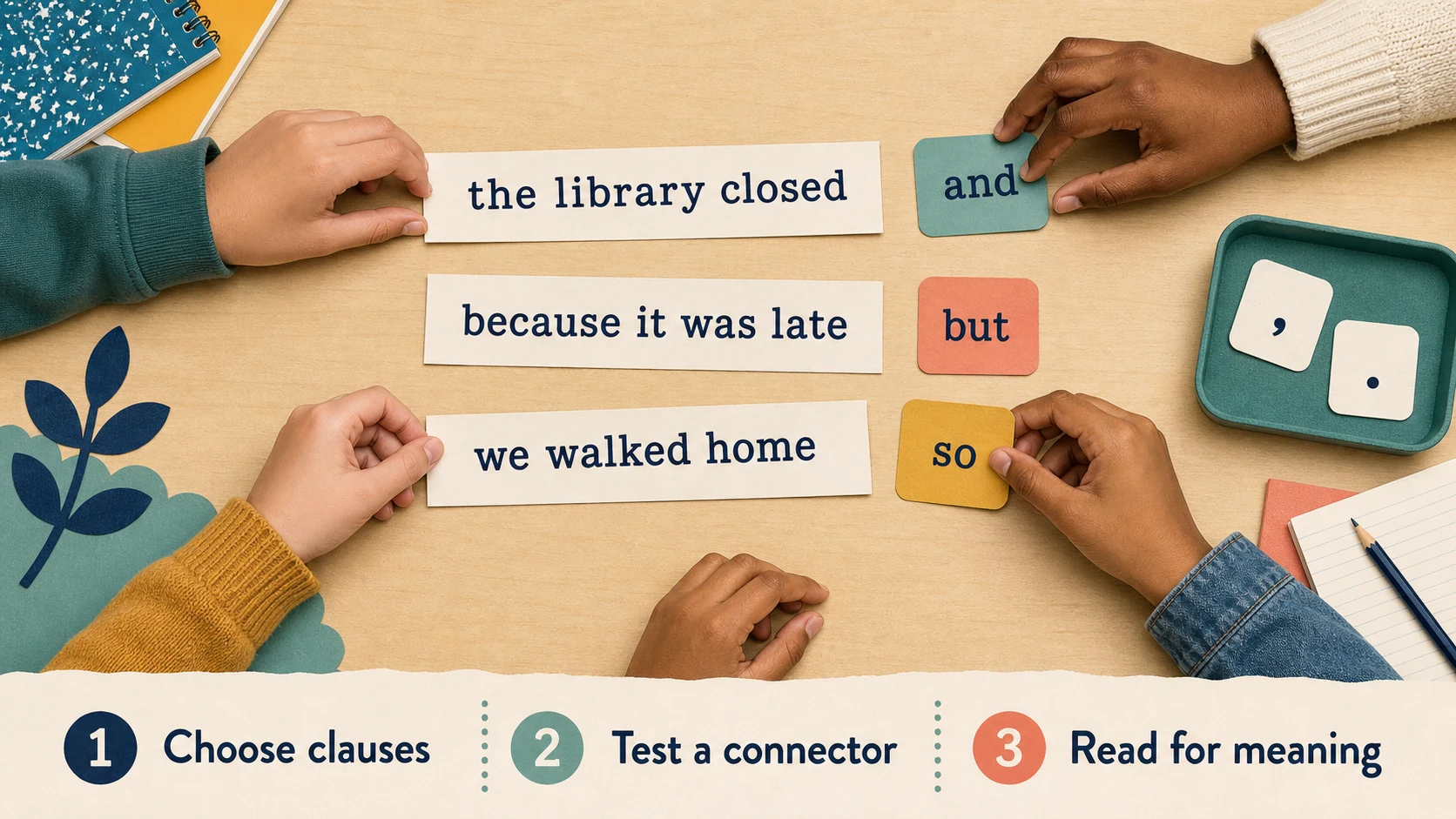
Use the answer key to verify structure while accepting more than one grammatically complete revision.
The IES elementary writing guide recommends daily writing time, explicit instruction in the writing process, support for foundational writing skills, and a community in which learners write for readers. A sentence worksheet can support one part of that work; it cannot replace composing, discussing, and revising meaningful text.
Math word problems: reduce reading load, not reasoning
Read a problem aloud if decoding is obscuring the math, but do not announce the operation. Ask the learner to retell the situation and represent the quantities.
For example: “Maya has 8 markers. Leo has 5 markers. How many more markers does Maya have?” The checked answer is 8 − 5 = 3. A comparison bar or matched pairs shows three unmatched markers. Teaching “how many more means subtract” is weaker than representing why the difference is three; keywords can appear in varied situations.
Keep a note trail that changes the next session
A tutoring record should be short enough to complete every time and specific enough to guide selection. Do not write “did decimals” or “needs more practice.”
Use six fields:
- Date and resource: page title or URL plus item numbers.
- Target: the exact action practiced.
- Independent evidence: what the learner completed without a cue.
- Error pattern: observable response, preferably with one example.
- Effective prompt or support: what changed the response.
- Next action: one item type, representation, or transfer task.
A useful decimal note might read:
Aug. 30 — Items 2, 4, 6, 9. Target: compare tenths and hundredths. Independently explained 0.7 > 0.62 using the tenths place. For 0.4 vs. 0.39, initially chose 0.39 because “39 is bigger.” Corrected after writing 0.4 as 0.40 on a place-value chart. Next: begin with 0.5 vs. 0.47 without the chart; add the chart only if needed.
This note does not label the learner. It preserves the task, evidence, interpretation, response, and next test.
For broader checks outside a tutoring session, formative assessment worksheets with answer keys can help sample taught skills. Keep the purposes distinct: tutoring follows reasoning closely; a formative check samples what a learner can currently do with controlled support.
Reuse a page by changing responsibility
Repeating a worksheet can be useful when the purpose changes. Do not simply erase answers and request the same performance.
A three-pass reuse cycle
Pass one: coached accuracy. Model, prompt, and use representations. Mark the kind of support required, not a score alone.
Pass two: delayed independence. Return to selected items at the next session without showing the previous answers. Ask for an explanation before confirming with the key.
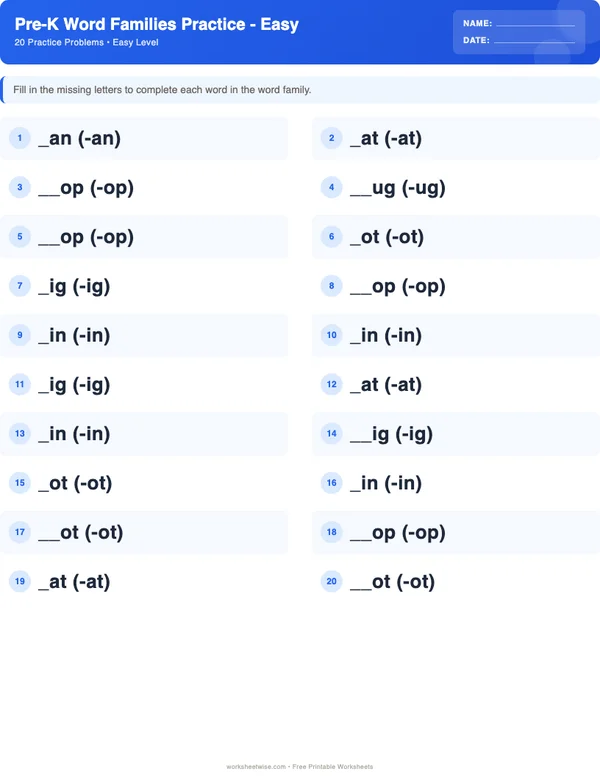
Pass three: transfer. Change numbers, words, order, or context while preserving the same reasoning. For decimal comparison, move from 0.6 versus 0.54 to 0.6 versus 0.64. For CVC blending, move from map to mop, changing the medial vowel while retaining the three-sound structure.
A two-week plan should alternate learning, short retrieval, and transfer rather than repeat an entire page daily.
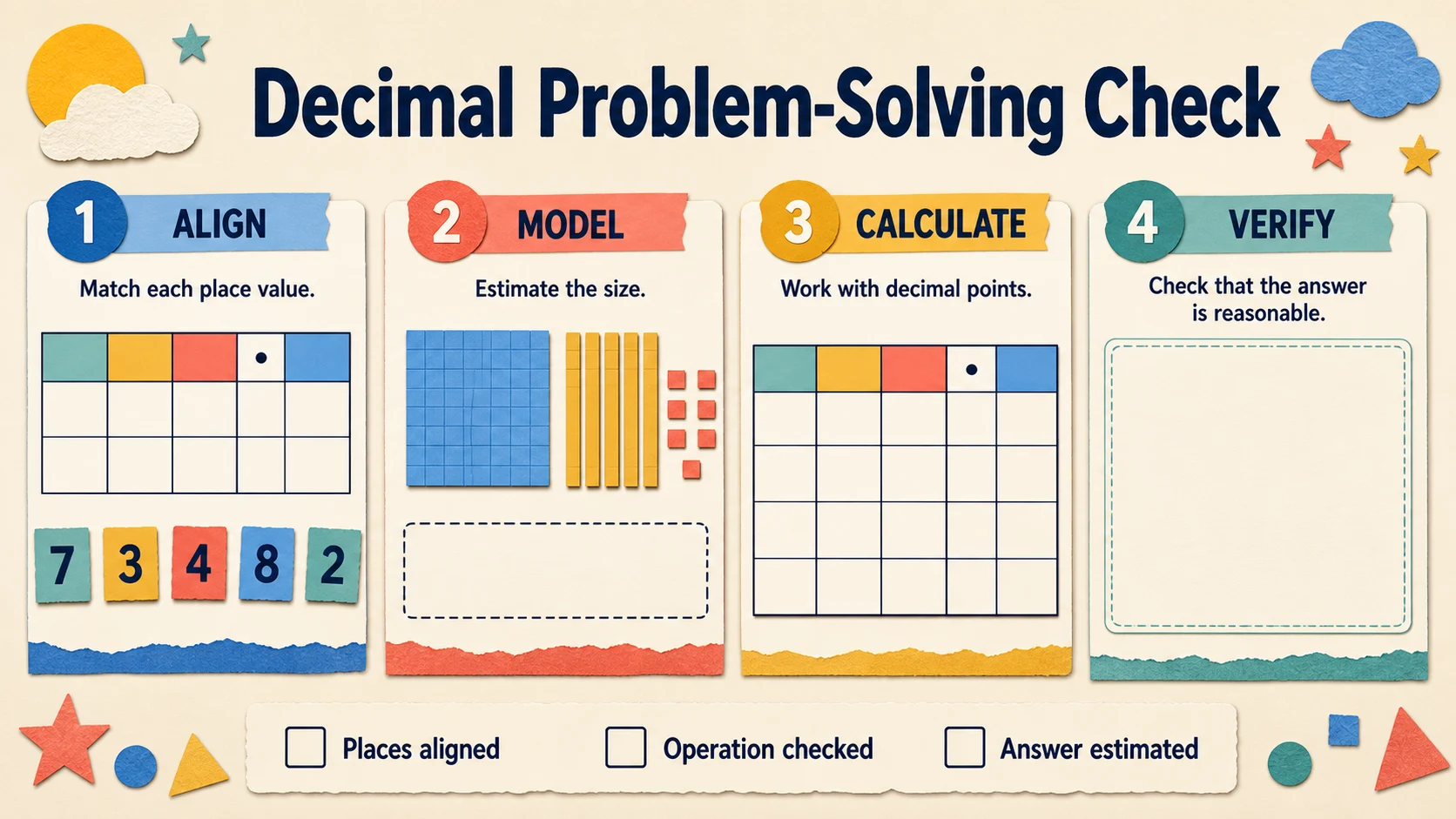
Let each session note determine which decimal representation or contrast returns next.
The observable next action after reuse is withdrawal of one support. If the learner compared decimals with a place-value chart today, begin the next session without it. Keep the chart nearby. Independent reasoning—not mere familiarity with the page—determines whether support can fade.
Know when a worksheet is the wrong tool
Set the page aside when it prevents you from observing the target skill.
A worksheet is the wrong tool when:
- a three- or four-year-old needs oral, matching, manipulative, or movement work rather than desk work;
- the learner cannot interpret the page’s visual layout or directions;
- reading demand overwhelms the intended math decision;
- handwriting or motor effort prevents the learner from showing oral knowledge;
- the concept requires handling, measuring, sorting, building, speaking, or moving;
- the learner needs connected reading rather than isolated word recognition;
- the writing goal is idea development, audience, organization, or revision across sentences;
- frustration has made further written responses uninformative;
- every item uses the same cue, allowing pattern completion without understanding;
- the answer key treats an open response as if only one reasonable wording were possible.
Replace the page with a closer observation: coins for money, counters for quantities, tiles for phoneme segmentation, a number line for magnitude, oral retelling for word problems, sentence strips for syntax, or a short authentic writing task. You may return to the worksheet after the underlying action is visible.
A worksheet result also cannot diagnose a disability, attention condition, language disorder, or other cause. Record the behavior, share patterns with the appropriate caregiver or school professional when relevant, and stay within the tutor’s role.
Make the next session visible before you stop
End with one fresh item that the learner has not watched you solve. Ask for an answer, an explanation, and a check. Then say what the note trail shows:
“Today you compared decimals correctly when the digits were aligned. Next time we’ll see whether you can explain the first unequal place without the chart.”
Do not promise mastery or infer standards alignment from one page. The Common Core mathematics standards and English language arts standards can help educators inspect grade-level expectations, but local curriculum sequences differ, and a catalogue grade label only indicates intended practice level.
For the next practical step, open the free deterministic worksheet generators and create a short set aimed at the single decision recorded in your session note. Choose enough items for one model, one shared attempt, two independent observations, and one exit item—then work and verify every answer before the learner arrives.
Put it into practice
Use the guide with a real printable
Move from explanation to a short, observable practice task. Check the first item together, then adjust the next session from the learner's actual work.
Open the first free worksheetExplore a neighboring collection
Choose by a different teaching need
After-School Worksheets With Answer Keys Formative Assessment Worksheets With Answer Keys Classroom Worksheets With Answer Keys Homeschool Worksheets With Answer Keys Homework Worksheets With Answer Keys Independent Practice Worksheets With Answer Keys Intervention Worksheets With Answer Keys Morning Work Worksheets With Answer Keys