Kindergarten Short Vowels: the essential skill
Short vowels are the vowel sounds heard in words such as cat, pen, sit, hot, and cup. In these consonant-vowel-consonant words, often called CVC words, the vowel is between two consonants:
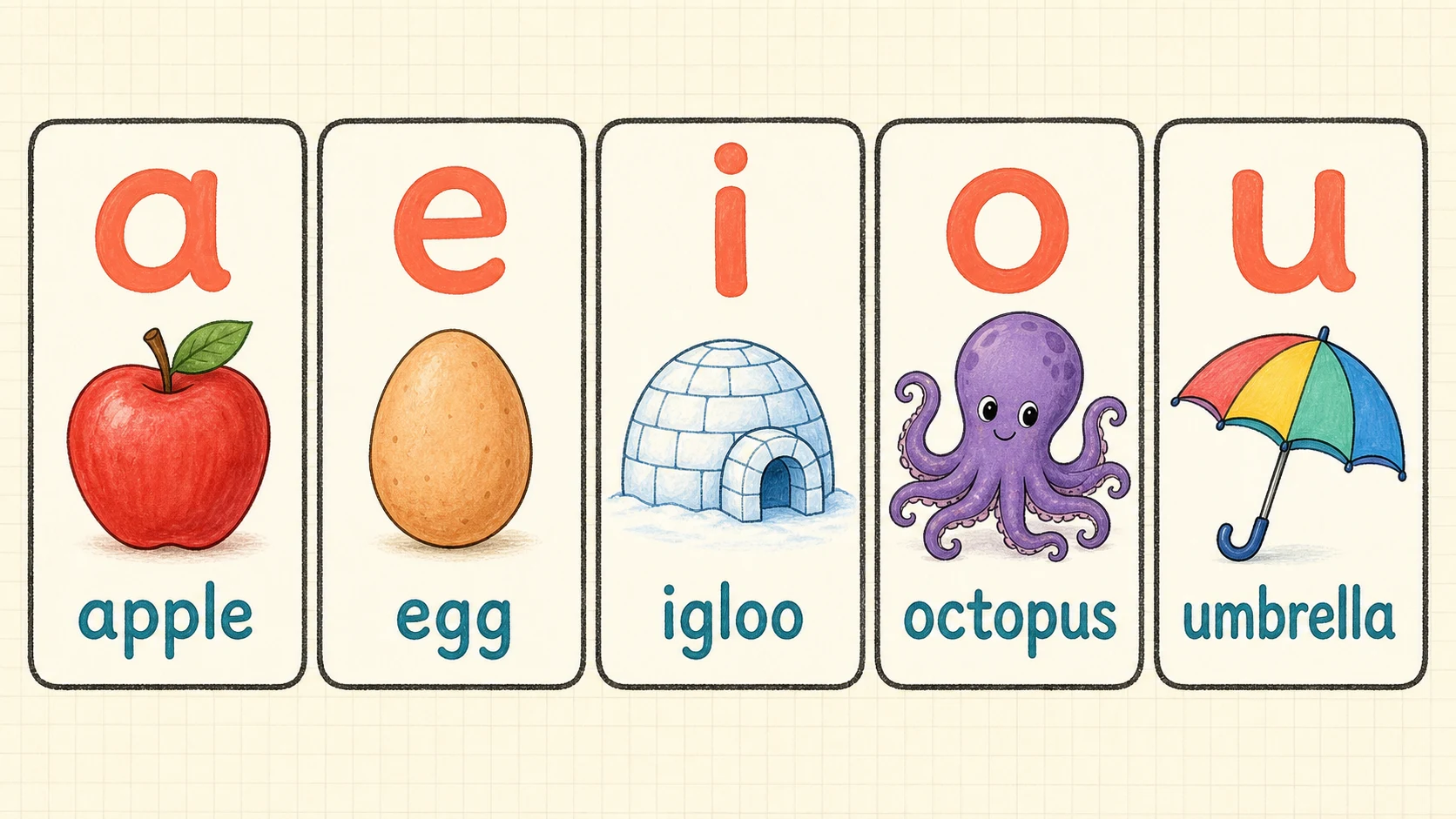
- a as in apple and cat
- e as in egg and pen
- i as in itch and sit
- o as in octopus and hot
- u as in umbrella and cup
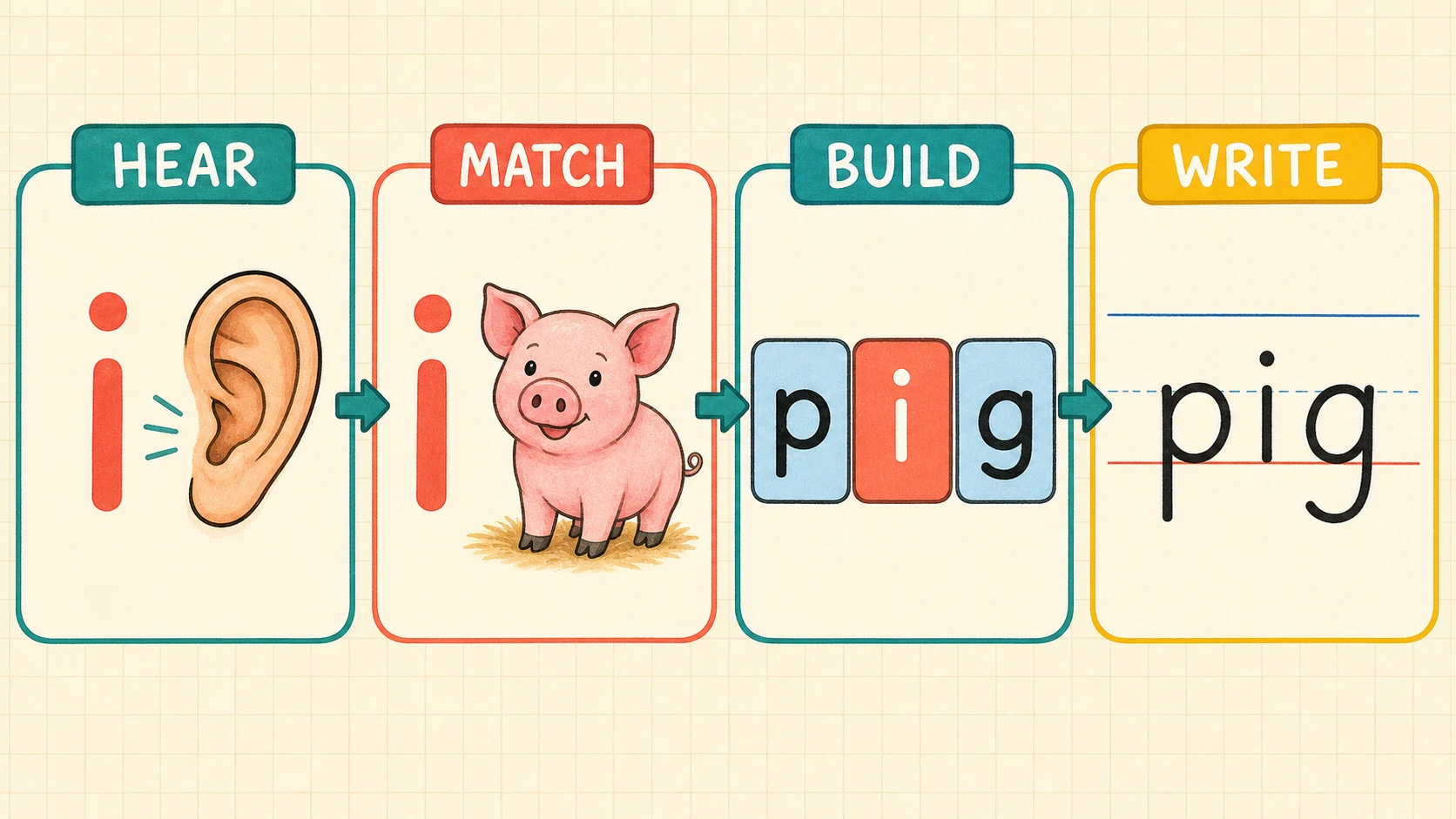
The direct teaching goal is for a learner to hear the middle vowel sound, connect that sound to its letter, blend all three sounds to read a word, and segment the word to spell it. A learner who can say the sounds in map but cannot combine them needs blending practice. A learner who can read map but writes mop needs closer attention to the middle sound. Those are related but different instructional needs.
Short vowels appear in closed syllables—syllables ending in a consonant. CVC words provide the clearest starting point, although not every three-letter word follows a simple short-vowel pattern. Words such as the, was, one, and you should not be presented as ordinary CVC examples.
Hearing, identifying, reading, and spelling the vowel are connected stages of the same skill.
The IES foundational reading practice guide supports systematic work with speech sounds, letter-sound relationships, decoding, and connected text. This is high-level instructional guidance; it is not an evaluation of WorksheetWise materials or any particular worksheet.
Grade labels describe the intended practice level, and local school or homeschool sequences differ. Use the learner’s observed work—not the label alone—to decide where to begin and how quickly to proceed.
What the learner should know first
Before expecting independent short-vowel reading, check several prerequisites. These do not all need to be perfect, but significant gaps will make CVC work unnecessarily difficult.
Hearing individual sounds
Ask the learner to identify the first or last sound in a spoken word without showing its spelling:
- “What sound begins map?” Expected response: /m/.
- “What sound ends sun?” Expected response: /n/.
- “Say the sounds you hear in fish.” A learner may say /f/ /i/ /sh/. The final sh is one sound even though it uses two letters.
Sound work is oral. If a learner cannot attend to the sounds in a spoken word, adding printed letters may hide the difficulty rather than resolve it.
Then check whether the learner can blend separated sounds. Say /m/ /a/ /p/, with a short pause between sounds. The learner should combine them into map. Avoid adding an extra “uh” to consonants: /m/ is more useful than “muh,” because “muh-a-puh” is harder to blend accurately.
Connecting consonants with sounds
The learner should recognize enough common consonant letters to read the words being taught. If m, s, t, and p are unfamiliar, a page full of CVC words will test consonant knowledge as much as vowel knowledge.
Use lowercase letters often because lowercase forms appear throughout ordinary text. Uppercase recognition remains useful, but recognizing A does not automatically show that the learner can identify a quickly inside cat.
Following left-to-right order
Check that the learner points to and says sounds from left to right. Reversing the order changes the word: tap is not pat. Three counters, letter tiles, or drawn boxes can make the sequence visible.
A learner ready for initial CVC practice can usually:
- Hear a beginning and ending sound.
- Blend two or three spoken sounds with support.
- connect several consonants to their usual sounds.
- Track three positions from left to right.
If one of these is weak, teach it alongside a small amount of short-vowel work instead of assigning a long mixed review.
A grade-appropriate teaching progression
Teach one short vowel at a time before requiring the learner to distinguish all five. The catalogue’s suggested sequence is a, i, o, u, e. Short a is introduced first because it is relatively distinct; short e comes later because learners may confuse it with short i.
This is a suggested sequence, not a universal timetable. A local curriculum may use another order, and a learner’s responses may justify reviewing or changing the pace.
| Stage |
Teaching focus |
Example task |
Evidence to watch |
| 1 |
Hear one target vowel |
Decide whether map contains /a/ |
Identifies the sound without seeing letters |
| 2 |
Connect sound and letter |
Place a in m _ p |
Chooses the vowel after stretching the word |
| 3 |
Blend one-vowel CVC words |
Read map, sat, fan |
Blends all sounds without guessing from the first letter |
| 4 |
Spell one-vowel CVC words |
Hear tap and write tap |
Records beginning, middle, and ending sounds |
| 5 |
Contrast two vowels |
Sort map, pin, sit, fan |
Attends to the middle rather than the picture or first sound |
| 6 |
Mix several vowels |
Read bed, rug, top, fin, cap |
Changes the vowel sound when the printed vowel changes |
| 7 |
Apply in short text |
Read a controlled sentence containing known patterns |
Maintains accurate decoding in context |
| 8 |
Review while adding later patterns |
Contrast known CVC words with new patterns |
Retains short vowels as instruction expands |
Support should decrease only after the learner demonstrates accurate attention to the middle vowel.
The Common Core State Standards for English Language Arts include Kindergarten-level work associating common spellings with long and short vowel sounds. That provides broad context for this topic, but it does not establish comprehensive standards alignment for this guide, worksheet, or pack.
Concrete and visual models that make the sounds visible
Short vowels are heard rather than seen, so young learners often benefit from a physical representation of sound order.
Three counters and three sound boxes
Draw three boxes. Say sun slowly but naturally. Have the learner push one counter into each box:
| /s/ |
/u/ |
/n/ |
| first |
middle |
last |
Ask, “Which sound is in the middle?” Only after the learner answers /u/ should you place or write u in the middle box. This keeps sound analysis ahead of spelling.
Do not stretch stop sounds into extra syllables. In tap, the /t/ and /p/ should remain crisp. The vowel can be slightly prolonged—/t/ /aaa/ /p/—while the learner attends to its position.
Anchor pictures and motions
The catalogue suggests a stable picture and motion for each sound:
| Vowel |
Anchor |
Optional motion |
| a |
apple |
Pretend to bite an apple |
| e |
egg |
Pretend to crack an egg |
| i |
itch |
Scratch an arm |
| o |
octopus |
Wiggle arms |
| u |
umbrella |
Pretend to hold up an umbrella |
These are memory cues, not substitutes for listening inside words. A learner should gradually move from “a, apple” to identifying /a/ directly in map.
Pictures used in sorting activities must have unambiguous names. An image that one adult calls a cup might be called a mug by a child. Name the picture together before asking for its vowel. Otherwise, an apparent phonics error may actually be a vocabulary mismatch.
Letter tiles and change-one-sound chains
Build map with three tiles. Ask the learner to touch each letter, blend the word, and then change only the middle tile:
- map becomes mop
- mop becomes mip, but mip is not an ordinary English word
- Replace i with u to make mup, also not an ordinary English word
The nonwords are useful boundary cases only when the task is explicitly sound-symbol practice. Tell the learner that a form may be readable without being a familiar word. For meaning-focused practice, use real words such as map, mop, and mop paired with other legitimate word chains.
Fully checked worked examples
Each example moves through hearing, mapping, blending, and checking. The adult can model the process aloud before the learner tries a similar item.
Worked example 1: identifying the vowel in “map”
Task: Read map and identify its short vowel.
- Point to the letters from left to right: m – a – p.
- Say the corresponding sounds: /m/ /a/ /p/.
- Blend them: /m-a-p/, map.
- Isolate the middle sound: /a/.
- Match /a/ to the letter a.
Checked answer: map contains short a.
A useful contrast is mop. Both words begin with /m/ and end with /p/, so the middle letter and sound determine the difference: map has /a/; mop has /o/.
Worked example 2: completing “s_t” to make “sit”
Task: Add the missing vowel to make sit.
- Say the intended word: sit.
- Segment it into sounds: /s/ /i/ /t/.
- Locate the missing position: the blank is between s and t.
- Identify the middle sound: /i/.
- Write the letter representing /i/: i.
- Reblend: /s/ /i/ /t/, sit.
Checked answer: s + i + t = sit.
This task is not solved by choosing any vowel that creates a word. Sat, set, sit, and sot are all readable letter patterns, although sot is not suitable everyday Kindergarten vocabulary. The spoken target determines the correct spelling.
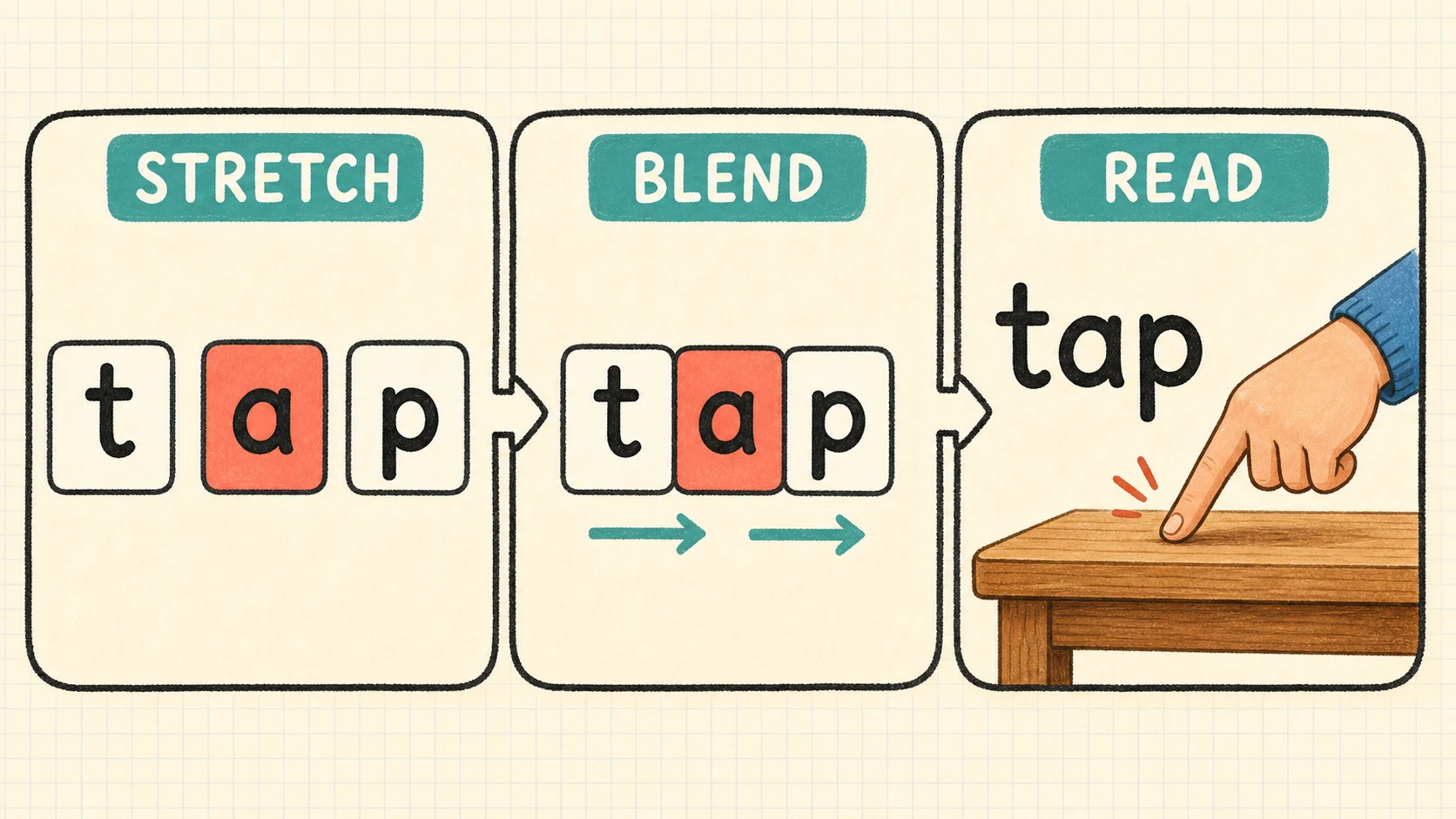
The learner hears the word, maps each sound to a position, and checks by blending.
Worked example 3: distinguishing “pen” from “pin”
Task: Decide whether the spoken word pen contains short e or short i.
- Listen to the whole word: pen.
- Hold the consonants constant: /p/ _ /n/.
- Stretch only the middle portion: /p-e-n/.
- Compare it with pin: /p-i-n/.
- Watch the speaker’s mouth if the contrast is difficult. The catalogue notes that short e uses a slightly wider mouth opening.
- Choose e and read the completed word: pen.
Checked answer: pen contains short e; pin contains short i.
Other useful spoken contrasts are set/sit and bed/bid. Present one pair at a time. If the learner cannot hear the contrast, do oral identification before asking for written spelling.
Worked example 4: sorting “rug,” “hot,” “cap,” and “fin”
Task: Sort each word by its middle vowel.
- rug segments as /r/ /u/ /g/. It belongs under u.
- hot segments as /h/ /o/ /t/. It belongs under o.
- cap segments as /k/ /a/ /p/. It belongs under a.
- fin segments as /f/ /i/ /n/. It belongs under i.
Checked answer:
| Short a |
Short i |
Short o |
Short u |
| cap |
fin |
hot |
rug |
Notice that the first and last consonants differ across these words. A learner who sorts correctly must attend specifically to the middle sound rather than matching initial letters.
Worked example 5: spelling “bed” from dictation
Task: The adult says bed. The learner spells it.
- Repeat the word without showing it.
- Say the sounds: /b/ /e/ /d/.
- Mark three positions with counters or fingers.
- Write b for /b/, e for /e/, and d for /d/.
- Read the result from left to right: bed.
- Compare the spoken and written forms.
Checked answer: bed.
Writing from dictation is encoding: the learner moves from sounds to letters. Reading bed is decoding: the learner moves from letters to sounds. Both directions matter, but success in one does not guarantee equal control of the other.
A short, repeatable lesson routine
A focused lesson can be brief. The learner’s accuracy and attention should determine its length; there is no universal daily timetable.
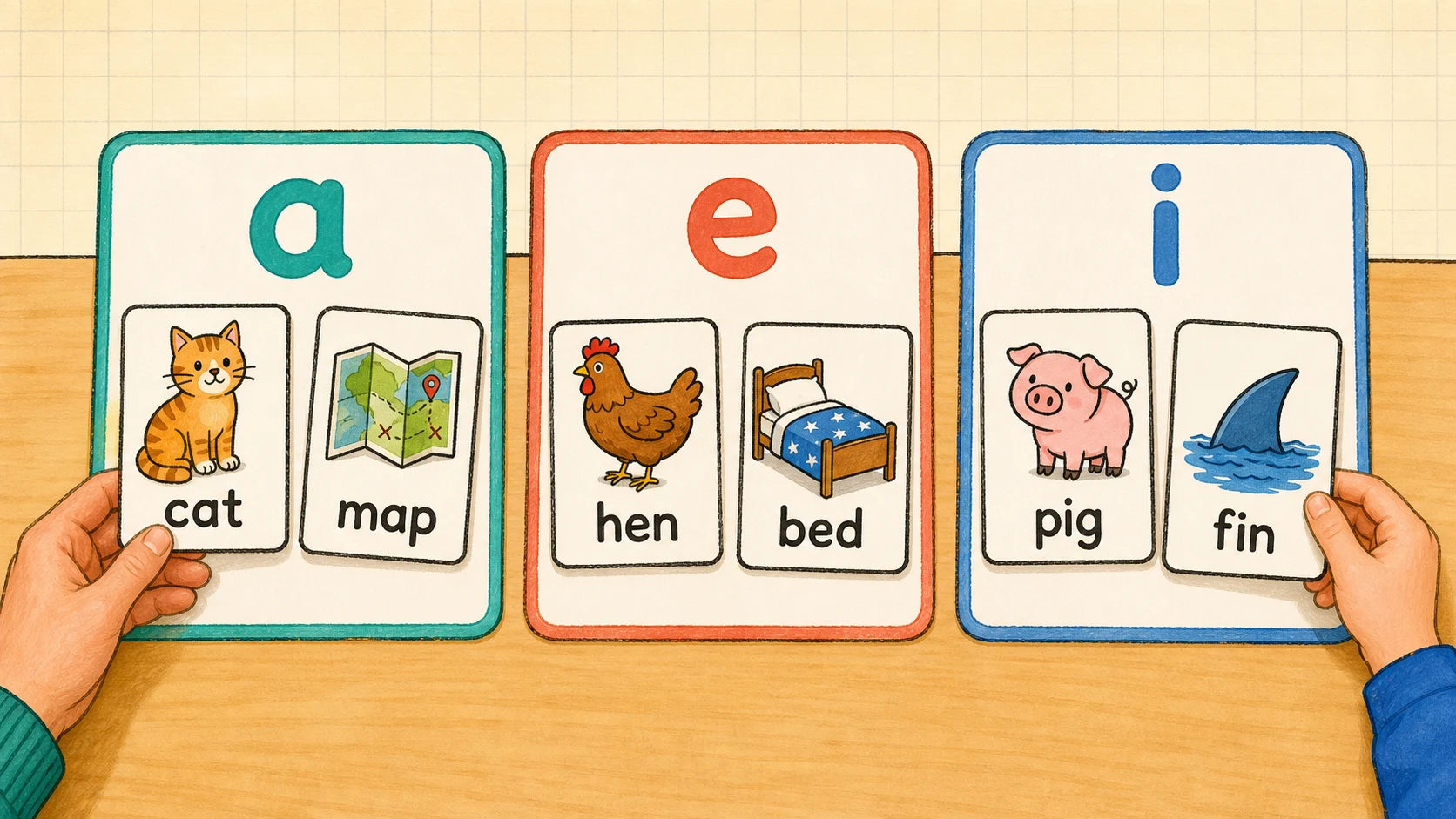
Review, hear, build, read, write, and check in a consistent sequence.
1. Review known sounds
Show two or three known letters. Ask for their sounds, then review the target vowel with its anchor picture and motion. Keep this quick enough that the main practice remains on blending and segmenting.
2. Listen before looking
Say three words. Ask the learner to signal when the target sound appears. For short a, try map, sun, fan. The target occurs in map and fan, not sun.
3. Build and blend
Use tiles to build two or three CVC words containing the target vowel. The learner touches each tile, says each sound, and blends the word. If blending is labored, sweep a finger under the complete word while repeating the sounds with shorter pauses.
4. Read a small word set
Present four to eight words, depending on observed stamina and accuracy. Keep the pattern controlled at first. Later, mix previously taught vowels so the learner must inspect the middle letter.
5. Write from dictation
Dictate two or three known-pattern words. Ask the learner to say the sounds before writing. The IES elementary writing guide provides broad guidance on developing writing skills and fluency. Here, the specific use of short CVC dictation is an instructional suggestion drawn from the supplied catalogue, not a claim that the guide evaluated this routine.
6. Check and record
End with one unprompted read and one unprompted spelling. Record exactly what happened: “Read 5 of 6 mixed CVC words; read pen as pin” is more useful than “Needs vowel help.”
Choosing suitable practice
Choose practice according to what the learner needs to demonstrate.
| Observed need |
Suitable practice |
Avoid as the only activity |
| Cannot hear the target vowel |
Oral picture or word sorting |
Silent copying |
| Knows a vowel alone but misses it in words |
Middle-sound identification with counters |
Flashcards showing isolated vowels only |
| Can identify sounds but cannot read words |
Continuous blending and word chains |
Large mixed worksheets |
| Reads accurately but spells inconsistently |
CVC dictation and fill-in-the-middle tasks |
Reading-only review |
| Confuses two vowels |
Minimal-pair listening and sorting |
Mixing all five immediately |
| Performs with help but not alone |
Short independent word set after modeling |
Repeating prompts on every item |
| Reads word lists but guesses in sentences |
Brief controlled text with known patterns |
Uncontrolled text containing many untaught patterns |
The Kindergarten phonics hub can help adults place short vowels among related phonics skills. The broader Kindergarten worksheet collection is useful when coordinating phonics with other practice.
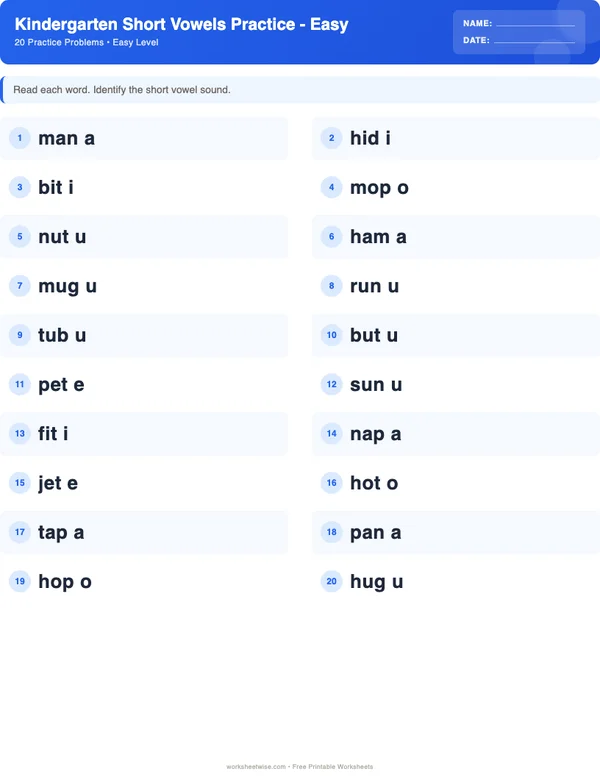
For a learner just beginning mixed-vowel identification, the free easy short-vowels worksheet provides 20 exercises asking the learner to read each word and identify its short vowel. It includes a separate answer key. Because the page mixes reading and vowel identification, first confirm that unfamiliar consonants are not interfering.
The focused short-vowels pack contains 18 worksheets and may suit families or educators who need repeated practice across several sessions. More pages are not automatically better: select only the amount that preserves careful listening and accurate checking.
Differentiation without changing the core goal
When the learner needs more support
Reduce the number of choices. Contrast short a with one other vowel instead of displaying all five. Provide counters, sound boxes, or two labeled sorting columns. Say every picture name before sorting it. Model one item, complete one together, and then ask for one independent response.
If letter writing is effortful, let the learner choose or place a vowel tile. That separates phonics knowledge from handwriting demands. Fine-motor practice can occur separately.
When the learner is ready for more independence
Remove the anchor picture during some trials. Mix previously learned vowels. Alternate reading and spelling:
- Read hot.
- Spell rug.
- Read fin.
- Spell cap.
Ask for a reason: “I chose o because the middle sound in hot is /o/.” The explanation need not be lengthy; it simply reveals whether the answer came from sound analysis.
When the learner is ready to extend
Keep the vowel focus while adding known consonant digraphs or blends only if those patterns have already been taught. Continue reviewing short vowels as longer patterns are introduced. Do not treat a successful mixed CVC page as proof that every closed-syllable or multisyllabic word is ready.
The short-vowels topic page can be used to return to targeted practice when a particular contrast weakens.
Common errors and diagnostic responses
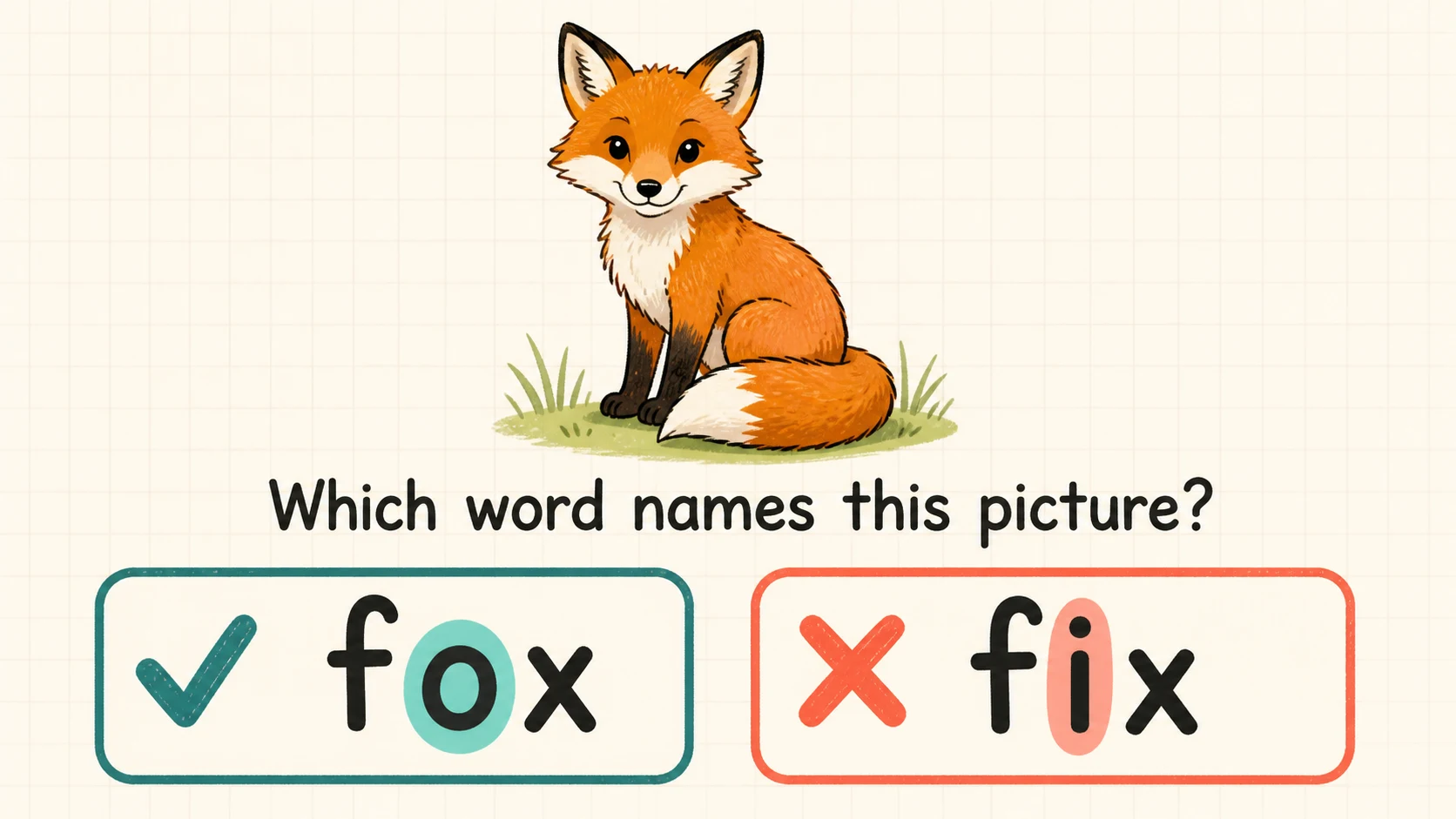
An error pattern identifies the next teaching move more clearly than a total score alone.
The learner guesses from the first letter
A learner sees map and says man, or sees a picture and supplies a related word. Cover the picture, point under all three letters, and ask for each sound. Use pairs such as map/mat so the final sound must be checked too.
Every middle vowel becomes the same sound
If map, sit, and hot are all read with /a/, return to a two-way contrast. Ask the learner to sort spoken words before showing print. This determines whether the difficulty is hearing the contrast or connecting it to letters.
Short e and short i are confused
Use pen/pin, set/sit, and bed/bid orally. Say the words clearly without exaggerating them into unnatural forms. Let the learner watch the speaker’s mouth, then identify which word was spoken. Move to printed words only after some reliable auditory discrimination.
Short o and short u are confused
Contrast words such as hot/hut and cop/cup. Confirm the pronunciation used in the learner’s speech community; vowel pronunciation varies. The instructional target is a stable connection between the learner’s spoken form and the spelling being taught, not imitation of an unfamiliar accent.
The learner names the letter instead of saying its sound
A response of “A” to the middle of cat shows letter-name knowledge, not necessarily vowel-sound knowledge. Prompt once: “Tell me the sound here.” In later trials, ask directly for the sound so the task remains clear.
Reading is stronger than spelling
A learner may recognize sun but write son when the target is sun. Use dictated CVC words, counters, and a deliberate middle-sound check. Do not count an accurate first and last consonant as full mastery of the word.
Spelling is stronger than blending
A learner may place the correct letters but read them separately without producing the word. Practice blending with close sound spacing and a left-to-right finger sweep. Reduce the word set until the blending process becomes stable.
Monitoring progress and deciding when to move on
Record separate evidence for listening, reading, and spelling. A single percentage can conceal important differences.
A simple weekly check might include:
- Four spoken words for middle-sound identification.
- Six printed CVC words for reading.
- Three spoken CVC words for spelling.
- One pair containing a previously confused contrast.
Note whether answers were independent, prompted, or corrected after rereading. Also record the actual substitution. “Read bed as bid twice” points toward an e/i contrast; “missed two words” does not.
Move forward when the learner shows accurate, reasonably steady performance across more than one session and can handle both familiar and newly arranged examples. Return to support when errors cluster around one vowel pair, blending breaks down, or the learner begins guessing. Accuracy with memorized cards alone is insufficient evidence of flexible decoding.
Monitoring should not become a high-pressure test. Short samples embedded in ordinary lessons usually provide enough information for the next decision.
A practical two-week practice plan
This plan is an instructional option, not a sourced or universal schedule. Adjust the number of words, lesson length, and vowel sequence in response to the learner’s work.
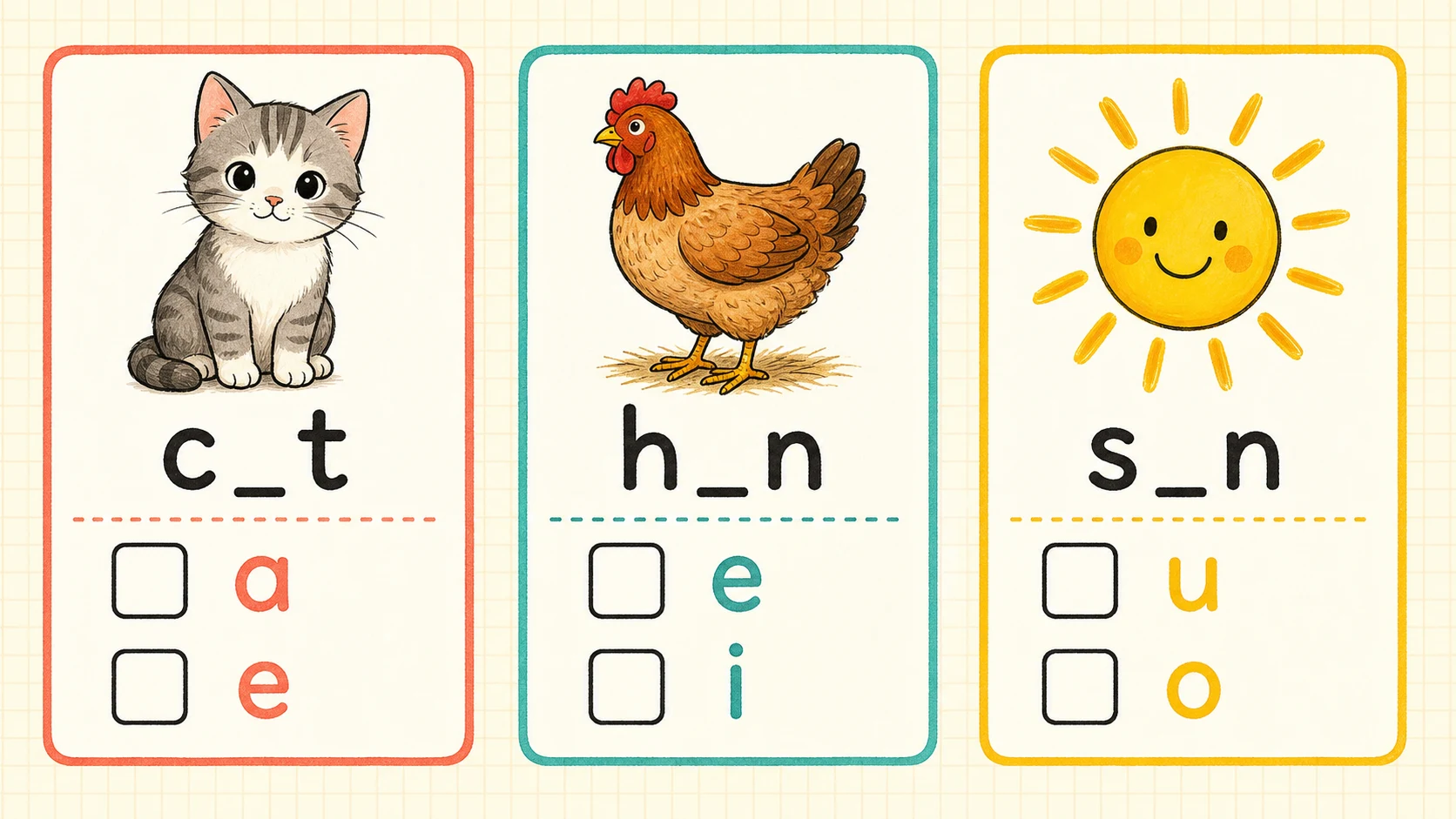
Each new contrast is followed by cumulative reading, spelling, and review.
| Day |
Main focus |
Suggested activity |
Quick evidence |
| 1 |
Check prerequisites |
Oral first, middle, and final sounds; blend three spoken sounds |
Note whether hearing or blending needs support |
| 2 |
Short a |
Apple cue, sort spoken words, build map, sat, fan |
Read two new short-a words |
| 3 |
Short a encoding |
Read a small set; dictate map, tap, cap |
Check all three sound positions |
| 4 |
Short i |
Itch cue; build sit, pin, fin |
Identify /i/ in spoken words |
| 5 |
Contrast a/i |
Sort map, fin, sat, pin; dictate two words |
Record any middle-vowel substitutions |
| 6 |
Review |
Brief mixed reading and one controlled sentence |
Check whether accuracy holds in context |
| 7 |
Short o |
Octopus cue; build hot, top, log |
Read and spell one short-o word |
| 8 |
Contrast o with known vowels |
Sort hot, cap, fin, top |
Require attention to the middle letter |
| 9 |
Short u |
Umbrella cue; build sun, cup, rug |
Identify /u/ without the cue |
| 10 |
Mixed a/i/o/u |
Read, sort, and dictate a small mixed set |
Look for o/u confusion |
| 11 |
Short e |
Egg cue; build pen, bed, net |
Read two short-e words |
| 12 |
Contrast e/i |
Oral pen/pin, set/sit, bed/bid; then show print |
Separate listening errors from print errors |
| 13 |
All five vowels |
Mixed word cards and two dictated words |
Record independent accuracy by vowel |
| 14 |
Review and choose next practice |
Brief listening, reading, and spelling check |
Continue, narrow a contrast, or extend |
A learner who struggles on Day 5 does not need to be pushed to Day 7 merely because the calendar says so. Repeat or simplify the contrast. Conversely, a learner who already demonstrates secure control may move into short controlled sentences, known digraphs, or later vowel patterns while maintaining cumulative review.
Boundaries, limitations, and the next step
Short-vowel practice does not teach every feature of early reading. It does not replace oral language, shared reading, vocabulary development, handwriting instruction, or opportunities to understand and discuss text. A CVC worksheet also cannot by itself reveal whether an error came from hearing the word, knowing a consonant, blending sounds, understanding a picture, sustaining attention, or forming letters.
Not every closed syllable is an appropriate first example, and not every common word follows the expected pattern. Use transparent CVC words for initial instruction. Teach irregular high-frequency words through the approach used in the learner’s broader program rather than forcing them into a short-vowel rule.
This guide offers educational practice suggestions, not medical or child-specific clinical guidance. If persistent difficulties affect learning across settings, document the exact patterns and discuss them with the learner’s teacher or another appropriately qualified professional.
The honest next step is to check one small mixed set rather than assign a large stack. Use the free Kindergarten short-vowels worksheet, observe how the learner identifies the middle vowel across its 20 exercises, and stop to reteach any repeated contrast before adding more practice.