Curated collectionAnswer keys includedPrint-ready PDFs
Multiplication Worksheets by Grade and Level
Show the full multiplication progression across 5 real grade combinations, compare task boundaries, model checked examples and explain how to choose the next level.
Start with a real resource
Browse this worksheet collection
5 relevant free entry points are available. Each one includes a printable learner PDF and separate answer key.
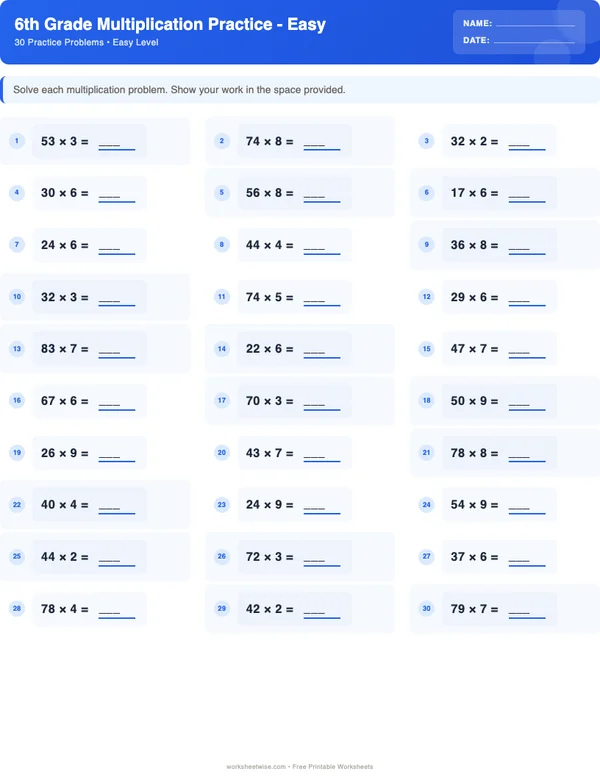
A useful practice loop
Print less. Observe more.
- Choose one skill and model the first item aloud.
- Use a short set and notice the learner’s strategy.
- Change the next task from the work you can see.
Need more than the free sheet?
Plus includes all 90 matching catalogue variations where available, plus saved deterministic generators and the worksheet designer.
See Plus membershipComplete guide
How to teach and practise multiplication worksheets
3,137 words Updated 6 instructional visuals
Choose by the work a learner can do, not by the grade printed on the page
The right multiplication worksheet is the one that begins just beyond what the learner can already explain independently. Across WorksheetWise’s five grade combinations—2nd through 6th grade—the useful progression is:
- Build and describe equal groups.
- Connect groups, repeated addition, skip counting, and multiplication notation.
- Use arrays to reason about facts and properties.
- Develop fact strategies before emphasizing recall.
- Extend place-value reasoning into multi-digit multiplication.
- Move from area models and partial products toward an efficient algorithm.
Grade labels describe the intended practice level, but local curriculum sequences differ. They are starting points for browsing, not placement decisions or claims of standards alignment.
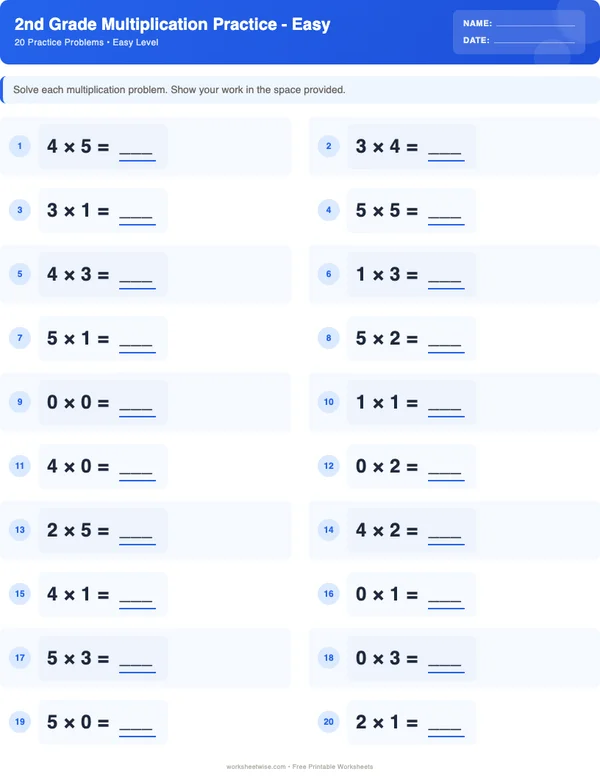
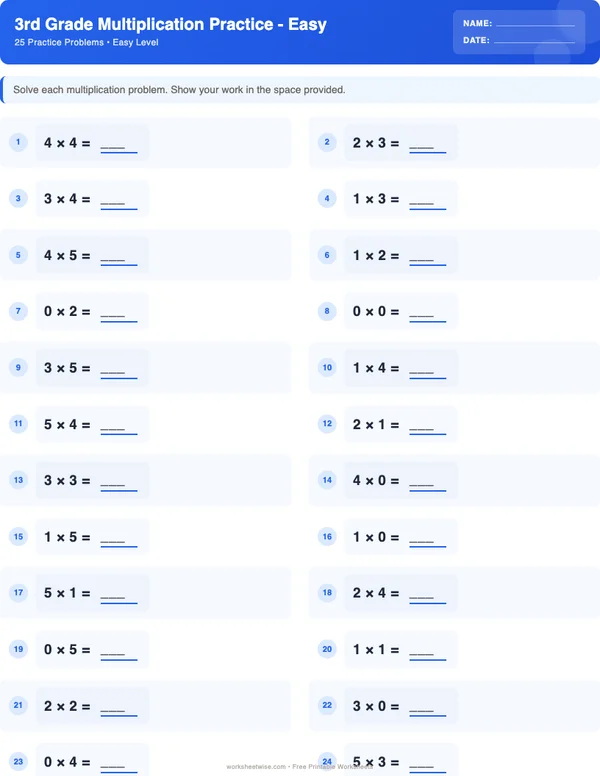
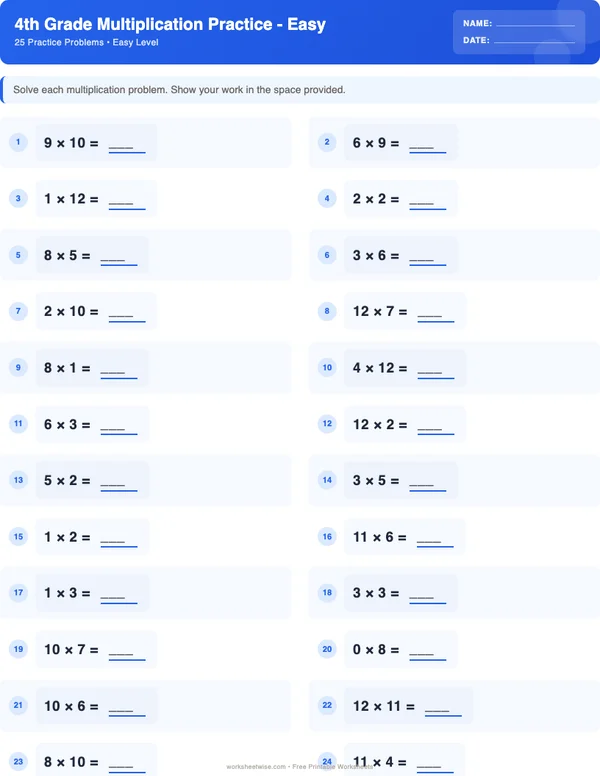
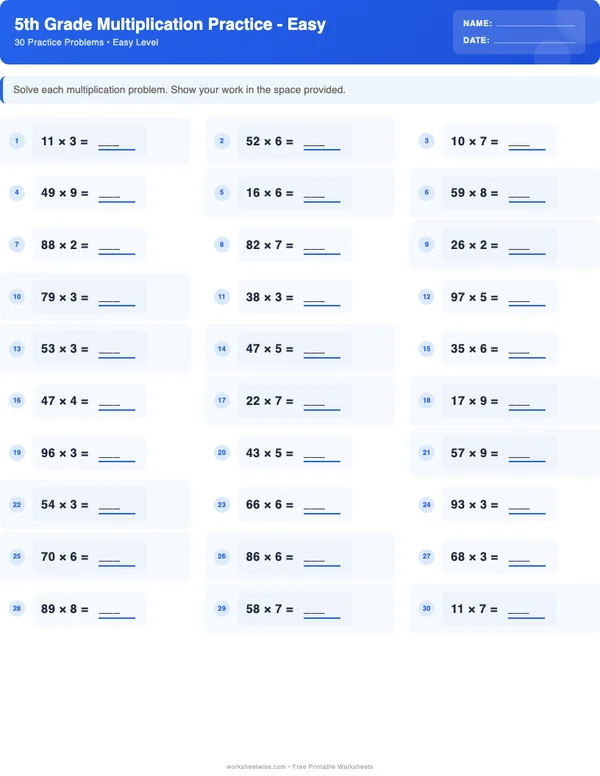
The live catalogue contains 90 multiplication variants and five free entry points, one for each grade. The free sheets contain 20 problems in 2nd grade, 25 in both 3rd and 4th grade, and 30 in both 5th and 6th grade. Because every free sheet is tagged “easy,” that label needs an observable interpretation: look for familiar number ranges, one clear operation, limited reading load, supportive representations, and few simultaneous decisions. It should never be used to label a learner.
Multiplication means equal-sized groups
Multiplication first becomes useful when a learner sees one quantity repeated in equal groups. “Three bags with five apples in each bag” can be represented as:
- Equal groups: 3 groups of 5
- Repeated addition:
- Multiplication:
- Total: 15 apples
This example belongs at the beginning of the catalogue progression because it gives every part of a meaning. The 3 counts groups, the 5 tells how many are in each group, and 15 is the total. Before assigning a page of equations, ask the learner to build the situation with counters and explain what each number represents.
A useful contrast is “three bags with five apples altogether.” That is not automatically ; five is now the total, not the amount in each bag. Question wording matters because a learner can calculate correctly while misunderstanding the situation.
The IES guide for teaching mathematics to young children recommends teaching number and operations through a developmental progression, monitoring what children know, and inviting them to describe their world mathematically. That is sourced guidance for early mathematics generally. It is not an evaluation of WorksheetWise or a claim about these worksheets.
Move from objects to drawings to symbols
Use the same mathematical structure in several forms:
- Place five counters in each of three cups.
- Draw three circles with five dots in each.
- Write .
- Write .
- Ask, “What does the 3 mean? What does the 5 mean?”
The representation changes, but the target remains understanding equal groups. Removing the cups before the learner can interpret the drawing changes too much at once. Keeping counters available while asking for the equation preserves the multiplication target and reduces demands on memory.
This sequence is a WorksheetWise editorial suggestion derived from the page’s teaching anchor. Adults should adjust the number of examples and amount of prompting after observing the learner, not according to a fixed schedule.
Arrays connect facts, properties, and area
An array organizes objects into equal rows and columns. Four rows of six chairs contain:
so .
Rotate or redraw the arrangement as six rows of four. It still contains 24 chairs, showing concretely that . This is the commutative property: changing the order of the factors does not change the product.
This checked example belongs in the middle of the progression because it does more than introduce notation. It connects a basic fact to a property and prepares the learner to interpret area as rows by columns. Ask the learner to point to the four rows before writing the equation. Otherwise, a correct answer may conceal confusion about which factor describes which feature of the drawing.
Partition an array instead of guessing a hard fact
Suppose the learner does not recall . Split an array of 7 rows and 8 columns after the fifth column:
The result is 56. Both partial arrays keep seven rows, so they reconstruct the original array exactly. This is a checked use of the distributive property, not a memory trick detached from meaning.
It belongs after facts involving 5 and 3 are reasonably secure. If or is itself inaccessible, use a different decomposition, such as . The best decomposition is one the learner can explain and calculate accurately.
The IES elementary mathematics intervention guide recommends a deliberately chosen set of concrete and semi-concrete representations, systematic instruction, clear mathematical language, and explicit work with word problems. Arrays, counters, and area models can serve those purposes when the adult connects them clearly. The guide did not assess WorksheetWise resources.
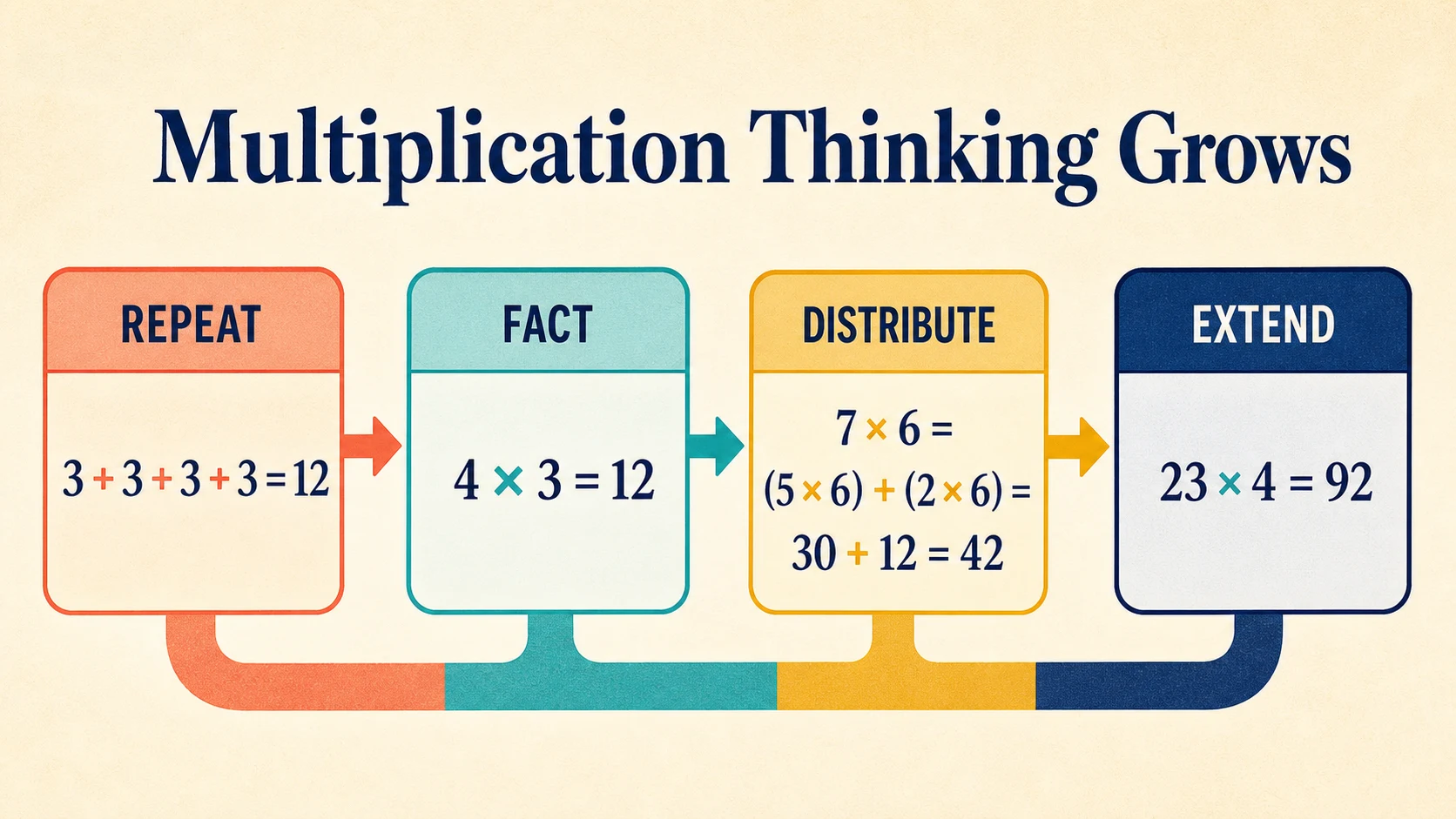
Use the 3rd grade progression to decide which support to remove next: objects, a drawn array, a written strategy prompt, or adult modeling.
The five grade entry points have different task boundaries
The catalogue’s grade pages share one topic but should not be treated as five interchangeable stacks of arithmetic.
2nd grade: recognize and represent equal groups
Start with the 2nd Grade Multiplication guide and free sheet when the learner benefits from concrete grouping, pictures, arrays, or a bridge from addition. Its free sheet contains 20 problems, the shortest free entry point on this page.
Appropriate readiness evidence includes being able to count a small collection accurately and understand that equal groups must contain the same number. A productive prompt is: “Build four groups of three, then tell me the total without counting every object from one.” The boundary is conceptual. If the learner cannot yet maintain one-to-one counting or compare group sizes reliably, use the Counting Worksheets by Grade and Level before expecting independent multiplication notation.
3rd grade: connect models to fact strategies
The 3rd Grade Multiplication guide and free sheet provides a 25-problem free entry point. Choose this level when the learner can interpret equal groups but still needs arrays, known facts, or decomposition to find products.
A useful question changes from “How many objects are there?” to “Which fact or property helped you?” That shift makes strategy visible. Suitable work includes explaining why can be doubled to help find , or why a turned array has the same total.
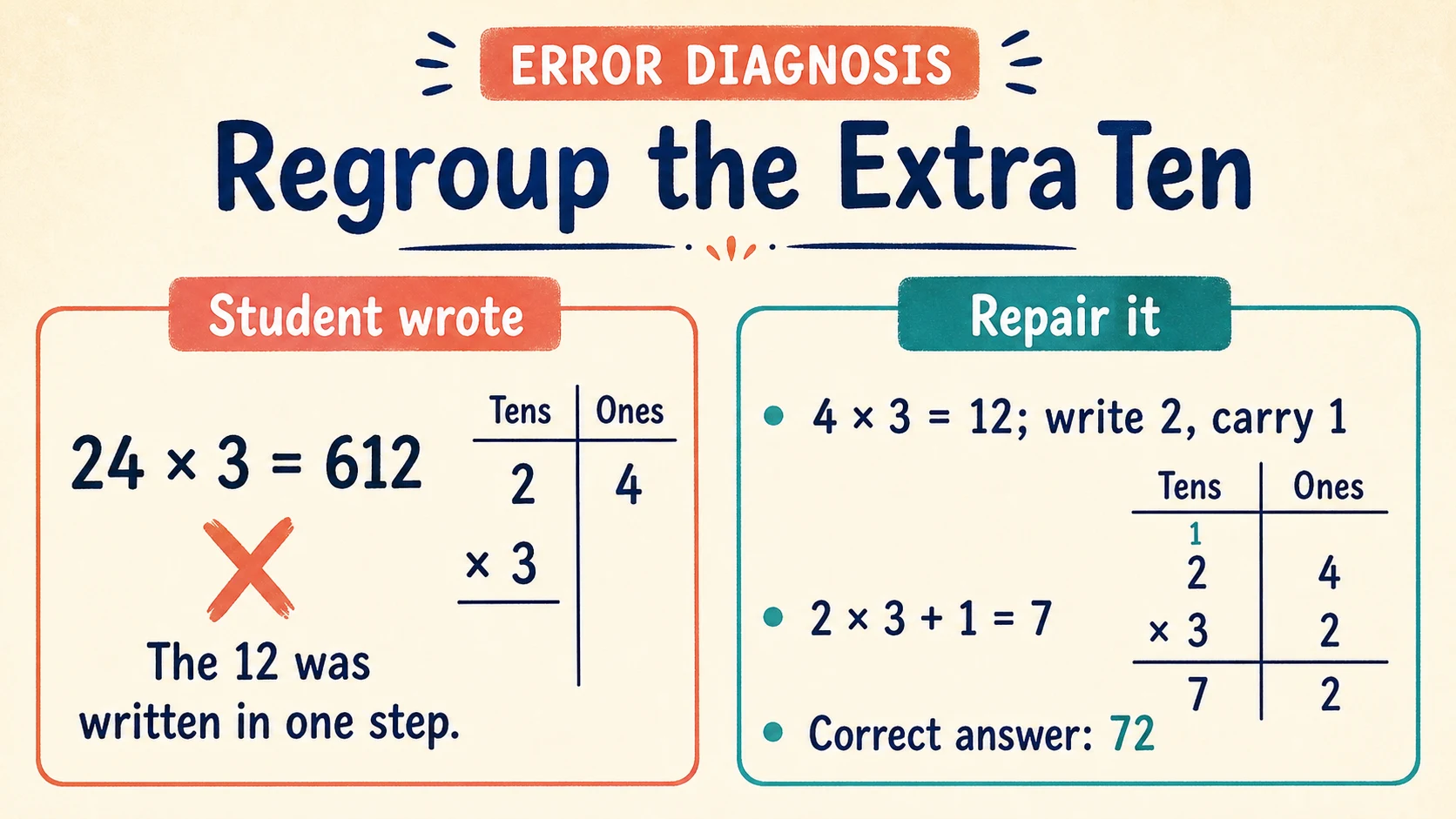
Treat a wrong 3rd grade answer as evidence to investigate: ask for a model and explanation before assigning more of the same fact.
4th grade: extend facts into place-value reasoning
The 4th Grade Multiplication guide and free sheet also begins with 25 problems. It is a sensible starting point when basic facts can support—not consume—all of the learner’s attention during larger calculations.
At this boundary, question design should expose structure. Instead of presenting only a vertical calculation, ask the learner to break into tens and ones:
The checked answer is 322. This example belongs at the transition to multi-digit work because each partial product corresponds to a region in an area model. It also reveals whether the learner understands that the 2 in 23 represents 20 and the 1 in 14 represents 10.
5th grade: coordinate larger products and methods
The 5th Grade Multiplication guide and free sheet contains 30 problems. Consider it when the learner can generate and organize partial products without losing place value.
The task boundary is not simply “bigger numbers.” It includes choosing a method, estimating a reasonable range, recording intermediate products clearly, and checking whether the final product has a plausible magnitude. A page becomes harder when it removes models, increases the number of partial products, mixes problem forms, or expects independent method selection.
6th grade: maintain multiplication inside more demanding work
The 6th Grade Multiplication guide and free sheet also contains 30 problems. Use it when multiplication needs consolidation at an upper elementary practice level or when the learner can calculate but needs more reliable organization and explanation.
For example:
The answer is 7,344. Estimation supports the check: , so 7,344 is plausible. The common incorrect total 1,836 can result from treating 24 as instead of . This example belongs here because the arithmetic requires fact knowledge, place value, decomposition, and organized recording at the same time.
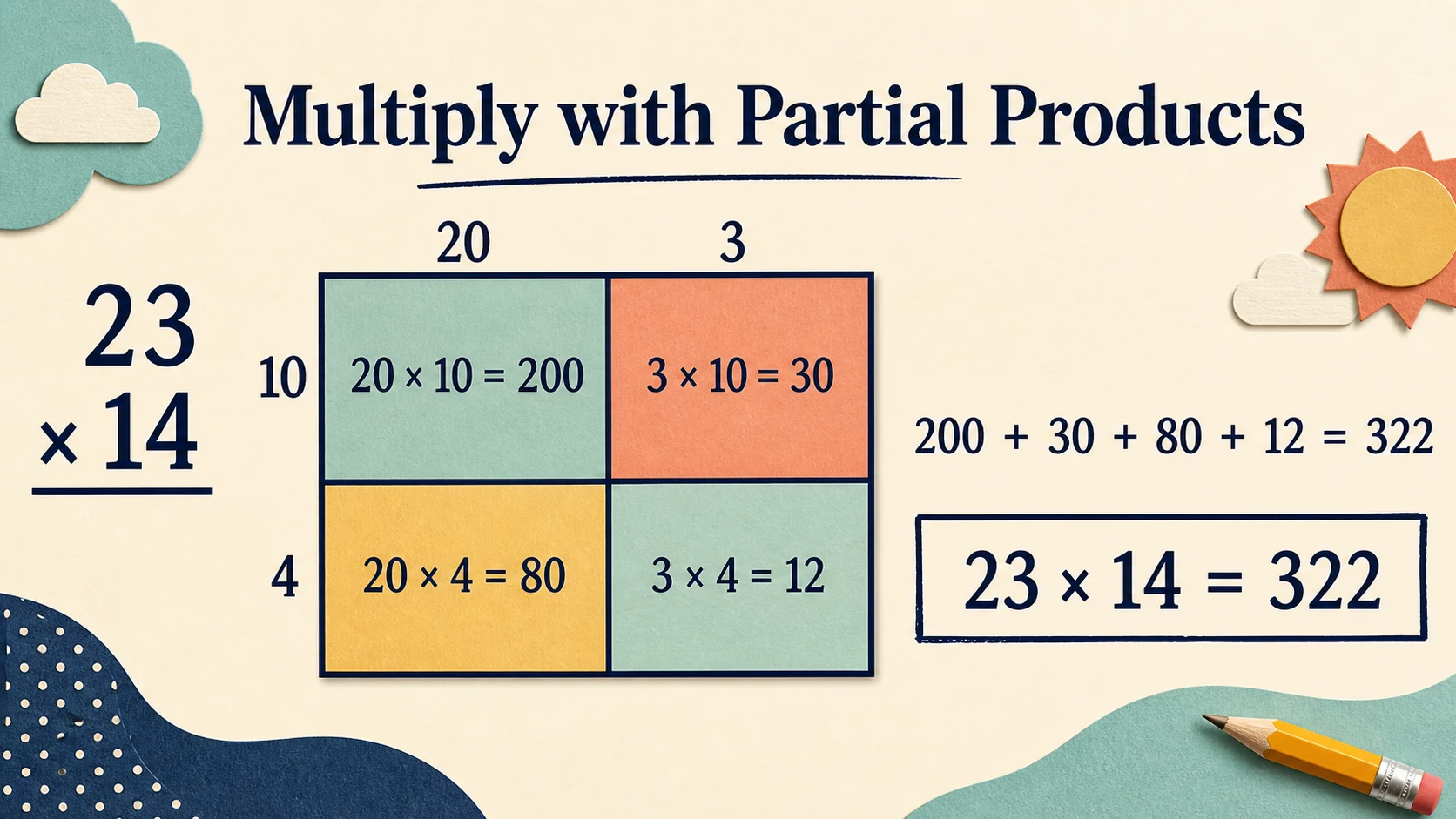
Use the worked example to connect each written partial product to a modeled quantity before expecting an independent algorithm.
Teach facts in an order that creates reusable strategies
A sequential march from ×0 through ×12 gives nearby facts similar-looking labels, but it does not necessarily give the learner an efficient way to reason. A more useful teaching order is:
- ×0 and ×1 for zero groups and the identity pattern
- ×2 for doubling
- ×5 and ×10 for familiar counting patterns
- ×3 and ×4 through known doubles and combinations
- ×6, ×7, ×8, and ×9 through decomposition and the distributive property
This order is a page-specific editorial recommendation from the supplied teaching anchor, not a claim that every school follows it. Use a fact check to discover which strategies are available rather than restarting the whole sequence automatically.
Skip counting is a bridge, not the destination
For , a learner might say “6, 12, 18, 24.” That shows a useful connection between equal groups and a number sequence. Now ask, “What multiplication equation summarizes those four jumps?” The goal is to recognize as a single multiplicative relationship rather than perform repeated addition indefinitely.
A number line can clarify the structure: four equal jumps of six land at 24. However, do not require a learner to draw 37 jumps to solve . At that point, decomposition——is more efficient and keeps the multiplication structure visible.
Build fluency after strategies are understood
Fluency practice can be brief and regular once the learner can explain at least one dependable strategy. A correct answer produced by counting every item is different from a correct answer found through a known fact or property.
The IES intervention guide includes timed activities as one possible way to develop fluency. That does not mean every multiplication session should be timed or that speed alone demonstrates understanding. If timing causes guessing, record accuracy and strategy use first. A suitable goal is increasingly efficient, accurate retrieval while preserving the ability to explain relationships among facts.
Let errors identify the missing connection
Wrong answers should lead to a small follow-up task, not a label or diagnosis.
| Observed response | What it may indicate | Check next | Teaching response |
|---|---|---|---|
| The symbols may be read as addition | Ask for three groups of five counters | Reconnect the equation to equal groups | |
| Counts a array as 20 | A row, column, or object may be skipped | Have the learner trace each row and write four 6s | Pair row counting with |
| Says | The fact may be guessed or confused with a nearby product | Ask for | Rebuild the fact from known products |
| Writes | Only may have been calculated | Ask what the 1 in 14 is worth | Use an area model showing 10 and 4 |
| Gets correct products but misadds partial products | Multiplication may be sound while recording or addition fails | Read each partial product aloud by place value | Align values or calculate partial sums separately |
These are possible interpretations, not diagnoses. One response is insufficient to establish a persistent difficulty. Ask the learner to model a similar problem, explain the numbers, and solve a near example before selecting the next worksheet.
The Common Core mathematics materials emphasize both understanding and procedural skill, including explanations appropriate to the learner’s level. That broad principle supports asking “Why does this work?” alongside “What is the answer?” It does not establish that a particular WorksheetWise sheet is aligned to any state or local curriculum. See the Common Core mathematics overview for the source guidance.
Choose a real worksheet with a three-problem preview
Before printing a full sheet, inspect three representative items. The following decision sequence prevents a grade label or “easy” tag from doing more work than it should.
Check the representation
Does the worksheet use objects, equal-group drawings, arrays, equations, area models, partial products, or a bare algorithm? Choose a representation the learner can interpret, plus at most one meaningful step toward greater abstraction.
If the target is multiplication, adaptations should preserve multiplication. Allow counters, grid paper, enlarged print, fewer visible problems, extra spacing, oral reading of directions, or a multiplication chart used as a fact reference. Do not replace every multiplication problem with unrelated addition practice unless addition is the actual prerequisite being addressed.
Check the number demand
Determine whether the learner must work with pattern-based facts, less familiar facts, one-digit by multi-digit products, or several place-value parts. Large numbers are not the only source of difficulty: a small product inside an unfamiliar word problem can require more reasoning than a familiar vertical calculation.
Ask the learner to solve one item independently, one with a prompt, and one in a slightly different form. If all three require complete adult modeling, move back in representation or number demand. If all three are solved accurately with a clear explanation, preview the next level rather than assigning many redundant items.
Check the response demand
A page that asks only for products measures something different from one that asks the learner to draw an array, choose an equation, explain an error, or solve a context problem. Match the response to the goal:
- For meaning, ask for a model and interpretation.
- For strategy, ask how a known fact helps.
- For computation, ask for organized work and an estimate.
- For fluency, use a short set of already-understood facts.
- For transfer, include a word problem without changing every other feature.
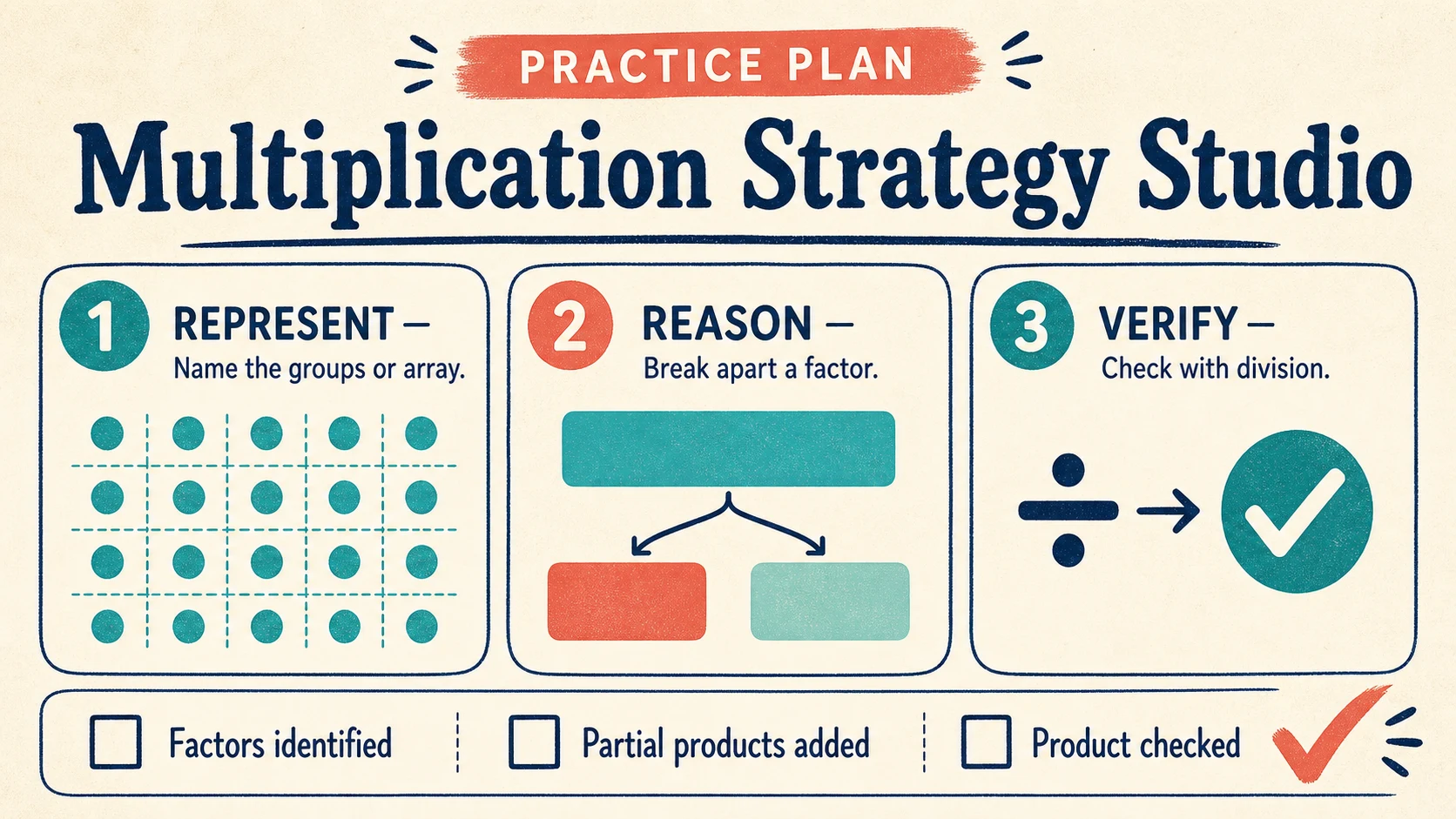
Use the two-week 3rd grade plan to alternate model-based learning, strategy practice, and review instead of repeating one full fact sheet daily.
Use a short routine that produces observable evidence
A worksheet is most informative inside a consistent routine. For a 10- to 15-minute session:
- Retrieve one known relationship. Ask for a familiar fact and why it is known: “How does help with ?”
- Model one target item. Use counters, an array, or an area model. Name the factors, product, rows, columns, and partial products accurately.
- Solve three to six selected problems. Cover the rest of the page if visual density is distracting.
- Compare methods. Ask whether an array, decomposition, or written algorithm made the structure easiest to see.
- Close with one independent check. Give a similar problem without the just-used prompt and record what the learner does.
The observable next action matters more than a vague judgment such as “needs more practice.” Record something concrete: “On three array items, correctly identified rows and columns but counted every dot,” or “Produced all four partial products for and misadded 80 and 30.”
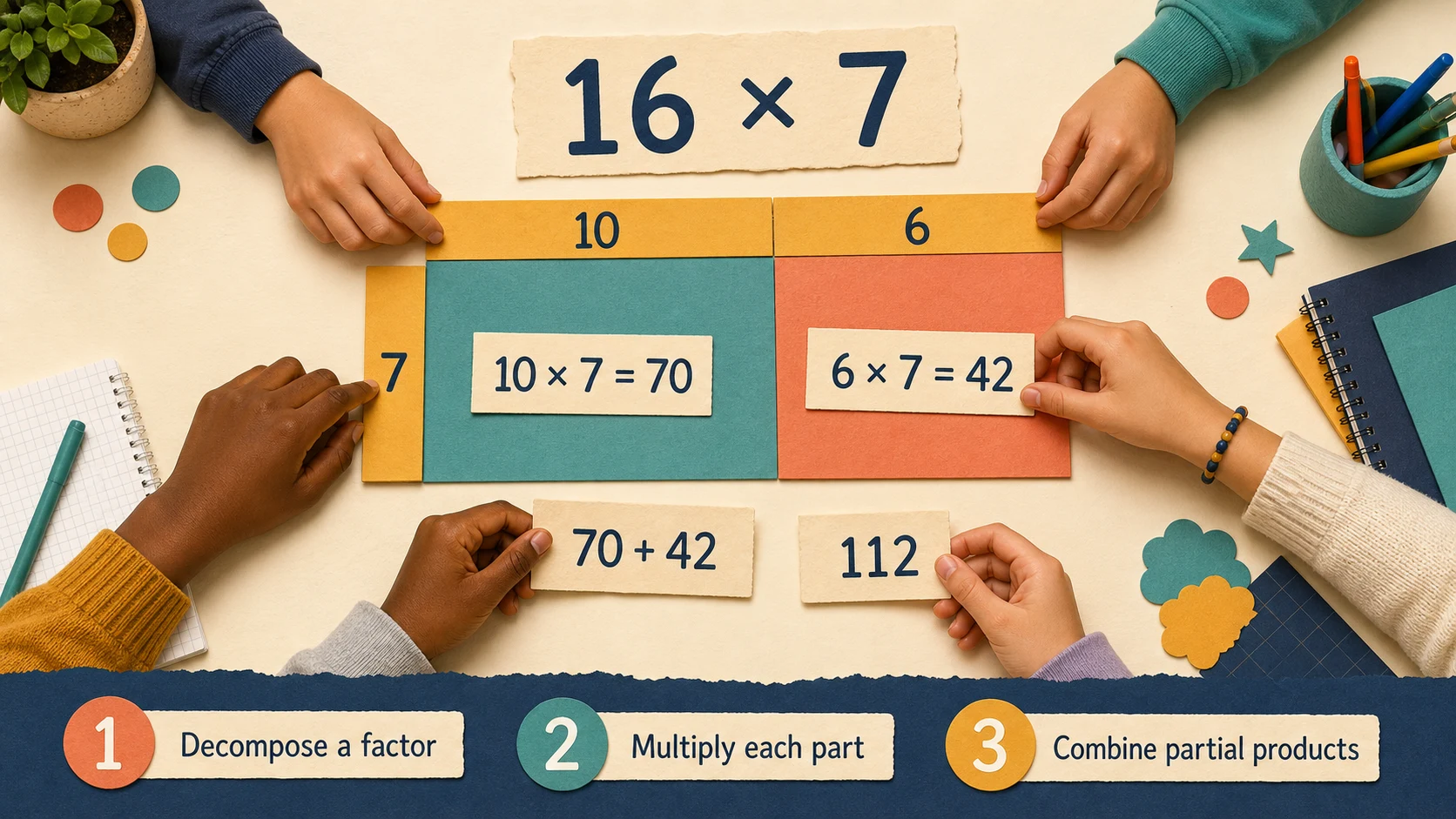
Repeat the upper-grade routine with a new product only after the learner can connect the model, partial products, and recorded answer.
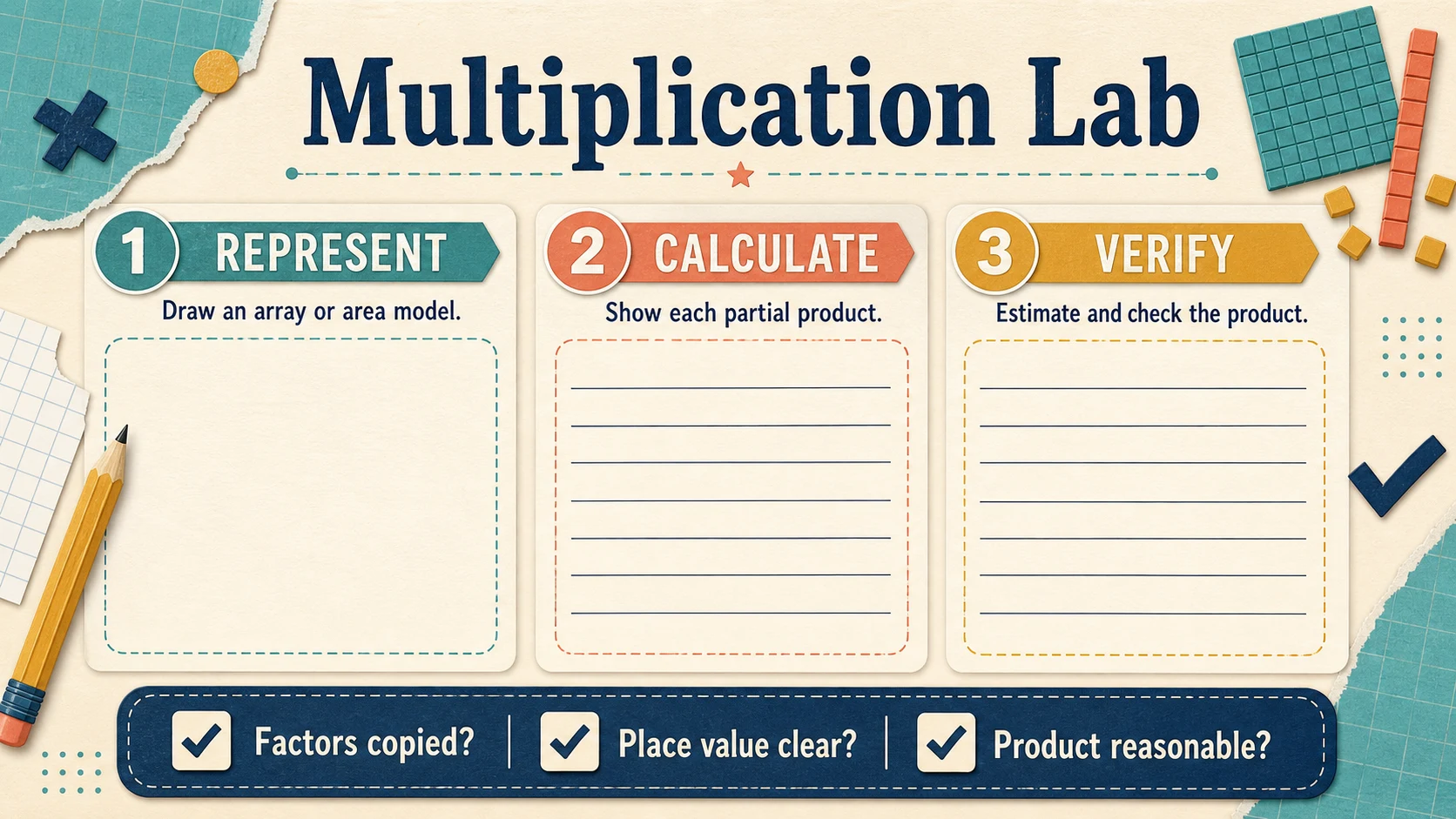
In the 6th grade plan, space review across days and vary the question form while keeping the underlying multiplication relationship recognizable.
Know what a multiplication worksheet cannot establish
A completed page can show answers, written methods, and sometimes representations. It cannot by itself establish why an error occurred, whether a correct answer was guessed, whether the learner understands a property, or whether the skill transfers to a new context. It should not be used to diagnose a learning condition or make a high-stakes placement decision.
The catalogue’s counts also do not reveal which exact representation appears in every variant. Preview the actual resource rather than assuming that every grade-level sheet includes arrays, word problems, partial products, or an algorithm. “Easy” is a catalogue difficulty label, not a promise that a sheet will feel easy to a particular learner.
Keep the target narrow when adapting:
- Reduce the number of visible questions without reducing the mathematical idea.
- Read a word problem aloud when reading is not the target.
- Permit manipulatives while requiring the learner to state the multiplication equation.
- Provide grid paper for place-value alignment.
- Remove a timer when it interferes with reasoning.
- Add a worked first item, then check whether support can be faded.
If the learner lacks a prerequisite, switch resources deliberately. Repeated-addition work may be supported by the Addition Worksheets by Grade and Level, while decimal multiplication should be selected through the Decimals Worksheets by Grade and Level. Those are different instructional targets, not merely easier or harder versions of the same page.
Make the next worksheet choice from one observed boundary
Begin with the grade page closest to the learner’s current instruction, preview three items, and note the first point at which explanation or organization breaks down. Then choose one next action:
- Cannot form equal groups: return to objects and the 2nd grade entry point.
- Understands groups but counts every object: use arrays and fact strategies at the 3rd grade entry point.
- Knows facts but loses place value: use an area model or partial-products task around the 4th grade boundary.
- Organizes partial products but needs greater independence: compare the 5th and 6th grade previews.
- Solves and explains all preview items accurately: increase one feature only—number demand, abstraction, response demand, or independence.
For the most practical first step, open the 3rd Grade Multiplication guide and free sheet, preview three of its 25 problems, and record whether the learner models the groups, selects a strategy, and explains the product. That evidence will tell you whether to stay there, return to the 2nd grade representation boundary, or inspect the 4th grade place-value boundary next.
Put it into practice
Use the guide with a real printable
Move from explanation to a short, observable practice task. Check the first item together, then adjust the next session from the learner's actual work.
Open the first free worksheetExplore a neighboring collection
Choose by a different teaching need
Addition Worksheets by Grade and Level Consonant Blends Worksheets by Grade and Level Counting Worksheets by Grade and Level CVC Words Worksheets by Grade and Level Decimals Worksheets by Grade and Level Digraphs Worksheets by Grade and Level Division Worksheets by Grade and Level Fractions Worksheets by Grade and Level