What Kindergarten Digraphs Are
Kindergarten digraphs are pairs of letters that work together to represent one sound. Common examples are sh in ship, ch in chip, th in thin and this, wh in when, and ck in duck. The learner must recognize the two letters as a unit, connect that unit to a sound, and use the sound when reading or spelling a word.
The short instructional answer is: begin after the learner can identify common letter sounds and blend simple consonant-vowel-consonant words. Introduce one digraph at a time, model how two letters represent one sound, and move from listening and sorting to reading, spelling, and short connected text. Let the learner’s observed work determine when to add another digraph.
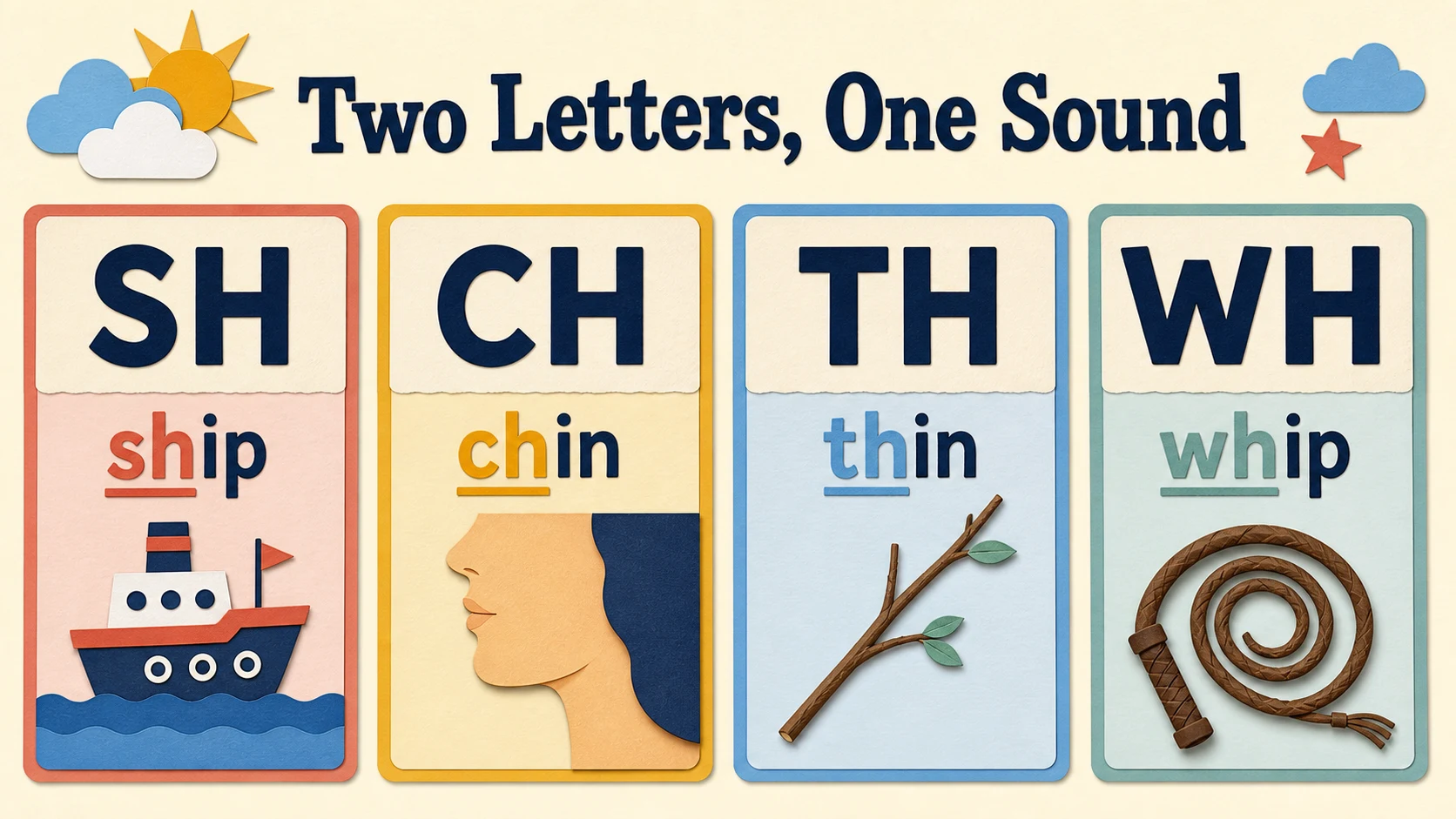
The skill develops from hearing one sound to recognizing, reading, and spelling its two-letter representation.
A digraph is different from a consonant blend. In a blend such as sl in slip, both sounds remain audible: /s/ followed by /l/. In sh in ship, the two letters represent a single sound. Holding two fingers together while saying /sh/ gives a learner a concrete reminder: two letters, one sound.
This guide uses sh, ch, th, wh, and ck because those are the consonant digraphs included in the supplied topic scope. Grade labels describe an intended practice level, not a promise that every learner will follow the same timetable. Local curricula and instructional sequences differ. The Common Core English Language Arts framework places sound-symbol knowledge within foundational reading, but this guide does not claim comprehensive standards alignment.
Prerequisites to Check Before Teaching Digraphs
A learner does not need perfect mastery of every earlier phonics skill. However, several foundations make digraph instruction more understandable.
Hearing and identifying sounds
Check whether the learner can attend to the beginning and ending sounds of short spoken words. For example:
- Ask, “What sound starts sun?” The expected response is /s/.
- Ask, “What sound ends map?” The expected response is /p/.
- Say ship and shop. Ask whether the beginning sounds are the same.
These are listening checks. Do not show print until you want to assess the letter-sound connection. If a learner cannot hear the relevant sound in spoken words, extra visual worksheets are unlikely to solve the immediate problem. Return to oral comparison, exaggerating the target sound without inserting an extra vowel.
Knowing common letter sounds
The learner should recognize the common sounds represented by individual consonants and short vowels in simple words. This knowledge makes the contrast between one-letter correspondences and a two-letter digraph meaningful.
For example, the learner may know s as /s/ and h as /h/. The teacher can then explain that s and h together in ship represent /sh/. Avoid presenting the pair as a puzzle in which the child must somehow combine /s/ and /h/. Teach the digraph sound directly.
Blending simple words
Before adding digraphs, check that the learner can blend a word such as map or sit. A learner who sees m-a-p and can blend /m/ /ă/ /p/ into map is ready to try a word in which one sound is written with two letters.
If basic blending remains effortful, keep digraph reading brief and continue CVC practice. The Kindergarten phonics collection can help an adult choose practice that matches the learner’s current phonics step instead of assigning digraph work simply because of age or calendar date.
A Grade-Appropriate Teaching Progression
The sequence below is an instructional suggestion based on the supplied catalogue scope. It is not a universal timetable. The IES foundational reading practice guide supports systematic instruction in sound awareness, letter-sound relationships, decoding, and connected text. It does not evaluate WorksheetWise or prescribe this exact digraph order.
| Stage |
Teaching focus |
Example task |
Evidence to look for |
| 1. Oral recognition |
Hear the target sound in spoken words |
Decide whether ship begins with /sh/ |
Learner responds from sound, not a picture clue |
| 2. Symbol introduction |
Connect the sound to its two letters |
Match /sh/ to sh |
Learner treats the letters as one unit |
| 3. Position sorting |
Find the digraph at the beginning or end |
Sort ship and wish |
Learner attends to the whole word |
| 4. Supported decoding |
Blend words with a known digraph |
sh-i-p → ship |
Learner says /sh/, not /s/ /h/ |
| 5. Encoding |
Spell a spoken word with tiles or letters |
fish → f-i-sh |
Learner uses both letters for the final sound |
| 6. Contrast and review |
Mix digraphs with CVC words and blends |
Sort shop, stop, sip |
Learner distinguishes one sound from two |
| 7. Connected use |
Read or write short controlled phrases |
“The fish is in the dish.” |
Learner applies the pattern beyond a list |
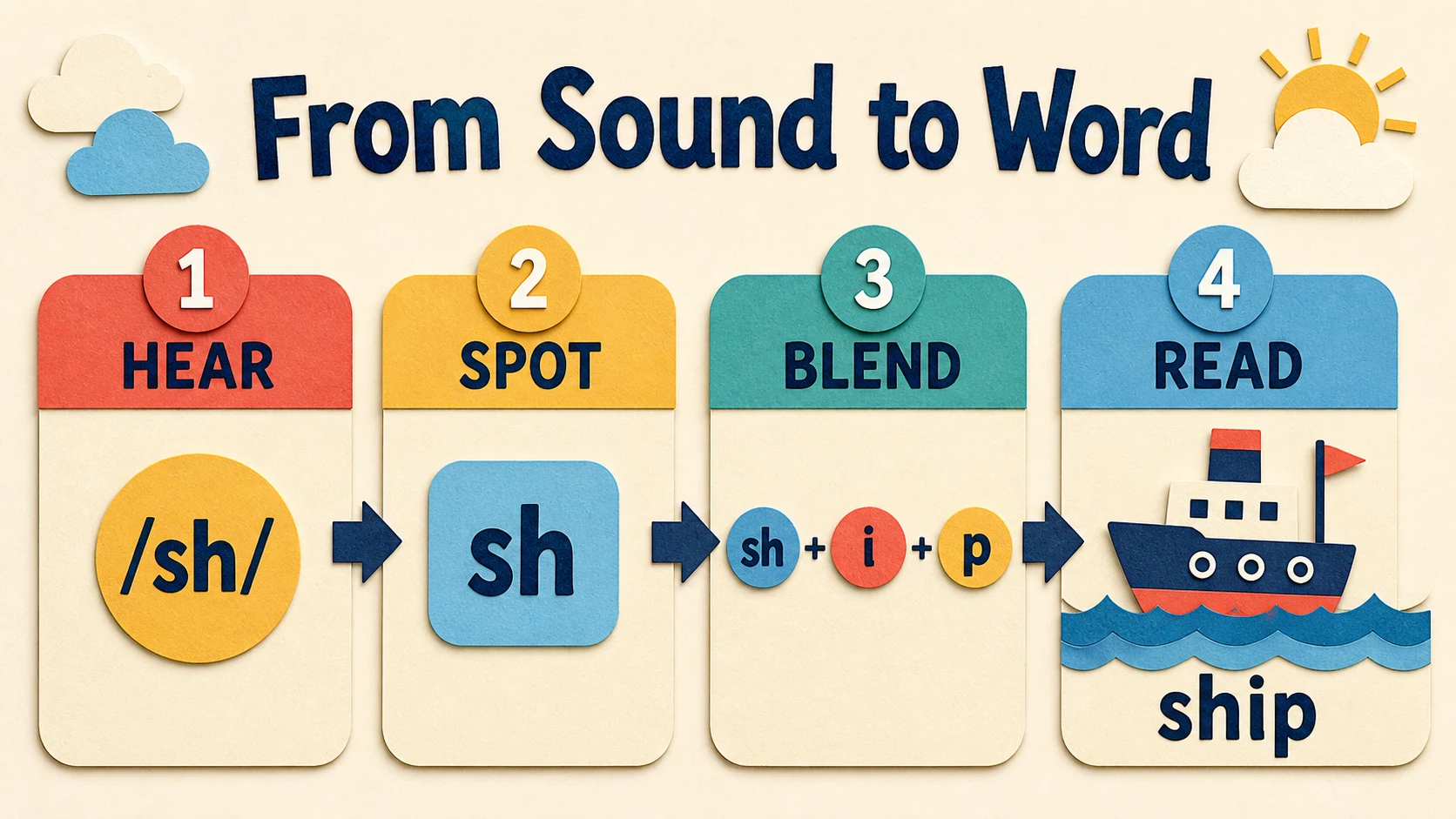
Advance when the learner’s reading and spelling show a stable connection, not merely after a set number of days.
A practical order
Begin with sh, whose sound is distinct and easy to extend orally. Follow with ch, then th. Introduce both sounds represented by th through examples, without requiring a kindergartner to use the labels voiced and unvoiced. Add wh and ck when the learner can manage earlier contrasts.
The supplied teaching guidance suggests spending at least a week on each digraph. Treat that as a starting suggestion rather than an automatic rule. A learner who repeatedly confuses sh and ch needs more contrast practice before another pair is added. A learner who reads and spells the current pattern accurately across different tasks may be ready for cumulative practice sooner.
Concrete and Visual Models That Clarify the Skill
The main teaching challenge is making “two letters, one sound” visible. A few simple models can do this without replacing actual reading.
Two tiles joined into one sound unit
Write s and h on separate tiles. Place them side by side and slide them together. Touch both tiles at once while saying /sh/. Then place i and p after them:
sh | i | p
The written word contains four letters but three sound units: /sh/ /ĭ/ /p/. This distinction matters because counting letters and counting sounds are different tasks.
For fish, display:
f | i | sh
Again, there are four letters and three sound units. Moving the joined tiles from the beginning to the end shows that sh can appear in more than one position.
Sound boxes
Draw one box for each sound, not one box for each letter. For chip, use three boxes:
The ch belongs in one box because it represents one sound. If the learner puts c and h into separate sound boxes, say the word slowly and ask how many separate sound beats can be heard. Then model the correct placement.
Mouth and voice observations
For the two pronunciations of th, use familiar examples:
- thin: air passes between the tongue and teeth without a vibrating voice.
- this: the mouth position is similar, but the voice vibrates.
The learner only needs exposure to the two sounds. Requiring technical terminology adds a language demand that is not necessary for reading the words.
For wh, use examples such as when. Pronunciation varies, so accept /w/ or /hw/ according to the learner’s speech and local instruction. The reading goal is recognizing wh as the relevant letter pair.
Fully Checked Worked Examples
Each example below separates the adult’s model from the learner’s response. The sound counts are checked by phonemes, while letter counts are checked by written characters.
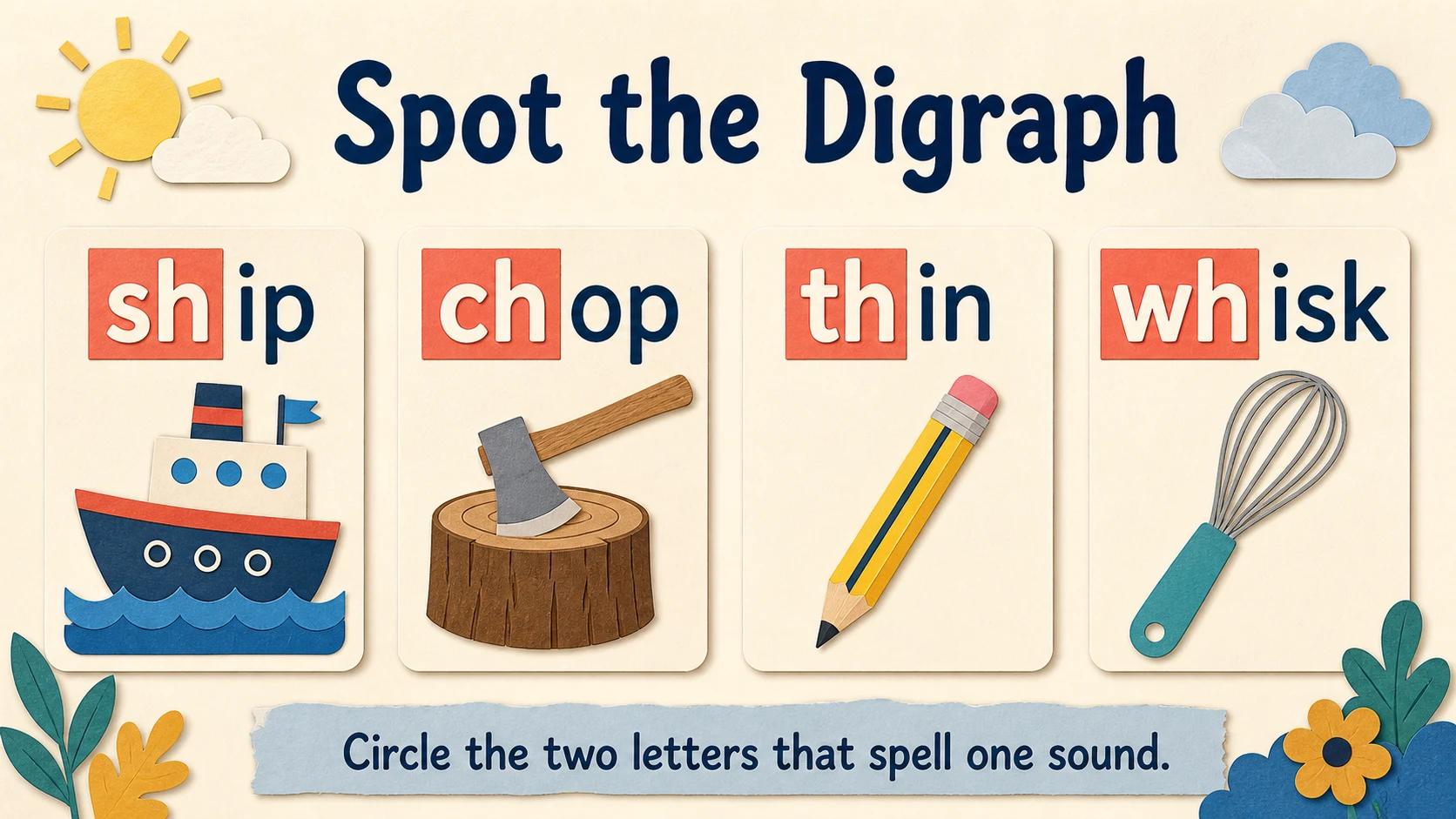
The adult marks the digraph as one sound unit before blending the complete word.
Example 1: Reading ship
Show ship.
- Underline sh and say, “These two letters represent /sh/.”
- Point across the sound units: sh | i | p.
- Say the sounds: /sh/ /ĭ/ /p/.
- Blend without pauses: ship.
Checked result:
- Word: ship
- Letters: 4
- Sound units: 3
- Digraph: sh
- Position: beginning
- Decoded word: ship
A common incorrect attempt is /s/ /h/ /ĭ/ /p/. Respond by covering i and p, touching sh together, and restating /sh/. Then rebuild the word.
Example 2: Reading much
Show much and ask the learner to find a known two-letter sound.
- Mark ch at the end.
- Separate the word as m | u | ch.
- Blend /m/ /ŭ/ /ch/.
- Read much.
Checked result:
- Word: much
- Letters: 4
- Sound units: 3
- Digraph: ch
- Position: end
- Decoded word: much
This example checks transfer from initial ch, as in chip, to final ch. If the learner recognizes ch only at the beginning, compare chip and much and circle the same pair in both.
Example 3: Comparing the two sounds of th
Display thin and this.
For thin:
- Segment: th | i | n
- Sounds: /th/ /ĭ/ /n/, using the non-vibrating th
- Letters: 4
- Sound units: 3
For this:
- Segment: th | i | s
- Sounds: /th/ /ĭ/ /s/, using the vibrating th
- Letters: 4
- Sound units: 3
Both words begin with the same spelling, th, but that spelling represents two related pronunciations in these examples. The learner does not need to predict the pronunciation from a rule at this stage. Model the word, let the learner compare the mouth and voice sensations, and provide repeated exposure.
Example 4: Spelling duck
Say duck without showing it.
- Ask the learner to stretch the word: /d/ /ŭ/ /k/.
- Place d for /d/.
- Place u for the short vowel sound.
- Explain that, in the supplied topic scope, ck appears at the end after a short vowel.
- Place ck for the final /k/: d-u-ck.
- Read the completed word: duck.
Checked result:
- Word: duck
- Letters: 4
- Sound units: 3
- Final sound: /k/
- Final spelling: ck
- Short vowel before ck: u
Do not generalize this into a claim that every final /k/ in every English word is spelled ck. The useful boundary here is narrower: the practised ck pattern occurs after a short vowel and at the end of words such as duck, neck, and stick.
Example 5: Distinguishing a digraph from a blend
Compare shop and stop.
For shop:
- sh | o | p
- /sh/ /ŏ/ /p/
- The initial two letters represent one sound.
For stop:
- s | t | o | p
- /s/ /t/ /ŏ/ /p/
- The initial letters retain two separate sounds.
The correct conclusion is not simply that both words start with two consonant letters. Sh is a digraph because the pair represents one sound; st is a blend because both consonant sounds remain audible.
A Short, Repeatable Lesson Routine
A focused lesson can be brief. The exact duration should respond to attention, accuracy, and available instructional time rather than a universal clock.
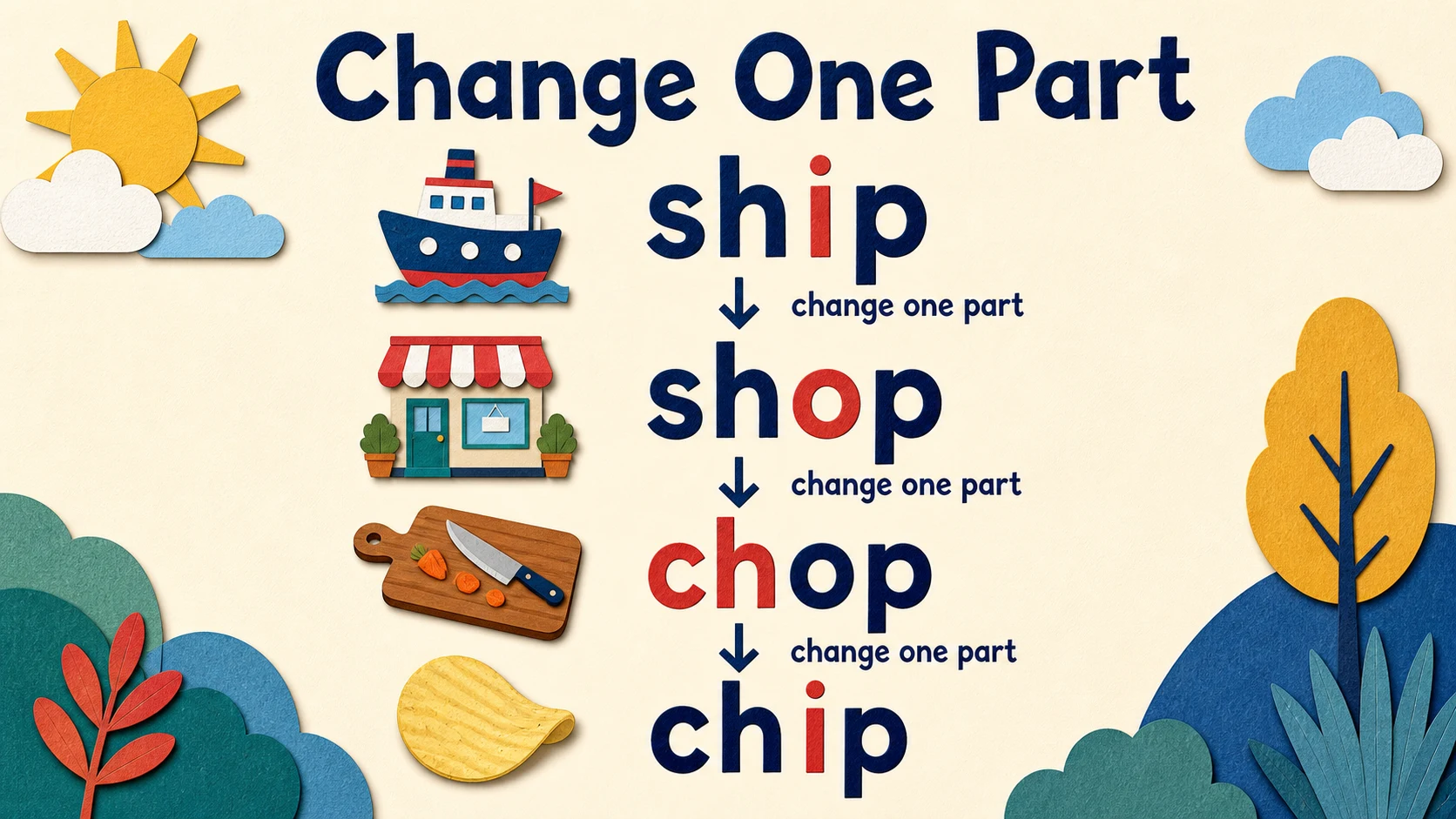
The routine moves from listening to print, reading, spelling, and cumulative review.
1. Listen
Say three or four words and ask the learner to identify the target sound. For sh, try ship, sun, wish, and map. Ask whether /sh/ is at the beginning, at the end, or absent.
2. Connect sound and print
Show the digraph card. Say the sound, have the learner repeat it, and use the two-fingers-together signal. Keep the wording consistent: “Two letters, one sound.”
3. Build and read
Use tiles or written sound units to build two or three words. Begin with a model, complete one together, and then ask the learner to try one. Include both initial and final positions when the digraph permits them, such as ship and fish.
4. Spell
Dictate one known word. The learner says the sounds, selects letters, writes the word, and reads it back. Word spelling connects phonics to writing, but it does not replace broader writing instruction. The IES elementary writing practice guide provides high-level guidance on explicit writing instruction and regular opportunities to write; it does not endorse this specific lesson or worksheet.
5. Review cumulatively
End with a small mixed set containing a current digraph word, an earlier digraph word, a CVC word, and a blend word. For example: ship, much, map, stop. Mixing prevents a learner from succeeding only because every answer on the page follows the same pattern.
Choosing Appropriate Practice
The best practice is not necessarily the worksheet with the most items. Choose the smallest task that reveals whether the learner can apply the target skill accurately.
When to use a focused worksheet
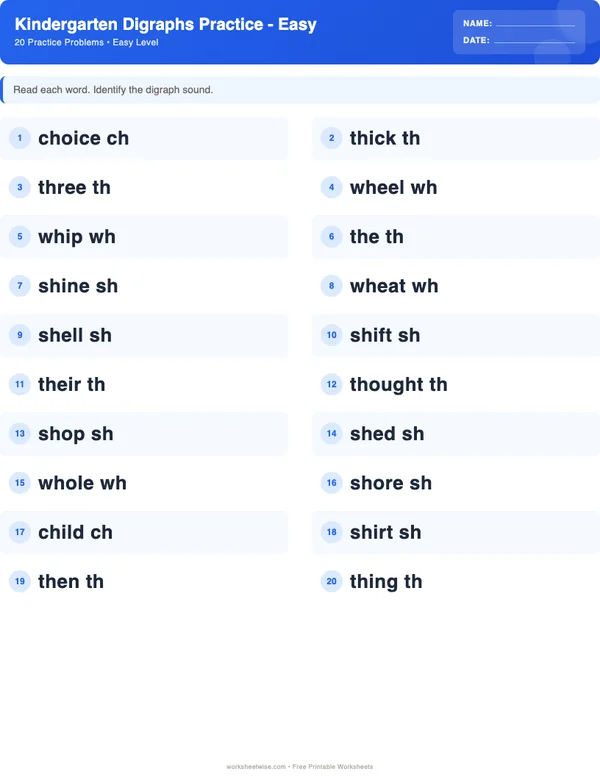
A focused page is useful when the learner already knows the target sound and needs repeated word-level recognition. The free Kindergarten digraphs worksheet contains 20 easy-level exercises asking learners to read each word and identify the digraph sound. It includes a separate printable answer key.
Use only part of the page if fatigue begins to lower the quality of responses. Ten attentive items can provide clearer evidence than 20 rushed guesses. Ask the learner to read the word aloud when possible; circling a letter pair alone does not prove that the word was decoded.
When to choose manipulatives or oral work
Choose tiles, sound boxes, or spoken sorting when the learner:
- splits a digraph into two sounds;
- cannot hear the target sound in a spoken word;
- depends heavily on pictures;
- knows the pair in one position but not another; or
- can recognize the letters but cannot spell a matching word.
A printable activity can follow the model once the learner understands what to attend to.
When to expand practice
The focused Kindergarten digraphs pack contains 18 worksheets and is listed at $4.79. A larger set may be appropriate when an adult needs varied, repeated practice across sessions. More pages should not mean assigning all pages in order. Select activities according to the learner’s errors and mix in previously taught material.
The broader Kindergarten worksheet hub can support review across subject areas, while the free worksheet generators offer another route when an adult needs a different practice set. Whatever the format, inspect a few responses closely rather than relying only on completion.
Differentiation Without Changing the Core Skill
Differentiation should adjust support, quantity, and contrast while preserving the goal of connecting a digraph spelling to its sound.
For a learner needing more support, teach one digraph in a small set of highly familiar words. Mark the pair visually, use joined tiles, and offer two choices rather than an open-ended response. Read the word together before asking for independent reading.
For a learner who recognizes but does not blend the pattern, keep the digraph joined during continuous blending: /shĭp/ rather than a slow /s/ /h/ sequence. Reduce the number of words and increase immediate corrective feedback.
For a learner ready for greater challenge, vary position and task type. Mix ship/wish, chin/much, and thin/bath. Add spelling from dictation and short controlled phrases. Challenge should come from applying known correspondences in new words, not from introducing unexplained spelling patterns.
For handwriting difficulty, allow movable letters or oral answers while still showing the print. This separates phonics knowledge from letter-formation demands. It is an instructional accommodation, not medical guidance or a diagnosis.
For multilingual learners, first check whether the target sound is familiar in the learner’s spoken language experience. Model mouth placement and provide clear examples without treating an accent difference as a failure to understand print.
Common Errors and Diagnostic Responses
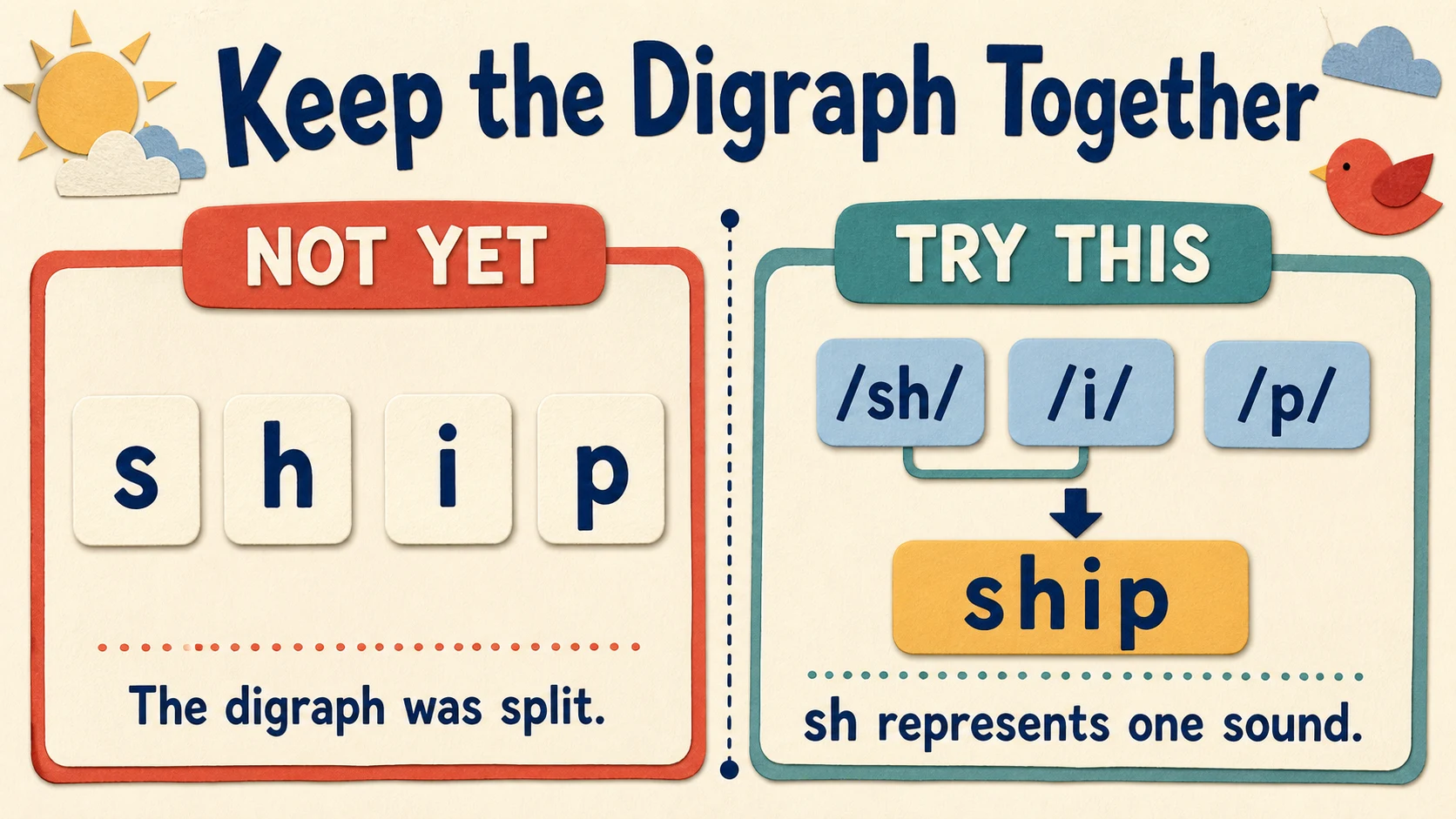
An error becomes useful when it leads to a specific check and a focused teaching response.
| Observed response |
Likely instructional issue to check |
Teaching response |
| Reads ship as /s/ /h/ /ĭ/ /p/ |
Treats each letter as a separate sound |
Join s and h physically; touch them once while saying /sh/ |
| Calls sl a digraph |
Uses “two consonants” as the definition |
Compare slip and ship; count audible beginning sounds |
| Finds sh in ship but not wish |
Recognition is tied to initial position |
Sort the same digraph in beginning and ending positions |
| Reads every th word with one pronunciation |
Has experienced only one th sound |
Contrast thin and this orally and in print |
| Spells fish as fis |
Hears /sh/ but does not recall its spelling |
Use one final sound box containing both s and h |
| Spells duck as duk |
Represents the final sound plausibly but has not learned the practised ck pattern |
Rebuild duck, neck, and stick; notice final ck after a short vowel |
| Circles a digraph but cannot read the word |
Visual matching is stronger than decoding |
Require sound-by-sound blending after identification |
| Guesses from a picture |
Uses meaning instead of the printed sequence |
Cover the picture and point through the sound units |
| Performs well on a single-pattern page but not a mixed list |
Relies on task predictability |
Mix digraph, CVC, and blend words in a short review |
A wrong answer does not establish a diagnosis. Repeat the word in another format before deciding what support is needed. If the learner reads ship incorrectly once, attention or unfamiliar vocabulary may be involved. If the same split appears in shop, fish, and wish, the “two letters, one sound” concept needs reteaching.
Monitoring Progress and Deciding What Comes Next
Monitor three related abilities: recognition, reading, and spelling. Success in one does not guarantee success in the others.
Keep a small dated record with five columns:
| Word |
Identified digraph |
Read accurately |
Spelled accurately |
Support used |
| ship |
Yes |
Yes |
Not checked |
None |
| fish |
Yes |
No |
No |
Joined tiles |
| much |
Yes |
Yes |
Yes |
One prompt |
Use fresh examples as well as familiar ones. A learner who has memorized ship may still be unsure about sh in shop or wish. Look for consistent performance across initial and final positions, isolated words, mixed lists, and short phrases.
A practical readiness sign is that the learner can recognize the current digraph, read several taught and untaught regular examples within the supplied pattern, and spell a few examples with limited prompting. This is an instructional judgment, not a standardized mastery rule.
Slow down when errors are systematic, guessing increases, or the learner needs the same prompt on nearly every item. Continue cumulative review even after introducing a new digraph. If progress remains limited despite clear modeling and repeated, appropriately sized practice, document the exact responses and consult the learner’s teacher or relevant educational professional. This guide cannot identify learning disabilities or provide child-specific clinical advice.
A Two-Week Practice Plan
This plan assumes short, regular sessions and a learner who can already blend basic CVC words. Adapt the amount and pace to observed work. If sh remains unstable, continue with it rather than adding ch merely because the calendar says to move on.
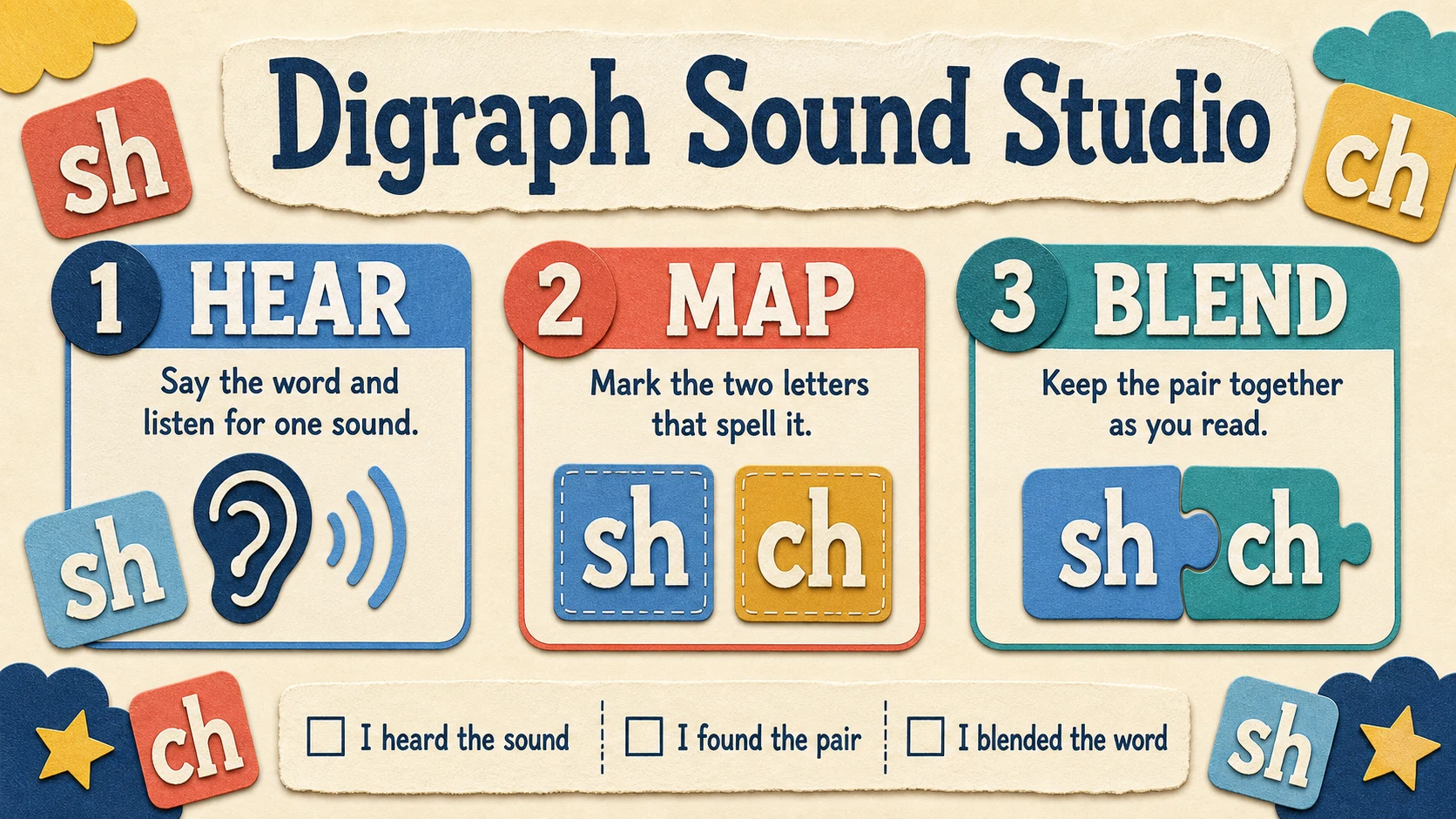
The plan alternates explicit teaching, application, and review while leaving room to repeat a step.
| Day |
Main focus |
Suggested activity |
Quick evidence |
| 1 |
Hear /sh/ |
Oral sort: ship, sun, wish, map |
Identifies presence and position |
| 2 |
Connect sh to /sh/ |
Joined tiles; build ship and shop |
Treats sh as one sound |
| 3 |
Final sh |
Read and build fish and wish |
Recognizes final position |
| 4 |
Read and spell sh |
Mixed reading; dictate ship and fish |
Transfers between reading and spelling |
| 5 |
Review sh |
Short phrase plus CVC contrast |
Reads without assuming every word has sh |
| 6 |
Hear /ch/ |
Oral comparison using chip and much |
Locates /ch/ |
| 7 |
Connect ch to /ch/ |
Build chip; compare with ship |
Distinguishes ch from sh |
| 8 |
Final ch |
Read much and other taught examples |
Transfers to final position |
| 9 |
Mixed sh/ch |
Sort, read, and spell a small set |
Selects the correct pair |
| 10 |
Check and plan |
Use a brief mixed assessment |
Decide whether to extend, review, or begin th |
Across the two weeks, include a few previously learned CVC and blend words. Stop a session when responses become careless or the learner is no longer attending to print. Resume later with a shorter set or a more concrete model.
Boundaries, Limitations, and the Next Step
Digraph knowledge supports word reading and spelling, but it is only one part of early literacy. Learners also need oral language, phonemic awareness, knowledge of individual letter sounds, blending practice, exposure to connected text, and opportunities to write. A digraph worksheet cannot establish all of those abilities, and correct completion does not by itself prove independent decoding.
English spelling also contains patterns and exceptions beyond this introductory scope. This guide focuses only on sh, ch, th, wh, and ck as described in the catalogue. It does not claim that every two-letter sequence is a digraph, that each digraph always has one pronunciation in every word, or that these examples form a complete Kindergarten phonics curriculum.
The honest next step is to collect a small sample of the learner’s work. Use the free easy Kindergarten Digraphs worksheet, listen as the learner reads several items, and note whether errors involve hearing the sound, recognizing the pair, blending the word, or recalling the spelling. Use that evidence to choose the next lesson: repeat the concrete model, contrast two patterns, add spelling, or move into cumulative word and phrase practice.