What Pre-K CVC Words Instruction Should Accomplish
CVC words have a consonant-vowel-consonant pattern: cat, pin, and hug. Each example contains three letters representing three sounds. A beginning reader identifies the sounds, connects each sound to a letter, and blends the sequence into a whole word.
The concise answer is this: teach a learner to hear three sounds before expecting independent reading or spelling. Model how the sounds connect, use three sound boxes or movable letters, and pair reading with spelling. Begin with a small group of familiar letter-sound relationships and one short vowel. Add new vowels and more independent work only when the learner’s observed responses show readiness.
This guide’s Pre-K label describes the intended practice level, not a universal timetable. Local school sequences differ, and children enter Pre-K with different experiences. The relevant Common Core English Language Arts standards place related phonemic-awareness and decoding expectations in kindergarten and first grade. Therefore, Pre-K CVC work is best treated as supported preparation and early practice—not as proof that a learner has completed a kindergarten reading sequence.
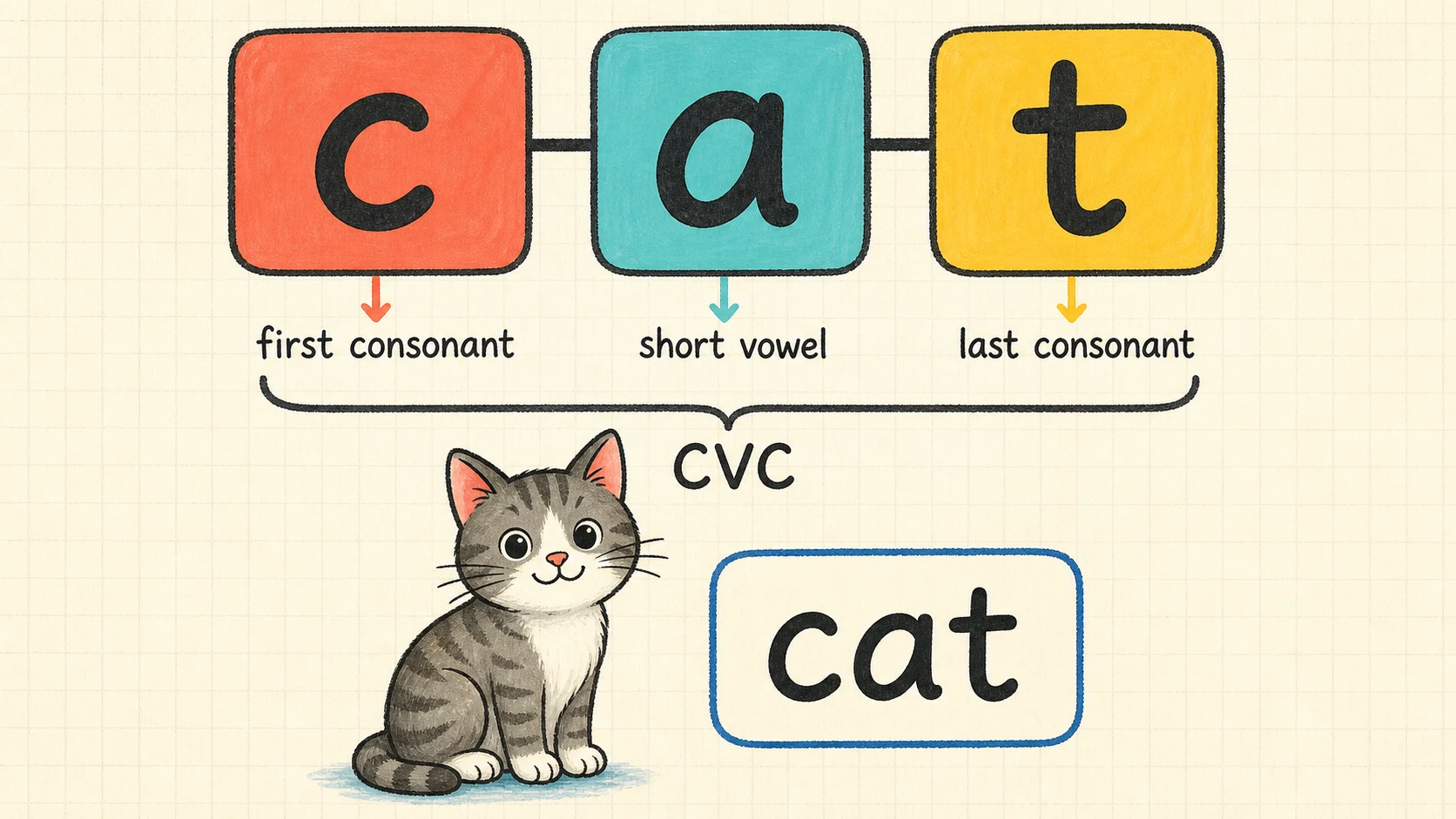
Hearing sounds, connecting sounds to letters, blending, and spelling form one connected learning path.
What a CVC Word Is—and Is Not
A CVC word follows a simple written pattern:
| Position |
Role in map |
Sound |
| First |
Consonant m |
/m/ |
| Middle |
Short vowel a |
/a/ |
| Last |
Consonant p |
/p/ |
The learner can touch or point to the letters from left to right, say the corresponding sounds, and blend them into map. The same structure appears in sit, hot, sun, and bed, using different short vowels.
CVC describes the relationship between letters and sounds in a particular word. It does not mean that every three-letter word is an appropriate CVC example.
Clear examples
- cat: c-a-t, three letters and three sounds
- pin: p-i-n, three letters and three sounds
- mop: m-o-p, three letters and three sounds
- hug: h-u-g, three letters and three sounds
- bed: b-e-d, three letters and three sounds
These examples allow a learner to practice one sound for each written position.
Boundary cases
Some short words fall outside the simplest CVC model:
- ship has four letters but three main sound units because sh works together. It introduces a digraph.
- chat also begins with the ch digraph.
- back ends with two letters representing the final /k/ sound.
- cake includes a final e pattern and is not a short-vowel CVC word.
- go has only two letters and does not have the CVC structure.
- the is a high-frequency word, but its spelling does not provide a simple three-sound CVC decoding example.
These words can be useful later, but placing them in an introductory CVC set adds patterns the learner has not yet been asked to manage. Choose examples whose letter-sound relationships match the current lesson.
Prerequisites to Check Before Teaching CVC Words
A learner does not need perfect alphabet knowledge before seeing a CVC word. However, several underlying skills make the task manageable.
Listening for sounds
Before print is added, check whether the learner can attend to parts of spoken words. Useful oral tasks include:
- recognizing that sun and sock begin alike;
- identifying the first sound in map;
- hearing the final sound in sit;
- moving one object for each sound in a slowly spoken word;
- blending orally presented sounds such as /m/ /a/ /p/.
Rhyming and clapping syllables are useful parts of broader Pre-K phonological awareness, but they do not by themselves demonstrate that a learner can hear the individual sounds in a CVC word.
Knowing the letters in the lesson
Check the specific letters rather than asking whether the learner “knows the alphabet.” A child might name m reliably but not recall /m/, or might recognize a without distinguishing its short sound in cat. For a first word set, use consonants and a vowel the learner can already identify with reasonable consistency.
Following print from left to right
The learner should practice looking at the first, middle, and last positions in order. If attention jumps immediately to a picture or the final letter, place a finger beneath the first letter and sweep from left to right during blending.
Handling the response format
Reading, selecting a picture, arranging magnetic letters, and writing are different response demands. A learner may be able to build map with letters but find pencil control difficult. Pre-K fine-motor development is still in progress, so handwriting difficulty should not automatically be interpreted as weak sound knowledge.
The Pre-K phonics hub can help adults choose practice centered on letter sounds or other foundations before returning to CVC work.
A Grade-Appropriate Teaching Progression
The progression below is an instructional sequence, not a deadline. Move according to what the learner actually does during practice.
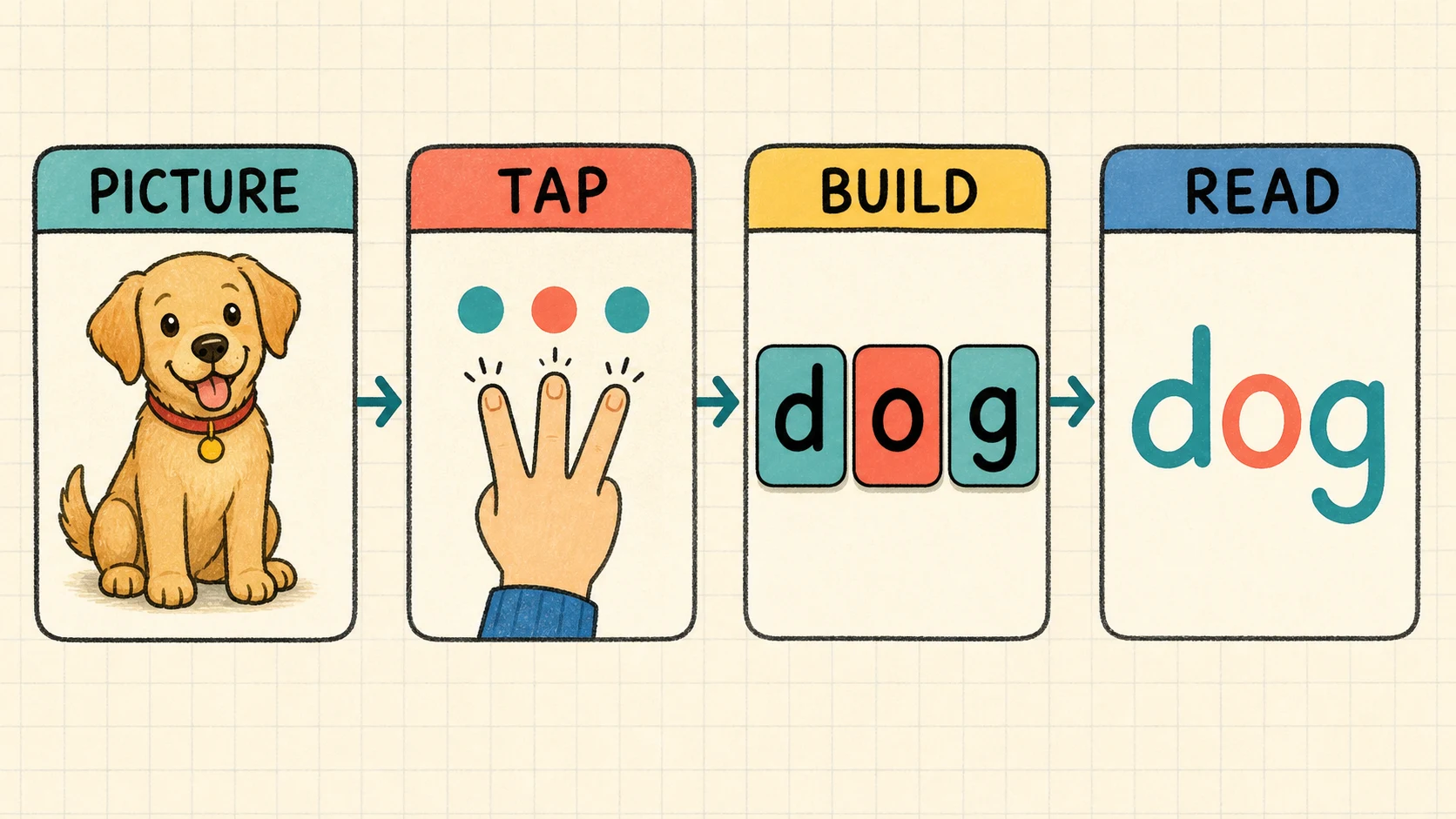
Support is gradually reduced as the learner demonstrates accurate sound analysis and blending.
| Stage |
Adult support |
Learner action |
Evidence to watch |
| 1. Hear the sounds |
Say a familiar CVC word slowly without showing letters |
Move one token for each sound |
One movement for each of three sounds |
| 2. Match sounds to print |
Provide three known letters and model the first match |
Place letters in sound boxes |
Letters match the spoken sequence |
| 3. Blend one vowel family |
Point beneath each letter and model connected sounds |
Sweep and say the word |
The three sounds become one word |
| 4. Read and build |
Present a word, then remove it |
Read it and rebuild it |
Reading and spelling agree |
| 5. Change one letter |
Keep two letters fixed |
Replace one letter and read again |
The learner notices how the word changes |
| 6. Mix short vowels |
Present words without grouping them by vowel |
Decode each word |
The middle vowel is read from print |
| 7. Complete brief independent practice |
Explain the direction and provide an example |
Read, select, or write answers |
Accuracy continues after prompts are reduced |
Begin with oral sound work
Say map. Repeat it slowly, then have the learner move three tokens: /m/, /a/, /p/. Do not show letters until the learner understands that the spoken word contains an ordered sequence.
If the learner moves two tokens, say the word again and stretch the sound that disappeared. For example, emphasize the middle of /mmmaaap/. The immediate goal is hearing the sequence, not naming a rule.
Introduce one short vowel family
The catalogue sequence begins with short a, followed by short i, short o, short u, and short e. Within one family, use words such as cat, mat, map, tap, and sad. Keeping the vowel stable lets the learner attend to changing consonants.
This order is an instructional suggestion from the WorksheetWise catalogue. It should yield to the learner’s known letters and observed work. If several consonants in a proposed set are unfamiliar, reduce the set rather than presenting every word at once.
Change one position at a time
Word chains make the effect of a single letter visible:
cat → mat → map → mop
Ask what changed at each step. In cat → mat, the first sound changes. In mat → map, the final sound changes. In map → mop, the vowel changes, making the last step more demanding.
Pair decoding with encoding
After the learner reads map, cover it and ask for the sounds. The learner can place m, a, and p in order or write them if handwriting is not the main obstacle.
The IES foundational reading practice guide recommends developing awareness of speech sounds and their links to letters, as well as teaching learners to decode, write, and recognize words. That source addresses kindergarten through third grade; it supports the broad instructional framing here but does not evaluate this guide or any WorksheetWise material.
Concrete and Visual Models That Make the Structure Visible
Three connected sound boxes
Draw three boxes:
|
|
|
| first sound |
middle sound |
final sound |
Give the learner three tokens. Say sun. The learner pushes one token into each box while saying /s/, /u/, /n/. Then the learner sweeps a finger beneath all three boxes and says sun.
Once that oral sequence is secure, replace the tokens with the letters s, u, and n. The boxes make the three positions visible without requiring a lengthy explanation.
Movable letters
Movable letters allow the learner to revise an answer without erasing. Build m-a-p, read it, and then replace m with t. The learner can see that two positions remain unchanged while map becomes tap.
Limit the available letters. If the target is tap, presenting t, a, p, s, i, n, m, o turns the activity into a broad search. Providing t, a, p, or one carefully chosen extra letter, keeps attention on sound order.
A finger sweep for blending
Point beneath m and begin /mmm/. Move beneath a without a long pause, continue through p, and then say map. The catalogue describes this as continuous blending: maintaining the connection between sounds so the learner can hear the whole word.
Some stop sounds cannot be stretched naturally. Avoid adding an extra “uh” after a consonant. /t/ should remain /t/, not “tuh,” because the added vowel can make blending confusing.
Fully Checked Worked Examples
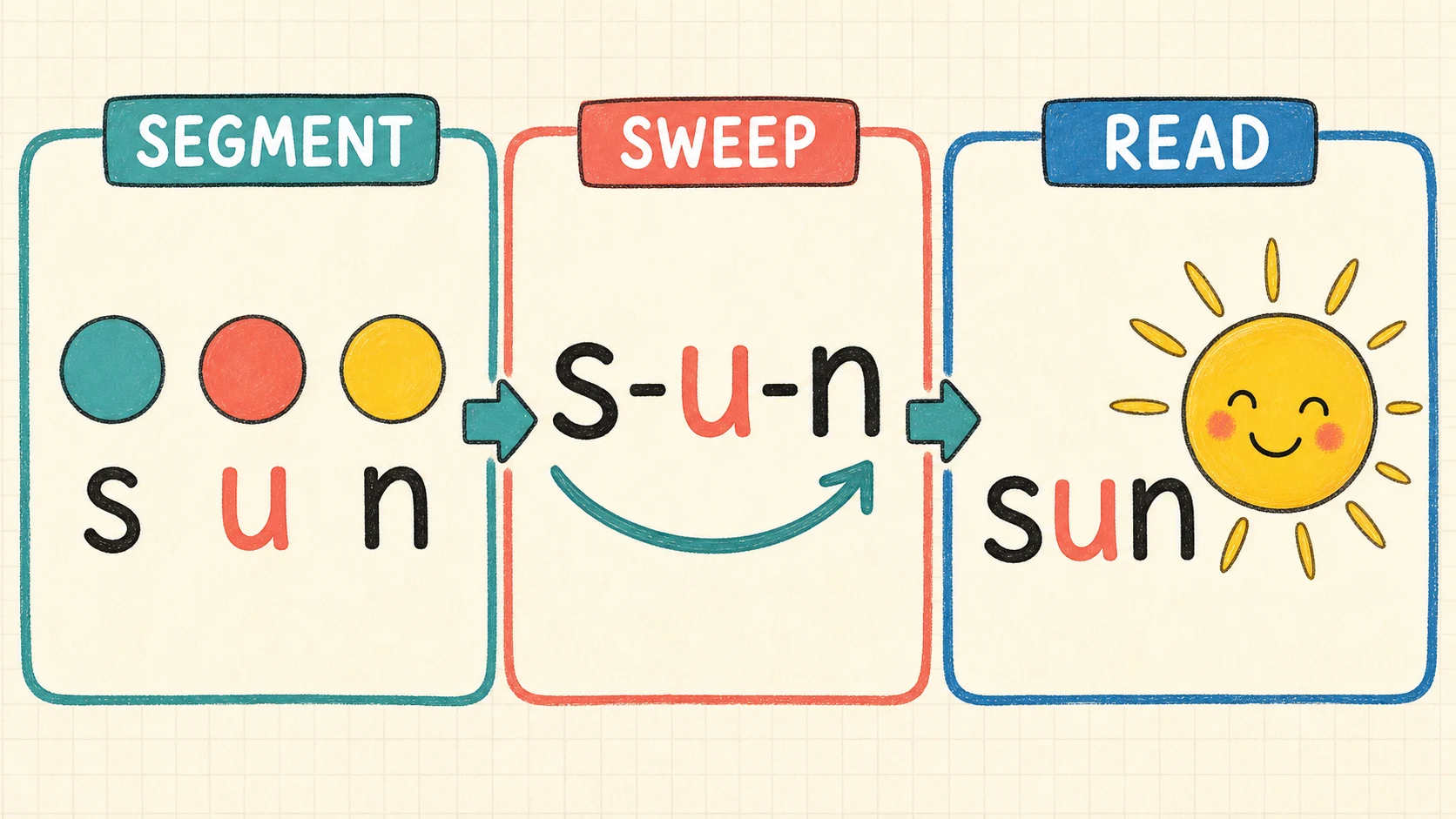
The learner hears the sequence, represents it, checks each position, and blends the result.
Worked example 1: Reading cat
Task: Read cat.
- Point to c and say /k/.
- Move to a and say its short sound /a/.
- Move to t and say /t/.
- Connect the sounds: /kkkaa at/ becomes cat.
- Check the positions: c is the first consonant, a is the middle vowel, and t is the final consonant.
Verified answer: cat. The written sequence is c-a-t, and all three positions match the spoken sequence /k/ /a/ /t/.
Worked example 2: Building pin
Task: Use p, i, and n to spell pin.
- Say pin slowly.
- Listen for the first sound, /p/, and place p in the first box.
- Listen for the middle sound, short /i/, and place i in the middle.
- Listen for the final sound, /n/, and place n last.
- Sweep beneath p-i-n and blend.
Verified answer: pin. Reading the completed spelling gives /p/ /i/ /n/ → pin, which matches the target word.
Worked example 3: Completing m_p
Task: Fill in the missing vowel to make map.
- Read the visible consonants: m and p.
- Say the target word map and stretch the middle: /m-aa-p/.
- The middle sound is short /a/.
- Write a in the blank.
- Read the complete word: m-a-p → map.
Verified answer: a. The completed word is map, not mip, mop, mup, or mep, because the spoken middle sound is /a/.
Worked example 4: Changing map to mop
Task: Change one letter in map to make mop.
- Compare the spoken words: map, mop.
- The first sound /m/ stays the same.
- The final sound /p/ stays the same.
- The middle changes from short /a/ to short /o/.
- Replace a with o.
Verified answer: mop. Exactly one letter changes: map → mop.
Worked example 5: Checking the nonsense word nib
Task: Read nib, even though it may not be a familiar word.
- Match n to /n/.
- Match i to short /i/.
- Match b to /b/.
- Blend /n/ /i/ /b/ into nib.
- Recheck all three letters rather than substituting a familiar word.
Verified answer: nib. A nonsense CVC item can show whether the learner is using the printed sequence instead of recalling a memorized word. Use such items sparingly and explain that the result is a pretend word.
A Short, Repeatable Lesson Routine
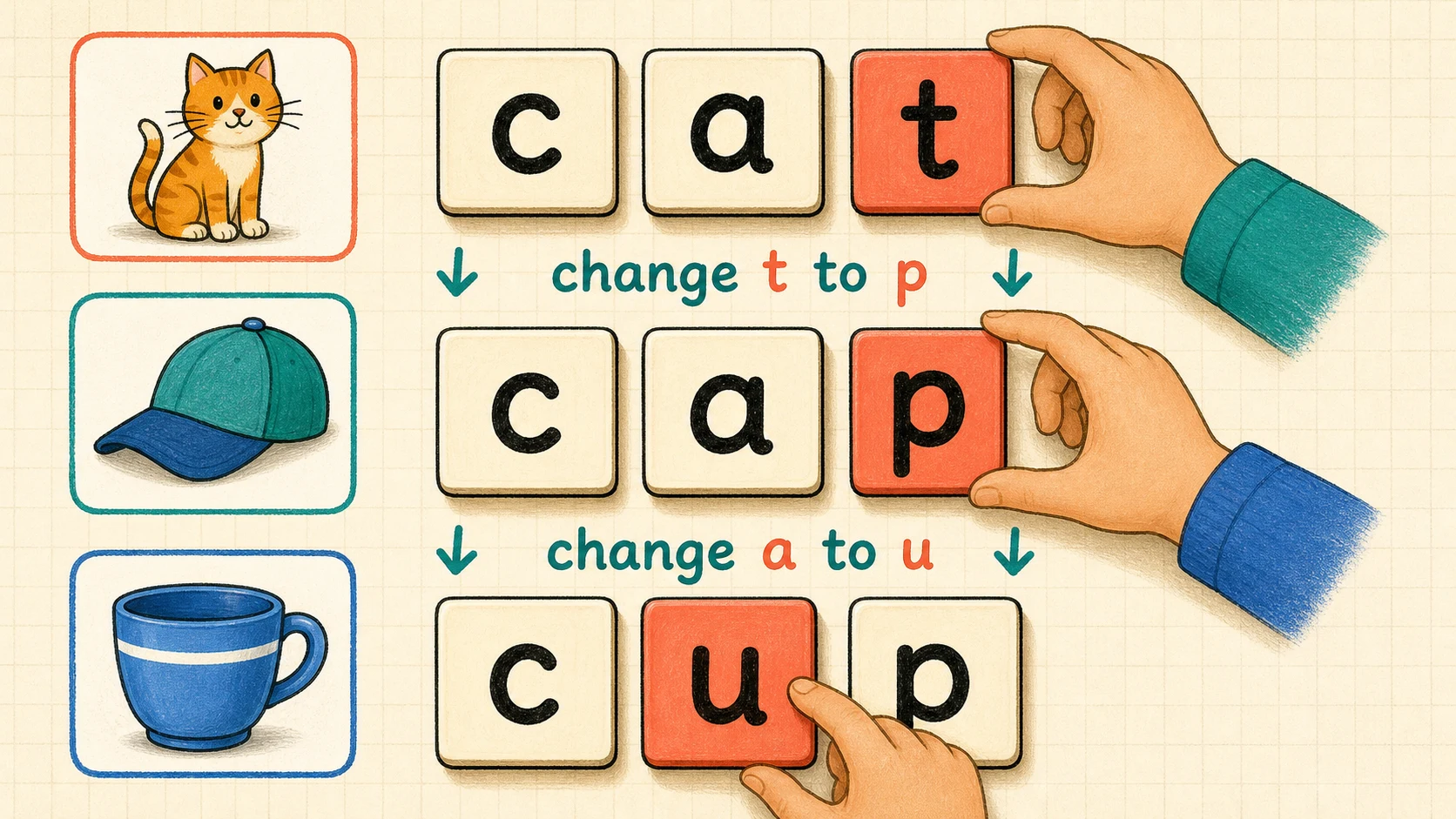
The routine moves from listening to modeling, guided practice, spelling, and a brief check.
A practical session can be brief. The suggested timings below are flexible; they are not a sourced or universal timetable.
Listen and review
Review two or three letter sounds needed that day. Then say one target word without showing it. Ask the learner to move three tokens while identifying the sounds.
Model one word
Build the word in sound boxes. Think aloud in plain language: “I hear /m/ first, so m goes here. I hear /a/ in the middle. I hear /p/ last.” Sweep beneath the word and blend it.
Practice a small word set
Guide the learner through three to five related words. Keep the vowel stable initially, and change one consonant where possible. Prompt with “first sound,” “middle sound,” or “last sound” instead of immediately supplying the letter.
Spell one or two words
Remove a word the learner just read. Say it aloud and ask the learner to rebuild it with movable letters. Writing is also appropriate when the learner can form the needed letters without the motor task overwhelming the phonics task.
The IES elementary writing guide includes spelling and handwriting fluency within broader elementary writing instruction. It is aimed at grades one through six, so it does not prescribe this Pre-K routine. It supports only the high-level point that spelling and handwriting matter; at this level, adults should separate sound knowledge from pencil-control demands when interpreting work.
End with a quick check
Present one practiced word and one closely related word. Record whether the learner read each independently, read after a prompt, or needed a model. Stop while attention remains productive rather than extending the session to meet an arbitrary number of items.
Choosing Practice That Matches the Learner
Practice should answer a teaching need. Before selecting a page or activity, identify the learner’s current obstacle.
| Observed need |
Suitable practice |
Avoid for now |
| Cannot separate three sounds |
Oral sound boxes with tokens |
A full written page |
| Knows sounds but cannot blend |
Finger-sweep blending with two or three words |
Large mixed word lists |
| Confuses the middle vowel |
Missing-vowel tasks with spoken targets or pictures |
Unexplained mixed vowels |
| Reads but cannot spell |
Movable-letter building after reading |
Heavy handwriting requirements |
| Memorizes familiar examples |
A few decodable nonsense CVC items |
Treating every hesitation as failure |
| Works accurately with support |
Brief independent items followed by review |
Removing all support at once |
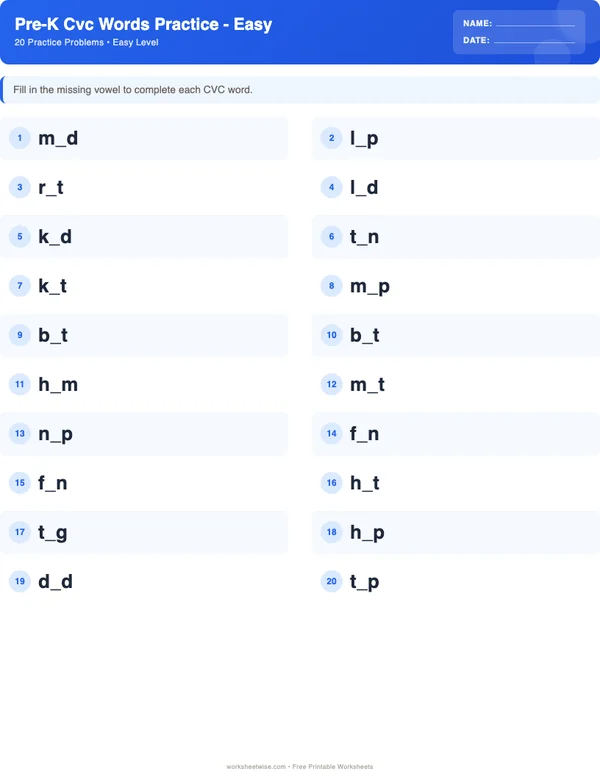
The free easy CVC worksheet contains 20 missing-vowel exercises and a separate answer key. It is most appropriate when the learner can hear the middle sound and understands the direction “Fill in the missing vowel.” It is not the best starting point for a learner who cannot yet segment a spoken word into three sounds.
Use only part of a page when that produces clearer information. Ten carefully observed responses can be more useful for planning than finishing 20 items with repeated guessing. The broader Pre-K worksheet hub provides alternatives when alphabet recognition, print direction, or fine-motor practice needs attention first.
Differentiation Without Changing the Core Skill
When the learner needs more support
Reduce the number of words and choices. Model one response, complete one together, and then ask the learner to try one. Keep the vowel constant and use consonants the learner already recognizes.
Let the learner point, move tokens, or arrange letters instead of requiring handwriting. Say the target word clearly when a picture could have more than one label. For example, a picture might be called cap or hat; the intended word should not depend on guessing the adult’s label.
When the learner is ready for more challenge
Mix two known short vowels, ask the learner to build a word after hearing it, or use a one-letter word chain. Add a small number of nonsense items to check decoding.
Challenge should preserve the simple CVC structure. Introducing digraphs, blends, long-vowel patterns, and irregular words simultaneously changes the skill being assessed.
For small groups
Listen to each learner respond. A group chorus can conceal whether one child is blending from print, following peers, or remaining silent. Rotate through quick individual turns while other learners build the same word with tokens or letters.
Diagnosing Common Errors and Misconceptions
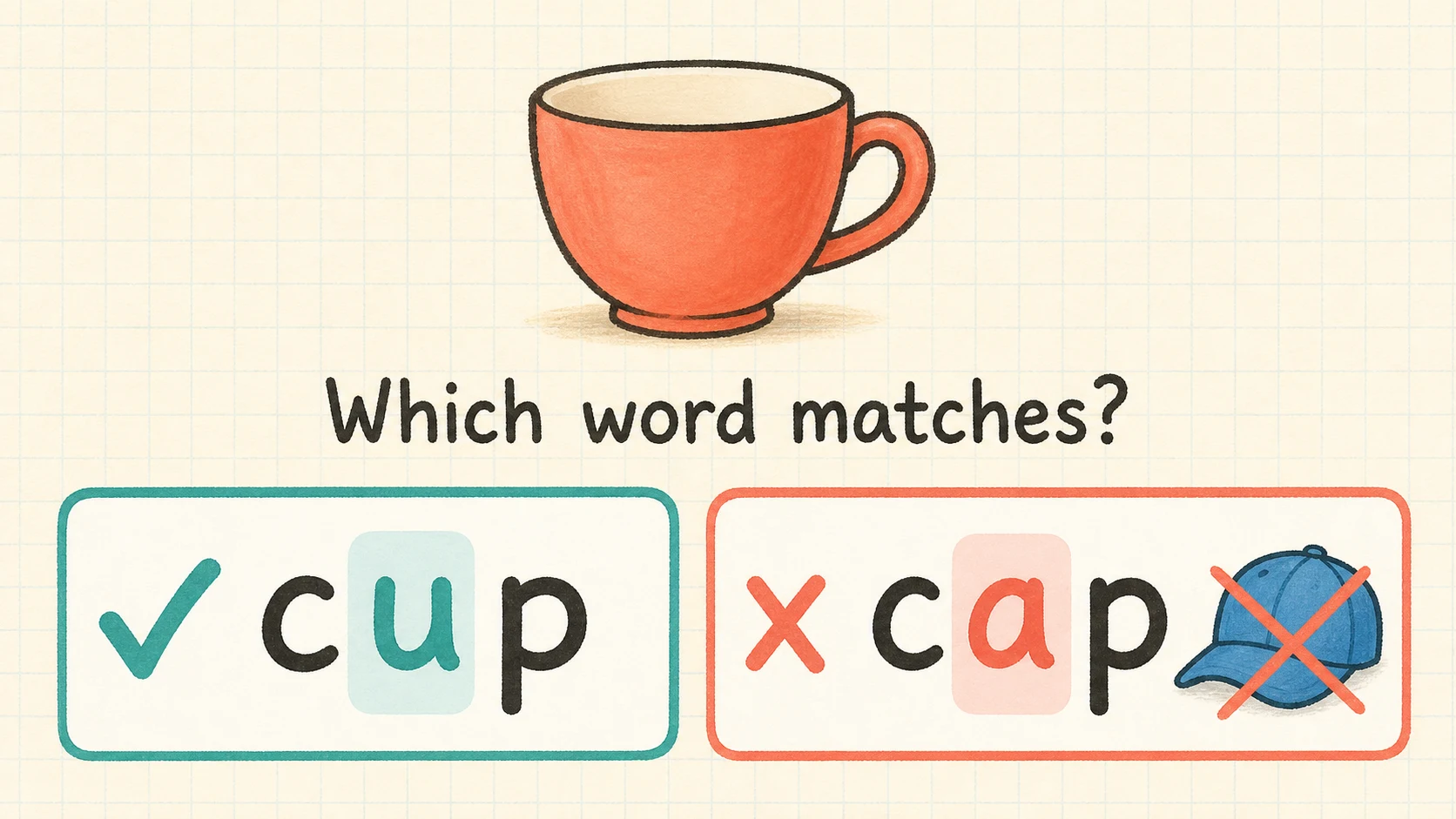
The same incorrect answer can arise from listening, letter knowledge, blending, vocabulary, or response-format difficulty.
The learner says separate sounds but not the word
A response such as “/m/ /a/ /p/” shows sound identification but not completed blending. Model the sounds with less space between them and sweep continuously beneath the letters. Ask, “What word do those sounds make?”
The learner omits the middle sound
If map becomes “mp,” return to oral sound boxes. Stretch the vowel and have the learner move a token into the middle box. Do not respond only with “Remember the vowel”; first establish whether the learner hears it.
The learner guesses from the first letter or picture
Cover the picture and guide attention through all three letters. Ask for the middle and final sounds before accepting a whole-word response. Then reveal the picture as a meaning check, not as the primary decoding strategy.
The learner adds “uh” to consonants
If m becomes “muh” and p becomes “puh,” the assembled sequence contains extra vowel sounds. Model the consonant sound cleanly, then connect it to the vowel.
The learner confuses short vowels
Contrast only two vowels at first. Build map and mop, say both words, and ask what changed. If the learner cannot hear the difference reliably, continue with oral comparison before assigning a mixed-vowel page.
The learner reads accurately but writes the wrong letter
Check whether the issue is letter formation, memory, or sound-letter matching. Let the learner choose from movable letters. Correct building with letters but inaccurate handwriting suggests that the phonics response and the motor response should be practiced separately.
A common misconception is that a completed page proves mastery. It does not. Pictures, repeated word families, adult prompts, and memorized items can all support correct answers. Observe how the learner reached the answer.
Monitoring Progress and Deciding What Comes Next
Record a small amount of useful information after practice:
- which letter-sound relationships were secure;
- whether the learner heard all three sounds;
- whether blending was independent or prompted;
- whether reading and spelling showed the same understanding;
- which short vowels were confused;
- whether the response format affected performance.
Use three simple labels: independent, prompted, and modeled. An answer is independent only when the learner completes it without a sound, letter, or word being supplied. A prompted response still shows progress, but it should not be recorded as independent.
Look for a pattern across several brief encounters rather than advancing after one successful word. Move ahead when the learner handles the current pattern with decreasing support. Step back when errors cluster around a prerequisite, such as hearing the middle sound. The learner’s observed work—not age alone, page completion, or a fixed calendar—should drive pacing.
A Flexible Two-Week Practice Plan
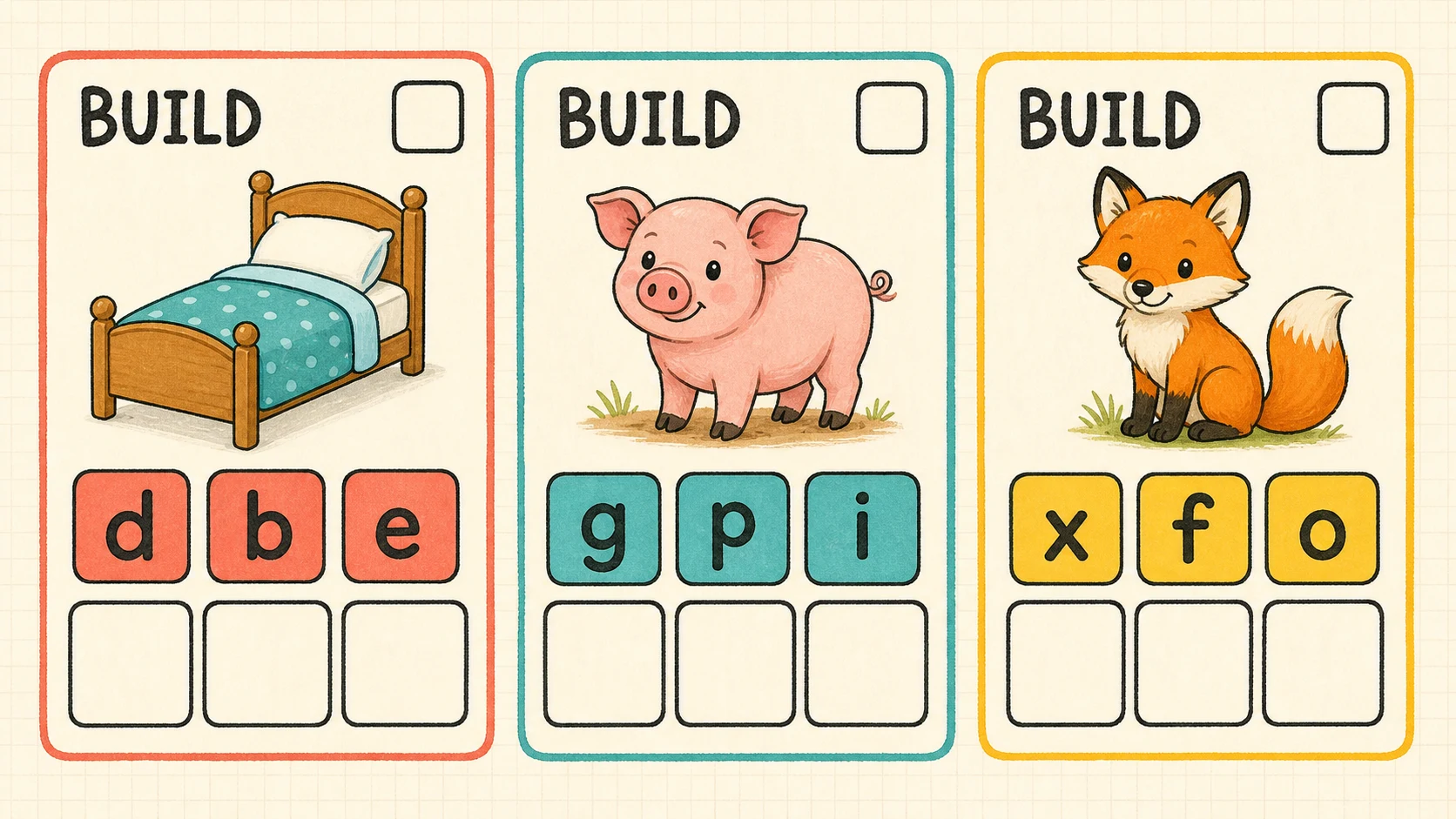
Each day revisits known material, introduces a small demand, and ends with evidence for the next decision.
This plan assumes the learner knows several consonant sounds and is beginning short-vowel work. Sessions may be shortened, repeated, or paused.
| Day |
Main focus |
Example activity |
Decision point |
| 1 |
Hear three sounds |
Tokens for cat, map, sad |
Does the learner represent three sounds? |
| 2 |
Match sounds to letters |
Build short a words in boxes |
Which letter-sound links need review? |
| 3 |
Blend short a words |
Sweep through cat, mat, map |
Are sounds connected into words? |
| 4 |
Read and rebuild |
Read tap; cover and spell it |
Does spelling preserve the sequence? |
| 5 |
Review |
Mix practiced short a words |
Which responses are independent? |
| 6 |
Introduce short i |
Compare map and sit orally and in print |
Can the learner hear the new middle sound? |
| 7 |
Practice short i |
Build pin, sit, fin |
Is the middle letter selected accurately? |
| 8 |
Contrast a and i |
Sort known words by middle vowel |
Is sorting based on sound and print? |
| 9 |
Change one letter |
cat → mat → map |
Can the learner explain what changed? |
| 10 |
Brief check and next step |
Read, build, and complete a few items |
Continue, review, or add another vowel? |
If short a remains difficult on Day 5, repeat that work rather than introducing short i because the table says to do so. If the learner handles both vowels accurately with minimal support, continue through short o, short u, and short e in later practice.
Limitations and the Honest Next Step
CVC practice addresses a narrow but important phonics structure. It does not by itself establish broad reading comprehension, vocabulary, fluent connected-text reading, handwriting fluency, or mastery of every spelling pattern. A child who reads cat may still need help understanding a sentence; a child who understands a spoken story may still be learning to decode its words.
Worksheets also cannot show everything an adult can notice during conversation and hands-on work. Use them alongside oral listening, movable letters, modeling, and brief individual observation. Neither the cited sources nor the catalogue claims that a particular page guarantees an outcome or provides comprehensive standards alignment.
The most useful next action is to model two short a words with sound boxes, then offer three to five missing-vowel items from the free Pre-K CVC Words worksheet. Record which answers are independent, prompted, or modeled. Use that evidence to choose the next lesson, explore the CVC Words topic guide, or create a smaller customized set with the free worksheet generators.