Kindergarten Addition: The Short Answer
Kindergarten Addition means learning to put together two groups and find how many objects there are altogether. A learner should first understand small quantities, count objects accurately, and recognize that the last counting word tells how many objects are in a group. Instruction can then move from physical objects to drawings and finally to equations such as 3+2=5.
A practical sequence is:
- Join real groups within 5.
- Describe the action with words such as “three and two make five.”
- Represent the groups with fingers, counters, drawings, or a five-frame.
- Connect the representation to + and =.
- Solve addition situations within 10.
- Begin efficient strategies, including counting on and noticing combinations that make 5 or 10.
- Practice independently only after the learner can explain what the numbers and symbols mean.
The learner’s observed work should determine the pace. A child who loses track while counting two groups needs more work with objects, not a longer page of equations. A child who models accurately but recounts every object may be ready to learn counting on.
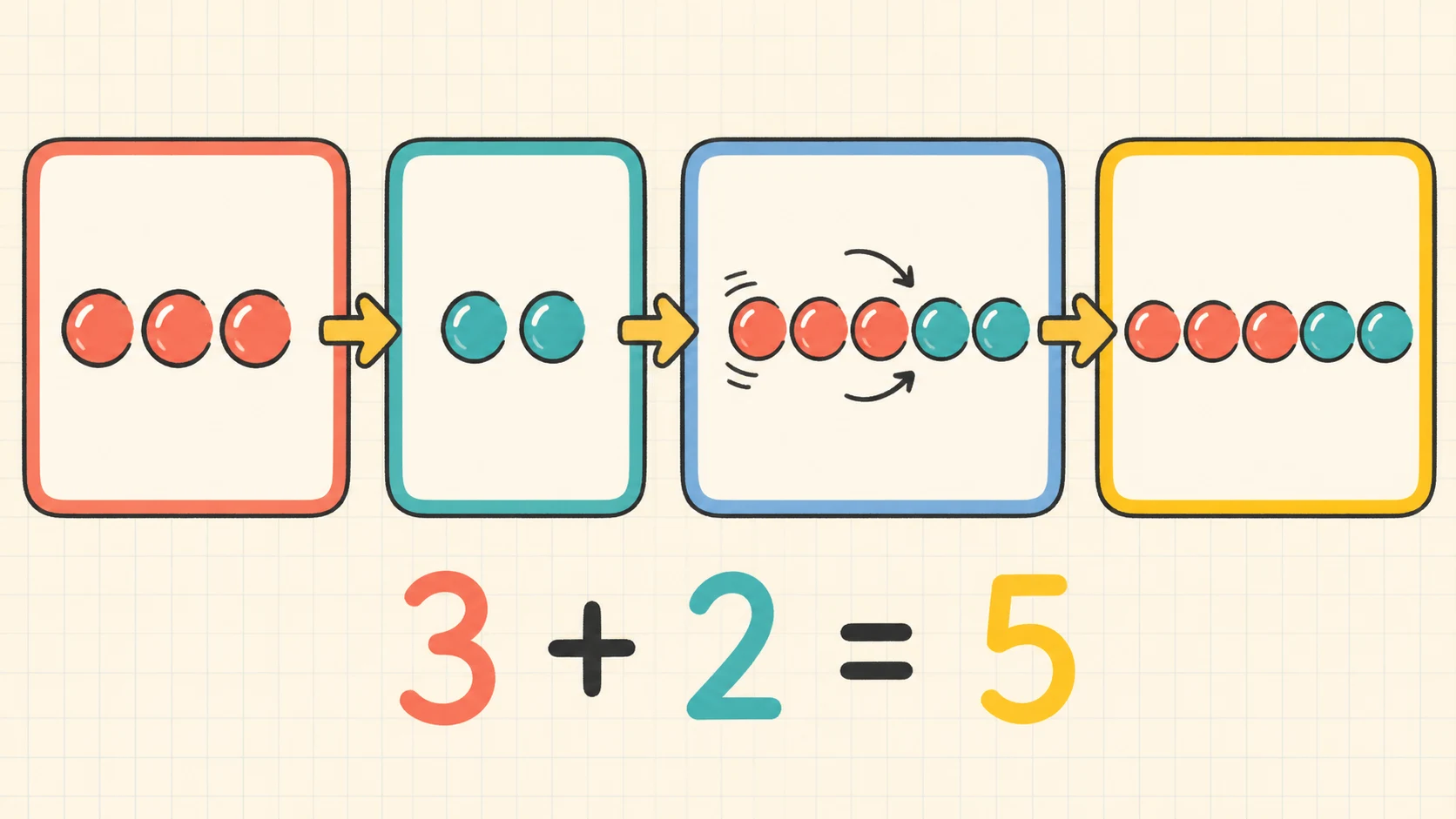
Addition develops through connected work with quantities, actions, representations, language, and symbols.
Grade labels describe the intended practice level, not a guarantee that every learner will follow the same sequence. Local curricula and classroom sequences differ. The Common Core State Standards for Mathematics provide one useful high-level frame: kindergarten learners represent addition with objects, drawings, explanations, and equations, solve addition situations within 10, and develop fluency within 5. Check local expectations before treating any sequence as a formal requirement.
What Addition Understanding Includes
Addition is more than producing an answer. A kindergarten learner is building several related ideas.
First, addition describes a relationship between quantities. If there are 2 red cubes and 3 blue cubes, joining them produces a total of 5 cubes. The cubes’ colors do not change the total, and rearranging them does not change how many there are.
Second, addition can describe an action. A learner may start with 4 toy animals and receive 2 more. The starting amount, added amount, and resulting total each have a role in the story.
Third, symbols record the relationship. In 4+2=6, the plus sign indicates that the two quantities are being combined. The equals sign states that the expression on one side has the same value as the quantity on the other. It does not mean “the answer comes next.”
Finally, addition can be solved in different valid ways. For 3+2, a learner might join counters, draw dots, show fingers, count on from 3, or recall that 3 and 2 make 5. Strategy choice should become more efficient over time without separating the symbols from their meaning.
Essential language
Use short, consistent sentences:
- “Two and three make five.”
- “Three more joined the group.”
- “There are five altogether.”
- “Three plus two equals five.”
- “The total is five.”
Introduce terms such as add, plus, equal, and total, but do not require vocabulary to replace a clear explanation. “I had three, put two more with them, and got five” shows meaningful understanding.
What addition is not yet
A kindergarten addition lesson does not need to become instruction in multi-digit addition, carrying, decimals, or formal algorithms. The broader addition progression eventually reaches those topics, but the immediate focus is small quantities, joining situations, representations, and equations within 10.
Making ten can begin as a visual relationship—for example, seeing that 8 needs 2 more to fill a ten-frame. It should not become a forced mental procedure before the learner understands the quantities involved.
Prerequisites to Check Before Teaching
A learner does not need perfect mastery of every counting skill before exploring addition. Still, several prerequisites make the work more accessible.
Counting and cardinality
Place 5 counters in an irregular arrangement and ask, “How many?” Watch whether the learner:
- touches or moves each counter once;
- says one number word for each object;
- uses the counting words in order;
- understands that the final word, “five,” names the total;
- gets the same total after the counters are rearranged.
If the learner double-counts or skips objects, practice organizing and counting sets before expecting reliable addition answers.
Recognizing and making small quantities
Show 1 to 5 dots briefly. The learner does not have to recognize every arrangement instantly, but should gradually become familiar with small quantities. Also ask the learner to make a requested set: “Please give me 4 counters.”
This ability matters because addition requires coordinating two quantities. If making a group of 4 is uncertain, combining 4 and 2 will be unnecessarily difficult.
Understanding “more” and “altogether”
Act out a simple event: place 2 bears on a mat, add 1 bear, and ask what happened. A learner who says “one” may be reporting only the added group. Contrast these prompts:
- “How many bears did I add?”
- “How many bears are there altogether?”
The distinction helps reveal whether the child understands the question, even when the counting itself is accurate.
Numerals and written symbols
Learners benefit from recognizing numerals 0 through 10, but a numeral-writing difficulty should not block oral or concrete addition. A child may correctly show 4+1 with counters while reversing the written numeral 5. Record conceptual understanding and writing accuracy separately.
Zero is an important boundary case. Adding zero means that no objects join the original group: 4+0=4. It does not mean that the entire quantity disappears.
A Grade-Appropriate Teaching Progression
The IES guide on teaching mathematics to young children supports high-level practices such as building instruction around developmental progressions, monitoring children’s mathematical knowledge, and helping them connect informal representations with mathematical language and notation. The following sequence applies that framing to the supplied kindergarten addition scope.
| Stage |
Learning focus |
Useful model |
Evidence of readiness to move on |
| 1. Join groups within 5 |
Experience addition as putting together |
Toys, counters, fingers |
Joins two groups and counts the total accurately |
| 2. Draw the action |
Preserve the two parts and total in a picture |
Dots, circles, simple sketches |
Drawing matches both quantities and the total |
| 3. Connect symbols |
Link a model to + and = |
Object groups beside an equation |
Explains what each numeral represents |
| 4. Solve varied situations within 10 |
Apply addition to short stories and pictures |
Ten-frame, number bond, drawing |
Selects both quantities and finds the total |
| 5. Count on |
Start with one quantity instead of recounting all |
Number path, fingers |
Starts at a known amount and counts the added amount |
| 6. Compose 5 and 10 |
Notice useful quantity relationships |
Five-frame or ten-frame |
Identifies the missing spaces or a familiar combination |
| 7. Mixed independent practice |
Choose and use a sound strategy |
Equations with optional drawing space |
Solves accurately and can explain at least one method |
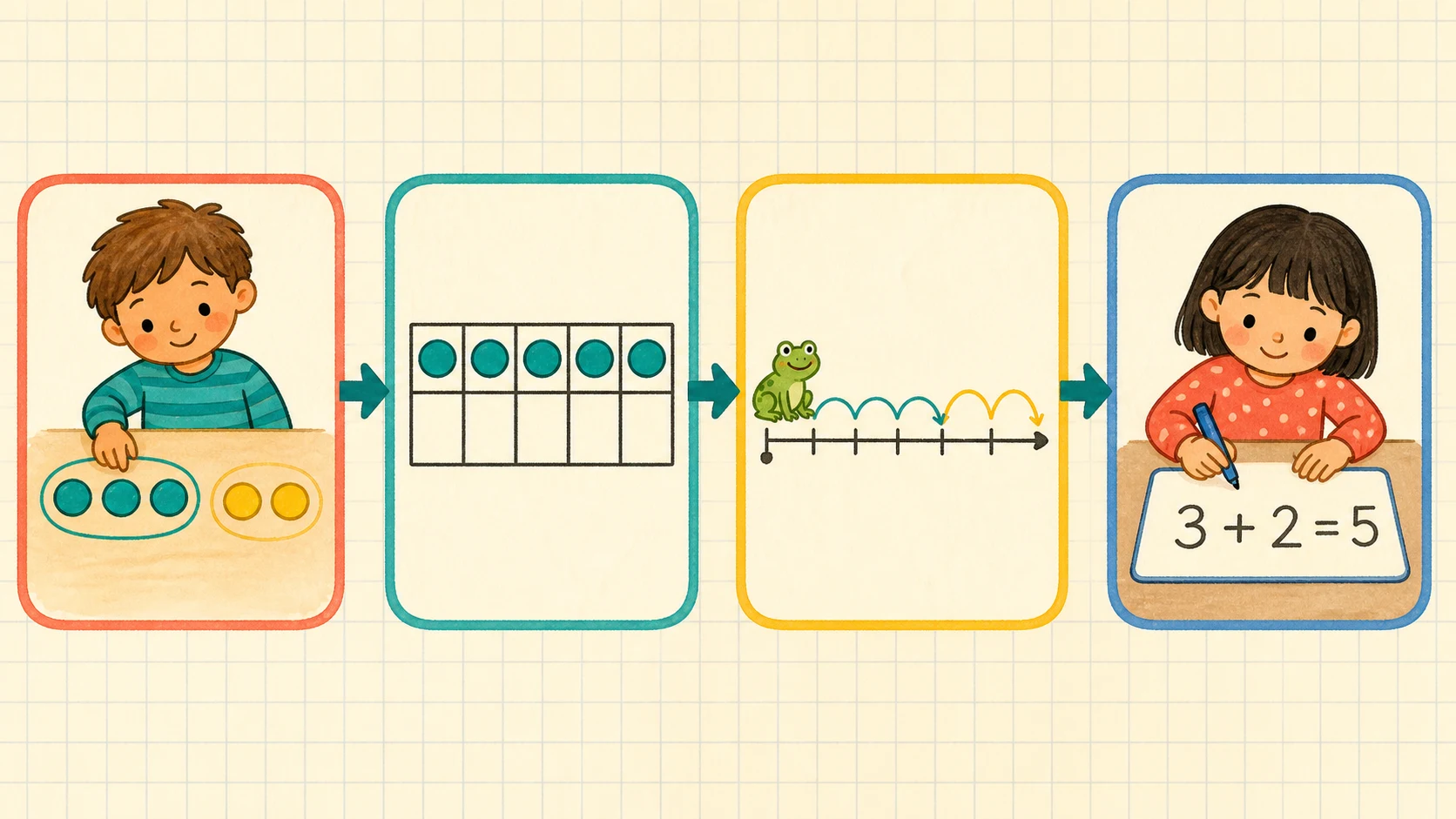
Move forward when the learner’s work is stable, and return to a clearer model when errors show that a connection is missing.
This table is an instructional path, not a universal timetable. Some learners may use equations early while still needing counters. Others may count on orally but need support interpreting story problems. Progress by evidence rather than age-based assumptions.
Concrete and Visual Models That Clarify Addition
Counters and everyday objects
Counters make the joining action visible. Use buttons, cubes, bottle caps, or small toys that can be moved safely.
For 2+3:
- Make a group of 2.
- Make a separate group of 3.
- Slide the groups together.
- Count the combined group.
- Match the action to 2+3=5.
Keep the two groups separate at first so the learner can see the parts. Joining them too soon can hide where each addend came from.
Fingers
Fingers are always available and work well for quantities within 10. Ask the learner to show 3 on one hand and 2 on the other, then determine how many fingers are raised altogether.
Finger use is a representation, not evidence of failure. Look instead at how it is used. A learner who raises the correct quantities and counts reliably is showing a meaningful method. Later, encourage noticing familiar patterns rather than repeatedly counting each finger.
Five-frames and ten-frames
A frame organizes quantity into fixed spaces. On a five-frame, 4 counters leave one space empty. This supports the relationship 4+1=5. On a ten-frame, 7 counters leave three empty spaces, making the combination 7+3=10 visible.
Fill frames consistently, usually from one end across a row. Random placement weakens the visual structure that makes the model useful.
Drawings and number bonds
Drawings should represent mathematical information, not artistic detail. For “3 birds were on a fence and 2 more arrived,” three circles and two additional circles are sufficient.
A number bond records the relationship between two parts and a whole:
At this level, use number bonds after the learner has physically joined or drawn groups. The diagram should summarize an understood relationship rather than become an unexplained template.
Number paths
A number path shows whole-number spaces in order. To solve 4+2, place a marker on 4 and move two spaces: 5, 6. The landing number is 6.
Count moves, not printed numerals. A learner who points to 4 and calls it “one” has counted the starting position as a jump. Model the difference by placing the marker on 4 before saying any counting-on numbers.
Fully Checked Worked Examples
Example 1: Joining objects within 5
Problem: Mia has 2 blocks. She gets 3 more blocks. How many blocks does she have altogether?
Make the starting group:
●●
Add the new group:
●●●
Join and count:
●●●●●
There are 5 blocks, so:
2+3=5
Check by counting every object once: 1, 2, 3, 4, 5. The answer is 5.
This example distinguishes the 3 new blocks from the total of 5. Ask both “How many were added?” and “How many are there altogether?” if those ideas are being confused.
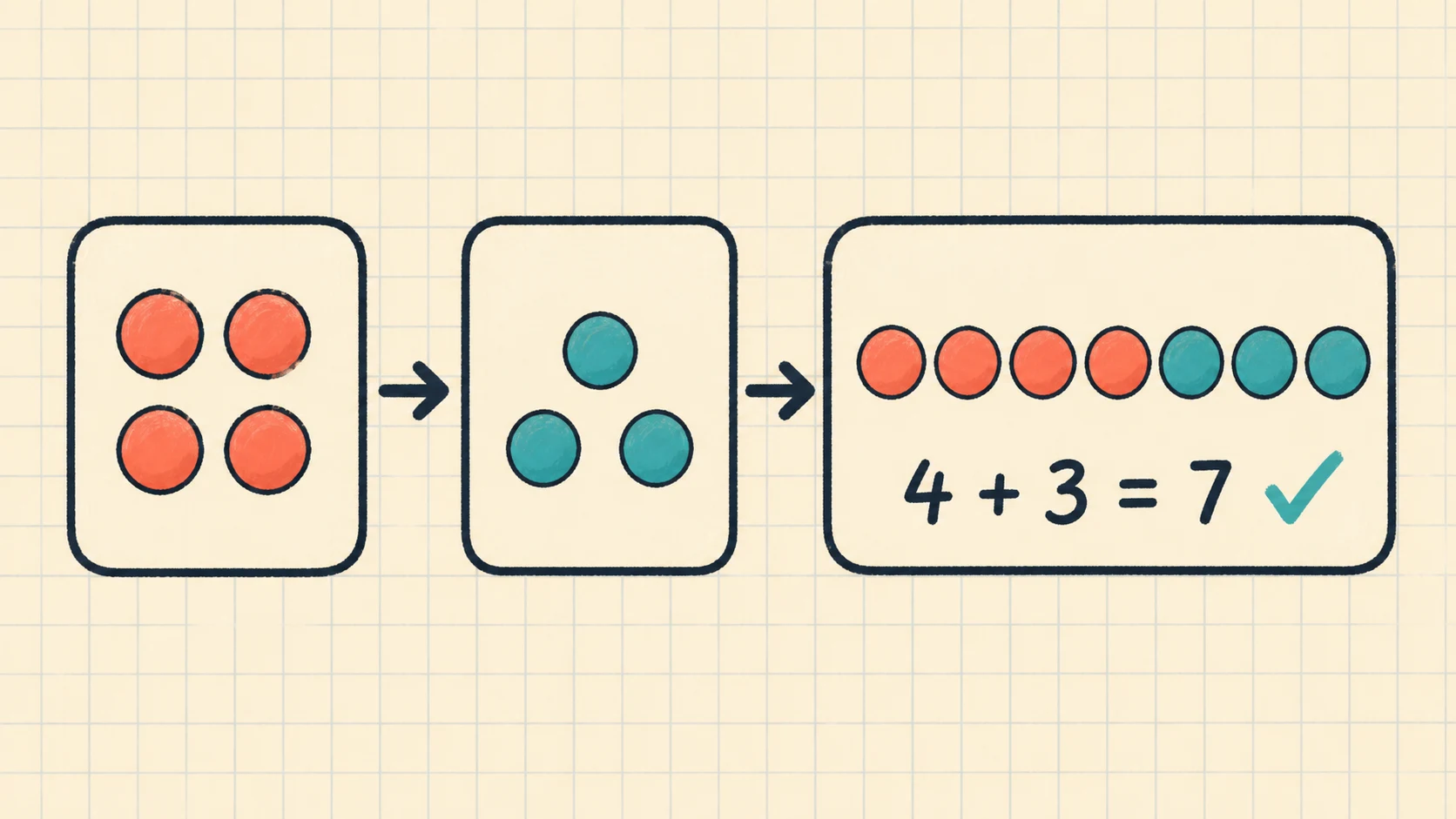
The objects, spoken explanation, and equation should describe the same joining action.
Example 2: Counting on within 10
Problem: Find 5+3.
Keep 5 as the known starting quantity. Count three more numbers:
- One more: 6
- Two more: 7
- Three more: 8
Therefore:
5+3=8
Check with quantities: a group of 5 joined to a group of 3 contains 5+3=8 objects.
A common boundary error is saying “5, 6, 7” and answering 7. That counts 5 as the first added amount. The correction is: “Start at 5. The first move lands on 6.”
Example 3: Completing a ten-frame
Problem: A ten-frame contains 8 counters. Two counters are added. How many counters are there now?
Eight occupied spaces leave two empty spaces. Adding 2 fills those spaces:
8+2=10
Check by decomposition: 8+1=9, and one more makes 10. Thus 8+2=10.
This is an appropriate introduction to making ten because the frame supplies the reasoning. The learner can see why 2 completes 10 rather than memorizing an isolated rule.
Example 4: Addition in either order
Problem: Compare 2+4 and 4+2.
First equation:
2+4=6
Second equation:
4+2=6
Both totals are 6. Two counters followed by four counters contain the same total as four followed by two.
This example helps a learner notice that the order of the two groups does not change the total. However, the story’s order may still matter when describing what happened: starting with 2 and receiving 4 is a different sequence of events from starting with 4 and receiving 2.
Example 5: Adding zero
Problem: Find 6+0.
Start with 6 counters. Add no counters. The group still contains 6:
6+0=6
Check: no object was added and none was removed. Zero is an amount, and adding that amount leaves the starting quantity unchanged.
Example 6: A missing result
Problem: Four frogs sit by a pond. Three more frogs arrive. Write and solve an equation.
The quantities being joined are 4 and 3:
4+3=□
Count on from 4: 5, 6, 7.
4+3=7
Check with the related order: 3+4=7. Both methods confirm the total.
A Short, Repeatable Lesson Routine
Keep a focused session brief enough that the learner remains attentive. Duration should respond to the learner’s work; it is not necessary to continue simply because a fixed number of minutes has not passed.
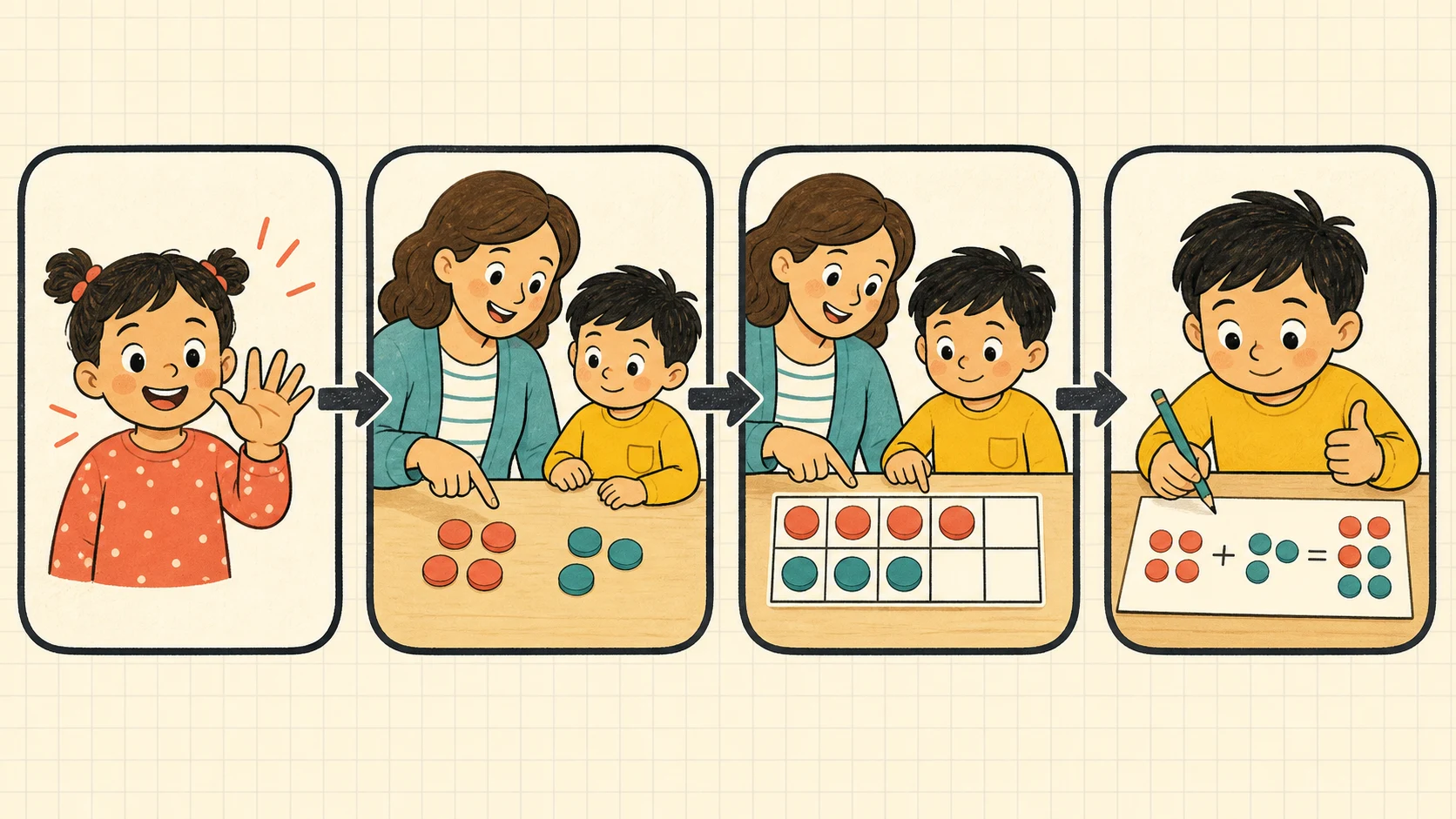
Use the same lesson structure while changing the quantities, stories, and level of support.
1. Revisit a known quantity
Spend a short opening moment counting or recognizing groups within 5 or 10. For example, show 4 counters and ask the learner to make the same quantity.
2. Model one addition situation
Tell a one-sentence story and act it out. Think aloud briefly: “I have 3. I add 2 more. Now I count the joined group.”
Avoid demonstrating several strategies at once. One clear model is easier to connect to the equation.
3. Solve together
Give a parallel problem. Let the learner move the objects while explaining the action. Ask prompts such as:
- “What amount did you start with?”
- “How many joined?”
- “What does the total tell us?”
- “Where do you see each number in the equation?”
4. Try a small independent set
Use three to five carefully selected items, not a large mixed page. Include an easy item, one similar to the model, and one that reveals whether the learner can transfer the idea.
5. Close with explanation and correction
Ask the learner to explain one answer using objects, a drawing, or words. Correct misconceptions immediately with a simpler representation. End with a problem the learner can solve successfully without being told the answer.
Choosing Effective Practice
Practice should match the learner’s current representation level and the purpose of the lesson.
Use object-based tasks when the child cannot yet explain joining. Use pictures when objects are understood but equations remain disconnected. Use equation practice when the learner can interpret the symbols and produce or describe a model.
The Kindergarten math collection can help adults compare practice across the subject, while the Kindergarten Addition topic page keeps the selection focused on this operation.
What to look for in a practice set
Choose work that has:
- quantities within the learner’s reliable counting range;
- enough visual space to draw or use counters;
- a consistent direction that the learner can understand;
- a manageable number of problems;
- an answer key for checking accuracy;
- a clear step up from supported to independent work.
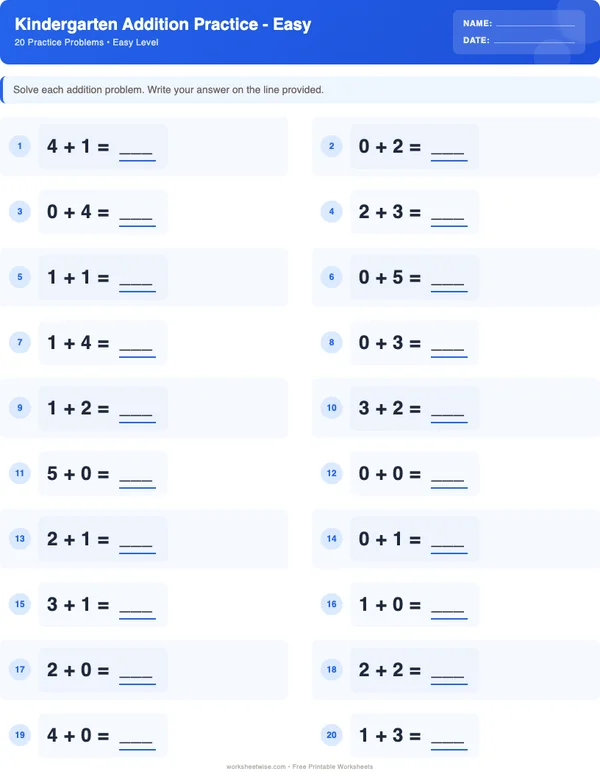
The free easy-level worksheet contains 20 exercises and includes a separate answer key. Twenty items may be suitable as a source of problems without being the required amount for one sitting. Select a smaller subset if attention, counting accuracy, or explanation quality declines.
How to sequence problems
For an emerging learner, begin with totals within 5, including 1+1, 2+1, and 3+2. Then add problems within 10 where one addend is 1 or 2. Next, mix combinations and include zero.
Do not increase number size and representation difficulty simultaneously. If moving from counters to written equations, keep the quantities familiar. If introducing larger totals, retain the known model.
Timed fact practice should come only after conceptual understanding and dependable strategies are present. Speed alone cannot show whether a learner understands addition.
Differentiation Without Changing the Core Idea
When the learner needs more support
Reduce the quantity range to totals within 5. Use two colors of counters, one color for each addend. Let the learner slide groups together and physically organize them before counting.
Present one problem at a time. Read story problems aloud if decoding the text would interfere with showing the mathematics. Permit pointing, oral explanations, and object models when numeral writing is still developing.
The IES guide for assisting students who struggle with mathematics supports high-level use of systematic instruction, clear mathematical language, representations, and deliberate practice. Applied here, that means using a stable routine, making each connection explicit, and checking understanding before removing support.
When the learner is ready for more challenge
Keep the total within 10 but increase the reasoning demand. Ask the learner to:
- show two ways to make 7;
- find a missing addend with counters, as in 5+□=8;
- decide whether two models show the same equation;
- correct an intentionally inaccurate drawing;
- solve 3+5 and 5+3, then compare the totals;
- write a short story for 4+2=6.
These extensions deepen relationships without rushing into inappropriate multi-digit work.
When performance is inconsistent
Alternate a known problem with a less secure one. Compare success across representations. If 4+2 is correct with counters but incorrect as an equation, the issue is probably not the joining action; the symbol connection needs attention.
Also separate mathematical errors from task-access problems. A learner might know the total but forget where to write it, reverse a numeral, or stop because the page contains too many items. Record what the learner demonstrated rather than reducing every difficulty to “does not know addition.”
Common Errors and Diagnostic Responses
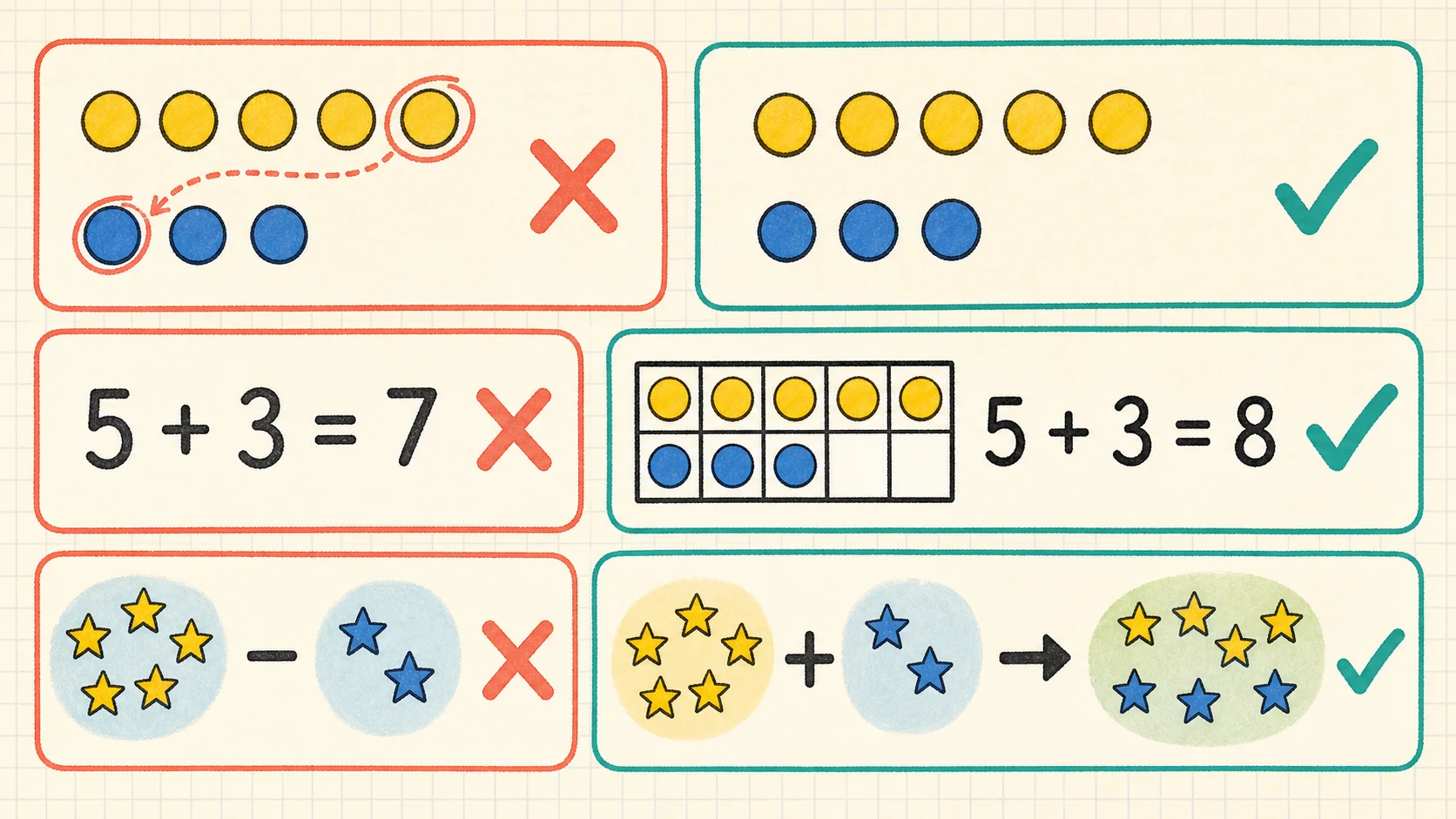
Treat an incorrect answer as evidence about the learner’s current method, then choose the smallest useful teaching response.
| Observed work |
Likely point of difficulty |
Teaching response |
| Counts one object twice |
One-to-one counting is unstable |
Move each counted object into a new row |
| Gives the second addend as the answer |
Confuses the added amount with the total |
Ask separately, “How many joined?” and “How many altogether?” |
| Answers 4+2=5 after saying “4, 5” |
Counts the starting number as a move |
Place a marker on 4, then make two visible moves to 5 and 6 |
| Writes 3+2=32 |
Treats numerals as digits to place side by side |
Rebuild both groups and join them physically |
| Says 5+0=0 |
Applies an overgeneralized idea about zero |
Start with 5 objects and visibly add nothing |
| Recounts all for every problem |
Counting is meaningful but not yet efficient |
Model counting on with one small addend |
| Solves equations but misses story problems |
Has difficulty identifying the action or quantities |
Act out the story before writing the equation |
| Gets a different total after rearrangement |
Cardinality is not secure |
Count, rearrange, predict, and recount the same set |
| Writes the right total for an incorrect drawing |
May be recalling a fact without matching the model |
Ask the learner to identify each addend in the drawing |
| Stops accurately solving late on the page |
Practice load may exceed productive attention |
Use fewer items and compare early and late accuracy |
Do not diagnose from one answer. Ask the learner to show the method and try a nearby problem. A repeated pattern provides more useful evidence than an isolated slip.
Monitoring Progress and Deciding What Comes Next
Monitor strategy, explanation, and accuracy together. A simple observation record can include:
- quantity range attempted;
- representation used;
- whether objects were counted once each;
- whether the learner identified both addends;
- whether the learner found the total;
- whether the equation matched the model;
- whether help was needed;
- whether the strategy was efficient for that problem.
Sample three kinds of tasks: a joining story, a visual model, and a bare equation. Success on only one format suggests that the connections between formats still need attention.
Move ahead when the learner repeatedly solves similar problems, explains what the quantities mean, and handles a small change in presentation. Return to a prior model when accuracy depends on guessing, the symbols cannot be explained, or counting breaks down.
Fluency within 5 means more than fast recitation. In the supplied kindergarten scope, it is an intended outcome, but teaching should still preserve meaning. A learner may reach an answer through a known combination, a visual pattern, or a short count-on method before recall becomes immediate.
A Two-Week Practice Plan
This plan is a flexible example, not a universal timetable. Each session can use a few well-chosen problems. Shorten, repeat, or pause a day according to the learner’s observed work.
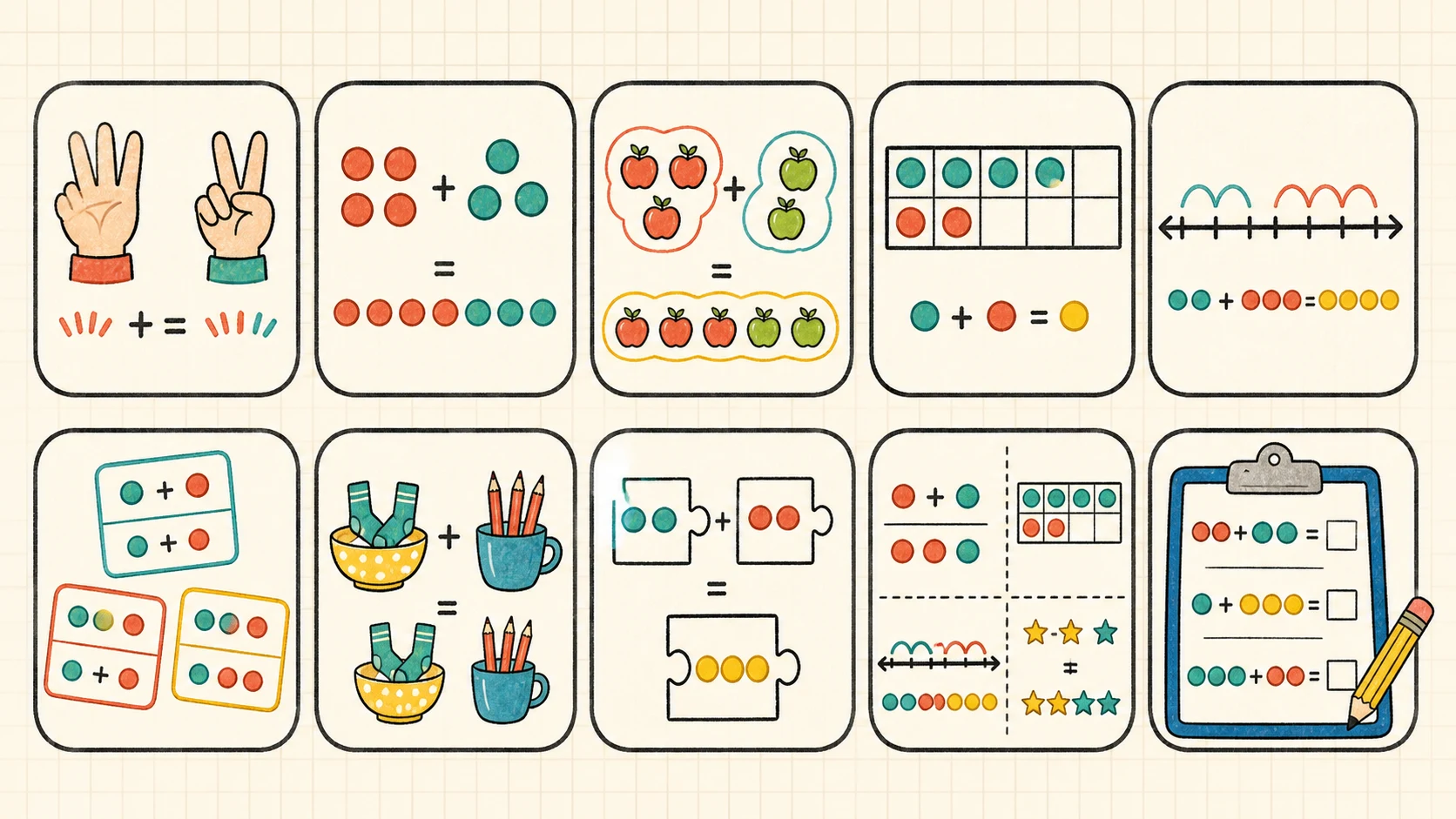
Across two weeks, revisit the same core idea through objects, pictures, language, and equations.
| Day |
Main focus |
Suggested activity |
What to observe |
| 1 |
Join within 5 |
Combine two counter groups |
Accurate one-to-one counting |
| 2 |
Addition language |
Act out “more” and “altogether” stories |
Distinguishes added amount from total |
| 3 |
Draw joined groups |
Replace counters with dots |
Drawing matches both addends |
| 4 |
Connect equations |
Match three models to equations |
Explains + and = in context |
| 5 |
Review within 5 |
Mix objects, pictures, and equations |
Stable understanding across formats |
| 6 |
Add 1 or 2 within 10 |
Use a number path or fingers |
Counts moves rather than starting point |
| 7 |
Ten-frame structure |
Fill spaces to make 10 |
Notices empty spaces and total |
| 8 |
Zero and order |
Compare 5+0, 2+4, and 4+2 |
Handles boundary cases accurately |
| 9 |
Story problems |
Model three short joining situations |
Selects relevant quantities |
| 10 |
Independent check |
Complete a small mixed set and explain two answers |
Accuracy, independence, and reasoning |
After Day 5, review the record. If the learner still confuses an addend with the total, repeat concrete joining rather than moving to larger quantities. After Day 10, decide among three next steps:
- continue within 5 for greater stability;
- practice varied addition within 10;
- explore missing parts or combinations that make 10.
Limitations and an Honest Next Step
A worksheet cannot by itself show whether a learner understands joining, counted accurately, copied an answer, or used an unsuitable strategy. Written work is most informative when paired with a brief explanation or demonstration. It also cannot determine a child-specific intervention, certify mastery, guarantee an outcome, or establish comprehensive alignment with every local curriculum.
The sequence in this guide stays within the supplied kindergarten addition scope. It does not replace local instructional requirements or individualized professional evaluation. Grade placement, lesson length, and the number of practice items should remain responsive to observed work.
For the next session, choose three to five items from the free easy Kindergarten Addition worksheet. Let the learner use counters, ask for an explanation of one answer, and record whether the model, equation, and total agree. If that small sample is secure, continue with a varied selection from the Kindergarten Addition pack; if it is not, return to joining two physical groups within 5.