Curated collectionAnswer keys includedPrint-ready PDFs
Worksheets for 4-Year-Olds: Printable Practice Guide
Short routines that connect pictures, spoken language, quantities and early pencil control without turning preschool into desk work.
Start with a real resource
Browse this worksheet collection
5 relevant free entry points are available. Each one includes a printable learner PDF and separate answer key.
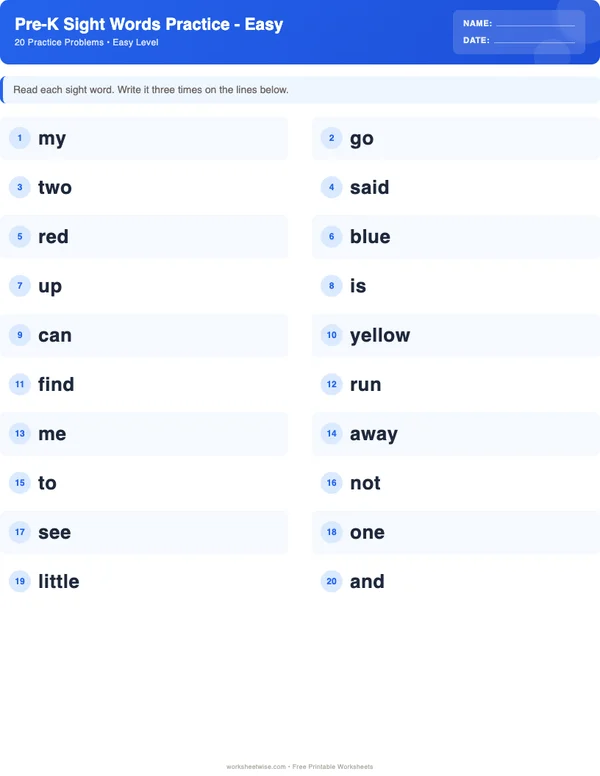
A useful practice loop
Print less. Observe more.
- Choose one skill and model the first item aloud.
- Use a short set and notice the learner’s strategy.
- Change the next task from the work you can see.
Need more than the free sheet?
Plus includes all 90 matching catalogue variations where available, plus saved deterministic generators and the worksheet designer.
See Plus membershipComplete guide
How to teach and practise worksheets for 4 year olds
3,497 words Updated 6 instructional visuals
Choose worksheets by what the child can do today
Worksheets for 4-year-olds are most useful as brief prompts for talking, counting objects, matching pictures, hearing sounds, and making a few purposeful pencil marks. At this age, prioritize adult-led oral, matching, manipulative, and movement work over desk work. A page should support an active experience, not replace one.
Age is a discovery aid rather than a placement decision. Two 4-year-olds may need very different entry points, and the same child may count confidently while finding letter-sound work tiring. Choose from the full worksheet library by observing the task in front of the child, not by treating the age label as a verdict.
The current WorksheetWise catalogue for this age page contains 90 Pre-K variants across two subjects and five topics. Five free entry points cover counting, CVC words, short vowels, word families, and sight words. Those are catalogue facts, not a claim that every 4-year-old should complete all five topics. Grade labels describe the intended practice level; local curriculum sequences differ.
For the first attempt, ask:
- Can the child understand the direction after you demonstrate it?
- Can the child answer orally, point, move an object, or match pictures before writing?
- Does the page contain enough familiar material for the target skill to be visible?
- Can you finish a meaningful part in about five minutes?
- Does the child remain willing to talk, touch, count, or try?
If most answers are yes, continue briefly. If the child understands the idea but the page demands too much writing, preserve the idea and change the response method. If the child cannot yet demonstrate the idea with speech, pictures, or objects, simplify before returning to paper.
What “easy” means on these Pre-K sheets
The five free catalogue sheets are labeled “easy,” but that word describes intended task difficulty, not a type of learner. Difficulty should be interpreted through observable task features.
A relatively accessible Pre-K task may have familiar pictures, one operation repeated across several items, small quantities, a visible model, limited visual clutter, or a response that requires pointing or one short mark. A more demanding version might mix several directions, remove picture support, require the child to hold multiple sounds in memory, use larger or scattered sets, or add substantial handwriting.
The free sheets each contain 20 problems. That is a page specification, not a recommended sitting length. A 4-year-old might complete three useful items and stop. Cover the rest of the page with another sheet of paper, cut the page into strips, or mark only the items chosen for that session.
Use a quick entry check
Before presenting the whole sheet, recreate one item without requiring a pencil.
For counting, place four buttons on the table and ask, “How many?” If the child points to each button once and gives the total, try one pictured item on the sheet. If the child recites “one, two, three, four” but touches one button twice, stay with movable objects.
For short vowels, show or name a familiar picture such as apple and ask for the first sound. If that oral task is unclear, do not make handwriting the next demand. Say the sound together, act out the catalogue’s suggested apple cue, and compare it with one other sound.
This check prevents a worksheet error from being mistaken for a skill error. A child may understand the spoken task but be unable to manage the page layout, pencil, or symbol choices.
Observe the work, not just the final mark
A correct circle or written answer tells only part of the story. Watch how the child reaches it.
For each short session, notice four things:
- Understanding: Does the child know what the direction asks?
- Representation: Can the child connect a real object, picture, spoken word, and printed symbol?
- Control: Can the child point, move, circle, draw, or write with manageable effort?
- Regulation: Does the child remain engaged, ask for help, rush, freeze, or leave?
These observations guide the next decision. They are not diagnoses.
Separate concept knowledge from pencil control
Suppose a child sees five pictured stars, counts them correctly, says “five,” and then writes a reversed or unrecognizable numeral. The counting concept is visible even though numeral formation needs support. Let the child select a numeral card, stamp a 5, or trace one large model. Do not replace counting practice with repeated numeral copying.
Now reverse the pattern: a child neatly traces the numeral 5 but cannot match it to five objects. More tracing will not address the counting need. Return to a set the child can move and touch.
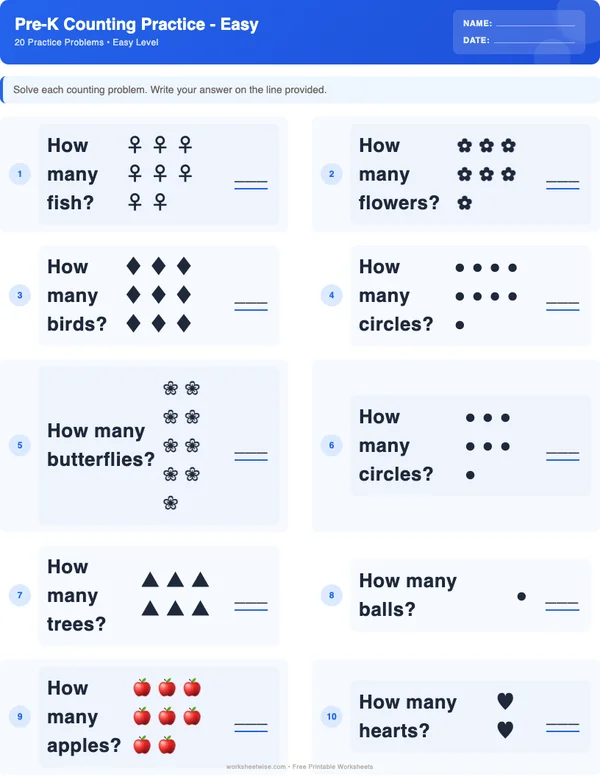
The Pre-K Counting guide and free sheet provides the relevant catalogue entry point, but the adult still decides how many items to reveal and how the child may answer.
Listen for whether language is carrying the task
A child may know which picture matches but not know the word you used in the direction. Ask the child to name the pictures first. If an image is unfamiliar, supply its name without turning vocabulary retrieval into the test.
Similarly, a child who identifies the first sound in sun may not yet understand “short vowel,” “middle sound,” or “word family.” Use concrete language: “Listen to the middle of sun: /ŭ/. Which picture has the same middle sound?”
The NAEYC principles of developmentally appropriate practice emphasize using knowledge of child development together with knowledge of the individual child and the child’s context. Applied here, that means the age filter can help an adult browse, while observed responses determine the actual task.
A five-to-eight-minute paper-and-play routine
A dependable routine matters more than the number of items completed. Keep materials ready: one worksheet, a few counters or letter tiles, a crayon or thick pencil, and a blank card for covering unused items.
1. Begin away from the page
Spend one or two minutes with speech, movement, or objects. Count four toy animals as the child moves each one into a “barn.” Say three picture names and clap when two rhyme. Stretch a CVC word orally while sliding three counters. Trace a large curve in the air before making it on paper.
This opening makes the target visible without adding page navigation or handwriting.
2. Model one complete item
Say what you are doing in plain language. For a set of three dots: “I touch each dot once: one, two, three. There are three. I circle 3.” Then ask the child to help with the next item.
For a word-family match: “I hear the end of cat: /at/. Hat ends with /at/ too, so these match.” Avoid lengthy explanations while the child waits.
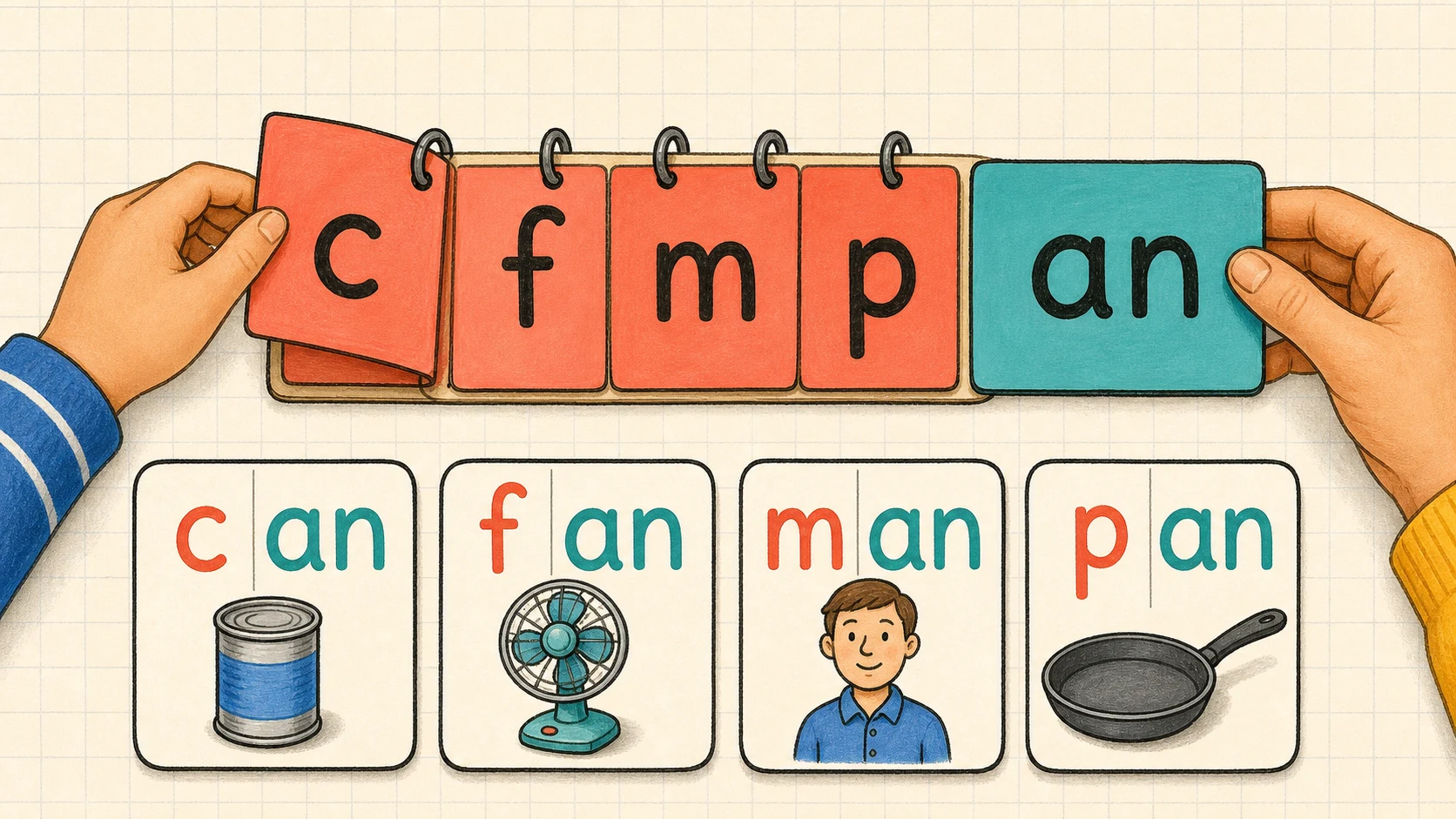
Use the routine as a short cycle—hear, build, match, mark, and stop—not as permission to fill an entire 20-problem page.
3. Let the child respond actively
Accept pointing, moving a counter, placing a tile, saying an answer, or making one mark when those responses preserve the target skill. If the target is hearing whether cat and hat rhyme, circling is incidental. If the target is early pencil control, however, replace a tiny circle with a larger path rather than removing the pencil entirely.
4. Check one transfer item
Change the surface while keeping the idea. After counting four pictured apples, ask the child to give you four blocks. After building cat, swap the first sound to make mat. Transfer helps reveal whether the child followed the concept or merely copied the model.
5. End while participation is still intact
Finish with a concrete statement: “You touched each bear once and found four,” or “You heard /ă/ in cat and map.” Avoid vague praise about being smart or promises about future achievement. Record one next step, such as “repeat scattered sets of four” or “contrast /ă/ and /ĭ/ orally.”
Counting: connect objects, pictures, and quantities
The catalogue’s Pre-K counting resource focuses on concrete objects, pictured sets, number sequences, missing numbers, and counting sets. For a 4-year-old, begin with quantities that can be physically organized. Moving each object supports one-to-one correspondence and makes double-counting easier to notice.
IES guidance on teaching math to young children recommends building children’s understanding through developmental progressions, monitoring what they know, and teaching them to view and describe their world mathematically. That supports a sequence from objects to pictures to numerals, but it does not prescribe a particular WorksheetWise page.
Checked example: count four buttons
Place four buttons in a scattered arrangement. Ask the child to move each button into a cup while saying one number for each move. Then place the buttons beside a pictured set of four on the worksheet and ask, “Do these groups have the same number?”
This example belongs here because it connects a concrete set, spoken number words, a pictured quantity, and an optional written numeral—the exact bridge the age-page thesis calls for. The answer is four because there are four discrete objects, each counted once. Rearranging them does not change the quantity.
If the child counts “one, two, three, four” accurately but says “five” when asked how many, repeat with three objects and emphasize that the last count word tells the total. If the child double-counts scattered objects, line them up or move each one. If the child succeeds, try four objects in a new arrangement before increasing the quantity.
Movement can extend the same idea: make four jumps, place four beanbags, or clap four times. These are suggestions for preserving the counting target, not sourced claims about guaranteed learning effects.
CVC words: begin with sounds and movable letters
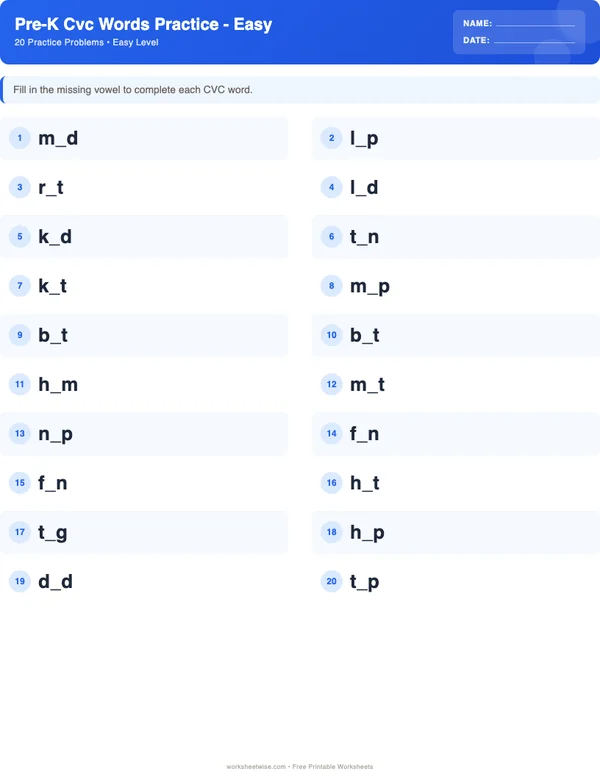
CVC words contain a consonant, vowel, and consonant, as in cat, pin, and hug. The catalogue includes picture matching, word building, missing-letter, and reading activities across the five short vowels. A child should first be able to participate in an oral sound task; printed letters should not be the only route into the activity.
The IES guide on foundational reading skills recommends teaching learners to connect sounds with letters and to decode words. It also places this work within a broader progression that includes awareness of sound segments and daily connected-text reading. It should not be read as evidence that a specific age or worksheet volume fits every child.
Checked example: build and change cat
Say cat slowly. Place one counter for /k/, one for /ă/, and one for /t/. Sweep beneath the counters and blend the word: cat. Replace the counters with the letters c, a, and t. Then replace c with m to make mat.
The check is exact: cat has three phonemes in this simple instructional analysis—/k/ /ă/ /t/—and mat changes only the initial consonant sound. This example belongs on a guide for 4-year-olds because the child can hear, move, and match before being asked to write. It also reflects the catalogue’s CVC word-building context.
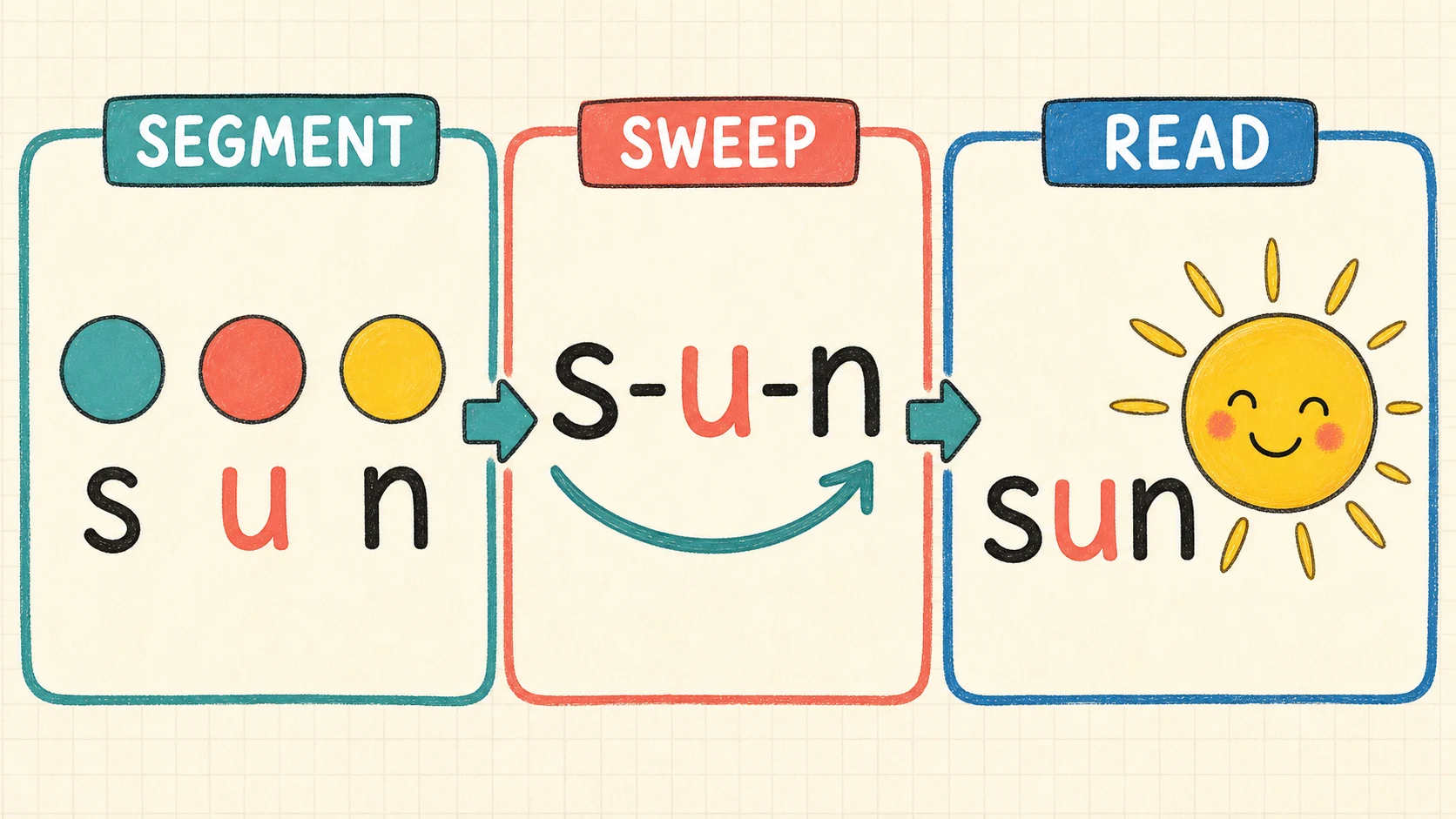
Move from three spoken sounds to three counters, then to letters; the written response is the final representation, not the starting demand.
Use the Pre-K CVC Words guide and free sheet when the child can attend to all three sounds with support. If the child guesses from a picture without looking at the letters, cover the picture after naming it and rebuild the word. If blending three sounds is not yet workable, return to identifying the first sound in familiar spoken words.
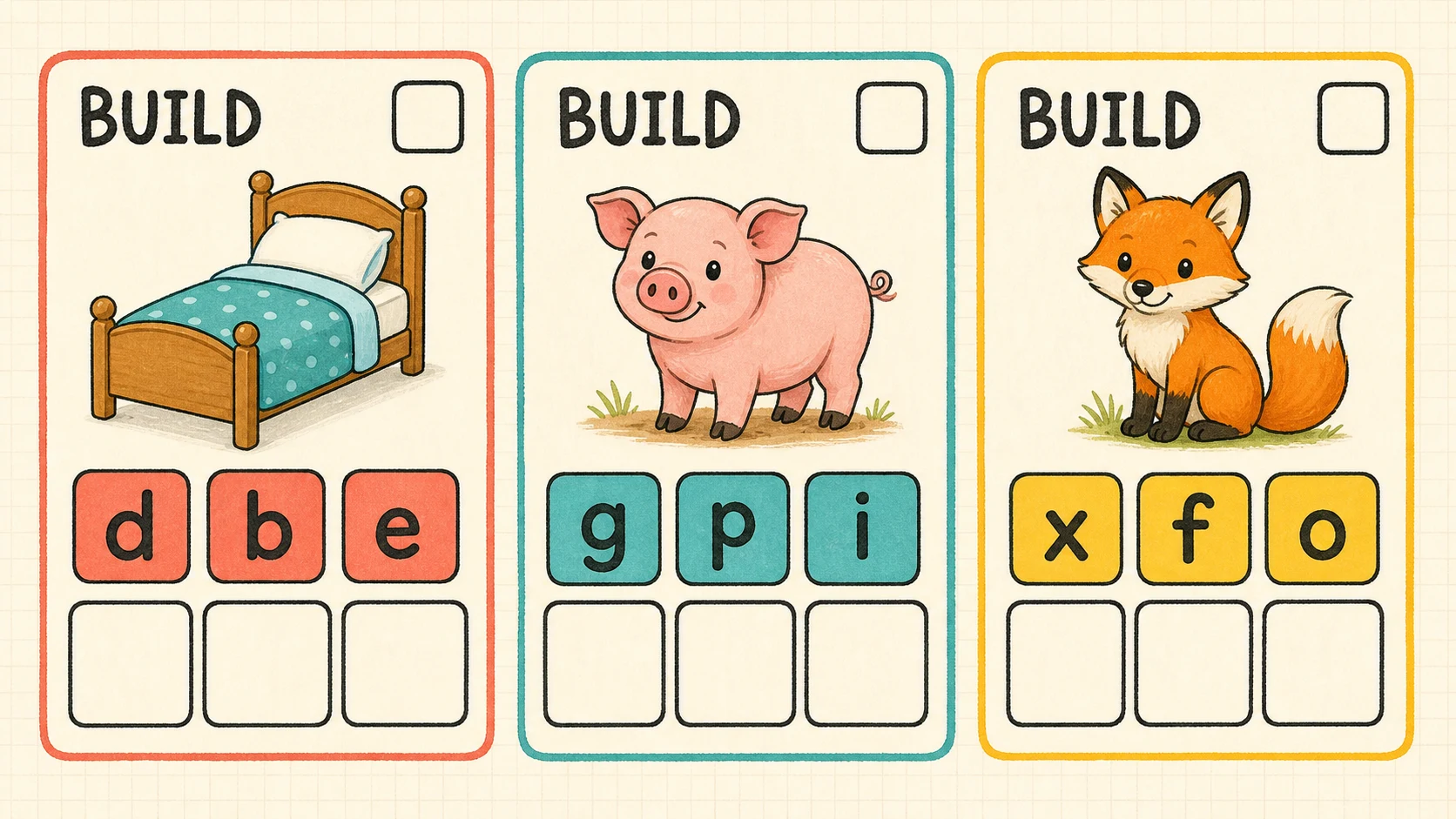
Treat this plan as a menu for spaced, short encounters; select one oral or manipulative task and a few page items rather than assigning every activity by age.
Short vowels: compare sounds before filling blanks
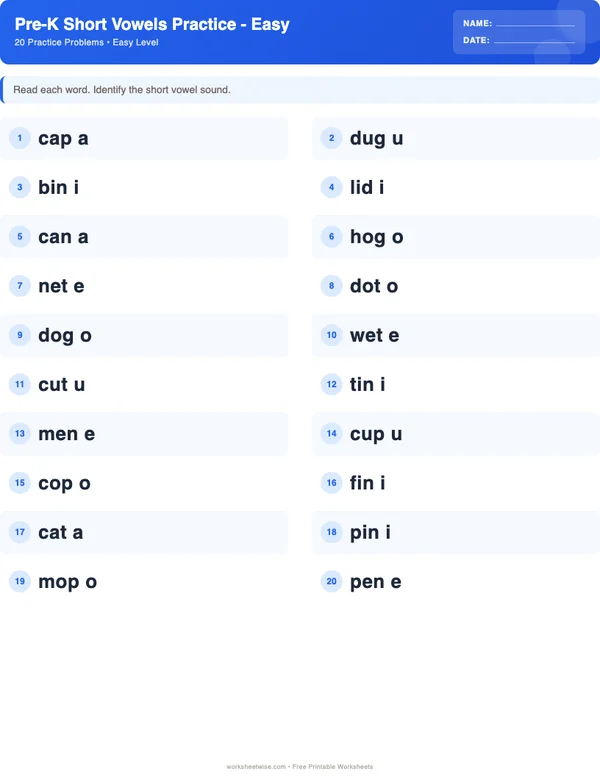
The catalogue’s short-vowel topic covers a as in apple, e as in egg, i as in itch, o as in octopus, and u as in umbrella. Its tasks include picture sorting, word reading, spelling, and filling the middle letter.
These sounds can be hard to distinguish in isolation, especially when the child’s pronunciation differs from the adult’s. Say whole words naturally, confirm picture names, and compare two choices rather than presenting all five vowels at once.
Checked example: sort map and sit
Say map and sit. Stretch the middle of each word without adding an extra syllable: /m/ /ă/ /p/ and /s/ /ĭ/ /t/. Put the map picture under an a card and the sit picture under an i card. Then let the child place a counter on the middle letter.
The example is checked because map is a closed, one-syllable CVC word with short a, while sit is a closed, one-syllable CVC word with short i. It belongs here because only two sounds are contrasted and the child may sort pictures before writing letters.
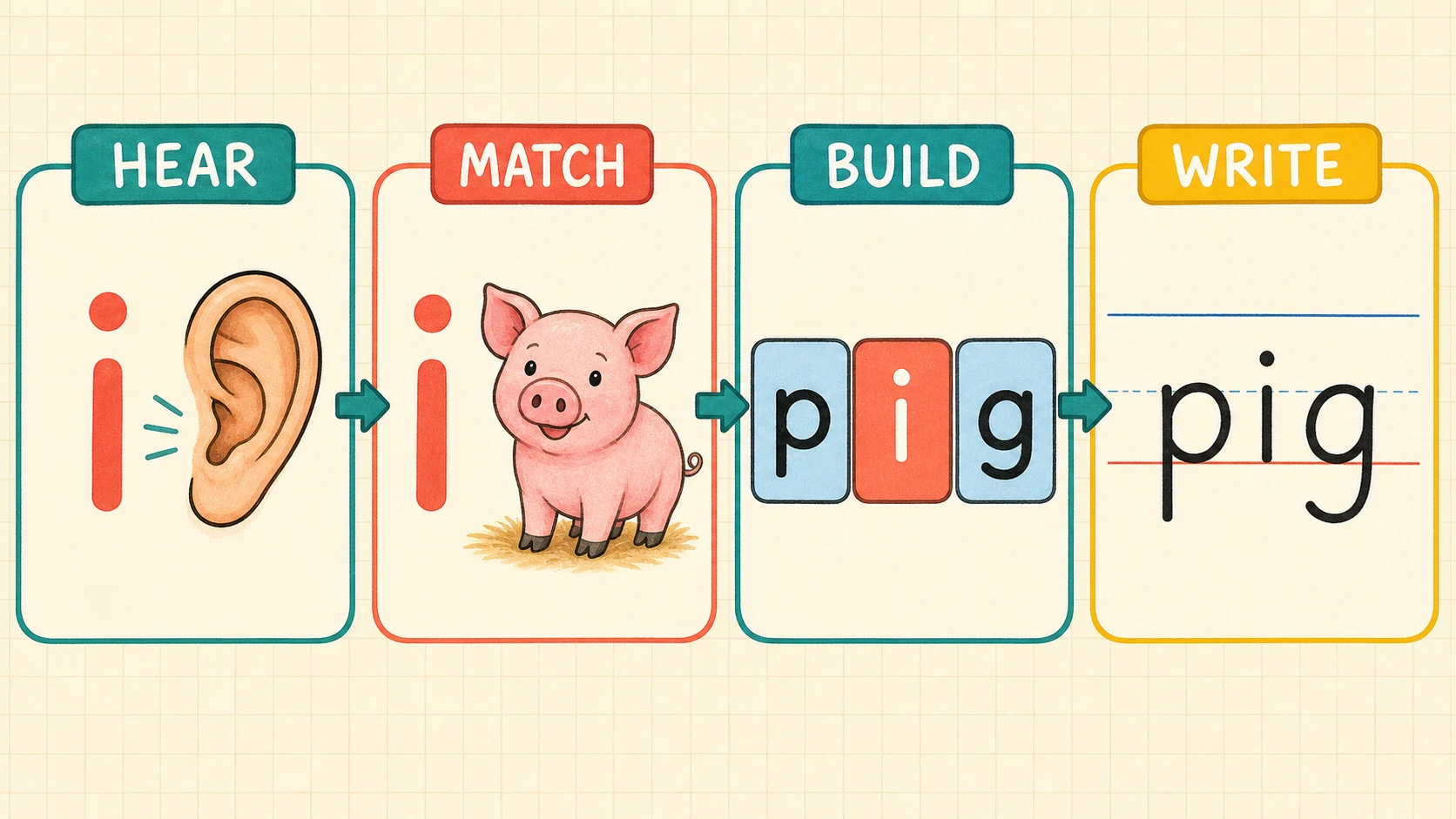
Advance by removing one support at a time: first say and sort together, then let the child sort, and only later ask for an independent written vowel.
The Pre-K Short Vowels guide and free sheet is an appropriate next resource when the child can hear the target contrast with adult modeling. If every answer becomes the same vowel, reduce the field to two spoken words and exaggerate neither sound. If the child sorts correctly but cannot form the letter, offer letter cards or stamps and keep letter formation as a separate brief activity.
Word families: use rhyme without teaching a visual trick
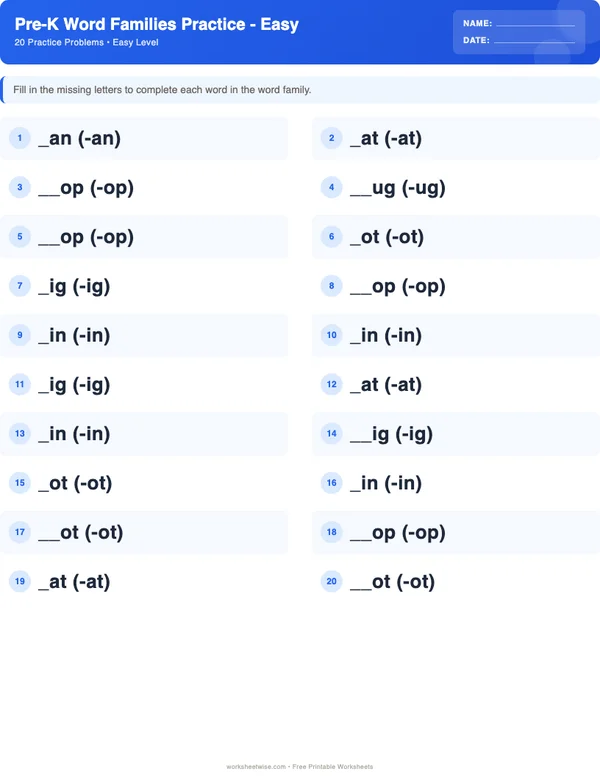
Word families on the page include endings such as -at, -ig, and -op. Recognizing a shared ending can reduce the amount of new print a beginning reader must inspect, but the child still needs to attend to the individual sounds. Word-family practice should sit alongside phonics, not replace it.
Checked example: compare cat, hat, and hop
Build -at once with letter tiles. Add c to make cat, then exchange it for h to make hat. Ask which part stayed the same. Next show hop and say all three words.
The check is straightforward: cat and hat share the rime /at/ and rhyme; hop ends in /op/ and does not belong in the -at family. This example belongs here because the change is visible with tiles and audible in spoken words. The child can demonstrate the relationship by matching two cards, even without writing.
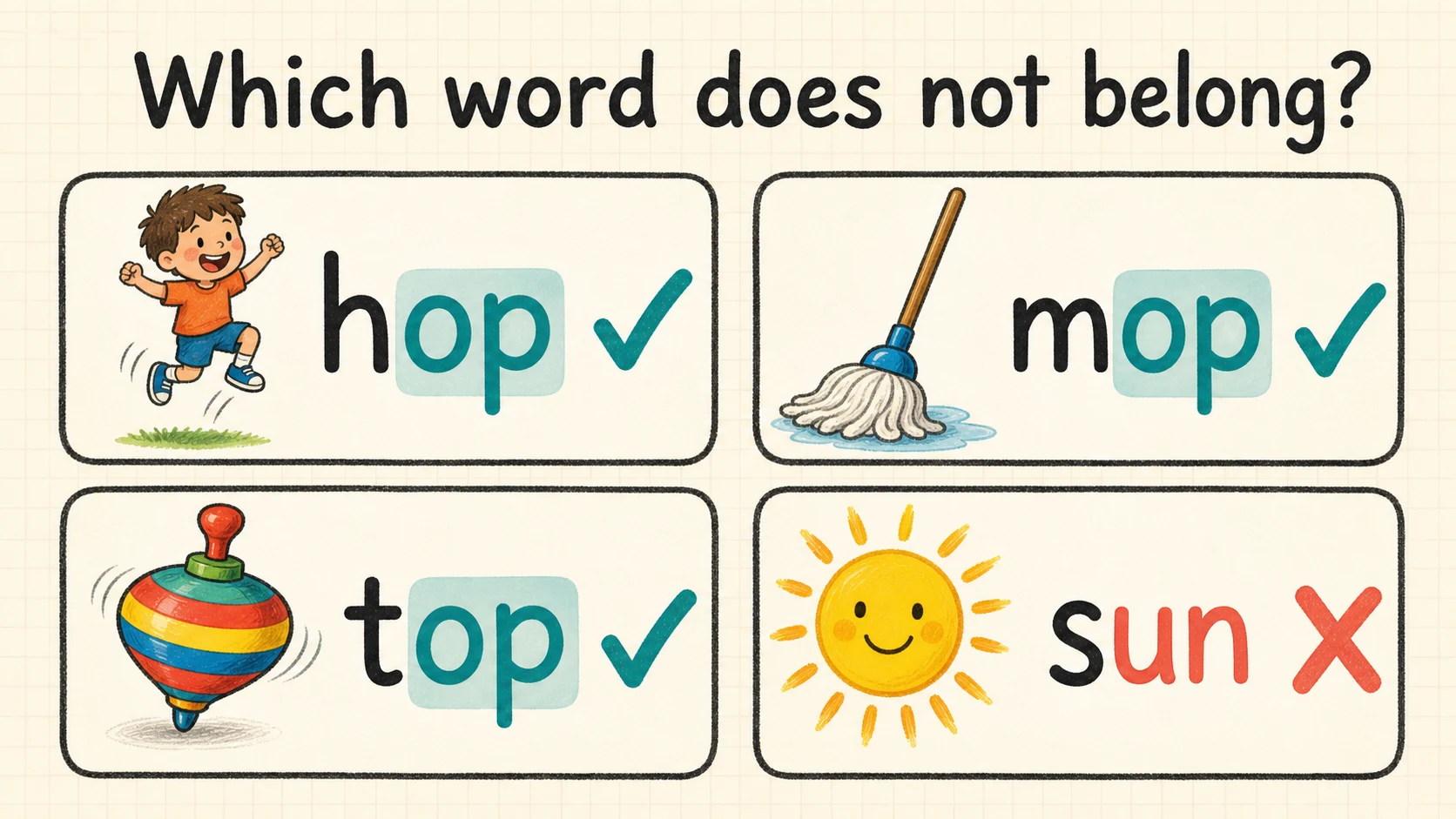
Use an error to select the next prompt—repeat the picture names, isolate the endings, or rebuild the words—without treating one response as a diagnosis.
If the child groups cat with car because both begin with ca, ask the child to listen to the ends: /at/ and /ar/. If the child matches only by picture meaning, use objects or pictures from unrelated categories. If the child hears the rhyme but cannot identify the printed ending, keep the oral success and add the two-letter tile at.
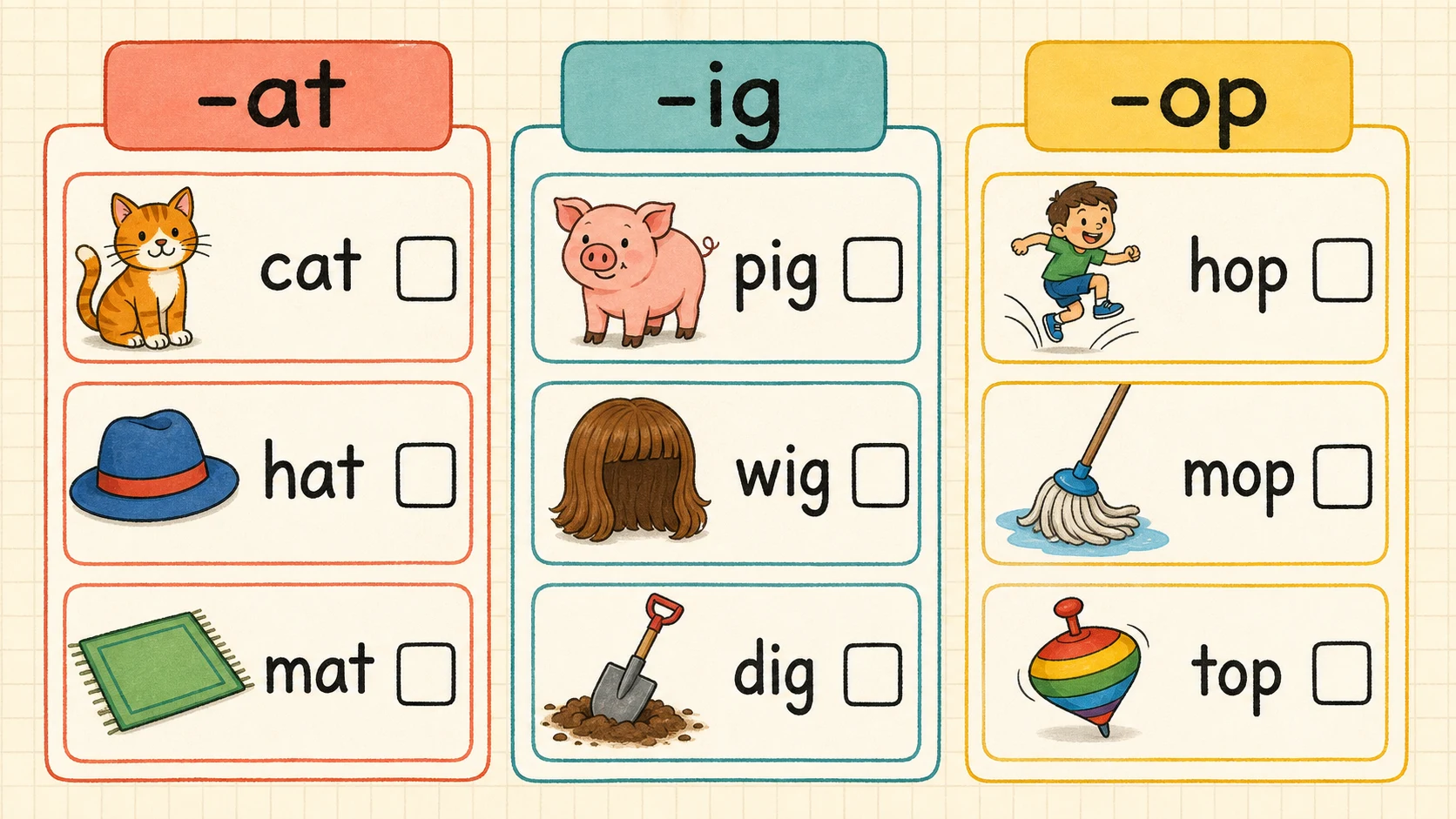
Revisit one familiar family across talk, tiles, pictures, and a few printed items; a two-week display is not a requirement to move on after a fixed date.
The Pre-K Word Families guide and free sheet can supply the page component after the oral match is established.
Sight words: keep meaning and print together
The catalogue also offers a Pre-K sight-word entry point with tracing, writing, finding words in sentences, using words in context, and reading short passages. High-frequency does not mean developmentally mandatory at age four, and a long list is not an appropriate placement test.
Select one word already meaningful in speech or shared reading. Show it in a short sentence, name it, inspect the letters, and find it again. Do not ask the child to memorize a large stack by visual shape alone.
Checked example: find the in a sentence
Write, “The cat sat.” Read the sentence aloud while pointing under each word. Ask the child to place a token under The. Then show “the dog” and ask which word is the same.
The answer can be checked visually: The and the contain the same three letters in the same order, with capitalization changed at the sentence beginning. The example belongs here because it connects spoken language, meaningful print, visual matching, and a movable response. It does not require a 4-year-old to copy the sentence.
If the child chooses cat, reread while pointing and explicitly name the. If the child matches The and the, continue with one more meaningful occurrence. Stop before the task becomes a rapid flash-card drill detached from language.
Preserve the target when adapting the page
An adaptation is useful when it removes an irrelevant obstacle while leaving the intended thinking intact.
For counting, allow the child to place counters on each pictured object. This preserves one-to-one correspondence. Do not count the objects for the child if counting is the target.
For vowel discrimination, let the child point to a or i cards instead of writing. This preserves sound selection. Do not say the vowel sound while pointing at the correct answer.
For word families, cut apart picture cards and let the child sort them. This preserves comparison of endings. Do not sort by color, because color could become the actual cue.
For pencil control, enlarge the path, use a thick crayon, stabilize the paper, or request one deliberate line. This preserves the motor target while reducing precision demands. If the target is phonics rather than handwriting, an oral or tile response may be more revealing.
The Common Core English Language Arts standards and Mathematics standards describe expectations by grade, not prescriptions for placing an individual 4-year-old. They may help adults understand later instructional sequences, but local curriculum sequences differ, and the WorksheetWise Pre-K label remains an intended practice level rather than proof of readiness or alignment.
Read errors as information, then choose one response
Avoid correcting every mark at once. Identify the kind of mismatch and change one feature.
When the child understands orally but not on paper
The likely obstacle may be page layout, symbols, or motor demand. Cover extra items, point to the current row, enlarge the response, or let the child use a token. Continue only long enough to confirm that the concept is still present.
When the child copies without showing the idea
A perfectly traced answer may hide uncertainty. Ask for a new example with objects or speech. If the child traced 4, present four blocks and three blocks and ask which set matches. If the child copied cat, ask the child to build it from mixed letter tiles.
When the child responds inconsistently
Reduce choices and repeat the same target with new materials. A child who counts three objects correctly and misses six may need smaller sets, not more directions. A child who hears /ă/ in map once but not in cat may need the words named clearly and compared orally.
When participation breaks down
Stop the worksheet. Movement, frustration, silence, or refusal does not tell you why the task became unworkable. It does tell you that continuing the same format is unlikely to produce useful evidence. Return later with fewer items, a familiar topic, and an active opening—or choose a different activity entirely.
Decide whether to simplify, continue, extend, or stop
Use the child’s observable work to make the next decision.
Simplify when the child cannot enter the task after one model, loses track of the direction, guesses across several items, or expends nearly all available effort on writing. Reduce the number of choices, return to objects or oral language, and complete one successful comparison.
Continue when the child understands the direction, uses a workable strategy, and remains engaged, even with occasional errors. Offer two or three more items and observe whether the strategy holds.
Extend when the child explains or demonstrates the idea reliably across a small change. Rearrange the same four counters, substitute m for c in cat, or find the same word in another short phrase. Extension should deepen the same idea, not jump automatically to a higher age page.
Stop when fatigue, distress, repeated random answers, or escalating adult prompting makes the work uninformative. Ending is an instructional decision, not a failure.
WorksheetWise resources cannot determine developmental status, diagnose a learning difficulty, or promise an outcome. A worksheet sample is also too narrow to represent everything a child knows. If concerns persist across familiar play, conversation, shared reading, movement, and repeated supported attempts, document concrete observations and discuss them with the child’s educator or an appropriate qualified professional.
Make the next session smaller and more informative
Choose one topic, one active experience, and no more than three worksheet items. For example: move four buttons while counting, match them to one pictured set, circle the numeral, and stop. Record whether the child touched each object once, gave the total, and connected the set to the symbol.
For the next session, use the Pre-K Counting guide and free sheet. Print the free sheet, cover all but the first selected item, gather five small counters, and begin with the objects rather than the page. Let that observed attempt—not the child’s age and not the 20-problem page length—determine whether you simplify, continue, or stop.
Put it into practice
Use the guide with a real printable
Move from explanation to a short, observable practice task. Check the first item together, then adjust the next session from the learner's actual work.
Open the first free worksheetExplore a neighboring collection
Choose by a different teaching need
Worksheets for 3-Year-Olds: Printable Practice Guide Worksheets for 10-Year-Olds: Printable Practice Guide Worksheets for 11-Year-Olds: Printable Practice Guide Worksheets for 12-Year-Olds: Printable Practice Guide Worksheets for 5-Year-Olds: Printable Practice Guide Worksheets for 6-Year-Olds: Printable Practice Guide Worksheets for 7-Year-Olds: Printable Practice Guide Worksheets for 8-Year-Olds: Printable Practice Guide