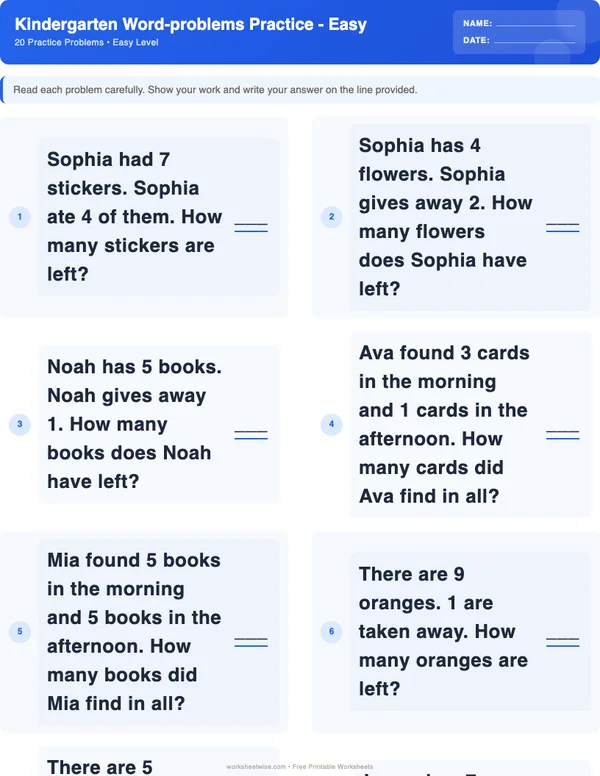
What Kindergarten Word Problems Teach
Kindergarten Word Problems are short mathematical stories in which a learner identifies quantities, understands how they are related, represents the situation, and finds an answer. At this level, the central work is solving simple addition and subtraction situations within 10 by using objects, drawings, spoken explanations, and equations.
The concise teaching sequence is:
- Read or hear the whole story.
- Retell what happens.
- Model the quantities.
- Decide what is unknown.
- Solve and state the answer.
- Check the answer against the story.
A correct numeral alone does not show whether the learner understood the situation. Ask the learner to show what happened with counters or a picture and explain the answer in a short sentence. A response such as “There are 6 birds now because 4 birds and 2 more birds make 6” provides more information than a bare 6.
The IES guide for teaching mathematics to young children recommends teaching number and operations through a developmental progression, monitoring what children know, and helping children describe their world mathematically. Those are high-level recommendations, not an evaluation of WorksheetWise materials. In practice, the learner’s observed work should determine when to add difficulty.
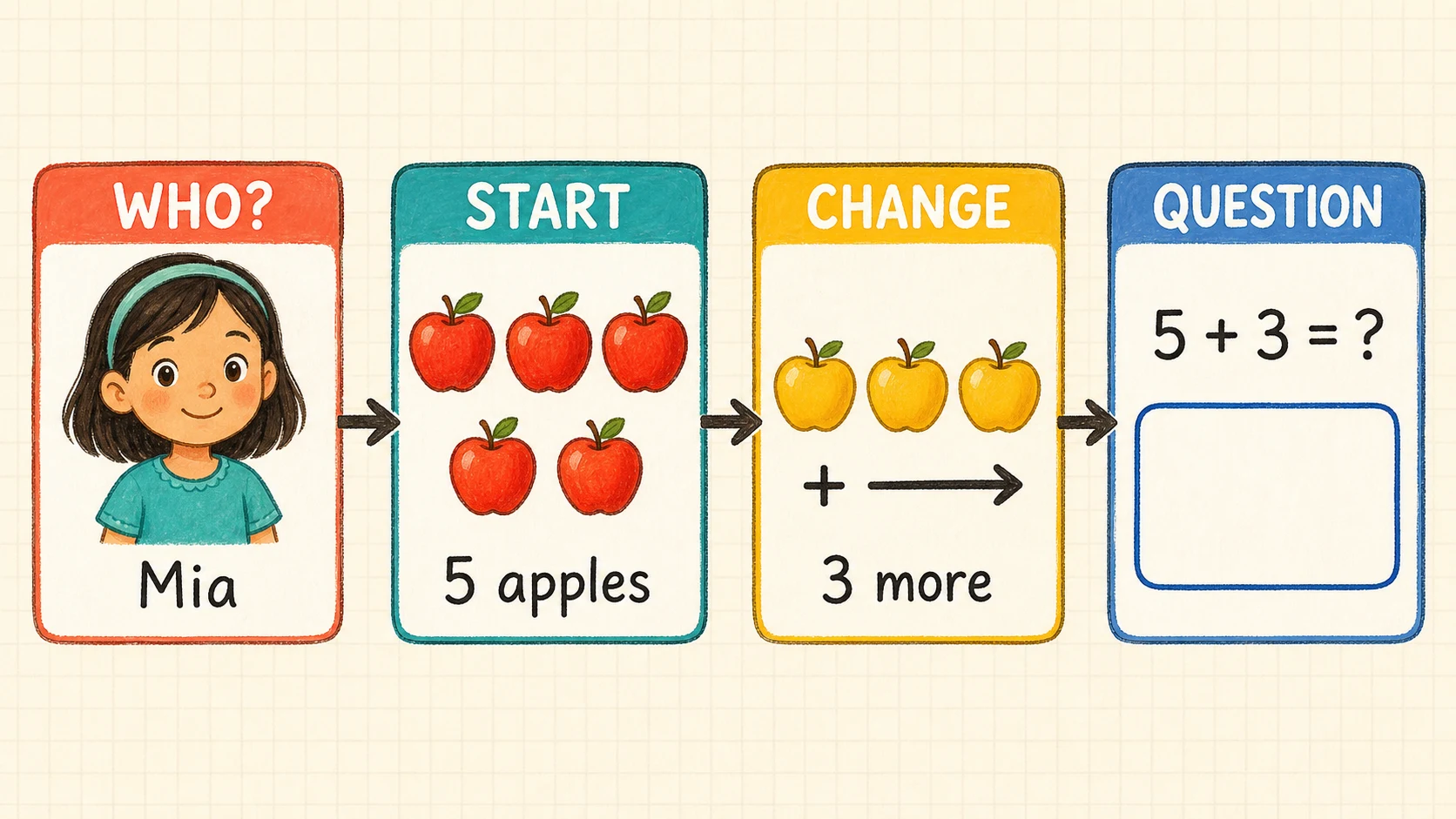
The skill connects story comprehension, quantity relationships, representations, calculation, and explanation.
Prerequisites to Check Before Teaching
A learner does not need fluent reading to begin solving story problems. An adult can read each problem aloud. The more important prerequisites are number meaning, counting, simple language comprehension, and the ability to represent a small collection.
Before assigning independent practice, check whether the learner can:
- Count a collection accurately, touching or moving each object once.
- Recognize or write the numerals used in the problem.
- Make a collection of a requested size, such as 6 counters.
- Understand action words in context, such as “gets,” “joins,” “eats,” or “goes away.”
- Answer “What happened?” after hearing a one- or two-sentence story.
- Distinguish the known quantities from the quantity being found.
- Combine two small groups or remove objects from one group.
- Match a concrete action to an equation such as
3 + 2 = 5 or 6 − 1 = 5.
If one of these skills is weak, teach it during the word-problem lesson rather than interpreting every incorrect answer as a calculation problem. For example, a learner who counts the same counter twice needs support with one-to-one counting. A learner who models the numbers correctly but cannot retell the action may need simpler language or another reading.
The Kindergarten catalogue describes work with objects, drawings, and equations for addition and subtraction within 10. The Common Core mathematics standards also frame mathematical understanding as more than producing an answer; an age-appropriate explanation can provide evidence of understanding. Grade labels describe the intended practice level, and local curriculum sequences differ. They do not establish a universal timetable for every learner.
A Grade-Appropriate Progression
Begin with stories that can be acted out and whose result is unknown. Move toward less visible relationships and different positions of the unknown only after the learner can explain the earlier forms.
| Stage |
Problem structure |
Example |
Helpful representation |
Evidence of readiness to progress |
| 1 |
Joining, result unknown |
“There are 2 bears. 3 more arrive. How many now?” |
Act out with counters |
Combines the groups and counts the total |
| 2 |
Separating, result unknown |
“There are 6 crackers. 2 are eaten. How many remain?” |
Start with 6; physically remove 2 |
Counts only the remaining objects |
| 3 |
Part-part-whole |
“There are 3 red blocks and 4 blue blocks. How many blocks?” |
Two groups, drawing, or simple bar model |
Identifies both parts and the whole |
| 4 |
Comparison |
“Mia has 6 shells. Leo has 4. How many more does Mia have?” |
Align two rows of counters |
Counts the unmatched objects |
| 5 |
Change unknown |
“There were 4 birds. Some joined. Now there are 7. How many joined?” |
Build 4, then add until reaching 7 |
Finds the missing part rather than adding 4 and 7 |
| 6 |
Start unknown |
“Some ducks were in a pond. 2 left. 5 remain. How many were there?” |
Rebuild the starting collection |
Understands that the starting amount must exceed 5 |
| 7 |
Information judgment |
Extra or missing information |
Model only relevant quantities |
Explains what can or cannot be solved |
This progression is instructional guidance derived from the catalogue’s problem types and representations. It is not a required schedule. A learner may solve joining stories independently while still needing objects for comparison or missing-part stories.
Do not base operation choice on isolated keywords. “Left” can describe subtraction—“2 birds left the tree”—but it can also describe a remaining quantity—“5 birds are left.” The learner must understand the event and the relationship between the quantities.
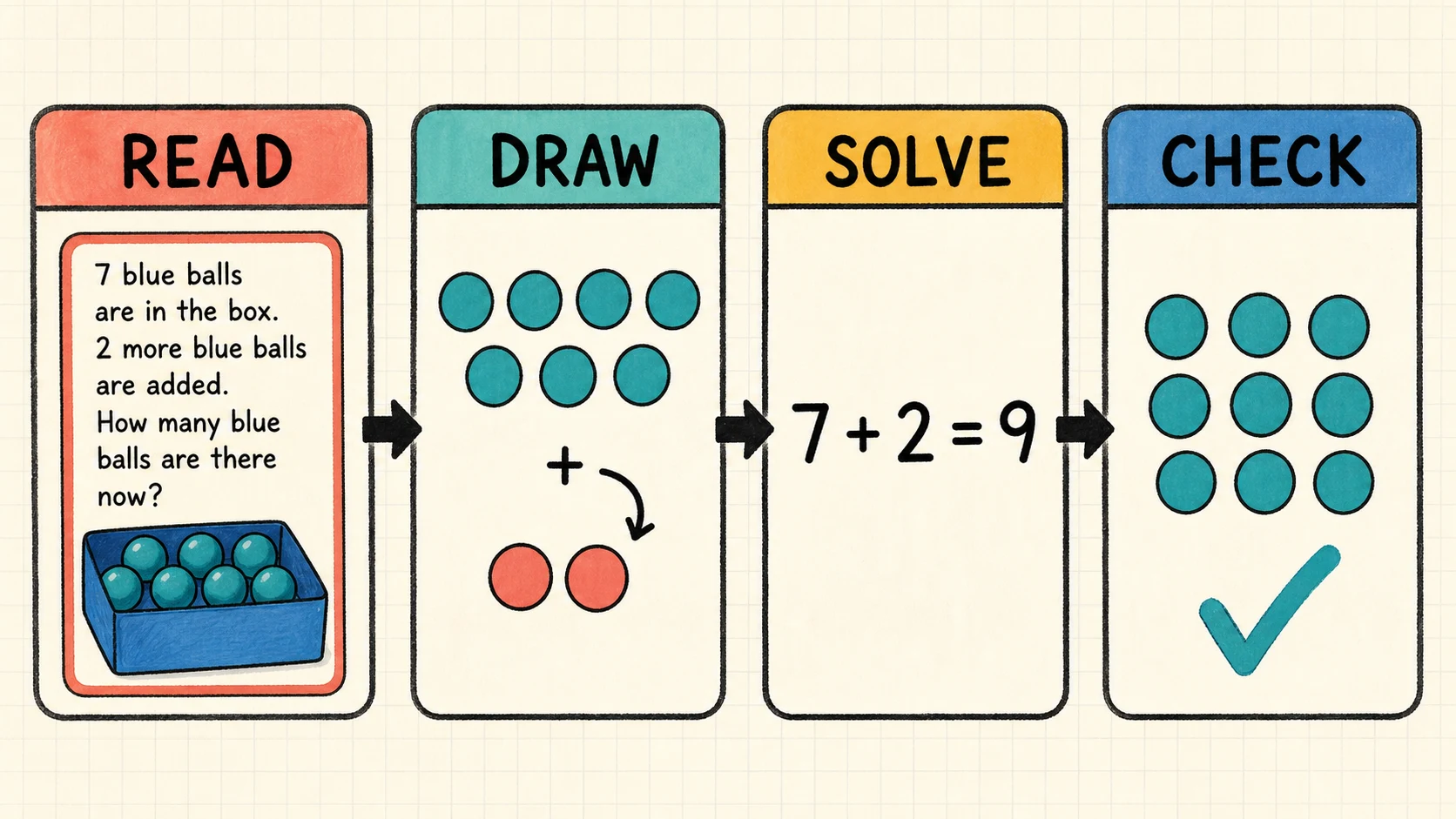
Support can fade from acting and adult prompting to drawings, equations, and independent explanations.
Concrete, Visual, and Symbolic Models
The IES mathematics intervention guide recommends systematic instruction, clear mathematical language, deliberate word-problem teaching, and a well-chosen set of concrete and semi-concrete representations. It covers elementary grades broadly and does not prescribe this exact lesson sequence or evaluate this worksheet.
Objects and acted-out stories
Counters, blocks, buttons, toy animals, or drawn dots can stand for the objects in a story. Keep the objects visually simple so that decoration does not distract from counting.
For “3 frogs sit on a log and 2 more join,” place 3 counters down first. Move 2 additional counters toward them. Ask:
- “What did we start with?”
- “What changed?”
- “What are we finding?”
- “Show me where the answer is in your model.”
For a subtraction story, begin with the complete starting collection. Move the removed objects away rather than covering them while leaving them mixed with the remaining group.
Drawings and aligned rows
Once the learner understands the physical action, replace objects with circles, tally-like marks, or quick pictures. Artistic detail is unnecessary. Five circles crossed out accurately are a better mathematical record than a detailed scene that is difficult to count.
Aligned rows are especially useful for comparison:
Mia:  ● ● ● ● ● ●
Leo:  ● ● ● ●
Extra:         ● ●
The two unmatched dots show that 6 is 2 more than 4.
Part-part-whole and bar models
A simple part-part-whole model makes the relationship visible:
Part 3 | Part 2
Whole 5
For a missing part:
Known part 4 | Missing part ?
Whole 7
Bar models can support relationships, but Kindergarten drawings should remain simple. If creating the bars demands more effort than understanding the story, return to counters or dots. The representation is a thinking aid, not an additional art or measurement task.
Equations and answer statements
Connect the model to symbols only after the learner can explain the action:
4 + 2 = 6
Then complete the meaning with a unit or noun: “There are 6 apples.” Accept age-appropriate spoken explanations when handwriting would obscure the learner’s mathematical thinking.
Fully Checked Worked Examples
Example 1: Joining with the result unknown
Problem: Three rabbits are in a garden. Two more rabbits hop into the garden. How many rabbits are there now?
Model: Make a group of 3 counters. Add a group of 2 counters.
Start: ● ● ●
Join:  ● ●
Total: ● ● ● ● ●
Equation: 3 + 2 = 5
Answer: There are 5 rabbits now.
Check: Count all five counters once: 1, 2, 3, 4, 5. The answer fits the story because rabbits joined the original group, so the final amount is greater than 3.
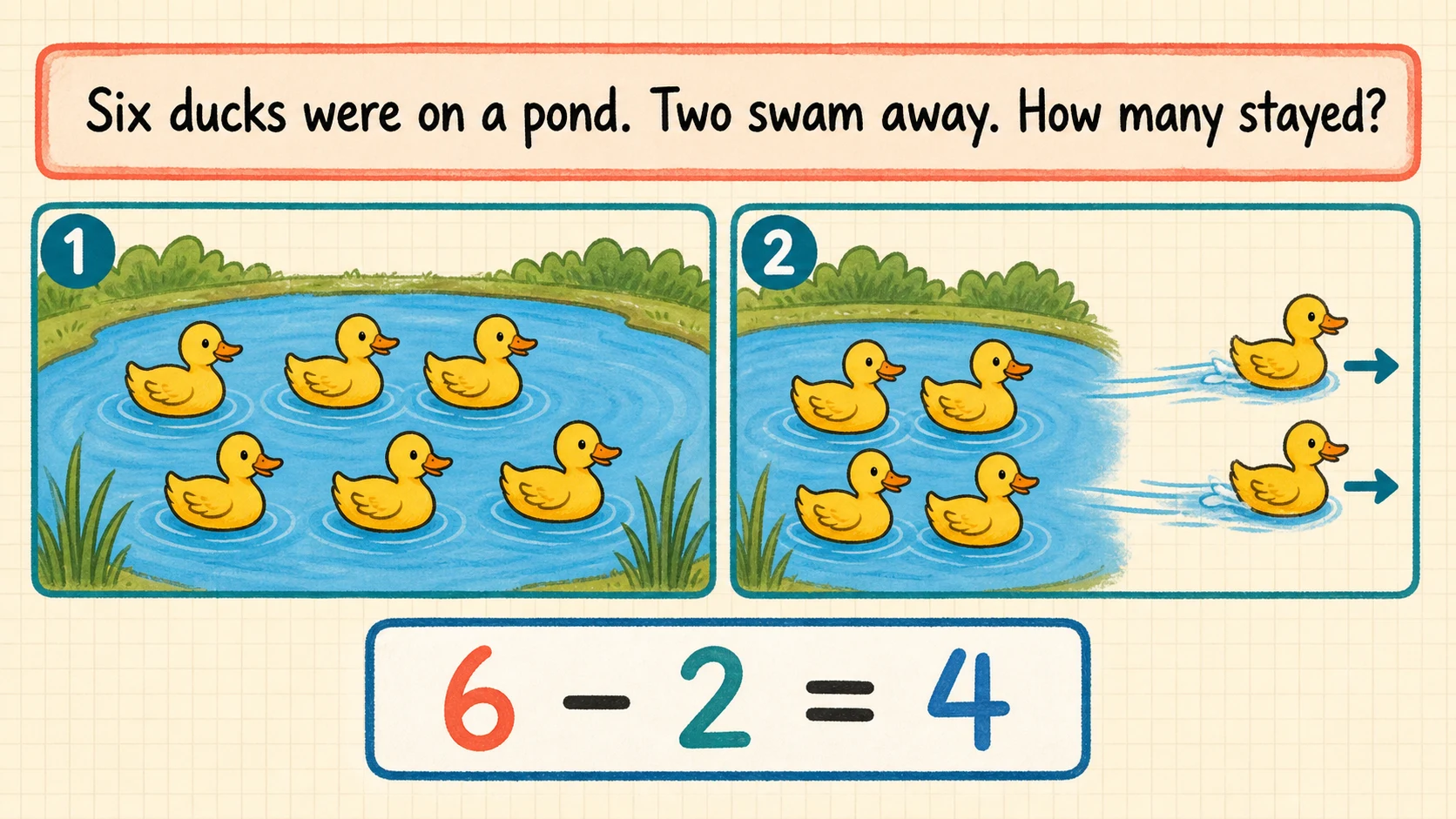
Objects show the action first; the drawing, equation, and answer record the same relationship.
Example 2: Separating with the result unknown
Problem: Seven strawberries are on a plate. Three strawberries are eaten. How many strawberries remain?
Model: Place 7 counters. Move 3 away.
Before:  ● ● ● ● ● ● ●
Eaten:   × × ×
Remain:        ● ● ● ●
Equation: 7 − 3 = 4
Answer: 4 strawberries remain.
Check: Recombine the eaten and remaining groups: 3 + 4 = 7. This returns to the starting amount. Four is also less than 7, which is reasonable because strawberries were removed.
A common error is to count the three removed objects and answer 3. Ask the learner to point to the strawberries that are still on the plate. The question asks for the remaining group, not the eaten group.
Example 3: Finding an unknown change
Problem: Four children are on the playground. Some more children arrive. Then there are seven children. How many children arrived?
Model: Make 4 counters. Add counters one at a time until the collection contains 7.
Known start:  ● ● ● ●
Added:        ● ● ●
Final amount: ● ● ● ● ● ● ●
Equation: 4 + 3 = 7, or 4 + □ = 7
Answer: 3 children arrived.
Check: Count on from 4: 5, 6, 7. Three counts were added. Subtracting confirms the missing part: 7 − 4 = 3.
The numbers 4 and 7 are both stated, but adding them would answer a different question. The final amount already includes the original four children.
Example 4: Finding an unknown start
Problem: Some ducks were in a pond. Two ducks flew away. Five ducks remained. How many ducks were in the pond at the start?
Model: Begin with the 5 ducks that remain. Add back the 2 ducks that left to rebuild the starting collection.
Remain:  ● ● ● ● ●
Left:    ● ●
Start:   ● ● ● ● ● ● ●
Equation: 7 − 2 = 5, or □ − 2 = 5
Answer: There were 7 ducks at the start.
Check: Remove 2 from the rebuilt group of 7. Five remain, exactly as the story states. The starting amount must be greater than 5 because some ducks left.
This structure is harder than a result-unknown subtraction story. If the learner repeatedly answers 3 from 5 − 2, return to acted-out stories and explicitly label “start,” “left,” and “remain.”
Example 5: Comparing two quantities
Problem: Ana has six crayons. Ben has four crayons. How many more crayons does Ana have than Ben?
Model: Align the two collections:
Ana: ● ● ● ● ● ●
Ben: ● ● ● ●
               ● ● unmatched
Equation: 6 − 4 = 2
Answer: Ana has 2 more crayons than Ben.
Check: Add the difference to Ben’s amount: 4 + 2 = 6. This matches Ana’s collection.
Do not teach “more means add” as a rule. Here, “how many more” asks for the difference between two known collections.
A Short, Repeatable Lesson Routine
Use a brief routine and stop while the learner is still reasoning carefully. The suggested timing below is flexible; observed attention and accuracy should control the pace.
Prepare and model
Choose one problem structure and numbers the learner can represent. Read the story aloud without asking for an operation. Have the learner retell it with names such as “the starting group,” “the group that joined,” and “the total.”
Model the first problem together with counters. Ask the learner to connect each group of objects to a sentence in the story.
Solve together
Give a closely related problem. Let the learner place or draw the quantities. Prompt only as much as needed:
- “What is happening?”
- “What do we know?”
- “What do we need to find?”
- “How can you show it?”
- “Does your answer fit the story?”
Write the equation after the model is understood.
Try independently and review
Offer one problem for the learner to solve without step-by-step prompting. Ask for a model, an answer, and one check. End by naming the relationship learned: “Today you found how many remained after some went away.”
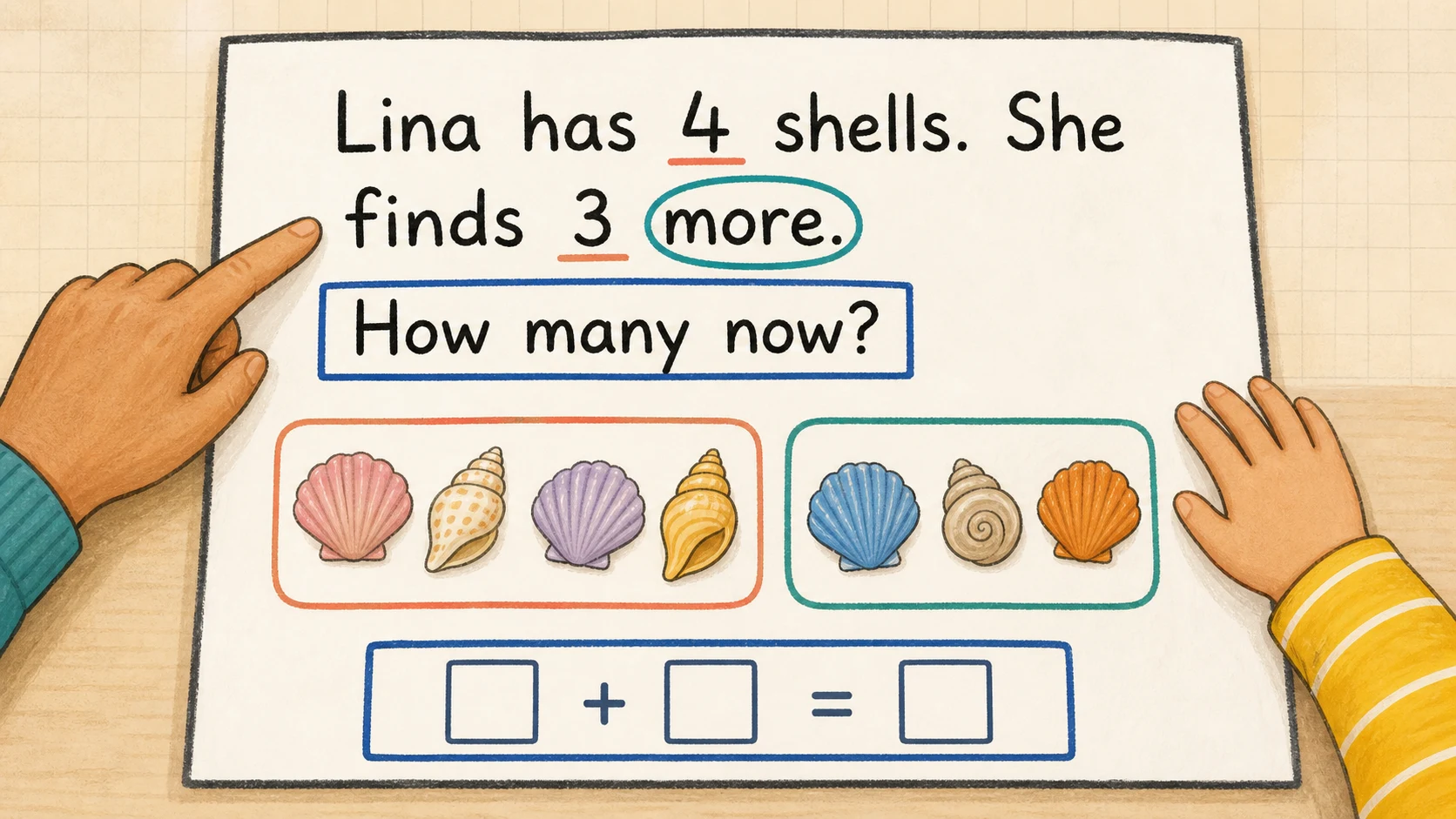
Read, retell, represent, solve, and check form a routine that can be reused across problem types.
Choosing Practice and Differentiating Support
Select practice by structure, not page count
First identify what the learner is ready to practice. A page with twelve problems is not automatically one sitting. Choose a smaller set when careful representation takes time.
The free easy Kindergarten word-problems worksheet contains 12 exercises and a separate answer key. Its directions ask learners to read carefully, show their work, and write an answer. The catalogue tags include problem solving, reading comprehension, multi-step reasoning, and mixed operations. These labels describe the resource; inspect each exercise and select only the problems that match the learner’s current readiness.
Use the broader Kindergarten math collection when a prerequisite such as counting or numeral recognition needs separate practice. Use the Kindergarten Word Problems topic guide to stay within the same topic while varying practice.
Reduce difficulty without removing the mathematics
For a learner needing more support:
- Read the story aloud and explain unfamiliar non-mathematical words.
- Use totals no greater than 5 before returning to totals within 10.
- Present one problem at a time.
- Provide counters and a mat labeled “start,” “change,” and “now.”
- Ask for an oral answer if writing is the main barrier.
- Keep the same structure for several examples while changing the objects and numbers.
- Model one example, solve one together, and then offer one independently.
These are instructional suggestions, not individualized clinical or medical guidance.
Increase challenge carefully
For a learner who solves accurately and explains independently:
- Change the unknown from the result to the change or start.
- Include a comparison problem.
- Ask for two representations, such as counters and an equation.
- Include relevant and irrelevant details.
- Ask the learner to create a story for a given equation.
- Remove the counters while keeping drawing available.
Do not increase number size merely because one page was completed. Flexible understanding of several problem structures within 10 is more informative than rapid answers to one repeated form.
Diagnosing Common Errors
Treat an incorrect answer as evidence to investigate. Ask the learner to reconstruct the story before correcting the equation.
| Observed work |
Likely issue to investigate |
Teaching response |
| Uses every stated number without regard to meaning |
Number hunting |
Retell the event without numerals, then rebuild each quantity |
| Adds whenever the story says “more” |
Keyword dependence |
Compare a joining story with a “how many more” comparison |
| Counts removed objects as the answer |
Confuses the changed group with the remaining group |
Physically separate and label both groups |
| Writes the right equation but miscounts objects |
One-to-one counting difficulty |
Move each object into a new row while counting |
Solves 4 + 7 for 4 + □ = 7 |
Does not recognize the whole already given |
Build 4 and add only until the total reaches 7 |
| Draws a correct model but gives no answer to the question |
Weak connection between model and language |
Complete the sentence “There are ___ ___” |
| Chooses an answer larger than the start after objects leave |
Does not check reasonableness |
Compare start and result explicitly |
| Cannot begin after reading independently |
Reading may be masking mathematical knowledge |
Read aloud, then observe whether the learner can model it |
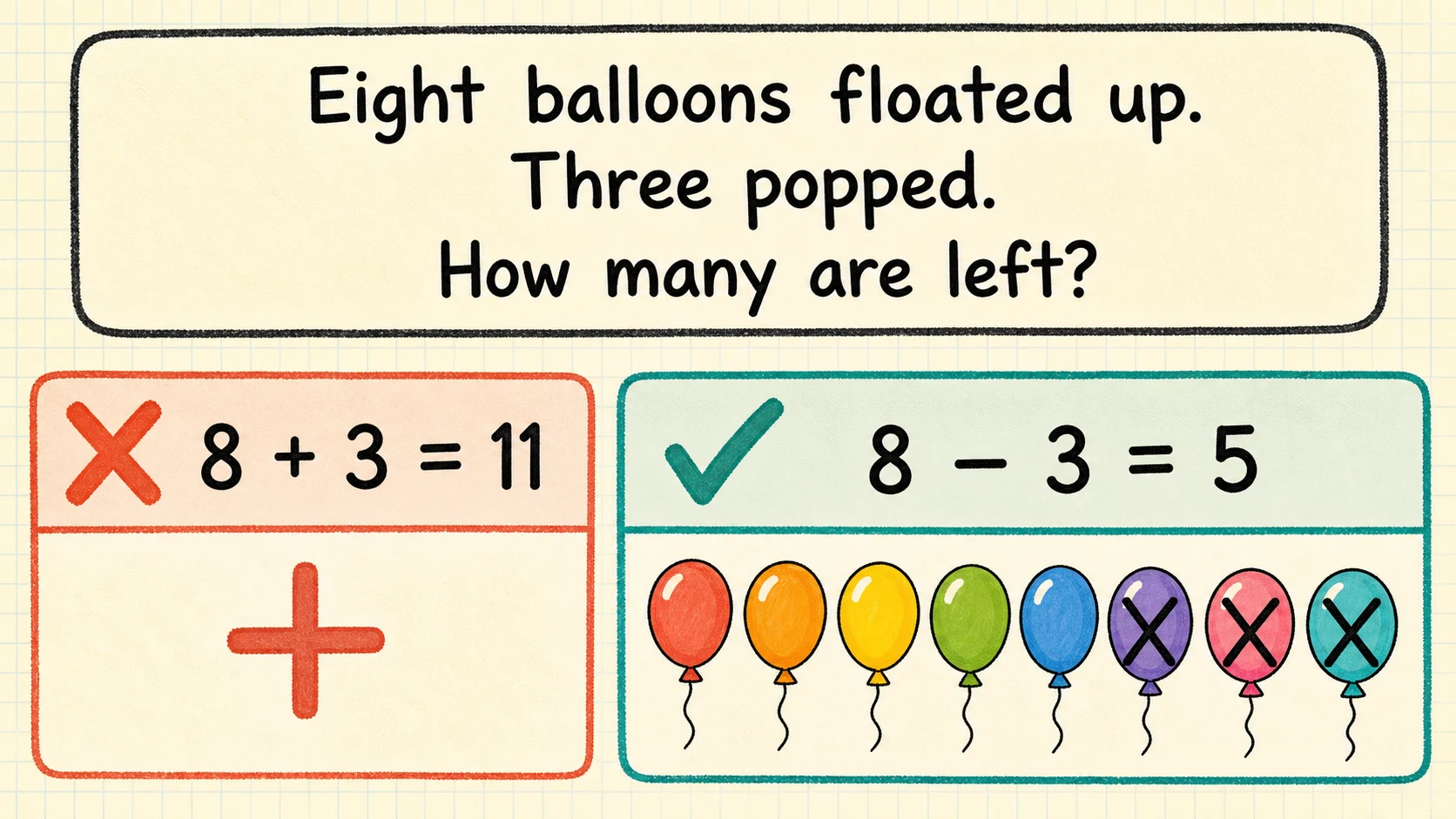
The most useful correction addresses the source of the error rather than supplying the operation.
Two boundary cases deserve direct teaching.
Extra information: “Lena has 3 red blocks and 2 blue blocks. Her box is green. How many blocks does she have?” The color of the box is not needed. The solvable relationship is 3 + 2 = 5.
Missing information: “Sam has some apples. He gets 2 more. How many apples does he have now?” The starting amount is missing, so there is no single numerical answer. Do not encourage guessing. A sound response is, “We need to know how many apples Sam had first.”
Monitoring Progress and Deciding What Comes Next
Keep a brief record of more than correctness. For each structure, note whether the learner can:
- Retell the action.
- Identify what is unknown.
- Select and use a suitable model.
- Count or calculate accurately.
- State the answer with its object or unit.
- Check whether the answer fits the story.
- Work independently, with a general prompt, or with direct modeling.
A simple mark such as I for independent, P for prompted, and M for modeled can reveal useful patterns. Three correct answers copied from adult modeling do not show the same readiness as three independently represented answers.
Revisit a structure when the learner can calculate but repeatedly misrepresents the story. Progress when the learner solves several varied examples accurately, explains the relationship, and catches an unreasonable answer. This use of observed work follows the high-level progress-monitoring emphasis in the IES early-mathematics guide; it is not a formal assessment protocol.
A Flexible Two-Week Practice Plan
This plan assumes short practice on ten days, but it is not a universal timetable. Repeat, shorten, or pause a day according to the learner’s work. Use two or three carefully discussed problems rather than insisting on a full page.
| Day |
Teaching focus |
Suggested activity |
What to observe |
| 1 |
Joining, result unknown |
Act out two stories with totals to 5; draw one |
Does the learner combine both groups? |
| 2 |
Joining within 10 |
Model, solve together, then try one independently |
Can the learner connect model, equation, and answer? |
| 3 |
Separating, result unknown |
Build a starting group and physically remove objects |
Does the learner count what remains? |
| 4 |
Mixed joining and separating |
Present one of each without operation labels |
Does story meaning drive the operation? |
| 5 |
Review and explain |
Revisit one error; have the learner create a story |
Can the learner explain why the answer fits? |
| 6 |
Part-part-whole |
Sort two colors of counters and find the total |
Can the learner identify two parts and one whole? |
| 7 |
Comparison |
Align two rows and count unmatched objects |
Does the learner find the difference? |
| 8 |
Change unknown |
Build a known start and add until reaching the whole |
Can the learner find the missing part? |
| 9 |
Start unknown and boundary cases |
Rebuild a start; discuss one missing-information story |
Does the learner resist combining stated numbers blindly? |
| 10 |
Mixed independent check |
Select three varied problems; allow a chosen model |
Which structures are independent, prompted, or not yet secure? |
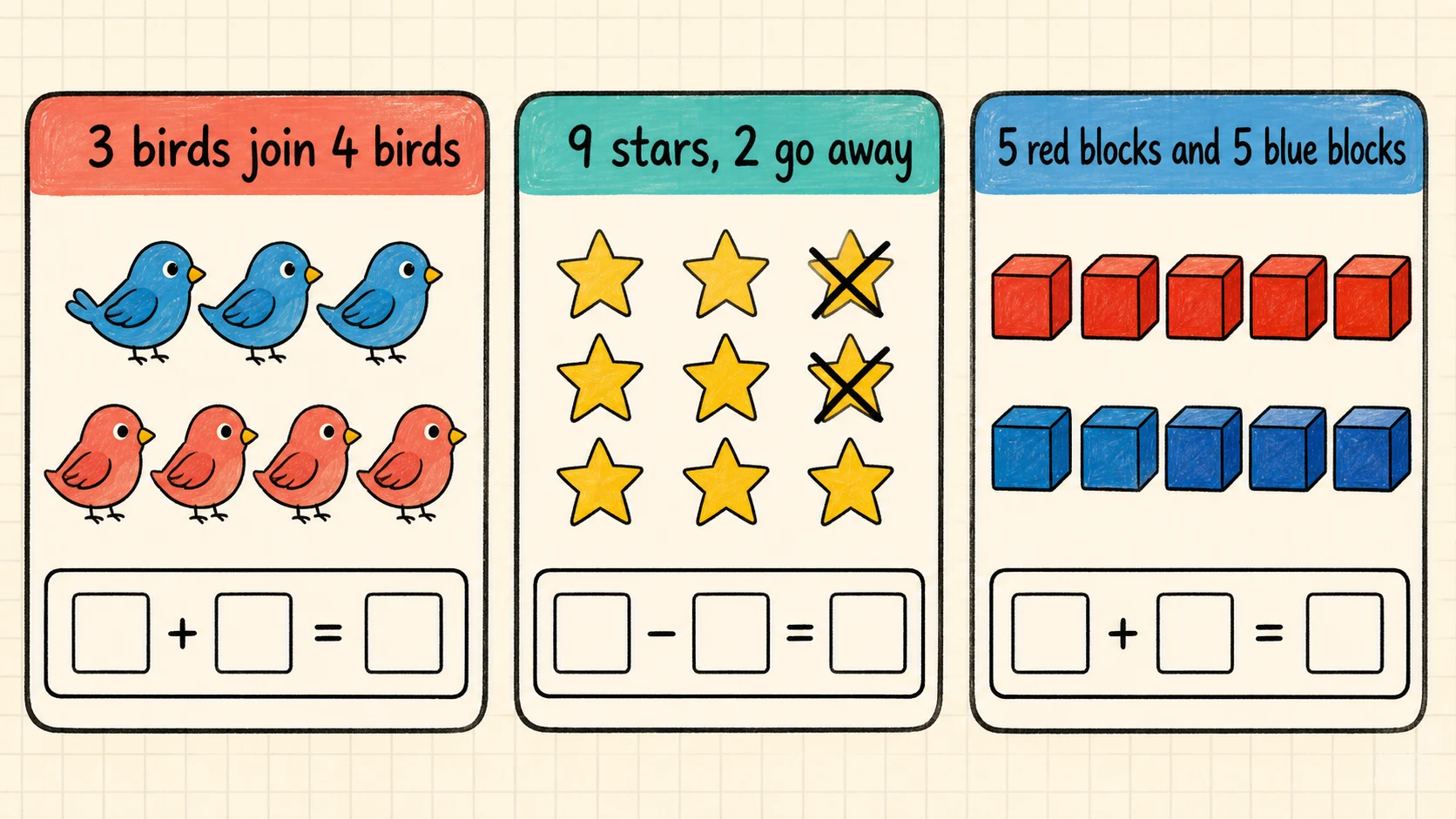
The plan alternates new structures with review while leaving room to repeat a day when the evidence calls for it.
If Day 4 reveals confusion between joining and separating, repeat those structures before comparison. If the learner solves Day 8 by reasoning rather than trial and can explain the missing part, proceed to another unknown position. If attention or handwriting deteriorates, reduce the number of problems while preserving discussion and checking.
Limits, Grade Labels, and the Next Useful Step
A worksheet can provide structured practice, but it cannot determine why a learner made an error. An answer key verifies final answers; it does not replace observation of counting, modeling, language, or explanation. Likewise, completing an easy-level resource does not demonstrate mastery of every Kindergarten story structure.
Grade labels describe intended practice level, and local sequences differ. This guide does not claim comprehensive standards alignment, certification, guaranteed outcomes, or a timetable suitable for every learner. Keep the quantities and story structures within the learner’s demonstrated readiness, and seek appropriate local educational support when ordinary instructional adjustments do not answer a broader concern.
For the next lesson, choose three suitable items from the free Kindergarten Word Problems worksheet. Read them aloud, require a model and an answer sentence, and record which problems are independent, prompted, or modeled. If the learner needs more examples after that check, move to the 18-worksheet Kindergarten Word Problems pack or use the free worksheet generators to vary practice while keeping the number range and problem structure controlled.