What Kindergarten Consonant Blends Means
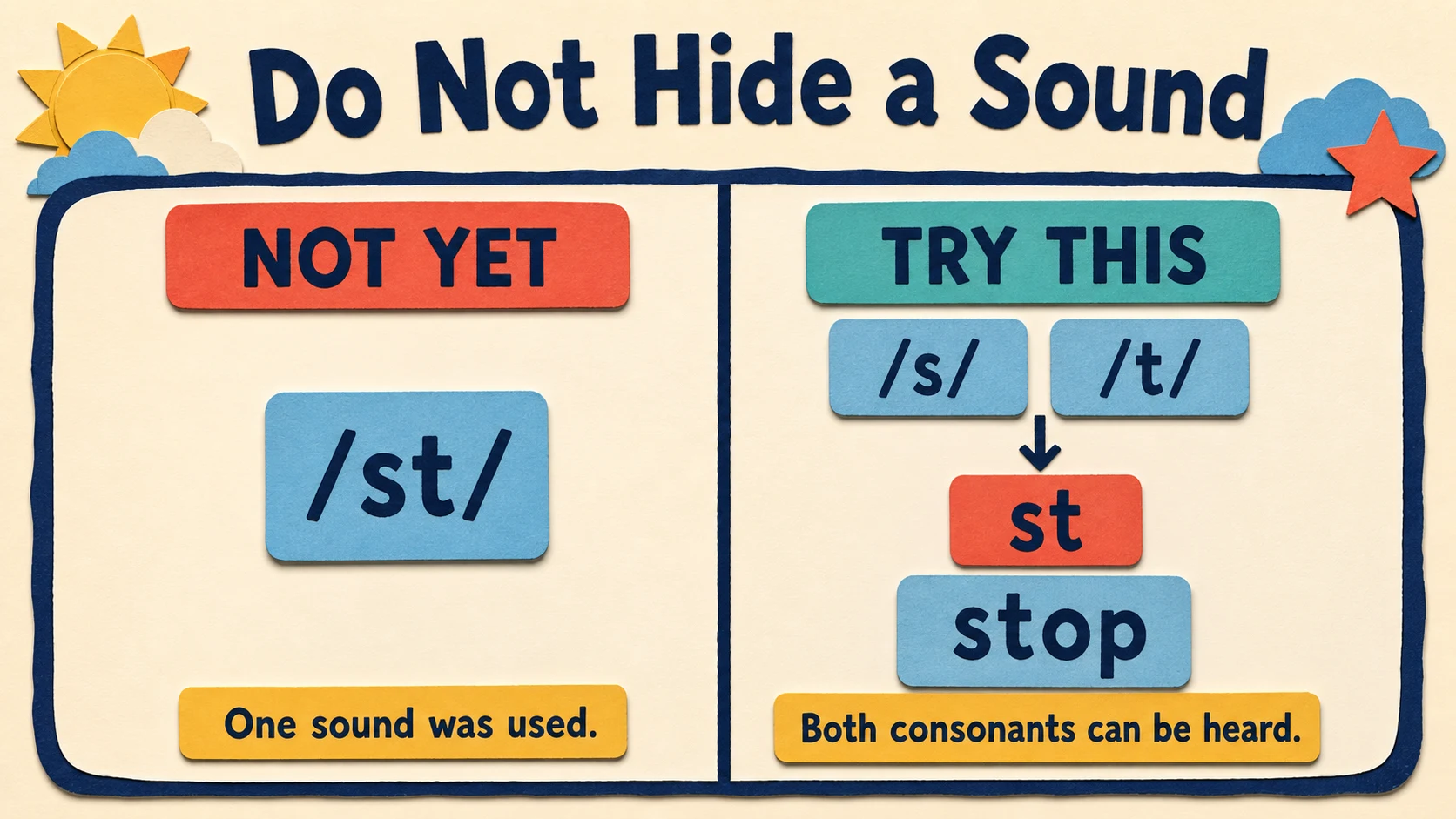
Consonant blends are groups of two or three consonants in which each consonant keeps its own sound. In stop, the initial blend st represents /s/ followed by /t/. In clap, cl represents /k/ followed by /l/. In tent, the final blend nt represents /n/ followed by /t/.
The concise teaching answer is this: introduce blends after a learner can identify common letter sounds and blend simple consonant-vowel-consonant words such as cat, pin, and hop. Start with a small set of initial blends, practice them in complete words, and watch whether the learner preserves every sound. Move to final blends and connected text only when the observed work shows that the earlier step is secure.
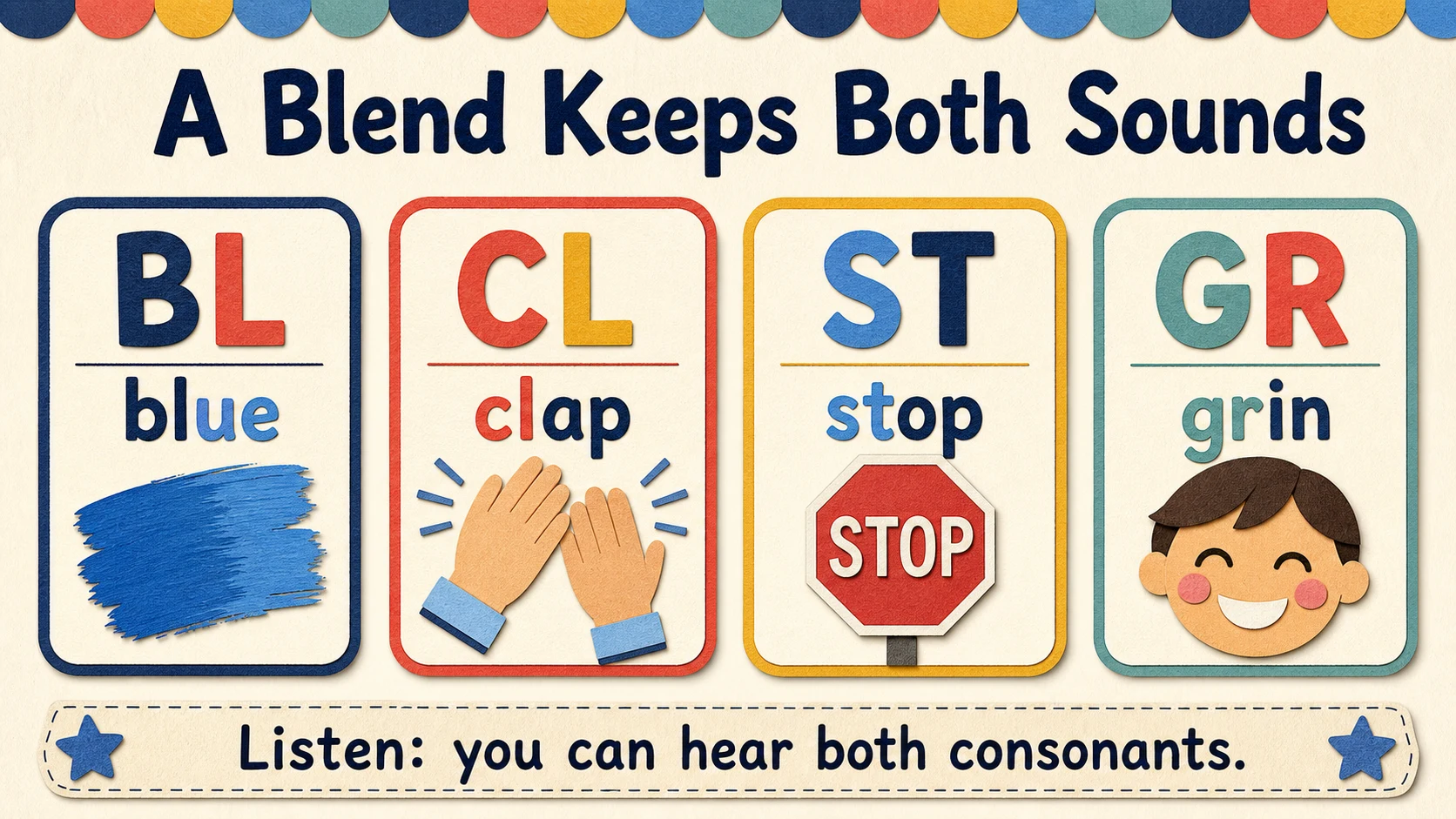
The skill connects sound awareness, letter recognition, word reading, spelling, and sentence reading.
The label Kindergarten Consonant Blends describes the intended practice level, not a universal timetable. Local curricula and instructional sequences differ. The supplied catalogue also associates several blend-related standards with first and second grade, so adults should not treat a Kindergarten label as proof of comprehensive standards alignment. The learner’s actual decoding should determine whether this practice is timely.
This guide uses the catalogue definition and examples for instructional decisions. For broader framing, the IES foundational reading guide addresses systematic work with sound segments, letter-sound relationships, decoding, and connected text in the early grades. The Common Core English Language Arts standards provide grade-specific reference points for foundational reading and writing skills. Neither source evaluates WorksheetWise or this particular worksheet.
Prerequisites to Check First
Blend practice becomes more useful when the learner has the foundations needed to examine and combine several sounds.
Letter-sound knowledge
Check whether the learner can supply the usual sounds for the consonants used in the target words. A child who does not yet connect t with /t/ cannot reliably read st in stop. That difficulty is different from knowing both sounds but dropping one during blending.
Use a brief check rather than an exhaustive test. Show several lowercase consonants, including those in the planned lesson. Ask for a sound, not merely the letter name. If responses are uncertain, review those letter-sound relationships before expecting independent blend reading.
Oral blending and segmenting
Say the sounds in a simple word with a short pause between them: /m/ /a/ /p/. Ask the learner to combine them into map. Then say map normally and ask the learner to identify its beginning, middle, and ending sounds.
This check does not require print. Its purpose is to separate a sound-combination problem from a letter-recognition problem. If the learner cannot blend three spoken sounds, adding a fourth sound in clap is likely to overload the task.
Secure CVC decoding
Use several regular CVC words, such as lap, ram, sit, not, and mud. The learner should attend to all three positions instead of guessing from the first letter or a picture.
Fluency here means dependable reading, not speed under pressure. If the learner laboriously identifies every letter but reaches the correct word, blends may be introduced with substantial modeling. If the learner frequently changes vowels, omits final consonants, or guesses, continue focused CVC practice through the Kindergarten phonics hub before adding many blends.
A Grade-Appropriate Teaching Progression
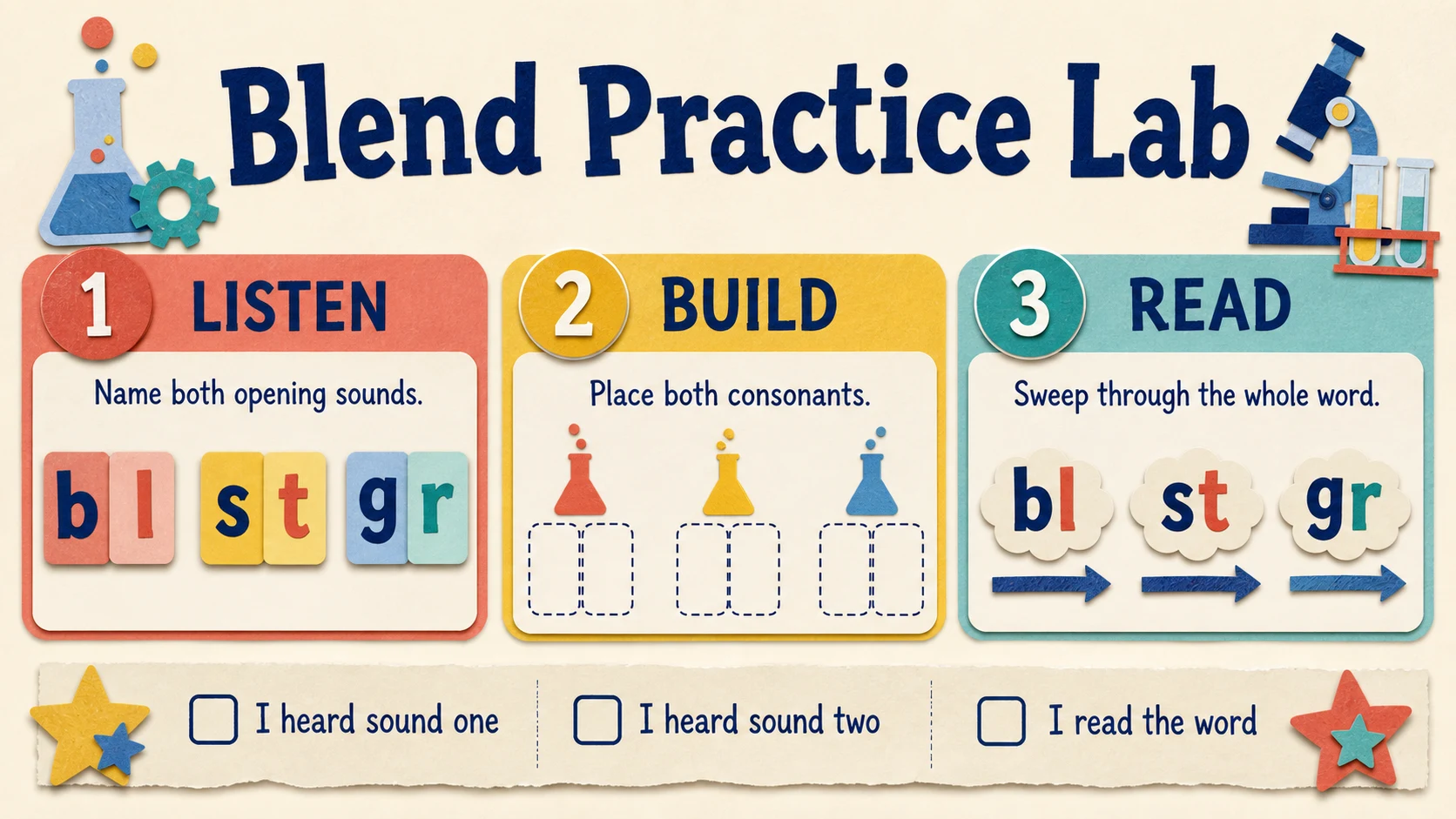
The catalogue recommends beginning with initial blends because they are easier to hear than final blends. It places s-blends first, followed by l-blends and r-blends, with only two or three blends introduced at a time. Final blends come later because learners may drop the last consonant.
Support should decrease only after the learner consistently preserves every sound.
| Stage |
Suggested focus |
Example words |
Evidence to look for |
| Readiness |
Letter sounds, oral blending, CVC words |
map, sit, lap |
Reads each position without guessing |
| 1 |
Two or three initial s-blends |
slip, snap, spot, stop, swim |
Retains /s/ and the next consonant |
| 2 |
Selected initial l-blends |
black, clap, flag, glad, plum |
Separates both blend sounds |
| 3 |
Selected initial r-blends |
brag, crab, drip, frog, grin, trim |
Avoids replacing or reversing sounds |
| 4 |
Mixed initial blends |
stop, clap, frog, swim |
Selects the correct blend without a cue |
| 5 |
Common final blends |
hand, sink, tent, bump |
Pronounces both final consonants |
| 6 |
Other listed final blends |
belt, gift, mask, nest |
Reads through the complete ending |
| 7 |
Connected reading and spelling |
Short phrases and sentences |
Transfers the skill beyond word lists |
This is an instructional sequence, not a required calendar. A learner may need several sessions on st and sp, while another may distinguish them quickly. Do not add more groups merely because a planned week has ended.
Why whole words matter
A blend is a spelling pattern inside a word, not a single combined sound to memorize. Briefly naming st can focus attention, but the learner should immediately read it in stop, step, or another decodable word. Whole-word practice requires the child to coordinate the blend with the vowel and final consonant.
Contrast is also useful. Compare top with stop, or lap with clap. The comparison shows exactly what the added consonant contributes without turning st or cl into an isolated chant.
Concrete and Visual Models
A useful model makes every sound noticeable while preserving the connection to print.
Finger tapping and sound counters
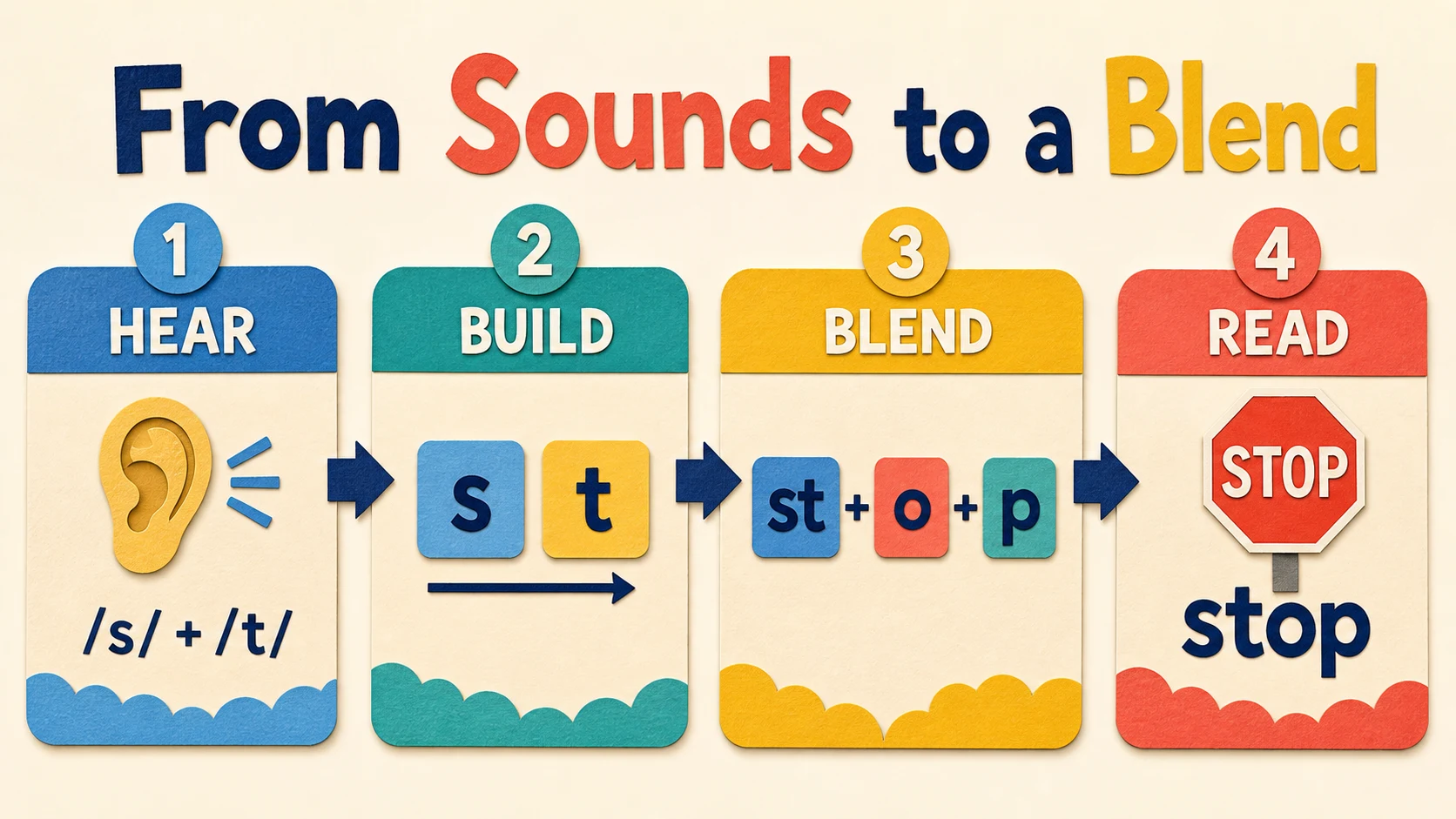
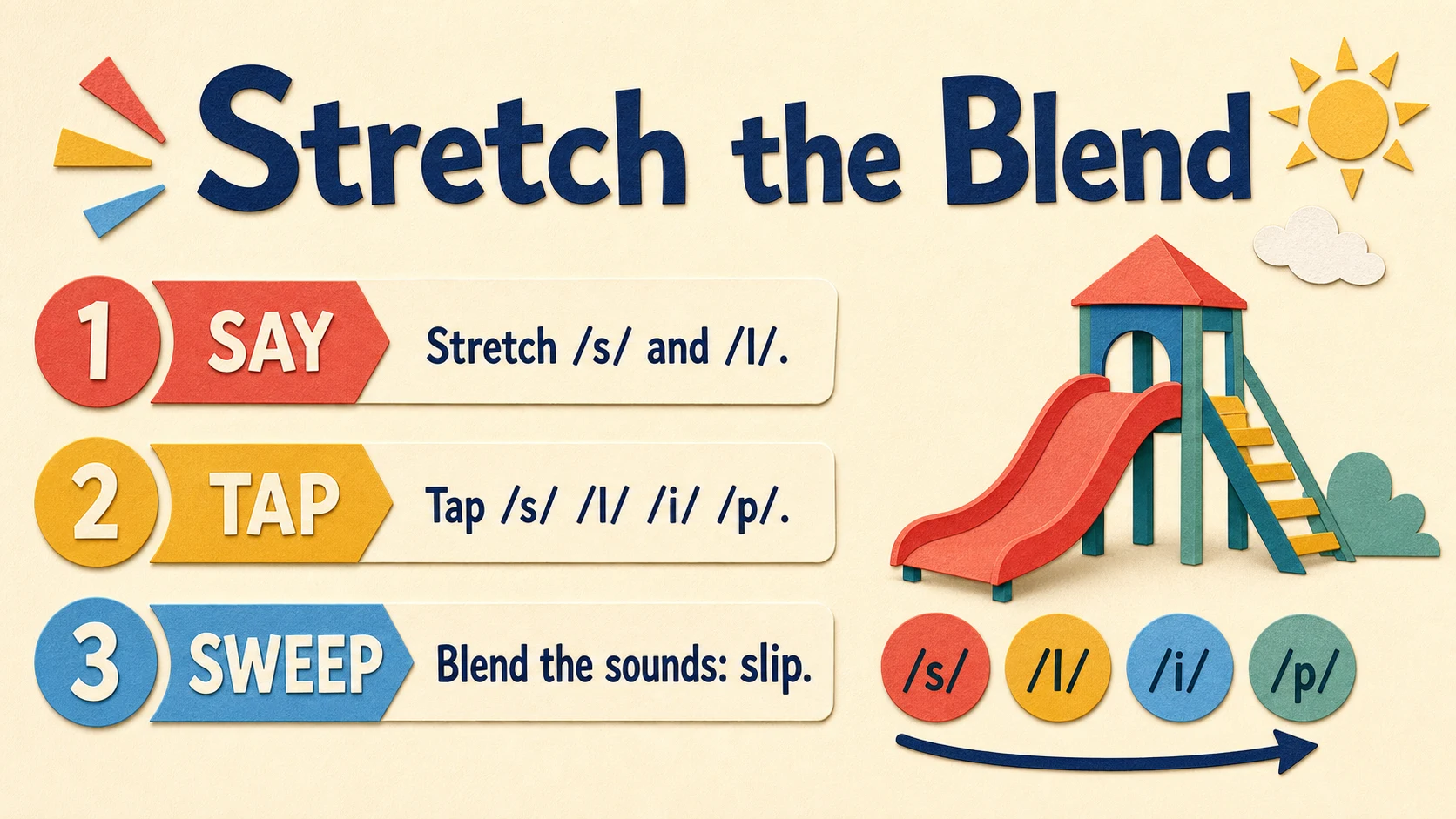
For stop, assign one finger or counter to each sound:
/s/ – /t/ – /o/ – /p/
Touch one finger or move one counter per sound. Then sweep a finger beneath the printed word and blend the sounds without long pauses: stop. Four sound movements are needed because all four consonant and vowel sounds remain audible.
For clap, use:
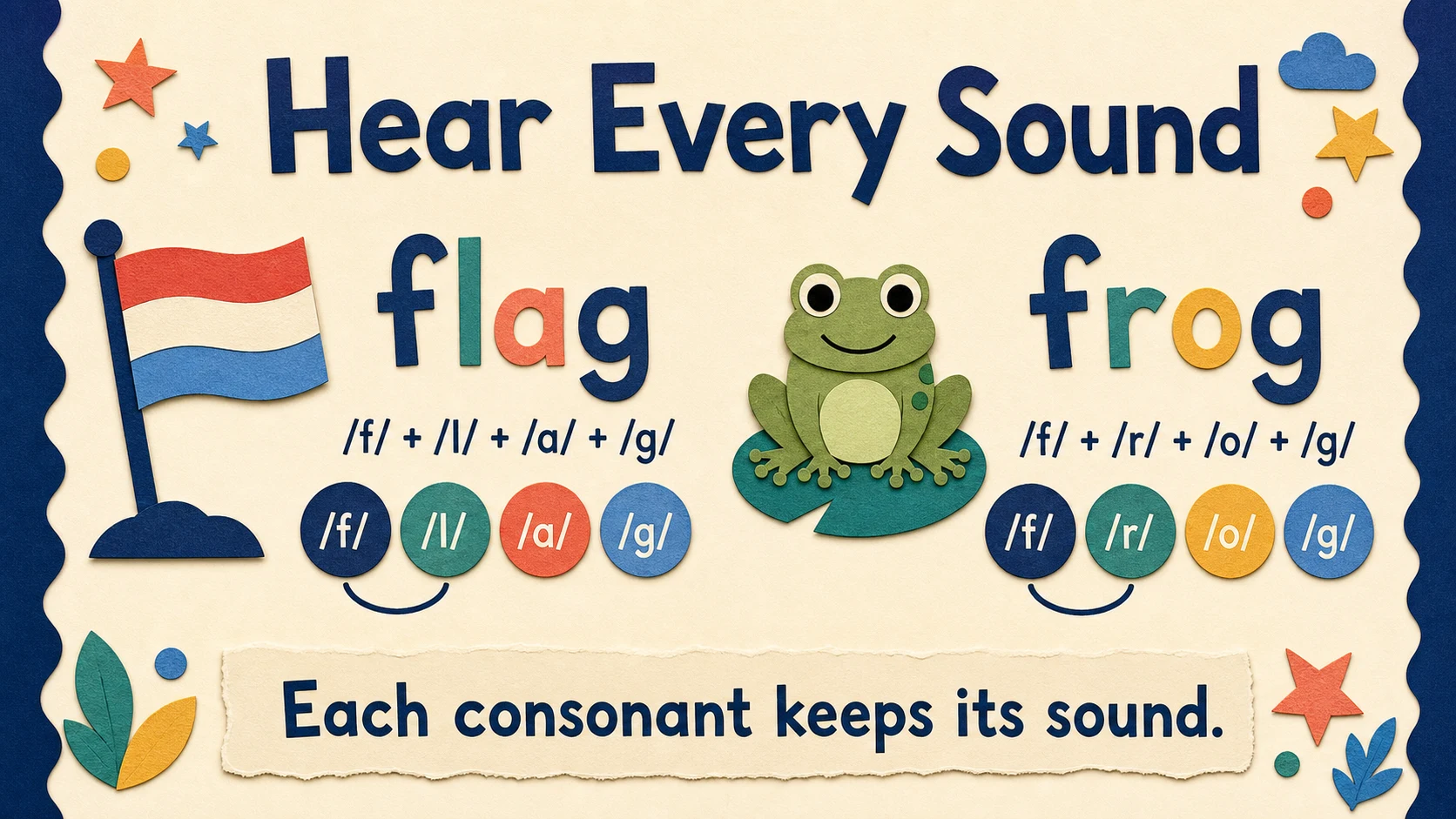
/k/ – /l/ – /a/ – /p/
The written word has four letters and, in this example, four sounds. The blend occupies the first two positions; it does not collapse into one sound.
Letter tiles and word chains
Build lap with letter tiles. Add c to make clap. Replace p with m to make clam. Add p at the end to make clamp:
lap → clap → clam → clamp
Ask what changed after each move. This catalogue-supplied chain moves from a CVC word to an initial blend, then changes the ending, then adds a final blend. Because only one letter changes at each step, an adult can see whether the learner attends to that specific change.
A drawn sound line can serve the same purpose when tiles are unavailable. Write one letter above each position, point from left to right, and have the learner blend only after identifying the sounds.
Fully Checked Worked Examples
The following examples show both the correct reasoning and the error an adult should watch for.
Moving from separate sound positions to a smooth reading keeps every consonant audible.
Example 1: Reading stop
- Look across the letters: s-t-o-p.
- Identify the sounds: /s/ /t/ /o/ /p/.
- Notice that st is an initial blend because both consonants occur at the beginning and both sounds remain.
- Blend continuously: stop.
- Check the result against every letter.
The answer is stop, and the initial blend is st. Reading sop is not a close-enough version; it omits /t/ and no longer accounts for every printed letter.
Example 2: Reading clap
- Begin with familiar lap: /l/ /a/ /p/.
- Add c before l.
- Read all four sounds: /k/ /l/ /a/ /p/.
- Sweep under the word and say clap.
The answer is clap, and cl is the initial blend. The learner must not replace the two sounds with a single unfamiliar sound or skip /l/. The comparison lap–clap makes the added /k/ concrete.
Example 3: Distinguishing ten and tent
Read ten first: /t/ /e/ /n/. Then place t at the end to form tent: /t/ /e/ /n/ /t/.
The answer for tent includes the final blend nt. The two words differ only at the end, so this pair checks whether the learner reads all the way through the word. If both are pronounced ten, the final /t/ has been dropped.
Example 4: Distinguishing bum and bump
Read bum as /b/ /u/ /m/. Add p to form bump, pronounced /b/ /u/ /m/ /p/.
The final blend is mp. A learner who says bum for bump has identified most of the word but has not completed the ending. Pointing separately to m and p, then blending the whole word, directly addresses the omission.
Example 5: Completing the word chain
Consider:
lap → clap → clam → clamp
- lap contains no consonant blend.
- clap adds c, creating the initial blend cl.
- clam changes final p to m while retaining cl.
- clamp adds final p, producing initial cl and final mp.
This chain is fully consistent: every arrow changes one letter, and every resulting item is a word. It can reveal whether the learner notices both ends of a longer one-syllable word.
A Short, Repeatable Lesson Routine
Keep a practice session focused enough that errors remain informative. The following routine is an instructional suggestion based on the supplied sequence; it is not a sourced universal lesson length.
Review, model, guided practice, application, and a quick check form one reusable cycle.
Review and model
Begin with two known CVC words and the consonant sounds needed for the day’s blends. Then model one target word. For st in stop, point to s and say /s/, point to t and say /t/, continue through the word, and blend it smoothly.
State the important idea plainly: “These consonants are next to each other, and we can still hear both sounds.”
Guided and independent practice
Build or read three to five words using only the selected blends. Prompt with a neutral cue such as “Check every sound” before supplying an answer. Mix in one previously learned pattern so the learner must inspect the print rather than repeat a routine.
Finish with one or two words read without help. If appropriate, add a short decodable sentence containing a learned blend. Connected reading checks whether the skill transfers when the blend is not the only feature receiving attention.
Close with evidence
Record which words were independent, prompted, or incorrect. Ask the learner to read one successful word again and explain which two consonant sounds begin or end it. The purpose is not a score; it is choosing the next lesson.
The IES foundational reading guide supports high-level use of explicit sound work, decoding instruction, and opportunities to read connected text. The exact routine above is a practical application, not a claim that IES prescribed or tested this WorksheetWise sequence.
Choosing Appropriate Practice
Match the activity to the question you need the learner’s work to answer.
| If you need to check… |
Choose… |
Avoid starting with… |
| Whether both sounds are heard |
Oral segmenting, finger taps, counters |
A long mixed worksheet |
| Whether sounds connect to letters |
Letter tiles and word building |
Picture-only identification |
| Whether a blend is recognized in print |
Circling the initial blend in whole words |
Memorizing a blend list alone |
| Whether similar forms are distinguished |
Word pairs such as ten–tent |
Unrelated words with many new patterns |
| Whether reading transfers |
Short decodable phrases or sentences |
Text containing numerous untaught patterns |
| Whether spelling transfers |
Dictation of known words |
Independent composition with many demands |
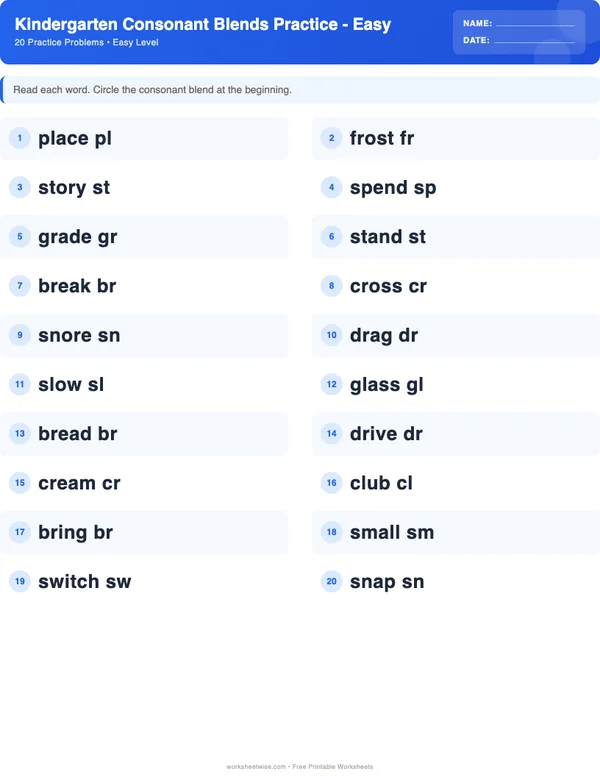
The free easy consonant-blends worksheet contains 20 exercises asking learners to read each word and circle its beginning blend. It is suitable when the target is identifying initial blends in printed words. It does not, by itself, show whether a learner can spell blends, read final blends, or transfer the skill to sentences.
The focused consonant-blends pack contains 18 worksheets and may suit adults who need more practice choices. More pages should not mean assigning everything. Select items that match the current pattern, and stop when the work no longer provides useful information.
Writing can reinforce print-sound connections, but keep the demand controlled. The IES elementary writing guide offers high-level guidance on writing instruction and practice. A brief activity such as building clap and then writing it from the model is an instructional suggestion; it should not be represented as a finding about this exact worksheet.
Differentiation Through Task Design
Differentiation should change the support, contrast, or response demand while preserving the target skill.
For a learner who is just beginning:
- Teach two blends rather than a large mixed set.
- Use words with familiar short vowels and endings.
- Provide counters, finger taps, or movable letters.
- Model the first word, complete the next together, and then request one independent response.
- Accept an oral response before requiring handwriting if writing mechanics hide the decoding evidence.
For a learner who can read practiced words but struggles with new ones:
- Mix known and unfamiliar words containing the same taught blend.
- Use a word chain so only one letter changes.
- Remove pictures during the final check.
- Ask the learner to point beneath each letter before blending.
- Add a short sentence containing one or two learned patterns.
For a learner who is accurate with initial blends:
- Contrast initial and final positions.
- Compare ten–tent and bum–bump.
- Mix s, l, and r blends already taught.
- Ask for simple spelling from dictation after successful reading.
- Use connected text containing the learned blends.
Do not increase difficulty merely by adding unfamiliar vocabulary, irregular spellings, or many untaught phonics patterns. That creates a different diagnostic problem.
Common Errors and Diagnostic Responses
An error pattern is useful when the response targets its likely source.
| Observed response |
What it may show |
Immediate teaching response |
| Reads stop as sop |
Drops the second sound in the initial blend |
Tap /s/ /t/ /o/ /p/, then blend again |
| Reads clap as cap |
Omits /l/ |
Compare cap and clap with tiles |
| Reads tent as ten |
Stops before the final consonant |
Contrast ten and tent |
| Reads bump as bum |
Drops the last sound in mp |
Hold m and p as separate tiles |
| Names st correctly but cannot read stop |
Recognizes the letter pair without blending the word |
Return to sound-by-sound whole-word reading |
| Chooses a word from a picture without checking print |
Relies on meaning or visual guessing |
Cover the picture and inspect every letter |
| Confuses several blend groups |
Too many contrasts may be active |
Return to two known blends and rebuild accuracy |
| Reads accurately but spells with one consonant |
Reading has not yet transferred to spelling |
Segment, map one letter per sound, then write |
A misconception to correct is that a blend makes one new sound. That describes neither st nor cl: each consonant remains audible. Another misconception is that every adjacent consonant pair should be taught as a blend. The scope here is the catalogue’s listed initial and final blends; do not use this guide to classify every consonant spelling pattern.
A third misconception is that speed proves mastery. Slow but complete decoding may show better control than a quick guess. Accuracy and attention to all letters come first.
Boundary Cases and Limitations
Blend identification is not the same as complete reading proficiency. A learner may circle st correctly yet be unable to blend stop. Conversely, a learner may read a familiar word automatically but be unable to identify its blend when asked. Check the exact skill you intend to teach.
Picture matching can support vocabulary, but it may also conceal decoding. Handwriting can support spelling, but weak letter formation may obscure what the learner knows about sounds. Oral reading, word building, circling, and writing therefore provide different evidence.
This guide does not diagnose language, hearing, vision, developmental, or medical conditions. Persistent difficulty calls for careful documentation and discussion with the learner’s teacher or an appropriately qualified professional; it does not justify a diagnosis from worksheet performance.
The grade label describes intended practice level, and local sequences differ. The catalogue’s listed standards include first- and second-grade references, so educators should consult their own curriculum and the Common Core ELA standards when standards documentation is required. No claim of comprehensive alignment is being made.
Monitoring Progress Without Rushing
Use a small record after each session:
- Target blends
- Words read independently
- Words read after a prompt
- Words read incorrectly
- Type of error
- Planned next response
A useful instructional rule is to advance when performance is accurate across more than one task and more than one occasion. For example, a learner who reads st words from a practiced list should also read a newly presented st word and find st in a short sentence before the adult assumes broad transfer.
Look for error patterns rather than a single total. Four omissions of the second consonant call for different teaching from four vowel substitutions. Recheck previously learned blends after new ones are introduced, because a pattern that appeared secure in isolation may become confused in a mixed set.
A Two-Week Practice Plan
This plan offers ten short practice sessions. It is not a guaranteed or universal timetable. Repeat, combine, or pause sessions according to observed work.
The sequence moves from readiness checks to mixed reading, final blends, and transfer.
| Day |
Focus |
Suggested activity |
Decision point |
| 1 |
Readiness |
Check consonant sounds, oral blending, and five CVC words |
Review foundations if omissions are frequent |
| 2 |
sl, sn |
Model, tap, build, and read a small word set |
Repeat if either blend loses a consonant |
| 3 |
sp, st |
Contrast words such as spot and stop |
Keep support if /s/ or the next sound disappears |
| 4 |
sw plus review |
Read mixed taught s-blends in whole words |
Add no new group if guessing increases |
| 5 |
Selected l-blends |
Introduce two of bl, cl, fl, gl, pl |
Continue only with the demonstrated pair |
| 6 |
l-blend review |
Use lap → clap → clam and mixed word reading |
Check transfer to an unfamiliar word |
| 7 |
Selected r-blends |
Introduce two of br, cr, dr, fr, gr, pr, tr |
Reduce contrasts if substitutions occur |
| 8 |
Final nd, nt |
Contrast ten–tent and read another taught pair |
Watch for dropped final consonants |
| 9 |
Final nk, mp |
Build and compare endings, including bum–bump |
Return to counters if the last sound is omitted |
| 10 |
Review and transfer |
Mix taught words, read a short sentence, and spell two known words |
Choose the next practice from the error record |
If Day 3 reveals repeated omission in st, Day 4 should review st, not automatically add sw. If initial blends are secure but final consonants disappear, keep initial words as a brief review and concentrate modeling on final blends. If reading is accurate and spelling is not, add sound-to-letter mapping without abandoning successful reading practice.
An Honest Next Step
Begin with a brief readiness check and two initial blends, then use the learner’s responses to choose the next task. When the learner can read whole words and the goal is printed initial-blend identification, use the free Kindergarten consonant-blends worksheet. Record omissions, substitutions, and independent successes instead of assigning additional pages automatically. Return to the broader consonant-blends topic guide or free worksheet generators when you need practice shaped around the specific blend pattern the learner is ready to review.