What Kindergarten Word Families Are
Kindergarten word families are groups of words with the same ending sound and spelling pattern. For example, cat, hat, mat, and sat belong to the -at family. The beginning sound changes, but the shared ending stays the same.
The most useful way to teach this skill is to help a learner hear, build, blend, read, and sort these patterns—not simply memorize lists. A child who can blend /m/ + /at/ to read mat can use the same process with /s/ + /at/ to read sat. This reduces the amount of new information in each word while preserving genuine decoding.
Word-family instruction belongs alongside systematic phonics. It does not replace attention to individual letter sounds or blending from left to right. The IES foundational reading practice guide supports explicit work with sound segments, letter–sound relationships, decoding, and connected text. Word families provide one practical structure for that broader instruction.
Grade labels describe the intended practice level; local school and homeschool sequences differ. A Kindergarten label therefore signals an appropriate starting range, not a universal timetable or a promise that every learner should complete the same work at the same time. The learner’s observed reading and spelling should determine pacing.
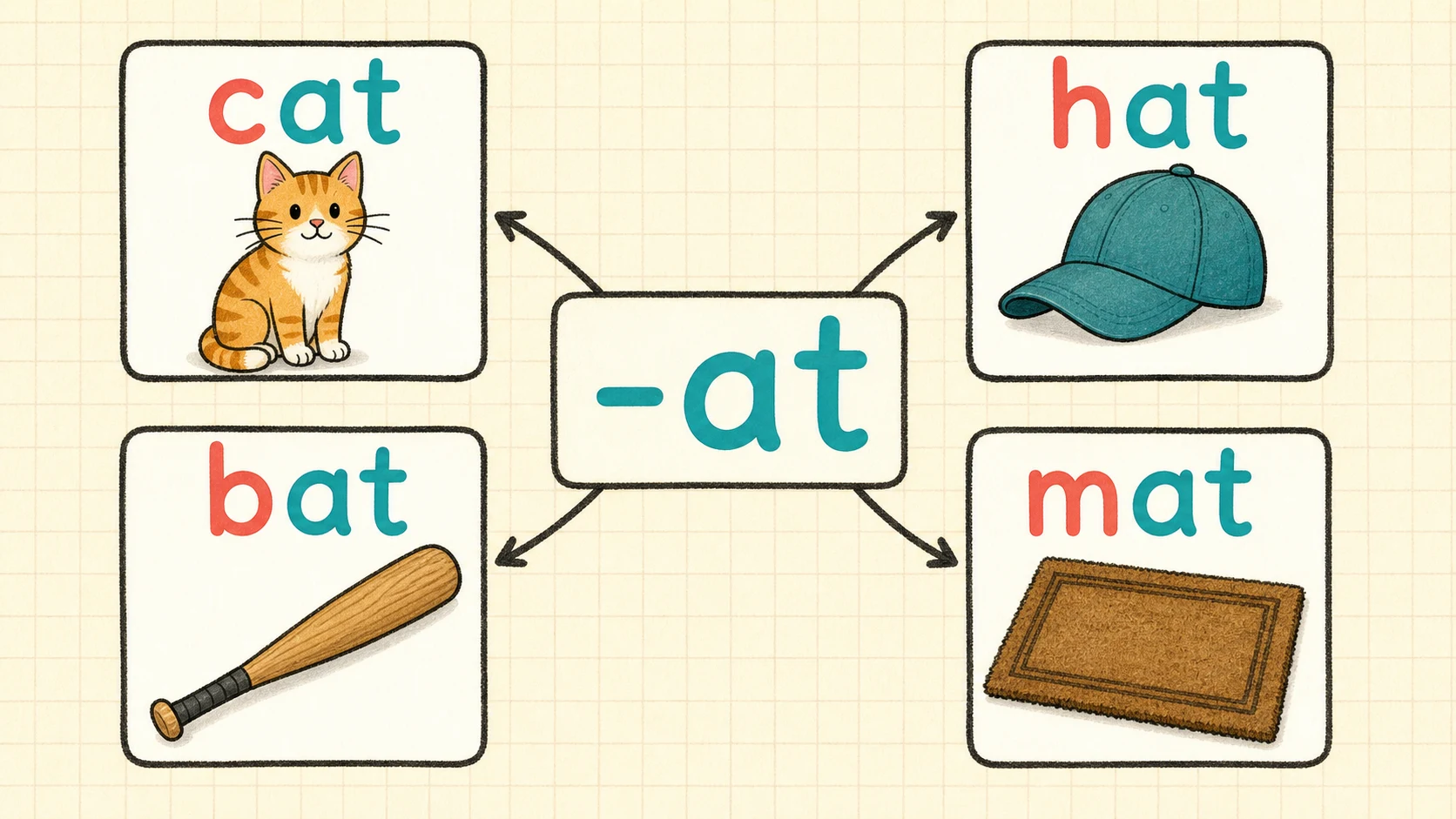
The skill connects listening, letter–sound knowledge, word building, decoding, sorting, and reading in context.
Prerequisites to Check Before Teaching Families
Word-family work is easiest when several underlying skills are at least emerging. A learner does not need perfect mastery, but persistent difficulty with a prerequisite should change the lesson.
Hearing and producing rhyme
Say cat and hat without showing the words. Ask whether they sound the same at the end. Then ask for another word that rhymes. A learner may offer a real word such as mat or a pronounceable invented word such as zat. Either response demonstrates attention to the shared sound.
Rhyming is related to word-family work, but it is not identical. Blue and shoe rhyme even though their written endings differ. Conversely, looking alike does not always guarantee the expected rhyme in English. At the beginning level, choose regular short-vowel families whose sound and spelling patterns correspond clearly.
Knowing relevant letter sounds
Before working on -at, check whether the learner can connect a with its short sound and t with /t/. Also check the initial consonants used in the lesson. If m, s, and f are unfamiliar, swapping them into -at becomes a guessing exercise.
Use lowercase letters first when the target words appear in lowercase. Uppercase recognition remains useful, but it should not add an avoidable demand to an introductory blending task.
Blending a simple spoken or printed word
Ask the learner to combine /m/ /a/ /t/ into mat. Then try the larger parts /m/ + /at/. Success with either approach provides a foundation. If the learner can blend orally but not from print, connect each spoken part directly to its letters. If oral blending is difficult too, shorten the task and practice with two clear parts before expecting independent worksheet completion.
Tracking from left to right
The learner should attend to the beginning consonant before the shared ending. A child who sees cat, notices only -at, and says hat has recognized the family but has not decoded the whole word. Pointing beneath the onset and then sliding beneath the rime can make the sequence visible.
The Kindergarten phonics collection can help an adult choose supporting letter-sound or CVC practice when word-family work reveals a prerequisite gap.
A Grade-Appropriate Teaching Progression
A sensible sequence begins with one regular short-vowel family and gradually increases what the learner must notice. Do not advance merely because a page is finished. Advance when the learner can perform the current task accurately with less prompting.
| Stage |
Instructional focus |
Example task |
Evidence to look for |
| 1. Hear |
Notice a shared spoken ending |
Identify cat and hat as rhyming |
Responds from sound without print |
| 2. Build |
Keep the rime and change one onset |
Change m-at to s-at |
Replaces only the beginning |
| 3. Blend |
Read onset and rime together |
/p/ + /ig/ → pig |
Produces the whole word without guessing |
| 4. Compare |
Contrast two families |
Sort cat, map, tap, hat |
Uses the complete ending pattern |
| 5. Complete |
Supply a missing letter or chunk |
_op → hop with a picture or choices |
Checks both sound and spelling |
| 6. Extend |
Add blends or digraphs |
fl-at, ch-at, sh-ip |
Blends the full onset into the rime |
| 7. Apply |
Read words in a short sentence |
“The fat cat sat.” |
Reads each word and preserves meaning |
| 8. Encode |
Build or write a heard word |
Hear mop, write m-o-p |
Represents the beginning and ending sounds |
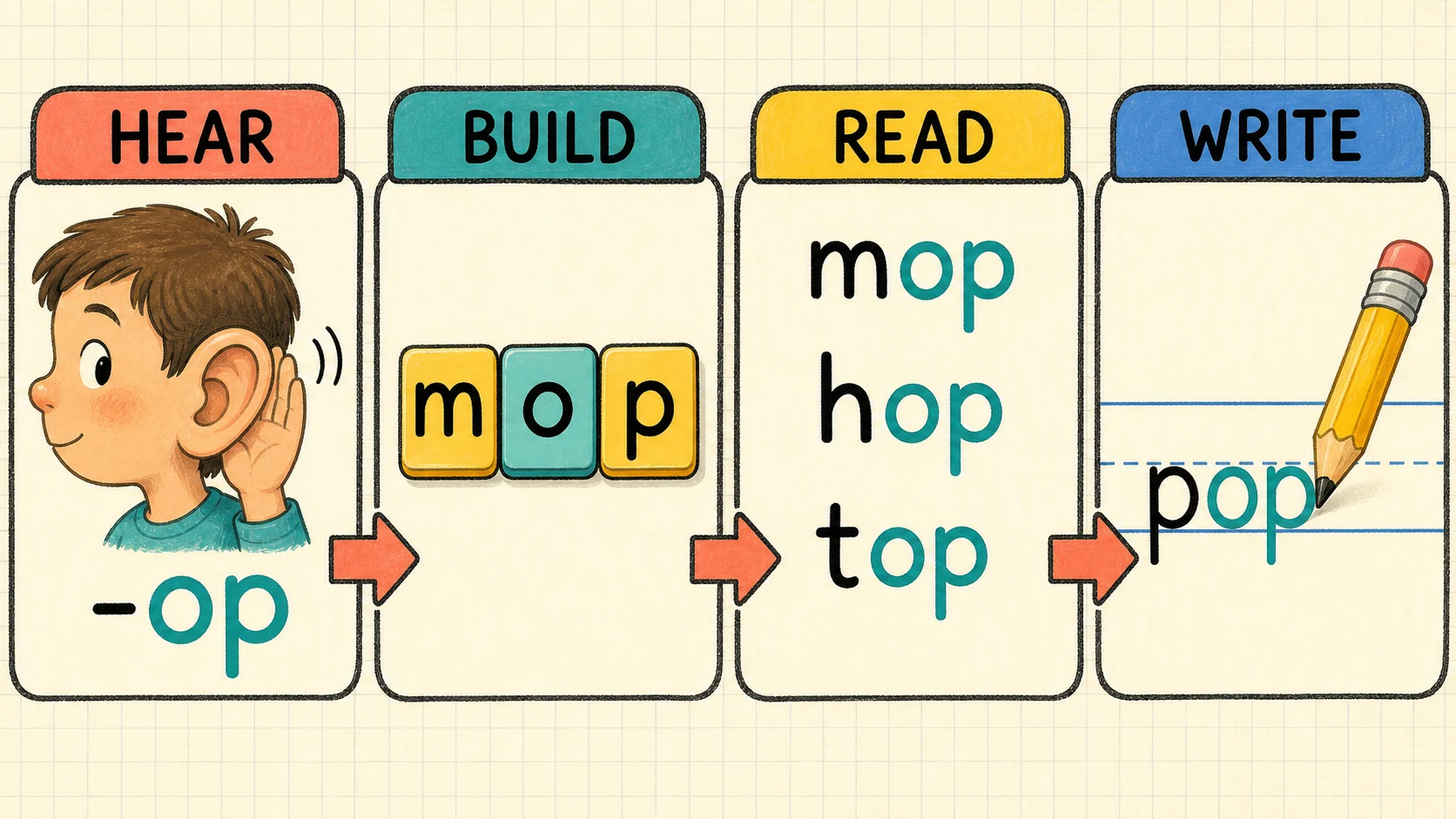
Support decreases as the learner moves from hearing a pattern to reading and writing it independently.
Begin with regular CVC families
The catalogue sequence starts with common short-vowel patterns:
- Short a: -at, -an, -am, -ap, -ad
- Short i: -it, -in, -ig, -ip, -id
- Short o: -ot, -op, -og
- Short u: -ut, -ug, -un, -up
- Short e: -et, -en, -ed
Introduce one family at a time when the pattern is new. Use a small set of familiar initial consonants and verify that every constructed item is either a real word the learner can understand or an explicitly labeled pretend word used only for decoding.
Contrast families after one-family success
A page containing only -at words can be completed by repeating at without carefully inspecting every word. Mixed practice asks the learner to discriminate. Begin with visibly and audibly distinct endings, such as -at and -op, before contrasting closer patterns such as -at and -an.
Add complex onsets carefully
Once simple CVC words are secure, introduce words such as chat, flat, and ship. The ending remains familiar, but the onset now contains a digraph or consonant blend. This is an increase in difficulty, not merely another word in the list. Return to letter tiles or segmented pointing if the learner drops part of the onset.
Concrete and Visual Models
The key relationship is:
onset + rime = word
In cat, c is the onset and at is the rime. In flat, fl is the onset and at is the rime. The rime begins with the vowel and includes the sounds that follow it.
Letter-tile swap
Place the tiles a and t together. Keep them stationary. Put m before them and blend:
m | at → mat
Remove only m, replace it with s, and blend:
s | at → sat
Ask, “What stayed the same? What changed?” The physical movement makes the structure concrete. The learner should still read the entire new word; the activity is not complete when the correct tile has merely been placed.
Word-family house
Write -ig on a “house.” Place p, d, and w on separate cards outside it. Move one initial consonant into the house at a time:
- p + ig = pig
- d + ig = dig
- w + ig = wig
A drawing may clarify a word’s meaning after decoding. It should not become the main strategy for identifying the word. Ask for the sounds first, then use the picture to confirm that the result makes sense.
Sound boxes and continuous blending
For mop, draw three boxes and place one letter in each:
Touch each letter while saying its sound, then sweep beneath the whole word: /m/ /o/ /p/, mop. Next, bracket the family structure: m | op. These two views are compatible. The first preserves attention to every phoneme; the second highlights the recurring chunk.
Oral-to-print bridge
Say sat. Ask the learner to segment it into /s/ /a/ /t/, build it, and read it back. This connects speech, print, decoding, and spelling. The IES elementary writing practice guide offers high-level guidance for explicit writing instruction and regular writing practice. In a phonics lesson, a brief build-or-write step can provide useful evidence about whether the learner can represent the sounds independently.
Fully Checked Worked Examples
Example 1: Building within the -at family
Task: Change cat to mat.
- Read the starting word:
c + at = cat.
- Identify the requested word mat and stretch its beginning:
/m/at.
- Keep at because both words share
/at/.
- Replace c with m.
- Blend the result:
/m/ + /at/ = mat.
- Check all letters: m-a-t spells mat.
Answer: mat
Only the onset changes. Replacing a or t would break the shared family pattern.
Example 2: Completing a missing onset
Task: Complete _op to make the word hop.
- Say hop slowly:
/h/ /o/ /p/.
- The printed chunk op represents
/o/ /p/.
- The missing beginning sound is
/h/.
- The letter for that sound is h.
- Insert it:
h + op = hop.
- Read the complete word from left to right: hop.
Answer: h, making hop
A learner who inserts m produces the valid word mop, but it does not answer this task. The target word or picture must be checked, not just the family.
Example 3: Sorting across two families
Task: Sort pig, top, wig, mop, dig, hop into -ig and -op.
Inspect the vowel-and-final-consonant chunk in every word:
| -ig family |
-op family |
| pig |
top |
| wig |
mop |
| dig |
hop |
Verification:
p + ig = pigw + ig = wigd + ig = digt + op = topm + op = moph + op = hop
Each word appears once. All words ending in the letters and sounds ig are in the first group; all ending in op are in the second.
Example 4: Reading a family word in context
Task: Read: The fat cat sat on a mat.
- Locate the patterned words: fat, cat, sat, mat.
- Confirm each onset:
f + at = fatc + at = cats + at = satm + at = mat
- Read the full sentence, including the other words.
- Check meaning: a fat cat can sit on a mat.
- Reread smoothly only after every word is accurate.
The four -at words share a rime, but their first sounds determine their identities. Saying cat for every patterned word would not be correct reading.
Example 5: Extending to a consonant blend
Task: Build flat from -at.
- Start with the known rime at.
- Hear the onset in flat:
/f/ /l/.
- Represent the onset with fl.
- Join the parts:
fl + at = flat.
- Blend without dropping a sound:
/f/ /l/ /a/ /t/ → flat.
- Check the spelling: f-l-a-t.
Answer: flat
The word belongs to the -at family, but its onset has two sounds. If the learner reads fat, the /l/ was omitted.
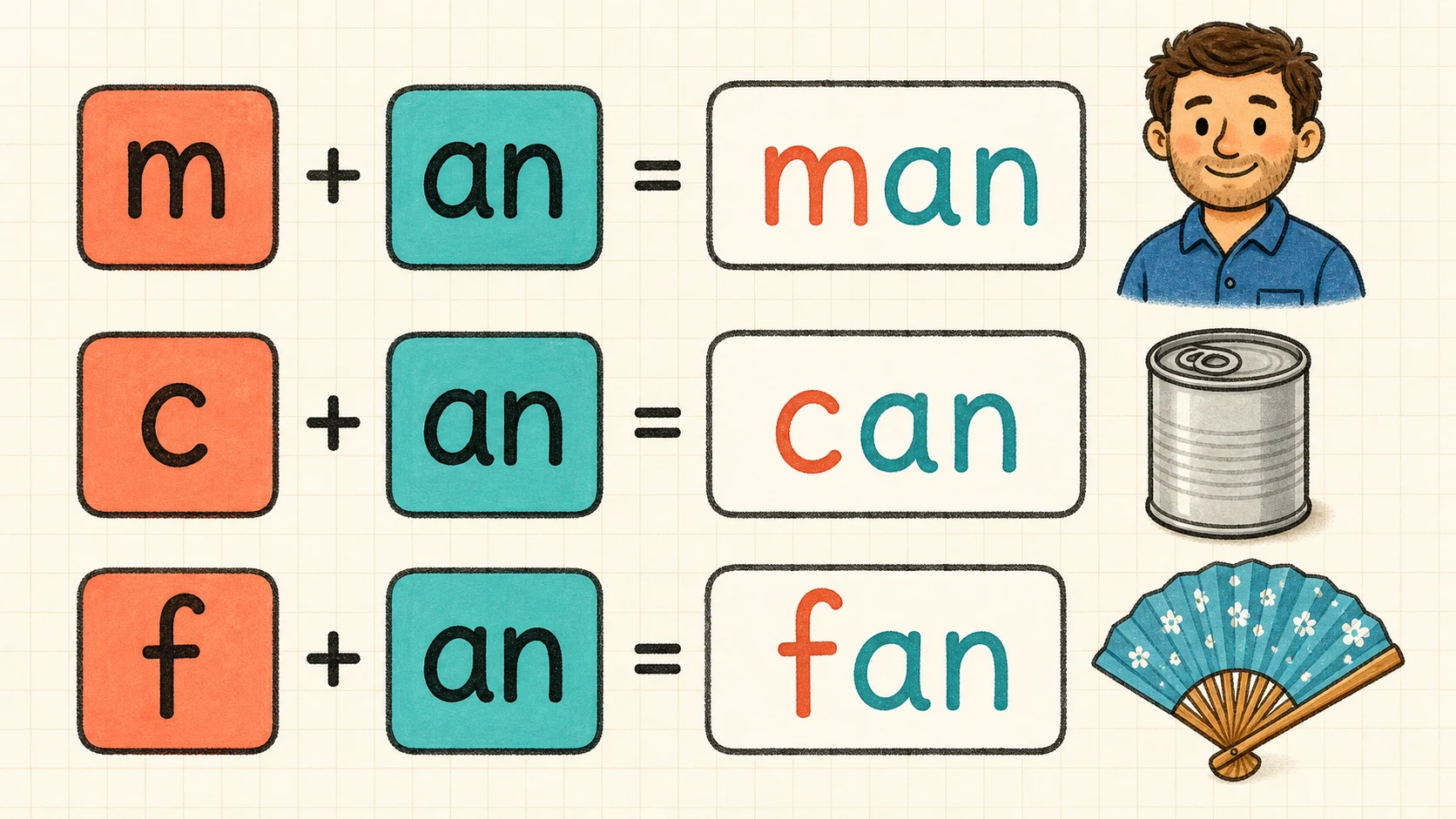
Each checked example links spoken sounds, visible letters, blending, and a final verification.
A Short, Repeatable Lesson Routine
Keep the routine stable while changing the target family. About five to ten focused minutes may be enough for some learners, but this is an instructional suggestion rather than a universal timetable. Stop or simplify when attention or accuracy falls sharply.
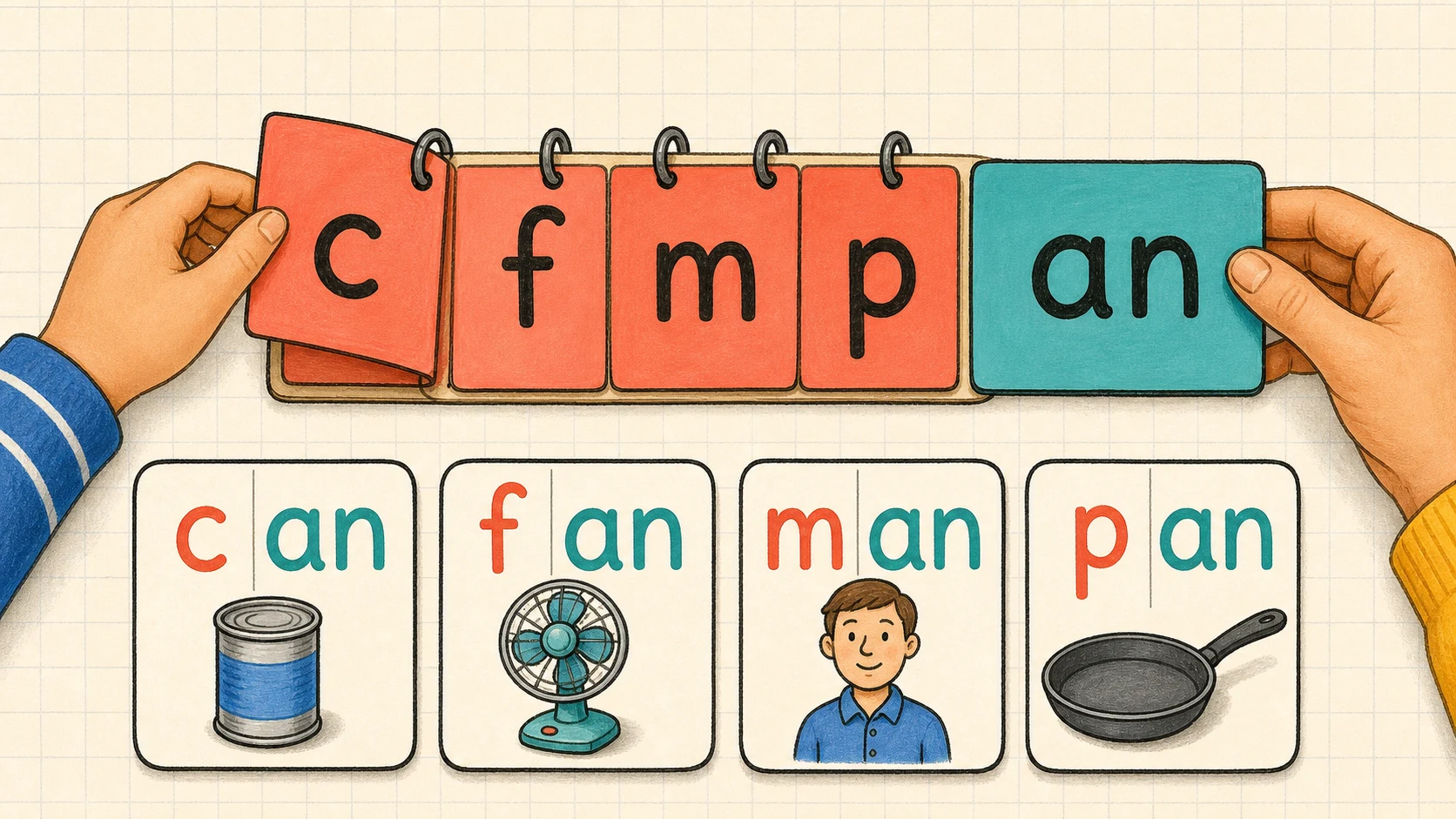
The same compact sequence can support a new family, a review lesson, or error correction.
1. Hear the pattern
Say two words, such as map and tap. Ask what sounds the same. Keep print hidden briefly so the learner must listen.
2. Reveal and map the letters
Show map and tap. Underline ap. Connect the heard /ap/ to the written ap, then identify m and t as the changing onsets.
3. Build and swap
Use tiles to make three or four words. After each swap, require a full blend: map, tap, cap. Mix their order and reread so the sequence is not memorized.
4. Read mixed items
Include one or two words from a previously learned family: map, pig, tap, cap. Mixed review shows whether the learner is attending to the vowel and ending rather than assuming every item belongs to the day’s family.
5. Apply and record
Read a short phrase or sentence, or ask the learner to build one dictated word. Record one observation, such as “read three -ap words independently; confused map and mop.” That note should shape the next lesson.
Choosing Appropriate Practice
Practice should match the next observable need. A longer worksheet is not automatically better, and an “easy” label does not tell you which prerequisite a particular learner has or has not mastered.
| Observed performance |
Choose next |
Avoid for now |
| Cannot hear the shared ending |
Oral rhyme matching with two choices |
Large written word sorts |
| Knows sounds but cannot combine them |
Tile building and guided blending |
Timed independent reading |
| Reads one family accurately |
Mixed review with one contrasting family |
Many new families at once |
| Guesses from pictures |
Print-first decoding, then picture confirmation |
Picture-only word identification |
| Reads CVC words securely |
Blends, digraphs, and short sentences |
Repeating only familiar CVC lists |
| Reads but cannot spell the pattern |
Dictated building and missing-letter tasks |
Copying without sound analysis |
| Makes errors after several items |
Shorter sets with immediate review |
Completing all items despite declining accuracy |
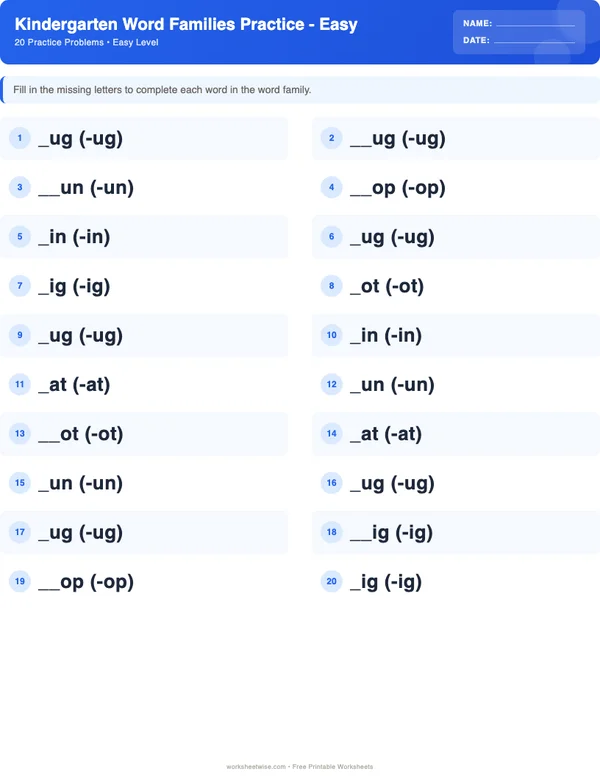
The free easy Kindergarten word-families worksheet contains 20 exercises in which learners fill in missing letters. It practices word patterns, onset and rime, rhyming, and word building, and includes a separate answer key. It is most appropriate when the learner understands the task and needs structured completion practice.
The focused Word Families pack contains 18 worksheets. A larger set can support spaced review or provide alternate practice, but it should not be treated as a requirement to complete every page. Select only the pages that fit the learner’s current pattern of performance.
For a narrower or differently arranged set, the free worksheet generators may help an adult create additional practice. Check generated items before presenting them, especially when a picture, vocabulary choice, or spelling pattern could introduce an unintended difficulty.
Differentiation Without Changing the Goal
Differentiation should adjust support, quantity, or complexity while preserving the central goal: attend to sounds and letters to read or build words.
When the learner needs more support
Use one family and two or three onsets. Provide letter tiles rather than requiring handwriting. Model one complete example, then solve the next together. Offer a choice between two initial letters, such as m and s, for _at with a picture of a mat.
Reduce visual clutter by covering all but one item. Say the target word aloud if vocabulary is the barrier. If the learner can build mat correctly but struggles to write it, record the successful phonics response separately from handwriting performance.
When the learner is ready for more challenge
Mix two or three established families. Remove pictures. Ask the learner to explain which part stayed the same. Introduce chat, flat, or ship after simple onsets are secure. Add a brief sentence and ask the learner to locate, decode, and use the family words.
Spelling can reveal deeper understanding. Dictate mop, provide no visible model, and ask the learner to build or write it. Reading mop from a card and spelling mop from speech are related but distinct demands.
When language or vocabulary adds difficulty
Teach the word’s meaning without replacing decoding. A learner may correctly blend dig yet not know what it means. Demonstrate or explain the action, then reread the word. Do not mark accurate decoding as incorrect merely because expressive vocabulary is limited; likewise, do not assume a guessed word was decoded because it fits a picture.
Diagnosing Common Errors and Boundary Cases
An error is useful evidence when the adult identifies what changed between the printed word and the spoken response.
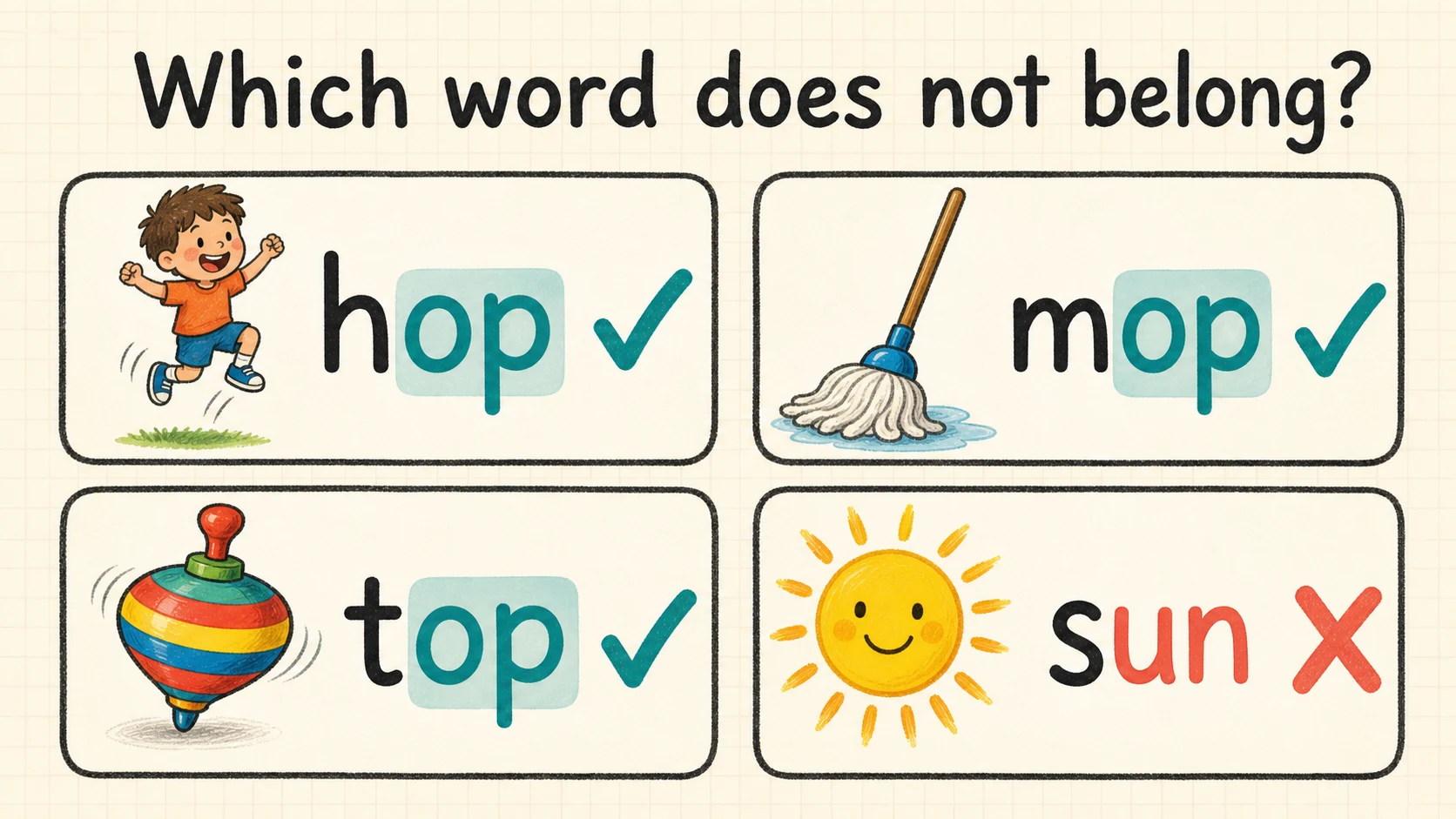
The response should address the source of the error rather than simply repeat the direction.
| Learner response |
Likely issue to check |
Teaching response |
| Reads mat as “sat” |
Initial consonant was ignored |
Contrast m and s; blend both words |
| Sorts map with -at |
Attended only to the vowel or first letters |
Box and compare the complete rimes ap and at |
| Reads flat as “fat” |
Dropped part of the blend |
Touch f, l, at, then blend continuously |
| Writes hp for hop |
Medial vowel was omitted |
Stretch /h/ /o/ /p/ into three sound boxes |
| Names every pictured rhyme correctly but cannot read the words |
Picture or memory is carrying the task |
Remove pictures and use decodable print |
| Reads a practiced list but fails when order changes |
Sequence may have been memorized |
Shuffle cards and mix in a known contrast family |
| Produces a rhyming word with different spelling |
Understands rhyme but not the target written family |
Acknowledge the rhyme, then compare spellings |
Boundary case: rhyme is broader than a printed family
Words can rhyme without sharing the same spelling. That is why an oral rhyming response should not automatically be accepted as membership in a specified written family. If the task says “find a rhyme,” sound is central. If it says “sort the -at family,” both the target sound and written at pattern matter.
Boundary case: a valid word can still be the wrong answer
For _op, both mop and hop are legitimate completions in an open word-building activity. If a picture or spoken target specifies hop, however, mop does not satisfy the direction. Adults should clarify whether a task allows any real family word or requires one particular word.
Boundary case: patterned reading is not word guessing
Recognizing -at narrows the decoding task, but it does not identify the onset. The learner must still distinguish bat, cat, fat, and hat. Prompt with “Check the first sound,” not “What would make sense?” Meaning is valuable for confirmation after the letters have been processed.
The Common Core English Language Arts standards provide broad grade-level context for Kindergarten work involving rhyme, onset–rime blending and segmentation, letter–sound knowledge, and beginning word reading. Local curricula may organize these elements differently, so the learner’s actual work remains the immediate guide.
Monitoring Progress and Deciding What Comes Next
Use a small, consistent sample rather than relying on a general impression. Once or twice during a practice cycle, present:
- Three words from the current family
- Two words from a previously taught family
- One unfamiliar but decodable word using a known family
- One build-or-write item
- One short phrase or sentence, when appropriate
Record the exact response and the level of help. “Read pig after I supplied /p/” is more informative than “needed help.” Distinguish independent, prompted, and modeled answers.
Look for three forms of transfer:
- New onset: Can the learner apply -ig to read wig after practicing pig and dig?
- New order: Can the learner read shuffled cards rather than a rehearsed list?
- New context: Can the learner read a family word in a phrase or sentence?
Move forward when accuracy is steady across more than one encounter and prompting is decreasing. Review when the learner recognizes a family only in one layout. Step back when errors show missing letter sounds, weak oral blending, or failure to inspect the whole word.
Speed may improve with familiarity, but do not trade accuracy for rushing. A child who reads slowly and checks every letter may be showing a more productive process than one who answers quickly from pictures. There is no universal score or number of days that guarantees readiness for the next family.
A Two-Week Practice Plan
This plan is a flexible instructional example, not a sourced or universal schedule. Sessions can be shortened, repeated, or separated by rest days. Begin each day with a quick review and let observed work determine whether to continue.
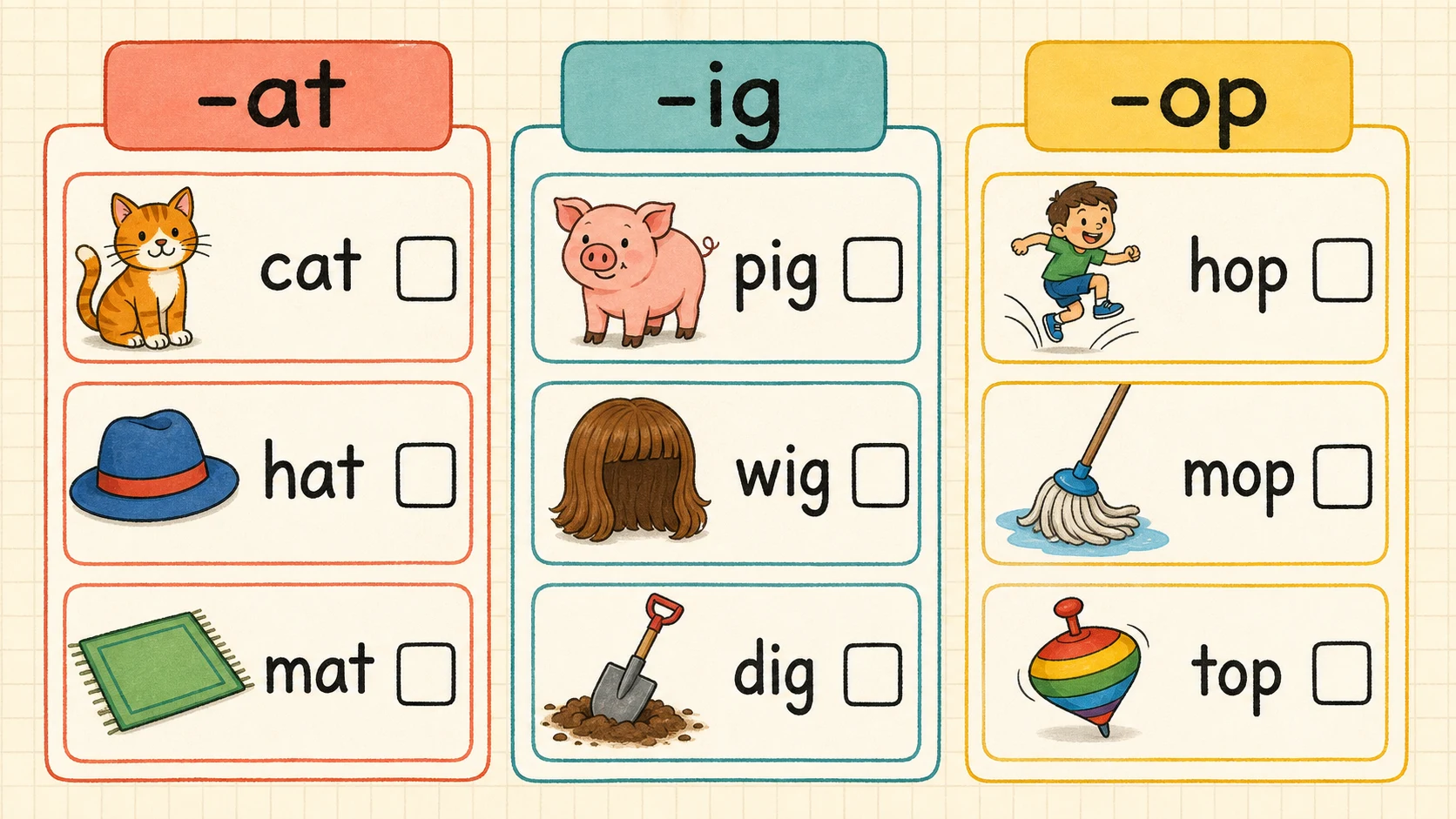
New teaching alternates with cumulative review, application, and a final transfer check.
| Day |
Focus |
Brief activity |
Decision point |
| 1 |
Prerequisite check |
Rhyme, letter sounds, oral blending, left-to-right tracking |
Choose the first family or repair a prerequisite |
| 2 |
Introduce -at |
Hear, build, and read cat, mat, sat |
Repeat if onsets are ignored |
| 3 |
Review -at |
Shuffle cards; build one dictated word |
Add a family only if reading is stable |
| 4 |
Introduce -ap |
Build map, tap, cap |
Contrast ap with at orally and visually |
| 5 |
Sort -at/-ap |
Sort six mixed words; explain each choice |
Note vowel or final-consonant confusions |
| 6 |
Apply short a |
Complete missing letters and read a short sentence |
Reduce the set if accuracy declines |
| 7 |
Light review |
Reread four known words and one new decodable word |
Keep the session brief |
| 8 |
Introduce -ig |
Build pig, dig, wig |
Check the short i sound |
| 9 |
Review and spell |
Read shuffled -ig words; build dig from dictation |
Return to sound boxes if the vowel is omitted |
| 10 |
Introduce -op |
Build hop, mop, top |
Compare -op with -ig |
| 11 |
Mixed sort |
Sort words among -at, -ig, -op |
Use only two groups if three overloads attention |
| 12 |
Sentence reading |
Read short sentences containing known family words |
Correct decoding before rereading smoothly |
| 13 |
Extension or repair |
Try flat, chat, or targeted CVC review |
Extend only if simple onsets remain accurate |
| 14 |
Transfer check |
Read, sort, and spell a small unseen sample |
Choose review, a new family, or prerequisite work |
A successful two weeks need not end with every listed family mastered. A more useful outcome is a clear teaching decision supported by observed responses.
Limitations and the Honest Next Step
Word families organize recurring patterns, but they do not account for every English word or every spelling of a rhyme. They also cannot replace systematic work with individual phonemes, letter–sound correspondences, blending, vocabulary, connected reading, and early writing. Repeated exposure to one family may produce familiarity without flexible decoding if the learner memorizes the list or relies on illustrations.
A worksheet shows what the learner writes on that page. It may not show whether the word was heard accurately, decoded independently, copied from another item, or guessed from a picture. Observe at least a few responses directly, and use the answer key to check correctness rather than infer the learner’s reasoning.
Start with the free Kindergarten Word Families worksheet. Complete only five well-observed items first. Note whether the learner hears the target word, checks the onset, preserves the rime, and reads the completed word. Use that evidence to choose the next five items, a concrete tile lesson, or prerequisite practice from the Kindergarten worksheet hub.