What Kindergarten CVC Words Teach
CVC words are three-sound words built in a consonant-vowel-consonant pattern, such as cat, pin, and hug. In direct terms, the learner’s job is to look at each letter, connect it with a sound, blend the three sounds into a word, and eventually reverse the process to spell the word.
This work connects several foundational abilities:
- Hearing three separate sounds in a spoken word
- Identifying the first, middle, and last sounds
- Connecting common consonants with their sounds
- Distinguishing the five short-vowel sounds
- Blending sounds from left to right
- Segmenting a whole word into sounds
- Representing those sounds with letters
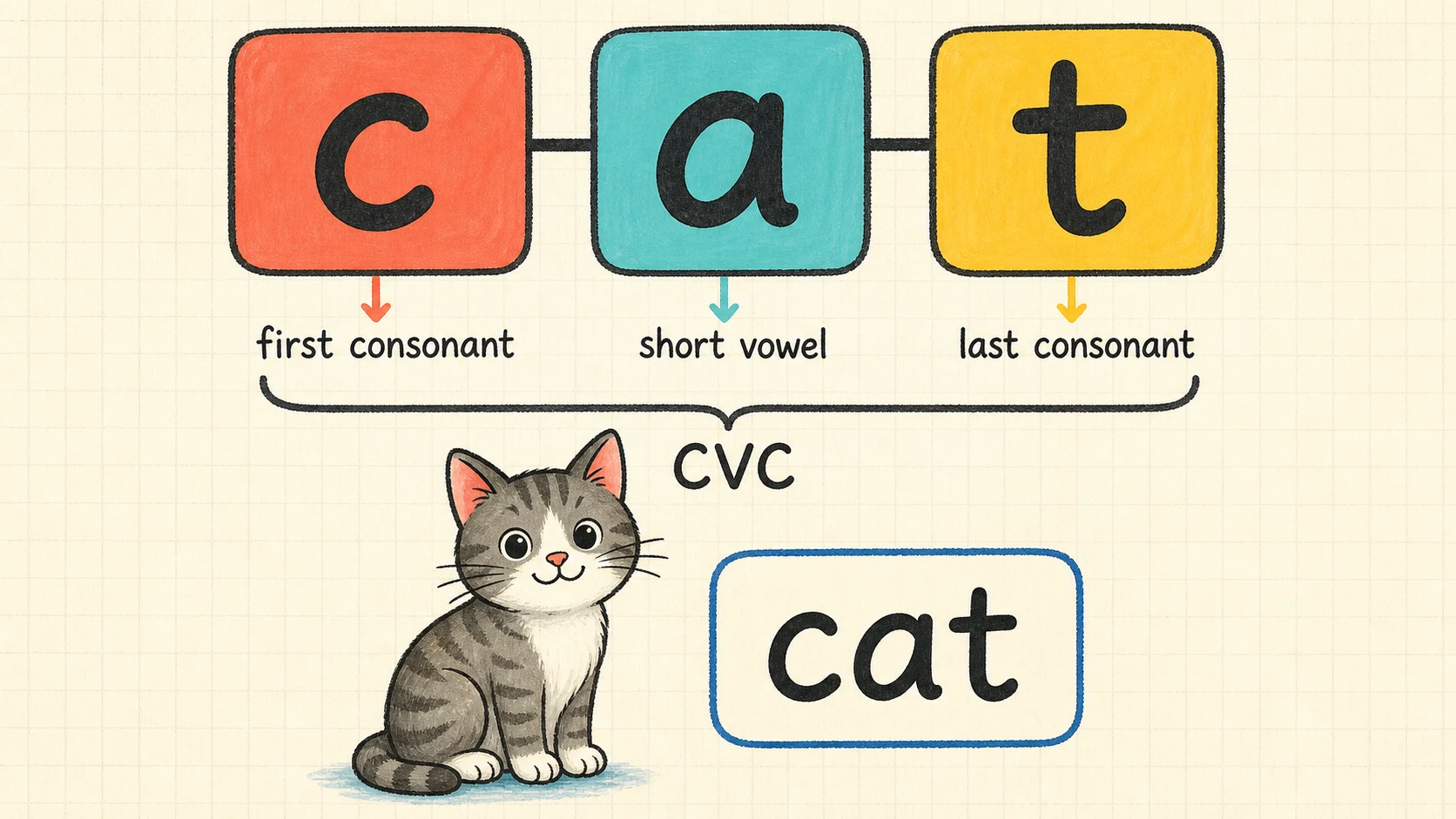
Reading and spelling CVC words depend on connected sound, letter, blending, and segmenting skills.
The IES foundational reading practice guide provides high-level support for teaching learners to connect speech sounds with letters and to blend and segment words. It does not evaluate WorksheetWise materials or prescribe one universal sequence.
Grade labels on WorksheetWise describe the intended practice level. Local school, district, state, and homeschool sequences differ, so “Kindergarten” should guide selection rather than impose a fixed timetable. The learner’s observed work should determine whether to move forward, repeat a step, or return to a prerequisite.
Prerequisites to Check Before Beginning
A learner does not need perfect mastery of every letter before attempting any CVC word. However, guessing and frustration become more likely when too many required sound-letter connections are unfamiliar.
Oral sound awareness
Begin without printed letters. Say map slowly and ask the learner to place one counter for each sound:
/m/ /ă/ /p/
Three counters indicate three sounds. The learner does not need to know the term phoneme, but should begin to notice that a short spoken word can be separated into ordered parts.
Check whether the learner can:
- Identify the first sound in sun
- Identify the last sound in map
- Notice that cat and cap differ at the end
- Blend orally presented sounds such as
/m/ /ă/ /p/
These are instructional checks, not formal diagnoses. If a learner cannot yet blend three sounds orally, spend more time with spoken words, counters, and pictures before expecting independent printed-word reading.
Letter-sound knowledge
Choose words made from sound-letter correspondences the learner has already practiced. For example, map is not a suitable first decoding word if m and p are both unknown.
It also helps to distinguish a letter’s name from its sound. In map, the middle letter is named a, but the sound needed for blending is short a, /ă/. Prompting with letter names—“em, ay, pee”—does not produce the spoken word.
For many consonants, use a clean sound without adding an extra vowel. Say /m/, not “muh,” and /t/, not “tuh.” Added sounds can make blending produce something like “muh-a-tuh” instead of mat.
Direction and print handling
The learner should understand that English words on the page are followed from left to right. A simple finger sweep under the letters can make that direction visible. If the learner routinely starts at the final letter, address tracking before increasing the number of words.
The broader Kindergarten phonics collection can help an adult select letter-sound or blending practice when CVC work reveals a missing prerequisite.
A Grade-Appropriate Teaching Progression
CVC instruction is clearest when each new demand is introduced deliberately. The following progression reflects the supplied catalogue sequence: start with short a, continue through short i, short o, short u, and short e, and combine reading with spelling.
| Stage |
Main demand |
Example activity |
Evidence to watch |
| 1. Hear sounds |
Segment and blend orally |
Move counters for /m/ /ă/ /p/ |
Learner keeps all three sounds in order |
| 2. Match sounds and letters |
Connect known sounds to print |
Place m, a, p in sound boxes |
Each letter matches the intended sound |
| 3. Blend one short vowel |
Read words such as mat, map, and sad |
Sweep under the word while blending |
Learner reaches the word without guessing from one letter |
| 4. Change one letter |
Compare cat → mat → map |
Replace one magnetic letter |
Learner notices which sound changed |
| 5. Add vowel families |
Work through short i, o, u, then e |
Sort or build words by medial vowel |
Learner attends to the middle sound |
| 6. Encode words |
Spell a spoken CVC word |
Say pin and build or write it |
Three sounds appear in the correct positions |
| 7. Mix reading and spelling |
Alternate decoding and encoding |
Read hug, then spell map |
Learner changes processes without losing accuracy |
| 8. Check transferable decoding |
Read an unfamiliar regular CVC form |
Blend a form such as nib |
Learner uses sound-by-sound decoding |
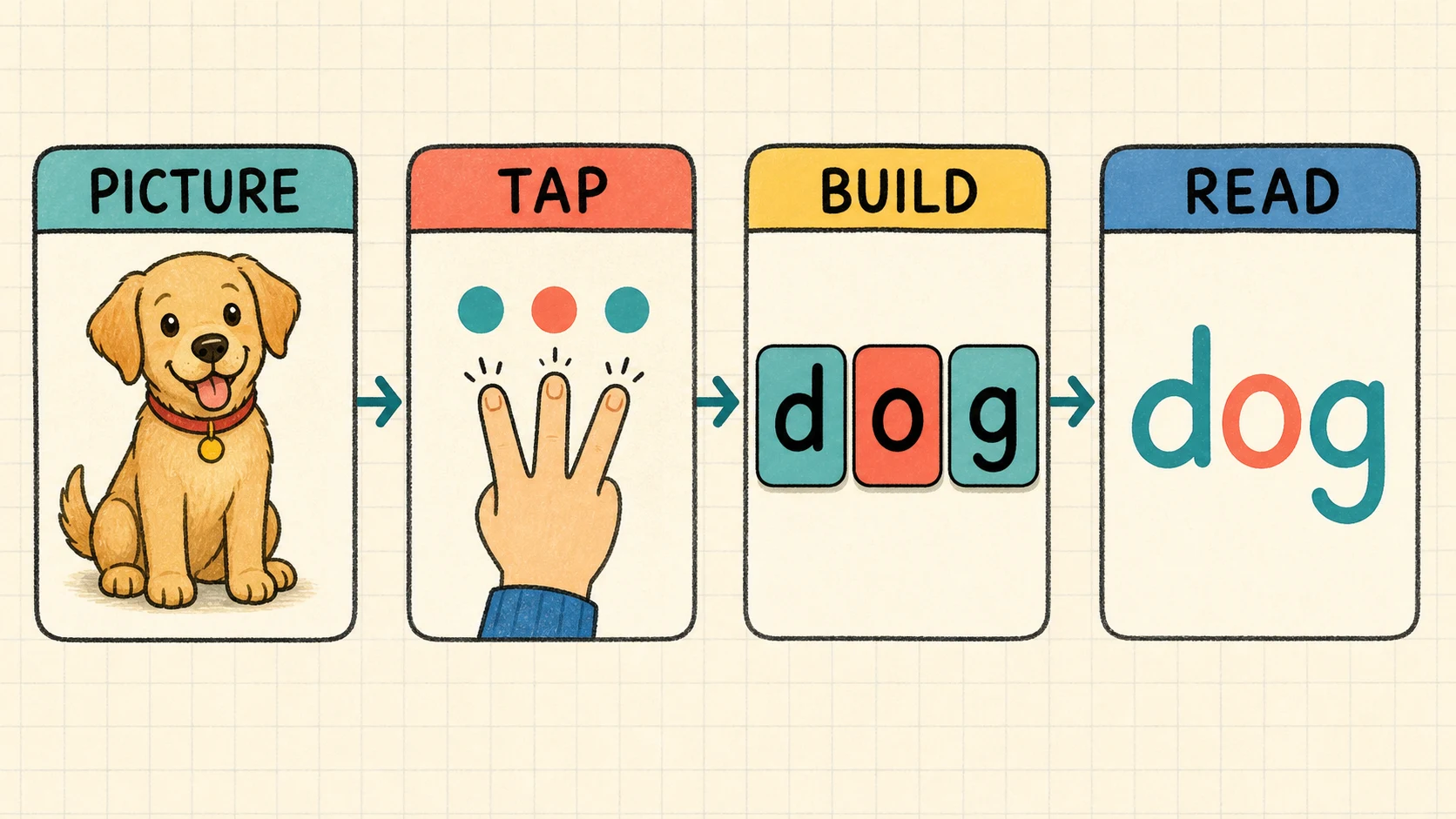
Support is reduced only when the learner’s work shows that the current step is secure.
Keep early word sets controlled
At first, keep the middle vowel unchanged while changing a consonant:
cat → mat → map
This sequence limits the amount of new information. From cat to mat, only the first sound changes. From mat to map, only the final sound changes. Ask, “Which letter changed? Which sound changed?”
The catalogue places short e after short u. That is an available teaching sequence, not a claim that every learner or curriculum must use the same order. If a local program introduces the vowels differently, retain that program’s sequence and use the same principles: controlled contrasts, explicit blending, and observed readiness.
Move from supported to independent work
A useful release of support is:
- The adult models.
- Adult and learner blend together.
- The learner blends with a finger sweep or sound boxes.
- The learner reads without the model.
- The learner spells the word after hearing it.
Do not equate speed with understanding. A careful blend that preserves all three sounds is more informative than a rapid guess. Fluency can develop after the process is accurate and stable.
Concrete and Visual Models
CVC words are easier to examine when sounds can be moved, pointed to, and compared.
Three connected sound boxes
Draw three adjoining boxes:
| 1 |
2 |
3 |
| first sound |
middle sound |
final sound |
Say sat. The learner pushes one token into each box while saying /s/ /ă/ /t/. Next, replace the tokens with the letters s, a, and t. Finally, sweep a finger under all three boxes and blend the sounds into sat.
The boxes represent sounds, not simply letters. That distinction matters later, when learners encounter words whose sound and letter patterns are not as straightforward. For this guide, keep the selected practice to regular three-sound CVC examples.
Magnetic or movable letters
Movable letters make a one-sound change visible. Build cat, then replace c with m:
cat → mat
Ask the learner to read both words and explain what changed. Next, replace t with p:
mat → map
This is both decoding and word manipulation. It encourages attention to every position rather than recognition of the word’s overall shape.
Continuous blending
The supplied teaching guidance recommends connecting sounds without long pauses:
/mmmăăăp/ → map
Some stop consonants, including /t/ and /p/, cannot be stretched naturally in the same way as /m/ or /s/. Keep them brief and attach them closely to the neighboring sound. The aim is a connected left-to-right blend, not distortion of each sound.
Pictures can confirm meaning after decoding, but the picture should not replace decoding. Cover the picture, ask the learner to blend the printed word, and then uncover it to check whether the answer makes sense.
Fully Checked Worked Examples
The following examples separate the adult’s model from the learner’s task. Each answer can be verified by mapping one sound to each letter.
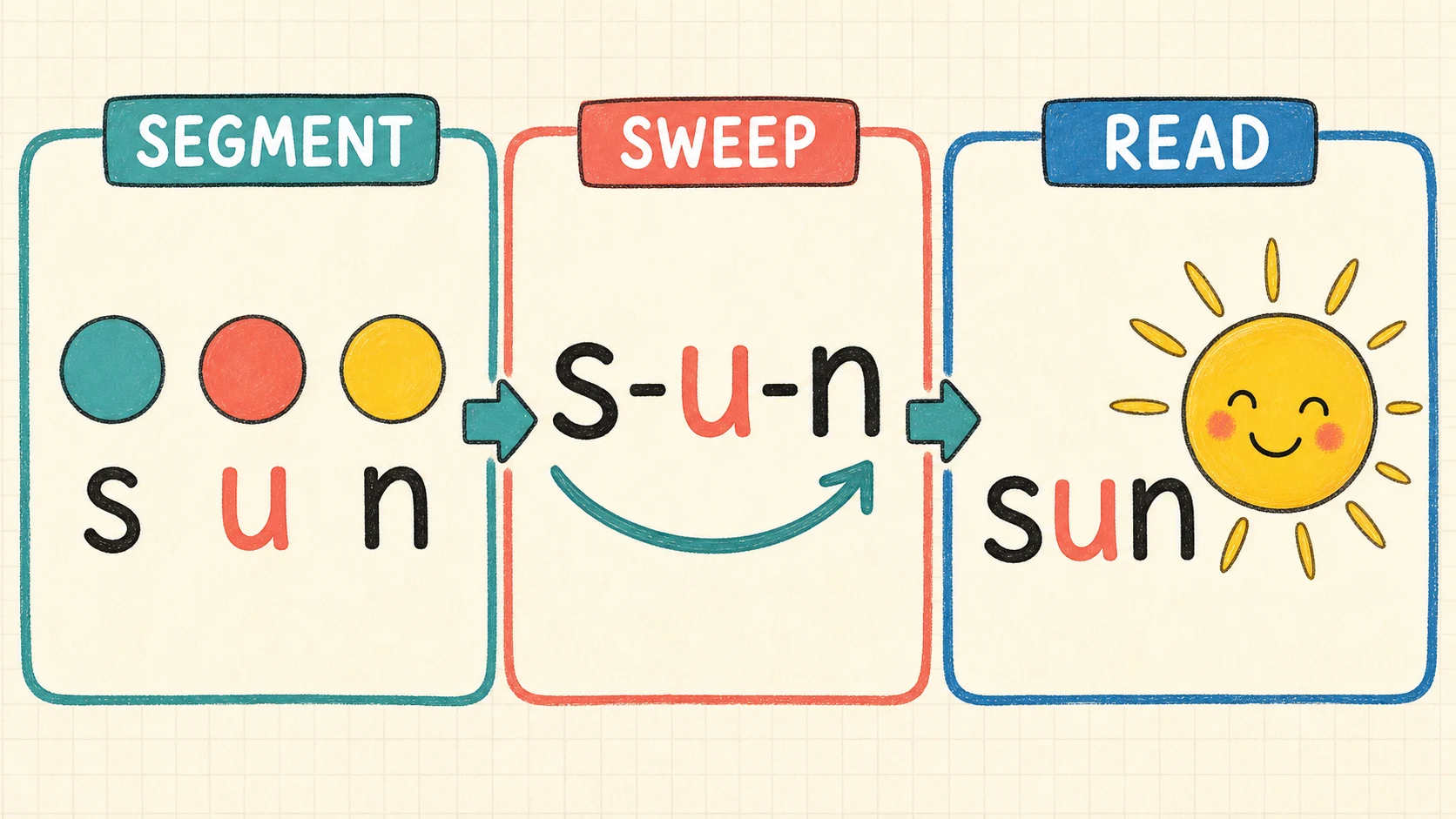
The learner hears or sees each part, records the sounds in order, and then checks the whole word.
Example 1: Decode cat
Printed word: cat
- Point to
c and say /k/.
- Point to
a and say short /ă/.
- Point to
t and say /t/.
- Move from left to right, connecting the sounds:
/k/ /ă/ /t/.
- Blend the parts: cat.
Check: cat has three ordered sounds—initial /k/, medial /ă/, and final /t/. The printed letters c-a-t represent those sounds in this word.
A helpful prompt is, “Start at the first letter and keep going.” Avoid asking the learner to identify the word from a cat picture before looking through the letters.
Example 2: Encode pin
Spoken word: pin
- Say the word normally: pin.
- Stretch or segment it:
/p/ /ĭ/ /n/.
- Push three counters into sound boxes.
- Replace the first counter with
p.
- Replace the middle counter with
i.
- Replace the final counter with
n.
- Read the completed spelling: pin.
Check: /p/ is first, short /ĭ/ is in the middle, and /n/ is last. Therefore, the spelling is pin, not nip or pen.
This example reverses decoding. Instead of turning letters into a spoken word, the learner turns a spoken word into letters.
Example 3: Fill in the missing vowel in h_g
Suppose a picture or spoken prompt establishes the intended word hug.
- Read the visible frame:
/h/ ... /g/.
- Say hug slowly:
/h/ /ŭ/ /g/.
- Isolate the middle sound: short
/ŭ/.
- Select the letter associated with that sound:
u.
- Write
u in the blank: hug.
- Blend the completed word to check it.
Answer: u
Check: h + u + g = hug. Choosing a would produce hag, and choosing o would produce hog. Both are pronounceable words, but neither matches the supplied word hug. This is why the learner must attend to the medial vowel rather than merely creating any possible word.
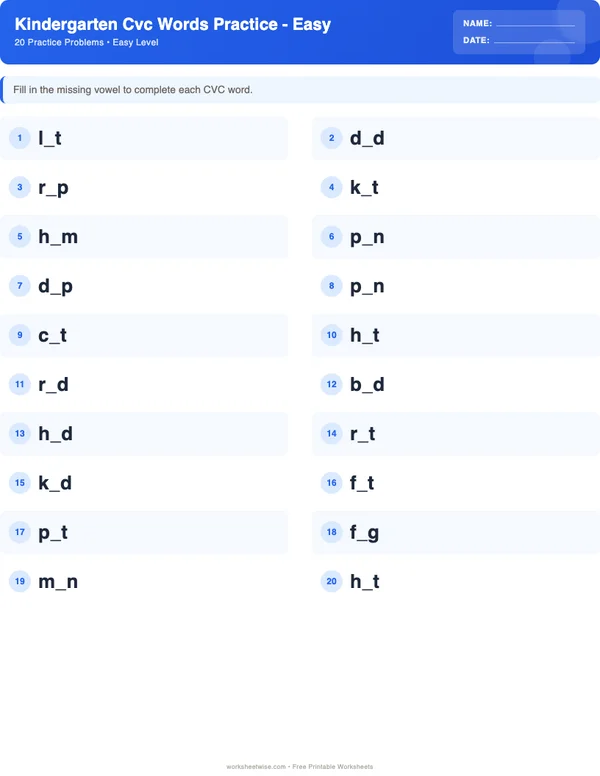
The free easy CVC worksheet contains 20 exercises using this missing-vowel format and includes a separate printable answer key.
Example 4: Change mat to map
Starting word: mat
Target word: map
- Blend the starting word:
/m/ /ă/ /t/ → mat.
- Say the target word:
/m/ /ă/ /p/ → map.
- Compare the first sounds: both use
/m/.
- Compare the middle sounds: both use short
/ă/.
- Compare the final sounds:
/t/ changes to /p/.
- Replace
t with p.
- Read the result: map.
Answer: change the final letter from t to p.
Check: only one sound and one letter changed. If the learner rebuilds the entire word successfully, acknowledge the correct result, then repeat with movable letters so the single change is visually explicit.
Example 5: Decode the unfamiliar form nib
Printed form: nib
- Map
n to /n/.
- Map
i to short /ĭ/.
- Map
b to /b/.
- Blend:
/n/ /ĭ/ /b/ → nib.
Decoded result: nib.
The value of this item is that the learner cannot rely only on memorizing a familiar practice list. Use unfamiliar or nonsense forms sparingly and explain that the item may not name a familiar object. The task is to demonstrate the decoding process, not vocabulary knowledge.
A Short, Repeatable Lesson Routine
A focused lesson can be brief. Its length should depend on the learner’s attention and observed accuracy, not a universal minute requirement.
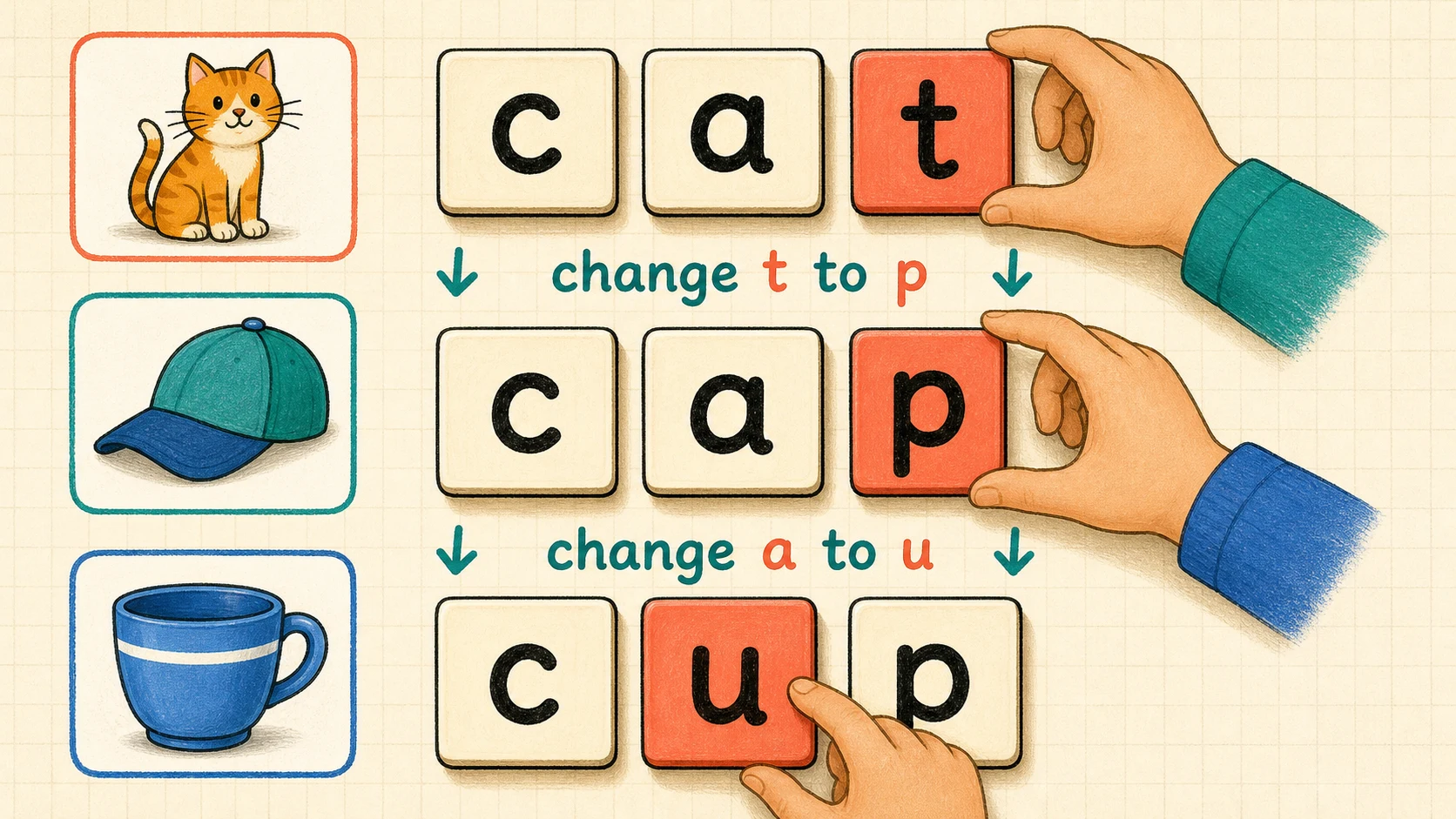
The routine moves from listening to reading, spelling, and a final independent check.
1. Review known sounds
Show two or three letters needed in the lesson. Ask for their sounds, then give the sound and ask the learner to select the matching letter. Keep this review short enough that most of the lesson remains focused on words.
2. Work orally
Say one CVC word without displaying it. Have the learner tap or move a counter for each sound. Blend the sounds together again. This reveals whether a difficulty originates in hearing the sounds or interpreting print.
3. Model one word
Place a familiar word such as mat in three sound boxes. Point to each letter, blend continuously, and read the whole word. Keep the explanation concrete: “I begin at m, move through a, and finish at t.”
4. Practice a controlled set
Use three to five related words, such as cat, mat, map, and tap. Alternate between reading and changing one letter. If errors multiply, reduce the set instead of adding more items.
5. Spell one or two words
Say a practiced word and ask the learner to build it with letters or write it. The IES elementary writing practice guide offers broad instructional framing for providing explicit writing instruction and opportunities to write. Here, spelling a CVC word is a limited application of that broader principle; the source does not assess this worksheet or mandate this exact routine.
6. End with an independent check
Present one word without modeling it. Record what the learner actually does: blends accurately, confuses the vowel, omits the final sound, guesses, or needs a prompt. That observation determines the next lesson.
Choosing Practice That Matches the Need
A worksheet should match the learner’s current process, not simply the learner’s age.
Choose sound boxes and counters when the learner cannot reliably hear three ordered sounds. Choose movable letters when the learner can hear the sounds but reverses or omits letters. Choose missing-vowel work when initial and final consonants are secure but medial vowels need attention. Choose mixed decoding when the learner can read controlled word families without guessing.
The Kindergarten CVC Words topic guide and resources provide a focused starting point. The broader Kindergarten worksheet hub is useful when the observed need lies outside this topic.
The available focused pack contains 18 worksheets and is listed at $4.79. A larger pack provides varied practice, but quantity should not replace careful selection. If the learner makes the same error repeatedly, completing more items of the same type may rehearse that error. Pause, model the relevant sound or position, and resume with fewer examples.
The Common Core English Language Arts standards include high-level expectations related to isolating sounds, applying letter-sound correspondences, orally blending sounds, and decoding regularly spelled one-syllable words. Standards can help adults understand the broader instructional context. They do not establish that every listed resource comprehensively aligns with every local requirement.
Differentiation Without Changing the Core Skill
When the learner needs more support
Reduce simultaneous demands:
- Use words containing already-known consonants.
- Keep one short vowel constant.
- Present two or three words rather than a full page.
- Say the intended word before asking for spelling.
- Use one counter and one box per sound.
- Blend together before asking for an independent attempt.
- Cover pictures until after the printed word has been decoded.
- Let the learner build with letters before requiring handwriting.
If forming letters consumes most of the learner’s attention, movable letters allow spelling practice without making handwriting the main obstacle.
When the learner is ready for greater independence
Mix previously taught short vowels, alternate reading and spelling, and ask the learner to explain which letter changed. Include a small number of unfamiliar regular forms to check whether the learner is applying the process.
Increase one difficulty at a time. Mixing five vowels, removing all visual support, adding many unfamiliar consonants, and requiring written answers simultaneously makes an error difficult to interpret.
What should remain constant
Even when support changes, preserve the essential sequence:
sound → letter → ordered blend → whole word
A learner may use counters, magnetic letters, handwriting, or a worksheet, but the answer should still come from attending to the complete sound sequence.
Common Errors and Diagnostic Responses
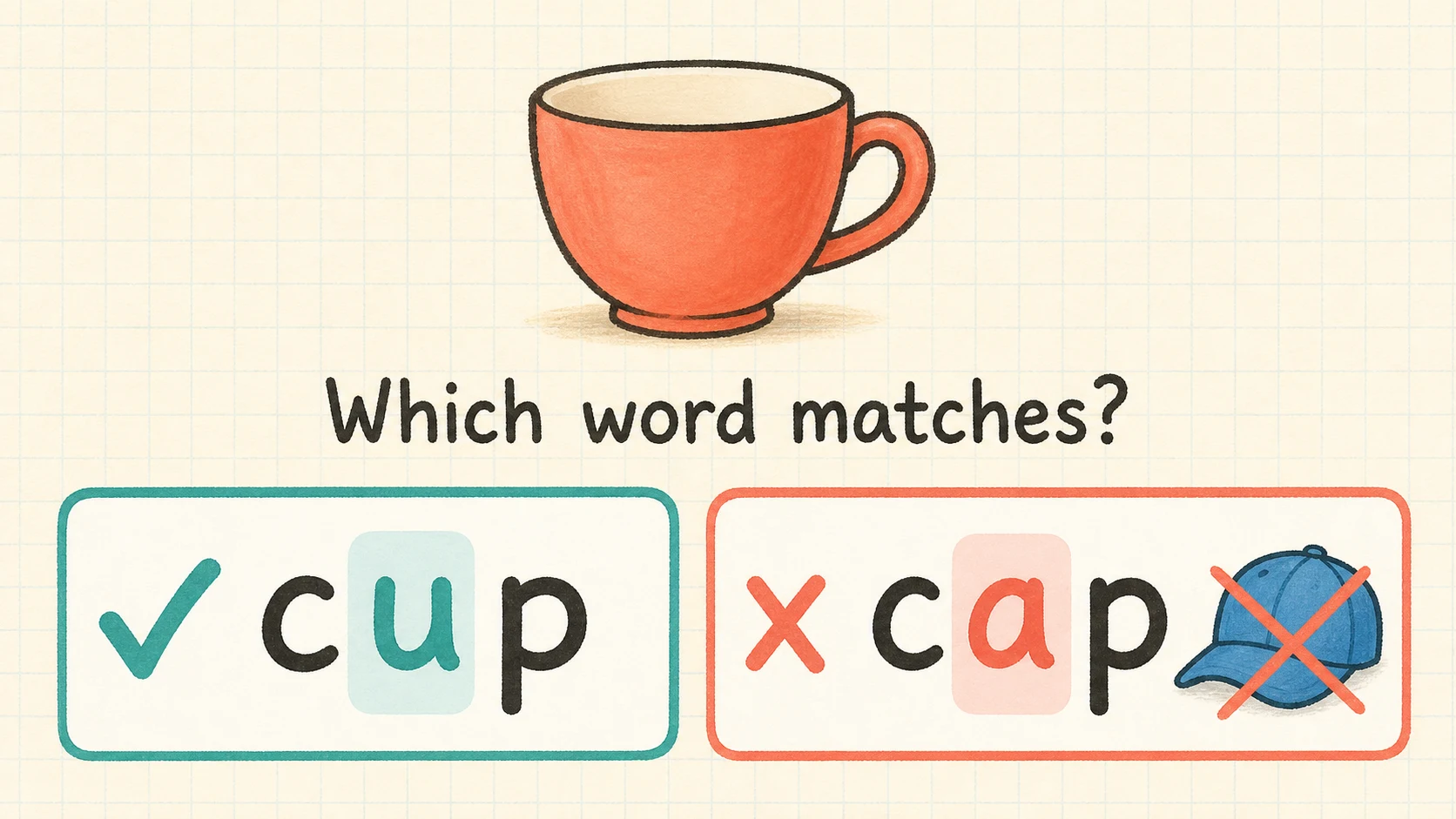
An error becomes useful when it points to the next small teaching decision.
| Observed work |
Likely instructional need to check |
Immediate response |
| Reads cat as “car” while looking at a picture |
Possible picture guessing |
Cover the picture and blend all three printed sounds |
| Reads map as “mat” |
Final sound not fully attended to |
Contrast map/mat and emphasize the last box |
Writes ct for cat |
Medial vowel omitted |
Segment with three counters and identify the middle sound |
Writes pam for map |
Sound order is unstable |
Push counters from left to right before choosing letters |
| Reads several short-vowel words with the same vowel |
Medial vowels not differentiated |
Contrast only two vowel sounds in otherwise controlled words |
| Produces “muh-a-puh” |
Extra vowel sounds attached to consonants |
Model clean consonant sounds and reconnect the blend |
| Knows practiced words but cannot read nib |
Possible memorization of the list |
Return to explicit letter-by-letter blending |
| Stops after naming letters |
Letter names are not being converted to sounds |
Prompt, “Tell me the sounds, then blend them” |
These interpretations are hypotheses for instruction, not diagnoses of a learning condition. One error can result from inattention, an unfamiliar picture, an unknown letter, or a momentary lapse. Look for a repeated pattern across several carefully chosen items before changing instruction.
A common misconception is that any three-letter word is a CVC word. The has three letters, but it does not provide the regular consonant-short-vowel-consonant pattern practiced here. Ship has four letters and includes a consonant digraph. Cake contains a final e pattern rather than a simple short-vowel CVC pattern.
Another misconception is that successful picture matching proves decoding. It may show vocabulary or visual reasoning instead. Ask the learner to read the word before seeing the picture when you need evidence of decoding.
Monitoring Progress and Deciding What Comes Next
Use a small, dated record rather than relying on a general impression. Once or twice during a lesson, note:
- The exact word presented
- Whether the task was reading or spelling
- Whether the word was familiar or unfamiliar
- The learner’s first response
- Any prompt required
- The specific sound position involved in an error
For example:
| Date |
Task |
Response |
Prompt |
Next decision |
| Day 3 |
Read map |
“mat” |
“Check the last sound” |
Contrast final p/t |
| Day 5 |
Spell pin |
pin |
None |
Add another short i word |
| Day 7 |
Read nib |
Blended accurately |
None |
Continue mixed decoding |
Look for process consistency. Independent accuracy across both reading and spelling is stronger evidence than success on one memorized list. If the learner needs the same prompt on nearly every item, the skill is still supported rather than independent.
Move forward when the learner usually follows all three letters, preserves their order, distinguishes the practiced vowel, and can spell at least some words from sound. Step back when errors are frequent, effort becomes unproductive, or the learner relies on pictures and adult completion.
A Two-Week Practice Plan
This plan provides a practical sequence, not a universal timetable. Shorten, repeat, or rearrange days according to the learner’s work and the local instructional sequence.
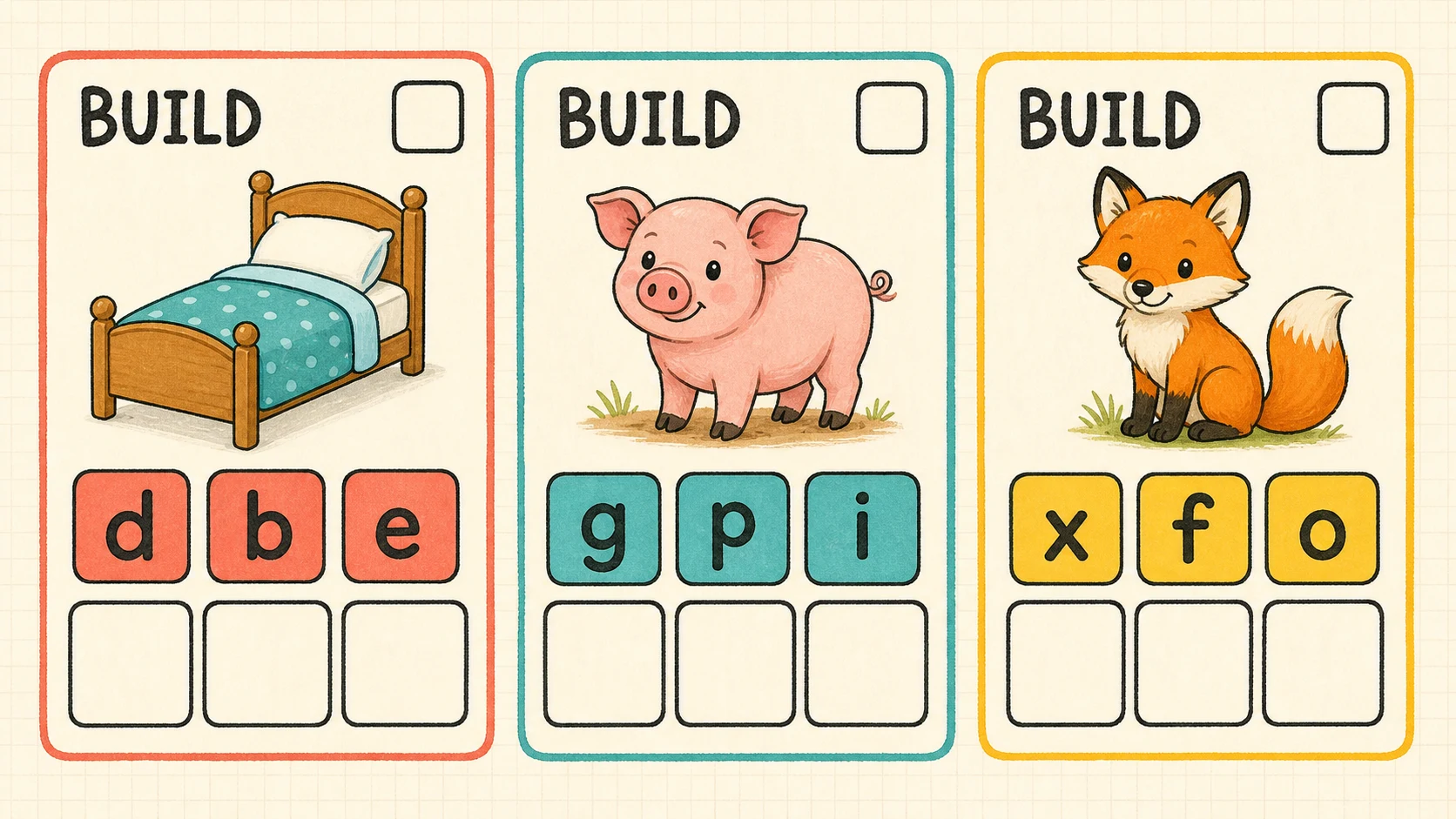
Each day combines review with one manageable new demand.
| Day |
Focus |
Suggested practice |
Decision point |
| 1 |
Oral segmentation |
Use counters for three short a words |
Can the learner preserve three sounds? |
| 2 |
Short a decoding |
Model and blend cat, mat, map |
Is each letter considered? |
| 3 |
Short a encoding |
Build or write map, sad, tap |
Is the middle vowel recorded? |
| 4 |
One-letter changes |
Work through cat → mat → map |
Can the learner identify the changed position? |
| 5 |
Review and check |
Mix reading and spelling of short a words |
Repeat short a if prompts remain frequent |
| 6 |
Short i |
Read and build words such as pin |
Can the learner hear short i? |
| 7 |
Short o |
Contrast a small short o set with known words |
Does the learner attend to the middle sound? |
| 8 |
Short u |
Complete and check h_g → hug |
Can the learner select u from the spoken word? |
| 9 |
Short e and review |
Introduce a controlled short e set, then review |
Keep the set small if vowels are confused |
| 10 |
Mixed application |
Read familiar words, spell selected words, and decode one unfamiliar form |
Choose review or the next phonics step from the evidence |
On any day, stop adding new material if the learner begins guessing or losing sound order. Repeat the oral and concrete parts of the routine instead. A repeated day is not a failure; it is a pacing adjustment based on evidence.
Boundary Cases and Limitations
CVC practice covers a deliberately narrow word structure. It does not by itself teach every feature needed for reading connected text. Learners will also encounter digraphs, consonant blends, long-vowel patterns, irregular words, vocabulary demands, sentence meaning, and text comprehension. Those should not be folded into a CVC assessment unless they are the intended target.
Be careful with words that appear simple but introduce another spelling feature. If the objective is a clean three-sound, one-letter-per-sound pattern, exclude items such as:
- ship, because
sh represents one sound with two letters
- chat, for the same reason
- stop, because it begins with a consonant blend
- cake, because it uses a final-e vowel pattern
- book, because its vowel spelling is outside the simple CVC pattern
- the, because it is not a regular short-vowel CVC example
Pictures also have limits. An image may permit more than one reasonable label: a picture intended as cap might be called a hat. State the target word orally when the picture could be ambiguous.
Nonsense forms can reveal whether a learner is applying sound-letter knowledge, but they do not measure vocabulary or comprehension. Explain the task plainly and use such forms only for a limited decoding check.
This guide offers educational instruction, not medical or child-specific clinical guidance. Persistent difficulty can be documented and discussed with the learner’s teacher or an appropriately qualified professional, but a worksheet response alone should not be used to label its cause.
The Honest Next Step
Begin with one controlled set and record how the learner blends, not just whether the final answer is correct. If initial and final consonants are secure but the middle vowel is often missing, use the free Kindergarten CVC Words worksheet for its 20 missing-vowel exercises. Complete only a manageable portion, check responses with the included answer key, and use the error pattern to choose the following lesson.