What Kindergarten Sight Words Instruction Should Accomplish
Kindergarten sight-word instruction should help a learner recognize useful high-frequency words quickly, connect each word’s sounds with its letters, notice any unusual spelling, write the word, and read it in a short sentence. It should support phonics—not replace it.
A productive sequence is:
- Check letter-sound knowledge and oral blending.
- Introduce a small set of useful words.
- Analyze the regular and irregular parts.
- practice reading and writing each word.
- Use the words in connected text.
- Review them on separate occasions before treating them as secure.
The learner’s observed work should determine the pace. Three to five new words in a week is a practical instructional suggestion from the supplied teaching guidance, not a universal timetable. A learner who remembers one new word reliably may need a smaller set; one who retains four and reads them in sentences may be ready to continue.
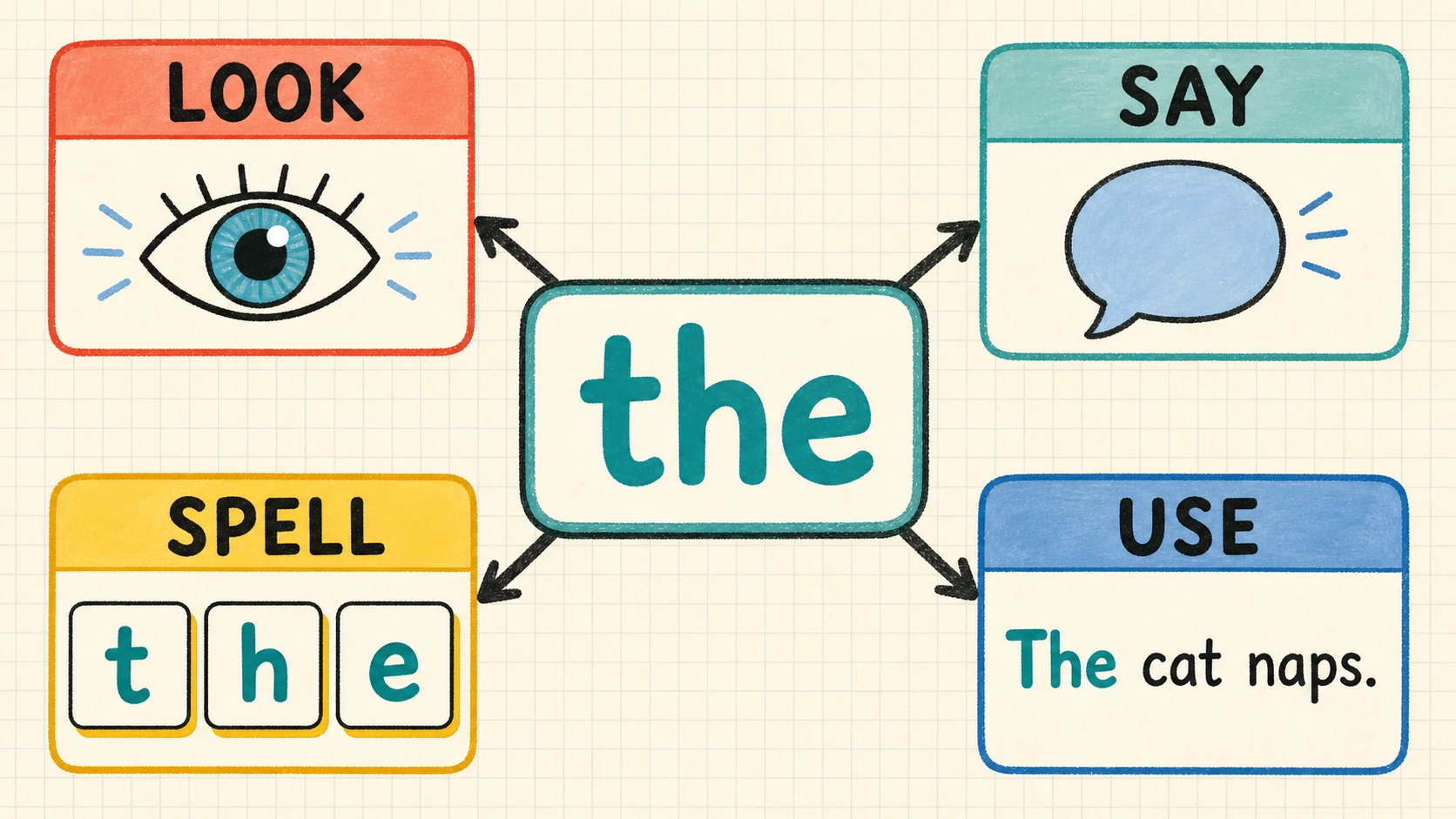
Sight-word learning connects phonics, spelling, memory, handwriting, and meaningful reading.
What a Sight Word Is—and Is Not
A sight word is a written word a learner recognizes immediately rather than laboriously sounding it out on every encounter. Many sight words are also high-frequency words: they appear often enough that quick recognition makes sentences easier to read.
The category includes two important kinds of words:
- Decodable high-frequency words, such as and and can, can be read using letter-sound relationships the learner has been taught.
- Words with irregular spellings, such as said, the, was, and of, contain a part that does not follow the expected sound-spelling pattern.
“Sight word” therefore does not mean “a word that must be memorized as a picture.” A learner can examine the letters, say the sounds that work as expected, and identify the part that must be remembered. After enough accurate encounters, the whole spelling becomes familiar.
This balance fits the broad instructional framing in the IES foundational reading practice guide, which recommends developing awareness of speech sounds and their links to letters, teaching learners to decode and analyze words, and providing daily opportunities to read connected text. The source does not evaluate WorksheetWise materials or prescribe the exact routine in this guide.
Sight-word study is only one part of Kindergarten phonics practice. Learners still need work with letter sounds, blending, segmenting, CVC words, and simple decodable text.
Prerequisites and Readiness Signs
Skills to check first
Before increasing the sight-word load, observe whether the learner can:
- name or recognize most letters used in the target words;
- give the common sounds for those letters;
- hear and blend a short sequence such as
/k/ /ă/ /n/ into can;
- follow print from left to right;
- attend to every letter rather than guessing from the first letter;
- form at least some letters well enough to copy a short word;
- repeat and use a simple oral sentence.
These are teaching checkpoints, not entrance requirements that must all be perfect. A learner can study one useful word while continuing to strengthen missing foundations.
Readiness in actual work
Look beyond a quick flashcard response. A learner is showing useful readiness when they can inspect can, say its sounds, blend it, and find it again in “I can hop.” If they call can “cat,” the issue is not simply slow memorization. They may be attending to the first two letters but not the final letter.
Handwriting also affects what adults see. A learner might read the correctly but reverse or omit a letter when writing it. That is different from not knowing the word. Keep reading recognition, spelling recall, and letter formation as related but separate observations.
A Grade-Appropriate Progression
Grade labels describe intended practice level, and local sequences differ. Schools, curricula, and homeschool programs may introduce words in different orders. The Common Core ELA materials provide grade-specific literacy expectations, including Kindergarten recognition of common high-frequency words, but a standards page is not a universal day-by-day teaching sequence. See the broader Common Core English Language Arts framework for that high-level context.
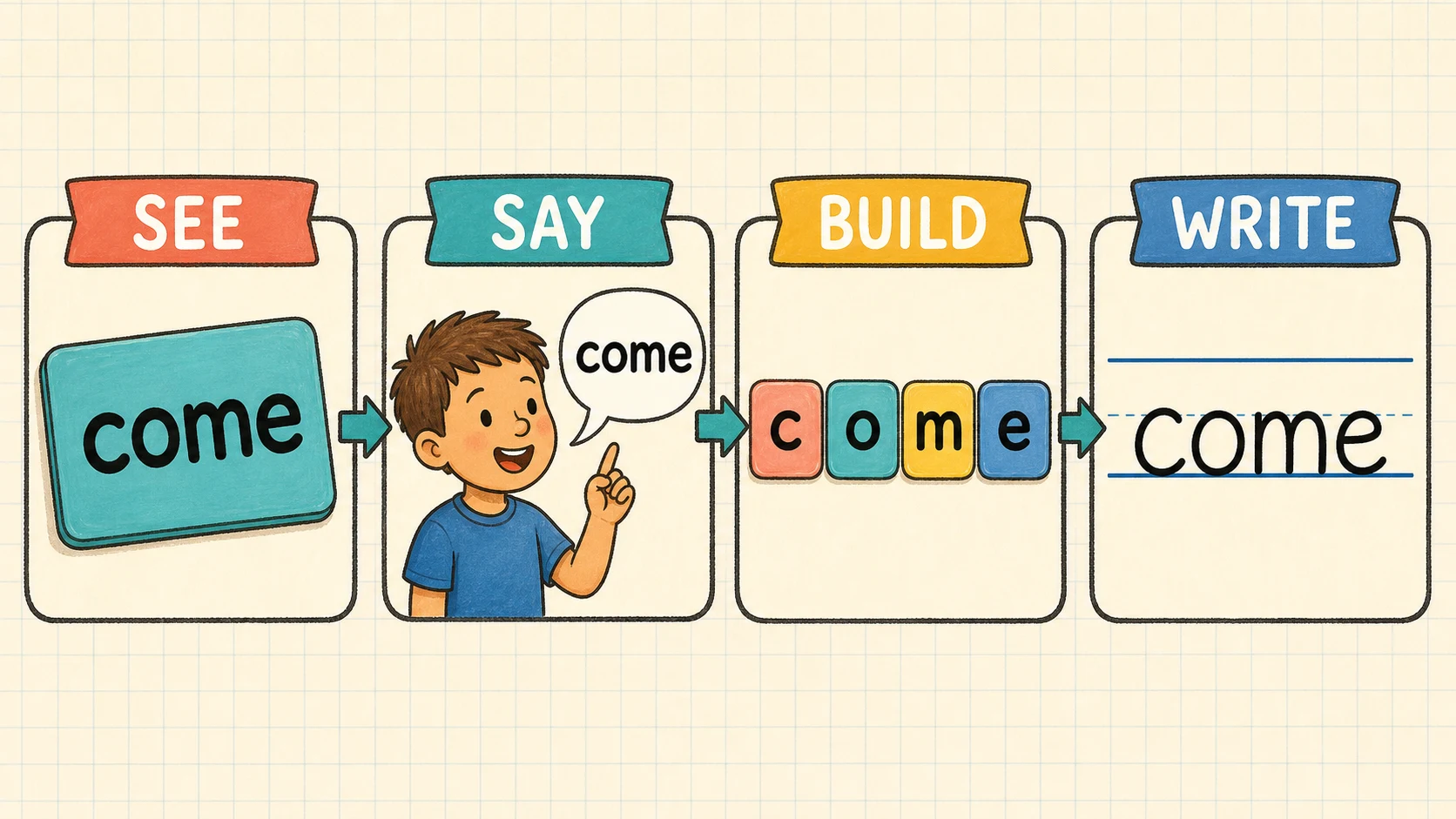
Support is reduced as the learner becomes more accurate across reading, spelling, and sentence use.
Suggested instructional progression
| Stage |
Adult support |
Learner task |
Evidence to watch |
| 1. Notice |
Show and pronounce one word |
Look, point, and repeat |
Attends to the complete word |
| 2. Analyze |
Model sounds and spelling |
Say sounds; identify regular or unusual parts |
Connects sounds to the correct letters |
| 3. Build |
Provide letter cards or tiles |
Arrange letters in order |
Uses every letter |
| 4. Trace and copy |
Keep the model visible |
Trace, spell aloud, and copy |
Maintains letter order |
| 5. Recall |
Briefly cover the model |
Write or build from memory |
Recalls without copying |
| 6. Contrast |
Present two or three known words |
Select or read the named word |
Distinguishes similar forms |
| 7. Read in context |
Supply a short sentence |
Read the word within the sentence |
Recognizes it without guessing |
| 8. Use independently |
Provide a picture or oral prompt |
Say or write a simple sentence |
Uses the word meaningfully |
| 9. Review later |
Mix old and new words |
Read in a different order or text |
Retains the word over time |
Do not move through these stages merely because a worksheet page is finished. Move forward when the work is accurate enough to reduce support. Move back temporarily when errors reveal a weak connection.
Concrete and Visual Models
Young learners benefit from seeing how spoken sounds, printed letters, and whole words fit together. The following models can be made with paper, counters, letter tiles, or a dry-erase board.
Sound boxes and letter tiles
For can, draw three boxes:
| Sound |
/k/ |
/ă/ |
/n/ |
| Letter |
c |
a |
n |
Have the learner push one counter for each sound, then replace the counters with letters. This makes the word analyzable rather than visually arbitrary.
Not every word has one letter per sound. In the, the letters th work together at the beginning. The adult should avoid forcing each letter into a separate spoken sound when the letters function as a unit.
Regular parts and “heart” parts
A heart-word model marks the sound-spelling relationships that work as expected and identifies the unusual part to remember “by heart.” In said, the initial s and final d are regular. The middle ai represents the short e sound in this word, so that is the part to mark for special attention.
The heart is a reminder, not a substitute for analysis. Ask, “Which letters are doing what we expect? Which part must we remember in this word?”
Word cards and sentence strips
Use a word card for concentrated practice, then place that same card into a sentence strip:
I | can | hop.
The learner can touch each word, read the sentence, remove can, and put it back in the correct place. This links isolated recognition with connected reading. Daily connected-text reading is part of the broad framing in the IES foundational reading guide; the specific card activity is an instructional suggestion.
Fully Checked Worked Examples
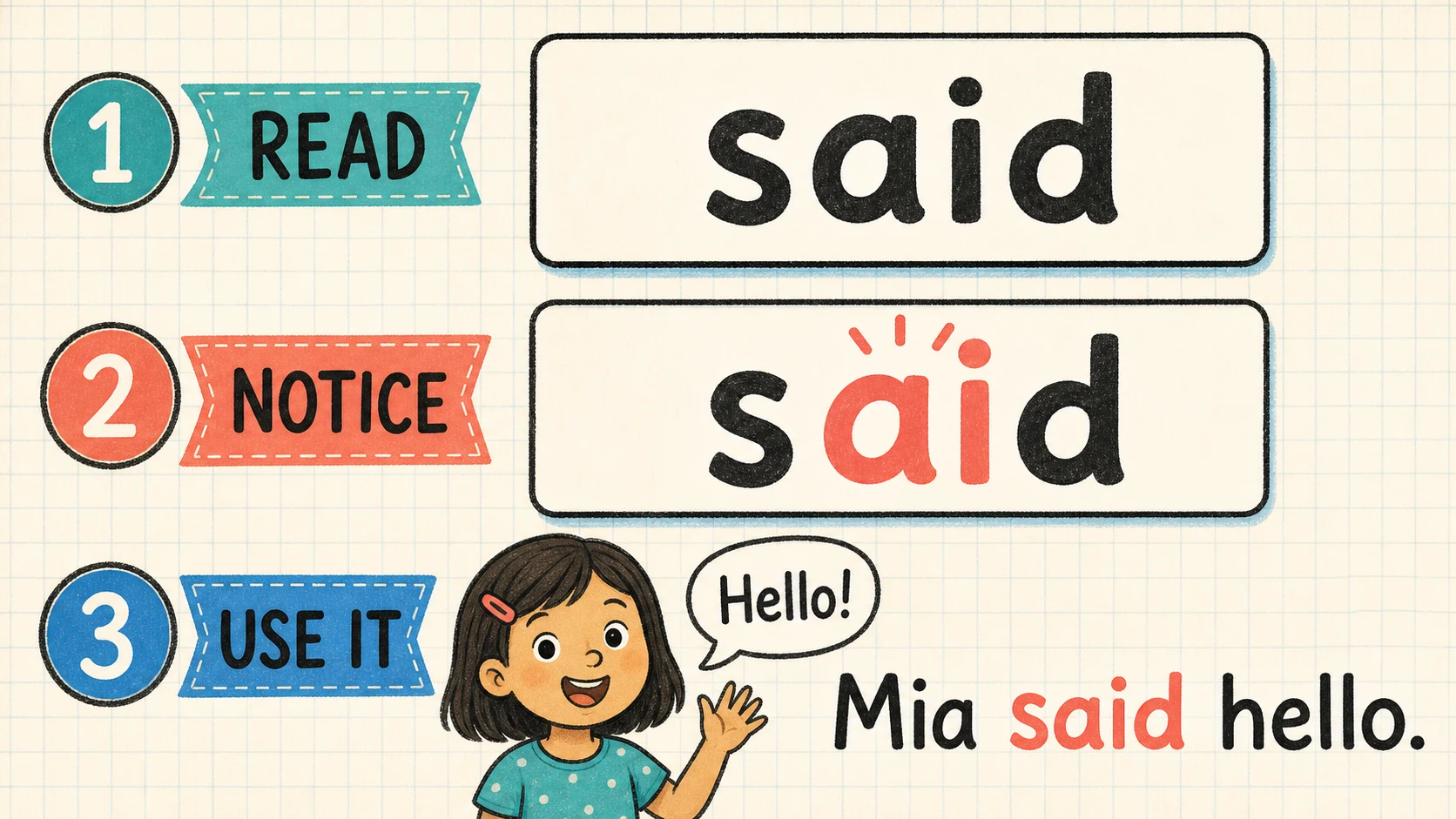
Each example moves from careful word analysis to reading or writing in context.
Worked example 1: Decoding and remembering can
Target: Read and spell can.
- Show
can.
- Point to c and say
/k/.
- Point to a and say
/ă/.
- Point to n and say
/n/.
- Blend:
/k/ /ă/ /n/, can.
- Cover the model.
- Ask the learner to build or write the word.
- Check the spelling: c-a-n.
- Read: “I can run.”
Verified answer: can has three letters in the order c-a-n, and the three sounds blend to can.
Boundary case: If the learner reads can accurately by blending but not instantly, count the decoding as correct. Continue brief review; do not label an accurate response as failure merely because it is not yet automatic.
Worked example 2: Marking the unusual part in said
Target: Analyze and read said.
- Show
said and pronounce it normally.
- Identify the first sound
/s/; s represents that sound.
- Identify the final sound
/d/; d represents that sound.
- Notice that ai represents the short e sound in this word.
- Mark ai as the part to remember by heart.
- Spell aloud: s-a-i-d.
- Cover, write, uncover, and compare.
- Read: “I said yes.”
Verified answer: The word is spelled s-a-i-d, not sed. The pronunciation sounds like sed, but the correct written form retains ai.
Diagnostic value: Writing sed shows that the learner represented the sounds plausibly but did not recall the irregular spelling. Praise the sound analysis, then reteach the written form.
Worked example 3: Reading the without treating it as a picture
Target: Read and write the.
- Display
the.
- Circle th together so the learner sees the opening letter team.
- Say the whole word: the.
- Draw attention to the final e, which must remain in the spelling.
- Spell: t-h-e.
- Mix letter cards
e, t, h.
- Rebuild them as
t-h-e.
- Read: “The dog can run.”
Verified answer: The correct order is t-h-e. teh and th are not correct spellings of the.
Boundary case: The pronunciation of the may shift slightly in connected speech, especially before a vowel sound. The printed spelling does not change. At this level, keep attention on recognizing and spelling the same written word in both positions.
Worked example 4: Distinguishing was from a visual guess
Target: Read was by attending to all three letters.
- Show
was.
- Ask the learner to point to the first, middle, and last letters.
- Name them: w-a-s.
- Say was and compare the spoken word with the printed form.
- Mark the unexpected sound-spelling portion for special attention.
- Cover the card and ask the learner to select was from
was, saw, and is.
- Read: “It was hot.”
Verified answer: was is w-a-s. Saw contains the same letters in a different order and is a different word.
Diagnostic value: Choosing saw suggests weak attention to letter order. Rebuild both words with tiles and read them separately instead of adding more flashcards.
Worked example 5: Reading known words in a sentence
Target sentence: The cat can sit.
Suppose the and can are the two taught sight words.
- Ask the learner to underline the and circle can.
- Check that the learner marked
The and can.
- Point out that sentence-initial
The has a capital T, but it is still the word the.
- Blend the decodable words cat and sit if their patterns have been taught.
- Read the complete sentence.
- Ask, “What can the cat do?” A correct response is “sit.”
Verified answer: The taught high-frequency words are The and can. The sentence says that the cat can sit.
Boundary case: If the learner reads the isolated card the but hesitates at The, explicitly connect the lowercase and capitalized forms. Do not introduce it as a completely new word.
A Short, Repeatable Lesson Routine
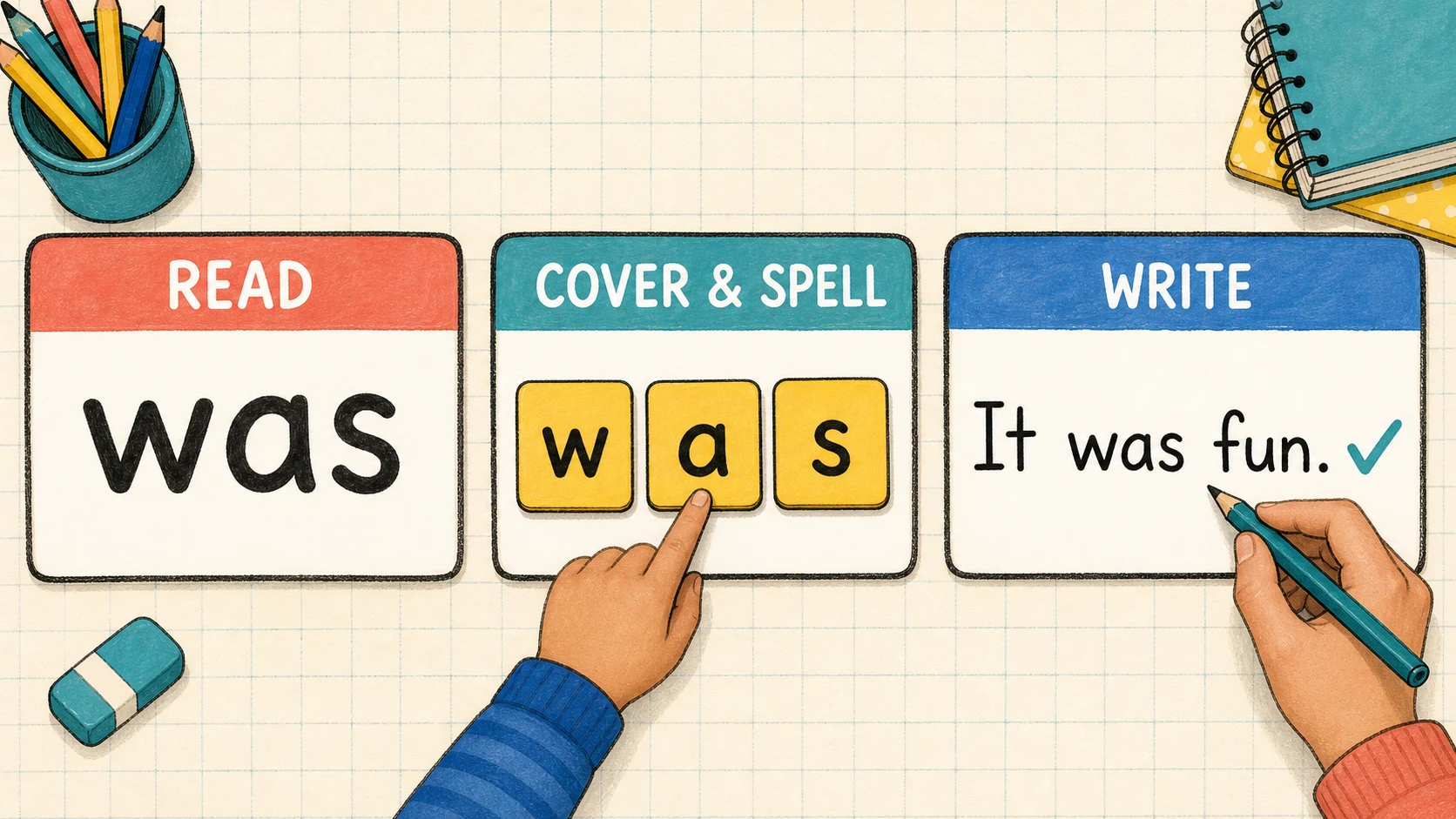
A compact routine combines review, analysis, writing, and connected reading.
A lesson can remain brief while still requiring careful thinking. The following seven-part routine is an instructional suggestion:
| Part |
What to do |
| Review |
Read three to five previously taught cards in mixed order. |
| Introduce |
Show one new word, say it, and use it orally. |
| Analyze |
Match sounds to letters and mark any irregular part. |
| Build |
Arrange letter tiles or cards in order. |
| Write |
Trace once if needed, copy once, then write from memory. |
| Read |
Find the word in one or two short sentences. |
| Check |
Record whether the learner read and wrote it independently. |
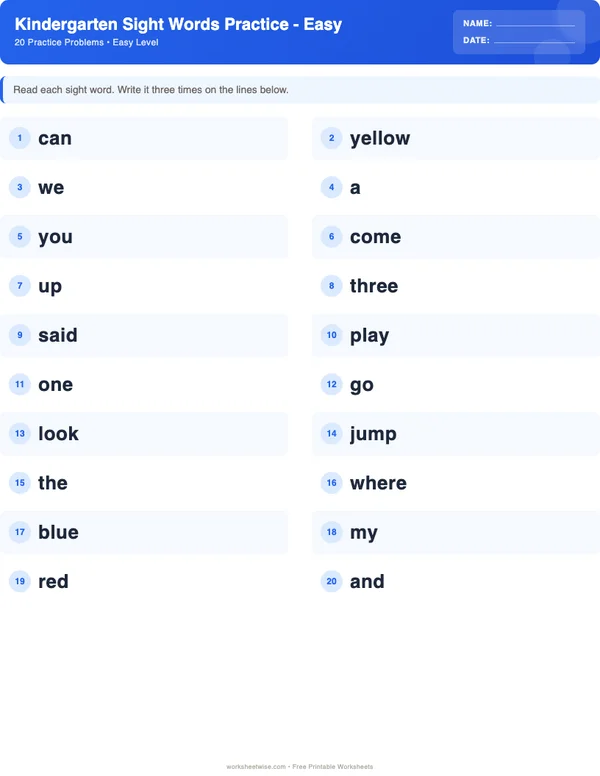
For the supplied easy worksheet, the printed direction is: read each sight word and write it three times. Improve the instructional value by analyzing the word first and asking the learner to read it again after writing. Repeated copying alone does not show whether the learner can recall the spelling.
Writing belongs in the routine because sight-word knowledge includes a written form, not only oral recognition. The IES elementary writing practice guide broadly recommends helping elementary learners become fluent with handwriting, spelling, and sentence construction. That guide addresses elementary writing generally; it does not validate this worksheet or set a Kindergarten sight-word schedule.
Choosing Practice That Matches the Learner
When to choose easier practice
Choose a highly supported activity when the learner:
- confuses several new words;
- omits or rearranges letters;
- cannot connect known sounds with the letters;
- needs the model visible throughout writing;
- recognizes a word on one card but not in a sentence;
- becomes inaccurate as the set grows.
Suitable practice includes matching identical words, building one word with tiles, tracing while naming letters, and finding one target in a short row. The free easy sight-words worksheet provides 20 read-and-write exercises and a separate answer key. It is best treated as a bank of practice, not necessarily as one sitting.
When to increase the challenge
Increase the challenge when the learner reads current words accurately across separate occasions and can find them in sentences. Possible next steps are:
- mix the cards so position cannot cue the answer;
- include a visually similar word;
- ask for spelling from memory;
- change lowercase the to sentence-initial The;
- use the word in a new short sentence;
- read a brief passage containing known words.
The catalogue suggests retiring a card to a mastered pile only after correct reading on three separate occasions. That is a useful local monitoring rule, not proof that the word will remain secure indefinitely. Continue to sample older words.
Differentiation without changing the goal
For a learner needing more support, teach one word at a time, reduce copying, enlarge the print, and use movable letters before handwriting. Give immediate, specific correction: “You read the first letter correctly. Check the final letter.”
For a learner ready for more independence, keep the same target words but remove the model sooner, mix old and new words, and ask for a complete sentence. The goal is deeper control, not simply a longer list.
Games such as matching, bingo, or quick card reading can add variety. Keep accuracy visible. A fast guess should not beat a slower, careful reading.
Diagnosing Common Errors
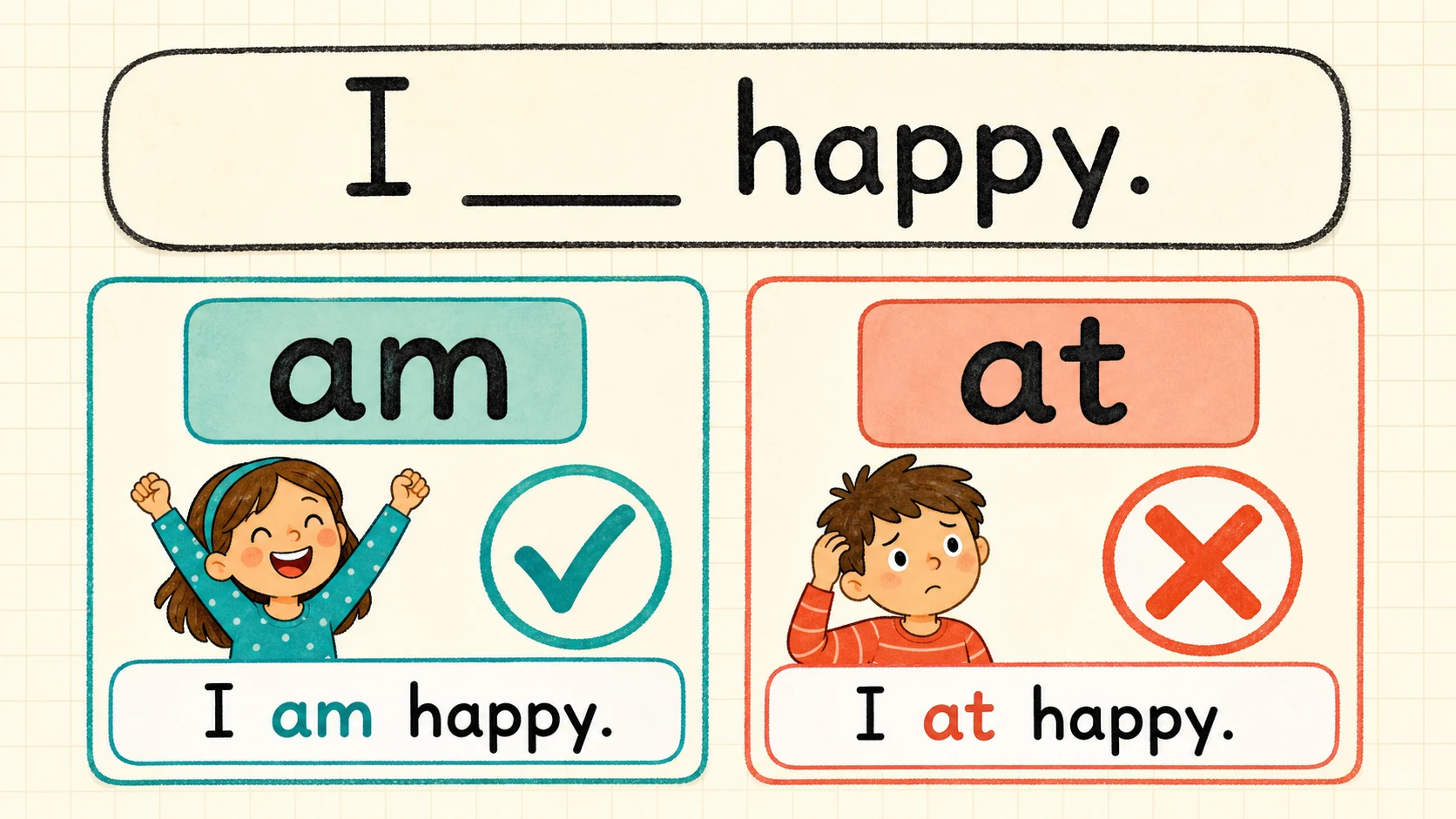
The response should address the pattern behind the error, not merely supply the answer.
| Observed work |
Likely instructional need |
Teaching response |
| Reads can as cat |
Attention to the final letter |
Compare n and t; blend both words |
Writes sed for said |
Recall of the irregular spelling |
Confirm the sounds, then mark ai as the heart part |
Writes teh for the |
Stable letter order |
Build t-h-e, scramble it, and rebuild |
Reads The as unfamiliar after learning the |
Connection between capitalized and lowercase forms |
Place both forms in sentence positions |
| Reads a card correctly but misses it in a sentence |
Transfer to connected print |
Highlight the same word in a short sentence, then remove highlighting |
| Identifies a word only when it is first in the row |
Position memorization |
Shuffle cards and vary the layout |
| Copies correctly but cannot write from memory |
Recall has not been demonstrated |
Use cover-write-check with one word |
| Guesses from the first letter |
Full-word attention |
Ask the learner to point under each spelling part |
| Reads accurately but writes poorly formed letters |
Handwriting formation needs separate support |
Continue oral reading while practicing the difficult letters |
| Knows old words until new ones are added |
Review load is too high |
Reduce new words and interleave a smaller old set |
Three misconceptions commonly distort instruction:
- “Every sight word is completely irregular.” Many high-frequency words can be decoded from taught patterns.
- “If the learner can copy it, the learner knows it.” Copying keeps the answer visible; recall requires the model to be covered.
- “A missed flashcard means the word was never learned.” One response is limited evidence. Check the word again, in another order and on another occasion.
Monitoring Progress Without Overtesting
Use a small record with separate columns for reads, spells, and reads in a sentence. Mark the date rather than recording only a permanent yes or no.
A word may be:
- new: requires a full model;
- developing: correct with a prompt or after blending;
- independent: read correctly without help;
- review: previously independent but due for another check.
Test words in mixed order and without a picture cue. Sample a few, then teach from the result. If a learner reads can on three occasions but repeatedly writes cn, preserve reading practice while returning to segmentation and the middle vowel for spelling.
Monitor patterns as well as totals. Repeated final-letter errors call for a different response from repeated difficulty with irregular spellings. This is why the learner’s actual work—not a fixed calendar—should drive pacing.
A Two-Week Practice Plan
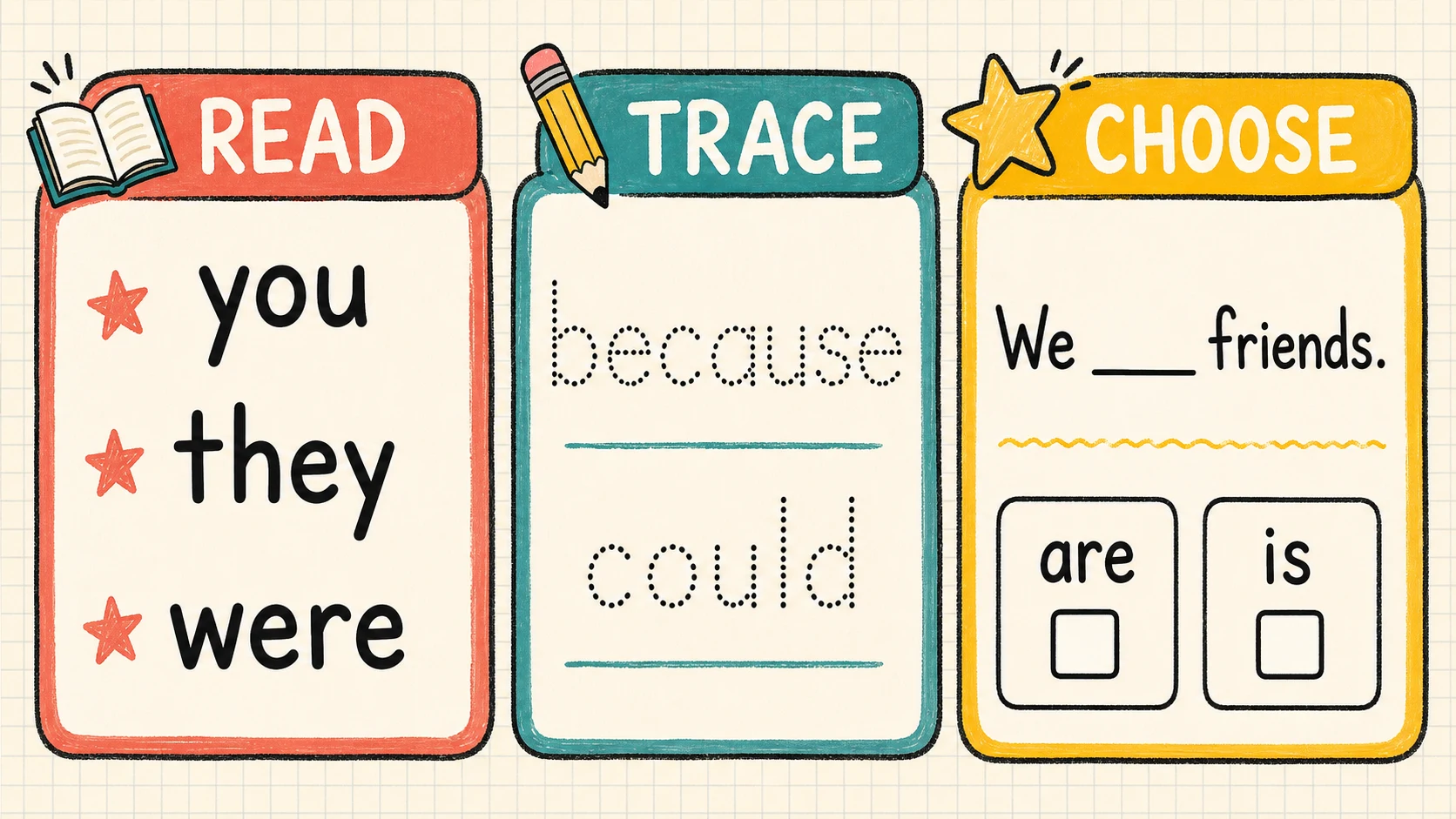
New instruction, cumulative review, writing, and sentence reading alternate across ten sessions.
This sample uses can, the, said, was, and is. Replace them if the learner’s local sequence uses other words. The plan is adaptable and is not a universal timetable.
| Day |
Main work |
Quick evidence |
| 1 |
Check letter sounds and blend can. Build, write, and read “I can hop.” |
Can the learner use all three letters? |
| 2 |
Review can. Introduce the; build t-h-e and compare the with teh. |
Can the learner select the correct order? |
| 3 |
Mix can and the. Find both in “The cat can sit.” |
Do isolated words transfer to a sentence? |
| 4 |
Introduce said. Mark ai as the unusual part; use cover-write-check. |
Does the spelling retain ai? |
| 5 |
Review all three words in mixed order and one new sentence each. |
Which word still needs a model? |
| 6 |
Recheck the three words after the break. Introduce was only if the set remains manageable. |
Which words were retained? |
| 7 |
Contrast was and saw with letter tiles. Read “It was hot.” |
Does the learner preserve letter order? |
| 8 |
Introduce or review is. Build a short sentence such as “It is red.” |
Can the learner recognize is in context? |
| 9 |
Read a short set of sentences containing all current words. Write two target words from memory. |
Are reading and spelling equally secure? |
| 10 |
Check words in a new order and unfamiliar short sentences. Sort cards into review and independent groups. |
Which specific words and error patterns should shape the next cycle? |
If Day 5 shows several uncertain words, do not add was on Day 6. Repeat analysis and sentence reading with the smaller set. If all three are secure across separate checks, continue while retaining a brief cumulative review.
Limits and the Honest Next Step
A worksheet can provide orderly repetition, but it cannot determine why a learner made an error, select the right prompt, or confirm lasting recognition by itself. Flashcards can check isolated words, yet isolated speed does not demonstrate spelling or sentence reading. Games can increase variety, but they do not replace explicit analysis. Sight-word work also cannot replace broader phonics, oral language, handwriting, or connected reading.
Kindergarten commonly includes beginning recognition of high-frequency words, with the supplied catalogue describing an end-of-year range of about 25 to 50 words for most learners. Treat that range as general catalogue context, not an individual deadline or guaranteed outcome.
For the next session, choose three words the learner has already encountered and use the full analyze-build-write-read routine. Then complete only the matching items from the free Kindergarten Sight Words worksheet. Record which words are read, spelled, and recognized in a sentence; use those observations to choose the following lesson. For broader practice options, continue with the Kindergarten Sight Words pack or create a smaller custom review through the free worksheet generators.