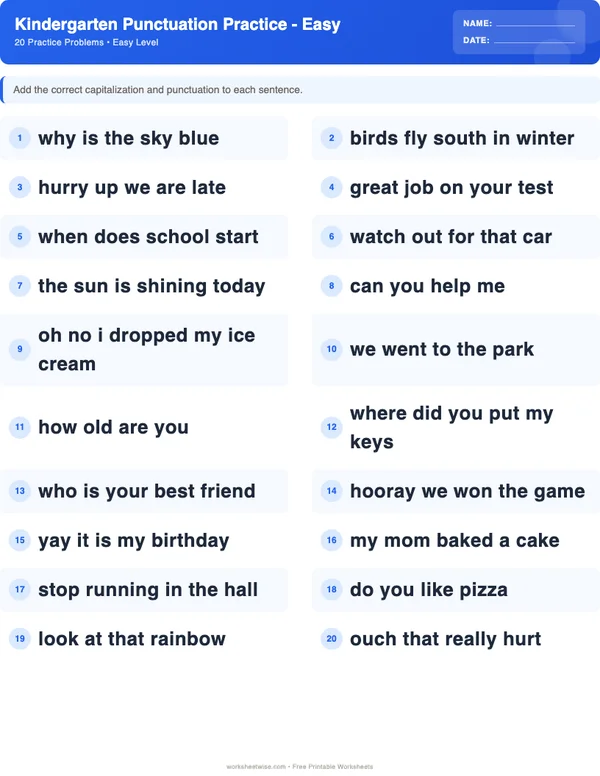
Kindergarten Punctuation: the essential goal
Kindergarten Punctuation instruction should help a learner recognize and name three end marks—a period, question mark, and exclamation point—and choose an appropriate mark for a simple sentence. Because the available worksheet asks learners to correct both capitalization and punctuation, they should also practice beginning a sentence with a capital letter.
The practical sequence is:
- Hear whether a sentence tells, asks, or expresses strong feeling.
- Match that purpose to
., ?, or !.
- place the mark at the end.
- Check that the sentence begins with a capital letter.
- Read the corrected sentence aloud and decide whether the mark fits.
That is the central kindergarten target. Commas, apostrophes, quotation marks, and more complex punctuation belong to later instruction in the supplied topic sequence. A learner who is still deciding among the three basic end marks does not need those additional rules yet.
Grade labels describe the intended practice level, not a universal timetable. Local school sequences differ, and the learner’s observed work should determine when to repeat, simplify, or advance.
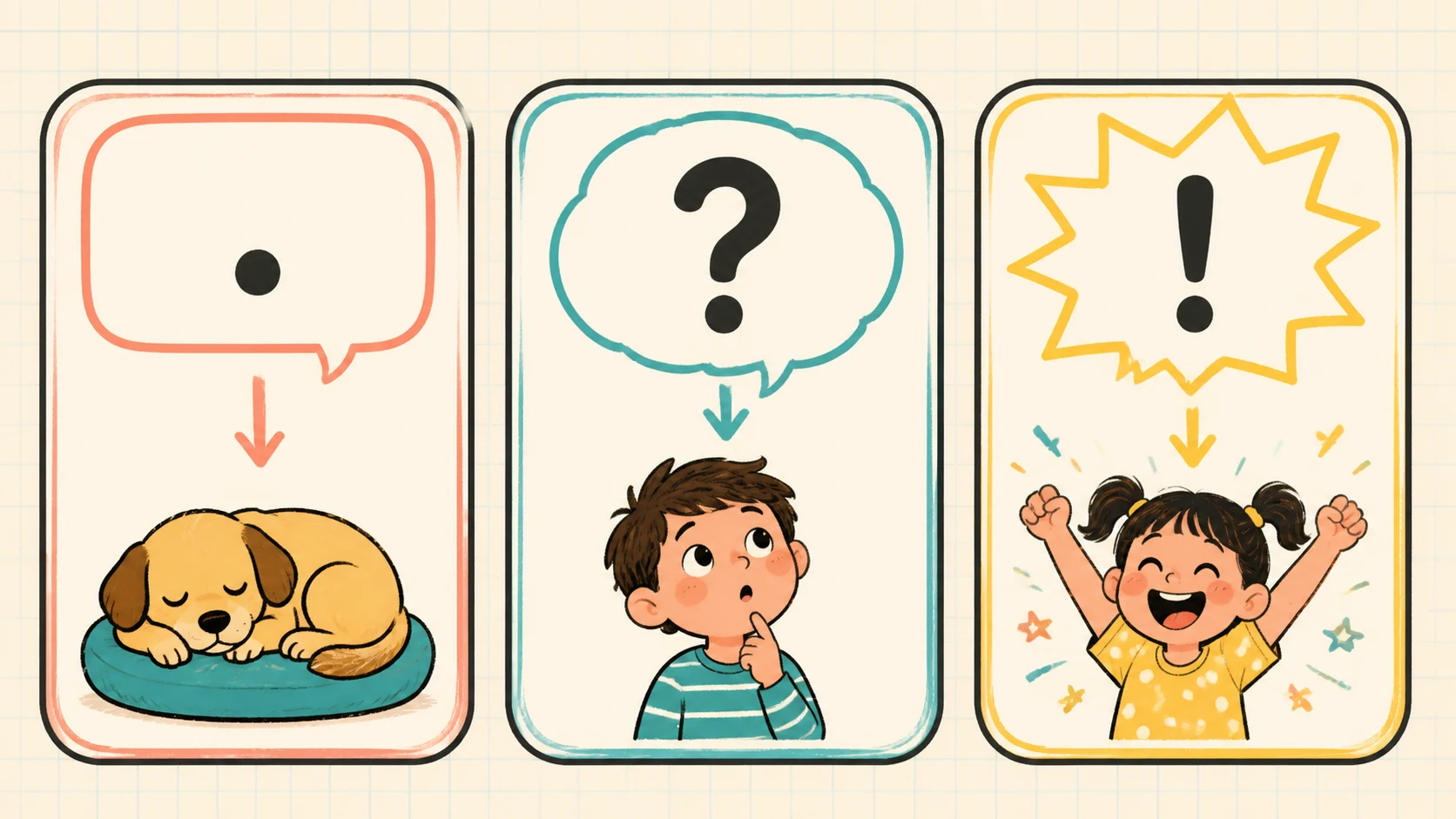
The skill connects sentence meaning, spoken expression, end marks, capitalization, and checking.
What the learner is actually learning
Punctuation is not merely a symbol added after writing. An end mark gives the reader information about the sentence’s purpose.
- A period ends a statement:
The cat is soft.
- A question mark ends a direct question:
Is the cat soft?
- An exclamation point ends an excited or strongly expressed sentence:
What a soft cat!
The supplied catalogue describes punctuation marks as traffic signals for written language because they help readers know when to stop, question, or add expression. That comparison is useful if it remains concrete: every complete practice sentence needs an ending signal.
At this level, the learner is coordinating several small decisions:
- Where does the sentence begin?
- Which letter needs to be uppercase?
- What does the sentence do?
- Where does the sentence end?
- Which end mark fits its meaning?
- Does the corrected sentence sound right when read aloud?
These decisions can be harder than simply naming punctuation shown on a card. A learner might point to a question mark correctly yet still add a period to Can you hop. Recognition and application are related, but they are not the same performance.
The Common Core English Language Arts standards identify recognizing and naming end punctuation within the kindergarten language scope. The catalogue associates this topic specifically with L.K.2.B. That source provides high-level context for the grade-level target; it does not establish a universal teaching schedule or evaluate this WorksheetWise material.
The three sentence jobs
A useful instructional model is to sort sentences by job before discussing the mark:
| Sentence job |
Meaning clue |
End mark |
Example |
| Tells something |
Gives information |
. |
The bus is red. |
| Asks something |
Seeks an answer |
? |
Is the bus red? |
| Shows strong feeling |
Expresses excitement, surprise, or force |
! |
Look at that red bus! |
“Tells, asks, or shows strong feeling” is child-friendly language. Adults may use the formal words statement, question, and exclamation, but the learner does not need to master terminology before choosing marks accurately.
Voice is a clue, not the whole rule
Reading aloud can make punctuation visible through sound. A statement often has a settled ending, a question may sound as though it seeks an answer, and an exclamation is usually read with added energy.
Use voice as supporting evidence rather than an automatic rule. Natural speech varies. Not every question has an obvious upward sound, and a sentence can be spoken loudly without becoming an exclamation. Meaning remains the deciding factor:
Do you see the frog? asks for an answer.I see the frog. tells something.That frog is huge! expresses strong feeling.
Prerequisites to check before formal practice
A learner does not need polished handwriting or independent reading before beginning punctuation. The adult can read sentences aloud, provide movable word cards, or let the learner point to a mark. Several foundational abilities do make the task more manageable.
Sentence and print awareness
Check whether the learner can:
- follow a short line of print from left to right;
- identify the first and last word in a sentence;
- distinguish a letter from an end mark;
- understand that a sentence communicates a complete thought in the current example;
- listen to a simple sentence and say whether it tells or asks something.
The IES foundational reading practice guide offers broad instructional guidance for supporting foundational reading in kindergarten through Grade 3. For punctuation work, the relevant framing is to keep print connected to spoken language and meaningful reading. It does not prescribe this exact activity or guarantee a particular result.
Capital-letter readiness
The featured worksheet combines capitalization with punctuation. Before expecting independent correction, check whether the learner can match common uppercase and lowercase forms, especially the first letter in the practice sentence.
If letter formation is demanding, separate knowing from writing. The learner can circle the first lowercase letter, select its uppercase partner, and place a punctuation card at the end. This reveals punctuation understanding without allowing handwriting difficulty to hide it.
Oral-language readiness
Ask the learner to classify spoken examples before showing print:
- “The dog can run.” Does it tell or ask?
- “Can the dog run?” Does it tell or ask?
- “The dog can run so fast!” Does it sound calm or strongly expressive?
If oral classification is inconsistent, keep the first lesson oral. Written correction is premature when the learner cannot yet identify the sentence’s purpose after hearing it.
A grade-appropriate teaching progression
Teach one contrast at a time. Beginning with three unexplained symbols can invite guessing, especially when every answer position looks identical.
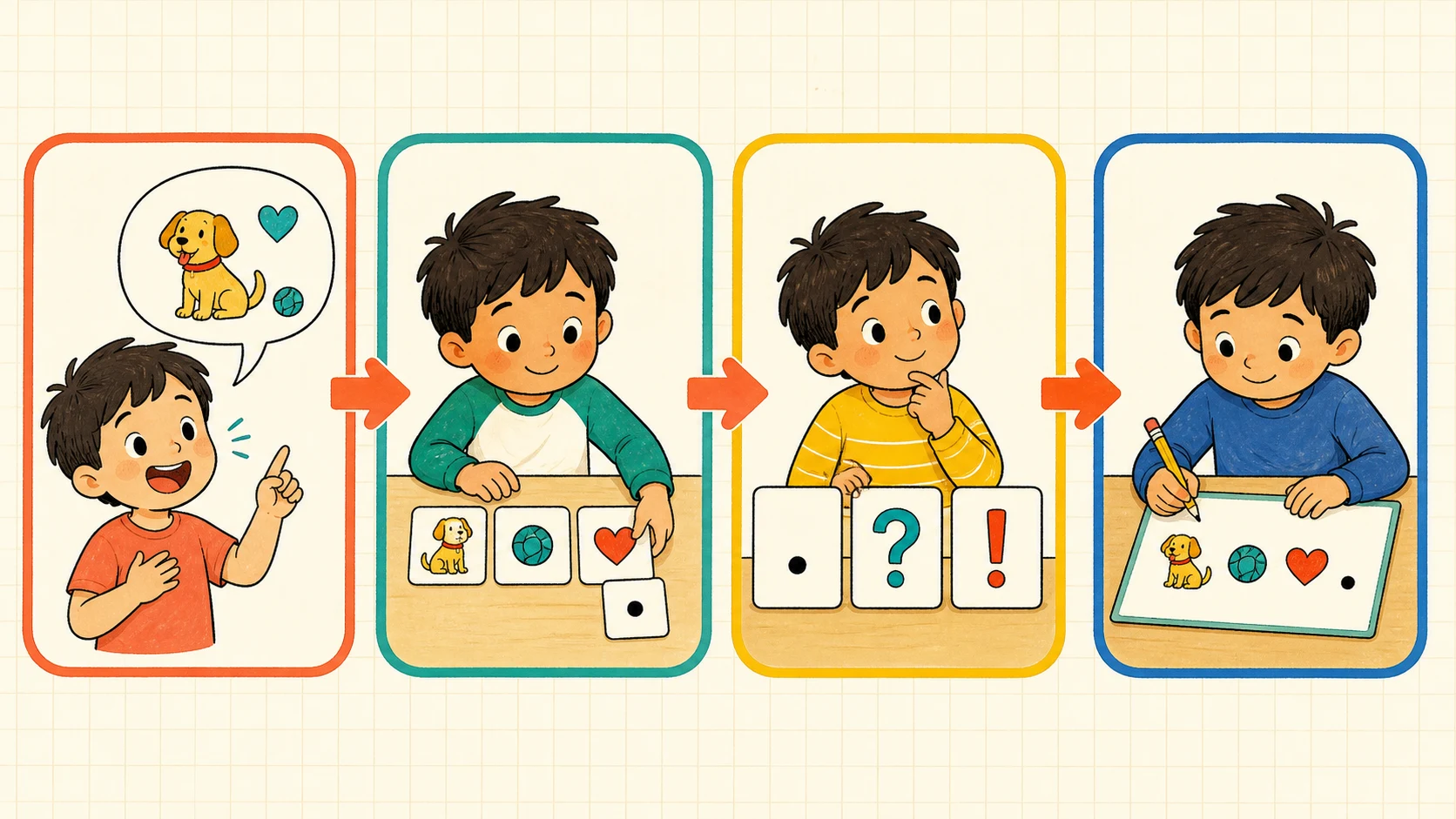
Support decreases as the learner moves from hearing sentence purpose to editing complete sentences.
| Stage |
Teaching focus |
Adult support |
Evidence of readiness to continue |
| 1. Notice endings |
Find where a spoken or printed sentence stops |
Point, track print, and model |
Learner locates the end |
| 2. Learn the period |
Match a telling sentence to . |
Use only statements |
Learner places and names a period |
| 3. Contrast tell and ask |
Choose between . and ? |
Read paired sentences aloud |
Learner explains “tells” or “asks” |
| 4. Add strong feeling |
Choose among ., ?, and ! |
Contrast calm and expressive examples |
Learner uses meaning, not symbol shape |
| 5. Add capitalization |
Correct the beginning and ending |
Mark both checking positions |
Learner checks both consistently |
| 6. Edit mixed items |
Correct unpunctuated sentences |
Reduce prompts |
Learner chooses and explains marks |
| 7. Apply in writing |
Write or dictate original examples |
Offer a picture or sentence frame |
Learner rereads and checks the ending |
Progress is not the same as completing one page. Move forward when the learner’s explanations and answers are becoming reliable. Return to an earlier contrast when errors show that the meaning of the marks is not secure.
Concrete and visual models
Three simple models make the choice visible.
Sentence-job cards
Prepare cards labeled:
TELLS .ASKS ?STRONG FEELING !
Read a sentence and let the learner hold up or place the matching card. This removes handwriting from the first decision.
Beginning-and-ending frame
Write:
[CAPITAL] the duck can swim [END MARK]
The two boxes show that editing has two separate checkpoints. The corrected result is:
The duck can swim.
Paired sentences
Keep most words the same while changing the sentence job:
The bird can fly.
Can the bird fly?
The controlled contrast directs attention to meaning, word order, capitalization, and the end mark without adding unrelated vocabulary.
Fully checked worked examples
Use a consistent thinking routine: locate the beginning, identify the sentence job, choose the end mark, make the correction, and reread.
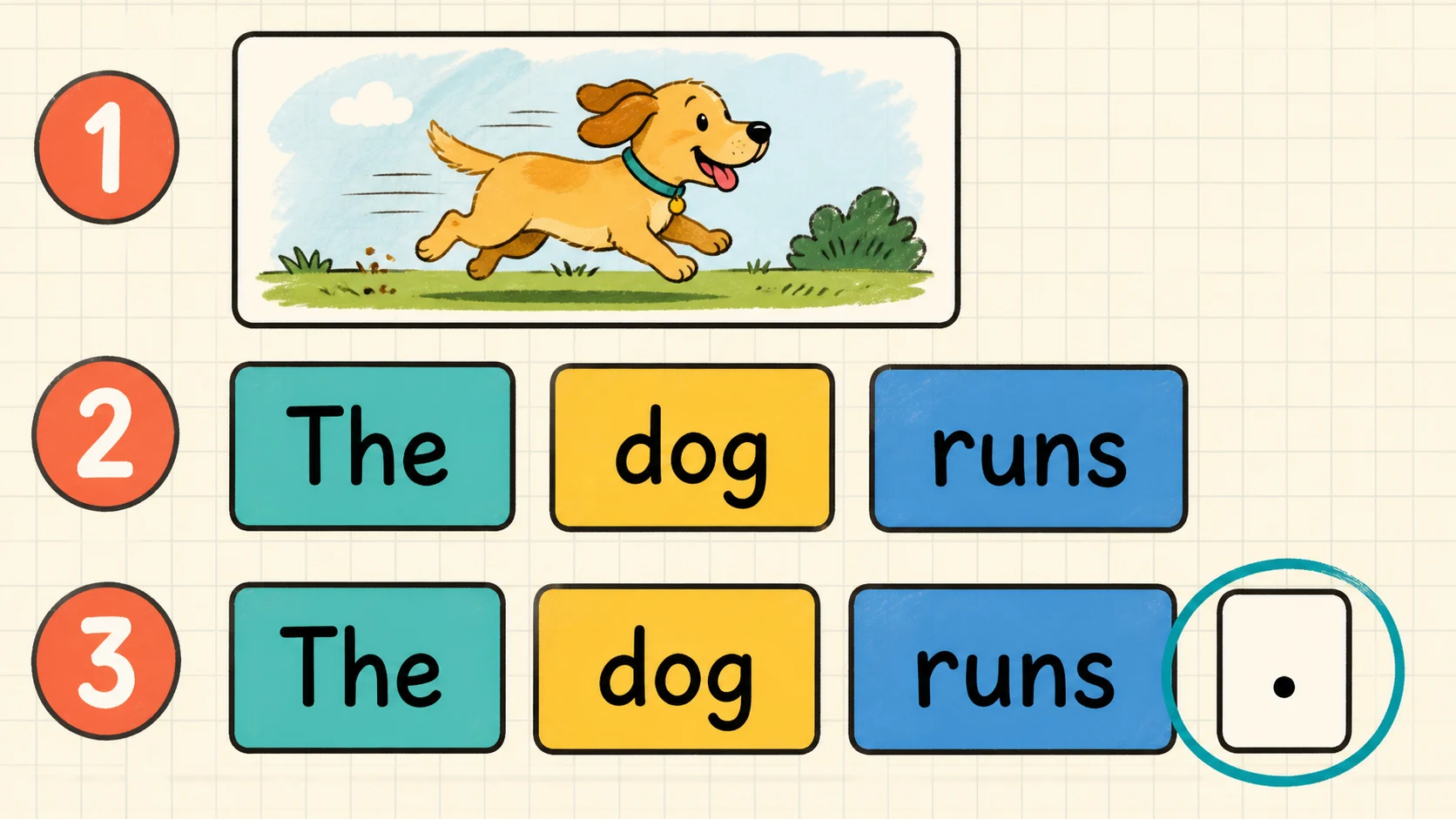
Each correction begins with meaning and ends with a visible two-part check.
Worked example 1: a statement
Given: the fish can swim
- The first word is
the, so its first letter must be capitalized.
- The sentence tells something about the fish.
- A telling sentence takes a period.
- The period belongs directly after the final word.
Corrected sentence: The fish can swim.
Check: It begins with uppercase T, ends with ., and reads as a complete statement.
Worked example 2: a direct question
Given: can the fish swim
can begins the sentence, so it becomes Can.- The sentence asks whether the fish can swim.
- A direct question takes a question mark.
- The question mark goes after
swim.
Corrected sentence: Can the fish swim?
Check: It begins with uppercase C. The sentence asks for an answer, so ? is more appropriate than . or !.
Worked example 3: strong feeling
Given: what a big kite
what begins the sentence, so it becomes What.- The words express a strong reaction to the kite.
- An exclamation point signals that strong feeling.
- The mark belongs after
kite.
Corrected sentence: What a big kite!
Check: The capital beginning and exclamation point are both present. The sentence is not asking what the kite is, so a question mark would not fit.
Worked example 4: a question beginning with a question word
Given: where is my hat
where becomes Where.- The speaker is asking for the location of the hat.
- The sentence requires a question mark.
- No period is added after the question mark.
Corrected sentence: Where is my hat?
Check: The sentence asks for information, begins with a capital, and has exactly one end mark.
Worked example 5: an excited statement
Given: we won the game
This sentence can be punctuated differently depending on intended meaning and expression. In a calm report, write:
We won the game.
If the surrounding context clearly shows celebration or strong excitement, write:
We won the game!
Both forms can be grammatical. For a kindergarten exercise, the picture, teacher’s reading, or directions should make the intended choice clear. Do not mark a learner wrong for failing to infer excitement that the item never signals.
Worked example 6: correcting an extra mark
Given: Is the door open?.
- The sentence begins correctly with uppercase
I.
- It asks whether the door is open.
- It needs a question mark.
- A sentence normally uses one appropriate end mark in this practice.
Corrected sentence: Is the door open?
Check: Remove the unnecessary period. The remaining mark matches the sentence job.
Boundary cases and honest limits
Not every short sentence has one obvious mark without context. Adults should recognize ambiguity rather than teaching punctuation as visual guesswork.
When a period or exclamation point could both fit
That is a tall tower
A calm observation is That is a tall tower. A surprised reaction is That is a tall tower! The words alone permit either reading. If an exercise expects one answer, its picture or directions should establish the tone.
When a command is not automatically an exclamation
Please sit down. is a polite command and can end with a period. Stop! can take an exclamation point when urgency or force is intended. Teaching “every command gets an exclamation point” would create a misconception.
When question words do not decide everything
A sentence beginning with what is not always a question:
What is in the box? asks for information.What a big box! expresses a strong reaction.
The learner should consider the whole sentence, not search for one trigger word.
What this level does not cover
The kindergarten catalogue target is end punctuation. Although the broader punctuation topic later includes commas, apostrophes, quotation marks, colons, and semicolons, those are not the next step for a learner still confusing ., ?, and !.
This guide also does not diagnose reading, language, attention, vision, hearing, or motor difficulties. If concerns extend well beyond punctuation or persist across settings, record the specific work samples and discuss them with the learner’s teacher or an appropriately qualified professional. That is a documentation step, not medical guidance.
A short, repeatable lesson routine
The IES elementary writing practice guide supports explicit writing instruction and regular opportunities to write within a broader instructional framework. The following routine is an instructional suggestion built for the supplied skill scope; it is not a timetable prescribed by IES.
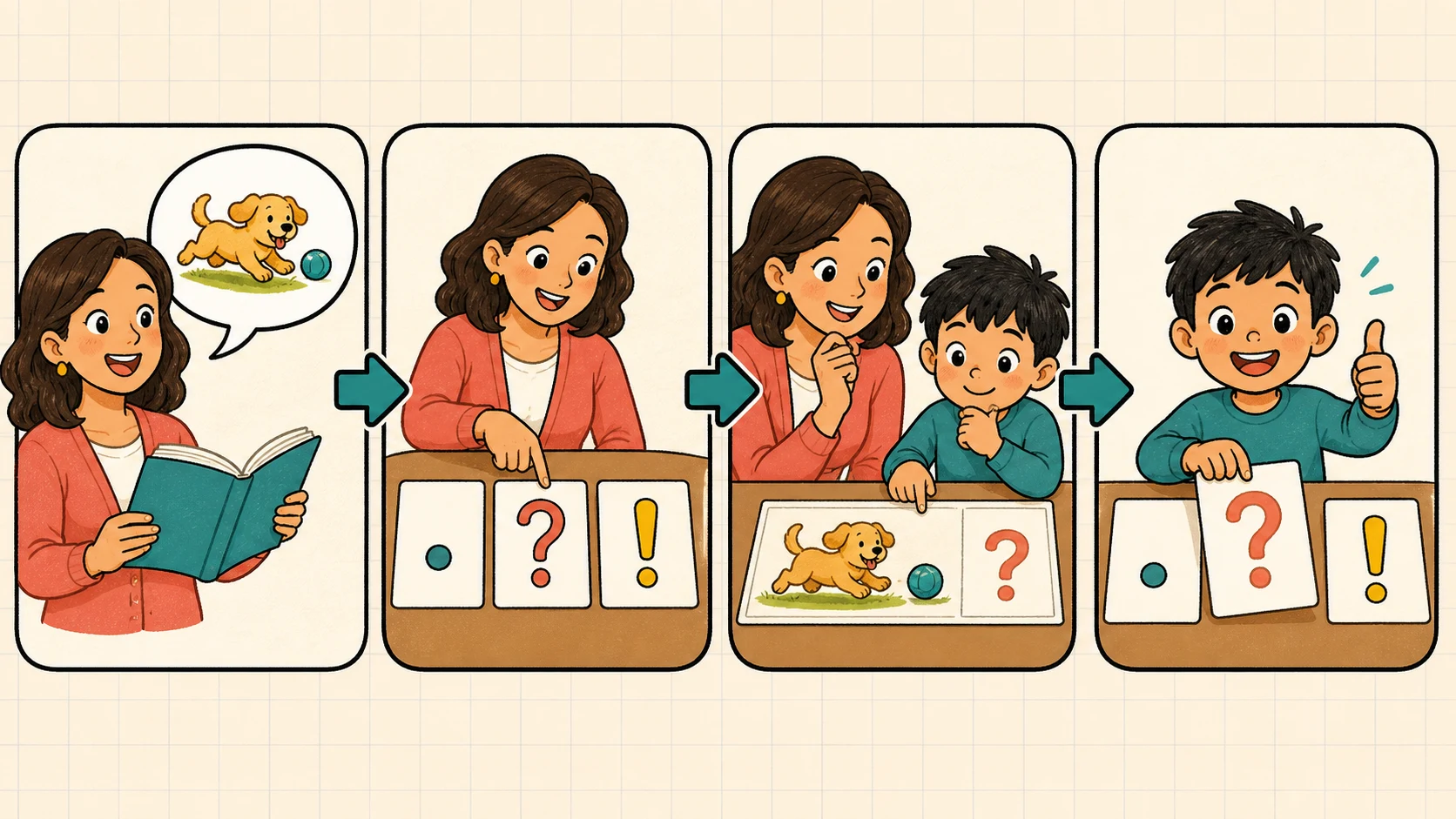
The routine moves from hearing meaning to marking print and explaining the choice.
A 10- to 15-minute routine
1. Hear it — about 2 minutes
Say two sentences with a clear contrast, such as The rabbit is fast and Is the rabbit fast. Ask the learner to identify which one tells and which one asks.
2. See it — about 2 minutes
Show the printed sentences with their marks. Point to the capital at the beginning and the punctuation at the end. Name each mark.
3. Build it — about 3 minutes
Give the learner a sentence strip without punctuation and three end-mark cards. Have the learner choose and place one card. Ask for a short explanation: “It asks, so I chose a question mark.”
4. Write or edit it — about 3 to 5 minutes
Correct two to four items. Keep the number small enough that the learner can think carefully rather than rush through repeated guesses.
5. Check it — about 2 minutes
Use two checks:
- “Capital at the beginning?”
- “Right mark at the end?”
Then reread each sentence aloud.
A learner who answers correctly but cannot explain the choice may still be relying on a pattern. Continue with contrasting examples and oral explanations before increasing the page length.
Choosing useful practice
The Kindergarten grammar hub can help adults compare this punctuation work with other early grammar activities. Choose practice by the learner’s current error pattern, not by the largest available set.
The free Kindergarten punctuation worksheet contains 12 easy-level exercises. Its instruction is to add correct capitalization and punctuation. The listed skills are capitalization, periods, question marks, and exclamation marks, and a separate printable answer key is included.
That worksheet is a reasonable choice when the learner can already:
- identify the beginning and end of a short sentence;
- distinguish telling, asking, and strongly expressive sentences with some consistency;
- recognize the three end marks;
- attempt both capitalization and punctuation in the same item.
Use more supported practice first if the learner cannot yet classify spoken sentences. A full mixed worksheet will reveal errors, but it may not teach the underlying contrast by itself.
Matching practice to need
| Observed performance |
Appropriate practice |
| Cannot name the marks |
Matching symbols to names |
| Names marks but guesses in sentences |
Oral sentence-job sorting |
| Confuses period and question mark |
Paired statements and questions |
Uses ! for every exciting picture |
Calm-versus-strong-feeling comparisons |
| Chooses marks correctly but misses capitals |
Beginning-and-ending editing frames |
| Corrects supplied sentences reliably |
Original sentence dictation or writing |
| Maintains accuracy across mixed items |
Short review with less prompting |
For repeated or varied work, the catalogue lists a focused Kindergarten punctuation pack containing 18 worksheets and priced at $4.79. Quantity alone is not a reason to use it. Select only pages that match the learner’s present stage. Free worksheet generators may be useful when the learner needs a fresh set with a deliberately narrow contrast.
Differentiation without changing the core goal
Differentiation should alter access, response demands, or the amount of support while preserving the decision about sentence purpose and end punctuation.
When the task is too difficult
- Read each sentence aloud.
- Offer only two marks at first, such as
. and ?.
- Use one sentence per strip.
- Let the learner point, place a card, or stamp a mark.
- Correct capitalization separately from punctuation.
- Use familiar words and short sentence structures.
- Complete the first item together, then try one independently.
If the learner gets Can the dog run? wrong, reduce the contrast to The dog can run. and Can the dog run? rather than adding more mixed questions.
When the task is appropriately challenging
- Mix the three end marks.
- Ask for a one-clause explanation.
- Include capitalization in the check.
- Alternate between reading, editing, and composing.
- Revisit a previous error after several different items.
When the task is secure
- Ask the learner to dictate one statement, one question, and one exclamation about the same picture.
- Remove the visible mark choices.
- Ask the learner to edit two sentences independently.
- Include a genuinely ambiguous sentence and discuss how context changes the choice.
Advancement should come from observed control, not age alone. Faster completion is not necessarily stronger understanding; an explanation and accurate rereading provide better evidence.
Diagnosing common errors
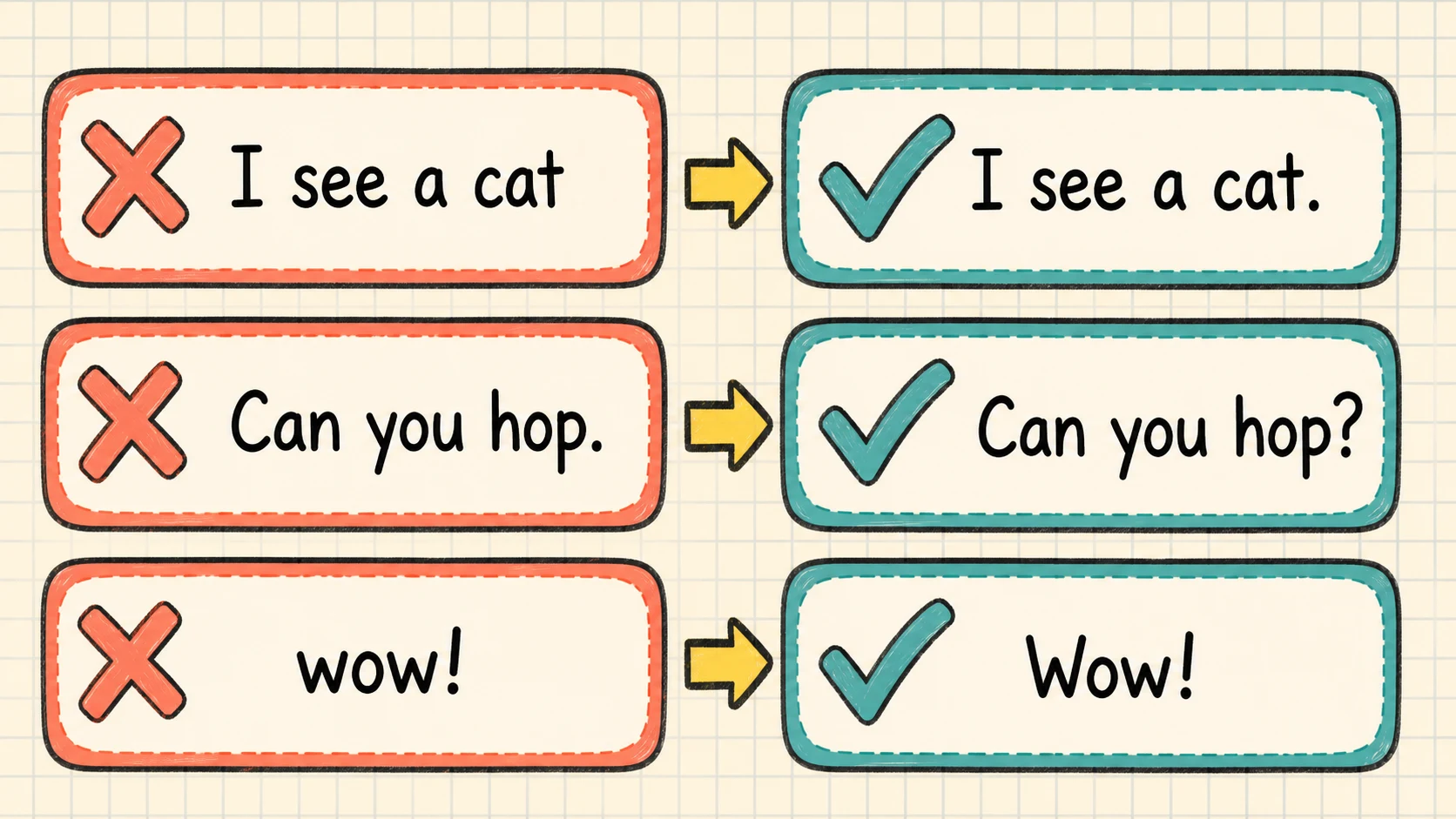
Different errors call for different responses; another mixed page is not always the right remedy.
| Error |
Possible instructional interpretation |
Teaching response |
| Adds a period to every sentence |
Has learned “sentences end with a dot” but not sentence jobs |
Contrast one statement with one direct question |
| Adds a question mark whenever the voice rises |
Depends on performance rather than meaning |
Ask whether the sentence seeks an answer |
| Uses an exclamation point for every picture |
Treats ! as decoration or “fun punctuation” |
Compare a calm statement with a strongly expressive version |
| Leaves every sentence unpunctuated |
May not locate the endpoint or remember the checking step |
Box the final word and place an end-mark card after it |
| Chooses the right mark but starts lowercase |
Understands punctuation but not the combined editing demand |
Use separate “beginning” and “ending” checks |
Writes both ?. |
Knows a mark is needed but not that one mark completes this task |
Model replacing the pair with the single fitting mark |
| Copies the sentence inaccurately |
Copying or handwriting demand may obscure punctuation knowledge |
Allow pointing, oral answers, or movable cards |
| Is correct only when the adult exaggerates voice |
Relies on vocal cues |
Present printed paired examples and discuss meaning |
| Alternates answers without explanation |
May be guessing |
Reduce choices and request a tell/ask/strong-feeling reason |
Treat these as instructional hypotheses, not diagnoses of the learner. Test a hypothesis with one or two carefully chosen examples. If a learner misses periods and questions in mixed work but succeeds on paired oral examples, the issue may be managing several written demands at once rather than misunderstanding both marks.
A common adult error is correcting too quickly. Instead of saying, “That needs a question mark,” ask, “Does this sentence tell something or ask for an answer?” The prompt returns attention to the decision the learner must eventually make independently.
Monitoring progress from actual work
Keep monitoring light and specific. A dated note with five items can be more informative than a vague impression that punctuation is “getting better.”
Track the parts separately:
| Check |
Record |
| Identifies sentence purpose |
tell / ask / strong feeling |
| Selects end mark |
. / ? / ! |
| Places mark at the end |
yes / not yet |
| Capitalizes first letter |
yes / not yet |
| Explains choice |
independent / prompted / unable |
| Rereads and self-corrects |
yes / not yet |
Review patterns across several short sessions. One mistake does not require restarting the entire skill, and one perfect page does not establish lasting control.
A practical instructional decision rule is:
- Mostly accurate with clear explanations: reduce prompts or add original sentences.
- Accurate only after reminders: keep the same difficulty and practice the checking routine.
- Repeated confusion between two marks: return to a two-way contrast.
- Errors scattered across capitalization, copying, and punctuation: reduce the number of simultaneous demands.
This is a teaching framework, not a validated assessment or guaranteed mastery threshold.
A two-week practice plan
The plan below is a flexible example. It assumes short sessions and can be stretched, repeated, or paused. Local sequences differ, and there is no universal timetable.

Across two weeks, the learner revisits meaning, mark choice, editing, and independent checking.
| Day |
Focus |
Suggested activity |
What to observe |
| 1 |
Sentence endings |
Point to the last word in five sentence strips |
Can the learner locate where a mark belongs? |
| 2 |
Periods |
Sort and punctuate four telling sentences |
Does the learner connect “tells” with .? |
| 3 |
Questions |
Compare three statement-question pairs |
Can the learner say which sentence asks? |
| 4 |
Mixed . and ? |
Choose marks for five short sentences |
Is the choice based on meaning? |
| 5 |
Review |
Correct three items, then explain each |
Which contrast still needs support? |
| 6 |
Exclamation points |
Compare calm and strongly expressive sentences |
Does the learner reserve ! for strong expression? |
| 7 |
Three-way sorting |
Sort six spoken or printed sentences |
Is one mark overused? |
| 8 |
Capital beginnings |
Correct the first letter and end mark in four items |
Can the learner manage both checkpoints? |
| 9 |
Mixed worksheet practice |
Complete part of the 12-item free worksheet |
Does accuracy hold with reduced support? |
| 10 |
Apply and review |
Dictate or write three original sentences, then edit |
Can the learner create and check each sentence type? |
Do not require completion of all 12 worksheet items in one sitting if careful thinking declines. The worksheet can be divided across sessions. When an answer is wrong, record the type of decision involved and teach that contrast before assigning another broad set.
Limitations and the next useful step
This guide addresses foundational end punctuation and the capitalization demand included in the supplied easy worksheet. It does not provide comprehensive standards alignment, certify mastery, predict outcomes, or replace local curriculum decisions. The authoritative sources above support broad language, reading, and writing instruction; they did not review WorksheetWise or this particular worksheet.
The most useful next action is to give the learner three oral examples—one statement, one question, and one strongly expressive sentence. If the learner classifies them accurately, begin the free Kindergarten Punctuation worksheet and stop after four carefully checked items. Use the errors, explanations, and self-corrections from those items to choose the next lesson.