Pre-K Short Vowels: What the Skill Means
Pre-K short-vowel work introduces a learner to the sounds represented by a, e, i, o, and u in simple words. The target sounds are:
- a as in apple
- e as in egg
- i as in itch
- o as in octopus
- u as in umbrella
The concise answer is this: begin with listening, connect one vowel sound to a memorable picture and letter, and then use that sound in simple consonant-vowel-consonant words such as cat, sit, hot, cup, and pen. Move forward when the learner’s observed responses are accurate and increasingly independent—not merely because a certain number of days has passed.
For many Pre-K learners, hearing and identifying a vowel sound is a more suitable starting point than reading a list of words independently. Adults can say the words, show pictures, model how the mouth moves, and let the learner sort or point before expecting written answers.
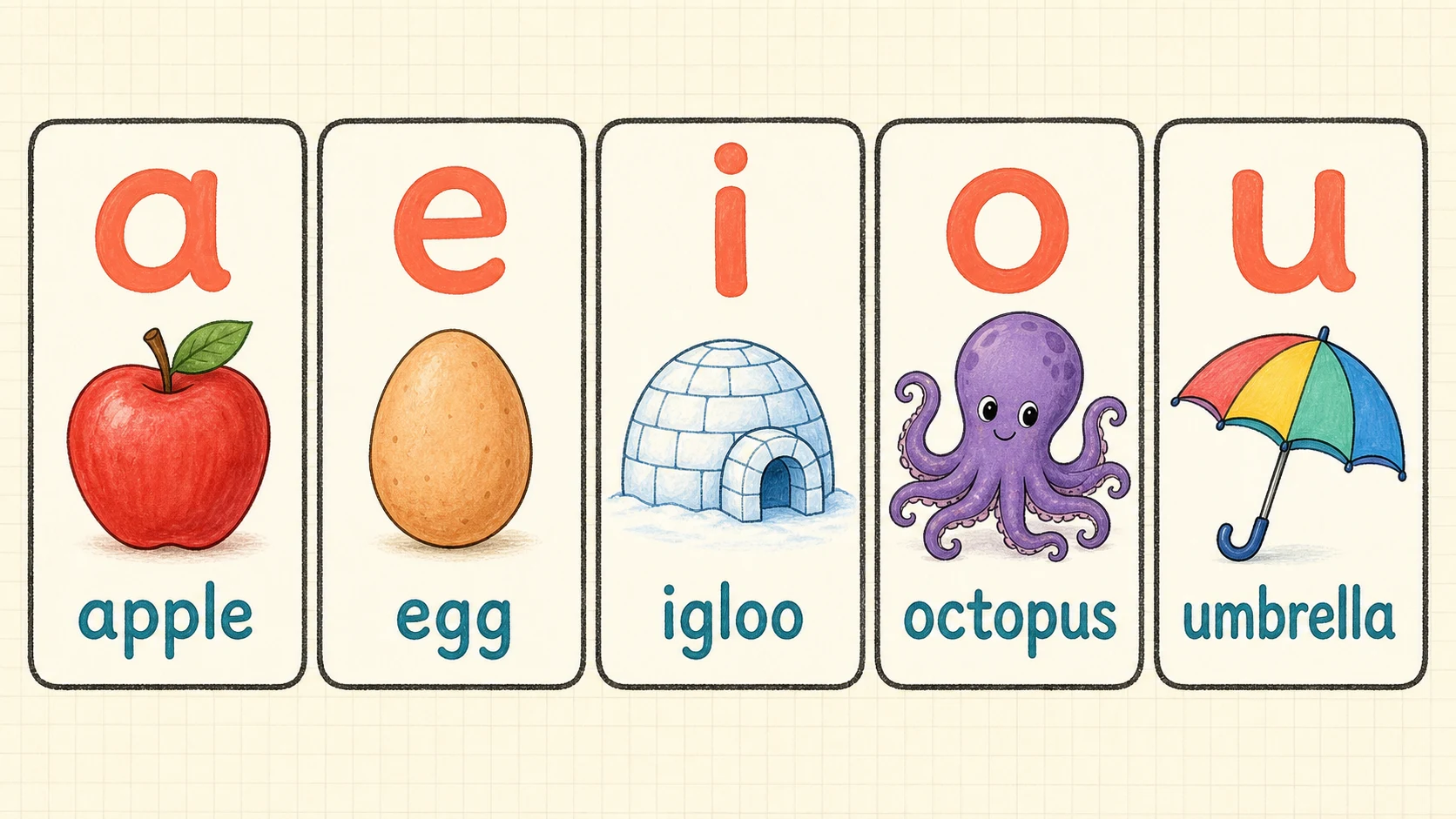
Short-vowel learning connects listening, letter recognition, word building, reading, and spelling.
Short vowels commonly appear in closed syllables, where the vowel is followed by a consonant, as in cat, pen, sit, hot, and cup. These simple CVC words—consonant, vowel, consonant—make the middle vowel easy to isolate. They also give the learner a manageable structure for beginning decoding.
This guide describes an intended Pre-K practice level, not a universal timetable. Grade labels describe intended practice level, and local sequences differ. Some children will need extended listening and picture work. Others may already be ready to blend and read several CVC words.
Prerequisites to Check Before Teaching Short Vowels
Short-vowel instruction is easier when a learner has several supporting skills. These do not all need to be perfect, but they should be checked before worksheet difficulty increases.
Listening for parts of spoken words
Ask the learner to listen without looking at print. Say two familiar words, such as map and sun. Can the learner tell that they sound different? Then stretch a word orally: /m/ /a/ /p/. Can the learner repeat the sounds or blend them into map?
A learner who cannot yet attend to separate sounds may need more oral play with rhyme, syllables, and beginning sounds. The Pre-K worksheet hub can be used to locate practice at the broader intended level, but the adult should choose tasks according to observed performance.
Letter recognition
Check whether the learner can find the lowercase vowel letters a, e, i, o, and u among a small group of letters. Lowercase recognition matters because simple printed words usually contain lowercase vowels.
Do not assume that naming a letter means knowing its sound. Ask separately:
- “What letter is this?”
- “What sound are we practicing for this letter?”
If the learner calls a “A” but cannot produce the short sound in apple, letter naming is present while the sound connection still needs instruction.
Beginning and ending consonants
CVC work is more manageable when the learner knows several common consonant sounds. The goal is not mastery of every consonant. A small usable set—such as m, s, t, p, n, c, h, and b—is enough to build many examples.
When consonant knowledge is weak, keep the vowel target clear. Say the consonant sounds for the learner or provide picture choices so that difficulty with m does not hide whether the learner can hear short a.
Print and motor readiness
Pre-K learners are still developing print awareness and fine-motor control. A learner may correctly identify the middle vowel yet struggle to write it neatly. Accept pointing, moving a letter tile, circling, or saying the answer when handwriting would distort the evidence.
The instructional question is, “Can the learner identify the sound?” That is different from, “Can the learner form the letter with a pencil?”
A Grade-Appropriate Teaching Progression
Teach one short vowel at a time before asking the learner to compare all five. The catalogue’s suggested sequence is a, i, o, u, e. It places the more confusable e/i contrast later, after the learner has experience listening for middle sounds.
| Stage |
Adult support |
Learner action |
Evidence to watch |
| 1. Hear one target |
Say words and emphasize the vowel |
Signal when the target sound is heard |
Correctly accepts examples and rejects clear nonexamples |
| 2. Link sound, picture, and letter |
Show an anchor picture and vowel card |
Say the sound and select the letter |
Connects the sound to the intended vowel |
| 3. Sort pictures |
Name each picture clearly |
Place pictures under target/not-target headings |
Sorts by sound rather than visual features |
| 4. Find the middle sound |
Stretch a CVC word |
Identify or place the middle vowel |
Attends to the medial sound |
| 5. Blend and read |
Point to each letter, then sweep across |
Blend the three sounds |
Produces the whole word without guessing from one letter |
| 6. Spell from dictation |
Say a known CVC word |
Segment and build or write it |
Represents the beginning, middle, and ending sounds |
| 7. Compare vowels |
Mix words containing two learned vowels |
Sort, read, or complete each word |
Maintains the contrast without an anchor prompt |
| 8. Review independently |
Reduce cues and mix familiar formats |
Complete a short practice set |
Responds accurately without relying on item order |
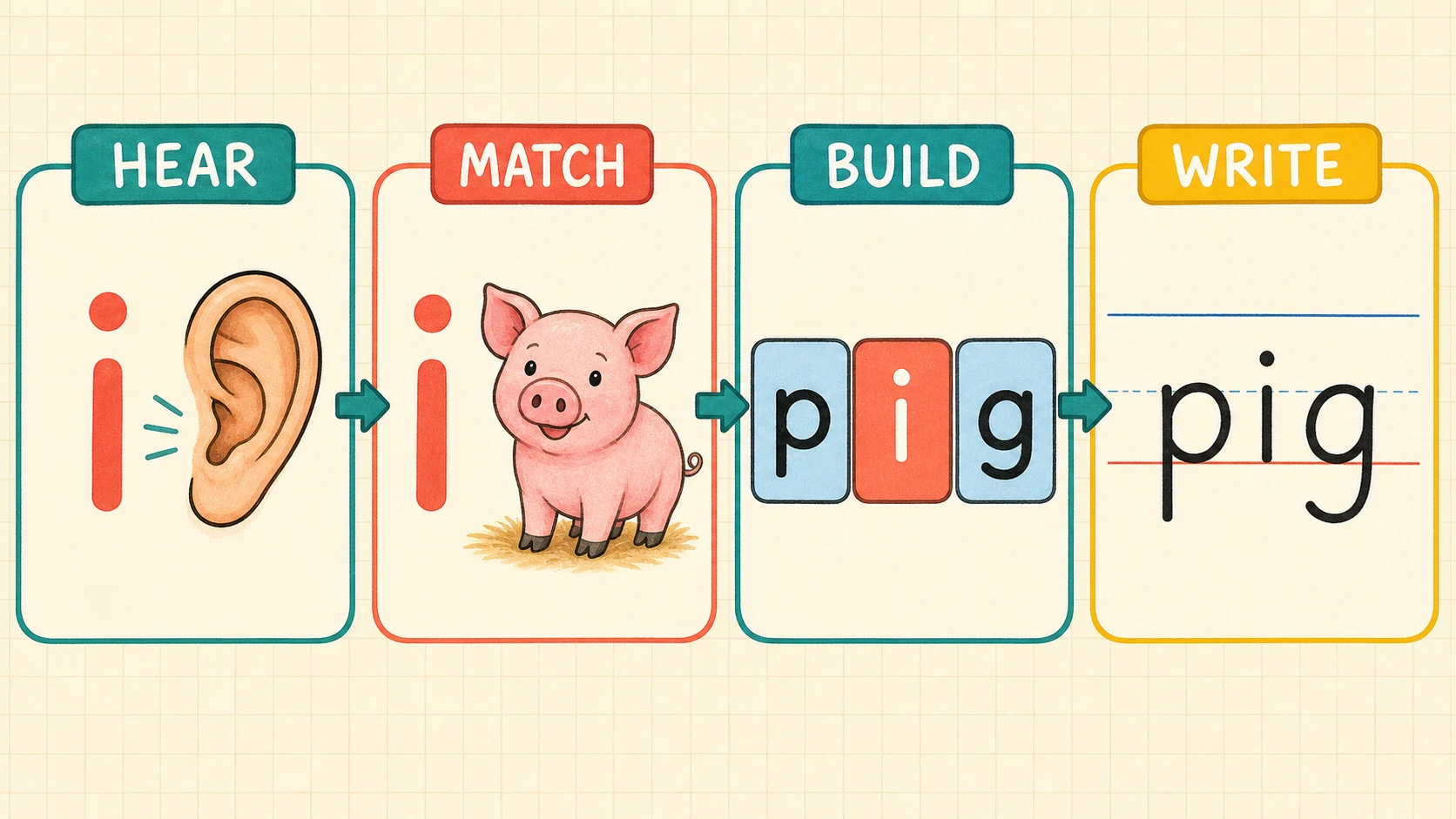
Support decreases gradually as the learner shows reliable control of each step.
This progression is instructional guidance, not a sourced mandate. The IES foundational reading practice guide provides broader evidence-based framing for teaching sound segments, connecting sounds with letters, and helping learners decode words. It does not evaluate WorksheetWise or prescribe this exact Pre-K sequence.
The Common Core English Language Arts standards include later expectations involving vowel sounds and regularly spelled one-syllable words. Those standards offer context for where foundational phonics can lead. They should not be treated as proof that every Pre-K learner must complete kindergarten, first-grade, or second-grade expectations early.
Concrete and Visual Models That Make the Sounds Clear
Anchor pictures and motions
Use one consistent anchor for each vowel:
| Vowel |
Anchor |
Motion |
| a |
apple |
Pretend to bite an apple |
| e |
egg |
Pretend to crack an egg |
| i |
itch |
Scratch an arm |
| o |
octopus |
Wiggle arms like tentacles |
| u |
umbrella |
Pretend to hold up an umbrella |
Say the sound rather than stretching the letter name: “a, apple.” The motion is a retrieval cue, not the learning goal. Once the learner recalls the sound without it, reduce the cue.
Sound boxes and movable letters
Draw three boxes for a CVC word:
| First sound |
Middle sound |
Last sound |
| /m/ |
/a/ |
/p/ |
Place one counter in each box as the learner says /m/ /a/ /p/. Replace the middle counter with the letter a, then replace the remaining counters with m and p. Finally, sweep a finger under map and blend the sounds.
This sequence makes a useful distinction visible: spoken words contain sounds, while printed words use letters to represent those sounds.
Mouth observation
Short vowels can sound similar. When comparing short e and short i, let the learner watch the adult’s mouth. For short e, the mouth opening is slightly wider. Pair this visual cue with careful listening; do not turn mouth position into a rigid test.
Mirrors can help, but the learner still needs to connect the heard sound with the correct letter. A correct facial imitation without sound-letter identification is not yet mastery.
Fully Checked Worked Examples
Example 1: Identify the vowel in map
- Say map naturally.
- Segment it: /m/ /a/ /p/.
- Isolate the middle sound: /a/.
- Match /a/ to the letter a.
- Rebuild and blend: m-a-p, map.
Checked answer: The short vowel is a. The written word is map, and a is between the initial consonant m and final consonant p.
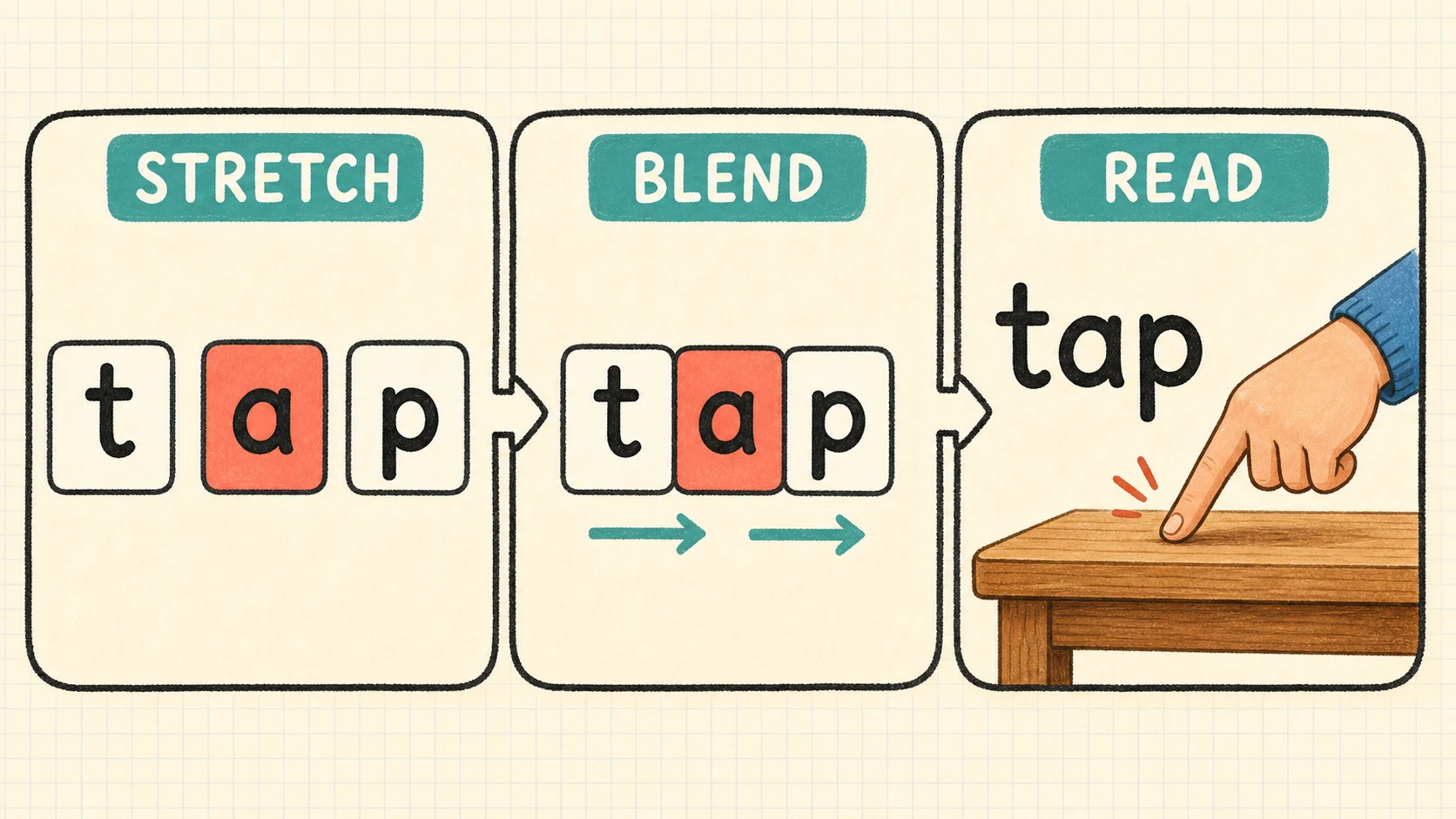
The learner moves from a spoken word to segmented sounds, a vowel choice, and a complete word.
Example 2: Complete s_t for the spoken word sit
Show s_t, then say, “The word is sit.”
- Stretch the word: /s/ /i/ /t/.
- Compare the middle sounds in sat and sit.
- Hear /i/ in the target word.
- Select i and place it in the blank.
- Blend s-i-t to verify the result.
Checked answer: sit. The missing letter is i because the middle sound is short i, as in itch. Choosing a would form sat, a different word.
Example 3: Sort hot and sun
Prepare headings short o and short u.
For hot:
- Segment: /h/ /o/ /t/.
- The middle sound is /o/.
- Place hot under short o.
For sun:
- Segment: /s/ /u/ /n/.
- The middle sound is /u/.
- Place sun under short u.
Checked answer: Hot belongs with short o; sun belongs with short u. The initial sounds do not determine the categories.
Example 4: Distinguish pen from pin
Say both words without showing print at first.
- Segment pen: /p/ /e/ /n/.
- Segment pin: /p/ /i/ /n/.
- Notice that the first and final sounds stay the same.
- Compare only the middle sounds.
- Match /e/ to e and /i/ to i.
Checked answer: Pen contains short e; pin contains short i. This is a minimal pair because changing the middle vowel changes the word while the outside consonants remain the same.
Example 5: Spell cup from dictation
Say cup and use it in a short oral phrase if clarification is needed: “a cup.”
- Repeat cup.
- Tap the sounds: /c/ /u/ /p/.
- Choose c for the first sound.
- Choose u for the middle sound.
- Choose p for the final sound.
- Read the completed word: cup.
Checked answer: cup. The medial vowel is short u.
These examples use regular CVC patterns so that each answer can be verified directly by segmenting and blending.
Boundary Cases and Important Limitations
Not every three-letter word is a suitable beginning short-vowel example. Select words whose pronunciations and spellings make the intended contrast clear.
Letter names are not short-vowel sounds
The letter name a is not the short sound heard in cat. If a learner says the letter name while reading cat, return to the apple anchor and model /c/ /a/ /t/.
Word length alone does not prove the pattern
A three-letter word is not automatically a regular CVC short-vowel word. For example, the does not follow the same simple decoding pattern as cat. Avoid using irregular words to assess whether a beginner understands short vowels.
Likewise, a word can contain a short vowel without fitting a three-letter CVC frame. The CVC pattern is a clear introductory model, not the definition of every possible short-vowel word.
Picture names can be ambiguous
A picture that one adult calls a cap might be called a hat by the learner. Both names contain short a, but other picture pairs may lead to different vowel answers. Name each picture before asking the learner to sort it. The task should measure vowel listening, not guessing the illustrator’s intended label.
Accent and pronunciation matter
Pronunciations differ across speakers and communities. Use familiar words that make a reliable contrast in the learner’s language environment. If a word does not produce a clear distinction for the speaker and learner, replace it rather than marking an attentive response wrong.
Worksheets show only part of the skill
A learner might copy a visible vowel, follow a repeated answer pattern, or rely on pictures without actually segmenting the word. Conversely, a learner may hear the correct vowel but make an unrelated handwriting error. Combine printed practice with oral prompts, letter tiles, and brief word reading.
This guide is educational rather than medical or diagnostic guidance. Persistent speech, hearing, or language concerns require appropriate local professional support; a worksheet score cannot identify their cause.
A Short, Repeatable Lesson Routine
Keep the routine brief enough for close observation. Five to ten focused minutes may be more informative than a long page completed with fading attention, but this is an instructional suggestion rather than a universal required duration.
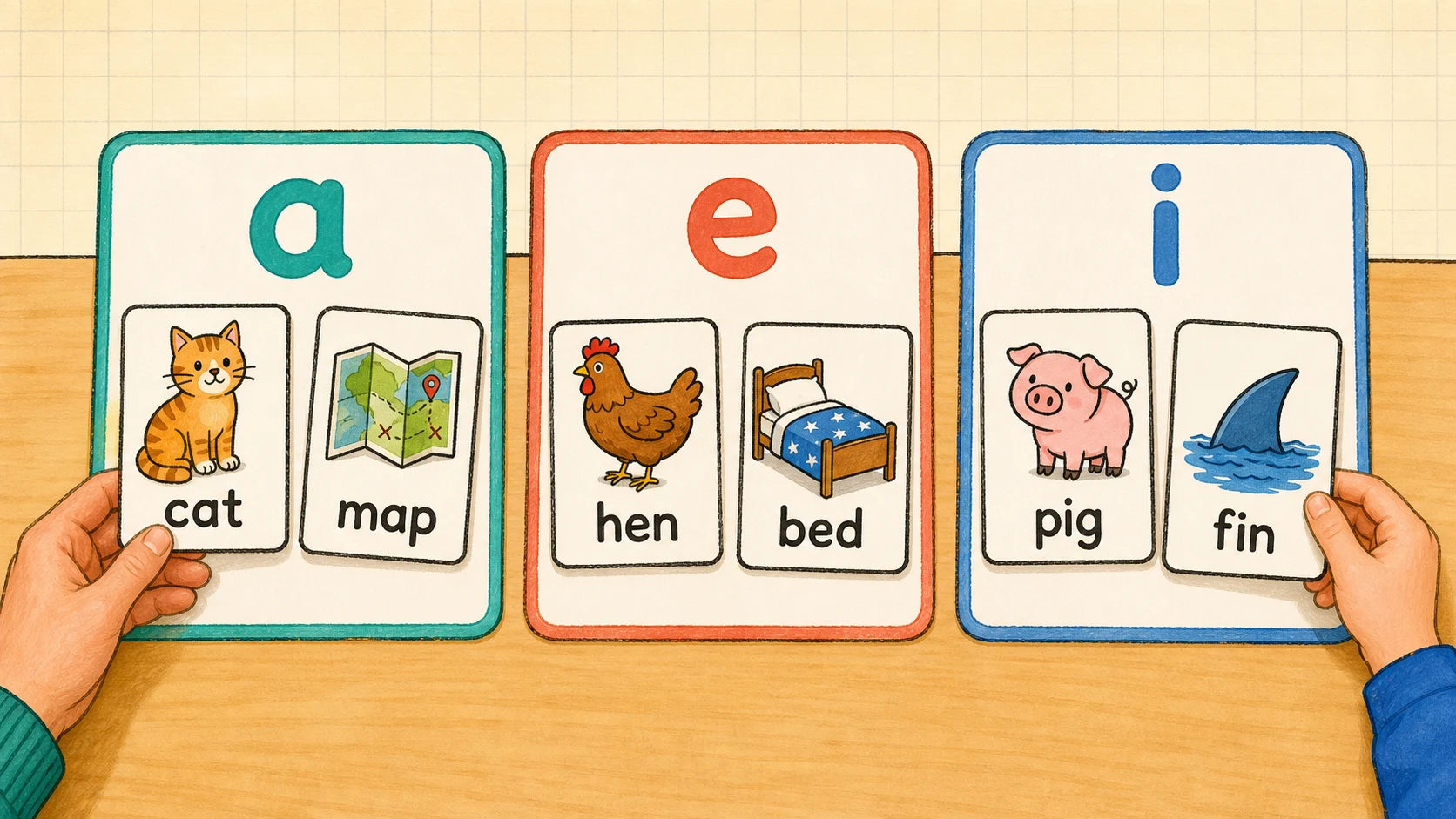
A stable routine reduces task confusion while the word choices provide the new challenge.
1. Review the anchor
Show one vowel card and its anchor picture. Say the sound together two or three times. Ask the learner to produce it once without the adult.
2. Listen before looking
Say three or four words. The learner makes the anchor motion whenever the target sound is heard. For short a, a set might be map, sun, cat, sit. Confirm each response by segmenting the word.
3. Build one word
Use counters or letter tiles to build a target CVC word. Ask, “What sound is in the middle?” If needed, stretch the word without adding an extra sound to the consonants.
4. Read or sort a small set
Use three to six familiar items. At first, keep one target vowel against clearly different nonexamples. Later, compare two learned vowels.
5. Encode one word
Dictate a word the learner has already heard during the lesson. Let the learner build it with letters before writing it. Writing the word connects spoken segmentation with print.
The broader IES writing practice guide supports high-level attention to teaching writing processes and foundational writing skills. Here, writing one dictated CVC word is a modest instructional application. The source does not recommend this exact routine or evaluate these materials.
6. End with an observable check
Present one new item without the anchor picture. Record whether the response was:
- Independent and correct
- Correct after a sound or picture cue
- Incorrect but corrected after segmentation
- Still uncertain after support
That record is more useful for pacing than a general impression that the lesson “went well.”
Choosing Practice That Matches the Learner
The appropriate task depends on what the learner can do today.
| Observed performance |
Choose next |
Avoid for now |
| Cannot reliably hear the target vowel |
Oral listening with clear examples and nonexamples |
Independent mixed-vowel reading |
| Hears the sound but forgets the letter |
Anchor pictures, vowel cards, and matching |
Long written sets |
| Identifies one vowel consistently |
Picture sorts and middle-letter completion |
Mixing all five immediately |
| Confuses two known vowels |
Two-category contrasts and minimal pairs |
Adding another vowel |
| Reads familiar CVC words |
New regular CVC words with known consonants |
Irregular words as test items |
| Reads but cannot spell |
Tile building and one-word dictation |
Copying as the main evidence |
| Completes supported items accurately |
Short independent mixed review |
Removing all review permanently |
The Pre-K phonics collection provides practice across foundational phonics skills. For focused work, the Short Vowels topic guide keeps the selection centered on this sound-letter relationship.
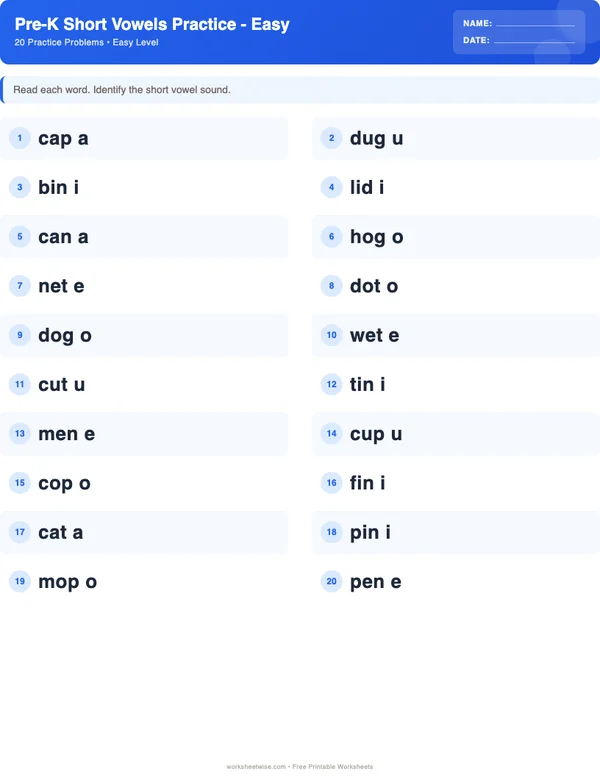
The available easy worksheet contains 20 exercises in which learners read a word and identify its short-vowel sound. It covers short-vowel sounds, phonics, CVC patterns, and decoding, with a separate answer key. Because the printed direction says “Read each word,” an adult should provide oral support if independent word reading is not yet secure. Twenty items can also be divided across sessions.
Differentiation Without Changing the Learning Target
When the learner needs more support
Reduce the number of choices. Compare a with one clearly different vowel rather than displaying all five. Say the picture name, stretch the word, and let the learner move a letter tile instead of writing.
Use consistent anchors and known consonants. If map is difficult because m is unfamiliar, supply the first sound and preserve attention for the middle vowel.
When attention or motor demands interfere
Cover all but one row of a worksheet. Offer a pointing or circling response. Complete a few items, pause for movement, and return only if attention is restored.
These adaptations change how the learner responds, not which vowel must be identified.
When the learner is ready for more challenge
Mix two or more learned vowels, remove anchor pictures, and use unfamiliar but regular CVC words made from known consonants. Ask for both decoding and encoding: read hot, then build sun from dictation.
Increase complexity only when accuracy remains stable. A faster page is not necessarily a better page if the learner has begun guessing.
Common Errors and Diagnostic Teaching Responses
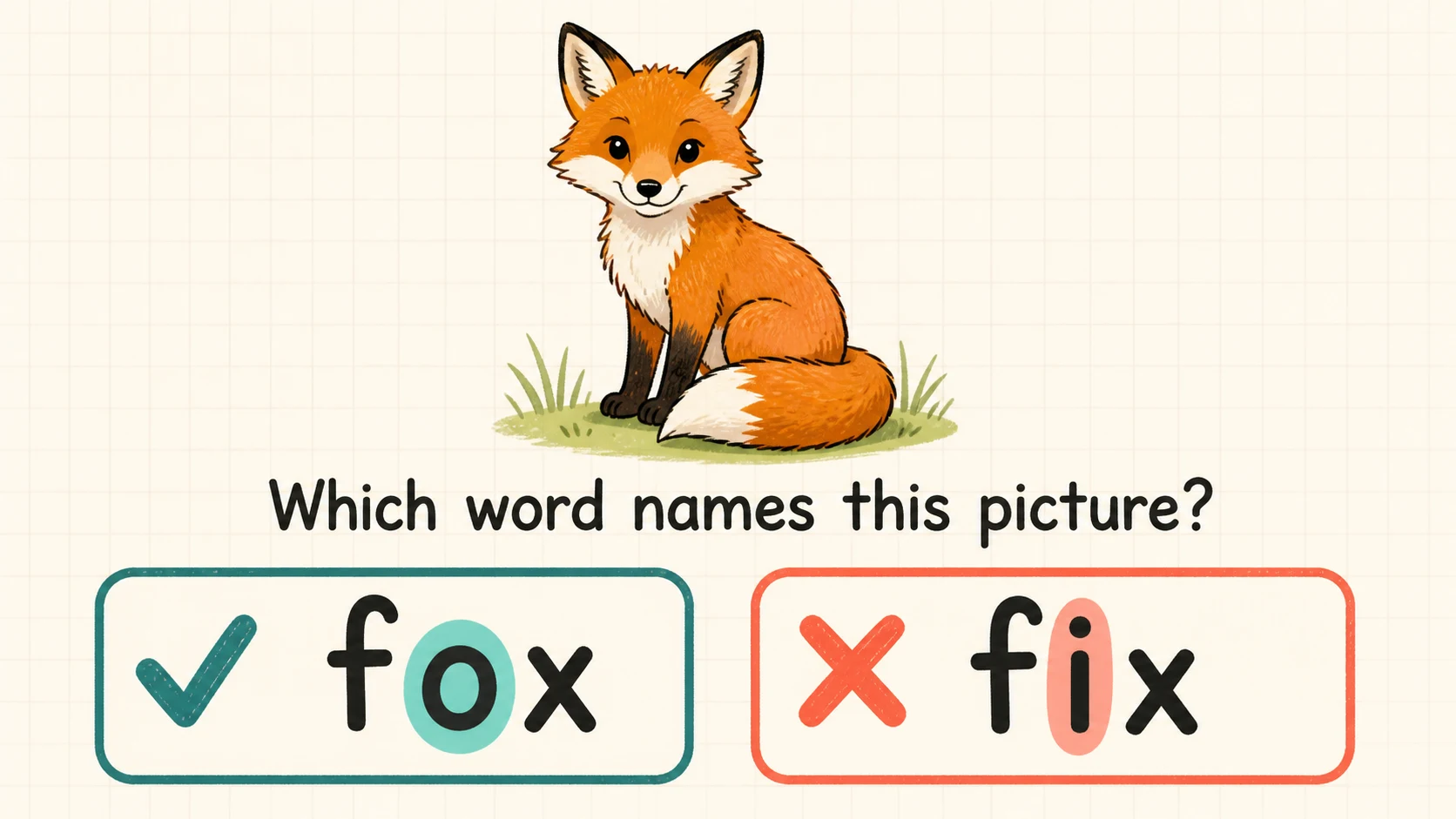
The response should address the likely source of an error rather than simply repeat the item.
| Observed error |
What it may show |
Immediate teaching response |
| Chooses the first letter instead of the vowel |
The learner is attending to initial sounds |
Use three sound boxes and point specifically to the middle box |
| Gives a letter name |
Letter-name knowledge is replacing the target sound |
Contrast “letter name” with “sound in apple” |
| Sorts by picture meaning or appearance |
The learner has not focused on sound |
Name both pictures and segment each word aloud |
| Confuses e and i |
The middle sounds are not yet distinct |
Compare pen/pin, set/sit, or bed/bid; watch the adult’s mouth |
| Confuses o and u |
The vowel contrast needs clearer listening practice |
Return to one vowel, then contrast a small set such as hot/sun |
| Reads from the first consonant and guesses |
Full blending is not secure |
Point under each letter and blend all three sounds |
| Copies the prior answer repeatedly |
Item order is cueing the response |
Shuffle cards and ask the learner to explain the middle sound |
| Identifies vowels orally but misses written items |
Letter matching, directions, or motor demands may interfere |
Use movable letters and have the learner point before writing |
| Reads accurately but misspells in dictation |
Encoding needs separate practice |
Segment into three boxes, then choose one letter per sound |
Treat these as hypotheses to test, not diagnoses. For example, an incorrect e/i answer could reflect unclear pronunciation, inattention, unknown vocabulary, or a genuine sound contrast difficulty. Recheck orally with familiar words before changing the teaching plan.
Monitoring Progress and Deciding When to Move On
Monitor a small, changing sample rather than repeatedly rehearsing the same cards. Include:
- Familiar words from instruction
- One or two new regular CVC words
- Oral identification without print
- Letter selection after hearing a word
- At least one reading or spelling response when appropriate
Track independence as well as correctness. A learner who answers four items correctly after an anchor cue is at a different stage from one who answers the same four items independently.
A simple record can use four columns:
| Date |
Vowels compared |
Independent evidence |
Next adjustment |
| Day 3 |
a only |
Heard a in 4 of 5 familiar words |
Add two new a words |
| Day 6 |
a/i |
Sorted 6 of 8 without cues |
Repeat contrast before adding o |
| Day 10 |
o/u |
Needed anchor for 3 of 6 |
Return to separate practice |
Move forward when the learner handles a small set accurately across more than one activity and with reduced prompting. Return to narrower practice when mixed work causes guessing. No single percentage, session count, or calendar date is universal.
A Flexible Two-Week Practice Plan
This plan follows the catalogue sequence but should bend around the learner’s observed work. Each day can use the short lesson routine. Review earlier vowels even after a new one is introduced.
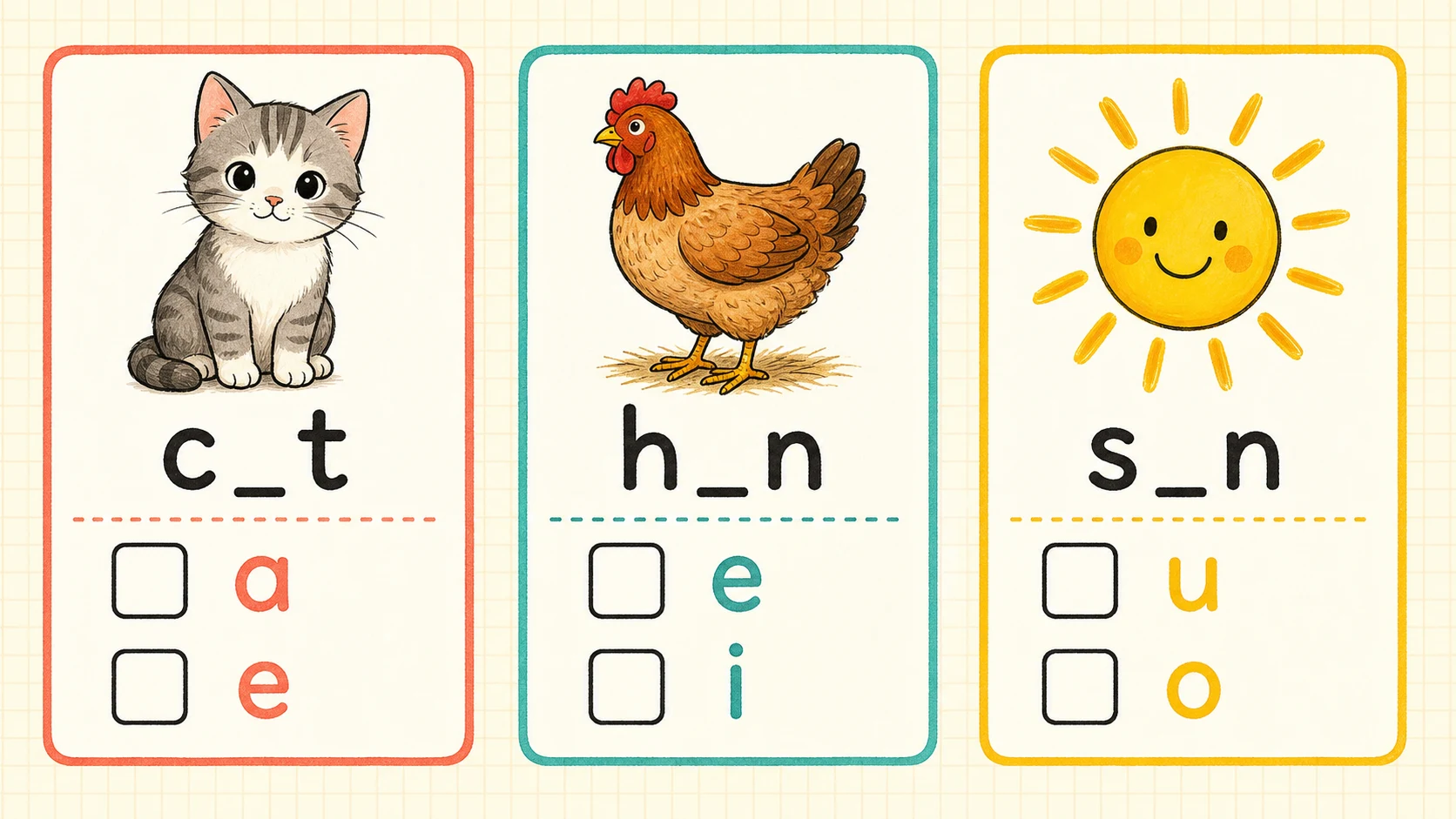
The plan alternates focused instruction, comparison, application, and review.
| Day |
Focus |
Suggested activity |
Decision point |
| 1 |
Short a |
Apple anchor; hear a in spoken words |
Can the learner signal the sound? |
| 2 |
Short a |
Sort pictures; build map and cat |
Is the sort based on sound? |
| 3 |
Short i |
Itch anchor; listen and build sit |
Can the learner connect /i/ to i? |
| 4 |
a/i contrast |
Sort map/sit, cat/pin |
If guessing begins, separate the vowels |
| 5 |
Review |
Read or complete a few a/i CVC words |
Keep support if blending is effortful |
| 6 |
Short o |
Octopus anchor; build hot |
Check the middle sound orally |
| 7 |
a/i/o |
Three-way picture or word sort |
Reduce to two choices if needed |
| 8 |
Short u |
Umbrella anchor; build cup and sun |
Compare o/u only if each is secure alone |
| 9 |
o/u contrast |
Sort hot/sun and other clear examples |
Recheck pronunciation and vocabulary |
| 10 |
Short e |
Egg anchor; build pen |
Keep i out initially if e is new |
| 11 |
e/i contrast |
Use pen/pin, set/sit, bed/bid |
Watch and listen to the mouth contrast |
| 12 |
Mixed listening |
Identify the vowel in spoken CVC words |
Note which contrasts still need cues |
| 13 |
Reading and dictation |
Read three words; build or write two |
Separate sound knowledge from handwriting |
| 14 |
Review and next choice |
Use a short mixed set with one new example |
Continue, narrow, or extend from evidence |
If the learner needs four days on short a, take four days. If o/u remains uncertain, delay e. The plan is a practical organizing tool, not a promise that all five sounds will become secure within two weeks.
Honest Next Step
Short-vowel learning is not complete when a learner finishes a page. Look for the ability to hear the medial sound, connect it to a vowel letter, blend a regular CVC word, and sometimes build or spell that word with decreasing support. Continue reviewing short vowels when later work introduces blends, digraphs, long vowels, or more complex words.
For the next session, choose five oral examples and then try a small portion of the free easy Pre-K short-vowels worksheet. Read the directions and words aloud if needed. Record which answers are independent, which require a cue, and which vowel contrast causes uncertainty. Use that evidence—not the page count—to choose the following lesson.