What Pre-K Counting Means
Pre-K Counting is the developing ability to say number words in order, match one number word to each object, and understand that the final number tells how many objects are in the group. A learner may be able to recite “one, two, three, four, five” without yet being able to count five objects accurately. Instruction should therefore connect spoken numbers, physical objects, pictures, written numerals, and quantities.
For most early practice, begin with quantities from 1 through 5, extend to 10 when the learner is accurate, and then work gradually toward 20 with concrete objects. Number recognition from 1 through 10 remains an important part of the Pre-K level. The learner’s observed work—not age alone and not a fixed calendar—should determine the pace.
Grade labels describe the intended practice level; local school, district, state, and homeschool sequences differ. The kindergarten counting expectations in the Common Core State Standards for Mathematics can help adults see where early counting eventually leads, but they should not be treated as a claim that every Pre-K learner must already meet kindergarten expectations.
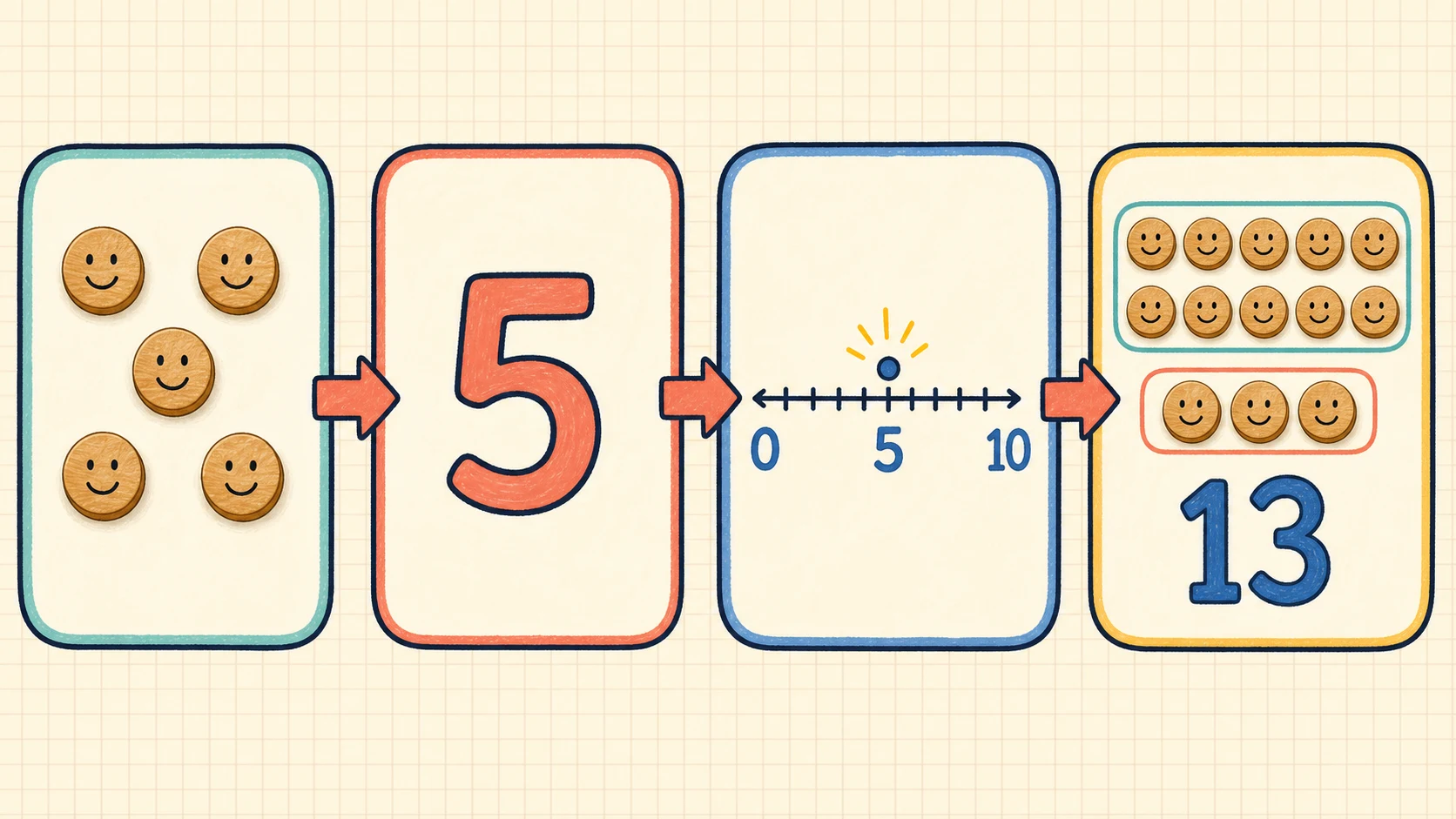
Counting develops through connected skills: number-word order, one-to-one matching, quantity, numeral recognition, and comparison.
The Pre-K math collection can provide written practice, but counting should not begin or end on paper. Young learners need frequent opportunities to touch, move, arrange, and recount real objects.
Prerequisites to Check Before Formal Practice
Counting lessons are more productive when the learner can participate in a short shared task. These are practical readiness signs, not entrance requirements:
- Attends to a small collection for a brief period.
- Follows a simple direction such as “Put one bear in each box.”
- Moves or points to objects deliberately.
- Notices whether two small groups look different.
- Attempts some number words, even if the sequence is incomplete.
- Recognizes that a written numeral is a symbol, although the learner may not know its name yet.
Fine-motor demands should not obscure mathematical understanding. A child who can count six counters but cannot write the numeral 6 has shown counting knowledge and a separate writing need. Allow pointing, speaking, selecting a numeral card, placing a sticker, or using a stamp when handwriting would interfere.
A quick readiness check
Place three familiar objects in a row and ask, “How many are here?” Watch before helping.
- If the learner says “three” immediately, ask for a count to confirm the quantity.
- If the learner touches each object once while saying “one, two, three,” the essential coordination is present.
- If the learner recites several numbers without matching them to objects, work on one-to-one correspondence.
- If the learner counts correctly but gives a different total afterward, work on the meaning of the final number.
- If the learner does not begin, model the action with two objects and invite imitation.
This check is instructional, not diagnostic or medical. It identifies a useful starting point for the next lesson.
A Grade-Appropriate Counting Progression
The progression below is a teaching sequence, not a universal timetable. A learner may be strong in one column and need support in another. For example, someone may recognize the numeral 8 but double-count objects in a scattered set.
| Stage |
Learner action |
Helpful model |
Evidence to look for |
| Join in with number words |
Says a short count sequence with an adult |
Song, movement, or spoken rhythm |
Number words become more stable |
| Count 1–3 objects |
Touches or moves each object once |
Large toys or counters in a row |
One word is matched to one object |
| Count 1–5 objects |
Counts arranged and rearranged sets |
Five-frame, cups, or small mats |
The same set retains its total |
| Match quantities to numerals |
Chooses the numeral for a counted set |
Numeral cards 1–5, then 1–10 |
Spoken total and written symbol connect |
| Count through 10 |
Counts rows, circles, and small scattered sets |
Ten-frame, cubes, buttons |
Accuracy continues across arrangements |
| Compare small groups |
Identifies which group has more or less |
Matched rows or paired objects |
Comparison is based on quantity |
| Extend toward 20 |
Counts larger collections by moving objects |
Two ten-frames or counting tray |
Objects are organized to prevent repeats |
| Explore sequences |
Supplies a missing number or continues a sequence |
Number line or numeral cards |
Number order is used without objects |
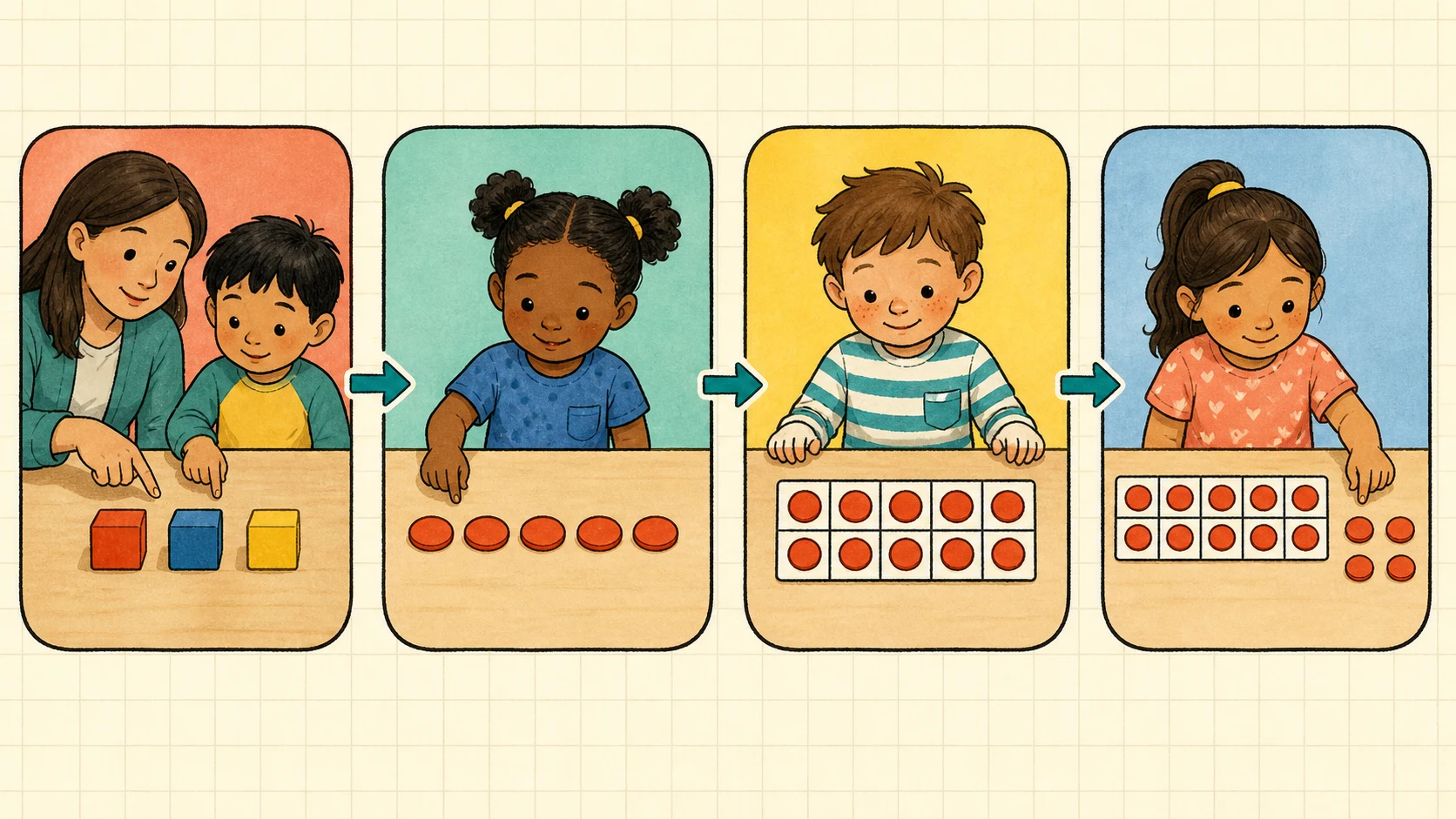
Move forward when accuracy is steady across more than one arrangement, and return to a concrete model when errors reappear.
The catalogue’s Pre-K scope includes recognizing numbers 1 through 10, counting with one-to-one correspondence, comparing small groups, and beginning to count toward 20 with concrete objects. Skip counting and backward counting appear in the broader counting topic and worksheet catalogue, but they should not displace accurate counting by ones. If a learner is not yet reliably counting objects, prioritize that foundation.
Concrete and Visual Models That Make Quantity Visible
The IES guide on teaching mathematics to young children supports high-level use of developmental progressions, monitoring, and instruction that helps children see and describe mathematical ideas. In practice, an adult can apply that framing by moving from objects to pictures and then to numerals while listening closely to the learner’s explanations.
Movable objects
Use linking cubes, buttons, blocks, toy animals, bottle caps, or other safe objects. Movable objects make each count visible: the learner can slide one item into a “counted” area for every number word.
For a set of seven buttons:
- Place all seven on the left side of a mat.
- Move one button to the right while saying “one.”
- Continue until every button has moved.
- Ask, “How many buttons did you count?”
- Let the learner point to or select the numeral 7.
Use objects appropriate to the setting and supervise small items as needed.
Rows, frames, and counting mats
A straight row reduces the chance of skipping or recounting. A five-frame or ten-frame makes empty and filled spaces visible. These arrangements are useful supports, but the learner should also encounter circles and scattered sets. Otherwise, success may depend on following a memorized path rather than tracking individual objects.
A simple two-column counting mat labeled “not counted” and “counted” is especially useful with collections above five.
Pictures and marks
Once real-object counting is accurate, use pictures that cannot be moved. Teach a tracking action:
- Point to each picture.
- Make a small mark beside it, if the page permits.
- Follow a consistent path from left to right or around the outside.
- Pause and check that every picture received one number word.
Pictures add a memory demand because counted objects remain in place. A learner who succeeds with counters but not pictures may need a stronger tracking strategy rather than easier quantities.
Numerals and number lines
A numeral names a quantity; it is not the quantity itself. After counting four cubes, place the cubes beside a card showing 4. A number line can support spoken order and missing-number work, but it should not replace object counting. Pointing along a number line shows sequence knowledge. Counting a collection shows whether number words are coordinated with objects.
Fully Checked Worked Examples
Worked example 1: Count a row of objects
Problem: Count the stars.
★ ★ ★ ★ ★
Method:
- Point to the first star and say “one.”
- Move right, giving each star exactly one number word: “two, three, four, five.”
- The final number spoken is five.
Answer: 5 stars.
Check: Match each star to one finger:
- Star 1 → one
- Star 2 → two
- Star 3 → three
- Star 4 → four
- Star 5 → five
There are five stars and five count actions, so the answer is confirmed.
Worked example 2: Count a scattered collection
Problem: Count these dots.
●       ●
    ●
●       ●     ●
Method: Scattered objects require a tracking plan. Begin at the top left, move across each row, and point once to each dot.
- Top row: 2 dots
- Middle row: 1 dot
- Bottom row: 3 dots
Continue the number sequence across the rows: 1, 2, 3, 4, 5, 6.
Answer: 6 dots.
Check: Rearrange six counters into a straight row and recount them. The arrangement changes, but the quantity remains six.
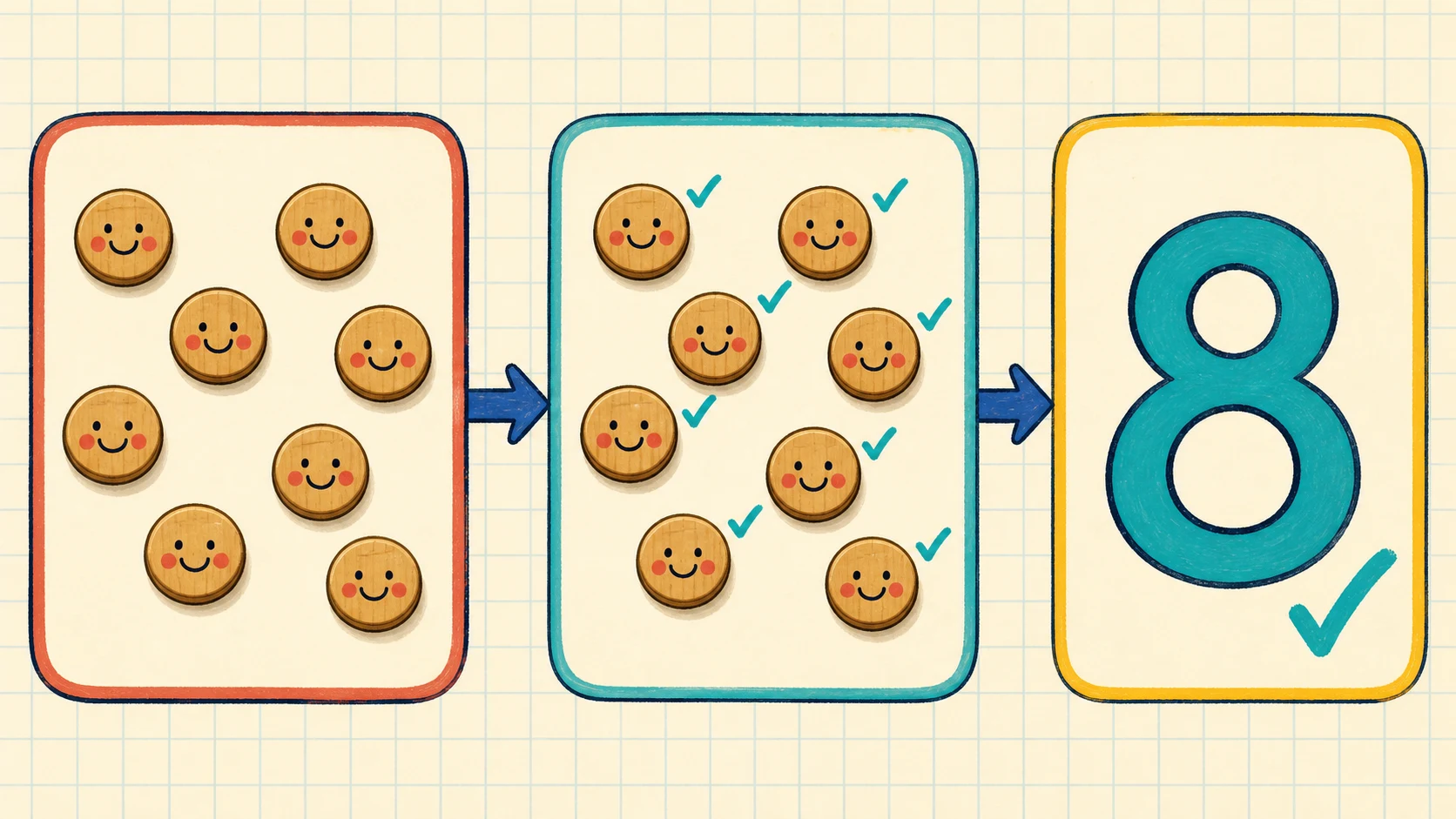
Moving, organizing, and recounting objects makes the connection between the count process and the total explicit.
Worked example 3: Match a quantity to a numeral
Problem: Which numeral matches this collection?
🍎 🍎 🍎 🍎
Choices: 3, 4, 5
Method: Touch each apple once and count: “one, two, three, four.” The final number is four. Select the numeral that names four objects.
Answer: 4.
Check: Place four counters under the numeral 4. Pair one counter with each counted apple. Both groups contain four objects.
A learner who counts four but selects 5 may understand the quantity while still confusing numeral shapes. Continue quantity work and teach the numeral distinction separately.
Worked example 4: Find a missing number
Problem: Complete the sequence.
2, 3, __, 5
Method: Say the sequence slowly: “two, three, four, five.” The number after 3 and before 5 is 4.
Answer: 4.
Check: Arrange numeral cards 2, 3, 4, and 5 in order. Remove 4 and observe the same gap.
This task measures number order more than object counting. If it is difficult, return to a short number line or place groups of two, three, four, and five objects beneath the numeral cards.
Worked example 5: Compare two small groups
Problem: Which group has more?
- Group A: ● ● ●
- Group B: ■ ■ ■ ■
Method: Count each group.
- Group A has 3.
- Group B has 4.
Because 4 is one more than 3, Group B has more.
Answer: Group B.
Check: Pair one dot with one square. Three pairs can be made, with one square left over. The unmatched square confirms that Group B has more.
Boundary cases that reveal understanding
A collection of zero objects is different from a collection of one object. If an empty plate is shown, say, “There are no counters on the plate.” Numeral 0 may be introduced as the symbol for that amount, but it need not become the focus before quantities 1–5 are stable.
A group of one needs only one count action. Learners sometimes continue reciting after the object is counted; stop when there are no uncounted objects.
Two groups can have the same quantity in different arrangements. Five counters spread widely still equal five counters packed closely together. Recount both groups and pair the objects to test the conclusion.
A Short, Repeatable Lesson Routine
A compact routine can be repeated with new quantities and arrangements. Ten to fifteen minutes is a practical instructional suggestion, not a universal requirement. Stop earlier if attention or accuracy declines.
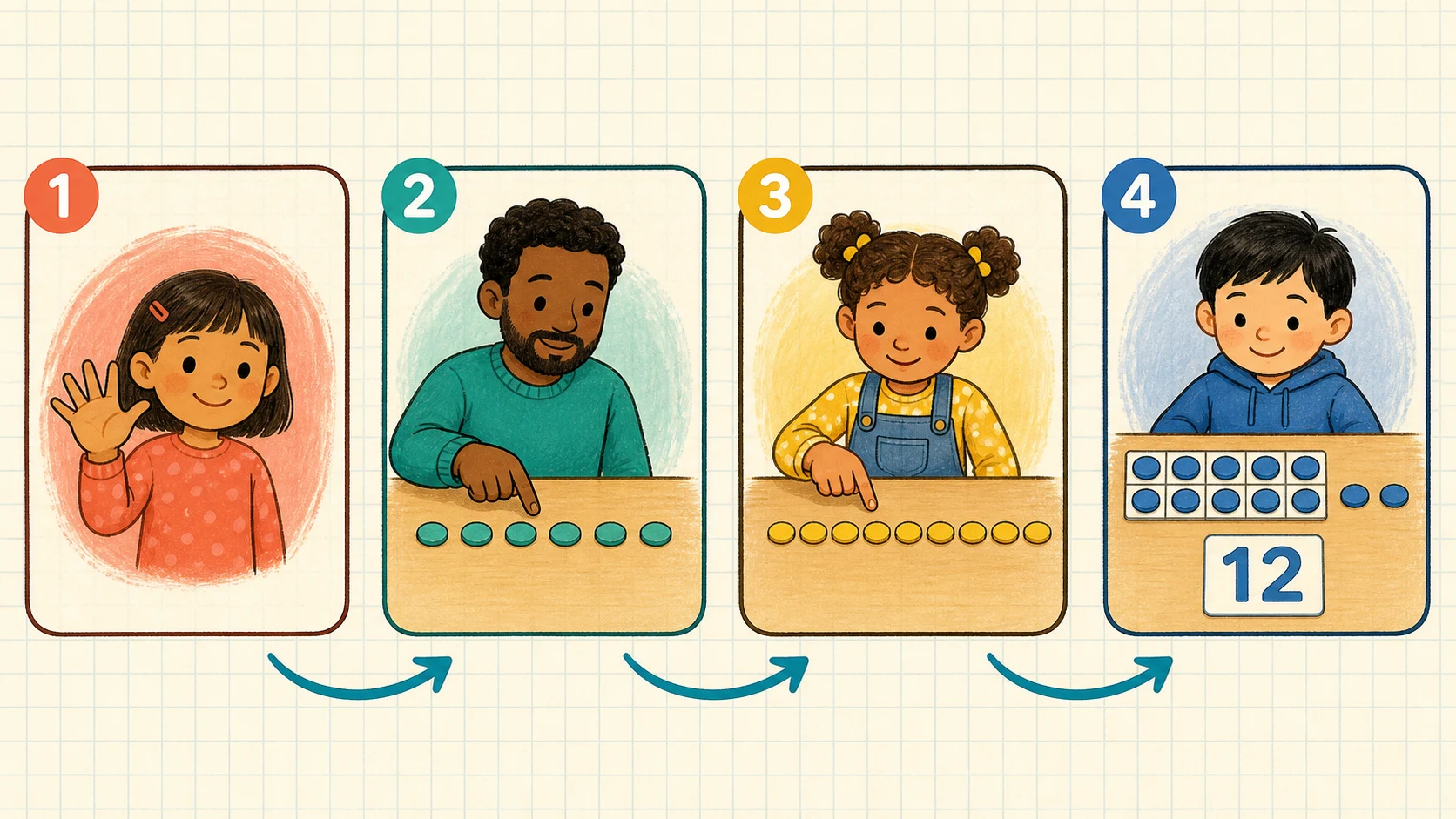
Use the same lesson structure while changing quantities, objects, and the amount of support.
1. Warm up with number words
Recite a short sequence together while tapping the table or taking steps. Keep the sequence within the learner’s current accurate range. If 1–8 is stable but 9–12 is not, practice around that transition without turning the activity into a speed test.
2. Model one target
Choose one clear goal, such as counting six objects. Model touching or moving one object per number word. Think aloud briefly: “I moved this one, so I will not count it again.”
3. Practice together
Reset the collection. Let the learner count while the adult points, or let the adult say number words while the learner moves objects. Then combine both actions.
4. Try independently
Present a similar collection without immediate prompting. Ask, “How many?” Wait long enough for the learner to choose a method. Record what happens rather than correcting every movement mid-count.
5. Check and explain
Ask the learner to recount, pair objects, or arrange them into a row. Finish with a short statement: “You counted seven objects, and the last number told the total.”
Choosing Effective Practice
Practice should match the specific error or next step. More questions at the wrong level can strengthen an unhelpful habit.
| Observed performance |
Choose next |
Avoid for now |
| Number words are unstable before 5 |
Songs, movement, and numeral cards 1–5 |
Long missing-number sequences |
| Objects are skipped or counted twice |
Movable objects and a two-area mat |
Dense picture pages |
| Counting is accurate to 5 |
Sets of 6–8 in rows and simple frames |
Immediate jumps to 20 |
| Rows are accurate but scattered sets are not |
Small scattered collections with marking |
Larger scattered groups |
| Quantity is correct but numeral choice is wrong |
Matching games with two or three numeral choices |
Treating the error as a counting failure |
| Counts to 10 accurately in several layouts |
Concrete collections from 11 toward 20 |
Removing all visual support at once |
| Regular counting is secure and sequence interest is evident |
Simple missing numbers or movement-based skip-count exposure |
Making skip counting the main foundation |
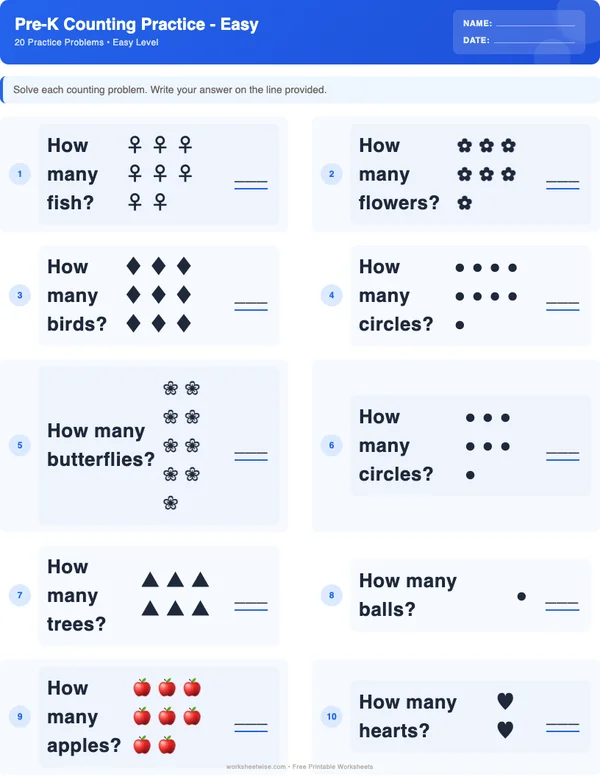
The easy Pre-K counting worksheet contains 20 exercises and covers counting, number sequences, skip counting, and number recognition. Preview the task types and select only those that fit the learner’s current evidence. It is reasonable to complete part of a worksheet, use counters over printed pictures, or postpone a skip-counting item while counting by ones is still developing. The separate answer key helps an adult check responses, but it cannot show how the learner counted.
For broader repetition, the Pre-K Counting Worksheet Pack contains 18 worksheets. A larger pack is useful only when its pages are selected deliberately; volume is not a substitute for observing strategy. The free worksheet generators may also help create fresh practice after the adult has identified an appropriate quantity range.
Differentiation Without Changing the Core Idea
When the learner needs more support
Reduce the quantity, not the clarity of the goal. Use three objects instead of eight, arrange them in a row, and provide a “counted” space. Model once, then let the learner repeat. Use large objects if pointing accurately is difficult.
Offer limited numeral choices. After counting five objects, ask the learner to choose between 5 and 7 rather than searching through ten cards. Gradually add choices as recognition improves.
Separate language from counting when needed. The learner can move an object for each number word spoken by the adult, then reverse roles. This helps reveal whether difficulty lies in coordinating actions, remembering the sequence, or both.
When the learner is ready for more challenge
Change one feature at a time:
- Keep the quantity the same but scatter the objects.
- Count the same collection from a different starting point.
- Ask for a requested quantity: “Give me nine cubes.”
- Hide the numeral choices until after counting.
- Present two groups and ask which has more or less.
- Begin from a given number in a short spoken sequence.
- Extend concrete counting from 10 toward 20.
Do not assume that fast recitation means the learner is ready for larger sets. Check one-to-one matching and the meaning of the final number first.
The IES guide for assisting students who struggle with mathematics offers high-level framing around systematic instruction, mathematical language, representations, and monitoring progress. For Pre-K support, that can translate into small steps, explicit modeling, clear vocabulary, and frequent checks of actual learner work. It does not prescribe one identical lesson length or schedule for every child.
Common Errors and Diagnostic Teaching Responses
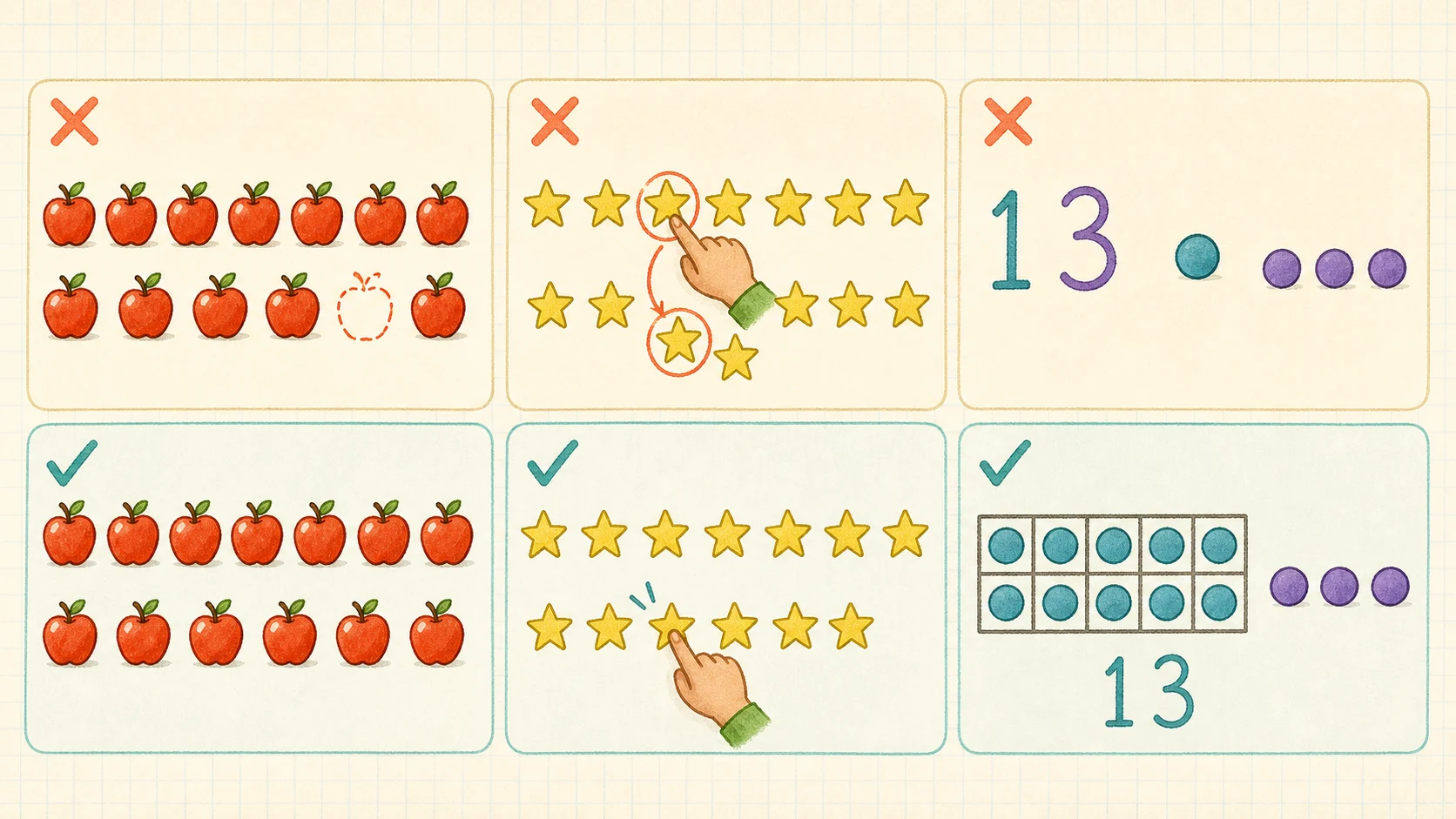
Treat an error as evidence about the counting process, then choose a response aimed at that process.
Skipping an object
What it looks like: The learner counts six objects as five because one object receives no number word.
Likely instructional need: A consistent tracking path.
Response: Arrange objects in a row. Have the learner slide each object across a line while counting. Return to a scattered set only after the movement pattern is reliable.
Counting one object twice
What it looks like: The learner points back to an already counted object.
Likely instructional need: A visible distinction between counted and uncounted items.
Response: Move counted objects into a bowl or onto the other side of a mat. With pictures, place a removable token on each image already counted.
Saying the sequence correctly but mismatching actions
What it looks like: The learner says “one, two, three, four” while touching only three objects.
Likely instructional need: Slower coordination between word and movement.
Response: Use a deliberate rhythm. One tap, one word; one move, one word. Speed is not the goal.
Recounting correctly but giving the wrong total
What it looks like: The learner counts to seven, then answers “six.”
Likely instructional need: Understanding that the final number represents the whole set.
Response: After the last object, pause and say, “You said seven last, so there are seven altogether.” Ask the learner to repeat the total without recounting.
Believing a spread-out group has more
What it looks like: Two groups each contain five, but the longer row is called “more.”
Likely instructional need: Attention to quantity rather than occupied space.
Response: Count both groups, then pair the objects one to one. Rearrange one group and recount it.
Confusing a numeral with a quantity
What it looks like: The learner counts eight objects correctly but selects numeral 6.
Likely instructional need: Numeral recognition, not necessarily counting remediation.
Response: Keep the set visible, name the total, and compare two numeral cards. Trace or build the correct numeral separately.
Losing the teen-number sequence
What it looks like: The learner counts “twelve, thirteen, fifteen.”
Likely instructional need: More practice with the spoken order of 11–19.
Response: Use a number line, short repeated sequences, and concrete groups. Avoid advancing merely because the learner can recite beyond 20 with gaps.
Monitoring Progress and Deciding When to Advance
Monitor performance across several brief opportunities rather than relying on one successful answer. Record the date, quantity, arrangement, support provided, spoken total, and any tracking error.
A simple note might read:
| Date |
Task |
Result |
Support |
Next step |
| Day 1 |
Count 5 objects in a row |
Accurate |
Adult pointed |
Learner points next |
| Day 3 |
Count 5 scattered objects |
Counted one twice |
Verbal reminder |
Use counting mat |
| Day 5 |
Match 5 objects to numeral |
Accurate |
Choice of 3 cards |
Add one more choice |
Consider increasing difficulty when the learner:
- Uses the number-word sequence accurately within the practiced range.
- Assigns one number word to each object.
- States the final number as the total.
- Succeeds with more than one arrangement.
- Recounts to check without changing the total.
- Needs little or no prompting.
If performance becomes inconsistent, reduce only one source of difficulty. Move from eight objects to six, scattered objects to a row, or pictures to movable counters. This preserves useful information about what caused the error.
Monitoring does not require grades or timed tests. The purpose is to decide what to teach next.
A Two-Week Practice Plan
This plan uses ten short sessions across two weeks. Adjust, repeat, or pause according to observed work. It is an instructional example, not a required timetable.
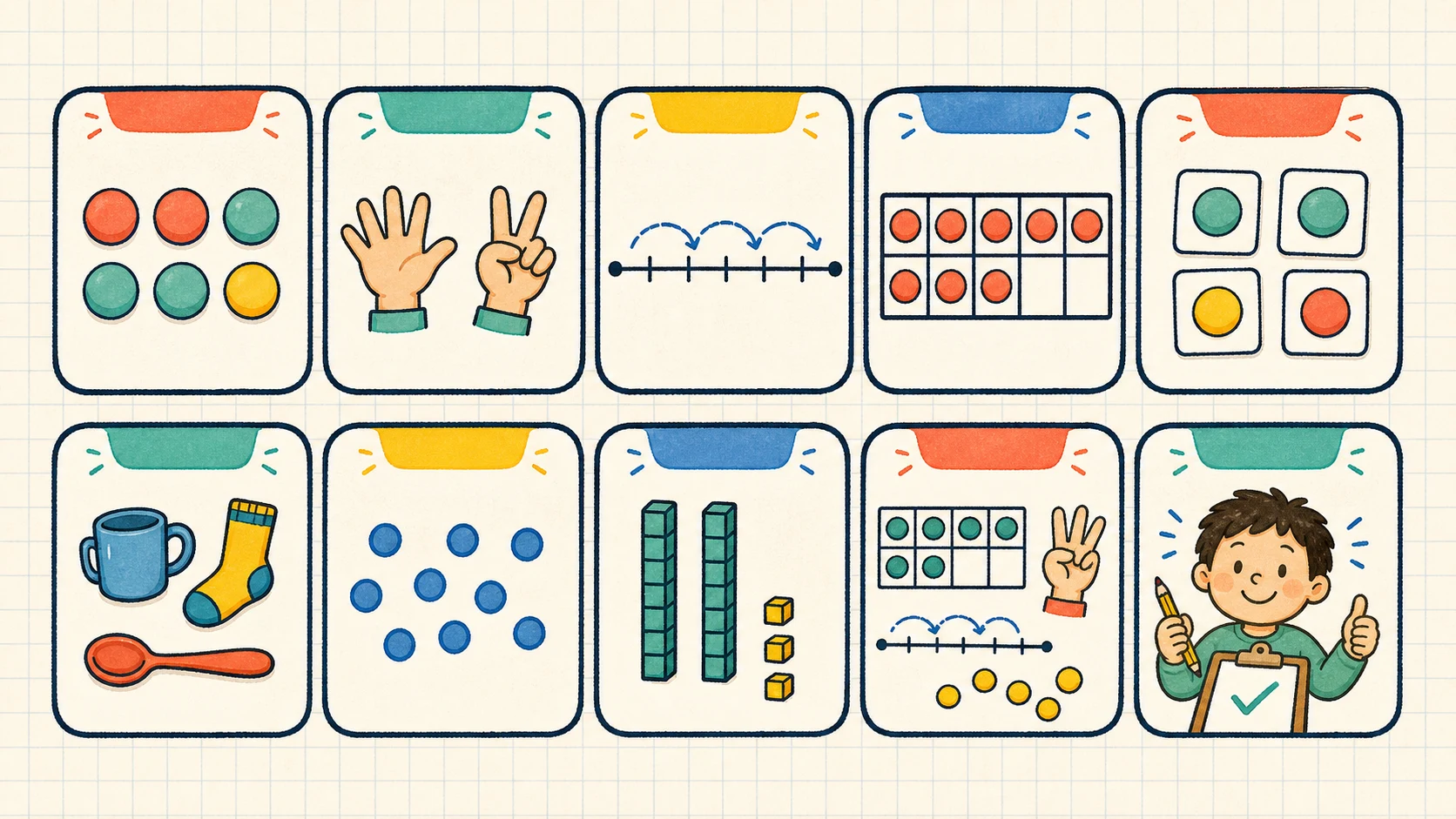
Alternate new work with review so that progress is checked across objects, pictures, numerals, and arrangements.
| Day |
Focus |
Activity |
What to observe |
| 1 |
Establish a starting point |
Count rows of 1–5 objects |
Number order and one-to-one matching |
| 2 |
Move while counting |
Transfer objects between two spaces |
Whether counted objects stay separate |
| 3 |
Connect total to numeral |
Count 1–5 objects and select a card |
Quantity–symbol connection |
| 4 |
Change arrangement |
Count the same set in a row and a circle |
Whether the total remains stable |
| 5 |
Review |
Mix familiar tasks from Days 1–4 |
Which support is still needed |
| 6 |
Extend quantity |
Try sets of 6–8 if earlier work is accurate |
Whether coordination remains steady |
| 7 |
Count pictures |
Point to or mark arranged pictures |
Tracking without moving objects |
| 8 |
Count scattered sets |
Use a planned path with 4–8 pictures |
Skips, repeats, and self-correction |
| 9 |
Compare groups |
Count and pair two small collections |
Understanding of more, less, or same |
| 10 |
Independent check |
Complete selected worksheet items, then verify with objects |
Transfer to printed practice |
If Days 1–5 remain difficult, repeat them with new objects instead of moving to larger quantities. If the learner is already secure through 10, Days 6–10 can use concrete collections moving gradually toward 20, short missing-number sequences, and requests such as “Build a group of 12.”
Limits, Appropriate Expectations, and the Next Step
A worksheet response shows an answer, not the complete reasoning process. Correct answers may come from guessing, copying a visual pattern, or recounting carefully; incorrect answers may reflect tracking, numeral recognition, language, attention, or writing demands. Watch the method before deciding what the learner understands.
This guide does not establish certification, guarantee outcomes, provide medical guidance, or claim comprehensive alignment with every local standard. The cited authoritative sources support broad instructional framing, not an evaluation of WorksheetWise materials or this specific worksheet. Kindergarten standards describe later expectations and should be interpreted alongside local requirements and the learner’s present work.
The honest next step is to identify the learner’s current stable range with five to eight real objects. If one-to-one counting and the final total are secure, use selected problems from the free Pre-K Counting worksheet. If either skill is uncertain, stay with movable objects first and return to the worksheet when the learner can show—not merely recite—how many are in the set.