Subtraction teaches students to find differences, compare quantities, and understand the inverse relationship with addition. Instruction begins with taking away objects within 5 and 10, develops through subtraction within 20 using strategies like counting back and using related addition facts, and progresses to multi-digit subtraction with regrouping (borrowing). Students learn that subtraction answers three types of questions: take-away, comparison (how many more/fewer), and missing addend. These worksheets provide systematic practice across all subtraction concepts with visual models and word problems.
Represent and solve subtraction problems using objects, drawings, and equations; fluently subtract within 5 (K) and within 20 (1-2); subtract within 100 using strategies based on place value (1-2); fluently subtract within 1000 using strategies and algorithms (2-3); fluently subtract multi-digit whole numbers using the standard algorithm (4).
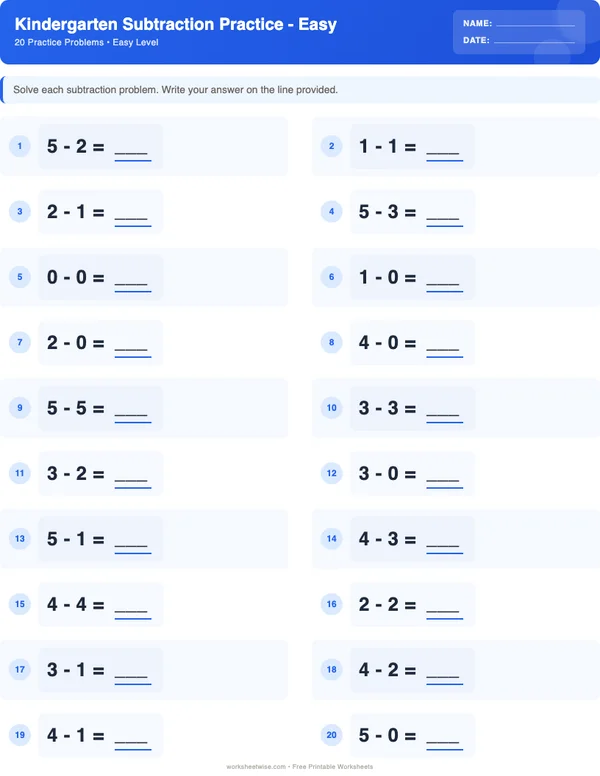
The Kindergarten Subtraction Worksheet Pack includes every current theme and all three difficulty levels—18 worksheets and 18 answer keys in one private ZIP.
How to teach and practise kindergarten subtraction
3,319 words Updated 6 instructional visuals
What Kindergarten Subtraction Means
Kindergarten subtraction is the study of taking apart quantities within 10. A learner should be able to represent a subtraction situation with objects or drawings, explain what changed, and connect the model to an equation such as 7−3=4. Work usually begins with small, visible quantities before moving toward pictures, number paths, and written equations.
Subtraction answers more than “How many are left?” It can describe three related situations:
Take away: Seven counters are present. Three are removed. How many remain?
Find the missing part: Seven counters belong in a set. Four are visible. How many are missing?
Compare: One group has seven counters and another has four. How many more are in the first group?
These situations can share the same equation, but they do not look or sound identical. Teaching each form helps the learner interpret subtraction rather than depend on a single clue word.
Subtraction develops through connected work with quantities, actions, pictures, language, and equations.
The Kindergarten label describes the intended practice level. Local curricula and teaching sequences differ. The catalogue places Kindergarten work within 10 and emphasizes objects, drawings, and equations. The Common Core State Standards for Mathematics also provide a broad reference point for representing and solving Kindergarten addition and subtraction situations. Neither a grade label nor one worksheet establishes a universal timetable for every learner.
Prerequisites to Check Before Teaching Subtraction
Subtraction becomes clearer when the learner can reliably work with small quantities. Before increasing written practice, observe whether the learner can do the following:
Count a group of up to 10 objects accurately.
Match one spoken number word to each object.
Understand that the last number counted names the total.
Recognize small quantities or count them without losing track.
Make a requested group, such as “Give me six counters.”
Tell whether two small groups are the same or different in size.
Join and separate objects without recounting objects that are no longer present.
Read numerals used in the current lesson.
Understand everyday action words such as take away, left, gone, more, and fewer.
A learner does not need perfect numeral writing before exploring subtraction with objects. If handwriting consumes most of the effort, let the learner say the answer, choose a numeral card, or have an adult record the equation. That is an instructional accommodation, not a claim that writing is unimportant.
A quick readiness check
Place five counters in a row and ask:
“How many are here?”
“Please take away two.”
“How many are left?”
“How do you know?”
Watch the actions, not only the final answer. A learner who removes two counters and counts the remaining three has demonstrated a usable starting strategy. A learner who counts all five again, includes removed counters, or guesses needs more work on coordinating the action with the quantity.
Use the learner’s observed work to determine pacing. Do not advance merely because a scheduled number of days has passed. Move forward when the learner can model and explain several examples with little prompting; step back when the representation is no longer meaningful.
Stage
Main representation
Appropriate task
Evidence to look for
1. Separate within 5
Real objects
Remove 1 or 2 from a small set
Removes the stated amount and counts what remains
2. Separate within 10
Objects and a mat
Act out equations such as 8−3
Keeps the starting set, removed part, and remainder distinct
3. Draw the action
Dots, circles, or simple pictures
Draw 7 and cross out 2
Crosses out exactly the amount removed
4. Connect models to symbols
Model beside an equation
Match 6−4 to a correct picture
Explains what 6, 4, and 2 represent
5. Explore missing parts
Ten-frame or two-part mat
“There are 8 spaces; 5 are filled”
Finds the unfilled or hidden part
6. Compare groups
Matched rows or paired objects
Compare 7 counters with 5
Identifies the unmatched amount as the difference
7. Use efficient reasoning
Fingers, number path, known facts
Solve familiar facts within 5 or 10
Chooses a sound method without needing every step supplied
8. Apply independently
Mixed equations and short stories
Select and solve an appropriate subtraction model
Represents, solves, and checks the result
Independence should follow successful modeling and explanation, not replace them.
The IES guide on teaching mathematics to young children offers high-level instructional guidance that includes building from children’s informal mathematical knowledge, using progressions, monitoring learning, and helping children describe mathematical ideas. It does not evaluate WorksheetWise materials or prescribe this exact sequence.
Concrete and Visual Models That Make Subtraction Visible
Different models highlight different meanings. Choose the model that matches the situation rather than rotating materials only for novelty.
Loose counters for taking away
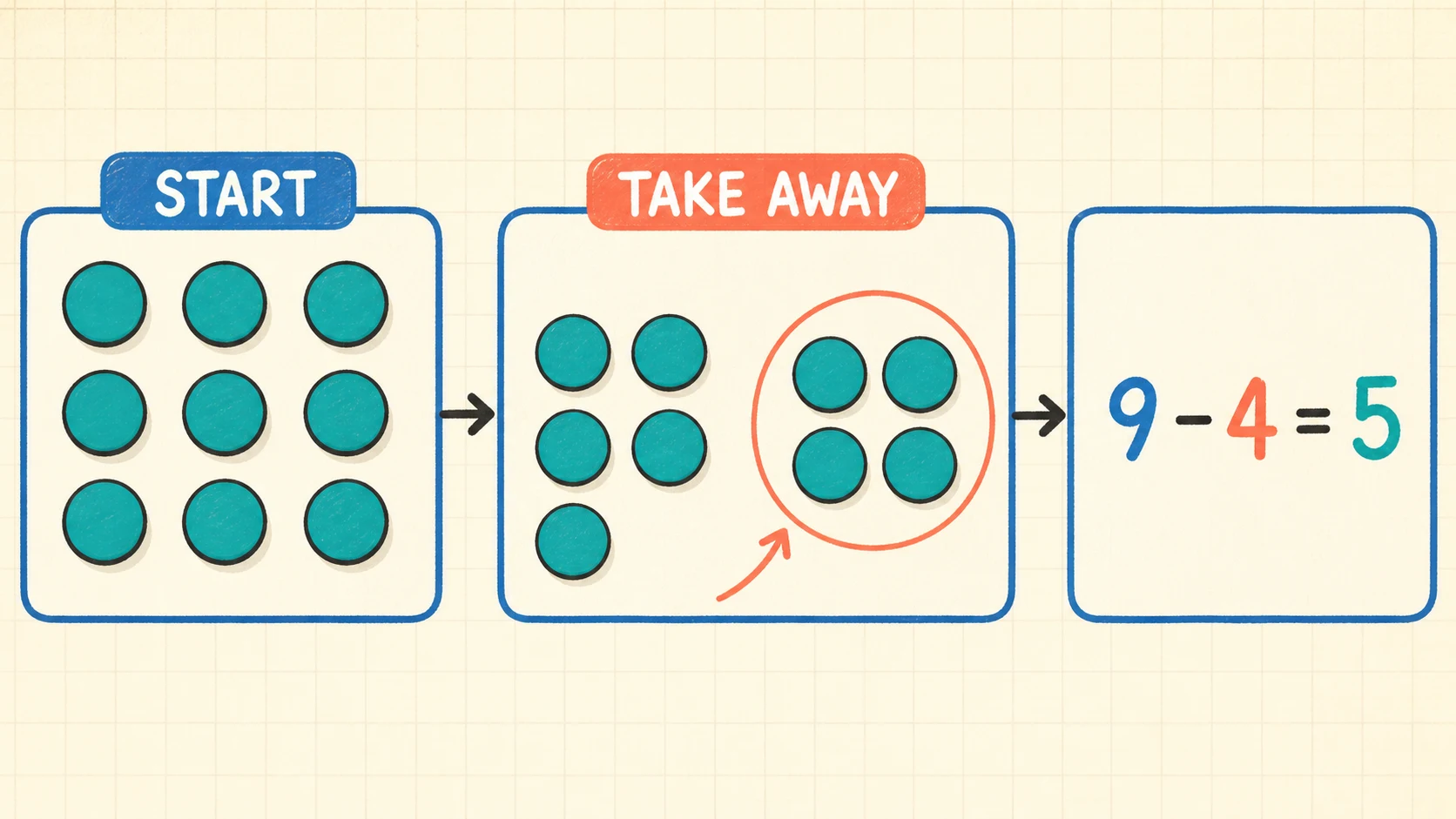
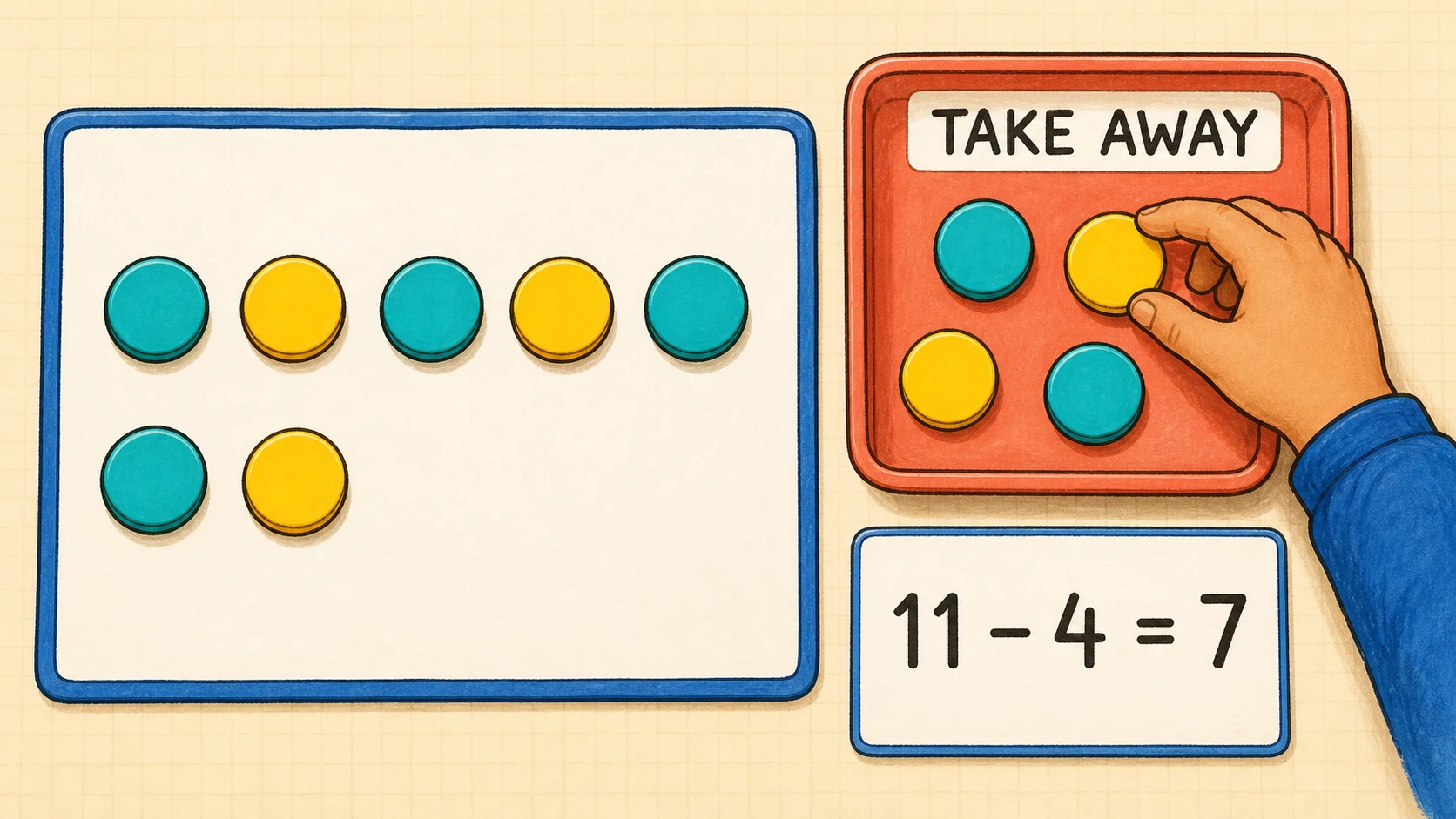
Start with a clearly defined set. Ask the learner to count it, move the amount being removed to a separate location, and then count what remains.
For 6−2:
Build six counters.
Slide two away.
Count the four remaining counters.
Say, “Six take away two equals four.”
Record 6−2=4.
Keep removed objects visible at first. Hiding them too soon may make it harder to see that the original six has been separated into two and four.
A two-part mat for decomposition
Draw one large box labeled “whole” and two smaller boxes labeled “parts.” Put seven counters in the whole. Separate them into five and two.
This arrangement supports all four related equations:
5+2=7,2+5=7,7−5=2,7−2=5
The goal is not to memorize the term inverse relationship. The useful idea is concrete: if seven is made from five and two, removing one part leaves the other.
Drawings and crossed-out marks
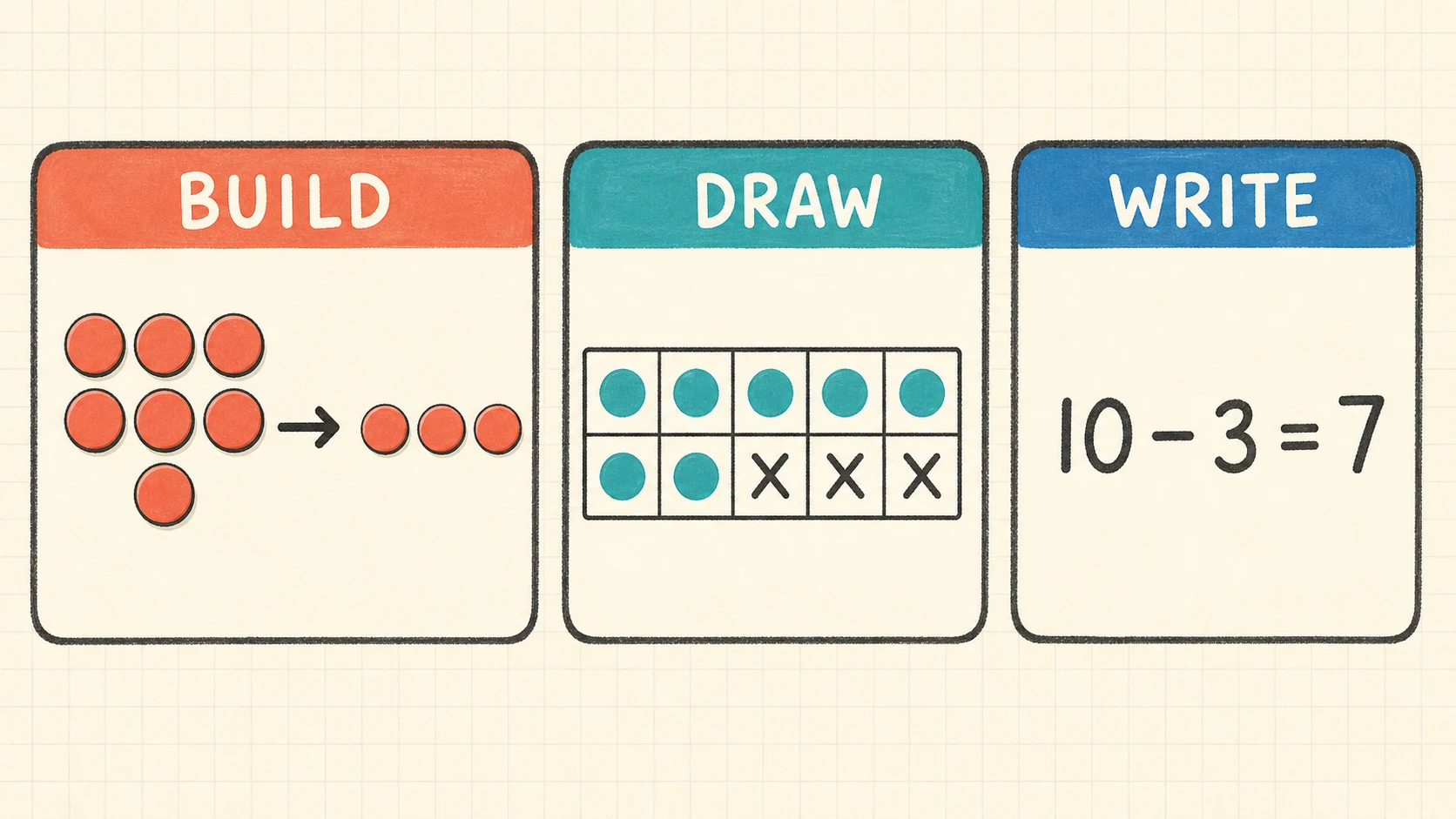
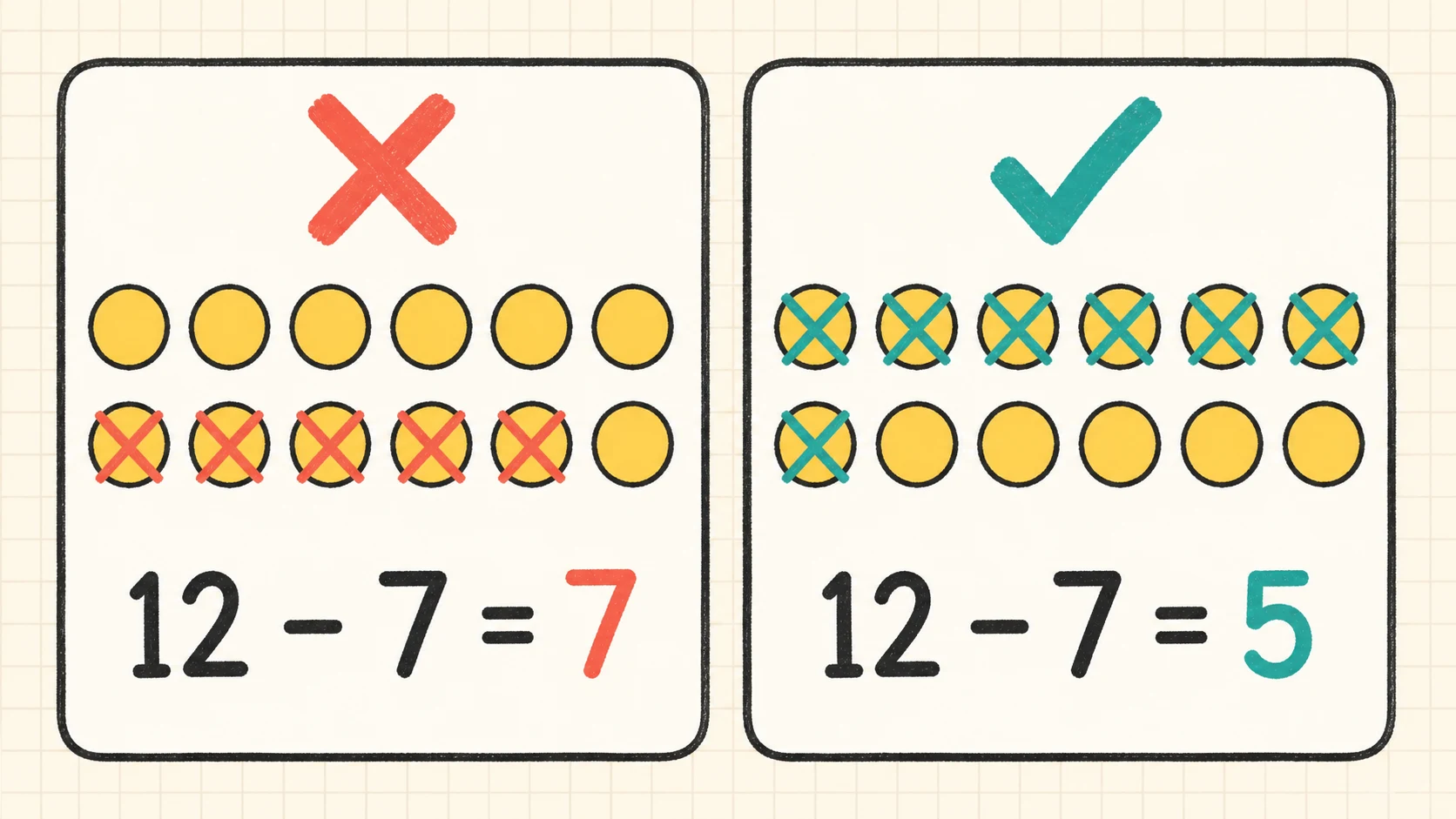
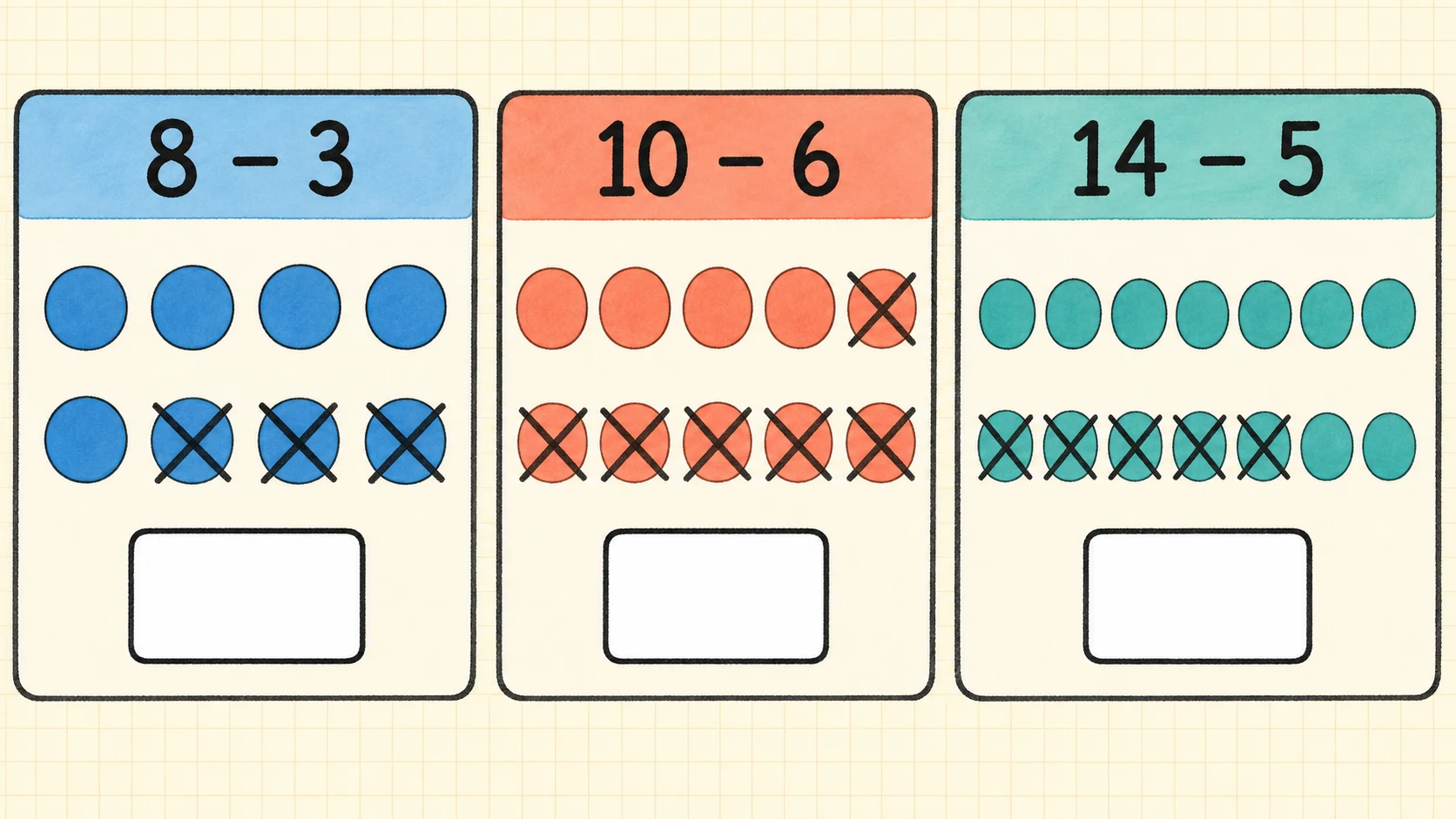
A drawing should preserve the action without creating an art task. For 8−3, the learner can draw eight circles, cross out three, and count five uncrossed circles. If elaborate pictures distract from the mathematics, use dots, tally-like marks, or stamped shapes.
Ten-frames and fingers
A ten-frame organizes quantities into rows of five. For 9−4, fill nine spaces, remove four counters, and inspect the five remaining. Fingers also provide a portable model for small facts, provided the learner connects raised and lowered fingers to the quantities in the equation.
Number paths
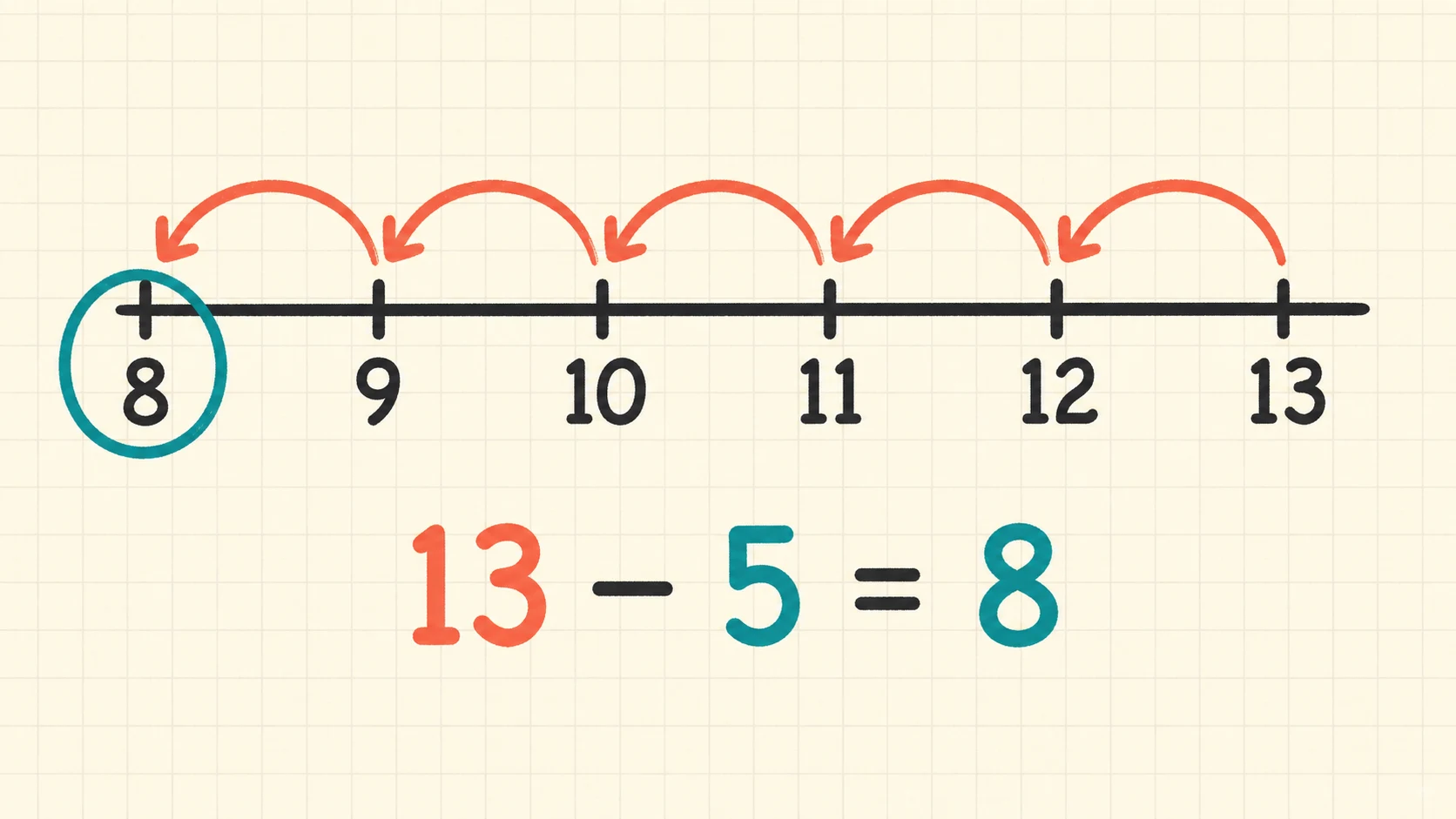
A number path shows whole-number positions in separate boxes. To solve 7−3, begin on 7 and make three backward moves: 6, 5, 4. The answer is 4.
Emphasize the difference between the starting position and the first move. A learner who counts “7, 6, 5” as three moves will incorrectly stop at 5. Mark each jump or let the learner move a token so the action can be checked.
Fully Checked Worked Examples
The following examples cover take-away, missing-part, comparison, and boundary cases. Each answer can be verified by rebuilding the starting quantity or using related addition.
Example 1: Taking away within 5
Problem: Mia has 5 blocks. She puts 2 blocks in a box. How many blocks remain outside?
Build five counters:
∙∙∙∙∙
Move two aside:
∙∙∙∙∙
Three counters remain, so:
5−2=3
Check: Put the two removed counters beside the three remaining counters.
3+2=5
The parts rebuild the original total, so the subtraction is correct.
The action, remaining quantity, spoken explanation, and equation should describe the same event.
Example 2: Taking away within 10
Problem: Solve 8−3.
Place eight counters on a mat. Move exactly three to a “taken away” area. Count the counters still in the starting area:
8−3=5
A number-path check begins at 8 and makes three moves back:
8→7→6→5
There are three moves, and the endpoint is 5.
Check:
5+3=8
Therefore, 8−3=5.
Example 3: Finding a missing part
Problem: Ten toy spaces are available. Six have toys in them. How many spaces are empty?
Represent the whole as 10 spaces:
■■■■■■□□□□
Six are filled and four are empty.
10−6=4
The same situation can be expressed as a missing-addend equation:
6+□=10
The missing number is 4.
Check:
6+4=10
This is subtraction because the whole is known and one part is being found, even though no objects physically move.
Example 4: Comparing two quantities
Problem: Ava has 7 shells. Ben has 4 shells. How many more shells does Ava have?
Arrange the groups in matched rows:
Ava: Ben: ∙∙∙∙∙∙∙∙∙∙∙
Match four of Ava’s shells with Ben’s four. Ava has three unmatched shells.
7−4=3
Check:
4+3=7
Ava has three more shells than Ben.
Example 5: Subtracting zero
Problem: Solve 6−0.
Start with six counters and remove none. All six remain:
6−0=6
Check:
6+0=6
Subtracting zero leaves the starting quantity unchanged.
Example 6: Subtracting the whole amount
Problem: Six birds are on a fence. All 6 fly away. How many remain?
Start with six and remove all six:
6−6=0
Check:
0+6=6
Zero is a valid quantity and a valid subtraction result.
Boundary Cases and Scope Decisions
Boundary cases reveal whether the learner understands the operation or follows a surface routine.
Zero and equal quantities
Include both 5−0 and 5−5. These equations look similar, but the actions differ:
In 5−0, nothing is removed, so five remain.
In 5−5, the entire set is removed, so zero remain.
Ask the learner to model both rather than recite a rule.
Reversed quantities
If the story begins with three objects and says five are taken away, the situation cannot be enacted with whole objects as stated. At this level, pause and inspect the story or equation instead of introducing negative numbers.
For example, 3−5 is outside the whole-number-within-10 model used in this guide. A suitable response is, “We only have three counters, so we cannot take away five from this set. Let’s check whether the numbers or the action were reversed.”
Numbers beyond 10 and regrouping
The catalogue’s broad subtraction topic extends beyond Kindergarten to subtraction within 20, place-value strategies, and multi-digit regrouping. Those are later points in the overall progression. This Kindergarten guide stays with problems within 10 using objects, drawings, equations, comparisons, and missing parts.
The listed worksheet description mentions regrouping among its skills. Adults should inspect the actual problems before assigning them and select only items that match the learner’s present understanding and local sequence. A catalogue label alone is not evidence that every listed skill is appropriate for every Kindergarten learner.
A Short, Repeatable Lesson Routine
A brief lesson can combine review, modeling, explanation, practice, and observation. The minutes below are an instructional suggestion, not a sourced universal schedule.
Phase
Approximate time
Adult action
Learner action
Revisit
2 minutes
Present one familiar problem
Models and explains
Introduce
3 minutes
Tell one clear subtraction story
Identifies the whole and action
Model
3 minutes
Demonstrate with counters and an equation
Watches, predicts, and checks
Practice together
4 minutes
Offer two related examples
Builds, draws, and records
Try independently
3 minutes
Give one or two suitable problems
Chooses a model and solves
Reflect
1 minute
Ask, “How did you know?”
Explains or demonstrates
One carefully observed problem may be more informative than a long page completed with uncertain reasoning.
Keep the mathematical language stable. For a take-away problem, name the starting amount, the amount removed, and the amount left. When presenting comparison, explicitly name the two groups and the unmatched difference.
If the learner becomes inaccurate, return to the last representation that was successful. An equation can become counters again; a number-path problem can become a take-away story. This is a pacing decision based on observed work.
Selecting Practice That Matches the Learner
Practice should reinforce a skill the learner can understand, not introduce several new demands at once.
For an early learner
Choose problems that:
Stay within 5.
Use a single take-away structure.
Show or permit counters.
Present only a few items at a time.
Include space to draw.
Avoid mixing comparison, missing-part, and take-away situations initially.
For a developing learner
Choose problems that:
Extend within 10.
Mix objects, drawings, and equations.
Include zero and subtracting the whole.
Ask the learner to match equations with models.
Introduce missing-part and comparison problems separately.
Require a brief explanation or check.
For a learner showing secure understanding
Choose problems that:
Mix the three subtraction situations.
Ask the learner to select a representation.
Include related addition checks.
Vary the position of the unknown, such as 8−□=5.
Include a small number of unfamiliar story contexts.
The Kindergarten Subtraction Worksheet Pack contains 18 worksheets and is listed at $4.79. It offers more practice choices, but quantity should not determine pacing. Select pages or individual problems according to the representation, number range, and subtraction situation the learner presently needs.
Differentiating Without Changing the Mathematical Goal
Differentiation can change access, amount, or representation while preserving the central goal: understand and solve a subtraction situation.
When counting is not yet stable
Reduce the starting quantity to 5 or fewer. Arrange counters in a line or frame so each object can be tracked. Ask the learner to touch or move each counter once while counting.
When the action is understood but symbols are not
Let the learner act out the story first. Then place numeral and operation cards beneath the model. Ask what each symbol represents. Continue using equations, but do not require the equation to carry the entire explanation.
When writing is the obstacle
Invite a spoken answer, numeral card, stamp, or adult-recorded equation. Keep at least some opportunities for numeral writing, but separate handwriting practice from the moment when subtraction understanding is being assessed.
When facts within 5 are secure
Move gradually within 10, mix problem types, or hide one part of a set. Do not jump automatically to larger numbers. Greater variety within 10 can reveal more understanding than repetitive work with a wider range.
The IES practice guide for assisting students struggling with mathematics supports high-level decisions about systematic instruction, mathematical language, representations, and cumulative review. It does not diagnose an individual child or validate this particular worksheet.
Common Errors and Diagnostic Teaching Responses
An incorrect answer is useful only when the adult studies how it was produced.
Observed work
Likely instructional issue
Teaching response
Counts removed objects as part of the remainder
Removed and remaining groups are not distinct
Move removed counters to a clearly labeled area
Removes the wrong number
Loses one-to-one tracking
Move and count each removed counter aloud
Solves 7−3 as 5 on a number path
Counts the starting number as the first move
Mark three jumps after placing a token on 7
Answers 5−0=0
Treats the second number as the answer
Act out “remove none” and count what remains
Answers 5−5=5
Focuses only on the starting set
Physically move all five away
Adds in a take-away story
Responds to two numbers without interpreting the action
Retell and act out what changes before choosing a symbol
Cannot solve a comparison problem already solvable as take-away
Knows one situation but not another
Match objects in two rows and count unmatched items
Writes 3−7 for “7 take away 3”
Reverses starting and removed quantities
Label the whole before recording the equation
Gives a correct answer but cannot show why
May be recalling or guessing without a stable model
Ask for a drawing, counters, or related addition check
Crosses out the right amount but recounts crossed-out marks
Visual separation is unclear
Cover crossed-out marks or move to physical counters
Diagnose the learner’s action before assigning more problems of the same type.
Avoid turning every error into a verbal explanation from the adult. Rebuild the problem, ask the learner to show each step, and identify the first point at which the quantities stop matching the story.
Monitoring Progress Without Overinterpreting a Score
A worksheet total tells how many recorded answers match the key. It does not, by itself, show which model the learner used, whether the learner interpreted the story independently, or whether the answers will be retained.
Track a small set of observable indicators:
Number range completed accurately.
Problem types understood: take-away, missing part, and comparison.
Representation used: objects, drawing, number path, fingers, or mental reasoning.
Level of prompting needed.
Ability to explain what each number means.
Ability to check subtraction with addition.
Error pattern, if one repeats.
Performance on a similar problem after a delay.
A simple note might read: “Solved take-away problems within 5 independently with counters; crossed out too many marks in 2 of 4 drawing problems; comparison not yet introduced.” That record gives clearer direction than “75%.”
Increase difficulty after multiple examples show stable understanding. If performance drops when the model changes, teach the connection between the two representations before adding more facts.
A Two-Week Practice Plan
This plan is one adaptable instructional option. It assumes short sessions and should be slowed, repeated, or shortened according to observed work. It is not a universal timetable.
Day
Focus
Suggested activity
What to observe
1
Take away within 5
Act out three stories with counters
Removes the correct amount
2
Equation connection
Place equations beside yesterday’s models
Explains each number
3
Drawings within 5
Draw and cross out simple marks
Counts only uncrossed marks
4
Zero cases
Compare n−0 and n−n
Distinguishes none from all
5
Mixed review
Use four short object, drawing, and equation tasks
Maintains meaning across models
6
Take away within 10
Build and separate sets of 6–10
Tracks larger sets accurately
7
Number paths
Make backward moves for three examples
Does not count the start as a move
8
Missing parts
Hide part of a set and find it
Uses whole-and-part reasoning
9
Comparison
Match two rows and count the excess
Identifies the difference
10
Independent application
Complete a selected worksheet portion, explain two answers, and correct errors
Selects a sound method with limited prompting
Review days and repeated models are deliberate; progression depends on evidence, not the calendar.
On each day, include one familiar item before the new focus. On Days 5 and 10, choose only enough problems to make the learner’s reasoning visible. If a learner cannot yet separate within 5 reliably, repeat Days 1–3 with new small quantities instead of moving to within 10.
Limitations and the Next Instructional Step
A printable can provide clear, repeatable practice, but it cannot observe counting behavior, determine why an answer is wrong, or decide when a learner is ready for a new representation. An answer key confirms the recorded result; it does not replace watching the process.
This guide also stays within the supplied Kindergarten scope. It does not provide medical or developmental guidance, promise outcomes, certify a curriculum, or claim comprehensive alignment with every local standard. Local sequences differ, and grade labels describe intended practice level.
A sensible next action is to open the free Kindergarten subtraction worksheet, preview its 20 exercises, and select three to five problems that match the learner’s current number range and model. Have the learner solve one with objects, one with a drawing, and one independently. Use the observed work—not the page count—to choose what to teach next.
Put it into practice
Use the guide with a real printable
Move from explanation to a short, observable practice task. Check the first item together, then adjust the next session from the learner's actual work.