Kindergarten Geometry: What the Learner Needs to Understand
Kindergarten Geometry teaches a learner to recognize, name, describe, compare, build, and combine shapes. The central idea is that a shape is identified by its geometric attributes—not by its color, size, material, or orientation. A triangle remains a triangle when it is turned, enlarged, or drawn with unequal sides.
At this level, useful instruction concentrates on:
- Recognizing familiar two-dimensional shapes, including circles, triangles, rectangles, and hexagons.
- Recognizing common three-dimensional solids, including cubes, cones, cylinders, and spheres.
- Describing shapes with observable attributes such as straight or curved edges, sides, corners or vertices, and flat or curved surfaces.
- Comparing shapes and explaining how they are alike or different.
- Building, tracing, drawing, sorting, and composing shapes.
- Finding shapes in varied positions and in everyday objects.
The learner does not need formal definitions, angle measures, area formulas, or perimeter formulas to develop a strong Kindergarten foundation. Those ideas belong to a later progression even if they appear in a mixed worksheet. Grade labels describe the intended practice level, and local school or homeschool sequences differ. The learner’s observed work should determine the actual starting point and pace.
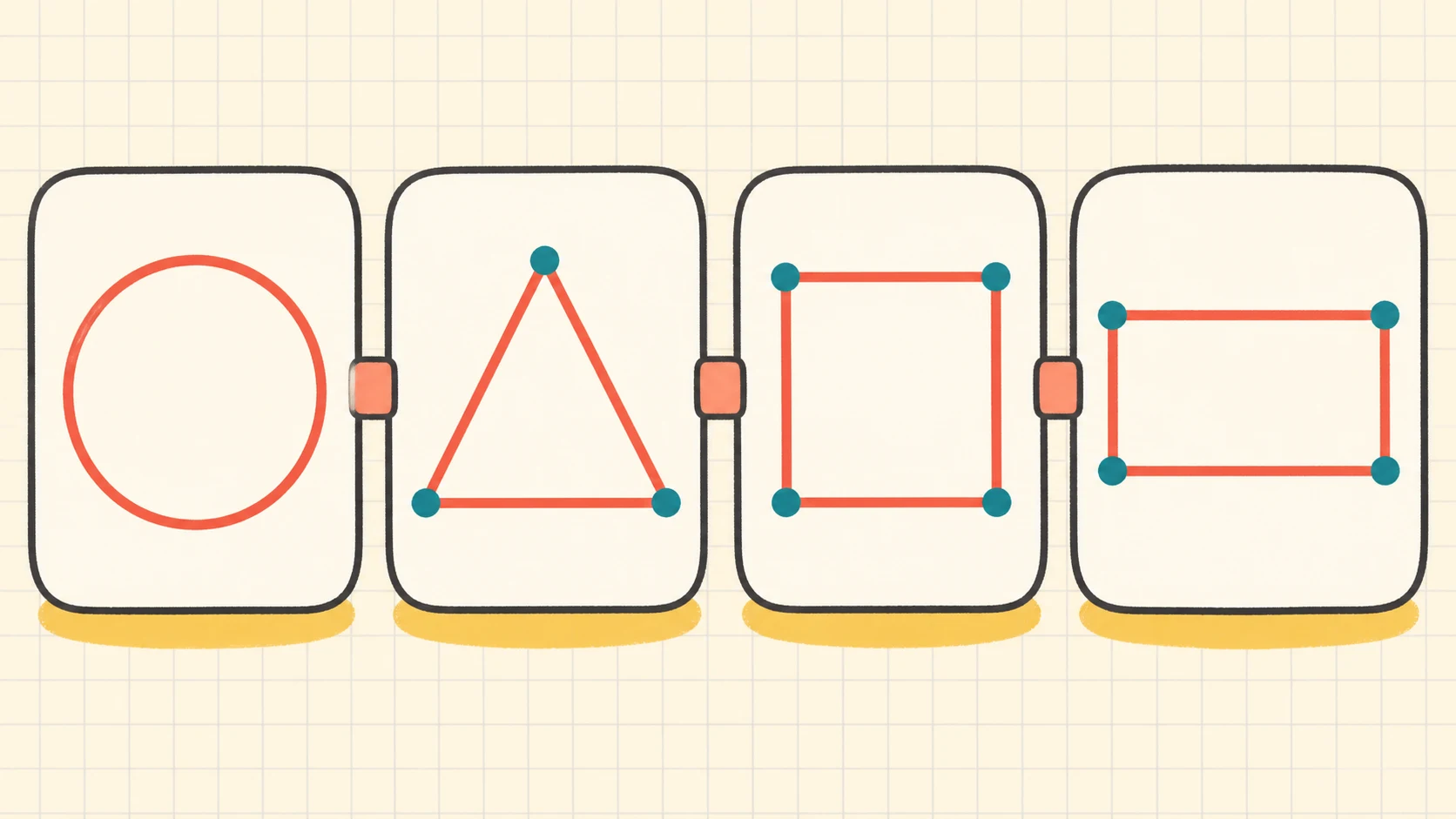
Kindergarten shape work connects recognition, description, comparison, construction, and composition.
The Common Core State Standards for Mathematics place Kindergarten emphasis on identifying and describing shapes, analyzing their attributes, and working with shapes to create other shapes. This source provides high-level context for the progression; it does not evaluate WorksheetWise materials or determine every local teaching sequence.
Prerequisites and Readiness
Geometry can begin before a learner consistently remembers every shape name. Naming is only one part of the work. A learner may be ready to compare shapes even while confusing the words rectangle and triangle.
Language needed for shape work
Check whether the learner can understand and use practical comparison words:
- Same and different
- Straight and curved
- Flat and solid
- Large and small
- Above, below, beside, and between
- Turn, slide, match, and build
These words can be taught during geometry rather than completed as a separate prerequisite. Model them with objects: “Place the circle above the rectangle,” or “Turn the triangle until it matches.”
Visual matching and sorting
Before asking for names, see whether the learner can match identical shapes and sort a small collection. Begin with obvious contrasts, such as circles and triangles. Then introduce less obvious comparisons, such as squares and nonsquare rectangles.
Observe the reason for each choice. Sorting every blue piece together shows attention to color, not geometric structure. Respond by making color unhelpful: offer a red triangle, a blue triangle, and a red circle, then ask which two have the same shape.
Counting with one-to-one correspondence
Counting to at least six is useful when discussing the sides or vertices of common polygons. The important prerequisite is not speed. It is touching or marking each side or vertex exactly once.
If the learner recounts a corner or skips one, place a small counter on the starting vertex. Move around the shape in one direction and stop upon returning to the counter.
Fine-motor demands
Tracing, cutting, and drawing can support geometry, but they also require motor control. A shaky drawing does not prove weak geometric understanding. Let the learner point, sort, build, or answer orally when handwriting would obscure what the learner knows.
A Grade-Appropriate Progression
A productive sequence moves from handling objects to interpreting pictures and then producing or explaining shapes independently. Advancement should depend on evidence, not a fixed number of days.
| Stage |
Teaching focus |
Suitable model |
Evidence to look for |
| 1. Match |
Match objects or cards with the same shape |
Shape blocks and cards |
Matches despite a change in color |
| 2. Name |
Name familiar flat shapes and solids |
Objects, cutouts, and pictures |
Names examples in more than one orientation |
| 3. Describe |
Notice sides, vertices, edges, and surfaces |
Large shapes that can be touched |
Gives an attribute rather than only a name |
| 4. Compare |
Explain similarities and differences |
Two shapes side by side |
Uses attributes to justify a comparison |
| 5. Sort |
Group shapes by a stated or discovered rule |
Mixed shape collection |
Maintains one consistent sorting rule |
| 6. Build and draw |
Make a requested shape |
Sticks, clay, tiles, or drawing tools |
Preserves defining attributes |
| 7. Compose |
Combine smaller shapes into a larger shape |
Pattern blocks or cut paper |
Names the parts and the resulting shape |
| 8. Apply |
Find and discuss shapes in varied contexts |
Room objects and new worksheets |
Transfers understanding to unfamiliar examples |
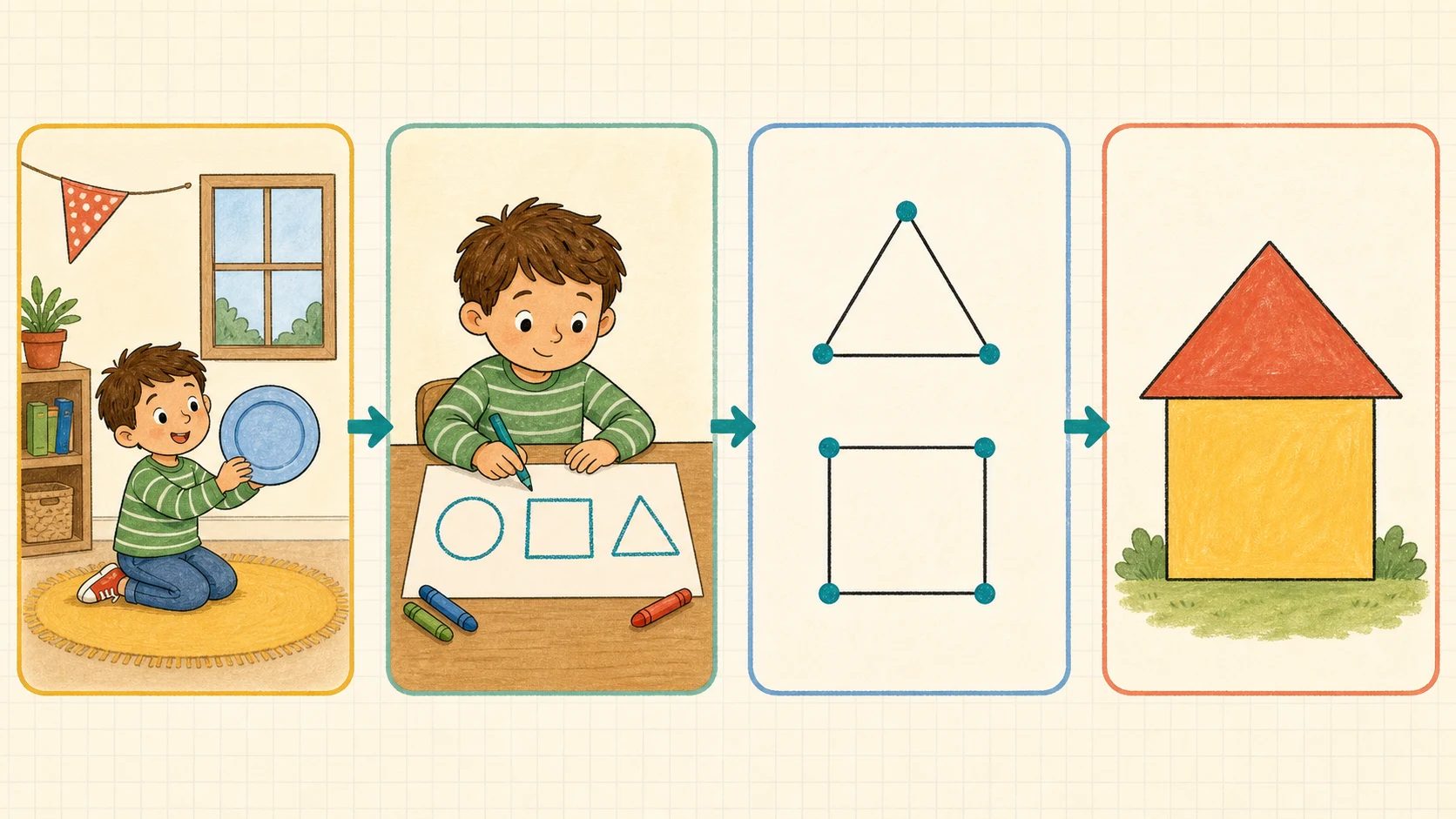
Move forward when the learner can explain or demonstrate the idea with decreasing support.
The IES practice guide on teaching mathematics to young children supports broad practices such as building on children’s existing mathematical knowledge, monitoring progress, and helping children view and describe their world mathematically. Those recommendations support the instructional framing here, but they are not claims about a particular worksheet.
Boundary cases belong in the progression
A learner who sees only an upright equilateral-looking triangle may decide that a sideways, narrow, or right triangle is “not a triangle.” Include nonexamples too: a three-sided figure with a gap is not a closed triangle, and a four-sided figure is not a triangle.
Similarly, do not teach that every rectangle “looks like a door.” Show wide, tall, small, large, and rotated rectangles. A square can be discussed as a four-sided shape with equal sides; avoid forcing classification language beyond what the learner’s local sequence expects.
Concrete and Visual Models
Hands-on materials are most useful when the adult connects the action to precise language. Free play may build familiarity, but a short prompt turns the materials into a mathematical model.
Flat shapes
Use paper cutouts, pattern blocks, craft sticks, string, clay, or a geoboard.
- Trace the boundary of a circle and notice that it curves.
- Build a triangle from three craft sticks.
- Touch each vertex of a rectangle while counting once around.
- Cover an outline with one matching shape.
- Place two triangles together and describe the larger shape produced.
- Sort shapes by a chosen attribute, then explain the rule.
Present shapes in different colors, sizes, and orientations. When every triangle is the same color, the learner may use color as the shortcut. When every rectangle is horizontal, orientation may become an unintended part of the learner’s rule.
Solid shapes
Use safe household objects alongside geometric solids:
- A ball can model a sphere.
- A block can model a cube.
- A can can model a cylinder.
- A party-hat shape can model a cone.
An object is a model, not always a perfect mathematical solid. A drink can may have rims or tabs; a toy block may have rounded edges. Ask which solid the object is most like and what features support that comparison.
Let the learner test what each solid can do. A sphere can roll in many directions. A cylinder can roll on its curved surface and rest on a flat circular surface. A cube rests on flat faces and can be stacked. These observations help distinguish solids without requiring formal vocabulary beyond the learner’s readiness.
Pictures and drawings
After concrete work, use photographs, outline drawings, and worksheets. Point out that a printed circle is a flat representation, while a ball is a solid object. If the learner calls both “a circle,” place them together and say, “This picture has a circle shape. The ball is like a sphere.”
The Kindergarten Math collection can provide visual practice after the learner has handled and discussed shapes. Choose only the page or problems that match the concept already taught.
Fully Checked Worked Examples
Worked examples should reveal the reasoning, not merely announce an answer. Let the learner attempt each task with objects first, then compare the attempt with the explanation.
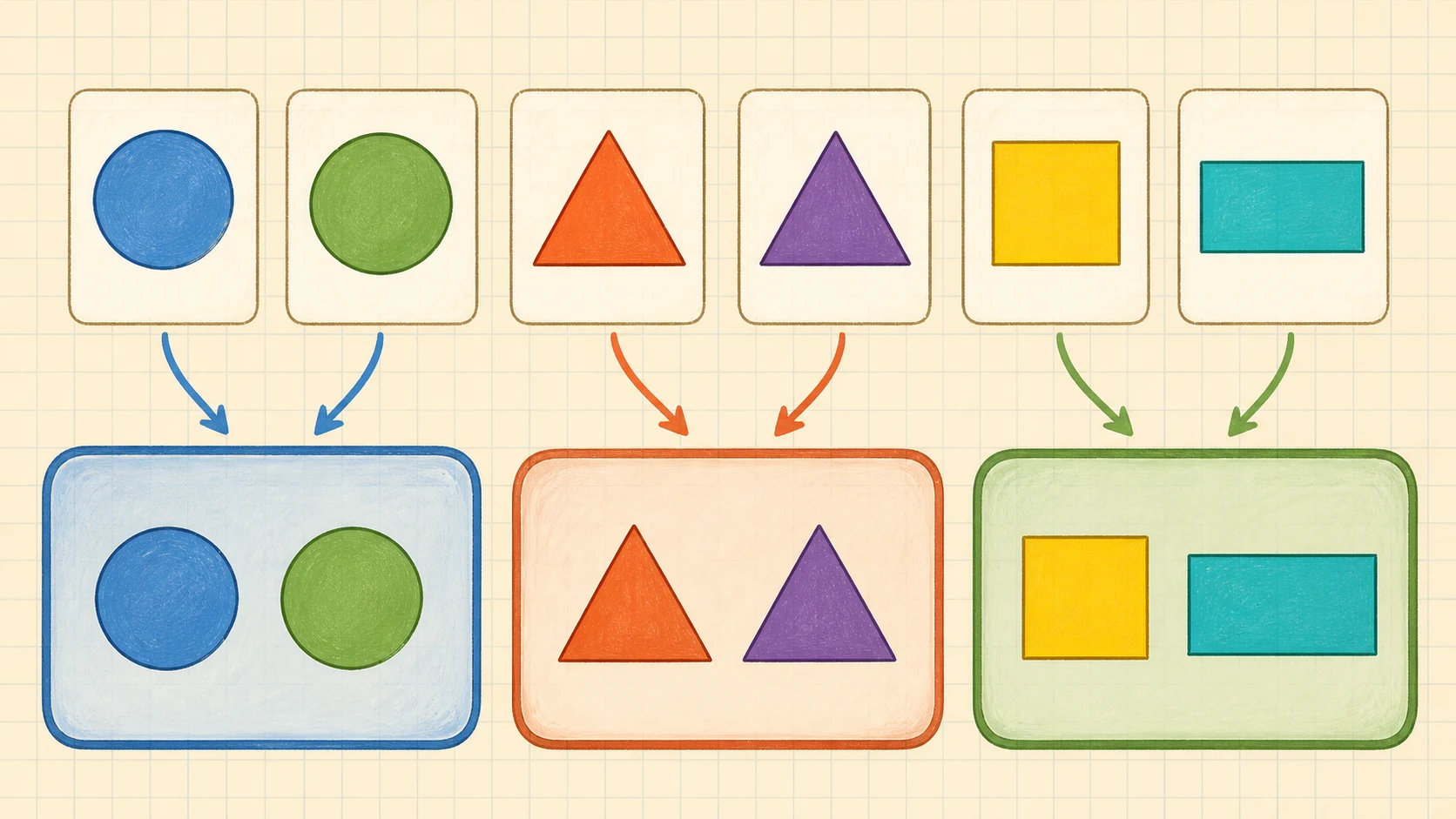
The adult connects what the learner touches and counts to the geometric conclusion.
Worked example 1: Identify a rotated triangle
Problem: A closed shape has three straight sides and three vertices. It is pointing sideways. What shape is it?
Check the attributes:
- Trace the entire boundary. It is closed.
- Count the straight sides: 1, 2, 3.
- Count the vertices: 1, 2, 3.
- Ignore the direction in which the shape points.
Answer: It is a triangle.
Why the answer is secure: Turning a shape changes its orientation, not its number of sides or vertices.
Boundary case: If the three line segments do not meet and leave a gap, the figure is not a closed triangle.
Worked example 2: Compare a rectangle and a triangle
Problem: How are a rectangle and a triangle alike, and how are they different?
Check the rectangle: It is closed and has four straight sides and four vertices.
Check the triangle: It is closed and has three straight sides and three vertices.
Answer: Both are closed flat shapes made with straight sides. The rectangle has four sides and four vertices; the triangle has three sides and three vertices.
Why the answer is secure: The comparison uses countable geometric attributes. “The rectangle is blue” would describe the example’s appearance, not what makes it a rectangle.
Worked example 3: Identify a cylinder
Problem: A solid has two flat circular surfaces and one curved surface. It can stand on a flat surface and can roll when placed on its curved surface. What solid is it?
Check the model:
- Find the two flat circular surfaces.
- Trace the curved surface joining them.
- Place the model on one flat surface; it stands.
- Turn it onto the curved surface; it rolls.
Answer: It is a cylinder.
Why the answer is secure: The combination of two flat circular surfaces and one curved surface distinguishes the cylinder from a sphere or cone.
Boundary cases: A sphere has no flat surface. A cone has one flat circular surface and narrows to a point.
Worked example 4: Compose a rectangle
Problem: Two matching squares are placed side by side with one full side touching. What larger shape can their outside boundary make?
Check the construction:
- Place the squares without a gap or overlap.
- Ignore the shared side inside the combined figure.
- Trace only the outside boundary.
- Count the outside sides: top, right, bottom, left.
Answer: The two squares can compose a rectangle.
Why the answer is secure: The outside boundary forms one closed four-sided figure. The line between the squares shows the parts but is not part of the outside boundary.
Boundary case: If the squares touch at only one vertex, they do not form a single rectangle.
Worked example 5: Decide whether an oval is a circle
Problem: A shape is closed and curved, but it is stretched so that it is longer from left to right than from top to bottom. Is it a circle?
Check the shape: Compare several distances across the center. They are not all the same.
Answer: No. It is an oval-like curved shape, not a circle.
Why the answer is secure: “No straight sides” is not enough to identify a circle. Many closed curved figures are not circles.
Worked example 6: Sort by a stated rule
Problem: Sort a circle, triangle, rectangle, and hexagon into “has straight sides” and “does not have straight sides.”
Check each item:
- Circle: curved boundary; no straight sides.
- Triangle: three straight sides.
- Rectangle: four straight sides.
- Hexagon: six straight sides.
Answer: The triangle, rectangle, and hexagon belong in “has straight sides.” The circle belongs in “does not have straight sides.”
Why the answer is secure: Every item was tested against the same rule. The learner did not switch midway from shape to color, size, or preference.
A Short, Repeatable Lesson Routine
Keep a lesson focused enough that the learner can remain attentive and explain one main idea. The following routine is an instructional suggestion, not a universal timetable.
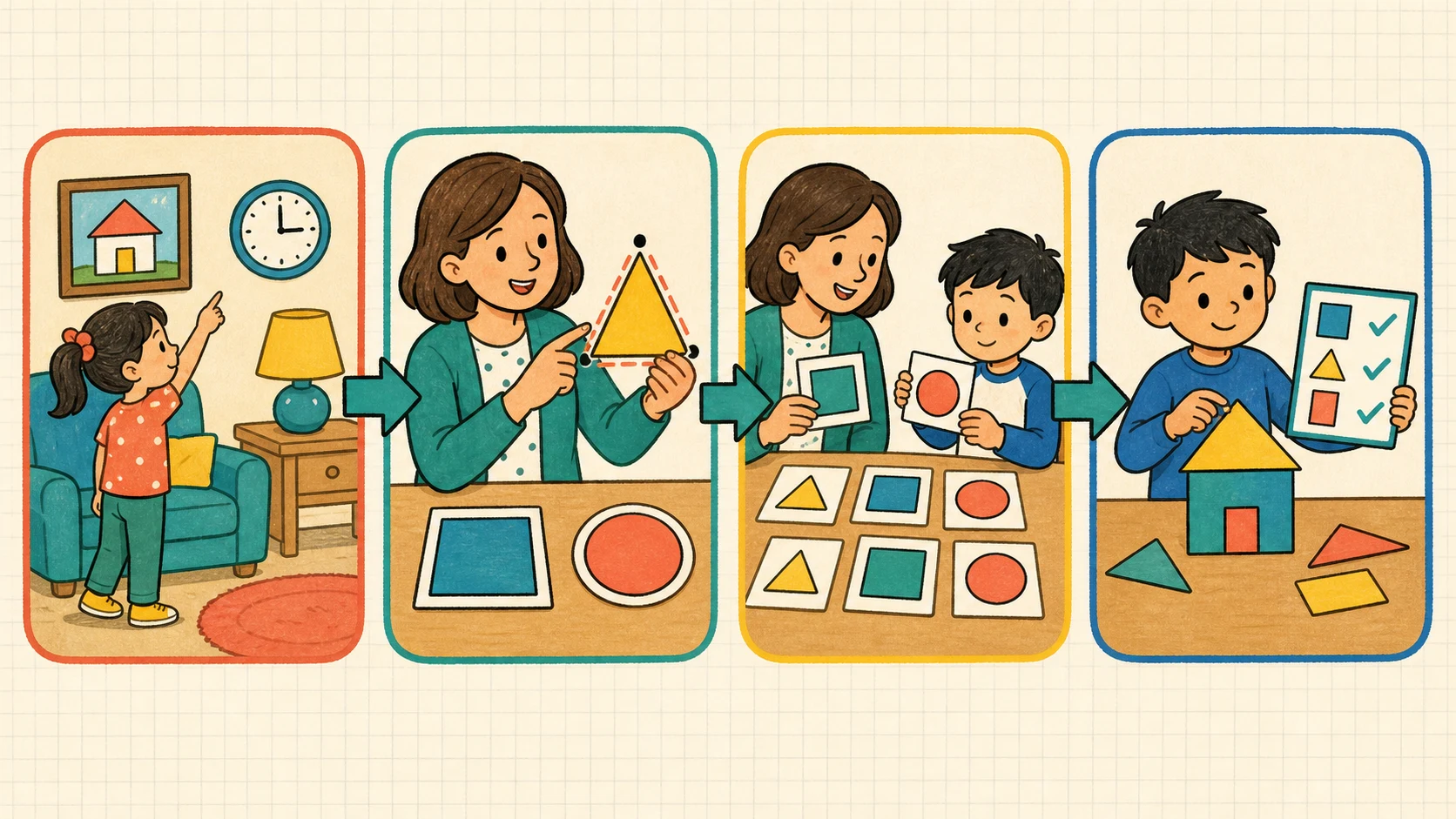
Use a stable routine while changing the shapes, examples, and level of support.
1. Retrieve
Show two previously learned shapes. Ask the learner to name or describe them. If naming is difficult, ask, “What do you notice?” This separates a vocabulary lapse from a concept gap.
2. Model
Present one example and think aloud: “I will trace the boundary. I count three straight sides, so I know this is a triangle even though it is turned.”
3. Practice together
Give the learner a similar example. Prompt only as much as needed:
- “Where will you begin counting?”
- “What stays the same when we turn it?”
- “Which attribute proves your answer?”
4. Contrast
Place an example beside a nonexample. Compare a closed triangle with an open three-segment figure, or a cylinder with a sphere. Contrast makes the defining attribute visible.
5. Check independently
Offer one or two new items without hints. Ask the learner to point, sort, build, draw, or explain. Record the kind of support needed rather than marking only right or wrong.
6. Close
Ask for one short statement: “A triangle has three straight sides,” or “A cylinder has flat and curved surfaces.” Revisit the same idea later with a different representation.
Selecting Practice That Fits the Learner
Choose practice by skill and representation before choosing it by page count.
For an early learner
Select tasks that ask the learner to match, point to, or sort one or two clearly different shapes. Use large images and limit visual clutter. Provide physical shapes beside the page.
A suitable sequence might be:
- Match circle to circle.
- Sort circles and triangles.
- Name circles and triangles in new colors.
- Find the same shapes in a room.
- Recognize a triangle after it is turned.
For a learner who knows the names
Choose attribute and comparison work:
- Count sides and vertices.
- Compare two shapes.
- Explain why a rotated example keeps its name.
- Find the item that does not belong and justify the choice.
- Sort the same collection in two different ways.
For a learner ready to compose shapes
Use pattern blocks, cut paper, or magnetic shapes. Ask the learner to fill an outline, make a larger shape in more than one way, or describe which smaller shapes were used.
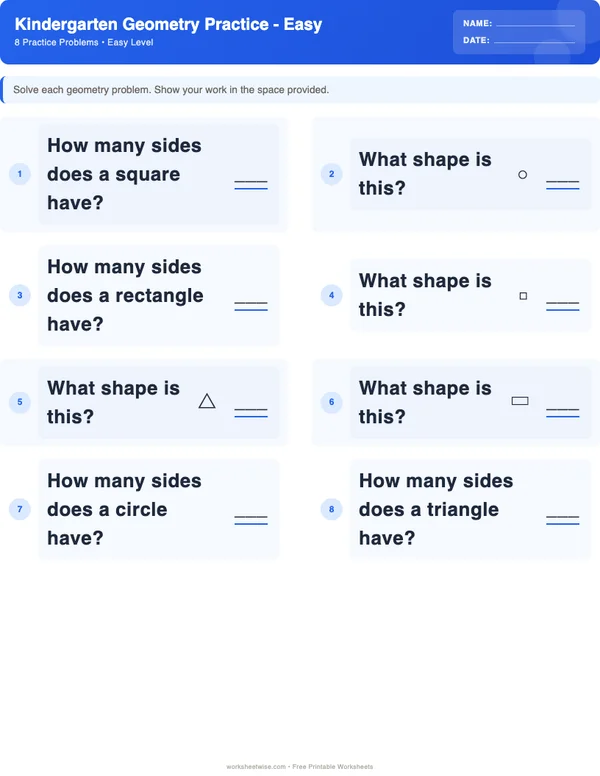
The Kindergarten Geometry topic guide and practice collection is the most direct place to compare available materials. The listed free worksheet contains 20 easy-level exercises and includes a separate answer key. Its catalogue description spans shape identification, side and vertex counting, perimeter, area, and geometric properties.
That breadth requires adult selection. Shape identification and attribute questions fit the central Kindergarten progression described here. Formal perimeter and area calculations extend beyond that core. Use such items only if they match the learner’s actual instruction and readiness; otherwise skip them without treating the omission as failure.
The 18-worksheet Kindergarten Geometry Worksheet Pack may be useful when varied practice is needed over time. More pages do not automatically produce better practice. Select a small set that addresses the learner’s current evidence.
Differentiation Without Changing the Mathematical Goal
Differentiation should reduce an irrelevant barrier or adjust the amount of support while preserving the idea being assessed.
When language is the barrier
Offer two shape names to choose from, let the learner point, and then model the full sentence. Pair words with actions: trace curved, tap each vertex, and sweep a hand across a flat surface.
Do not assume that an incorrect name means the learner cannot distinguish shapes. Ask for a sort or match to check the underlying concept.
When visual complexity is the barrier
Show fewer items at once. Increase spacing. Use bold outlines and remove decorative pictures. After success, gradually reintroduce varied sizes, orientations, and contexts.
When counting is the barrier
Mark the starting point, have the learner move clockwise, and place a token on each vertex after counting it. The goal is to make one-to-one counting reliable enough to support the geometry.
When the work is already secure
Increase reasoning rather than merely adding more identical items:
- Ask for two different sorting rules.
- Include rotated and unusual-looking examples.
- Ask the learner to create a nonexample.
- Compose one target shape in two ways.
- Request a justification using an attribute.
The IES guide for assisting students who struggle with mathematics offers high-level support for systematic instruction, clear mathematical language, representations, and monitoring. Apply that framing responsively; it does not prescribe a diagnosis or a universal intervention schedule for an individual child.
Common Errors and Diagnostic Responses
An error is evidence about the learner’s current rule. Before correcting it, find out what rule the learner used.
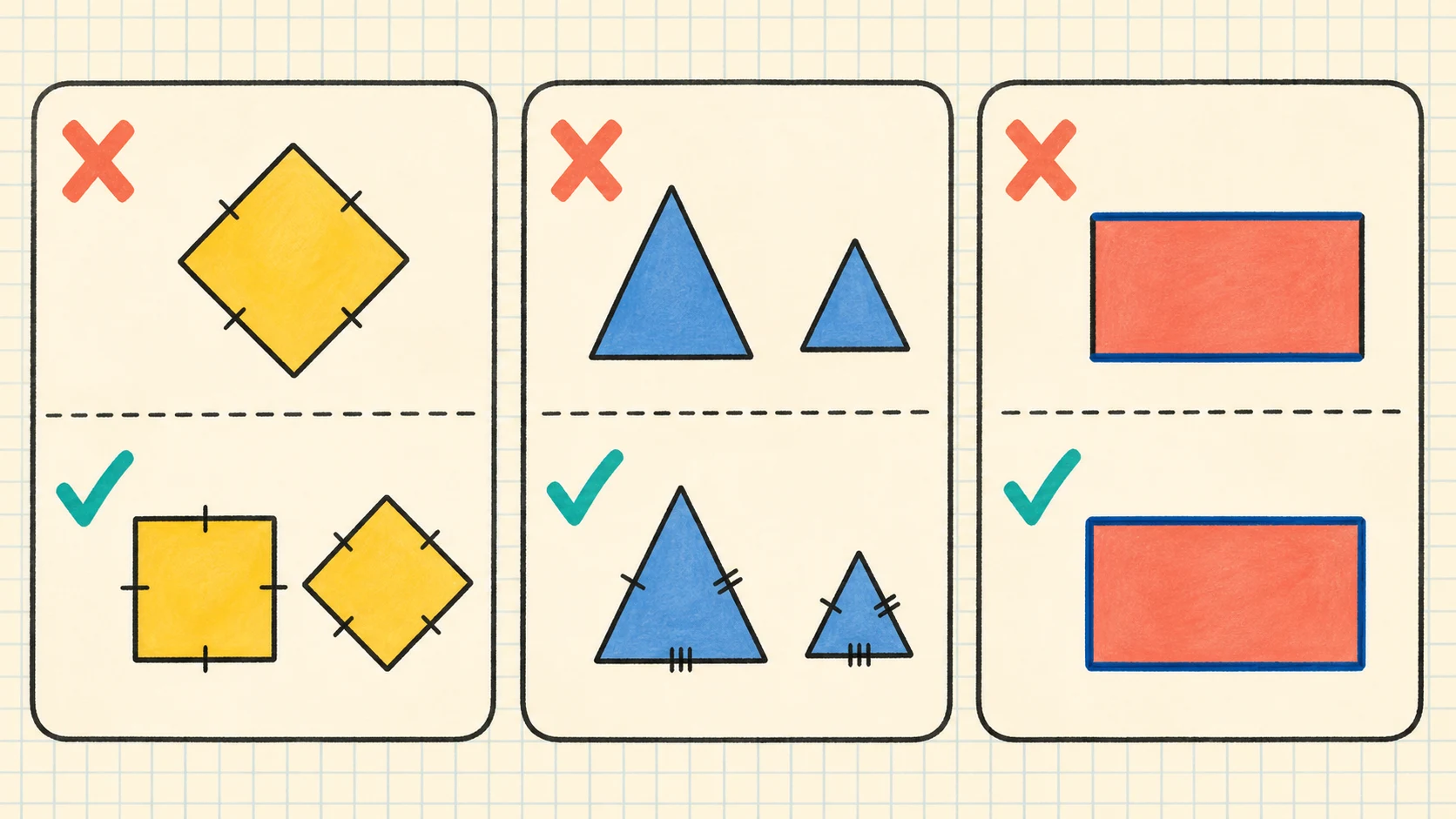
Match the teaching response to the reasoning behind the error.
| Observed error |
Likely reasoning to check |
Diagnostic prompt |
Teaching response |
| Rejects a rotated triangle |
Orientation is treated as defining |
“What changed when I turned it? What stayed the same?” |
Rotate one physical triangle while recounting its sides |
| Sorts shapes by color |
Color is more noticeable than shape |
“Can a red shape and a blue shape have the same number of sides?” |
Vary color within each shape category |
| Calls every four-sided figure a square |
Side length has not been considered |
“Are all four sides the same length?” |
Compare a square with a clearly long rectangle |
| Calls an open figure a triangle |
Counts segments but ignores closure |
“Can your finger travel around without jumping a gap?” |
Contrast open and closed figures |
| Counts one vertex twice |
No stable starting point |
“Where did you start, and when should you stop?” |
Mark the first vertex with a counter |
| Calls a sphere a circle |
Flat and solid representations are merged |
“Can you hold it? Does it have a surface?” |
Compare a circle card with a ball |
| Calls a cone a triangle |
Uses the object’s outline from one view |
“What happens when you turn the object?” |
Handle and rotate the solid |
| Counts the shared line when composing |
Focuses on every visible line |
“Which lines form the outside boundary?” |
Trace only the outside of the composed shape |
Avoid correcting every mistake with “Look again.” A more useful response directs attention to the attribute that matters. Then present a new example to learn whether the idea transferred.
Monitoring Progress and Deciding What Comes Next
Use a brief record with the date, skill, representation, accuracy, explanation, and support required. Three correct answers after heavy prompting do not show the same independence as three correct answers with no help.
Monitor across different forms:
- Physical object
- Shape cutout
- Simple outline
- Rotated example
- Picture of an everyday object
- Shape embedded in a composed figure
Look for stable understanding across at least two occasions and more than one representation. This is an instructional decision rule, not a sourced universal benchmark.
Move forward when the learner can usually identify or describe the target shapes, handle a changed orientation, and explain a choice with a relevant attribute. Continue supported practice when answers depend on color, familiar position, or adult hints. Step back when the learner guesses, cannot maintain a sorting rule, or becomes confused by the vocabulary.
Do not use one worksheet score as a complete picture. Drawing errors may reflect motor demands; naming errors may reflect word retrieval; counting errors may interfere with an otherwise sound visual distinction. A quick follow-up with objects can clarify what happened.
A Two-Week Practice Plan
This plan uses short, repeatable sessions and built-in review. It is a practical option, not a required timetable. Shorten, repeat, combine, or pause days according to the learner’s observed work.
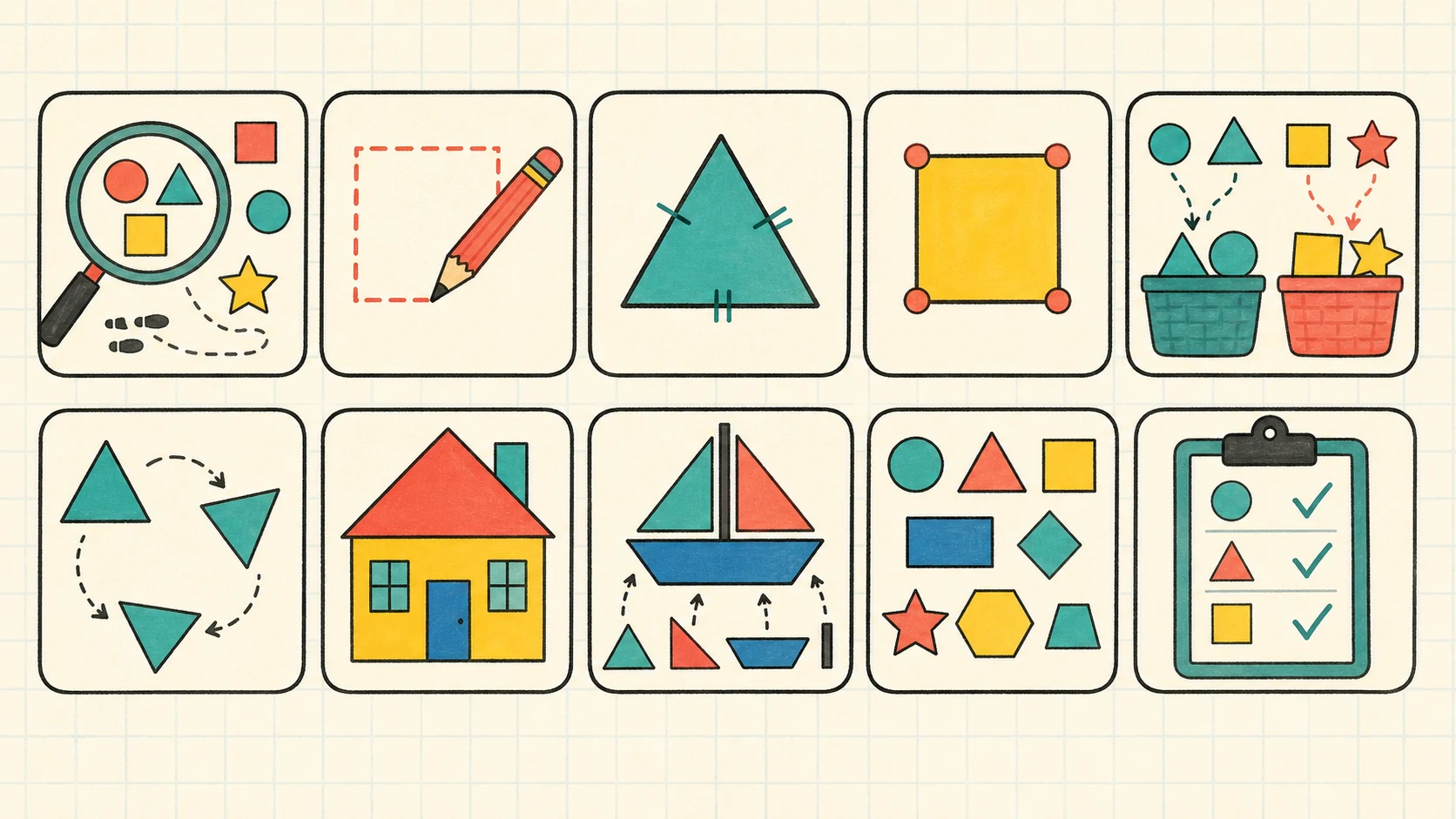
Alternate new learning, contrast, construction, and review instead of assigning a new worksheet every day.
| Day |
Focus |
Suggested activity |
Independent check |
| 1 |
Circle and triangle |
Match, trace, and sort physical shapes |
Identify each in a new color |
| 2 |
Rectangle and hexagon |
Count sides and vertices with marked starting points |
Explain one difference |
| 3 |
Orientation |
Turn triangles and rectangles through several positions |
Name two rotated examples |
| 4 |
Examples and nonexamples |
Compare closed shapes with open figures |
Choose the true triangle and explain |
| 5 |
Review |
Mixed sort by curved or straight boundary |
State the sorting rule |
| 6 |
Sphere and cube |
Handle, roll, stack, and compare solids |
Identify each without a model name |
| 7 |
Cylinder and cone |
Examine flat and curved surfaces |
Distinguish the two solids |
| 8 |
Flat versus solid |
Compare circle with sphere and rectangle with block-like objects |
Sort pictures and objects |
| 9 |
Composition |
Join two squares or several triangles |
Name the resulting outside shape |
| 10 |
Cumulative check |
Use unfamiliar shapes, orientations, and representations |
Explain two answers independently |
On review days, include one easy retrieval item, one current item, and one boundary case. If the learner cannot explain a correct answer, return briefly to the concrete model. If the learner is consistently accurate and articulate, introduce a more varied example rather than lengthening the session.
Limits and the Honest Next Step
This guide supports instructional decisions about foundational Kindergarten shape work. It cannot establish a learner’s full mathematical level, identify a learning condition, replace local curriculum requirements, or guarantee an outcome. It also does not claim comprehensive alignment with every state, district, or homeschool sequence.
Area and perimeter are part of the broader geometry progression, but formal calculation is not the central Kindergarten target described in the supplied standards scope. If a resource combines those topics with shape identification, select the relevant problems instead of assuming every problem must be completed.
Start by giving the learner three simple checks: identify a rotated triangle, compare a circle with a rectangle, and distinguish a sphere from a cylinder. Use the explanations—not speed—to choose the next practice. Then open the free Kindergarten Geometry worksheet, select only the shape and attribute problems that match the evidence, and use its answer key to check the completed work.