Curated collectionAnswer keys includedPrint-ready PDFs
Tutoring Spelling Worksheets
Use one-to-one think-alouds, immediate error interpretation and a session-to-session note trail instead of assigning an undifferentiated packet.
Start with a real resource
Browse this worksheet collection
5 relevant free entry points are available. Each one includes a printable learner PDF and separate answer key.
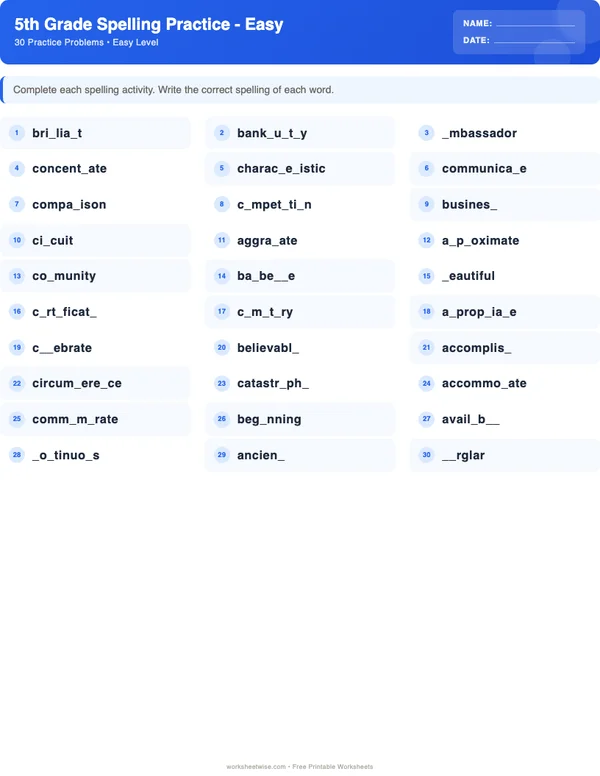
A useful practice loop
Print less. Observe more.
- Choose one skill and model the first item aloud.
- Use a short set and notice the learner’s strategy.
- Change the next task from the work you can see.
Need more than the free sheet?
Plus includes all 90 matching catalogue variations where available, plus saved deterministic generators and the worksheet designer.
See Plus membershipComplete guide
How to teach and practise tutoring spelling worksheets
3,201 words Updated 6 instructional visuals
Turn a spelling sheet into a one-to-one teaching conversation
Tutoring spelling worksheets work best when the tutor uses each response as evidence, not merely as an answer to score. Select a small set of words sharing a useful feature, model how to inspect one word, ask the learner to explain a second, and interpret errors immediately. End by recording what the learner noticed, what still caused difficulty, and which response format should come next.
That is more useful than assigning all 20, 25, or 30 items simply because they appear on the page. A learner who writes hoping as hopping needs a different next task from one who writes hoping as hopeing. The first response raises a question about vowel sound and consonant doubling; the second shows that the learner retained the base word but has not yet handled the final e when adding -ing. Both answers are incorrect, but they should not lead to the same follow-up sheet.
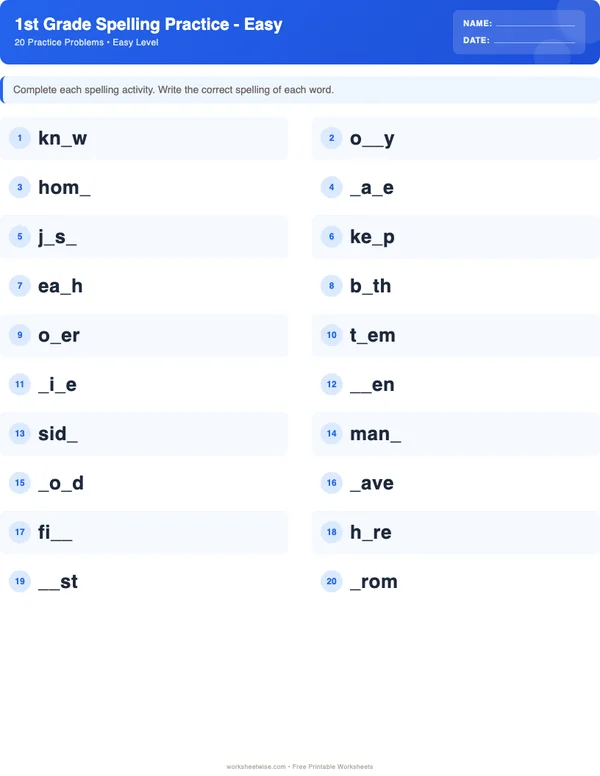
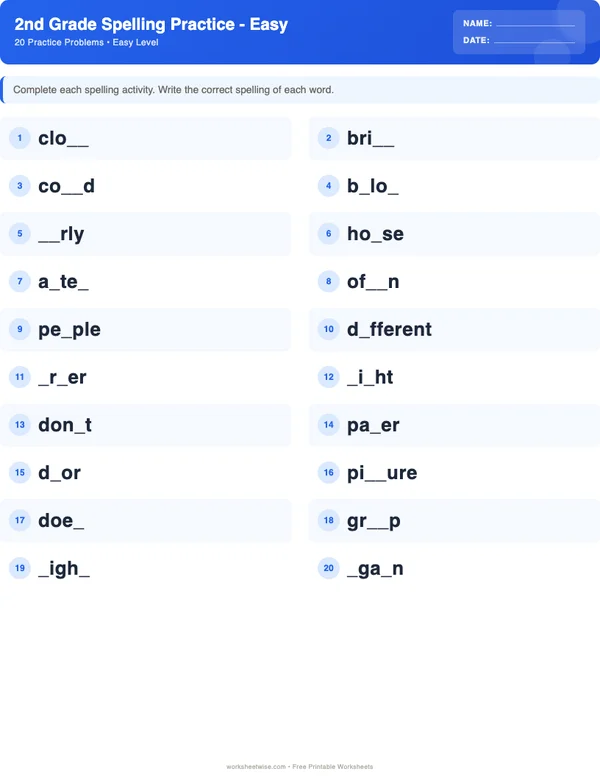
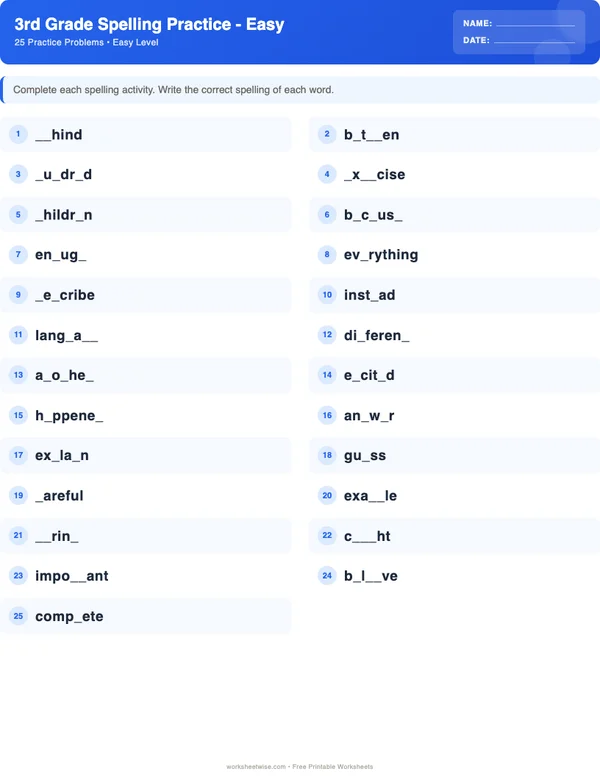
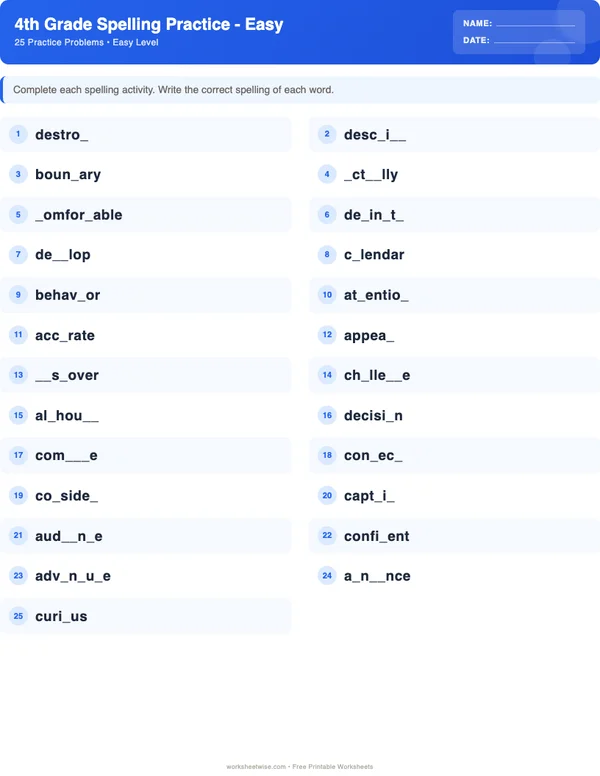
WorksheetWise currently lists 90 spelling variants across five intended grade levels, with five free entry points. The representative free sheets contain 20 problems in first and second grade, 25 in third and fourth grade, and 30 in fifth grade. Those counts describe available practice, not an appropriate tutoring dose. In a one-to-one session, six carefully discussed items may provide more usable evidence than 30 hurried responses.
Grade labels describe the intended practice level; local curriculum sequences differ. Treat age or grade as a discovery aid rather than a placement decision. Choose the actual task by inspecting its words, directions, response demands, and the learner’s independent attempts.
Select the sheet by the decision it can reveal
Before printing, decide what you need to learn. “Practice spelling” is too broad. A useful selection question sounds like one of these:
- Can the learner hear and represent every sound in a short word?
- Can the learner distinguish two spellings for the same long-vowel sound?
- Does the learner preserve a base word when adding a suffix?
- Can the learner find the incorrect part of a misspelled word?
- Can the learner spell a practiced pattern in a sentence without seeing the target word?
- Can the learner read back and edit a spelling independently?
The catalogue covers short vowels, long-vowel spellings, consonant doubling, r-controlled vowels, silent letters, prefixes, suffixes, and multisyllabic words. Available formats include look-cover-write-check, rainbow writing, pattern sorting, sentence use, and identification of misspelled words. Those are not interchangeable activities. Each reveals different information.
Match the response format to the evidence you need
Use matching or sorting when you want to see whether the learner notices a feature without the additional burden of recalling every letter. Use oral segmentation and letter tiles when you need to observe how sounds are mapped. Use look-cover-write-check when the learner can inspect a complete word and attempt recall. Use dictated words when you want unsupported production. Use sentence dictation when you need to see whether spelling survives alongside capitalization, spacing, handwriting, punctuation, and meaning.
Identifying a misspelled word is recognition; correcting it is editing; spelling the word from dictation is recall. Success in one format does not establish success in the others.
For example, a learner may correctly sort cake, rain, play, and break as words containing the long-a sound. That is a defensible pattern-noticing task drawn from the catalogue’s teaching guidance. It does not show that the learner can recall each spelling. The tutor’s next question should therefore be precise: “Which part spells /ā/ in each word?” The checked answers are a-e in cake, ai in rain, ay in play, and ea in break. This example belongs in spelling tutoring because it separates a shared sound from four different written representations—and prevents the tutor from presenting “long a” as one universally applicable rule.
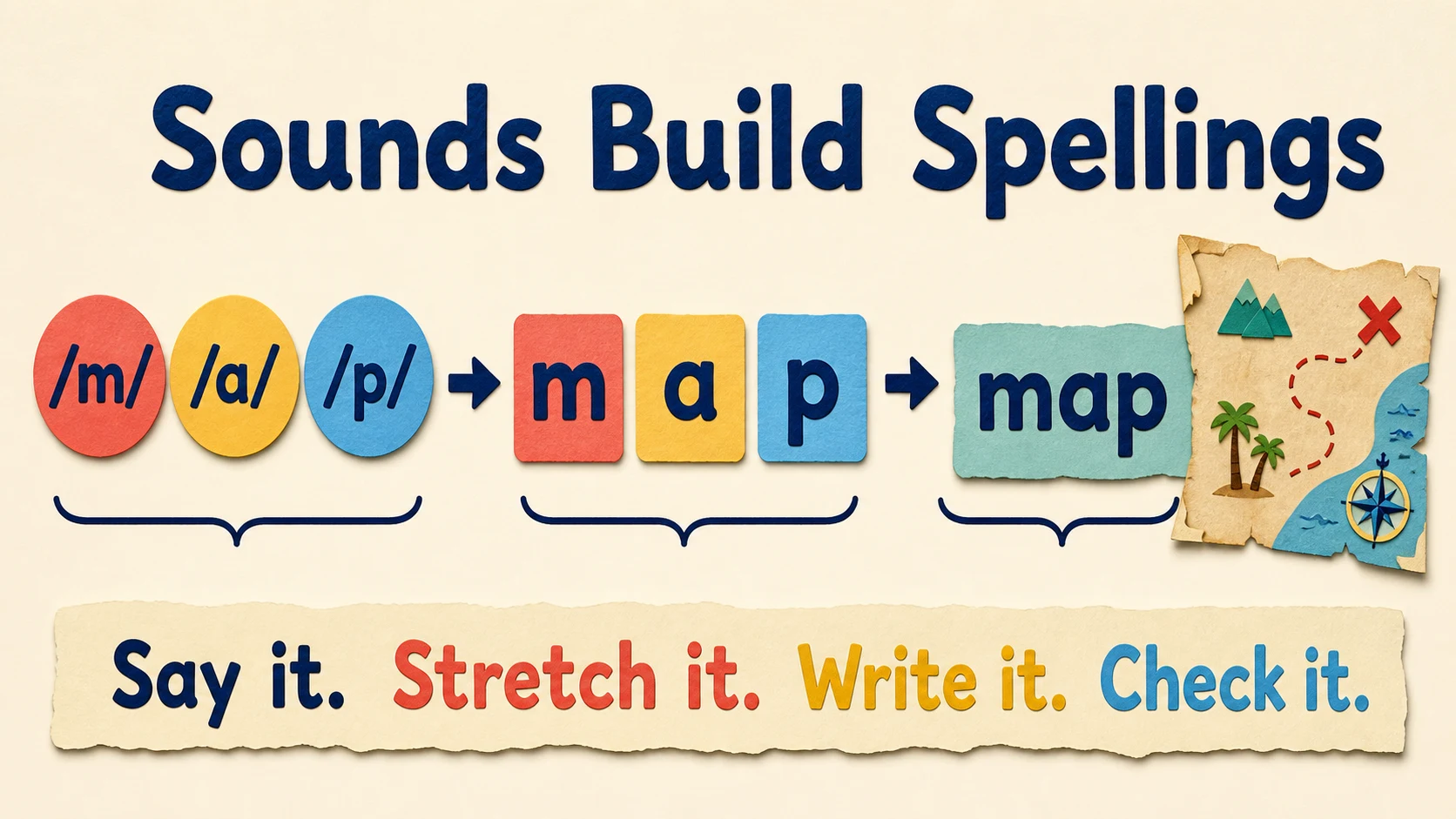
Use a skill map to choose one relationship to observe, such as hearing a vowel, locating its letters, and then recalling the whole word.
Read “easy” as a description of the task, not the learner
Each representative free sheet is catalogued at the difficulty label “easy.” That label must not become a label for a child. Define difficulty through observable task features.
A relatively supported spelling task might provide the complete target word, use familiar one-syllable words, focus attention on one feature, offer a word bank, and ask for matching, tracing, copying, or sorting. A less-supported task might remove the model, mix several patterns, require recall in a sentence, include inflected forms, or ask the learner to explain and correct an error.
The same word can become easier or harder without changing the spelling target:
- Most supported: Match rain to a picture and underline ai.
- More demanding: Sort rain by its long-vowel spelling.
- More demanding still: Look at rain, cover it, write it, and check.
- Independent recall: Write rain after hearing it.
- Contextual application: Write “The rain filled the drain” from dictation.
- Editing: Find and correct rane in a sentence.
If recall is difficult, preserve the long-a target while restoring a visual model or offering letter tiles. Do not replace the task with unrelated copying and then infer that the learner understands the pattern.
The progression also works in the other direction. If a learner copies accurately but never needs to retrieve the word, remove the model for one attempt. If isolated recall is secure, place the word in a short sentence. Increase one demand at a time so that a changed response can be interpreted.
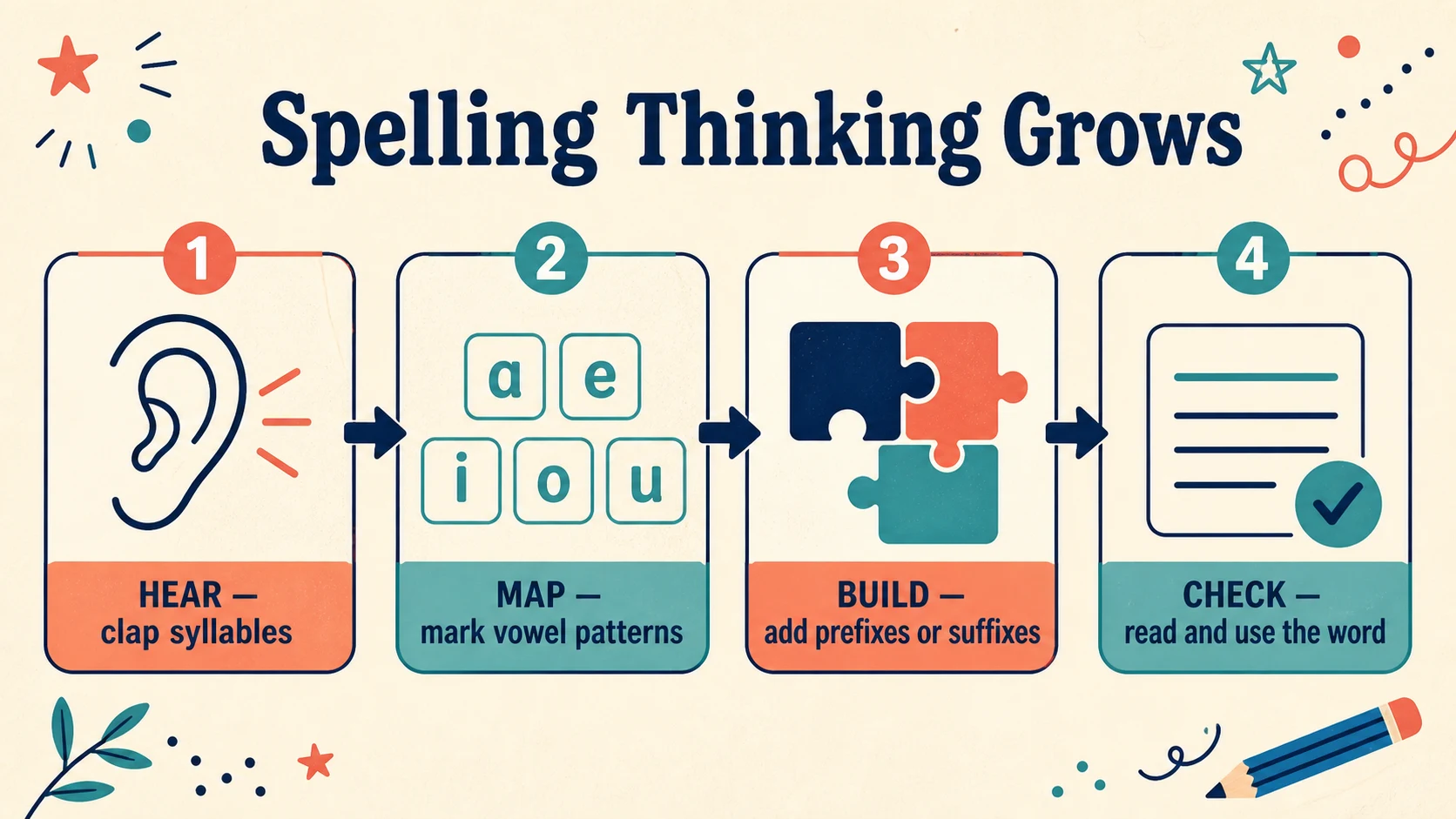
A spelling progression should remove support deliberately: inspect, explain, recall, and then apply—not jump from copying to a long mixed test.
Run a repeatable tutoring cycle
A useful spelling session can fit into 20–30 minutes, but the sequence matters more than the clock. Keep the target narrow enough that the learner can compare examples and explain what changed.
Reconnect with the previous note
Begin with two words from the last session: one that became secure and one that remained uncertain. Ask for an oral explanation before requesting written work. A note such as “recognized ai and ay in a sort; wrote rane from dictation” tells you to begin with recall, not another recognition-only sort.
Do not announce the remembered error as a verdict. Say, “Last time, this was the part we were investigating. Show me what you notice today.”
Model one word with a visible think-aloud
Choose one representative word and expose the decisions a proficient speller might otherwise make silently. Keep the explanation short and specific.
For hoping, a tutor might say: “I hear two syllables: hop-ing. The base word is hope. When I add -ing, I remove the final silent e: hope becomes hoping. I do not double the p, because the base word has the long-o sound.”
Write hope → hoping while speaking. Contrast it with hop → hopping: “Here the base is hop, with a short vowel, and the final consonant doubles before -ing.” Check the letters explicitly: hop + p + ing = hopping.
This example belongs here because consonant doubling and suffixes are both named in the live catalogue, and the pair reveals more than memorizing either word alone. It also supplies an immediate diagnostic contrast: hopeing preserves an unnecessary e; hoping written as hopping changes the vowel signal and the base-word structure.
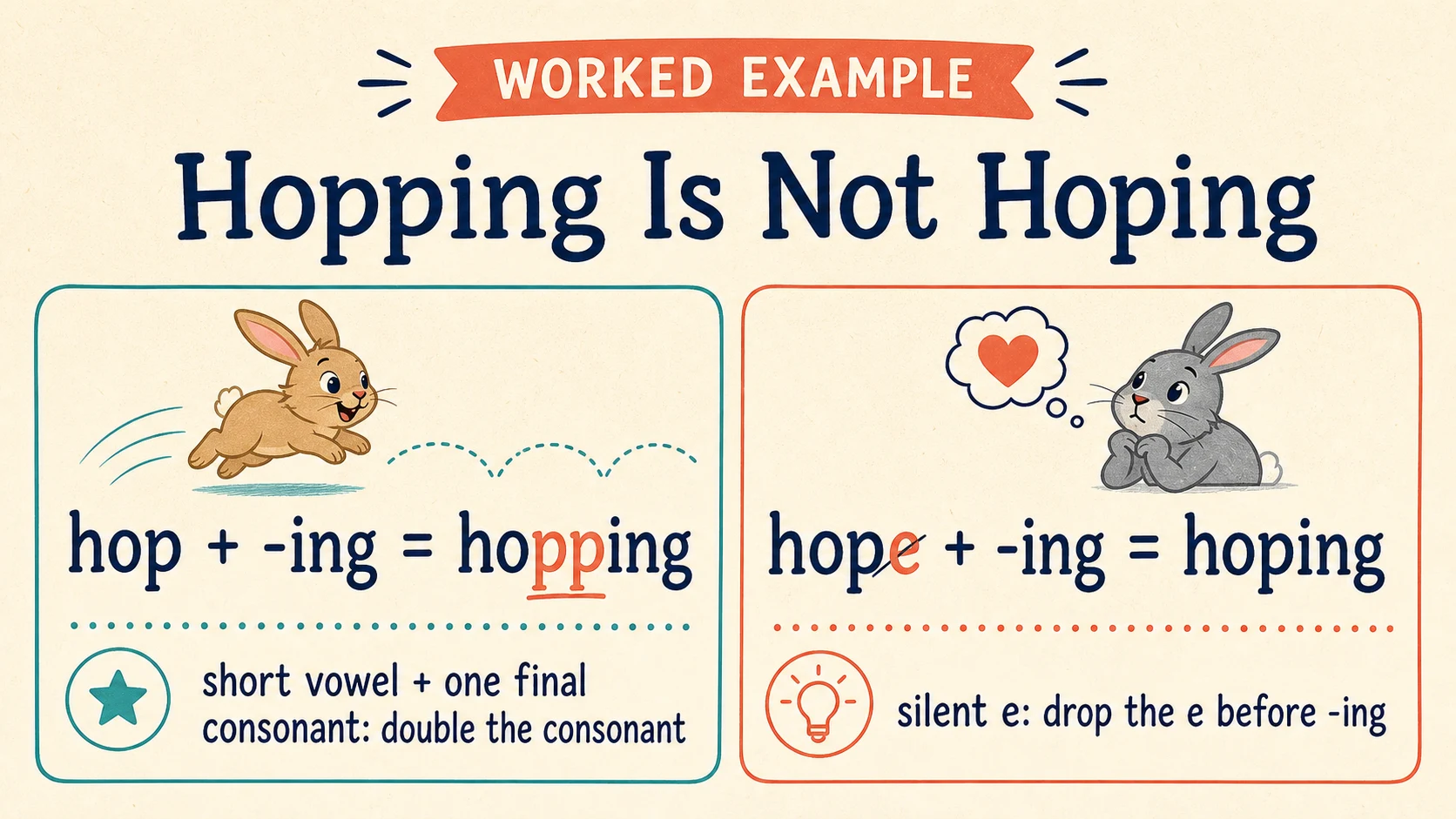
Make the model show the spelling decision—base word, changed ending, and final check—rather than only displaying the answer.
Prompt a learner think-aloud
Give a parallel item and ask, “What will you check first?” Avoid turning the think-aloud into a guessing performance. The learner may tap syllables, stretch a word, name a base, point to a vowel team, or compare two candidate spellings.
Useful prompts include:
- “Say the word normally. Now say it slowly without distorting it.”
- “Which letters represent that sound?”
- “Is there a base word you know?”
- “What changed when the ending was added?”
- “Which part are you least sure about?”
- “How could you check that part?”
If the learner says, “I just know it,” ask for one visible verification rather than demanding a rule that may not apply cleanly.
Try a short independent set
Use three to six items that share the target but vary enough to reveal whether the learner is applying a relationship. Include one previously seen word, one close comparison, and one new example when the sheet supports that selection.
Do not intervene after the first hesitation. Allow a complete attempt, then ask the learner to mark the uncertain part with a dot. This separates uncertainty from unnoticed error.
Check immediately and record the next decision
Compare each attempt with the model while the reasoning is still available. Ask the learner to circle the first point of difference. Record the error form, not merely the number wrong.
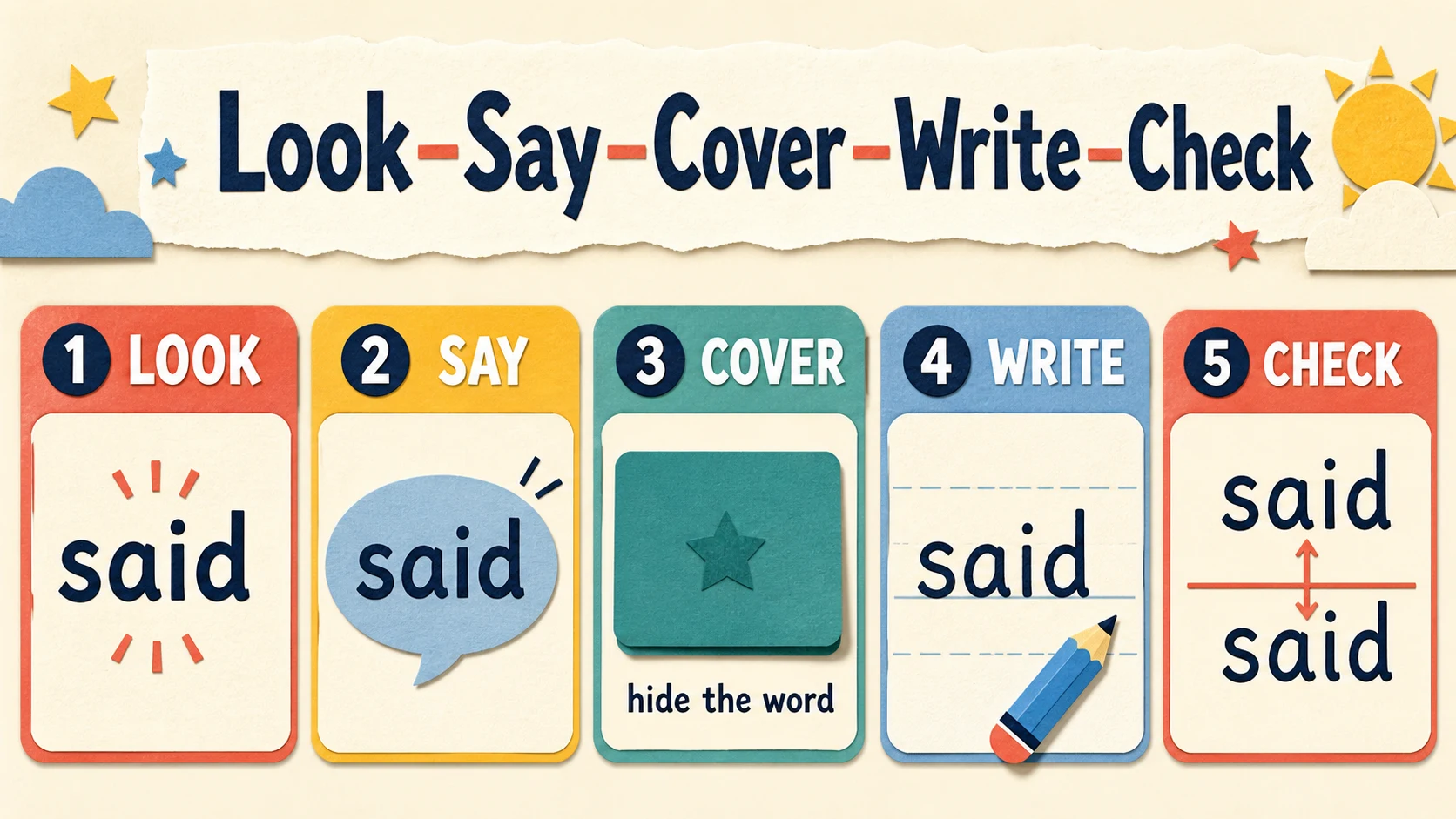
For early spelling work, repeat a compact cycle: hear it, build it, explain it, write it, and choose the next prompt from the response.
Interpret the error before choosing the correction
A red mark says that two strings differ. It does not say why. Immediate interpretation means comparing what the learner heard, wrote, noticed, and could explain.
Omitted, substituted, or reordered sounds
Suppose a first-grade learner hears stop and writes sop. The checked comparison is:
- Target: s-t-o-p
- Attempt: s-o-p
- Difference: medial /t/ is omitted
Ask the learner to say stop, then move one counter for each sound: /s/ /t/ /o/ /p/. Build the word with tiles before writing it again. Preserve the target—representing the consonant blend—while reducing handwriting and memory demands.
This example belongs with the 1st Grade Spelling Words guide and free sheet because short vowels and early sound-to-letter work are among the catalogue’s stated spelling patterns, and a four-sound word exposes whether both consonants in the initial blend are represented. It does not diagnose a reading or language condition. One response may reflect a rushed attempt, uncertainty about the blend, or difficulty holding the sequence; the next two or three comparable words provide better instructional evidence.
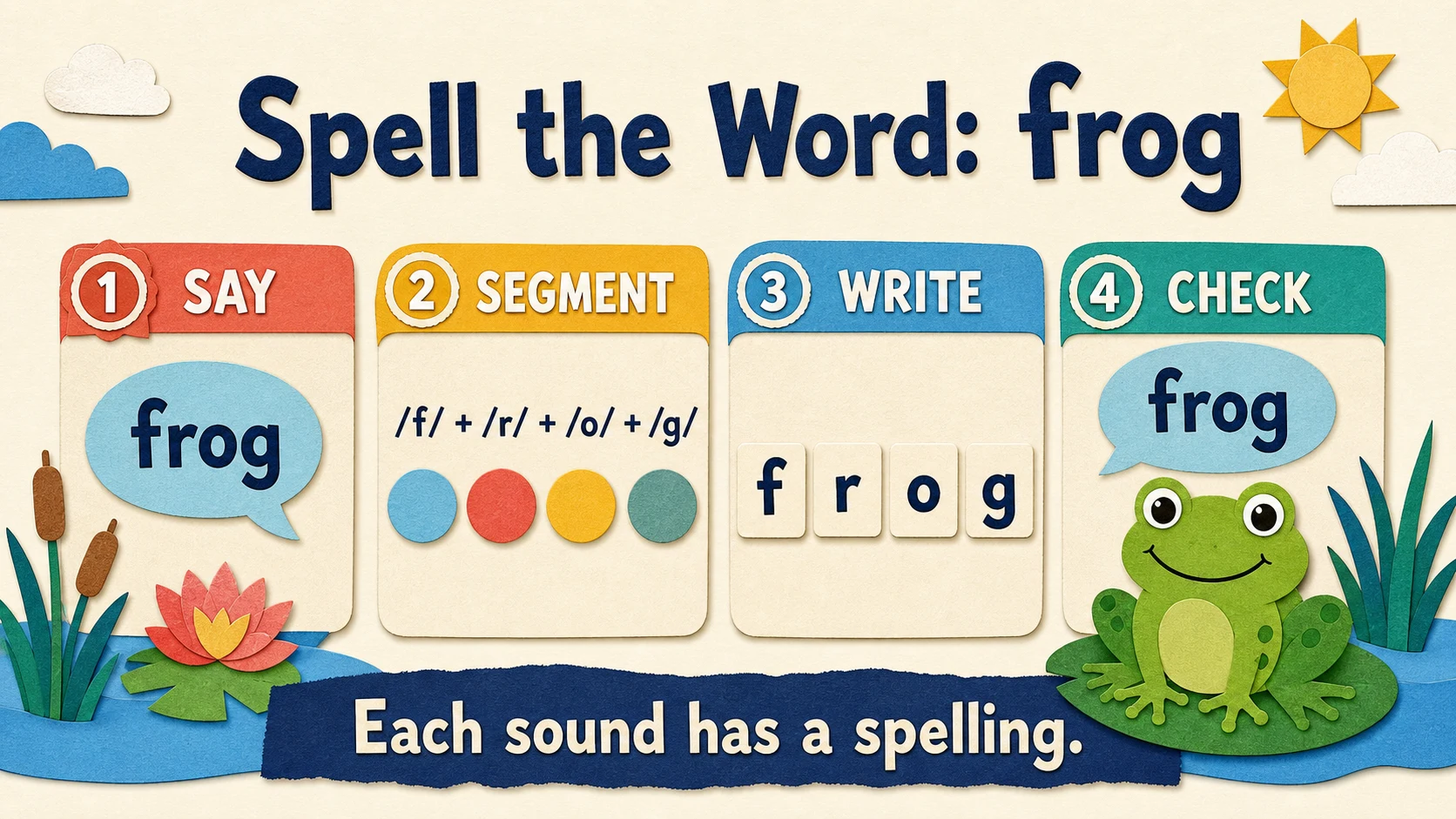
An early worked example should connect the spoken sound sequence to movable letters before asking for an unsupported written response.
Plausible sound spelling but wrong conventional pattern
If a learner writes rain as rane, every major sound is represented, but the selected long-a spelling is not conventional for this word. Do not respond, “You don’t know long vowels.” Say, “Your spelling gives me the sounds in rain. The part to investigate is the vowel spelling.”
Place rain beside train and paint, then contrast cake and name. Ask the learner to identify ai in the first group and a-e in the second. Follow with one dictated word from each group. If sorting is accurate but dictation is not, the next sheet should retain the two patterns and change the response from recognition to recall.
The 2nd Grade Spelling Words guide and free sheet is a reasonable catalogue entry point for exploring such pattern work, but the grade label is not a placement decision.
Base-word or suffix change
Consider running written as runing. The learner has represented the spoken word recognizably but omitted the doubled n. Compare:
- run + n + ing = running
- hope − e + ing = hoping
Ask the learner to read runing as though the single consonant and preceding vowel followed the same visual relationship seen in words such as hoping. Then return to the base run. The next task should contrast a small number of short-vowel base words that double with final-e words that drop the e. It should not mix prefixes, silent letters, and unrelated multisyllabic words.
This example is appropriate to the catalogue because suffixes and consonant doubling are explicitly represented. The instructional suggestion—contrast the two transformations and ask the learner to articulate the base—is an editorial application, not a claim that an approved source evaluated these worksheets.
Correct in isolation, incorrect in a sentence
A learner may spell because correctly in look-cover-write-check and then write becaus during sentence dictation. That does not erase the first success. It shows that retrieval changed when attention was shared across meaning, handwriting, spacing, and punctuation.
Repeat a shorter sentence, allow a planning pause, and ask the learner to underline the target word before checking. If the spelling returns, preserve sentence practice but reduce sentence length. If it remains incomplete, return briefly to word-level recall and then try a new short sentence.
The IES foundational reading practice guide recommends systematic work connecting sounds, letters, and word analysis in early literacy instruction. That supports examining the internal structure of a word rather than treating every error as a failure to memorize. It does not establish which WorksheetWise sheet a particular learner should use.
Give feedback that causes another spelling decision
Effective tutoring feedback should direct attention to the useful part of the attempt and require a new decision. “Wrong—copy it three times” may produce three accurate copies without revealing whether the learner can hear, explain, or retrieve the spelling.
Use a three-part response:
- Name what the attempt preserved.
- Locate the part that needs attention.
- Ask for a specific check or reconstruction.
For rane:
“You represented /r/, /ā/, and /n/. Check the letters that spell /ā/ in this word. Compare it with train.”
For stop → sop:
“Your first and last sounds are in place. Move a counter for every sound and find the sound between /s/ and /o/.”
For hopeing:
“You kept the base word hope. Now show what happens to final e before -ing.”
After correction, request one delayed retrieval rather than immediate copying alone. Cover the model, discuss another item for 20–30 seconds, and return to the word. A correct delayed response is more informative than copying from a visible answer.
The catalogue’s teaching guidance suggests locating the incorrect part, repeating missed words, keeping a word-study record, reviewing earlier patterns, and connecting spelling with reading. These are supplied catalogue suggestions. Separately, the IES elementary writing practice guide emphasizes explicit strategy instruction, gradual release, and regular opportunities to write. In tutoring, those principles support modeling the checking process and then handing the decision back to the learner. They should not be represented as a review or endorsement of WorksheetWise.
Let the error trail choose the next sheet
A session note should be short enough to use and specific enough to change instruction. Avoid entries such as “spelling weak” or “got 7/10.” Record four things:
- Target: the spelling relationship or response demand
- Prompt: what the learner was asked to do
- Observation: the exact attempt and any explanation
- Next action: the smallest useful change in task or support
A usable note might read:
Target: Long-a spellings ai and a-e
Prompt: Sort six visible words, then spell two from dictation
Observation: Sorted all six; wrote rain as rane and self-corrected cake after pointing to final e
Next action: Begin with rain/train/paint recall; then contrast one a-e word; no mixed vowel review yet
That note leads directly to selection. It says that another picture sort would probably provide redundant evidence, while an undifferentiated 25-item packet would add unnecessary variables.
Use a two-session handoff
In Session 1, model the target, observe three to six attempts, and select two review words. In Session 2, begin without displaying the original model. If both review words are spelled and explained, move to a new example or sentence application. If the same error returns, restore the support that addresses that error: tiles for a missing sound, a contrast column for competing patterns, a base-word equation for a suffix change, or a shorter sentence for divided attention.
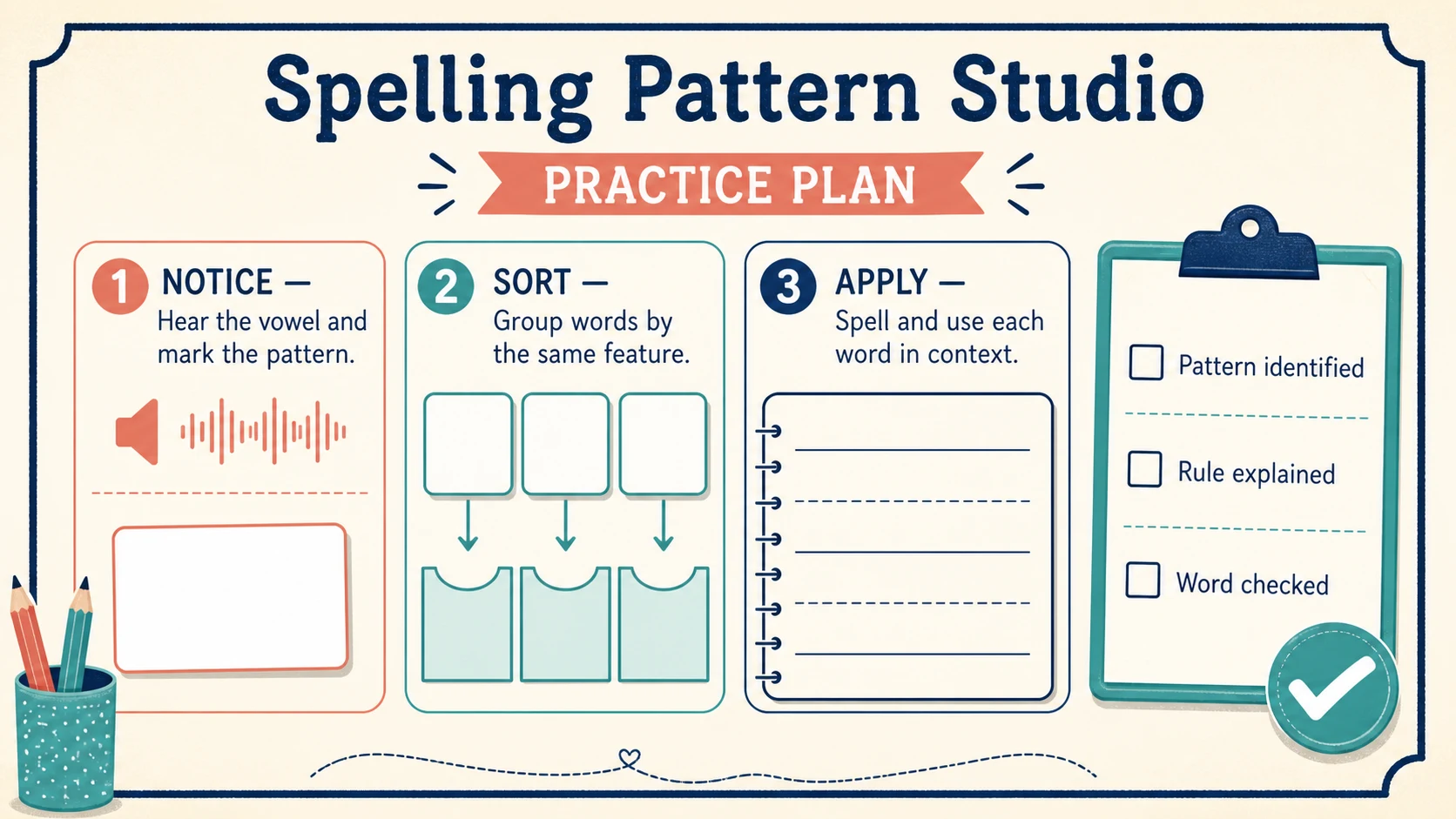
A plan across sessions should revisit the observed spelling decision in a new response format, not merely repeat the same page.
The representative 3rd Grade Spelling Words guide and free sheet contains 25 problems. One possible tutoring plan is to use only the subset relevant to the current note, then reserve unmatched items for later review. That is an editorial recommendation based on one-to-one interpretability, not a sourced rule about an ideal number of problems.
Adapt access without replacing the spelling target
Adaptation should remove an obstacle that is not the focus while keeping the spelling decision intact.
If handwriting is slowing the response, use letter tiles, magnetic letters, oral letter naming, or typing. If visual tracking is difficult, cover the rest of the sheet and reveal one row. If working memory is overloaded by sentence dictation, repeat the complete sentence, then dictate it in meaningful phrases. If the learner is distracted by a crowded word bank, cut it into cards. If speaking the whole word is uncomfortable, allow pointing, sorting, or constructing before requesting an explanation.
For ages three and four, prioritize brief adult-led oral, matching, manipulative, and movement work over desk work. A tutor might say map and moon, ask the child to step onto the picture beginning with /m/, and then match a movable m to both pictures. If the target is hearing an initial sound, requiring a full written word would add demands that obscure that target. Age remains a discovery aid, not a placement decision, and early activities should remain short and responsive.
Do not “adapt” a silent-letter task by removing all silent-letter words, or a suffix task by allowing the learner to copy every completed word indefinitely. Instead, move along a support ladder: visible model, partial model, manipulatives, oral rehearsal, covered model, independent response.
Know what a worksheet cannot establish
A spelling worksheet captures performance under particular conditions. It cannot by itself establish a diagnosis, explain the cause of persistent errors, or guarantee transfer into everyday writing. It also cannot show whether a learner knew a word yesterday, encountered it in a local curriculum, understood its meaning, or was affected by fatigue, attention, language familiarity, vision, hearing, or motor demands.
Do not promise outcomes from completing a packet. Do not infer standards mastery from a single sheet. The Common Core English Language Arts standards include grade-linked expectations involving spelling patterns, conventions, and use of reference materials, but local sequences and adopted standards differ. Worksheet grade labels describe intended practice levels; they are not proof of alignment for a school, district, or learner.
Escalate questions appropriately when errors remain broad, persistent, or difficult to interpret across several supported attempts. Share neutral evidence with the learner’s teacher or relevant professional: exact words, response formats, supports given, self-corrections, and changes across sessions. Avoid diagnostic labels.
A tutor should also distinguish spelling instruction from phonics instruction. They overlap, especially when analyzing sounds and letter patterns, but the immediate goal may differ. If the main uncertainty is hearing or blending sounds before writing them, the Tutoring Phonics Worksheets collection may provide a more focused next resource. If the learner can spell target words but struggles to use them within complete sentences, Tutoring Grammar Worksheets may address the separate sentence-level need without pretending it is the same spelling problem.
Make the next session observable now
Choose one live grade entry point from the full worksheet library, using grade as a discovery aid. Preview the word features and response format before printing. Then write one observation question at the top, such as: “Does the learner distinguish ai from a-e when the word is no longer visible?”
During the session, model one item, collect three independent responses, circle the first differing part in each error, and finish the four-part note: target, prompt, observation, next action. Use that note—not the number of unfinished problems—to select the following sheet.
Put it into practice
Use the guide with a real printable
Move from explanation to a short, observable practice task. Check the first item together, then adjust the next session from the learner's actual work.
Open the first free worksheetExplore a neighboring collection