What Pre-K Word Families Means
Pre-K Word Families instruction helps a learner notice that several words can share the same ending pattern. In cat, bat, hat, mat, and sat, the beginning changes while -at stays the same. The beginning part is the onset; the shared ending is the rime.
The concise answer is this: begin with listening and rhyming, connect a familiar ending such as -at to its letters, and build a few words by changing one initial sound. Keep the ending visible and stable. Move to independent worksheet practice only when the learner can hear the pattern, identify the changing beginning, and blend the parts without substantial prompting.
Word families can reduce the amount of new information a beginning reader handles at once. After learning to blend /m/ + /at/ as mat, the learner can reuse -at while trying cat or sat. This is a teaching route into word analysis, not a replacement for systematic letter-sound instruction.
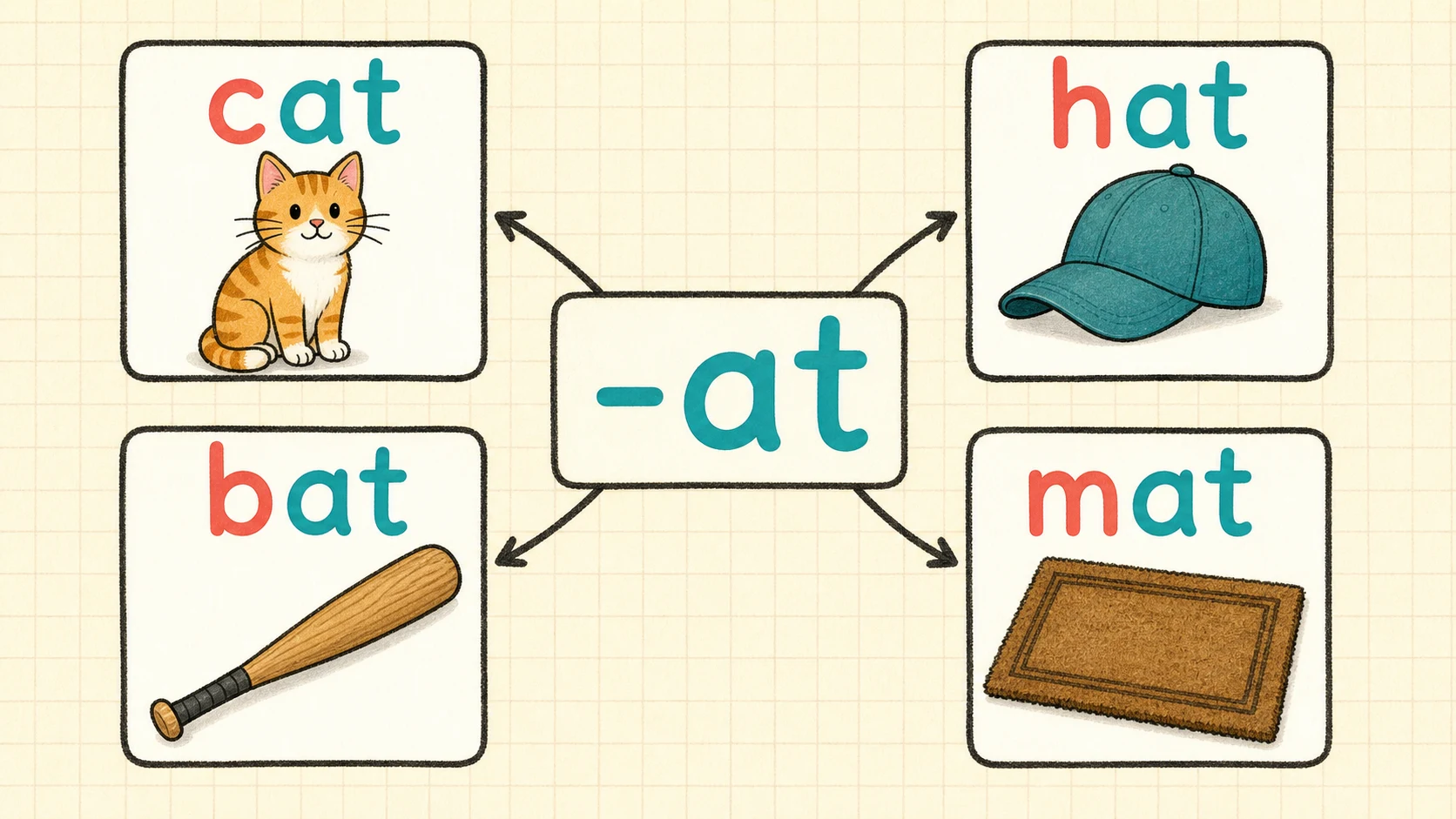
The skill connects listening, letter-sound knowledge, onset-rime blending, pattern recognition, word building, and early reading.
Grade labels describe the intended practice level; local curricula and instructional sequences differ. The Common Core English Language Arts standards place rhyming and spoken onset-rime work in kindergarten-level foundational skills, but that does not create a universal Pre-K timetable. A Pre-K learner may be ready for an informal introduction, may need more oral-language preparation, or may already be able to build simple words. The learner’s observed work should determine the pace.
Prerequisites to Check Before Teaching Word Families
A child does not need conventional reading fluency before exploring word families. However, several underlying abilities make the work meaningful rather than mechanical.
Listening for rhyme
Say cat, sun, hat without showing print. Ask which two words sound alike at the end. A learner who selects cat and hat is attending to the shared sound pattern. If the child chooses by meaning or beginning sound, spend more time with oral rhyme before asking for written family names.
Use familiar, easily pictured words. Two or three options are enough. Accept pointing, moving picture cards, or saying the words; handwriting should not become the test of listening.
Recognizing relevant letters and sounds
For an -at activity, the learner benefits from recognizing a, t, and at least a few initial consonants. Check sounds in isolation:
- Show m and ask for its usual sound.
- Show s and ask for its usual sound.
- Place a and t together and model the ending.
- Ask the learner to repeat /at/ before adding an onset.
If several needed letter-sound correspondences are uncertain, teach or review those first. The Pre-K phonics collection can help an adult select practice closer to the learner’s current need.
Blending two spoken parts
Test blending without print: say /m/ … /at/, then ask the learner to put the parts together. Repeat with /s/ … /at/. The goal is to produce mat and sat, not to name the individual letters.
A child who can rhyme but cannot blend an onset with a rime needs oral blending practice. A child who blends orally but becomes stuck when letters appear needs help connecting sounds to print.
Handling the response format
The free worksheet asks learners to fill in missing letters. That task also depends on understanding the directions, looking across a printed word, and making a written or selected response. A learner may understand the word family yet lack the fine-motor control to write the answer neatly. Let the child point to a letter tile, place a magnetic letter, dictate the answer, or trace over a model when handwriting would hide the phonics knowledge.
A Grade-Appropriate Progression
The progression below is an instructional suggestion based on the supplied catalogue sequence. It is not a universal schedule. Advance when the child is accurate with light support, and step back when guessing replaces listening.
| Stage |
Adult presents |
Learner does |
Evidence for moving on |
| 1. Hear the ending |
Spoken words or pictures |
Finds two words that rhyme |
Consistently attends to endings rather than meanings or first sounds |
| 2. Blend orally |
An onset and rime, such as /c/ + /at/ |
Says the whole word |
Blends several familiar combinations without seeing print |
| 3. Match sound and print |
A visible ending such as -at |
Says or identifies the ending |
Connects the printed chunk with its spoken form |
| 4. Build one family |
Fixed -at plus movable consonants |
Makes and reads cat, hat, mat, sat |
Changes the onset while keeping the rime stable |
| 5. Complete words |
A partially written word or picture cue |
Supplies the missing letter or letters |
Explains the answer by blending, not only by naming the picture |
| 6. Sort two families |
Mixed words from familiar families |
Groups by ending pattern |
Checks both the sounds and printed endings |
| 7. Read in context |
A short controlled sentence |
Reads family words within the sentence |
Recognizes the pattern without losing the sentence’s meaning |
| 8. Extend carefully |
A familiar family with ch-, sh-, or fl- |
Blends a more complex onset and the known rime |
Handles the added onset sounds without confusion |
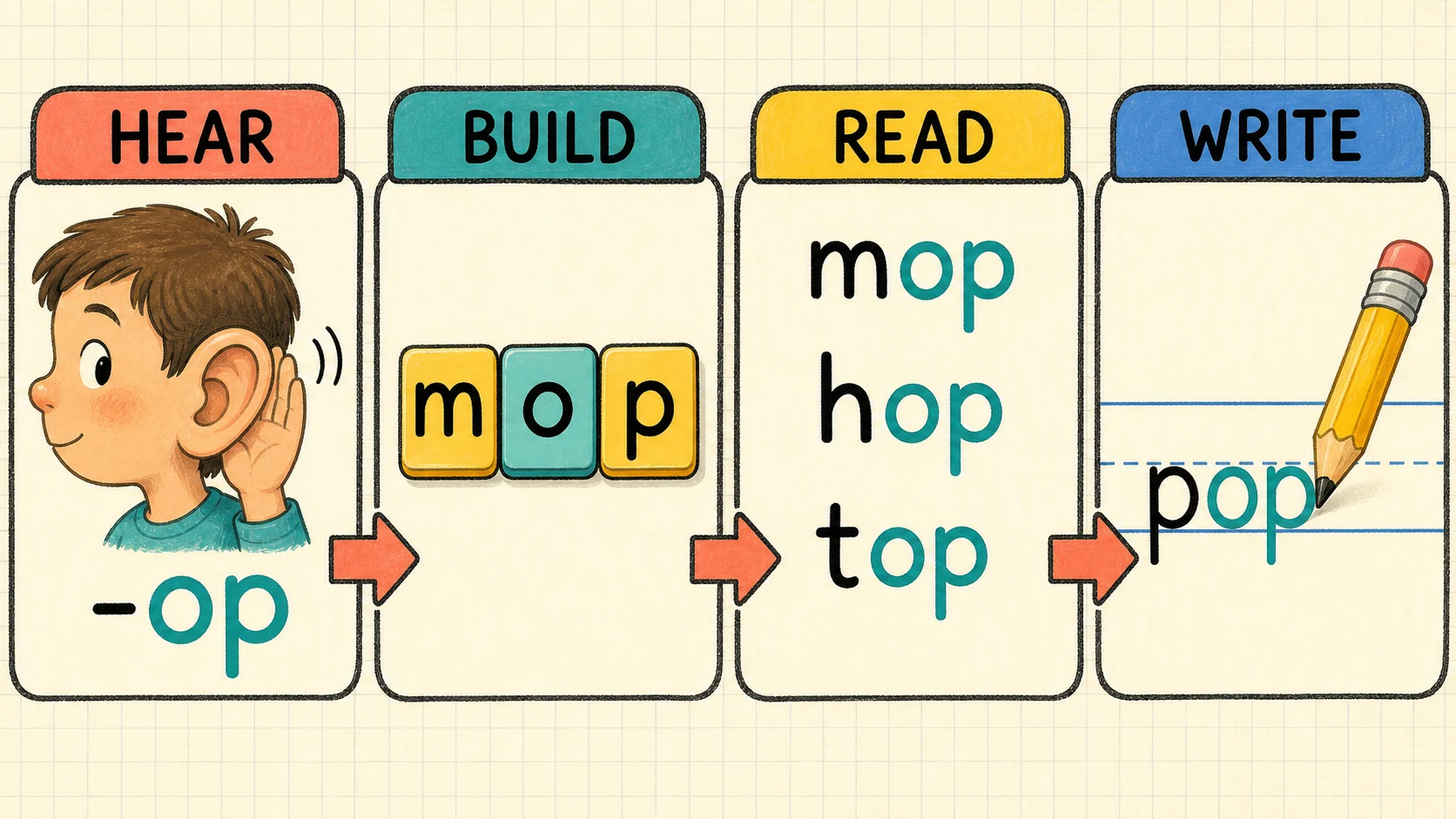
Oral work and movable letters provide support before missing-letter exercises and independent sorting.
The supplied teaching sequence begins with common short-vowel families: -at, -an, -am, -ap, -ad; -it, -in, -ig, -ip, -id; -ot, -op, -og; -ut, -ug, -un, -up; and -et, -en, -ed. That is a menu, not a requirement to teach every family at once. For an initial Pre-K lesson, one family and three or four words are enough.
The Common Core English Language Arts standards provide a later reference point for recognizing rhymes and blending or segmenting onsets and rimes in spoken single-syllable words. They do not certify this guide, evaluate WorksheetWise materials, or require every Pre-K learner to complete the same sequence.
Concrete and Visual Models
Young learners benefit from seeing exactly what stays the same and what changes. Keep the model uncluttered.
A word-building strip
Write -at on a card. Prepare separate cards for c, h, m, and s. Place one onset card before the ending:
m + at → mat
Slide m away, replace it with s, and read again:
s + at → sat
Use one color for the changing onset and another for the fixed rime. Color is a visual support; the learner must still listen and blend.
A word-family house
Write -ig on the roof of a simple house. Place big, dig, pig, and wig inside. Ask what every word shares. Then cover one word’s first letter and ask the learner to predict what kind of information is missing: the changing beginning or the fixed ending.
A family house is most useful after the learner has built the words. If the completed display is introduced first, a child may memorize where pictures belong without analyzing sounds or letters.
A picture, word, and sound check
For mop, show or draw a mop, build m-op, and say the word slowly. Ask three short prompts:
- “What is the picture?”
- “What sound begins mop?”
- “What ending do you see and hear?”
This separates vocabulary, onset identification, and family recognition. If the learner cannot name the picture, supply the name before testing the phonics skill.
The Pre-K grade hub can be used to choose related early-learning work when the learner needs more letter recognition, listening, or fine-motor practice before a full word-family page.
Fully Checked Worked Examples
Each example below checks the sounds, the letter pattern, and the completed word. The examples use regular, familiar combinations from the supplied families.
Example 1: Build mat from -at
Given: the ending -at, the initial letter m, and a picture of a mat.
- Say the onset sound: m represents /m/.
- Say the rime: -at represents /at/ in this word.
- Blend the parts: /m/ + /at/ = mat.
- Join the letters: m + at = mat.
- Check the picture and meaning: mat is a real word and matches the picture.
Answer: mat
Now replace m with s. The ending remains -at:
/s/ + /at/ = sat
This creates sat, not another object in the same picture category. Word-family membership comes from the shared ending pattern, not from shared meaning.
Example 2: Complete p_g in the -ig family
Given: p_g, a pig picture, and the target family -ig.
- Name the picture: pig.
- Listen to the ending: /ig/.
- Compare the printed letters with -ig. The word already contains p and g.
- Supply the missing vowel i.
- Read the completed word: /p/ + /ig/ = pig.
- Verify the spelling: p-i-g ends with the letters i-g.
Answer: pig
A picture guess alone is not enough. The final check is that the sounds and letters produce pig.
Example 3: Decide whether hop belongs with mop
Given: hop, mop, hat.
- Read or repeat hop and mop.
- Isolate their beginnings: /h/ and /m/.
- Isolate their shared ending: both end in /op/.
- Check the print: both end in o-p.
- Compare hat. It ends in /at/ and the letters a-t.
Answer: hop and mop belong to the -op family. Hat does not.
This is a two-part check: the words share the spoken rime and the printed ending.
Example 4: Complete _un
Given: _un, a picture of the sun, and the choices s, m, t.
- Name the picture: sun.
- Say the target ending: /un/.
- Test s: /s/ + /un/ = sun.
- Test m: /m/ + /un/ = mun, which does not match the target picture or intended word.
- Test t: /t/ + /un/ = tun, which also does not match the target.
- Insert s and read sun.
Answer: s, making sun.
The check matters because choosing a visually familiar letter is not the same as blending the word.
Example 5: Extend -at with a digraph
Given: the onset ch- and the familiar rime -at.
- Treat ch as the complete onset for this task.
- Say /ch/.
- Keep the known ending /at/.
- Blend: /ch/ + /at/ = chat.
- Check the spelling: ch + at = chat.
Answer: chat
This is an extension, not the starting point. If the learner tries to pronounce c and h separately and cannot blend the result, return to single-consonant onsets before teaching the digraph.
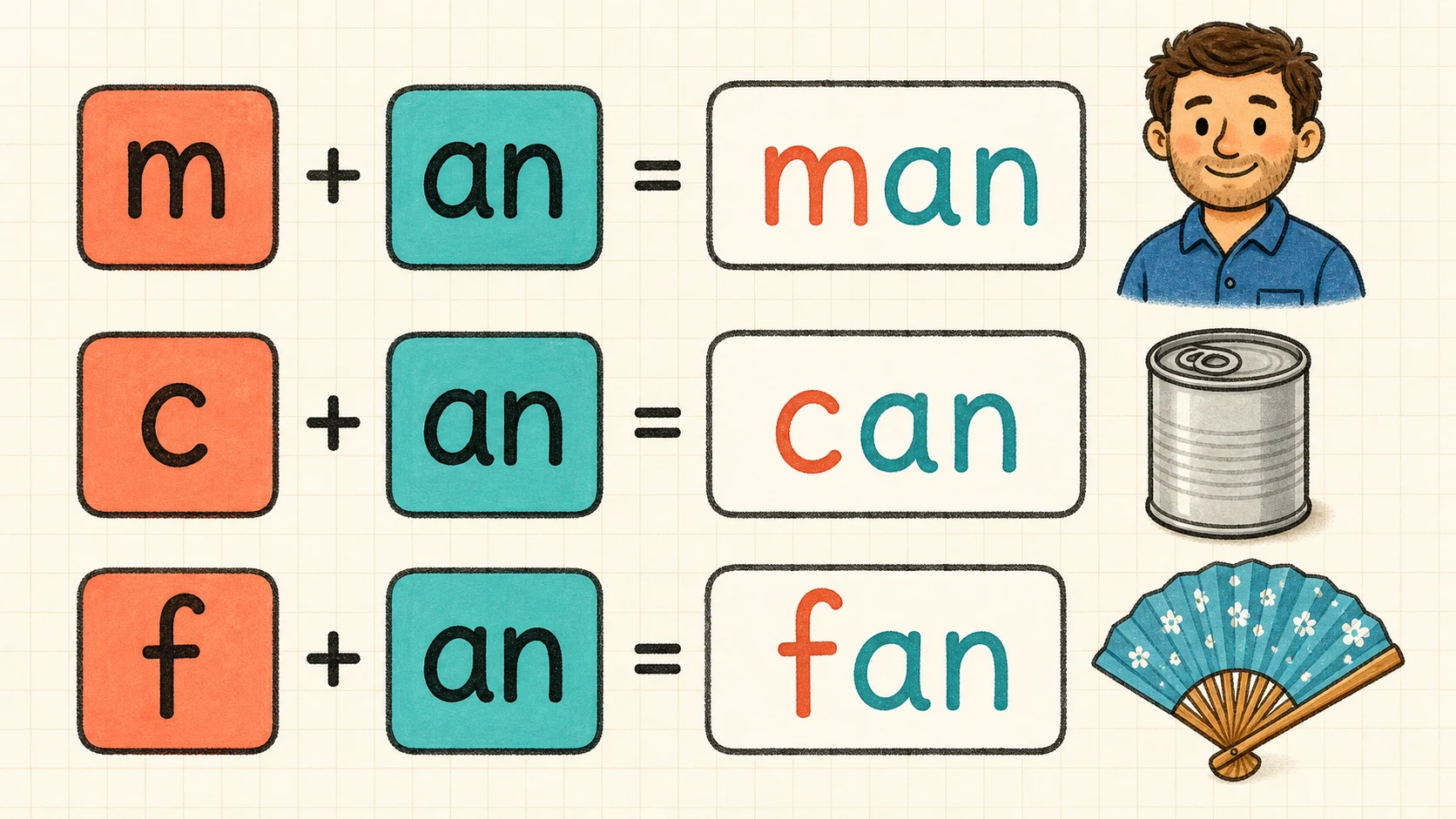
The learner hears the parts, builds the word, reads it, and verifies that the answer fits both print and meaning.
Boundary Cases and Misconceptions
Same meaning does not make a word family
Cat and dog are both animals, but they do not share an ending pattern. Cat and hat belong together for an -at activity even though one is an animal and the other is clothing.
Ask, “Do these words end the same?” rather than, “Which words go together?” The second prompt can invite a meaning-based sort.
Same first sound does not make a word family
Pig and pop both begin with p, but their endings differ. Pig belongs with dig in -ig; pop belongs with mop in -op.
Cover the first letter and compare what remains. This makes the relevant feature visible.
A matching picture is not proof of decoding
A child may call a picture “cat” and write c without reading the printed pattern. After the answer is filled in, point under the onset and rime and ask the child to blend them. If the child cannot, record the response as a correct picture identification but an unfinished decoding step.
Similar letters are not necessarily the same rime
-in and -ig both begin with i, but their final consonants and spoken endings differ. A sort involving those families requires attention to the whole ending, not only the vowel.
Word-family practice is not whole-language memorization
The aim is not to memorize a chant such as “cat, bat, hat” while ignoring letters. Change the order, introduce a new supported combination, and ask the learner to show which part stayed fixed. Successful transfer is stronger evidence than reciting a rehearsed list.
More complex onsets change the task
Chat and flat share -at with cat, but ch- and fl- place additional demands on the learner. Keep those words for extension after single-consonant onsets are manageable. Difficulty with flat does not necessarily mean the child has forgotten -at; the onset may be the obstacle.
A Short, Repeatable Lesson Routine
A focused lesson can be brief. End while the learner is still attending, and use observed accuracy rather than a fixed number of minutes.
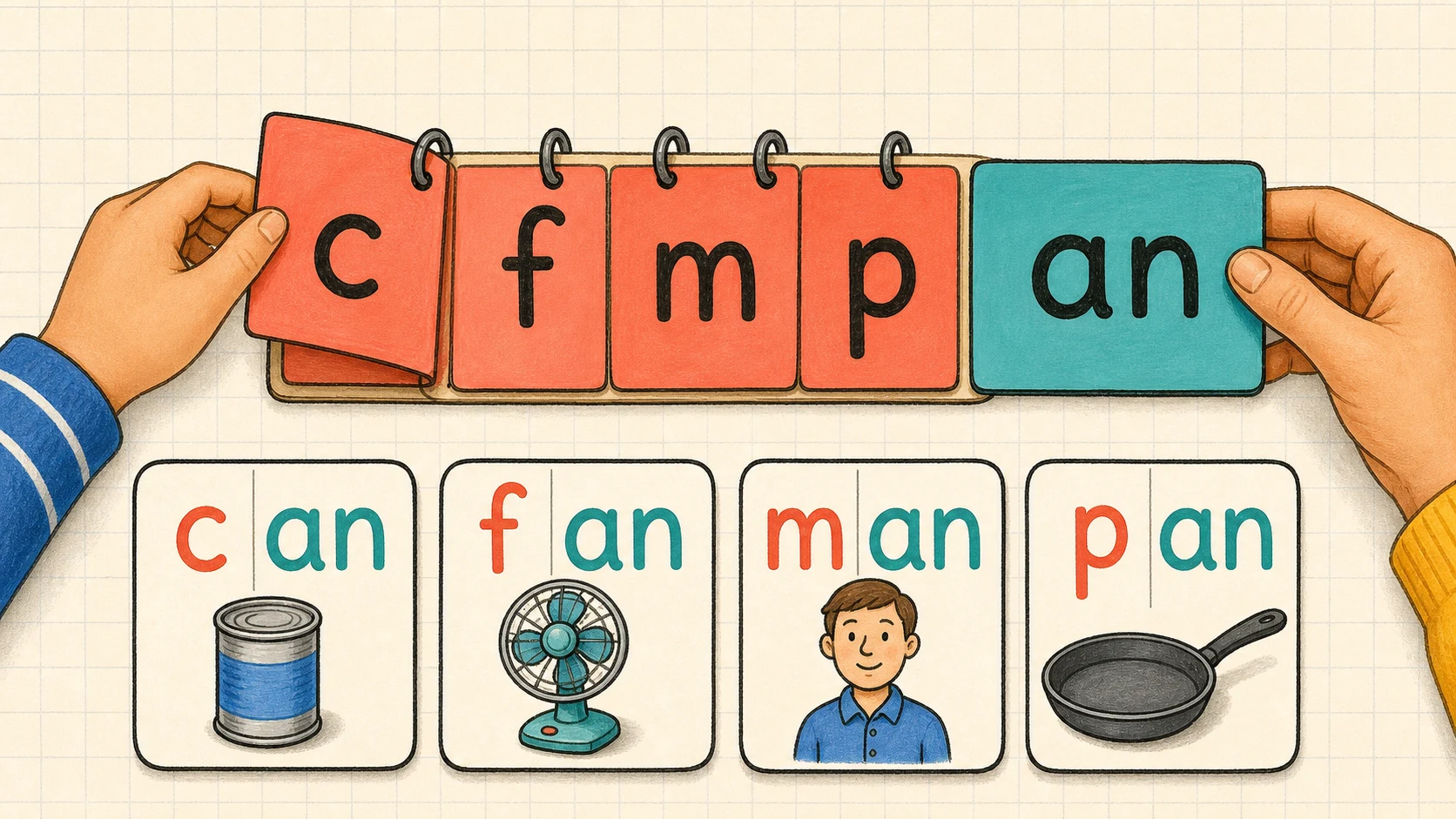
The routine moves from hearing to building, reading, checking, and a small amount of independent practice.
1. Listen
Say three words, such as cat, hat, sun. Ask which two rhyme. Do not show print yet.
2. Reveal the pattern
Show -at. Say, “These words have the same ending sound and the same ending letters: -at.” Have the learner trace under the ending while saying it.
3. Build and change
Place m before -at. Blend mat. Replace m with s, then c. After each change, ask:
- “What changed?”
- “What stayed the same?”
- “What word did we make?”
4. Read and verify
Mix the three completed words. Have the learner read them in a new order. Use pictures only if vocabulary or recall blocks the response.
5. Complete one or two items
Present a missing-letter item such as _at with a cat picture. Let the learner choose or write c, then blend the completed word.
6. Close with retrieval
Remove the materials and ask, “What ending did we practice?” If the learner cannot recall it, show -at and repeat one successful blend. The purpose is a calm check, not a high-pressure test.
The IES foundational reading practice guide addresses kindergarten through third grade and provides broader instructional framing for sound-letter relationships, blending, and word reading. Its age range means it should be treated as a view of later foundational reading instruction, not as proof that every Pre-K child should follow this lesson or complete a worksheet independently.
Choosing the Right Practice
Choose practice by the response the learner can produce now.
| Observed performance |
Appropriate next practice |
Avoid for the moment |
| Cannot identify rhyming pairs |
Oral rhyme matching with two or three pictured choices |
Written family sorts |
| Hears rhyme but does not know needed letters |
Brief letter-sound review plus one visible rime |
Pages containing many unfamiliar onsets |
| Blends orally but not from print |
Movable onset cards joined to one printed ending |
Independent missing-letter work |
| Builds three or four words in one family |
A few missing-letter items from that same family |
Mixing many new families |
| Confuses two known families |
A two-column sort with clearly different endings |
Adding a third family |
| Completes items accurately but slowly |
Repeated reading in changed order; a short controlled sentence |
Advancing merely to create novelty |
| Reads simple family words readily |
Families with a supported digraph or blend onset |
Assuming every complex onset will be easy |
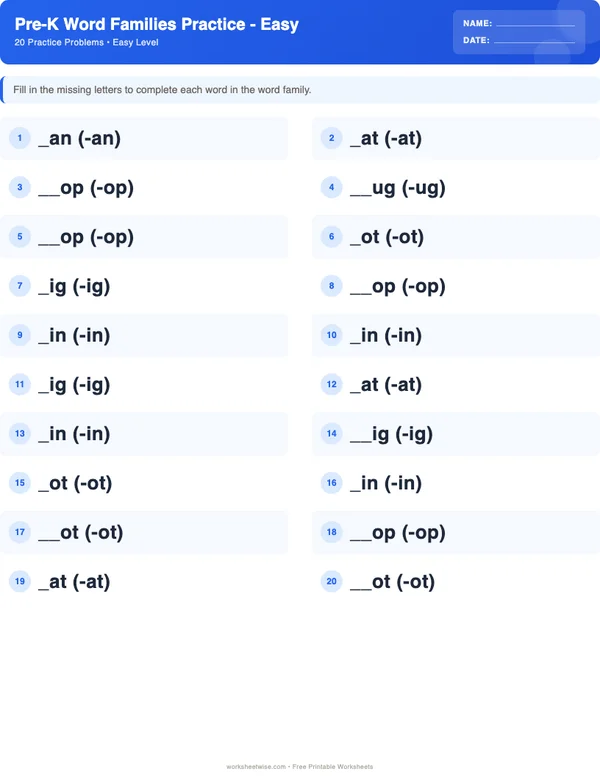
The free Pre-K Word Families worksheet contains 20 easy-level exercises in which learners fill in missing letters. It practices word patterns, onset and rime, rhyming, and word building, with a separate printable answer key. A 20-item page does not have to be completed in one sitting. Fold the page, cover unused rows, or select only the items matching the family already taught.
For broader repeated practice, the focused Pre-K Word Families pack contains 18 worksheets. More pages are useful only when they match an identified need. Repeating an error across many items does not replace reteaching.
Differentiation Without Changing the Goal
Increase support
Keep the learning goal—recognizing and building a shared ending—but reduce unrelated demands:
- Say the picture name before asking for the missing letter.
- Offer two letter choices instead of an open response.
- Let the learner place a tile rather than write.
- Use one family per lesson.
- Keep the rime card fixed while changing onsets.
- Blend together first, then ask the learner to repeat.
- Complete alternate worksheet items rather than every item.
Reduce support
When performance is accurate:
- Remove the picture after naming it once.
- Mix the order of familiar words.
- Ask the learner to explain what stayed the same.
- Sort two known families without headings, then add the labels.
- Present a new, regular combination using a known onset and rime.
- Read a short sentence containing practiced words.
The supplied sentence example, “The fat cat sat on a mat,” gives several -at words in context. It should follow successful word-level blending. Reading the sentence is not required to prove that the child understands the family.
Separate phonics from handwriting
If the child says the correct missing letter but forms it poorly, note two results: the phonics response was correct, while letter formation needs separate support. Conversely, neat copying does not demonstrate that the child blended the word.
The IES elementary writing guide concerns broader writing instruction for elementary students. It does not evaluate this worksheet or establish a Pre-K word-family sequence. Its relevance here is limited: written production is its own instructional area, so adults should not treat handwriting quality as the sole measure of phonics understanding.
Diagnosing Common Errors
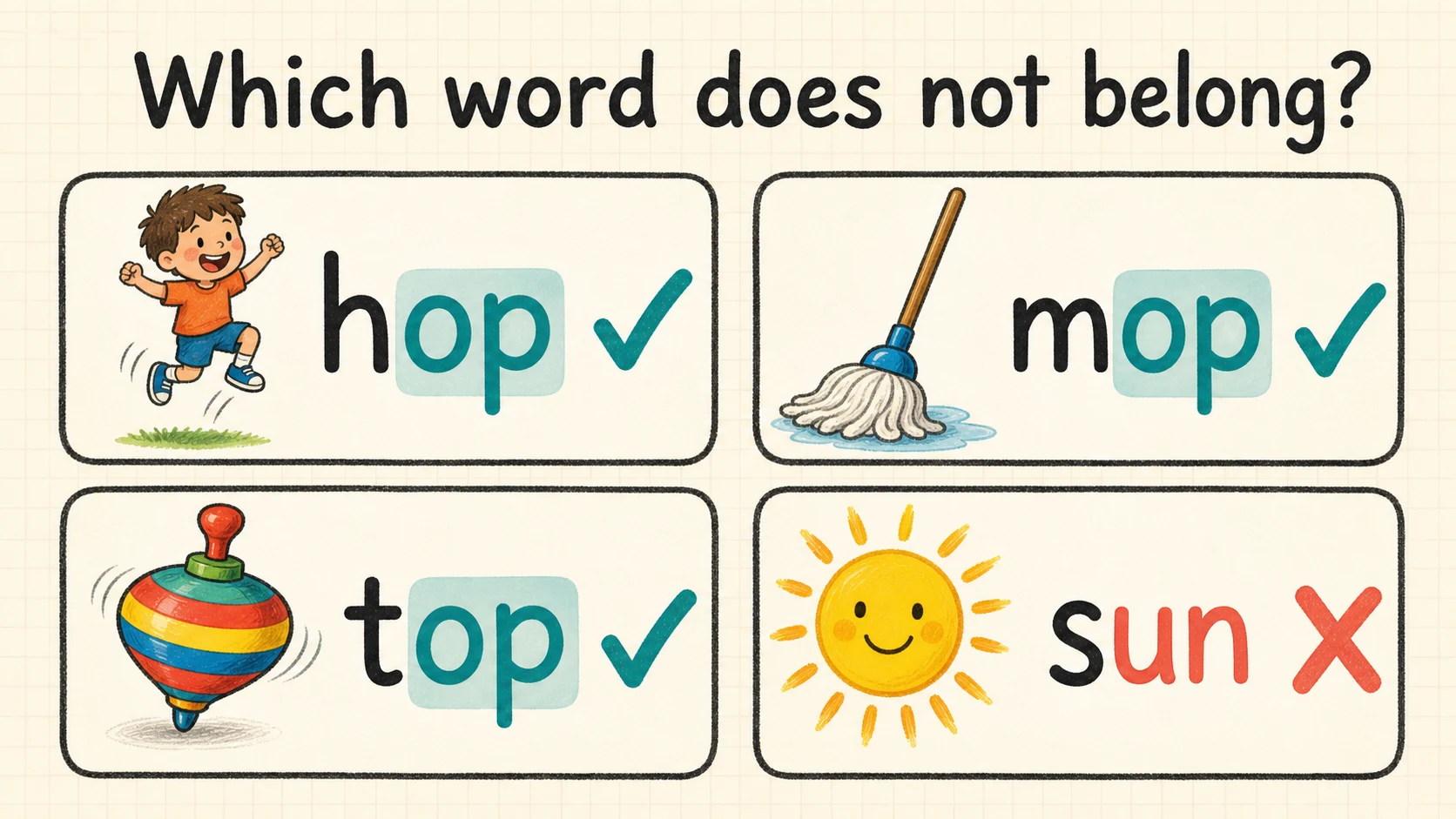
An error is useful evidence when the adult identifies whether the difficulty involves vocabulary, sound attention, blending, print, or the response format.
| Error pattern |
What to check |
Teaching response |
| Chooses words from the same category |
Whether the learner understands “sounds the same at the end” |
Contrast cat–hat with cat–dog using spoken words |
| Sorts by first letter |
Whether the learner is attending to the onset instead of the rime |
Cover the first letter and compare the endings |
| Names the picture but cannot read the result |
Whether the answer came from picture recognition alone |
Point under onset and rime; blend the completed word |
| Says sounds separately without producing a word |
Whether oral blending is secure |
Return to spoken /m/ + /at/ before showing letters |
| Changes part of the fixed ending |
Whether the family chunk is visually stable |
Put the ending on one uncut card and move only the onset |
| Confuses -ig and -in |
Whether the learner hears or sees the final consonant |
Emphasize the last sound and compare g with n |
| Gives no answer for an unfamiliar picture |
Whether vocabulary, rather than phonics, is blocking the task |
Name the picture, have the child repeat it, then analyze it |
| Knows orally but avoids writing |
Whether fine-motor demand is obscuring knowledge |
Permit pointing, tiles, or dictation; teach writing separately |
| Succeeds only in memorized order |
Whether the pattern transfers |
Shuffle known words and introduce one checked new combination |
| Struggles only with chat or flat |
Whether the complex onset is the difficulty |
Return to single-consonant words while keeping -at familiar |
Avoid assigning a cause from one mistake. Repeat the item with a small change, such as removing the picture or offering movable letters. The contrast helps reveal what the learner knows.
Monitoring Progress
Use a simple record rather than relying on whether a page “felt easy.” Once or twice each week, sample a few tasks:
- One oral rhyme match
- Two spoken onset-rime blends
- Two built or completed words from the taught family
- One contrast item from another familiar family
- One explanation of what stayed the same
Record the level of support:
- Independent: correct without a cue
- Light support: correct after the direction is repeated or the parts are pointed out
- Modeled: correct only after the adult demonstrates
- Not yet: response remains inaccurate after support
Also note the error type: vocabulary, rhyme, letter sound, blending, visual pattern, handwriting, or attention to directions. This makes the next lesson easier to choose.
Do not advance solely because the learner finished a page. Move forward when the child can demonstrate the pattern in a slightly different form—for example, building hat after practicing cat and mat, or sorting familiar -at and -op words in a new order.
A Two-Week Practice Plan
This plan assumes short sessions and one initial short-vowel family. It is an instructional option, not a universal timetable. Repeat, shorten, or pause days according to the learner’s work.
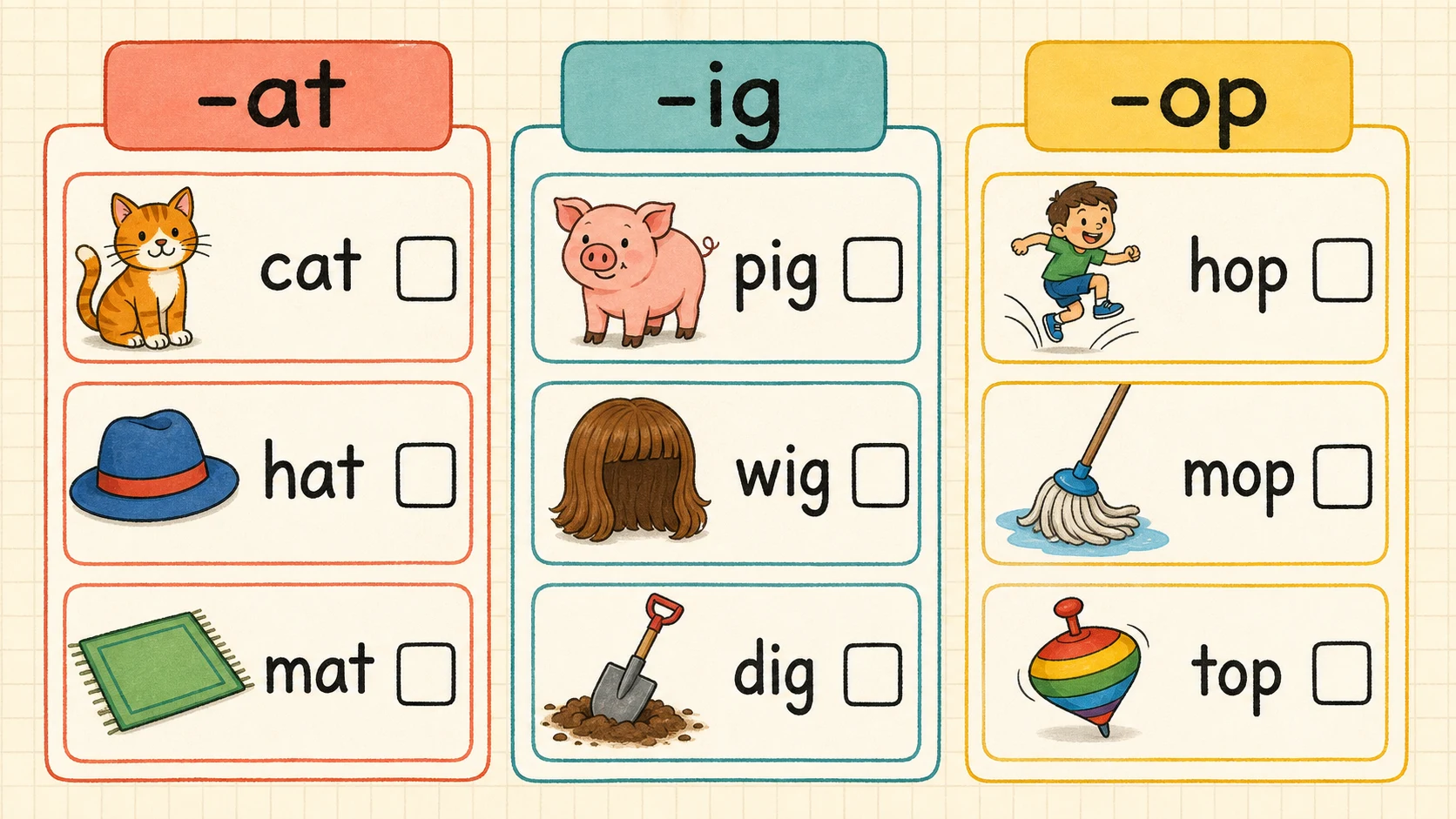
New material is limited, while listening, building, retrieval, sorting, and worksheet practice recur across two weeks.
| Day |
Focus |
Suggested activity |
Decision point |
| 1 |
Oral rhyme |
Match cat with hat rather than sun |
If endings are not heard, remain with oral work |
| 2 |
Introduce -at |
Build cat, mat, sat with movable onsets |
Check that the learner identifies the fixed ending |
| 3 |
Retrieve and rebuild |
Rebuild the same words in a mixed order |
Model again if order changes cause guessing |
| 4 |
Missing onset |
Complete two or three _at items with pictures |
Allow letter choices if open recall is too demanding |
| 5 |
Review |
Oral blend, build, and read three -at words |
Continue -at if support remains heavy |
| 6 |
Introduce -op |
Build hop, mop, pop |
Keep -at available for comparison, not testing |
| 7 |
Contrast families |
Sort practiced words under -at and -op |
Reduce to two words per family if the sort is confusing |
| 8 |
Missing letters |
Complete selected items from the taught families |
Stop when attention or accuracy drops |
| 9 |
Apply in context |
Read individual words, then a very short sentence |
Return to word cards if sentence reading overloads the task |
| 10 |
Monitor and choose |
Sample rhyme, blending, building, sorting, and explanation |
Repeat, extend, or change the response format based on evidence |
If single-consonant words are consistently secure, a later session may introduce chat or flat as an extension. If they are not secure, further work with cat, hat, mat, and sat is appropriate. Repetition with purposeful variation is not falling behind.
Limitations and the Honest Next Step
Word-family work covers one part of early phonics. It does not by itself teach every letter-sound relationship, guarantee fluent reading, assess language development, or determine readiness for a grade. A worksheet also cannot show, by itself, whether a correct answer came from blending, picture guessing, copying, or memory. Adult observation supplies that missing information.
Keep claims narrow. The materials described here provide practice with word patterns, onset and rime, rhyming, and word building. They are not presented as certified, medically diagnostic, universally sequenced, or comprehensively aligned to every local standard.
The most useful next action is to conduct the prerequisite check, teach one family with movable letters, and then give only a few matching items from the free easy-level worksheet. Watch whether the learner hears the ending, preserves its letters, blends the completed word, and explains what stayed the same. Use that evidence—not the number of items finished—to choose the following lesson.