What Kindergarten Counting includes
Kindergarten Counting is more than saying number words in order. A learner needs to connect each spoken number to one object, understand that the final number tells how many objects are in the whole set, recognize and write numerals, continue a sequence from a given number, and notice regular patterns when counting by ones or tens.
In practical terms, teach the learner to:
- Recite the counting sequence without repeatedly restarting at one.
- Touch, move, or mark each object exactly once while counting.
- Answer “how many?” after counting a set.
- Recognize and write numerals from 0 through 20.
- Count forward from a number other than one.
- Count arranged and scattered objects.
- Count to 100 by ones and by tens.
- Explore backward counting from 20.
- Practice simple skip-counting patterns when the underlying counting skills are secure.
The supplied Kindergarten topic scope corresponds to the counting and cardinality expectations described in the Common Core State Standards for Mathematics: counting to 100 by ones and tens, beginning from a given number, writing 0 through 20, relating numbers to quantities, and counting objects to answer “how many?” The broader topic catalogue also includes introductory skip counting, but that extension should not replace secure one-by-one counting.
Grade labels describe the intended practice level, not a promise that every learner should complete the same work on the same date. Local school and homeschool sequences differ. Let the learner’s observed work determine whether to repeat, simplify, or extend a task.
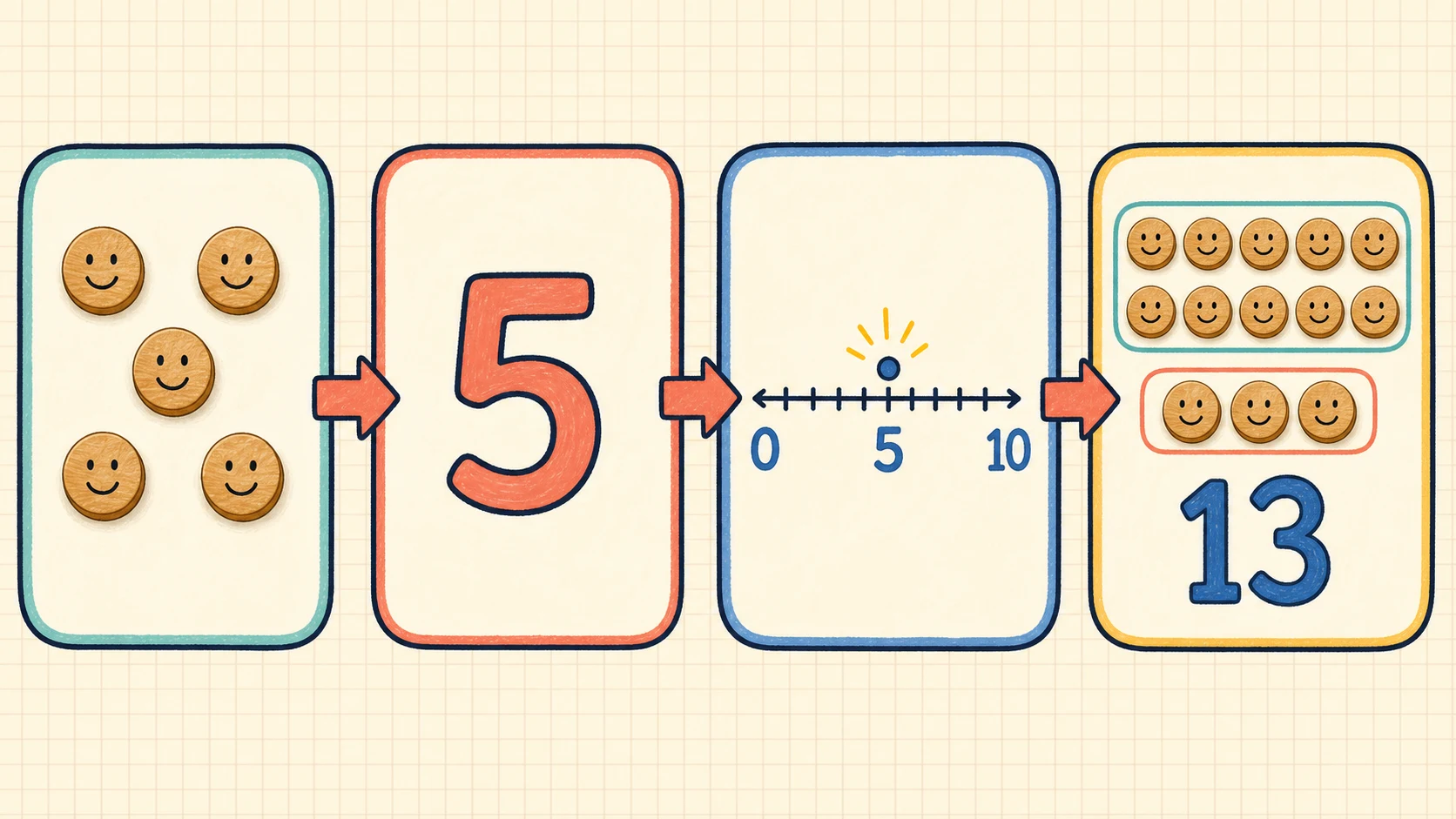
Counting develops through connected oral, concrete, visual, and written skills.
Check the prerequisites before increasing the range
A learner may be able to recite a long sequence while still needing help counting objects. Begin by checking the component skills separately.
Stable number-word order
Ask the learner to count aloud from one. Listen for a consistent sequence. A learner who says “one, two, three, five” needs practice with the spoken sequence before a worksheet full of object sets will be useful.
Check several ranges rather than asking only for the highest possible count:
- Count from 1 to 10.
- Count from 1 to 20.
- Begin at 6 and continue.
- Begin at 13 and continue.
- Count by tens from 10 toward 100.
Starting from a given number is a distinct demand. A learner who must return to one before naming the number after 13 has not yet made that part of the sequence readily available.
One-to-one correspondence
Place five counters in a row and ask the learner to count them. Watch the actions, not only the answer. Each spoken number should match one counter. The learner might touch each object, slide it aside, or place it in a container.
Look for skipped objects, double-counted objects, or speech that runs ahead of the hand. Slow, coordinated counting is preferable to fast but unreliable counting.
Cardinality
After the learner counts six objects, ask for the total. A secure response is “six” without counting the same set again. This shows that the last number spoken represents the quantity of the entire set.
If the learner recounts, do not treat that as mere carelessness. Say, “You counted one, two, three, four, five, six. The last number was six, so there are six altogether.” Then repeat with a smaller set.
Numeral recognition and formation
Oral counting and numeral knowledge can develop at different rates. A learner may correctly count eight buttons but select the numeral 6. Check whether the difficulty lies in counting, recognizing the written symbol, or forming it with a pencil.
The intended Kindergarten range includes writing numerals 0 through 20. Zero deserves direct attention: it represents a set with no objects, not an object that was overlooked.
Follow a progression from objects to independent notation
The IES guide on teaching mathematics to young children supports organizing instruction around developmental progressions, monitoring what children know, and helping them connect informal mathematical ideas with representations and mathematical language. For this guide, that high-level framing translates into a practical sequence: act on real objects, interpret pictures, use organized visual tools, and then work with numerals.
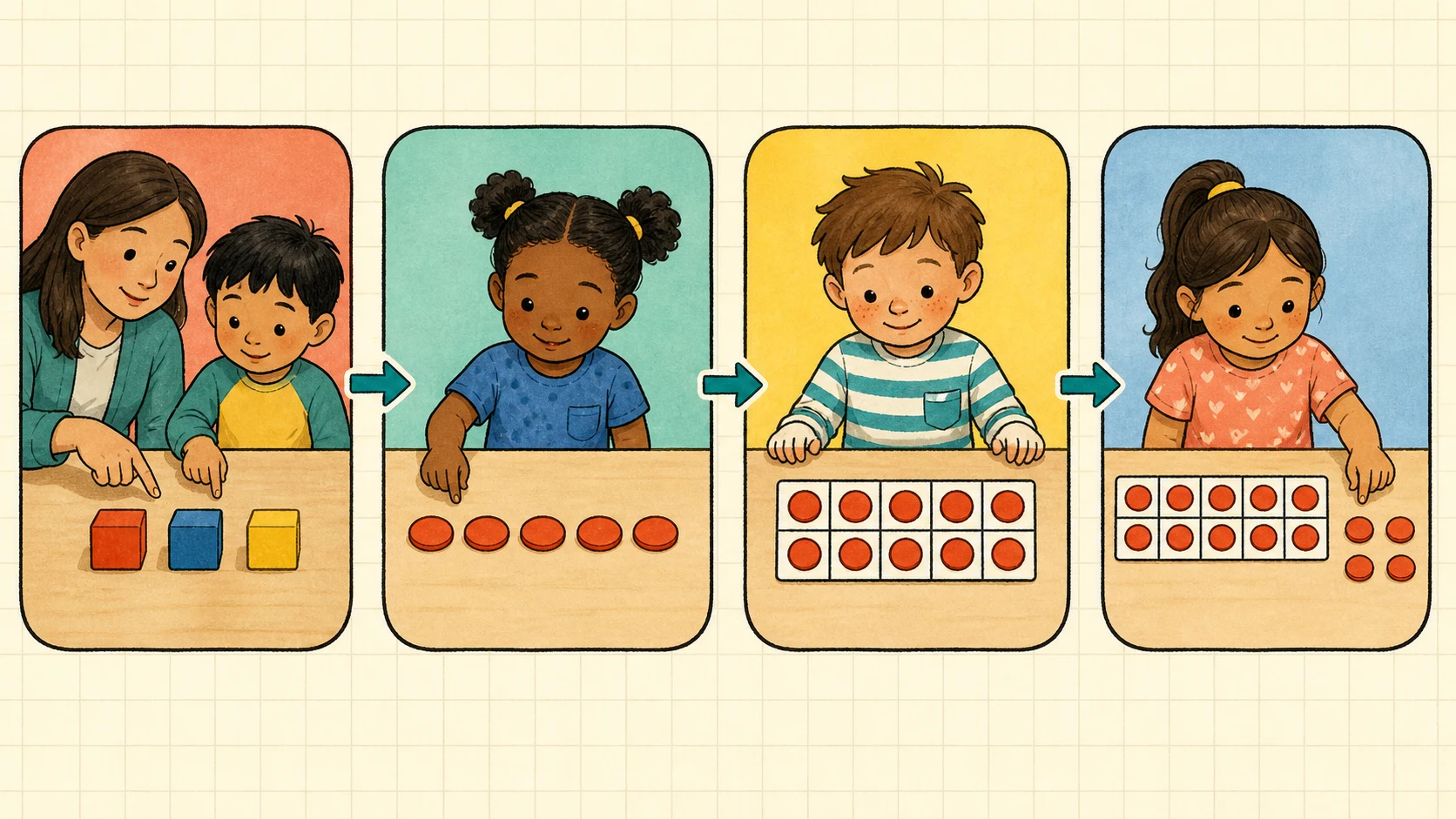
Move forward when the learner’s work is accurate and explainable, not merely because a page is finished.
| Stage |
Suitable task |
What to observe |
Move on when |
| Oral sequence |
Count aloud from 1 to 10, then 20 |
Stable order and clear transitions |
The sequence is mostly reliable across attempts |
| Concrete sets |
Count movable cubes or buttons |
One word for each object |
Objects are neither skipped nor counted twice |
| Cardinality |
Count, then state the total |
The final count word is retained |
“How many?” is answered without an unnecessary recount |
| Organized pictures |
Count objects in rows or frames |
A consistent counting path |
The learner handles several layouts accurately |
| Scattered pictures |
Count an irregular group |
Tracking and self-checking |
The learner marks or organizes the set effectively |
| Numerals |
Match sets to numerals; write 0–20 |
Symbol recognition and formation |
Quantities and numerals are connected reliably |
| Number sequences |
Fill one missing number; continue from a given number |
Awareness of before and after |
The learner does not always restart at one |
| Larger range |
Count toward 100 by ones and tens |
Decade transitions and patterns |
Errors are infrequent and can be corrected |
| Extension |
Count backward or explore equal jumps |
Secure base sequence |
The extension does not disrupt one-by-one accuracy |
Progress is not always linear. A learner might count objects accurately to 12 but lose the oral sequence after 16. Another might recite to 40 while double-counting scattered objects. Teach the weaker component instead of assigning every skill at the same level.
Use concrete and visual models deliberately
Movable objects
Linking cubes, buttons, bottle caps, blocks, or small toys make each count visible and physical. Begin with a small collection. Ask the learner to move each object from a “not counted” area to a “counted” area while saying one number word.
Moving objects helps establish a record of what has already been counted. It is especially useful when the objects look alike or are close together. Check that the learner moves only one object for each number word.
Rows, frames, and scattered sets
A neat row reduces the tracking demand. It is therefore a good early model, but success with rows does not prove that the learner can count any arrangement.
Use a deliberate progression:
- Objects in a straight row.
- Objects in two short rows.
- Pictures arranged in a regular frame.
- Objects arranged in a circle.
- Scattered objects.
- A mixed page containing several arrangements.
For a scattered set, teach a strategy: point from left to right, circle each object after counting it, or move concrete objects into a line. Changing the arrangement without changing the quantity also demonstrates that spacing and position do not determine how many there are.
Number lines and hundred charts
A number line makes “one more,” before, after, and counting forward visible. Put a finger on 7 and move one position for each spoken number: 8, 9, 10. Make clear whether the starting number is already counted. When asked to count forward from 7, the oral sequence begins “7, 8, 9.” When asked for three numbers after 7, the answers are “8, 9, 10.”
A hundred chart can reveal the repeating ones digits in columns and the sequence of tens. Use it as a reference, not as a substitute for reasoning. Ask the learner to trace a row while counting by ones and point to 10, 20, 30, and so on when counting by tens.
Teen numbers often need extra attention because their spoken names are less transparent than later tens-and-ones patterns. Build 14 as one group of ten cubes and four single cubes, say the number, and match it to the numeral 14.
Study fully checked worked examples
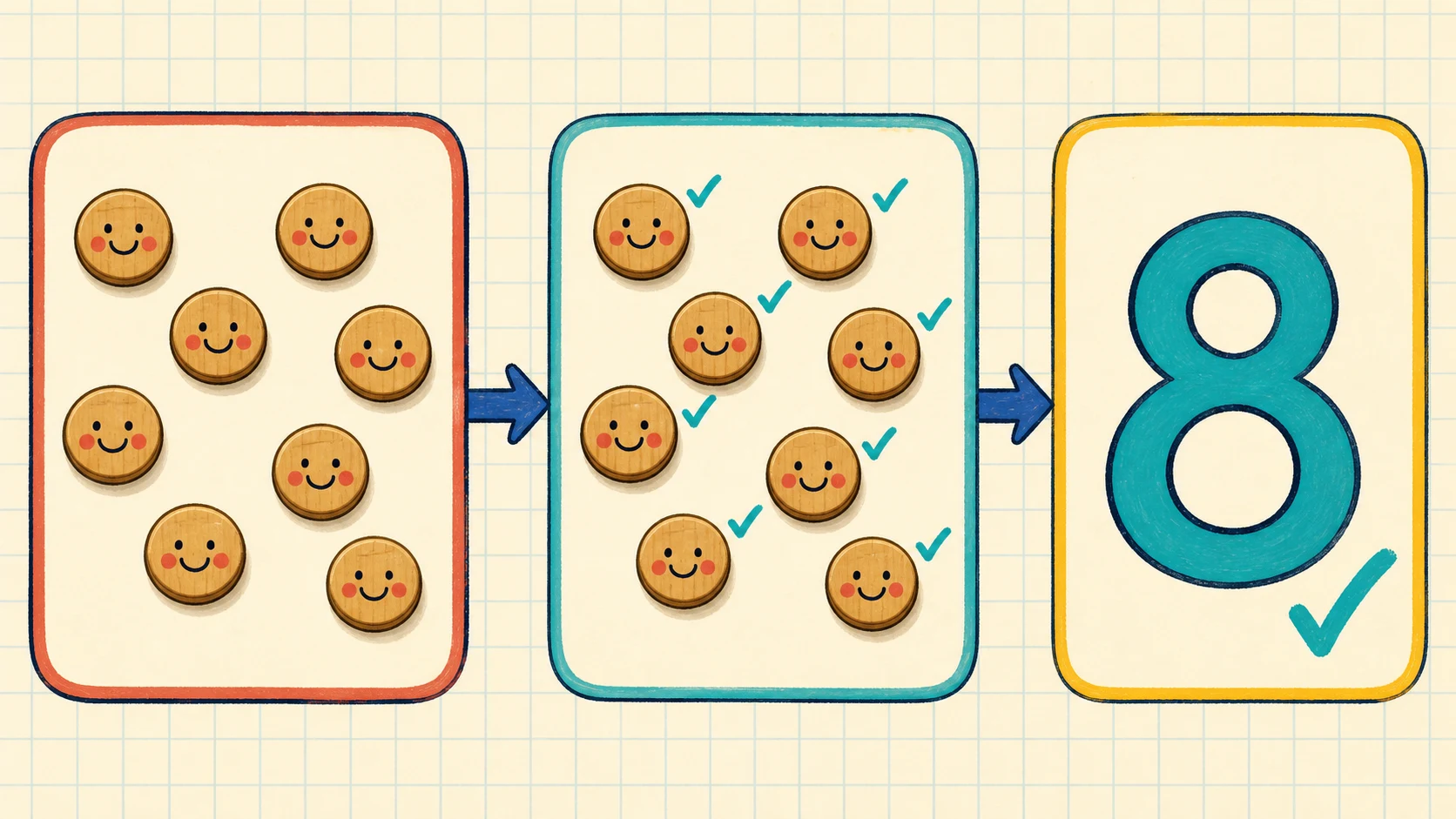
Make the count visible, connect it to the total, and then record the numeral.
Example 1: Count a concrete set
Place these counters in a row:
● ● ● ● ● ●
Touch one counter for each count word:
1, 2, 3, 4, 5, 6.
The last number spoken is 6, so there are 6 counters.
Check: Match the counters into six one-to-one touches. No counter is skipped or touched twice. The written answer is 6.
Example 2: Count a scattered set
Suppose eight stars are scattered on a page. The learner circles each star while counting:
1, 2, 3, 4, 5, 6, 7, 8.
Every star has one circle, and no circled star is counted again. The answer is 8 stars.
A useful check is to recount in a different organized way. Draw an imaginary path from top to bottom or number the circles. If the second count also ends at 8, the total is confirmed.
Boundary case: If the stars are spread farther apart, the quantity remains 8. Spacing changes the appearance of the set, not its count.
Example 3: Find a missing number
Complete:
12, 13, __, 15, 16
Count forward from 12:
12, 13, 14, 15, 16.
The number after 13 and before 15 is 14.
Check: Substitute 14 into the sequence:
12, 13, 14, 15, 16.
Each number is one more than the previous number, so the answer is correct.
Example 4: Count forward from a given number
Prompt: Begin at 17 and count to 22.
The complete response is:
17, 18, 19, 20, 21, 22.
Check each transition. After 17 comes 18, after 18 comes 19, and after 19 comes 20. The sequence then continues 21, 22.
A common incorrect response is to begin at 1 and eventually reach 22. That recites the sequence but does not satisfy the instruction to begin at 17.
Example 5: Count by tens
Complete:
10, 20, 30, __, 50
Each step adds one group of ten:
- 10 + 10 = 20
- 20 + 10 = 30
- 30 + 10 = 40
- 40 + 10 = 50
The missing number is 40.
Check: The ones digit remains 0, and the tens increase from 1 ten to 5 tens.
Do not infer from this example that the learner can count every object in a group of 50. Counting by tens works cleanly when the items are already organized into equal groups of ten. Fifty loose counters would first need to be counted and grouped reliably.
Example 6: Interpret zero
Show an empty plate and ask how many crackers are on it.
There are no crackers to touch or count. The quantity is 0.
Check: Adding one cracker would change the count from 0 to 1. Removing that cracker would return the count to 0.
Zero is a genuine quantity. It should not be confused with a blank response, which means that no answer was recorded.
Example 7: Count backward
Begin at 8 and count backward to 3:
8, 7, 6, 5, 4, 3.
Check with a number line by moving one position left after each number. This is an extension that can prepare the learner to think about taking away, but forward counting should remain secure and receive priority if the two directions become confused.
Teach with a short, repeatable routine
A counting lesson can be brief and focused. Five to fifteen attentive minutes may be more informative than a long page completed with fatigue or heavy prompting. This is an instructional suggestion, not a universal timetable.
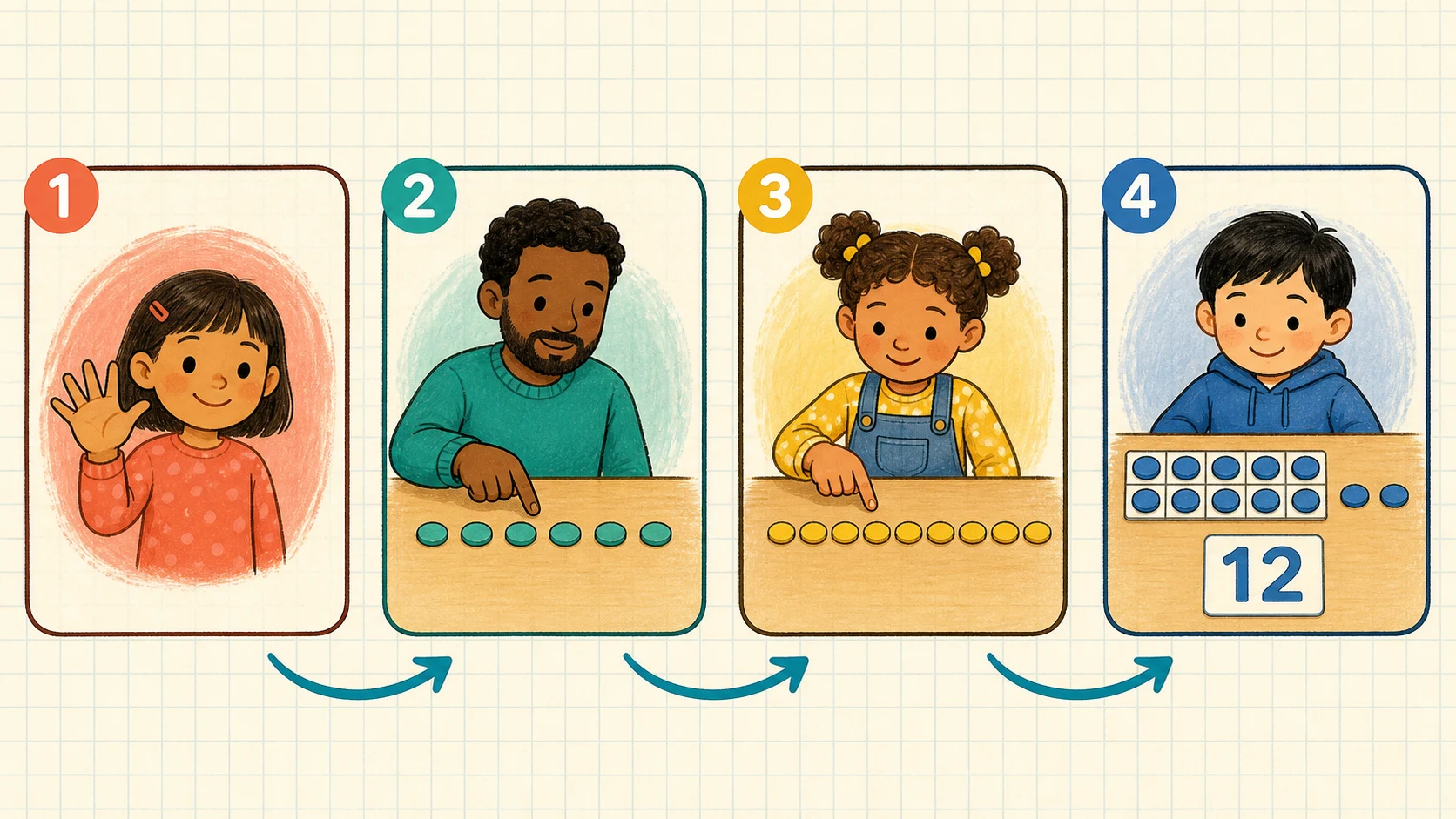
Use one clear objective, model it, observe practice, and finish with a quick independent check.
1. Revisit a known skill
Spend one or two minutes on something the learner can usually do: count five cubes, name a few numerals, or count aloud from 1 to 10. This gives you a comparison point for the new task.
2. State and model one objective
Use precise language: “Today we will count scattered objects without counting any object twice.”
Model a small set. Point, say each number, and mark the object. Then summarize: “I counted every object once. The last number tells how many there are.”
3. Practice together
Give the learner a slightly different set. Prompt only as much as needed:
- “Where will you start?”
- “How will you show which objects are counted?”
- “What was the last number?”
- “So how many are there altogether?”
Avoid supplying the next number immediately. A short pause may show whether the learner can retrieve it independently.
4. Try an independent item
Use one or two items without step-by-step prompting. Independence matters because heavily guided success can conceal an unstable skill. Record the type of help required if the learner gets stuck.
5. Close with a verbal summary
Ask the learner to demonstrate the strategy: “Show me how you kept track.” End with one accurate statement, such as “The last number you said was 9, so the set has 9 objects.”
Choose practice that matches the actual need
The Kindergarten math hub provides a broader context, while the Kindergarten Counting topic guide keeps practice focused on counting. Choose a task after observing the learner, not simply from age or page difficulty.
If the learner loses the number-word sequence, choose short oral sequences and missing-number tasks. If the learner knows the sequence but miscounts objects, choose concrete sets and pictures that require one-to-one tracking. If numeral formation is the obstacle, separate the writing demand from the counting demand: let the learner select a numeral card before asking for written answers.
A useful practice set mixes success, direct instruction, and a small amount of challenge:
- Several familiar items to confirm the skill.
- A few items targeting the current objective.
- One transfer item with a new arrangement or starting number.
- A short review item from an earlier lesson.
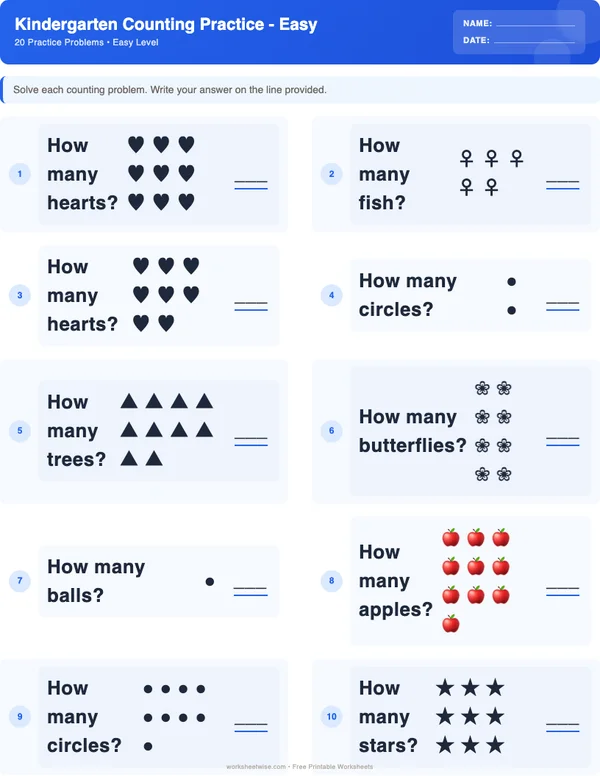
The free easy counting worksheet contains 20 exercises involving counting, number sequences, skip counting, and number recognition, with a separate answer key. It may suit a learner beginning this kind of written practice or needing reinforcement. Preview the task types first; do not require all 20 exercises in one sitting if accuracy or attention deteriorates.
The Kindergarten Counting Worksheet Pack contains 18 worksheets and is listed at $4.79. A larger pack can provide varied practice, but more pages are not automatically better. Select only the pages that address the observed skill and revisit earlier pages when errors recur.
Diagnose errors before assigning more work
The IES guide for assisting students who struggle with mathematics provides high-level support for systematic instruction, clear mathematical language, representations, and regular assessment. Applied here, that means identifying the point where counting breaks down and teaching that component explicitly.
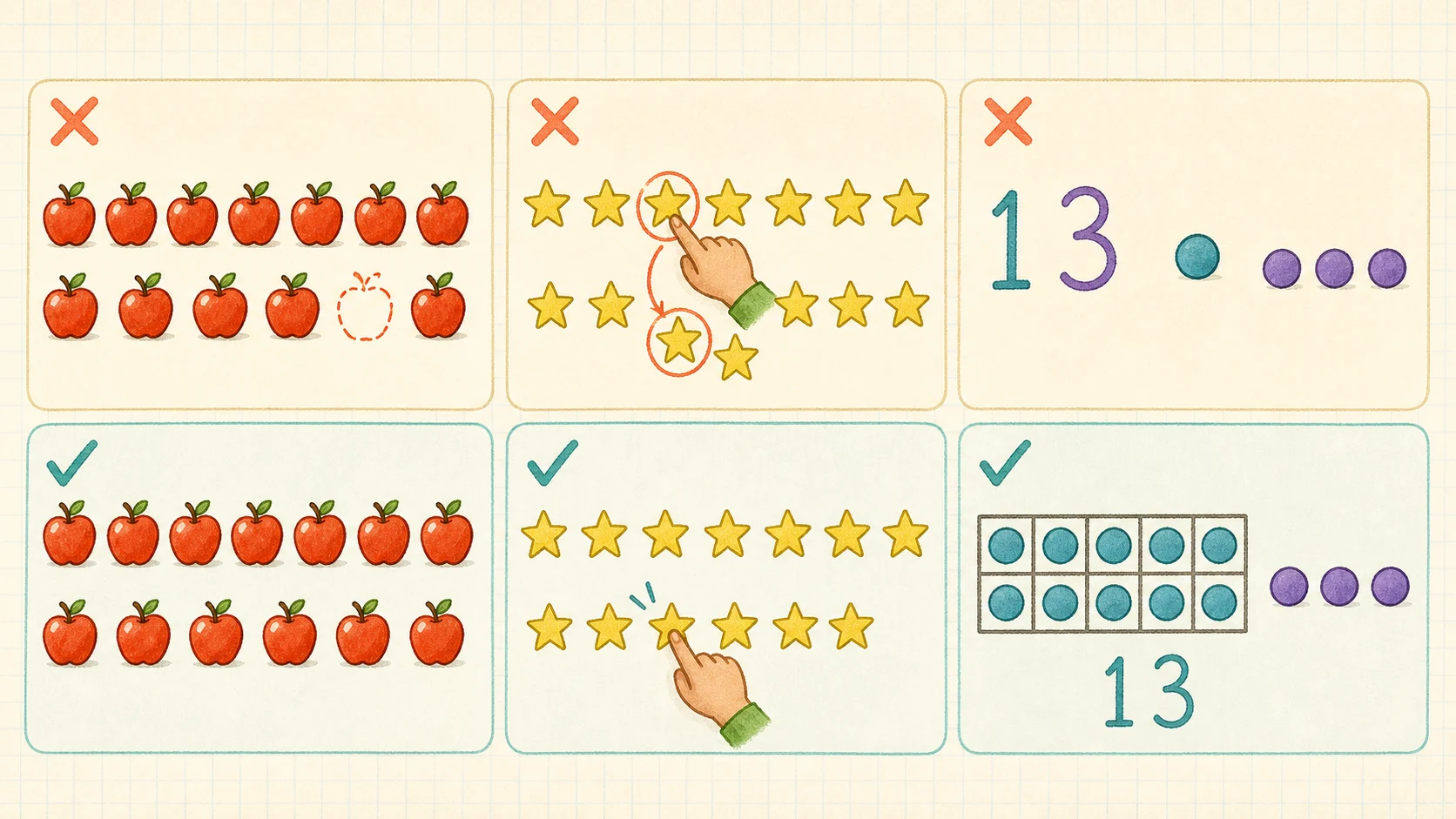
An incorrect total is evidence to inspect the learner’s sequence, actions, and interpretation.
| Observed error |
Likely skill to inspect |
Teaching response |
| Says “1, 2, 3, 5” |
Number-word order |
Practice a shorter oral range with a number line |
| Touches two objects while saying one number |
Coordination of word and action |
Slow the count and move one object per word |
| Counts the same object twice |
Tracking |
Move counted objects or mark each picture |
| Skips an object in a scattered set |
Visual organization |
Establish a starting point and counting path |
| Recounts when asked for the total |
Cardinality |
Emphasize that the last number names the whole set |
| Gives the right total but chooses the wrong numeral |
Numeral recognition |
Match quantity cards to numeral cards |
| Writes 14 when intending 41 |
Numeral order or formation |
Build 14 as ten and four, say it, then copy and write it |
| Cannot begin at 8 without starting at 1 |
Counting from a given number |
Anchor 8 on a number line and continue aloud |
| Says “18, 19, 30” |
Decade transition |
Practice 18, 19, 20 with a chart and concrete groups |
| Counts by tens over ungrouped objects |
Meaning of equal groups |
Organize objects into groups of ten before skip counting |
Treat inconsistent answers as useful information. If a learner gets 7 objects correct in a row but misses 7 objects when scattered, the quantity is probably not the only issue; visual tracking has increased the demand.
Also distinguish a counting error from a recording error. A learner may count 12 accurately and reverse a digit while writing. Ask for an oral answer and a numeral-card selection to locate the difficulty before reteaching the entire task.
Differentiate without changing the mathematical goal
When the learner needs more support
Reduce one source of difficulty at a time:
- Use fewer objects.
- Arrange objects in a row.
- Let the learner move each object.
- Provide a number line.
- Say the sequence together before independent counting.
- Offer numeral cards instead of requiring handwriting.
- Divide a page into short sections.
- Return to teen numbers for concentrated practice.
Keep the central question intact. If the objective is cardinality, the learner should still count and state the total, even if the set is smaller.
When the learner is ready for more challenge
Change the reasoning demand before merely increasing the number of items:
- Rearrange the same set and ask whether the total changed.
- Begin counting at 9, 16, or another given number.
- Hide part of a familiar sequence.
- Mix rows and scattered arrangements.
- Ask the learner to explain how double-counting was avoided.
- Organize objects into groups of ten and connect them to 10, 20, 30.
- Count backward from 20 in a supported setting.
Skip counting by 2s or 5s can be explored through equal jumps, movement, or grouped objects. It is not evidence of one-to-one counting unless the learner can also count the individual objects accurately.
When motor or attention demands interfere
Use larger objects, fewer items, pointing instead of writing, or two short sessions. These are instructional access choices, not medical guidance. If broader developmental or health concerns arise, this guide cannot evaluate them.
Monitor progress with brief, comparable checks
Use a small record rather than relying on whether a worksheet “looked easy.” Once or twice a week, sample several forms of the skill:
| Check |
Example |
Record |
| Oral sequence |
Count from 1 to 20 |
First error and whether self-corrected |
| Start elsewhere |
Begin at 11 and continue to 17 |
Restarted at 1 or began at 11 |
| Concrete set |
Count 9 movable counters |
Accuracy and tracking method |
| Scattered set |
Count 8 irregularly placed pictures |
Skips, repeats, or independent organization |
| Cardinality |
Ask for the total after counting |
Immediate answer or recount |
| Numeral connection |
Match 13 objects to 13 |
Correct selection and writing |
| Larger pattern |
Count by tens toward 100 |
Accurate sequence and transitions |
Compare like with like. Improvement from five arranged objects to ten scattered objects is hard to interpret because both quantity and layout changed. Repeat one comparable task, then add one transfer task.
A single mistake does not establish a pattern. Look across several attempts. Move ahead when the learner is accurate across more than one arrangement or prompt and can work with limited help. Step back when errors cluster around the same transition, representation, or instruction.
Use a two-week plan that responds to evidence
The following plan assumes short sessions on ten practice days. It is a flexible instructional example, not a required schedule. Repeat a day, shorten a task, or omit an extension when the learner’s work indicates that choice.
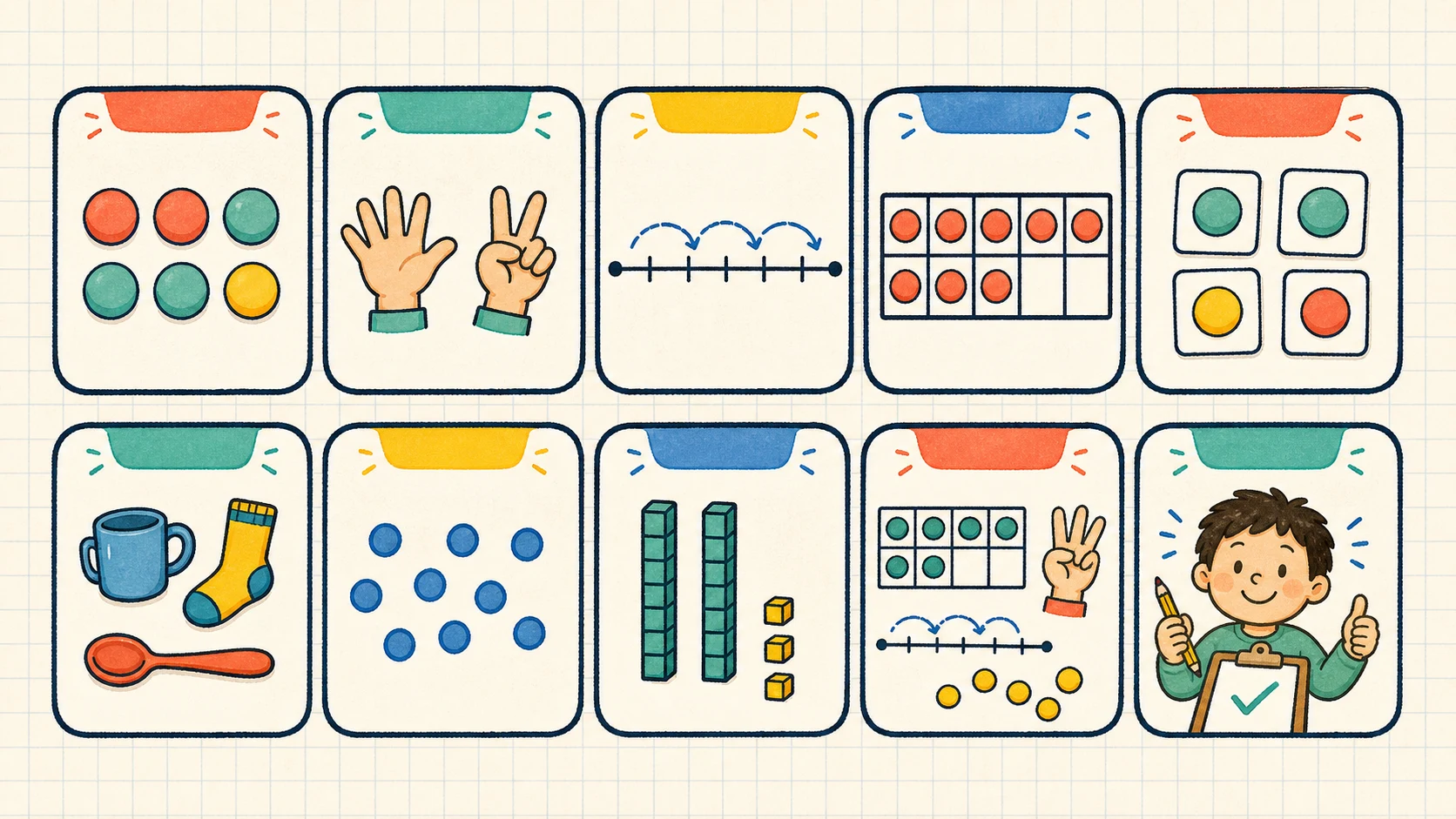
Alternate instruction, review, and transfer so that progress is visible across different representations.
| Day |
Main focus |
Suggested activity |
Quick check |
| 1 |
Establish a baseline |
Oral count; count rows and scattered sets; match numerals |
Note the first independent error in each form |
| 2 |
One-to-one correspondence |
Move 3–10 objects into a container while counting |
Did each word match one object? |
| 3 |
Cardinality |
Count a set, cover it, and state the total |
Was the last number retained? |
| 4 |
Numerals 0–10 |
Match object sets, numeral cards, and written numerals |
Include an empty set for 0 |
| 5 |
Transfer to pictures |
Count rows, circles, and scattered pictures |
Did the learner choose a tracking strategy? |
| 6 |
Oral sequence and teen numbers |
Count through 11–19; build selected teens as ten and extras |
Check 18–19–20 carefully |
| 7 |
Numerals 11–20 |
Match, trace if needed, and independently write selected numerals |
Separate counting accuracy from writing accuracy |
| 8 |
Count from a given number |
Start at 5, 9, 13, and 17; use a number line only when needed |
Did the learner avoid restarting at 1? |
| 9 |
Count by tens and review |
Point to 10, 20, 30 through 100; connect to groups of ten |
Can the learner explain that each jump is ten? |
| 10 |
Independent sample |
Use selected worksheet items and repeat baseline-style checks |
Compare accuracy, strategy, and prompting with Day 1 |
On worksheet days, stop when the learner begins guessing, loses the counting path repeatedly, or needs more prompting than earlier. Analyze two or three errors while they are fresh. Finishing every exercise is less informative than understanding why an answer changed.
If Day 10 shows reliable work with arranged sets but continued difficulty with scattered sets, the honest next step is not a harder number range. Continue varied tracking practice at the current range. If the learner is secure across oral, concrete, visual, and numeral tasks, expand the range gradually and introduce more independent sequence work.
Keep the scope and next step clear
This guide can organize counting instruction, examples, practice, and observation. It cannot determine an individual learner’s full mathematics program, guarantee an outcome, establish comprehensive standards alignment, or replace local curriculum decisions. The Common Core link provides a public standards reference; it does not mean that every activity, worksheet, school, or local sequence uses identical wording or timing.
Begin with the smallest useful next action: give the learner five to ten movable objects, observe how each object is counted, ask for the total, and then match that total to a numeral. Use what you observe to select a few relevant problems from the free Kindergarten Counting worksheet. If a different quantity, layout, or sequence would fit better, create targeted practice with the free worksheet generators.