What Kindergarten Place Value Means
Kindergarten Place Value is the beginning understanding that numbers can be made from groups and leftover objects. At this level, the central idea is narrow and concrete: a teen number is one group of ten and some additional ones. For example, 14 is one ten and four ones, so 14=10+4.
A learner is ready for this work when they can count a small collection accurately, recognize or write numerals through at least 10, and understand that the last number said tells how many objects are in the collection. They do not need to master general two-digit place value, hundreds, formal rounding, or multi-place expanded form.
The most useful teaching sequence is:
- Count individual objects.
- organize ten objects into one visible group;
- keep extra objects separate;
- describe the quantity as “one ten and ___ ones”;
- connect the model to a teen numeral;
- compose and decompose the same number in several ways.
The learner’s observed work should determine the pace. If they can name 16 but cannot build it as ten and six, return to concrete objects rather than assigning more numeral-only exercises.
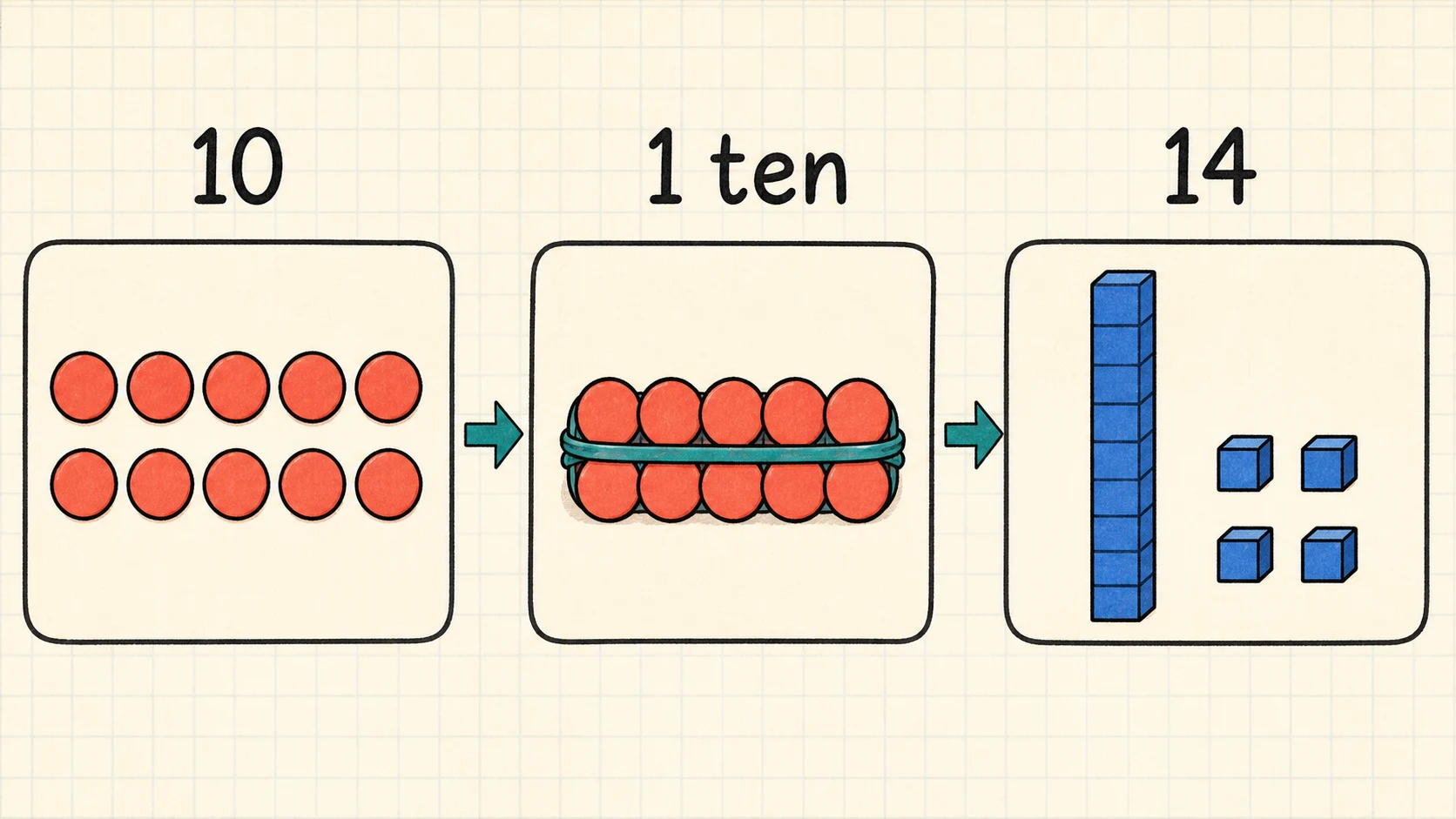
The core pathway connects counting, grouping, mathematical language, drawings, numerals, and equations.
Grade labels describe the intended practice level, not a universal timetable. Local curricula and instructional sequences differ. The Common Core mathematics standards place the composition and decomposition of 11–19 into a ten and ones within Kindergarten, but families and educators should check their own school or homeschool sequence.
Prerequisites to Check Before Teaching Teen Numbers
Place value instruction becomes confusing when a prerequisite counting difficulty is mistaken for a place value difficulty. A brief readiness check helps identify what the learner actually needs.
Accurate one-to-one counting
Place 8 counters in an irregular arrangement. Ask the learner to count them. Watch whether they:
- touch or move each counter once;
- say one number word for each object;
- stop after every object has been counted;
- answer “How many?” with 8 rather than restarting without giving a total.
Repeat with 10 counters. If objects are skipped or counted twice, first practice organizing and counting collections. A row, five-frame, or ten-frame can make the objects easier to track.
A stable understanding of ten
Ask the learner to make a collection of 10. Rearrange it without adding or removing anything, then ask how many there are. The goal is not rapid recall. The learner should understand that moving the objects does not change the quantity.
Next, place the 10 objects in a cup, bag, connected cube train, or rubber-banded bundle. Explain that the container still represents all 10 objects. Open it occasionally and recount so that “one ten” does not become an unexplained label.
Connections among quantities, words, and numerals
Show 7 objects and ask the learner to choose or write the numeral 7. Then show the numeral 9 and ask for a matching collection. These opposite directions matter: quantity to numeral and numeral to quantity.
Before moving into teen numbers, also check 10. The learner should be able to connect:
- ten individual objects;
- one complete group of ten;
- the spoken word “ten”;
- the numeral 10.
Temporary numeral reversals or uneven handwriting should not automatically be treated as misunderstandings. Ask the learner to build or explain the number so that handwriting and number knowledge can be considered separately.
A Grade-Appropriate Progression
The progression below is an instructional suggestion, not a claim that every learner needs the same number of lessons. Move ahead when the learner can show the idea with limited prompting, and move back when the model and numeral no longer agree.
| Stage |
Learner action |
Helpful prompt |
Evidence to look for |
| 1. Count ones |
Count collections through 10 |
“Move each object as you count.” |
Each object is counted once |
| 2. Make ten |
Put exactly 10 objects into a group |
“How can we show these belong together?” |
The group consistently contains 10 |
| 3. Add leftovers |
Place 1–9 loose objects beside the ten |
“What is in the group? What is outside it?” |
Grouped and loose objects remain distinct |
| 4. Say the structure |
Describe 11–19 as one ten and some ones |
“Say the ten first, then the ones.” |
For 13, the learner says one ten and three ones |
| 5. Match a numeral |
Connect a grouped model to 11–19 |
“Which numeral matches this model?” |
Model and numeral agree |
| 6. Draw the model |
Represent one ten and loose ones on paper |
“How will your drawing show ten efficiently?” |
The ten is distinguishable from each one |
| 7. Write an equation |
Record 10+6=16 or 16=10+6 |
“What part is ten? What part is extra?” |
Both sides describe the same quantity |
| 8. Explain and correct |
Analyze a correct or incorrect model |
“How do you know?” |
The explanation refers to the ten and ones |
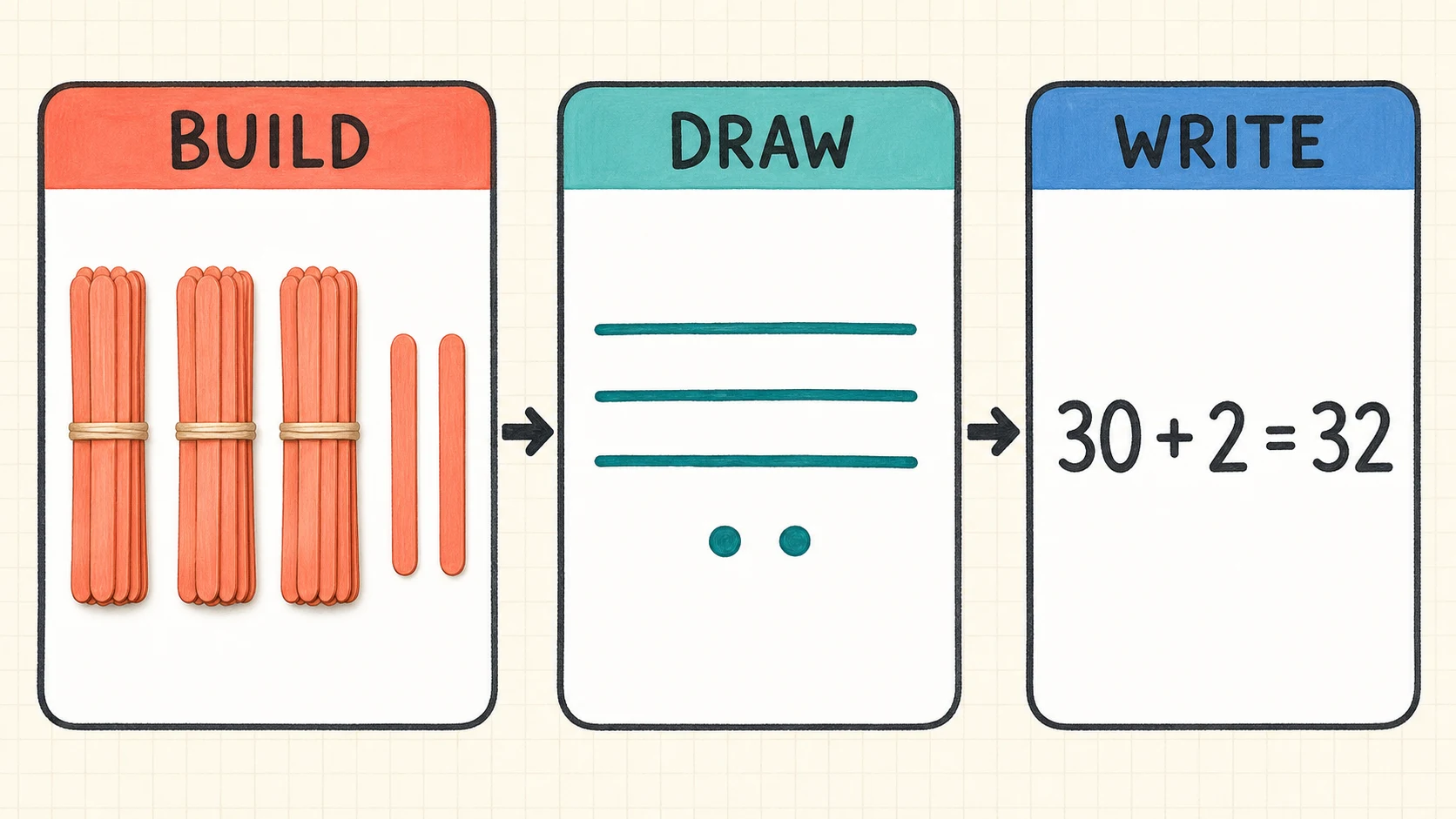
Independence should follow accurate modeling and explanation, not simply a completed page.
The Kindergarten math hub can help adults see this skill alongside counting, number writing, comparison, addition, subtraction, and geometry. Those neighboring skills are related, but they should not all be taught as if they were place value.
Concrete and Visual Models That Clarify the Idea
The model should make a group of ten visibly different from a single one. If ten individual counters remain scattered, a learner may correctly count the total without noticing the ten-and-ones structure.
Bundled everyday objects
Use craft sticks, straws, pencils, connecting cubes, or counters. Count out 10, then bind or connect them. Place loose objects beside the bundle.
For 15, the display should have:
- one bundle containing 10;
- five loose objects;
- no hidden or uncounted objects.
Ask, “How many objects are in the bundle?” rather than merely announcing that it is a ten. Periodically open the bundle and verify its contents.
Ten-frames
Fill one ten-frame completely and place extra counters on a second frame or beside the first. A full frame represents ten; the extra counters represent ones.
A ten-frame is especially useful when a learner recounts the completed group unnecessarily. The adult can say, “We already know this full frame has ten. Start with ten and count on: 11, 12, 13.”
Base-ten blocks and drawings
A ten rod can represent ten unit cubes, but first compare the rod with 10 units. The physical relationship should be visible rather than assumed.
For paper work, agree on a simple notation. A long bar can represent one ten, and small circles can represent ones. Thus, one bar and eight circles represent 18. Ask the learner what the bar means; a memorized picture without meaning is not sufficient evidence.
Numerals and place-value mats
A two-column mat labeled “tens” and “ones” can organize models. For 17, place one ten in the tens column and seven units in the ones column. Then write 17 beneath the mat.
Do not begin with a rule such as “the 1 means tens because it is on the left.” First build the quantity. The positional explanation is more meaningful after the learner sees that the written 1 records one group of ten and the written 7 records seven ones.
The IES guide Teaching Math to Young Children recommends teaching number and operations through a developmental progression and using progress monitoring to build on what a child already knows. That high-level framing supports moving from countable quantities toward organized representations while checking understanding along the way.
Fully Checked Worked Examples
Example 1: Build and write 14
Problem: Show 14 as a ten and ones.
Count 10 connecting cubes and join them into one train. Place 4 single cubes beside the train.
- Tens: 1
- Ones: 4
- Equation: 10+4=14
Check by counting on from the known ten: 10, 11, 12, 13, 14. There are four counts after 10, so one ten and four ones is 14.
A suitable explanation is: “The train has ten cubes, and there are four more. Ten and four make fourteen.”
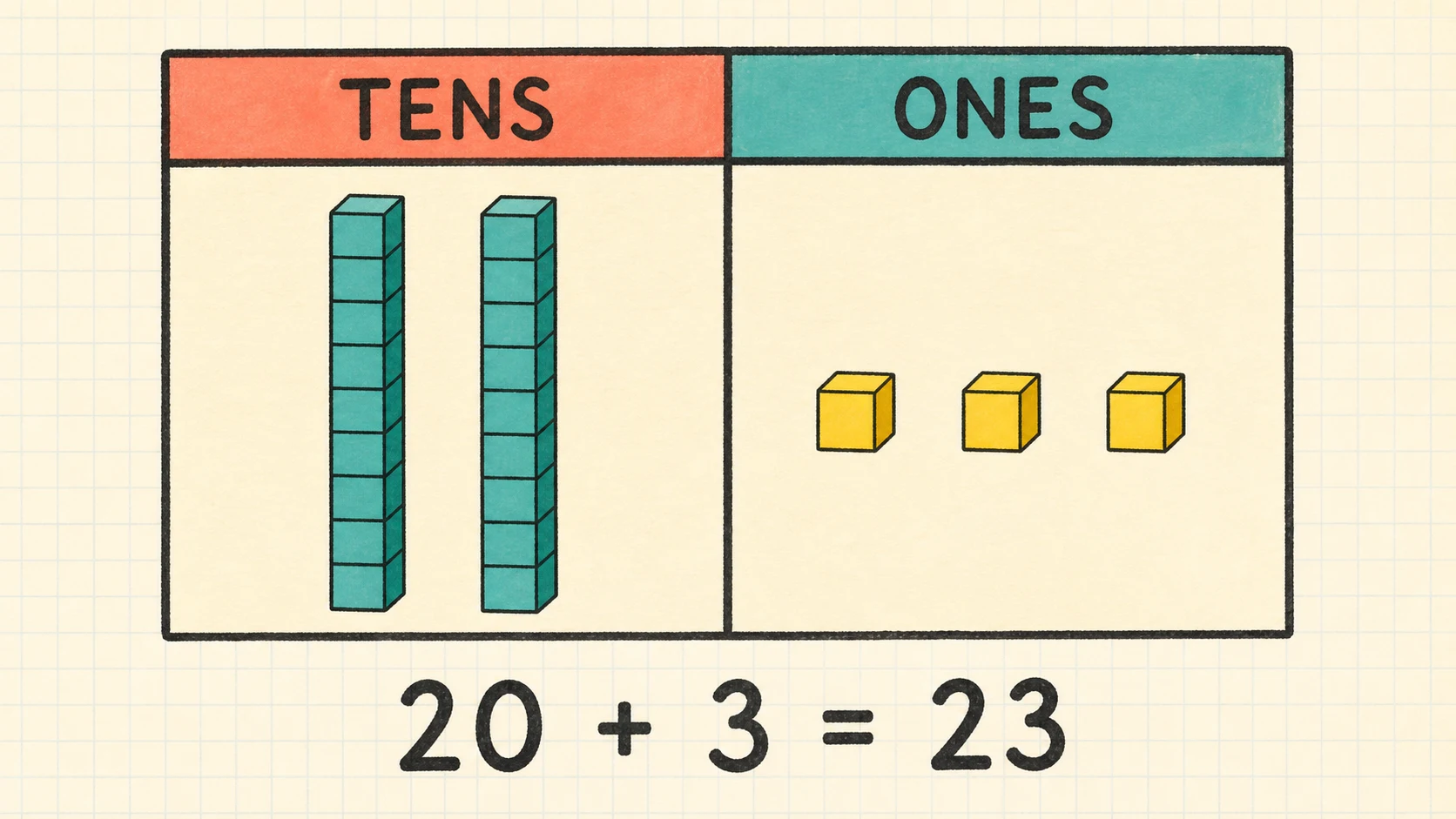
The answer is supported by the same quantity shown as objects, grouped units, words, and symbols.
Example 2: Find the missing ones in 17
Problem: One ten and how many ones make 17?
Start with one bundle of 10. Count on while adding loose counters:
- first counter: 11;
- second: 12;
- third: 13;
- fourth: 14;
- fifth: 15;
- sixth: 16;
- seventh: 17.
Therefore, one ten and 7 ones make 17.
The completed equation is:
10+7=17
Check by separating the model into its two parts: the bundle contributes 10 objects and the loose group contributes 7. Combining them gives 17.
Example 3: Match a model to 12
Problem: A drawing shows one ten bar and two single circles. Which numeral matches it: 12, 20, or 21?
The bar represents 10. The two circles represent 2 ones.
10+2=12
So the matching numeral is 12.
Why the other choices do not match:
- 20 would require two tens and no ones.
- 21 would require two tens and one one.
This example checks meaning rather than visual resemblance. A learner who chooses 21 may be reading the two circles before the one bar instead of considering what each symbol represents.
Example 4: Compare 15 and 12 with models
Problem: Which quantity is greater, 15 or 12?
Build both numbers:
- 15 is one ten and 5 ones.
- 12 is one ten and 2 ones.
Both quantities contain one ten, so compare the loose ones. Five ones are three more than two ones. Therefore:
15>12
Check by pairing the loose ones. Two pairs can be matched, leaving three unpaired ones in the model for 15.
This comparison is appropriate only when the learner already understands both decompositions. If they rely on guessing from numeral shapes, return to the models.
Example 5: Examine the boundary between 19 and 20
Problem: What happens when 1 is added to 19?
Build 19 as one ten and 9 loose ones. Add one more loose object. The loose objects now total 10, so they can be grouped into a second ten.
- Before adding: 1 ten and 9 ones
- After adding: 2 tens and 0 ones
- Total: 20
19+1=20
This is a useful boundary case. It shows why 19 is the largest number that can be described as exactly one ten and some extra ones. Twenty introduces two tens. Use it as a contrast, not as a reason to rush into general two-digit place value.
A Short, Repeatable Lesson Routine
A focused lesson can be brief when it includes modeling, learner action, explanation, and a final check. The times below are flexible instructional suggestions rather than a universal schedule.
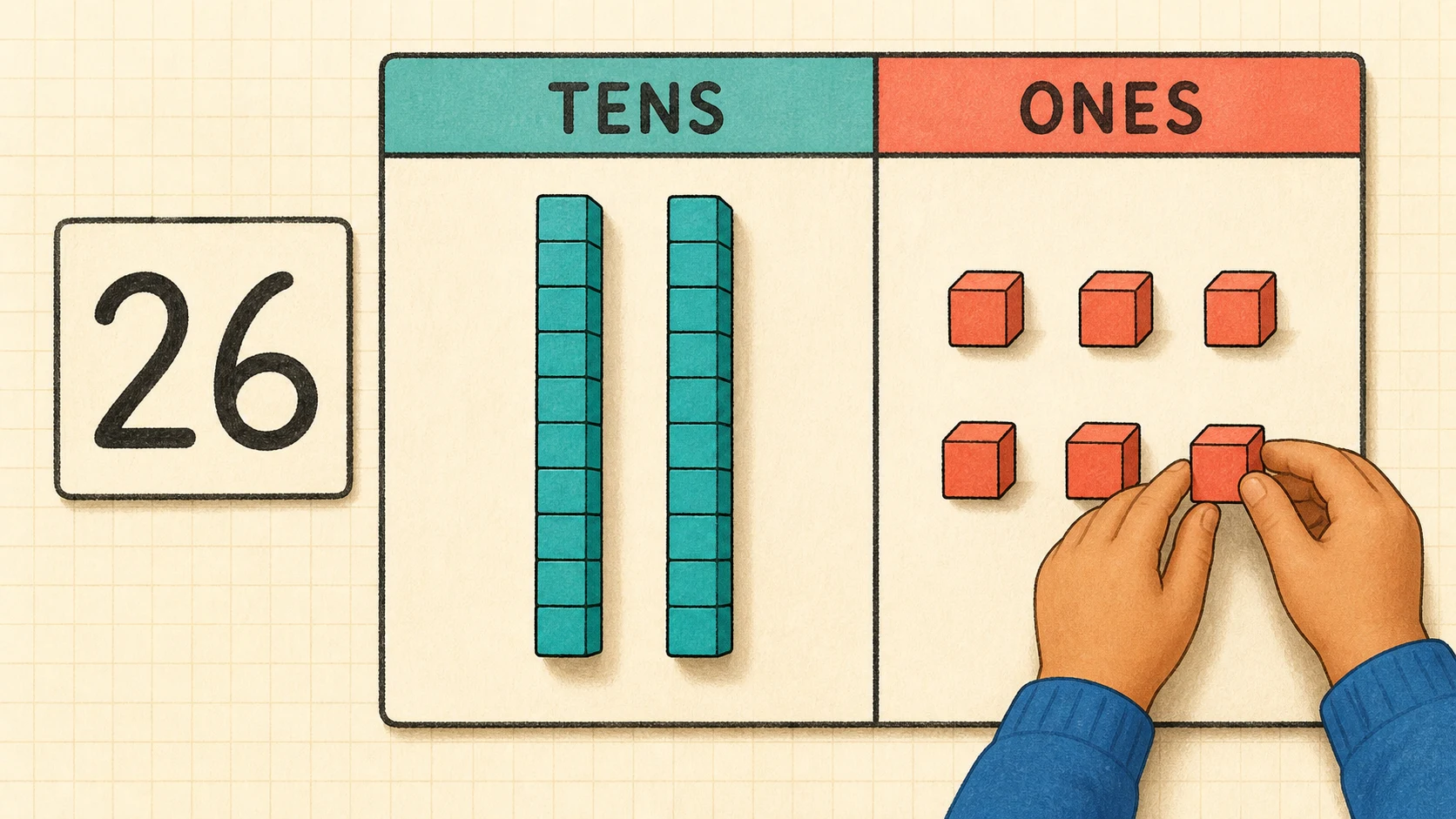
Each lesson moves from a visible quantity to language, symbols, and a quick independent check.
1. Revisit a known quantity
Spend about two minutes counting a collection through 10 or checking a completed ten-frame. Ask the learner to explain how they know there are ten.
2. Model one target number
Choose one teen number. Build it while narrating precisely: “I have one group of ten. I am adding six ones. One ten and six ones make sixteen.”
Write 10+6=16. Point to each part of the model as its number appears in the equation.
3. Build, draw, and explain
Ask the learner to build the same number with different objects, then draw it. Use prompts such as:
- “Where is the ten?”
- “How many ones are outside the ten?”
- “What numeral records the whole amount?”
- “How could you check it?”
Wait for the learner’s explanation before correcting. Their words often reveal whether an error came from counting, grouping, vocabulary, or numeral recognition.
4. Change one feature
Give a nearby contrast: change 16 to 17 by adding one object, or change it to 13 by removing three ones. Ask what stayed the same and what changed.
5. End with one independent item
Show a fresh model or name a fresh teen number. The learner builds, draws, or writes the decomposition without step-by-step prompting. Record what kind of help was needed. One carefully observed response is often more informative than many rushed items.
Choosing Practice That Matches the Learner
Practice should target the next unresolved step, not merely carry the correct grade label.
For a learner still counting inaccurately, choose movable objects and collections no larger than 10. For a learner who counts accurately but does not group, choose “make a ten” tasks. For a learner who builds teen numbers correctly but struggles with symbols, use matching tasks among models, spoken number names, numerals, and equations.
A balanced practice set might include:
- two build-a-number tasks;
- two model-to-numeral matches;
- two numeral-to-model tasks;
- one missing-part item such as 10+□=18;
- one explanation or error-analysis task.
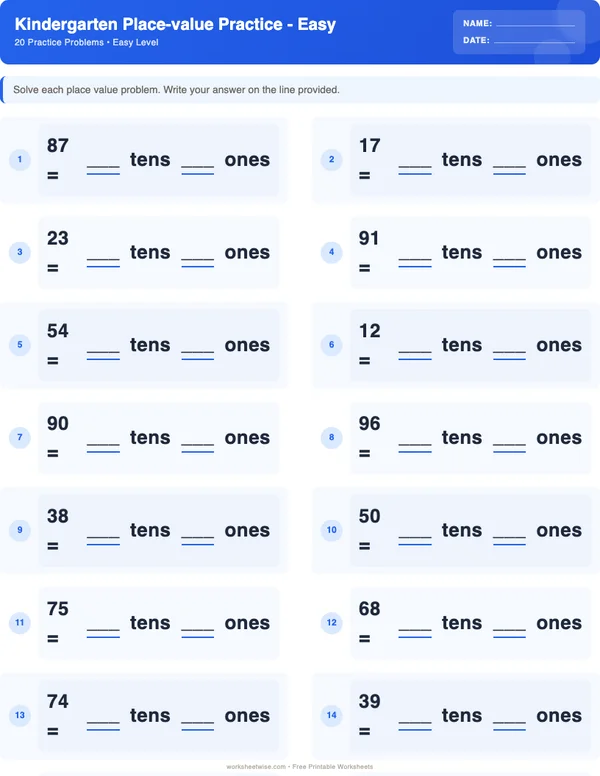
The catalogue’s free easy worksheet contains 20 exercises and includes practice described as place value, expanded form, number comparison, and rounding, with a separate answer key. Those labels do not mean every exercise is automatically the right next step for every Kindergarten learner. Preview the tasks and select only those that match the learner’s current instruction.
At this grade, expanded form is best kept concrete: 16=10+6. General expanded form across hundreds or thousands belongs later. Similarly, comparison can reinforce teen-number structure when models are available. Formal rounding is not part of the stated Kindergarten compose-and-decompose focus, so rounding items should be treated as extension or omitted unless the learner’s local curriculum explicitly calls for them.
For broader selection, browse the Kindergarten worksheet hub or the focused Kindergarten Place Value guide. The 18-worksheet Kindergarten Place Value pack offers more volume, but volume should follow a clear instructional need.
Differentiation Without Changing the Core Idea
When the learner needs more support
Reduce the number of representations used at once. Begin with objects and spoken language before adding a drawing and equation. Keep one completed ten visible, use only one target number per short session, and allow the learner to touch or move every loose one.
Use consistent language: “one ten and six ones.” Avoid switching rapidly among “bundle,” “rod,” “tens place,” “group,” and “stick” unless each term has been connected explicitly.
The IES guide on assisting students who struggle with mathematics recommends systematic instruction, clear mathematical language, and carefully chosen concrete and semi-concrete representations. Applied here, that means using a small set of familiar models, explaining what each part represents, and sequencing examples deliberately.
When the learner is ready for greater challenge
Keep the mathematical focus on composing and decomposing rather than adding bigger numerals without purpose. Ask the learner to:
- show 18 in two materials;
- find and correct a model for 15 that has one ten and four ones;
- identify a hidden teen number from clues;
- order several modeled teen quantities;
- explain what changes when 19 becomes 20.
A useful clue might be: “My number has one ten. It has more than five ones but fewer than eight ones.” The possible numbers are 16 and 17. Add another clue—“The number of ones is odd”—and the answer is 17. Verify by building one ten and seven ones.
For a learner with strong verbal knowledge but weak recording
Accept an oral explanation and concrete model first. Then ask the learner to trace, copy, or choose the matching numeral. Do not let handwriting difficulty conceal sound place value reasoning.
For a learner who writes correct numerals but cannot explain them, reverse the emphasis. Require building and explanation before written practice. Correct symbols alone do not show that the ten-and-ones relationship is understood.
Common Errors and Diagnostic Responses
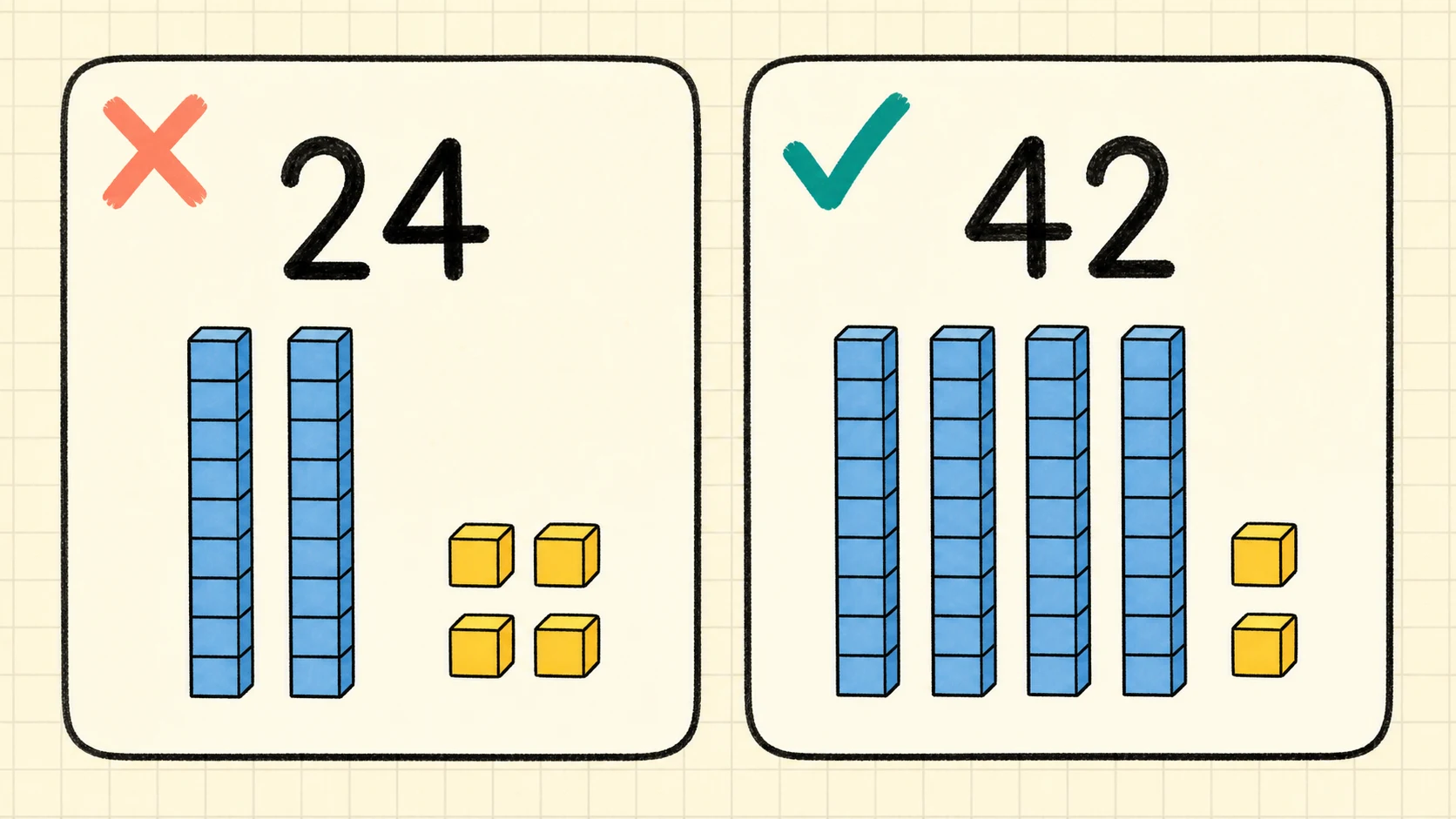
An error becomes useful when the adult identifies the underlying decision and selects a matching response.
| Observed response |
Possible interpretation |
Diagnostic check |
Teaching response |
| Builds 13 with 3 objects |
Attends only to the final digit |
Ask, “Where is the ten?” |
Build 10 first, then add 3 |
| Calls one ten rod “one” |
Counts pieces rather than represented units |
Compare the rod with 10 unit cubes |
Rebuild and verify the equivalence |
| Builds 16 correctly but writes 61 |
Understands quantity but reverses digit order |
Ask the learner to point to the digit recording the ten |
Use a labeled tens-and-ones mat |
| Counts the ten bundle as 10 separate items every time |
Does not yet trust the grouped unit |
Ask what remains inside the bundle after it closes |
Open, count, close, and recount from ten |
| Says 18 is one ten and 8, but draws 9 ones |
Loses track while recording |
Match each drawn one to a loose counter |
Organize drawings in a row or frame |
| Chooses 12 for one ten and five ones |
Numeral recognition or model-to-symbol connection is insecure |
Offer 12 and 15 beside their models |
Match and explain one number at a time |
| Treats 20 as one ten and 10 loose ones only |
Has not regrouped the second set of ten |
Ask whether the 10 loose ones can form a group |
Bundle them to show two tens |
| Answers correctly but cannot explain |
May be recalling a pattern |
Change the model or ask for a second representation |
Require build–say–draw connections |
These are hypotheses, not diagnoses of a child. Test the interpretation with a small follow-up task. The same wrong answer can arise from different causes.
Monitoring Understanding and Deciding When to Move On
Use a short record with the date, target number, representation, response, and amount of prompting. Avoid reducing progress to a percentage alone. Note whether the learner can:
- make exactly one group of ten;
- keep extra ones separate;
- describe 11–19 as one ten and the correct number of ones;
- match models and numerals in both directions;
- write or complete 10+n= a teen number;
- explain why a model is correct or incorrect;
- retain the idea after a break or change of materials.
A reasonable readiness check uses several unfamiliar teen numbers across more than one occasion. If the learner succeeds only after copying an immediately preceding example, continue supported practice. If they can build, name, record, and explain new examples with little or no prompting, introduce mixed practice and occasional review.
Do not interpret speed as the primary goal. Accuracy, structure, and explanation provide better information at this stage. Also avoid turning every session into a test. Observation during ordinary building and discussion can supply useful evidence.
A Two-Week Practice Plan
This plan assumes short practice on weekdays, but it is not universal. Shorten, repeat, rearrange, or pause days according to the learner’s observed work and local sequence.
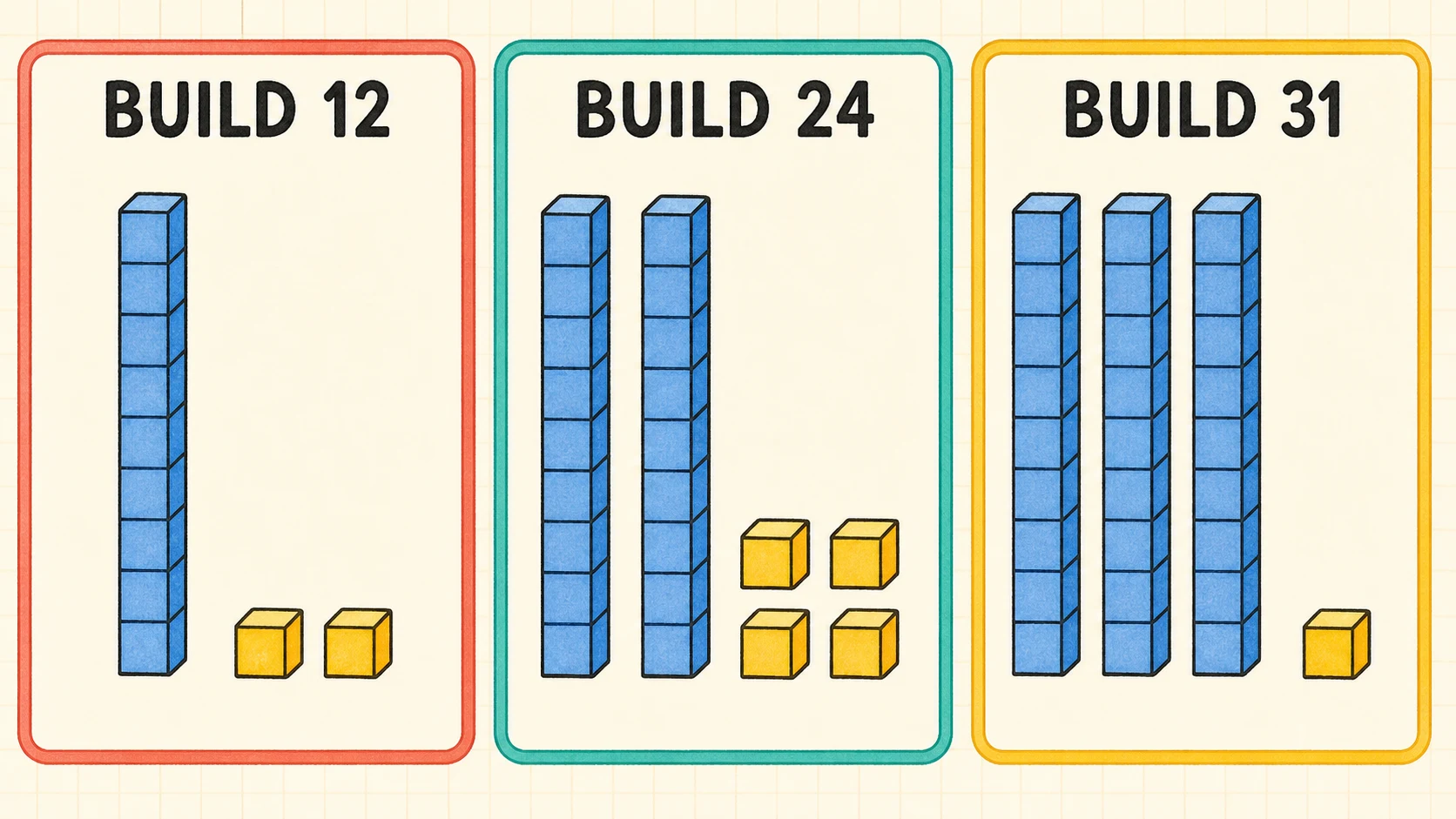
The plan alternates modeling, representation, explanation, and review instead of assigning ten identical sessions.
| Day |
Main focus |
Suggested activity |
Check before ending |
| 1 |
Readiness |
Count collections to 10; make and verify one group of ten |
Can the learner make exactly 10? |
| 2 |
Ten plus one or two |
Build 11 and 12 with a bundle and loose objects |
Can they state the ten and ones? |
| 3 |
Teen models |
Build 13 and 14; match each to a numeral |
Does the written numeral match the model? |
| 4 |
Ten-frames |
Show 15 and 16 with a full frame and extras |
Can they count on from 10? |
| 5 |
Review |
Mix 11–16 model-to-numeral matches |
Which representation still needs prompting? |
| 6 |
Larger teen numbers |
Build 17 and 18 using bundles or blocks |
Are all loose ones counted once? |
| 7 |
Equations |
Connect models to 10+7=17 and 10+8=18 |
Can the learner identify each part? |
| 8 |
Error analysis |
Correct several deliberately mismatched models and numerals |
Can they explain the correction? |
| 9 |
Boundary case |
Build 19, add one, and regroup to make 20 |
Can they describe what changed? |
| 10 |
Independent check |
Build, draw, write, and explain two unfamiliar teen numbers |
What is the next specific teaching need? |
If Day 5 reveals uncertainty, repeat earlier work rather than pushing forward. If Day 10 is secure, continue with spaced review and connect the idea to age-appropriate comparison or addition examples. If understanding remains uneven, return to the earliest column in the progression table where the learner needs help.
Limits and the Honest Next Step
This guide addresses the Kindergarten focus of composing and decomposing 11–19 into one ten and additional ones. It does not provide comprehensive standards alignment, prescribe a universal timetable, or replace local curriculum decisions. It also does not establish that every catalogue exercise is necessary for every learner.
Hundreds, thousands, decimal places, general rounding procedures, and multi-digit expanded form belong to later development in the broader place value progression. Even two-digit reasoning beyond the teen-number focus should be introduced according to the learner’s readiness and local sequence.
The next useful action is to give the learner one build–say–draw task for a teen number you have not practiced that day. Use the response to choose practice. If the learner can identify the ten and ones accurately, preview the free Kindergarten Place Value worksheet and select only the items that reinforce that current skill. If a custom mix would fit better, use the free worksheet generators to create practice around the specific representation or number range the learner needs.