Curated collectionAnswer keys includedPrint-ready PDFs
Differentiated Phonics Worksheets
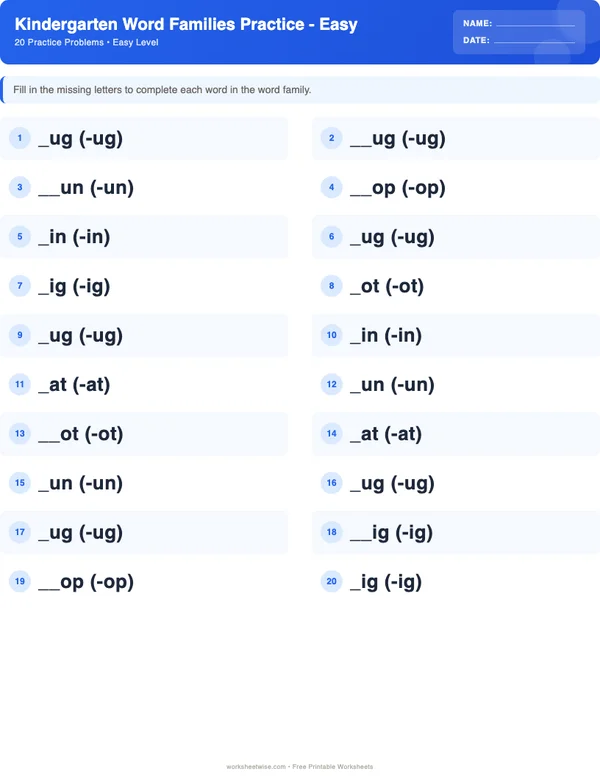
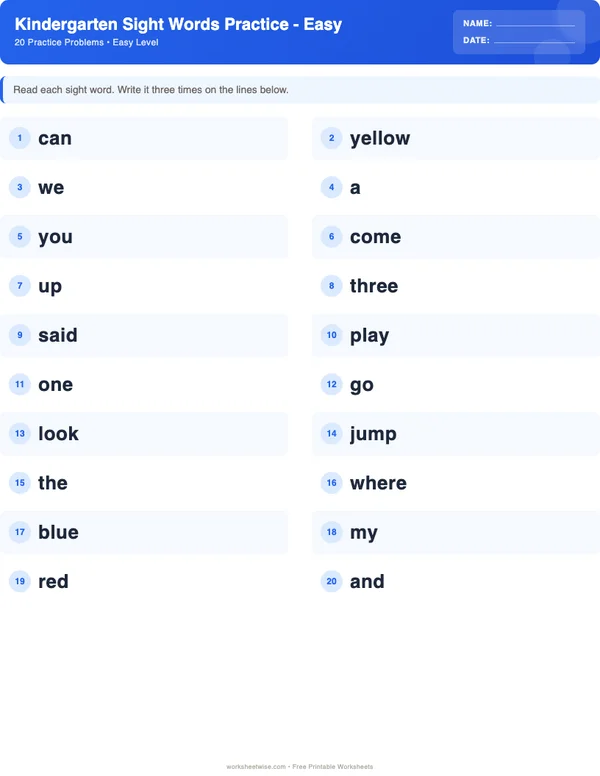
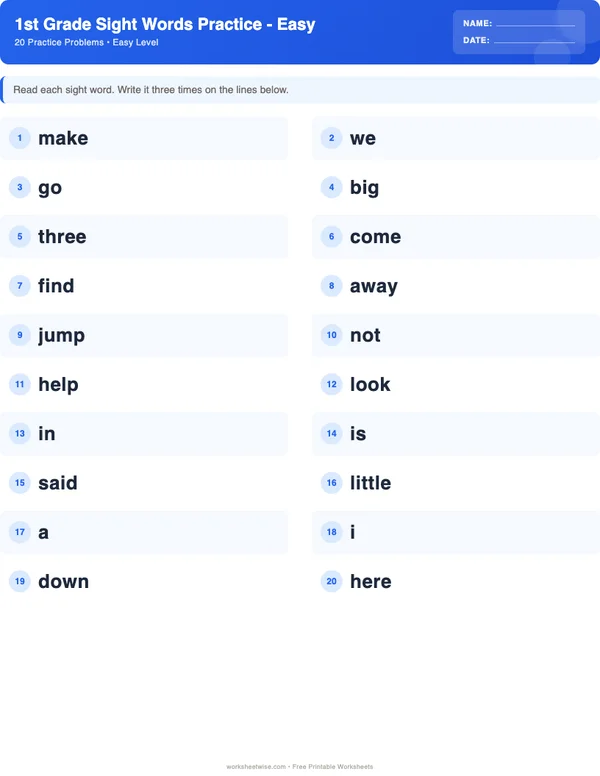
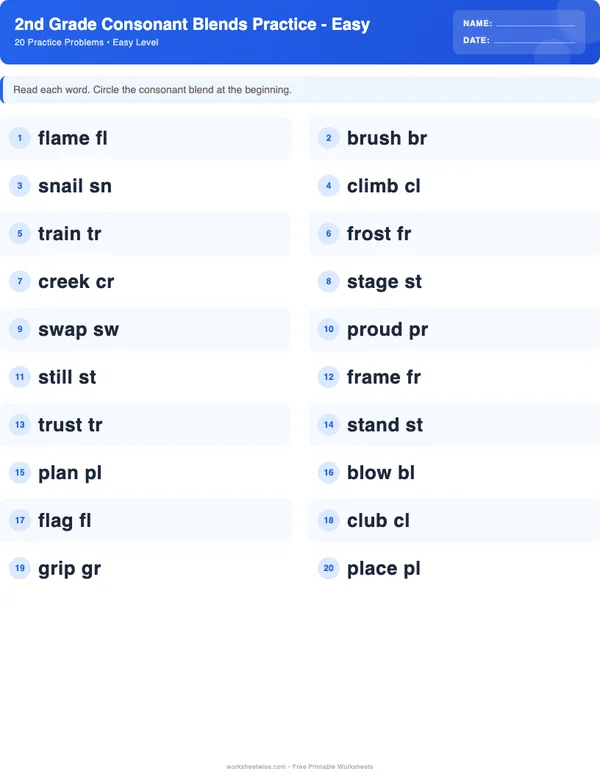
Hold the learning goal steady while changing number bounds, prompts, representations, response load and extension demand across three real worksheet versions.
Start with a real resource
Browse this worksheet collection
22 relevant free entry points are available. Each one includes a printable learner PDF and separate answer key.
A useful practice loop
Print less. Observe more.
- Choose one skill and model the first item aloud.
- Use a short set and notice the learner’s strategy.
- Change the next task from the work you can see.
Need more than the free sheet?
Plus includes all 396 matching catalogue variations where available, plus saved deterministic generators and the worksheet designer.
See Plus membershipComplete guide
How to teach and practise differentiated phonics worksheets
3,247 words Updated 6 instructional visuals
Differentiate the work, not the phonics target
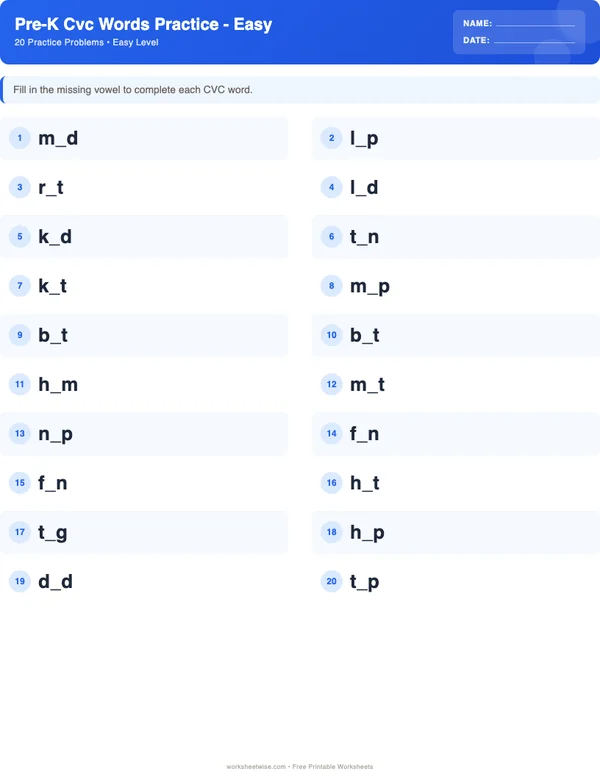
Effective differentiated phonics worksheets keep one learning goal constant while changing how much the learner must process, produce, and explain. If the target is distinguishing short e from short i, all three worksheet versions should test that contrast. One version might use adult-spoken words and picture matching; another might ask the learner to complete p_n and s_t; a third might require sorting, spelling, and explaining the vowel choice. Giving one learner short vowels and another long vowels is not differentiation of the same lesson—it is teaching different content.
WorksheetWise currently lists 396 phonics variants across four intended grade levels and seven topics, including 22 free entry points. That range is useful only when adults select by observed task demands rather than by grade label alone. Grade labels describe intended practice level; local curriculum sequences differ. Age is a discovery aid, not a placement decision.
Use this decision rule:
- Name one phonics behavior that should remain constant.
- Choose words that isolate that behavior.
- Adjust prompts, representations, response load, and extension demand.
- Listen to the learner read or explain at least several items.
- Select the next sheet from the error pattern, not merely the score.
The formative assessment phonics worksheets can support that final decision when the purpose is to collect evidence rather than assign more practice automatically.
Define the target narrowly enough to observe
“Practice phonics” is too broad. “Read six CVC words containing short a by blending all three sounds” is observable. So is “distinguish sh from ch in initial and final positions” or “change a short-vowel CVC word into a silent-e word and read both.”
The catalogue contains related skills that must not be treated as interchangeable:
- In a CVC word such as cat, three letters represent three sounds in a consonant-vowel-consonant structure.
- In a blend such as st in stop, both consonant sounds remain audible.
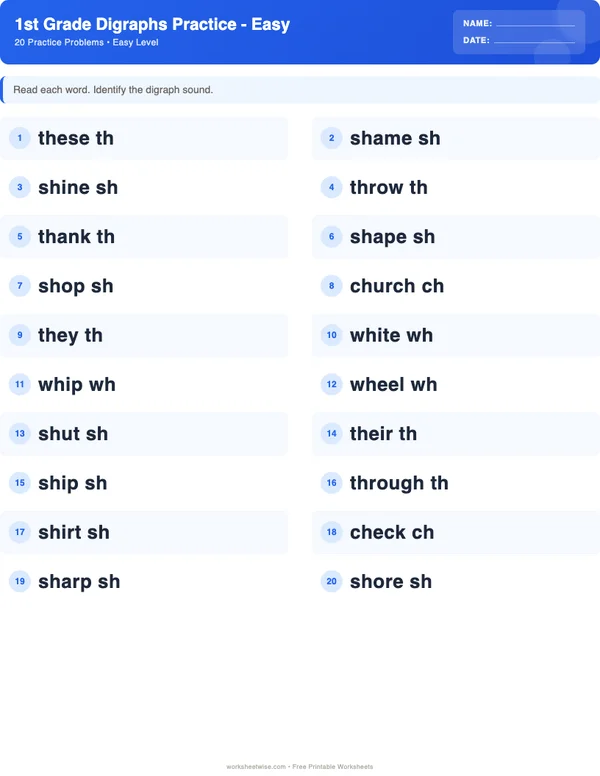
- In a digraph such as sh in ship, two letters work together to represent one sound.
- In a silent-e contrast such as hop/hope, the final e changes the vowel pattern without adding a separate final sound.
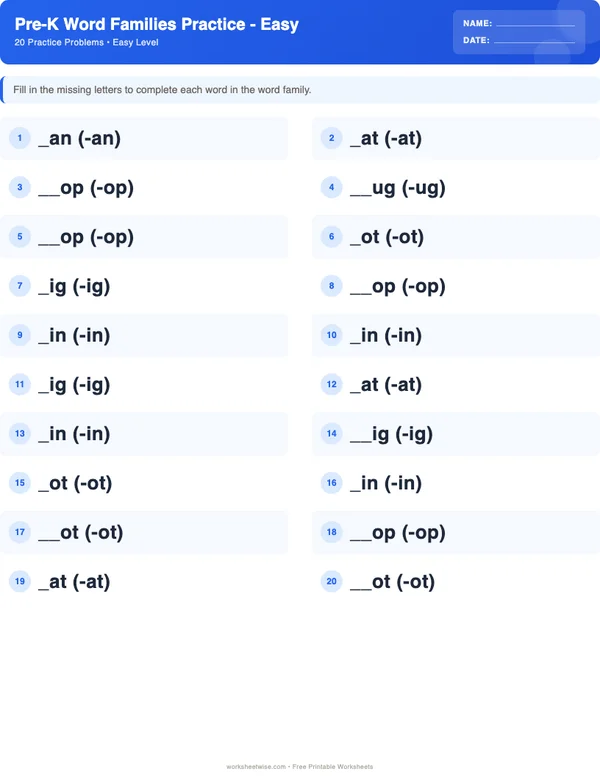
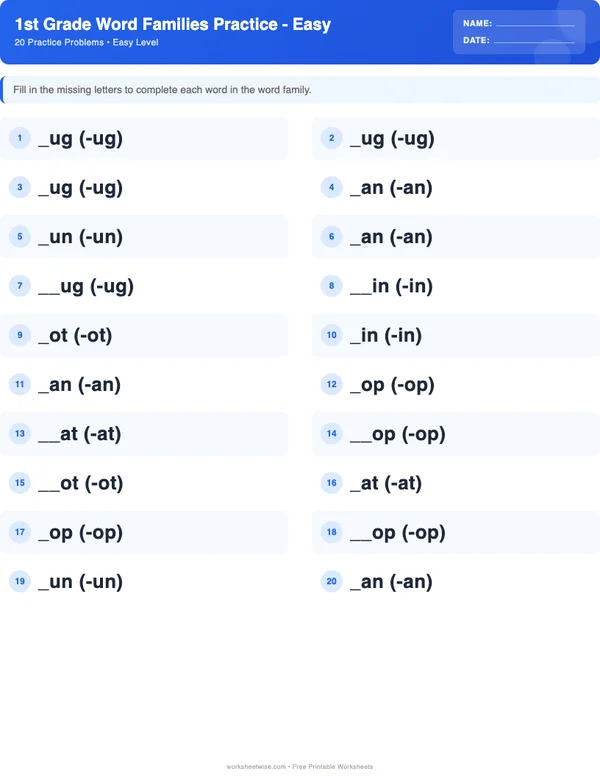
- In the word family -at, the shared ending remains stable while the beginning changes.
These distinctions determine what should appear on a worksheet and what feedback should follow an error. A learner reading stop as sop needs attention to a missing sound in a blend. A learner reading ship as though s and h were separate sounds has a different problem. Putting both errors under “consonants” would conceal the next teaching move.
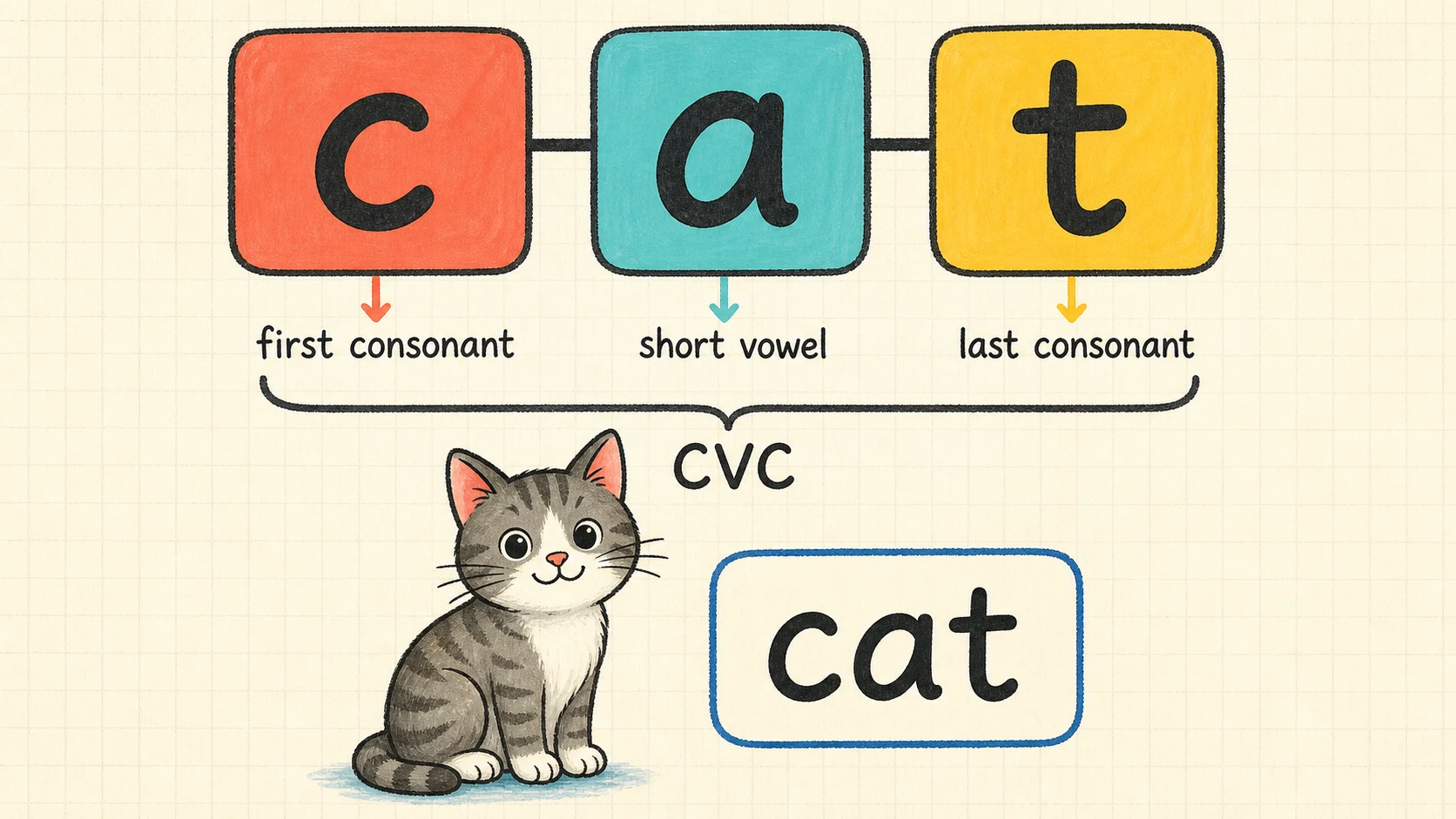
Use the CVC map to keep blending, segmenting, letter–sound matching, and spelling connected without turning them into one vague objective.
The Institute of Education Sciences recommends explicit instruction that helps children connect speech sounds with letters, decode words, analyze word parts, and read connected text. It also calls for modeling followed by supported practice and feedback. That guidance supports a deliberate sequence, but it does not prescribe any particular WorksheetWise sheet or prove that one worksheet format will suit every learner. See the IES foundational reading practice guide.
Select among live skills by prerequisite and contrast
A useful sheet presents enough challenge to reveal thinking without burying the target beneath unfamiliar patterns, vocabulary, or writing demands.
CVC words before heavier sound sequences
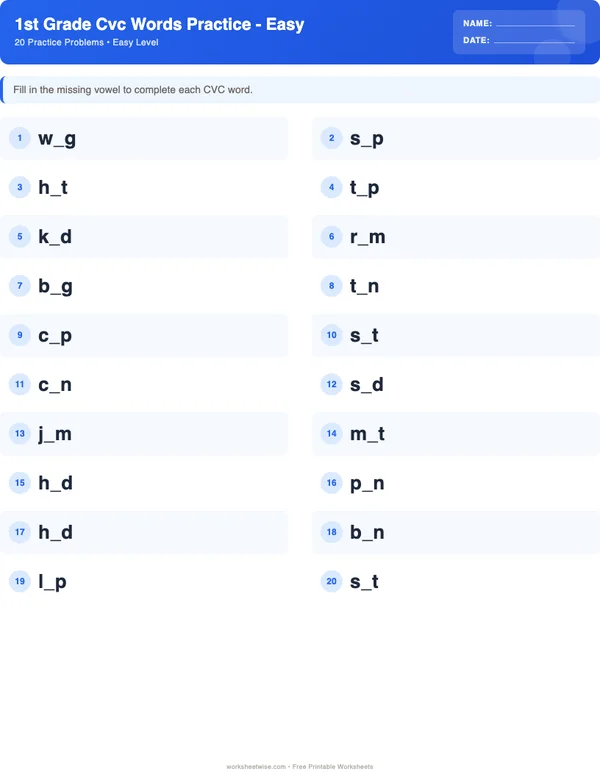
The live catalogue includes 20-item CVC sheets at Pre-K, kindergarten, and first-grade intended practice levels. The repeated topic is useful because the grade label need not determine placement. First ask whether the learner can hear, map, and blend three sounds.
For example, cat, pin, and hug are checked CVC examples: each has three letters in consonant-vowel-consonant order and a short vowel in a closed syllable. They belong here because they permit direct observation of initial, medial, and final sound processing without a blend, digraph, or silent-e pattern.
Use a more supported version when the learner can identify sounds orally but loses the sequence while reading. Put three counters under three sound boxes, say map, move one counter for each sound, and sweep beneath the boxes while blending. Use a less supported version when the learner can blend but needs to connect reading with spelling: show a picture or say map, then require letter tiles or written letters.
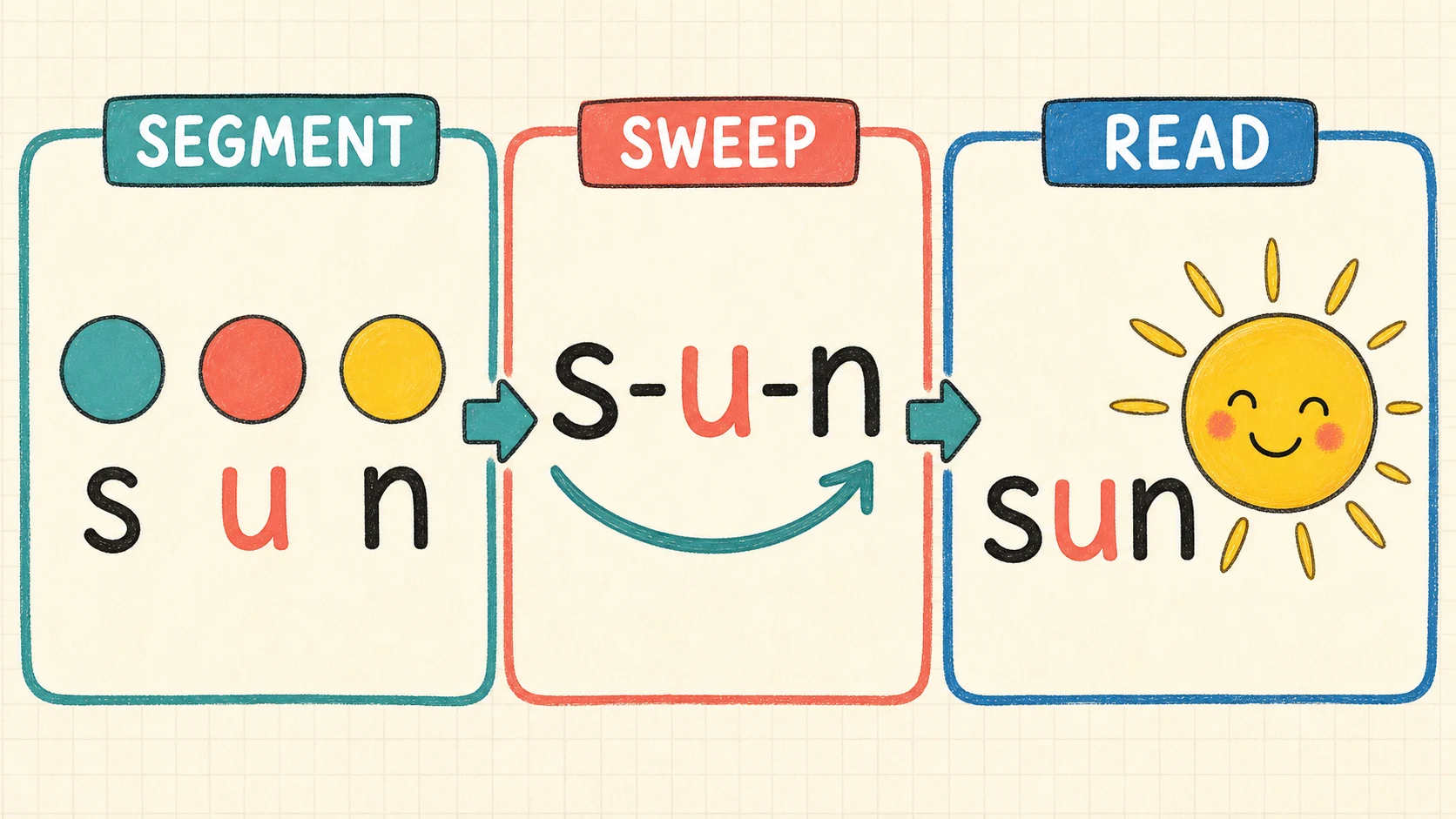
The worked CVC example clarifies how the same three-sound target can move from counters or boxes to a written response.
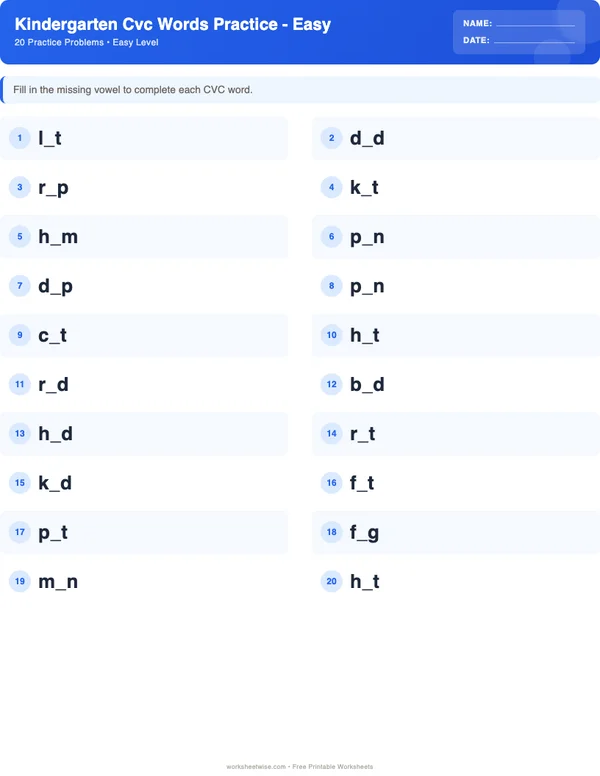
Adults needing a focused starting point can compare the Pre-K CVC Words guide and free sheet with the kindergarten CVC Words guide and free sheet. Select from the observable demands, not from the label.
Short-vowel discrimination before long-vowel patterns
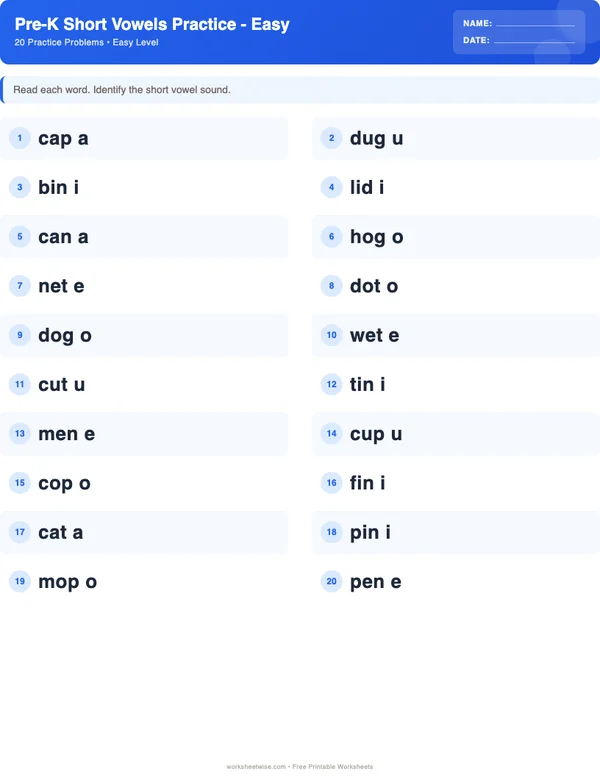
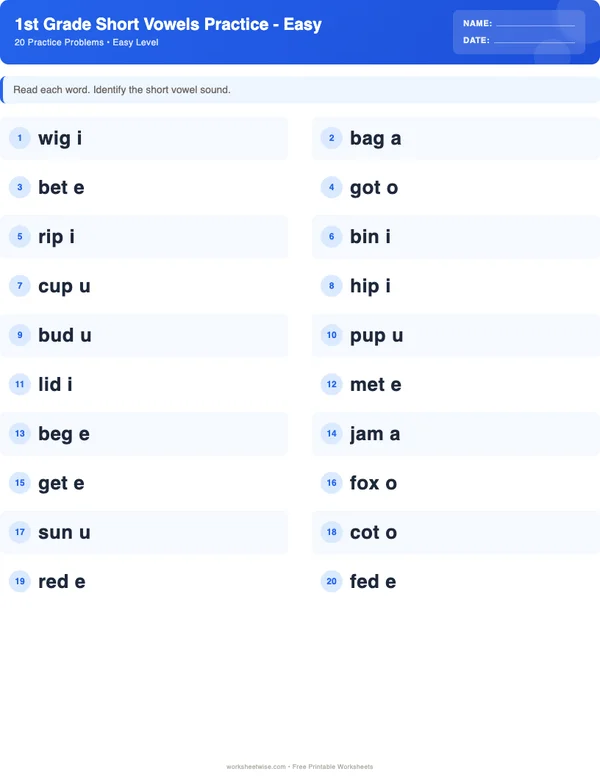
Short-vowel work asks learners to notice the middle sound in closed syllables such as cat, pen, sit, hot, and cup. The catalogue guidance specifically identifies short e/short i and short o/short u as useful contrasts to watch.
A checked minimal-pair example is pen/pin. Both words begin with /p/ and end with /n/; only the medial vowel changes. This belongs in differentiated phonics because it isolates the target better than a pair such as pen/sit, where every phoneme changes. Start with the adult saying each word while the learner points to an e or i anchor. Then remove the anchors and ask the learner to place printed words into two columns. Finally, dictate a mixed set and require spelling.
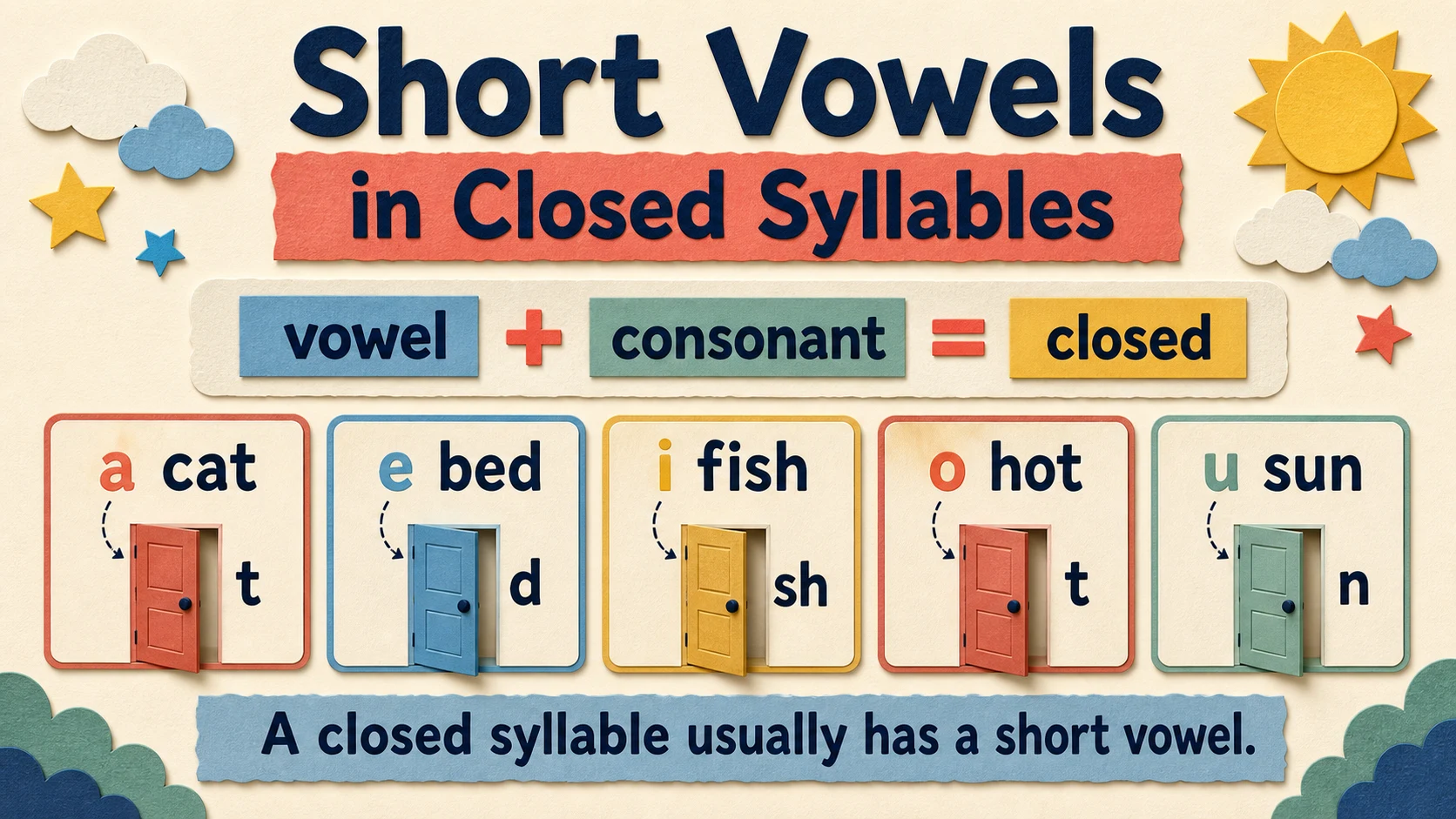
The short-vowel map helps an adult separate hearing the vowel, choosing its letter, reading the word, and spelling it.
Do not move to long vowels merely because a short-vowel sheet is complete. Move when the evidence shows that the learner can handle the intended short-vowel contrast with decreasing support across reading and spelling.
Blends and digraphs require different sound counts
The catalogue describes blends as adjacent consonants whose individual sounds remain, while a digraph uses two letters for one sound. This difference should be physically represented.
For stop, use four counters: /s/ /t/ /o/ /p/. For ship, use three: /sh/ /i/ /p/. Both words have four letters, but they do not have the same number of phonemes. This checked comparison belongs here because it prevents a worksheet’s boxes or blanks from teaching the false rule “one letter always equals one sound.”
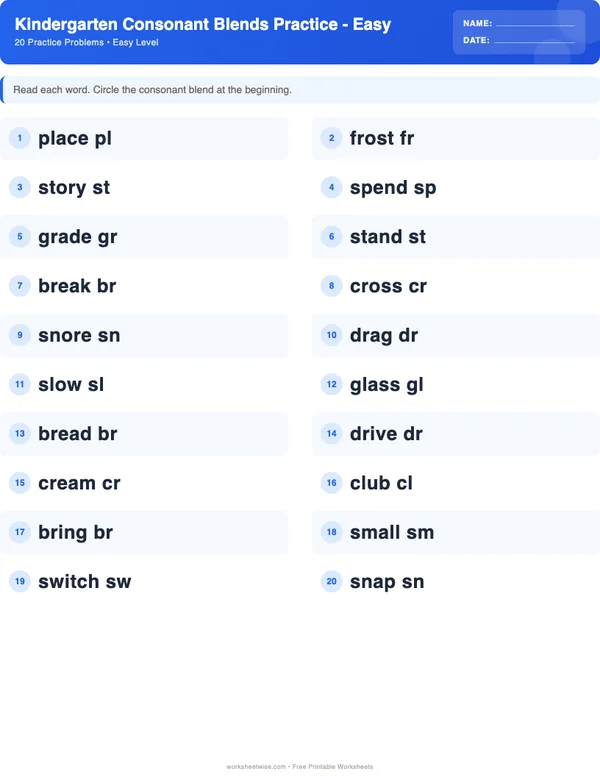
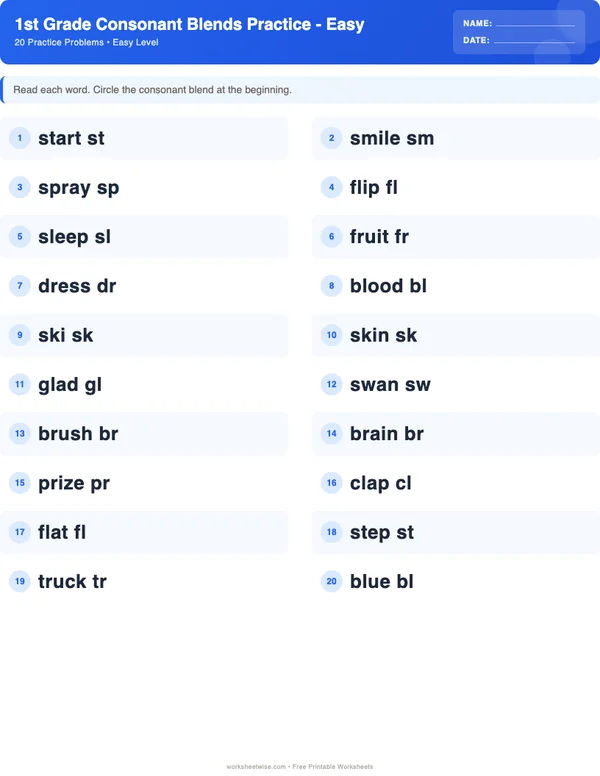
The live kindergarten consonant-blends guidance suggests beginning with continuous s blends and watching for deletion, such as reading stop as sop. The kindergarten Consonant Blends guide and free sheet is therefore appropriate after simple CVC blending is secure enough that the extra consonant is the meaningful new demand.
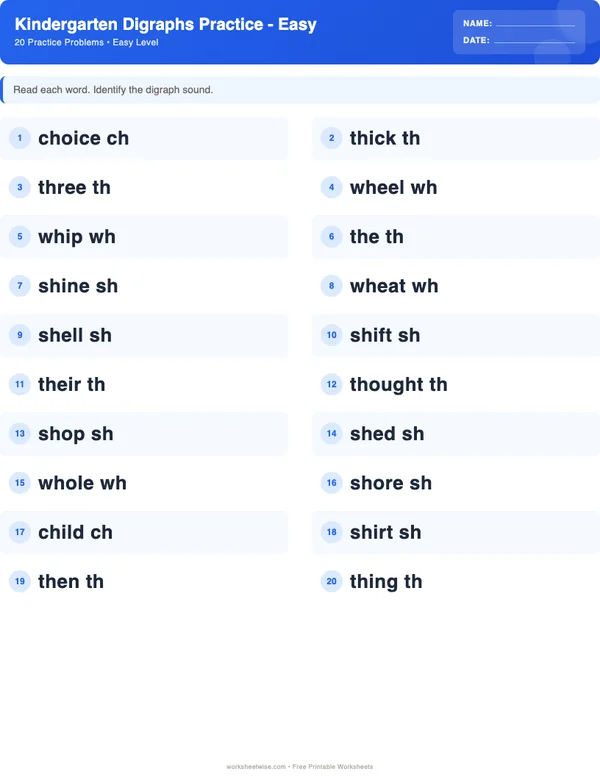
For digraphs, contrast ship/wish, chin/much, or thin/bath to vary position while holding the target grapheme steady. Do not ask for labels such as “voiced” and “unvoiced” if the actual goal is reading th words; the catalogue guidance says exposure to both pronunciations is sufficient for that stage.
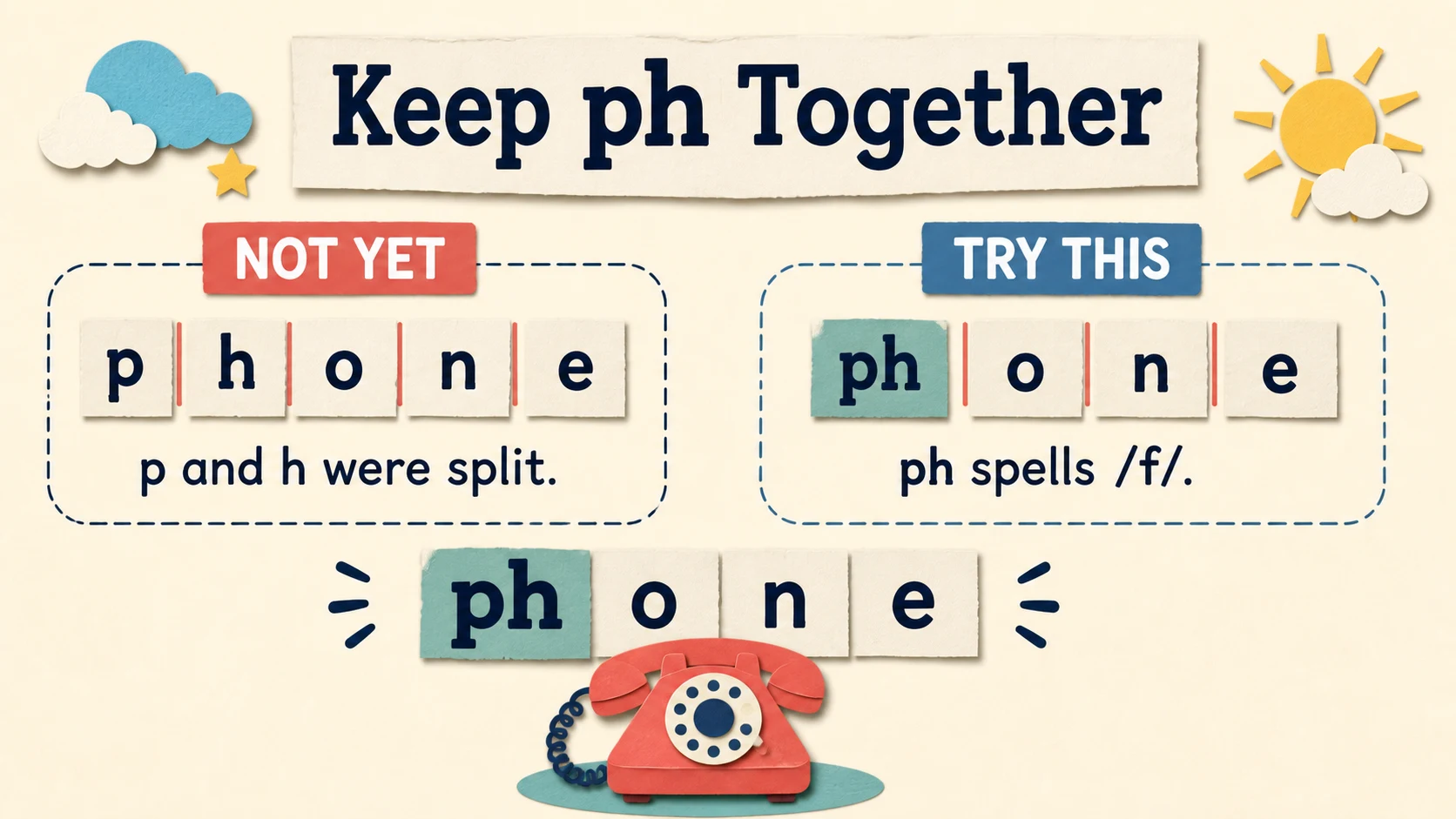
Use the digraph error display to choose a response based on what the learner said, not simply whether the answer was marked wrong.
Build three versions around one word set
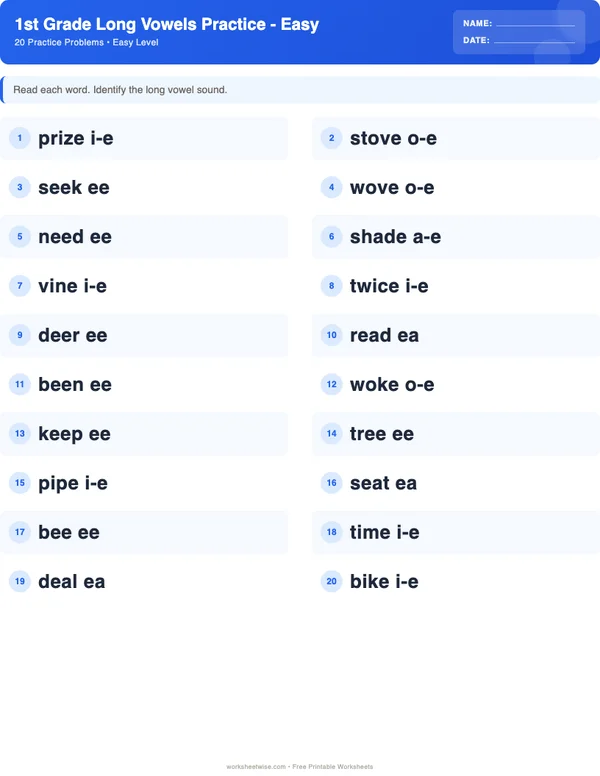
The cleanest differentiation begins with a common core. Suppose the learning goal is: Distinguish short-vowel CVC words from silent-e long-vowel words by reading the vowel accurately. Use the checked pairs cap/cape, pin/pine, hop/hope, and cub/cube. In every pair, adding final e changes the spelling pattern and vowel sound. Each version therefore addresses the same contrast.
Version A: model, point, and build
Display one pair at a time. The adult reads hop, points under each sound-bearing part, and contrasts it with hope. The learner then:
- repeats both words;
- points to the word the adult says;
- builds it with letter tiles;
- reads the completed word aloud.
Keep the response load small—perhaps four to six decisions—while repeating the target orally. The learner should not have to copy eight words before demonstrating vowel discrimination. Pictures may support meaning, but the adult should sometimes cover them to check whether the print, rather than the illustration, drives the answer.
Version B: read, sort, and complete
Present the same eight words in mixed order. Ask the learner to:
- read each word;
- sort it under “short vowel” or “long vowel”;
- complete one missing-vowel or missing-final-e item;
- reread each pair.
The prompt has less modeling, and the learner must retain the category. Yet the word set and target remain stable. This makes performance more comparable with Version A.
Version C: spell, transform, and justify
Dictate hop, then ask the learner to change it to hope with the smallest possible letter change. Repeat with two or three other pairs. Add a brief explanation prompt: “What changed in the spelling, and what changed in the vowel sound?”
This version raises extension demand, not the underlying phonics target. It should not introduce unfamiliar vowel teams such as oa unless the new goal is comparing long-vowel spellings. A response such as “I added e and the o became long” is enough; paragraph writing would measure composition and handwriting as much as phonics.
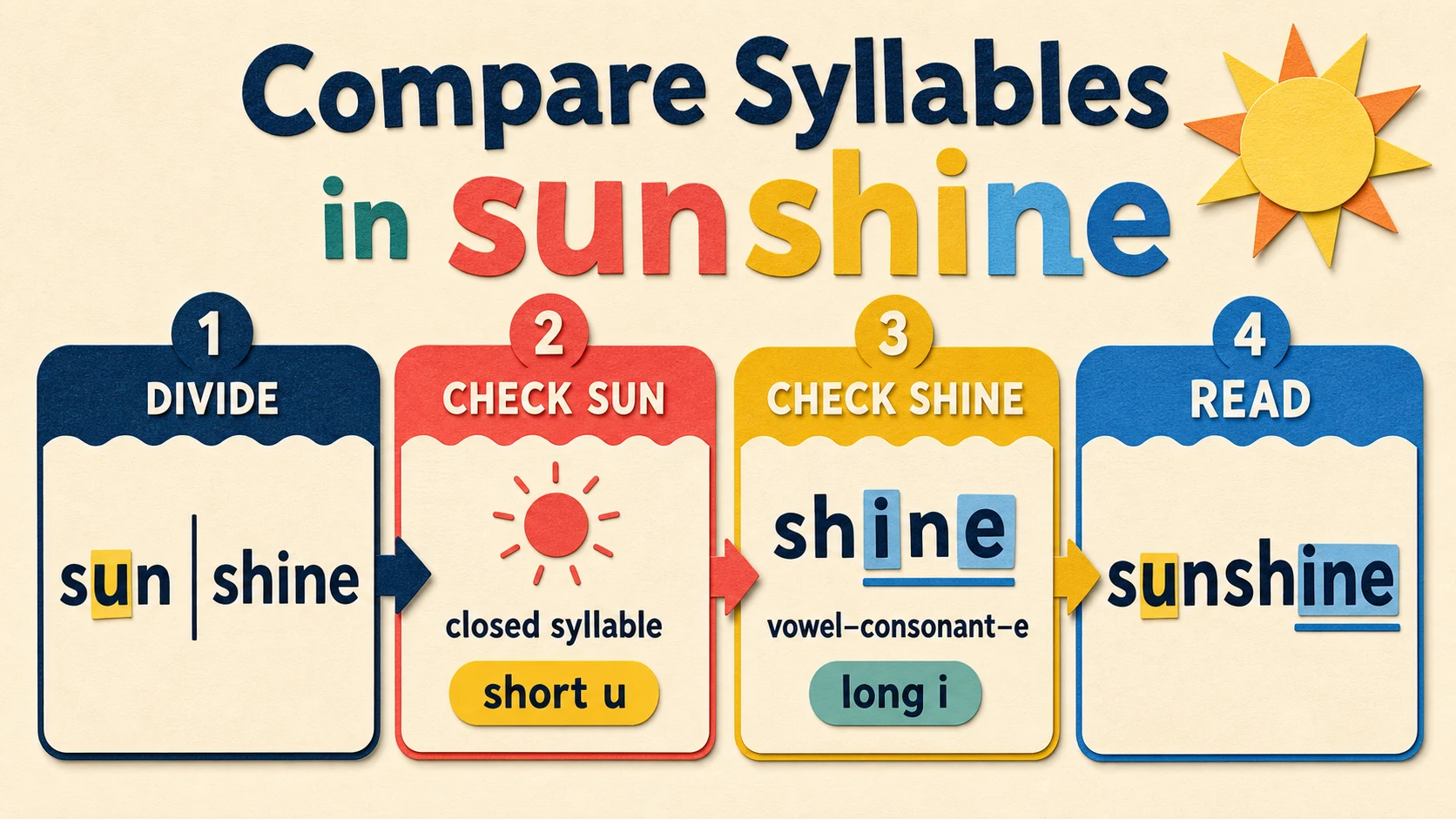
The long-vowel progression shows how prompts can recede while the vowel-pattern target remains visible.
The Common Core English Language Arts standards include grade-specific foundational-skills expectations involving sound–spelling relationships and word analysis. They can help adults understand the intended progression, but they do not establish an individual learner’s placement, and local curricula may teach patterns in a different order. Consult the applicable Common Core ELA standards only as a sequence reference.
Use a short teach–attempt–check routine
A worksheet becomes more informative when it sits inside a repeatable interaction.
Before the sheet: preview the exact contrast
Take two minutes to state the goal and model one example. For a short e/short i sheet, say: “Listen to the middle sound. I hear /e/ in pen and /i/ in pin.” Ask the learner to repeat the pair and point to the relevant vowel letters.
Do not preteach every answer. The preview should explain the decision the learner will make, not complete the page in advance.
During the sheet: sample aloud
Let the learner work, but listen to the first two items and then sample later items. Silent completion cannot show whether a correct picture match came from decoding, guessing, or using the image. Ask neutral prompts such as:
- “Read the whole word.”
- “Show me the sound that changed.”
- “How many sounds do you hear?”
- “Build it, then write it.”
If an item is wrong, avoid immediately supplying the word. Return attention to the target feature: “Touch each sound in stop. Which sound came after /s/?”
After the sheet: reread and record one pattern
Choose two correct items and one corrected item for rereading. Record a compact observation such as: “Read 6/8 CVC words; both errors changed short e to short i,” or “Read initial sh accurately but separated the letters in final sh.”
The record is not a diagnosis. It is a description of performance in one task under known support conditions. Use it to choose the next instructional contrast.
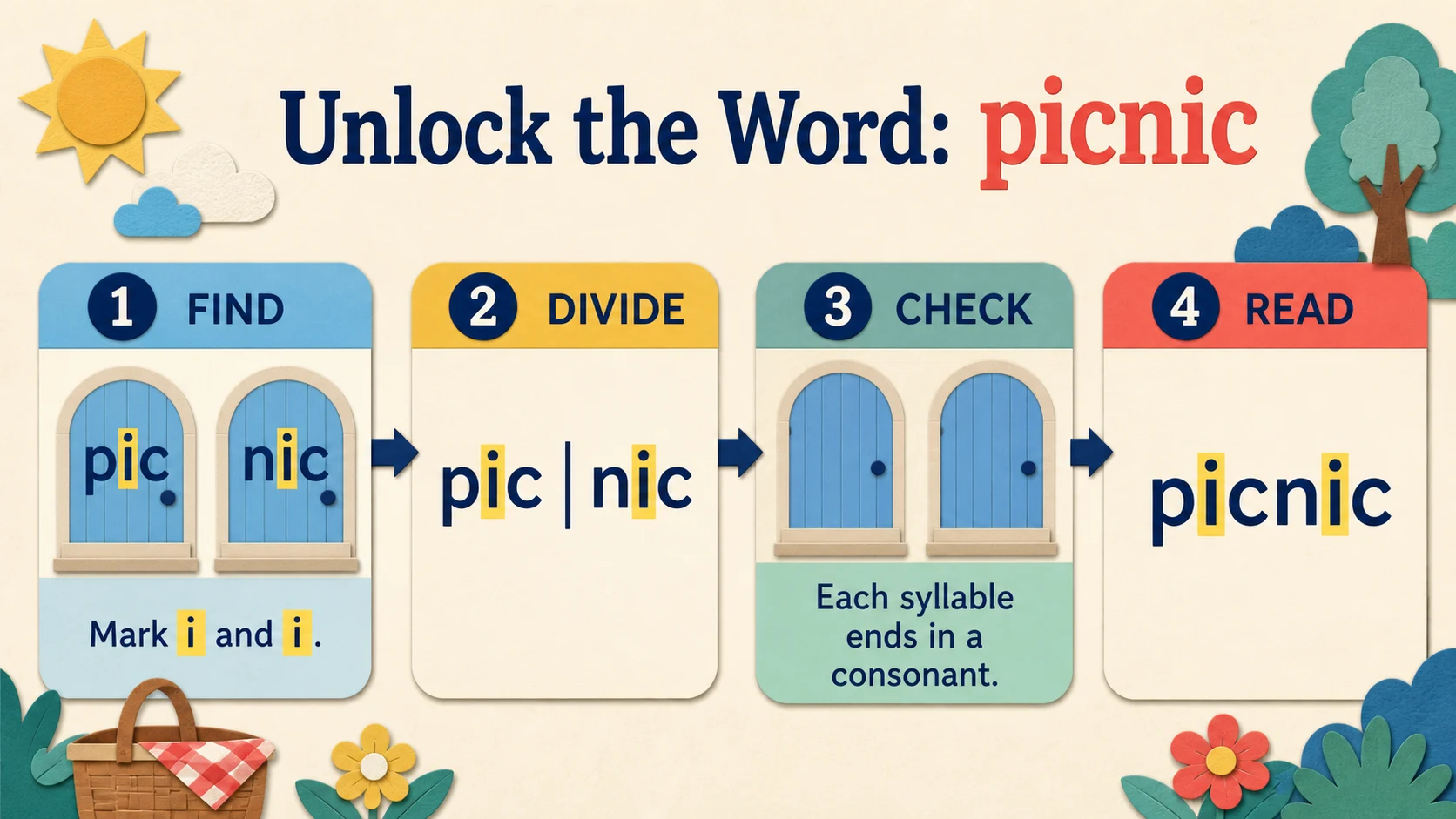
The short-vowel progression makes support visible: adult modeling, constrained choices, mixed reading, and independent spelling are different task conditions.
Interpret errors before choosing another sheet
A total such as 14/20 hides the information needed for differentiation. Group errors by what changed.
The learner guesses from the picture or first letter
Evidence: the learner sees a picture of a cat and says cat without attending to the printed word cap, or reads several words with the same initial consonant as the same word.
Next sheet: keep CVC words but reduce or remove pictures on some items. Ask the learner to track all three graphemes and blend before checking meaning. A nonsense form such as nib can be used cautiously as a decoding check because it cannot be retrieved as a familiar memorized word; explain that it is a pretend word so the learner does not search for meaning.
The middle vowel changes repeatedly
Evidence: pen becomes pin, bed becomes bid, while consonants remain accurate.
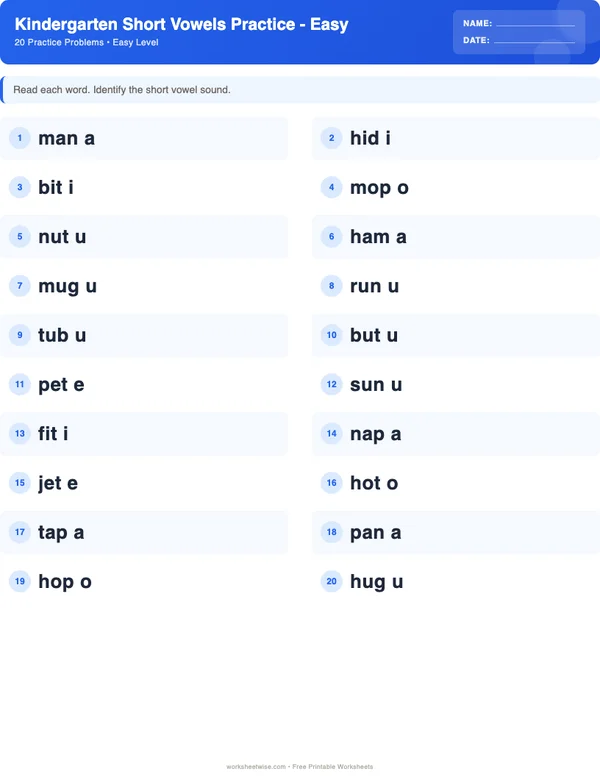
Next sheet: do not broaden to all five vowels. Use an oral and printed two-way e/i contrast with minimal pairs, then dictate a few CVC words. The Pre-K Short Vowels guide and free sheet provides a focused entry point, but the adult should shorten the 20-item load when sustained written work would obscure the listening target.
One consonant disappears from a blend
Evidence: stop becomes sop, or tent becomes ten.
Next sheet: keep the same blend position. Use sound counters or finger taps so every sound receives an action, then contrast ten/tent or bum/bump. Avoid switching immediately to digraph practice: deletion from a blend is not evidence that the learner needs two-letters-one-sound instruction.
Two digraph letters are treated as separate sounds
Evidence: ship is segmented as four sounds, or the learner attempts separate /s/ and /h/ sounds.
Next sheet: use two joined letter tiles or two fingers held together for sh, then map ship into three sound boxes. Mix in a blend such as slip only after the digraph response is established, asking, “Where do you hear one sound, and where do you hear two?”
Reading succeeds but spelling does not
Evidence: the learner reads cat, pin, and hug but omits or substitutes the medial vowel in dictation.
Next sheet: preserve the same word pattern and change the response from recognition to encoding. Say the word, ask the learner to segment it, build it, and then write it. Do not interpret the mismatch as proof that reading is absent; record the narrower observation that spelling from dictation required more support.
The IES elementary writing practice guide addresses writing instruction more broadly and supports explicit teaching, modeling, guided practice, and feedback. In this phonics context, that framework can inform how an adult models letter formation or a brief spelling response. It does not justify turning a phonics check into an extended composition task.
Adapt access while preserving the sound–spelling decision
An adaptation preserves the target only when the learner still performs the essential phonics operation.
For a learner who tires during handwriting, let the learner select letter tiles, point, circle, or dictate letters to an adult. If the target is choosing short e or short i, pointing to the correct grapheme can show the decision without requiring repeated word copying. Later, add a small spelling sample to determine whether the sound–letter connection transfers to writing.
For a learner who needs more visual structure, reveal one row at a time, increase spacing, or cover pictures after the first modeled example. Color can mark the position to inspect—such as a box around the medial vowel—but should not encode the answer by making every e one color and every i another.
For language support, confirm that the pictured object’s name is known before treating a response as phonics evidence. If a learner calls a pictured ship a “boat,” the mismatch does not show failure to decode sh. Say the intended word aloud or use a print-only item.
For ages three and four, prioritize brief adult-led oral, matching, manipulative, and movement work over desk work. A 20-item free sheet can be split into small encounters rather than completed in one sitting. Place e and i cards on opposite sides of the room, say pen or pin, and have the child move to the matching vowel. The discovery label may help adults find content, but age does not decide placement.
Do not preserve only the page’s appearance. If an adult reads every word and the learner merely traces it, the activity no longer checks decoding. Conversely, requiring full written sentences to prove recognition of sh adds writing demands unrelated to the stated target.
Define difficulty through the task, not the learner
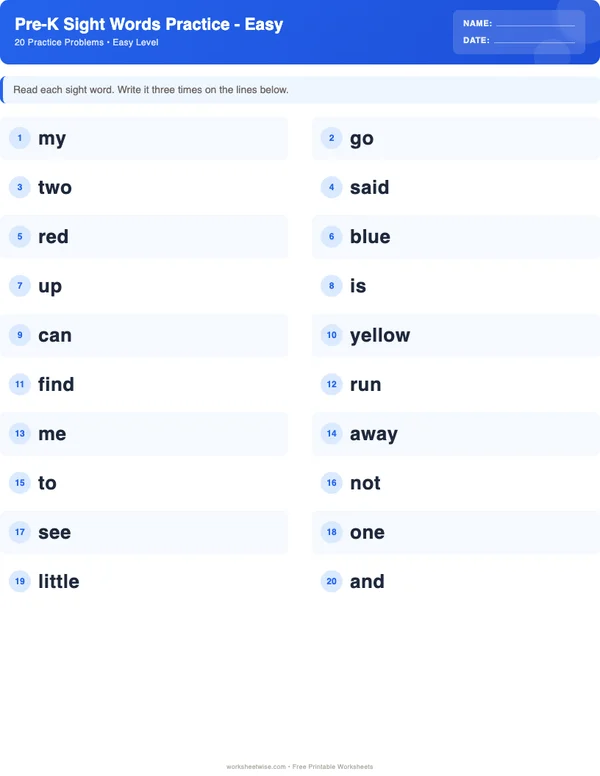
The representative free sheets are labelled “easy” in the live catalogue and contain 20 problems. Treat that label as a description to inspect, not an identity to attach to a child.
Observable features that can make a phonics task more supported include:
- one sound or spelling pattern at a time;
- a modeled first item;
- pictures or anchor cues;
- two response choices;
- oral responding or letter tiles;
- fewer items visible at once;
- repeated word structures.
Features that increase demand include:
- mixed contrasts;
- reduced visual cues;
- reading and spelling on the same sheet;
- digraphs in both initial and final positions;
- transforming one word into another;
- explaining a spelling choice;
- cumulative review with previously taught patterns.
Number of items is only one variable. A 20-item picture match may require less phonics processing per item than six dictated words. Likewise, a neat completed page may reflect copying stamina, while an oral word chain may reveal more about sound manipulation.
Use labels for worksheets only: “This version has two choices and a model,” or “This version mixes short and long vowels without pictures.” Do not label a learner “easy,” “developing,” or “advanced.”
Know what a worksheet cannot establish
One page cannot diagnose a reading disorder, measure general reading ability, or establish mastery. Performance may change with fatigue, vocabulary familiarity, speech production, visual layout, adult prompting, or prior exposure to the exact words.
A picture-matching sheet cannot by itself prove independent decoding. A word list cannot show whether the learner reads the pattern in connected text. Familiar real words cannot completely rule out memorization. A spelling response may be affected by letter formation or motor demands. Nonsense words can reduce the role of memorized vocabulary, but they still represent only one kind of evidence and should be clearly identified as pretend words.
Do not advance solely because every box is filled. Look for the target across at least two response forms—for example, reading and building, or sorting and brief dictation. Also avoid endless repetition after the learner demonstrates accurate, increasingly independent performance. At that point, retain a few cumulative-review items and move to the next justified contrast.
WorksheetWise’s catalogue counts describe available resources, not research outcomes. The authoritative sources above provide broader instructional guidance; they did not assess WorksheetWise, its worksheets, or its generators.
Make the next sheet answer one question
End each session by writing one observable next action:
- “Next, use six e/i CVC words without pictures because consonants were accurate but the middle vowel changed.”
- “Next, repeat initial st words with four sound counters because /t/ was omitted in three items.”
- “Next, contrast ship and slip with sound boxes because two letters were treated as one sound in both words.”
- “Next, dictate four familiar CVC words because oral reading was accurate but spelling evidence is missing.”
- “Next, move from hop/hope matching to word transformation because the learner read all four modeled pairs without an anchor.”
That sentence prevents random worksheet hopping. It names the retained target, the observed evidence, and the changed task condition.
For the next session, open the free deterministic worksheet generators and create or select a small set built around the exact contrast you recorded. Keep the words and phonics goal stable, change only the support or response demand, and listen to the first two answers before deciding whether the sheet is the right next step.
Put it into practice
Use the guide with a real printable
Move from explanation to a short, observable practice task. Check the first item together, then adjust the next session from the learner's actual work.
Open the first free worksheetExplore a neighboring collection