What 1st Grade Sight Words Instruction Should Accomplish
First-grade sight-word instruction should help a learner read common words accurately and with decreasing effort while still paying attention to spelling and sound patterns. Some high-frequency words are fully decodable once their phonics patterns have been taught. Others contain an unexpected letter-sound relationship that must be remembered. Effective practice distinguishes between those cases instead of treating every word as an unbreakable visual shape.
A practical teaching sequence is:
- Read the word in context.
- Say it clearly.
- Map the sounds to the letters.
- Identify any unexpected spelling.
- Read and write the word from memory.
- Apply it in a sentence or short passage.
- revisit it on separate occasions.
The goal is accurate, increasingly automatic recognition—not hurried guessing. The learner’s observed work should determine when to add words, repeat a lesson, or reduce support.
Grade labels describe the intended practice level, and local school or homeschool sequences differ. A word labeled for first grade may already be secure for one learner and entirely new to another. Begin with evidence from reading and spelling rather than assuming that every child needs the same list on the same timetable.
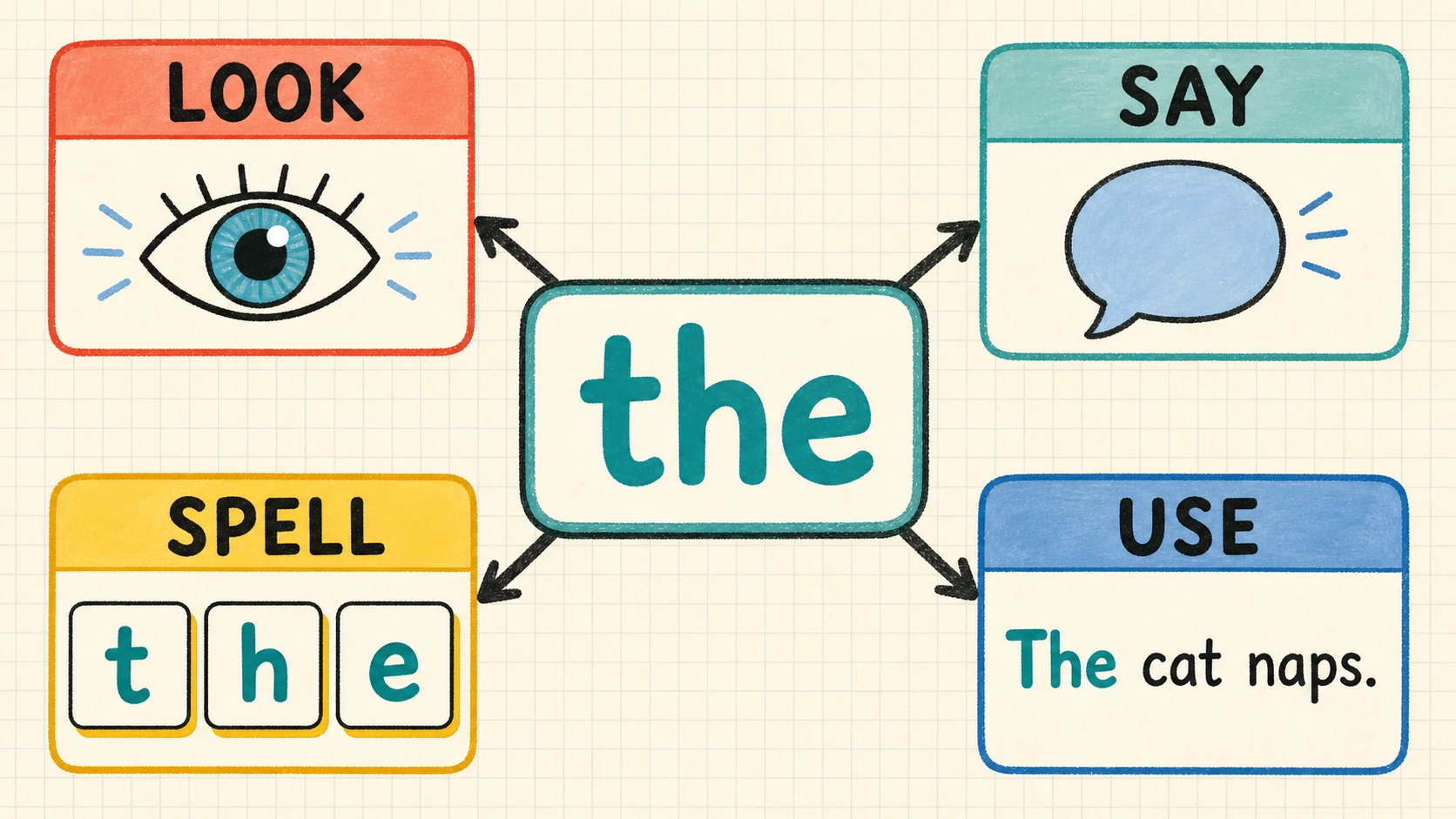
Sight-word learning connects recognition, sound-spelling analysis, memory, spelling, and use in connected text.
Understanding High-Frequency Words and Sight Words
A high-frequency word appears often in written language. A sight word is a word a reader recognizes immediately from memory. These ideas overlap, but they are not identical: frequency describes how often a word occurs, while sight recognition describes what the reader can do.
A common word such as and can become a sight word after the learner repeatedly maps and reads its regular spellings. A word such as said can also become a sight word, but part of its spelling is unexpected and requires special attention. Neither word should be taught only as a picture to memorize.
The WorksheetWise catalogue includes both decodable high-frequency words and irregularly spelled words in this topic. Its first-grade overview describes a progression from simple consonant-vowel-consonant words into blends, digraphs, long-vowel patterns, and more complex reading. Sight-word instruction should accompany that phonics work.
Decodable high-frequency words
A decodable word uses letter-sound relationships the learner has already been taught. Whether a word is currently decodable therefore depends partly on the learner’s instruction.
Consider and:
- The letters represent the sounds /ă/, /n/, and /d/.
- A learner who knows those correspondences can blend the word.
- Repeated accurate reading can make recognition faster.
The word may eventually be read instantly, but that automatic recognition grows from attention to its internal structure.
Words with an irregular part
An irregular word contains at least one spelling that does not match the phonics correspondences the learner is expected to use at that point. In said, the opening s and final d are predictable. The middle spelling ai represents /ĕ/ here rather than its more familiar long-a sound.
A useful model is to mark the predictable parts normally and place a heart, star, or small box beneath the unexpected part. The mark means “remember this spelling,” not “ignore the rest of the word.”
Pronunciation varies by accent and sentence position. Adults should model the pronunciation used in the learner’s community while preserving the printed spelling.
Prerequisites to Check Before Expanding the Word Set
Sight-word work is easier when several underlying skills are developing. These are not rigid admission requirements. They are checkpoints that help an adult select suitable support.
Spoken-word and sound awareness
Check whether the learner can:
- repeat a short word accurately;
- identify or isolate sounds in simple words;
- blend a few spoken sounds into a word;
- notice when two spoken words differ.
A learner who hears said as sad, for example, may need oral comparison before studying the spelling.
Letter knowledge and basic phonics
The learner should be able to name many letters and recall common consonant and short-vowel sounds. For a particular word, check the correspondences it contains. A child does not need to master every first-grade phonics pattern before reading high-frequency words, but instruction is clearer when known and unexpected parts can be distinguished.
If ship is difficult because sh has not been taught, more visual repetition will not solve the underlying problem. Teach or review the digraph first.
Print tracking and oral language
Confirm that the learner tracks print from left to right, points to a whole word rather than an individual letter when asked, and understands the word in a simple sentence. Recognition without meaning is fragile. The learner should know what was contributes in “The dog was wet,” even if an adult must explain the sentence orally.
Readiness evidence
Use a brief sample rather than a large test. Present five known words and two possible new words. Ask the learner to read each one, explain or use it, and write one known word from memory. Record whether the response was immediate, decoded slowly, guessed, self-corrected, or unknown.
That observation provides more useful planning information than a total score alone.
A Grade-Appropriate Progression
The following progression is an instructional suggestion based on the supplied catalogue sequence. It is not a universal timetable. Move forward when the learner’s reading and spelling show readiness.
| Stage |
Word focus |
Adult support |
Learner action |
Evidence to look for |
| 1. Establish meaning |
Familiar words in short oral sentences |
Say and explain the word |
Repeat it and use it orally |
Meaning is clear |
| 2. Map regular words |
Short, fully decodable high-frequency words |
Stretch sounds and point to spellings |
Blend, read, and spell |
Sounds match letters accurately |
| 3. Map irregular parts |
Common words with one unexpected part |
Mark predictable and remembered parts |
Explain which part must be remembered |
The learner attends to every letter |
| 4. Retrieve from memory |
A small mixed set of known and new words |
Reduce prompts and vary order |
Read, cover, write, and check |
Recall improves without guessing |
| 5. Apply in sentences |
Sentences containing taught words |
Prompt attention to meaning and punctuation |
Read and compose sentences |
Word recognition transfers to context |
| 6. Build independence |
Mixed review and short passages |
Intervene only after useful wait time |
Read, self-correct, and reread |
Accuracy holds across separate occasions |
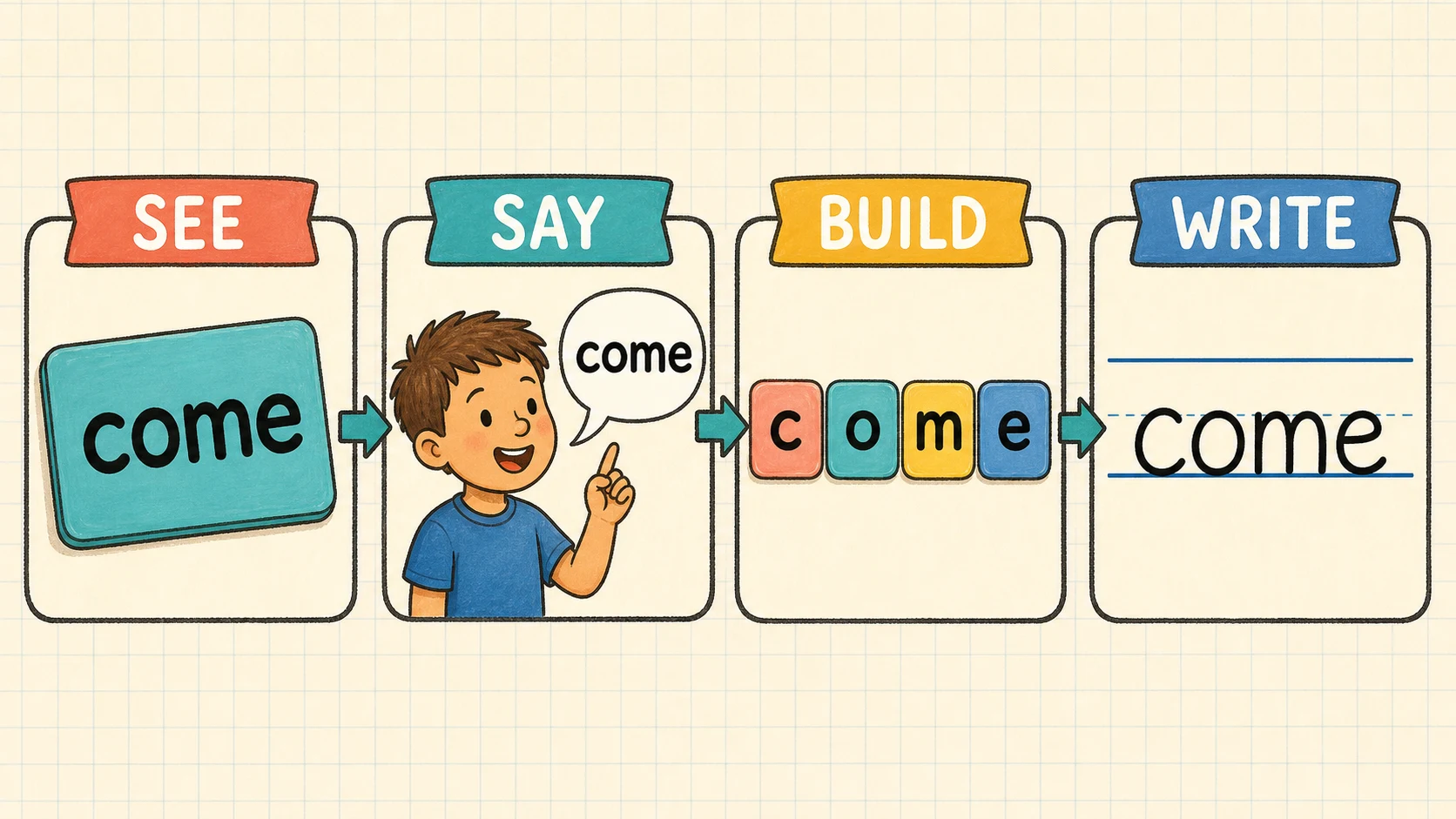
Support is gradually removed only when the learner’s responses show that the word is becoming secure.
The catalogue suggests introducing three to five new words per week with daily review. Treat that as a starting suggestion, not a quota. A learner who confuses two of three new words needs consolidation. A learner who reads, spells, and applies the full set accurately on separate occasions may be ready for another small set.
The 1st Grade Phonics hub can help adults place sight-word work beside decoding practice rather than separating the two.
Concrete and Visual Models That Make the Word Structure Clear
A concrete model turns an abstract spelling into something the learner can see and manipulate. Letter tiles, paper letter cards, sound boxes, and an erasable board are enough.
Sound-to-spelling mapping
Say the word normally, then stretch it only enough to hear its sounds. Place one counter for each sound. Replace each counter with the letter or letter group that represents that sound.
For and:
Sounds:     /ă/   /n/   /d/
Spellings:   a     n     d
For said:
Sounds:     /s/   /ĕ/   /d/
Spellings:   s     ai    d
                    ♥
The heart marks the part that needs special memory. It does not add a sound, and the two letters in ai work together in this word.
The read-build-write-check cycle
Use four visible spaces labeled Read, Build, Write, and Check.
- Read: The learner reads the printed word.
- Build: The learner constructs it with letter cards.
- Write: The model is covered, and the learner writes from memory.
- Check: The learner uncovers the model and compares every letter.
Comparison is an instructional step, not merely correction. Ask, “Which letters match? Where would you make a change?” This keeps responsibility with the learner.
Pictures can clarify sentence meaning, but they should not replace attention to print. If a child identifies was only because a picture suggests the sentence, cover the picture and check the printed word again.
Fully Checked Worked Examples
The examples below show the complete reasoning an adult can model. The sound notation is included for adult clarity; first graders can use ordinary spoken sounds, tiles, or sound boxes.
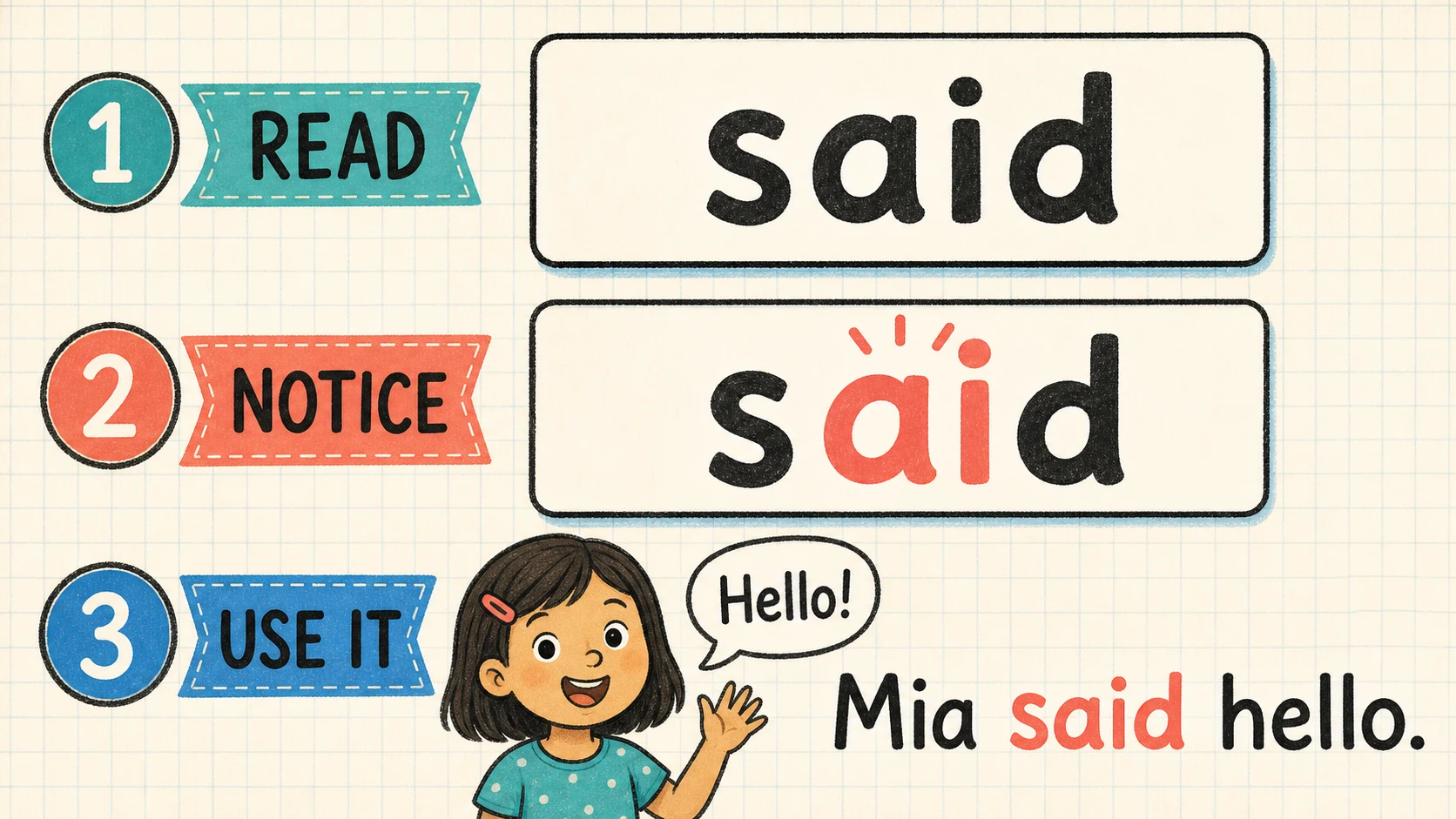
The learner moves from hearing and mapping the word to reading and writing it independently.
Worked example 1: and
Sentence: “Sam and Kim ran.”
- Say and.
- Segment it as /ă/ /n/ /d/.
- Map the sounds to a-n-d.
- Check regularity: each sound has an expected spelling for this level.
- Cover the model and write and.
- Compare: a-n-d matches a-n-d.
- Reread the sentence: “Sam and Kim ran.”
Checked answer: and is spelled a-n-d, contains three sounds, and joins Sam with Kim in the sentence.
Boundary case: A learner might hear the final /d/ weakly in quick speech. Pronounce the word clearly without adding a separate vowel after /d/.
Worked example 2: said
Sentence: “Mia said yes.”
- Say said.
- Segment it as /s/ /ĕ/ /d/.
- Map /s/ to s and /d/ to d.
- Map the middle /ĕ/ to ai, then mark ai as the unexpected part.
- Build s-ai-d and read the whole word.
- Cover it and write said.
- Compare all four letters, then reread the sentence.
Checked answer: said is spelled s-a-i-d. It has three spoken sounds in this pronunciation. The ai spelling represents /ĕ/ and must be remembered in this word.
Boundary case: said is not sad. The words differ in spelling, pronunciation, and meaning even though they look similar.
Worked example 3: was
Sentence: “The cup was full.”
- Read the sentence and identify the target word was.
- Say the word naturally.
- Notice the initial w and final s.
- In the common pronunciation /wŭz/, the a does not represent its usual short-a sound, and the final s is pronounced /z/.
- Mark those unexpected relationships for memory.
- Cover and write was.
- Check the order w-a-s, then reread the complete sentence.
Checked answer: was is spelled w-a-s, not w-u-z. Its pronunciation cannot be reconstructed by simply substituting the letters a learner might expect from the sounds.
Boundary case: Pronunciation may vary somewhat by accent. Use the learner’s natural spoken form, but always retain the spelling was.
Worked example 4: of
Sentence: “I see a cup of milk.”
- Locate of between cup and milk.
- Say of naturally.
- In the common pronunciation /ŭv/, the opening o represents /ŭ/ and the f represents /v/.
- Mark both spellings as unexpected for this word.
- Build o-f, read it, cover it, and write it.
- Check that the response is of, not ov, off, or for.
- Reread the sentence smoothly enough to preserve meaning.
Checked answer: of is spelled o-f. In the pronunciation modeled here, both letters represent less expected sounds.
Boundary case: Do not teach the f in of as silent. It represents a sound, although that sound is /v/ in the common pronunciation.
Worked example 5: choosing the correct word
Sentence frame: “The cat ___ wet.”
Choices: was, said, and
- Read the complete frame.
- Test each choice orally.
- “The cat was wet” forms a meaningful sentence.
- “The cat said wet” does not fit the intended meaning without additional context.
- “The cat and wet” is incomplete.
- Write the selected word and read the sentence again.
Checked answer: was.
This task checks more than visual recognition. It requires the learner to coordinate word reading, grammar, and meaning.
A Short, Repeatable Lesson Routine
A focused session can remain brief while including direct teaching, retrieval, and connected reading. The IES foundational reading practice guide supports high-level instruction that connects sound awareness, decoding, word analysis, and reading connected text. That source provides broad instructional framing; it does not evaluate WorksheetWise materials or prescribe this exact routine.
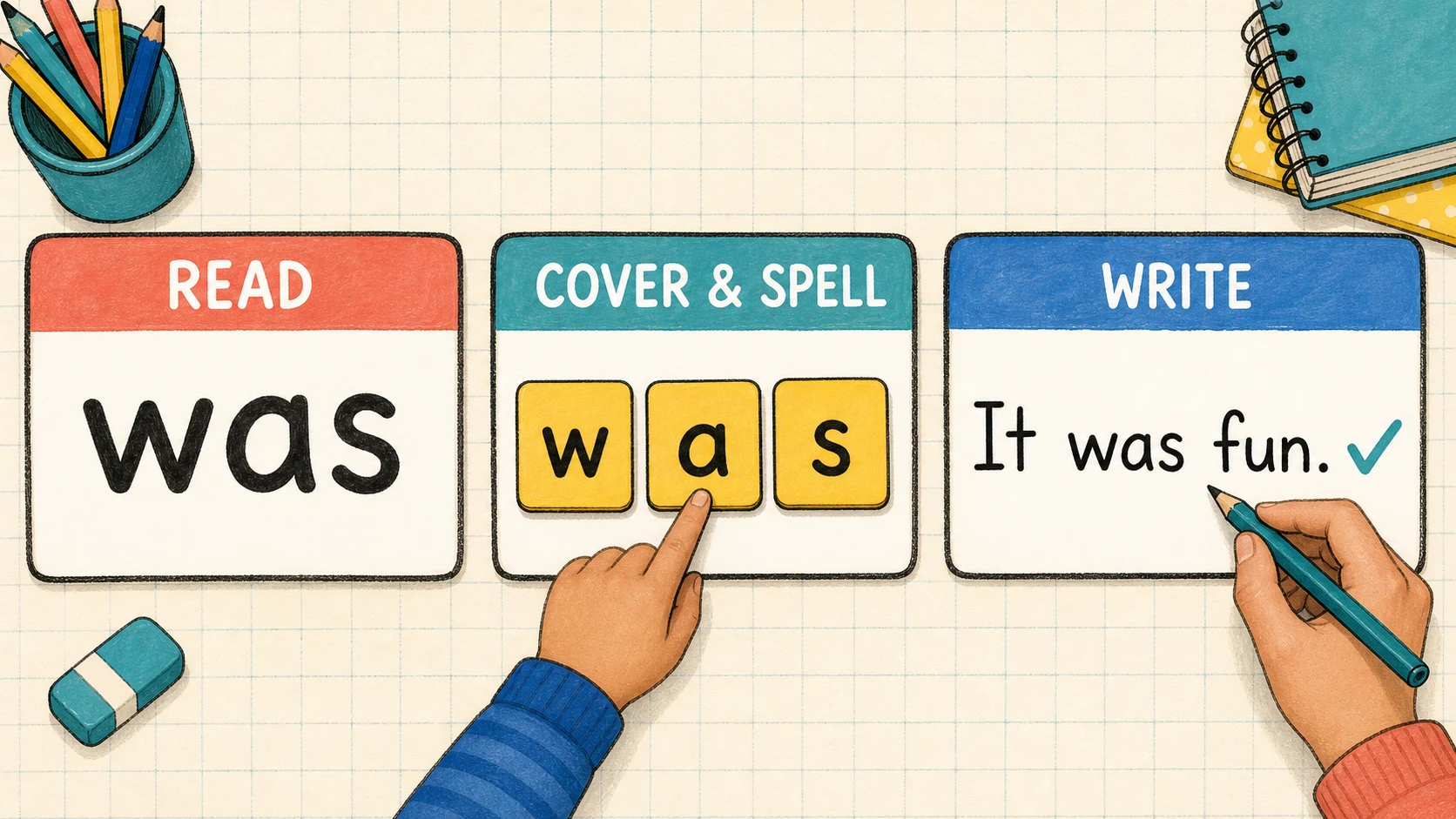
The same predictable routine can be used with different word sets and adjusted from observation.
1. Review
Mix three to six previously taught words. Ask the learner to read them in changing order. Note hesitation and errors without turning the review into a speed contest.
2. Teach one new word
Use the word in a sentence, map its sounds and spellings, and mark any unexpected part. Have the learner explain the mapping in simple language: “The s and d are expected; the ai is the part I remember.”
3. Retrieve
Cover the word. Ask the learner to say it, spell it aloud, and write it. Uncover the model and compare letter by letter. Repeat after another activity rather than copying it many times in one uninterrupted block.
4. Read in context
Place the word in two short sentences or a short decodable passage containing patterns the learner knows. Ask one meaning-focused prompt, such as “Who said yes?” The learner should not need to choose between decoding and understanding.
5. Record the response
Mark the word as accurate, hesitant, self-corrected, or incorrect. The catalogue suggests moving a word to a mastered pile only after correct reading on three separate occasions. Keep the occasions separate so that immediate repetition is not mistaken for durable recall.
Selecting Practice That Matches the Need
Choose an activity because it responds to observed work, not simply because it is entertaining or labeled for the correct grade.
| Observed need |
Suitable practice |
Avoid relying on |
| Learner does not notice every letter |
Letter building and sound mapping |
Picture guessing |
| Learner reads correctly but slowly |
Mixed retrieval in changing order |
Recopying one word repeatedly |
| Learner reads a word but misspells it |
Cover-write-check and short dictation |
Recognition-only flashcards |
| Learner knows isolated cards but misses words in text |
Short sentences and passages |
More isolated-card practice alone |
| Learner confuses similar words |
Side-by-side comparison and oral meaning |
Presenting the pair rapidly |
| Learner forgets words after a day |
Spaced review across separate sessions |
Declaring mastery in one sitting |
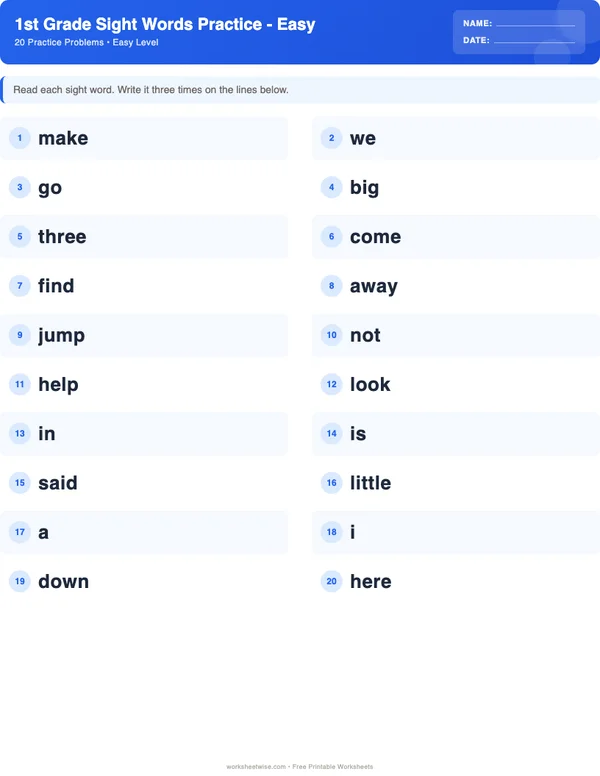
The free easy sight-word worksheet provides 20 exercises in which learners read each word and write it three times. It is suitable for recognition, handwriting, spelling attention, or reinforcement. Because repeated copying alone does not demonstrate independent recall or transfer, pair it with covered writing and sentence reading.
For broader mixed practice, the 1st Grade Sight Words Worksheet Pack contains 18 worksheets. Select only the pages that match the current word set and response pattern; completing every page in order is not necessary.
Games such as matching, bingo, and flashcard sorting can add variety. Maintain accuracy as the condition for success. Racing is unsuitable when it causes guessing, anxiety, or loss of attention to letters.
Differentiating Without Lowering the Learning Goal
Differentiation changes the support, set size, response format, or review frequency. It does not require abandoning accurate word reading.
When the learner needs more support
Use one or two new words at a time. Keep known comparison words visible, use letter tiles before handwriting, and shorten sentences. Provide an oral model, then ask the learner to repeat the analysis.
If handwriting is consuming most of the learner’s attention, accept letter cards or oral spelling during the mapping phase. Add handwriting separately in a smaller amount.
When recognition is stronger than spelling
Ask the learner to read the word, cover it, write it, and explain any unexpected part. Dictate a sentence containing the word. The IES elementary writing guide offers high-level framing for explicit writing instruction and regular opportunities to write. It does not establish that one sight-word worksheet or routine produces a particular outcome.
When the learner is ready for extension
Mix the target words into short passages, sentence construction, or editing. Ask the learner to replace a word while preserving meaning: “The cup was full” can become “The cup is full.” Compare how the meaning changes.
The catalogue notes first-grade expectations for complete sentences, capitalization, ending punctuation, finger spaces, and common-word spelling. A short sentence task can therefore connect reading and writing without introducing a large new word list.
When English pronunciation differs
Model the learner’s community pronunciation and discuss the spelling consistently. Do not label an accent as an error. If pronunciation makes a sound-spelling explanation uncertain, focus on the stable written sequence and a clearly spoken example.
Diagnosing Common Errors and Misconceptions
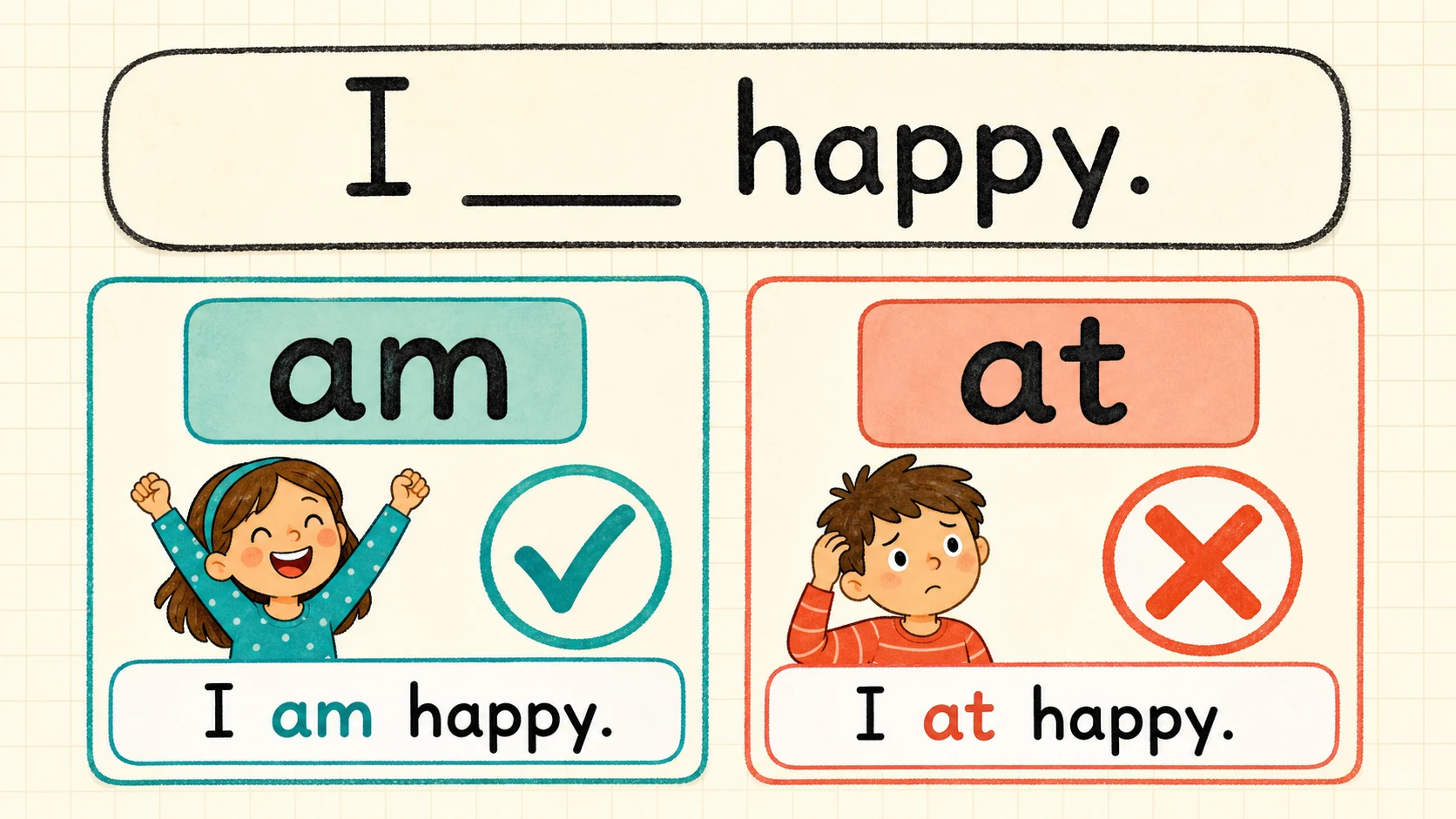
An error is most useful when it leads to a specific check and a targeted teaching response.
Guessing from the first letter
A learner sees said and answers some. This suggests partial use of print rather than secure recognition.
Response: Ask the learner to point through every spelling in said, map its sounds, and compare it directly with some. Do not merely repeat, “Look carefully.”
Guessing from the picture or sentence
A learner supplies a sensible word that is not printed. Meaning is being used, but the print is not sufficiently checked.
Response: Acknowledge that the guess makes sense, then ask, “Do the letters match?” Cover the picture if necessary and reread the printed word.
Treating every word as visually irregular
A learner tries to memorize and without sounding or mapping it.
Response: Show that all three letters connect to sounds. Explain that a word can become instantly recognized through phonics-based analysis and practice.
Forcing every word through the most familiar rule
A learner reads said as “sayed” because ai often represents a long-a sound.
Response: Confirm that the learner applied a known pattern, then identify this word’s exception: ai represents /ĕ/ in said. Rebuild and reread the word in a sentence.
Confusing copying with knowing
A learner copies was three times accurately but cannot write it once the model is covered.
Response: Separate copying from retrieval. Use one careful copy, cover the model, write from memory, and compare. Schedule another check later.
Assuming fast means mastered
A rapid answer can still be a guess. Conversely, a careful decoded answer may be correct but not yet automatic.
Response: Track accuracy, attention to letters, explanation, spelling, and use in text. Speed is one observation, not the sole criterion.
The Common Core English Language Arts standards provide broad grade-level context for reading common irregularly spelled words. Local curriculum sequences and interpretations vary, and this guide does not claim comprehensive standards alignment.
Monitoring Progress and Deciding What to Teach Next
Use a simple record with the word, date, task type, and response:
- A: accurate without help;
- H: accurate after hesitation;
- SC: initially incorrect, then self-corrected;
- P: accurate after a prompt;
- I: incorrect or unknown.
Test words in at least two forms: isolated and in connected text. Include occasional spelling from memory. A learner may recognize said on a card yet overlook it in a sentence, or read it accurately while spelling it sed.
A reasonable instructional decision rule from the supplied catalogue is to consider a word mastered after correct reading on three separate occasions. Even then, return it periodically in mixed text. If errors reappear, restore it to active review without presenting that as failure.
Add new words when previously taught words remain accurate in mixed order and at least some transfer to sentences is visible. Pause new introductions when errors cluster, the learner relies on prompts, or spelling shows weak attention to internal letters.
A Two-Week Practice Plan
This plan uses the catalogue suggestion of three to five new words per week, but the set size should be reduced whenever the learner’s work calls for it. Sessions may be shortened or divided. There is no universal daily duration.
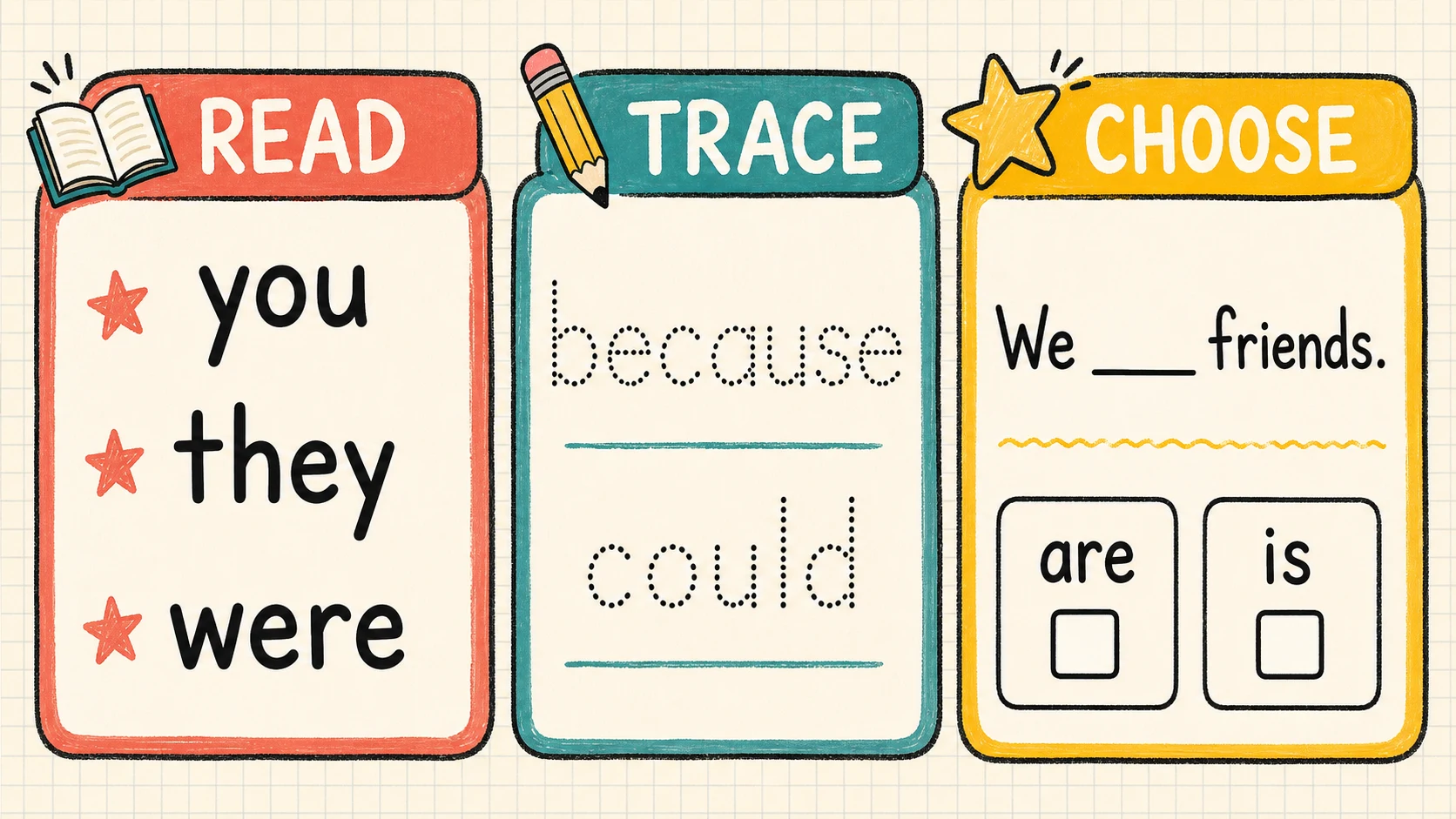
New instruction, spaced retrieval, sentence use, and brief monitoring alternate across two weeks.
| Day |
Main action |
Suggested evidence |
| 1 |
Check five known words; teach and and said |
Can map each word and explain the unexpected part of said |
| 2 |
Review in mixed order; cover-write-check both words |
Reads and spells without copying |
| 3 |
Read the words in two short sentences; introduce was if ready |
Uses print and meaning together |
| 4 |
Build all active words with letter cards; write one dictated sentence |
Preserves letter order |
| 5 |
Separate check in cards and sentences |
Record accurate, hesitant, prompted, or incorrect responses |
| 6 |
Review only words that were not secure; introduce of if ready |
Explains its written sequence |
| 7 |
Contrast of with a visually or orally similar response such as off |
Notices the spelling and pronunciation difference |
| 8 |
Use all secure words in short sentence-completion tasks |
Selects words by print, grammar, and meaning |
| 9 |
Read a brief passage containing taught words; write one original sentence |
Transfers recognition to connected text |
| 10 |
Conduct a separate mixed check and select the next step |
Keep, retire, or reteach each word from evidence |
If the learner is not ready for four new words, use two. If all four are already secure, choose a small set from the learner’s current reading rather than repeating work without purpose.
Limitations and the Honest Next Step
A sight-word activity cannot by itself establish broad reading fluency, comprehension, spelling control, or writing ability. It should sit beside systematic phonics, oral language, meaningful reading, and regular writing. A worksheet response also offers only a snapshot; handwriting, fatigue, unfamiliar directions, or dependence on a visible model can affect performance.
The catalogue describes the intended content and practice level, not a guaranteed outcome for a particular learner. This guide does not provide medical guidance, diagnose a learning difficulty, certify a curriculum, or establish a universal timetable. When persistent difficulty appears across carefully taught reading tasks, document the specific responses and discuss them with the learner’s teacher or another appropriately qualified local professional.
For the next session, choose five words the learner has already encountered and use the brief read-map-write-check routine. Then complete one section of the free 1st Grade Sight Words worksheet, cover the printed models, and check which words can be read and written independently. Use those results—not the page count—to choose the following lesson.