Curated collectionAnswer keys includedPrint-ready PDFs
Differentiated Math Worksheets
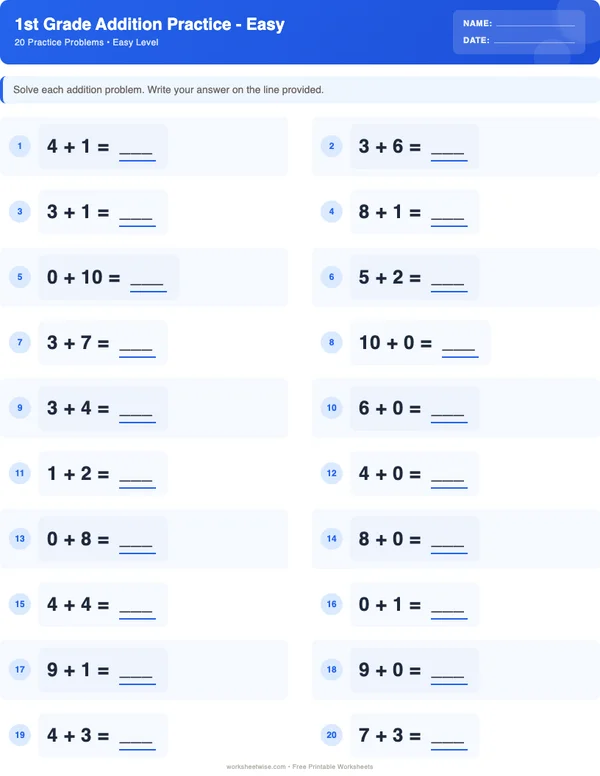
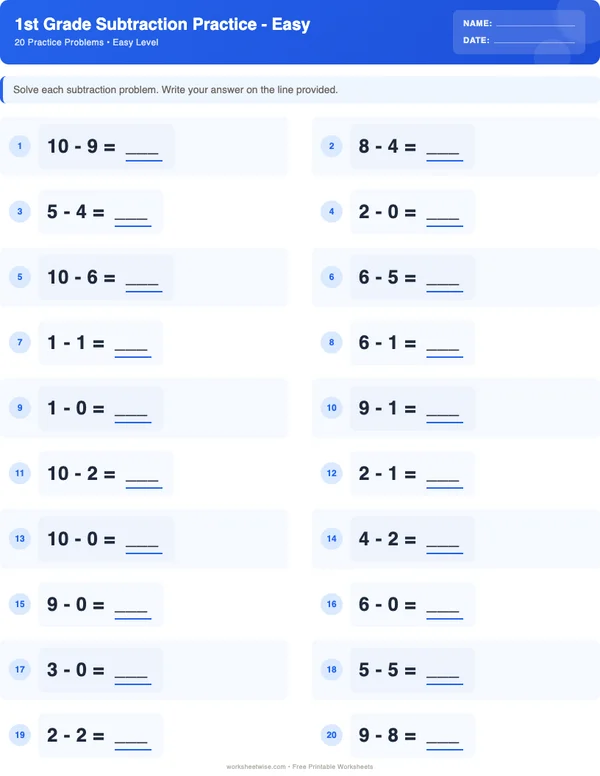
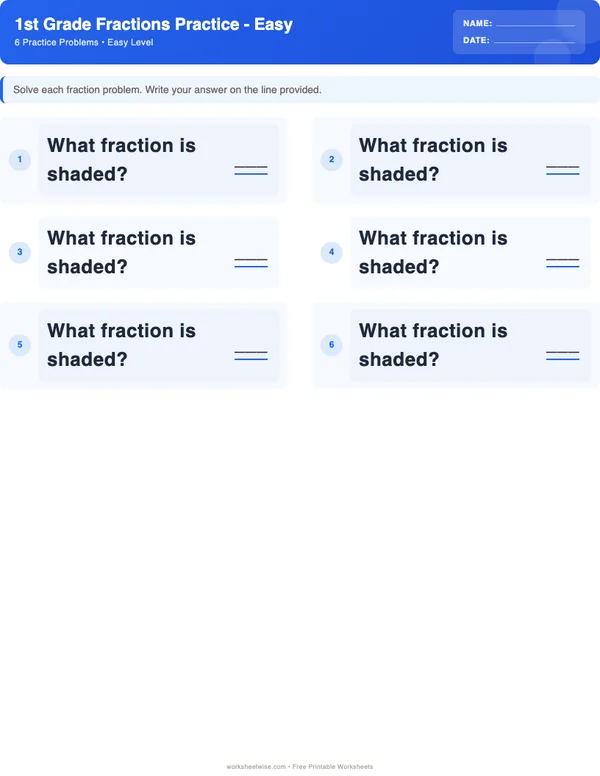
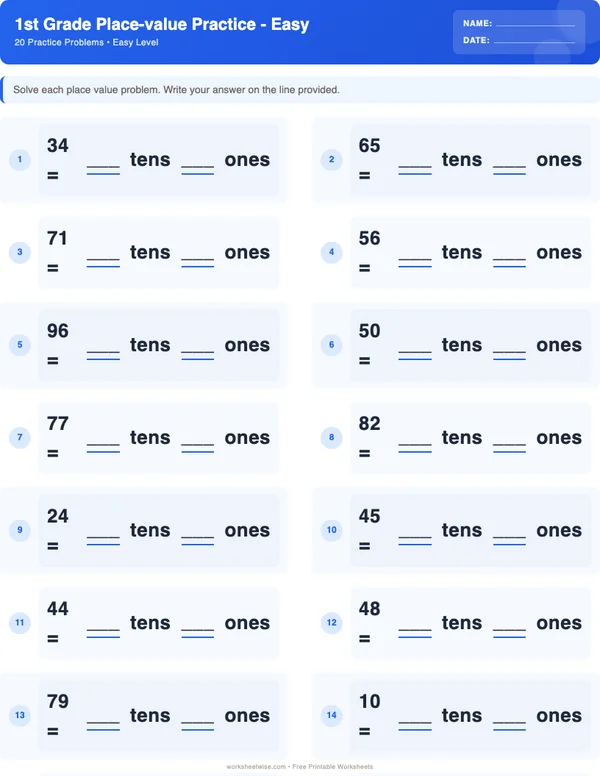
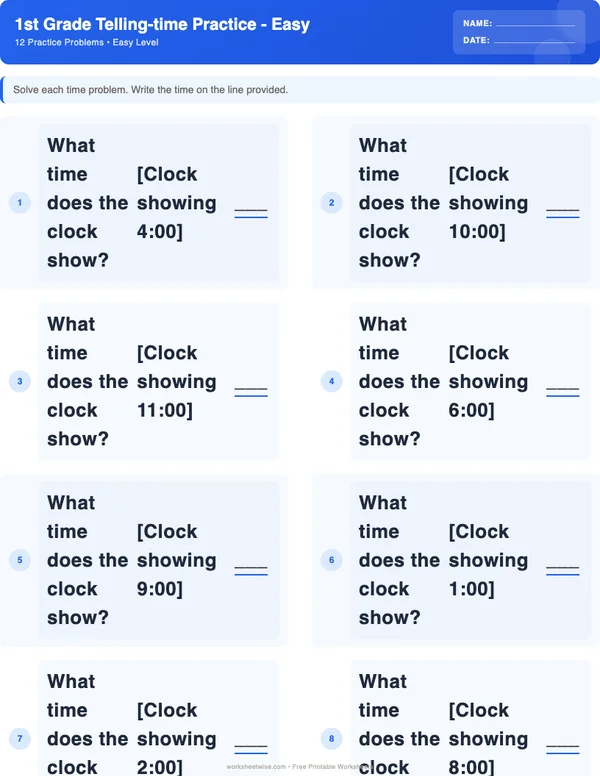
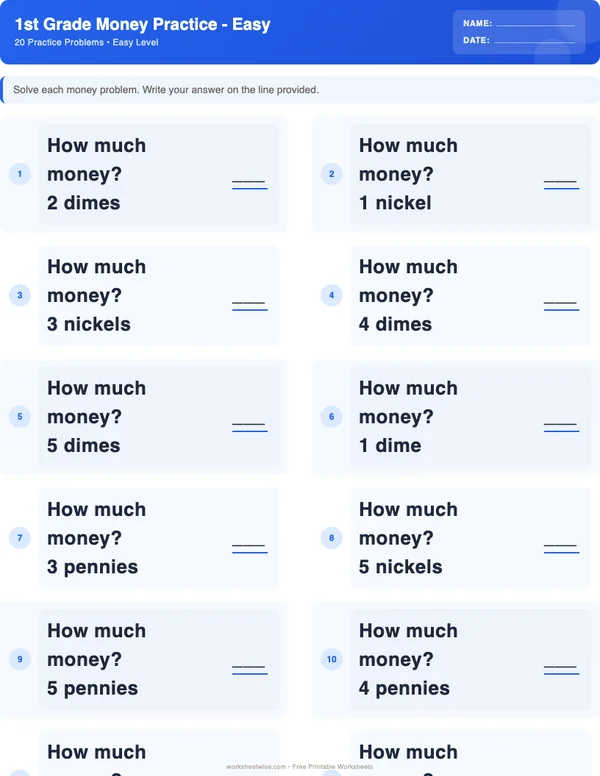
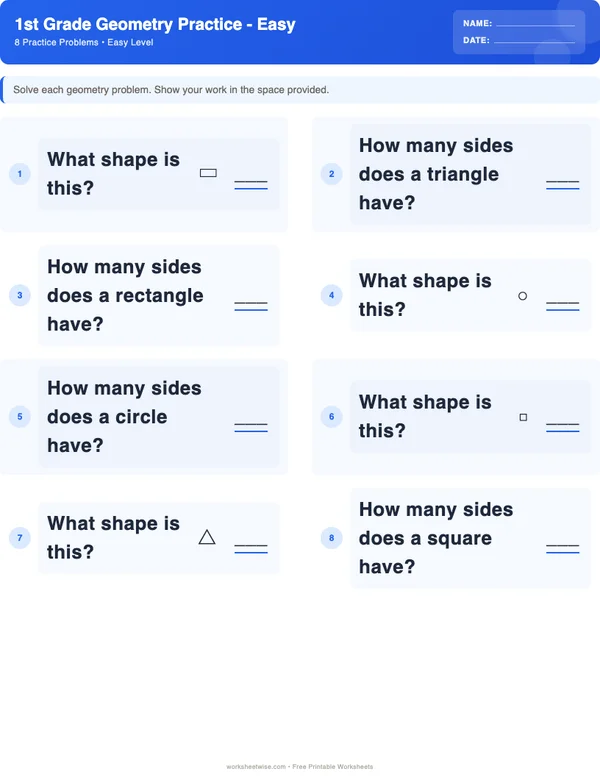
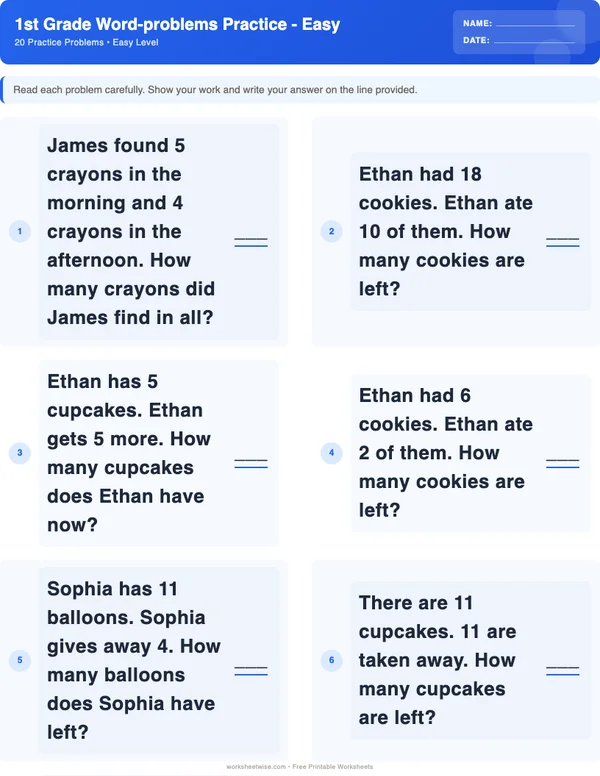
Hold the learning goal steady while changing number bounds, prompts, representations, response load and extension demand across three real worksheet versions.
Start with a real resource
Browse this worksheet collection
61 relevant free entry points are available. Each one includes a printable learner PDF and separate answer key.
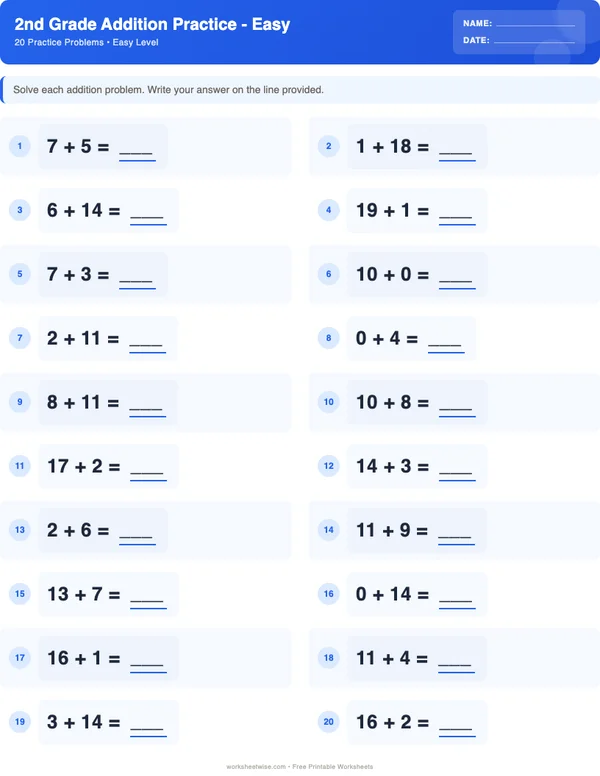
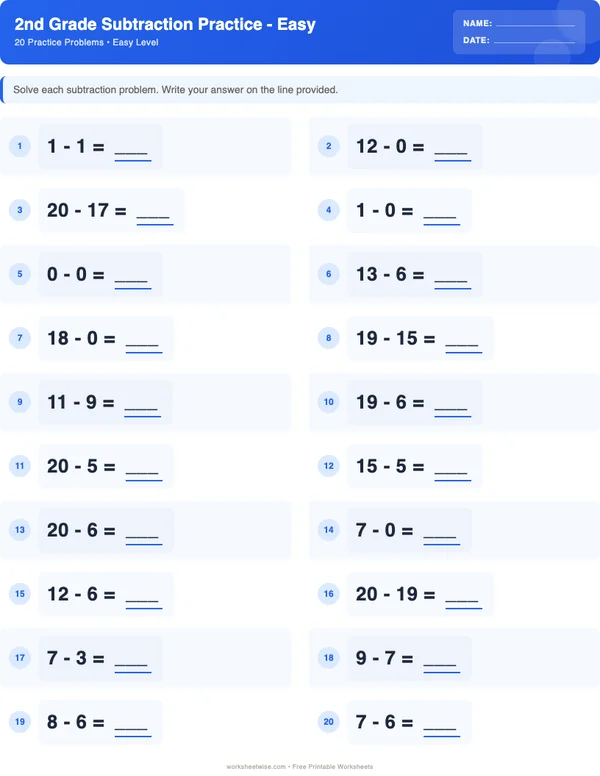
A useful practice loop
Print less. Observe more.
- Choose one skill and model the first item aloud.
- Use a short set and notice the learner’s strategy.
- Change the next task from the work you can see.
Need more than the free sheet?
Plus includes all 1098 matching catalogue variations where available, plus saved deterministic generators and the worksheet designer.
See Plus membershipComplete guide
How to teach and practise differentiated math worksheets
3,581 words Updated 6 instructional visuals
Differentiate the path, not the mathematics
Differentiated math worksheets should let learners pursue the same mathematical goal through different number bounds, prompts, representations, response formats, and extension demands. They should not quietly assign one learner “real math” and another a permanently simplified curriculum.
Use three versions of a task:
- Version A: make the structure visible. Use smaller numbers, concrete or pictured models, one operation or decision at a time, and space to show each step.
- Version B: reduce the prompts. Keep the same concept, use the expected practice range, and ask for both an answer and a representation or explanation.
- Version C: increase independence or reasoning. Remove some scaffolds, vary how the unknown appears, add a comparison or justification, or ask the learner to create and check an example.
Difficulty names such as “easy” are catalogue labels, not learner labels. Define difficulty through observable features: size and type of numbers, number of steps, familiarity of the representation, amount of reading, location of the unknown, available prompts, response load, and required explanation.
The WorksheetWise catalogue currently contains 1,098 math variants across eight grade labels and 12 topics, including 61 free entry points. Those counts provide choice, but choice alone is not differentiation. The adult still has to identify a precise goal, inspect the task, observe the learner’s method, and select the next sheet from evidence.
Grade labels describe intended practice level; local curriculum sequences differ. Age can help adults discover plausible materials, but it is not a placement decision. A learner’s written work and oral explanation are more useful than age alone when choosing among versions.
Set one goal that can survive three versions
Write the goal as something the learner will do mathematically, not as a page-completion target. “Finish 20 problems” describes workload. “Represent teen numbers as one ten and some ones” describes learning.
A stable goal should specify:
- the mathematical relationship;
- acceptable evidence of understanding;
- what may change without changing the goal.
For example:
Goal: Represent addition within 10 as joining two quantities and explain how the model matches the equation.
The counters, ten frame, equation format, amount of writing, and number of examples may change. The requirement to connect joining, quantity, and equation remains.
This focus matters because the Common Core mathematics overview treats understanding and procedural skill as complementary and notes that age-appropriate justification can reveal understanding. That source offers a standards framework; it did not assess WorksheetWise, and this guide does not claim that a catalogue label guarantees standards alignment.
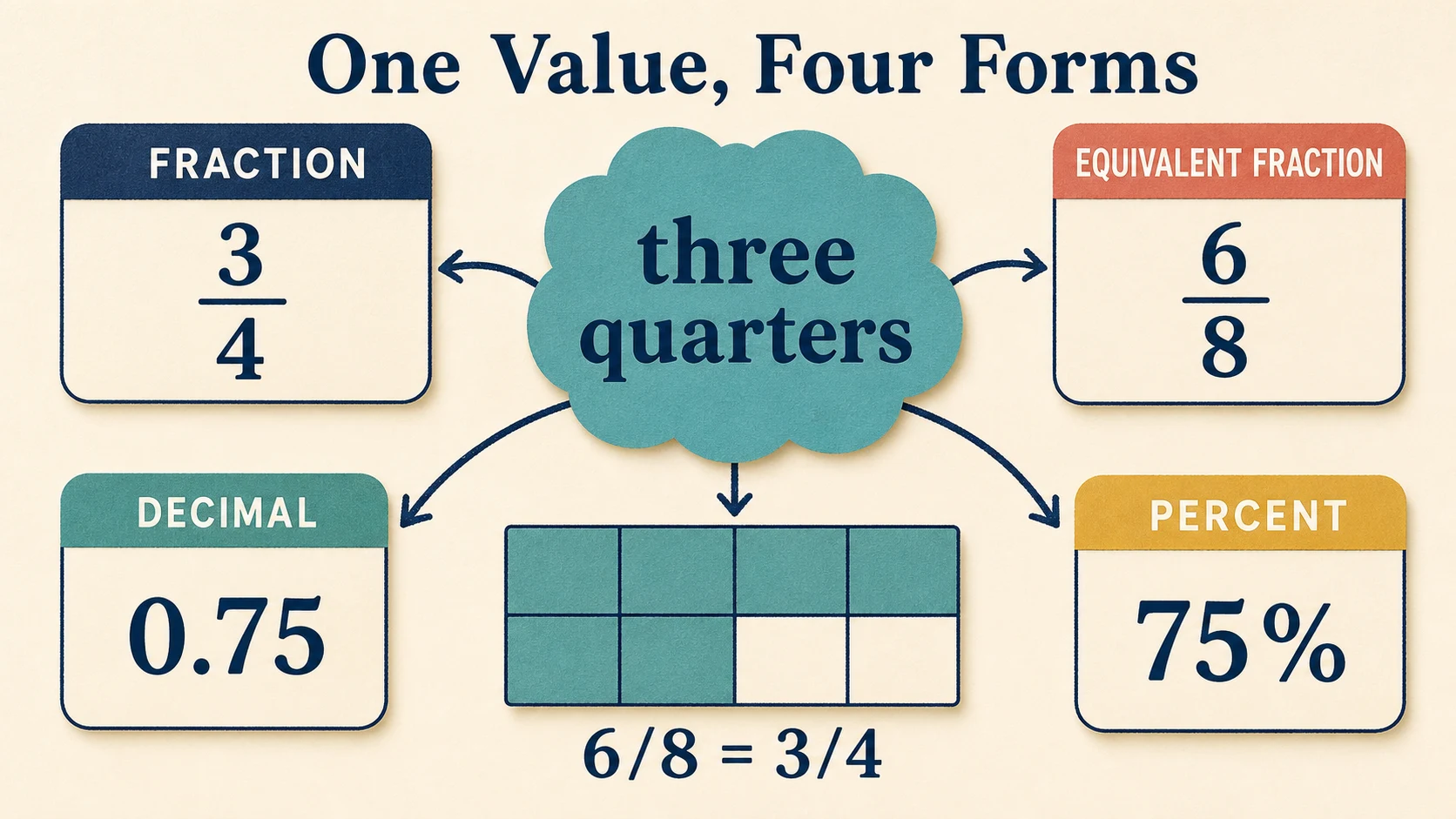
Use a concept map to name the exact fraction relationship being held steady—equivalence, comparison, placement, or an operation—before changing the worksheet conditions.
Decide what may vary
Five useful differentiation levers are:
- Number bounds: within 5 rather than within 10; whole-number dimensions before fractional dimensions.
- Prompts: “Build, draw, write” before a blank workspace.
- Representations: objects, pictures, number lines, clocks, equations, tables, or words.
- Response load: pointing or matching, then a short written response, then an explanation.
- Extension demand: classify, compare methods, find an error, create an example, or prove whether a statement is always true.
Change only one or two levers when you want the learner’s response to be interpretable. If you simultaneously enlarge the numbers, remove the model, add dense text, and require a paragraph, an incorrect answer will not tell you which change caused the difficulty.
Protect the mathematical demand
A support preserves the target when it helps the learner access or express the same relationship. Reading a word problem aloud may remove a decoding barrier while preserving mathematical modeling. Providing fraction strips may make equivalence visible. Letting a learner point to the correct clock before drawing hands may reduce motor demand.
A support changes the target when it performs the central reasoning. If the goal is choosing an operation from a story, preprinting “addition” removes the decision. If the goal is composing ten, giving the missing addend removes the composition.
Select the first sheet from a short mathematical check
Do not begin by guessing a level from age, grade, speed, or confidence. Give a two- or three-item check using the intended concept and ask, “How did you know?” Watch the method, not merely the score.
Choose Version A when the learner cannot yet connect quantities, representations, and symbols, or when prompts are needed to begin. Choose Version B when the learner has a valid method but needs repeated, accurate use. Choose Version C when the learner solves accurately and can explain the relationship without the built-in support.
The IES guide for teaching math to young children recommends developmental progressions and progress monitoring that builds on what a child knows. That is sourced guidance. The three-version decision rule below is a practical editorial routine suggested for this catalogue; it is not an IES protocol.
A 90-second entry check
Use this sequence before printing a full page:
- Present one item with objects or a clear visual.
- Present the same relationship with a drawing or diagram.
- Present it with symbols, if appropriate.
- Ask the learner to explain or demonstrate the connection.
Suppose the target is subtraction as a missing part. Show 10 counters, cover 4, and ask how many are hidden when 6 remain. Then show a bar split into 6 and an unknown part with total 10. Finally show or .
A learner who solves with counters but not the bar needs a bridge between concrete and drawn models. A learner who solves both models but writes needs help connecting the situation to notation. Those are different next sheets even though both produced an incorrect symbolic response.
Run one repeatable lesson around the page
A worksheet works best inside a brief cycle of modeling, guided use, independent evidence, and feedback. It should not replace the explanation or the conversation.
Before the sheet: model one item
State the goal in learner-friendly language: “Today we will show how the parts make the total.” Work one example and narrate only the decisions that matter.
For , place 7 counters on a ten frame. Move 3 of the 5 counters into the open spaces, leaving 2. Say, “Seven needs three to make ten. Five is three and two, so .” Check every quantity: , and .
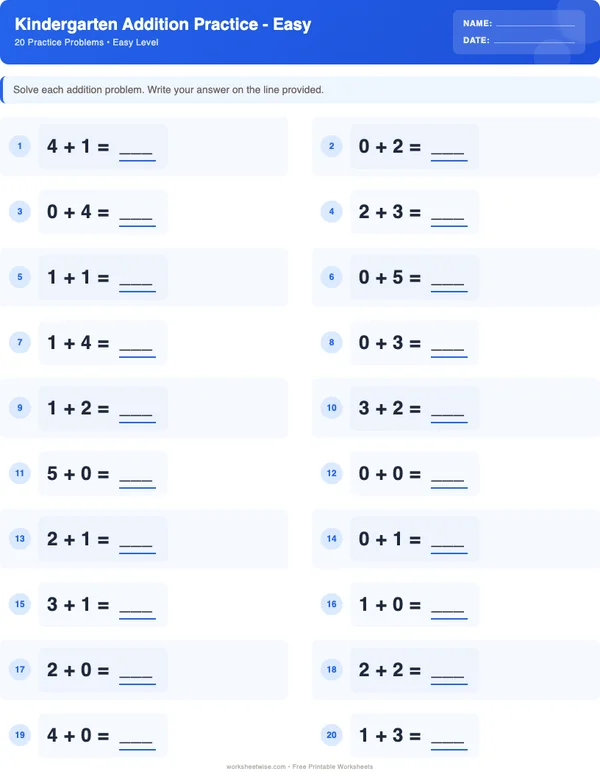
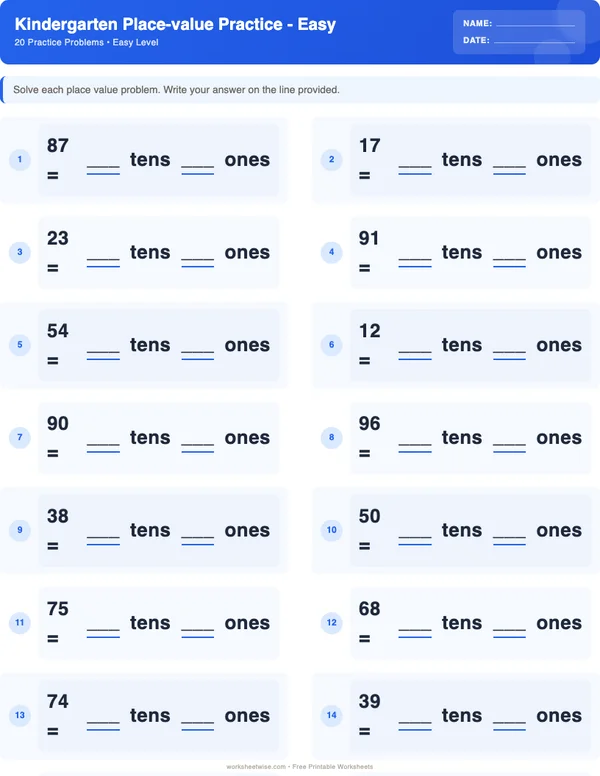
This example belongs here because the live catalogue includes kindergarten and first-grade addition sheets with 20 problems and describes a progression from objects to drawings to equations. The specific three-version routine is a suggestion:
- Version A: Provide counters and a ten frame; ask the learner to build 7, add 5, and complete .
- Version B: Print an empty ten frame and ask for a drawing plus the equation.
- Version C: Ask for two methods, such as making ten and counting on, then ask which method makes the structure easier to see.
The goal—understanding addition as combining quantities—does not change.
During the sheet: sample, do not hover
Ask the learner to complete two items independently. Then inspect:
- whether the representation matches the numbers;
- whether the chosen operation matches the situation;
- whether place values or units remain consistent;
- whether an explanation names the relevant relationship.
Do not correct every mark immediately. Select one error that reveals the method, ask the learner to reconstruct that item, and then decide whether the remaining items are useful. Ten repetitions of a misconception produce practice in the wrong method.
After the sheet: use an exit item
Give one new item without copying the worksheet’s surface pattern. If every practice clock showed 15-minute intervals in chronological order, ask for 3:45 on a blank clock. If every subtraction story involved objects being removed, give a comparison story.
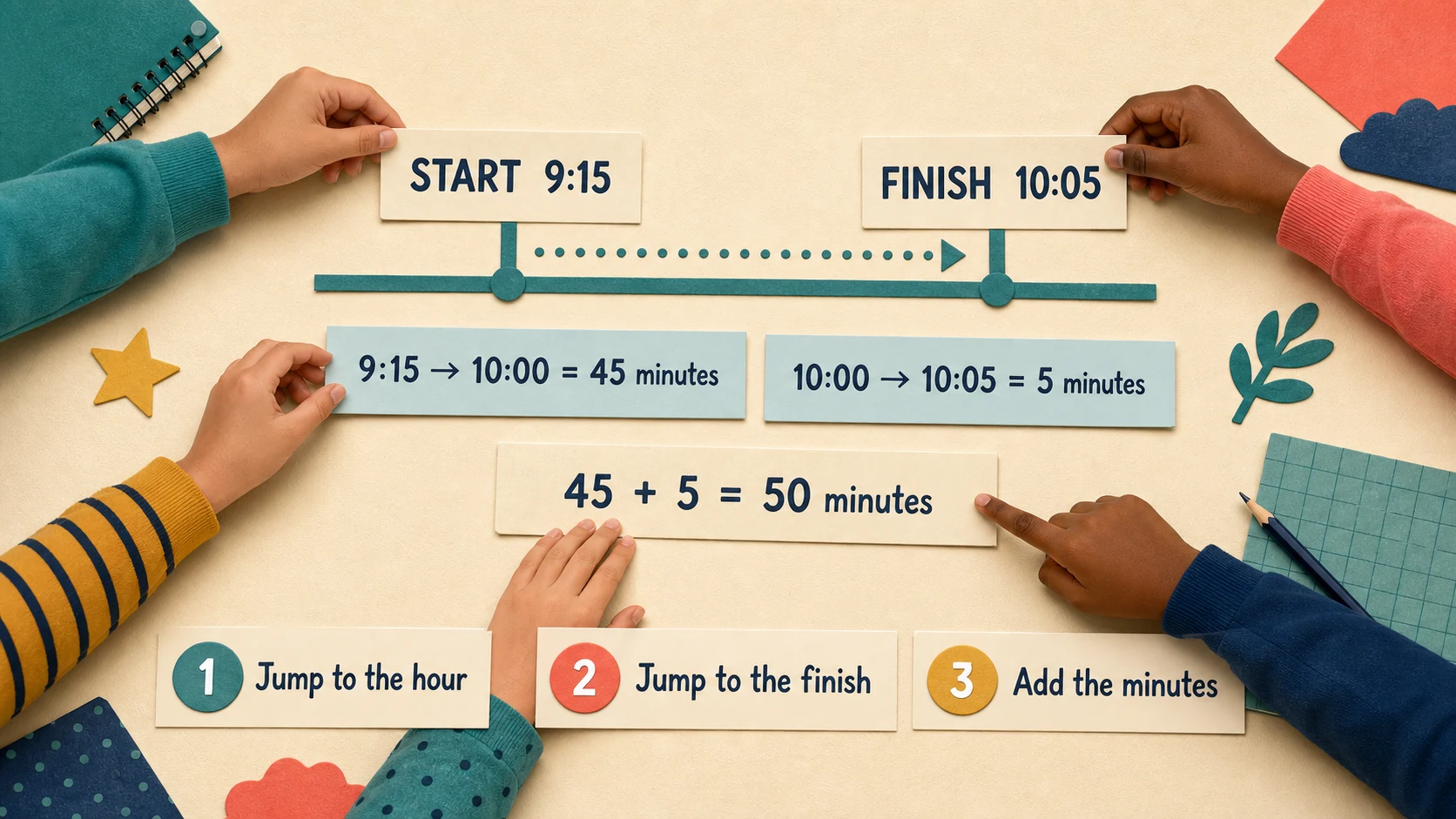
For telling time, repeat the cycle with a demonstration clock, one drawn clock, one independent reading, and a final check that changes the hand positions.
Differentiate modeling before reducing the goal
The IES elementary mathematics intervention guide recommends systematic instruction, clear mathematical language, well-chosen concrete and semi-concrete representations, number lines, and deliberate word-problem instruction. It does not say that more pictures are automatically better. The model must expose the relationship being learned.
Example 1: count a scattered set, not only a row
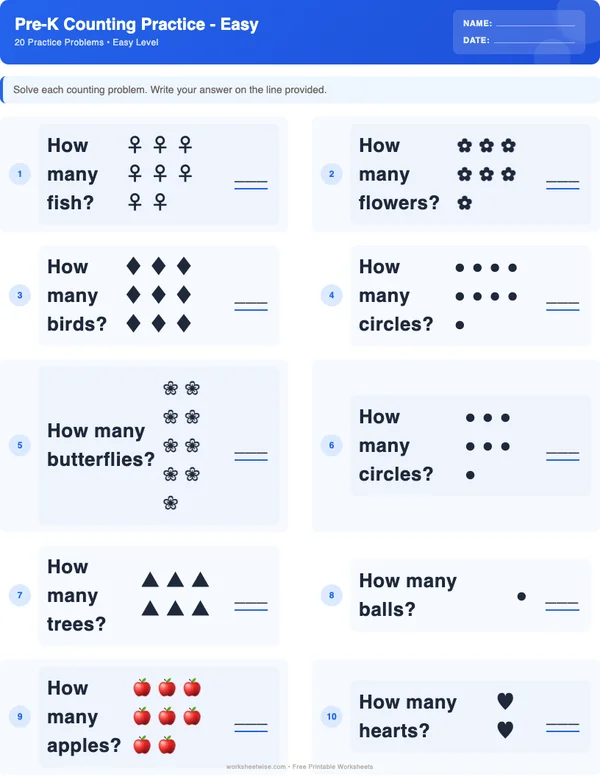
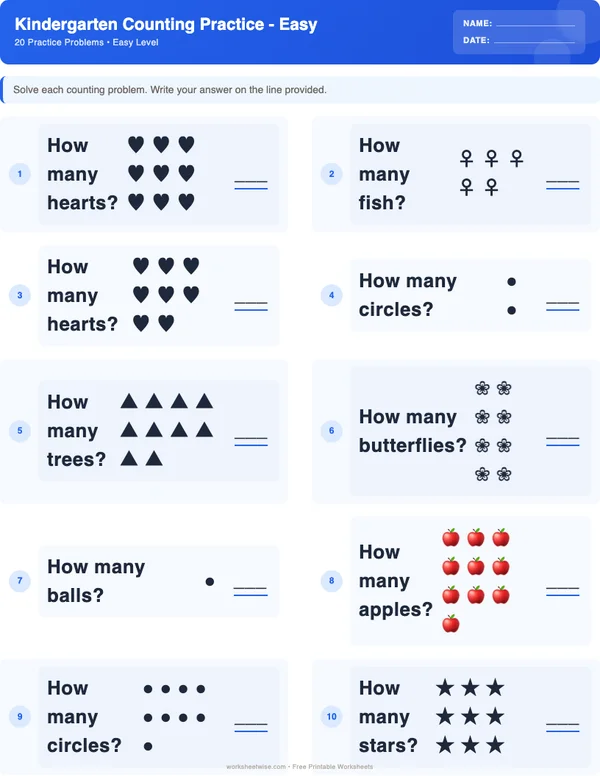
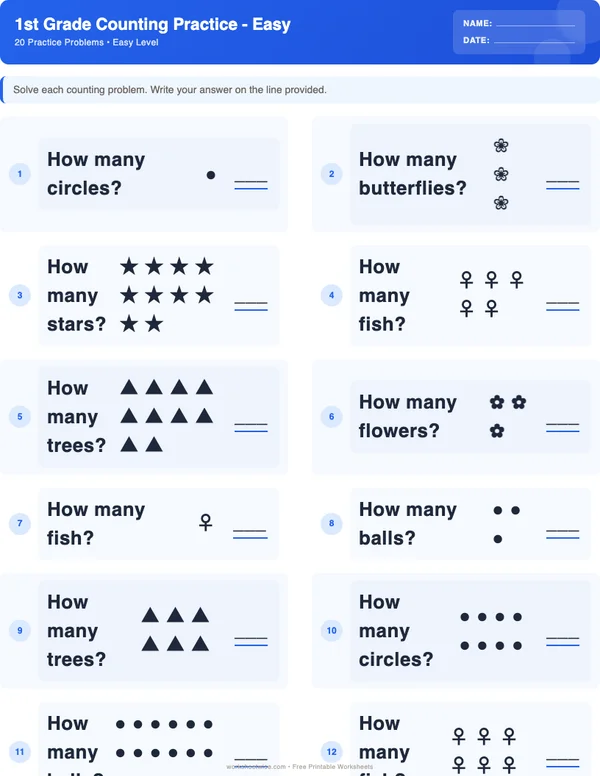
The catalogue’s Pre-K counting entry has 20 problems and identifies concrete objects, one-to-one correspondence, sequences, and missing numbers as relevant practice. For ages three and four, prioritize brief adult-led oral, matching, manipulative, and movement work over desk work. A 20-item sheet is a source of selectable prompts, not a required sitting.
Place 8 buttons in a scattered arrangement. Ask the child to move each button into a cup while saying one number. The checked result is 8 because each of the eight buttons is moved and counted once.
- Version A: Use 5 objects in a line and let the child touch or move each one.
- Version B: Use 8 scattered objects and ask the child to organize them while counting.
- Version C: Show 8 objects, rearrange the same set, and ask whether the quantity changed and why.
This example belongs because scattering reveals whether the child coordinates one spoken number with one object rather than merely reciting a sequence. If the child says the sequence correctly but counts one button twice, the next activity should preserve a small bound and emphasize moving counted objects. Raising the bound to 20 would increase load without addressing the observed error.
Adults can begin with the Pre-K Counting guide and free sheet, selecting only a few prompts and pairing them with real objects.
Example 2: distinguish area from perimeter
Suppose a learner builds a rectangle that is 3 units by 4 units. Check the measures:
-
Area: square units.
-
Perimeter: linear units, equivalently .
-
Version A: Provide 12 square tiles. Ask the learner to build the rectangle, count the covered squares, and trace the outside edge.
-
Version B: Show a 3-by-4 grid rectangle. Ask for area and perimeter, with units.
-
Version C: Ask for another rectangle with area 12 and compare perimeters. A 2-by-6 rectangle also has area square units, but perimeter units.
This belongs because the catalogue’s geometry progression includes attributes, area, perimeter, and hands-on work. The extension deepens the same distinction; it does not merely assign larger dimensions.
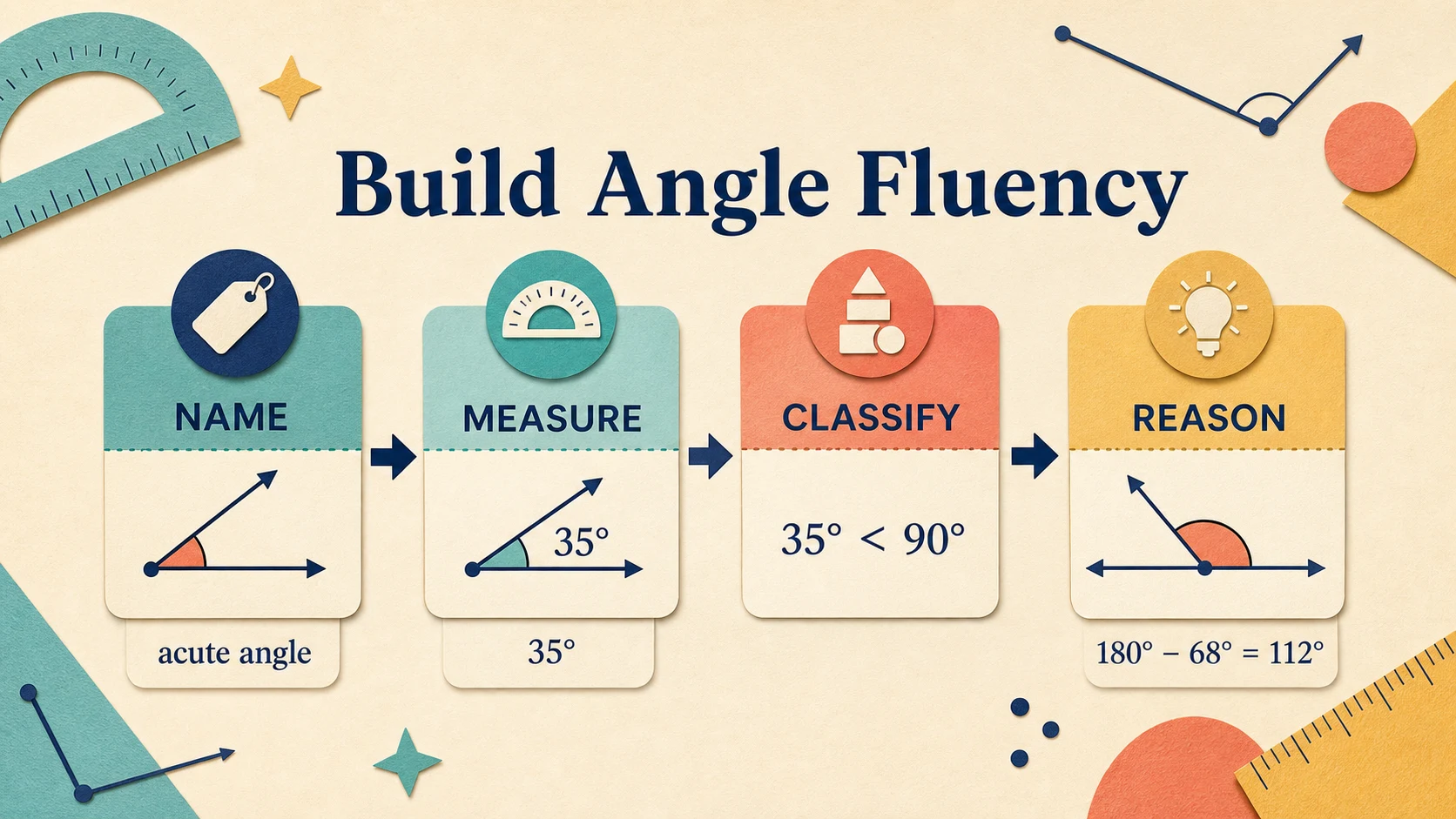
In an upper-elementary geometry sequence, remove tiles and prompts gradually while continuing to require correct units and a distinction between covered space and boundary length.
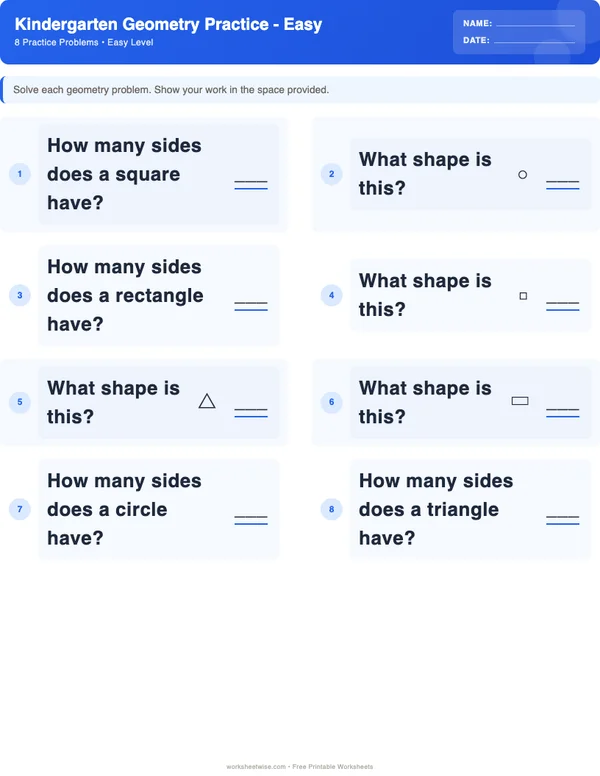
For younger learners working on shape identification, begin with sorting, tracing, building, and composing. The Kindergarten Geometry guide and free sheet can supply visual prompts, but rotate shapes and include nonexamples rather than presenting every triangle with the same orientation.
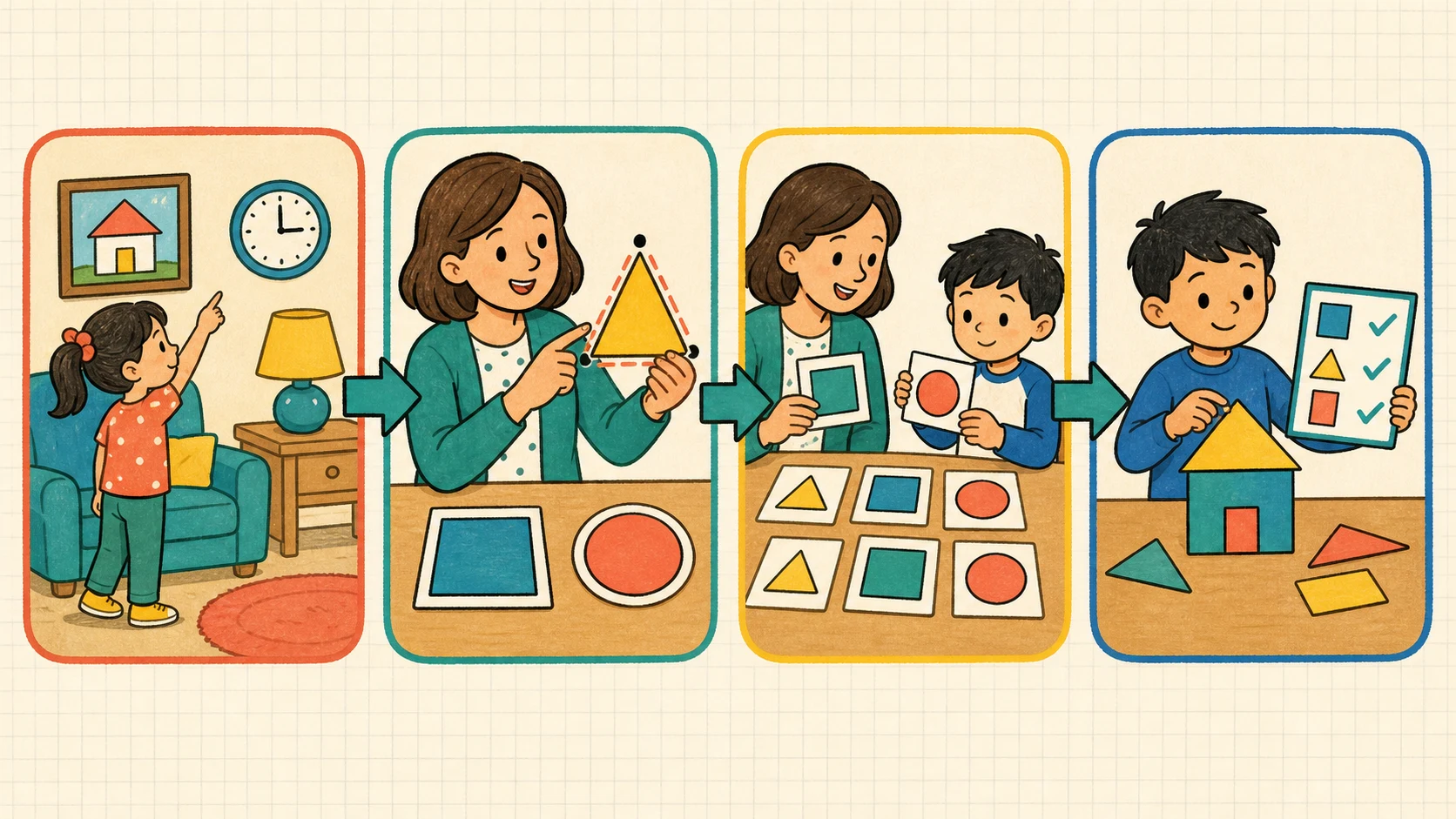
An early-geometry routine should move from handling and sorting shapes to describing attributes, then to one brief independent response.
Vary response formats without hiding reasoning
Writing volume, language demands, and fine-motor demands can obscure mathematical knowledge. Change the response channel while keeping the evidence requirement clear.
A learner might:
- build a quantity with counters;
- match an equation to a model;
- draw a number line;
- point and explain orally;
- arrange equation cards;
- write a numerical answer and one sentence;
- record an audio explanation with an adult’s help.
The key question is: Can the adult still see the target reasoning? For a fraction-comparison goal, circling the larger fraction may be enough only if the representation makes the comparison observable. If the learner circles over , ask for a common model or explanation.
Check the comparison: using twelfths, and , so .
Example 3: compare fractions through a common representation
- Version A: Provide two equal-length fraction bars already divided into fourths and thirds. The learner shades and , then points to the longer shaded length.
- Version B: Provide blank equal-length bars and ask the learner to partition, shade, compare, and write or .
- Version C: Ask whether remains true when both fractions refer to different-sized wholes. The correct response is that a numerical fraction comparison assumes the same unit whole; shaded physical amounts cannot be compared solely from the fraction names when wholes differ.
This example belongs because the catalogue describes fraction identification, comparison, equivalence, number lines, and operations. It also shows meaningful extension: Version C examines the unit whole instead of adding unrelated arithmetic.
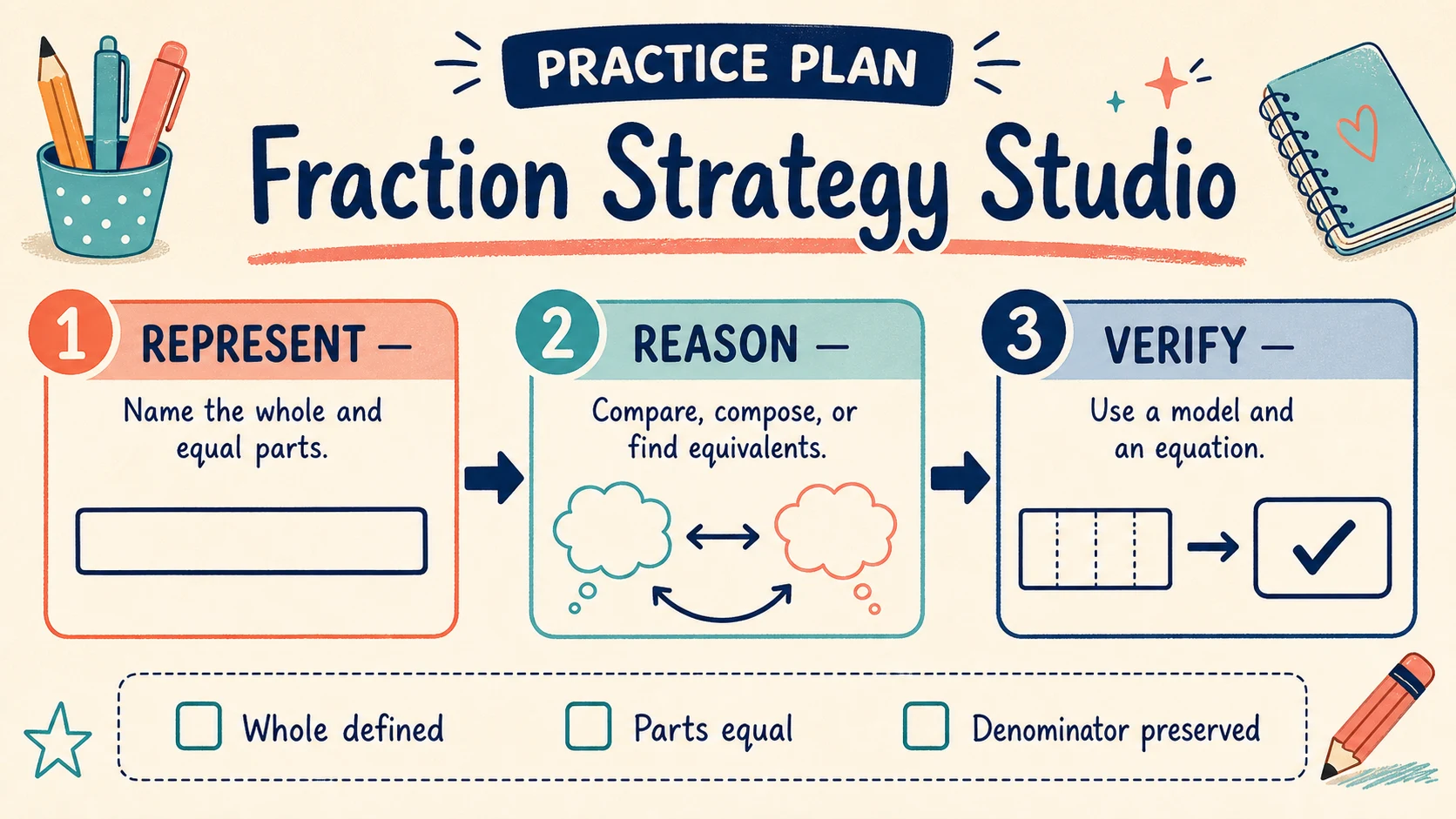
Space fraction comparisons across days and representations so the adult can see whether a learner recognizes the relationship beyond one worksheet layout.
Treat word problems as modeling tasks
A word-problem sheet is not simply computation with extra words. The learner must interpret a situation, identify quantities and their relationship, choose a representation or operation, calculate, and judge whether the answer makes sense.
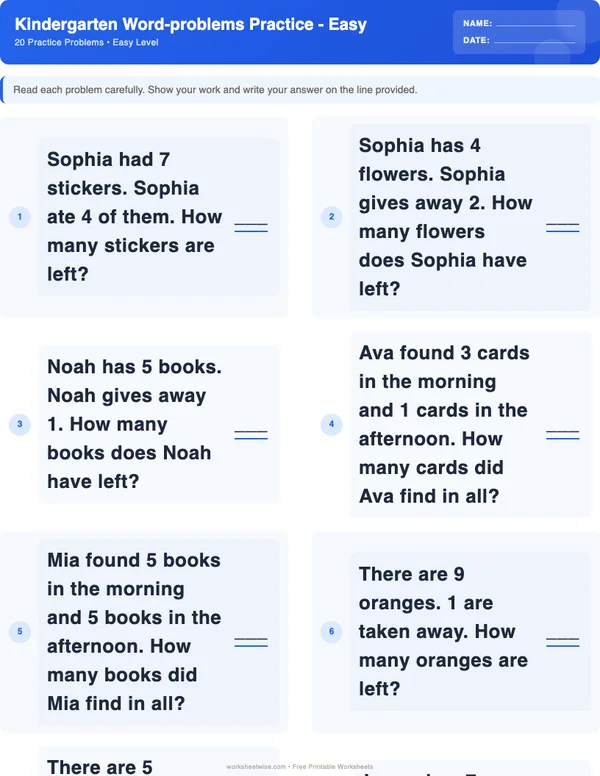
Do not rely on keyword rules. “Left” does not always mean subtract, and “in all” does not by itself establish the relationship. Ask the learner to retell the event before choosing an operation.
Example 4: keep subtraction, change the unknown
Use the same quantities in three stories:
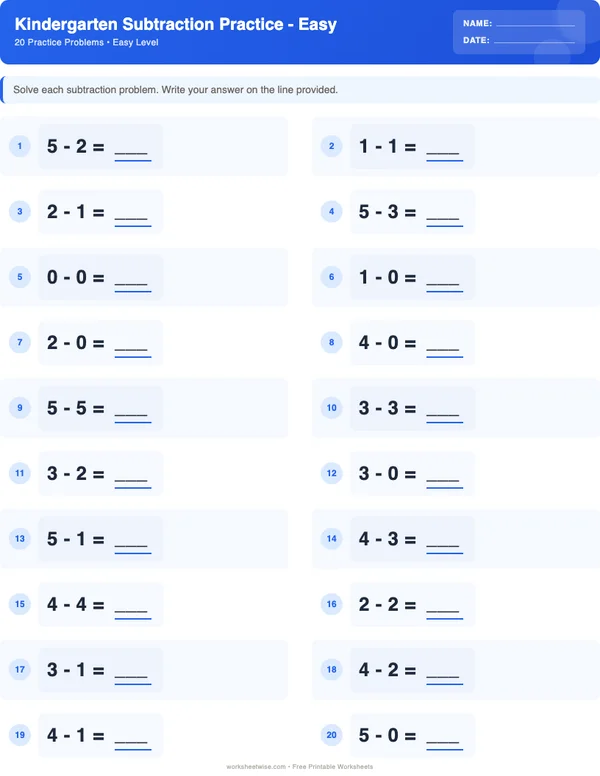
- Result unknown: Mia has 10 cubes and gives away 4. How many remain?
. - Change unknown: Mia has 10 cubes. She gives some away and has 6 left. How many did she give away?
, so the missing amount is 4. - Start unknown: Mia has some cubes. She gives away 4 and has 6 left. How many did she start with?
, so the starting amount is 10.
All arithmetic is checked: , , and .
These versions hold the subtraction relationship steady while changing where the unknown appears. This belongs because the catalogue explicitly distinguishes removal, comparison, and missing-part situations. A learner who completes result-unknown items but adds every time the unknown moves has not necessarily misunderstood subtraction facts; the learner may be mapping a page pattern rather than modeling the story.
Differentiate as follows:
- Version A: Act out each story with 10 cubes and provide a part-part-whole mat.
- Version B: Ask the learner to draw a bar model and write an equation.
- Version C: Present all three stories in mixed order and ask how the equations are related.
For younger learners, an adult may read the story aloud. That changes reading load while preserving the mathematical choice.
Read errors as evidence for the next sheet
An error should lead to a testable instructional decision, not a broad judgment about ability. Mark the first place where the learner’s model stops matching the mathematics.
When the answer is wrong but the model is sound
If a learner draws 8 objects, crosses out 3, leaves 5 visible, but writes 6, the subtraction concept is represented correctly. The likely next step is a low-volume recording check: recount the remaining objects, say the answer before writing it, and complete two similar items. Do not automatically return to easier subtraction situations.
When the answer is right but the model is unsound
A learner might answer correctly but explain, “I always subtract the smaller digit.” Test that rule with . The correct answer is 18: regroup as 3 tens and 13 ones, then and . The incorrect digit rule can produce 22 by subtracting smaller digits from larger digits in each column.
The next sheet should use base-ten drawings or physical blocks and require the learner to show the trade of 1 ten for 10 ones. Correct answers alone are not sufficient evidence when the explanation reveals a rule that will fail.
When the representation creates the error
A learner reads a clock as 4:45 because the hour hand is close to 4. The next sheet should not merely add more clock faces. Use a geared demonstration clock and ask the learner to track the hour hand from 3:00 to 4:00. At 3:45, it has moved toward 4 but has not reached 4, so the time remains “3 something.”
- Supported next sheet: hour and half-hour clocks with the hour interval highlighted.
- Practice next sheet: quarter-hour clocks in mixed order.
- Independent next sheet: draw hands for 3:45 and explain why the hour is 3.
When language obscures the operation
If computation is accurate in equations but word problems are not, compare an orally presented story with an independently read one. Ask for a retell and a drawing before an equation. If the learner models the oral version correctly, reduce reading load temporarily while retaining the operation decision. Do not infer a diagnosis from this comparison.
Give feedback that names the mathematical mismatch
Useful feedback is brief, specific, and actionable:
- “Your drawing shows 12 squares, but your perimeter answer also says 12. Trace only the outside edge and count its units.”
- “You shaded three pieces in each bar. Check whether the pieces are the same size.”
- “Your clock’s minute hand shows :45. Which hour has the short hand passed, and which has it not reached?”
- “Your story says some cubes were given away. Show the starting amount and the amount left before choosing an equation.”
Avoid feedback such as “Be careful,” “Try harder,” or “You’re almost there.” It does not identify a decision the learner can revise.
After feedback, give one near-transfer item. If the learner corrects with regrouping, try , whose checked answer is 15. If the same error returns, remain with the representation and reduce the problem count. If the learner explains the trade and solves accurately, move to a version with less preprinted support.
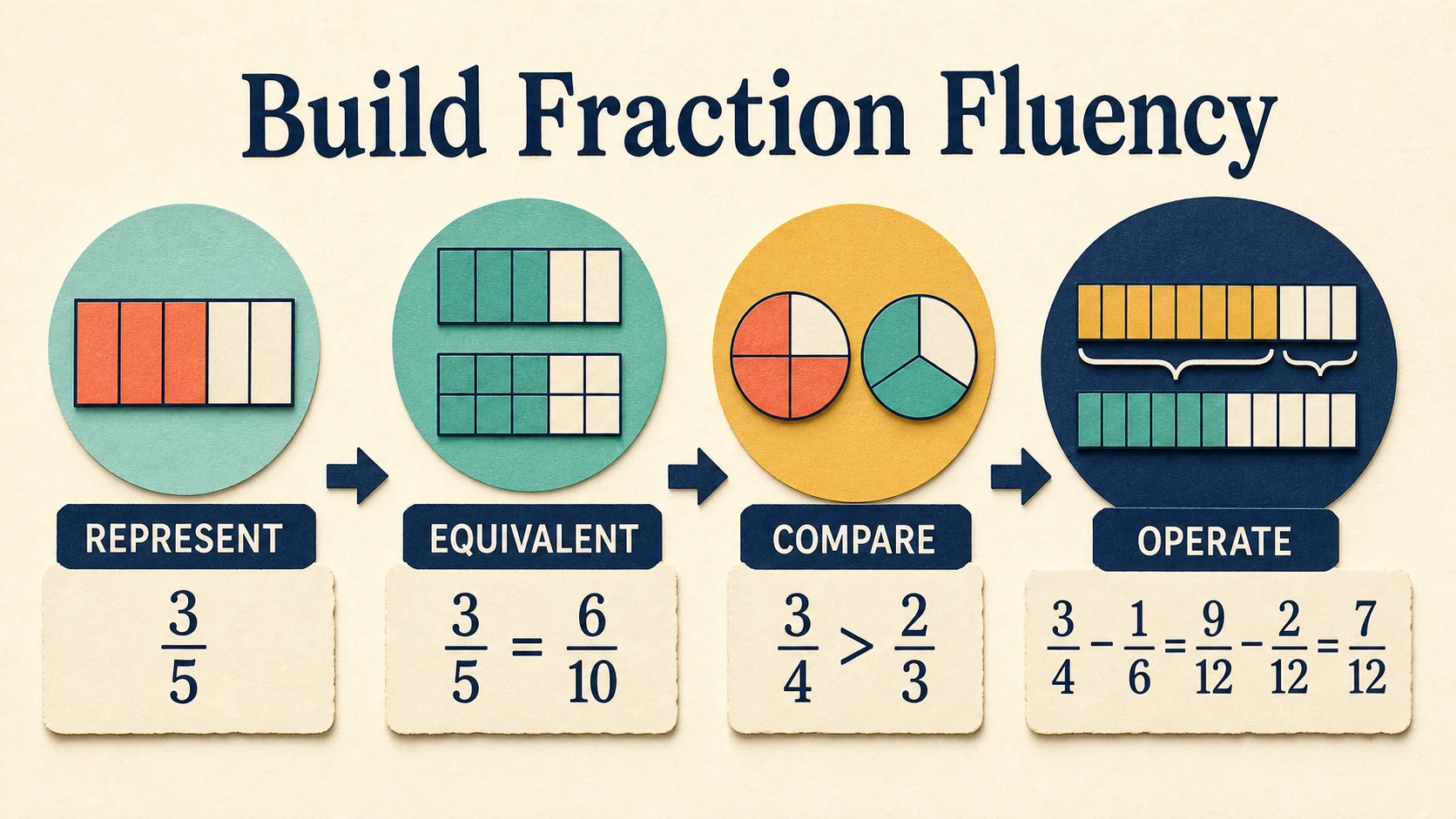
Move toward independent fraction work only after the learner can connect the model, notation, operation, and estimate—not merely after one accurate page.
Plan a three-sheet sequence from observable evidence
A practical sequence can fit across three short sessions.
Sheet 1: reveal the method
Choose four to eight representative items rather than assuming the full page must be completed. Include a model, ask for an equation, and collect one explanation. Record the exact error pattern: “counts one object twice when the set is scattered,” not “weak at counting.”
Sheet 2: respond to one pattern
Keep the goal and alter the feature implicated by the error. Add a number line for fraction placement, base-ten blocks for regrouping, or equal-length bars for comparison. Reduce response load if writing concealed the learner’s reasoning. Increase variation if the learner followed a layout without understanding it.
Sheet 3: test independence and transfer
Remove one prompt and change the surface form. Keep numbers comparable so the new format, not a number jump, is being tested. Ask for an oral or written justification appropriate to the learner.
Use a simple decision record:
| Observation | Interpretation to test | Next sheet |
|---|---|---|
| Accurate with counters, inaccurate with equations | Connection between quantities and symbols may be missing | Same numbers; counters plus matching equations |
| Accurate on identical denominators only | Comparison method may depend on a surface rule | Equal-length bars with unlike denominators |
| Correct area, perimeter equals area | Interior and boundary may be conflated | Tiled rectangles with traced edges |
| Correct subtraction facts, wrong story operation | Situation model may be unclear | Retell, bar model, then equation |
| Accurate but slow and fully explained | Concept appears secure; efficiency needs checking | Same goal, fewer prompts, modestly greater fluency demand |
These are instructional hypotheses, not diagnoses. Confirm each one with a new item before acting on it.
Know what worksheets cannot determine
A worksheet captures performance under particular conditions. It cannot by itself establish a diagnosis, explain why an error occurred, demonstrate durable learning, or determine a learner’s overall placement. Fatigue, unfamiliar language, visual layout, reading demands, motor demands, and prior instruction can all affect what appears on the page.
Do not infer that:
- a fast learner understands every step;
- a slow learner lacks understanding;
- one perfect page proves retention;
- one difficult page proves the goal is inappropriate;
- a catalogue grade label overrides local curriculum or direct observation;
- a difficulty label describes the learner.
Printable differentiated math worksheets are also poorly suited to replacing hands-on experience in early counting, shape composition, place-value trading, money handling, or clock movement. Use the paper to record or revisit mathematics first encountered through objects, actions, diagrams, and discussion.
For additional practice outside a lesson, the After-school Math Worksheets collection can help adults find short follow-up work. Keep the follow-up tied to one observed need rather than assigning a mixed packet because it matches an age or grade.
Make the next choice from one real response
Choose one current goal and open the free deterministic worksheet generators. Create three closely related versions: one with a visible model and smaller bound, one with standard prompts, and one with reduced scaffolding plus a justification or comparison.
Give only the middle version first. Examine two completed items and one explanation. Then make one observable decision:
- move to the supported version if the learner cannot connect the model, quantities, and symbols;
- continue the middle version if the method is valid but inconsistent;
- move to the extension version if the learner is accurate, independent, and able to explain why the method works.
That next-sheet decision—not the number of pages completed—is the working evidence that differentiation is serving the mathematics.
Put it into practice
Use the guide with a real printable
Move from explanation to a short, observable practice task. Check the first item together, then adjust the next session from the learner's actual work.
Open the first free worksheetExplore a neighboring collection