What first graders need to understand about digraphs
A digraph is a pair of letters that works as one spelling unit for one sound. In ship, the letters s and h appear together, but the reader says /sh/, not separate /s/ and /h/ sounds. Common consonant digraphs at this level include sh, ch, th, wh, and ck.
The practical goal is for a learner to:
- Notice the two-letter spelling pattern.
- connect it to the intended sound;
- blend that sound with the rest of a word;
- read the whole word without guessing; and
- use the pattern when spelling suitable words.
This learning should begin after the child can read simple consonant-vowel-consonant words such as map, sit, and hot with reasonable accuracy. Some familiarity with consonant blends is also useful because it gives the adult a meaningful contrast: a blend contains two audible consonant sounds, while a digraph represents one sound.
Grade labels describe the intended practice level, not a guarantee that every learner should begin or finish the topic at the same time. Local school and homeschool sequences differ. Use the learner’s observed reading and spelling work—not the calendar alone—to decide when to introduce, repeat, or extend a pattern.
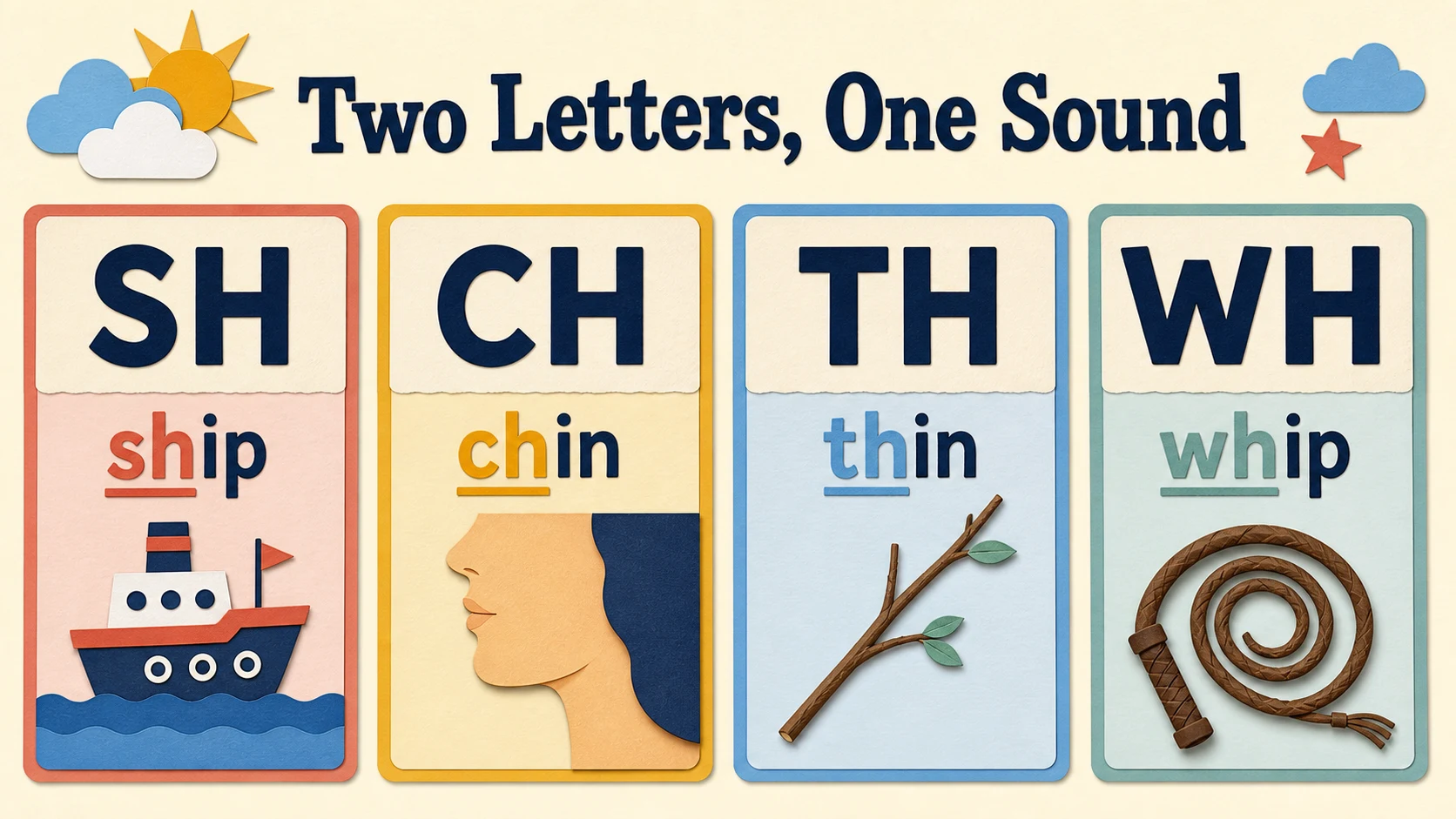
Two letters are recognized as one spelling unit, connected to a sound, and applied in reading and spelling.
Prerequisites for 1st Grade Digraphs
Before concentrating on digraphs, check the foundations that make the new pattern manageable.
Letter-sound knowledge
The learner should recognize most common consonant sounds and short vowel sounds. For example, when shown m, t, p, a, i, or o, the learner should usually be able to produce an appropriate sound without needing to recite the alphabet.
A temporary hesitation is not necessarily a reason to stop. Frequent confusion between several basic sounds is more significant. If a child cannot reliably identify /m/, /p/, and /t/, adding sh and ch may create an unnecessarily heavy memory demand.
Blending simple words
Ask the learner to read several regular CVC words:
- map: /m/ /a/ /p/
- sit: /s/ /i/ /t/
- hot: /h/ /o/ /t/
The child does not have to read rapidly. What matters is whether the sounds can be joined in order to reach the word. A learner who says each sound correctly but cannot combine them needs additional oral and printed blending practice alongside—not hidden beneath—digraph work.
Hearing sounds in words
The learner should be able to listen for the beginning or ending sound in a short word. Try prompts such as “What sound begins sun?” or “What sound ends map?” This is a listening task, so do it once without print if you are unsure whether the difficulty comes from hearing the sound or interpreting letters.
Understanding the difference between letters and sounds
Digraphs make this distinction especially important. Ship has four letters but three sounds: /sh/ /i/ /p/. A child who assumes that every letter must have its own separate sound may try to pronounce sh as /s/ followed by /h/.
Counters, blocks, or drawn sound boxes can make the distinction visible. Use one counter for each sound, not one for each printed letter.
A grade-appropriate teaching progression
The catalogue teaching sequence begins with sh, followed by ch and then th. It also includes wh and final ck, practice in initial and final positions, and cumulative review with previously learned CVC and blend words. The following progression turns that scope into teachable decisions.
| Stage |
Main focus |
Example words |
Evidence to look for |
| 1 |
Review short vowels and CVC blending |
map, sit, hot |
Reads by blending in order |
| 2 |
Introduce sh as two letters representing /sh/ |
ship, shop, wish |
Finds and reads sh at either end |
| 3 |
Introduce ch |
chin, chip, much |
Keeps /ch/ together while blending |
| 4 |
Contrast sh and ch |
ship/chip, wish/much |
Selects the pattern from the sound |
| 5 |
Introduce both pronunciations of th through examples |
thin, math, this, that |
Reads familiar examples without forcing one pronunciation |
| 6 |
Add wh in initial position |
when |
Treats wh as one taught spelling unit |
| 7 |
Teach final ck after a short vowel |
duck, neck, stick |
Reads and spells suitable final ck words |
| 8 |
Mix positions and earlier word types |
ship, wish, chin, much, map, stop |
Applies the pattern without relying on a single list |
| 9 |
Read and write in short context |
“The duck is in the shed.” |
Uses word-level knowledge in a sentence |
This is a progression, not a universal timetable. The catalogue suggests introducing one digraph at a time and spending substantial time on each. That is an instructional suggestion for deliberate practice, not a claim that every learner requires exactly the same number of days.
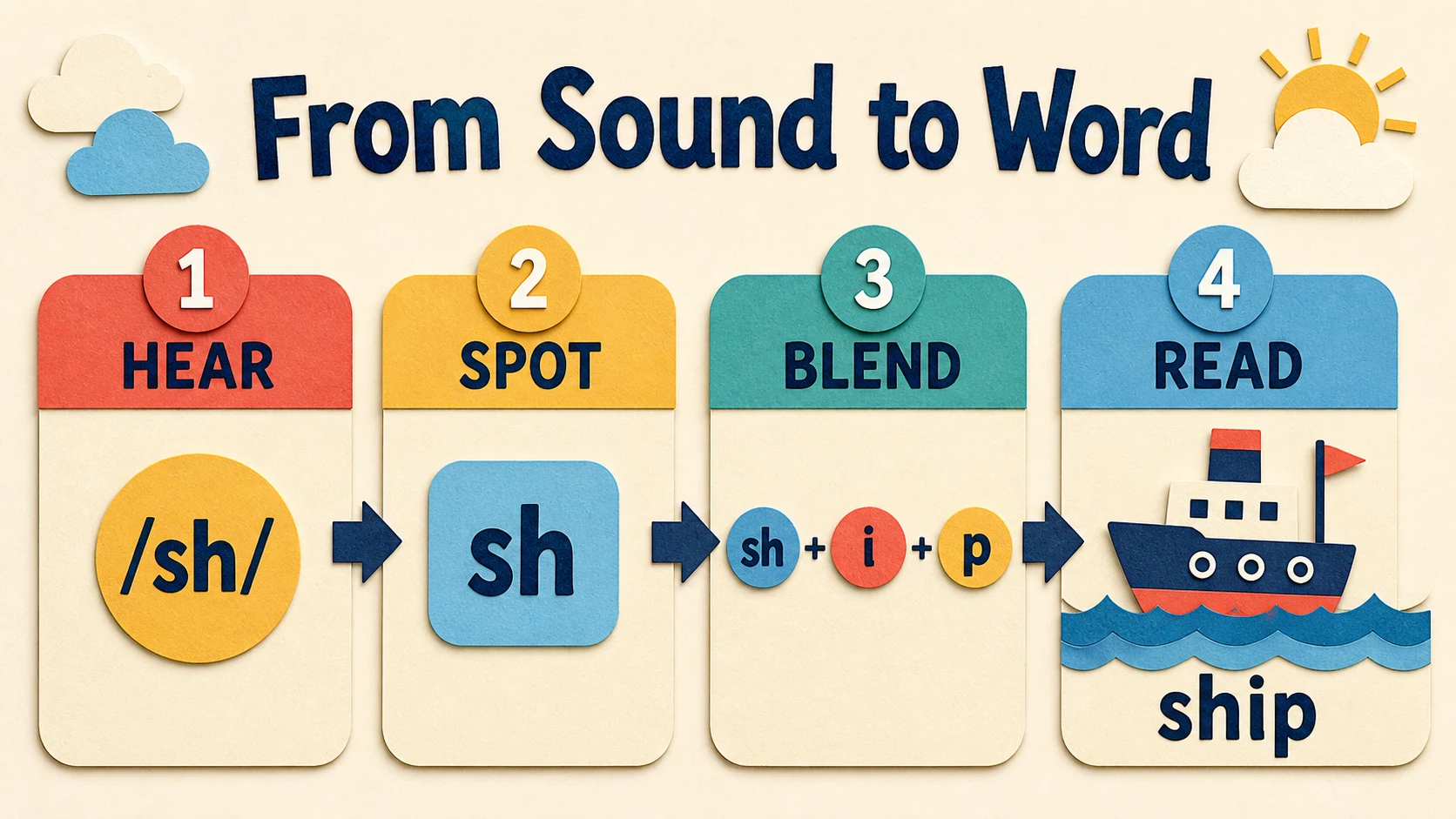
Support can gradually move from sound modeling and marked patterns to mixed reading and independent spelling.
The IES foundational reading practice guide supports high-level use of explicit instruction in sound-letter relationships, word decoding, and connected text. It does not prescribe this WorksheetWise sequence or evaluate this material. The Common Core English Language Arts standards provide a broad grade-level context for knowing common consonant digraph correspondences and decoding regularly spelled one-syllable words. Local curricula may arrange individual patterns differently.
Concrete and visual models that make the pattern clear
A useful model should reveal what the learner needs to notice. Decoration is less important than showing the relationship between print and sound.
Two fingers together
Hold up two fingers separately while naming the letters s and h. Then bring the fingers together as you say /sh/. Explain: “There are two letters, but they work together for this sound.”
Use the same motion when reading a word. Point to sh as one unit, then point to i and p:
sh | i | p
/sh/ /i/ /p/
ship
The gesture is a temporary cue. Reduce it after the learner begins noticing the pattern independently.
One sound box for a two-letter spelling
Draw three boxes for the three sounds in ship:
The first box contains two letters because those letters represent one sound. Compare that with a word containing a blend:
In slip, /s/ and /l/ remain separately audible. This makes the digraph-blend boundary visible without requiring a long definition.
Color or underline the unit
Write ship, fish, chin, and much. Use one underline beneath both letters of the digraph. Do not underline the letters separately, because the purpose is to mark them as a unit.
Color can help during initial instruction, but it should not become a permanent requirement. The learner ultimately needs to recognize the same patterns in ordinary black print.
Fully checked worked examples
The following examples model reading, sound analysis, and spelling. Slash marks show sounds; bold type shows the digraph.
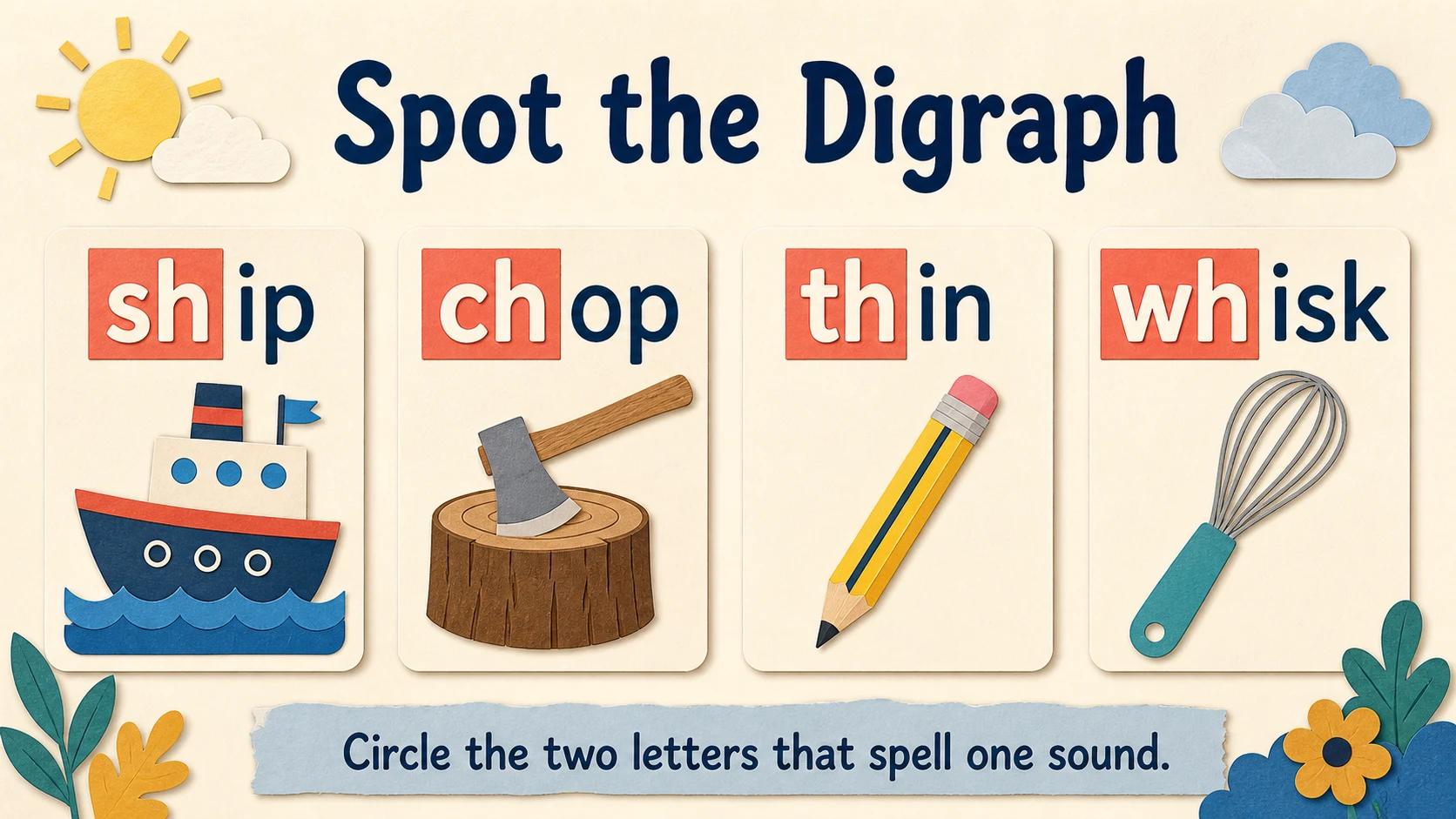
The learner identifies the spelling unit, maps it to one sound, blends, and then checks the whole word.
Example 1: Reading ship
- Find the known pair: sh.
- Say its sound: /sh/.
- Read the remaining letters: i represents the short vowel /i/, and p represents /p/.
- Blend in order: /sh/ /i/ /p/.
- Read the word: ship.
Check: ship has four letters and three sounds. The sh is at the beginning and represents one sound.
Example 2: Reading wish
- Read w as /w/.
- Read i as short /i/.
- Notice final sh and say /sh/.
- Blend: /w/ /i/ /sh/.
- Read the word: wish.
Check: wish also has four letters and three sounds. Here the same digraph appears at the end, showing that sh is not limited to initial position.
Example 3: Contrasting chip and ship
Place the words side by side:
- chip: /ch/ /i/ /p/
- ship: /sh/ /i/ /p/
The vowel and final consonant are the same. Only the first digraph changes. Ask the learner to read each word, point to the letters responsible for the changed sound, and say the words again.
Check: both words have four letters and three sounds. The contrast prevents a learner from treating all two-letter beginnings as interchangeable.
Example 4: Reading thin and this
For thin:
- Identify th.
- Use the unvoiced pronunciation heard at the beginning of thin.
- Add /i/ and /n/.
- Blend the three sounds to read thin.
For this:
- Identify the same written th.
- Use the voiced pronunciation heard at the beginning of this.
- Add /i/ and /s/.
- Blend to read this.
Check: th has two pronunciations in the supplied topic scope. First graders need exposure to both, but they do not need to memorize the labels voiced and unvoiced. If a learner uses the wrong pronunciation, supply the word orally, have the learner repeat it, and reconnect that pronunciation to th.
Example 5: Spelling duck
- Say duck slowly.
- Segment the sounds: /d/ /u/ /k/.
- Record /d/ with d.
- Record the short vowel /u/ with u.
- At the end, spell /k/ with ck: duck.
Check: the word has four letters and three sounds. In this taught pattern, ck appears at the end after a short vowel.
Example 6: Spelling stick
- Say stick and segment it: /s/ /t/ /i/ /k/.
- Record the separately heard /s/ and /t/ as st. This is a blend because both consonant sounds remain audible.
- Record short /i/ with i.
- Record final /k/ with ck.
- Read the completed word: stick.
Check: stick contains a beginning blend and a final digraph. It has five letters and four sounds. This is an appropriate cumulative example after the learner can handle the two features separately.
Boundary cases and important distinctions
A digraph is not a blend
In sh, the two letters function together for /sh/. In st, the sounds /s/ and /t/ can both be heard. Therefore:
- ship begins with a digraph.
- stop begins with a blend.
- stick begins with a blend and ends with the digraph ck.
If a worksheet asks the learner to find a digraph, st should not be selected merely because it contains two adjacent consonants.
Position matters
The catalogue scope includes initial and final digraphs:
- Initial sh: ship
- Final sh: wish
- Initial ch: chin
- Final ch: much
- Initial th: thin, this
- Final th: math, bath
- Initial wh: when
- Final ck: duck, neck
Do not assume that success with ship automatically transfers to wish. Position changes what the child must scan and hold in mind.
The same letters may require more than one practiced pronunciation
The important first-grade boundary case in this scope is th. The beginning sounds in thin and this are not identical, although both are written th. Teach this through familiar examples and oral comparison. Requiring technical terminology adds little to the immediate reading task.
ck has a restricted taught position
Within this topic scope, teach ck after a short vowel and at the end of a word, as in duck, neck, and stick. A learner should not generalize that every /k/ sound is spelled ck. Keep early spelling practice to examples that fit the taught pattern.
A short, repeatable lesson routine
A focused lesson can be brief if every part has a clear purpose. The sequence below can be used for one digraph at a time.
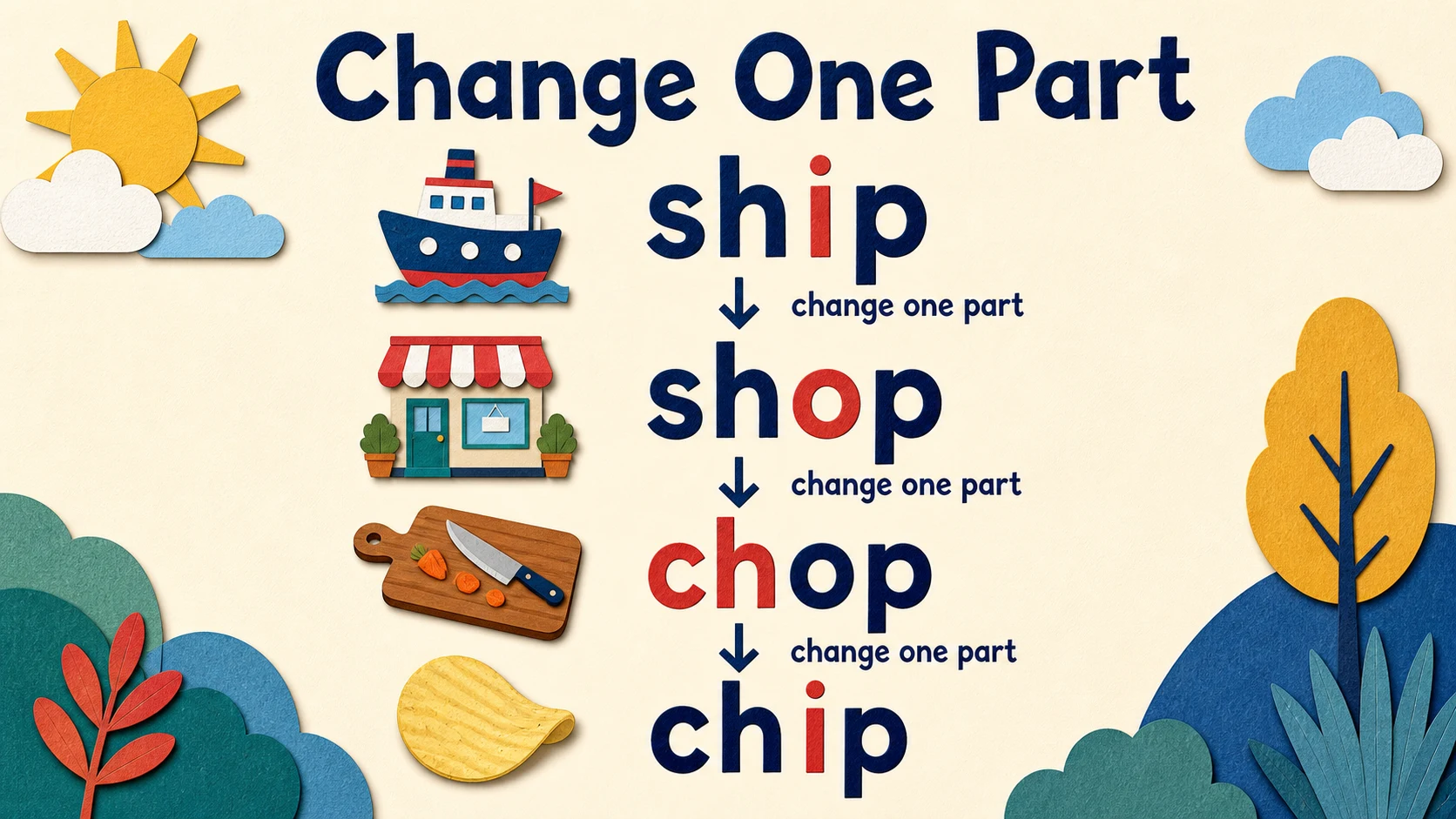
Review, explicitly model, read, spell, use the pattern in context, and finish with a quick check.
1. Review known material
Read three to five previously taught words. Include CVC words and, when appropriate, a familiar blend word. This checks whether earlier knowledge remains available.
2. State and model the new relationship
Show sh and say: “These two letters work together for /sh/.” Use the two-finger gesture or one underline. Model ship and wish so the learner sees the pattern in two positions.
3. Read a small word set
Begin with three or four words containing the target pattern. Then mix in a word that does not contain it. For example: ship, shop, wish, map. Ask the learner to point to sh, say the sound, blend, and read.
4. Build or spell words
Say one suitable word without showing it. The learner segments the sounds and writes or arranges letters. For fish, the sound sequence is /f/ /i/ /sh/, so the final sound is represented by sh.
5. Read a short sentence
Use a sentence in which the surrounding words are manageable, such as “The fish is in the dish.” The purpose is to apply decoding in context, not to encourage guessing from context.
6. Give an exit check
Present one familiar example and one new example using the taught pattern. Record whether each was read accurately, read after prompting, or not yet read. That observation should determine the next lesson.
Writing the word after reading it can strengthen the connection between sound and spelling. The IES elementary writing practice guide provides high-level support for explicit writing instruction and regular opportunities to write. It does not specifically evaluate this digraph routine or the WorksheetWise materials.
Choosing practice that matches the learner
Practice should be selected by the error the learner is making, not simply by the number of pages available.
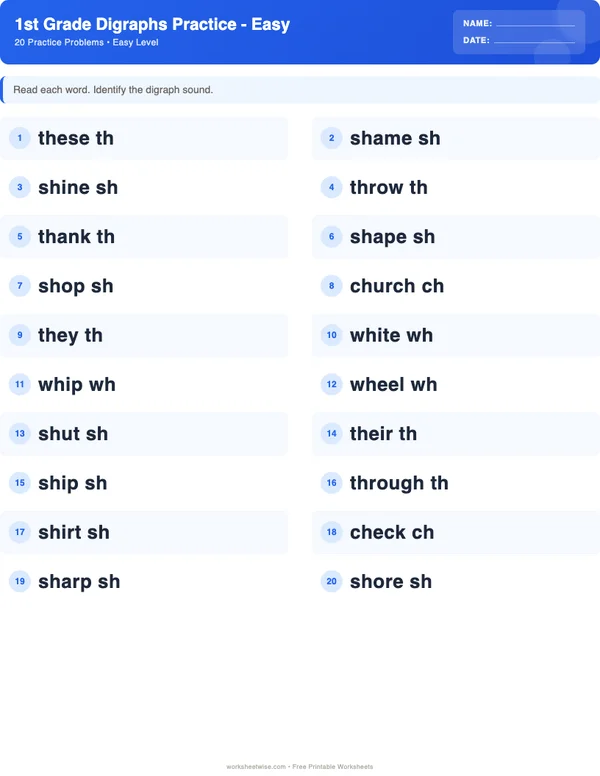
For initial recognition, choose items that ask the learner to find or identify one target digraph. The free easy digraph worksheet contains 20 exercises centered on reading words and identifying the digraph sound. Its separate answer key can help an adult check responses consistently.
For position flexibility, use word sets containing the same digraph at the beginning and end: ship/wish or chin/much. For discrimination, mix two known patterns: ship, chip, shop, chop. For spelling, dictate pattern-fitting words and ask the learner to explain which two letters represent the target sound.
For cumulative review, mix digraph words with CVC and blend words. A page containing only sh words can establish the new pattern, but it does not show whether the learner will recognize sh when other word types compete for attention.
The broader 1st Grade phonics collection can help an adult move between prerequisite practice and digraph work. The 1st Grade worksheet hub provides additional grade-intended material, while the focused digraph pack contains 18 worksheets for learners who need a larger practice set. More pages are useful only when the task remains well matched to the observed need.
Differentiation without changing the core skill
When the learner needs more support
Reduce the number of patterns shown at once. Work with sh alone before asking the child to distinguish sh from ch. Mark the digraph with an underline, provide letter tiles, and blend together before asking for independent reading.
If the learner can read a word after hearing it but cannot decode it from print, return attention to the letters. If the learner cannot distinguish /sh/ and /ch/ when no letters are shown, begin with oral listening and production before returning to print.
When reading is stronger than spelling
Have the learner read ship, cover it, segment the word, and write it from memory. Then uncover the model and compare each spelling unit. Avoid responding only with “wrong.” Ask which sound is missing or which sound has been represented by the wrong letters.
When the learner is ready for more challenge
Mix initial and final positions, add words that combine a blend and digraph, and move into short sentences. Ask the learner to sort words by pattern and explain the sort. A suitable explanation is concrete: “Wish goes under sh because it ends with sh.”
Challenge should increase the decision-making demand, not merely add more items.
Common errors and diagnostic responses
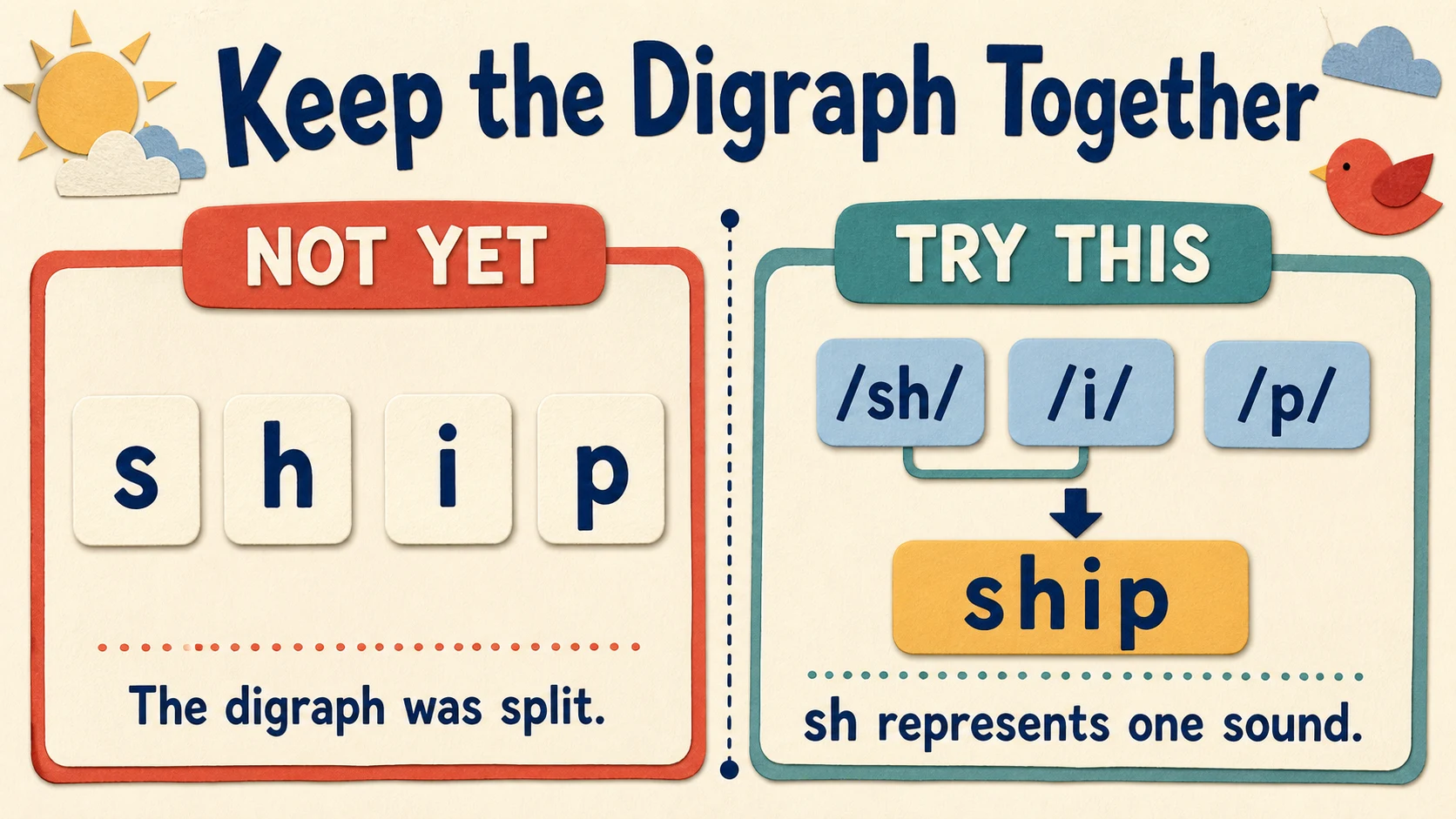
An error becomes useful when the adult identifies the likely missing step and chooses a matching response.
| Observed error |
Likely issue to check |
Teaching response |
| Reads ship with separate /s/ and /h/ sounds |
Treats each letter as a separate sound |
Join the letters with one underline and place sh in one sound box |
| Calls st in stop a digraph |
Uses “two consonants together” as the definition |
Compare stop and shop; count the beginning sounds |
| Reads ship correctly but misses wish |
Recognition is tied to initial position |
Sort and read matched initial/final examples |
| Confuses sh and ch |
Sound or visual discrimination is unstable |
Contrast a small pair such as ship/chip |
| Uses only one pronunciation for th |
Has not encountered both pronunciations securely |
Orally compare thin and this, then reconnect both to th |
| Spells duck as duk |
Represents the sounds but has not applied final ck |
Acknowledge the three sounds, then model ck after the short vowel |
| Guesses from a picture or first letter |
Is not checking the whole printed word |
Cover the picture and guide left-to-right blending |
| Succeeds on a single-pattern page but not a mixed list |
Relies on the page’s repeated answer pattern |
Mix digraph, CVC, and blend words in a short cumulative set |
These are instructional hypotheses, not diagnoses of a child or medical guidance. Test the hypothesis with another example before choosing the response.
Monitoring progress and deciding what comes next
Keep a simple dated record with three categories:
- Independent: reads or spells without a cue.
- Prompted: succeeds after the adult points to the digraph or supplies its sound.
- Not yet: cannot complete the item accurately after a brief prompt.
Use a small sample rather than repeatedly testing a long list. Include a familiar word, a less-practiced word with the same pattern, and a mixed item that requires discrimination.
For example, after teaching sh, check ship, wish, and chip. The first two test position; the third shows whether the learner distinguishes a different digraph. Later, add a short sentence to see whether word-level knowledge carries into connected reading.
Move forward when the learner is increasingly accurate without prompts across more than one position or activity. Review when correct responses depend on highlighting, gestures, or a predictable page format. If performance varies from day to day, retain the pattern in cumulative review while keeping lessons short.
A flexible two-week practice plan
This plan assumes the learner already has the prerequisites and is beginning targeted digraph practice. It is a sample structure, not a universal timetable or promise of mastery.
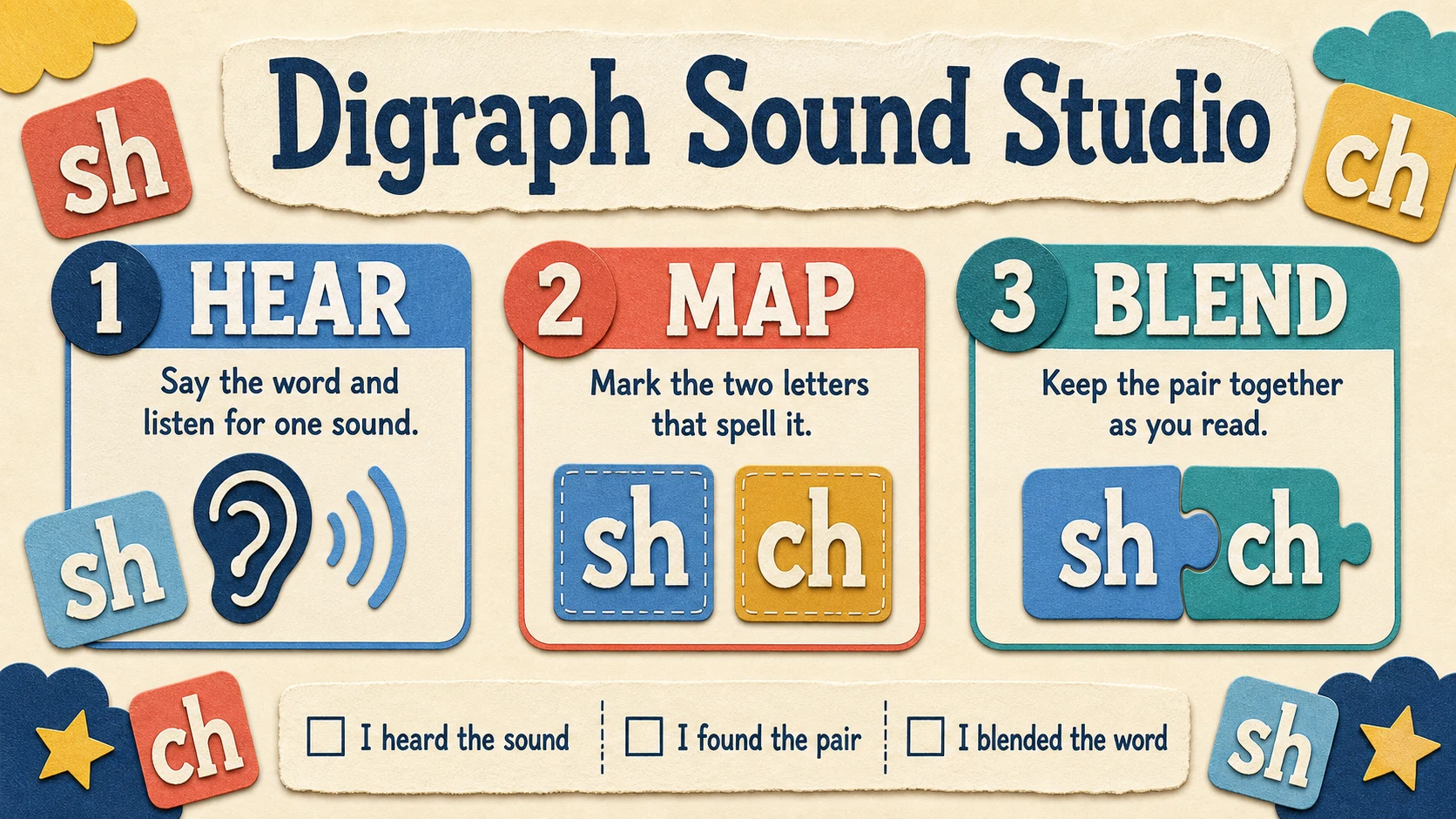
Daily observation determines whether the next session advances, repeats, or reduces the number of patterns.
| Day |
Focus |
Suggested activity |
Quick evidence |
| 1 |
Prerequisite check |
Read CVC words; identify first and last sounds |
Note blending or sound gaps |
| 2 |
Initial sh |
Model, build, and read ship, shop |
Read one new initial sh word |
| 3 |
Final sh |
Compare ship and wish; use sound boxes |
Read both positions |
| 4 |
sh spelling |
Dictate two pattern-fitting words |
Check whether sh stays together |
| 5 |
sh review |
Read a mixed CVC, blend, and sh list |
Record independent versus prompted |
| 6 |
Initial ch |
Model and read chin, chip |
Read one new ch word |
| 7 |
Final ch |
Read and build much; compare positions |
Identify final ch |
| 8 |
sh/ch contrast |
Sort and read ship, chip, wish, much |
Explain each sort |
| 9 |
Introduce th examples |
Compare thin and this orally and in print |
Attempt both pronunciations |
| 10 |
Review and next decision |
Sample sh, ch, and th in words and a sentence |
Repeat, extend, or pause based on work |
The plan does not attempt to master wh and ck within the same two weeks. If sh, ch, and initial th remain unstable, continue there. If they are secure, use the same routine for wh, then teach final ck with short-vowel examples such as duck, neck, and stick.
Limitations and an honest next step
A worksheet can provide orderly word-level practice, but it cannot by itself determine why a learner made an error. It also cannot replace listening to the child read, checking oral sound discrimination, modeling pronunciation, or observing whether a skill transfers to a sentence. Pictures, repeated item formats, and familiar word lists may sometimes make performance look stronger than independent decoding really is.
This guide stays within common first-grade consonant digraphs and the supplied catalogue sequence. It is not a comprehensive account of every two-letter spelling in English, a complete standards-alignment statement, or an individualized intervention plan.
Begin by checking CVC blending, then teach one pattern explicitly. For a manageable next action, use the free 1st Grade Digraphs worksheet as a brief sample. Mark which answers were independent, prompted, or not yet secure, and let that evidence choose the next lesson. If you need different item combinations for cumulative review, explore the free worksheet generators rather than advancing before the learner’s work shows readiness.