What 1st Grade Consonant Blends Are
A consonant blend is a group of two or three neighboring consonants in which each consonant keeps its own sound. In stop, the initial blend st represents /s/ followed by /t/. In clap, cl represents /k/ followed by /l/. In tent, the final blend nt represents /n/ followed by /t/.
The concise teaching answer is this: begin blend instruction after the learner can reliably read simple consonant-vowel-consonant words such as map, sit, and run. Teach a small group of initial blends in complete words, show the learner how to hear and preserve every sound, and then move toward final blends and connected text. If a sound is dropped, return to oral segmentation and sound-by-sound blending before adding harder words.
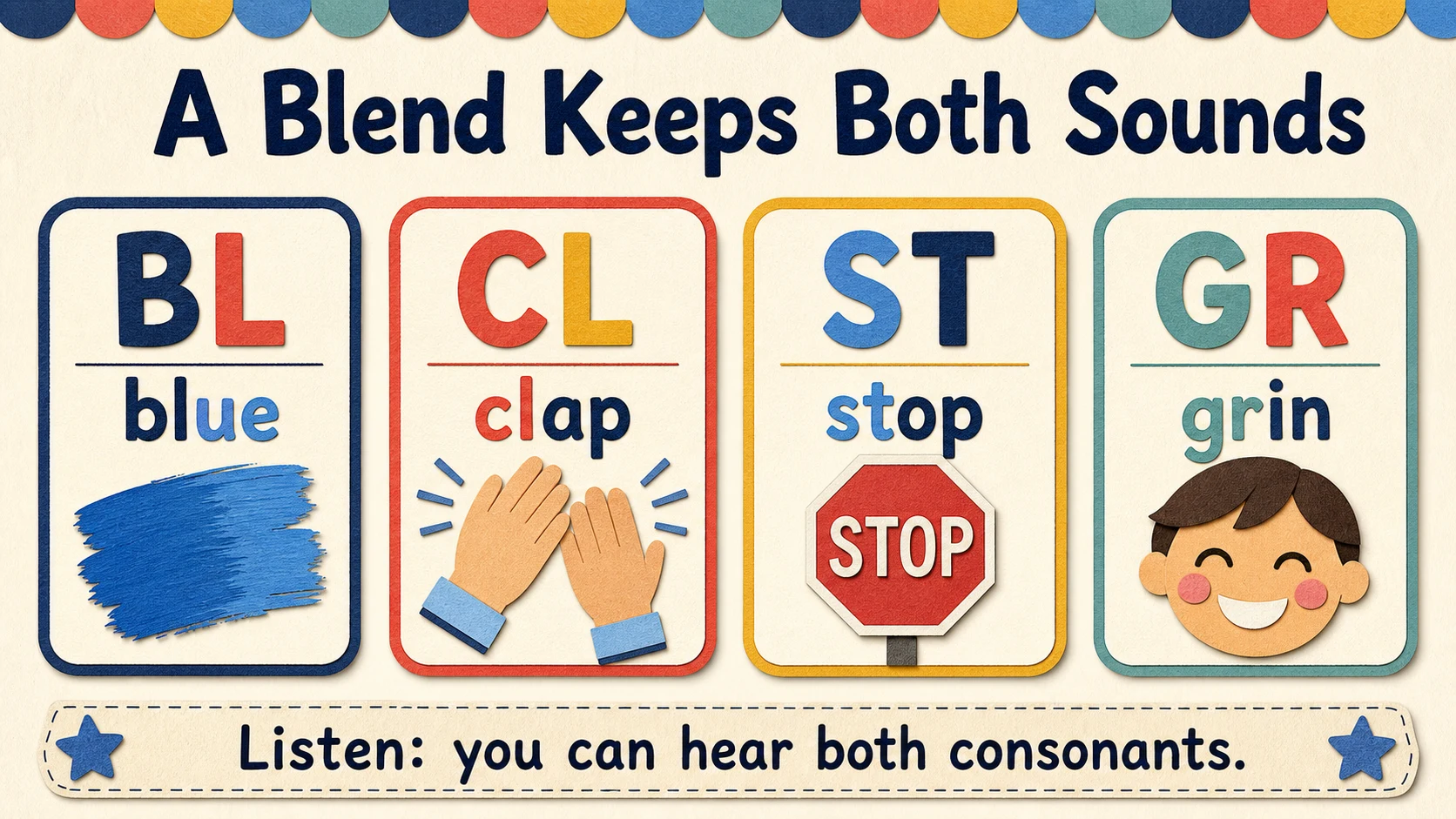
The skill connects listening, letter recognition, sound blending, word reading, spelling, and sentence reading.
Common initial blends include:
- s-blends: sl, sn, sp, st, and sw
- l-blends: bl, cl, fl, gl, pl, and sl
- r-blends: br, cr, dr, fr, gr, pr, and tr
- Other initial blends: sc, sk, sm, and tw
Common final blends include -nd, -nk, -nt, -mp, -lt, -ft, -sk, and -st. Three-consonant sequences, such as str in strap, also function as blends when all three sounds can be heard.
The IES foundational reading practice guide provides high-level support for teaching sound segments, letter-sound relationships, decoding, and connected-text reading as coordinated parts of beginning reading instruction. It did not evaluate WorksheetWise or this particular worksheet.
Grade labels describe an intended practice level, not a guarantee that every learner should reach the same point on the same date. Local curricula and teaching sequences differ. Use the learner’s observed reading and spelling to decide whether to continue, review, or advance.
Prerequisites to Check Before Teaching Blends
Blend instruction is more productive when the learner already has several underlying skills. A quick check can prevent a worksheet from becoming a guessing exercise.
Hearing and producing individual sounds
Say map without showing the word. Ask the learner to say the sounds separately: /m/ /ă/ /p/. Try the same with sit, log, and run. The learner does not need technical vocabulary, but should be able to notice the beginning, middle, and ending sounds.
Next, test oral blending. Say /f/ /ĭ/ /sh/ with short pauses and ask for the word fish. This checks whether the learner can combine sounds before printed blends add another demand.
Reading simple CVC words
Show a short set such as map, sit, red, log, and cup. Look for actual left-to-right decoding rather than recognition from a picture or memorized list. A learner who cannot yet read these words consistently may benefit from more CVC practice before working on clap, stop, or drum.
The shift from lap to clap adds a consonant sound at the beginning. The vowel and final consonant still matter. If the learner reads clap as cap, the difficulty may be holding both sounds in the initial blend rather than reading the rest of the word.
Knowing the relevant letter sounds
Check the consonants that will appear in the lesson. Before teaching st, for example, verify that the learner can connect s with /s/ and t with /t/. Before cl, check c as /k/ in the selected words and l as /l/.
Do not introduce many unfamiliar letter-sound relationships and several new blends in the same short lesson. That makes it difficult to tell which part caused an error.
A Grade-Appropriate Teaching Progression
The catalogue sequence begins with initial blends because they are generally easier to hear than final blends. It recommends starting with s-blends, then moving to l-blends and r-blends. Teach only two or three blends at a time and provide substantial practice before expanding the set.
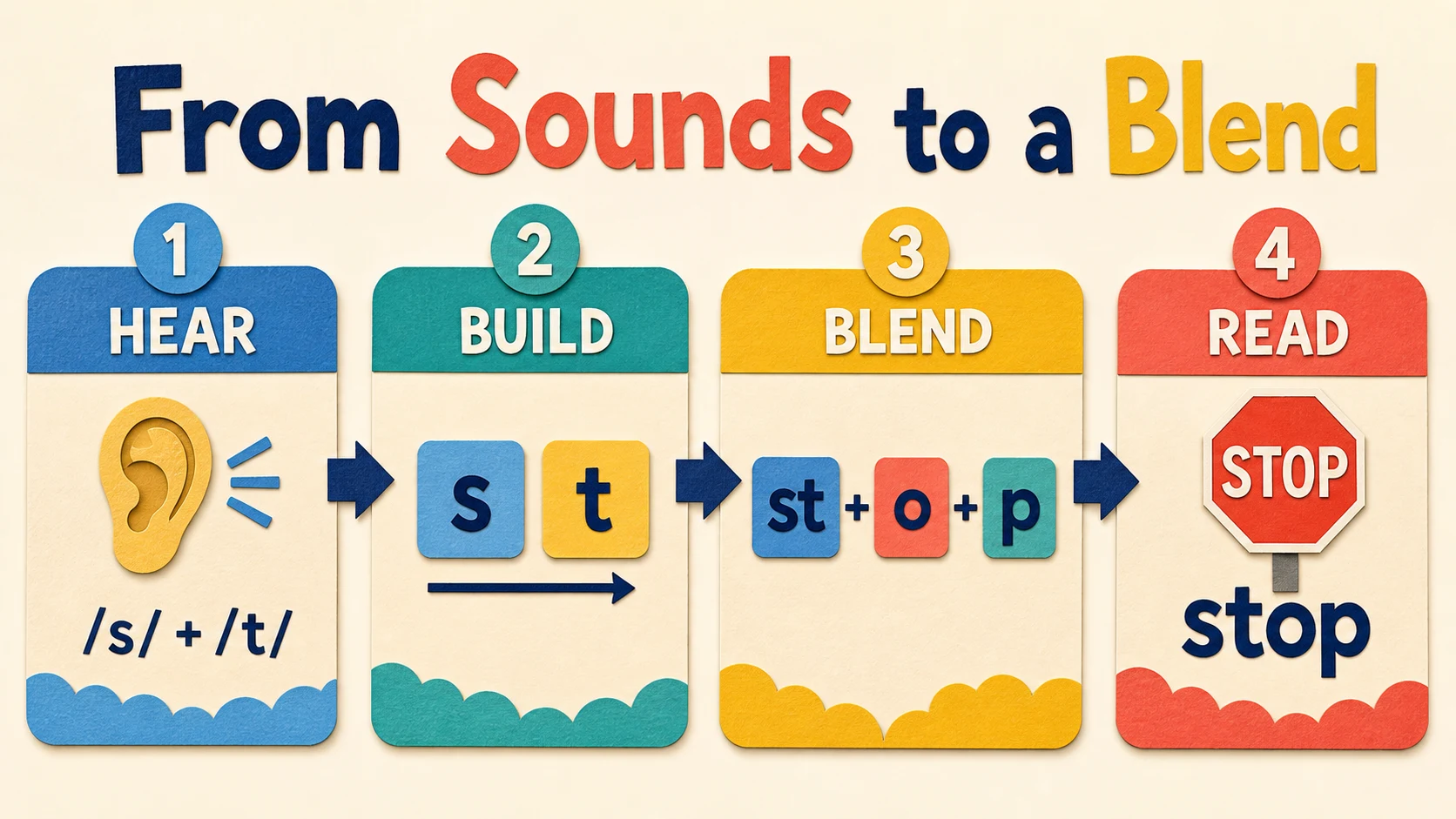
Support should decrease only when the learner preserves every sound accurately.
| Stage |
Suggested focus |
Example words |
Evidence to watch |
| 1 |
Review CVC decoding |
lap, fog, run |
Reads every sound from left to right |
| 2 |
Introduce two initial s-blends |
spin, stop, slip, snap |
Preserves /s/ and the following consonant |
| 3 |
Add another s-blend |
swim, step, spot |
Sorts and reads the selected blends |
| 4 |
Teach selected l-blends |
clap, flag, plum, glad |
Distinguishes the first two sounds |
| 5 |
Teach selected r-blends |
crab, drum, frog, trip |
Reads the blend without inserting a vowel |
| 6 |
Contrast initial blends |
slip, clip, trip |
Uses letters, not only pictures, to identify words |
| 7 |
Introduce final blends |
hand, tent, lamp, milk |
Keeps both final sounds |
| 8 |
Contrast nearby word forms |
ten/tent, bum/bump |
Notices the added final consonant |
| 9 |
Read mixed words and sentences |
The frog swam in the pond. |
Applies learned blends in connected text |
| 10 |
Spell and review |
stop, flag, hand |
Maps the heard sounds to the correct letters |
This table is an instructional suggestion based on the supplied catalogue sequence, not a universal timetable. A learner may need to revisit a stage, and a local program may order particular blends differently.
The Common Core English Language Arts standards provide broad first-grade context for oral sound work and decoding regularly spelled one-syllable words. That context can help an educator place blend practice within a larger literacy program, but it does not establish that this guide or every WorksheetWise activity comprehensively aligns with every local requirement.
Concrete and Visual Models That Make Every Sound Visible
The key idea is that the consonants stay close together in print but remain separate in sound. A model should direct attention to both facts.
Sound counters and letter tiles
For stop, place four counters in a row. Touch one counter for each sound:
/s/ /t/ /ŏ/ /p/
Then replace the counters with letter tiles:
s t o p
Slide a finger under the letters while blending the sounds into stop. Do not present st as one indivisible sound. The letters form a useful visual unit, but the learner should still hear /s/ and /t/.
For lamp, use the same process:
/l/ /ă/ /m/ /p/
The blend occurs at the end, so the final two counters and letters can be placed slightly closer after the learner has segmented all four sounds.
Continuous blending
Some sounds can be stretched. With slip, prolong /s/ briefly, move directly into /l/, and continue through the word: /ssslllĭp/. The purpose is not to distort the word. It is to prevent a pause that encourages the learner to lose one consonant.
A teacher might say, “Keep the voice moving. I want to hear both /s/ and /l/ before the vowel.” This is an instructional prompt, not a sourced quotation.
Word chains
A word chain changes one sound or adds one sound at a time:
lap → clap → clam → clamp
The learner reads each word, identifies what changed, and rebuilds it with tiles or writes it. The chain shows that adding c changes lap to clap, changing p to m produces clam, and adding final p produces clamp.
Word chains are especially useful diagnostically. If lap and clam are read correctly but clap becomes cap, the missing /l/ points to an initial-blend problem. If clam is correct but clamp becomes clam, attention should shift to the final blend.
Fully Checked Worked Examples
These examples model decoding, not guessing from pictures. Slash marks represent sounds; letters remain in ordinary print.
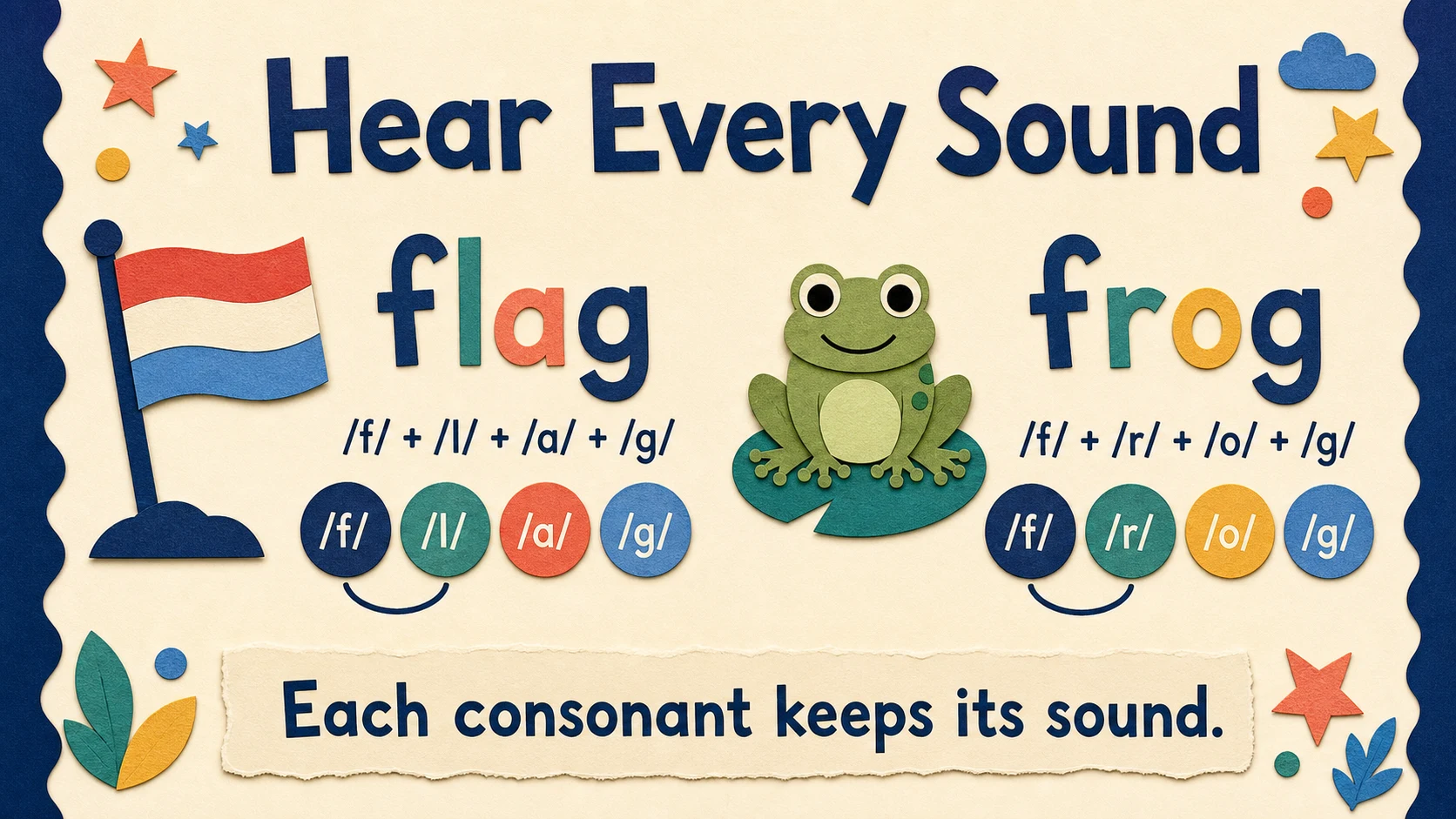
Move from separate sounds to a smooth word, then check that the spoken word matches every letter.
Example 1: Reading an initial s-blend in “stop”
- Look at the letters:
s t o p.
- Say each sound:
/s/ /t/ /ŏ/ /p/.
- Notice that s and t both come before the vowel.
- Blend without dropping either consonant:
/stŏp/.
- Say the whole word: stop.
- Check: four letters represent the four sounds heard in this word.
Answer: the initial consonant blend is st.
A reading of sop is not correct because it leaves out /t/. A reading of top leaves out /s/.
Example 2: Reading an l-blend in “clap”
- Look at
c l a p.
- In this word, c represents /k/.
- Segment the sounds:
/k/ /l/ /ă/ /p/.
- Join the first two sounds while keeping both audible:
/kl/.
- Blend through the vowel and final consonant:
/klăp/.
- Say clap and compare the spoken word with all four letters.
Answer: the initial blend is cl.
If the learner says cap, return to /k/ /l/ and have the learner touch two counters before blending the complete word.
Example 3: Reading an r-blend in “frog”
- Examine
f r o g.
- Say the separate sounds:
/f/ /r/ /ŏ/ /g/.
- Combine the first two without adding a vowel:
/fr/.
- Blend the complete sequence:
/frŏg/.
- Say the word normally: frog.
- Check that /f/ and /r/ are both present.
Answer: the initial blend is fr.
A pronunciation such as “fuh-rog” inserts an extra vowel that is not represented in the spelling. Shortening the consonant pronunciations can help: /f/, not “fuh.”
Example 4: Reading a final blend in “tent”
- Look at
t e n t.
- Segment it:
/t/ /ĕ/ /n/ /t/.
- Read through the vowel to
/tĕ/.
- Preserve both ending sounds:
/nt/.
- Blend the complete word:
/tĕnt/.
- Compare ten and tent. The final /t/ changes the word and is shown by the last letter.
Answer: the final consonant blend is nt.
The word ten is not an acceptable reading of tent because the final /t/ has been omitted.
Example 5: Reading both an initial and a final blend in “clamp”
- Look at
c l a m p.
- Segment:
/k/ /l/ /ă/ /m/ /p/.
- Identify the initial blend:
/k/ /l/, spelled cl.
- Identify the final blend:
/m/ /p/, spelled mp.
- Blend all five sounds:
/klămp/.
- Say clamp and verify that no sound disappeared.
Answer: cl is the initial blend and mp is the final blend.
This is harder than clap or lamp because the learner must preserve a blend at both ends.
Boundaries and Common Misconceptions
A blend is not simply any pair of consonant letters. The defining feature is that each consonant retains its sound.
Blends and digraphs are different
In ship, sh represents a single sound, /sh/. It is a digraph, not a blend. In chop, ch also represents one sound. By contrast, sl in slip contains /s/ followed by /l/, so it is a blend.
The word fresh contains an initial blend, fr, and a final digraph, sh. This makes it a useful boundary case after the learner understands each feature separately.
Position matters
In stop, st is an initial blend because it appears at the beginning. In fast, st is a final blend because it appears at the end. The same letter pair can therefore be discussed differently according to its position.
In strap, str is a three-consonant initial blend: /s/ /t/ /r/. It is not necessary to begin instruction with three-consonant blends. They can follow successful work with two-consonant blends.
A consonant pair may cross a syllable boundary
This guide focuses on regularly spelled one-syllable words. A pair of neighboring consonants in a longer word should not automatically be treated as the same kind of blend practice. Keep early examples controlled so the learner can apply the target idea without additional syllable demands.
Circle-the-blend work is not the whole skill
Correctly circling st in stop shows visual identification. It does not, by itself, prove that the learner can decode stop, spell it from speech, or read it in a sentence. Follow visual identification with oral reading and, when appropriate, a brief spelling check.
Diagnosing Errors Before Choosing More Practice
An incorrect response is useful evidence when the adult records exactly what the learner said or wrote.
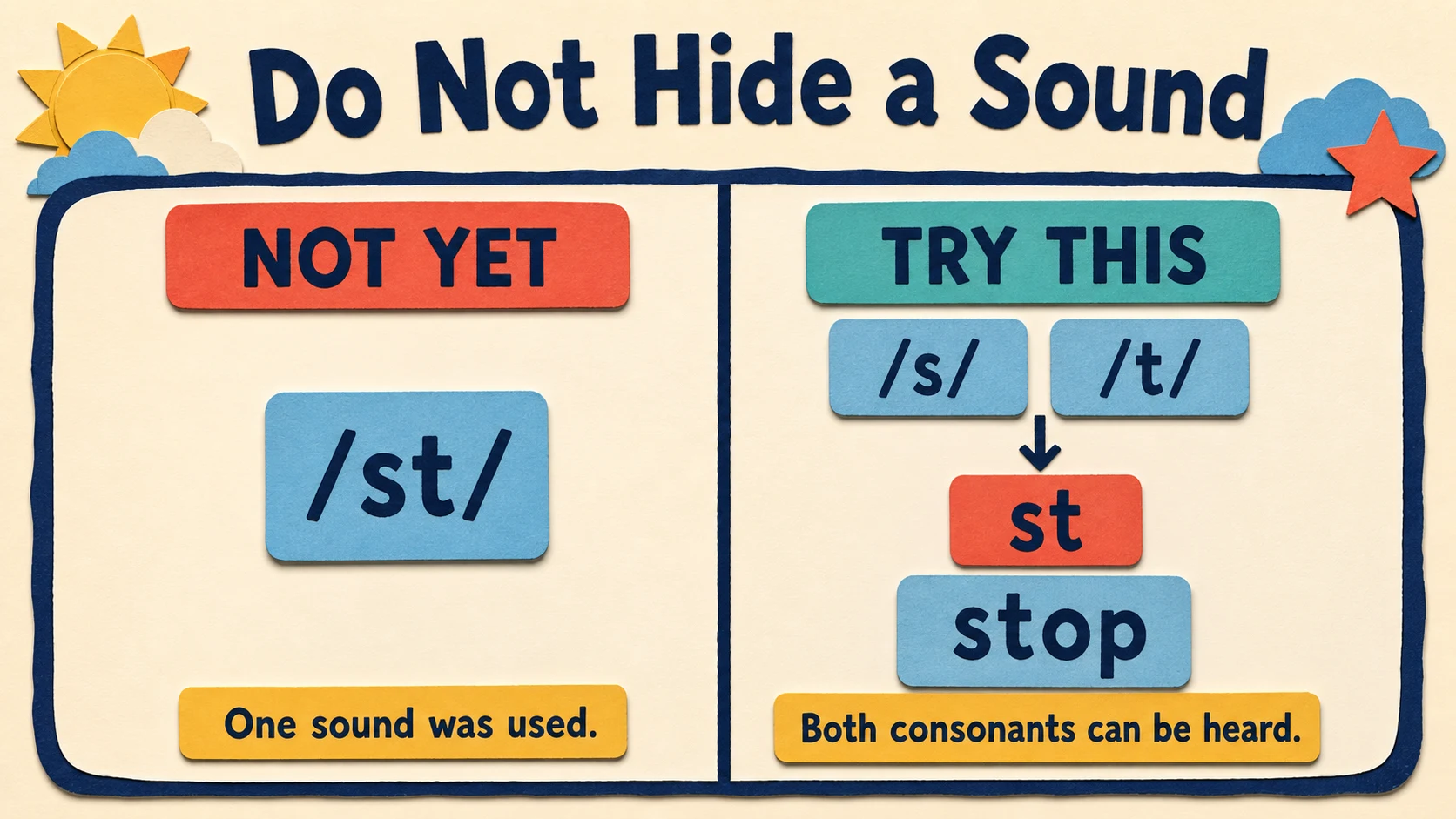
Match the response to the error instead of assigning more mixed practice immediately.
| Observed response |
Likely point to check |
Targeted teaching response |
| Reads stop as sop |
Second sound in the initial blend is dropped |
Tap /s/ /t/ /ŏ/ /p/, then blend again |
| Reads clap as cap |
/l/ is omitted |
Contrast cap and clap with letter tiles |
| Reads frog as “fuh-rog” |
An extra vowel is inserted |
Model short consonant sounds and continuous blending |
| Reads tent as ten |
Final consonant is dropped |
Contrast ten/tent and point to the last letter |
| Calls sh in ship a blend |
Blend and digraph concepts are confused |
Compare slip with ship: two sounds versus one |
| Circles the right letters but misreads the word |
Visual recognition is ahead of decoding |
Require sound-by-sound reading after circling |
| Guesses from the picture |
Printed letters are not controlling the response |
Cover the picture, read the word, then reveal it |
| Reads one blend accurately but confuses several mixed together |
Practice set is too broad |
Return to two known contrasts before adding another |
Finger tapping is particularly appropriate when a consonant disappears. The catalogue recommends tapping each sound before blending. For final blends, contrasts such as ten/tent and bum/bump make the omitted consonant easier to notice.
If errors remain inconsistent even with a very small, familiar word set, record the examples and share them with the learner’s teacher or reading instructor. This guide offers educational practice, not medical guidance or an individual diagnosis.
A Short, Repeatable Lesson Routine
A compact lesson can combine listening, modeling, reading, spelling, and connected text. The learner’s observed work—not a timer alone—should determine when to continue or stop.
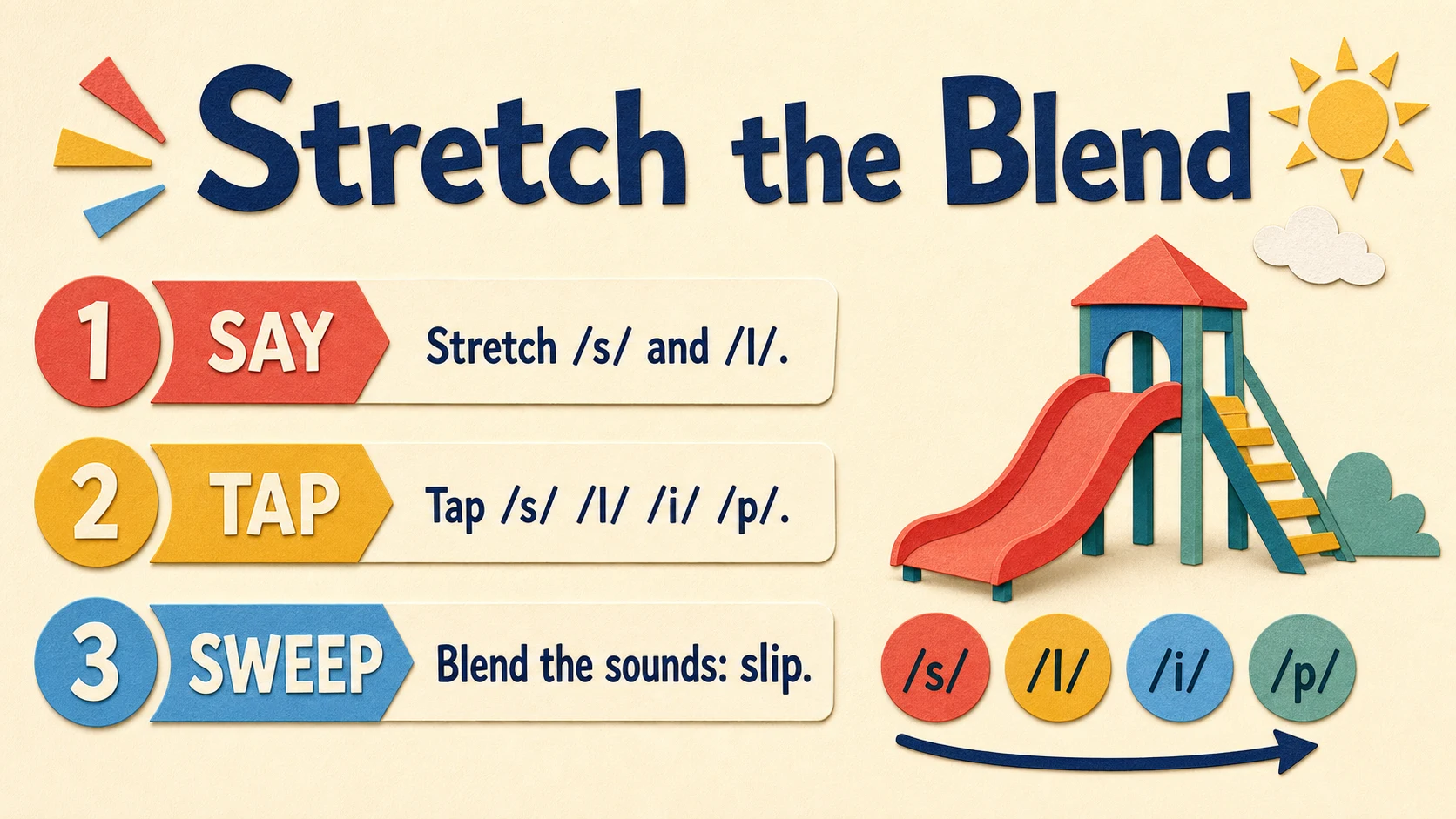
Keep the target narrow, obtain several accurate responses, and finish with meaningful reading.
1. Hear the sounds
Say two or three words without showing them: stop, step, and spin. Ask what sound comes first and what sound follows it. If the learner cannot hear both consonants, stretch the sequence and use counters.
2. Model one word
Build stop with tiles. Touch each letter, say each sound, and blend the word. Explain briefly: “The s and t are together, and I can hear both sounds.”
3. Read a controlled set
Use four to six words containing only the selected blends and familiar vowel patterns. For example: stop, step, spin, spot, slip, and snap. Mix their order after an accurate first reading so location on the page does not become the cue.
4. Build or write words
Dictate two words from the set. Have the learner repeat the word, tap its sounds, and then build or write it. Ask for a letter-by-letter check against the spoken sounds.
The IES elementary writing practice guide offers high-level instructional framing for developing foundational writing skills and giving learners regular opportunities to write. Here, a short spelling or sentence task is a practical instructional suggestion that connects phonics with writing; the source did not test this exact routine.
5. Read connected text
Finish with one or two sentences containing learned blends, such as:
The frog can swim.
The crab hid in the sand.
Ask the learner to reread after correcting any blend error. Connected text reveals whether the skill transfers beyond an isolated list.
Selecting Practice and Differentiating It
Choose practice by the next observable need, not only by the worksheet’s grade label.
When the learner is just beginning
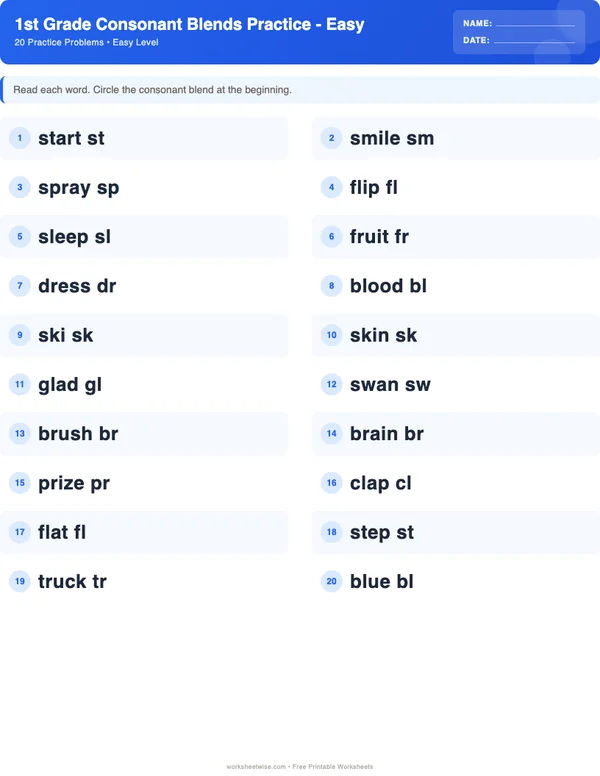
Use the free easy consonant-blends worksheet. It contains 20 exercises asking learners to read each word and circle its beginning consonant blend. A separate printable answer key is included.
Before independent work, complete one item orally. After several items, ask the learner to read the whole words. This extra check distinguishes genuine decoding from successful letter spotting.
When one blend type causes difficulty
Create a smaller set containing two or three blends rather than assigning a broad mixed page. For example, contrast st and sp with stop, step, stem, spin, spot, and spun. If accuracy improves, add sl in a later set.
The 1st Grade phonics collection can help an adult move back to prerequisite phonics work or choose a neighboring skill. The broader 1st Grade worksheet hub is useful when planning practice across subjects.
When isolated words are secure
Move to short sentences and brief decodable passages featuring already taught blends. Include occasional words without blends so the learner must inspect each word rather than assume every item contains the target pattern.
Add spelling selectively. Dictate flag, ask for the sounds /f/ /l/ /ă/ /g/, and have the learner write the word. A correct reading with an incorrect spelling shows that recognition and production are developing at different rates.
When the work is too easy
Increase complexity one dimension at a time:
- Mix known initial blend families.
- Add selected final blends.
- Use words with blends at both ends, such as clamp.
- Move from lists to sentences.
- Ask the learner to explain which letters form the blend and which sounds they represent.
Do not equate speed with mastery. Accurate, increasingly smooth reading across new examples is more informative than racing through a memorized list.
The focused consonant-blends pack contains 18 worksheets and is a practical option when varied practice is needed. Select pages according to the learner’s current errors rather than assigning the entire pack automatically.
Monitoring Progress Without Over-Testing
Use a brief record after practice. Note the date, blend set, number of words attempted, exact errors, level of prompting, and performance in a sentence. The purpose is to guide the next lesson.
A useful record might say:
Aug. 26 — st/sp, six words. Read five accurately without help. Read stop as sop, then corrected after tapping. Read “The pig can spin” accurately.
That note is more actionable than “needs more phonics.” It shows that the learner generally handles the set but sometimes drops /t/ in st.
Look for three forms of progress:
- Accuracy: Are all consonant sounds preserved?
- Independence: Does the learner read without a model or prompt?
- Transfer: Does the learner apply the pattern in an unfamiliar word, spelling task, or sentence?
Review when errors cluster around one blend or position. Advance when the learner reads a small mixed set accurately and applies the patterns in connected text with little support. These are instructional decision rules, not certified mastery thresholds.
A Flexible Two-Week Practice Plan
This plan assumes short, regular sessions and should be adapted to observed work. It is not a universal timetable. Repeat a day when the target remains unstable, and compress review when the learner already demonstrates the skill.
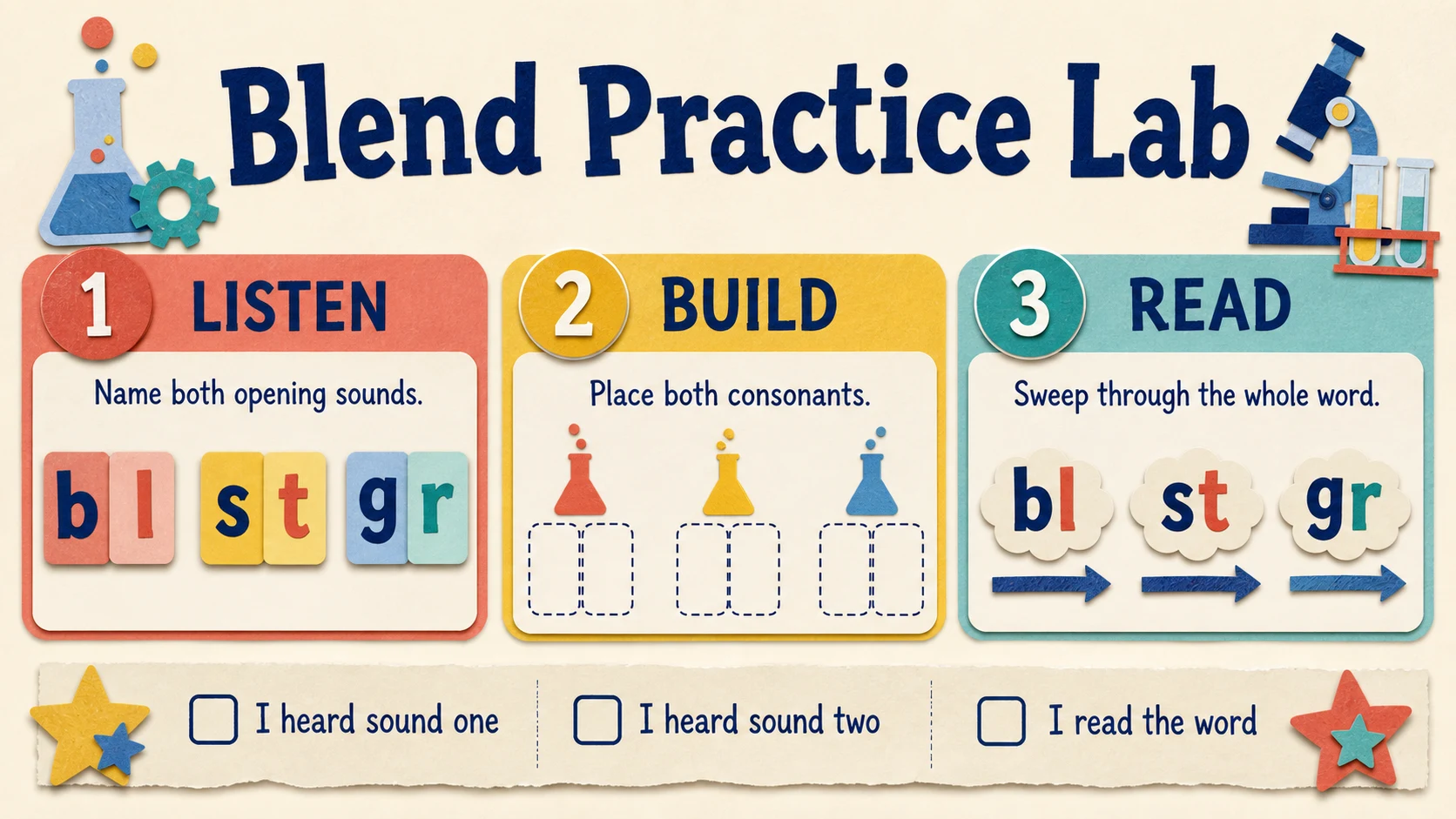
Alternate focused teaching, cumulative review, spelling, and connected reading.
| Day |
Focus |
Suggested activity |
Decision point |
| 1 |
Prerequisite check |
Oral segmenting and CVC reading |
Review CVC words if decoding is unreliable |
| 2 |
st and sp |
Counters, tiles, then six words |
Continue if both sounds are preserved |
| 3 |
Review st/sp |
Word sort and two dictated words |
Note omissions or picture guessing |
| 4 |
Add sl |
Read slip, slam, and slid with known words |
Remove new items if errors spread |
| 5 |
Cumulative application |
Short sentence reading and rereading |
Check transfer beyond the list |
| 6 |
cl and fl |
Model, build, and read selected words |
Contrast cap/clap if /l/ disappears |
| 7 |
Add pl or review |
Word chain: lap → clap → clam |
Choose review when rebuilding is inaccurate |
| 8 |
br and fr |
Read and spell words such as brag and frog |
Correct inserted vowel sounds |
| 9 |
Selected final blends |
Contrast ten/tent and bum/bump |
Listen for the last consonant |
| 10 |
Mixed check and next step |
New words, two sentences, one spelling item |
Record accuracy, independence, and transfer |
At the end of the plan, avoid a simple pass-or-fail judgment. Instead, identify the next teaching target. A learner who reads initial blends accurately but drops final consonants needs focused final-blend contrasts. A learner who circles blends correctly but cannot read the words needs more decoding practice. A learner who handles new words and sentences can move into broader mixed review.
Limitations and the Next Useful Step
A printable page provides a sample of performance, not a complete reading profile. Pictures may encourage guessing, familiar words may be memorized, and one successful session may not show lasting transfer. Blend practice also does not replace work on vowels, digraphs, irregularly spelled words, fluency, comprehension, or writing.
This guide cannot determine an individual learner’s full instructional needs, guarantee an outcome, or establish comprehensive standards alignment. Use local curriculum expectations, teacher observations, and repeated work samples alongside it.
For the next session, open the free 1st Grade Consonant Blends worksheet, model the first word, and record whether the learner can both circle the beginning blend and read the complete word. Use that evidence to choose either a smaller two-blend review, the broader topic guide and practice collection, or a customized activity from the free worksheet generators.