What 2nd Grade Consonant Blends Practice Should Teach
Consonant blends are groups of two or three consonants in which each consonant keeps its own sound. In stop, the letters s and t form the initial blend st because the reader can hear /s/ and /t/. In tent, the final blend nt contains both /n/ and /t/.
The practical goal for a 2nd Grade learner is to read and spell complete words containing familiar initial and final blends, then use those words accurately in phrases and sentences. Begin only after the learner can read straightforward consonant-vowel-consonant words such as lap, ten, and sit with reasonable accuracy. Teach a small set of blends at a time, notice whether the learner preserves every sound, and use observed work to decide when to add complexity.
Grade labels describe the intended practice level, not a universal timetable. Local curricula and instructional sequences differ, and some 2nd Grade learners will need earlier phonics review while others will be ready for final blends, three-consonant blends, and connected text.
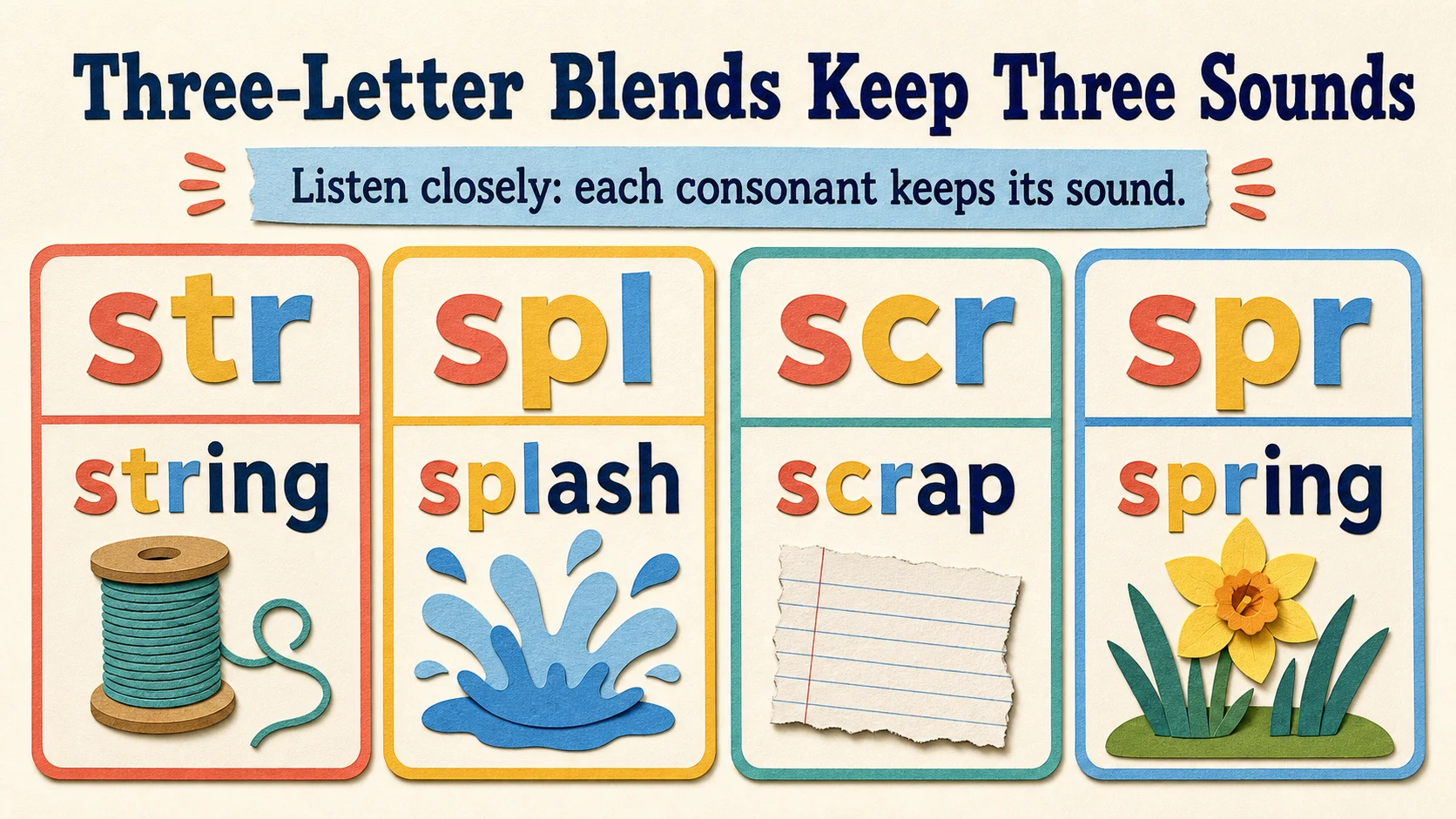
The skill develops from hearing each consonant to reading, spelling, and using blended words.
The IES foundational reading practice guide provides high-level support for explicit work with sound segments, letter-sound relationships, decoding, and connected text. It does not evaluate WorksheetWise or prescribe one blend sequence for every learner.
Prerequisites to Check Before Teaching Blends
A blend adds at least one consonant sound to a word structure the learner may already know. For example, lap has three sounds, while clap has four:
- lap: /l/ /ă/ /p/
- clap: /k/ /l/ /ă/ /p/
Before concentrating on blends, check whether the learner can do the following:
- Identify common consonant letters and produce their usual sounds.
- Hear the beginning, middle vowel, and ending of a spoken one-syllable word.
- Blend three sounds into a word, such as /m/ /ă/ /p/ into map.
- Segment a simple word into its individual sounds.
- Read regularly spelled CVC words without guessing mainly from the first letter or a picture.
- Write or select letters for familiar consonant sounds.
A learner does not need perfect mastery of every CVC word. However, if map, sit, and ten are still regularly misread, blend practice may hide the more basic problem. Review sound-by-sound blending first.
A quick prerequisite check
Use five spoken or printed items:
- Ask the learner to blend /s/ /ĭ/ /t/. The answer is sit.
- Ask for the first sound in map. The answer is /m/.
- Ask for the last sound in ten. The answer is /n/.
- Show lap and ask the learner to read it.
- Say fit and ask the learner to segment it: /f/ /ĭ/ /t/.
Look for the process as well as the total score. A learner who self-corrects after checking every letter may be ready for supported blend work. A learner who repeatedly substitutes unrelated words needs more direct review.
A Grade-Appropriate Progression
The catalogue sequence begins with initial blends because they are generally easier to hear than final blends. It starts with s-blends, then moves to l-blends and r-blends, usually introducing only two or three blends at a time. Final blends follow, with contrastive word pairs used to make the last consonant easier to notice.
| Stage |
Suggested focus |
Example words |
What to observe |
| 1 |
CVC review |
lap, ten, sit |
Does the learner blend all three sounds? |
| 2 |
Initial s-blends |
slip, snap, spot, stop, swim |
Is the second consonant retained? |
| 3 |
Initial l-blends |
black, clap, flag, glad, plan |
Can the learner move through both consonants into the vowel? |
| 4 |
Initial r-blends |
bran, crab, drum, frog, grin, trip |
Does the learner distinguish the two opening sounds? |
| 5 |
Additional initial blends |
scan, skip, twin |
Can the learner apply the same process to a less-practiced blend? |
| 6 |
Final blends |
hand, sink, tent, bump, belt, lift, task, best |
Is the last consonant pronounced and represented? |
| 7 |
Mixed positions |
blend, print, crust, clamp |
Can the learner attend to blends at both ends? |
| 8 |
Phrases and sentences |
“The frog went past the stump.” |
Does accurate decoding continue in connected text? |
This table is an instructional pathway, not a fixed calendar. A learner who reads stop accurately but drops the /t/ from tent needs final-blend work rather than more pages of initial-blend identification.
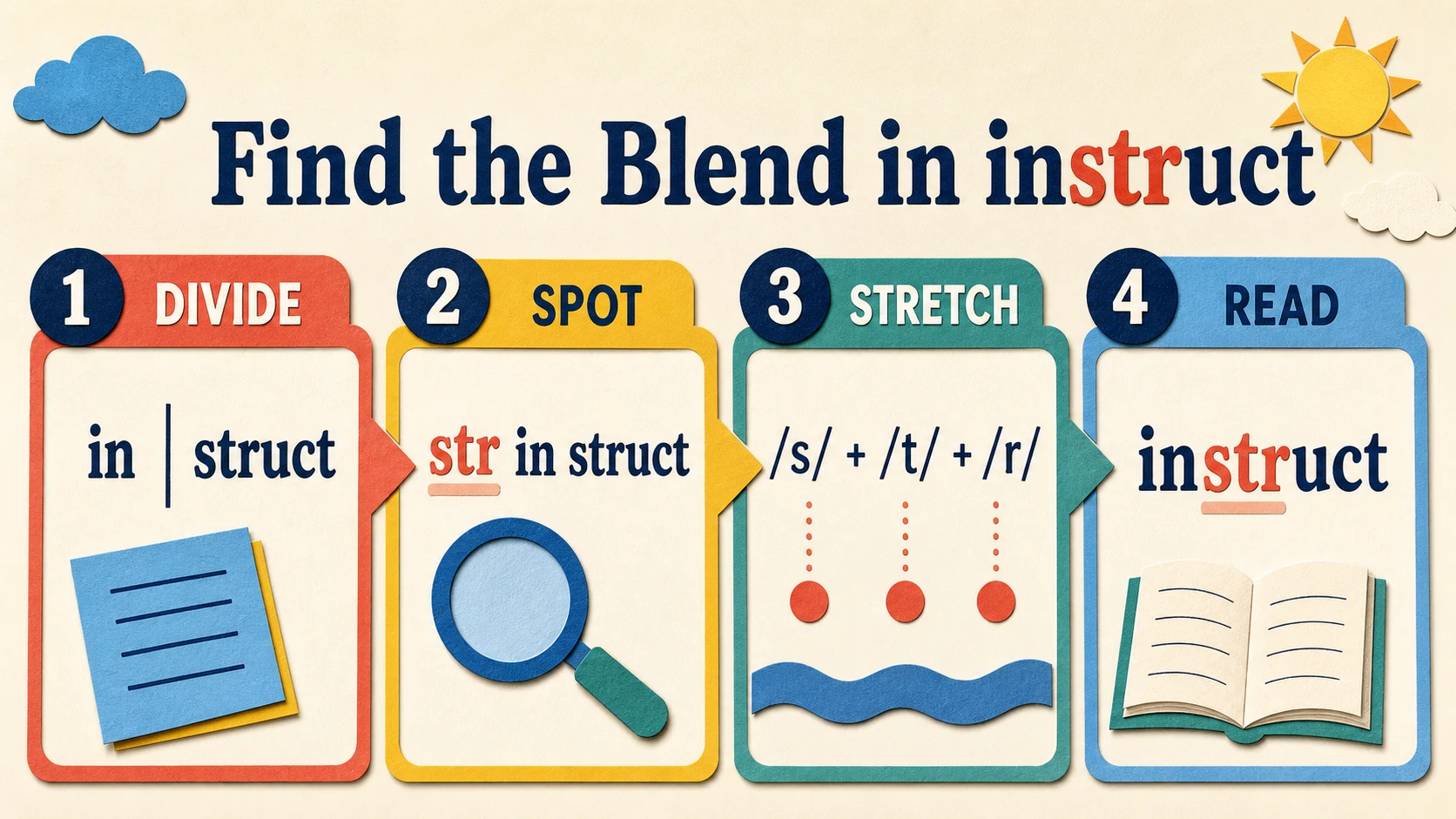
Move forward when the learner consistently preserves the target sounds, not merely when a page is complete.
The Common Core State Standards for English Language Arts include broad expectations related to sound analysis and decoding regularly spelled one-syllable words. The supplied catalogue references RF.1.2.B, RF.1.2.C, RF.1.3.B, RF.1.3.G, and RF.2.3.A as relevant context. That list should not be treated as a claim of comprehensive standards alignment, and local requirements may organize the content differently.
Concrete and Visual Models That Make Every Sound Visible
A useful model should help the learner notice that the consonants remain separate sounds even though the letters appear beside one another.
Sound counters
Place one counter for each sound in a word. For stop, use four counters:
/s/ /t/ /ŏ/ /p/
Slide a finger beneath the counters while saying the sounds, then sweep across them while blending: stop. The counters represent sounds, not syllables and not necessarily groups of letters.
For clamp, use five counters:
/k/ /l/ /ă/ /m/ /p/
This model makes both cl and mp visible as two-sound sequences.
Letter tiles and sound boxes
Build lap with three tiles: l – a – p. Add c at the beginning to make clap. Ask:
- What letter was added?
- What new sound do you hear?
- Did the other sounds change?
The checked transformation is:
lap /l/ /ă/ /p/ → clap /k/ /l/ /ă/ /p/
A four-box sound frame can reinforce the same structure:
Avoid drawing one box around cl if the immediate purpose is phoneme segmentation. That presentation could obscure the fact that /k/ and /l/ are separate sounds.
Continuous blending
Point beneath each letter without stopping between sounds:
s → t → o → p
Stretch the continuous /s/ briefly, move to /t/, then continue through the vowel and ending: /sss-t-ŏ-p/, stop. The goal is a smooth whole word, not a memorized pronunciation of the blend by itself.
Fully Checked Worked Examples
Example 1: Finding an initial blend in “stop”
Task: Read the word and identify the consonant blend at the beginning.
- Look at every letter: s-t-o-p.
- Say the sounds in order: /s/ /t/ /ŏ/ /p/.
- Blend them: stop.
- Check the beginning. Both /s/ and /t/ are heard.
- Circle st.
Answer: The initial consonant blend is st.
Check: Removing t would leave sop, a different word. The /t/ must not disappear.
Example 2: Building “clap” from “lap”
Task: Add one consonant to lap to make clap, then identify the blend.
- Read lap: /l/ /ă/ /p/.
- Place c before lap: c + lap.
- Read every sound: /k/ /l/ /ă/ /p/.
- Blend the sounds smoothly: clap.
- Identify the two opening consonants: c and l.
Answer: The new word is clap, and its initial blend is cl.
Check: Four sounds are represented: /k/, /l/, /ă/, /p/. Neither consonant in cl is silent.
Example 3: Distinguishing “ten” from “tent”
Task: Decide which word ends with the blend nt.
- Segment ten: /t/ /ĕ/ /n/.
- Segment tent: /t/ /ĕ/ /n/ /t/.
- Compare the endings.
- Ten ends with the single consonant sound /n/.
- Tent ends with /n/ followed by /t/.
Answer: Tent ends with the final blend nt.
Check: The two words differ by one final sound. If the learner reads both as ten, the /t/ in tent has been dropped.
Example 4: Following the chain “lap → clap → clam → clamp”
Task: Read each word and explain what changes.
- lap = /l/ /ă/ /p/
- Add /k/ at the beginning: clap = /k/ /l/ /ă/ /p/
- Change the ending /p/ to /m/: clam = /k/ /l/ /ă/ /m/
- Add /p/ after /m/: clamp = /k/ /l/ /ă/ /m/ /p/
Answers:
- Clap has the initial blend cl.
- Clam also has the initial blend cl.
- Clamp has initial cl and final mp.
Check: Clam has four sounds; clamp has five. The last /p/ distinguishes the final two words.
Example 5: Reading a blend in a sentence
Task: Read: The frog went past the stump.
- Locate likely blend words: frog, went, past, and stump.
- Decode frog: /f/ /r/ /ŏ/ /g/; initial blend fr.
- Decode went: /w/ /ĕ/ /n/ /t/; final blend nt.
- Decode past: /p/ /ă/ /s/ /t/; final blend st.
- Decode stump: /s/ /t/ /ŭ/ /m/ /p/; initial st, final mp.
- Reread the entire sentence smoothly.
Check: Each named blend contains two audible consonant sounds. The sentence reread tests whether accuracy carries into connected text.
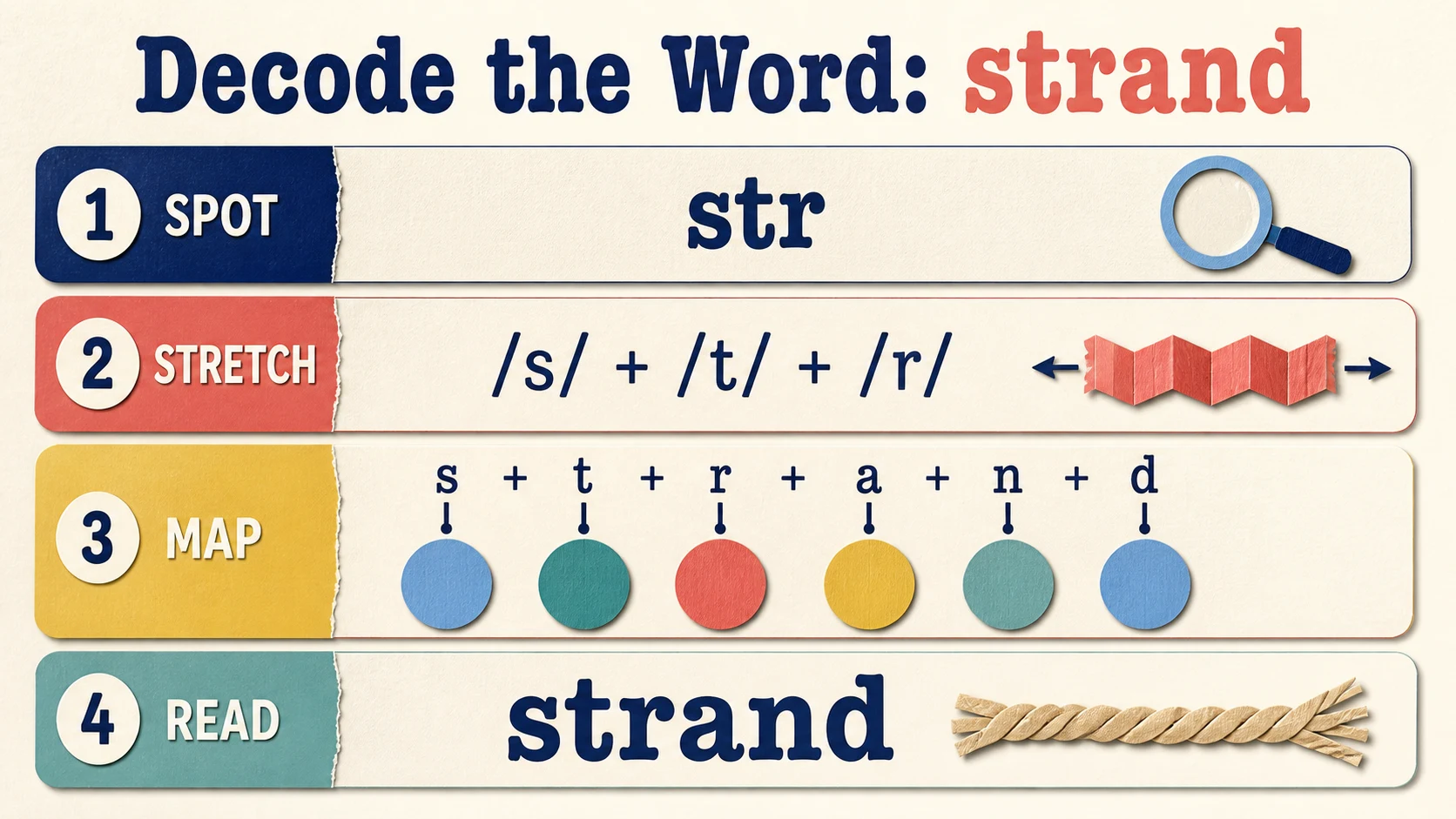
Sound counters, letters, and a final reread connect the spoken structure to the printed word.
Boundary Cases and Misconceptions
A blend is not the same as a digraph
In a blend, each consonant retains its sound. Cl in clap represents /k/ followed by /l/. By contrast, a letter pair such as sh in ship represents one consonant sound, /sh/. It is therefore not a consonant blend.
A simple test is to ask, “Can I hear both consonant sounds?” In frog, the answer is yes: /f/ and /r/. In ship, s and h are not pronounced as separate /s/ and /h/ sounds.
Adjacent consonants may cross a syllable boundary
The topic focuses on blends within words that can be decoded as sound sequences, especially regularly spelled one-syllable words. Two consonant letters appearing next to one another in a longer word do not automatically create the same instructional case. Before labeling a pair, say the whole word, segment it, and consider its syllables.
A blend can appear at either end
Some learners assume “blend” means only the first two letters. Initial blends include st in stop, pl in plan, and gr in grin. Final blends include nd in hand, nk in sink, and mp in bump.
A word may have both. Clamp contains initial cl and final mp.
Three consonants can form a blend
A blend may contain two or three consonants. In strap, the opening sounds are /s/ /t/ /r/, so str is a three-consonant blend. This is a reasonable extension after the learner can preserve two-consonant sequences. It should not replace needed practice with simpler contrasts.
Circling a blend is not full decoding
A learner might circle st correctly in stop from visual familiarity yet read the whole word inaccurately. Identification is useful, but the stronger check is whether the learner can segment, blend, read, and later spell the complete word.
A Short, Repeatable Lesson Routine
A focused lesson can be brief. The exact duration should respond to attention, accuracy, and the purpose of the session rather than a universal schedule.
1. Hear the sounds
Say two words that contrast the target feature, such as ten and tent. Ask the learner to repeat each word and identify what is added at the end of tent.
2. Map sounds to letters
Use counters or boxes for /t/ /ĕ/ /n/ /t/. Replace the counters with t-e-n-t. Point out that the final n and t both contribute sounds.
3. Read a small word set
Use four to six words sharing the target blend or a meaningful contrast:
tent, bent, sent, went, ten, bend
Do not require the learner to infer everything unaided. Model the first item, complete another together, and then ask for independent attempts.
4. Build or spell words
Dictate two or three words. Have the learner say the sounds before writing. If tent is written as ten, return to counters and compare the two words.
5. Read connected text
Use one or two decodable sentences containing already taught patterns. Ask for an accurate first reading and then a smoother rereading. Connected practice checks whether the learner can maintain attention to blends while processing an entire sentence.
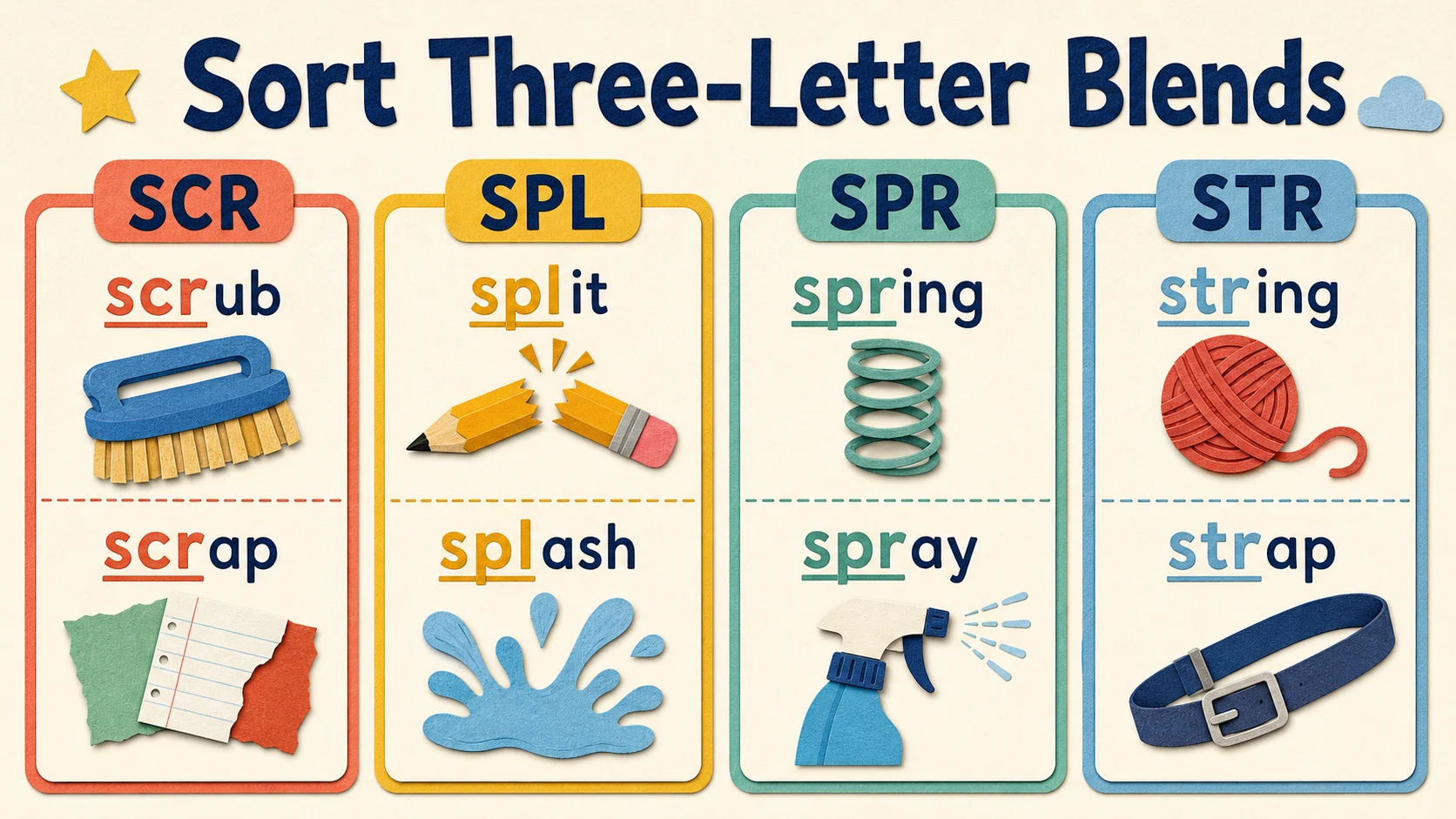
Hear, map, read, spell, and reread in a consistent instructional cycle.
The IES elementary writing practice guide offers high-level framing for explicit writing instruction, supported practice, feedback, and purposeful writing. Here, spelling a few blend words is an instructional suggestion that connects decoding with written production; it is not a claim that the source recommends this exact WorksheetWise routine.
Choosing Practice That Matches the Learner
Use practice selection to answer a specific instructional question.
| Observed need |
Suitable practice |
Less useful as the only activity |
| Cannot hear both initial sounds |
Oral segmentation, counters, contrasting words |
Large mixed word list |
| Reads blends but cannot identify them |
Circle or highlight the opening consonants in complete words |
Memorizing blend names alone |
| Drops the second initial consonant |
Finger tapping, letter tiles, word chains such as lap → clap |
Repeated guessing from pictures |
| Drops the final consonant |
Pairs such as ten/tent and bum/bump |
More initial-blend sorting |
| Reads isolated words accurately |
Phrases and decodable sentences |
Endless isolated identification |
| Confuses several blend families |
Sort a small number of taught blends |
A page containing every blend at once |
| Needs independent review |
Short worksheet with familiar blend types |
New, unsupported three-consonant words |
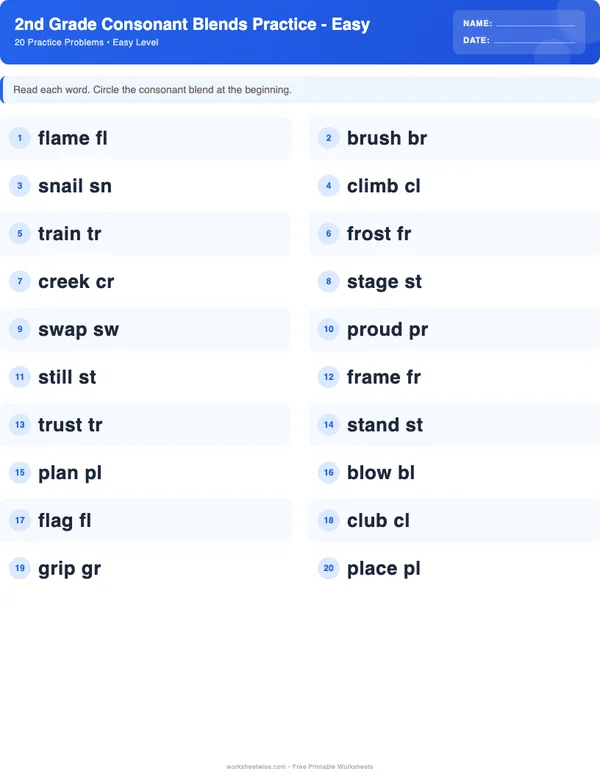
The free 2nd Grade Consonant Blends worksheet contains 20 easy-level exercises asking learners to read each word and circle its beginning blend. It is appropriate for initial-blend identification and reinforcement. It does not by itself assess final blends, spelling, oral segmentation, or sentence reading.
For a broader view of available material, use the 2nd Grade phonics hub. The focused consonant blends pack contains 18 worksheets and is listed at $4.79, but more pages should be selected according to the learner’s demonstrated need rather than assigned simply for volume.
Differentiation Without Lowering the Precision
When the learner needs more support
Reduce the number of contrasts. Teach two blends, not ten. Use words with familiar vowels and endings so the new feature is the blend itself. Model one word, solve one together, and then ask the learner to try one.
Keep letters visible during oral work. If the learner reads stop as sop, tap four fingers for /s/ /t/ /ŏ/ /p/, rebuild the word, and reread it. Return to the same contrast later to check retention.
When the learner is accurate but slow
Use a short, previously taught list and reread it. Do not introduce new blends merely to make the task harder. Accuracy comes first; a second reading can then focus on smoother blending and phrasing.
Move from words to short phrases such as a black flag, the small crab, or went past. The learner must preserve the blend while attending to surrounding words.
When the learner is ready for extension
Mix initial and final blends, use words with blends at both ends, and ask for spelling or sentence use. A learner might sort clap, hand, stump, and clamp into “initial only,” “final only,” and “both.”
Three-consonant openings can be added cautiously. Continue checking each sound rather than treating the longer cluster as one memorized unit.
Diagnosing Common Errors
| Error |
Likely instructional issue to check |
Teaching response |
Evidence of improvement |
| Reads stop as sop |
Drops one initial consonant |
Tap /s/ /t/ /ŏ/ /p/; rebuild with tiles |
Reads stop and another st word with both sounds |
| Reads clap as cap |
Omits /l/ |
Contrast cap/clap and count sounds |
Explains that clap has one extra sound |
| Reads tent as ten |
Drops the last consonant |
Contrast ten/tent orally and in print |
Pronounces and spells final /t/ |
| Reads bump as bum |
Does not preserve final /p/ |
Segment /b/ /ŭ/ /m/ /p/ with four counters |
Distinguishes bum/bump without prompting |
| Circles the wrong two letters |
Looks at position without listening |
Say and map the word before circling |
Identifies the letters tied to audible consonants |
| Circles correctly but misreads the word |
Visual recognition exceeds decoding |
Require a sound-by-sound read and whole-word blend |
Reads the complete word accurately |
| Performs well on lists but not sentences |
Skill is not yet stable in connected text |
Use brief controlled sentences and rereading |
Preserves blends during sentence reading |
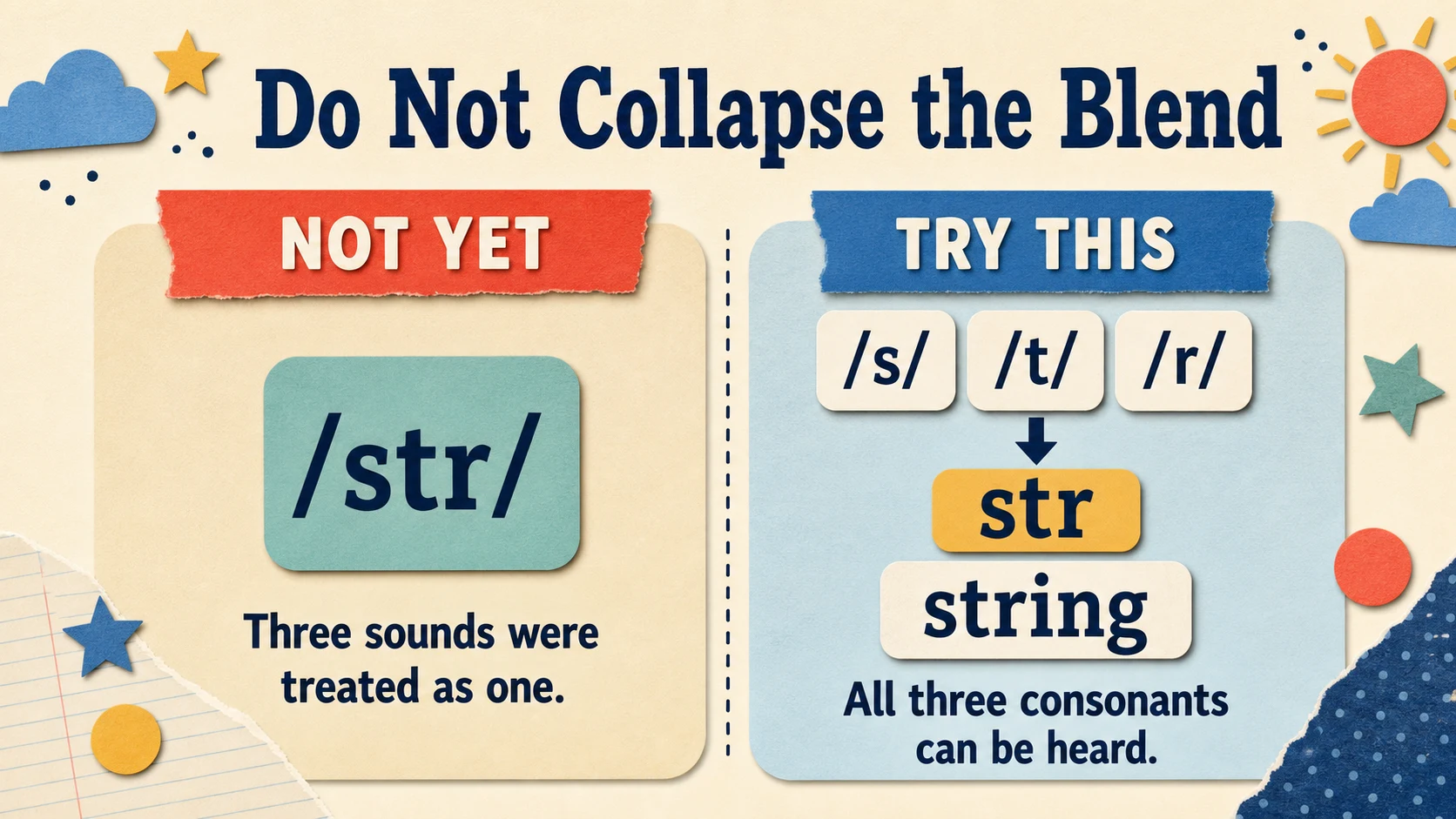
Correct the exact omitted or confused sound, then verify the correction in a new word.
Avoid labels such as “careless” when the work gives more specific information. An omitted first consonant, omitted final consonant, vowel error, and whole-word guess call for different responses.
Monitoring Progress and Deciding When to Move On
Keep a small record with four columns:
| Date |
Task |
What happened |
Next instruction |
| Monday |
Read six st/sp words |
Read 5 accurately; changed stop to sop |
Revisit four-sound mapping for st |
| Wednesday |
Read and spell stop, spot, step |
Read all; omitted t when spelling stop |
Add sound boxes during dictation |
| Friday |
Read two sentences |
Preserved st in both target words |
Mix st with one familiar l-blend |
Monitor several forms of performance:
- Recognition: Can the learner locate the blend?
- Decoding: Can the learner read the complete word?
- Segmentation: Can the learner say every sound?
- Encoding: Can the learner represent the sounds in spelling?
- Transfer: Can the learner read the pattern in a phrase or sentence?
- Retention: Can the learner do it again after a break?
Move to a new set when performance is accurate across more than one task and does not depend on immediate prompting. If errors return in sentences, keep the new material limited and revisit the unstable pattern. The learner’s observed work should set the pace.
A Two-Week Practice Plan
This plan assumes ten practice days, but it is not a universal timetable. Shorten, repeat, or reorder days based on the learner’s responses.
| Day |
Focus |
Suggested activity |
Quick check |
| 1 |
Prerequisites |
Blend and segment five CVC words |
Can every sound be identified? |
| 2 |
Initial st, sp |
Counters, letter tiles, four-word reading set |
Are both initial sounds retained? |
| 3 |
Initial sl, sn, sw |
Sort complete words by beginning blend |
Can words be read after sorting? |
| 4 |
Review s-blends |
Read words, spell three, read one sentence |
Does accuracy transfer to spelling? |
| 5 |
Initial cl, fl, pl |
Use lap → clap and similar word changes |
Can the added sound be explained? |
| 6 |
Initial r-blends |
Practice br, cr, tr in small sets |
Are both opening sounds distinct? |
| 7 |
Final nd, nt |
Contrast hand/han-like segmentation and ten/tent |
Is the final consonant preserved? |
| 8 |
Final nk, mp |
Segment sink and bump; spell both |
Are four sounds represented? |
| 9 |
Mixed positions |
Sort initial, final, and both-position words |
Can the learner justify each sort? |
| 10 |
Connected review |
Read a short controlled passage or sentences |
Which blend needs the next review cycle? |
Do not use invented nonwords as printed vocabulary unless the adult clearly explains the decoding purpose. On Day 7, for example, ten/tent provides a clean real-word contrast. For hand, oral segmentation can establish /h/ /ă/ /n/ /d/ without presenting an unfamiliar or misleading item as a word.
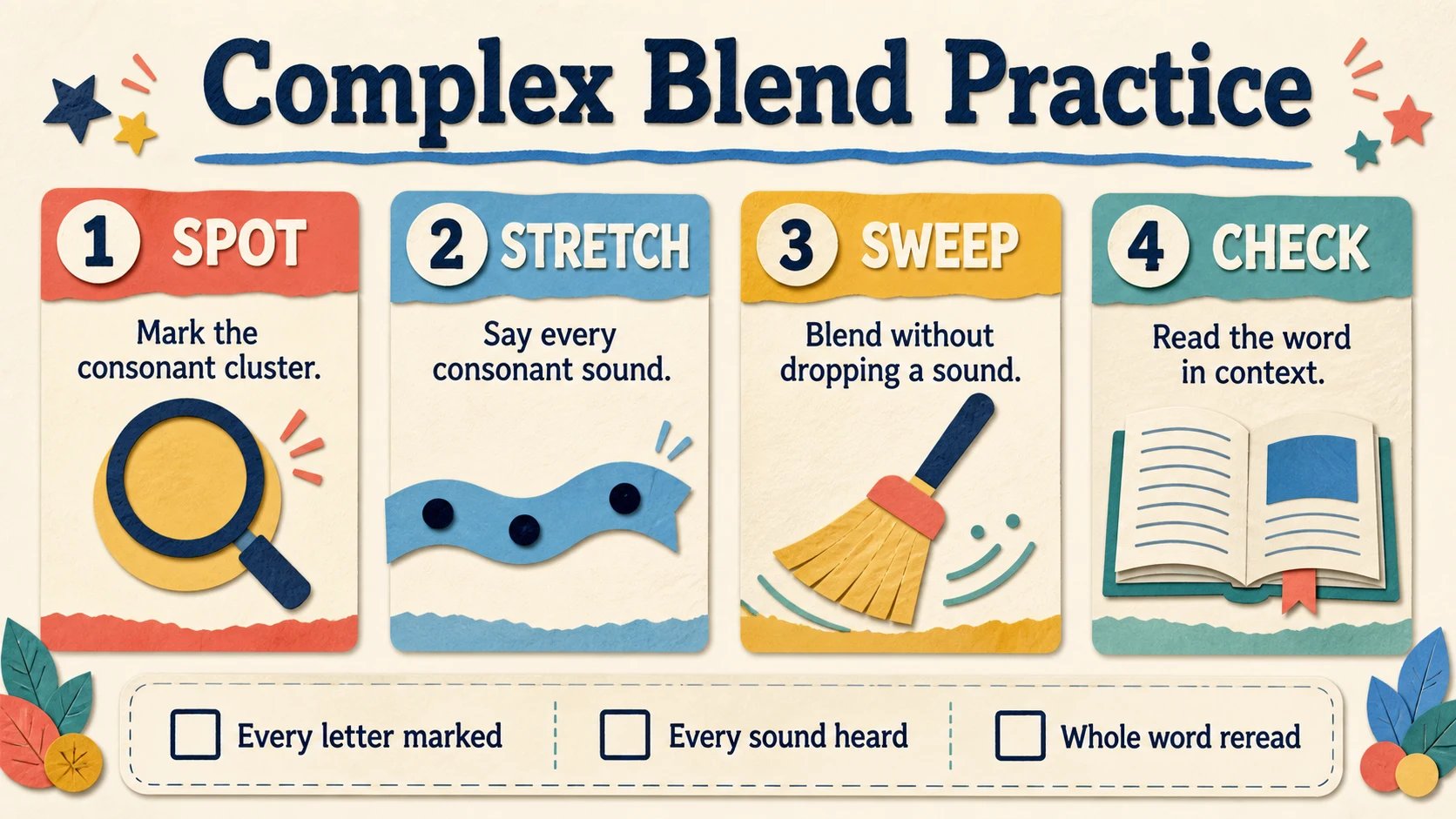
Use the plan as a review cycle, repeating any stage that remains unstable.
Limitations and the Honest Next Step
A consonant-blend worksheet can show whether a learner recognizes a printed blend under a particular set of directions. It cannot, on its own, establish fluent decoding, spelling transfer, comprehension, or performance across unfamiliar texts. Pictures can support meaning, but they can also allow guessing. Word lists isolate a pattern, but they do not replace connected reading. Sentence reading adds context, but a single successful sentence does not prove lasting mastery.
Consonant blends are also only one part of 2nd Grade phonics. Learners may simultaneously encounter short and long vowels, vowel teams, r-controlled vowels, suffixes, irregularly spelled words, and more complex word structures. If errors center on the vowel rather than the consonant sequence, more blend repetition may not address the actual need.
Start with one observable next action: give the learner the free easy initial-blends worksheet, listen as each whole word is read, and mark whether errors involve a dropped consonant, an incorrect vowel, or guessing. Then use the Consonant Blends topic guide or the free worksheet generators to choose the next practice around that evidence.