What 1st Grade Short Vowels instruction should accomplish
Short-vowel instruction should help a learner hear, identify, read, and spell the middle vowel in regularly spelled one-syllable words such as cat, pen, sit, hot, and cup. Begin with oral sound work, connect each sound to its letter, build and read consonant-vowel-consonant words, and then mix the vowels so the learner must discriminate among them.
The five target sounds are:
| Vowel |
Anchor word |
Example CVC words |
| short a |
apple |
cat, map, ham |
| short e |
egg |
pen, bed, jet |
| short i |
itch |
sit, pin, lip |
| short o |
octopus |
hot, log, mop |
| short u |
umbrella |
cup, sun, rug |
The learner’s observed work should determine the pace. A child who can read words from a single word family may still need practice when vowels are mixed. A child who can choose the vowel in a picture-based activity may not yet be able to spell the same word from dictation.
Grade labels describe the intended practice level, not a universal timetable. Local curricula and instructional sequences differ. Use “1st Grade” as a practice guide, then adjust the support, word set, and pace according to what the learner can actually do.
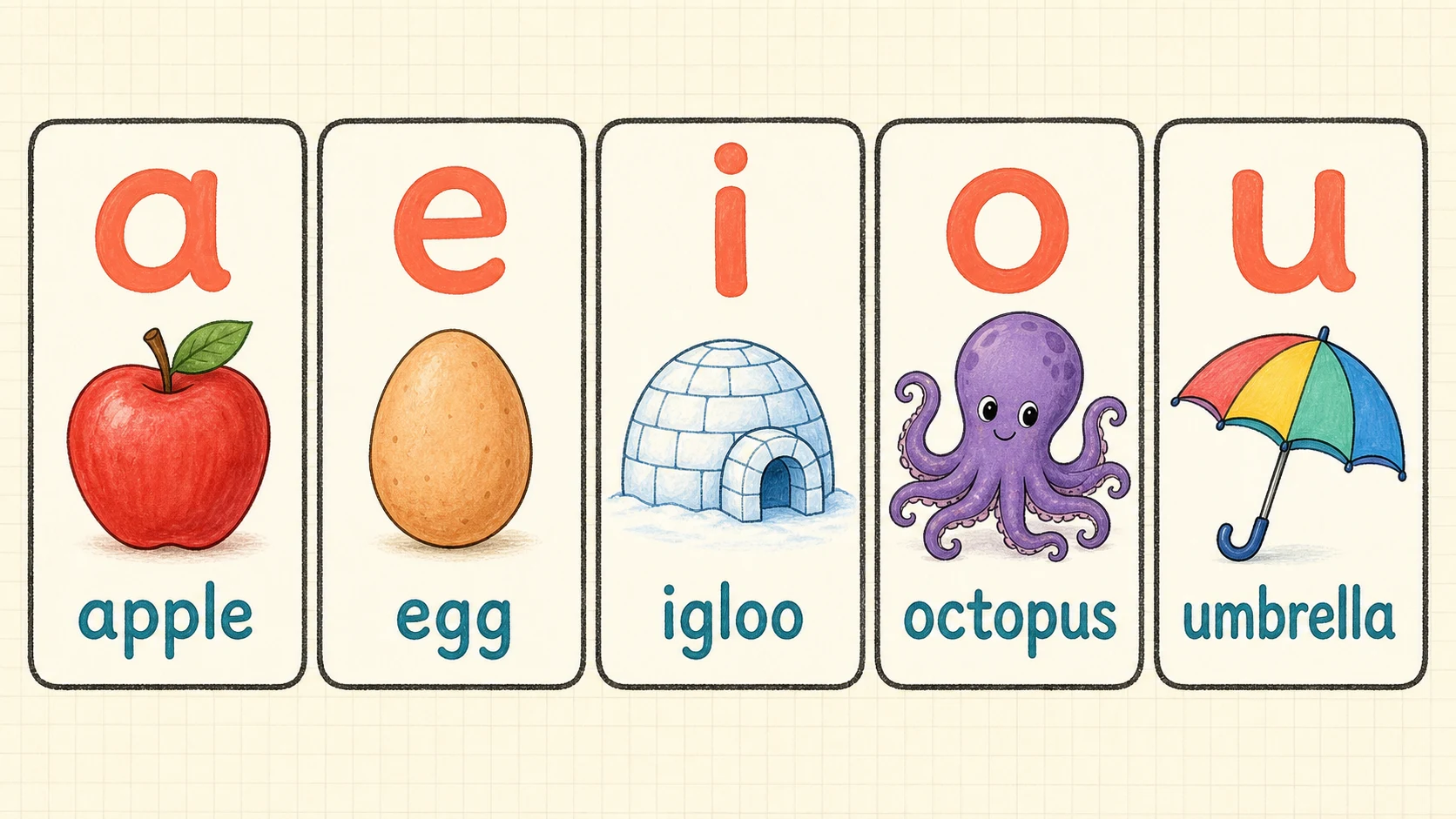
Short-vowel learning connects listening, letter knowledge, blending, word reading, and spelling.
What the skill includes—and what it does not
Short vowels commonly appear in closed syllables: syllables that end in a consonant. In a simple CVC word such as map, the consonant after the vowel “closes” the syllable, and the vowel represents its short sound.
That description is useful, but a first-grade learner needs more than a rule. The learner must coordinate several actions:
- Hear the three phonemes in a spoken word.
- Locate the middle sound.
- Associate that sound with a vowel letter.
- Blend the sounds without inserting extra sounds.
- Read the complete word.
- Reverse the process when spelling from dictation.
The IES foundational reading practice guide provides broad instructional framing for teaching sound segments, letter-sound relationships, decoding, and connected reading. It did not evaluate this WorksheetWise guide or its worksheets.
Decoding and encoding are related but distinct
Decoding begins with print. The learner sees sun, produces /s/ /ŭ/ /n/, and blends the sounds into sun.
Encoding begins with speech. The learner hears sun, segments it as /s/ /ŭ/ /n/, identifies u as the middle spelling, and writes sun.
A learner can be stronger in one direction than the other. Check both instead of assuming that accurate reading guarantees accurate spelling.
Short vowels are not simply “any vowel in a short word”
Word length does not determine vowel type. Cat has a short vowel, but cake does not. Hop has short o, while hope has long o. The final silent e changes the pattern in those examples.
Some short-vowel words also contain consonant blends or digraphs:
- flag contains short a and the initial blend fl.
- ship contains short i and the digraph sh.
- chop contains short o and the digraph ch.
These words can extend short-vowel practice, but they introduce additional consonant demands. Use plain CVC words first when you need to see whether the vowel itself is secure.
Prerequisites to check before mixed-vowel practice
Before asking a learner to compare all five vowels, check the foundations below.
Oral blending and segmenting
Without showing print, say the sounds /m/ /ă/ /p/. Ask the learner to blend them. The answer is map.
Then reverse the task: say map and ask for each sound. The response should be /m/ /ă/ /p/. If the learner cannot perform these oral tasks, letter-filled worksheets may hide the underlying difficulty. Use counters or spoken practice before expecting independent written answers.
Consonant and vowel-letter knowledge
Check that the learner can identify the letters a, e, i, o, u and produce their taught short sounds. Also check the consonants in the intended word set. A response of pat for printed pad could reflect uncertainty about final d, not a vowel problem.
Left-to-right sound tracking
The learner should understand that the first, middle, and final sounds map across the printed word. Three counters or three boxes can make the order visible:
/c/ | /ă/ | /t/
c | a | t
Ask, “Which sound is in the middle?” rather than “What vowel do you see?” when you are assessing listening. Ask the second question when you are assessing letter recognition. Keeping the prompts precise makes the response easier to interpret.
A grade-appropriate progression
The catalogue teaching sequence is a, i, o, u, e. It begins with short a, introduces other vowels separately, and saves short e until later because e and i are often confused. Treat this as a practical sequence, not an inflexible timetable.
| Stage |
Teaching focus |
Example task |
Move forward when… |
| 1 |
Hear one target vowel |
Sort spoken words into “has /ă/” and “does not” |
The learner attends to the middle sound |
| 2 |
Connect sound and letter |
Build map with tiles |
The learner selects a for /ă/ |
| 3 |
Read one-vowel CVC sets |
Read map, cat, ham |
Responses are accurate without guessing from the first letter |
| 4 |
Spell one-vowel CVC sets |
Hear jam and write it |
All three sounds are represented in order |
| 5 |
Contrast two vowels |
Sort map, sit, lip, ham |
The learner discriminates without relying on one word family |
| 6 |
Add confusable contrasts |
Compare pen/pin, bed/bid |
The learner hears and records the middle difference |
| 7 |
Mix all five vowels |
Read cat, jet, lip, mop, sun |
Vowel choice remains accurate in random order |
| 8 |
Extend the consonant frame |
Read ship, flag, chop |
Added consonant patterns do not displace the vowel |
| 9 |
Apply in short text |
Read and discuss a controlled sentence |
Word reading carries into connected print |
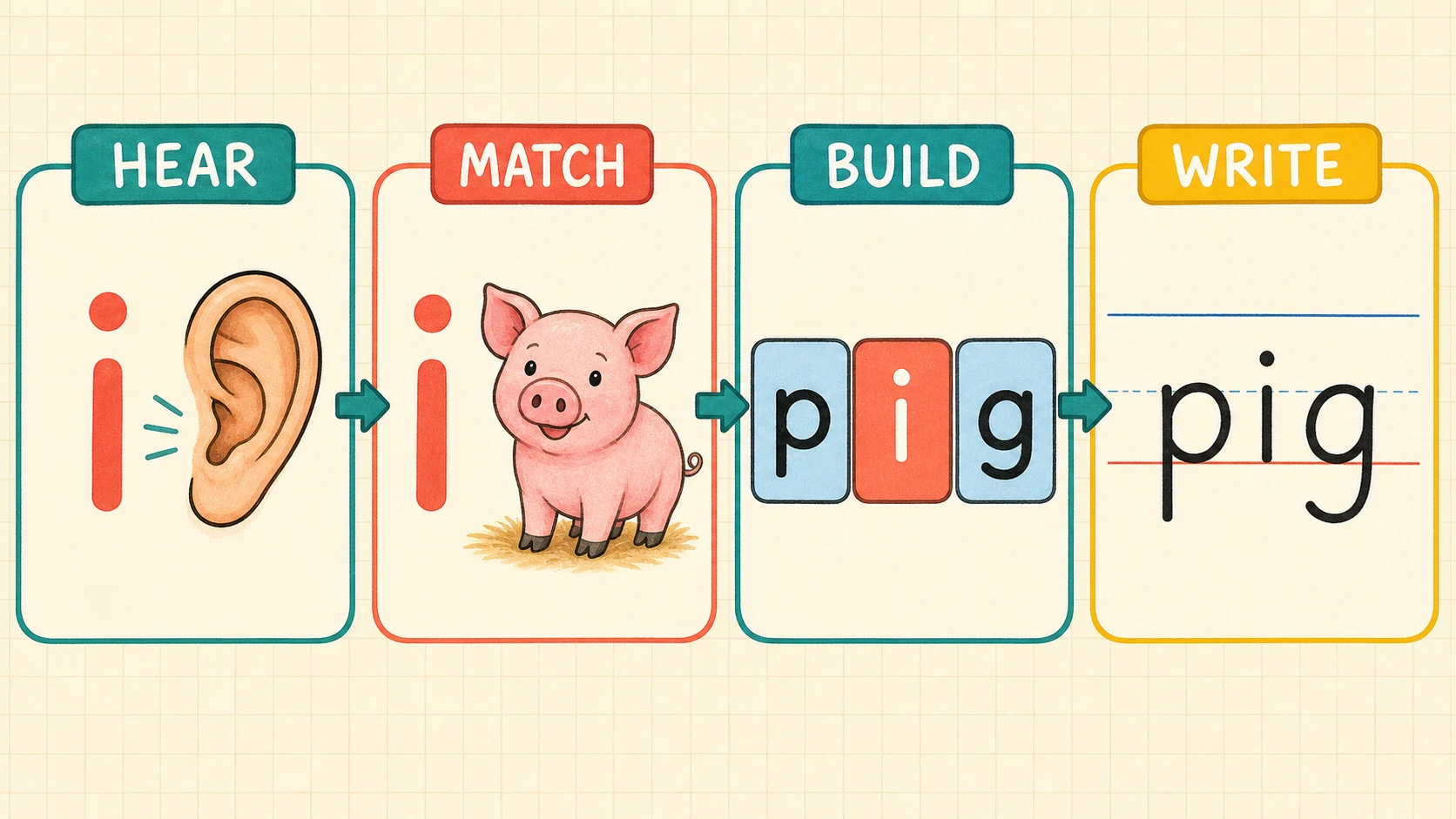
Support should gradually decrease while the vowel comparisons become less predictable.
Do not move ahead merely because a page is complete. Look for the same skill in a fresh order, in reading, and in spelling. If the learner succeeds only when every answer is a, introduce a contrast before adding more short-a pages.
The Common Core English Language Arts standards include relevant high-level expectations for isolating sounds in spoken single-syllable words and decoding regularly spelled one-syllable words. This guide does not claim comprehensive standards alignment; local standards and instructional sequences should be checked separately.
Concrete and visual models that clarify the vowel
Three counters and three sound boxes
Place one counter for each phoneme in lip. Move the counters from left to right while saying:
/l/ | /ĭ/ | /p/
Replace each counter with a letter:
l | i | p
Touch beneath the letters, blend the sounds, and sweep a finger under the word while saying lip. This model separates two jobs: hearing the middle phoneme and connecting it to i.
Use tokens before letters when print is distracting. Move to letter tiles when the learner can segment the spoken word.
Change only the middle tile
Build cat. Replace a with o to make cot. Replace o with u to make cut.
Ask the learner what stayed the same and what changed. The consonants c and t remain fixed; the middle vowel changes both the sound and the word. This comparison is more informative than reading a long list in which every part changes.
Anchor pictures and gestures
The catalogue suggests these memory cues:
- a—apple: pretend to bite an apple.
- e—egg: pretend to crack an egg.
- i—itch: scratch an arm.
- o—octopus: wiggle the arms.
- u—umbrella: pretend to hold up an umbrella.
These are instructional suggestions, not sourced requirements. Use a cue only if it helps the learner retrieve the sound. Gradually remove it so the learner responds to the letter rather than waiting for the picture or gesture.
Fully checked worked examples
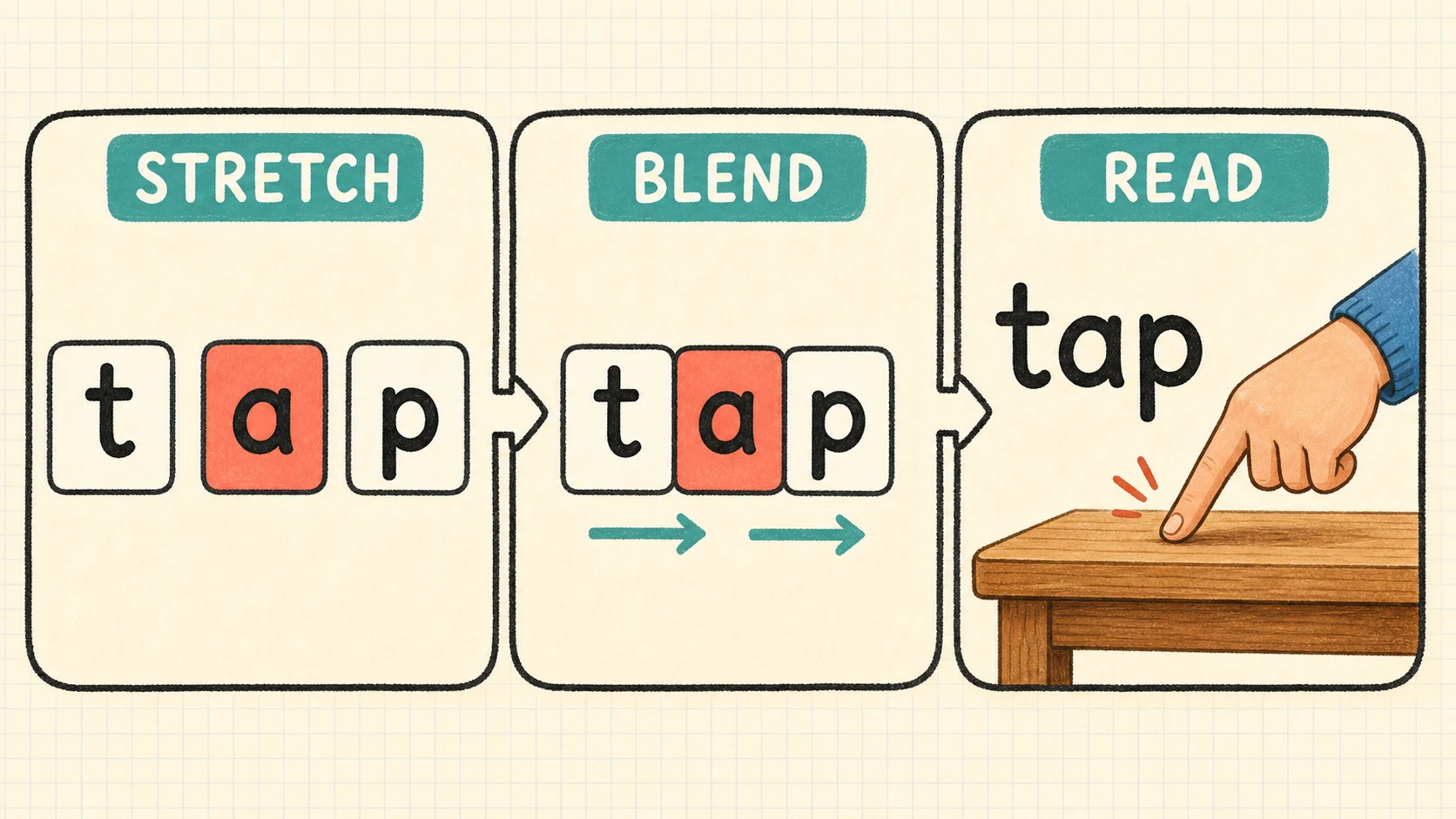
The learner hears the word, maps each phoneme, selects the middle vowel, and checks by blending.
Example 1: Build and read cat
- Say cat naturally.
- Stretch the word enough to notice its parts: /k/ /ă/ /t/.
- Place the sounds into three positions: first /k/, middle /ă/, final /t/.
- Match the sounds to letters: c-a-t.
- Blend from left to right: /k/ /ă/ /t/, cat.
Checked answer: The middle sound is short a, represented by a. The completed word is cat.
Example 2: Complete p_n for the spoken word pen
- Read the frame: p_n.
- Say the intended word pen.
- Segment it: /p/ /ĕ/ /n/.
- Compare the possible middle vowels. i would make pin, not pen.
- Insert e and blend: /p/ /ĕ/ /n/, pen.
Checked answer: pen uses short e. The completed spelling is p-e-n.
This minimal-pair check matters because pen and pin differ only in the middle vowel.
Example 3: Read and sort hot
- Point to each letter in hot: h-o-t.
- Produce the sounds: /h/ /ŏ/ /t/.
- Blend them: hot.
- Compare the vowel with the anchors. The middle sound matches short o in octopus, not short u in umbrella.
Checked answer: hot belongs in the short-o group.
Example 4: Spell cup from dictation
- Say cup without showing the word.
- Segment it: /k/ /ŭ/ /p/.
- Write the first sound as c.
- Write the middle /ŭ/ as u.
- Write the final /p/ as p.
- Read the result: cup, /k/ /ŭ/ /p/.
Checked answer: The spelling is cup, and its middle vowel is short u.
Example 5: Distinguish bed from bid
Build both words:
b | e | d
b | i | d
The first and last phonemes are identical. In bed, the middle phoneme is /ĕ/, so the vowel is e. In bid, the middle phoneme is /ĭ/, so the vowel is i.
Checked answers: bed is short e; bid is short i. If the learner calls both words bid, return to listening before asking for more written work.
Example 6: Identify a boundary case
Consider cake.
It contains one written a, but it does not follow the CVC pattern used in the earlier examples. The final e is part of a different spelling pattern, and a represents its long sound.
Checked conclusion: Cake is not a short-a example. Do not place it in a short-vowel sort merely because it contains a.
Now consider ship. It has four letters but three phonemes: /sh/ /ĭ/ /p/. The two letters sh represent one initial consonant sound.
Checked conclusion: Ship does contain short i, but it also tests knowledge of the sh digraph. Use it after plain CVC words when you want a controlled extension.
A short, repeatable lesson routine
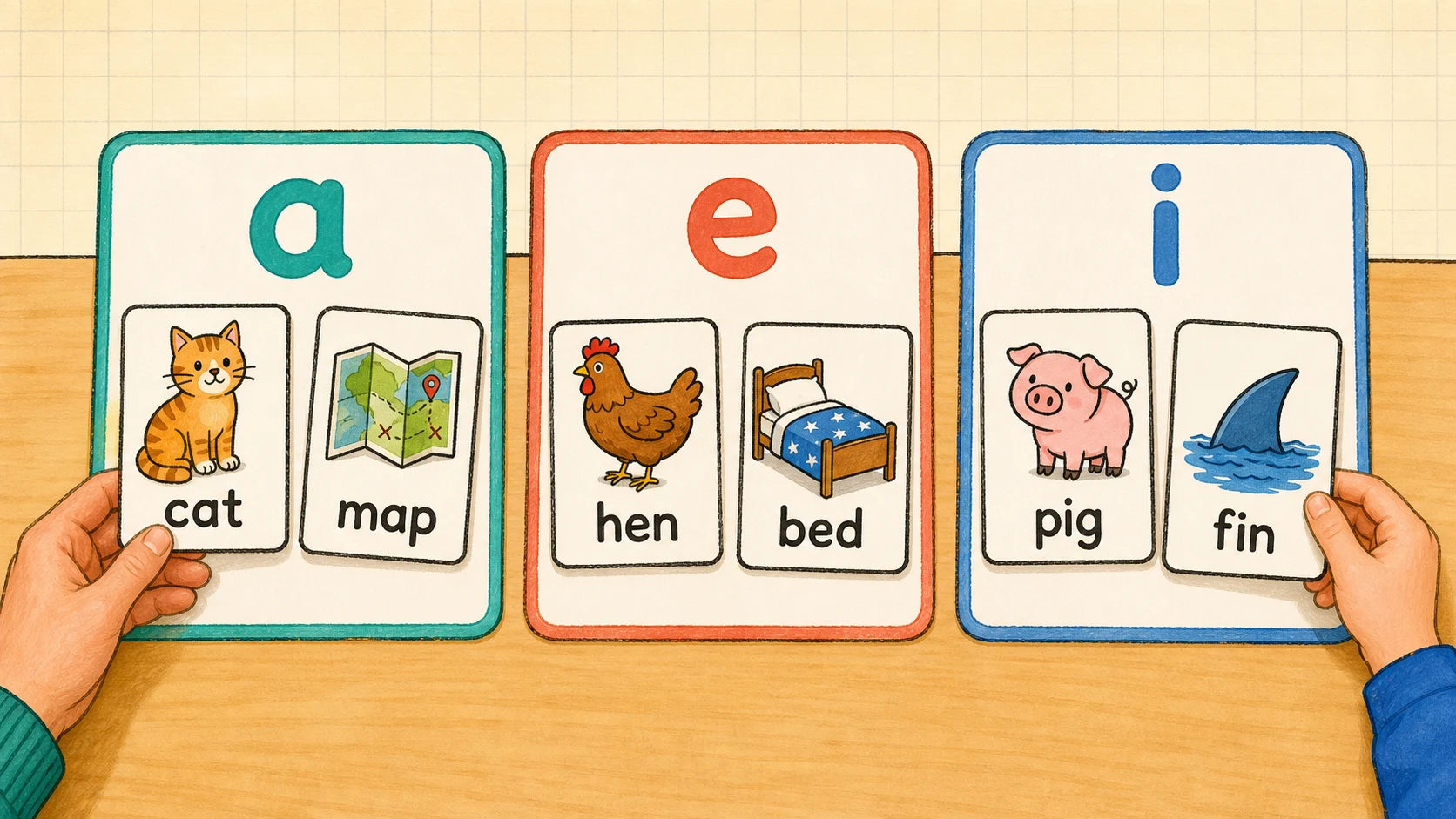
Listen, model, blend, spell, and apply in a compact sequence.
A five-part routine
- Review a known sound. Show one or two vowel cards. Ask for the short sound and an anchor word.
- Listen without print. Say three to five words. The learner identifies or sorts the middle sounds.
- Build and blend. Use counters or letter tiles for several CVC words. Change one sound at a time when possible.
- Read and spell. Mix a small set of printed words, then dictate two or three of them in a new order.
- Apply and check. Read a short phrase or sentence containing familiar patterns. End by revisiting one error calmly.
This routine is an instructional suggestion. Its exact duration should depend on attention, accuracy, and the learner’s response. Stop or simplify when errors become repetitive. Extend the task when responses are accurate and the learner can explain the middle sound.
Dictation here is a focused phonics check, not a complete writing program. The IES elementary writing practice guide addresses the broader teaching of writing. Short-vowel spelling can support sentence work, but it does not replace instruction in composing, handwriting, capitalization, spacing, or punctuation.
Choosing useful practice
Select practice according to the error you need to investigate or correct.
Match the activity to the learning need
| Observed need |
Useful practice |
Avoid relying on |
| Cannot hear the middle sound |
Oral sorting, counters, same/different judgments |
Independent fill-in pages |
| Knows sounds but cannot blend |
Continuous left-to-right blending with tiles |
Picture guessing |
| Reads one vowel in isolation |
Two-vowel mixed lists |
Another unmixed list only |
| Confuses e and i |
Minimal pairs such as pen/pin, bed/bid |
Introducing several new patterns |
| Reads but misspells CVC words |
Short dictation and immediate checking |
Recognition-only tasks |
| Performs slowly but accurately |
Brief mixed review across several days |
Adding harder patterns too quickly |
| Handles mixed CVC words |
Words with familiar blends or digraphs, then short text |
Premature long-vowel instruction |
Picture sorting can reduce the print demand, but pictures must represent unambiguous words. A picture that one person calls a cup and another calls a mug is a poor assessment item unless the intended label is given.
Using WorksheetWise materials purposefully
The 1st Grade phonics hub can help you place short vowels within the broader phonics sequence. The Short Vowels topic guide keeps the focus narrower.
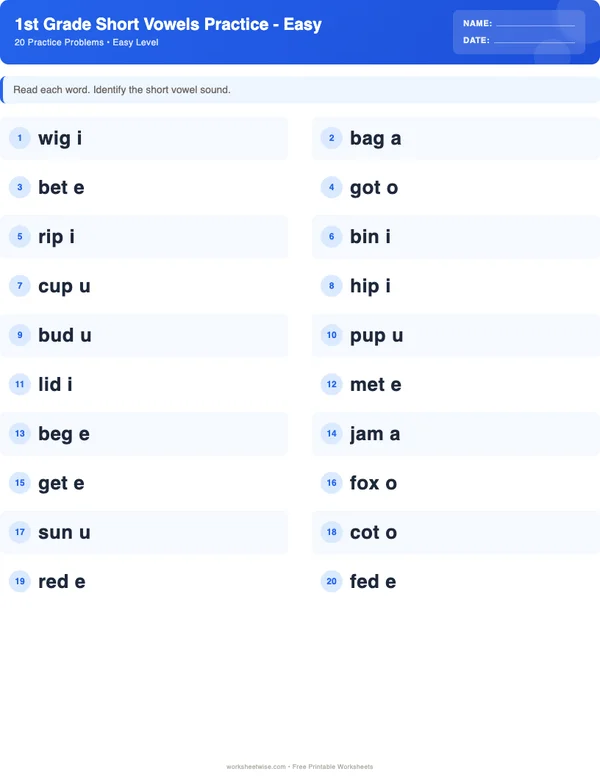
The free easy short-vowels worksheet contains 20 exercises in which learners read words and identify their short-vowel sounds. It is suitable for checking straightforward CVC identification or providing extra reinforcement. Its separate answer key supports quick checking.
A completed worksheet is one piece of evidence. Follow several items with oral reading or dictation so that circling, copying, and spelling are not treated as interchangeable skills. For broader review, the focused short-vowels pack contains 18 worksheets. Choose pages selectively instead of assigning the entire pack by default.
Differentiation without changing the target
When the learner needs more support
Reduce the number of contrasts. Work with short a alone, then compare a with one clearly different vowel. Offer two letter choices rather than five. Use counters before letter tiles, and model one example before asking for a response.
Keep the consonant frame simple. Words such as map, sit, and cup reveal vowel knowledge more clearly than words containing unfamiliar blends or digraphs.
If the learner repeatedly confuses e and i, pronounce the words naturally, provide minimal-pair listening practice, and invite the learner to watch the mouth. The catalogue notes that short e uses a slightly wider mouth opening. Treat this as a cue, then verify the sound by saying and blending the full word.
When the learner is ready for less support
Remove anchor pictures, mix all five vowels, and vary the task order. Ask the learner to read, sort, spell, and use a word in a short sentence. Add familiar blends and digraphs while keeping the vowel pattern short.
Do not assume that faster work is automatically better work. Independence means the learner can attend to the printed word, justify the vowel choice, and recover from an error without being told the answer.
Common errors and diagnostic responses
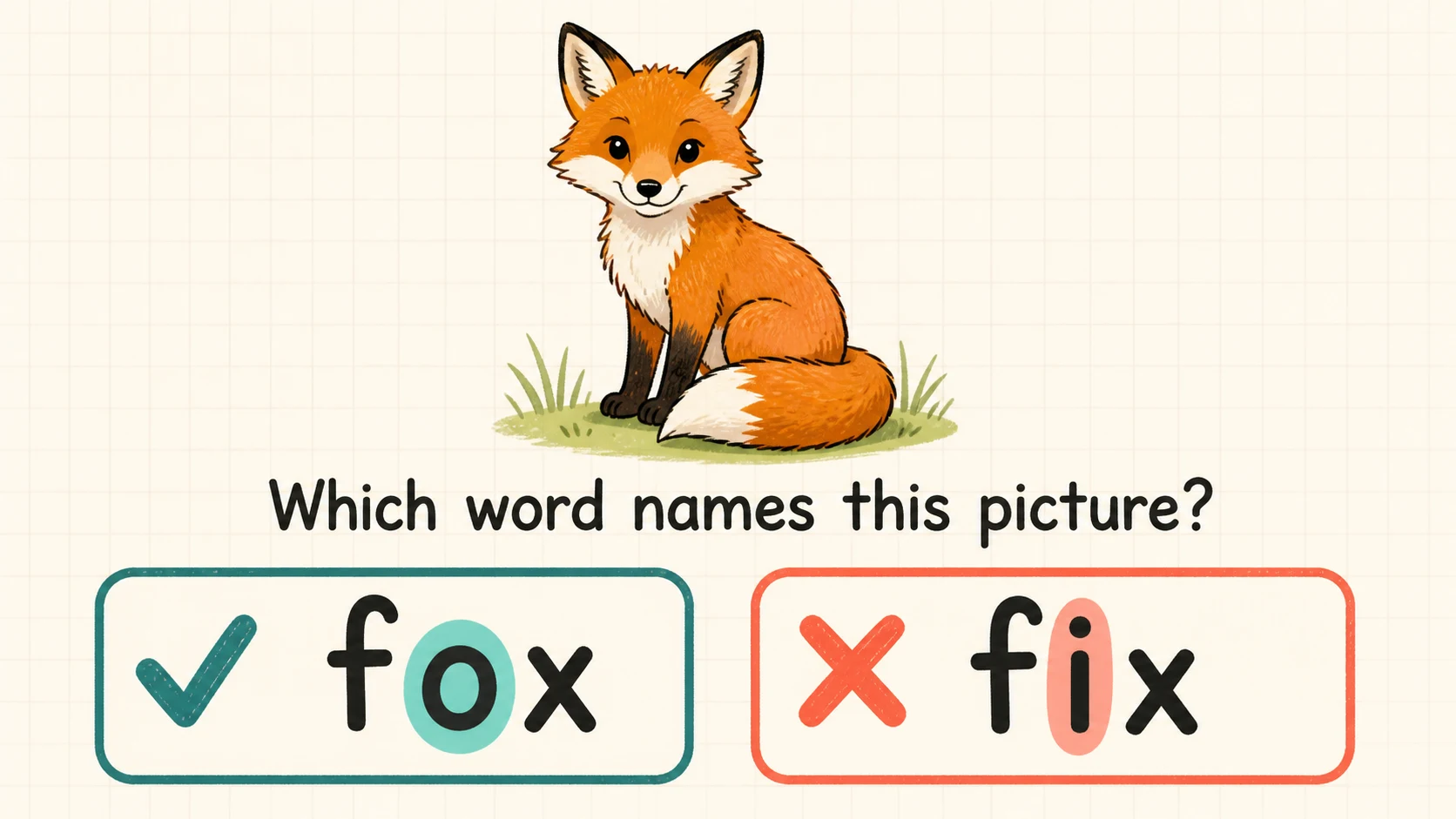
The form of an error helps identify whether to reteach listening, letter knowledge, blending, or spelling.
| Error |
What it may indicate |
Diagnostic check |
Teaching response |
| Reads pin as pen |
Confusion between /ĭ/ and /ĕ/ |
Ask whether pin and pen sound the same |
Use spoken and printed minimal pairs |
| Chooses every a correctly but misses mixed items |
Memorized task pattern |
Shuffle words from two vowel groups |
Require attention to each middle sound |
| Reads from the picture without looking at letters |
Picture dependence |
Cover the picture and present the word |
Point under each grapheme while blending |
| Says /muh/ /ă/ /puh/ for map |
Adds vowel sounds to consonants |
Ask for the consonant sounds alone |
Model clipped /m/ and /p/ |
| Writes ct for cat |
Omits the medial phoneme |
Segment with three counters |
Touch each counter before writing |
| Writes cap for dictated cup |
Hears consonants but misidentifies the vowel |
Offer a and u orally and in print |
Contrast cap/cup with the frame fixed |
| Reads ship incorrectly |
May not know sh, even if i is known |
Test sit and the sound sh separately |
Separate digraph review from vowel review |
| Calls cake a short-a word |
Generalizes from the letter alone |
Compare cap and cape |
Sort by sound and spelling pattern |
An error is not a diagnosis by itself. Look for a repeated pattern across a few carefully chosen items. If responses vary widely, simplify the task and check attention to the directions as well as phonics knowledge.
Monitoring progress and deciding what comes next
Use a small mixed check
Periodically select unfamiliar examples that use taught consonants. Include:
- Two or three oral middle-sound items.
- Five mixed printed words.
- Two dictated CVC words.
- One contrast involving a previously confused pair.
- One short phrase or sentence, if the words are familiar.
Record the actual response, not only a score. “Read pen as pin twice” gives more instructional information than “three wrong.”
Look for transfer across formats. A learner is showing stronger control when the same vowel knowledge appears in listening, word reading, and spelling. If reading is secure but dictation is not, keep the word pattern stable and add brief encoding practice. If isolated words are secure but connected reading is hesitant, use short controlled phrases without introducing several new spelling patterns at once.
Avoid setting a universal mastery percentage or deadline. The supplied catalogue does not establish one, and a single score cannot capture the kinds of errors made. Compare current work with the learner’s own earlier work, using similar tasks and fresh examples.
A two-week practice plan
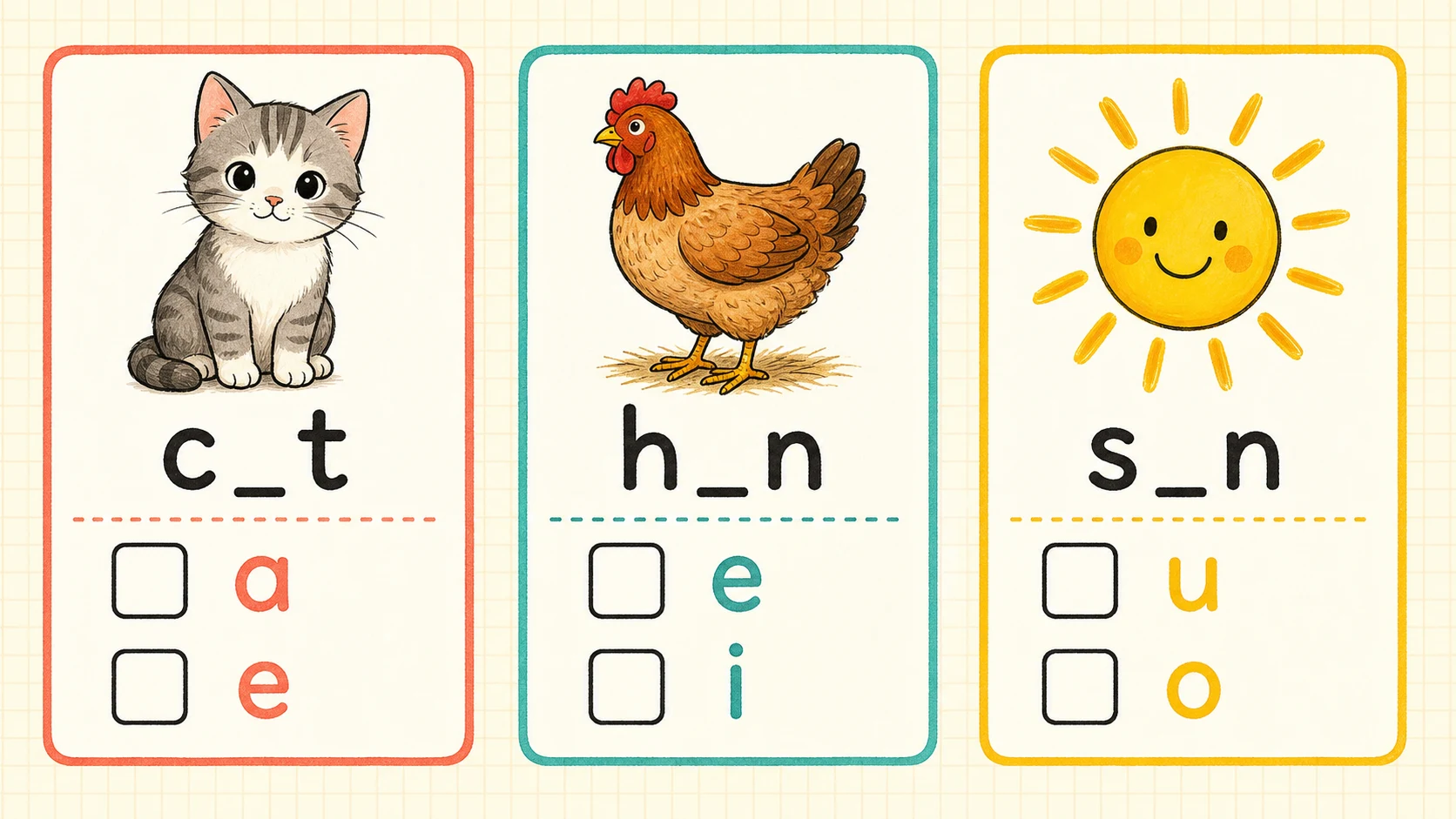
The plan alternates focused teaching, mixed review, spelling, and application.
This is a flexible instructional plan, not a required timetable. Repeat, combine, or postpone days according to the learner’s observed responses.
| Day |
Main focus |
Suggested practice |
Evidence to note |
| 1 |
Check prerequisites |
Oral blending, segmenting, vowel cards |
Which sounds and letters are secure? |
| 2 |
Short a |
Build and read cat, map, ham; dictate two words |
Does the learner retain the middle sound? |
| 3 |
Short i |
Build sit, pin, lip; contrast with short a |
Can the learner switch vowels accurately? |
| 4 |
Short o |
Read and sort hot, log, mop with earlier vowels |
Is o confused with another sound? |
| 5 |
Review a, i, o |
Mixed reading and three-word dictation |
Does accuracy hold in random order? |
| 6 |
Short u |
Build cup, sun, rug; compare cot/cut |
Can the learner hear o/u differences? |
| 7 |
Short e |
Build pen, bed, jet; watch and hear the sound |
Is e distinct in isolation? |
| 8 |
Contrast e/i |
Sort pen/pin, set/sit, bed/bid |
Which minimal pairs remain difficult? |
| 9 |
All five vowels |
Complete a mixed worksheet, then spell selected words |
Do worksheet and dictation results agree? |
| 10 |
Apply and decide |
Read mixed words and a short controlled sentence; review errors |
Continue CVC work or extend the consonant frame? |
Keep previously taught vowels active while introducing a new one. On Day 7, for example, do not practice only short e. After several supported examples, include familiar words with other vowels so the learner must listen and look rather than follow a predictable answer pattern.
Limitations and the honest next step
Short-vowel work is foundational, but it is not a complete reading program. It does not by itself teach every consonant spelling, high-frequency word, vocabulary item, comprehension strategy, fluency behavior, or writing skill. CVC practice also cannot represent every English word. Use regular examples to establish the pattern, and identify words that do not fit rather than forcing them into the short-vowel rule.
Once the learner can accurately hear, read, and spell mixed CVC words, continue reviewing short vowels while introducing appropriate consonant blends, digraphs, long-vowel patterns, and eventually more complex words. If errors remain concentrated in one pair, such as e/i, targeted comparison is a better next step than simply increasing page quantity.
Start with the free 1st Grade Short Vowels worksheet. Check a few answers through oral reading and dictation, record the exact error pattern, and choose the next practice from that evidence. If you need a fresh set arranged around the learner’s current needs, explore the free worksheet generators.