What 1st Grade Word Families Teach
Word families are groups of words with the same ending pattern. In cat, hat, and mat, the initial sound changes while the ending -at stays the same. The changeable beginning is the onset; the shared vowel-and-ending chunk is the rime.
The direct teaching goal is simple: help the learner notice a familiar spelling pattern, combine it with a beginning sound, and read the whole word. A learner who can blend c + at can use the same process for m + at, s + at, and later fl + at.
Word-family instruction should support systematic phonics rather than replace it. Learners still need to attend to every letter, blend sounds, and check that the result is a real word that makes sense in context. The IES foundational reading practice guide provides high-level guidance for teaching sound awareness, letter–sound relationships, word decoding, and connected-text reading. Word-family practice can contribute to that broader sequence when it is explicit and carefully chosen.
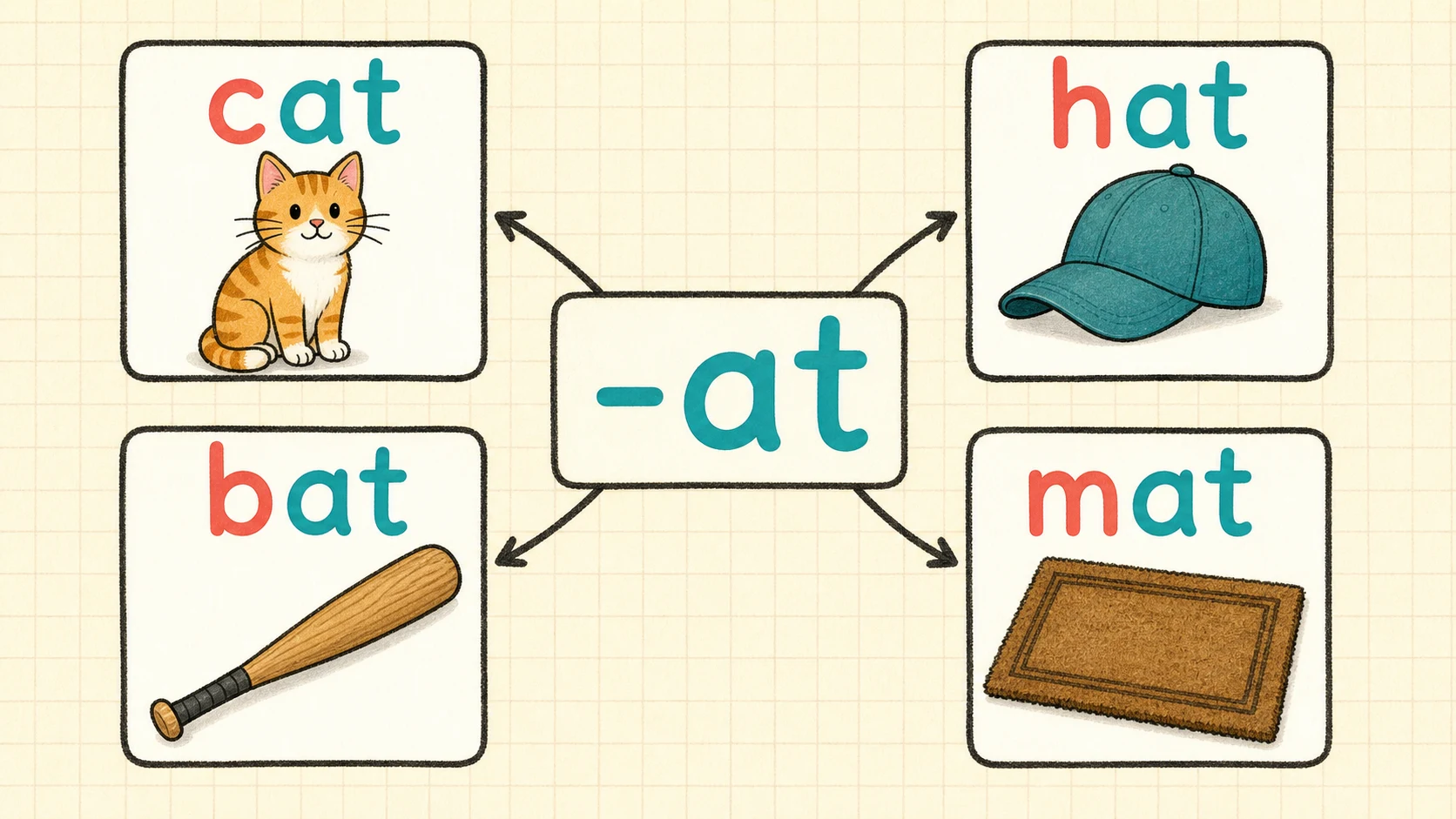
The shared ending links sound awareness, spelling-pattern recognition, word building, decoding, and sentence reading.
For most learners, a useful lesson moves through four actions:
- Hear the shared ending in spoken words.
- Build or mark the shared spelling pattern.
- Blend the onset and rime to read each word.
- Apply the words in phrases, sentences, or a short text.
Grade labels describe the intended practice level, not a universal timetable. Local curricula and instructional sequences differ. Choose the starting point from the learner’s observed reading and spelling, even when a page is labeled for 1st Grade.
Prerequisites to Check Before Teaching Families
Word-family practice is most productive when the learner can already do several smaller tasks. Check these through brief observation rather than a lengthy test.
Hearing and producing sounds
Say map slowly and ask the learner to identify the first sound. Then ask what remains after the first sound is removed. A ready learner can usually hear /m/ and /ap/, even if the terms onset and rime are unfamiliar.
Also check whether the learner can:
- Recognize that cat and hat rhyme.
- Blend a spoken sequence such as /s/ /a/ /t/ into sat.
- Segment pig into /p/ /i/ /g/.
- Tell that pig and pin do not have the same complete ending.
Rhyming alone is not enough. A child may know that cat rhymes with hat but still need help matching the sounds to c-a-t and h-a-t.
Knowing useful letter–sound correspondences
For early short-vowel families, the learner needs the consonant sounds used at the beginning and the short vowel in the family. Teaching -ig will be frustrating if i is not yet associated with its short sound.
Do not require knowledge of every consonant before beginning. Instead, select families whose words use correspondences the learner has already met. For example, -at can be practiced with bat, cat, hat, mat, and sat if those initial letters are familiar.
Blending without guessing
Show map. Ask the learner to sound it out without a picture or sentence clue. Listen for whether all three letters influence the answer. If the learner sees m and guesses mouse, return to simple continuous blending before expecting pattern recognition to carry the work.
A learner does not need perfect speed. Accurate, deliberate blending is an appropriate starting point. Use the 1st Grade phonics hub to select related practice when letter sounds or basic CVC blending need reinforcement first.
A Grade-Appropriate Teaching Progression
The catalogue sequence begins with common short-vowel families: -at, -an, -am, -ap, -ad; -it, -in, -ig, -ip, -id; -ot, -op, -og; -ut, -ug, -un, -up; and -et, -en, -ed. It then extends familiar families with consonant blends and digraphs, such as chat, flat, and ship.
This is an instructional progression, not a requirement to teach every listed family in exactly this order.
| Stage |
Learner’s task |
Suitable examples |
Adult support |
| 1. Hear the pattern |
Identify spoken rhymes |
cat–hat, pig–wig |
Stretch the onset and rime orally |
| 2. Build one family |
Keep the rime and replace one onset |
cat, hat, mat, sat |
Use tiles, a wheel, or a flip strip |
| 3. Read mixed members |
Blend several words from one family |
dig, fig, pig, wig |
Prompt attention to every letter |
| 4. Contrast families |
Sort words by complete ending |
cat/cap, hop/hot |
Place family headings above columns |
| 5. Add complex onsets |
Read blends or digraphs with known rimes |
flat, chat, ship |
Blend the onset before joining the rime |
| 6. Read in context |
Read phrases and sentences |
“The fat cat sat.” |
Reread only after accuracy |
| 7. Spell and apply |
Build or write a dictated word |
“Write mop.” |
Ask for sounds before letter names |
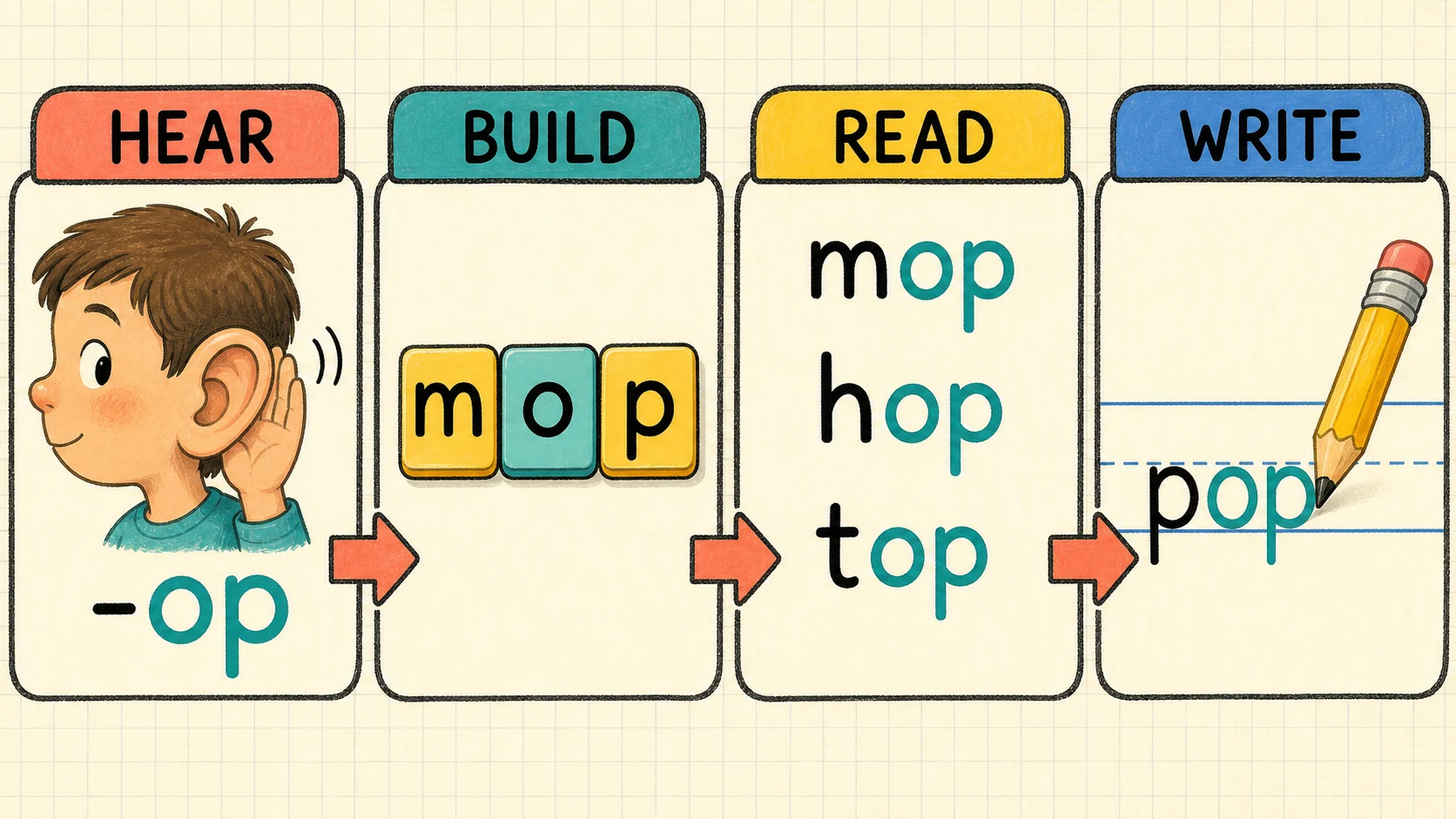
Support can gradually shift from movable letters and marked chunks to unmarked words, sentences, and independent spelling.
Move forward when the learner can read the current pattern accurately across different onsets, not merely recite a memorized row. If accuracy falls when words are mixed, return to contrast practice. If accuracy remains strong but reading is effortful, keep the same content and add short rereadings rather than immediately adding more patterns.
The Common Core English Language Arts standards include broad expectations related to phonological awareness and decoding regularly spelled one-syllable words. That framework can help educators locate word-family work within foundational reading, but it does not establish one universal order for these particular worksheets.
Concrete and Visual Models That Make the Pattern Visible
Letter tiles and a fixed rime
Place the letters a and t together. Draw a small box around them or place them on a card so they remain visibly fixed. Put m to the left:
m | at → mat
Replace only the first tile:
s | at → sat
Ask, “What changed?” and “What stayed the same?” The learner should point to the new onset and the fixed -at pattern. Then have the learner blend the complete word. Do not let the visible chunk turn into an invitation to ignore the onset.
A word-family house or flip strip
Write -op on a house, pocket chart, or stationary card. Use a movable strip containing h, m, p, and t. Each movement creates a new word: hop, mop, pop, and top.
Before revealing the next onset, ask the learner to read -op. After revealing it, ask for the beginning sound and then the whole word. This keeps the routine connected to decoding rather than visual memorization alone.
Sound boxes with a marked spelling chunk
Draw three sound boxes for pig: one each for /p/, /i/, and /g/. Place p, i, and g into the boxes. Then underline ig to show the family:
p | i g
The three boxes show that pig contains three phonemes; the underline shows that -ig is the recurring written rime. Both representations are useful because onset–rime grouping and phoneme-by-phoneme analysis answer different questions.
Sorting mats
Create headings for -at and -ap. Give the learner cat, cap, map, mat, tap, and sat. The learner reads each word before placing it. Reading first prevents the sort from becoming a last-letter matching exercise.
Ask for a verbal justification: “Map goes under -ap because its last two letters are a-p, and I hear /ap/.” A correct placement without an explanation may still conceal guessing.
Fully Checked Worked Examples
Example 1: Building within the -at family
Task: Change cat to mat by replacing the onset.
- Split cat into c | at.
- Identify the beginning sound: c represents /k/ here.
- Remove c. The rime at remains.
- Add m, representing /m/.
- Blend /m/ + /at/ to make mat.
- Check the spelling: m-a-t.
- Check the meaning: mat is a real word.
Verified answer: mat
Only the first letter and first sound changed. The -at spelling and /at/ rime stayed constant.
Example 2: Completing a word in the -ig family
Task: Fill in the missing onset: _ig, with the clue “an animal that may live on a farm.”
- Read the fixed rime -ig.
- Consider an onset that forms a word matching the clue.
- Add p.
- Blend /p/ + /ig/.
- The result is pig.
- Verify every letter: p-i-g.
- Verify the family: pig ends in -ig.
Verified answer: pig
The clue confirms the decoded word, but the learner should still account for all three letters.
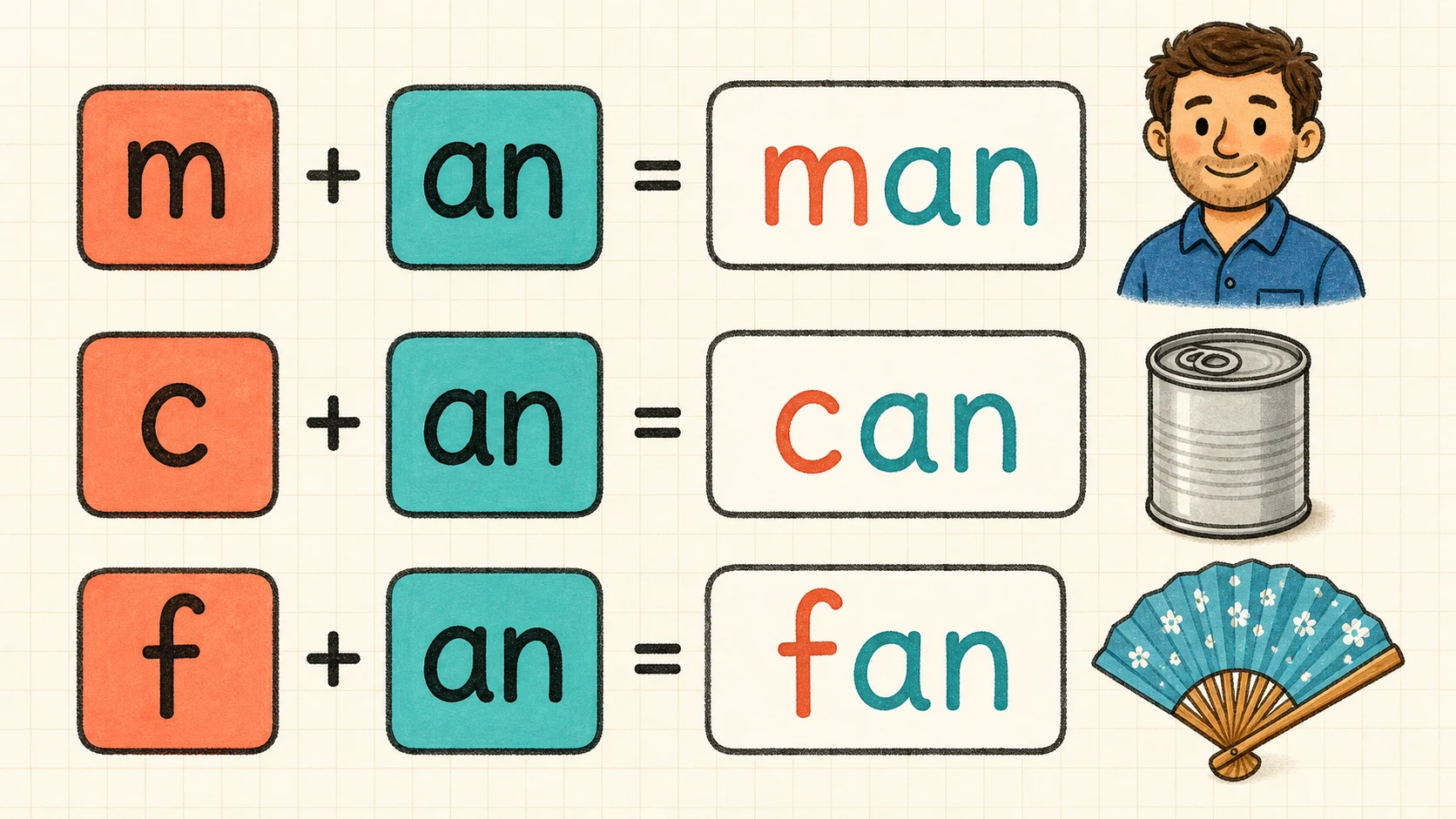
The learner keeps the ending visible, changes the onset, blends, and then checks spelling and meaning.
Example 3: Sorting similar short-a families
Task: Sort cap, cat, map, mat, tap, and sat under -ap or -at.
Read and inspect each word:
- cap ends with a-p, so it belongs to -ap.
- cat ends with a-t, so it belongs to -at.
- map ends with a-p, so it belongs to -ap.
- mat ends with a-t, so it belongs to -at.
- tap ends with a-p, so it belongs to -ap.
- sat ends with a-t, so it belongs to -at.
| -ap |
-at |
| cap |
cat |
| map |
mat |
| tap |
sat |
Verified result: three words belong to each family. No word belongs to both because the final consonant differs.
Example 4: Adding a digraph to a known family
Task: Combine ch with -at.
- Treat ch as the onset.
- In this word, ch represents one consonant sound, /ch/.
- Keep the known rime -at.
- Blend /ch/ + /at/.
- Read chat.
- Check the letters: c-h-a-t.
- Check the family: the written word still ends in -at.
Verified answer: chat
This example has four letters but three phonemes: /ch/ /a/ /t/. Counting letters and counting sounds are not the same task.
Example 5: Adding a blend to a known family
Task: Combine fl with -at.
- Read the onset fl by retaining both sounds: /f/ /l/.
- Read the rime /at/.
- Blend /f/ /l/ /at/.
- The word is flat.
- Verify the spelling: f-l-a-t.
- Verify the family: flat ends with -at.
Verified answer: flat
Unlike ch in chat, fl is a blend: both consonant sounds remain audible.
Boundary Cases and Important Limitations
A word family is a useful decoding pattern, not a promise that every similar-looking word follows the same pronunciation. Start with regularly spelled examples from the taught short-vowel families. Do not ask a beginning learner to infer a universal rule from one word list.
Several boundaries deserve explicit attention:
- A rhyme is not automatically the same spelling family. Blue and shoe rhyme, but they do not share the same ending letters. This guide uses word families that share an ending sound and spelling pattern.
- The last letter alone does not define the family. Cat and hot both end in t, but their complete rimes are -at and -ot.
- Changing the onset does not always create a familiar word. Replacing c in cat with v makes vat, a real but possibly unfamiliar word. Other substitutions may produce nonwords. Nonwords can test decoding, but clearly label them and do not present them as vocabulary.
- A picture can have several names. A picture intended as cap might be called hat. Supply the intended word orally if picture naming, rather than phonics, becomes the obstacle.
- Meaning checks do not replace decoding. A sentence may help confirm mat, but it should not justify guessing from the first letter.
- One successful list does not establish transfer. A learner may memorize cat, bat, hat, and mat in a fixed order. Mix the order and include an untaught but decodable member such as sat to check use of the pattern.
- Not every learner needs the same number of repetitions. The observed work should determine whether to repeat, simplify, contrast, or extend.
Word families cover only part of early phonics. Learners also encounter consonant blends, digraphs, long-vowel patterns, high-frequency words, inflectional endings, and increasingly complex words. Use the broader 1st Grade worksheet hub when the next need falls outside short-vowel families.
A Short, Repeatable Lesson Routine
Keep the routine brief enough that the learner remains attentive. The following 10-to-15-minute structure is an instructional suggestion, not a sourced universal timetable.
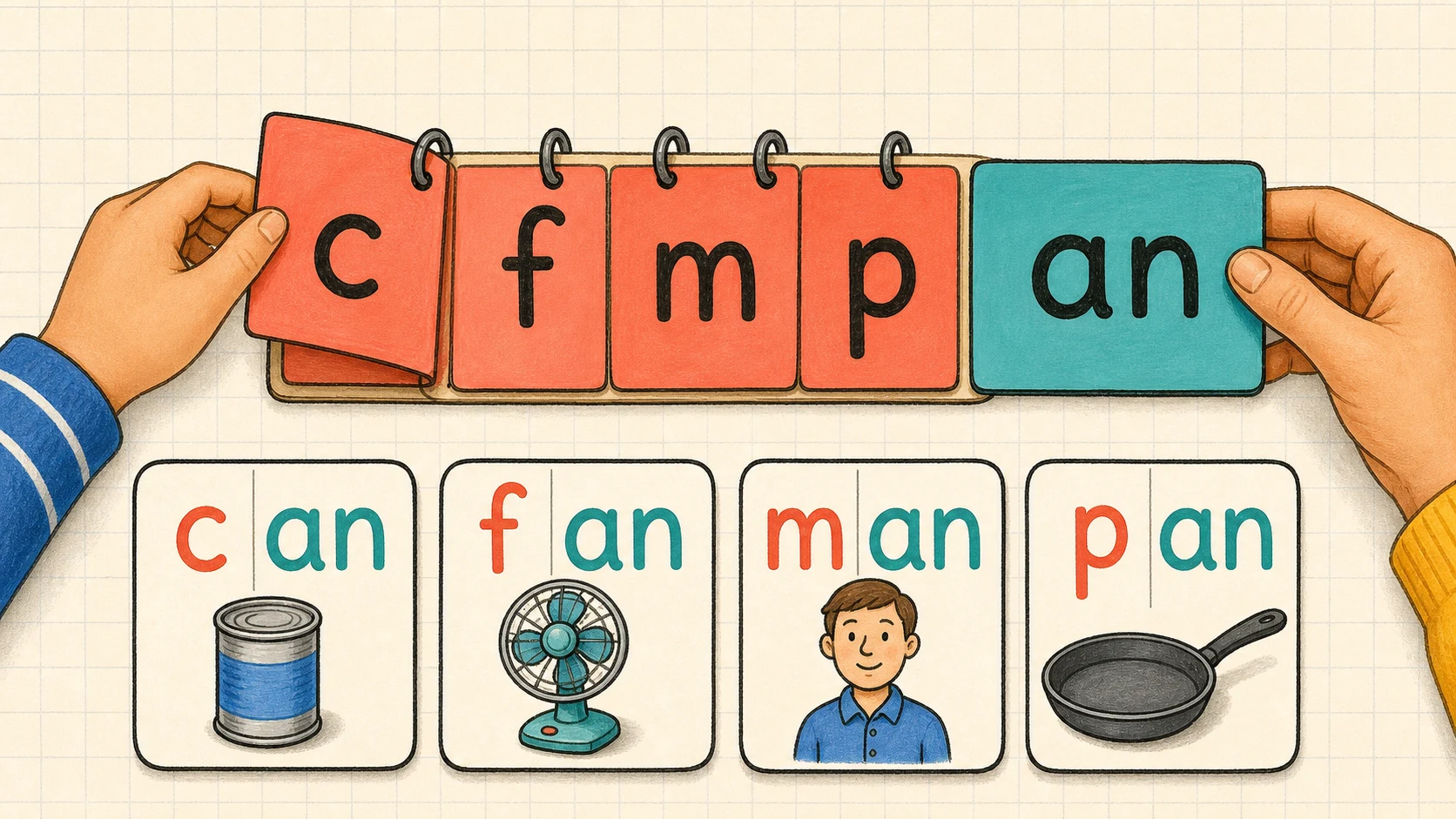
Each lesson moves from listening to building, reading, and a small amount of application.
1. Listen and compare for two minutes
Say three words, such as cat, hat, and map. Ask which two share the same rime. Repeat them with a slight onset–rime separation: c–at, h–at, m–ap.
2. Build and change for three minutes
Build -at with tiles. Add m, read mat, and then replace m with s. Ask what changed and what stayed fixed. Use three or four known onsets rather than exhausting every possibility.
3. Read in mixed order for three minutes
Show hat, sat, mat, and cat in a new order. The learner points under each part, blends, and reads. Add one contrasting word, such as map, if the learner is ready to attend to the complete ending.
4. Write or complete one word for two minutes
Dictate sat. Ask the learner to say the sounds, build or write the word, and underline -at. If handwriting consumes all the attention, allow tiles and preserve the phonics goal.
5. Read one sentence and review for two minutes
Use a controlled sentence such as “The cat sat on a mat.” Read for accuracy first. Then reread smoothly if the first reading was correct enough to support it.
The IES elementary writing practice guide offers high-level framing for regular writing opportunities and explicit instruction. In this lesson, writing one word or sentence is a limited application of the phonics pattern, not a complete writing program.
Choosing Practice That Matches the Learner
Select practice by task demand, not by page appearance.
| Observed performance |
Choose next |
Avoid for now |
| Cannot hear which words rhyme |
Oral matching with two choices |
Independent written sorts |
| Hears rhymes but cannot build words |
Tiles with one fixed rime |
Large mixed-family lists |
| Reads one family accurately |
Mixed-order words and one new onset |
Repeating the same memorized row |
| Confuses close families |
Two-column contrast sorts |
Adding several new families |
| Reads CVC members accurately |
Sentences and dictated spelling |
Speed pressure |
| Handles simple onsets |
Known families with ch, sh, fl, or another taught onset |
Untaught spelling patterns |
| Reads accurately in isolation but not in sentences |
Short controlled phrases and sentences |
More isolated lists only |
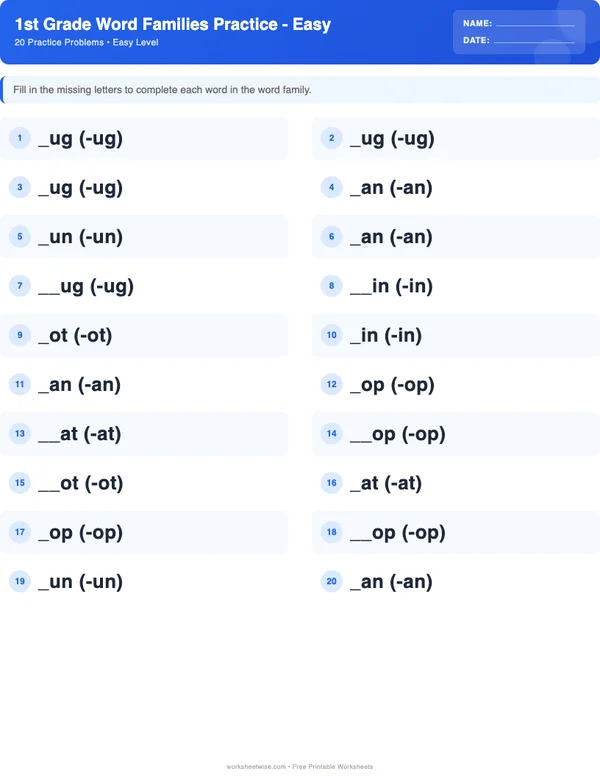
The free easy word-families worksheet contains 20 exercises in which learners fill in missing letters. It practices word patterns, onset and rime, rhyming, and word building. It is an appropriate choice when the learner can identify the family and supply a missing letter with limited support.
For broader repetition across several sessions, the focused word-families pack contains 18 worksheets. More pages are useful only when the task remains well matched. Repeating a task the learner does not understand is not a substitute for reteaching with speech, tiles, or a smaller contrast.
Differentiation Through Support, Contrast, and Extension
When the learner needs more support
Use one family and two or three onsets. Keep the rime physically fixed. Say each sound with the learner, then reduce your voice on the next attempt.
If the learner confuses -at and -ap, do not introduce another short-a family. Put cat and cap side by side. Point to the final letters and have the learner articulate /t/ and /p/. Then sort four words rather than twenty.
Reduce writing when letter formation interferes with demonstrating phonics knowledge. The learner can select a tile, point to an answer, or dictate while the adult records it.
When the learner is ready to extend
Mix previously taught families, change the order, and introduce a new decodable member. Move from cat to chat only after the digraph ch has been taught; move from mat to flat after the learner can blend both consonants.
Ask the learner to create a sentence containing one or two family words. Check the phonics target separately from capitalization, spacing, and punctuation so feedback remains understandable. A possible sentence is “The pig is big.” Both target words belong to -ig.
Extension should deepen application rather than become a race. Accuracy in an unfamiliar order, spelling from dictation, and reading in context provide more information than reciting a long memorized list quickly.
Common Errors and Diagnostic Responses
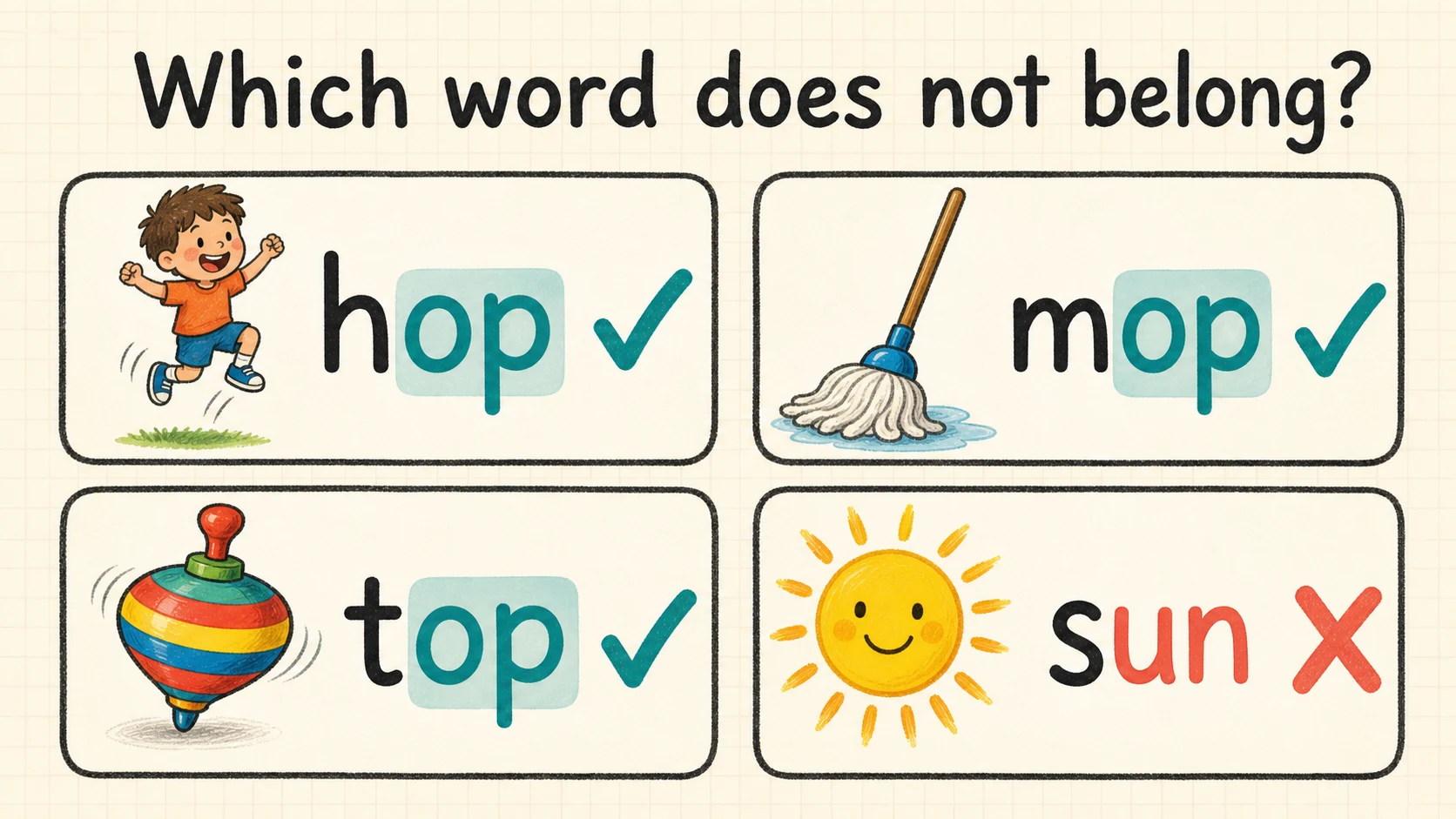
An error is useful evidence when the adult identifies which part of the word-processing task broke down.
| Error |
What to check |
Teaching response |
| Reads mat as map |
Attention to the final consonant |
Contrast t and p orally and visually; sort -at/-ap |
| Calls every rhyming word an -at word |
Understanding of spelling patterns |
Compare spoken rhyme with written endings |
| Guesses from a picture |
Reliance on print |
Cover the picture, blend the word, then reveal the picture to confirm |
| Reads flat as fat |
Retention of both blend sounds |
Stretch /f/ /l/, point to both letters, then blend |
| Reads chat as cat |
Knowledge of the digraph |
Review ch as one taught sound before joining -at |
| Reads a practiced row but not mixed cards |
Memorized order |
Shuffle cards and include one new decodable family member |
| Completes _ig randomly |
Connection between sound, clue, and print |
Say the intended word, identify its first sound, and select the matching letter |
| Spells hop as hot |
Final-phoneme discrimination |
Say both words, isolate /p/ and /t/, then rebuild them |
Avoid correcting only with “Try again.” Direct the learner to the relevant evidence: “Look at the last letter,” “Say both sounds in the blend,” or “Which part stayed the same?” Record repeated error types because patterns across several attempts are more informative than one slip.
Monitoring Progress Without Overtesting
Use a small weekly sample containing:
- Three familiar words from one taught family.
- Two familiar words from another family.
- One new but decodable member of a taught family.
- One short phrase or sentence.
- One dictated word.
Mark responses as accurate and independent, accurate after a prompt, or inaccurate. Also note the error: omitted onset, confused final consonant, guessed from context, or could not blend. Timing is optional and should never replace accuracy analysis.
A practical decision rule is qualitative:
- Continue support when the learner cannot explain the shared ending or needs prompts on most items.
- Add contrast when one family is secure alone but breaks down beside a similar family.
- Increase application when isolated words are accurate but sentence reading or spelling remains difficult.
- Extend the onset when simple CVC members are secure and the needed blend or digraph has already been taught.
- Revisit prerequisites when the learner cannot hear, segment, or blend the component sounds.
This monitoring is instructional, not medical or diagnostic. Persistent reading difficulty may require discussion with the learner’s teacher or another appropriately qualified professional who can review a broader body of work.
A Two-Week Practice Plan
This plan assumes ten short sessions. Adjust the pace, repeat a day, or pause the sequence according to observed work. It is not a universal timetable.
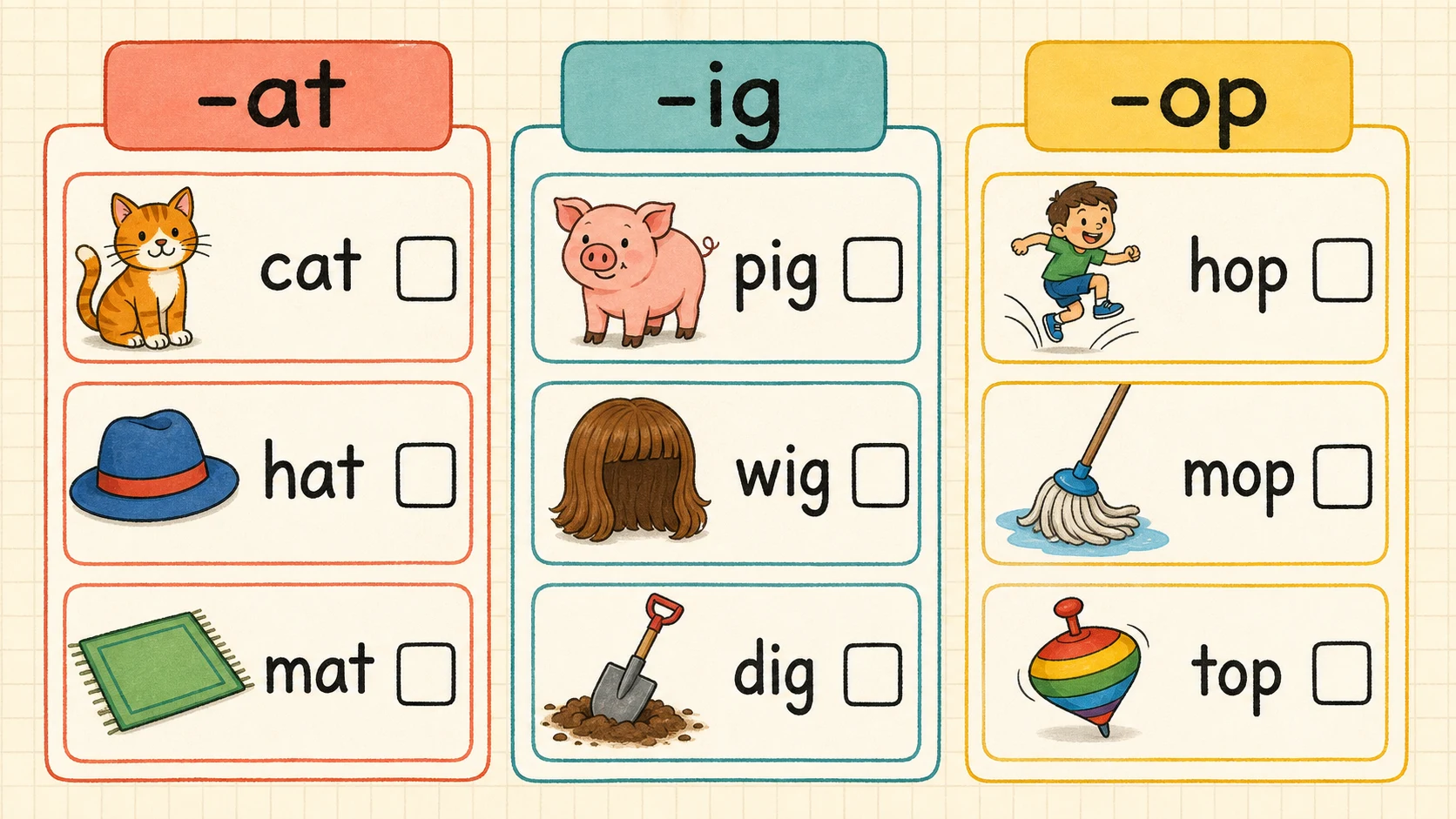
The plan alternates explicit teaching, contrast, contextual reading, spelling, and review.
| Day |
Focus |
Suggested activity |
Evidence to collect |
| 1 |
Hear and build -at |
Oral rhymes; build cat, hat, mat, sat |
Can identify what stays fixed |
| 2 |
Read and spell -at |
Shuffle word cards; dictate mat and sat |
Accuracy without fixed order |
| 3 |
Introduce -ap |
Build cap, map, tap |
Correct onset–rime blending |
| 4 |
Contrast -at/-ap |
Sort six mixed words after reading each |
Attention to final consonants |
| 5 |
Apply short a |
Read a short sentence; complete a few missing-letter items |
Transfer from list to context |
| 6 |
Introduce -ig |
Build big, dig, pig, wig |
Accurate short i and ending |
| 7 |
Read and spell -ig |
Mixed cards; dictate pig and wig |
Connection from sounds to letters |
| 8 |
Add a known complex onset |
Build chat or flat only if ch or fl is taught |
Keeps all onset sounds |
| 9 |
Mixed review |
Sort -at, -ap, and -ig words |
Maintains complete family patterns |
| 10 |
Brief check and next decision |
Read familiar and new members, one sentence, and spell one word |
Select repeat, contrast, or extension |
Keep sessions focused. If Day 4 reveals repeated cat/cap confusion, repeat the contrast on Day 5 instead of proceeding simply because the calendar says to move on. If the learner reads all mixed words accurately and spells them independently, move to another catalogue family or controlled sentence work.
The Honest Next Step
Word-family study can make recurring chunks visible, but it does not by itself cover the full range of 1st Grade decoding and spelling. Its value depends on accurate blending, deliberate pattern comparison, and application beyond a memorized list.
Begin with one short-vowel family that matches the learner’s known letter sounds. Model two examples with tiles, then watch the learner complete a small independent sample. Record the exact errors and choose the next lesson from that evidence.
For a concrete starting point, use the free 1st Grade Word Families worksheet. Preview a few of its 20 missing-letter exercises, teach the required family first, and assign only the number the learner can approach attentively. Use the included answer key to check the responses, then decide whether the next step is another supported model, a two-family contrast, or sentence-level application.