What 1st Grade CVC Words Teach
CVC words are one-syllable words built in a consonant-vowel-consonant pattern, such as cat, pin, and hug. They give a learner a manageable way to connect three spoken sounds with three letters, blend those sounds to read a word, and segment the word to spell it.
The concise answer is this: teach CVC words by moving repeatedly between sound and print. The learner should hear three sounds, map each sound to a letter, blend from left to right, and then reverse the process by spelling the word. Begin with familiar letter-sound correspondences and one short vowel at a time. Add mixed vowels, word changes, sentences, and unfamiliar examples only as the learner’s observed work becomes accurate and less effortful.
CVC work develops several connected abilities:
- Recognizing common consonant sounds
- Hearing a short vowel in the middle of a word
- Blending three sounds into a spoken word
- Segmenting a spoken word into three sounds
- Matching each sound to a letter
- Reading regularly spelled one-syllable words
- Spelling CVC words from dictation
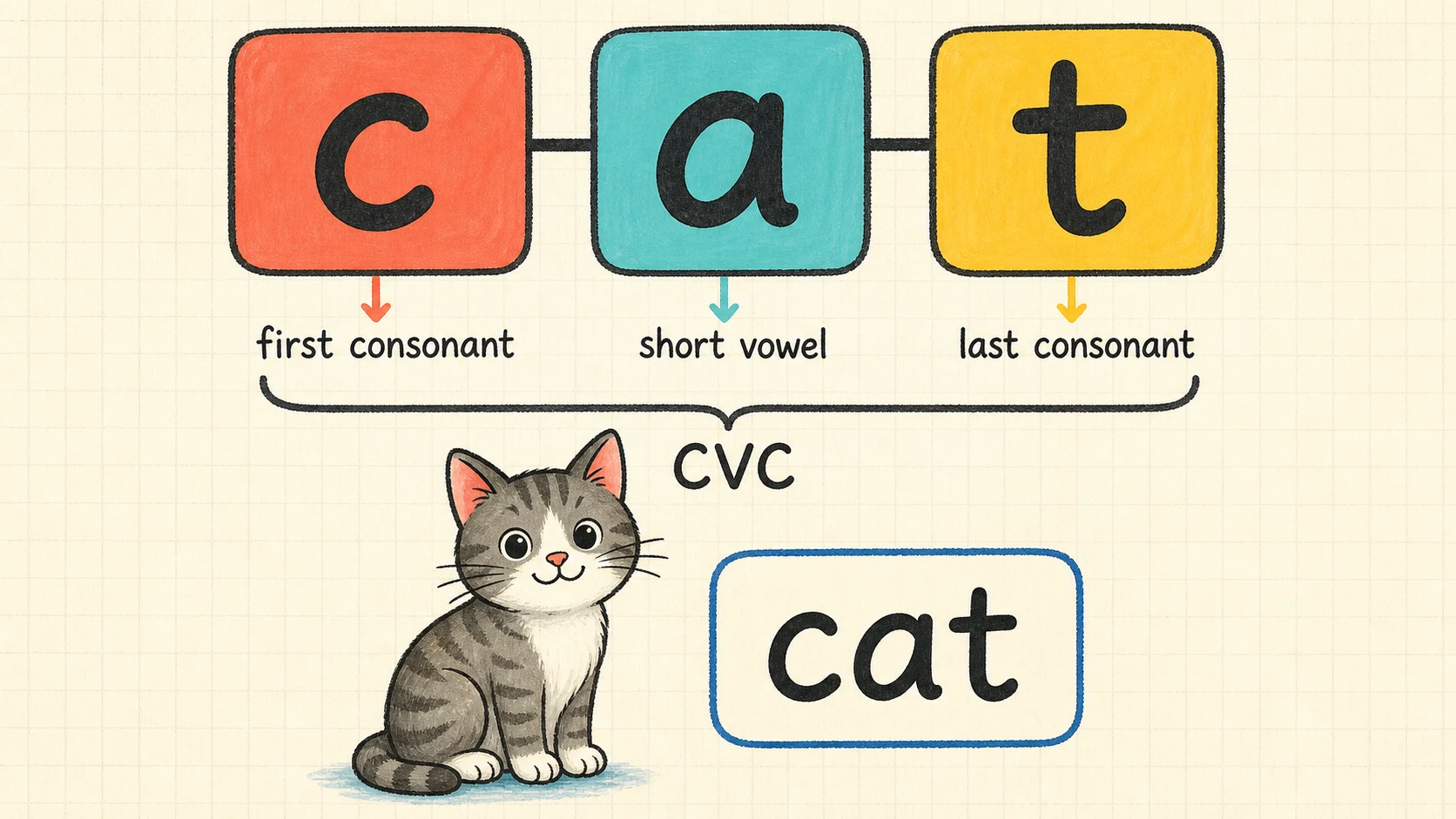
The central skill is a two-way connection: blend letters to read, then segment sounds to spell.
The IES foundational reading practice guide recommends systematic instruction that helps children connect speech sounds with letters and use those relationships to decode words. That source supports the broad instructional frame used here; it does not evaluate WorksheetWise or prescribe this exact sequence.
Grade labels describe the intended practice level, not a fixed rule about what every child must do at a particular age. Local curricula and instructional sequences differ. A learner’s current decoding, spelling, and error patterns should determine the starting point and pace.
Prerequisites to Check Before CVC Practice
CVC worksheets are most useful when the learner already has enough underlying knowledge to understand the task. A low score does not automatically mean the child needs more copies of the same page. Check the component skills first.
Hearing three sounds
Say map without showing the word. Ask the learner to move one token for every sound heard. The checked response is:
/m/ | /ă/ | /p/
There are three phonemes. If the learner moves one token because map is one spoken word, clarify that the task is to notice sounds within the word.
Try two or three additional words, such as sit, log, and sun. Do not require letter names during this oral check. Its purpose is to find out whether the learner can attend to the sound sequence.
Knowing useful letter-sound correspondences
Display letters such as m, s, t, p, n, c, and f in random order. Ask for the most common sound represented by each letter. Then check short vowel sounds separately:
a as in mapi as in sito as in logu as in sune as in hen
A learner does not need to know every consonant before beginning. Choose words made from correspondences the learner already knows, and explicitly teach any new correspondence before expecting independent use.
Blending from left to right
Write m a p. Point beneath the letters while joining the sounds with minimal pauses: /mmmăăăp/, then map. Ask the learner to repeat the blend.
If the learner can identify each sound but cannot produce the word, blending—not vocabulary or handwriting—is the immediate teaching target. If the learner blends accurately but does not know what the resulting word means, briefly explain or illustrate the word after decoding it.
A Grade-Appropriate Progression
The catalogue sequence begins with short a, then moves through short i, short o, short u, and short e. This is an instructional sequence supplied for these materials, not a universal timetable. Keep a vowel set in place until the learner shows reasonable control, but avoid waiting for flawless performance before reviewing earlier patterns.
| Stage |
Instructional focus |
Sample task |
Evidence to look for |
| 1 |
Oral segmentation and blending |
Say and blend /m/ /ă/ /p/ |
Hears and joins three sounds |
| 2 |
One short vowel, stable word structure |
Read cat, mat, map, tap |
Tracks all three letters |
| 3 |
Read and spell within one vowel family |
Read sit; build or write sit |
Connects decoding with encoding |
| 4 |
Contrast two short vowels |
Sort map, sit, pin, tap |
Attends to the medial vowel |
| 5 |
Mix all five short vowels |
Read hen, log, sun, cat, fin |
Selects the vowel from print |
| 6 |
Manipulate one phoneme |
Change cat to mat, then map |
Changes only the required sound |
| 7 |
Apply words in short sentences |
Read “The cat can nap.” |
Decodes within connected text |
| 8 |
Check transfer |
Read a new regular CVC item |
Applies the pattern rather than recalling a list |
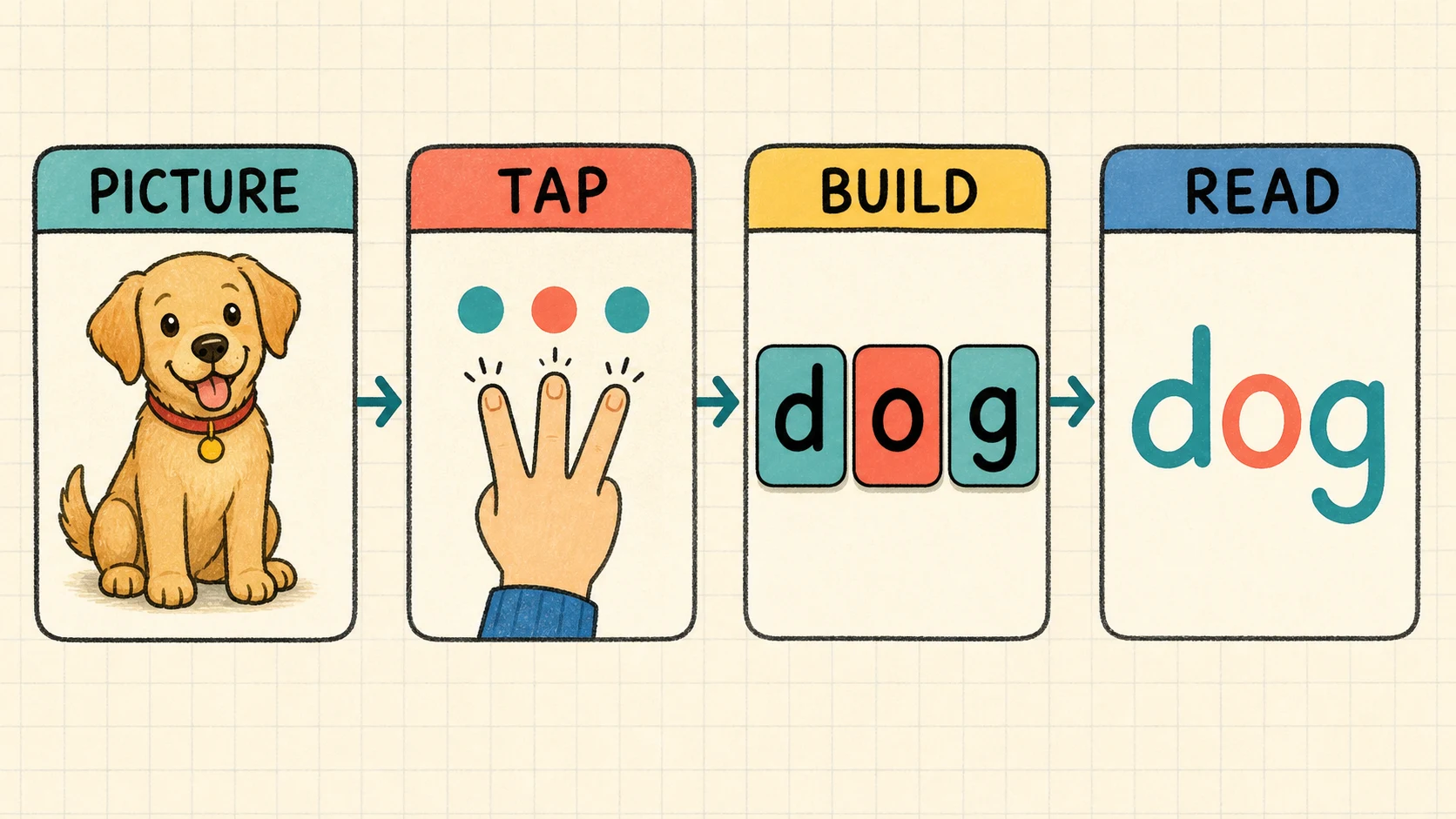
Support can fade from modeling and sound boxes to independent reading, spelling, and sentence use.
The Common Core State Standards for English Language Arts include first-grade expectations related to blending spoken words, isolating sounds, and decoding regularly spelled one-syllable words. These expectations provide broad context. They do not establish that a particular worksheet offers comprehensive standards alignment, and schools may use different standards or sequences.
Concrete and Visual Models
A visual model should make the sound sequence easier to perceive without replacing the act of reading. Tokens, connected boxes, letter tiles, and a finger sweep can all focus attention on the three positions.
Sound boxes before letters
Draw three connected boxes:
| 1 |
2 |
3 |
| initial sound |
medial vowel |
final sound |
Say sun. The learner pushes one token into each box while saying:
/s/ | /ŭ/ | /n/
Next, replace the tokens with s, u, and n. Sweep a finger under the complete row and blend sun. The boxes show three sound positions; they are not syllable boxes. Sun has one syllable but three phonemes.
A continuous blending model
Isolated sound production can become choppy: /m/ ... /ă/ ... /p/. The learner may remember the sounds but lose their order before combining them.
An instructional suggestion is to reduce the pauses: hold sounds that can be stretched, move directly through the vowel, and finish with the last consonant. For map, model something close to /mmmăăăp/, followed immediately by map. Some consonants cannot be sustained naturally, so the goal is a connected left-to-right sweep, not an exaggerated performance.
Letter changes that preserve most of the word
Use three letter tiles to build c a t. Replace only c with m to form m a t. Ask:
- Which letter changed?
- Which sound changed?
- Which sounds stayed the same?
- What is the new word?
Then change t to p and read map. This makes the relationship between the changed phoneme and changed grapheme visible.
Fully Checked Worked Examples
The following examples show both the reasoning and the verified answer. Adults can model the complete process first, then ask the learner to perform increasingly larger parts.
Example 1: Read cat
Printed word: cat
- Point to
c: the sound is /k/.
- Point to
a: in this word, it represents short /ă/.
- Point to
t: the sound is /t/.
- Blend from left to right:
/k/ /ă/ /t/ → cat.
- Check meaning: cat is a known English word and fits the letters shown.
Verified answer: cat
The learner should not use the first letter and a picture to guess. The answer is checked against all three letters.
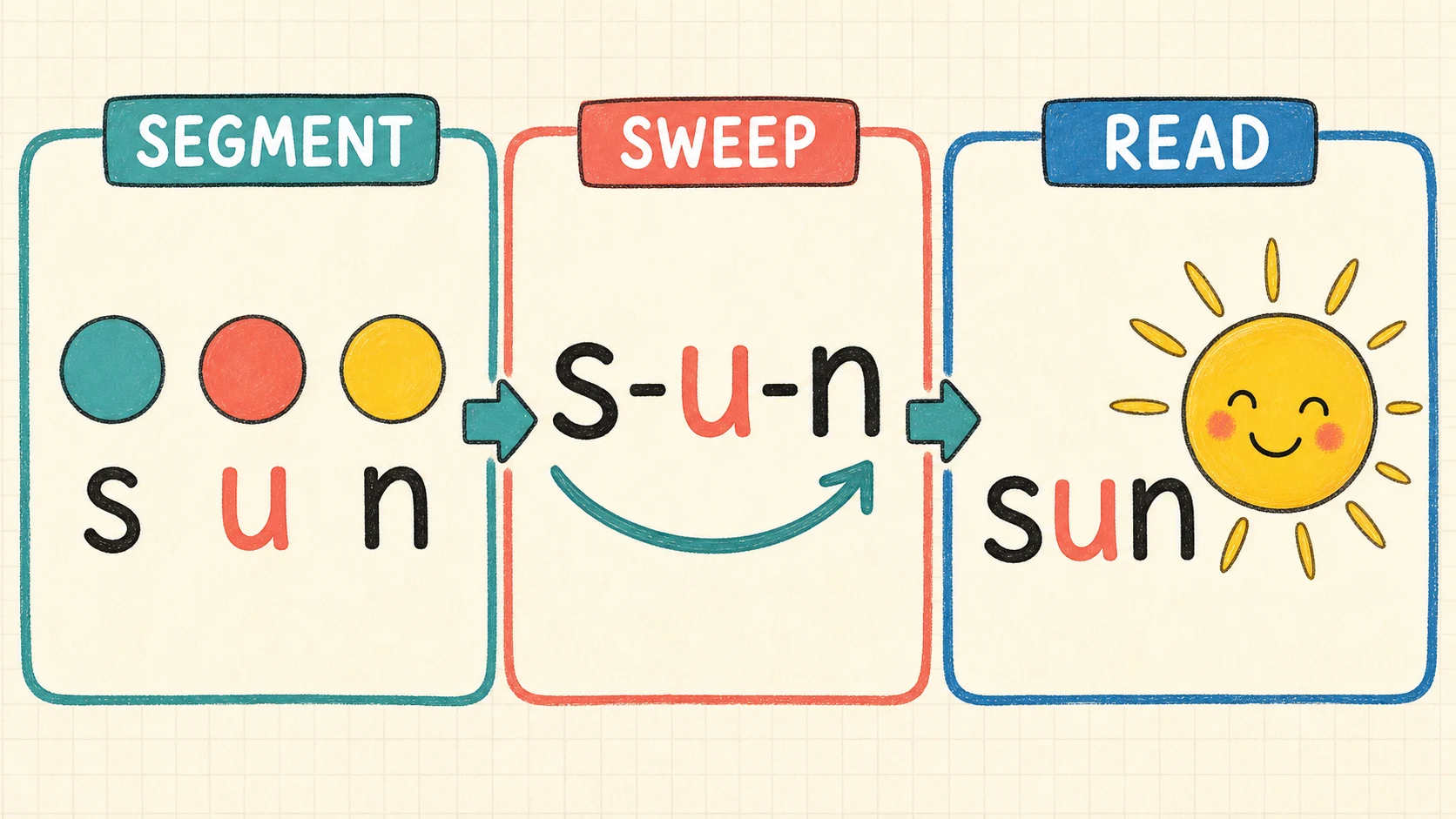
Sound positions, letters, and a final blend make the reasoning visible rather than leaving the answer as a guess.
Example 2: Spell pin
Spoken word: pin
- Say the word normally: pin.
- Stretch and segment it:
/p/ | /ĭ/ | /n/.
- Match
/p/ to p.
- Match short
/ĭ/ to i.
- Match
/n/ to n.
- Read the completed spelling from left to right:
p-i-n → pin.
Verified answer: pin
There are three phonemes and three letters in this example. Reading the spelling back is an important check because it tests whether the written letters reconstruct the intended word.
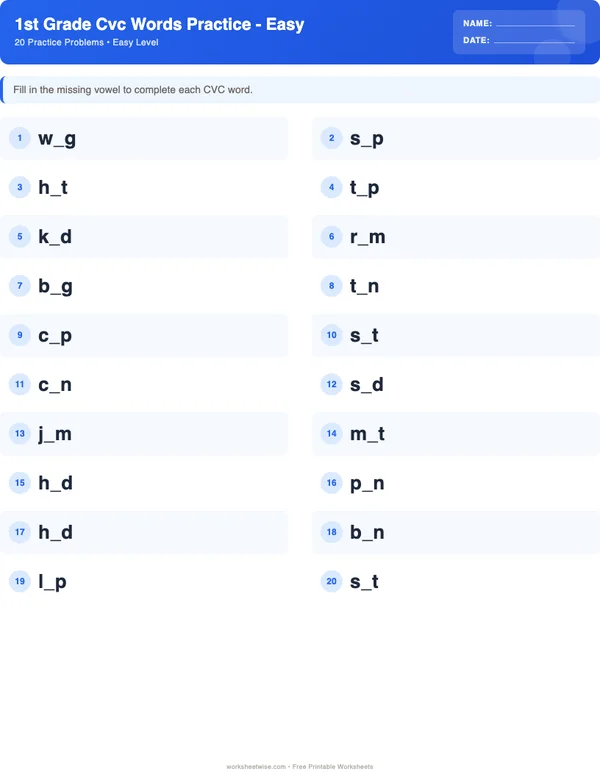
Example 3: Fill in the missing vowel in h_n
Suppose the picture or spoken target is hen.
- Say hen slowly:
/h/ | /ĕ/ | /n/.
- The first and final letters already match
/h/ and /n/.
- The missing medial sound is short
/ĕ/.
- The letter used for that sound in this word is
e.
- Insert it:
h e n.
- Blend to verify:
/h/ /ĕ/ /n/ → hen.
Verified answer: e, making hen
This is the task format used by the free easy worksheet: the learner fills in a missing vowel to complete a CVC word. If a learner tries every vowel until something looks familiar, return briefly to oral segmentation.
Example 4: Change map to mop
Starting word: map
Target word: mop
- Segment map:
/m/ | /ă/ | /p/.
- Segment mop:
/m/ | /ŏ/ | /p/.
- Compare the positions. The first
/m/ stays the same. The last /p/ stays the same.
- Only the middle sound changes:
/ă/ becomes /ŏ/.
- Replace
a with o: m a p → m o p.
- Blend
mop to verify the result.
Verified answer: change a to o.
This example checks whether the learner can attend specifically to the medial vowel rather than rebuilding the whole word without comparison.
Example 5: Decode an unfamiliar CVC item
Use the catalogue’s sample nonsense word nib.
- Read
n as /n/.
- Read
i as short /ĭ/.
- Read
b as /b/.
- Blend:
/n/ /ĭ/ /b/ → nib.
- Report the pronunciation without trying to replace it with a familiar word.
Verified decoding: nib, pronounced to rhyme with rib.
An unfamiliar or nonsense item can show whether the learner applies letter-sound knowledge instead of relying only on memorized words. Use such items sparingly and clearly label them as made-up or unfamiliar so the learner does not search for a meaning that is not part of the task.
A Short, Repeatable Lesson Routine
A focused lesson can be brief, but its length should remain responsive to the learner. Stop, simplify, or add modeling when accuracy collapses or the child is no longer attending. The following timings are planning suggestions, not sourced requirements or a universal schedule.
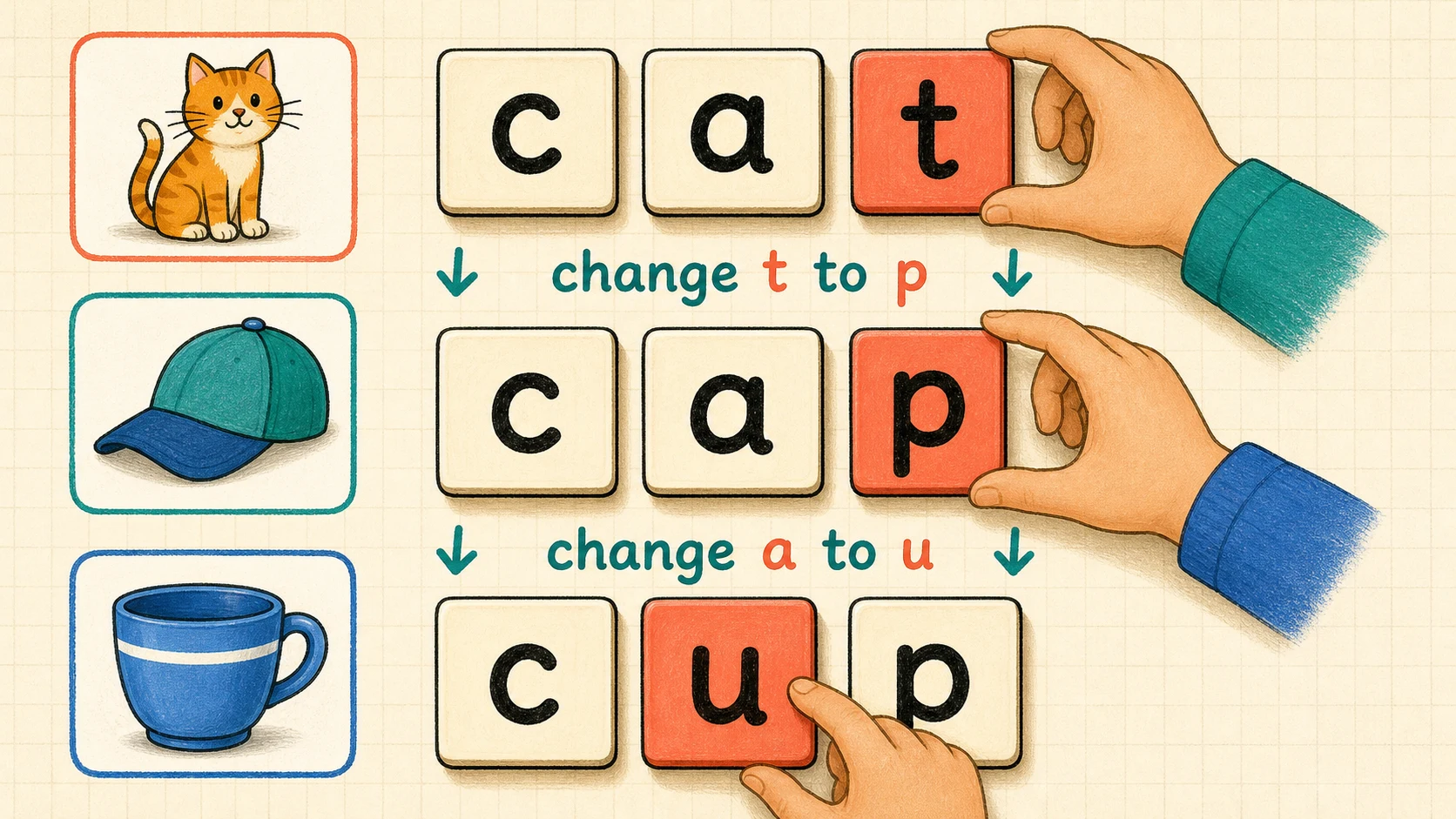
The routine moves from sound review to modeling, guided practice, spelling, and a quick transfer check.
1. Review sounds for one or two minutes
Show the vowel and consonants needed in the lesson. Ask for sounds rather than letter names. Correct an error immediately and revisit that card after two or three others.
2. Blend orally for two minutes
Say three sounds without letters and ask the learner to blend them. Use words such as /m/ /ă/ /p/ and /s/ /ĭ/ /t/. If this is difficult, reduce pauses and model the complete blend.
3. Model one word
Build or write a word. Point under each letter, blend continuously, and say the whole word. Then segment it and map the sounds back to the letters. Keep the explanation short enough that the learner can imitate it.
4. Guide three to five words
Let the learner point, blend, and read. Prompt at the point of difficulty:
- “Start at the first letter.”
- “Keep the sounds connected.”
- “Check the middle vowel.”
- “Read the whole word again.”
Avoid giving several prompts at once. One precise cue reveals more about what the learner can do.
5. Spell two or three words
Dictate a word already read. The learner says the sounds, places letters or writes them, and reads the completed word back. Pairing decoding with encoding is a central recommendation in the supplied teaching guidance.
The IES elementary writing practice guide provides high-level support for explicitly teaching foundational writing processes and giving learners regular opportunities to write. It does not specifically evaluate CVC dictation or this routine.
6. End with one transfer item
Present a CVC word that was not practiced in the lesson but uses known correspondences. Record whether it was read independently, read after a prompt, or not yet read. That final item helps determine the next lesson more effectively than a general impression such as “did well.”
Selecting Useful Practice
Choose practice according to the error you need to observe, not only the number of items on a page.
When to use missing-vowel work
A missing-vowel task is suitable when the learner can identify the first and final consonants but needs practice hearing and representing the medial vowel. The free 1st Grade CVC Words worksheet contains 20 easy-level exercises in which the learner fills in the missing vowel. It also has a separate answer key.
Before assigning the whole page, try three items. If the learner cannot orally identify the middle sound, teach that step with sound boxes first. If three items are accurate and independent, the worksheet can provide useful reinforcement.
When to use word building and manipulation
Choose letter tiles when the learner:
- Omits a sound while spelling
- Reverses the order of sounds
- Has difficulty seeing which position changed
- Needs to compare two vowels directly
Build cat, change it to mat, then map, and finally mop. Ask the learner to describe each change. The CVC Words topic guide can serve as the central page for related topic practice.
When to use mixed reading
Mix vowel patterns only after the learner can read some words within separate vowel sets. Mixed practice requires the learner to inspect the printed vowel rather than assume that every word uses the vowel practiced most recently.
The 1st Grade phonics collection places CVC practice in the broader progression toward blends, digraphs, long-vowel patterns, and more complex words.
When a larger set is useful
The focused CVC worksheet pack contains 18 worksheets and costs $4.79 according to the catalogue. A larger set may be useful when an adult wants varied practice across multiple sessions. More pages are not automatically better, however. Select only tasks that match the learner’s current need and review errors before assigning the next page.
Differentiation Without Changing the Core Skill
Differentiation should adjust support, item selection, and response mode while preserving the sound-to-letter work.
For a learner who needs more support
Use words made entirely from known letters. Keep one vowel constant, provide three connected sound boxes, and let the learner move tokens before selecting letters. Model the first item, complete the second together, and observe the third.
Reduce visual clutter by showing one word at a time. If handwriting consumes most of the learner’s attention, use movable letters so that decoding and spelling can be observed separately from letter formation.
For a learner who is becoming accurate
Contrast two vowels, remove the sound boxes, and alternate reading with spelling. Ask the learner to change one phoneme at a time:
cat → mat → map → mop
Include short sentences containing decodable CVC words and any necessary familiar high-frequency words. Sentence reading should add context, not invite guessing. Ask the learner to return to the letters when a word is misread.
For a learner ready for greater challenge
Mix all five short vowels, introduce new regular CVC examples, and ask for dictated spelling without a model. Nonsense items such as vog may be used occasionally to check transfer. Have the learner explain which letter represents the middle sound.
Do not advance merely because a page was completed quickly. Check whether the learner read the words, guessed from pictures, memorized the order, or depended on adult prompts.
Boundary Cases and Misconceptions
Not every three-letter word is a straightforward CVC practice word, and not every spoken word with three phonemes is spelled with three letters.
Three letters do not guarantee a regular CVC example
Words such as the and was have three letters, but they do not provide the simple short-vowel CVC mapping targeted here. A learner should not be expected to apply the cat–pin–hug pattern to every three-letter word.
Words such as she and chip also fall outside a basic three-letter CVC set. She includes the digraph sh and a long vowel sound. Chip has a consonant digraph and four letters, even though its spoken form can be analyzed as three phonemes: /ch/ /ĭ/ /p/.
A picture is a meaning check, not the decoding method
A child who sees a cat picture and says kitten has interpreted the image but has not read the printed word cat. Cover the picture temporarily, point under the letters, and ask for a left-to-right blend. Reveal the picture afterward to confirm meaning.
Letter names are not the same as sounds
Reading map as “em-ay-pee” names letters but does not blend the word. Acknowledge the correct letter names, then restate the task: “Now say the sounds those letters represent in this word.”
Fast completion is not the same as mastery
A learner may complete a familiar page from memory or by following its pattern. Change the order, present one new word, and include a spelling item. Transfer across these small changes provides stronger evidence than speed alone.
Diagnosing Common Errors
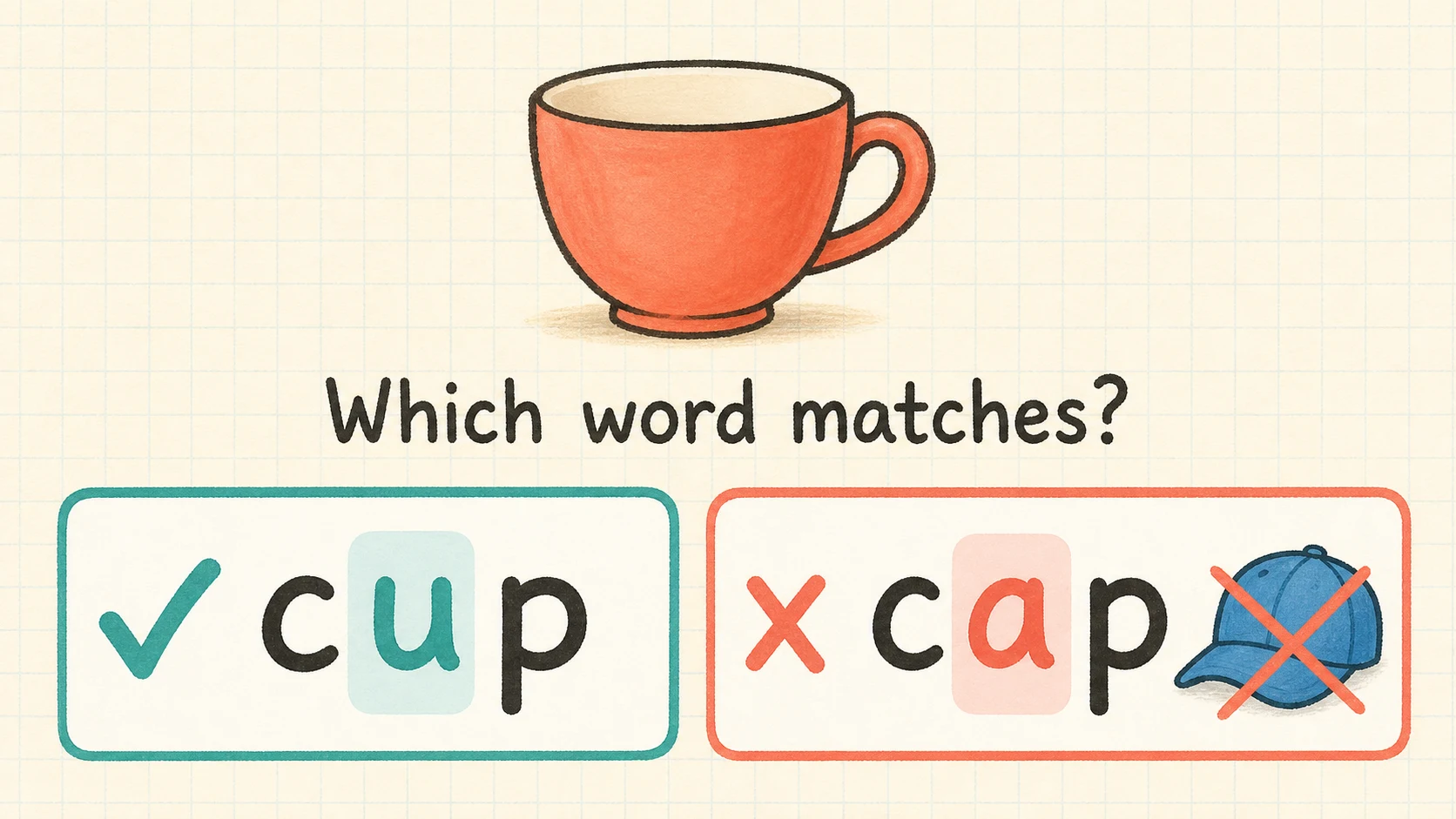
The same incorrect answer can have different causes, so the response should target the process that broke down.
| Observed work |
Likely instructional need |
Teaching response |
| Reads cat as cap |
Final sound or letter not checked |
Point to the final position; contrast /t/ and /p/; blend again |
| Reads pin as pan |
Medial vowel confusion |
Segment both words and compare the middle sounds and letters |
| Says separate sounds but no word |
Blending connection is weak |
Model a smoother continuous blend with fewer pauses |
Spells map as mp |
Medial phoneme omitted |
Use three sound boxes and require one token per sound |
Spells sun as sn |
Vowel is not represented |
Stretch the word and isolate the middle sound before choosing a letter |
| Guesses from the picture |
Print is not controlling the response |
Cover the picture, track the letters, then use the picture to check meaning |
| Reads only familiar items |
May be recalling rather than decoding |
Add one unfamiliar regular CVC item using known correspondences |
Confuses b and d while otherwise blending |
Letter identification interrupts decoding |
Briefly review the two letters, then retry with only one in the word set |
Treat these as instructional hypotheses, not diagnoses of a child or claims about a medical condition. Confirm the cause by changing one feature and observing what happens. For example, if a learner misses vowels only when five choices are mixed, reduce the set to two vowels. If accuracy returns, the learner may need more contrast practice rather than a complete restart.
Monitoring Progress and Choosing the Next Step
Keep a compact record of what the learner does without help. Once or twice during a week, use a small set that includes:
- Two previously practiced words
- Two words with the same patterns in a new order
- One new regular CVC word
- One dictated spelling word
- Optionally, one clearly labeled nonsense item
Record the response as independent, prompted, or incorrect. Also note the error itself. “Read map as mop” is more useful than a total score because it points toward medial-vowel work.
Consider moving forward when the learner reads and spells across more than one presentation, checks all three positions, and handles at least some new examples without guessing. Continue or step back when performance depends heavily on pictures, a memorized list, or repeated adult prompting.
Do not turn one session into a permanent label. Attention, familiarity with the vocabulary, handwriting demands, and task layout can change what is observed. Compare several short samples and let the pattern of work guide pacing.
A Two-Week Practice Plan
This plan assumes short sessions across ten instructional days. It is a practical suggestion, not a universal timetable. Repeat a day, divide it into smaller sessions, or pause the sequence when the learner’s work shows that more support is needed.
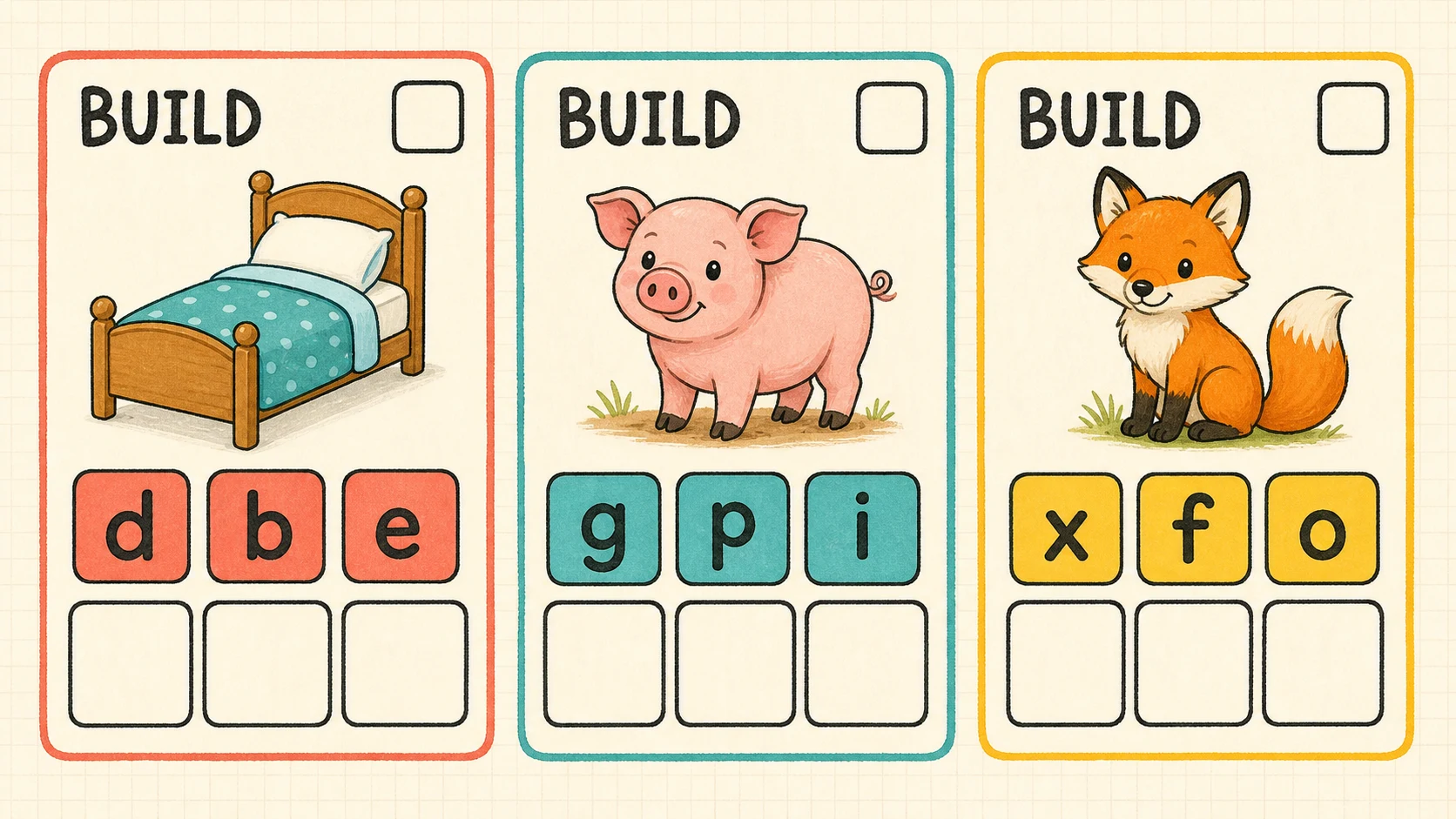
Each day combines review with one manageable increase in independence or variety.
| Day |
Focus |
Suggested practice |
Decision point |
| 1 |
Check prerequisites |
Segment three spoken words; review needed letters |
Start with sound boxes if sounds are omitted |
| 2 |
Short a blending |
Read and build cat, map, tap, sad |
Continue one vowel if blending remains choppy |
| 3 |
Short a spelling |
Dictate three practiced words; read them back |
Rebuild omitted sounds with tokens |
| 4 |
Short i |
Read sit, pin, fin; contrast with one short-a word |
Note whether the middle vowel controls the response |
| 5 |
Review and transfer |
Mix short a and i; add one new regular item |
Record independent versus prompted reading |
| 6 |
Short o |
Build and read log, mop, and another known-letter word |
Limit the consonant set if it causes confusion |
| 7 |
Short u |
Read and spell sun, hug, and another suitable word |
Compare /ŏ/ and /ŭ/ only if needed |
| 8 |
Short e |
Read and spell hen and other known-letter examples |
Avoid unfamiliar consonants during vowel teaching |
| 9 |
Mixed vowels |
Sort, read, and spell examples from all practiced sets |
Return to a two-vowel contrast if errors scatter |
| 10 |
Application check |
Read a mixed list, spell two words, and read a short sentence |
Choose review, more mixed practice, or the next phonics feature |
At the end of the two weeks, look for a direction rather than a pass-or-fail judgment. If the learner reads accurately but spells poorly, increase segmentation and dictation. If spelling is accurate with tiles but reading remains slow, emphasize blending. If both are secure across new examples, begin bridging toward first-grade work with blends, digraphs, and longer patterns while continuing brief CVC review.
Limitations and an Honest Next Step
CVC practice addresses an important early decoding and spelling structure, but it does not cover the full range of first-grade reading. It does not by itself teach irregular high-frequency words, vocabulary, comprehension, fluency, consonant blends, digraphs, long-vowel patterns, or multisyllabic decoding. A missing-vowel worksheet also cannot show every component of the skill: a learner might choose the correct vowel yet still need help blending the complete word.
Use worksheets as observable practice, not as a substitute for explicit explanation and responsive feedback. When a learner makes an error, return to the spoken sounds, map them to letters, and verify the completed word by reading it back.
A useful next action is to open the free easy CVC worksheet, complete three items together, and then watch the learner attempt three independently. Use those six responses to decide whether the next lesson should focus on hearing medial vowels, blending whole words, or spelling all three sounds.