What 1st Grade Long Vowels Means
Long vowels are vowel sounds in which the vowel usually says its letter name: the a in cake, e in feet, i in kite, o in bone, and u in cube. First graders learn to connect these sounds with recurring spelling patterns, especially final-e patterns such as make, vowel teams such as ai and ee, and open syllables such as he and go.
The direct teaching goal is practical: help the learner notice a familiar pattern, blend the sounds to read the word, and use the same pattern when spelling. Begin after the learner can decode short-vowel consonant-vowel-consonant words such as cap, pin, hop, and cub with reasonable fluency.
A useful sequence is:
- Contrast short- and long-vowel sounds.
- Teach final-e words.
- Add common vowel teams one group at a time.
- Introduce simple open-syllable words.
- Mix patterns so the learner must examine the spelling instead of guessing.
Grade labels describe the intended practice level, not a fixed timetable. Local curricula and instructional sequences differ, and the learner’s observed work should determine when to review, advance, or reduce the amount of support.
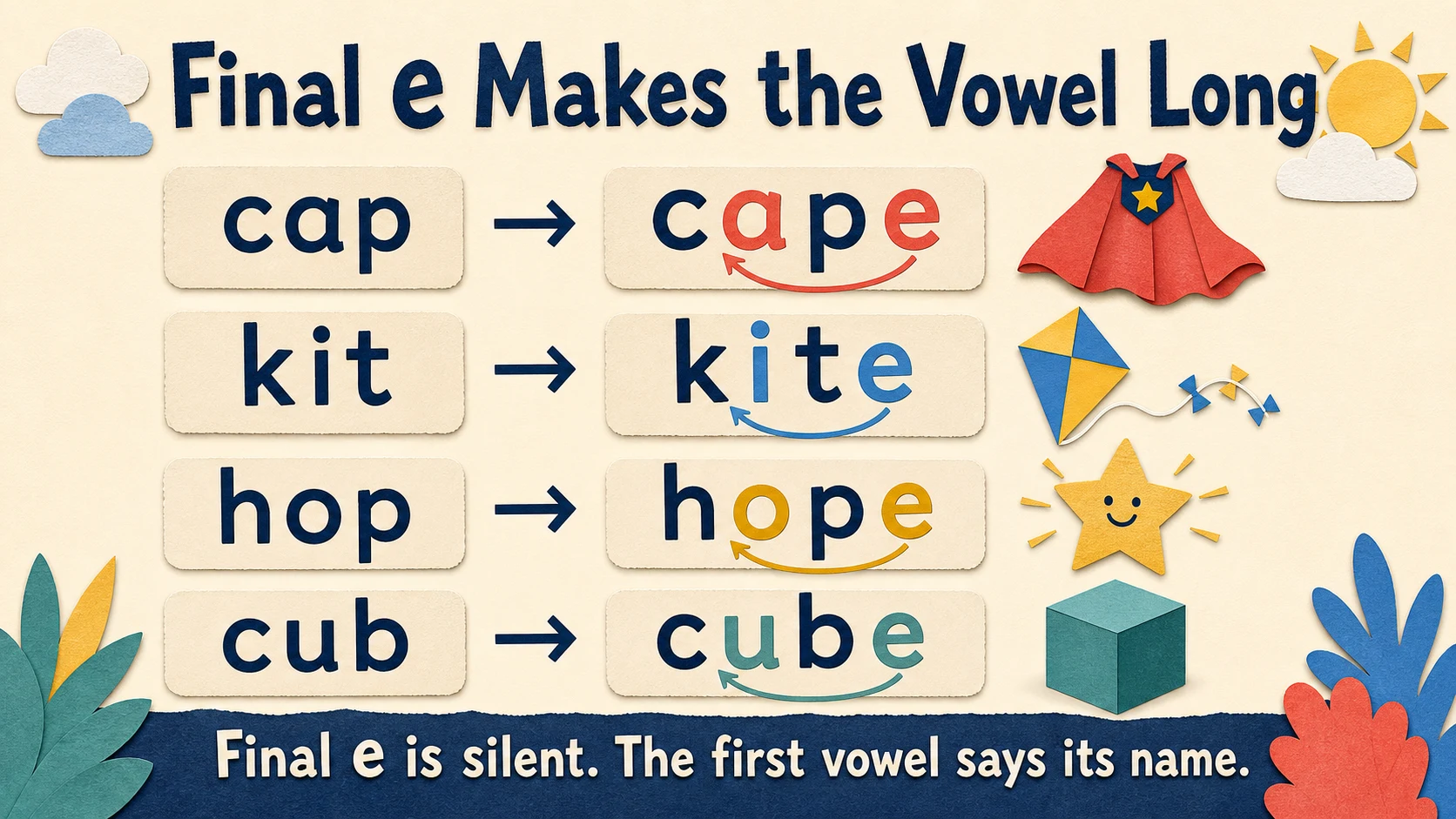
Long-vowel learning connects sound recognition, spelling patterns, decoding, and encoding.
Prerequisites to Check Before Teaching Long Vowels
Long-vowel instruction is easier when several earlier skills are secure. A learner does not need flawless performance, but frequent difficulty with these foundations may make long-vowel practice unnecessarily confusing.
Letter sounds and short vowels
Check whether the learner can identify common consonant sounds and the short sounds of a, e, i, o, and u. Use simple words rather than asking for vowel sounds only in isolation:
- map has short a.
- pet has short e.
- sit has short i.
- hot has short o.
- sun has short u.
If map and mop sound the same to the learner, pause to work on listening and contrasting the middle sounds. Adding more spelling patterns will not resolve an underlying sound-discrimination problem.
Blending and segmenting CVC words
Ask the learner to blend /m/ /a/ /p/ into map. Then reverse the task: say map and ask for its three sounds. These related skills support both reading and spelling.
A learner ready for final-e instruction should usually be able to read several regular CVC words without relying on pictures. Useful checks include tap, kit, hop, and cub. If every word requires slow prompting, continue short-vowel blending while introducing only a small number of long-vowel contrasts.
Attention to every letter
Long-vowel patterns require the learner to look beyond the first letter. For example, cap and cape begin alike, but the final e changes the vowel sound. Watch whether the learner scans the whole word before answering.
A practical readiness check is to display cap and cape together. Even before explaining the rule, ask, “What is different?” Noticing the added letter is an important starting point.
A Grade-Appropriate Teaching Progression
The IES foundational reading practice guide supports systematic instruction in sound-letter relationships, decoding, and connected reading. Within the supplied catalogue sequence, that high-level framing can be applied by teaching a limited pattern explicitly, practicing it in words, and then using it in short text. The source does not evaluate this particular WorksheetWise guide or worksheet.
| Stage |
Main focus |
Supported practice |
Evidence that suggests readiness to continue |
| 1 |
Short versus long vowel |
Sort pairs such as cap/cape and hop/hope |
Learner hears and identifies the changed middle sound |
| 2 |
Final-e, or CVCe |
Build and read make, ride, hope, and cube |
Learner checks the ending and blends without guessing |
| 3 |
Common vowel teams |
Teach ai, ay, ee, ea, oa in small groups |
Learner reads taught patterns and sorts them by spelling |
| 4 |
Additional catalogue patterns |
Add ow and ue with carefully selected examples |
Learner recognizes the taught sound-spelling connection |
| 5 |
Open syllables |
Read words such as he and go |
Learner notices that the vowel ends the syllable |
| 6 |
Mixed decoding and spelling |
Mix CVC, CVCe, vowel-team, and open-syllable words |
Learner selects a strategy from the printed pattern |
| 7 |
Application |
Read phrases and write dictated words or sentences |
Learner carries the pattern into meaningful reading and writing |
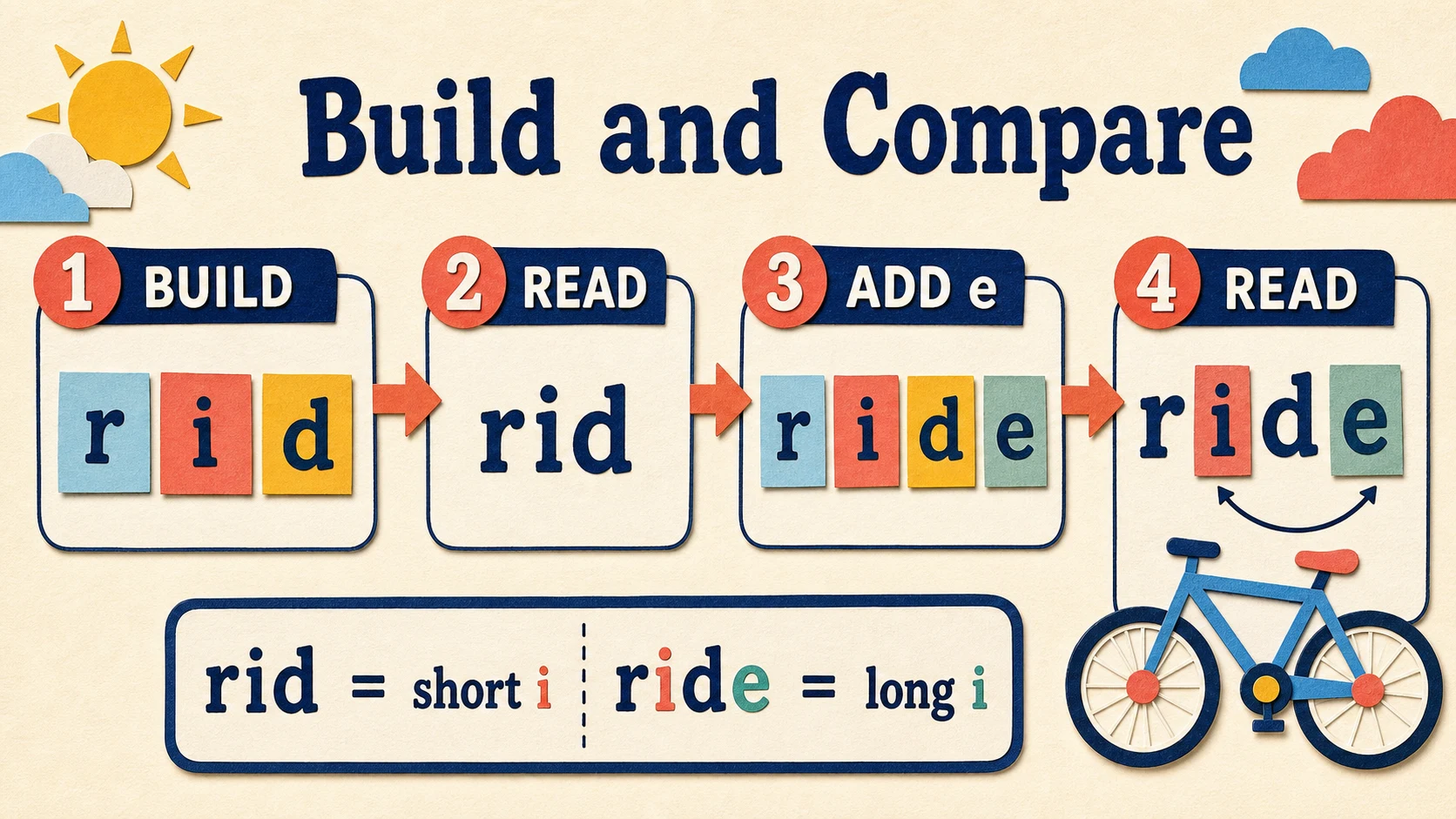
Support can gradually move from side-by-side contrasts to independent reading and spelling.
Why final-e comes first
Final-e is visually distinctive and creates useful contrasts with known CVC words:
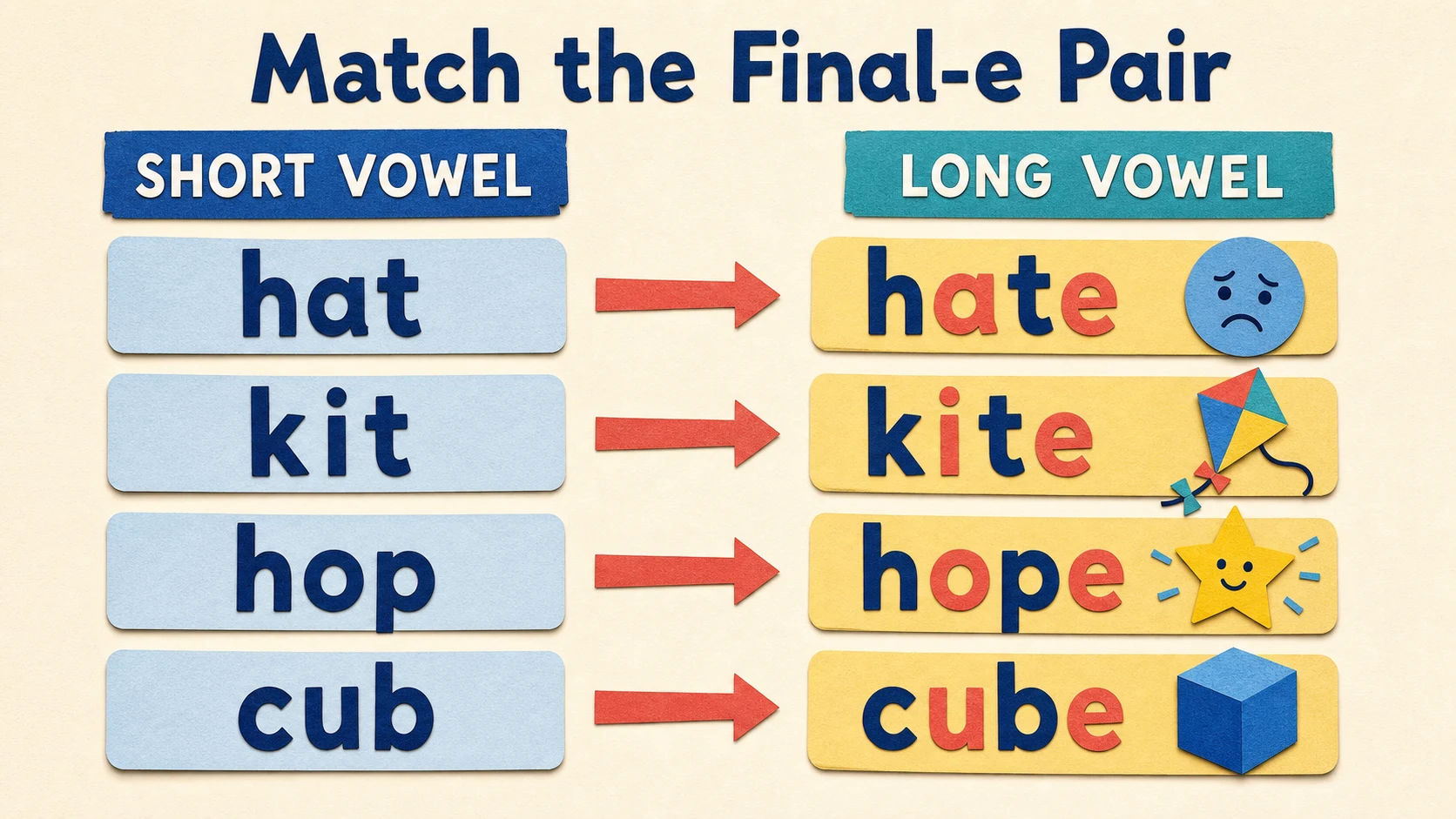
- cap → cape
- tap → tape
- pin → pine
- rid → ride
- hop → hope
- cub → cube
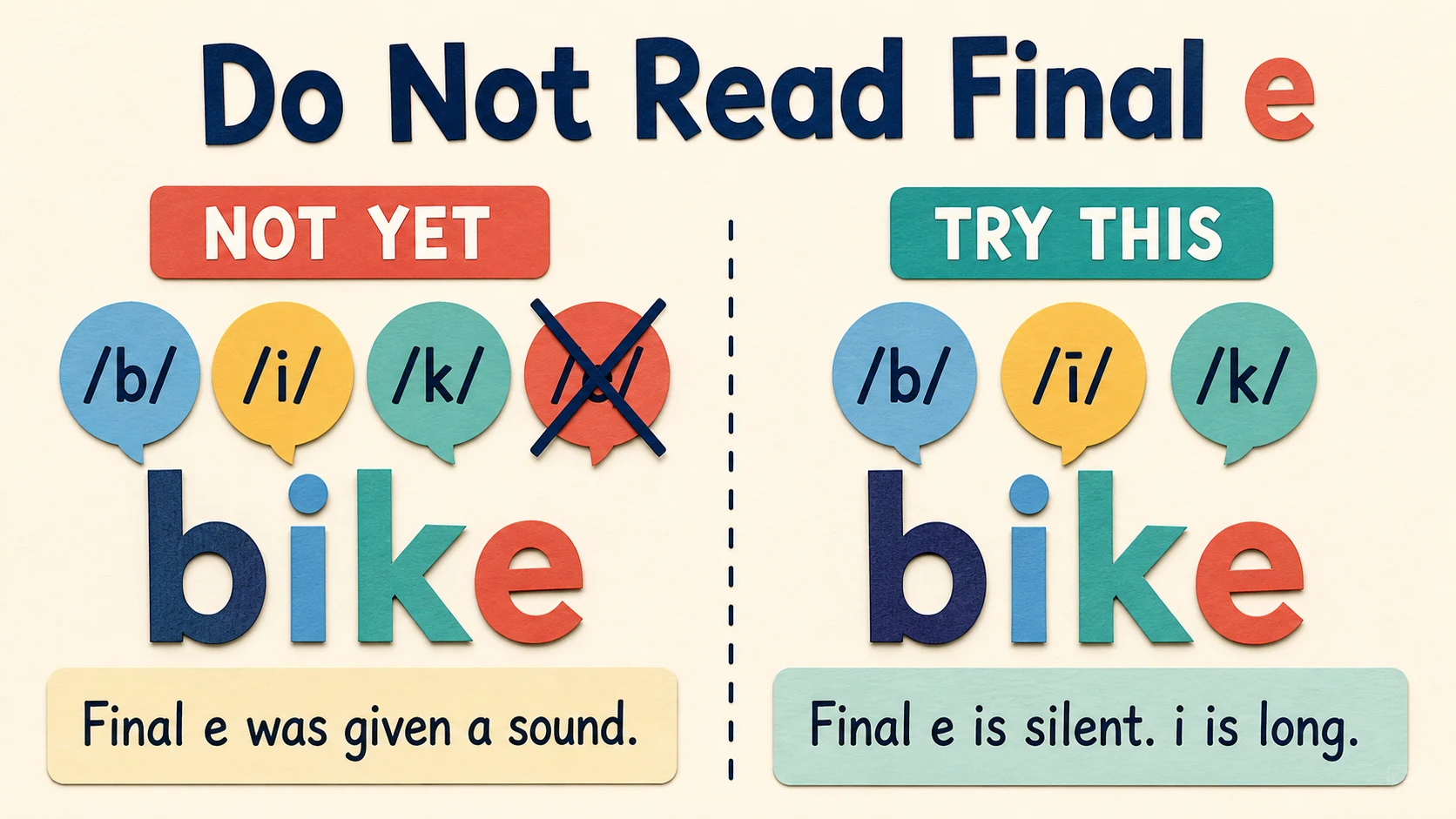
A child-friendly explanation is, “The e at the end makes the earlier vowel say its name.” This is an instructional starting point for selected regular examples, not a claim that every word ending in e follows the pattern.
How to introduce vowel teams
After final-e words are becoming familiar, introduce common vowel teams in small sets. The catalogue includes ai, ay, ea, ee, oa, ow, and ue.
The familiar saying “When two vowels go walking, the first one does the talking” can help learners remember examples such as rain, feet, and boat. Present it as a temporary memory aid, not an absolute English spelling rule. Some vowel pairs represent other sounds, so the learner must eventually know individual patterns and words.
Start with one sound and two spellings where possible. For long a, compare a_e, ai, and ay in cake, rain, and play. Ask the learner to hear the shared vowel sound while noticing the different spellings.
Open syllables
An open syllable ends in a vowel, and that vowel can be long. The one-syllable words he and go are clear introductory examples. The first syllable in music also illustrates an open syllable, but a multisyllabic word requires more processing than he or go. Use simple one-syllable examples before expecting the learner to analyze longer words.
Concrete and Visual Models That Clarify the Pattern
Long vowels are sounds, but learners encounter them through visible letter patterns. Effective models link what the learner hears, sees, reads, and writes.
Build-and-change word cards
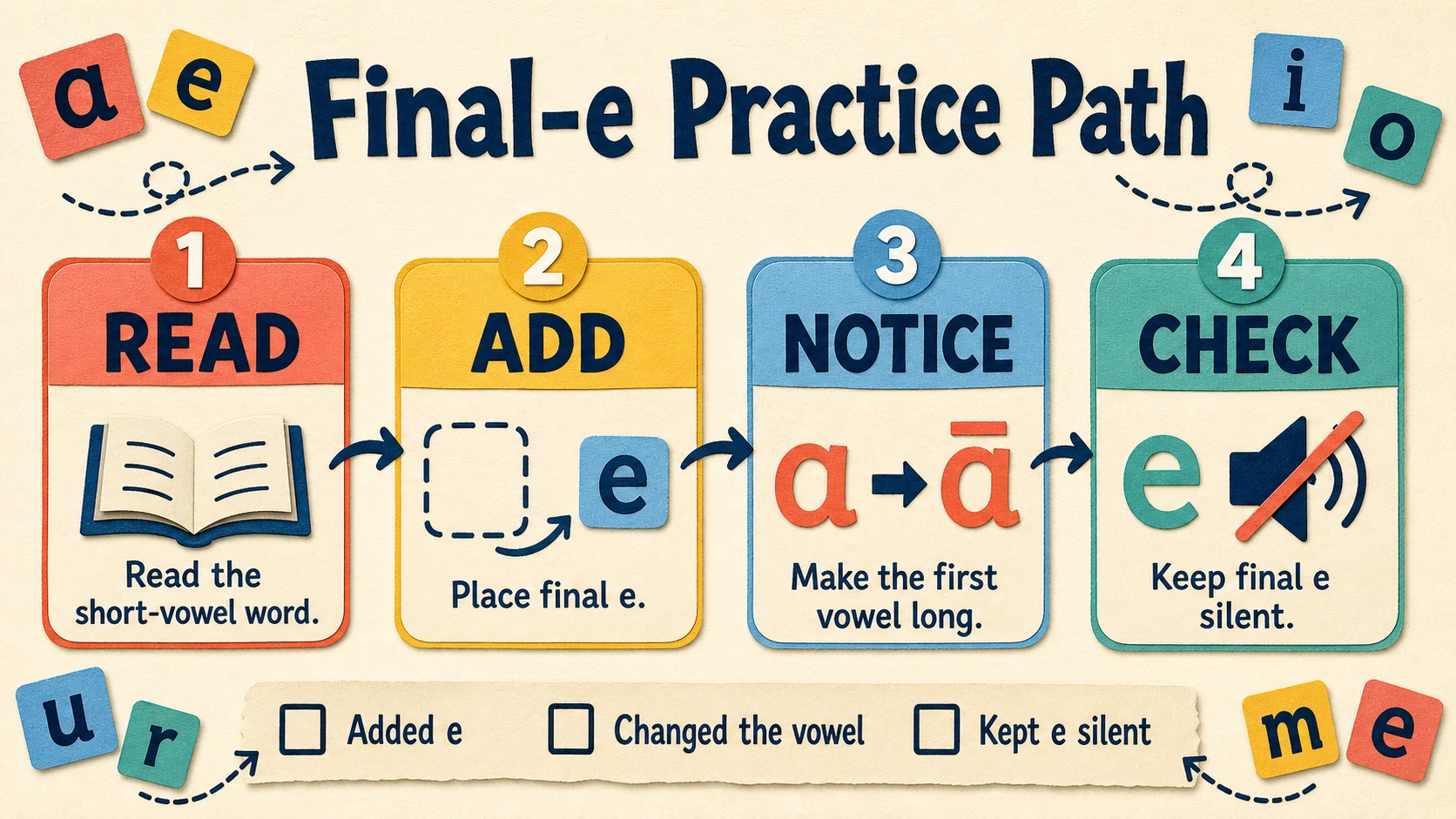
Write each letter on a separate card. Build c-a-p and blend cap. Add e to make c-a-p-e. Have the learner point to the first vowel, then the final e, before reading cape.
Use a curved arrow from the final e back to the first vowel. The arrow is not part of the word; it is a visual reminder of the instructional relationship being taught.
Repeat the process with tap/tape, pin/pine, hop/hope, and cub/cube. Ask what changed in both spelling and sound.
Sound boxes with letter groups
Draw one box for each sound, not necessarily one for each letter. For rain, use three sound boxes:
The two letters ai share one box because they work together to represent the vowel sound. This helps prevent the learner from trying to pronounce a and i separately.
For feet, the mapping is /f/ /ē/ /t/, with ee in the middle box. For boat, it is /b/ /ō/ /t/, with oa together.
Color and sorting models
Use one consistent visual code, such as underlining the long-vowel spelling:
- ca_ek? No—show the actual word as cake only if the learner understands which letters matter.
- A clearer first model is cake: circle a, box final e, and connect them.
- In rain, underline ai.
- In feet, underline ee.
- In go, circle the final o.
Avoid decorating every letter differently. The visual should direct attention to the target pattern rather than make the word harder to scan.
Fully Checked Worked Examples
The following examples model both decoding and explanation. Adults can first demonstrate the complete reasoning, then leave one step for the learner to supply.
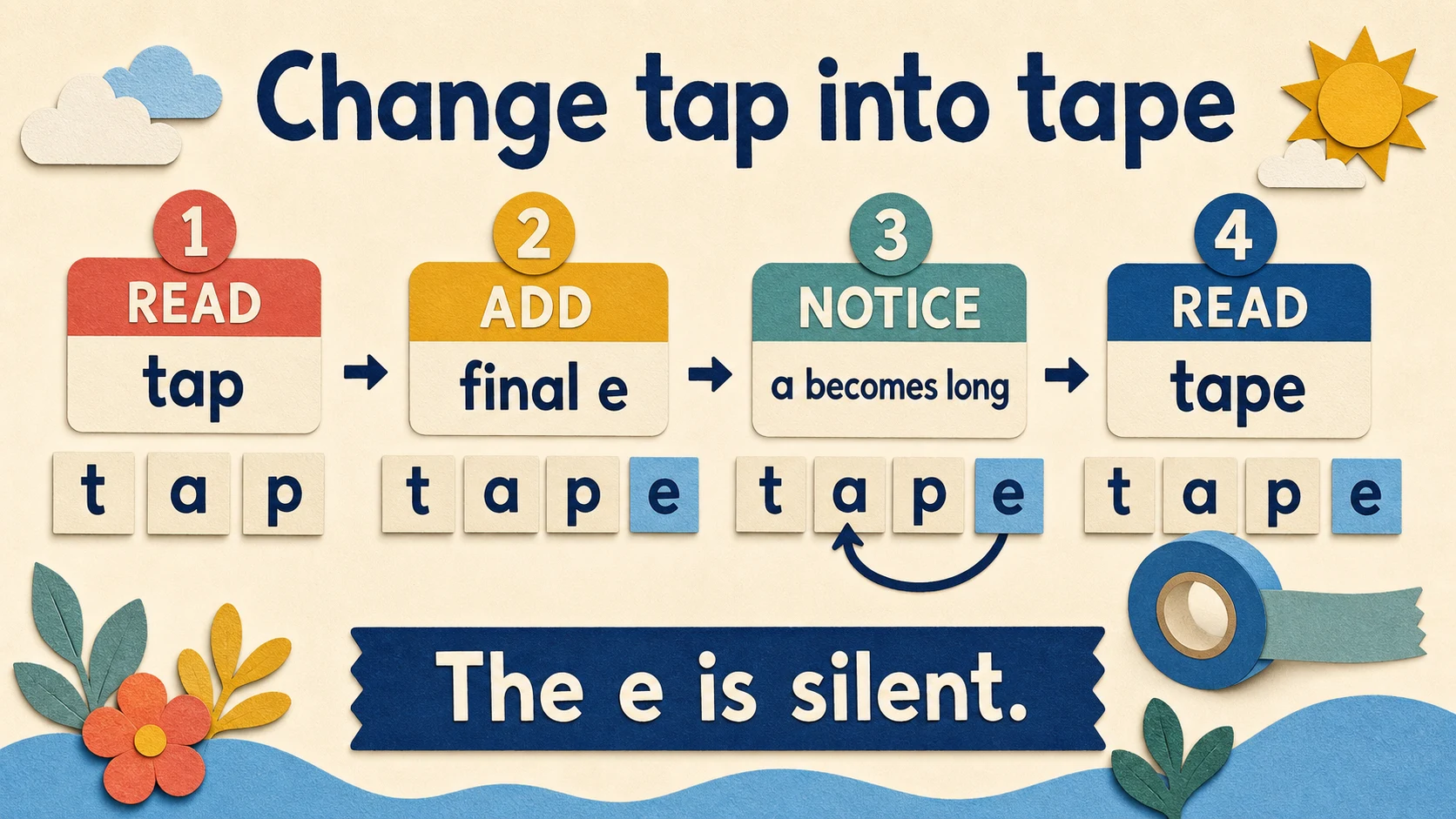
The learner moves from inspecting the letters to blending the complete word.
Worked example 1: cap and cape
Word 1: cap
- Read the letters from left to right: c-a-p.
- The vowel a is between two consonants.
- Blend the sounds:
/k/ /ă/ /p/.
- The word is cap, with short a.
Word 2: cape
- Inspect the whole word: c-a-p-e.
- Notice the final e.
- Apply the taught final-e pattern: the earlier a says its name.
- Blend
/k/ /ā/ /p/.
- The word is cape, with long a. The final e is not pronounced as a separate sound.
The contrast is fully controlled: adding final e changes cap to cape and short a to long a.
Worked example 2: pin and pine
Word 1: pin
- The letters are p-i-n.
- Blend
/p/ /ĭ/ /n/.
- The word is pin, with short i.
Word 2: pine
- The letters are p-i-n-e.
- Final e signals the taught CVCe pattern.
- Change the middle vowel from
/ĭ/ to /ī/.
- Blend
/p/ /ī/ /n/.
- The word is pine, with long i.
For spelling, say pine, stretch the sounds, and then ask, “What pattern can show long i here?” The expected taught spelling is i_e: p-i-n-e.
Worked example 3: hop and hope
Word 1: hop
- Read h-o-p.
- Blend
/h/ /ŏ/ /p/.
- The word is hop, with short o.
Word 2: hope
- Read through the ending and notice e.
- Connect final e with the earlier o.
- Blend
/h/ /ō/ /p/.
- The word is hope, with long o.
If the learner reads hope as hop, cover and reveal the final letter again. Ask the learner to inspect the whole word before blending a second time.
Worked example 4: rain
- Inspect r-a-i-n.
- Identify ai as the taught vowel team.
- Place ai together in one sound box.
- Map the sounds:
/r/ /ā/ /n/.
- Blend the word: rain.
- The long-vowel sound is long a, spelled ai.
For encoding, give the pattern choice a_e, ai, or ay. Say rain and ask the learner to select the spelling used in the practiced word. This is a spelling-pattern task, not a request to infer every English spelling from sound alone.
Worked example 5: feet
- Inspect f-e-e-t.
- Identify ee as a vowel team.
- Map
/f/ /ē/ /t/.
- Blend feet.
- The long-vowel sound is long e, spelled ee.
Contrast feet with fit. The consonants differ only because feet ends with t while fit also ends with t; the central comparison is ee versus i and /ē/ versus /ĭ/.
Worked example 6: go
- The word has two letters: g-o.
- The vowel o comes at the end of the syllable.
- Read o as long o in this taught open-syllable word.
- Blend
/g/ /ō/.
- The word is go.
This example does not use final e or a vowel team. It shows why learners need more than one route to a long-vowel sound.
Boundary Cases and Misconceptions
English spelling patterns are useful, but beginning explanations should not be turned into universal rules.
“Every final e makes the vowel long”
It does not. The word have ends in e, but its a is not the long a heard in cake. That makes have a poor word for first practice with the final-e pattern.
Teach regular, controlled examples first. When an exception appears in reading, say plainly that this word does not follow the pattern being practiced. Do not require the learner to force the regular strategy onto it.
“Every vowel pair uses the first vowel’s name”
This memory aid works for many catalogue examples, including ai in rain, ee in feet, and oa in boat. It does not describe every two-vowel spelling. For example, ea is not long e in bread.
The corrective language can be brief: “That saying helps with some words. In this word, the vowel team represents a different sound.”
“A long word must contain a long vowel”
Long in “long vowel” names a sound category; it does not describe the length of the printed word. He is a two-letter word with long e. A longer word can contain a short vowel.
“The learner should guess from the picture”
Pictures can establish meaning, but they do not replace decoding. If a picture shows a boat and the learner says ship, the answer makes sense semantically but does not match the letters. Prompt, “Check the first sound and the vowel team. What word do those letters make?”
“Reading a pattern means the learner can spell it”
Decoding and encoding are connected but distinct tasks. A learner may read rain correctly when ai is visible yet spell it as ran or rane. Include short dictation and word-building practice rather than assuming that reading alone establishes spelling.
A Short, Repeatable Lesson Routine
The following 10- to 15-minute routine is an instructional suggestion, not a sourced universal timetable. Shorten it when attention or accuracy declines. Extend it only when the learner remains engaged and is working carefully.
Each lesson revisits known material, teaches one focus, and ends with an observable check.
1. Review known sounds and words
Spend about two minutes reading three short-vowel words and two previously taught long-vowel words. Keep the review brisk enough to reveal whether recognition is becoming easier.
2. State and model one focus
Say, “Today we will read long o words with final e.” Build hop, add e, and model hope. Point to the spelling feature that changed the vowel sound.
Avoid presenting final-e, three vowel teams, and open syllables in the same first explanation. A narrow target makes errors easier to interpret.
3. Practice with support
Read or build four to six examples. Mix one or two short-vowel contrasts into the set:
- hop, hope
- not, note
- rod, rode
Prompt the learner to identify the relevant spelling before reading. Reduce the prompt once the learner begins doing this independently.
4. Dictate one or two words
Say a practiced word without displaying it. Ask the learner to repeat it, segment it, choose the pattern, and write it. Have the learner read the completed word back.
The IES elementary writing guide provides high-level support for explicit instruction, guided practice, and regular writing opportunities. Here, a brief dictation task is an instructional application of that broad framing; the source does not prescribe this exact long-vowel routine.
5. Finish with a quick check
Present one known word and one new word using the taught pattern. Record whether each was read:
- independently,
- after a reminder to inspect the pattern,
- after sound-by-sound support, or
- incorrectly.
That information should shape the next lesson.
Choosing Practice and Differentiating Support
Practice should match the learner’s present error pattern, not simply the grade printed on the page. The 1st Grade phonics hub can help adults place long-vowel work alongside related decoding skills, while the long-vowels topic guide keeps the focus on this particular skill.
When the learner is just beginning
Choose a small set of final-e word pairs with familiar consonants. Use letter cards, side-by-side comparisons, and oral blending. An easy worksheet should follow direct teaching rather than serve as the learner’s first explanation.
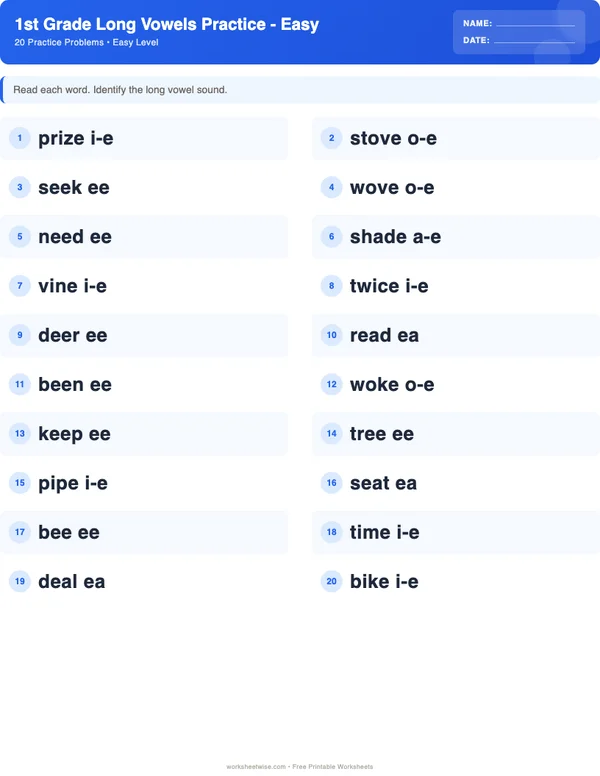
The free easy long-vowels worksheet contains 20 exercises in which learners read words and identify long-vowel sounds. It is suited to introductory practice or reinforcement when that task matches the learner’s needs.
When reading is accurate but slow
Use short word chains and repeated mixed reading:
- tap → tape
- rip → ripe
- hop → hope
- cub → cube
Ask for careful reading before speed. If accuracy remains stable, reread the same set later and observe whether the process becomes smoother.
When reading is stronger than spelling
Use word building and dictation. Sort long-a words by a_e, ai, and ay, then dictate selected practiced words. Provide the possible pattern headings at first. Remove them only after the learner can recall the alternatives.
When the learner needs more challenge
Mix pattern types instead of adding obscure words:
- cake, rain, play
- feet, team, he
- hope, boat, go
Ask the learner to name both the vowel sound and its spelling. Add a short sentence so decoding serves meaning: “The boat can float.” Confirm every target word before using it; not all words containing two vowels follow the same generalization.
The focused 1st Grade Long Vowels pack contains 18 worksheets and offers a larger practice pool. More pages are useful only when they provide suitable variation or review. Repeating a task the learner fundamentally misunderstands is not productive differentiation.
Diagnosing Common Errors
The response should address the source of the error, not merely mark the answer wrong.
| Observed response |
Likely instructional issue |
Teaching response |
| Reads cape as cap |
Does not inspect final e, or defaults to a familiar CVC pattern |
Compare cap/cape with letter cards and require a whole-word scan |
| Reads rain as two vowel sounds |
Treats a and i separately |
Put ai in one sound box and blend /r/ /ā/ /n/ |
| Reads every ea word as long e |
Overgeneralizes a taught vowel-team pattern |
Contrast a taught regular example with a boundary word such as bread |
| Identifies long a but cannot spell rain |
Sound is known, spelling pattern is not secure |
Sort and build words under a_e, ai, and ay headings |
| Guesses a related picture word |
Uses meaning without checking print |
Ask for first sound, vowel pattern, and final sound |
| Reads correctly only after the adult names the pattern |
Strategy remains prompt-dependent |
Pause before helping and ask, “What do you notice?” |
| Confuses hop and hope in both directions |
Short/long contrast is unstable |
Return to listening, matching, and minimal word-pair practice |
| Performs well in a word list but not a sentence |
Application requires more attention or fluency |
Use short phrases and sentences containing already taught patterns |
A single mistake is not enough to establish a persistent difficulty. Look for a pattern across several items and more than one session. This guide offers instructional analysis, not medical or diagnostic guidance.
Monitoring Progress Without Over-Testing
Use a brief record every few lessons. Select five to eight words that represent the current teaching target. Include known items, one or two unfamiliar regular examples, and an occasional short-vowel contrast.
Record three separate outcomes:
| Area |
What to observe |
| Sound recognition |
Can the learner identify the long-vowel sound? |
| Decoding |
Can the learner read the complete word from print? |
| Encoding |
Can the learner spell a practiced word from dictation? |
Do not combine these into a vague judgment such as “knows long vowels.” A learner may identify long a correctly while still confusing ai and ay in spelling.
Advance when performance is consistently accurate with little prompting and the learner can handle a new regular example. Review when the same error recurs, responses depend on adult clues, or accuracy falls sharply in mixed practice. If only one spelling pattern causes difficulty, reteach that pattern rather than restarting the entire topic.
The Common Core English Language Arts standards include first-grade foundational work with final-e and common vowel-team conventions. That source provides standards context, but local sequences, terminology, and assessment expectations differ. This guide does not claim comprehensive standards alignment.
A Two-Week Practice Plan
This plan assumes brief practice on ten instructional days. It is adjustable rather than universal. Repeat a day when the learner still needs heavy support, combine days when the work is already secure, and stop a session when fatigue begins to reduce useful attention.
The plan alternates explicit teaching, comparison, spelling, application, and review.
| Day |
Focus |
Suggested activity |
Quick evidence |
| 1 |
Readiness and contrast |
Read CVC words; compare cap/cape and tap/tape |
Identifies short versus long a |
| 2 |
Final-e long a and i |
Build cape, tape, pine, and ride |
Checks final e before blending |
| 3 |
Final-e long o and u |
Contrast hop/hope and cub/cube |
Reads both members of each pair |
| 4 |
Mixed final-e |
Use a CVC/CVCe word sort and two dictated words |
Sorts by pattern and spells with support |
| 5 |
Review and application |
Read short phrases using taught words |
Maintains accuracy beyond isolated words |
| 6 |
Long a teams |
Sort cake, rain, and play under a_e, ai, and ay |
Names sound and visible spelling |
| 7 |
Long e teams |
Compare ee and ea in selected regular words |
Keeps each team together while blending |
| 8 |
Long o patterns |
Compare hope, boat, and go |
Recognizes three routes to long o |
| 9 |
Mixed reading and spelling |
Read a mixed list; dictate four practiced words |
Chooses a strategy without immediate prompting |
| 10 |
Review and next-step check |
Use five known and three new regular words |
Shows which patterns are secure or need review |
On Days 5 and 10, retain actual work samples. Mark the prompt level rather than only correct or incorrect answers. A correct answer after the adult says, “Look at the final e,” represents different evidence from an independent answer.
Limitations and the Honest Next Step
A long-vowel worksheet can provide organized practice, but it cannot listen to the learner blend, determine why an error occurred, or decide when prompting should be reduced. It also cannot cover every English vowel spelling or every exception. Adults should use printed work alongside oral reading, word building, dictation, and short connected text.
The most useful next action is to teach one clearly defined pattern and then check it with the free 20-exercise long-vowels worksheet. Note whether errors involve hearing the vowel, recognizing its spelling, blending the word, or working independently. Use that evidence—not the calendar—to choose the following lesson.