Curated collectionAnswer keys includedPrint-ready PDFs
Classroom Phonics Worksheets
Move from whole-group modeling to guided practice, independent work and a manageable check routine without using sheets as filler.
Start with a real resource
Browse this worksheet collection
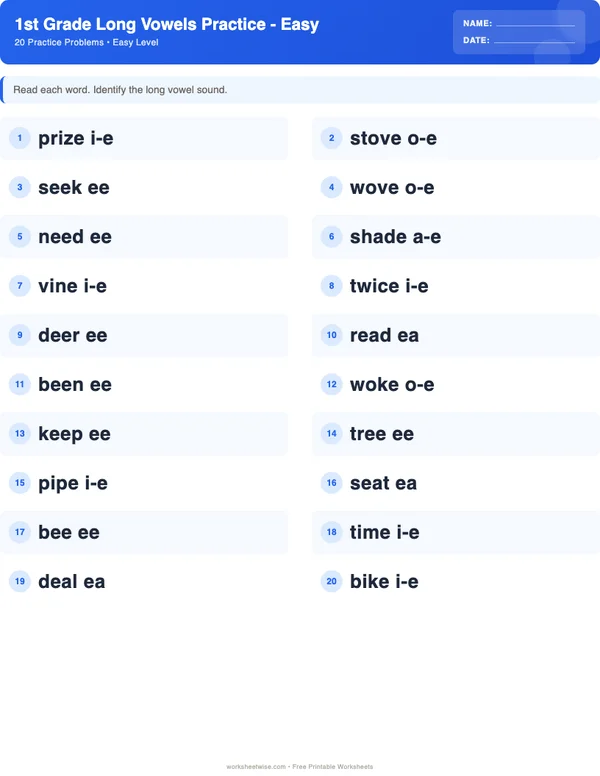
22 relevant free entry points are available. Each one includes a printable learner PDF and separate answer key.
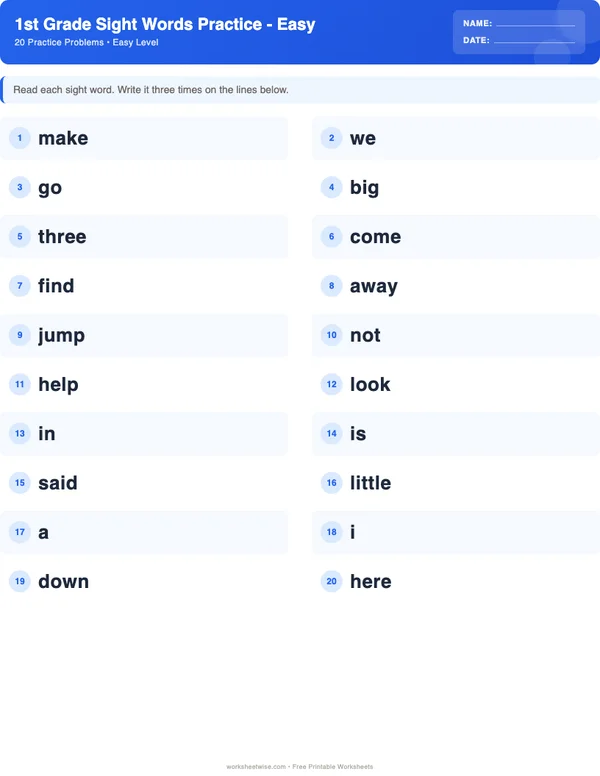
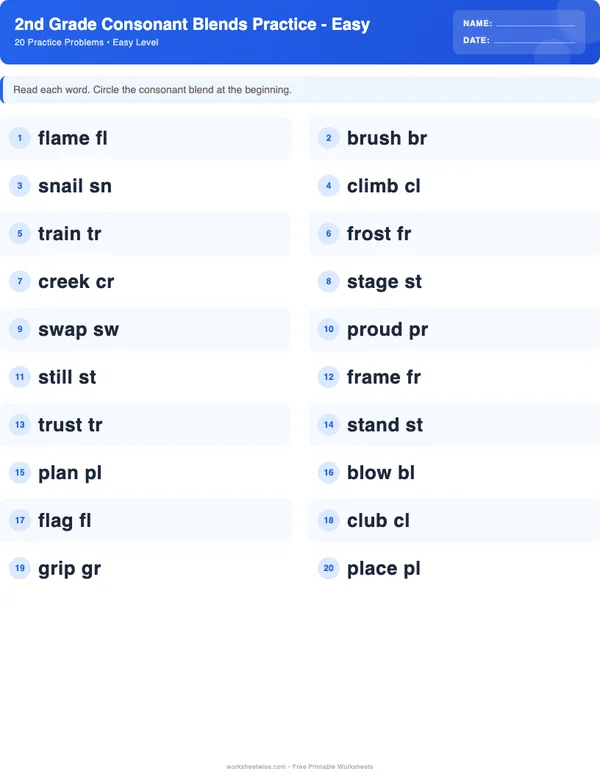
A useful practice loop
Print less. Observe more.
- Choose one skill and model the first item aloud.
- Use a short set and notice the learner’s strategy.
- Change the next task from the work you can see.
Need more than the free sheet?
Plus includes all 396 matching catalogue variations where available, plus saved deterministic generators and the worksheet designer.
See Plus membershipComplete guide
How to teach and practise classroom phonics worksheets
3,308 words Updated 6 instructional visuals
Turn a phonics sheet into a short teaching cycle
Classroom phonics worksheets are most useful when each sheet has a defined job: rehearse a sound-spelling pattern that the teacher has modeled, reveal how learners are processing that pattern, and provide evidence for the next lesson. A sheet should not introduce an unfamiliar pattern by itself or occupy learners who are waiting for instruction.
Use a four-part cycle:
- Model one phonics decision aloud with letters and spoken sounds.
- Guide learners through a few items while prompting the same decision.
- Assign a short, closely matched section for independent work.
- Sort responses by error type and choose the next sheet accordingly.
The live WorksheetWise phonics catalogue contains 396 variants, including 22 free resources across four grade labels and seven topics. That range makes selection important. More pages are not automatically more practice: a short-vowel discrimination sheet, a CVC word-building sheet, and a consonant-blend sort demand different thinking even when all contain short words.
Grade labels describe an intended practice level, not a placement decision. Local curriculum sequences differ. Likewise, age can help an adult discover plausible resources, but it should not decide placement. For ages three and four, prioritize brief adult-led oral, matching, manipulative, and movement work over sustained desk work. A Pre-K sheet can supply pictures or word cards without requiring a young learner to complete all 20 printed problems.
Select the sheet by the decision learners must make
Begin with the phonics target, then inspect the response format. Ask, “What must the learner notice, say, and record?” Do not select a page merely because its grade label matches the class roster.
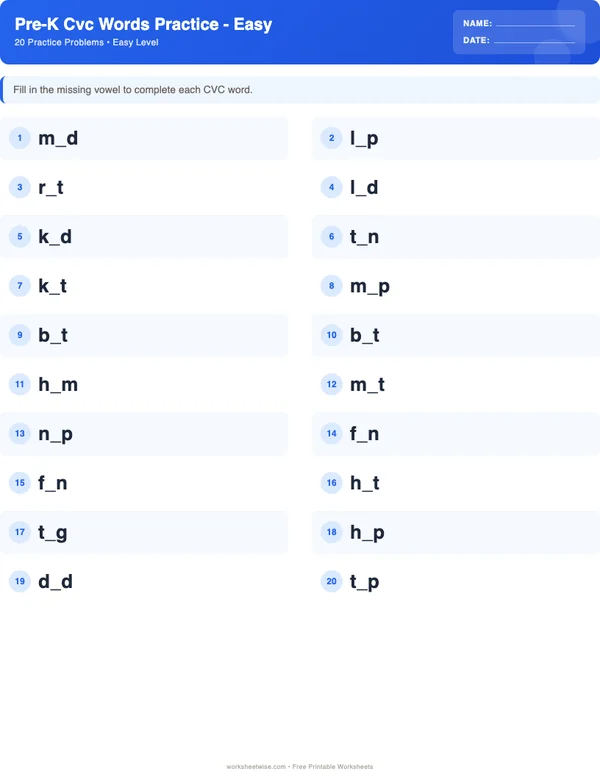
CVC words: blend three phonemes in sequence
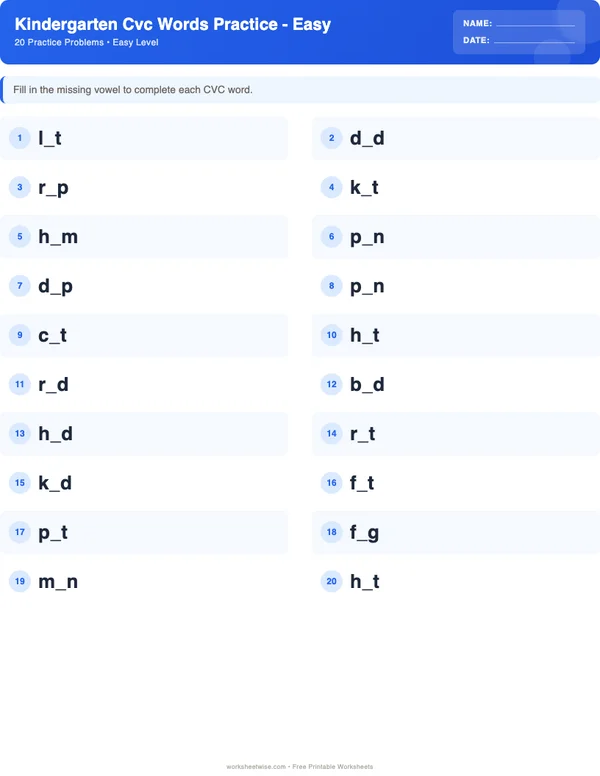
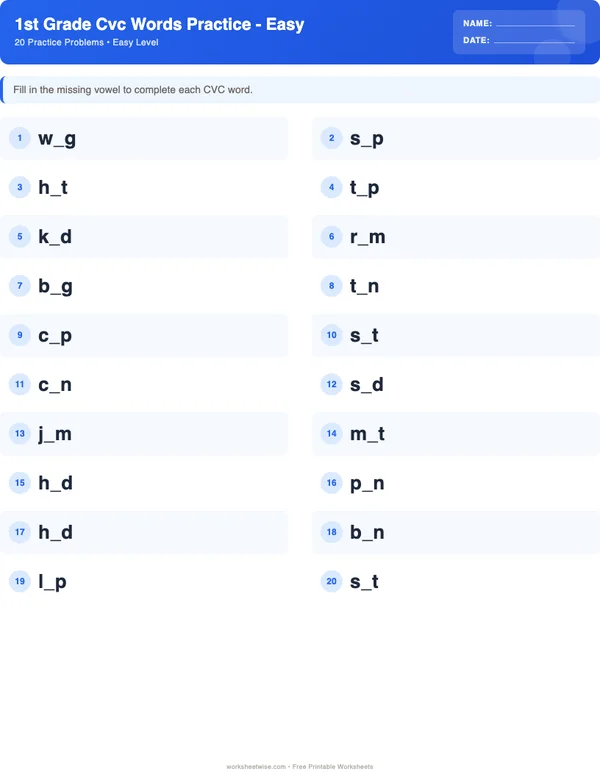
A CVC task belongs after learners can identify the relevant letter sounds and can orally blend a sequence such as /m/ /a/ /p/. The catalogue’s CVC resources include word building, picture matching, fill-in-the-blank, and reading activities. Those formats are not interchangeable:
- Picture matching asks learners to decode a word and connect it to a meaning, but a distinctive picture may permit guessing.
- Word building makes the order of all three letters visible.
- Filling in a missing letter isolates one position, such as the medial vowel.
- Reading a list requires decoding without a picture clue.
- Spelling from dictation requires segmenting a spoken word and encoding every sound.
Consider the checked chain cat → mat → map → mop. Every item is a CVC word. The first change replaces initial /k/ with /m/; the second replaces final /t/ with /p/; the third changes the medial vowel from short a to short o. This example belongs in a CVC lesson because it makes learners attend to one grapheme change at a time while preserving the three-phoneme structure.
For a class still learning to blend, model cat with three sound boxes and tokens, then change only the necessary letter in each following word. For learners who can build the chain with letters, follow it with an unpictured reading item. The Kindergarten CVC Words guide and free sheet is a practical entry point for that transition.
Short vowels: distinguish the middle sound
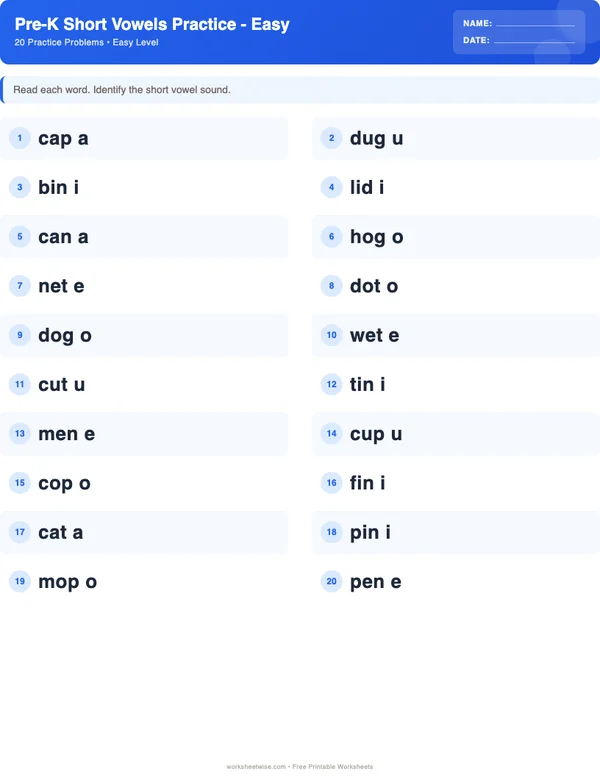
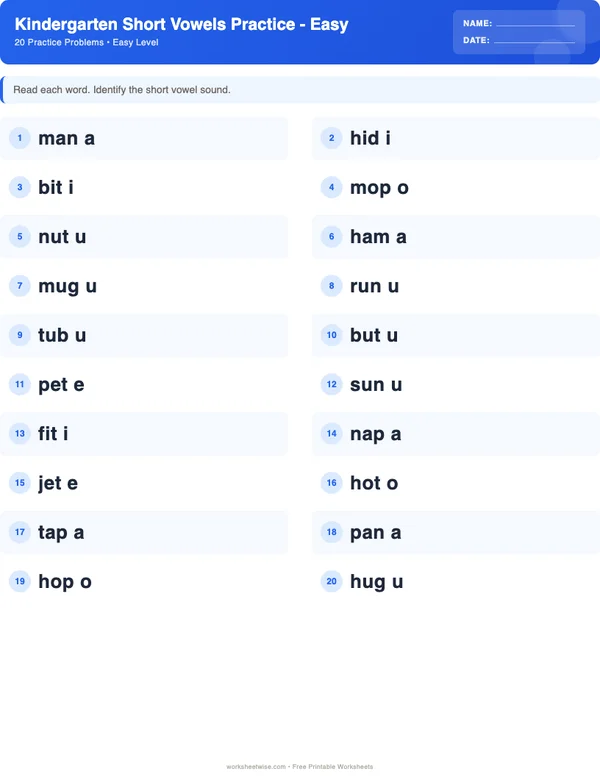
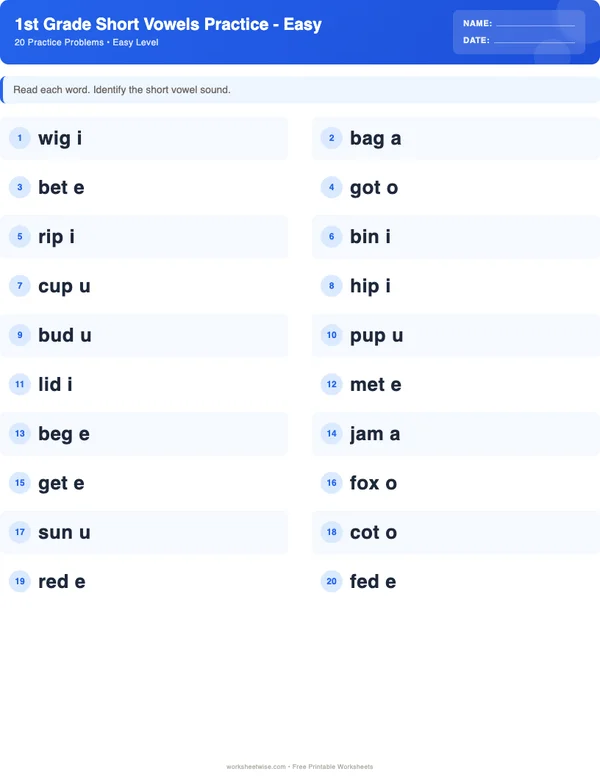
A short-vowel sheet is appropriate when the instructional decision is about the medial vowel, not general word reading. The catalogue identifies short a, e, i, o, and u in closed syllables such as cat, pen, sit, hot, and cup. A useful early page holds the consonant frame steady or uses carefully chosen contrasts so the vowel carries the decision.
Check the pair pen/pin: both have /p/ first and /n/ last; only the medial vowel changes. The same is true of set/sit and bed/bid. These examples belong in short-vowel practice because a correct response cannot come from attending only to the first or last consonant. Say each pair without showing print first. Learners indicate which vowel they hear, then reveal or build the written words. If they cannot distinguish the spoken words, another written discrimination page is premature.
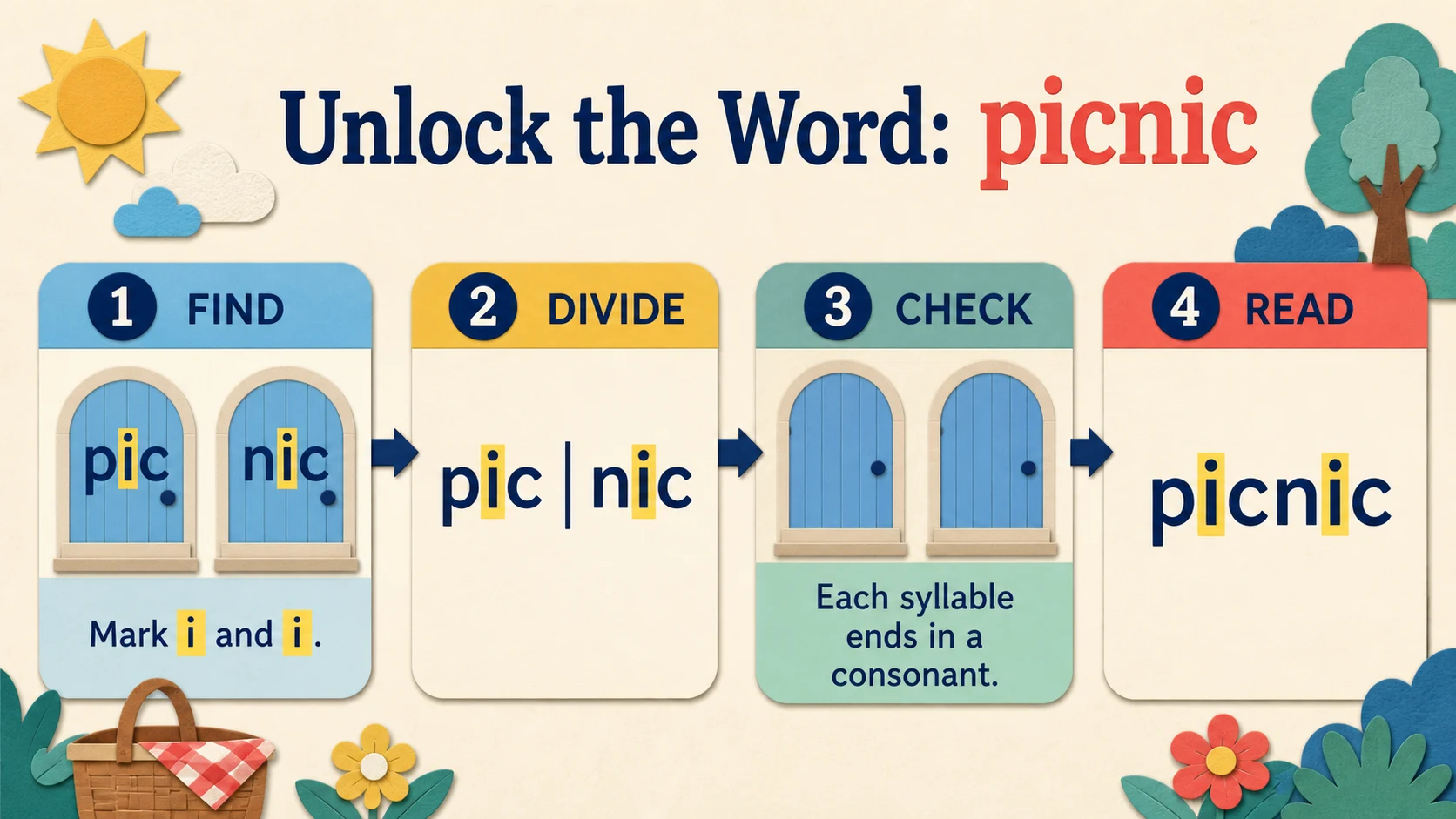
Use the progression to reduce support only after learners can hear, read, and record the medial-vowel contrast—not simply after they finish a page.
Consonant blends: retain both sounds
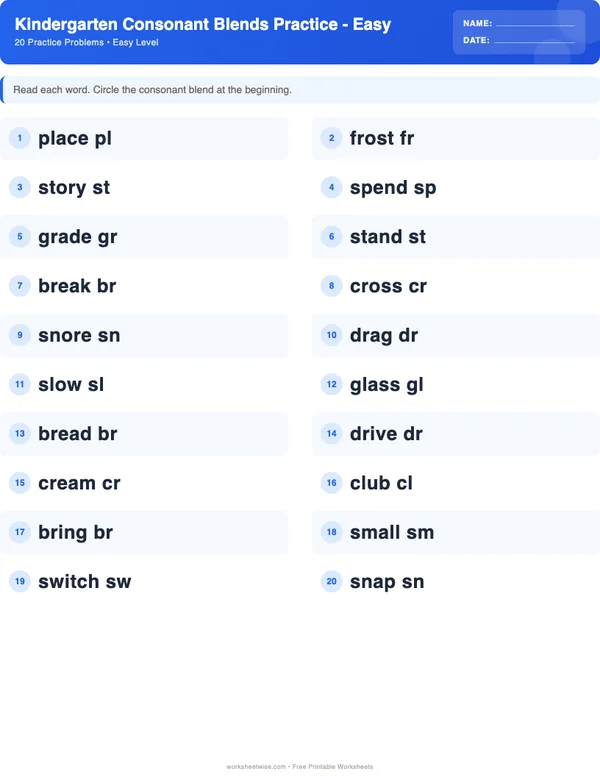
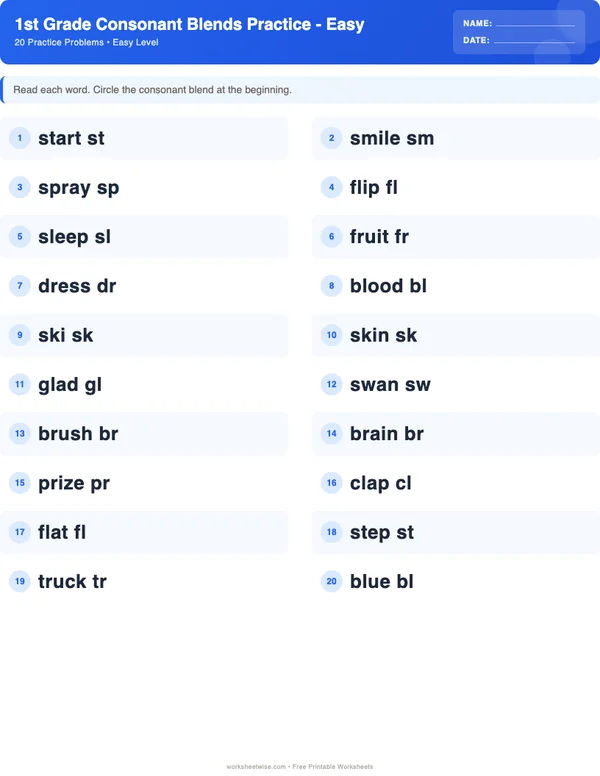
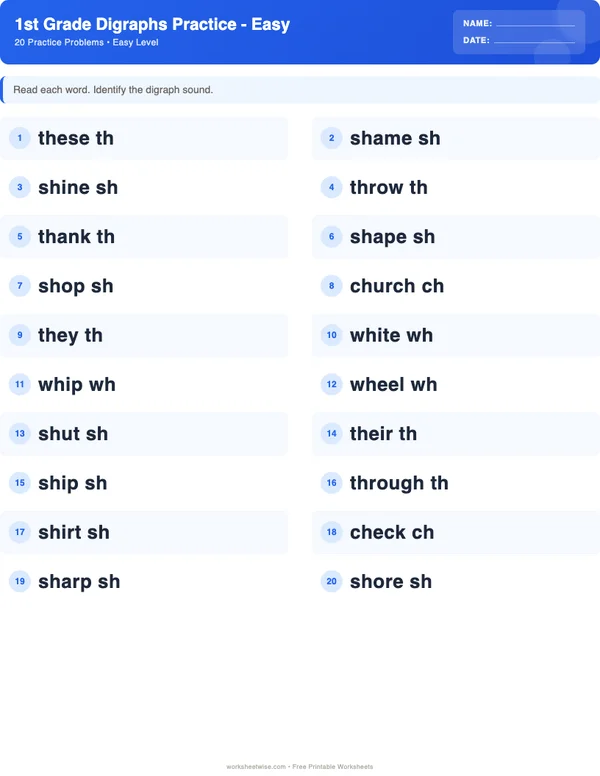
In a blend, each consonant retains its sound. That makes st in stop different from a digraph such as sh in shop, where two letters represent one sound. Select an initial-blend sheet when learners can decode CVC words but omit or distort one consonant as another is added.
Check the catalogue example lap → clap → clam → clamp. Lap has three phonemes. Adding /k/ creates the initial blend in clap; changing the final /p/ to /m/ creates clam; adding /p/ after /m/ creates the final blend in clamp. The chain belongs here because it increases the sound sequence in controlled steps and exposes whether the learner retains every consonant.
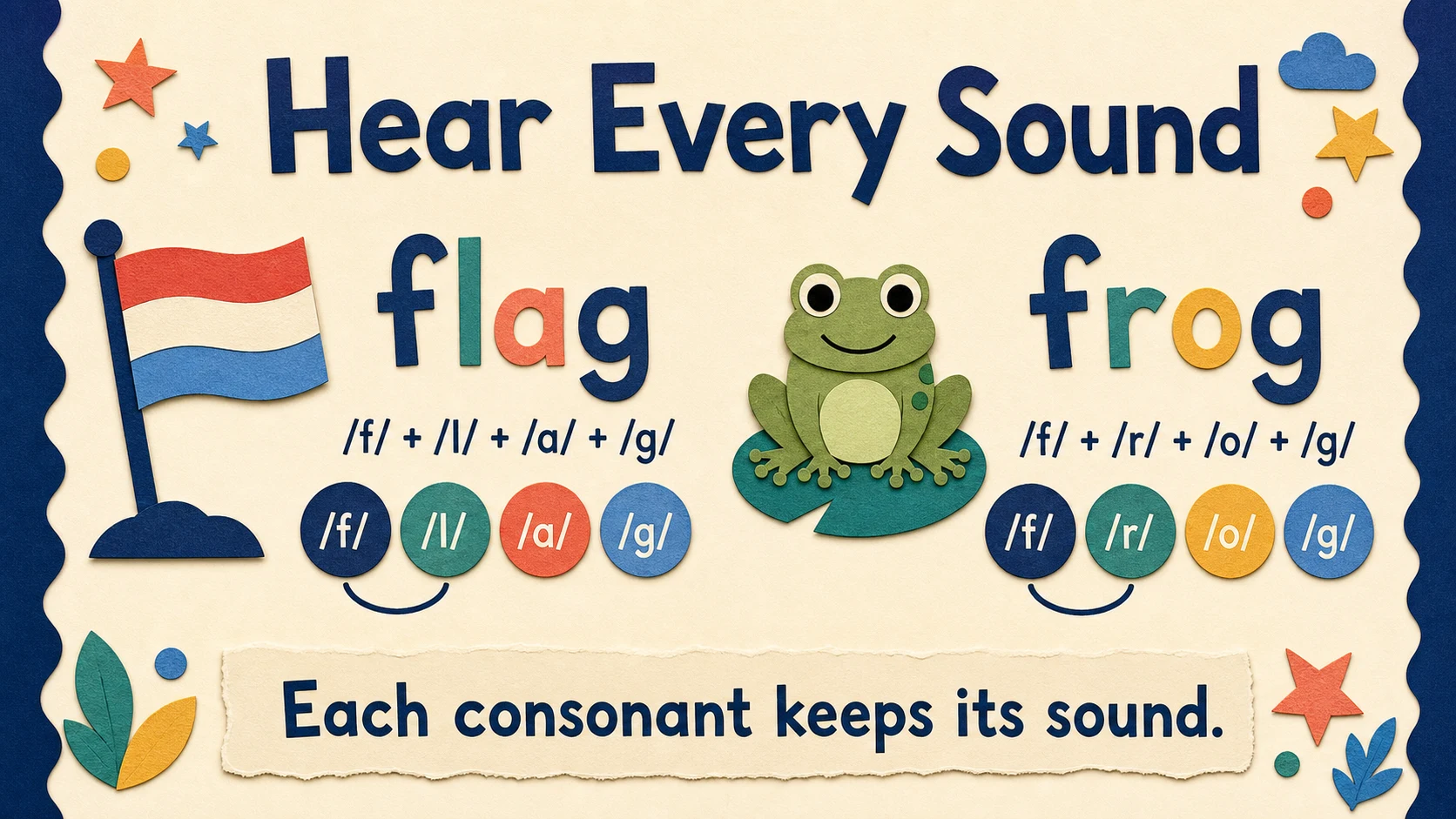
The worked example should make the two consonant sounds audible before learners are asked to select or write the blend independently.
Start with two or three taught blends rather than a page mixing every possible initial and final blend. The catalogue guidance suggests initial s-blends such as sl, sn, sp, st, and sw as useful starting material because /s/ can be sustained. This is a catalogue-based teaching suggestion, not a claim about a universal curriculum order.
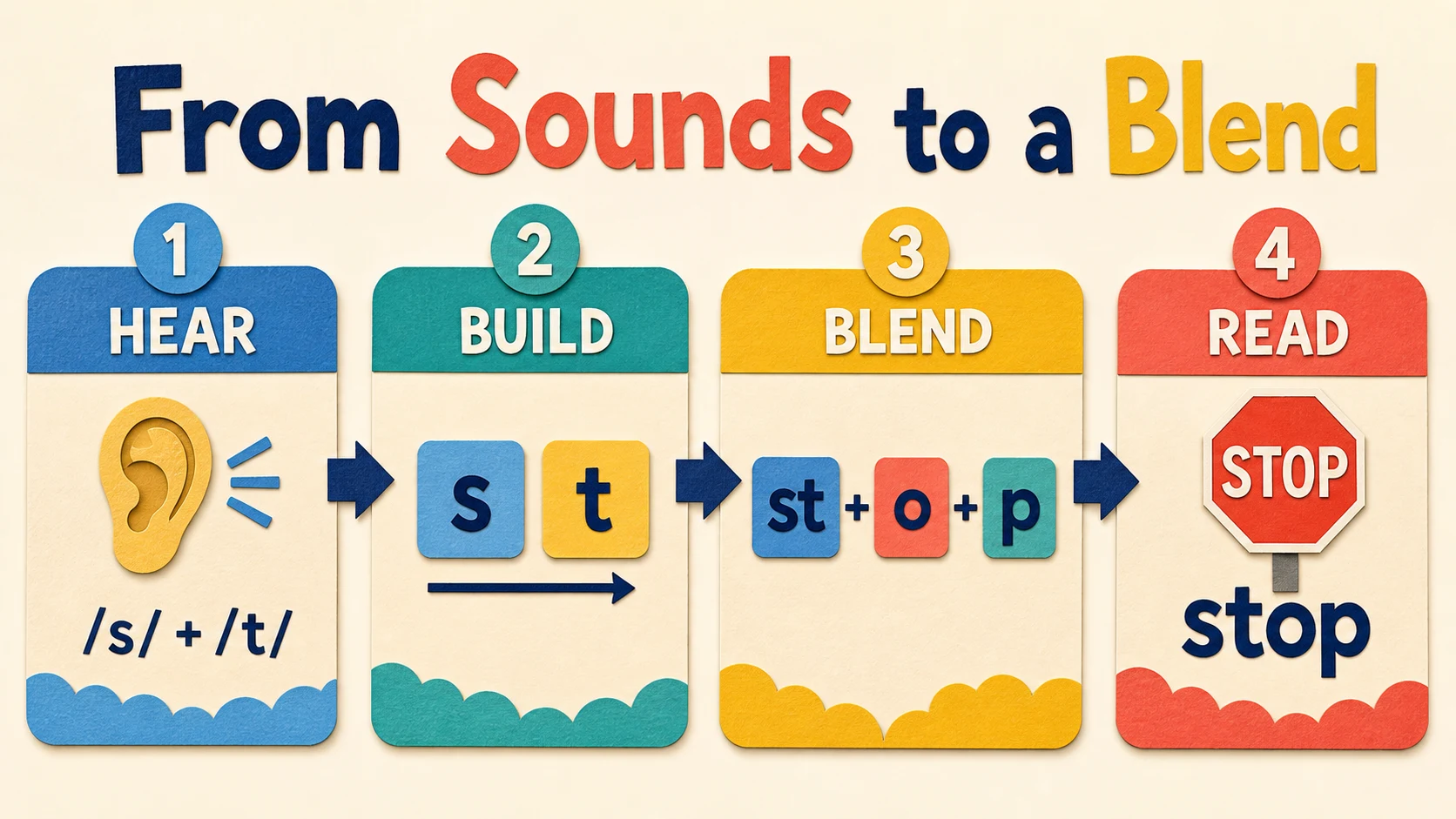
Move from hearing and building a blend to reading and writing it while keeping the target words and correction language consistent.
Digraphs, word families, and sight words: do not collapse the targets
Three pages can look similar while teaching different decisions:
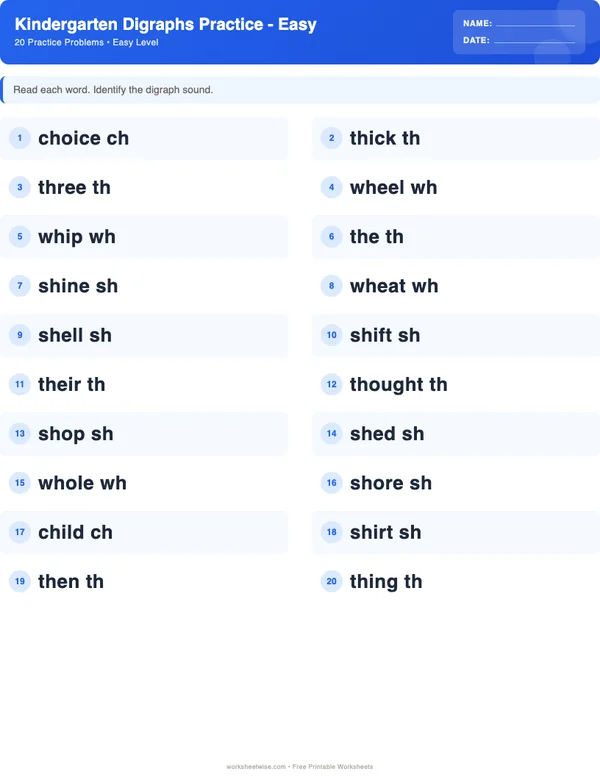
- A digraph page asks whether two letters represent one sound, as in
shinshiporckinduck. - A word-family page asks learners to use a stable ending such as
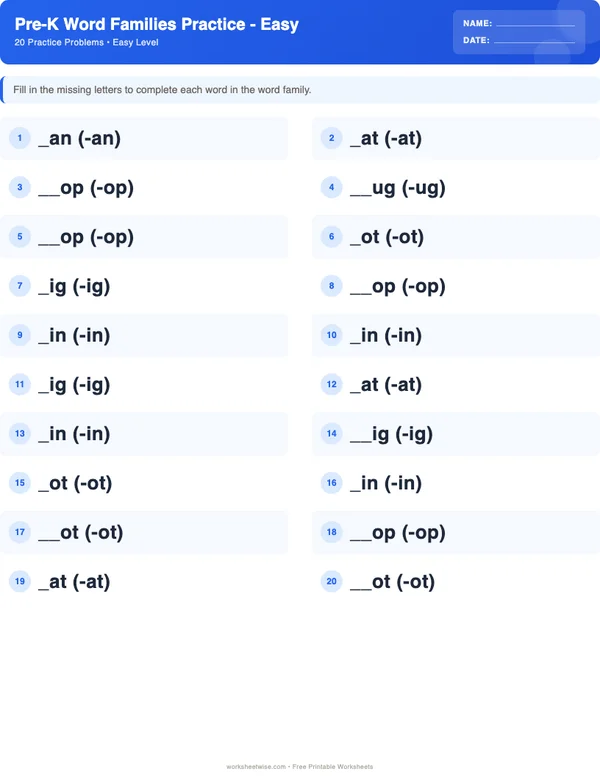
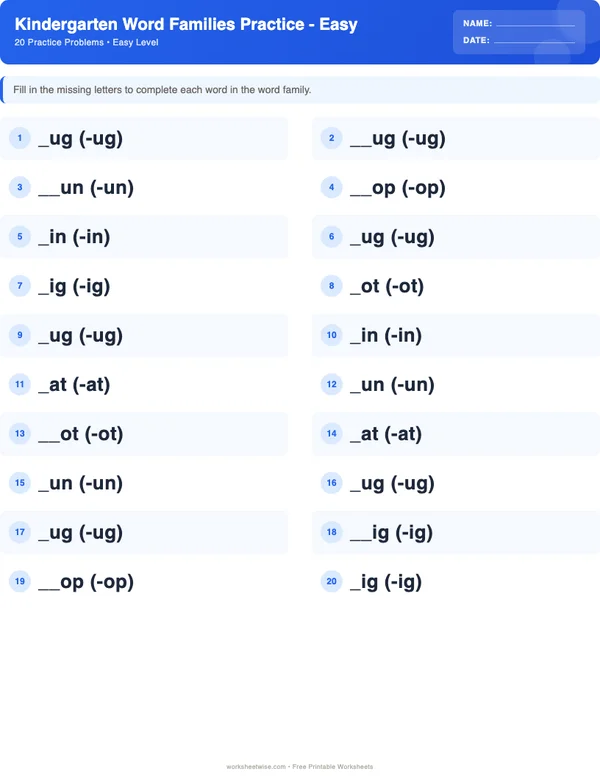
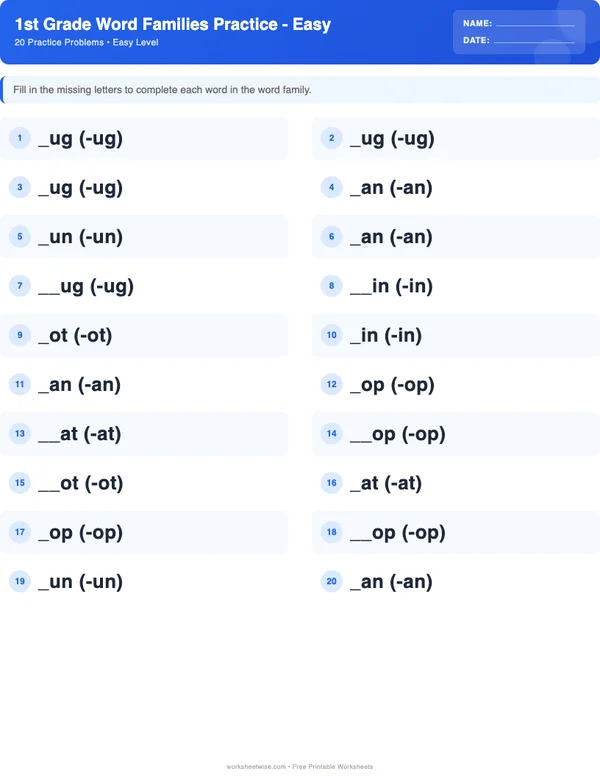
-atwhile changing the onset:cat,bat,hat,mat. - A sight-word page asks learners to read and spell a particular high-frequency word, including attention to any unexpected spelling.
For example, flat can appear in blend practice or an -at family. In a blend lesson, the question is whether the learner retains /f/ and /l/. In a word-family lesson, the question is whether the learner recognizes and uses the stable -at ending. Put only one of those decisions in the directions and feedback.
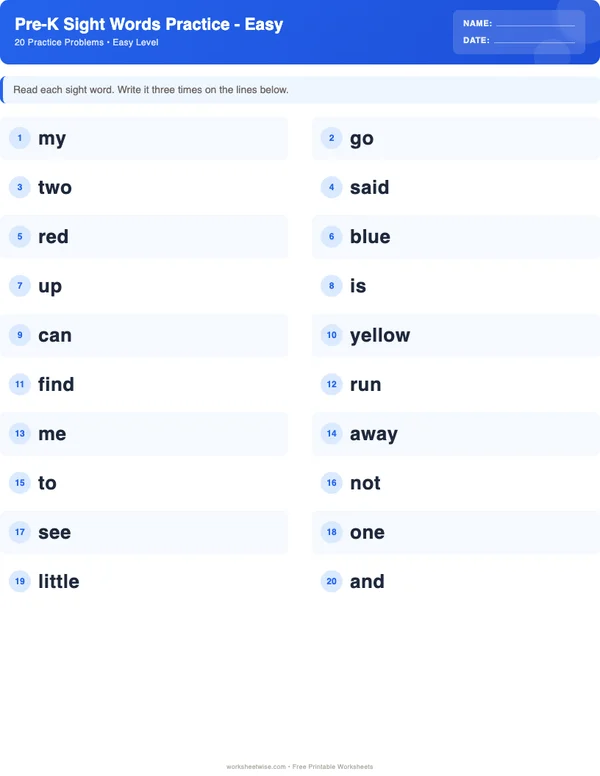
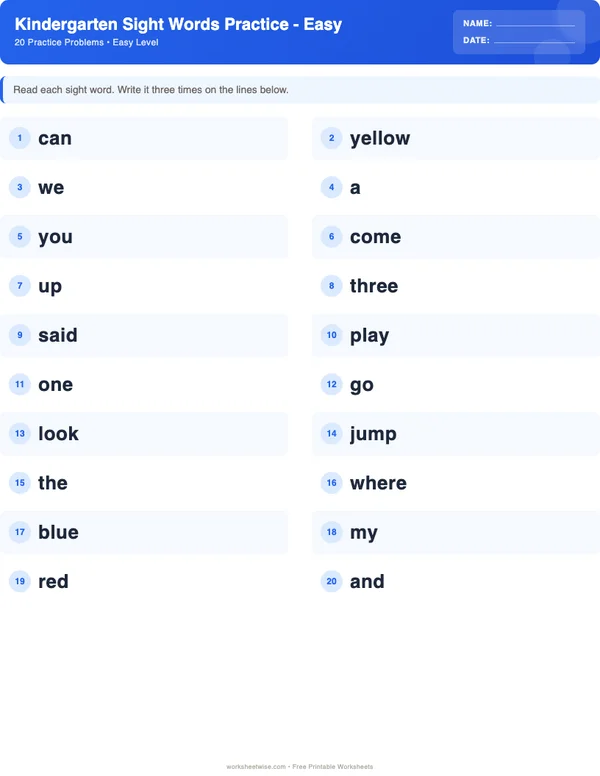
Sight-word work also needs phonics analysis rather than visual memorization alone. In said, the initial s and final d map predictably; the middle spelling requires particular attention. Ask learners to identify the parts they can explain and the part they must remember. Do not call every high-frequency word “irregular.”
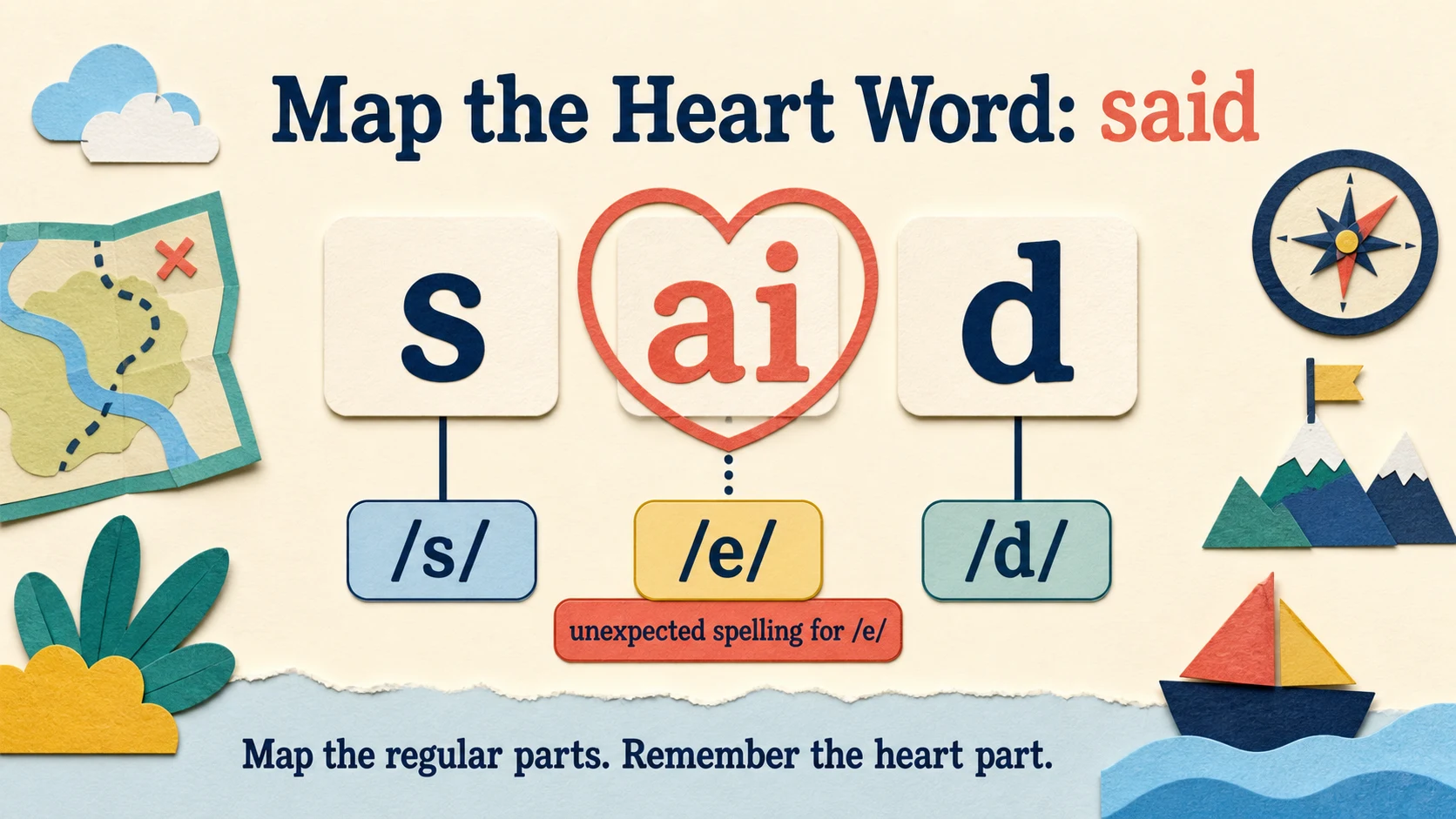
Keep word recognition connected to pronunciation, spelling analysis, writing, and use in a short sentence.
Define difficulty through observable task features
The live representative resources are labeled “easy,” but that label describes the sheet, not the learner. Translate it into features you can observe before assigning the work.
A lower-demand phonics task may have:
- one already-taught correspondence;
- a consistent word position;
- pictures with unambiguous vocabulary;
- one response type repeated across the page;
- letters or answer options provided;
- an adult reading the directions;
- three to five selected items rather than all 20.
Demand increases when a task mixes positions, contrasts several patterns, removes picture or letter choices, asks for spelling from dictation, embeds words in sentences, or requires switching between reading and writing. Handwriting load and phonics difficulty must also be separated. A learner may identify the correct vowel orally but struggle to form it legibly.
Use a quick preview test. Cover the title and inspect five items. Name the exact knowledge needed, any non-phonics vocabulary needed, and every possible shortcut. If a learner can answer by looking only at a picture’s first sound, the page does not independently demonstrate whole-word decoding. If the page introduces unfamiliar picture names, teach those names or replace the item.
Run a model–guide–independent–check lesson
The routine can fit a short classroom block, but its phases should remain distinct. The following timings are suggestions for planning, not sourced requirements.
Model the thinking, not just the answer
Display one item and state the phonics question. For a CVC word, point beneath each grapheme as you produce the corresponding sound, blend through the word, and check whether the result is a known word. For short-vowel discrimination, pronounce the word, stretch or repeat the medial sound without distorting it, choose the vowel, then read the completed word.
A first-grade blend model might use stop:
- Say
stop. - Segment
/s/ /t/ /o/ /p/. - Place or write one grapheme for each phoneme.
- Point out that both
/s/and/t/remain audible. - Blend through the written word and read it normally.
This checked example belongs in blend instruction because the common incorrect response sop reveals deletion of /t/, not confusion about the short vowel. Feedback should therefore restore the missing consonant rather than reteach o.
The IES practice guide on foundational reading skills recommends teaching learners to blend, segment, and manipulate sound segments and to connect those skills with letter knowledge. That sourced guidance supports combining spoken segmentation, letter work, and reading. It does not mean IES evaluated any WorksheetWise page.
Guide a small set with fading prompts
Complete two to four nearby items together. Use prompts that direct attention without giving the answer:
- “Say every sound.”
- “Which sound is in the middle?”
- “Do you hear one consonant sound or two at the start?”
- “Point to the letters as you blend.”
- “Read the completed word to check it.”
Record who answers only after peers respond. That learner may need another guided item even if the group answer is correct. Fade from modeling to a neutral cue, then to silence. If several learners fail when the prompt disappears, the page is still guided practice.
Make independent work short enough to inspect
Assign a defined subset: for example, items 1–6, one row, or four words plus one dictated word. Learners should know the target, the response method, and what to do when unsure. “Underline the vowel, write the missing letter, and whisper-read the word” is more useful than “finish the page.”
Do not turn the remaining problems into filler. They can become tomorrow’s retrieval practice, a teacher-led station, or a later check with reduced support. A 20-problem free sheet may provide several instructional episodes rather than one sitting.
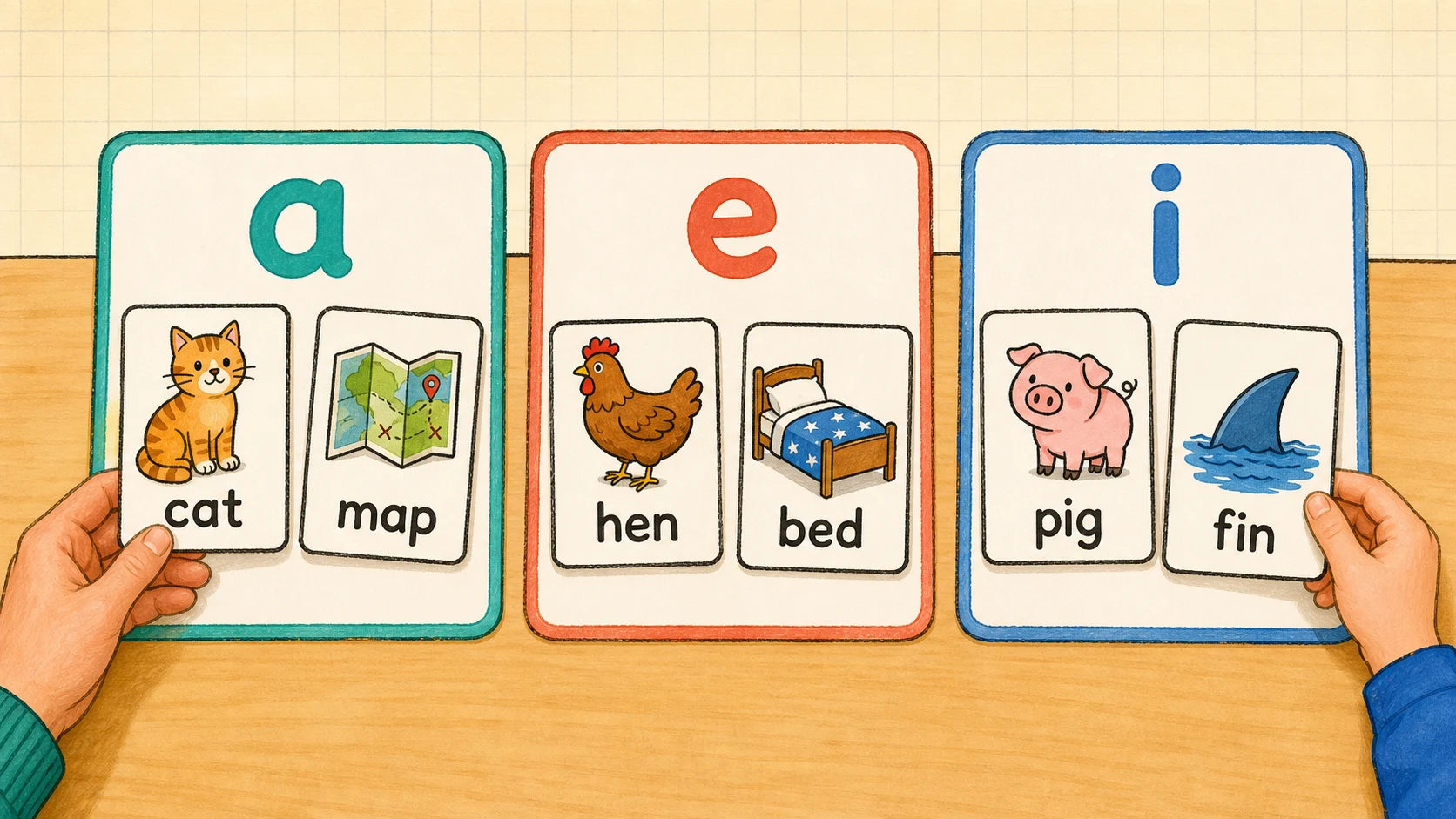
Repeat the same lesson architecture while changing the vowel contrast in response to what learners actually confuse.
Check by error pattern
Scan responses immediately if possible. Mark the smallest information needed to recover the phonics decision. Instead of writing the correct word over an error, circle the relevant position or ask the learner to map the sounds again.
Use three columns on a class checklist:
| Observed response | Likely instructional question | Immediate next action |
|---|---|---|
sop for stop |
Was /t/ heard but omitted, or not segmented? |
Tap four phonemes, rebuild stop, then try step |
pin for pen |
Can the learner hear short e versus short i? |
Return to an oral minimal-pair sort before print |
ship read with separate /s/ and /h/ |
Is sh understood as one sound? |
Re-model two letters representing one phoneme |
| correct picture match, incorrect unpictured word | Did the picture carry the response? | Use an unpictured list with the same taught pattern |
| correct reading, inaccurate dictation | Is segmentation or grapheme recall less secure? | Build and write two dictated words |
| many blanks after correct oral answers | Is writing load masking phonics knowledge? | Permit pointing, tiles, or letter choices and recheck |
These are instructional hypotheses, not diagnoses. Confirm each one with one or two targeted responses before choosing the next page.
Match feedback to the phonics misconception
General praise or a page-level score gives little guidance. Feedback should name the operation that needs another attempt.
When a sound is omitted
If a learner reads stop as sop, say, “You kept the first and last parts, but one sound in the beginning blend is missing. Say it slowly and tap every sound.” After the learner rebuilds stop, present step or stun to check transfer. Do not immediately switch to a page containing unrelated blends.
For a final-blend contrast, use ten/tent. Both begin with /t/ /e/ /n/; tent adds final /t/. Likewise, bum/bump adds /p/. These checked pairs belong in final-blend practice because they expose final-consonant deletion without changing the preceding sequence.
When short vowels are confused
If pen becomes pin, do not say only, “Check the vowel.” First establish whether the learner hears the contrast. Say pen and pin in random order and have the learner point to two known picture or word anchors. Then build each word and read it.
If oral discrimination is accurate but spelling is not, shift to a small dictated set. If both listening and spelling are unstable, the next task should remain adult-led and contrast only those two sounds. A page mixing all five vowels would add irrelevant decisions.
When a learner guesses from pictures
Ask the learner to cover the picture and read the letters. Then show the picture and decide whether the word matches. If the item depends on an unfamiliar picture label—cap versus hat, for example—supply the label before judging the phonics response.
The next sheet should reduce picture support while preserving the same taught pattern. Switching immediately to more complex words would confuse removal of a cue with an increase in phonics complexity.
When a learner recognizes but cannot spell
Have the learner say the word, segment it, build it with tiles, and write it. The IES elementary writing practice guide addresses foundational writing skills, including spelling and sentence construction. In this phonics routine, that source supports giving learners brief opportunities to encode words rather than limiting practice to recognition. It does not establish that a particular worksheet format is effective.
Keep the correction small: one rebuilt word and one fresh transfer word are usually more informative than copying the answer several times.
Let the error choose the next sheet
The next page should change one relevant feature while holding the rest steady.
Move sideways before moving forward
Suppose a first-grade group can match st words to pictures but drops /t/ when reading without pictures. Do not move to mixed s, l, and r blends. Choose another st task with unpictured words, or read a short controlled list followed by one sentence. The target stays constant; the cue changes.
Suppose learners accurately sort short a and short i words but confuse short e and short i. Do not assign a five-vowel review merely because it is the next page. Choose an oral e/i contrast followed by a printed minimal-pair or medial-vowel task.
Suppose a learner reads cat, pin, and hug but cannot spell them from dictation. The next sheet should emphasize filling the middle letter or writing the entire CVC word, not introduce silent e.
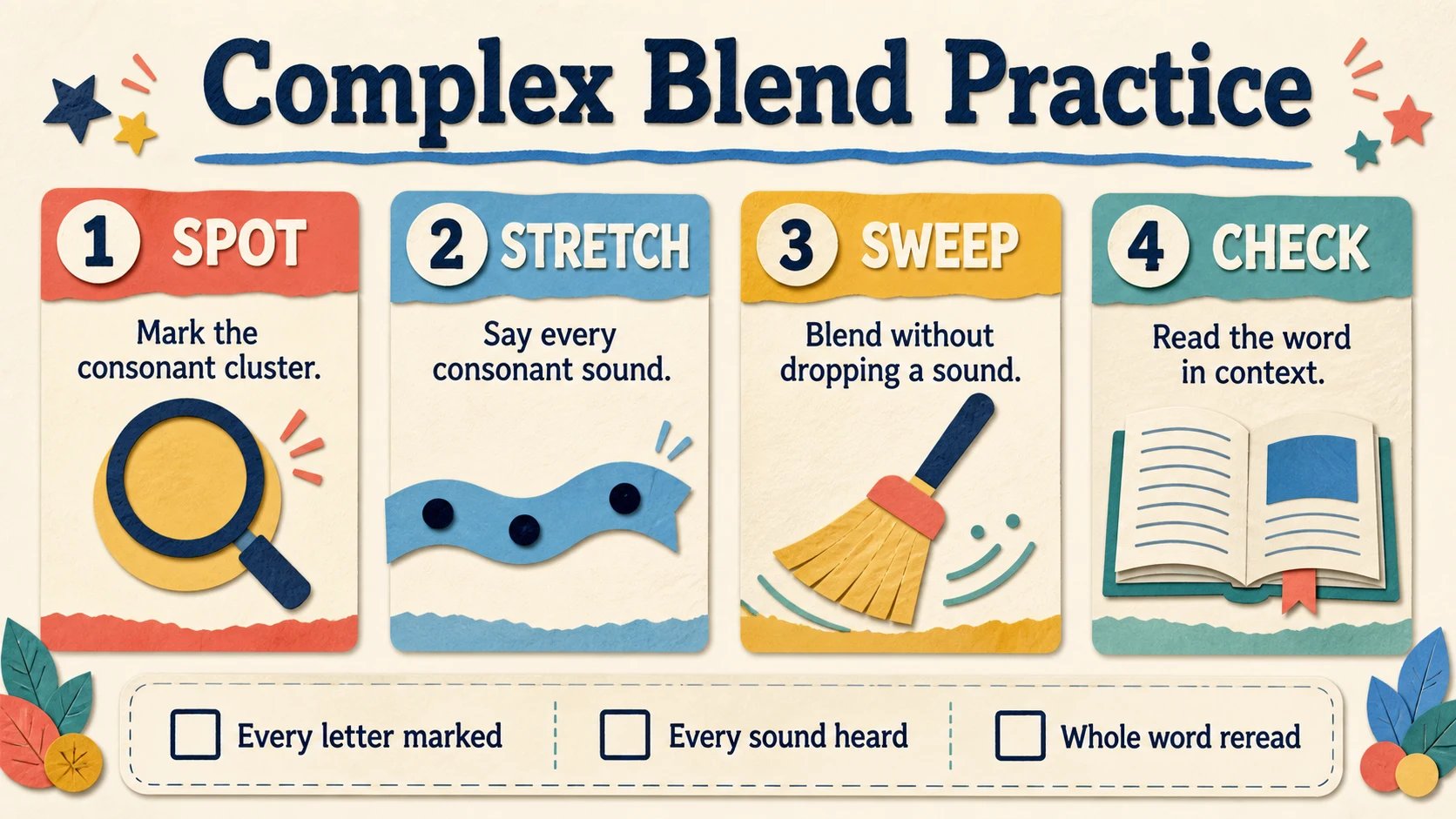
Use a plan as a revisable sequence: retain, shorten, or replace the next practice set when the check reveals a specific blend error.
A simple decision rule keeps the routine manageable:
- Accurate with adult prompts but not alone: repeat the same pattern with fewer prompts.
- Accurate in matching but not reading: remove the picture cue.
- Accurate in reading but not spelling: add segmentation and dictation.
- One repeated phoneme or grapheme confusion: narrow the next sheet to that contrast.
- Several unrelated errors: return to a brief oral and manipulative check before selecting more print.
- Accurate on the target in words: check the same pattern in a short sentence or controlled text.
The Formative assessment Phonics Worksheets can support this evidence-gathering role when the purpose is to identify the next instructional move rather than accumulate completed pages.
Adapt access without changing the target
An adaptation preserves the phonics decision while reducing an unrelated barrier. If the target is identifying a medial vowel, the learner can point to a, e, i, o, or u, place a letter tile, stamp the letter, or say it before writing. Each response can still show which vowel the learner selected.
Useful access adaptations include:
- enlarging print or increasing spacing;
- cutting a page into short rows;
- reading directions aloud;
- previewing picture vocabulary;
- allowing tiles, counters, or pointing;
- reducing the number of items;
- providing a movable strip to track one line;
- accepting an oral response before handwriting;
- pairing spoken segmentation with finger taps or sound boxes.
Be careful with supports that answer the phonics question. If the target is selecting the initial blend, color-coding the correct blend in every word removes part of the task. If the target is decoding, reading each answer option aloud changes the work into listening and matching.
For ages three and four, treat printable material as a source of adult-led cards, pictures, and matching pieces. Say a word, have the child move once for each sound, push counters into boxes, match two rhyming pictures, or build one short word with letters. Stop before attention and motor demands overtake the sound work. Age remains a discovery aid, not a placement decision.
Keep phonics practice connected but bounded
Worksheets can provide controlled repetitions and visible responses. They cannot, by themselves, show exactly how a learner pronounced a sound, whether a correct answer came from a peer, or whether a picture prompted a guess. They also cannot replace oral language, teacher modeling, manipulatives, reading connected text, or responsive correction.
A completed page does not establish mastery. Check at least one response in a changed format: ask the learner to read an unpictured word, spell a word from dictation, manipulate one phoneme, or read a short sentence containing the pattern.
The Common Core English Language Arts standards include grade-specific foundational-skills expectations involving sound-spelling relationships and word analysis. They can help adults understand one published sequence, but a worksheet’s grade label does not prove standards alignment, and local curricula may introduce or review patterns in another order.
Keep adjacent subjects distinct. A sentence-copying task may become primarily handwriting or grammar work even if it contains a target word. If the next instructional need is spelling rather than decoding, use the Classroom Spelling Worksheets deliberately rather than calling every word-writing task phonics.
Nor should adults infer a diagnosis from recurring reversals, omissions, slow responses, or vowel confusions. Record what happened, change the instructional conditions, and consult the school’s established support process when concerns persist. This guide offers teaching decisions, not clinical interpretation or promised outcomes.
Plan tomorrow from six responses today
Before dismissing the group, collect six informative responses: two read words, two encoded words, one manipulated word, and one word in a short sentence or matching context. You do not need another full worksheet to decide what happens next.
Write one of these notes beside each learner or group:
- retain the same target and fade the prompt;
- remove the picture cue;
- narrow to one vowel contrast;
- restore a missing sound with segmentation;
- distinguish a blend from a digraph;
- move from word reading to spelling;
- move from isolated words to controlled context.
Then choose or generate only the items that match that note. For example, after errors on stop, tomorrow’s set might contain step, stem, stun, and stop, with tiles for the first two and independent reading for the last two. After pen/pin confusion, tomorrow should begin with an oral contrast and proceed to a few written items—not a broad mixed-vowel packet.
Your practical next action is to open the free deterministic worksheet generators and make one narrowly targeted practice set from today’s most common error. Print only the number of items you can model, observe, and check in the next lesson.
Put it into practice
Use the guide with a real printable
Move from explanation to a short, observable practice task. Check the first item together, then adjust the next session from the learner's actual work.
Open the first free worksheetExplore a neighboring collection