Curated collectionAnswer keys includedPrint-ready PDFs
Differentiated Spelling Worksheets
Hold the learning goal steady while changing number bounds, prompts, representations, response load and extension demand across three real worksheet versions.
Start with a real resource
Browse this worksheet collection
5 relevant free entry points are available. Each one includes a printable learner PDF and separate answer key.
A useful practice loop
Print less. Observe more.
- Choose one skill and model the first item aloud.
- Use a short set and notice the learner’s strategy.
- Change the next task from the work you can see.
Need more than the free sheet?
Plus includes all 90 matching catalogue variations where available, plus saved deterministic generators and the worksheet designer.
See Plus membershipComplete guide
How to teach and practise differentiated spelling worksheets
3,395 words Updated 6 instructional visuals
Build three versions around one spelling decision
Differentiated spelling worksheets should keep the spelling target constant while changing how much a learner must notice, remember, write, and explain. If the target is choosing among long-a spellings, all three versions should require attention to that choice. One version might provide words to sort, another might require recall after a brief model, and a third might ask the learner to use and explain the pattern in context. Giving one learner short-a words and another prefixes would not be differentiation of the same lesson; it would be two different lessons.
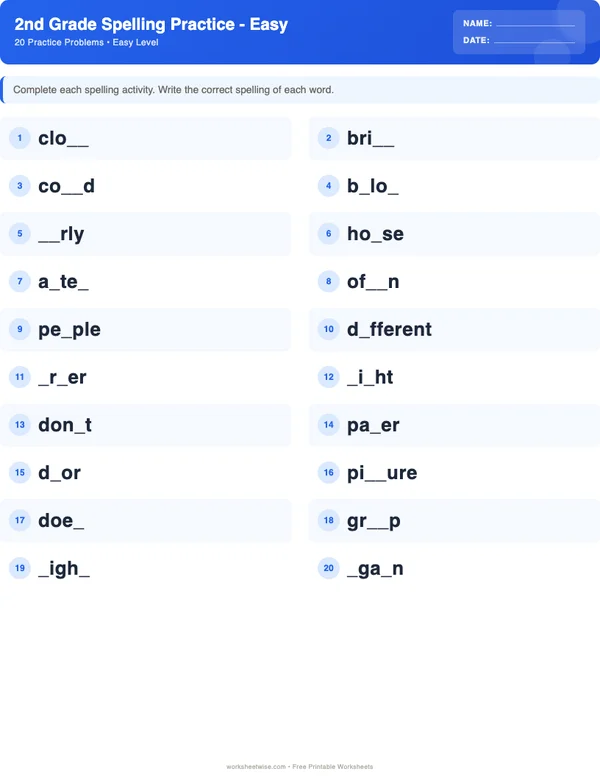
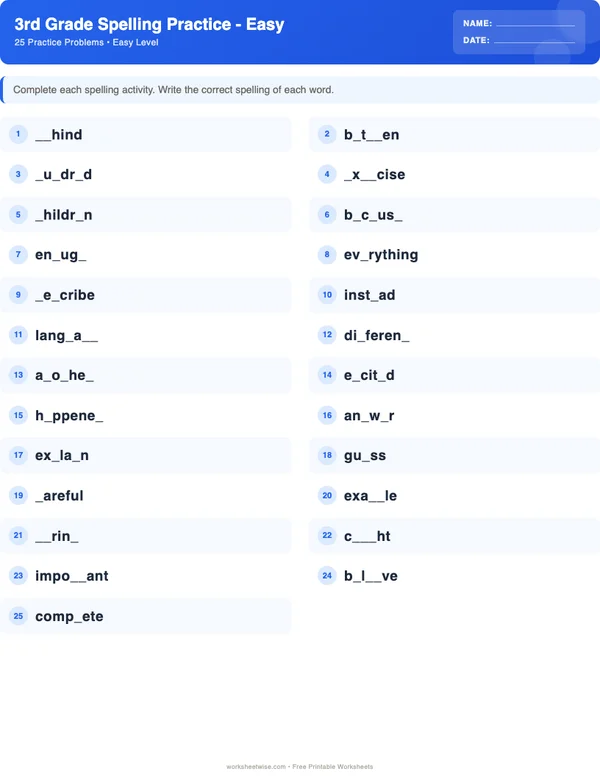
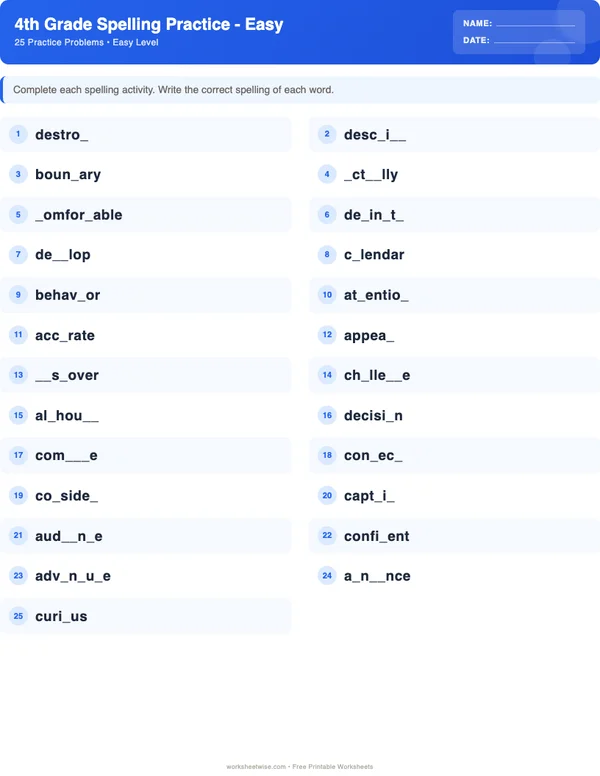
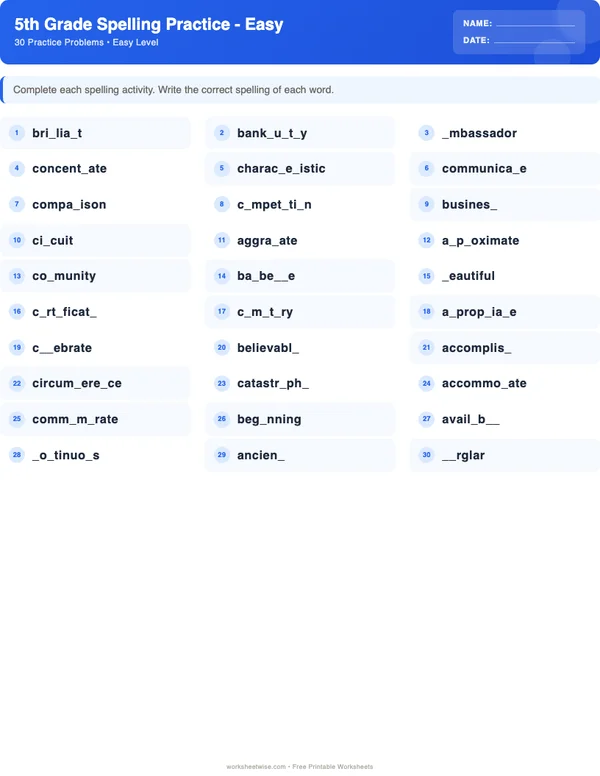
WorksheetWise’s live catalogue currently contains 90 spelling variants across five intended grade levels, with one free spelling-word entry point per grade. The representative free sheets contain 20 items in first and second grade, 25 in third and fourth grade, and 30 in fifth grade. Those counts are catalogue facts, not recommended daily quotas. An adult can assign a smaller portion when the full response load would obscure the learner’s spelling knowledge.
Use grade and age only as discovery aids. Grade labels describe an intended practice level, not a placement decision, and local curriculum sequences differ. Select a sheet by examining its words, pattern, directions, and response demands, then compare those features with what the learner can do now.
Define the learning goal before choosing a sheet
A useful goal identifies the spelling decision the learner will make. “Practice spelling” is too broad. Better goals include:
- Distinguish short-a from short-i when spelling one-syllable words.
- Choose among common long-a representations in a supplied word set.
- Preserve a base word while adding a prefix.
- Decide whether a consonant must double before a suffix.
- Spell an unfamiliar multisyllabic word by working through its meaningful and pronounceable parts.
- Apply previously studied words correctly in a dictated sentence.
The catalogue descriptions include short vowels, long-vowel spellings, consonant doubling, r-controlled vowels, silent letters, prefixes, suffixes, and multisyllabic words. They also identify several response formats: look-cover-write-check, rainbow writing, pattern sorting, sentence writing, and finding misspelled words. These formats are not interchangeable.
A sort asks the learner to compare visible spellings. Look-cover-write-check adds a memory demand. Finding a misspelling asks for recognition and correction. Dictation requires recall without a visible model. Sentence writing adds composition, handwriting, capitalization, and punctuation. Decide which of those demands serves the day’s goal and which would merely add noise.
The IES foundational reading practice guide supports explicit work connecting sounds, letters, and word reading. It does not evaluate WorksheetWise materials. Applied here, that guidance favors modeling the relevant sound–spelling relationship before expecting independent recall, especially when an error shows that the learner has not yet identified the sounds in the word.
Compare the five live entry points by task, not label
The five representative resources all address “Spelling Words,” but their item counts and intended grade levels differ.
| Live entry point | Free-sheet count | What an adult should inspect |
|---|---|---|
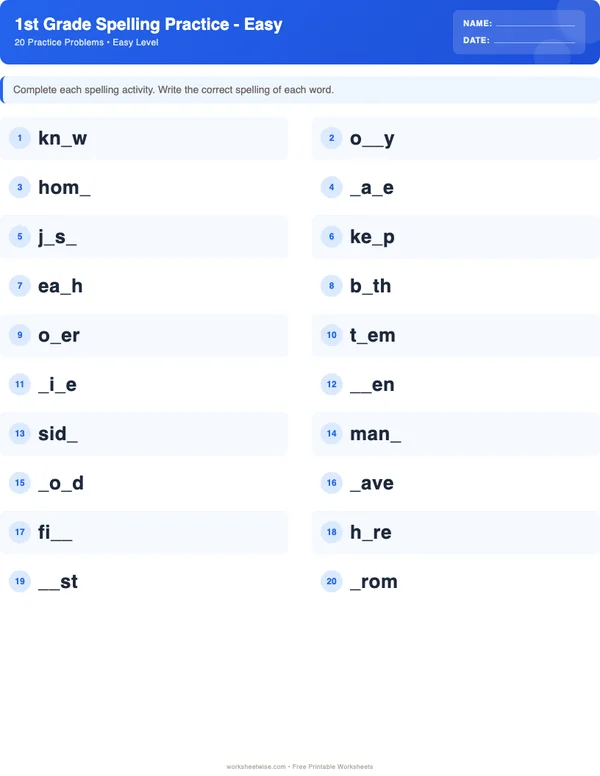
| First grade | 20 | Whether words and directions permit attention to a single sound–spelling feature |
| Second grade | 20 | Whether the learner must compare, recall, or use the words in context |
| Third grade | 25 | Whether the increased list length adds useful review or excessive writing |
| Fourth grade | 25 | Whether affixes, silent letters, or other patterns are actually present |
| Fifth grade | 30 | Whether the learner can manage the word complexity and response load separately |
The catalogue calls each representative free sheet “easy.” Treat that as a resource label, not a learner label. Define difficulty through observable task features:
- Is the correct spelling visible, partially cued, or recalled from memory?
- Does the learner select an answer, copy it, or produce it independently?
- Are the words controlled around one pattern or mixed across patterns?
- Must the learner write only a word, correct a word, complete a sentence, or compose a sentence?
- How many items are assigned at once?
- Does the task require an explanation or transfer to an unfamiliar word?
- Are old patterns mixed with the new target?
A 30-item fifth-grade sheet can become more accessible without changing its word-level target: assign eight selected items, model the first one, allow oral segmentation, and provide a pattern bank. Conversely, a 20-item first-grade sheet can become more demanding by removing visible models and asking for a transfer word. The meaningful distinction is not “easy versus hard learner”; it is visible support, memory distance, response load, pattern mixture, and extension demand.
Use the first-grade spelling guide and free sheet when its actual words match the needed sound–spelling work. Compare it with the third-grade spelling guide and free sheet or fifth-grade spelling guide and free sheet when investigating how word complexity and item count change across the catalogue. Do not move a learner upward merely because a lower-grade sheet was completed quickly.
Construct three versions that preserve the target
Suppose the shared goal is: “Notice and reproduce the long-a spelling in a controlled set.” The catalogue’s teaching notes supply the example set cake, rain, play, and break. These four words are useful precisely because they do not all use the same representation. That makes the adult’s wording important: do not announce a single rule that covers every item. Ask, “What part of each word spells the long-a sound?”
Version A: visible comparison and reduced writing
Print or write cake, rain, play, and break on cards. Say each word, have the learner repeat it, and ask the learner to underline the letters associated with the long-a sound. Then place the cards under visible headings such as a_e, ai, ay, and ea. The response can be pointing, moving a card, or copying only the relevant letter group.
This version preserves the target because the learner must still locate and compare the spellings. It reduces recall, handwriting, and page-length demands. It is appropriate when the adult needs to find out whether an incorrect written word reflects pattern confusion or simply difficulty holding the whole word in memory.
Version B: model, cover, write, and check
Show one word at a time. The learner reads it, identifies the long-a letters, covers it, writes it, and compares the attempt with the model. After checking, the learner circles only the part that differed.
This adds memory while retaining immediate feedback. Do not count a self-corrected attempt as equivalent to an unexamined error: the check is part of the task. Record both the first attempt and the correction so the next sheet can address what was initially uncertain.
Use the worked third-grade sequence to identify where the visual model ends and independent spelling begins; that transition is the feature to adjust.
Version C: context and explanation
Dictate a sentence containing one studied word, then ask the learner to underline the long-a spelling and explain the choice in plain language. A response such as “I remembered that play ends in ay” is enough. Add one unfamiliar transfer item only if it genuinely uses a studied representation and you have checked its spelling.
This version raises the response demand through recall, sentence-level application, and explanation. It does not change the learning goal. If sentence construction is not the target, dictate the sentence rather than asking the learner to invent one.
In an upper-elementary worked example, separate the spelling decision from the amount of writing required to display that decision.
Check four examples before teaching from them
Examples must demonstrate exactly what the adult claims. These four have been checked letter by letter and belong here because each isolates a catalogue-listed spelling feature or response format.
Example 1: long-a comparison
Use cake, rain, play, and break for a pattern sort. The relevant written representations are a_e in cake, ai in rain, ay in play, and ea in break. The final item matters because ea is not reliably pronounced the same way in every English word. Present break as a word in this set, not proof of a universal “ea says long a” rule.
A suitable initial response is sorting visible cards. A stronger transfer check is asking the learner to spell one previously taught word without the model. Do not invent a transfer word on the spot without verifying that it fits the stated feature.
Example 2: short-vowel substitution
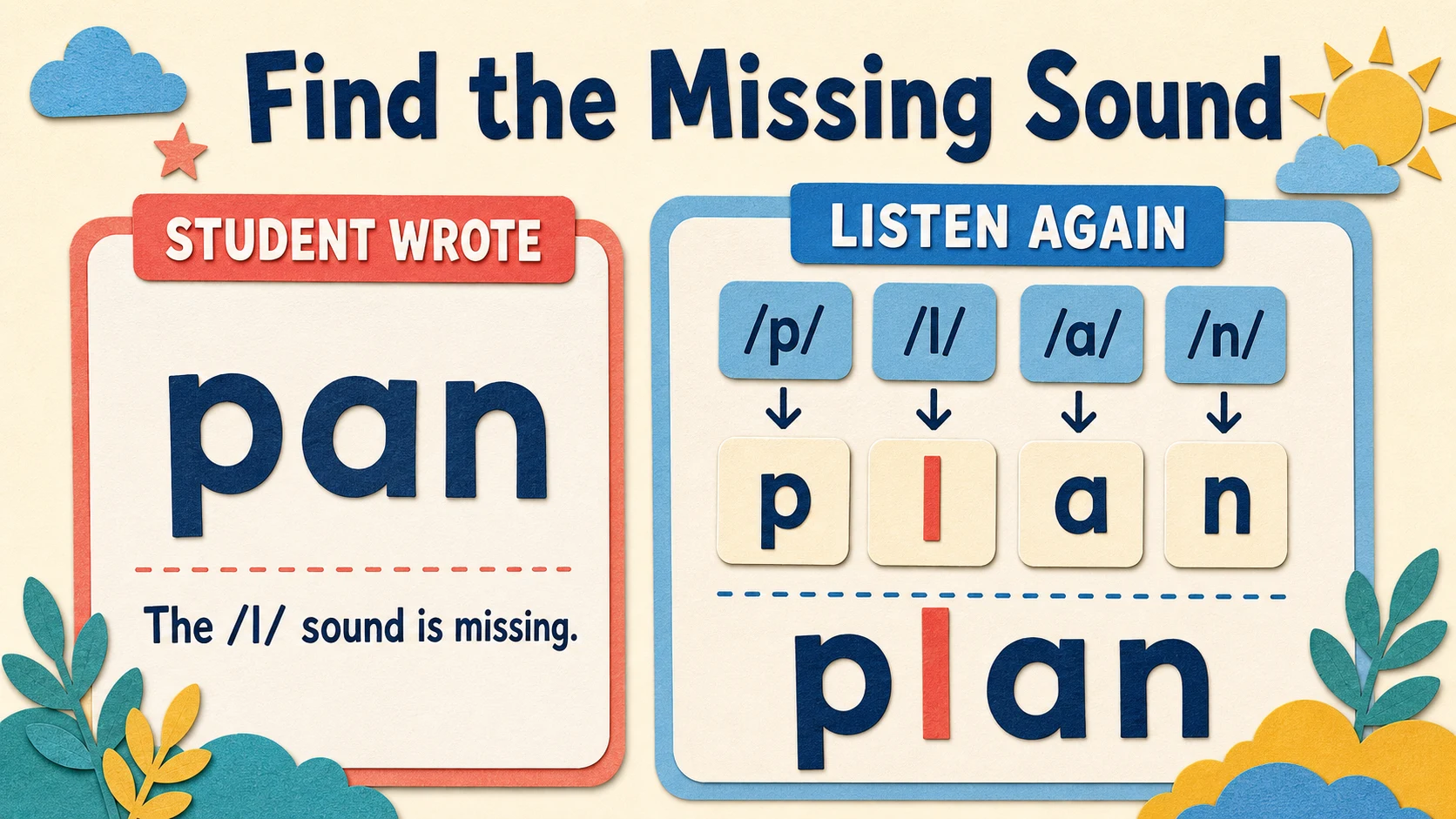
Dictate sit. If the learner writes sat, the first and last consonants are preserved, but the medial vowel changes the word. The next action is not ten repetitions of sit. Say sit and sat, have the learner identify the middle sound in each, and then match the two spoken words to visible spellings. Follow with a brief contrast set.
This example belongs in early spelling work because short vowels are explicitly represented in the catalogue, and the error gives a clear instructional choice: contrast the vowel sounds before increasing independent writing.
Read an early spelling error by its location—initial, medial, or final—before choosing the next prompt.
Example 3: consonant doubling before a suffix
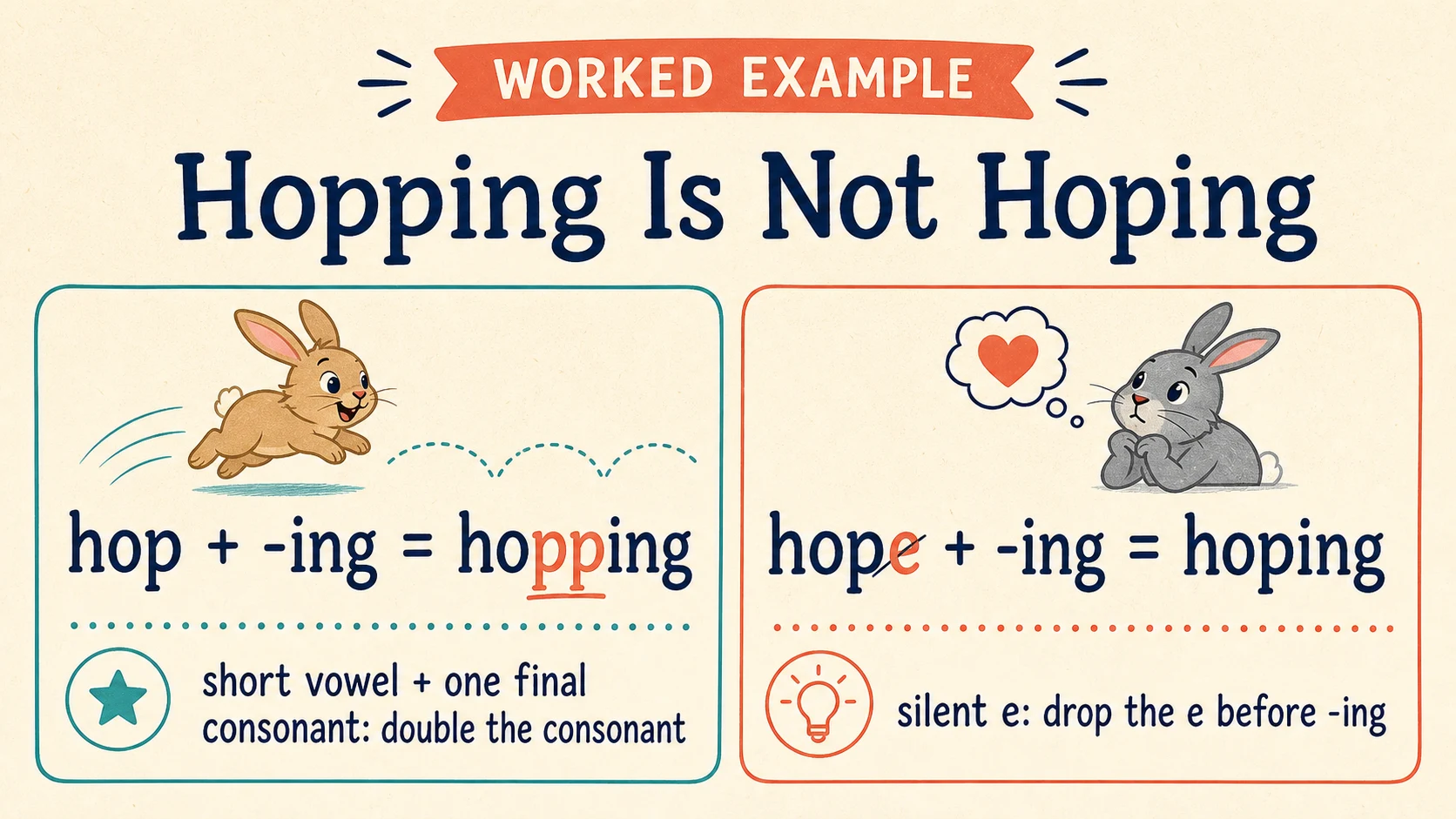
Compare hop → hopping with hope → hoping. Both are correctly spelled, but only hopping doubles the final consonant. Ask the learner to mark the base word and added ending, then read each completed word.
If a learner writes hoping when the intended word is hopping, ask what word the spelling actually represents. This makes the contrast visible without calling the learner careless. The next sheet should contain a small, checked contrast set in which the learner preserves the intended base and meaning. It should not mix in unrelated silent-letter work.
This example belongs because consonant doubling and suffixes are named catalogue targets. It also shows why meaning must accompany letter manipulation: hoping is a real word, just not the intended one.
Example 4: prefix plus stable base
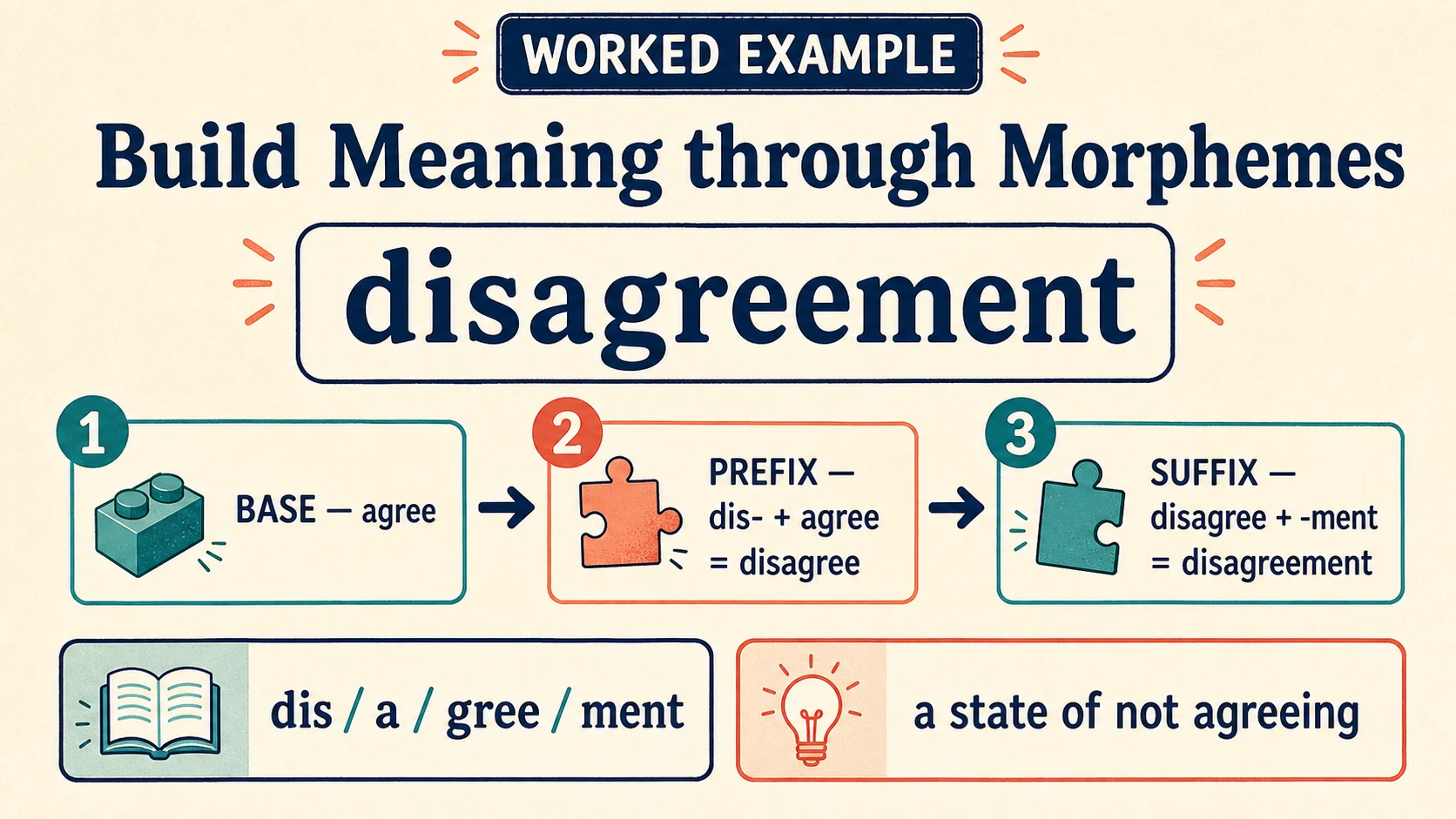
Build unhelpful as un + help + ful. The checked spelling is unhelpful: the base help remains visible, and the prefix and suffix are attached without deleting or doubling a letter. Ask the learner to box un, underline help, and circle ful before writing the complete word from memory.
If the attempt is unheplful, the relevant issue is the internal order of letters in help, not failure to understand the prefix. Return briefly to the base word, then rebuild the whole word. This belongs in upper-elementary differentiation because prefixes, suffixes, and multisyllabic words are among the live topic features, while the chunked response reduces the burden of remembering the entire string at once.
Use a short teach–attempt–inspect routine
A differentiated sheet is most informative when the adult uses a stable routine. The learner should know when a model is available, when it will disappear, and how correction works.
Preview the spelling decision
Choose one pattern or contrast. Read the relevant words aloud and ask the learner to notice the target letters. Keep the explanation narrower than the evidence. For cake, rain, play, and break, say that each word in this set contains a spelling for the long-a sound; do not turn four examples into a complete account of English spelling.
Model one complete response
Demonstrate the exact behavior the sheet requires. For look-cover-write-check, actually look closely, name the notable part, cover the word fully, write it, uncover it, and compare letter by letter. For error correction, model circling the changed part rather than crossing out the whole attempt.
Assign a diagnostic sample
Start with three to five selected items rather than automatically assigning every item. Include at least two examples of the target and, when useful, one checked contrast. Watch whether the learner reads the direction, identifies the relevant segment, and uses the model as intended.
Inspect first attempts
Mark the location and type of difference. Record rain → ran rather than only “incorrect.” Note whether the response was copied, recalled, selected, or produced in a sentence. Those conditions affect what the attempt demonstrates.
Give narrow feedback
Use three moves:
- Confirm the part that is correct: “You kept r and n.”
- Locate the decision: “The long-a part is in the middle.”
- Prompt an action: “Compare your middle letters with rain and repair only that part.”
Then ask for one fresh attempt after a short delay. Immediate copying shows that the learner can reproduce a model; delayed recall gives different information.
The IES writing practice guide recommends explicitly teaching writing processes and providing opportunities for practice and feedback. It does not prescribe these worksheets. For spelling support, the practical implication is to make feedback actionable and allow revision rather than placing a mark beside an error and moving on.
Let error patterns choose the next sheet
One misspelling is an observation, not a diagnosis. Look for recurrence across a small, controlled sample and in more than one response condition when possible.
| Observed pattern | Reasonable interpretation to test | Next-sheet decision |
|---|---|---|
| Correct when copying, incorrect after covering | The written pattern may not yet be retained | Keep the same words; shorten the look-to-write delay and require letter-by-letter checking |
| Vowel substitutions across several one-syllable words | The learner may need a sharper sound contrast or spelling comparison | Use oral comparison and a two-column vowel sort before dictation |
| Correct isolated words, incorrect words in sentences | Sentence-level load may be competing with spelling attention | Dictate short sentences containing fewer targets and include a final spelling check |
| Prefix correct, base disrupted | Attention may shift away from the base during word building | Mark prefix, base, and suffix separately; rebuild from the verified base |
| Same word missed in identical way after correction | Recopying did not change the uncertain representation | Return to sound, letter sequence, or meaningful chunks; do not add more words yet |
| Accurate target words but weak explanation | Knowledge may be usable without verbal precision | Ask for a short comparison, not a long written explanation |
| Accurate controlled list, inaccurate unfamiliar example | Transfer is not yet evident | Continue with checked contrasts and one new item at a time |
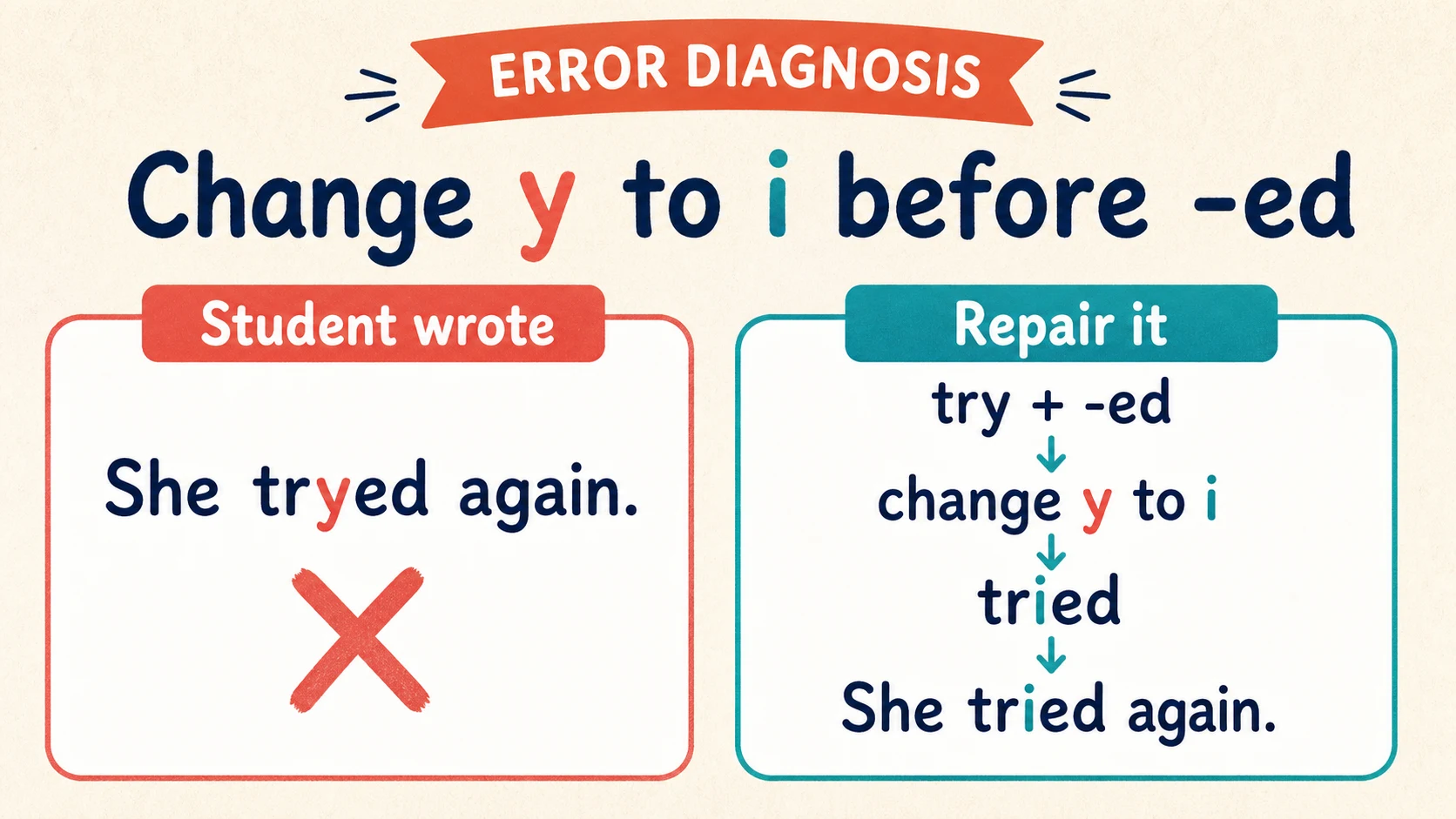
Match the next third-grade response to the repeated feature in the error, not to the total number marked wrong.
Avoid explanations such as “not trying,” “bad memory,” or “below grade level” based on a sheet. Handwriting, attention to directions, word knowledge, hearing, language background, and fatigue can affect a response, but a worksheet cannot determine their cause. Describe what happened: “Three long-a words were correct with a model and changed after the model was covered.”
The Common Core English Language Arts standards include grade-specific language expectations related to conventional spelling and using learned spelling patterns. They can help an adult inspect the intended level of a task, but they do not establish an individual learner’s placement, and local standards and teaching sequences may differ.
Change access without replacing spelling
Useful adaptations preserve the spelling decision. They alter the path to the response, not the word feature being learned.
Reduce response load
Assign six targeted items from a 25- or 30-item sheet. Ask for oral analysis before written production. Provide larger writing space or let the learner use movable letters for the first attempt. These changes reduce endurance or handwriting demands while retaining attention to letter order.
Adjust the prompt
Progress from “Choose between two visible spellings” to “Complete the missing pattern,” then to “Write after covering,” and finally to dictation. Keep the same word set during that progression so a change in performance can be linked more plausibly to the prompt.
Change the representation
Use letter tiles, word cards, color marking, sound boxes, or morpheme boxes. Color is useful only if it points to a meaningful feature. Coloring every letter differently can increase activity without clarifying the spelling.
Extend demand carefully
For a learner who accurately completes the target under independent recall, add one of these:
- Sort the words and name what the members of each group share.
- Correct a misspelled version and justify the changed segment.
- Use two target words in a dictated or self-composed sentence.
- Spell one checked transfer word and compare it with the original set.
- Revisit the words after a delay mixed with previously taught patterns.
Do not extend merely by adding ten more copies. Extra volume may test persistence more than spelling knowledge.
The distinction between spelling and phonics also matters. Phonics work commonly emphasizes the relationship between written symbols and spoken sounds in reading; spelling requires producing a written form. When the learner cannot hear or compare the target sounds, an oral and matching step may be needed before another spelling sheet. The Differentiated Phonics Worksheets provide a neighboring resource, but changing to phonics should be a deliberate response to the observed task, not a permanent label.
Plan two weeks without turning practice into repeated testing
The catalogue notes support weekly practice, cumulative review, sorting, and use in sentences. A workable two-week sequence alternates supported study, independent attempts, application, and review.
Week one: establish and check the pattern
On day one, model the target and complete a visible sort. On day two, use look-cover-write-check with a short selection. On day three, dictate several studied words and inspect first attempts. On day four, correct errors by segment and use one or two words in context. On day five, give a brief mixed check containing studied items, not an entirely new full list.
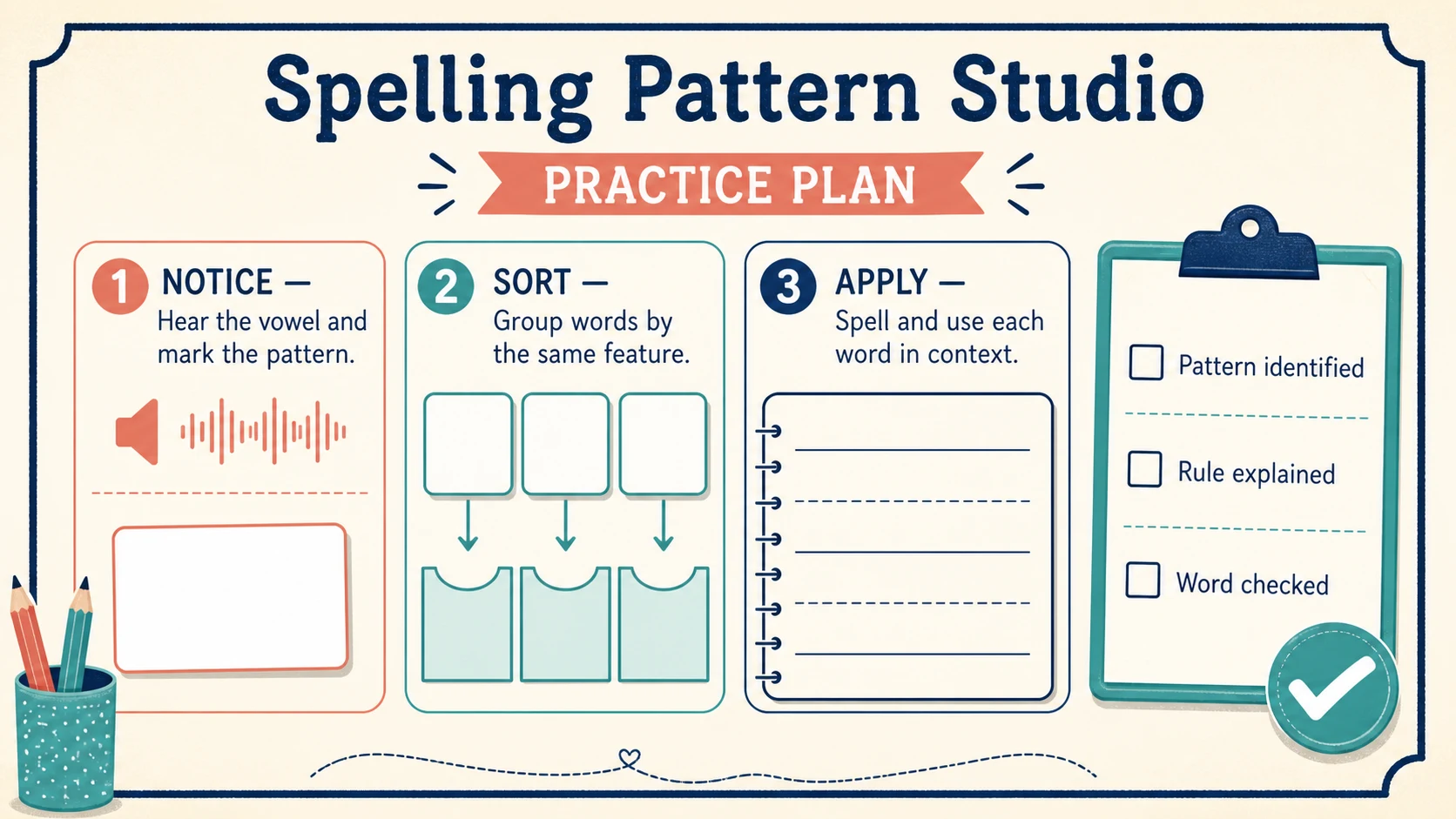
Use the middle-grade plan to alternate supported pattern study with independent retrieval rather than administering the same list every day.
Week two: retain, contrast, and transfer
Begin with a delayed review of the words that were uncertain, not every word. Add a contrast that exposes the decision, such as hop/hopping beside hope/hoping. Later in the week, mix a few prior words with the current target. End with one sentence-level application and one checked transfer item if the controlled items are secure.
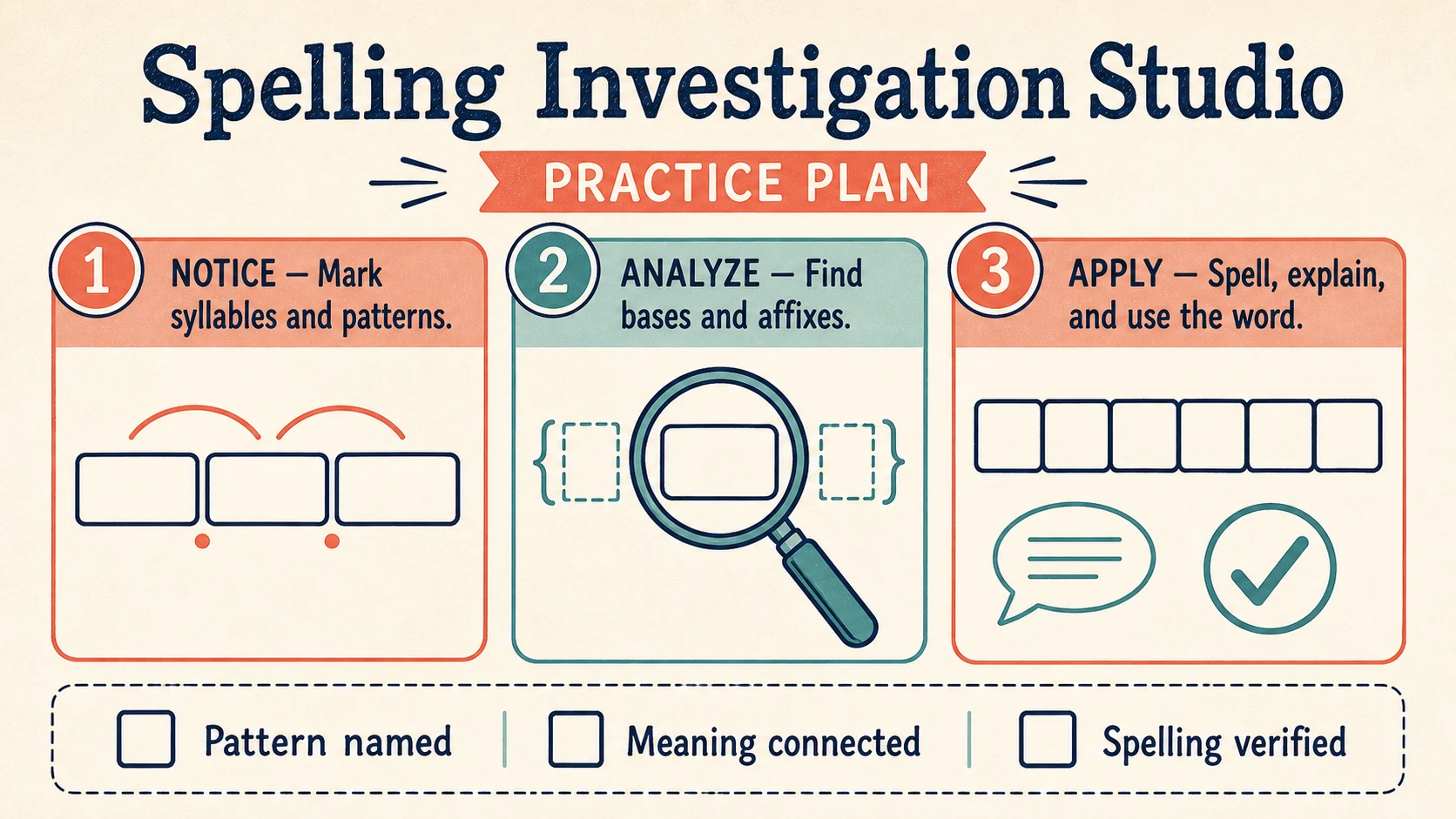
For upper-elementary practice, distribute base-word analysis, affix work, recall, and sentence use across sessions so one long sheet does not carry every demand.
At each session, preserve evidence from the first attempt. A perfectly corrected page can conceal whether the learner recalled the pattern independently, needed a prompt, or copied the answer. A simple notation—I for independent, P for prompted, and M for model available—is an editorial suggestion, not a sourced assessment system. Its purpose is to help the adult select tomorrow’s prompt.
Know what a worksheet cannot tell you
A spelling worksheet can show how a learner responded to particular words under particular conditions. It cannot by itself establish mastery of all words with that pattern, explain why an error occurred, diagnose a learning condition, or predict school performance.
Other limits matter:
- A correct multiple-choice answer may reflect recognition, not recall.
- A correct copied word does not show that the learner can spell it later.
- An incorrect sentence may combine spelling, composition, handwriting, capitalization, and punctuation problems.
- One successful transfer word is encouraging evidence, not proof of generalization.
- A long list can hide a sound–spelling strength behind fatigue or writing load.
- A short list can miss errors that appear only during connected writing.
- English spellings often reflect history and morphology as well as straightforward sound matching; a brief pattern statement should not be presented as exceptionless.
- Grade labels indicate intended practice level only. Local curriculum order and individual experience vary.
Escalate concerns through the learner’s usual school or qualified professional when persistent difficulties affect broader reading or writing participation. Report concrete observations and supports tried rather than proposing a diagnosis: for example, “Across three brief sessions, the learner selected ai correctly when visible but omitted the i during delayed dictation.”
Make tomorrow’s sheet answer one question
Before printing another page, write one question the next attempt should answer: “Can the learner retain ai after the model is covered?” or “Can the learner preserve help while adding un- and -ful?” Choose three to six items that answer that question, select the lightest prompt that still requires the target decision, and decide in advance what error will send you back to modeling.
If the learner succeeds independently, increase only one demand: delay, mixed patterns, context, response length, or explanation. If the same feature breaks down, keep the goal steady and restore the representation that made the spelling visible. If a different feature breaks down, record it for later instead of abandoning the current target mid-sheet.
For the next session, open the relevant real entry point—such as the third-grade spelling guide and free sheet—inspect its words, select no more than six that match one spelling decision, and prepare three versions: visible sort, cover-and-write, and delayed sentence application. The learner’s first attempts on those six items should determine the following sheet.
Put it into practice
Use the guide with a real printable
Move from explanation to a short, observable practice task. Check the first item together, then adjust the next session from the learner's actual work.
Open the first free worksheetExplore a neighboring collection