Curated collectionAnswer keys includedPrint-ready PDFs
After-School Phonics Worksheets
Account for transition and fatigue with short tasks, clear stopping points and a print-plus-conversation routine.
Start with a real resource
Browse this worksheet collection
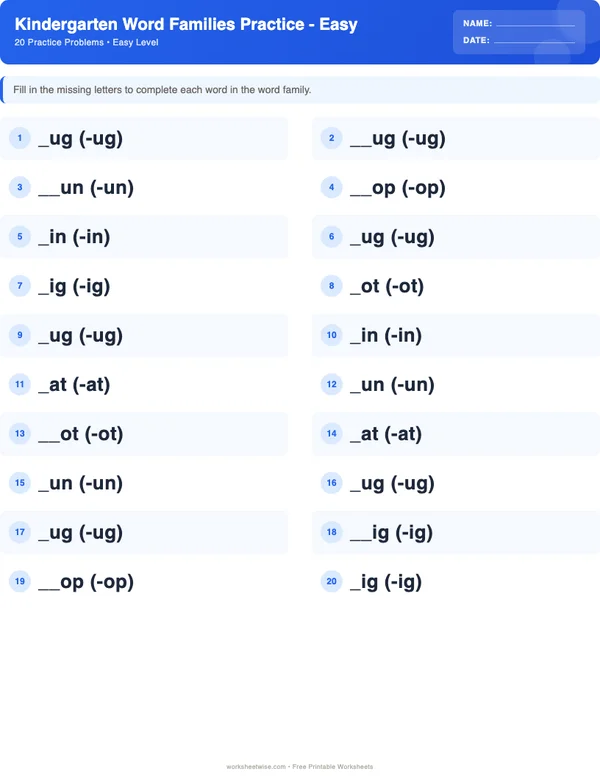
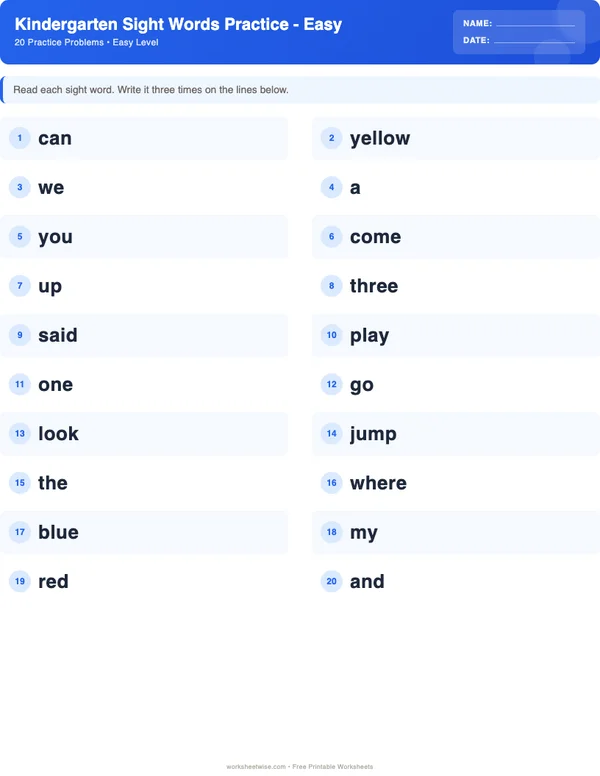
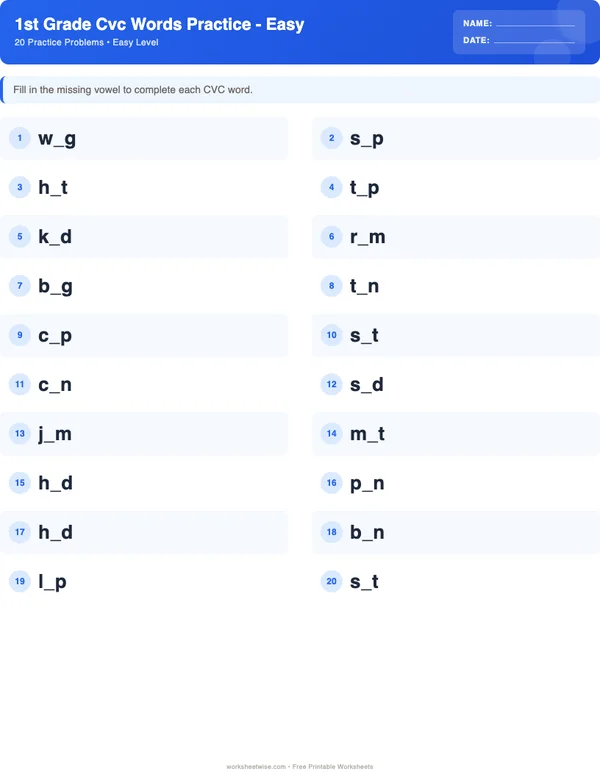
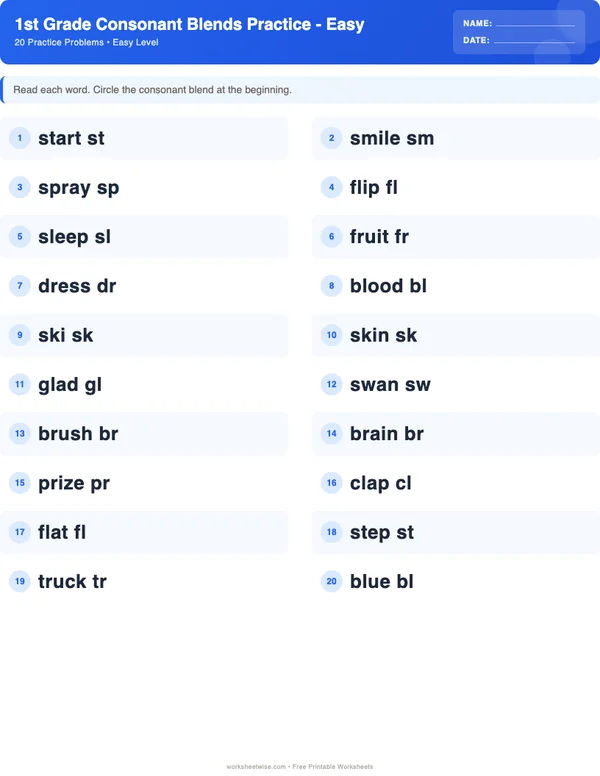
22 relevant free entry points are available. Each one includes a printable learner PDF and separate answer key.
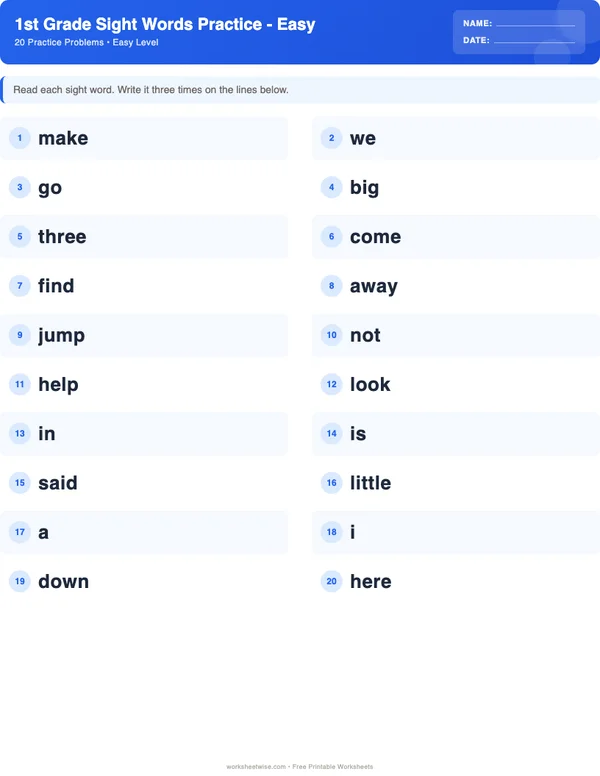
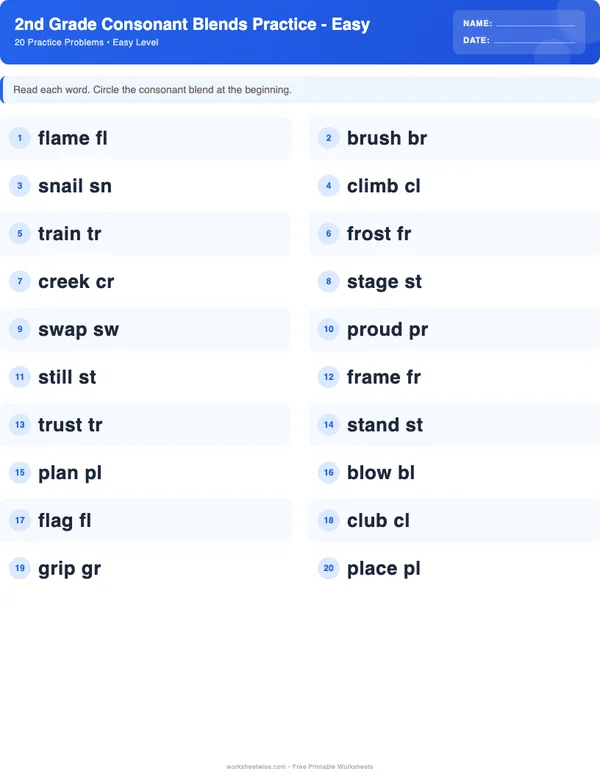
A useful practice loop
Print less. Observe more.
- Choose one skill and model the first item aloud.
- Use a short set and notice the learner’s strategy.
- Change the next task from the work you can see.
Need more than the free sheet?
Plus includes all 396 matching catalogue variations where available, plus saved deterministic generators and the worksheet designer.
See Plus membershipComplete guide
How to teach and practise after-school phonics worksheets
3,412 words Updated 6 instructional visuals
Use one short phonics decision cycle after school
After-school phonics practice works best as a brief adult-guided exchange, not as another full school lesson. Choose one sound-spelling target, model it aloud, let the learner complete a small visible section, discuss two or three responses, and stop at a marked point. Use the errors—not the number of unfinished items—to choose the next sheet.
A practical session lasts about 8–15 minutes:
- Reset for 2 minutes. Offer water, a snack, movement, or quiet conversation before presenting paper.
- State one target. “Today we will listen for both sounds in an initial blend.”
- Model one item. Show how the sounds connect to the letters.
- Complete a short set. Cover the rest of the page and expose four to eight items.
- Discuss selected responses. Ask the learner to explain, reread, build, or correct—not merely accept a check mark.
- Record one observation. Note the exact error pattern and choose the next task accordingly.
That routine suits this catalogue because its phonics resources cover seven topics across four intended grade levels, with 396 variants and 22 free entry points. The representative free sheets contain 20 problems. Twenty problems describe what is printed; they do not prescribe what must be completed in one tired sitting.
The IES foundational reading practice guide recommends developing awareness of speech sounds and their links to letters, teaching learners to decode and analyze word parts, and giving them opportunities to write and recognize words. It also recommends daily connected-text reading. Those are sourced instructional priorities. The short after-school sequence above is a WorksheetWise editorial recommendation for applying them when attention and energy may be limited; IES did not assess WorksheetWise or this routine.
Select by the task the learner can perform, not by the label
Begin with evidence from the learner’s latest reading or spelling attempt. Ask, “What does this sheet require the learner to notice and do?” A useful match is narrow enough that the adult can model it in one sentence.
Age is a discovery aid rather than a placement decision. Grade labels describe intended practice level, and local curriculum sequences differ. A first grader who omits the second sound in stop may need a consonant-blend task labeled for kindergarten. A kindergartner already reading CVC words accurately may be ready to compare a small set of digraph words. Neither choice changes the learner’s grade or constitutes a diagnosis.
The catalogue calls the representative free sheets “easy.” Define that only through observable task features: familiar one-syllable patterns, a limited response demand, picture matching, sorting, tracing, filling one missing letter, or reading a short list with support. Do not use “easy” as a description of the learner. A visually simple page can still be demanding if it mixes several vowel contrasts or asks for handwriting after a long day.
Match the sheet to one observable need
Use these selection tests:
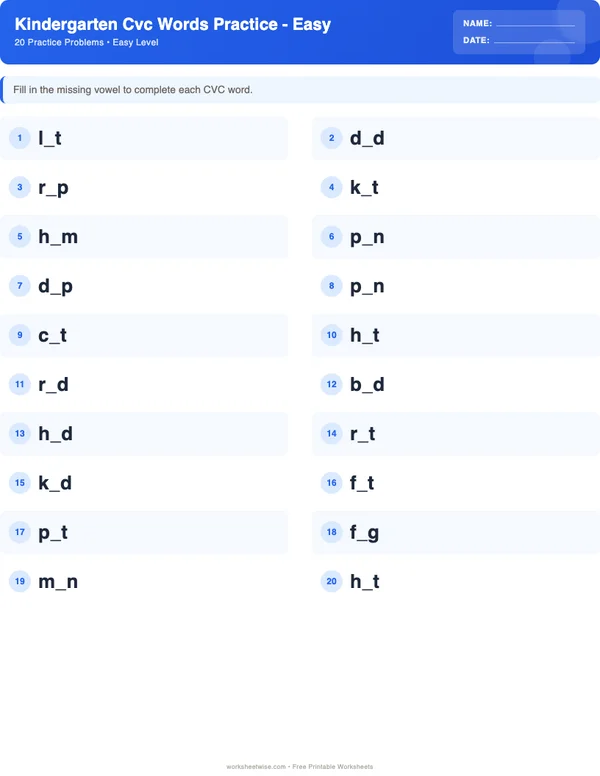
- Choose CVC words when the learner can say individual sounds but cannot yet combine three sounds reliably, or spells a three-sound word with a missing middle sound.
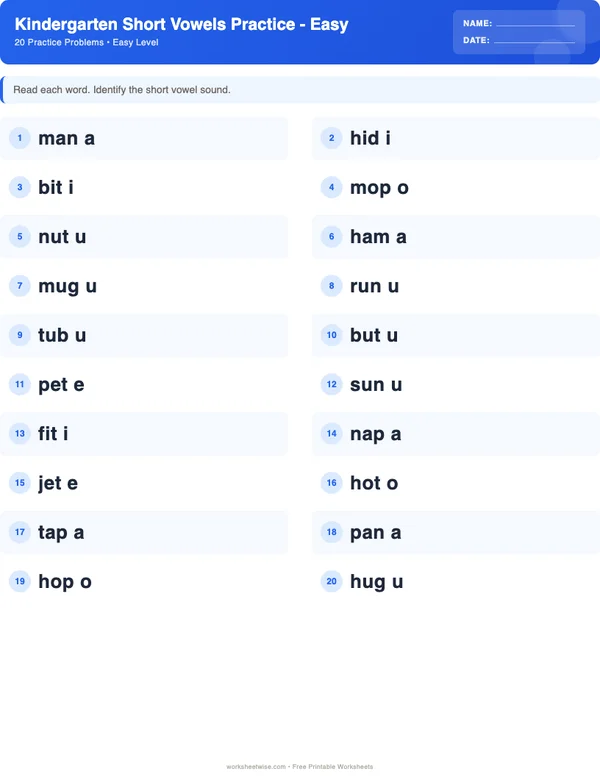
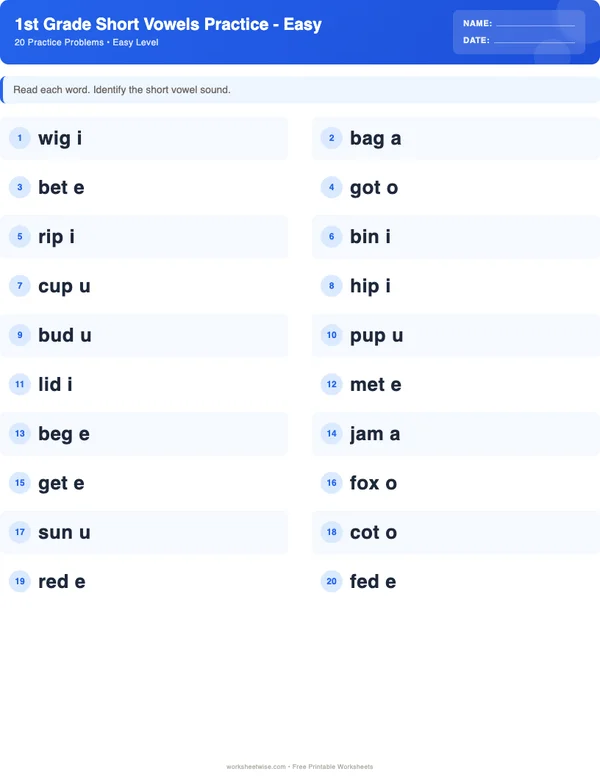
- Choose short vowels when consonants are mostly secure but the learner confuses the middle vowels in words such as pen/pin or hot/hut.
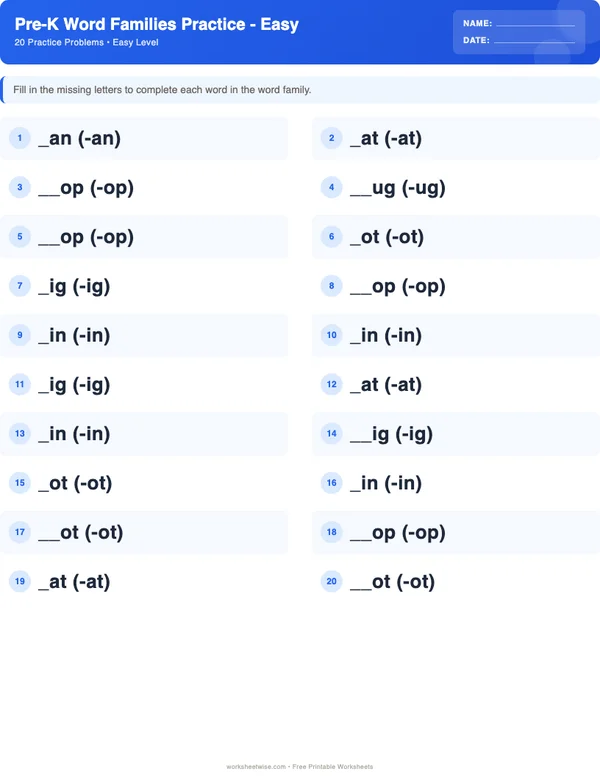
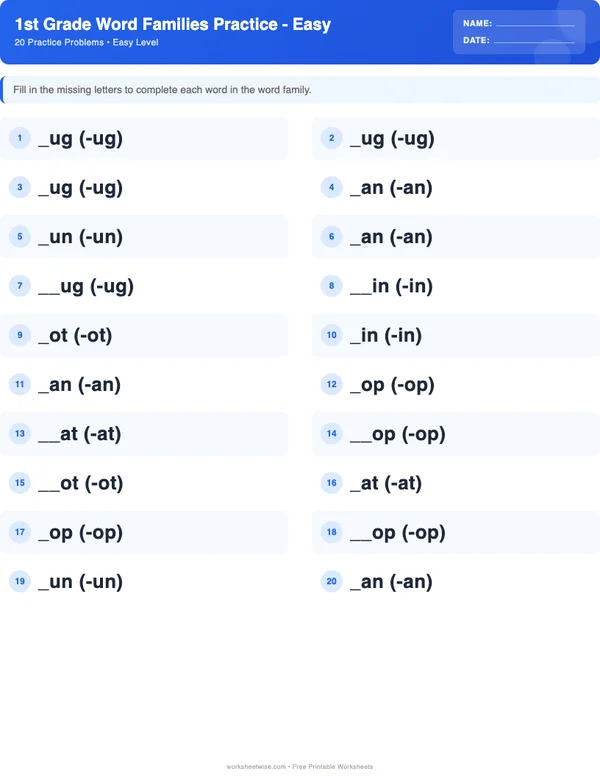
- Choose word families when the learner can read a shared ending such as -at but needs practice changing the initial sound without rebuilding the whole word.
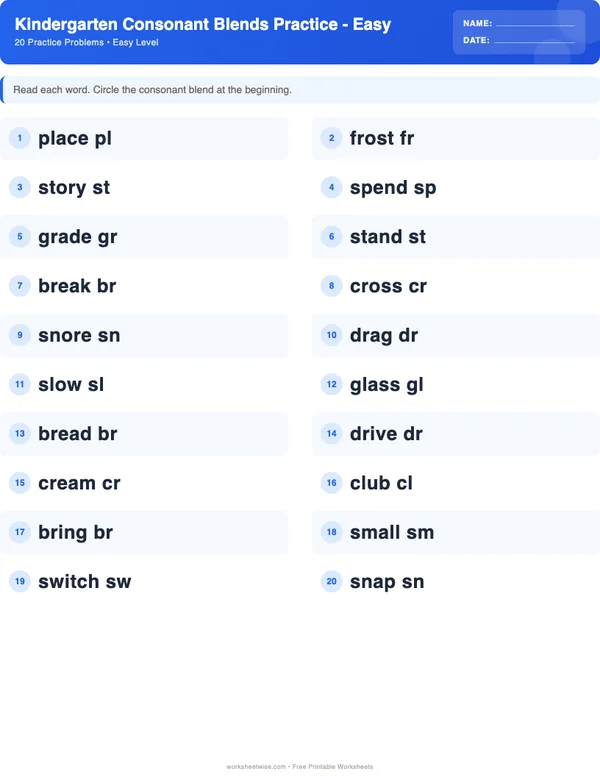
- Choose consonant blends when the learner drops one of two adjacent consonant sounds, as in stop read as sop.
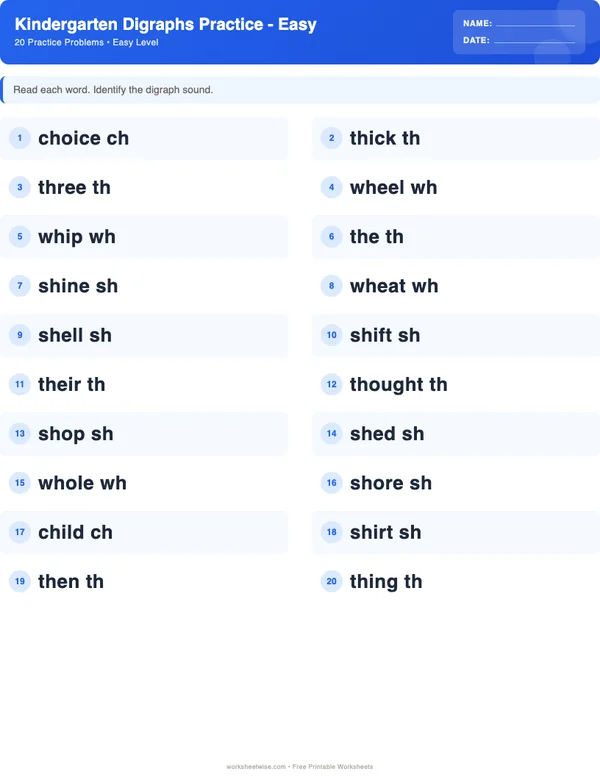
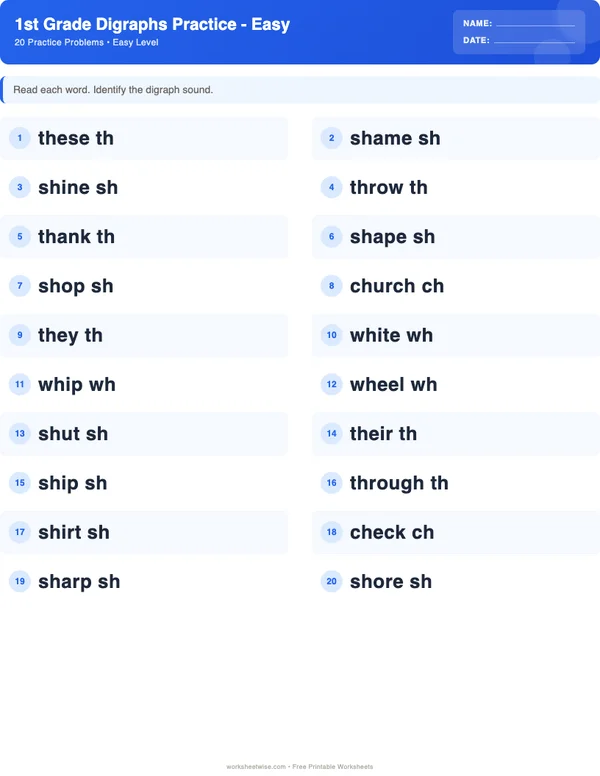
- Choose digraphs when two letters must be treated as one sound, as in sh in ship.
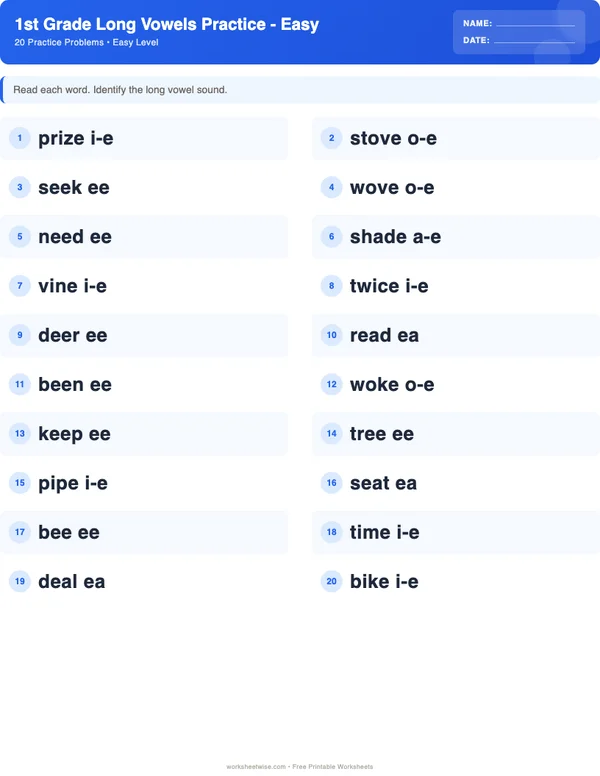
- Choose long vowels only when short-vowel CVC reading is stable enough to compare patterns such as cap/cape.
- Choose sight words when a specific high-frequency word needs recognition and spelling practice, while still discussing the regular and irregular parts of that word.
A topic is not a session plan. Narrow “digraphs” to “hear and read initial sh,” or “long vowels” to “compare short a with silent-e long a.” If a worksheet mixes more than the intended target, mark only the usable items before beginning.
Make the transition part of the lesson
A learner arriving from school may be hungry, physically restless, socially overloaded, or simply finished with writing for the moment. Treat that state as information about the response format, not as proof that the phonics target is too hard.
Run an eight-to-fifteen-minute print-plus-conversation routine
Reset. Keep the worksheet out of sight during the first two minutes. Let the learner move three letter cards across the table, stretch, or tell you one thing about the day.
Preview. Point to the stopping line you have drawn after item 6. Say, “We will do these six, talk about two, and then stop.” A clear endpoint makes the demand concrete.
Model. Think aloud for one item. For ship, say, “These two letters, s-h, work together. I hear one sound, /sh/. I keep them together while I blend /sh/–/i/–/p/: ship.” The model identifies the print feature, the sound, and the action.
Respond. Let the learner answer through the format that best preserves the target: circle, point, match, build with letters, say, read, or write. Do not require extra copying when the target is decoding rather than handwriting.
Converse. Select one correct response and one revealing error. Ask, “What sound do these letters represent?” or “Show me every sound you heard.” Avoid “Why did you get this wrong?” which invites guessing about motives rather than examination of the word.
Close. Have the learner reread or rebuild one corrected word. Record a specific note: “Read stop as sop twice; retained both sounds after finger tapping.” That note can choose tomorrow’s sheet.
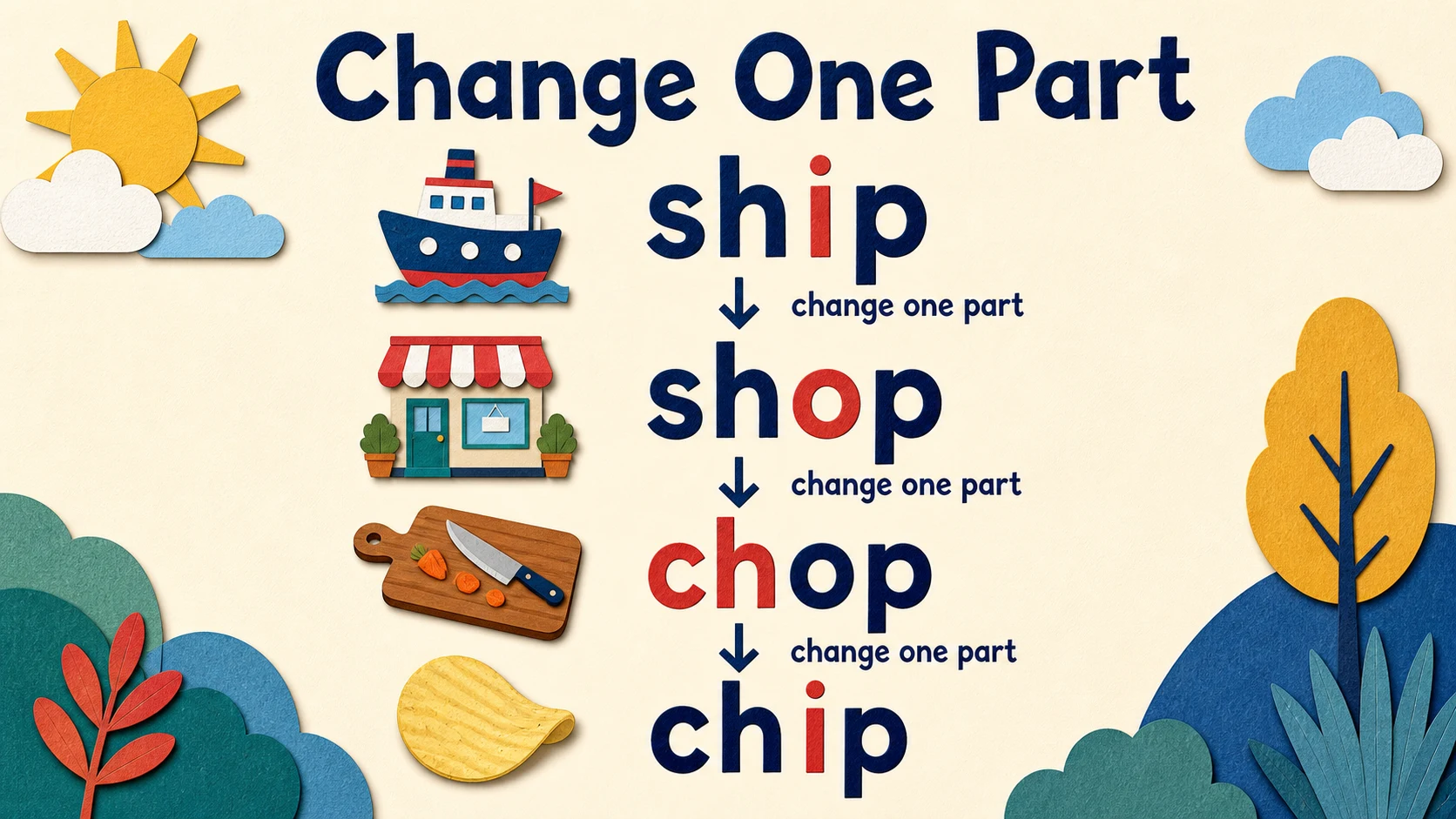
Use the routine with one 1st grade digraph at a time: model the two-letter spelling, hear its single sound, complete a short set, and end with one corrected reread.
Compare four representative phonics choices
Several catalogue topics can look similar on paper while requiring different thinking. The following checked examples show how to identify the actual target.
Example 1: CVC blending with cat
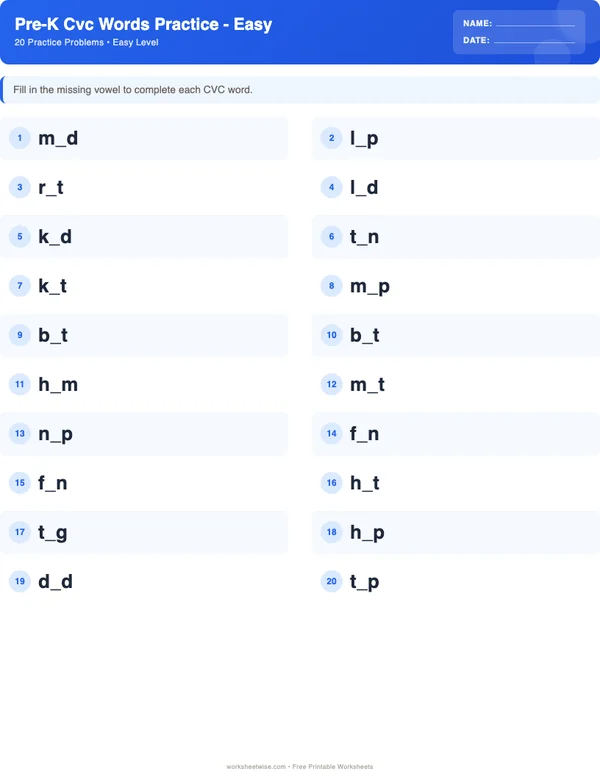
The Pre-K and kindergarten CVC resources include words such as cat, pin, and hug and offer word building, picture matching, fill-in-the-blank, and reading activities. For cat, the checked sound sequence is /k/–/ă/–/t/, represented by three letters and three phonemes.
Model by sliding a finger continuously beneath the letters: “/kkkăăăt/—cat.” Then place three counters in three sound boxes, one for each sound, and sweep beneath them to blend. Ask the learner to build cat, then change only the first letter to make mat. Both words preserve the -at ending, so the adult can observe whether the learner changes the initial sound while retaining the rest.
This example belongs here because it demonstrates the catalogue’s simplest stated word structure and allows oral blending, manipulation, reading, and spelling without a long written demand. The Pre-K CVC Words guide and free sheet is a suitable discovery point. For ages three and four, prioritize brief adult-led oral, matching, manipulative, and movement work over desk work: three counters and two built words may be the entire session.
If the learner says every sound correctly but cannot combine them, choose another tightly controlled CVC blending set next. If the middle sound is wrong across several words, move to a short-vowel discrimination task instead.
Example 2: short e versus short i
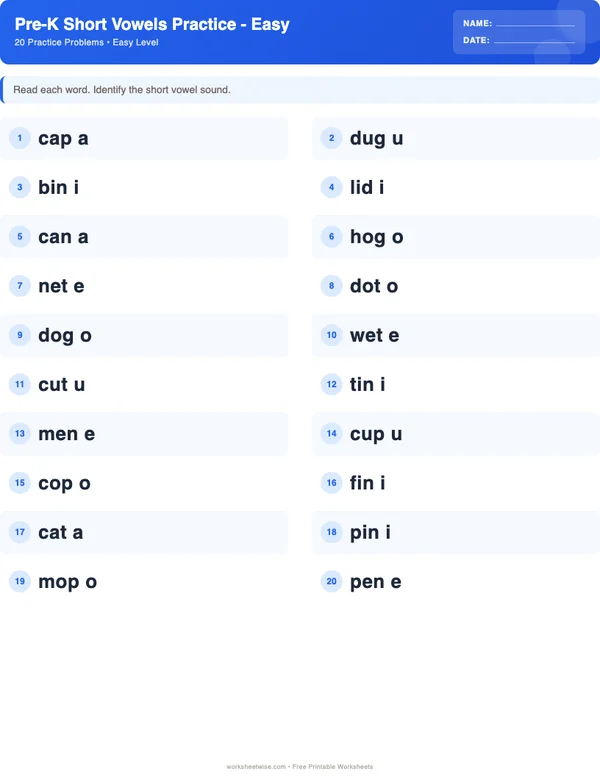
The catalogue identifies short e and short i as a confusable pair and supplies the minimal pairs pen/pin, set/sit, and bed/bid. Each pair changes only the medial vowel:
- pen /p/–/ĕ/–/n/ versus pin /p/–/ĭ/–/n/
- set /s/–/ĕ/–/t/ versus sit /s/–/ĭ/–/t/
- bed /b/–/ĕ/–/d/ versus bid /b/–/ĭ/–/d/
Say both words without showing print. Ask the learner to point to an e or i card, then reveal the written words and have the learner place each beneath the matching vowel. Finish by dictating one pair.
This belongs in an after-school routine because pointing and sorting isolate auditory discrimination before handwriting is added. It is more informative than assigning 20 mixed-vowel items and counting the total. The Pre-K Short Vowels guide and free sheet provides the relevant entry point, but the learner’s responses—not the Pre-K label—determine whether it fits.
If oral choices are accurate but written vowels are reversed, retain the same contrast and use letter tiles before more writing. If oral choices are inconsistent, keep the next sheet limited to e/i rather than introducing all five vowels.
Example 3: a blend is not a digraph
Compare slip with ship. In slip, s and l are an initial blend: both sounds remain audible, /s/–/l/–/ĭ/–/p/. In ship, s and h form the digraph sh: two letters represent the single sound /sh/, followed by /ĭ/–/p/.
Ask the learner to hold up two separated fingers for the two sounds in sl and two joined fingers for the one sound represented by sh. Then read the words and sort them under “two sounds” and “one sound.”
This example belongs because the catalogue explicitly distinguishes blends from digraphs. It also prevents an unhelpful next-sheet choice: a learner who reads slip as sip needs blend work, while a learner who treats sh as two separate sounds needs digraph modeling.
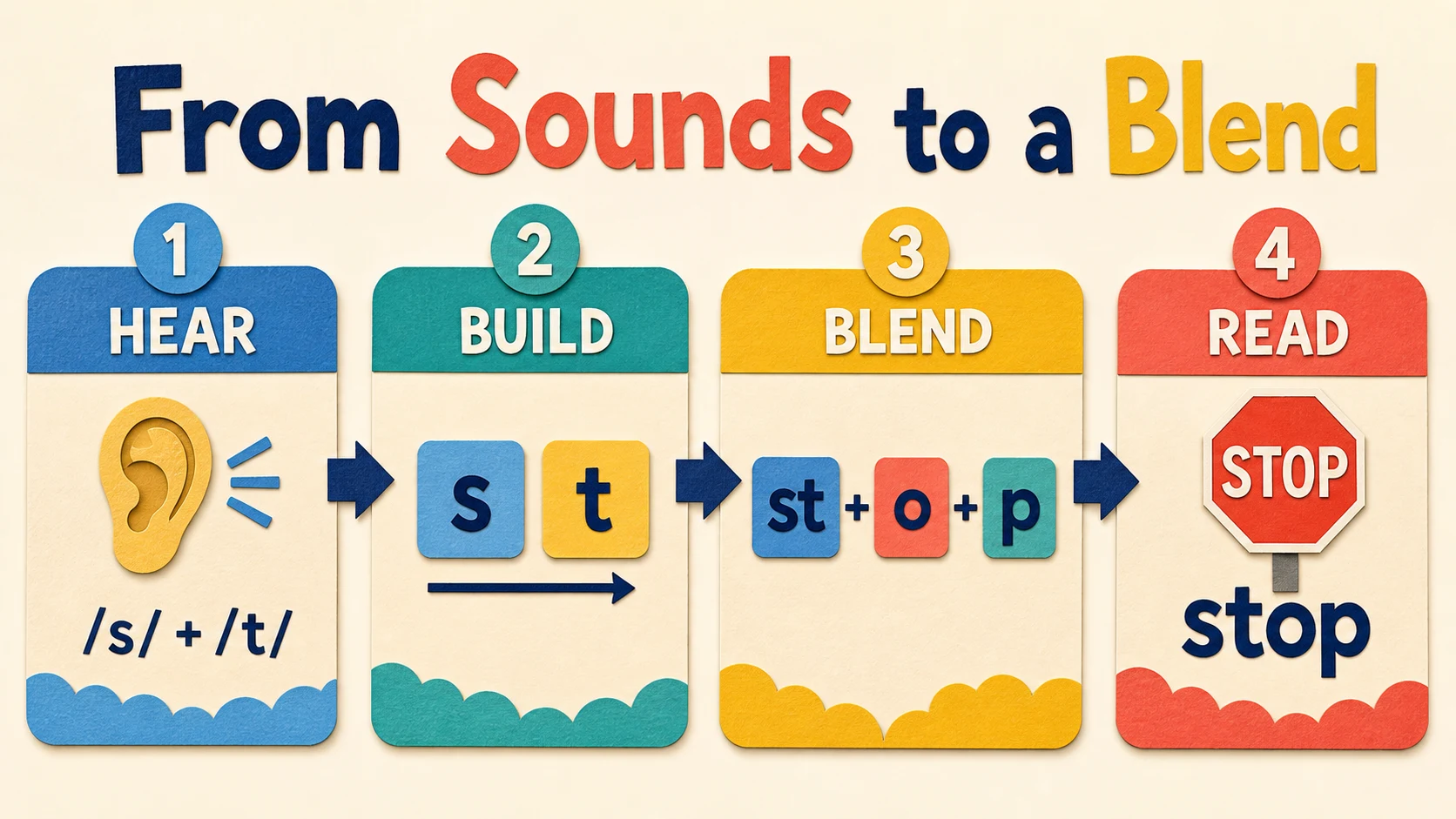
Move from hearing both consonants with an adult to reading and spelling whole 1st grade blend words; independence should follow accurate sound retention, not a calendar date.
Example 4: silent-e contrast with cap/cape
The 1st grade long-vowel catalogue entry recommends beginning with visually distinctive silent-e contrasts. Check cap and cape: cap follows CVC and has short a; adding final e creates cape, where the vowel is long. The words differ in both spelling and pronunciation, so the learner must attend to the final letter rather than guess from the initial letters.
Build cap with tiles, read it, add e, and read cape. Repeat with the supplied pairs pin/pine, hop/hope, and cub/cube. Then dictate only one pair. This belongs here because each physical change has a visible stopping point and the adult can hear whether the learner notices the vowel change.
If the learner reads both forms with the short vowel, return to one CVC/CVCe contrast. If short-vowel CVC forms are themselves unstable, select CVC or short-vowel practice next; adding more long-vowel patterns would obscure the prerequisite.
Choose response formats that preserve phonics
A response format should expose the target skill with the least unrelated load. Changing how the learner answers is an adaptation; changing what must be noticed may accidentally remove the phonics work.
Adapt the motor demand, not the sound-spelling decision
For decoding, the learner can point to a word, match word to picture, underline the target spelling, or read aloud. For encoding, the learner can arrange magnetic letters, write in sound boxes, or dictate letters for the adult to place. For discrimination, the learner can sort cards, move to opposite sides of the room, or hold up a vowel card.
These adaptations preserve the target:
- Cover 14 of a 20-item sheet and complete six.
- Let the learner say each blend word while the adult records it.
- Cut apart selected items for a standing sort.
- Use tokens before pencil marks to segment a word.
- Enlarge the page or provide a blank strip beneath the active row.
- Alternate one oral response with one written response.
These changes do not preserve the target:
- Reading the answer aloud when independent decoding is what you need to observe.
- Naming the picture and asking the learner only to copy the word.
- Reducing stop to top when the target is retaining both blend sounds.
- Allowing a sight-word activity to become pure visual matching without saying, analyzing, or writing the word.
- Correcting every letter before the learner attempts the word.
The IES writing guide recommends building fluency with handwriting, spelling, and sentence construction and providing regular opportunities to write. That is relevant when the phonics task includes encoding, but it does not mean every after-school phonics response must be handwritten. Use the IES elementary writing practice guide as sourced guidance for writing instruction; using tiles when fatigue would hide the phonics skill is a situational adaptation suggested here.
Give feedback that returns attention to the word
Feedback should identify the relevant sound-spelling relationship, prompt another attempt, and finish with the learner performing the corrected action.
Use a three-move correction
- Name what was heard or seen. “You read sop.”
- Direct attention precisely. “Point to the letters before o. Tap both sounds: /s/, /t/.”
- Retry the whole word. “Now blend from the beginning: /s/–/t/–/ŏ/–/p/, stop.”
For a correct answer, confirm the process: “You kept s and t and blended all four sounds.” Avoid praise that gives no phonics information, such as “You’re so smart.”
For ship read with separate /s/ and /h/ sounds, say, “These two letters work together here. Join two fingers: sh, /sh/. Blend again.” For pin written as pen, say both words, have the learner select the intended word orally, then rebuild only the middle letter. For cape read as cap, point to final e and ask, “What changed when we added this letter?” If there is no response, model once and present a fresh contrast such as hop/hope.
Do not erase the evidence immediately. Put a small dot beside the item, complete the correction, and note whether the retry succeeded with a prompt or independently. The purpose is instructional decision-making, not a spotless page.
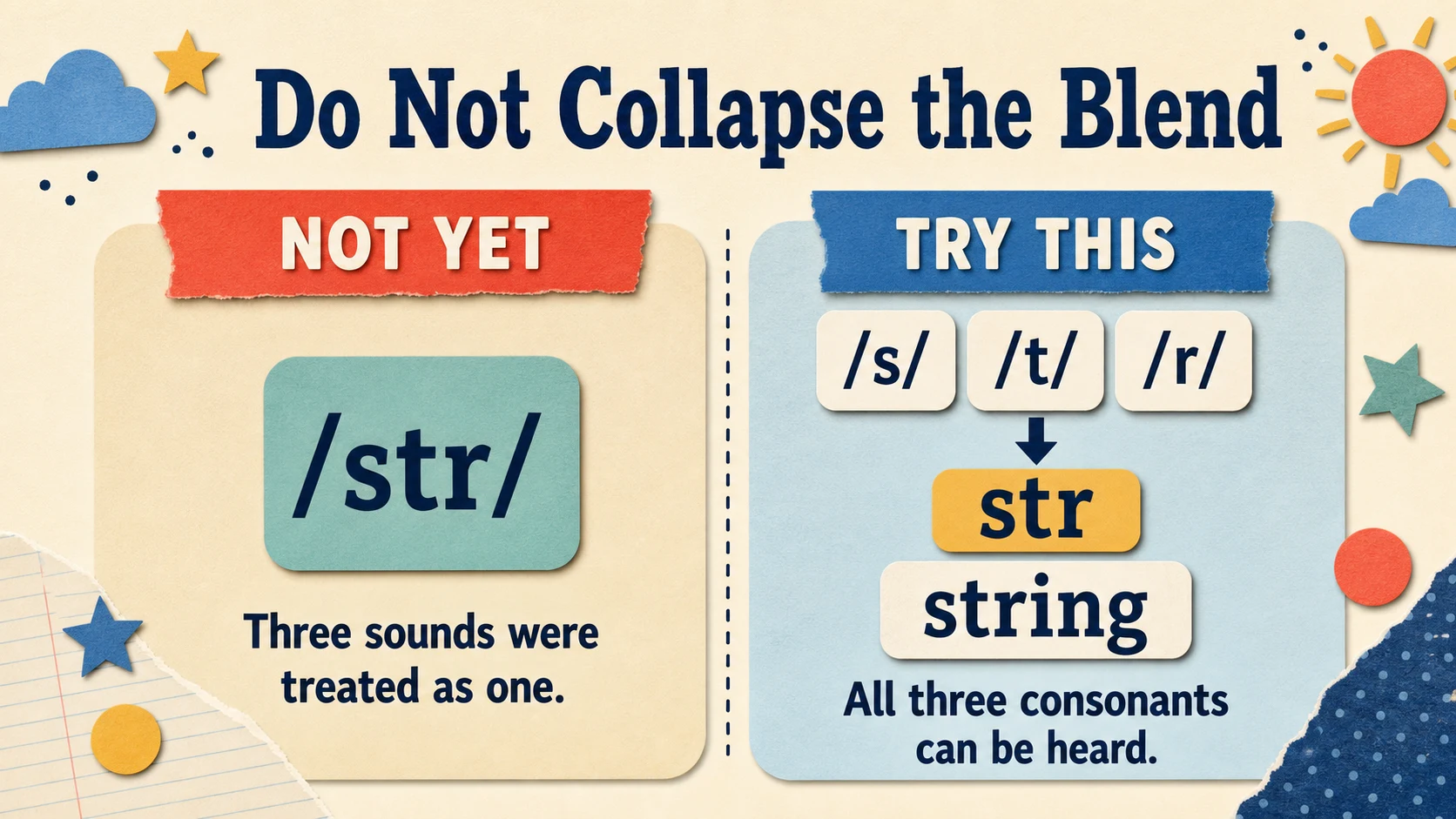
Treat a repeated 2nd grade blend error as a cue for a specific teaching response—such as tapping every consonant—not as a diagnosis or a reason to assign more mixed problems.
Let the error pattern choose the next sheet
One wrong answer may be a lapse. A repeated, structurally similar error is more useful. Compare errors across at least three relevant items and record what the learner did before choosing another page.
Translate observations into next actions
| Observation during the short set | Plausible instructional interpretation | Next sheet or activity |
|---|---|---|
| Says /k/, /ă/, /t/ accurately but cannot blend cat | Individual sounds are available; continuous blending needs support | Another single-vowel CVC set with an adult finger sweep |
| Reads pen as pin and bed as bid | The same medial-vowel contrast is unstable | Short e/i oral sort followed by two dictated CVC words |
| Reads stop as sop and step as sep | The second consonant in an initial blend is being omitted | Initial st words with finger tapping; do not mix many blend families |
| Reads ship as separate /s/ and /h/ sounds | The learner is treating a digraph as a blend | A focused initial sh identification and reading set |
| Reads cap and cape both with short a | Final e is not yet controlling the vowel response | CVC/CVCe matched pairs with letter tiles |
| Reads a practiced word in isolation but not in a sentence | Recognition has not transferred consistently to connected text | A short decodable sentence containing that known pattern |
| Spells tent as ten | The final consonant of the final blend is omitted | Contrast ten/tent, then bum/bump, using a token for every sound |
The interpretations are instructional hypotheses, not diagnoses. Hearing, language background, speech production, attention, vision, fine-motor demands, and unfamiliar vocabulary can all affect a response. A worksheet cannot determine the cause. If concerns are persistent across settings, share concrete observations with the learner’s teacher or an appropriate qualified professional rather than attaching a label.
The formative assessment phonics worksheets can support a more deliberate check when errors are mixed. Use a small sample to identify a pattern; do not turn a tired session into a high-stakes test.
Separate cumulative review from new teaching
A learner needs repeated encounters, but repetition should not mean completing the same format until frustration rises. Use a two-week sequence that alternates focused teaching, light cumulative review, and connected reading.
A digraph plan with deliberate stopping points
For a 1st grade learner working on sh:
- Day 1: Model initial sh with ship; read four sh words.
- Day 2: Sort initial and final positions, such as ship/wish.
- Day 3: Build and spell three words; reread Day 1 words.
- Day 4: Mix three sh words with familiar CVC words.
- Day 5: Read one or two short decodable sentences containing known patterns.
- Day 6: Brief oral review only.
- Day 7: Recheck four words in a changed order.
- Day 8: Add ch only if sh is consistently treated as one sound.
- Day 9: Contrast sh and ch in a small sort.
- Day 10: Read a short cumulative set and record the next error pattern.
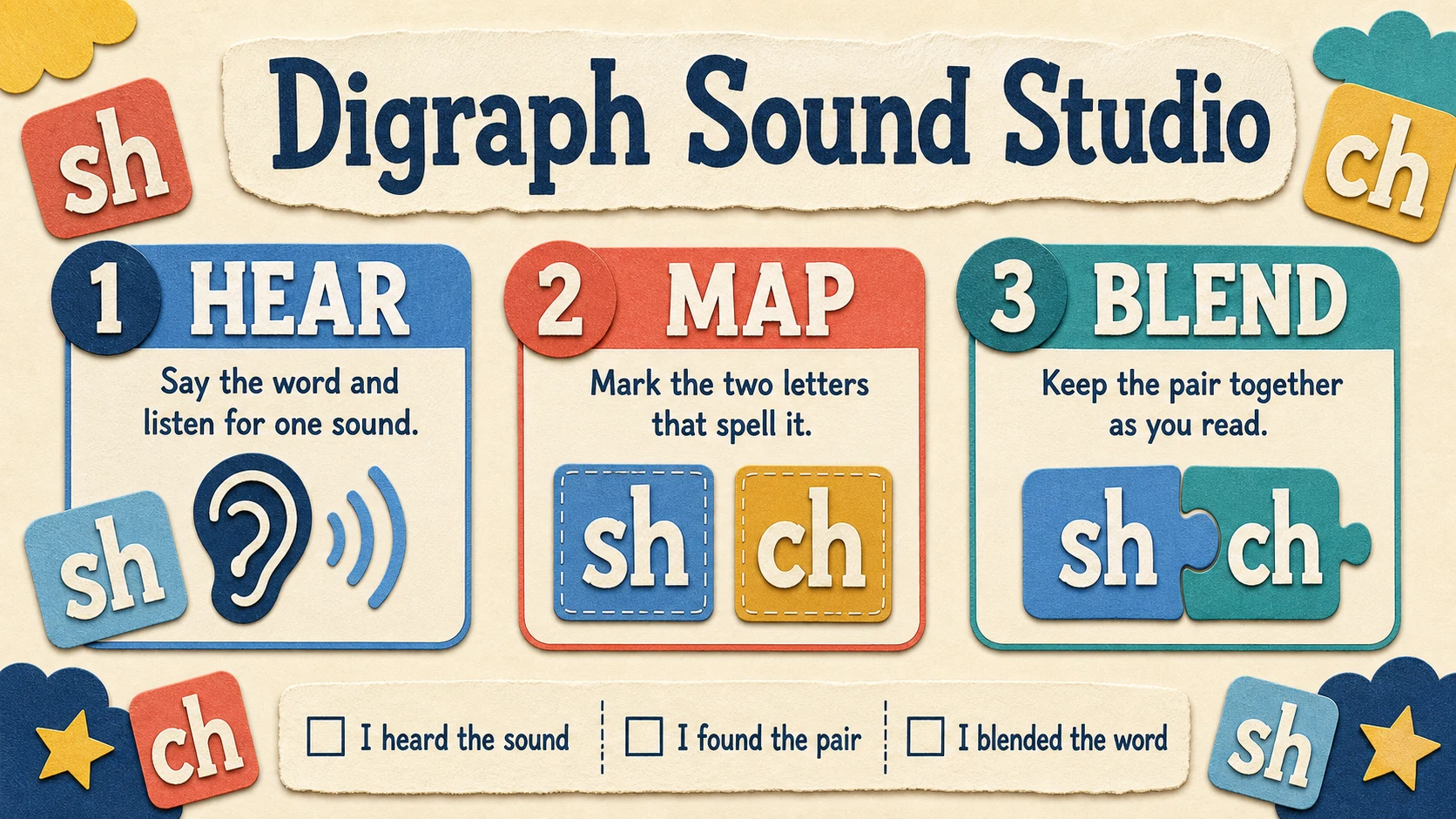
Across two weeks, revisit a 1st grade digraph through hearing, reading, spelling, contrast, and connected text instead of repeating one worksheet format.
This cadence is a suggested after-school plan, not a promised timeline. If the learner needs longer with sh, stay there. If the target is already secure across reading and spelling, move sooner.
A sight-word plan that still uses phonics
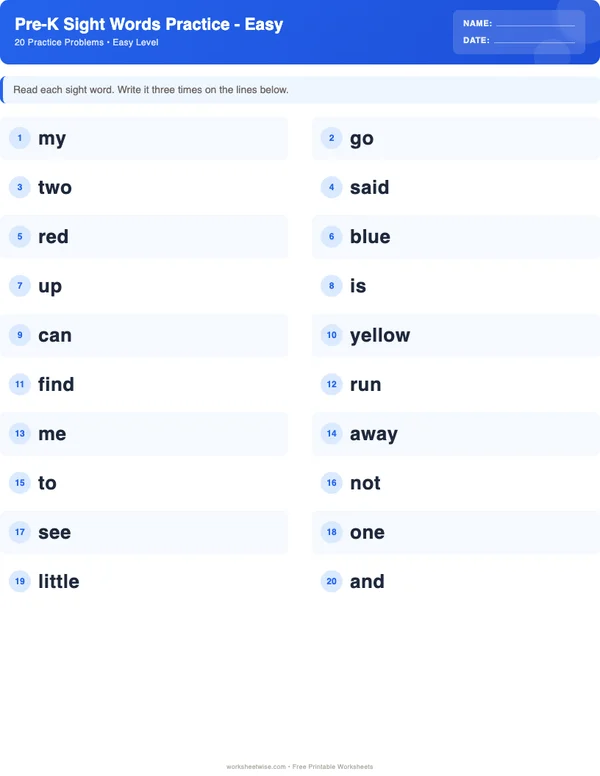
For a sight word, first identify the parts the learner can decode and the part that must be remembered. With the catalogue example said, s and d correspond regularly to their sounds, while ai represents the unexpected short-e sound in this word. Have the learner say said, map the sounds to the spelling, mark the unexpected part, cover the word, write or build it, and use it orally in a sentence.
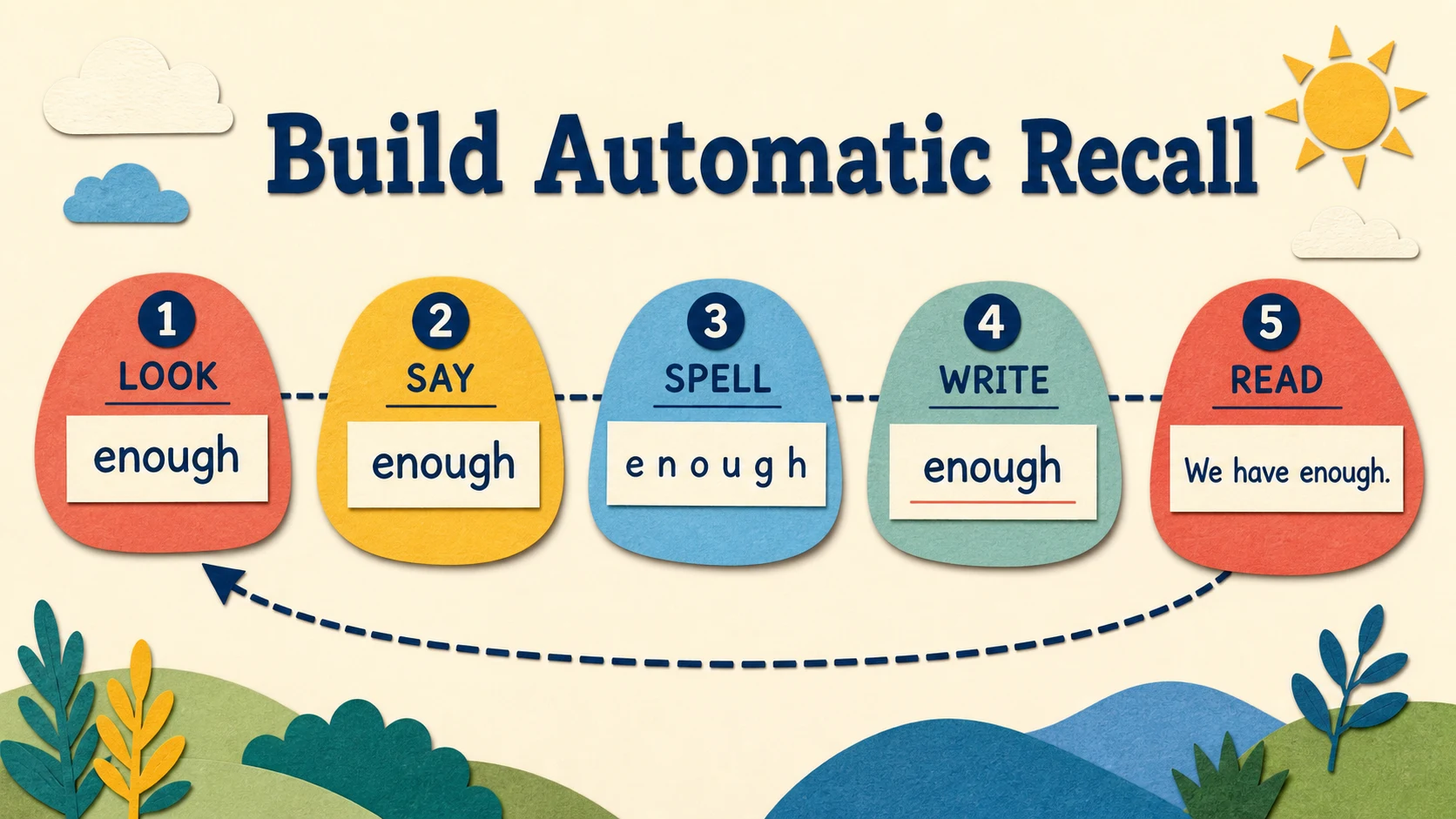
For 2nd grade sight-word practice, fade support only after the learner can analyze, recall, and use the word—not after repeated visual exposure alone.
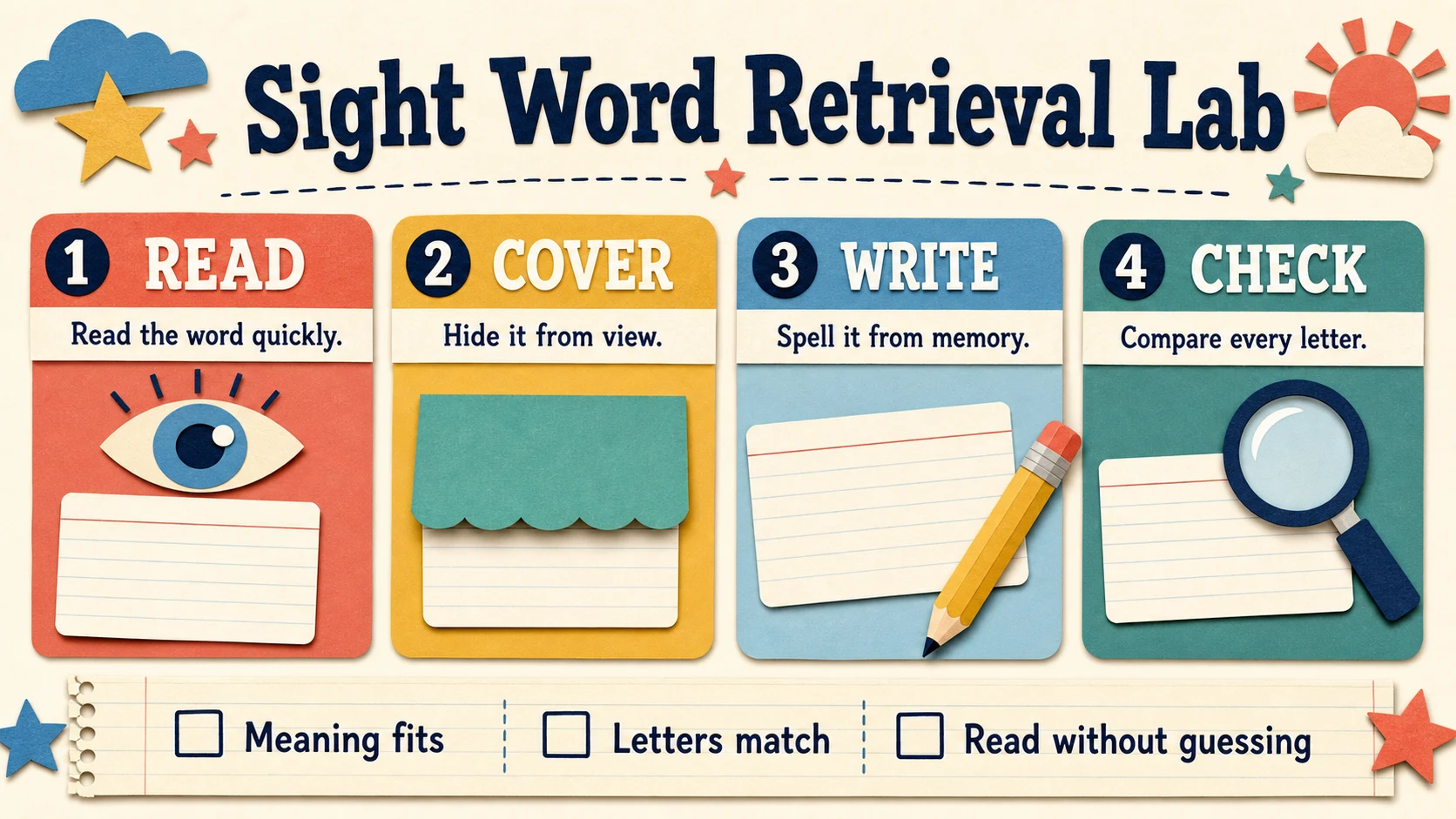
Space 2nd grade sight-word review across days and vary seeing, saying, analyzing, spelling, and reading the word in context.
The catalogue suggests introducing a small number of sight words and reviewing previously taught words. The exact pace is a teaching suggestion, not a universal rule. If two words are producing confused spellings, reduce the set. If recognition is accurate but spelling is not, choose an encoding response rather than another matching page.
Add connected text without losing the stopping point
Word lists reveal whether a learner can apply a pattern in isolation. Short connected text reveals whether that skill remains available while meaning and sentence structure also demand attention. The IES foundational reading guide recommends daily connected-text reading to support accuracy, fluency, and comprehension. For after-school use, that can be one or two carefully selected sentences rather than a long passage.
After practicing sh, use a sentence containing known spellings and one or two target words. Ask the learner to underline sh, read the sentence, and tell what happened. Do not insert many untaught vowel teams merely to make the sentence more interesting.
The Common Core ELA standards present grade-specific expectations within a broader framework that includes reading, writing, speaking, listening, and language. That supports considering phonics as part of literacy rather than isolated page completion. It does not establish that a particular WorksheetWise sheet matches every local sequence. Grade labels remain intended practice levels, and local curricula may introduce patterns in a different order.
Conversation supplies the meaning check that paper alone cannot. After a correct decoding, ask, “What does that word mean here?” If the learner decodes accurately but cannot explain the sentence, do not infer a phonics failure. Clarify vocabulary or choose more familiar connected text.
Know when to stop, repeat, or switch
Stop the session when the marked section is complete, even if the learner could do more. A predictable ending protects tomorrow’s willingness to return. Also stop early if responses become hurried, handwriting deteriorates sharply, the learner begins guessing from pictures, or the interaction turns into repeated correction without successful retries.
Repeat the same target with a different response format when the phonics pattern remains the problem. Switch to movement, oral sorting, or tiles when paper mechanics are masking the target. Step back to a prerequisite when errors show that the current pattern depends on an unstable earlier skill.
Do not use these worksheets to diagnose a reading disorder, hearing difficulty, language disorder, attention condition, or motor difficulty. Do not promise that completing a number of pages will produce mastery, fluency, or grade-level performance. Do not compare one learner’s pace with another’s. A home observation becomes useful when it is concrete: word attempted, response given, prompt used, and result of the retry.
Make tomorrow’s choice before putting the page away
End by writing one line on the sheet: “Target—initial st; observed—dropped /t/ in two of four words; retry—accurate after tapping.” Tomorrow, select only a small initial-st set, model the tapping once, and check whether the learner retains both sounds without the prompt.
If no clear pattern emerged, use the free deterministic worksheet generators to create a narrowly controlled follow-up rather than assigning a broad mixed review. Generate one short set around the exact pattern you recorded, mark a six-item stopping point, and begin the next session with one model plus one conversation question.
Put it into practice
Use the guide with a real printable
Move from explanation to a short, observable practice task. Check the first item together, then adjust the next session from the learner's actual work.
Open the first free worksheetExplore a neighboring collection