1st Grade Counting at a Glance
First-grade counting instruction should help a learner connect spoken number words, written numerals, quantities, and positions in a sequence. A learner should not only recite numbers but also count objects accurately, continue from a given number, find missing numbers, cross decade boundaries, count backward from a small number, and develop skip-counting patterns by 2s, 5s, and 10s.
The most useful teaching order is concrete objects, then pictures or structured visual models, and finally numerals alone. Watch the learner’s work closely: move forward when the current representation is accurate and reasonably fluent, and return to a more concrete model when errors become persistent.
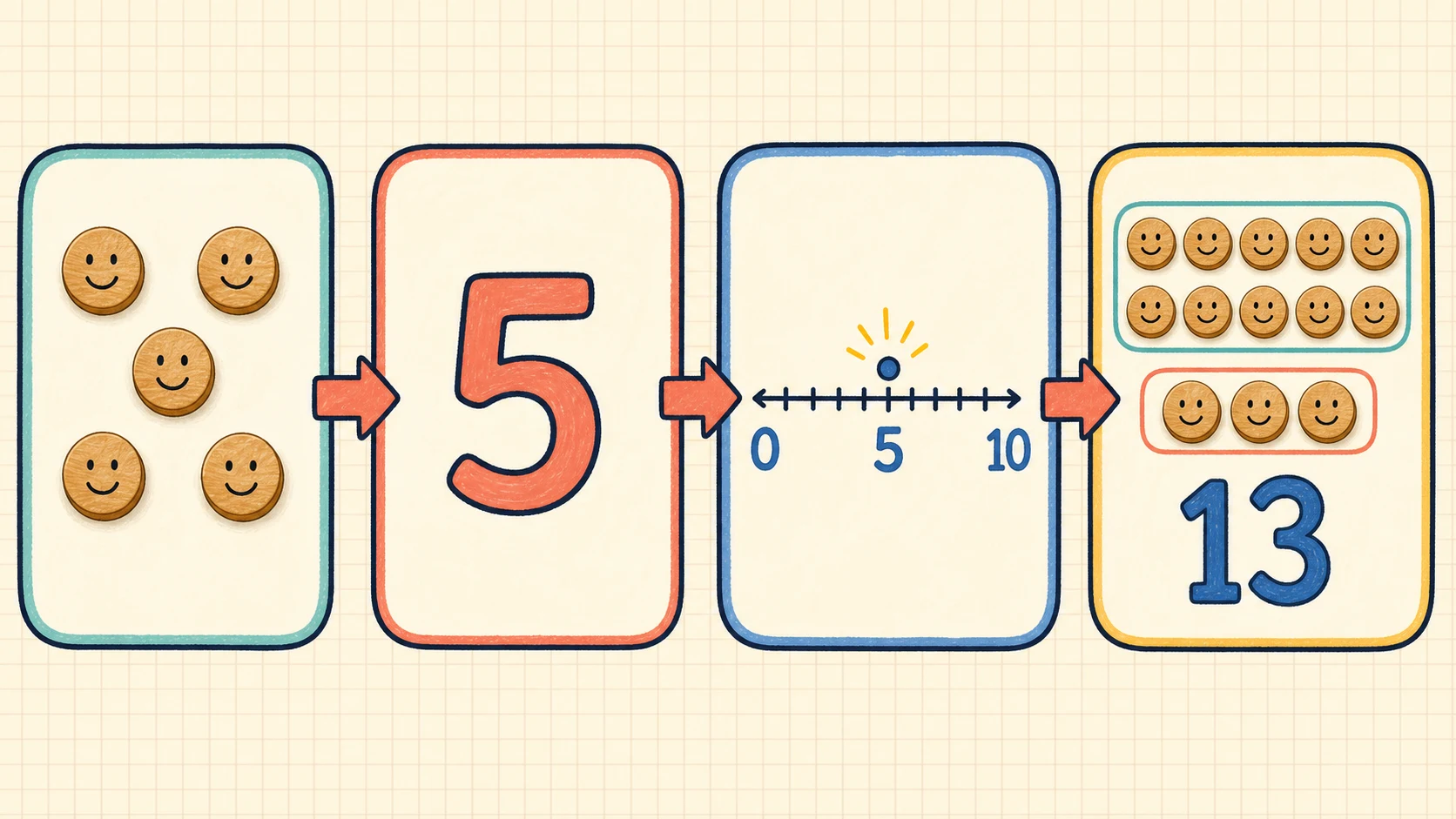
Counting connects number words, quantities, numerals, sequence positions, and repeated intervals.
Grade labels describe the intended practice level, not a fixed rule about what every child must do at the same time. Local curricula and instructional sequences differ. Some material traditionally associated with kindergarten counting remains valuable in first grade because it supports place value, addition, subtraction, money, and later number work.
The Common Core State Standards for Mathematics place foundational counting concepts in the kindergarten counting and cardinality progression. In first grade, those concepts continue to support work with operations and tens and ones. This source offers high-level curricular context; it does not evaluate WorksheetWise materials or prescribe a universal timetable.
The Knowledge Underneath Accurate Counting
Before choosing a page of sequence exercises, identify which part of counting is secure and which part is causing difficulty.
Stable number-word order
The learner needs to say number words in the correct order. If the learner says “twenty-seven, twenty-eight, thirty, thirty-one,” a missing “twenty-nine” may reflect an unstable verbal sequence rather than a numeral-reading problem.
Check short sections instead of always beginning at one:
- Count from 8 to 16.
- Start at 34 and stop at 42.
- Count backward from 15 to 9.
- Say the next three numbers after 58.
Starting at varied numbers reveals whether the learner knows the sequence or has memorized only a long recital beginning with one.
One-to-one correspondence
Each object must receive exactly one count. The learner may touch, slide, point to, or cover each item while saying one number word. Accurate recitation does not guarantee accurate object counting.
Use both orderly and scattered sets. A row makes tracking easier; a scattered group reveals whether the learner has a deliberate counting path. If an object is counted twice or skipped, reduce the set and let the learner move each counted object into a separate area.
Cardinality
After counting a set, the final number named tells how many objects are in the whole set. A learner who counts eight objects correctly but starts counting again when asked how many may not yet be using the final count as the set’s total.
Ask for the total after the count. Then rearrange the same objects and ask whether the quantity changed. The learner may recount to verify, but the teaching point is that spreading or clustering objects does not add or remove any.
Numeral recognition and production
A learner must connect a quantity and spoken number word to its written numeral. Recognition and writing are related but distinct. A child may identify 17 correctly while reversing digits during writing, or may copy 41 without reading it accurately.
Keep handwriting demands modest when the immediate goal is counting. Numeral formation can be practiced separately if it is obscuring what the learner understands about quantity or sequence.
A Grade-Appropriate Counting Progression
Use this progression as a decision guide, not as a rigid schedule. Begin at the first row that produces uncertain, slow, or inconsistent work.
| Stage |
Learner action |
Useful model |
Evidence to look for |
| Count visible sets |
Count each object once and state the total |
Counters, buttons, cubes, small toys |
Coordinated pointing and number words |
| Match quantities and numerals |
Place a numeral card beside a counted set |
Objects and numeral cards |
Correct match without guessing from appearance |
| Continue a sequence |
Count forward from a number other than one |
Number line or hundred chart |
Starts with the number after the given number |
| Complete missing numbers |
Determine numbers before, after, or between |
Partly covered number line |
Uses sequence relationships |
| Cross a decade |
Continue through 19–20, 29–30, and similar boundaries |
Hundred chart and bundled groups |
Changes the tens digit at the correct point |
| Count backward |
Recite and record descending sequences |
Number line with leftward movement |
Decreases by one without reversing direction |
| Skip-count |
Count by equal intervals of 2, 5, or 10 |
Grouped objects and hundred chart |
Maintains the same interval |
| Apply counting |
Count on, compare totals, or check simple work |
Model selected by the learner |
Chooses an efficient counting approach |
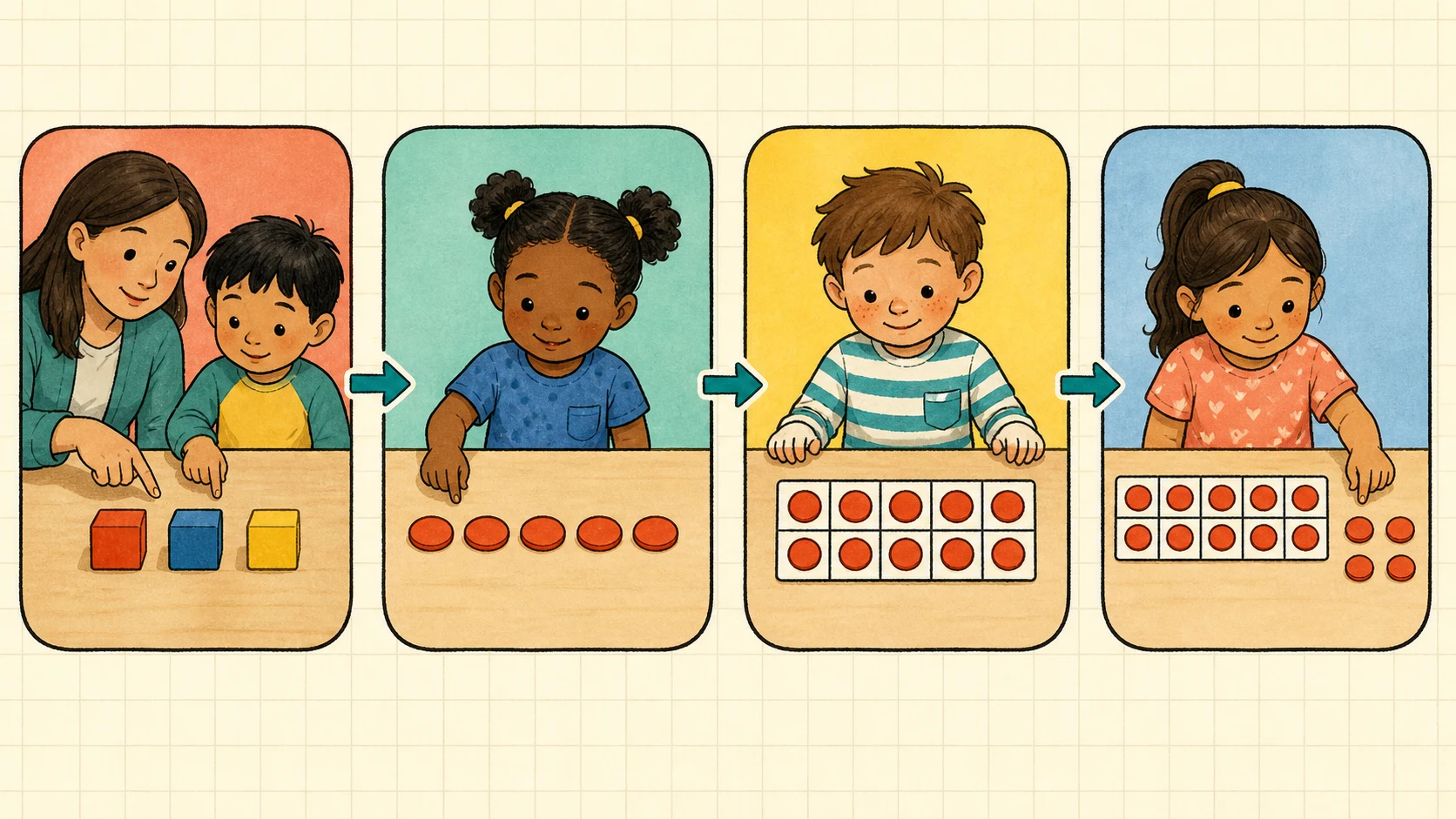
Support can fade from movable objects to visual references and then to independent numeral work.
Teen numbers deserve deliberate attention. Their spoken names are less transparent than patterns such as twenty-one through twenty-nine. Pair 14, for example, with one group of ten and four single objects. Do the same for 16, 18, and 19 so the learner sees a stable tens-and-ones structure even when the spoken name is difficult.
Concrete and Visual Models That Clarify the Skill
Movable objects
Linking cubes, buttons, counters, or small toys make each counted unit visible and movable. Ask the learner to slide every counted item from a “not counted” region to a “counted” region. This physical separation prevents duplicate counts and makes omissions easier to notice.
For larger sets, organize objects into groups of ten plus leftover ones. A set of 27 becomes two complete groups of ten and seven singles. This supports counting while preparing for first-grade place-value work.
Number lines
A number line shows that consecutive whole numbers are one step apart. Place a marker on 46 and move it one space at a time while saying 47, 48, 49, and 50. For backward counting, reverse the movement. The learner should see that the direction changes, but the size of each step remains one.
Avoid using jumps as decoration. One spoken number should correspond to one landing point. When skip-counting by 5, each jump must cover five number-line intervals.
Hundred charts
A hundred chart highlights repeated base-ten patterns. Moving right usually increases the number by one, while moving down one row increases it by ten on a standard chart. The final digit repeats down a column, helping learners notice that 7, 17, 27, and 37 share a ones digit.
Use the chart to explain an observed pattern, then hide part of it. Permanent access can turn an exercise into copying rather than counting.
Drawings and marks
Dots, tally-like marks, circles, and simple boxes are useful bridges between objects and numerals. The learner can cross out each mark while counting. Keep drawings plain enough that visual detail does not interfere with tracking.
The Institute of Education Sciences guide Teaching Math to Young Children provides broad, evidence-based instructional framing for early mathematics, including purposeful progression, mathematical language, and attention to what children understand. Here, using objects and visuals is an instructional application of that framing, not a claim that the guide reviewed this topic page or its worksheets.
Fully Checked Worked Examples
Example 1: Counting a scattered set
Suppose a learner sees 14 scattered counters.
- Move each counter into a row while assigning it one number word.
- Count: 1, 2, 3, 4, 5, 6, 7, 8, 9, 10, 11, 12, 13, 14.
- State the total: 14 counters.
- Check by arranging them as a group of 10 and a group of 4.
- Count the structured groups: 10, then 11, 12, 13, 14.
The two methods agree, so the checked answer is 14. The important evidence is not merely that the learner said “14,” but that every counter received one count and the final number was understood as the total.
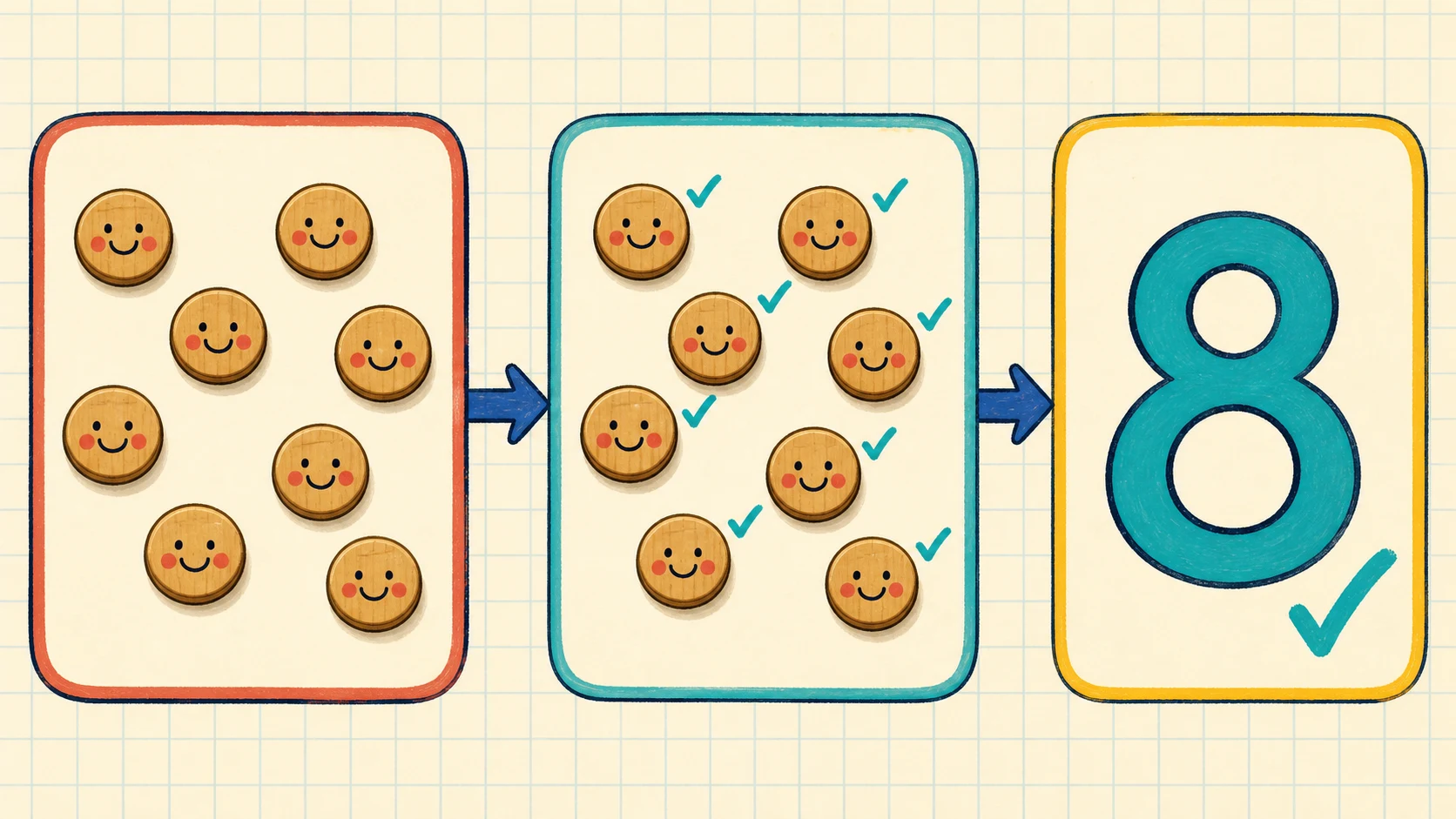
Reorganizing a set provides a second count without changing its quantity.
Example 2: Counting forward from a given number
Complete four numbers after 47.
Start with the number after 47, not with 47 again:
48, 49, 50, 51
Check each transition:
- 47 + 1 = 48
- 48 + 1 = 49
- 49 + 1 = 50
- 50 + 1 = 51
The boundary from 49 to 50 is correct because nine ones are followed by a new group of ten and zero extra ones.
A common alternative response is “47, 48, 49, 50.” That is accurate if the direction says to count four numbers beginning with 47, but not if it asks for four numbers after 47. Clarify whether the starting number is included.
Example 3: Finding a missing number
Complete:
36, 37, __, 39, 40
The sequence increases by one each time. The number after 37 is 38, and the number before 39 is also 38. Both relationships confirm the same result.
The checked sequence is:
36, 37, 38, 39, 40
If the learner writes 28, ask for an oral count from 35 to 40. This helps distinguish an uncertain sequence from confusion between the written forms of 2 and 3.
Example 4: Skip-counting by fives
Continue from 5 to 40 by fives:
5, 10, 15, 20, 25, 30, 35, 40
Check by adding five at every step:
- 5 + 5 = 10
- 10 + 5 = 15
- 15 + 5 = 20
- 20 + 5 = 25
- 25 + 5 = 30
- 30 + 5 = 35
- 35 + 5 = 40
Another check is to make eight equal groups with five counters in each group. The running totals are the eight numbers in the sequence.
Skip-counting is counting equal-size groups, not merely reciting a chant. If the learner loses the pattern, return to grouped objects or mark every fifth position on a number line.
Example 5: Counting backward across a boundary
Count backward from 22 to 17:
22, 21, 20, 19, 18, 17
Each term is one less than the term before it. The transition from 20 to 19 is the boundary case: one group of two tens becomes one ten and nine ones when one is removed.
Check by reversing the completed sequence:
17, 18, 19, 20, 21, 22
Because the forward count restores the original order, the backward sequence is consistent.
Example 6: Distinguishing numerals with reversed digits
A set contains 23 objects. Should the numeral be 23 or 32?
Organize the objects into two groups of ten and three single objects:
- Two tens represent 20.
- Three ones represent 3.
- 20 + 3 = 23.
Therefore, the correct numeral is 23, not 32. The numeral 32 would represent three tens and two ones. This example checks numeral order through quantity rather than relying on visual memory alone.
A Short, Repeatable Lesson Routine
A focused lesson can be brief. Its length should respond to attention, accuracy, and the purpose of the session rather than a universal time requirement.
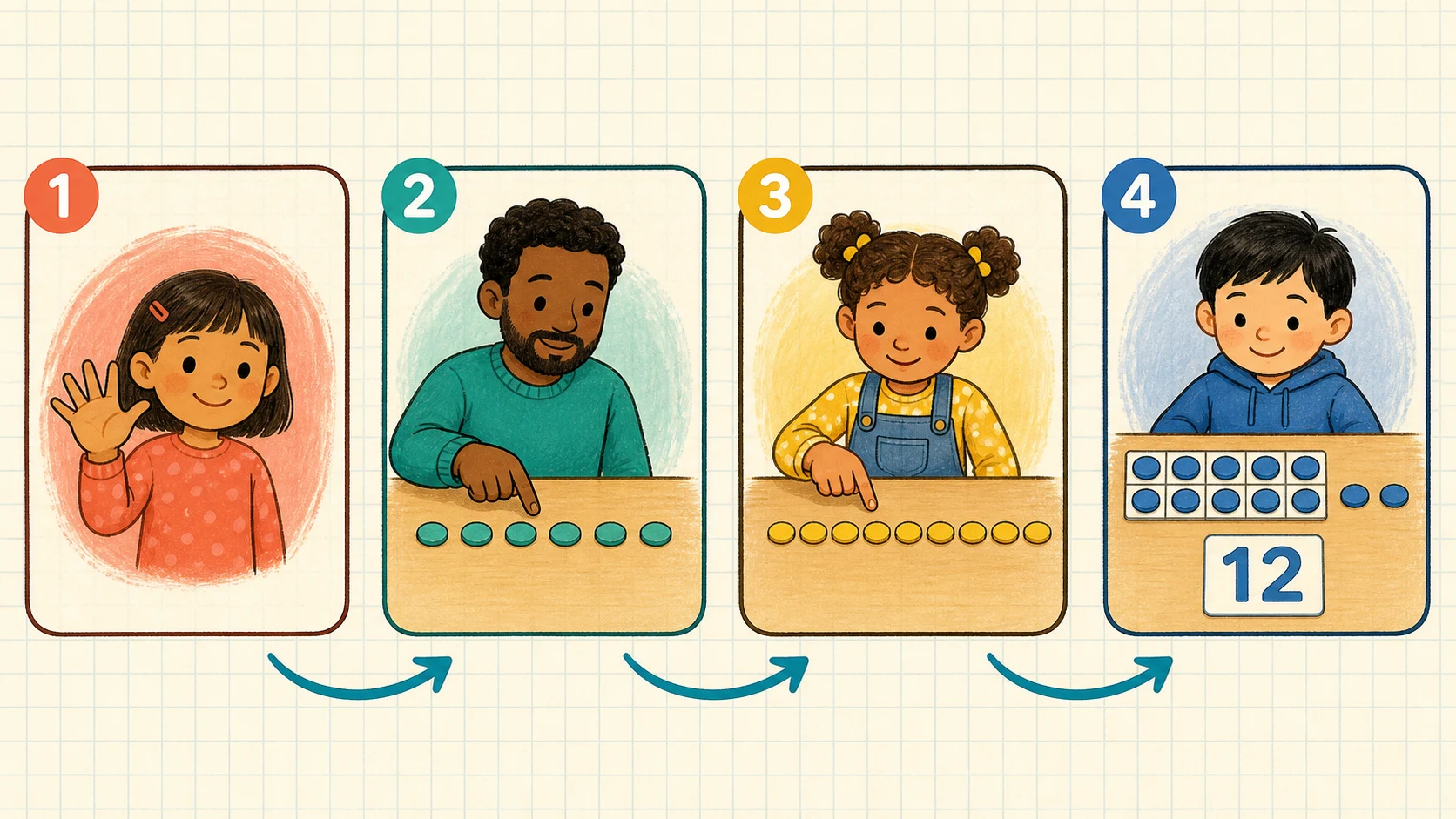
Use a familiar structure while changing the numbers, models, and amount of support.
1. Oral warm-up
Spend a short period counting from an unexpected starting point. Include one carefully chosen boundary, such as 18 through 22 or 38 through 42. On another day, count backward from 15.
2. Model one idea
Demonstrate a single focus with objects or a number line. Think aloud in precise language: “I start at 28. The next number is 29. One more takes me to 30.”
Keep the model narrow. Mixing scattered-set counting, backward counting, and skip-counting in the same explanation can make the source of an error difficult to identify.
3. Solve together
Complete two or three items with the learner. Ask the learner to point, move, or mark each step. Reduce prompts across the examples.
4. Independent check
Offer a small set of similar items without immediate help. Include one familiar item and one boundary case. Accuracy here is more informative than performance during guided work.
5. Explain and record
Ask the learner to show how one answer was found. Record what happened: accurate, hesitant, dependent on a model, or based on a repeatable error. Use that observation to choose the next session.
Selecting Practice With a Clear Purpose
Choose practice by the error or skill you observed, not by page count alone.
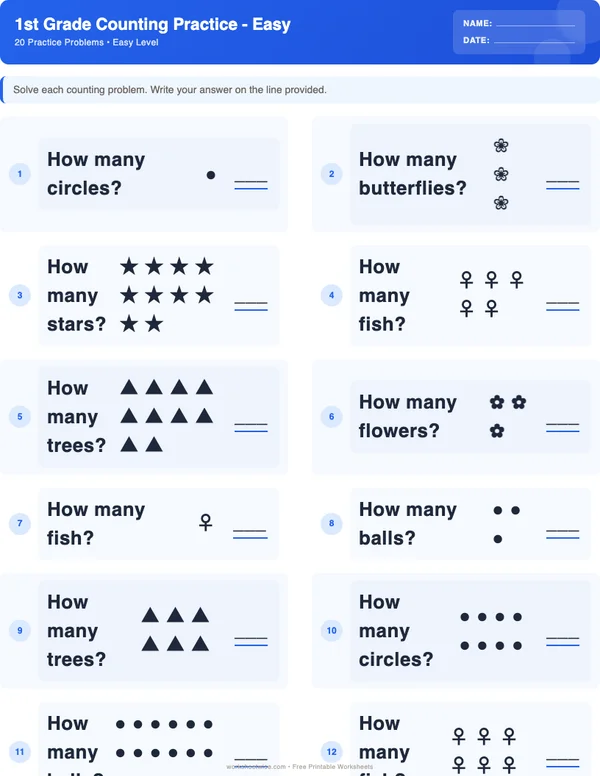
The free 1st Grade Counting worksheet contains 20 easy-level exercises covering counting, number sequences, skip-counting, and number sense, with a separate printable answer key. It is appropriate for an initial check, routine practice, homework, or reinforcement when those exercise types match the learner’s needs.
Use only part of a page when a narrower sample is sufficient. Ten carefully reviewed items can provide more instructional value than 20 hurried responses. An answer key verifies results, but it does not explain whether an incorrect answer came from number order, numeral recognition, direction, tracking, or the skip size.
For broader navigation, use the first-grade math collection to connect counting with later work on number relationships and operations. The focused counting pack contains 18 worksheets and may be useful when varied, repeated practice is needed. More material is not automatically better; select pages that address the current learning target.
Common Errors and Diagnostic Responses
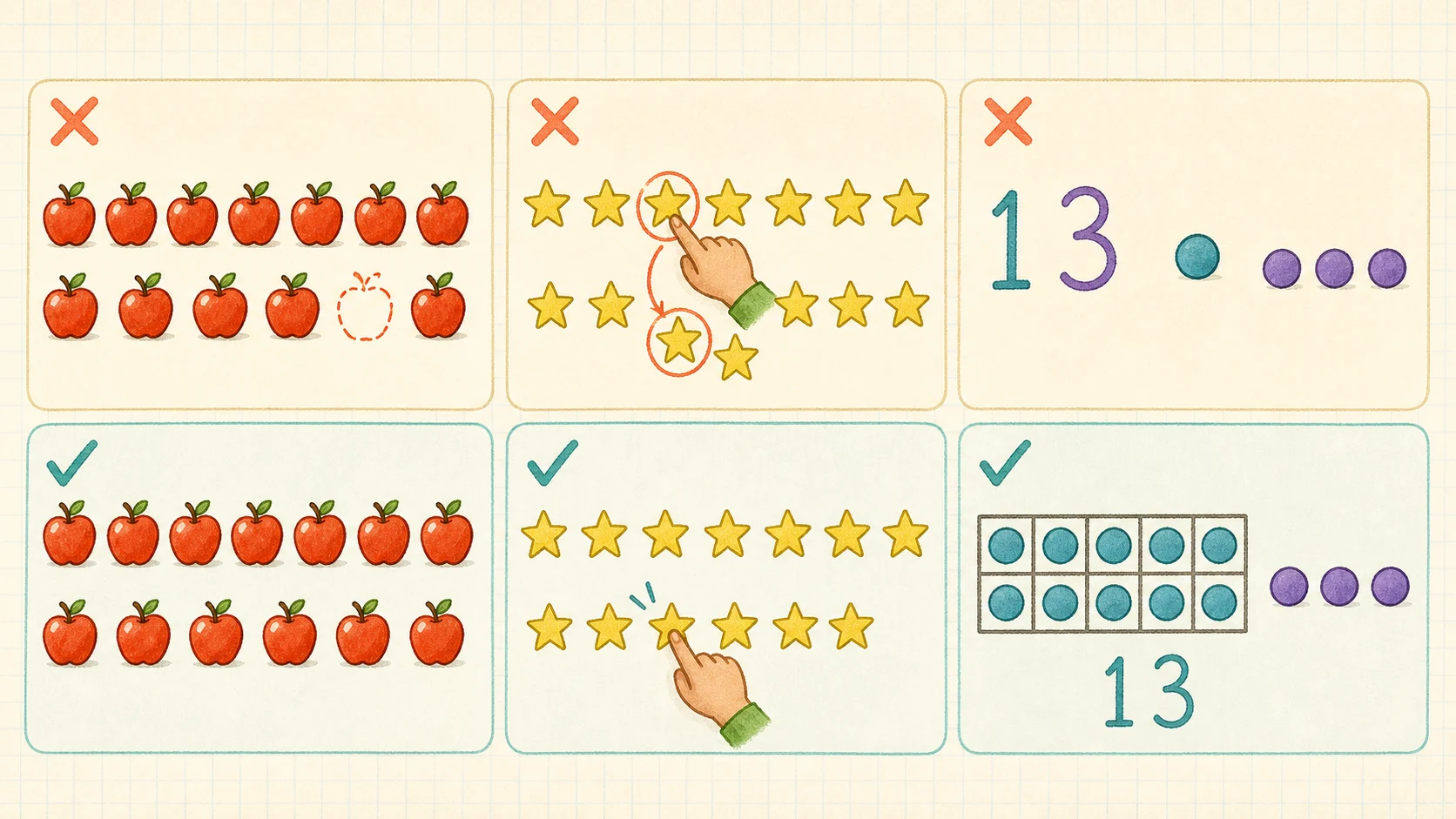
Treat an error as evidence about the next teaching move, not simply as a wrong answer.
| Observed work |
Likely issue to investigate |
Instructional response |
| Skips objects in a scattered set |
No consistent tracking path |
Let the learner move counted objects into a separate area |
| Counts one object twice |
Pointing and speaking are not coordinated |
Slow the count and require one touch for each number word |
| Counts correctly but cannot state the total |
Cardinality is not yet secure |
Ask for the total immediately after counting; avoid an unnecessary recount |
| Begins again at one when asked to continue from 46 |
Counting-on sequence is weak |
Place a marker at 46 and take one-step moves on a number line |
| Says 28, 29, 20 |
Decade transition is uncertain |
Use a hundred chart and groups of ten to connect 29 with 30 |
| Confuses 13 and 30 |
Teen and decade names or numerals are mixed |
Compare one ten and three ones with three tens and zero ones |
| Skip-counts 5, 10, 15, 21 |
Interval changes after a familiar run |
Build equal groups of five and recount cumulative totals |
| Counts backward by alternating directions |
Direction is not stable |
Move a marker left one space for every spoken number |
| Copies a hundred chart accurately but fails without it |
Reference use has replaced independent sequence knowledge |
Cover selected cells, then fade the chart |
| Gives different totals after objects are rearranged |
Quantity conservation or tracking needs attention |
Recount the same unchanged set in two arrangements |
Do not infer a broad learning difficulty from one short sample. Check the same concept with a different format. For example, compare oral counting, numeral cards, a number line, and object sets. A learner who succeeds orally but not in writing may need numeral support rather than more verbal sequence practice.
The IES guide Assisting Students Struggling with Mathematics supports high-level practices such as systematic instruction, clear mathematical language, visual representations, and cumulative review. Use those principles to organize support, while relying on the learner’s actual responses to determine pacing and representation. The guide does not provide child-specific advice and did not evaluate WorksheetWise resources.
Differentiation Without Changing the Core Idea
When the learner needs more support
Reduce the number range, simplify the arrangement, and restore a concrete model. If counting 37 objects is unreliable, use sets within 10 or 20 while rebuilding one-to-one correspondence. Then increase the set gradually.
Offer supports such as:
- A movable marker on a number line
- Objects arranged into rows or groups of ten
- A partially completed sequence
- Oral rehearsal before numeral writing
- A smaller independent set followed by immediate review
Change one feature at a time. If the number range, direction, representation, and skip size all change together, it becomes difficult to identify what helped.
When the learner is accurate but slow
Keep the underlying task stable while encouraging more efficient organization. A learner might group 34 counters into tens rather than counting every item from one. For sequences, ask for a reasonable short run from a varied starting number instead of repeatedly reciting from one.
Speed should follow understanding. Do not treat rapid guessing as fluency.
When the learner is ready for extension
Preserve the counting concept while increasing reasoning:
- Find two missing numbers in a sequence.
- Explain what changes when counting from 39 to 40.
- Compare counting by 2s with counting by 10s.
- Start a skip-count at 10 instead of zero.
- Create a sequence with one intentional error for an adult to locate.
- Represent 46 as grouped objects and then continue to 52.
Extensions should remain interpretable from the learner’s work. If explanations become inaccurate, return to a visible model.
Monitoring Progress and Deciding What Comes Next
Use brief, repeated samples rather than a single large test. Record the number range, task type, model provided, accuracy, and kind of help required.
A simple monitoring record might read:
| Date |
Task |
Result |
Support used |
Next decision |
| Day 1 |
Count 16 scattered objects |
Counted one twice |
Moved objects after prompting |
Repeat with 10–15 scattered objects |
| Day 4 |
Continue 28 to 34 |
Accurate through 29; paused at 30 |
Number line |
Practice decade crossings |
| Day 8 |
Count by 5s to 40 |
Accurate independently |
None |
Mix missing-number positions |
Look for consistency across at least a few opportunities. One correct response may be a guess; one error may be a momentary lapse. Progress is clearer when the learner can perform the skill with different numbers and with less support.
Pause advancement when errors share a pattern. Advance when the learner is accurate, can explain or model the relationship, and succeeds on a new example. Continue cumulative review so an earlier skill does not disappear when a new one is introduced.
A Flexible Two-Week Practice Plan
This plan assumes ten practice days, but it is not a universal timetable. Sessions may be shortened, repeated, combined, or postponed according to the learner’s observed work.
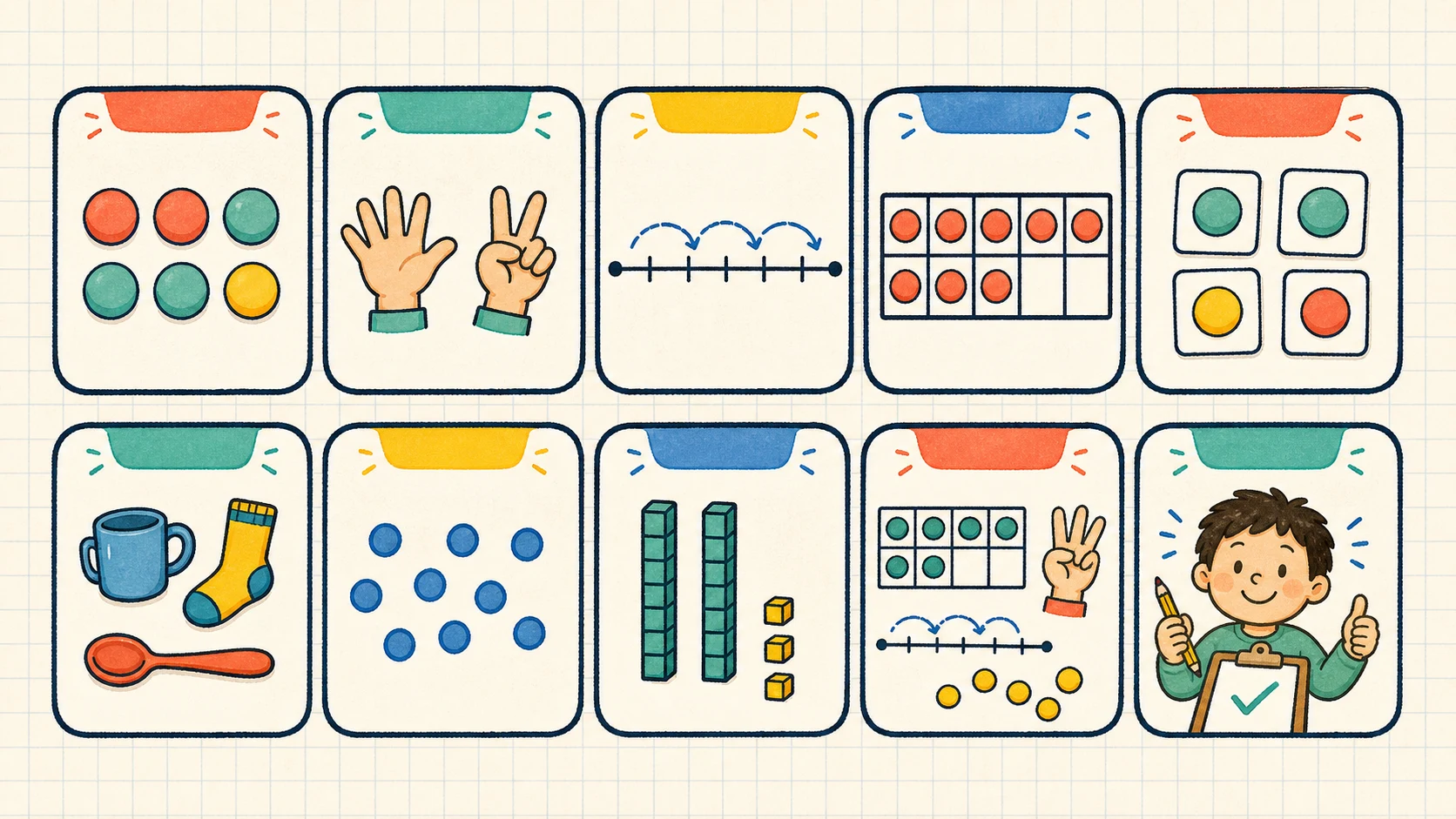
Each day adds a small demand while retaining review of earlier counting relationships.
| Day |
Main focus |
Suggested activity |
Quick evidence check |
| 1 |
Baseline observation |
Count orderly and scattered sets; continue two short oral sequences |
Note tracking, totals, and boundary errors |
| 2 |
One-to-one correspondence |
Move 8–20 objects while counting |
Every object receives one number word |
| 3 |
Cardinality and numeral matching |
Count sets and select matching numeral cards |
Final count is stated as the total |
| 4 |
Counting forward |
Start from several numbers rather than one |
Learner gives the next number without restarting |
| 5 |
Decade boundaries |
Cross 19–20, 29–30, and one higher boundary |
Tens change at the correct point |
| 6 |
Missing numbers |
Fill gaps before, after, and between given numerals |
Learner checks both neighboring numbers |
| 7 |
Backward counting |
Move left on a number line from numbers within 20 |
Sequence decreases by one consistently |
| 8 |
Skip-counting by 10s and 5s |
Build equal groups, then connect them to a chart |
Interval remains constant |
| 9 |
Skip-counting by 2s |
Pair objects and record cumulative totals |
Each new total increases by two |
| 10 |
Mixed review and transfer |
Use selected worksheet items without announcing the skill type |
Learner selects a suitable strategy |
On Days 1 and 10, use comparable but not identical tasks. For example, count 14 scattered objects initially and 17 later; continue from 28 initially and from 38 later. This checks transfer instead of memory for a repeated answer.
If the learner struggles on a day, repeat the concept with a simpler number range and a concrete model. If the work is consistently accurate, reduce support or add a carefully chosen boundary case. The plan should bend around evidence.
Limits, Responsible Use, and the Next Step
A counting worksheet can provide structured practice, visible work samples, and an efficient way to review answers. It cannot by itself determine why a learner made an error, replace responsive instruction, or guarantee mastery. Grade labels indicate intended practice level, and school, state, and local sequences may organize these skills differently.
This guide does not claim comprehensive standards alignment, certification, guaranteed outcomes, medical guidance, or a schedule suitable for every learner. Its examples and teaching suggestions are designed to help an adult observe counting behavior and make a reasonable next instructional choice.
Begin with the free easy 1st Grade Counting worksheet. Review a small selection of its 20 exercises, identify the first repeatable error, and use the matching concrete or visual model from this guide before assigning further practice. If you need a different format or number range, explore the free worksheet generators and build the next practice set around what the learner’s work actually shows.