What 1st Grade Money Instruction Should Accomplish
For a first-grade learner, money instruction should begin with recognizing pennies, nickels, and dimes, connecting each coin to its value, and counting manageable collections accurately. Quarters may follow when the learner is ready to count by 25s. The learner should handle real or realistic play coins, explain the counting path aloud, and then record the amount with a cent sign.
The central idea is simple but important: a coin’s value is not determined by its size or by the number of coins present. One dime is worth more than five pennies even though five objects may look like “more.” Instruction must connect three things:
- The coin’s appearance and name
- The coin’s value in cents
- The number sequence used when counting that coin
A sound progression is pennies first, followed by dimes, nickels, and then quarters. Mixed collections come after the learner can identify and count individual denominations. Addition, comparison, simple purchase situations, and introductory change problems should grow out of that foundation.
Grade labels describe the intended practice level, not a universal timetable. Local curricula and instructional sequences differ. Use the learner’s observed work—not the label alone—to decide whether to repeat, simplify, or extend a task.
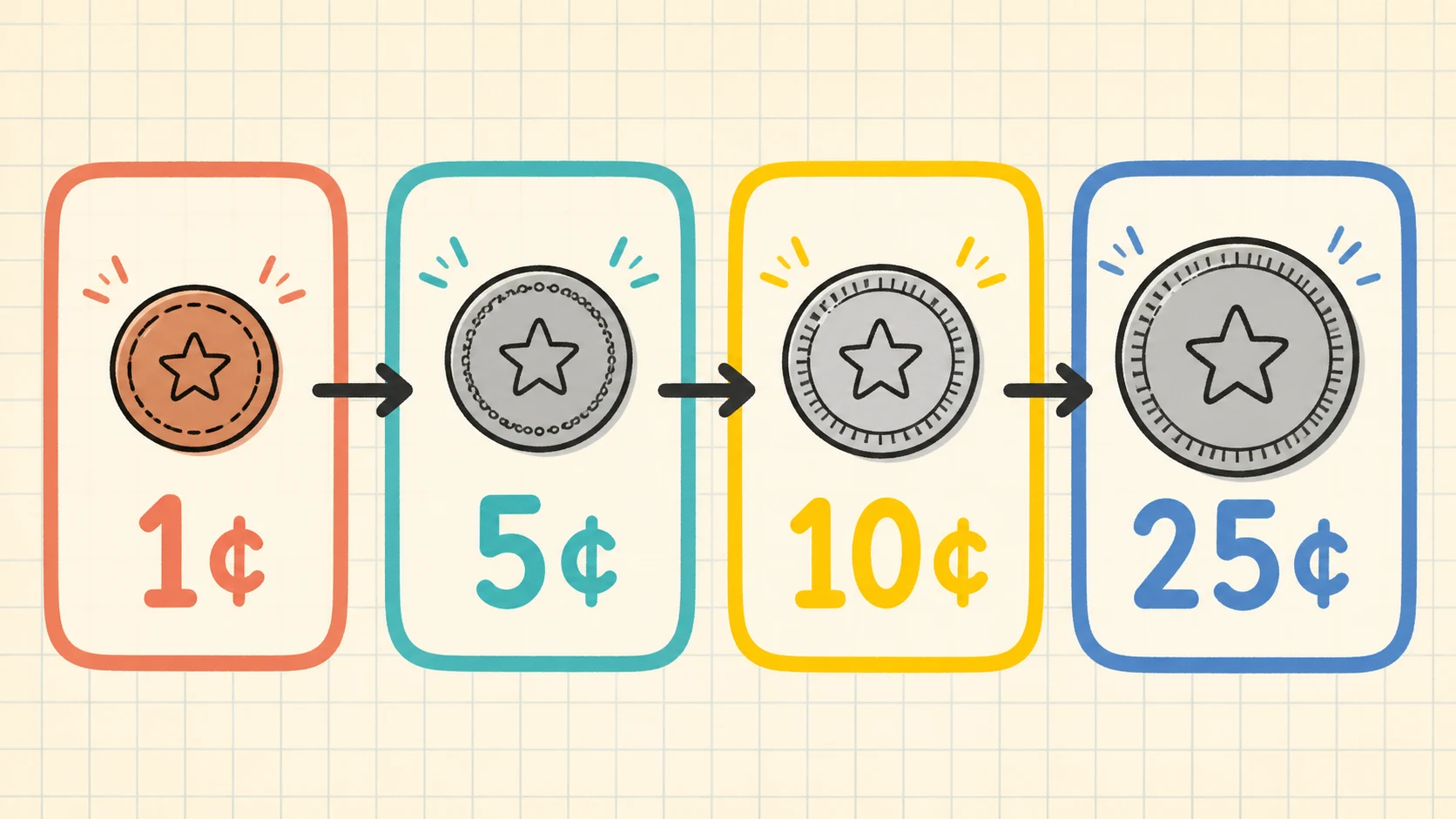
Money learning moves from identifying coins to counting, comparing, and applying values in simple situations.
Prerequisites to Check Before Teaching Money
Money tasks combine several mathematical demands. A learner may know coin names but struggle to count their values, or may count by 5s successfully until pennies are added. A brief prerequisite check helps identify the actual starting point.
Counting and cardinality
Check whether the learner can count a set of objects one at a time without skipping or recounting any item. Place six counters in a scattered arrangement and ask, “How many are there?” Watch the method rather than accepting only the final answer.
The learner should understand that the last number said represents the total. If six coins are counted as “one, two, three, four, five, six,” the total number of coins is six—but that does not necessarily mean the coins are worth six cents. This distinction becomes essential as soon as nickels and dimes appear.
Addition and counting on
First graders are developing addition and subtraction within 20. Money practice can use this knowledge without turning every task into a written equation.
Check whether the learner can:
- Begin at a given number and count forward
- Combine small quantities
- Recognize that 10+5=15
- Explain whether a total became greater after another coin was added
Counting on is especially useful with mixed collections. For a dime and three pennies, the learner starts at 10 and continues, “11, 12, 13,” instead of returning to 1.
Skip-counting readiness
Dimes connect naturally to counting by 10s, while nickels require counting by 5s. Ask the learner to continue short sequences such as:
- 10, 20, 30, …
- 5, 10, 15, …
- 10, 11, 12, …
A memorized chant is not enough by itself. Place three dimes in a row and ask the learner to touch each coin while saying 10, 20, 30. This checks whether the sequence is attached to the objects.
Symbol and comparison knowledge
The learner should recognize numerals at least through the amounts used in the lesson. It also helps to understand language such as more, less, same amount, and total. Introduce the cent sign only after the numerical value is clear: 14 pennies have a value of 14 cents, written 14¢.
Do not assume that familiarity with buying things means the learner understands money mathematically. Everyday exposure may help with vocabulary, but the learner still needs explicit practice connecting coins to values.
A Grade-Appropriate Teaching Progression
The following sequence keeps each new demand visible. Move forward when the learner can complete the current type of task accurately and explain the method. Return to an earlier row if performance becomes dependent on guessing.
| Stage |
Instructional focus |
Useful model |
Evidence to look for |
| 1 |
Match identical coins |
Real or realistic play coins and coin-image cards |
Sorts coins by appearance |
| 2 |
Name coins |
One denomination at a time |
Names the coin without relying only on size |
| 3 |
State coin values |
Coin-value cards |
Connects penny to 1¢, nickel to 5¢, and dime to 10¢ |
| 4 |
Count pennies |
One-to-one counting |
Counts by 1s and records the total in cents |
| 5 |
Count dimes |
Number line marked by tens |
Counts 10, 20, 30, and so on |
| 6 |
Count nickels |
Number line marked by fives |
Counts 5, 10, 15, and so on |
| 7 |
Count one denomination |
Rows, ten-frames, or labeled groups |
Chooses the appropriate count pattern |
| 8 |
Count mixed coins |
Greatest-value-first arrangement |
Starts with the largest value and counts on |
| 9 |
Compare collections |
Two organized coin mats |
Compares values rather than coin quantities |
| 10 |
Solve simple purchase and change situations |
Price tags and a small pretend store |
Selects coins, totals them, and checks the result |
Quarters are worth 25¢ and belong in the broader money progression. Introduce them after the learner has a stable understanding of pennies, nickels, and dimes. Counting by 25s adds a new pattern—25, 50, 75, 100—and may require more support than counting by 5s or 10s.
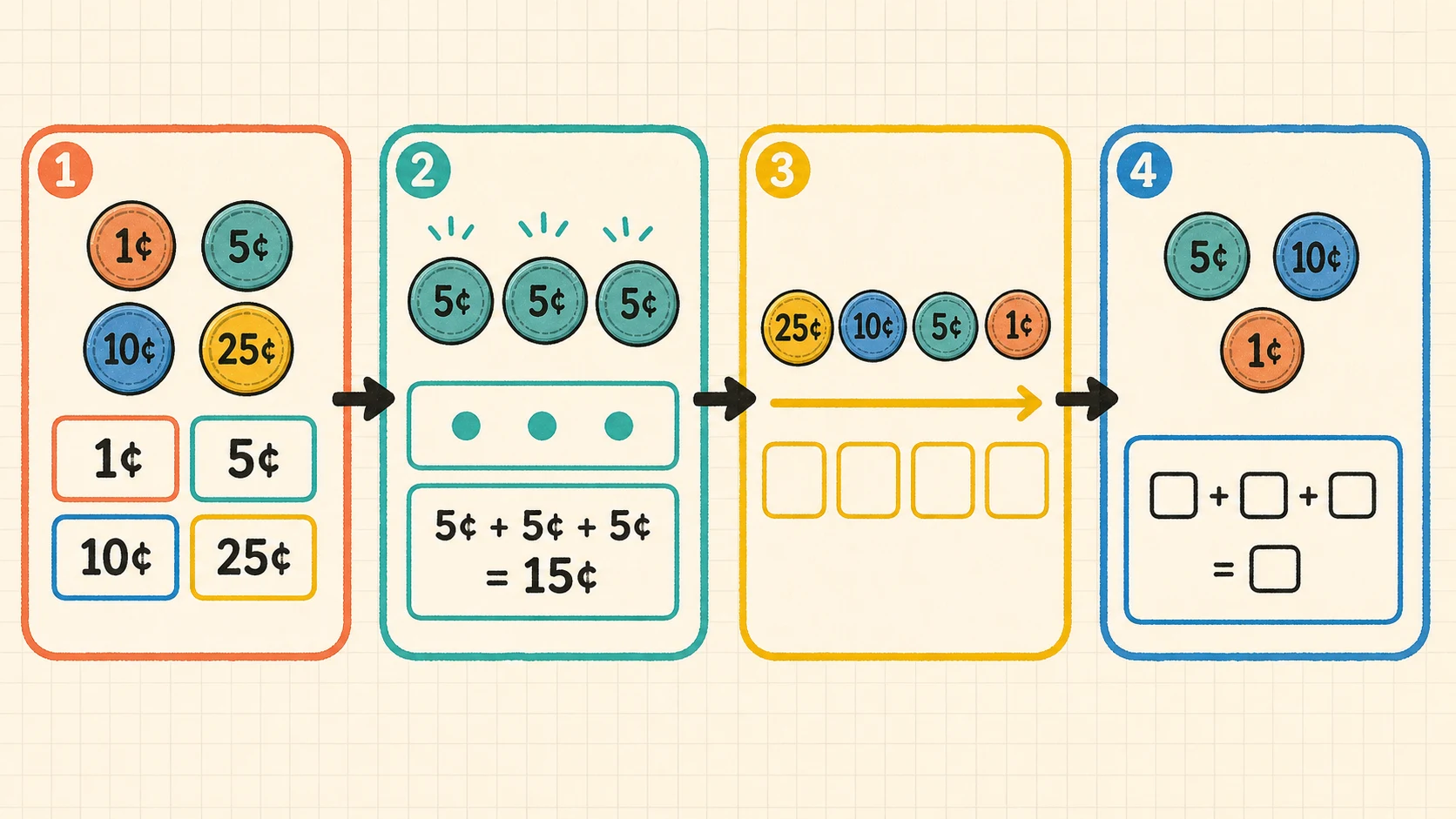
Remove supports gradually: handle coins, organize them, draw them, and finally interpret printed coin images independently.
This sequence is an instructional suggestion based on the supplied catalogue progression. It is not a claim that every learner or local curriculum must use the same order. The Common Core mathematics standards provide useful grade-level context, but money word problems involving dollars and multiple coin denominations are stated explicitly in Grade 2. First-grade work should therefore emphasize a secure, concrete foundation rather than rushing into complex dollar-and-cent calculations.
Concrete and Visual Models That Make Value Visible
The IES guide on teaching mathematics to young children supports instruction that builds mathematical understanding through purposeful activities, representations, and clear mathematical language. In a money lesson, manipulatives should reveal the value relationships rather than serve as decoration.
Real or realistic play coins
Begin with coins the learner can pick up, turn over, group, and rearrange. Use realistic play coins when handling real currency is impractical. Ask the learner to notice several features, because a single feature can mislead:
- Color
- Edge
- Images or markings
- Relative size
- Coin name
- Value
Avoid teaching “the smallest coin is the most valuable” as a rule. It may seem to identify a dime within one familiar set, but it does not explain value and will not generalize reliably.
Coin-value cards and matching mats
Prepare cards showing a coin image, its name, and its value. During early practice, the learner can place a coin on its matching card. Later, cover one element:
- Show the coin and ask for its name.
- Show the name and ask for its value.
- Show the value and ask the learner to select the coin.
This separates recognition from counting. If the learner cannot identify a nickel, a mixed-coin counting task is premature.
Number lines and count-on paths
Use a number line to display how each coin changes a running total. For two dimes, a nickel, and two pennies, mark jumps of 10, 10, 5, 1, and 1:
0→10→20→25→26→27
Say the unit during modeling: “10 cents, 20 cents, 25 cents…” This prevents a bare number such as 25 from becoming disconnected from money.
Equivalent-value exchanges
Exchanges show that different collections can have the same value:
- 5 pennies = 1 nickel
- 10 pennies = 1 dime
- 2 nickels = 1 dime
Have the learner build both sides and verify each total. These relationships prepare the learner to compare values and understand why counting coins is not the same as counting objects.
Drawings and printed images
Once physical coins are understood, move to simple drawings or printed coin images. Ask the learner to write the value beneath each image before finding the total. The 1st Grade Math collection can provide written follow-up after the concept has been modeled concretely.
Printed images have limits. They may not preserve real size, color, thickness, or texture. A learner who struggles with a worksheet image may need help interpreting the representation rather than more arithmetic practice.
Fully Checked Worked Examples
A worked example should make the reasoning visible. Model the method, ask the learner to explain why it works, and then give a closely related problem.
Example 1: Counting pennies
Problem: How much are 7 pennies worth?
Each penny is worth 1¢. Count by ones:
1¢+1¢+1¢+1¢+1¢+1¢+1¢=7¢
Answer: 7¢.
Check: There are seven coins, and every coin has a value of exactly 1¢. In this special case, the number of coins and the number of cents are the same.
Boundary case: This shortcut does not work for seven nickels. Seven nickels are worth 7×5¢=35¢, not 7¢.
Example 2: Counting one denomination
Problem: How much are 4 dimes worth?
Each dime is worth 10¢. Count by tens:
10¢, 20¢, 30¢, 40¢
Equivalently:
4×10¢=40¢
Answer: 40¢.
Check: Four groups of 10 give 10+10+10+10=40.
Instructional variation: Put four pennies beside the four dimes. Both sets contain four coins, but their values are 4¢ and 40¢. Ask which set is worth more and why.
Example 3: Counting mixed coins
Problem: Find the value of 2 dimes, 1 nickel, and 3 pennies.
Organize the coins from greatest value to least value:
10¢, 10¢, 5¢, 1¢, 1¢, 1¢
Count the dimes first:
10¢, 20¢
Add the nickel:
20¢+5¢=25¢
Count on for the pennies:
26¢, 27¢, 28¢
Answer: 28¢.
Check by addition:
10+10+5+1+1+1=28
The two methods agree, so the total is confirmed.
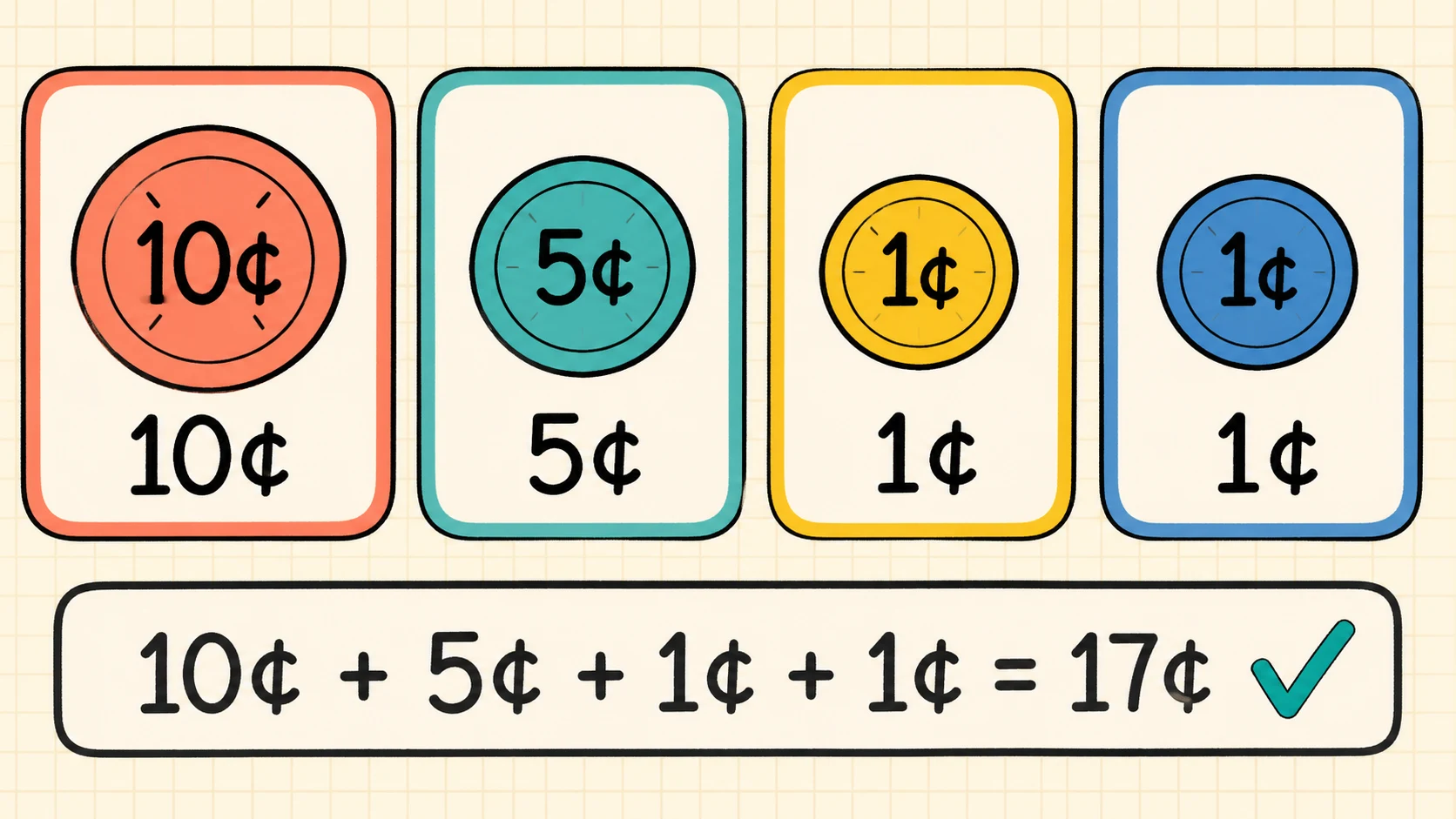
Organizing coins by value makes the count-on path easier to see and verify.
Example 4: Comparing coin collections
Problem: Which is worth more: 3 nickels or 1 dime and 4 pennies?
Find each total separately.
Collection A:
5¢+5¢+5¢=15¢
Collection B:
10¢+1¢+1¢+1¢+1¢=14¢
Compare:
15¢>14¢
Answer: 3 nickels are worth 1¢ more.
Check: The first collection has three coins and the second has five. The collection with more coins is not worth more. Value, not coin count, decides the comparison.
Example 5: Paying an exact price
Problem: A pencil costs 16¢. Can 1 dime, 1 nickel, and 1 penny pay the exact price?
Add the values:
10¢+5¢+1¢=16¢
Answer: Yes. The coins pay exactly 16¢.
Check: The coin total and the price are equal. There is no amount left over and no change is needed.
Boundary case: A dime and a nickel total 15¢, so they are 1¢ short. A dime, nickel, and two pennies total 17¢, which is 1¢ more than the price.
Example 6: Introductory change
Problem: An item costs 12¢. The customer pays 15¢. How much change is needed?
Use the count-up method:
12¢→13¢→14¢→15¢
Three one-cent steps were added.
Answer: 3¢ change.
Check by subtraction:
15¢−12¢=3¢
For an early lesson, three pennies are a clear way to represent the change. More advanced change examples involving dollars and decimal notation belong later in the progression.
A Short, Repeatable Lesson Routine
A focused lesson can be brief. Its length should depend on attention, accuracy, and the learner’s response, not on a universal timer.
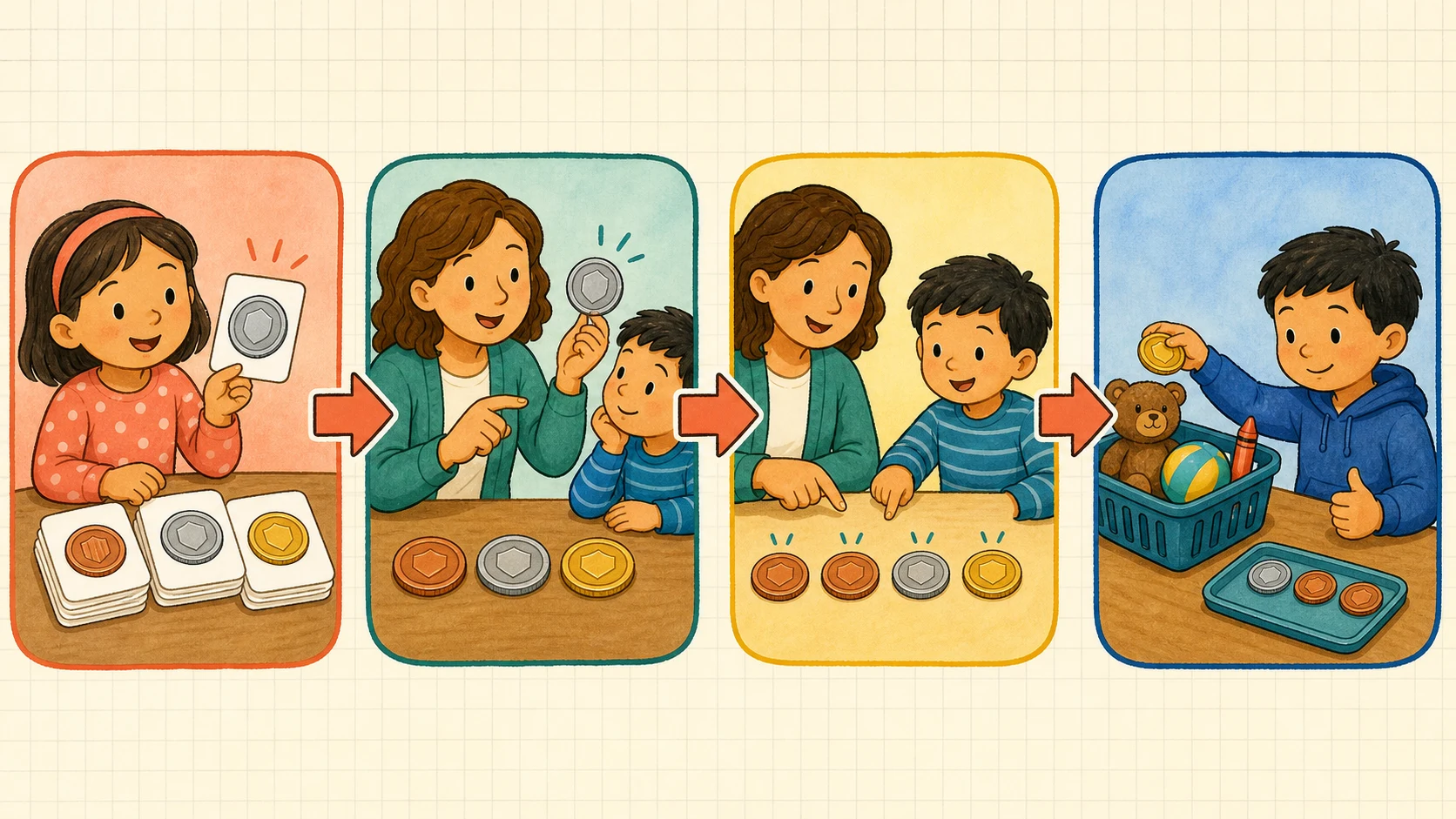
Each lesson moves from retrieval to modeling, guided practice, independent work, and a quick check.
1. Retrieve a known fact
Show two or three familiar coins. Ask for the name and value of each. If responses are uncertain, stay with recognition rather than beginning a mixed total.
2. Model one new idea
Demonstrate one problem with coins and a spoken counting path. For example: “A dime is 10 cents. I add a nickel and move forward 5: 15 cents.”
Keep the new feature narrow. A lesson introducing nickels need not also introduce quarters, price comparisons, and change.
3. Solve together
Give a similar collection. Let the learner arrange the coins and say each running total. Prompt only as much as necessary:
- “Which coin has the greatest value?”
- “What total will you start with?”
- “How much does the nickel add?”
- “What unit belongs with the answer?”
4. Try independently
Use two to four carefully chosen items. Independent work should match the modeled task before including a small variation. If the learner needs continuous prompting, return to guided practice.
5. Check and explain
Ask the learner to verify one answer by another method: recount, add the values, exchange equivalent coins, or compare the total with a number line. End with a specific observation such as, “You identified every coin correctly, but the count changed from fives to ones too early.”
The IES practice guide on assisting students who struggle with mathematics supports systematic instruction, clear mathematical language, representations, and attention to the learner’s responses. This is high-level instructional framing; it is not an evaluation of WorksheetWise materials or a prescribed script for every child.
Selecting Practice That Matches the Learner
Choose practice by the source of difficulty, not by how full or colorful a page appears. The 1st Grade Money topic guide is a useful place to compare available practice, while the broader 1st Grade worksheet hub helps when prerequisite number work needs attention.
Use items with:
- Pennies only when one-to-one counting or cent notation is developing
- Dimes only when connecting coins to counting by 10s
- Nickels only when counting by 5s needs practice
- One denomination at a time when coin values are still fragile
- Mixed coins when individual denominations are secure
- Comparisons when totals can be found accurately
- Price tags when exact payment is the goal
- Simple change situations only after the learner distinguishes price, payment, and change
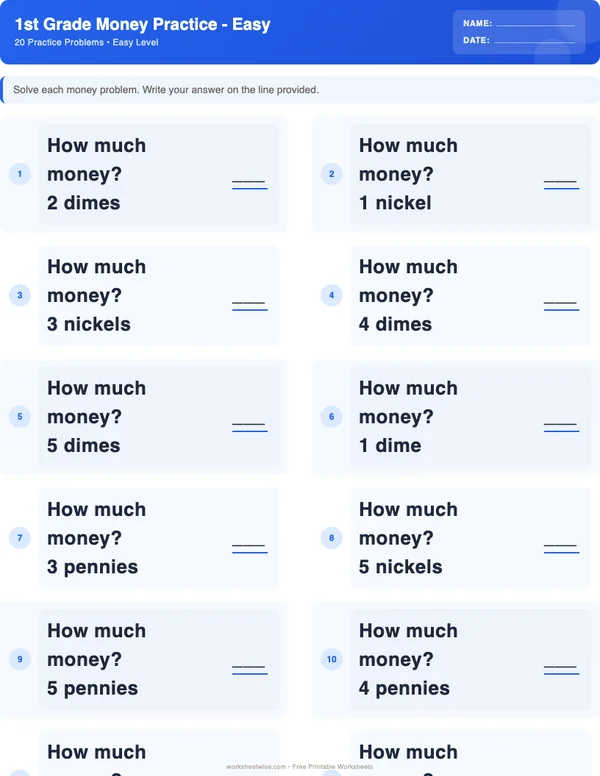
The catalogue’s free easy worksheet contains 20 exercises covering counting money, coin values, making change, and money operations. Because those are distinct demands, review the learner’s work item by item. A single total score may hide whether mistakes came from identification, skip-counting, addition, notation, or the language of change.
Differentiation without changing the core idea
For more support:
- Use fewer coins and more physical handling.
- Keep all coins facing the same direction.
- Label each coin’s value temporarily.
- Sort coins before counting.
- Provide a number line marked by 1s, 5s, or 10s.
- Ask the learner to say running totals aloud.
- Separate coin recognition from arithmetic.
For additional challenge:
- Ask for two different collections with the same value.
- Include irrelevant information in a short shopping situation.
- Compare collections with different numbers of coins.
- Ask the learner to find and correct an incorrect counting path.
- Give a target such as 18¢ and ask for more than one exact-payment solution.
- Remove the physical coins after the learner has drawn and labeled them.
Challenge should deepen reasoning, not merely add larger numbers. A learner who creates 18¢ as 10+5+1+1+1 can be asked whether another collection works, such as 5+5+5+1+1+1.
Diagnosing Common Errors
Do not respond to every wrong answer with “count again.” First determine where the reasoning changed.
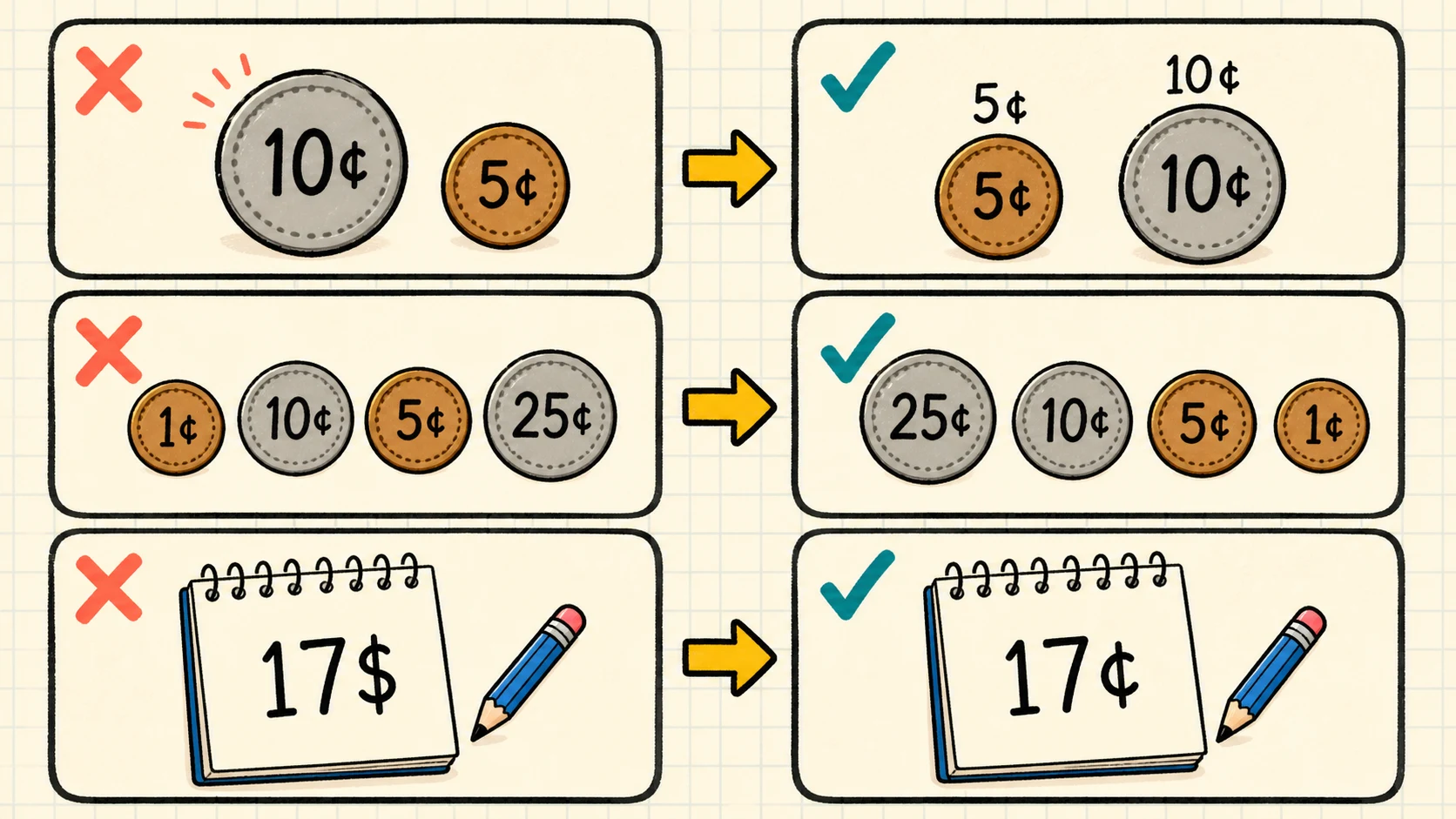
The most useful correction targets the step that failed: recognition, value, sequence, organization, or notation.
| Observed work |
Likely issue to investigate |
Teaching response |
| Three dimes are recorded as 3¢ |
Counts objects instead of values |
Contrast three pennies with three dimes and label each coin |
| A nickel is called 10¢ |
Coin-value association is unstable |
Return to matching and sorting before totaling |
| 10¢ + 5¢ is counted as 10, 11 |
Does not connect a nickel to a five-cent jump |
Show a jump from 10 to 15 on a number line |
| Mixed coins are counted accurately in one order but not another |
Counting strategy is fragile |
Sort greatest value to least and rehearse the count-on path |
| 25 is written without ¢ |
Unit notation is missing |
Ask, “Twenty-five what?” and model 25¢ |
| 5 coins are judged greater than 3 coins without totaling |
Compares quantity of coins, not value |
Find both totals before using comparison language |
| A dime and 2 pennies become 21¢ |
Reverses or concatenates digits |
Build 10, then add two one-cent steps: 11, 12 |
| The learner gives the payment as the change |
Roles in the story are confused |
Act out price, payment, and amount returned with separate labels |
Some errors have more than one possible cause. For example, recording two dimes as 2¢ may reflect an unknown dime value, object counting, or inattention to the unit. Ask the learner to name each coin and explain the count before deciding what to reteach.
Monitoring Progress Without Over-Testing
Keep a small record of what the learner can do independently, with a prompt, and not yet. Useful categories include:
- Identifies pennies, nickels, and dimes
- States each value
- Counts a single denomination
- Changes correctly between counting by 10s, 5s, and 1s
- Counts a mixed collection
- Records cents correctly
- Compares two totals
- Pays an exact price
- Finds simple change by counting up
Use three or four fresh items for a quick check. A fresh item changes the coin arrangement or numbers while preserving the skill. Repeating a memorized worksheet item does not show whether the idea transfers.
Move ahead when accuracy is stable and the learner can explain the method without step-by-step prompting. If accuracy drops sharply when coins are rearranged, the skill is not yet independent. Return to concrete models or simplify one feature at a time.
Also look at efficiency. A correct answer reached through repeated restarts may signal that the learner needs a more organized strategy. Conversely, do not require the greatest-value-first method when a different clear method is accurate and explainable. The goal is reliable reasoning, not verbal conformity.
A Two-Week Practice Plan
This plan is a flexible instructional suggestion, not a universal schedule. Shorten, repeat, or reorder sessions according to observed work. A “day” can be one brief session; missed days do not need to be doubled.
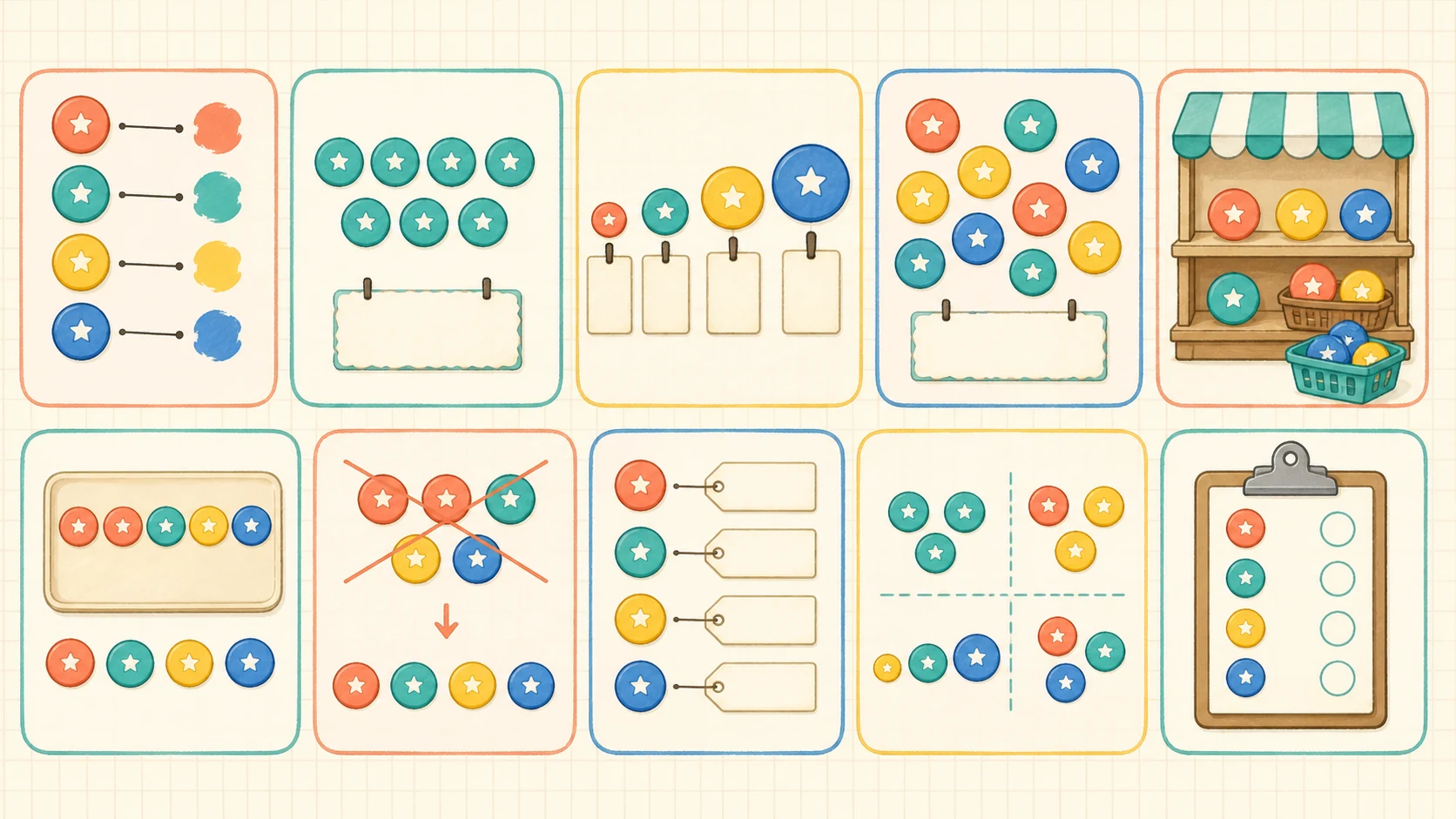
The plan alternates new learning, mixed review, application, and checking rather than adding a new skill every day.
| Day |
Focus |
Suggested activity |
Quick evidence |
| 1 |
Coin recognition |
Sort pennies, nickels, and dimes; match names and values |
Names and values each coin |
| 2 |
Pennies |
Build and count totals from 1¢ to 10¢ |
Counts by 1s and writes ¢ |
| 3 |
Dimes |
Count rows of one to four dimes |
Connects each dime to a 10-cent jump |
| 4 |
Pennies and dimes |
Sort first, then count mixed collections |
Changes from tens to ones accurately |
| 5 |
Review |
Use fresh recognition and counting items |
Completes without value labels |
| 6 |
Nickels |
Build totals by counting 5, 10, 15, 20 |
Touches one coin per five-count |
| 7 |
Nickels and pennies |
Count nickels first, then pennies |
Changes from fives to ones |
| 8 |
Three-coin mix |
Count dimes, nickels, and pennies |
Organizes and states running totals |
| 9 |
Equivalent values |
Exchange 5 pennies for a nickel and 2 nickels for a dime |
Explains why collections are equal |
| 10 |
Compare amounts |
Total two collections before comparing |
Uses value rather than coin count |
| 11 |
Exact payment |
Build amounts shown on simple price tags |
Matches coin total to price |
| 12 |
Simple change |
Count up within a small cent range |
Separates price, payment, and change |
| 13 |
Mixed application |
Combine counting, comparison, and one purchase problem |
Selects a suitable strategy |
| 14 |
Independent check |
Complete a short worksheet sample and explain two answers |
Shows which skills are secure or need review |
If Day 4 reveals confusion between coin values, repeat recognition and single-denomination counting before introducing nickels. If mixed totals are accurate but notation is inconsistent, keep the mathematics level steady and add a brief recording check. If all tasks are secure, introduce quarters concretely or ask for multiple ways to make the same amount.
Limitations and the Honest Next Step
Money worksheets are useful for interpreting coin images, recording totals, and building independent practice. They cannot fully replace handling coins, hearing the learner’s counting path, or observing where a mistake begins. Printed coins may also differ from real coins in size, color, and detail.
The catalogue’s broader topic includes bills, quarters, multi-step problems, dollars and cents, and making change. Those are part of the longer money progression, but they should not all be treated as automatic first-grade starting points. The supplied grade description specifically identifies first-grade work with pennies, nickels, and dimes. Complex dollar-and-cent change examples should be reserved for learners whose underlying coin values, counting patterns, and subtraction reasoning are ready.
No single page establishes comprehensive standards alignment or guarantees an outcome. Local sequences differ, and the learner’s observed work should determine pacing.
A practical next action is to model two or three mixed-coin examples with real or play coins, then use the free 1st Grade Money standard easy worksheet as a short diagnostic sample. Check whether any errors come from coin recognition, value recall, counting transitions, or notation. If the learner is ready for sustained practice, the focused 1st Grade Money pack contains 18 worksheets; if a more customized amount or format would fit better, explore the free worksheet generators.