What 1st Grade Word Problems Ask Learners to Do
First-grade word-problem work connects a short story to addition or subtraction. The learner must understand what is happening, identify the quantity to find, represent the relationship, calculate, and explain the answer in context.
The concise answer is this: teach the learner to understand the story before choosing an operation. Begin with objects and drawings, move to equations, and vary where the unknown appears. Choose new practice from the learner’s observed work—not from age, speed, or a page sequence alone.
A learner working at this level should gradually become able to:
- Retell a problem in plain language.
- Identify the known and unknown quantities.
- Model joining, separating, part-part-whole, and comparison situations.
- Solve addition and subtraction problems within 20.
- Write an equation that matches the story.
- answer with a number and an appropriate label.
- Check whether the answer makes sense.
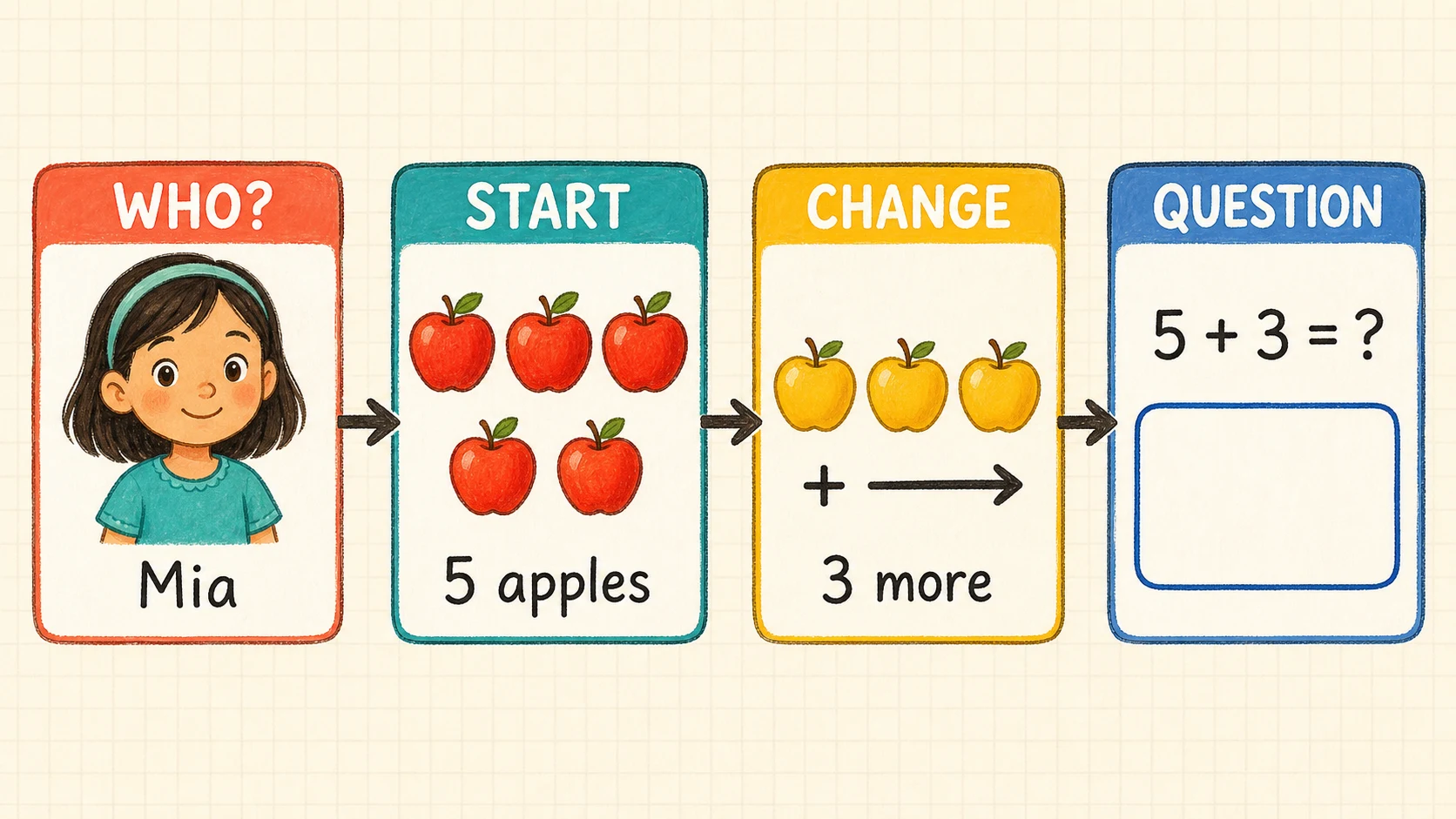
The skill joins reading, representation, calculation, explanation, and checking.
This is more than computation. A learner may know that 8−3=5 but still struggle to recognize when a story represents subtraction. Conversely, a learner may understand that three objects were removed but make a counting error. Those difficulties require different teaching responses.
Grade labels describe an intended practice level, and local curriculum sequences differ. The supplied catalogue places first-grade work primarily within addition and subtraction through 20, while the Common Core mathematics standards frame mathematical understanding as including both accurate procedures and age-appropriate explanations. This guide does not claim comprehensive alignment with every local standard or curriculum.
Prerequisites to Check Before Assigning a Full Page
Word problems combine several demands. Check the component skills separately so that a reading difficulty is not mistaken for a calculation difficulty.
Quantity and counting knowledge
Ask the learner to make sets such as 6 counters and 11 counters. Check whether each object is counted once, the final count is understood as the total, and a set can be made without repeated recounting.
Next, check simple combinations and differences. The learner does not need instant recall of every fact before solving stories, but should have a workable strategy such as counting on, counting back, making 10, or using objects.
Story comprehension
Read a problem aloud without showing any numbers:
Mia had some shells. She found three more. Did her collection grow or shrink?
If the learner can explain that the collection grew, the central relationship is understood. If not, simplify the language, act out the event, and clarify words such as more, fewer, altogether, gave, and remaining.
Do not teach a rigid keyword code. “More” does not always mean that the written equation should use addition. In “Leo has 3 more blocks than Ana,” the correct operation depends on which quantity is unknown. The whole situation matters.
Equality and equations
Check that the equal sign means “the same value as,” not “the answer comes next.” Present:
6+2=88=6+2
Both statements are true because each side has the same value. This understanding helps when the unknown appears in an unfamiliar position, as in 5+□=12 or □−4=7.
Representing before calculating
Give a short story and ask for a drawing rather than an answer. A useful picture must show the quantities and their relationship. Decorative details—a full tree, faces, or elaborate scenery—may consume attention without clarifying the mathematics.
The IES guide for young children recommends teaching number and operations through a developmental progression and using progress monitoring to build on what a child already knows. Although that guide focuses on preschool through kindergarten, those high-level principles provide useful framing when preparing a first grader for story problems.
A Grade-Appropriate Progression
Progress from understandable actions to less visible relationships. Within each stage, begin with totals comfortably inside the learner’s calculation range.
| Stage |
Problem structure |
Helpful model |
Evidence of readiness to advance |
| 1 |
Join or separate, result unknown |
Act out with counters |
Models the action and finds the result |
| 2 |
Part-part-whole, whole or part unknown |
Two groups and a total bar |
Explains how the parts relate to the whole |
| 3 |
Change unknown |
Counters, covered set, or bar |
Finds how much was added or removed |
| 4 |
Start unknown |
Covered starting set or equation |
Reasons backward without guessing |
| 5 |
Compare, difference unknown |
Aligned rows or comparison bars |
Identifies the matched amount and difference |
| 6 |
Mixed structures |
Learner chooses a model |
Selects an operation from meaning |
| 7 |
Boundary cases |
Model plus discussion |
Notices extra or missing information |
| 8 |
Independent practice |
Drawing, equation, and written answer |
Solves and checks with limited prompting |
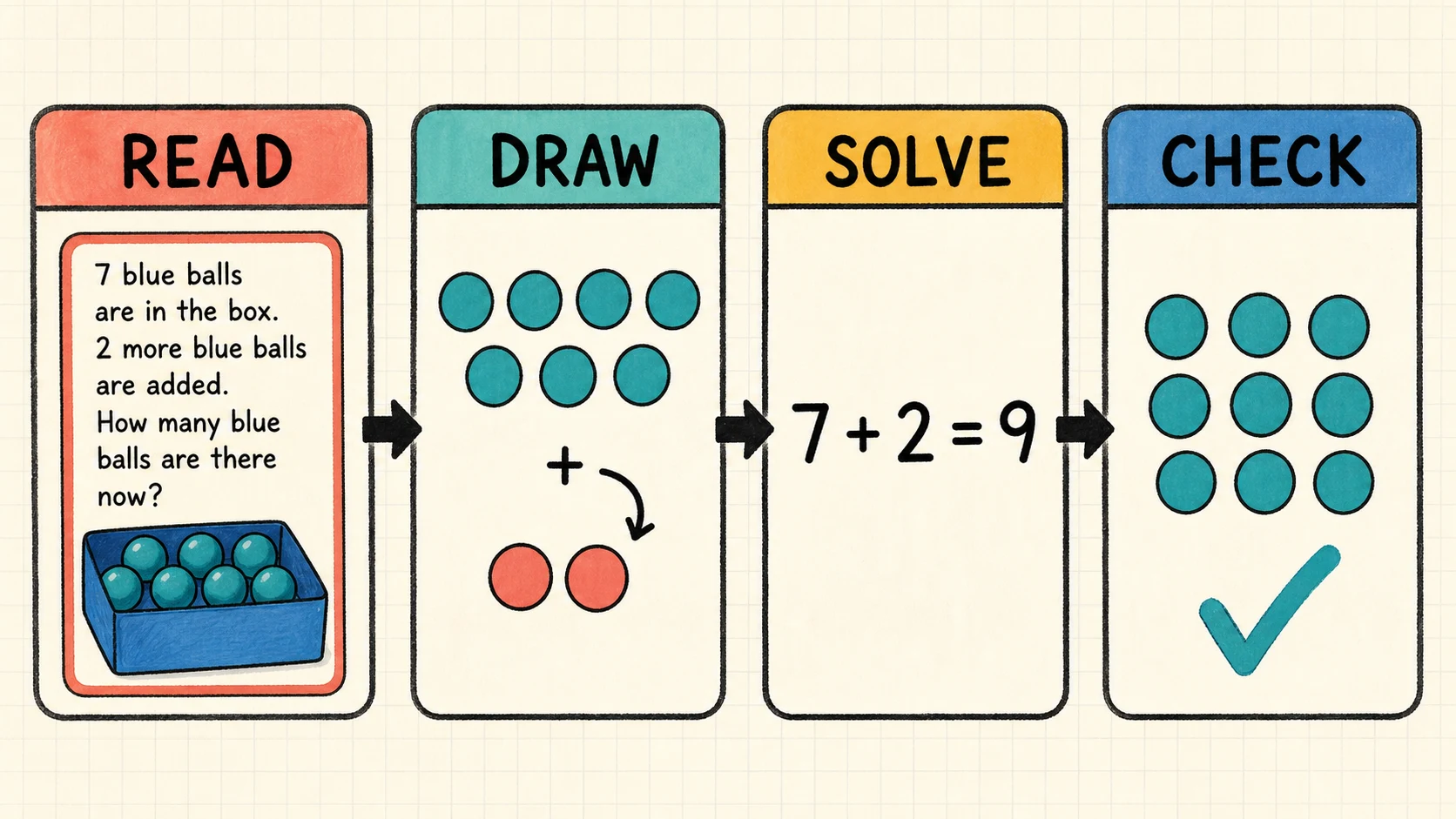
Advance when the learner’s work is accurate and explainable, not merely because a session has ended.
Result-unknown situations
These make the change visible:
- “There were 7 ducks. Three more arrived. How many ducks are there now?”
- “There were 12 crackers. Four were eaten. How many remain?”
Because the action directly suggests joining or separating, these are usually suitable starting points.
Change-unknown and start-unknown situations
These require more flexible reasoning:
- “Eva had 6 beads. Now she has 10. How many did she add?”
- “Some birds were on a fence. Three flew away, and 5 remained. How many were there at first?”
A learner who automatically adds whenever something arrives may write 6+10 for the first problem. Modeling reveals that 6 and an unknown part combine to make 10.
Comparison situations
Comparison does not describe a quantity physically arriving or leaving. It relates two existing quantities:
- “Noah has 9 crayons. Ava has 6. How many more does Noah have?”
Aligning two rows makes the shared six and the unmatched three visible. This supports 9−6=3.
Concrete, Visual, and Symbolic Models
The IES elementary mathematics intervention guide recommends deliberate word-problem instruction, clear mathematical language, and carefully selected concrete and semi-concrete representations. It does not evaluate WorksheetWise or prescribe this exact routine; it supports the broad instructional choice to connect language, models, and mathematical ideas.
Objects and acting out
Use counters, cubes, buttons, or other safe objects. For a joining story, make the starting set and physically add the new set. For a separating story, remove objects. Ask the learner to narrate each action:
“I started with 8. I took away 3. There are 5 left.”
Acting out is especially useful when the learner cannot yet explain whether the amount grows, shrinks, or is being compared.
Drawings and ten-frames
Replace objects with quick circles, tally marks, or dots. Cross out removed items; circle a part that is added. A ten-frame can make totals near 10 easier to organize, but it should clarify the quantity rather than become another procedure to memorize.
Bar models
A part-part-whole bar shows two parts combining into one whole:
|---- 6 ----|-- 3 --|
|------ unknown -----|
A comparison model aligns quantities:
Noah: |------ 9 ------|
Ava:  |---- 6 ----|
                     |3|
The difference is the unmatched segment. Bar models are instructional tools, not proof that every learner must draw an identical diagram.
Equations and number lines
After the relationship is visible, connect it to an equation. A number line can represent movement: start at 7 and make four forward jumps to reach 11, or begin at 13 and make five backward jumps to reach 8.
Keep the model and equation side by side until the learner can explain the connection. Removing the representation too early may hide uncertainty; requiring it after the learner no longer needs it may add unnecessary work.
Fully Checked Worked Examples
Example 1: Joining, result unknown
Problem: Luis has 7 toy cars. His aunt gives him 5 more. How many toy cars does Luis have now?
Understand: Luis begins with 7, and the collection grows by 5.
Model: Make 7 counters, then add 5 counters.
Equation:
7+5=12
One way to calculate is to make 10: split 5 into 3 and 2.
7+3=10,10+2=12
Answer: Luis has 12 toy cars.
Check: Reverse the change: 12−5=7. This returns to the starting amount, so the answer is consistent.
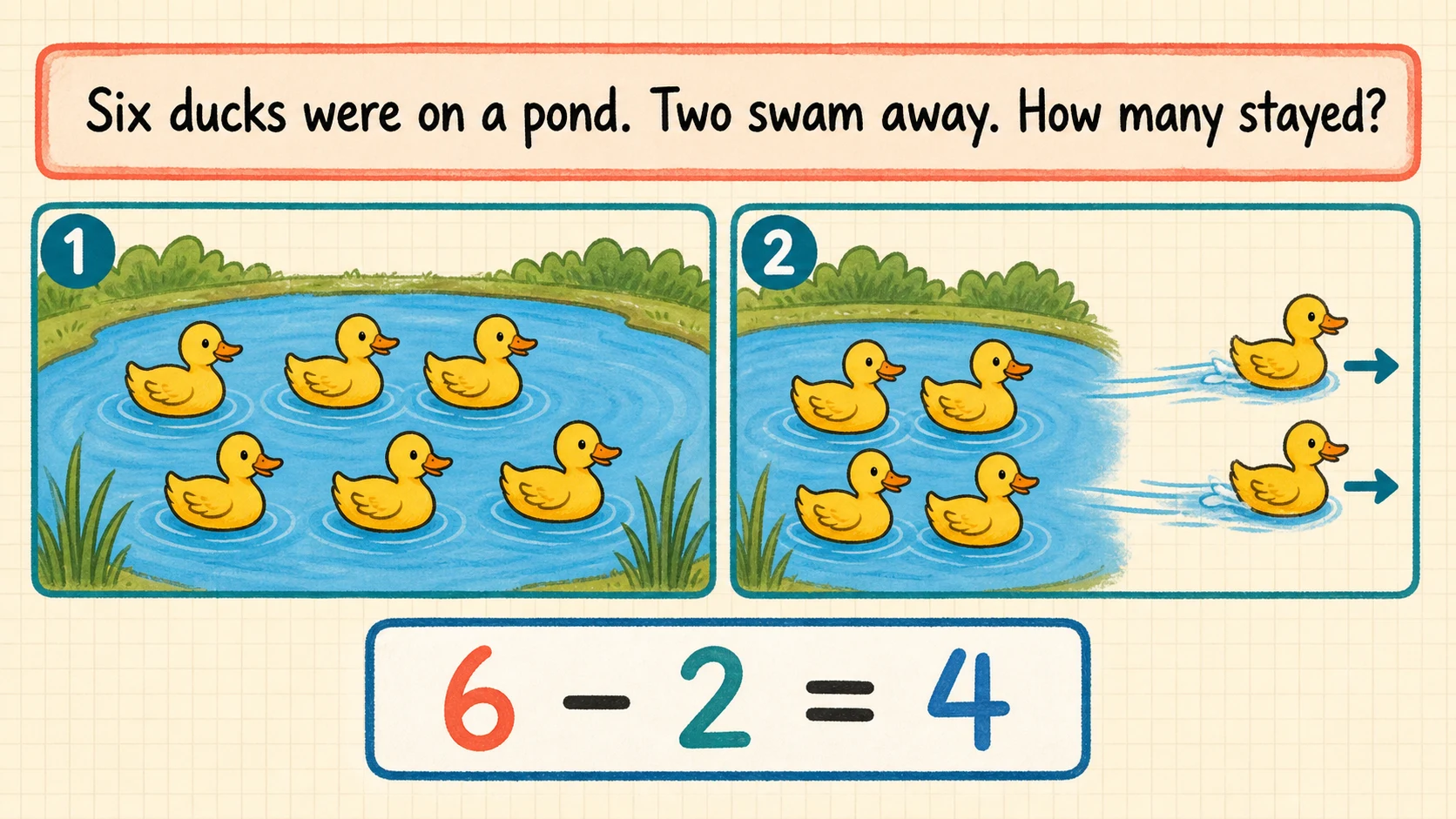
Objects show the event; a drawing preserves it; the equation records the relationship.
Example 2: Separating, result unknown
Problem: A basket holds 14 apples. Four apples are used for a snack. How many apples remain?
Understand: The basket starts with 14, and 4 are removed.
Model: Draw 14 circles and cross out 4.
Equation:
14−4=10
Answer: 10 apples remain.
Check: Add the remaining and removed parts:
10+4=14
The two parts reconstruct the original amount.
Example 3: Joining, change unknown
Problem: Priya has 8 stickers. A friend gives her some more. Now she has 13 stickers. How many stickers did her friend give her?
Understand: The start and final total are known. The added part is unknown.
Model:
|---- 8 ----|-- ? --|
|------- 13 ---------|
Equations:
8+□=13
To find the missing part:
13−8=5
Answer: Her friend gave her 5 stickers.
Check:
8+5=13
The computed part produces the stated total.
Example 4: Separating, start unknown
Problem: Some frogs sat near a pond. Three frogs jumped into the water. Six frogs remained. How many frogs were there at first?
Understand: The starting amount is unknown. It consists of the 3 frogs that left and the 6 that remained.
Equation:
□−3=6
Reconstruct the start:
6+3=9
Answer: There were 9 frogs at first.
Check:
9−3=6
This matches the story.
Example 5: Comparison, difference unknown
Problem: Ben has 11 blocks. Kai has 7 blocks. How many more blocks does Ben have than Kai?
Understand: Nothing is added or removed. Two amounts are compared.
Model: Align 11 marks above 7 marks. Seven pairs match, leaving four unmatched marks in Ben’s row.
Equation:
11−7=4
Answer: Ben has 4 more blocks than Kai.
Check:
7+4=11
Kai’s amount plus the difference equals Ben’s amount.
Example 6: Two related steps
Problem: There are 6 red balloons and 5 blue balloons. Two balloons pop. How many balloons remain?
Step 1—find the starting total:
6+5=11
Step 2—remove the balloons that popped:
11−2=9
Answer: 9 balloons remain.
Check: 9+2=11, and 6+5=11. Both relationships agree.
This example has two operations, so use it only after the learner can solve the component story types. If the learner loses track of the intermediate total, write “11 balloons before popping” beside the first equation.
A Short, Repeatable Lesson Routine
Use the following routine as an instructional suggestion, not a universal timetable. A learner may need more modeling, a shorter session, or repeated work with one problem type.
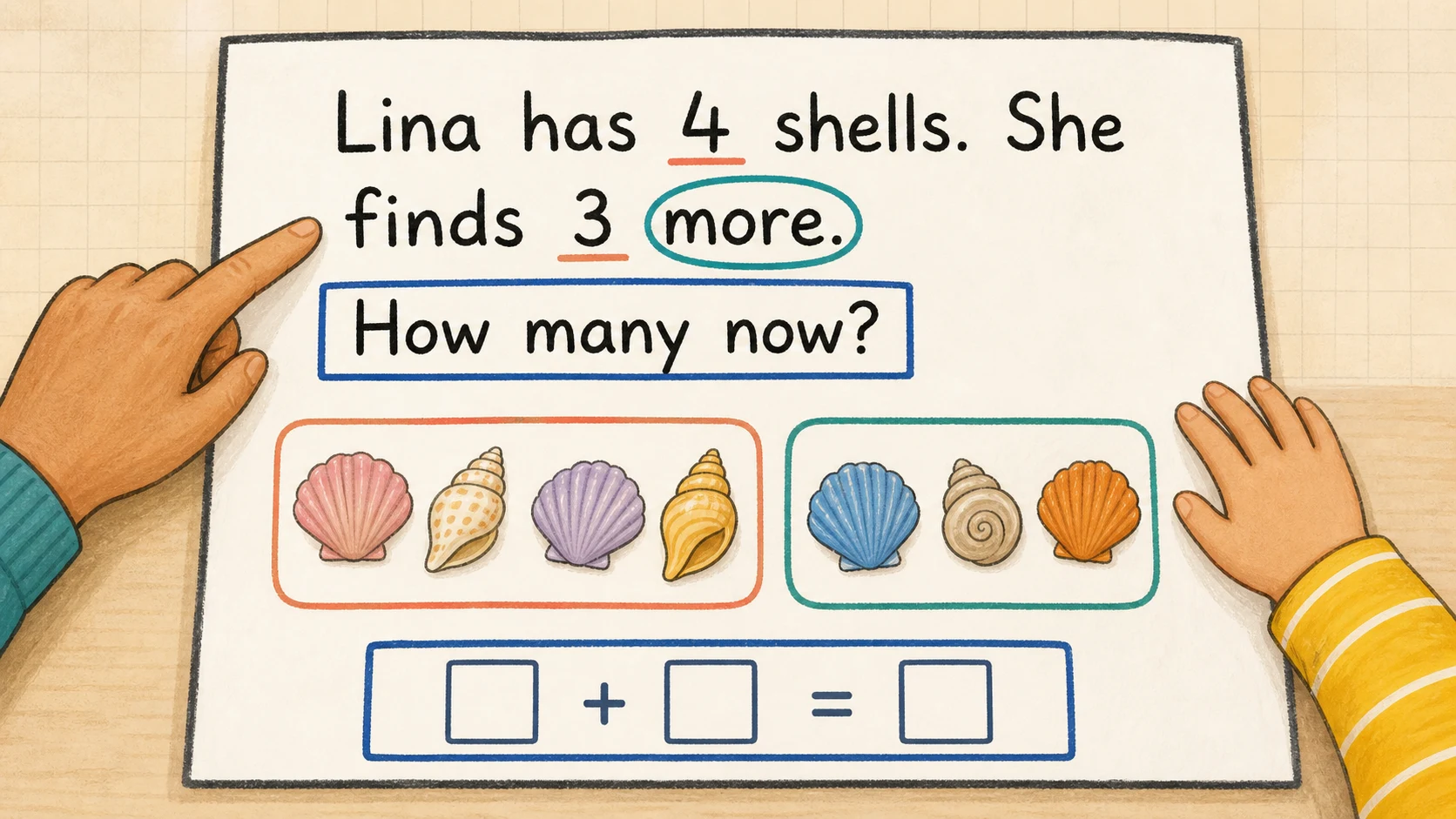
One routine can support several story structures while keeping attention on meaning.
1. Read and retell
Read the complete problem. Help with decoding if necessary without interpreting the mathematics. Ask, “What happened in this story?” A faithful retelling is more informative than circling isolated words.
2. Name what is known and unknown
Have the learner point to or state each known quantity. Then complete the sentence:
“I need to find ______.”
If the learner cannot name the unknown, reread the final sentence and connect it to the story.
3. Choose and make a model
Offer counters, a quick drawing, a bar, or a number line. At first, model the choice aloud. Later, ask the learner to select a representation and explain why it fits.
4. Write and solve an equation
Record the relationship before or alongside calculation. Accept an equation with a box for the unknown, such as 8+□=13, when it accurately describes the story.
5. Answer and check
Require a labeled answer: “9 frogs,” not only “9.” Ask one check question:
- Did the amount grow, shrink, or stay as two compared amounts?
- Is the answer larger or smaller than the starting amount?
- Can the related addition or subtraction fact verify it?
Choosing Practice From Observed Work
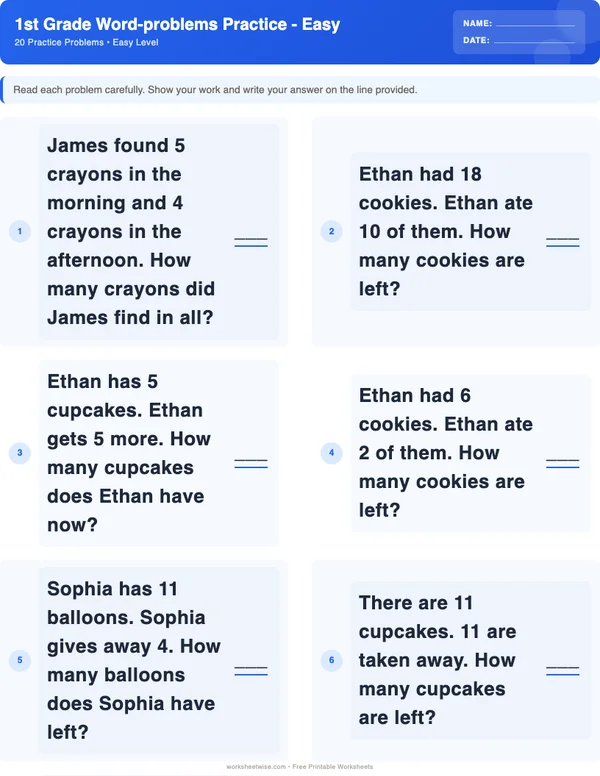
Start with the free easy word-problems worksheet if the learner is beginning or needs reinforcement. It contains 12 exercises and a separate answer key. The worksheet instructions ask learners to read carefully, show their work, and write an answer.
Do not assign all 12 automatically. First inspect two or three responses.
| What the work shows |
Practice to choose next |
| Story understood; calculation inaccurate |
Same structure with smaller numbers or concrete counting support |
| Operation correct; equation does not match |
Pair each model with an equation-building prompt |
| Result-unknown problems accurate |
Introduce change-unknown problems |
| Addition accurate; subtraction uncertain |
Contrast one joining and one separating story |
| Both operations accurate in isolation |
Mix the operations without keyword cues |
| Models accurate; answers unlabeled |
Add a consistent “number + unit” response line |
| Single-step work secure |
Introduce one carefully scaffolded two-step problem |
| Errors occur after several items |
Use fewer problems per sitting and review quality |
For broader browsing, the first-grade math collection provides context around related skills, while the Word Problems topic guide keeps the focus on story problems.
The 18-worksheet focused Word Problems pack costs $4.79. It may suit adults who want more practice choices, but quantity alone does not determine fit. Select pages according to the learner’s demonstrated story structure, number range, and support needs.
Differentiation Without Changing the Mathematical Goal
When reading is the main barrier
Read the problem aloud, preteach an unfamiliar everyday word, or divide a long sentence into shorter clauses. Keep the numbers and mathematical relationship unchanged. Then ask the learner to retell the story before modeling it.
This distinguishes access support from solving the problem for the learner. Avoid emphasizing an operation word while reading aloud.
When number work is the main barrier
Reduce the quantities while retaining the structure. A learner struggling with 14−6 in a separating story can first solve the same type with 8−3. Provide counters or a number line and observe whether the learner can map the story onto the model.
When representation is the barrier
Begin the diagram and let the learner complete it. For a comparison, draw two aligned starting points. For part-part-whole, provide an empty bar divided into two sections. Gradually remove these prompts as the learner becomes accurate.
When work is consistently secure
Increase reasoning demand before increasing numerical size. Change the unknown’s position, ask the learner to write a matching story, include two operations, or ask for two different models. First-grade practice should remain grounded in appropriate addition and subtraction relationships rather than advancing merely for novelty.
Boundary Cases Worth Teaching Explicitly
A complete word-problem lesson also shows when a calculation cannot—or should not—be completed.
Extra information
Problem: Nia has 6 red beads and 4 blue beads. Her box is green. How many beads does she have?
The box color is irrelevant.
6+4=10
Answer: Nia has 10 beads.
Ask the learner to explain why “green” does not affect the total.
Missing information
Problem: Sam had some pencils. He gave away 3. How many pencils remain?
There is no starting quantity, so a unique numerical answer cannot be found. The correct response is to identify what is missing: how many pencils Sam had at first.
Do not pressure the learner to invent a number merely because most worksheet items have answers.
Zero change
Problem: Five birds are on a branch. No birds leave. How many remain?
5−0=5
The amount stays the same. This tests whether the learner follows the relationship rather than assuming that subtraction must make every number smaller.
A mathematically possible but contextually impossible result
If a learner writes 4−9 to represent “There were 9 cookies and 4 were eaten,” the equation reverses the quantities. At this practice level, returning to the story and model is more useful than extending into negative numbers.
Common Errors and Diagnostic Responses
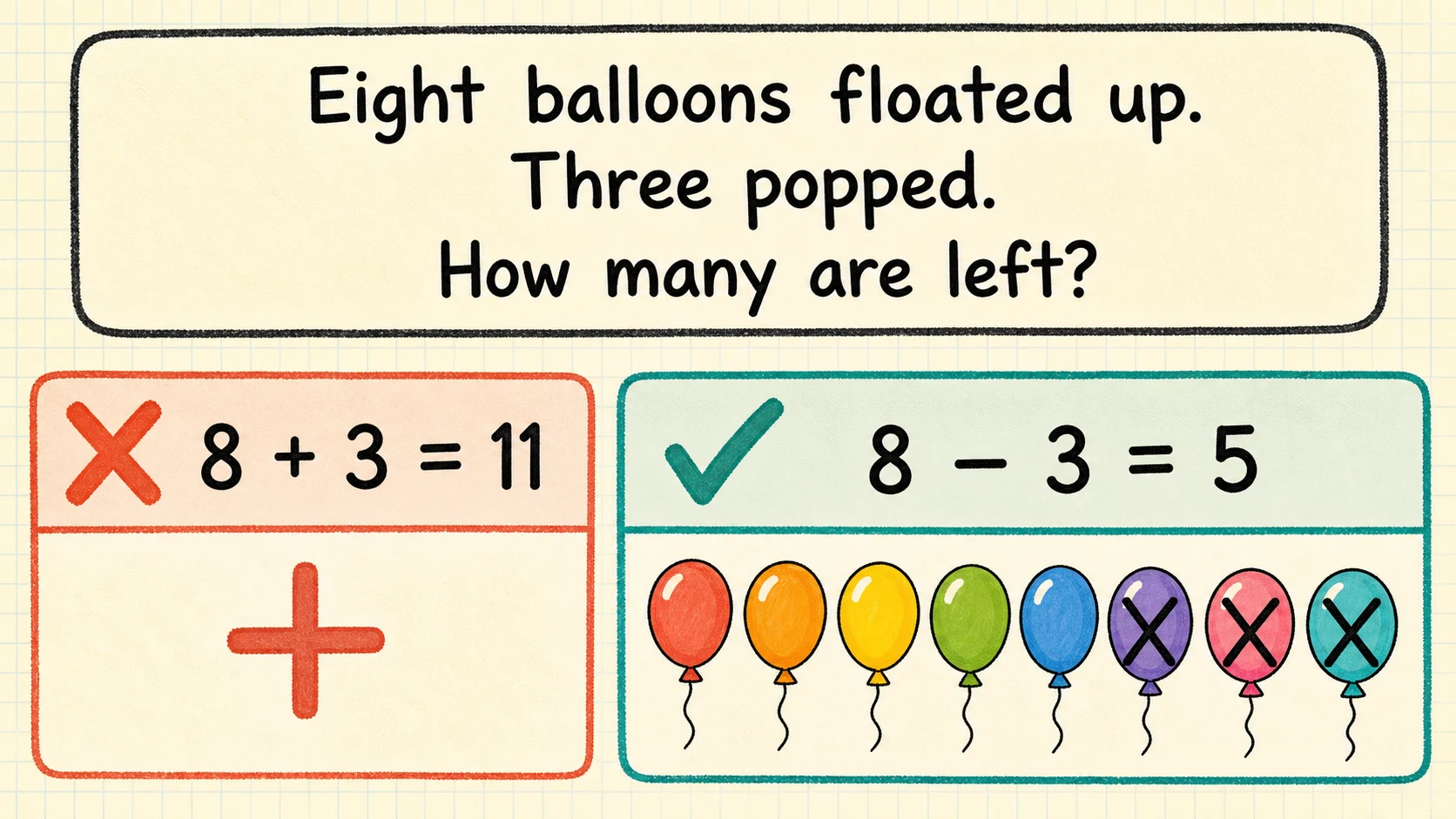
Diagnose the point of breakdown before selecting another page.
| Observed error |
Likely point to investigate |
Teaching response |
| Adds every pair of numbers |
Operation chosen from habit |
Act out contrasting join and separate stories |
| Uses a keyword mechanically |
Story relationship overlooked |
Remove numbers, retell the event, then restore quantities |
| Reverses subtraction |
Start, removed part, and remainder confused |
Build the starting set and physically remove the stated part |
| Counts a set twice or skips objects |
One-to-one counting is unstable |
Arrange counters in a line or ten-frame |
| Gives the right number with a mismatched equation |
Calculation and representation are disconnected |
Ask the learner to point from each number to its story quantity |
| Cannot solve a missing-start problem |
Unknown position is unfamiliar |
Cover the starting set, reveal removed and remaining parts, then reconstruct |
| Says “13” without “stickers” |
Context is dropped after calculation |
Use a response frame: “There are ___ ___.” |
| Copies an irrelevant number |
Relevance is not evaluated |
Ask what each fact tells us and whether it changes the target quantity |
| Changes operation after being asked to explain |
Answer may have been guessed |
Return to objects and ask for an action-by-action account |
| Accurate early, careless later |
Volume or attention may be affecting work |
Shorten the set and compare performance across brief sessions |
A wrong answer is not a diagnosis by itself. Preserve the drawing, equation, counting marks, and oral explanation. Together, they show whether the breakdown occurred during reading, modeling, operation selection, calculation, or recording.
Monitoring Progress and Deciding When to Move On
Use brief samples across several days rather than one score. Record the problem structure, number range, support provided, model chosen, equation, answer, and explanation.
A simple note might read:
Comparison, 11 and 7; adult read aloud; learner drew aligned rows; wrote 11−7=4; answered “4 more blocks”; explained the unmatched marks.
Look for three kinds of progress:
- Accuracy: Does the model, equation, and answer match the story?
- Independence: Are prompts or materials gradually becoming less necessary?
- Flexibility: Can the learner handle different unknown positions and explain why an operation fits?
Move forward when recent work shows stable understanding, not after a fixed number of repetitions. If a learner succeeds only when all addition problems are grouped together, mix addition and subtraction before introducing harder numbers. If mixed single-step problems are secure but change-unknown problems are not, target that structure rather than adding two-step work.
The learner’s observed work should drive pacing. This guide cannot determine a universal schedule, diagnose a learning condition, or provide child-specific medical or educational advice. Persistent difficulty across reading, quantity, and representation may warrant discussion with the learner’s teacher or another appropriately qualified professional who can examine broader evidence.
A Two-Week Practice Plan
This plan is a practical option, not a sourced or universal timetable. Keep each session short enough for the learner to explain their work carefully. One to four well-discussed problems can be more informative than a full page completed mechanically.
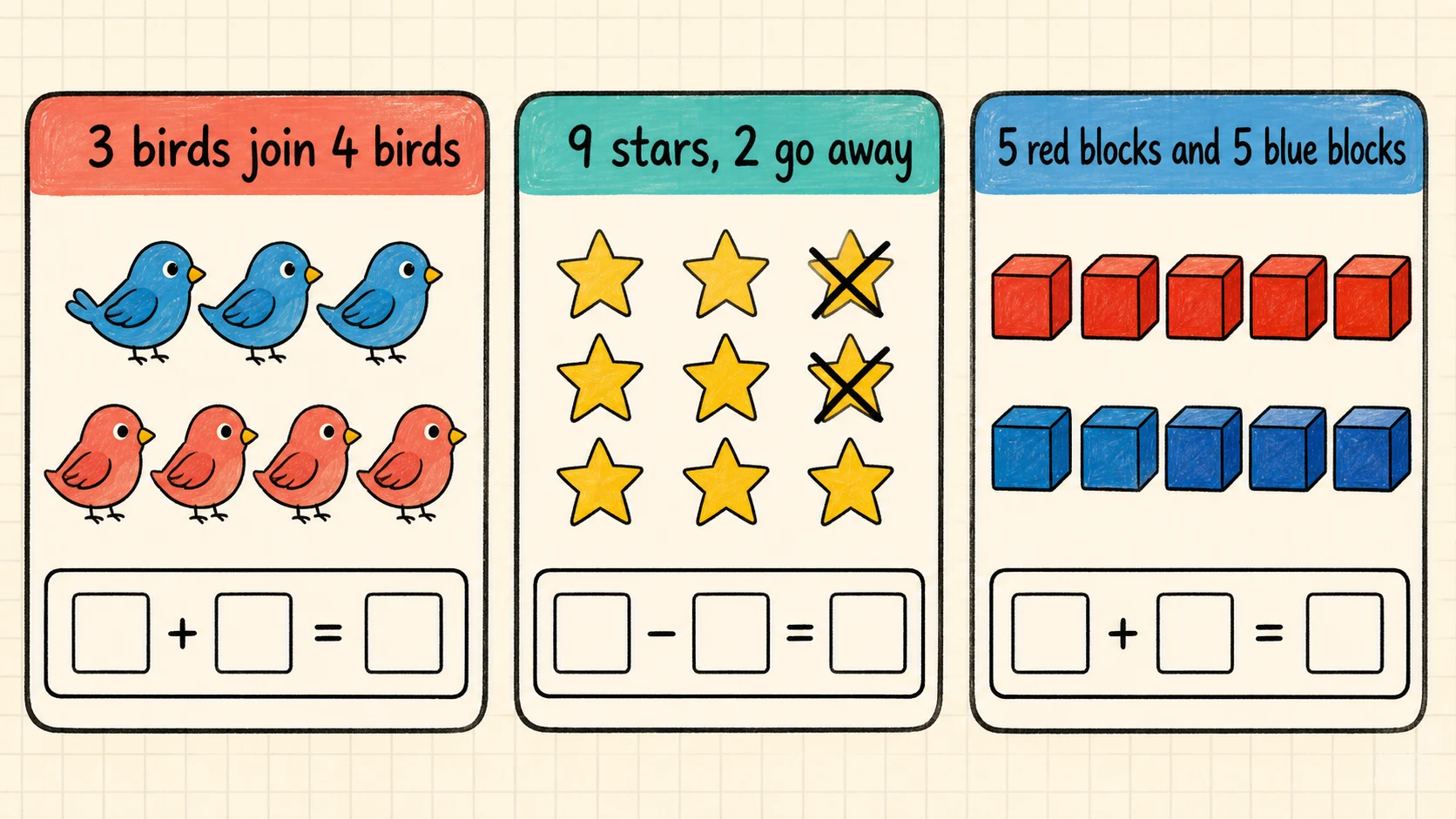
The sequence alternates instruction, mixed review, observation, and adjustment.
| Day |
Focus |
Suggested activity |
What to observe |
| 1 |
Baseline |
Solve one join, one separate, and one comparison problem |
Reading, model choice, operation, calculation |
| 2 |
Join, result unknown |
Act out two stories; draw and write equations |
Whether the learner connects “more arrives” to a growing set |
| 3 |
Separate, result unknown |
Remove counters and verify with addition |
Whether the starting amount is built correctly |
| 4 |
Part-part-whole |
Combine two visible groups; find a whole and then a missing part |
Understanding of parts and whole |
| 5 |
Mixed review |
Mix four familiar problems without operation labels |
Whether meaning—not page grouping—drives the choice |
| 6 |
Pause or informal use |
Notice a simple story during daily activity |
Whether the learner can describe quantities naturally |
| 7 |
Review the work |
Re-solve one error using a different model |
Whether the explanation improves |
| 8 |
Change unknown |
Use a covered added or removed set |
Whether the learner can find a missing change |
| 9 |
Start unknown |
Reconstruct the starting amount from two known parts |
Whether the learner reasons backward |
| 10 |
Comparison |
Build aligned rows and comparison bars |
Whether the learner distinguishes difference from total |
| 11 |
Boundary cases |
Try one extra-information and one missing-information problem |
Whether relevance and sufficiency are checked |
| 12 |
Independent sample |
Complete selected worksheet items with minimal prompting |
Independence and answer labels |
| 13 |
Optional challenge |
Solve one supported two-step problem |
Tracking of the intermediate result |
| 14 |
Review and choose next practice |
Compare Days 1 and 12; select the weakest structure |
Accuracy, independence, and flexibility |
After two weeks, do not automatically move to larger numbers or harder pages. If the learner still confuses comparison with joining, continue comparison work using small quantities. If the mathematics is sound but reading support remains necessary, keep providing access while monitoring independent retelling. If the work is consistently accurate and explainable, mix structures and vary the unknown.
Limitations and the Honest Next Step
A worksheet can provide organized practice, but it cannot observe hesitation, hear a retelling, or determine why an answer is wrong. An answer key confirms results; it does not replace examining the learner’s model and explanation. Real-world scenarios can make a task understandable, but familiarity with a setting does not guarantee understanding of its mathematical relationship.
Use this guide to choose the next teachable step, not to label the learner. Start with three carefully selected items from the free 1st Grade Word Problems worksheet. Ask for a retelling, a model, an equation, and a labeled answer. Then choose the next practice from what the learner actually shows.