Curated collectionAnswer keys includedPrint-ready PDFs
Classroom Math Worksheets
Move from whole-group modeling to guided practice, independent work and a manageable check routine without using sheets as filler.
Start with a real resource
Browse this worksheet collection
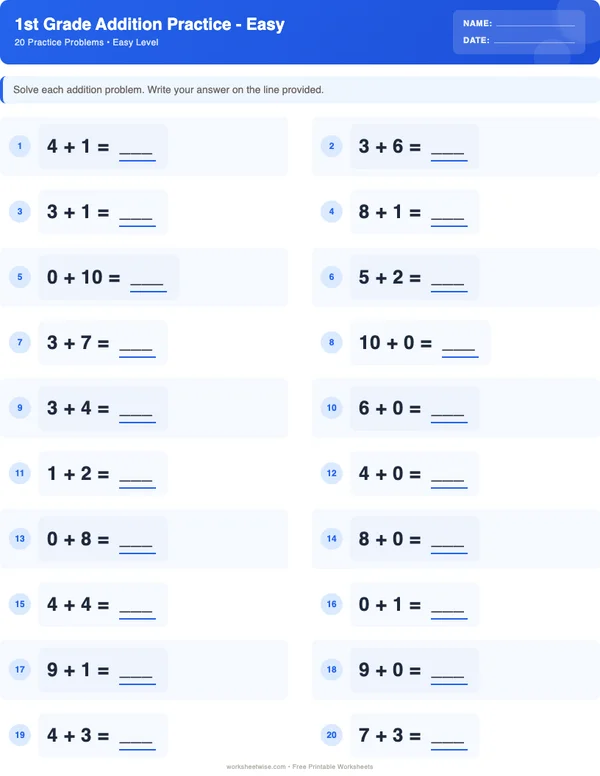
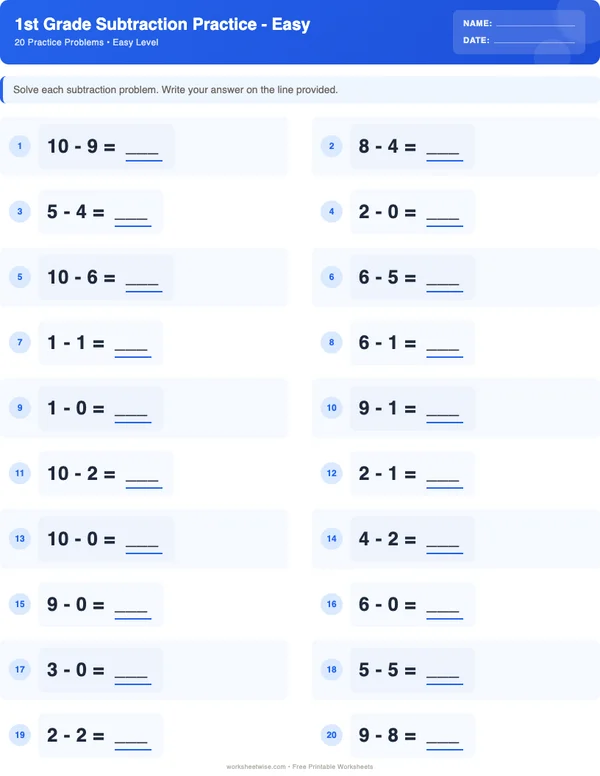
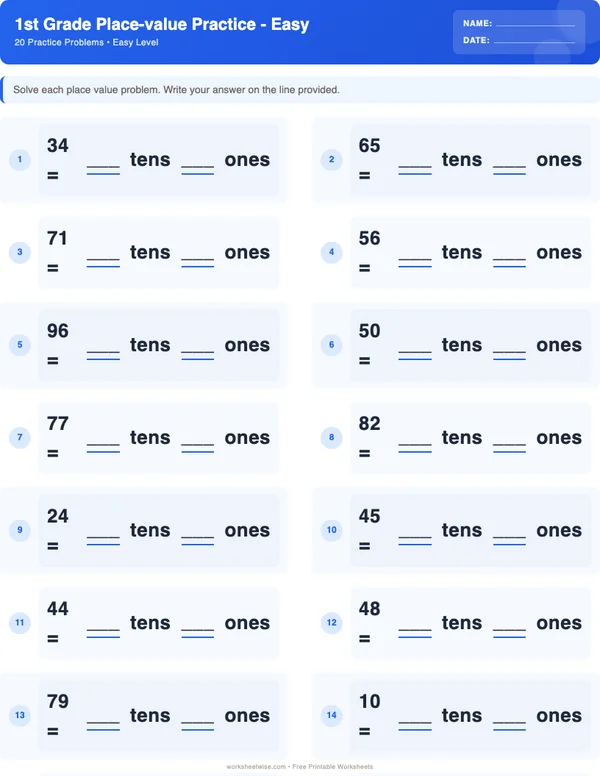
61 relevant free entry points are available. Each one includes a printable learner PDF and separate answer key.
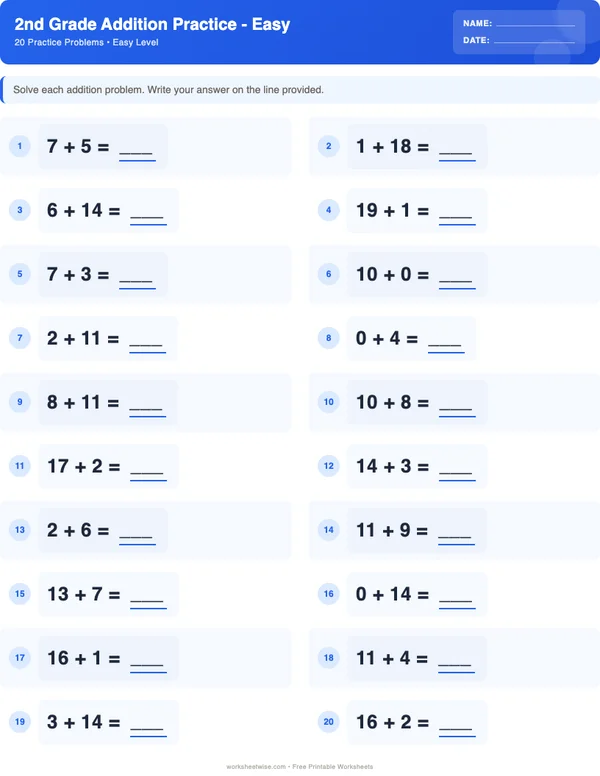
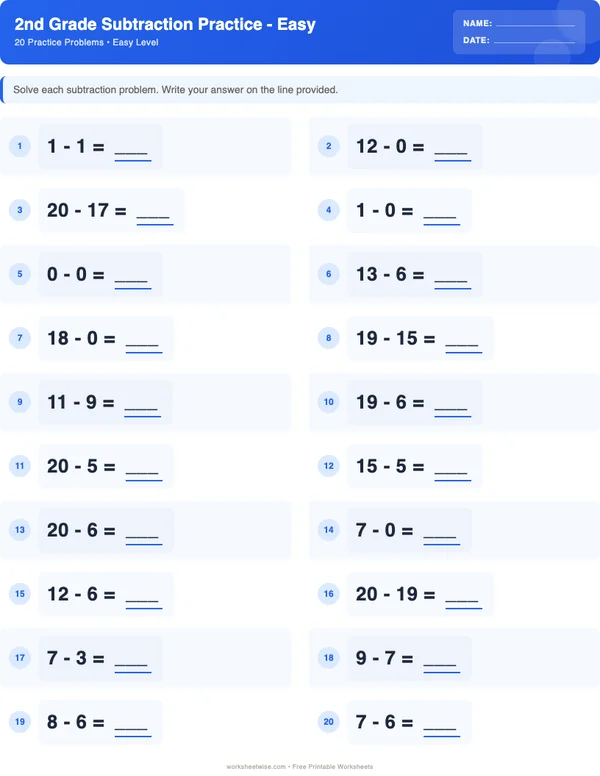
A useful practice loop
Print less. Observe more.
- Choose one skill and model the first item aloud.
- Use a short set and notice the learner’s strategy.
- Change the next task from the work you can see.
Need more than the free sheet?
Plus includes all 1098 matching catalogue variations where available, plus saved deterministic generators and the worksheet designer.
See Plus membershipComplete guide
How to teach and practise classroom math worksheets
3,367 words Updated 6 instructional visuals
Turn a worksheet into one stage of the math lesson
Classroom math worksheets work best after learners have seen the mathematics modeled and before the teacher decides what to teach next. A practical sequence is:
- Model one carefully chosen problem for the whole group.
- Solve a second problem with learners contributing the decisions.
- Assign a short set that preserves the same mathematical target.
- Check a small number of revealing responses.
- Select the next sheet from the errors observed—not simply from the calendar.
This sequence keeps a sheet from becoming filler. It also separates two questions that are often blurred: “Can the learner calculate an answer?” and “Does the learner understand the quantities, representation, or operation involved?”
WorksheetWise’s live math catalogue currently contains 1,098 variants across eight grade labels and 12 topics, including 61 free resources. Those numbers indicate breadth, not a prescribed sequence. Grade labels describe the intended practice level; local curriculum sequences differ. Age can help adults discover likely resources, but it is not a placement decision. Select work by inspecting the actual quantities, models, language, response format, and number of steps.
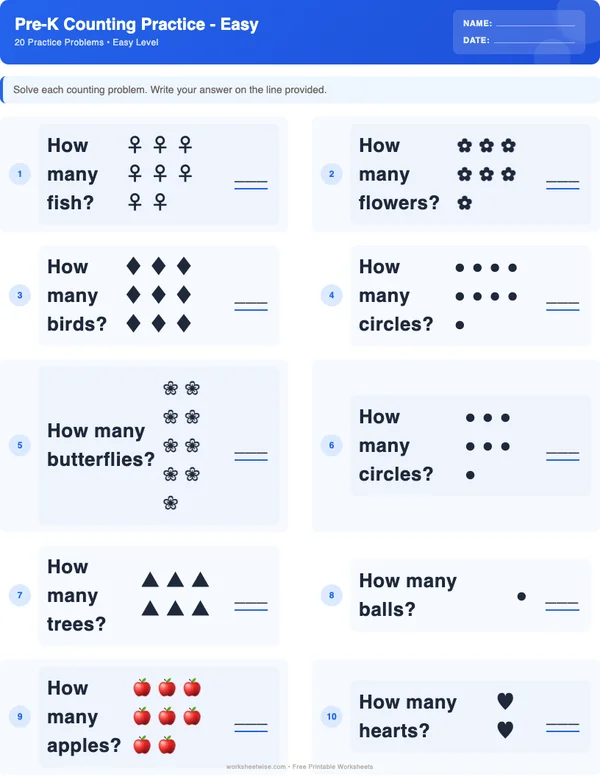
For ages three and four, prioritize brief adult-led oral, matching, manipulative, and movement experiences over desk work. A 20-item Pre-K counting sheet, for example, may supply useful pictures or prompts, but it need not be completed as a 20-question seated assignment. Count real objects, match a numeral to a set, or step along a floor number line first.
Select the mathematical decision before selecting the sheet
Begin with a sentence learners should be able to complete after the lesson:
- “I can touch each object once and say one number for it.”
- “I can show how two parts combine to make a total.”
- “I can decide whether a story asks me to join, remove, compare, or find a missing part.”
- “I can identify a shape from its properties even when it is turned.”
- “I can count a mixed group of coins by starting with the greatest value.”
These targets are narrower and more observable than “practice counting” or “do money.” They also make worksheet selection manageable.
Inspect four task features
Before printing, examine:
- Mathematical range. Is the work within 5, within 10, within 20, or beyond? Are shapes merely named, or classified by properties?
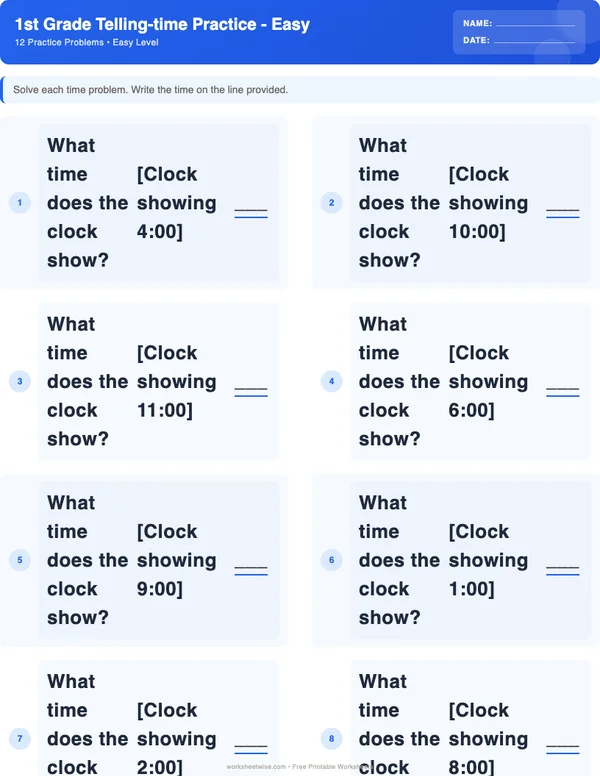
- Representation. Do learners respond to objects, pictures, ten frames, number lines, equations, clock faces, coin images, or written situations?
- Response demand. Must they circle, match, draw, write a numeral, write an equation, explain, or complete several steps?
- Variation. Do items test the same surface pattern repeatedly, or vary orientation, unknown position, arrangement, or wording?
These features define the practical difficulty of the task. The catalogue’s representative free sheets are labeled “easy,” but that label should describe observable features such as small quantities, one-step prompts, familiar images, substantial visual support, and a short written response. It must not become a label for a learner. A page may be straightforward computationally yet demanding because it requires reading, handwriting, visual discrimination, or switching between representations.
Compare representative live skills
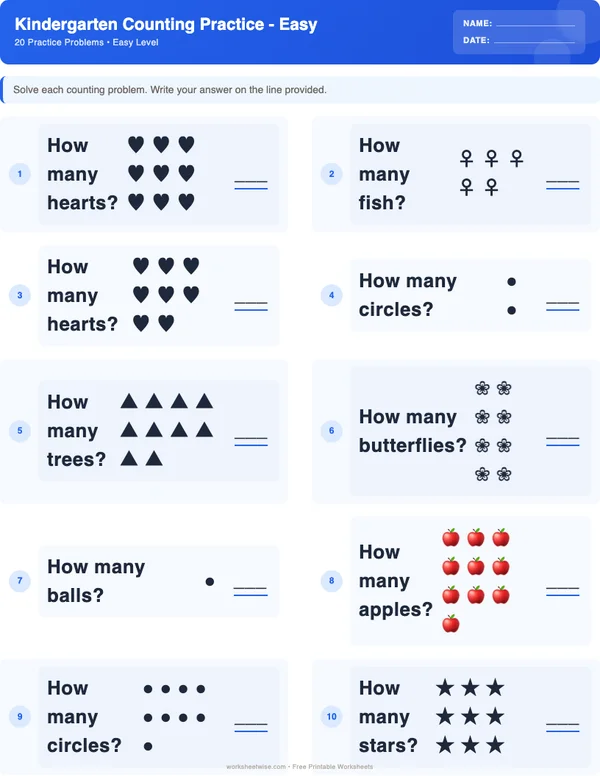
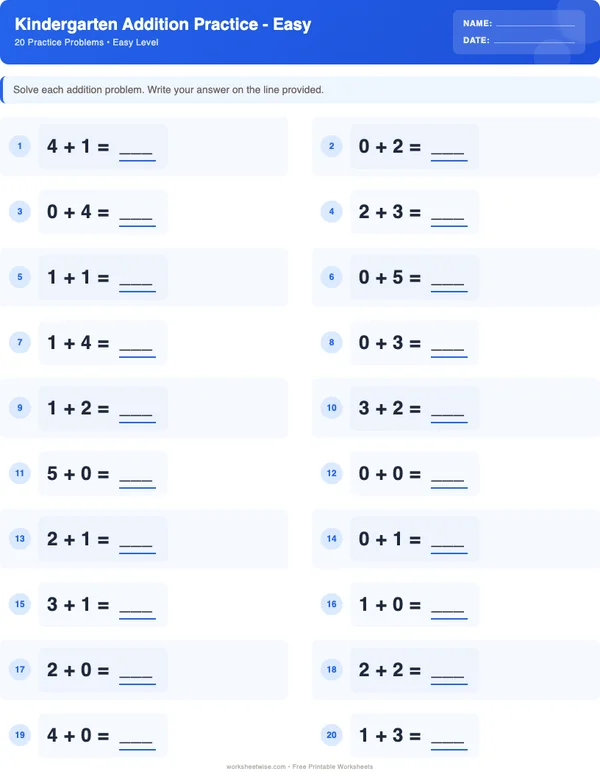
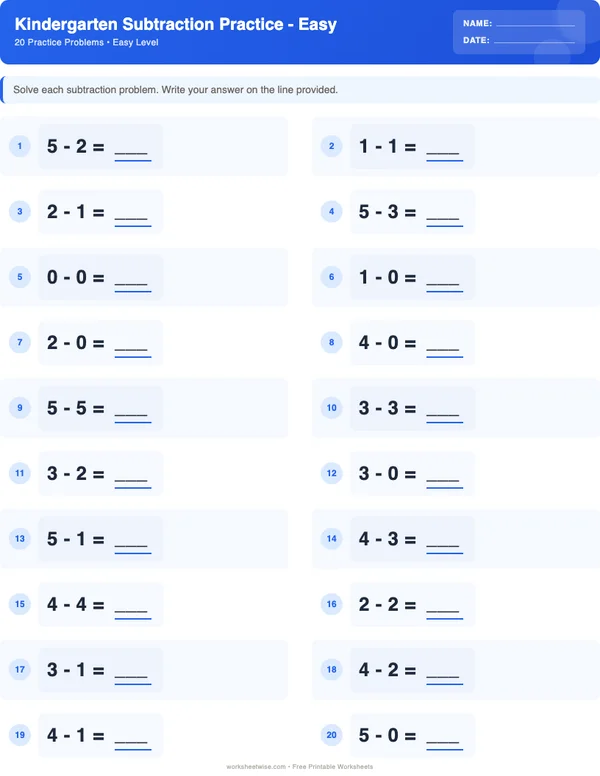
The representative Kindergarten counting, addition, subtraction, place-value, and geometry resources each contain 20 problems. That common item count does not make the tasks interchangeable.
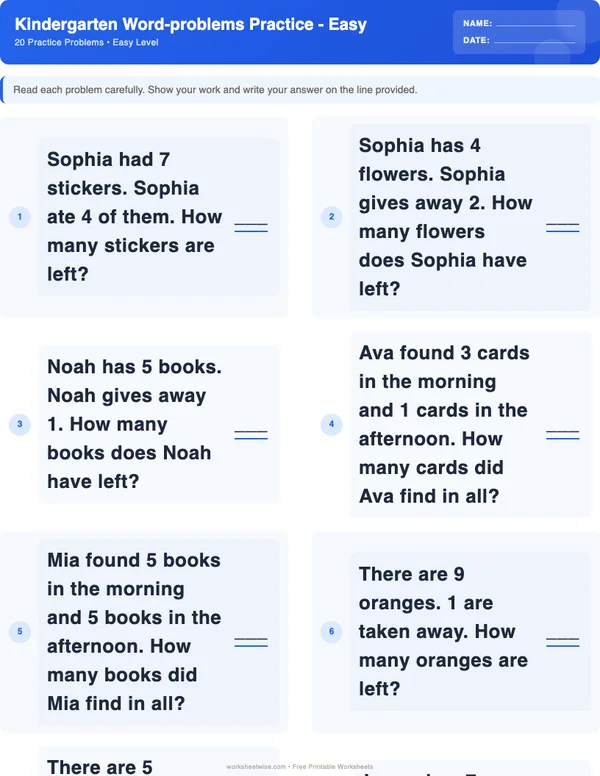
A counting item may require one-to-one correspondence. An addition item may require composing a total. A subtraction story may ask for removal, comparison, or a missing part. A place-value item may require seeing a teen number as one ten and some ones. A geometry item may depend on properties rather than quantity. The representative Kindergarten word-problem sheet has 12 problems, but each problem may impose a larger language and reasoning load than a single equation.
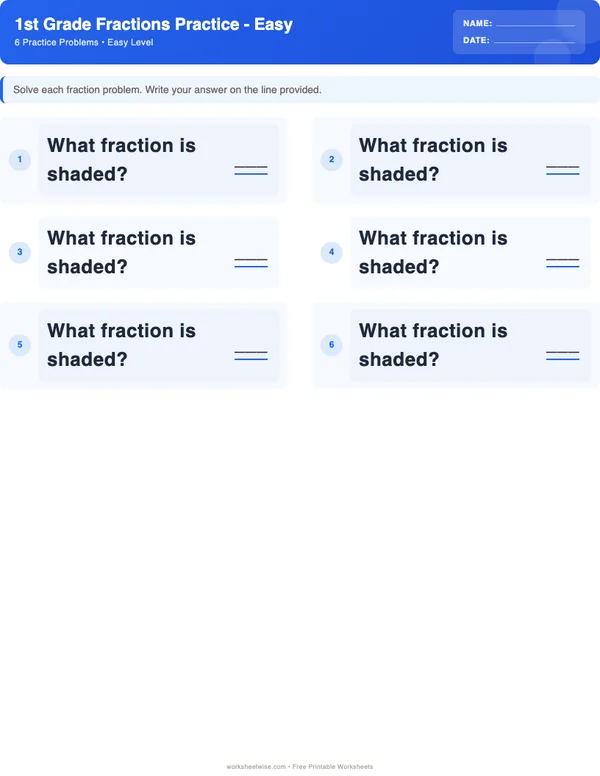
Likewise, the representative first-grade fractions sheet has six problems, while first-grade money has 20. Six fraction tasks involving equal partitioning can provide more evidence than 20 rapid identifications if each response requires the learner to decide whether the parts are equal. Judge the cognitive work, not the page length.
Model the response you expect learners to produce
Whole-group modeling should expose decisions rather than display a polished answer. Choose one problem that represents the central structure of the independent work. Ask:
- What information is shown?
- What are we trying to find?
- What model fits the quantities?
- What does each mark, number, or unit mean?
- How can we check the result?
Then record the answer in the exact response format the sheet requires. If learners must draw an equation, model one. If they must label units, include units. If they must circle all shapes with four sides, demonstrate checking properties instead of choosing a familiar-looking square.
Example 1: geometry from concrete construction to classification
Suppose a third-grade geometry task shows a rectangle with side lengths 6 units and 3 units and asks for perimeter. Build or trace the rectangle first. Mark each boundary length, then calculate:
units.
Check the shortcut:
units.
This example is fully checked: the four sides total 18 units. It belongs in this classroom workflow because it reveals more than arithmetic. A learner who writes happens to reach the same numeral by calculating area, so the model and unit are necessary evidence. Use a different rectangle during guided practice—such as 5 by 2—where area is 10 square units and perimeter is 14 units. That prevents the accidental equality in the first example from hiding the misconception.
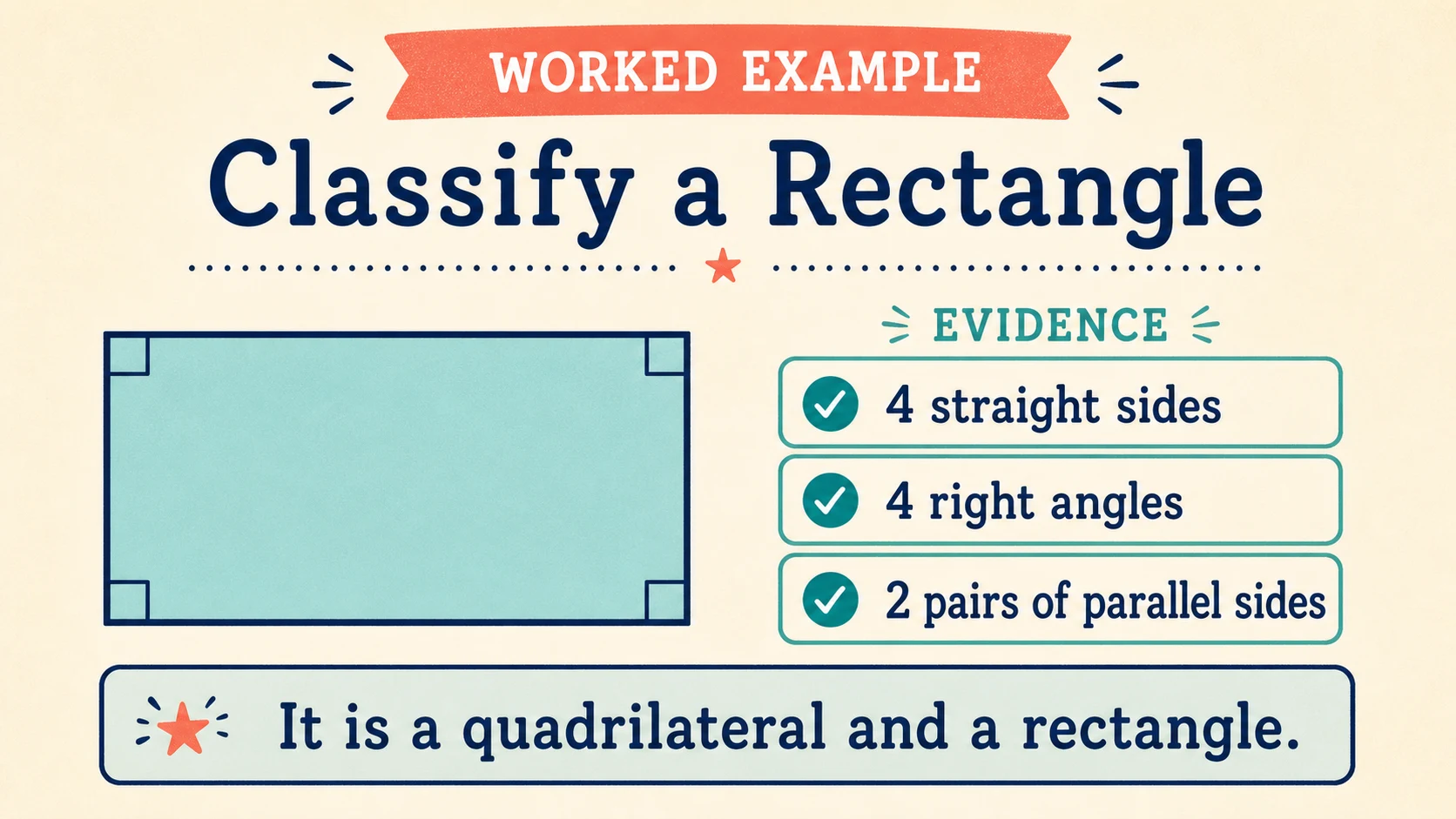
The boundary marks and unit label make the intended geometric measure visible before independent calculation.
The catalogue guidance recommends hands-on and visual geometry work, including building shapes and using square tiles when distinguishing area from perimeter. The IES guide for assisting students who struggle with mathematics likewise supports systematic instruction that uses clear mathematical representations and connects them to notation. That source offers general instructional guidance; it did not evaluate WorksheetWise.
Example 2: a word problem without keyword guessing
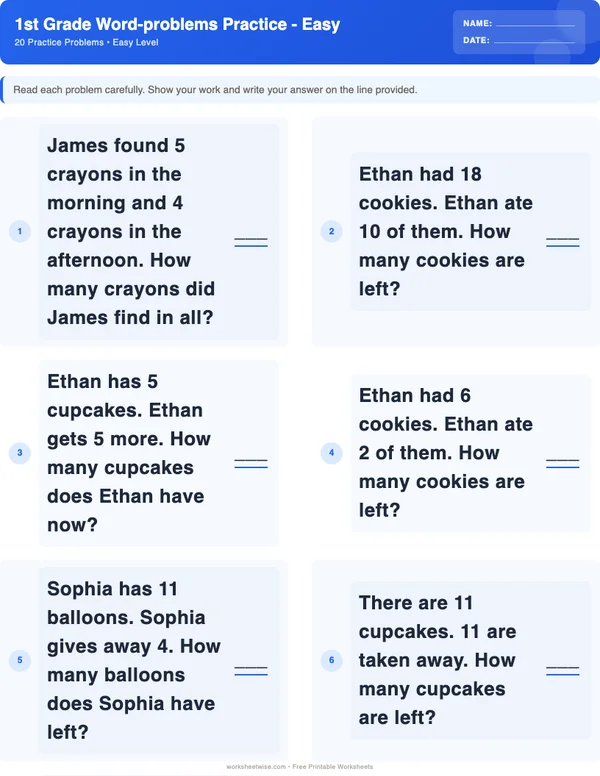
Model this first-grade situation:
Mia has 7 counters. She gives 3 counters to Jay. How many counters does Mia have now?
Act it out. Start with seven counters, move three away, and count four remaining. Record:
.
Check with the inverse relationship:
.
This example belongs here because it aligns with the live first-grade subtraction progression and uses quantities within 10. It also shows a removal situation. Do not tell learners that “gives” always means subtract; instead, ask what happens to Mia’s collection.
Next, contrast it with:
Mia has 7 counters. Jay has 3 counters. How many more counters does Mia have than Jay?
The equation is again , but nothing is physically removed. Align two rows of counters to display the difference. Same calculation, different relationship.
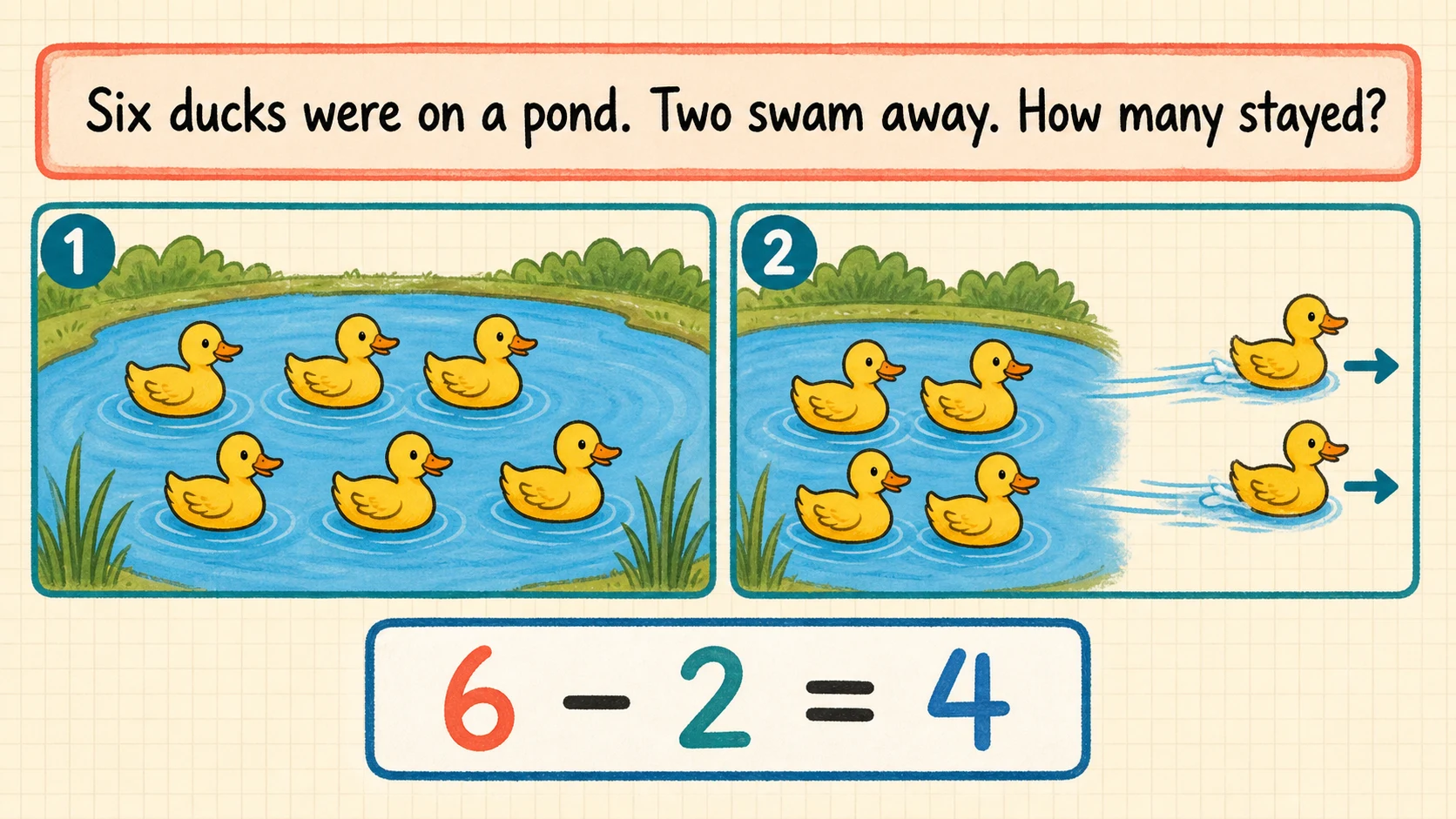
Acting out the quantities before writing the equation keeps the operation tied to the story structure.
Move through guided practice without doing the sheet for the class
Guided practice should require learners to make the key decision while support is still available. Display one new item and withhold the answer. Invite a learner to choose or create the model, then ask another learner to connect it to notation.
Use brief prompts:
- “Show where the total is represented.”
- “Which quantity changed?”
- “What stays equal when we trade one ten for ten ones?”
- “How do you know that turned shape is still a triangle?”
- “What does the 5 mean in this coin count?”
- “Does your unit describe length or square units?”
Avoid narrating every step while learners copy. Copying can produce correct pages without revealing whether anyone can choose a strategy independently.
Example 3: counting coins by value, not by number of coins
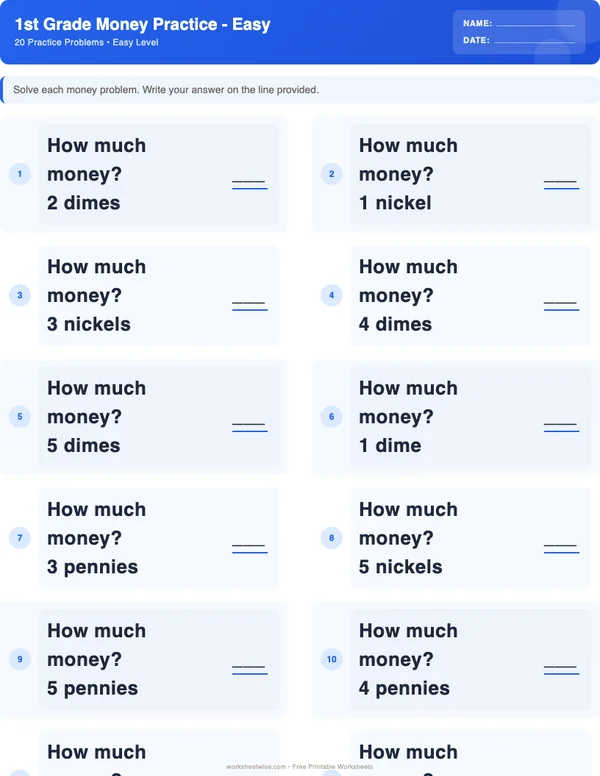
For a first-grade money task, place one dime, one nickel, and three pennies in view. Identify each value before counting:
- dime: 10 cents
- nickel: 5 cents
- three pennies: 3 cents
Count from the greatest value: 10, 15, 16, 17, 18. The total is 18 cents.
The result is checked by addition:
.
This example belongs because the live first-grade money resource uses coin identification and mixed collections, with 20 problems on the representative free sheet. It exposes a common response error: writing 5 because five coins are pictured. That answer reports the number of objects, not their monetary value.
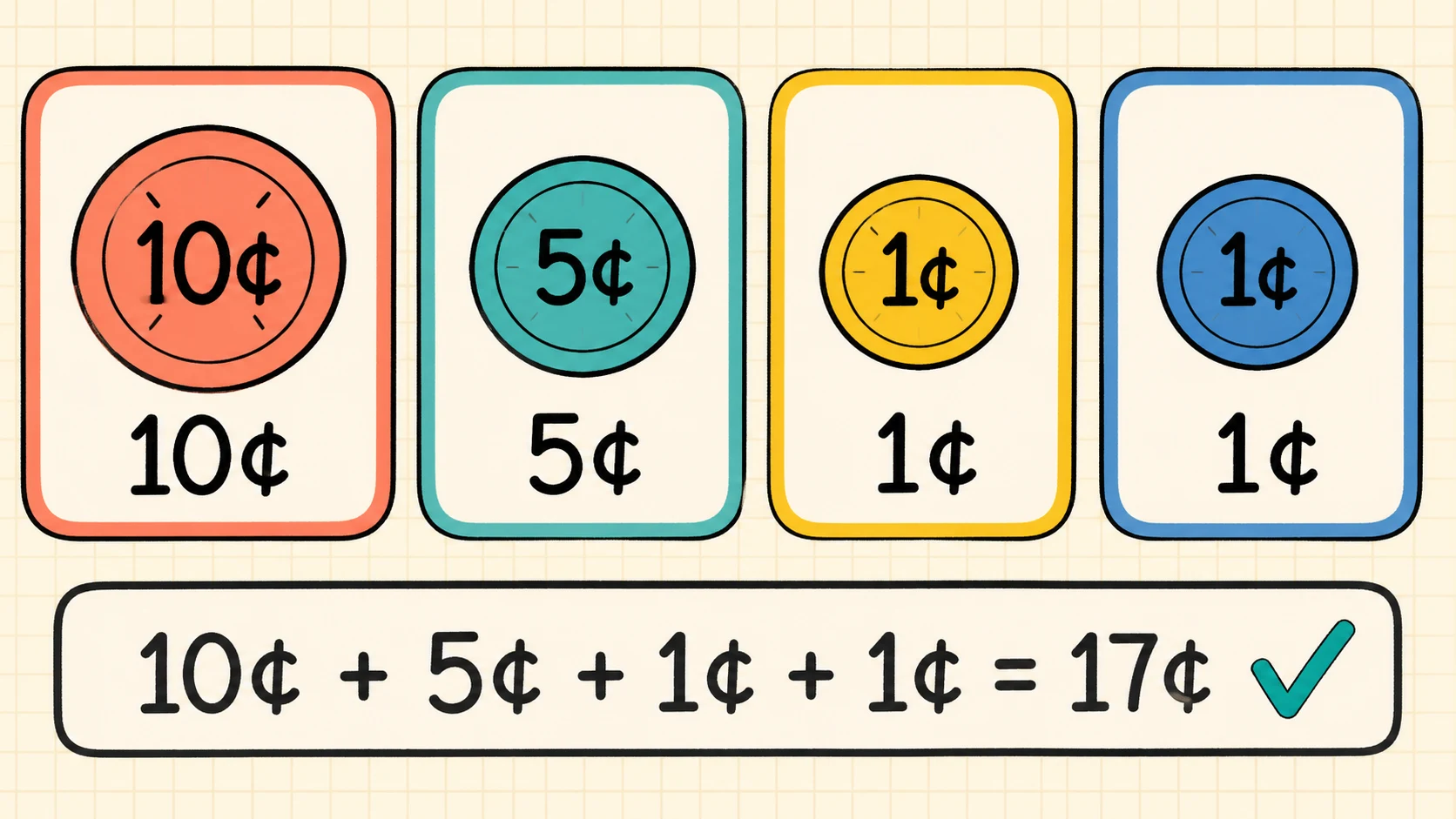
Touching each coin while counting on from the greatest value connects the picture to an auditable total.
Keep realistic play coins available during guided practice. If the target is counting coin values, access to coins preserves the target; it does not provide the answer. If the target is identifying coins from their visual features, however, labeling every coin with its value would remove part of the intended work.
A short money routine can repeat across several lessons: identify, arrange by value, count on, record cents, and verify by addition.
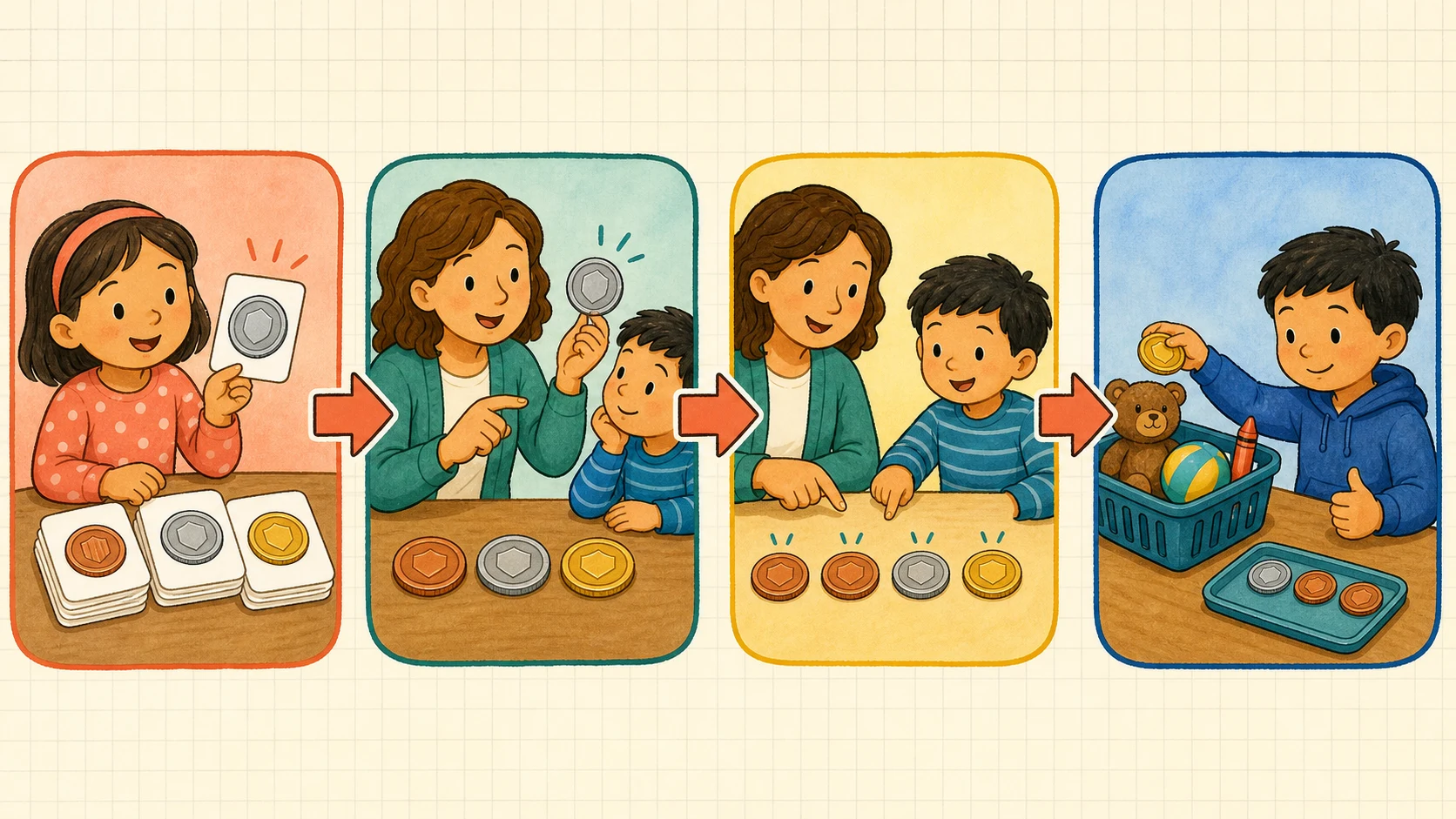
The stable sequence reduces procedural clutter while the coin combinations supply the mathematical variation.
Assign less work and collect better evidence
A manageable independent set often contains three kinds of items:
- two close matches to the modeled structure;
- one variation that changes arrangement, wording, orientation, or unknown position;
- one item that asks for a model, explanation, or check.
That could mean four selected items from a 20-problem sheet rather than the entire page. The decision depends on lesson purpose. A full sheet may be reasonable for established practice, but it is usually inefficient when the teacher is trying to identify a new misconception.
Example 4: addition that distinguishes counting all from making ten
Consider . Model eight counters in a ten frame and five outside it. Move two of the five into the empty spaces:
.
Check by counting 13 counters and by subtraction:
.
This example belongs because the live Kindergarten and first-grade addition descriptions progress from objects and pictures toward addition within 10 and 20, including counting on and making ten. The response “13” alone does not show which strategy was used, so ask one independent item to include a ten-frame drawing or decomposition.
If a learner draws eight, then separately recounts all five and the combined set, the answer may be correct but the strategy remains laborious. The next sheet should not automatically increase the number range. First provide a short set that visibly supports composing ten—for example, , , and —and ask learners to mark the part moved to complete ten.
The IES early-mathematics practice guide recommends teaching children to view and describe the world mathematically, use progressions, monitor learning, and help children recognize and extend patterns. In this routine, those principles support moving between objects, pictures, and symbols while observing what a learner can actually explain. They are sourced instructional guidance, not evidence about this catalogue.
Use response formats to locate the source of an error
A wrong answer is not yet an instructional diagnosis. Compare responses across formats before choosing the next task.
Counting: sequence error or correspondence error?
Ask the learner to count eight objects arranged in a row, then eight scattered objects.
- If both totals are wrong and the spoken sequence is unstable, return to brief oral counting and movement.
- If the row is correct but the scattered set is not, practice organizing or moving each object after it is counted.
- If the count is correct but the written numeral is wrong, separate numeral formation from quantity recognition.
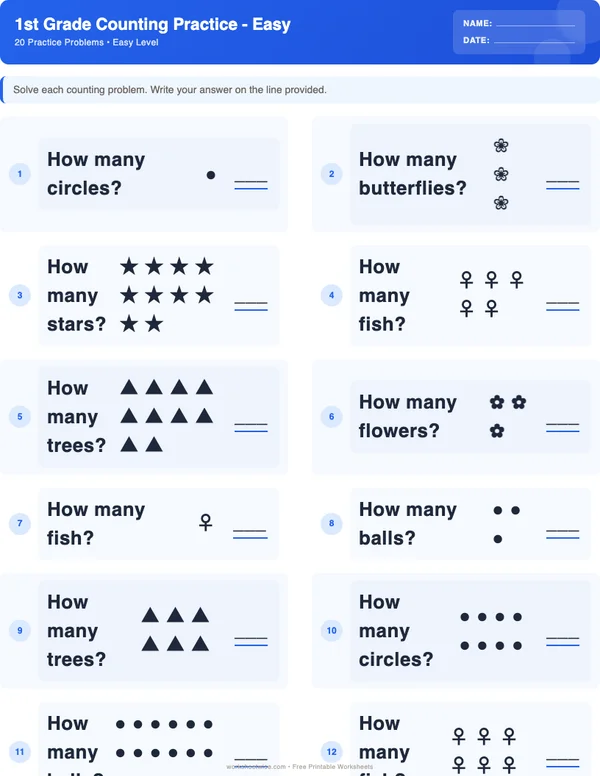
For ages three and four, make this adult-led and brief: touch toys, move buttons into a cup, match a numeral card, or take eight steps. The Pre-K Counting guide and free sheet can provide a discovery point, but the learner’s observed counting behavior should determine how it is used.
Place value: numeral reading or unit composition?
Show 14 with one bundle of ten and four single objects. Ask the learner to build 14, say the number, and write it.
A learner who writes 41 after correctly building one ten and four ones may understand the quantity but reverse the written digits. A learner who builds 14 ungrouped objects may count correctly without yet using ten as a unit. The next sheet differs:
- For reversed notation, use short matching tasks among models, spoken numbers, and numerals.
- For weak unit composition, return to bundling and trading before abstract expanded-form work.
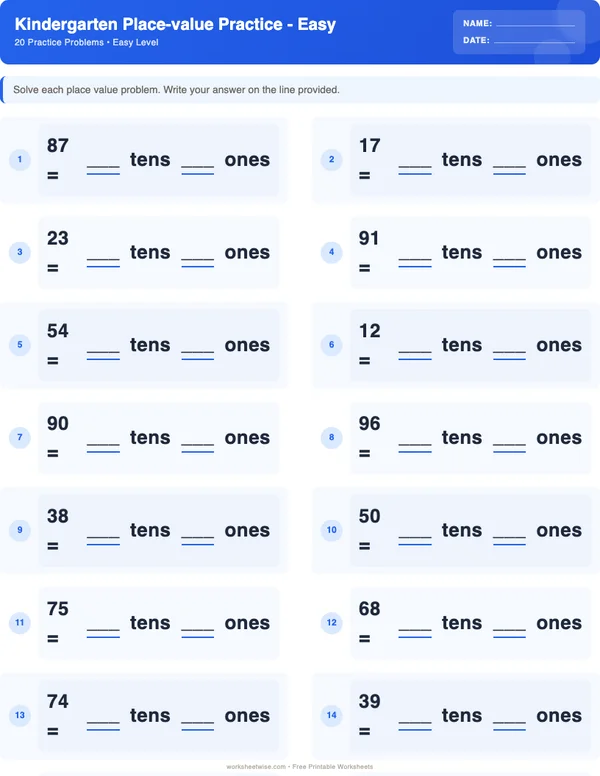
The Kindergarten Place Value guide and free sheet is relevant when the target is composing teen numbers, not merely writing a sequence of numerals.
Geometry: visual prototype or property reasoning?
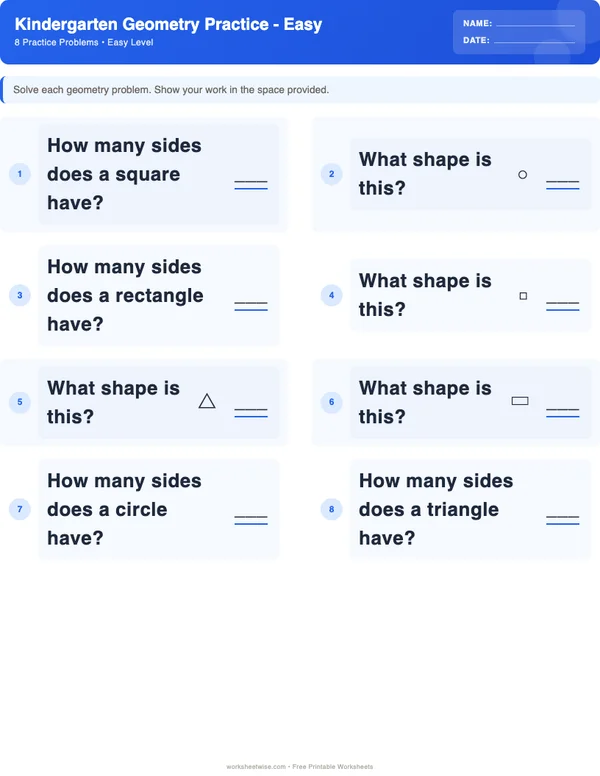
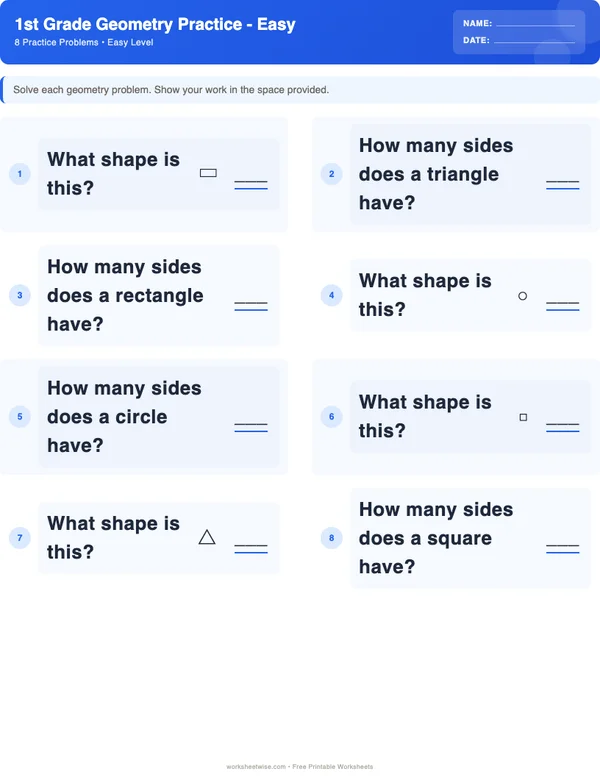
Show triangles in several orientations, including a right triangle and an obtuse triangle. Ask learners to identify each and explain the decision. If they reject a triangle because it “points sideways,” do not assign more pages containing only upright equilateral triangles. Select or create a set with varied orientations and ask learners to check three sides and three vertices.
The Common Core mathematics standards provide grade-level descriptions that can help teachers inspect mathematical expectations, but local curricula may order or emphasize content differently. Standards should inform the target; they do not prove that a particular sheet fits a particular learner.
Adapt access while preserving the target skill
An adaptation is useful when it removes an irrelevant barrier without solving the mathematics.
If the target is choosing an operation in a word problem, an adult may read the text aloud. The learner must still retell the situation, model the relationship, choose the operation, and solve. If the target includes independent reading of mathematical language, reading every sentence aloud changes what is being assessed.
Other target-preserving adaptations include:
- cover unused rows so the learner sees one item at a time;
- enlarge coin images, clock faces, diagrams, or writing spaces;
- allow counters, base-ten blocks, a number line, or a demonstration clock when representation is part of instruction;
- accept pointing, oral explanation, matching, or dictated reasoning when handwriting is not the target;
- reduce repeated items while retaining the model, operation, and number range;
- use high-contrast marks to identify relevant dimensions without supplying the calculation;
- let learners draw a bar model or ten frame before writing an equation.
Do not preserve page completion at the expense of the mathematical target. Splitting 20 items over two sessions is not equivalent to lowering the mathematics. Conversely, replacing every two-step problem with a one-step problem does change the target.
Example 5: equal parts, not merely named parts
Fold a rectangle into two equal sections and shade one. The shaded amount is . Then divide another same-sized rectangle into two unequal sections and shade one section. It is not valid to call the shaded part one-half merely because there are two sections; halves must be equal.
This checked contrast belongs because the representative live first-grade fractions sheet contains six problems and begins with partitioning shapes into equal parts. A learner who counts two regions and writes may be attending to the number of parts but ignoring equality. The next sheet should emphasize judging equal versus unequal partitions, not introduce thirds or symbolic fraction operations.
Check a revealing sample, then sort the errors
A sustainable check routine does not require marking every item in the same way. Select three evidence points before learners begin:
- an item closely matching the model;
- an item with one meaningful variation;
- an item requiring a model, unit, or explanation.
During review, sort responses into instructional categories.
Accurate answer and adequate model
The learner independently represents the quantities, completes the procedure, and labels the answer appropriately. The next sheet may remove one support, vary the representation, or introduce a closely related application. Do not jump several steps merely because one page is correct.
Accurate answer but mismatched reasoning
Examples include calculating area when perimeter was requested but obtaining the same numeral, counting coin objects instead of value in a conveniently matched set, or choosing an operation by a keyword. Give a contrast pair where the two methods yield different answers. Ask the learner to explain what the number measures.
Consistent misconception
A repeated, interpretable pattern should determine the next model:
- subtracting the smaller digit from the larger digit in each column suggests returning to place-value trading;
- treating the denominator as a count of shaded pieces without checking equal parts suggests comparing equal and unequal partitions;
- identifying only upright prototypes as triangles suggests sorting varied examples and nonexamples;
- writing the number of coins rather than their value suggests handling, naming, ordering, and counting real or play coins.
Treat these as hypotheses to test with another representation, not diagnoses.
Inconsistent or incomplete responses
Scattered errors may reflect uncertain knowledge, language demands, visual tracking, fatigue, or an overloaded page. The worksheet alone cannot establish the cause. Ask the learner to solve one missed item aloud with materials. That short conference usually provides better selection evidence than assigning another full page immediately.
A two-week plan can alternate short multiplication practice, representation, application, and cumulative review rather than repeat an undifferentiated fact sheet daily.
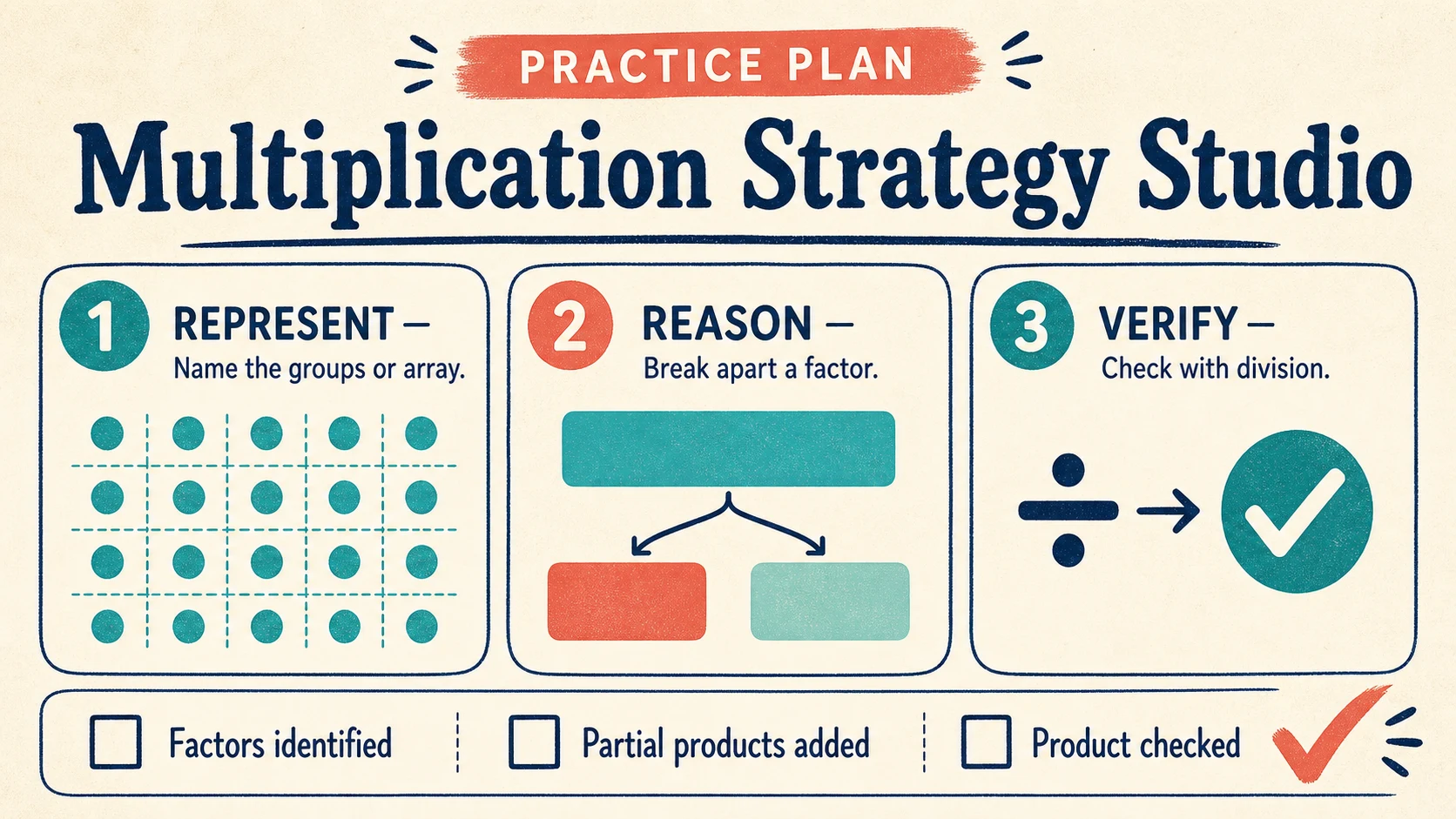
Spacing model-based practice and review makes each sheet’s purpose visible in the sequence.
Decide the next sheet from the smallest useful change
Change one important feature at a time whenever possible. That makes the next response interpretable.
If a learner can solve from an array, the next task might retain the factors but remove the drawn array and ask the learner to sketch one. It should not simultaneously increase the factors, add multistep language, remove all visual support, and require a written explanation.
Use this decision rule:
- Representation error: keep the quantities stable and return to objects or diagrams.
- Concept error: contrast examples and nonexamples.
- Procedure error: model the step where the quantities cease to be equivalent.
- Language error: read or restate while preserving the mathematical decision.
- Fluency need after understanding is evident: use a short mixed set with an accuracy check.
- Secure work across two representations: vary the context or reduce one support.
- Correct only when copying a model: assign a near-transfer item before moving ahead.
A sixth-grade geometry progression, for example, should make support fade visibly: annotated model, partially completed diagram, unannotated problem, then independent application. “Upper grade” should not simply mean more items.
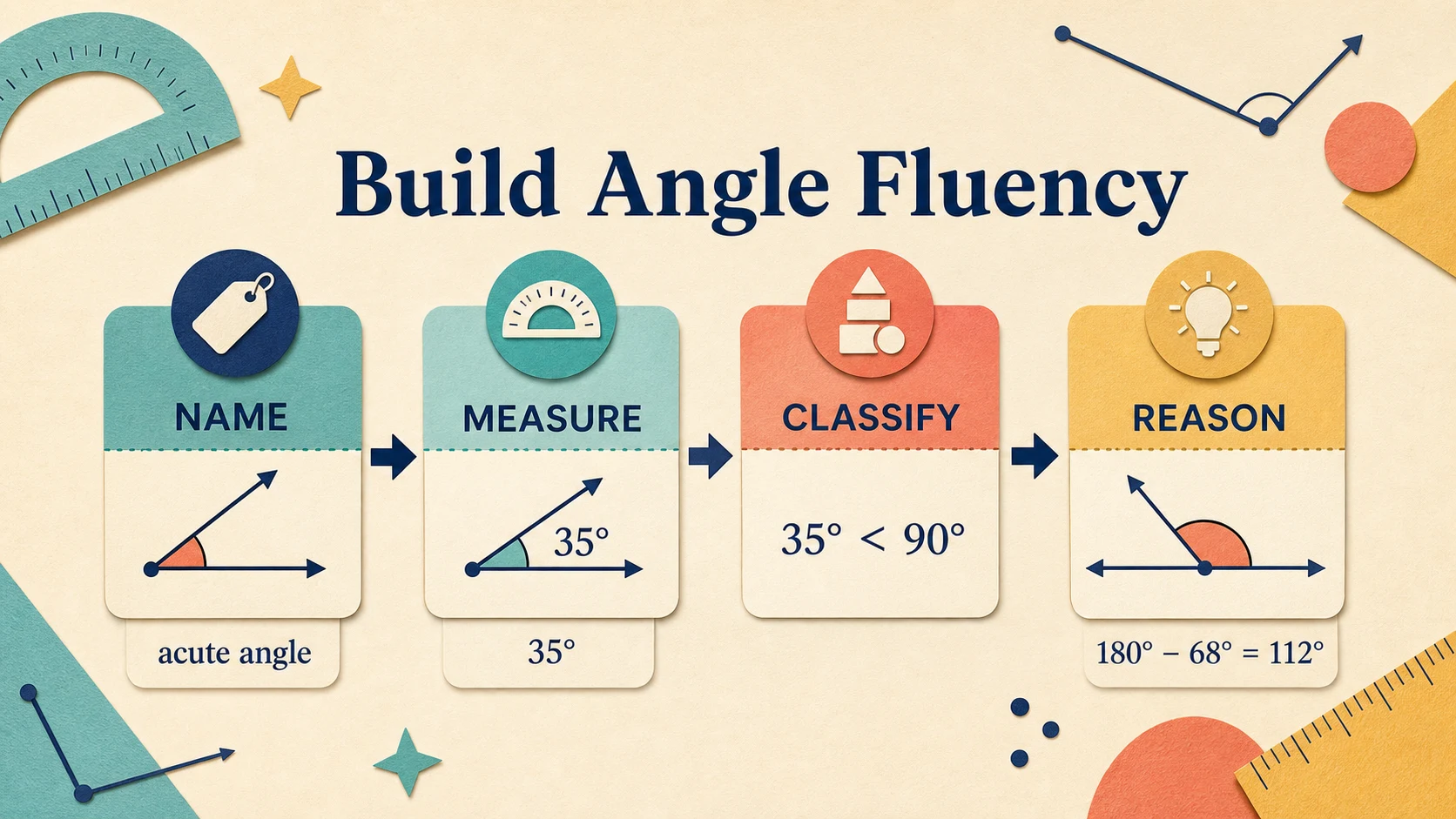
The progression changes the available support while keeping the geometric reasoning recognizable.
For a broader assessment-focused workflow, use Formative assessment Math Worksheets. That context is useful when the main purpose is eliciting evidence rather than supplying routine practice.
Keep worksheets within their proper boundaries
A worksheet records a response under particular conditions. It cannot, by itself, establish mastery, motivation, a learning condition, or the cause of an error. It also cannot replace oral explanation, manipulatives, teacher observation, collaborative reasoning, or purposeful mathematical discussion.
Avoid using sheets:
- to occupy early finishers with unrelated computation;
- as the first encounter with an unfamiliar representation;
- to punish an error with a larger volume of the same task;
- to infer understanding from answer totals alone;
- to accelerate solely because every answer on one repetitive page is correct;
- to hold every learner to the same item count when the target can be demonstrated more efficiently.
The practical boundary is simple: if the teacher cannot state what evidence a page should produce and what decision will follow, the sheet is probably filler.
Prepare tomorrow’s model, check points, and follow-up now
Choose one target for the next lesson and locate a matching page in the full worksheet library. Before printing, circle one item to model, box one for guided practice, and star three responses to check. Write two follow-up choices on the page: one that restores a concrete or visual model, and one that removes a single support.
Then teach, inspect the starred responses, and choose between those two paths. The observable next action is not “complete another worksheet.” It is: select tomorrow’s sheet from the representation, misconception, or successful strategy learners show today.
Put it into practice
Use the guide with a real printable
Move from explanation to a short, observable practice task. Check the first item together, then adjust the next session from the learner's actual work.
Open the first free worksheetExplore a neighboring collection