What 2nd Grade Subtraction Includes
The short answer: A learner working at a typical 2nd Grade Subtraction level should connect subtraction to addition, represent take-away, comparison, and missing-part situations, recall or efficiently derive facts within 20, and subtract within 100 using place-value strategies. Concrete objects, drawings, number lines, equations, and carefully chosen word problems should support that progression.
The goal is not merely to produce answers. The learner should increasingly be able to explain:
- What the two numbers represent.
- Why subtraction fits the situation.
- How the chosen strategy works.
- Whether the answer is reasonable.
- How addition can check the result.
Grade labels describe the intended practice level, not a universal timetable. Local curricula and instructional sequences differ. Some second graders will still need substantial work within 20; others will be ready to reason confidently about two-digit subtraction and regrouping. Let the learner’s observed work determine the pace.
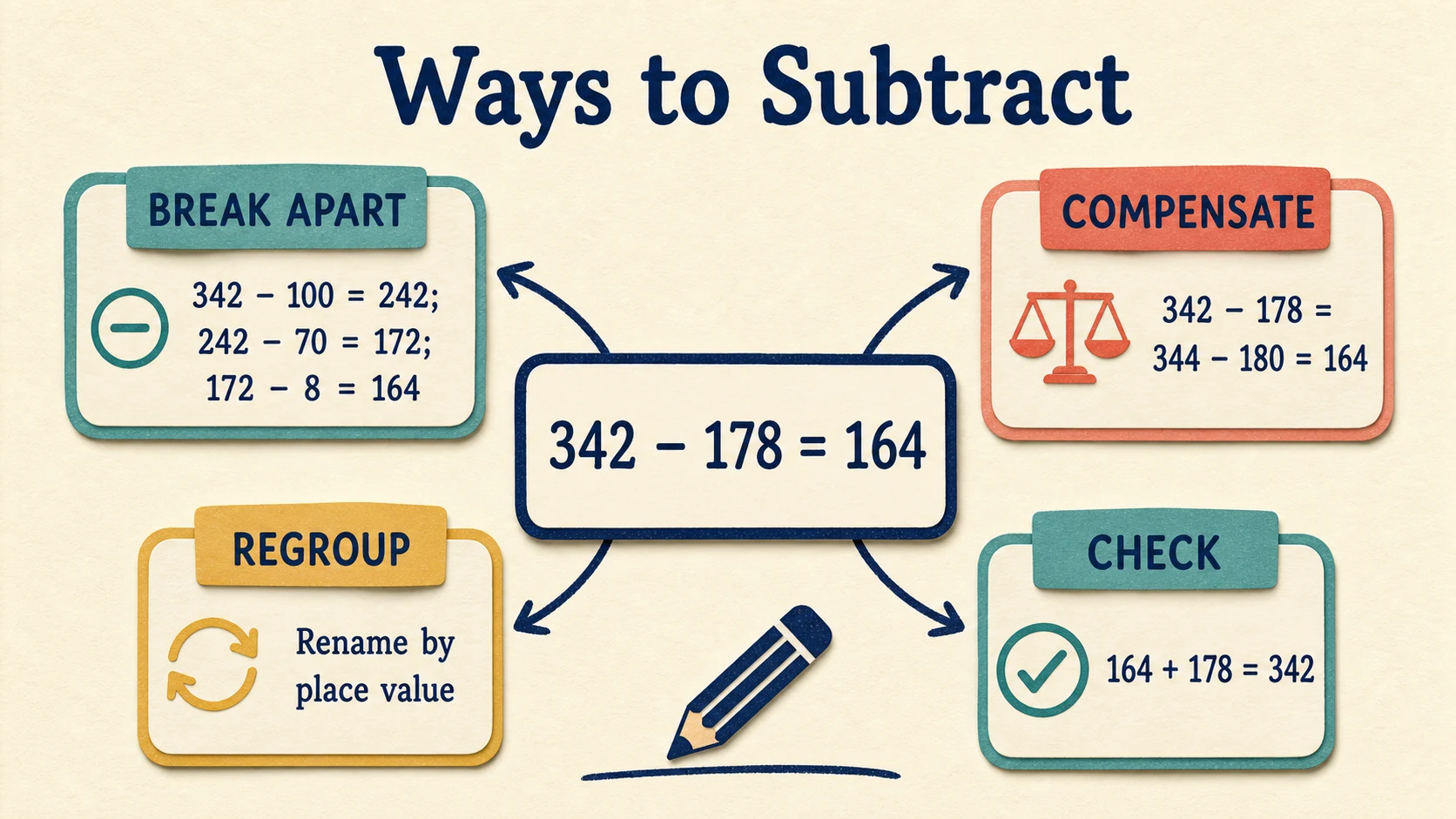
Subtraction develops through connected work with meanings, representations, facts, place value, and explanation.
The 2nd grade math collection provides practice across the broader grade-level subject area. Use the subtraction topic guide and worksheet collection when subtraction is the immediate instructional focus.
Prerequisites to Check Before Moving Ahead
Subtraction becomes much harder when an underlying number concept is insecure. Before assigning a full page, use a few oral questions or object-based tasks to check the following foundations.
Quantity and counting
Ask the learner to count a set of 14 objects, remove 3, and say how many remain. Watch whether the learner:
- Counts each object once.
- Understands that the last number counted names the total.
- Removes exactly the requested amount.
- Recounts accurately or reasons from the original quantity.
A learner who loses track while counting may need work with smaller sets before practicing written subtraction facts.
Part-whole understanding
Show 12 counters, cover some, and leave 7 visible. Tell the learner that there are 12 altogether and ask how many are hidden. This checks whether subtraction can represent a missing part rather than only an action in which objects are taken away.
The connected equations are:
- 7+5=12
- 5+7=12
- 12−7=5
- 12−5=7
If the learner can solve the addition equations but not the subtraction equations, explicitly connect the four facts instead of assigning unrelated subtraction drills.
Place value
For two-digit subtraction, confirm that the learner understands a number such as 43 as 4 tens and 3 ones. Ask for at least two representations:
- 4 tens and 3 ones.
- 3 tens and 13 ones.
Both representations have the same value. The second becomes useful when subtracting a ones amount greater than 3.
Also check whether the learner can identify tens and ones without reversing them. In 52, the 5 represents 50, not 5.
Addition knowledge
Because addition and subtraction are inverse operations, known addition facts can support subtraction. For example, 13−5 can be treated as “5 plus what equals 13?” If the learner knows 5+8=13, then 13−5=8.
The IES guide on teaching mathematics to young children supports high-level instructional practices such as helping children connect mathematical ideas and representations. The guide does not evaluate WorksheetWise or prescribe this exact sequence.
A Grade-Appropriate Progression
Do not treat the following stages as a fixed calendar. Move forward when the learner can solve and explain representative problems with decreasing support. Return to an earlier representation whenever errors show that understanding has become fragile.
| Stage |
Main instructional focus |
Useful representation |
Evidence of readiness to progress |
| 1 |
Take away from quantities within 10 |
Real objects or counters |
Removes the correct amount and states what remains |
| 2 |
Find differences and missing parts within 10 |
Matched objects, ten-frames, drawings |
Recognizes that subtraction is not always “cross some out” |
| 3 |
Develop subtraction facts within 20 |
Ten-frames, number lines, related addition facts |
Derives answers without counting every object |
| 4 |
Subtract multiples of ten |
Base-ten blocks, open number line |
Uses tens as units, such as 70−30=40 |
| 5 |
Subtract two-digit numbers without regrouping |
Tens-and-ones drawings or blocks |
Subtracts tens from tens and ones from ones |
| 6 |
Subtract within 100 with regrouping |
Base-ten blocks followed by drawings and equations |
Trades one ten for 10 ones while preserving value |
| 7 |
Apply subtraction in varied problems |
Diagrams, equations, written explanations |
Selects subtraction from the situation rather than a keyword |
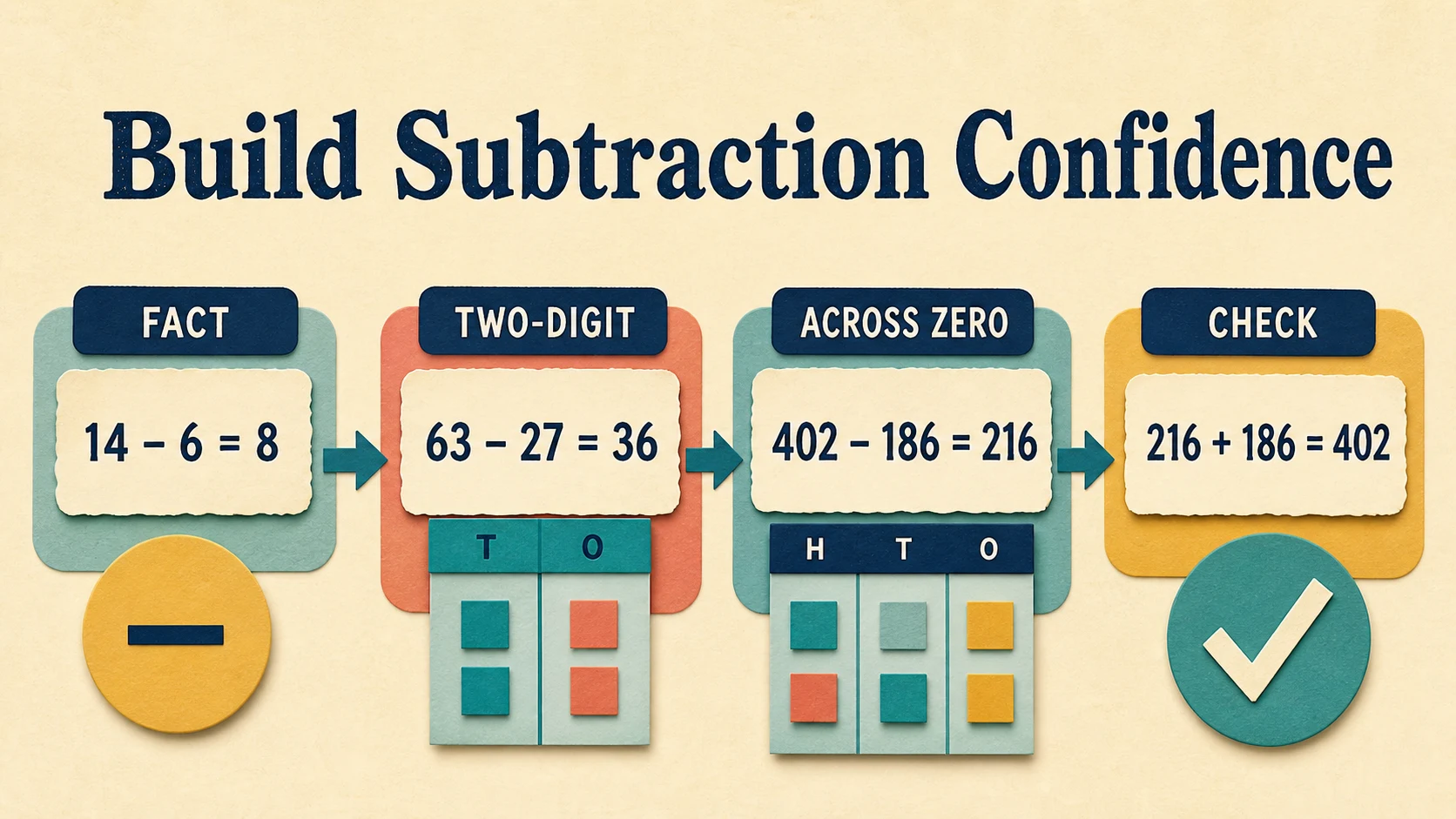
Support should fade as the learner shows accurate reasoning, not simply because a set number of days has passed.
The Common Core mathematics materials place second-grade emphasis on subtraction facts within 20 and place-value-based addition and subtraction within 100. They also describe a longer progression across grades, so this guide should not be read as comprehensive standards alignment. Consult the Common Core State Standards for Mathematics alongside any applicable local requirements.
Teach the Three Meanings of Subtraction
A learner who interprets every subtraction problem as “take away” may calculate correctly in familiar exercises but struggle with comparison or missing-part situations.
Take-away situations
A quantity starts at one amount and decreases.
There are 15 crayons. Four are put away. How many remain?
The equation is 15−4=11. Counters can enact the action directly: build 15, remove 4, and count or reason about what remains.
Comparison situations
Two quantities are compared.
Lena has 15 crayons. Marco has 11 crayons. How many more crayons does Lena have?
The equation is also 15−11=4, but nothing is physically removed. Align 15 counters with 11 counters. The 4 unmatched counters show the difference.
The wording “how many fewer” can be challenging because the requested difference is still a positive amount. If Marco has 11 and Lena has 15, Marco has 4 fewer than Lena.
Missing-part situations
The whole and one part are known; the other part is unknown.
A box holds 15 crayons. Eleven are already inside. How many more are needed to fill it?
The unknown part is 4. Either 15−11=4 or 11+4=15 represents the relationship.
Ask, “What do we know: the whole, a part, or both parts?” This is an instructional prompt, not a rule that appears in every curriculum. It helps direct attention to the quantities before the operation.
Concrete and Visual Models That Clarify the Mathematics
Representations should expose the structure of a problem. They should not become decorations that the learner ignores.
Counters and everyday objects
Counters work well for quantities within 20 and for demonstrating the three meanings of subtraction. Buttons, blocks, or paper squares can serve the same purpose.
For 14−6:
- Build a set of 14.
- Remove 6.
- Count or recognize the 8 that remain.
- Record 14−6=8.
- Check with 8+6=14.
Move beyond objects when the learner can anticipate the result and explain the relationship without recounting the entire set.
Ten-frames
Ten-frames make relationships to 10 visible. For 13−5, represent 13 as a full ten-frame and 3 more counters. One possible strategy is:
- Remove the 3 extra counters, leaving 10.
- Remove 2 more because 5=3+2.
- The result is 8.
Record the decomposition:
13−5=13−3−2=10−2=8
This is often more informative than asking the learner to count backward five isolated steps.
Number lines
A number line can show subtraction in more than one way. For 47−23, the learner may jump backward:
47−20=27,27−3=24
For a comparison such as 52−48, counting up may be more efficient:
48→50 is 2,50→52 is 2
The total distance is 2+2=4, so 52−48=4.
Base-ten blocks and drawings
Base-ten blocks connect written digits to quantities. In 43−25, 43 begins as 4 tens and 3 ones. Because 5 ones cannot be removed from 3 ones without changing the representation, trade 1 ten for 10 ones. The amount remains 43, now shown as 3 tens and 13 ones.
Remove 2 tens and 5 ones:
- 3 tens −2 tens =1 ten.
- 13 ones −5 ones =8 ones.
- The answer is 18.
The trade changes the grouping, not the total value. Physical blocks are particularly helpful before the learner is expected to understand regrouping from digits alone.
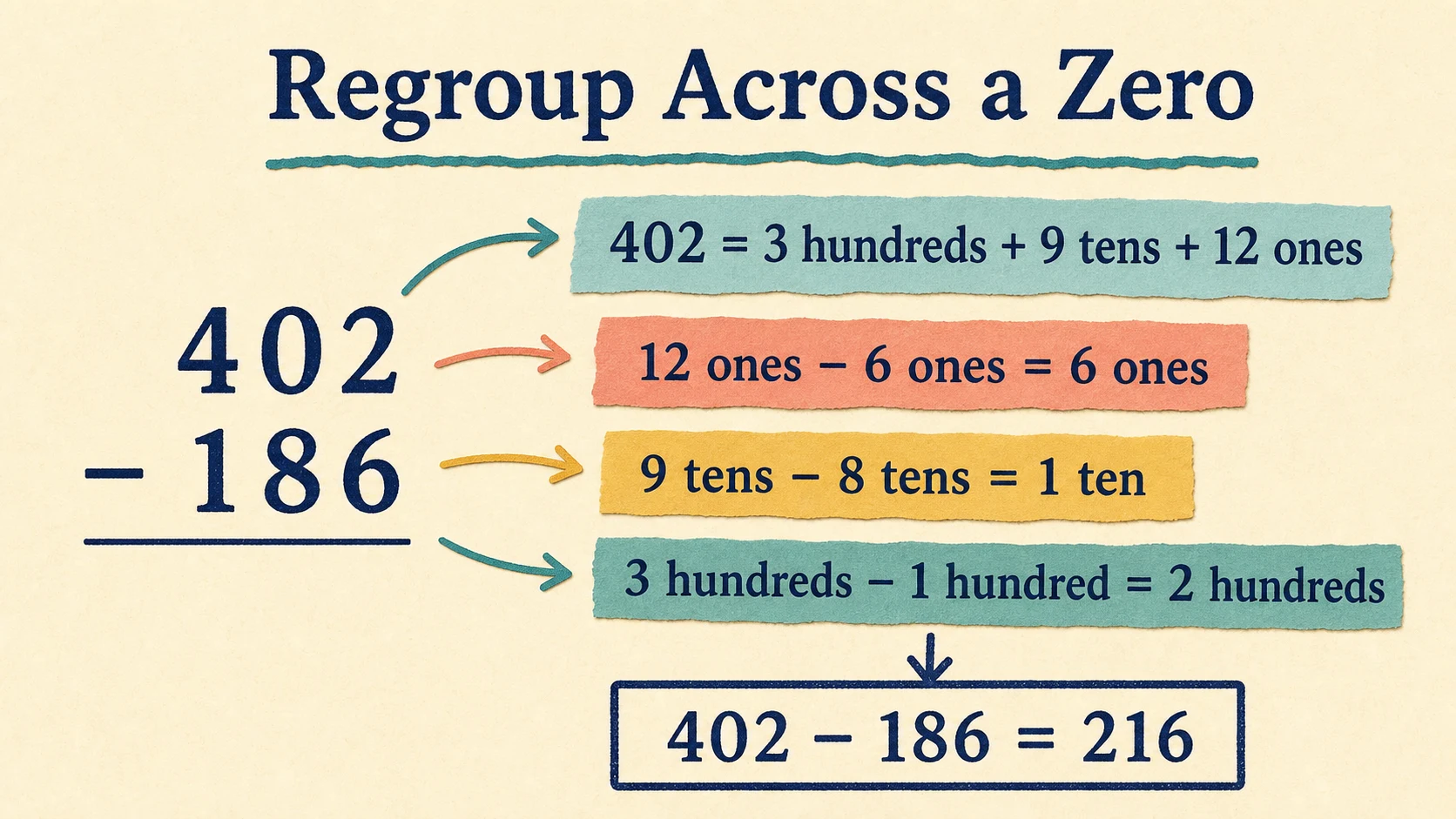
Concrete quantities, visual groupings, and written notation should describe the same calculation.
Fully Checked Worked Examples
These examples illustrate different meanings and strategies. A learner does not need to use the same strategy every time, but the method must preserve the quantities correctly.
Example 1: Use a related addition fact
Solve 16−7.
Think: “7 plus what equals 16?”
7+9=16
Therefore:
16−7=9
Check:
9+7=16
The check returns to the starting whole, so the answer is consistent.
Example 2: Subtract in parts
Solve 34−12.
Break 12 into 10 and 2:
34−10=24
Then subtract 2:
24−2=22
Therefore:
34−12=22
Check:
22+12=22+10+2=32+2=34
The addition check reaches 34.
Example 3: Regroup one ten
Solve 43−25.
Rewrite 43 as 3 tens and 13 ones:
43=30+13
Rewrite 25 as 2 tens and 5 ones:
25=20+5
Subtract corresponding place-value parts:
(30−20)+(13−5)=10+8=18
Therefore:
43−25=18
Check:
18+25=18+20+5=38+5=43
The answer is correct. Notice that subtracting the smaller visible digit from the larger one in each column would incorrectly produce 22. Place value, not digit size, determines the operation.
Example 4: Count up to find a close difference
Solve 61−57.
Count from 57 to 61:
57→60=3
60→61=1
Combine the distances:
3+1=4
Therefore:
61−57=4
Check:
57+4=61
Counting up is efficient here because the numbers are close together.
Example 5: Interpret a comparison problem
Noah has 32 cards. Ava has 19 cards. How many more cards does Noah have?
The problem asks for the difference:
32−19
Count up from 19:
19→20=1
20→30=10
30→32=2
Add the jumps:
1+10+2=13
Noah has 13 more cards.
Check:
19+13=32
Example 6: Find a missing part
There are 50 spaces on a chart. Thirty-six are filled. How many spaces are empty?
50−36
Regroup 50 as 4 tens and 10 ones:
50=40+10
Then:
(40−30)+(10−6)=10+4=14
There are 14 empty spaces.
Check:
36+14=50
Boundary Cases Learners Should Meet
Boundary cases reveal whether the learner understands subtraction as a relationship rather than a collection of memorized steps.
Subtracting zero
27−0=27
Nothing is removed, so the original quantity remains. A learner who answers 0 may be applying an incorrect “zero makes zero” idea borrowed from another operation.
Subtracting a number from itself
27−27=0
The entire quantity is removed. Contrast this directly with 27−0.
A zero in the ones place
Consider 40−6. The written 0 does not mean regrouping is impossible. Represent 40 as 3 tens and 10 ones:
40−6=34
Check:
34+6=40
Very close numbers
For 72−69, counting up is concise:
69→70=1,70→72=2
Therefore, 72−69=3. A lengthy written method is valid but may obscure the simple difference.
Order matters
9−4=5
but 4−9 is not the same calculation. At this instructional level, practice commonly keeps results within nonnegative whole numbers. Do not teach the learner to reverse the numbers merely to avoid a difficult result.
A Short, Repeatable Lesson Routine
A focused lesson can be brief if it contains reasoning, modeling, practice, and review. The following routine is an instructional suggestion rather than a universal timetable.
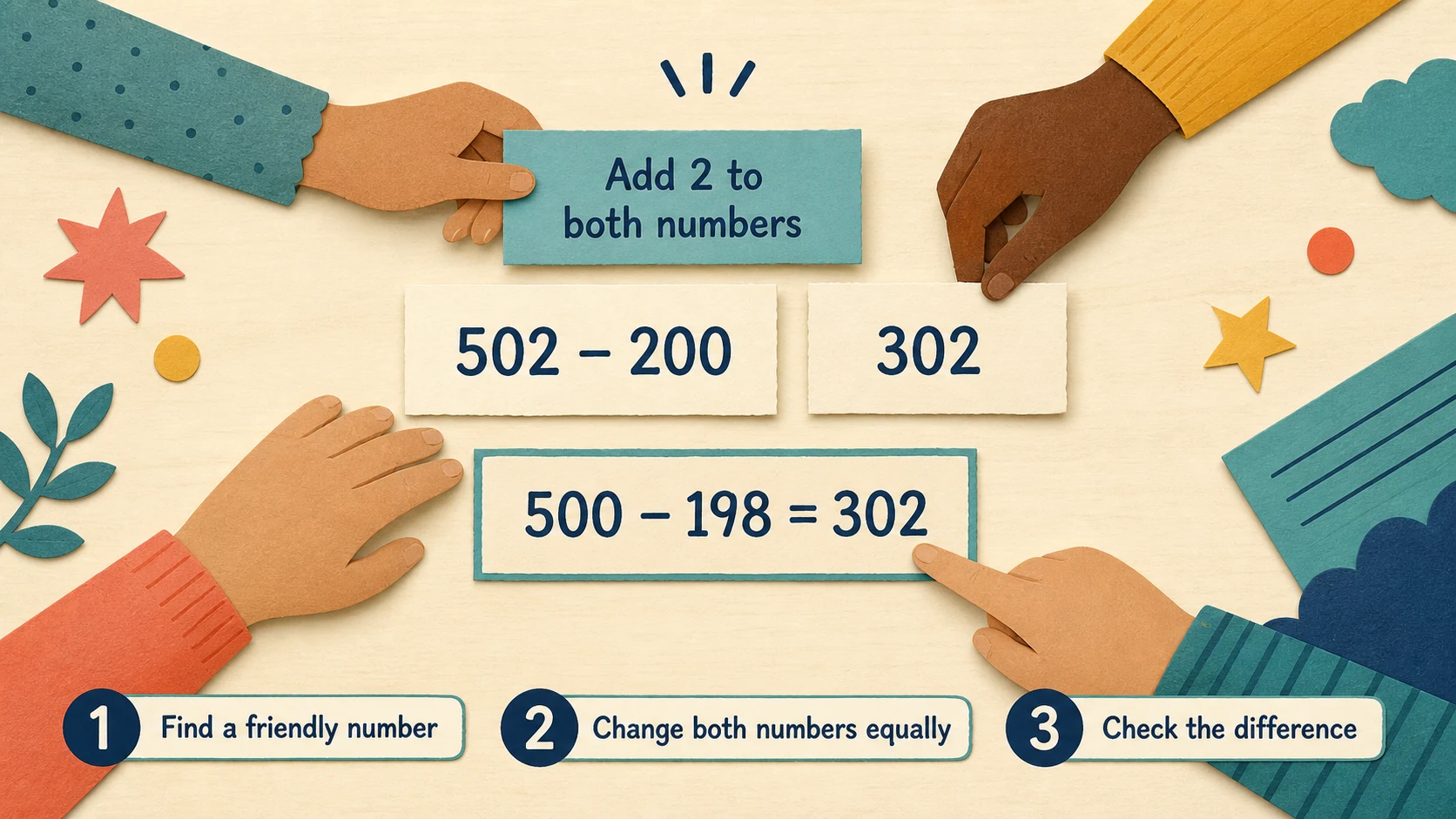
A stable routine leaves more attention available for the changing mathematical idea.
1. Review a prerequisite
Spend two or three minutes on a connected idea: make 10, identify tens and ones, or recall an addition fact family. Choose the review from the learner’s recent errors.
2. Present one purposeful problem
Use a short story or equation. Ask the learner to identify what is known, what is unknown, and whether the situation describes removal, comparison, or a missing part.
3. Model and connect
Represent the problem with objects or a drawing. Then connect the model to an equation. Keep the language precise: “I traded one ten for ten ones; the value did not change.”
4. Solve together
Give one closely related problem. Prompt only as much as needed. If the learner stalls, return to the representation instead of supplying the next procedural step immediately.
5. Try independently
Use two to four problems that match the demonstrated structure. Include enough blank space for drawings or decomposition.
6. Close with explanation and a check
Ask the learner to explain one answer and check it with addition. Record any error pattern that should shape the next lesson.
The IES practice guide for assisting students struggling with mathematics offers broader, evidence-based instructional framing, including systematic instruction and attention to mathematical representations. It does not provide child-specific advice or certify this routine.
How to Select Useful Practice
Choose practice by the learner’s current strategy and error pattern, not by page count alone.
If the learner counts every fact from one, select a small set within 10 or 20 and connect each subtraction fact to a known addition fact. If the learner knows facts but misreads word problems, use fewer calculations and more varied problem situations. If two-digit errors involve place value, return to base-ten blocks or tens-and-ones drawings.
A useful practice set might combine:
- Four recently taught problems.
- Two review problems from an earlier skill.
- One word problem requiring interpretation.
- One problem that asks for a drawing or explanation.
- One addition check.
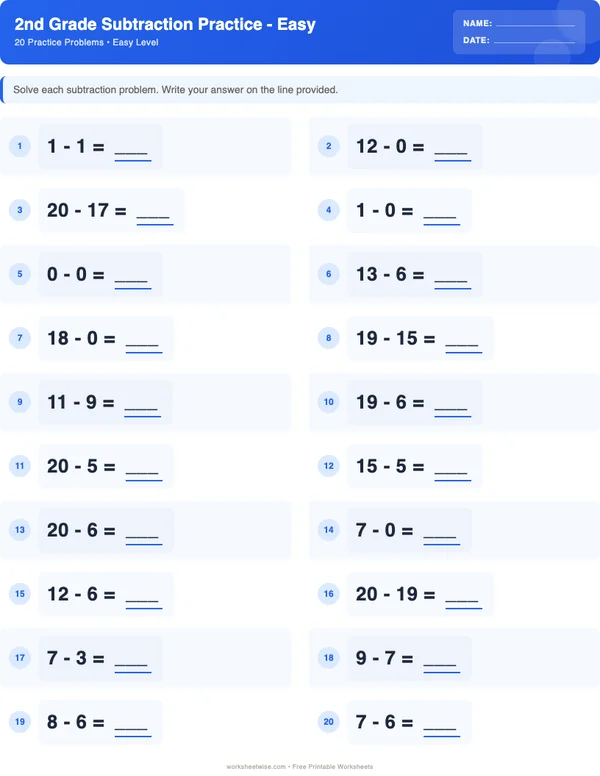
The catalogue’s free easy subtraction worksheet contains 20 exercises and includes a separate answer key. Its listed skills are subtraction facts, mental math, number sense, and regrouping. Preview the problems and assign a suitable subset if a full page would conceal fatigue or encourage guessing.
For broader repeated practice, the 2nd Grade Subtraction Worksheet Pack contains 18 worksheets. More material is not automatically better; select pages that match the specific next step. The free worksheet generators can also help when the learner needs a fresh set rather than repeated answers from memory.
Differentiation Without Changing the Core Idea
Differentiation should adjust access, quantity, representation, or complexity while preserving the mathematical goal.
When the learner needs more support
- Reduce the number range.
- Provide counters, a ten-frame, or base-ten blocks.
- Use one problem type at a time.
- Read word problems aloud without interpreting them for the learner.
- Mark tens and ones columns clearly.
- Ask for an addition fact that completes the whole.
- Assign fewer problems and examine the reasoning closely.
For 42−17, a supported version might provide a drawing of 4 tens and 2 ones and ask the learner to show the regrouping.
When the learner is ready for less support
- Remove a supplied model and ask the learner to choose one.
- Mix take-away, comparison, and missing-part problems.
- Ask for two strategies on a suitable problem.
- Include missing-number equations such as 52−□=18.
- Ask the learner to find and correct a fictional error.
- Require an estimate or reasonableness statement before checking.
Challenge should come from reasoning, not merely from using larger numbers outside the intended practice scope.
Common Errors and Diagnostic Responses
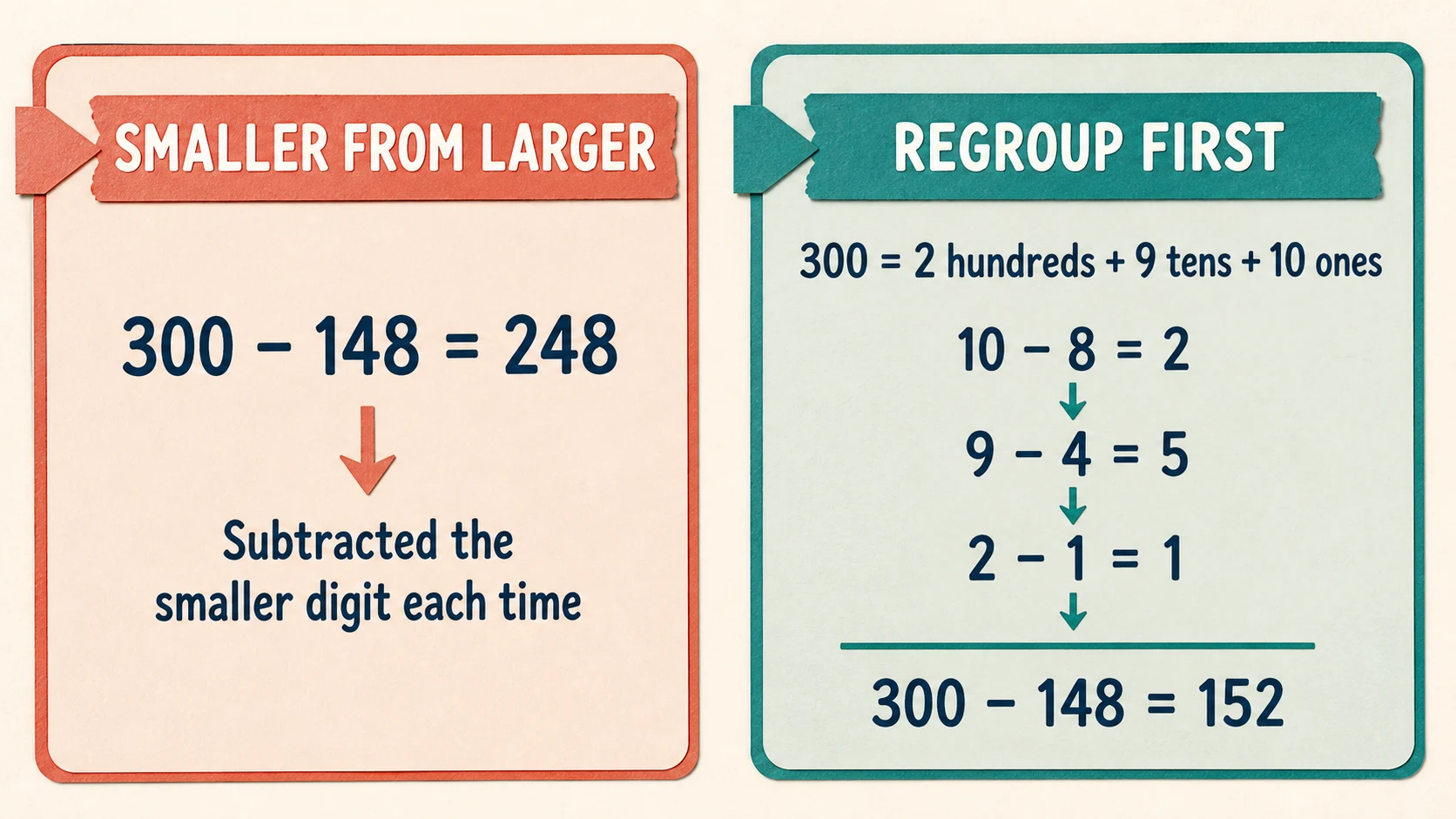
An error is most useful when it points to the representation or prerequisite that needs attention.
| Observed work |
Likely issue to investigate |
Instructional response |
| 43−25=22 |
Learner subtracts the smaller digit from the larger digit in each column |
Build 43 with base-ten blocks, regroup, and match every action to the written notation |
| 27−0=0 |
Roles of zero are confused |
Contrast “remove nothing” with “remove everything”: 27−0 and 27−27 |
| 15−8=6 after counting backward |
A count was skipped or the starting number was counted as the first step |
Use a number line and label each jump; then connect to 8+□=15 |
| Uses addition for every “how many more” problem |
The learner follows words without identifying known and unknown quantities |
Build aligned sets and identify the unmatched difference |
| Cannot solve 40−7 |
Zero ones are treated as no available quantity |
Trade one of 4 tens for 10 ones and confirm that the total remains 40 |
| Correct answer but no stable explanation |
Procedure may be memorized without a connected model |
Ask for a drawing, number-line path, or addition check |
| Regroups when it is unnecessary |
Written steps are being applied mechanically |
Compare 46−23 with 43−26 and ask when the ones require a trade |
| Reverses 3−8 to 8−3 |
Learner assumes subtraction may always be reordered |
Use a take-away story to show that the starting quantity and removed quantity have different roles |
Do not diagnose from one isolated mistake. Give two or three related probes. For example, after an error on 43−25, try 54−21, 42−18, and a block representation of 31−14. The pattern will help distinguish a momentary slip from a place-value misunderstanding.
Monitoring Progress and Deciding What Comes Next
Keep monitoring simple enough to use consistently. Once or twice each week, collect a short sample containing:
- Two subtraction facts within 20.
- Two two-digit computations.
- One word problem.
- One explanation or addition check.
Record more than the score. Note the strategy, independence, accuracy, and type of error. A compact entry might read: “Solved facts through related addition; accurate without-regrouping examples; needed blocks to regroup; interpreted comparison correctly.”
Move ahead when the learner is consistently accurate across more than one session, can explain the strategy, and can use it in a slightly different problem. Continue or step back when answers depend on heavy prompting, place-value errors repeat, or a model cannot be connected to an equation.
Speed can be observed, but it should not replace evidence of understanding. The catalogue identifies fluency as important in second-grade mathematics; it does not establish one required timing threshold. Local expectations may differ.
A Two-Week Practice Plan
This plan assumes ten short sessions. Adjust the number and length of sessions to the learner’s observed attention and work. It is not a universal timetable.
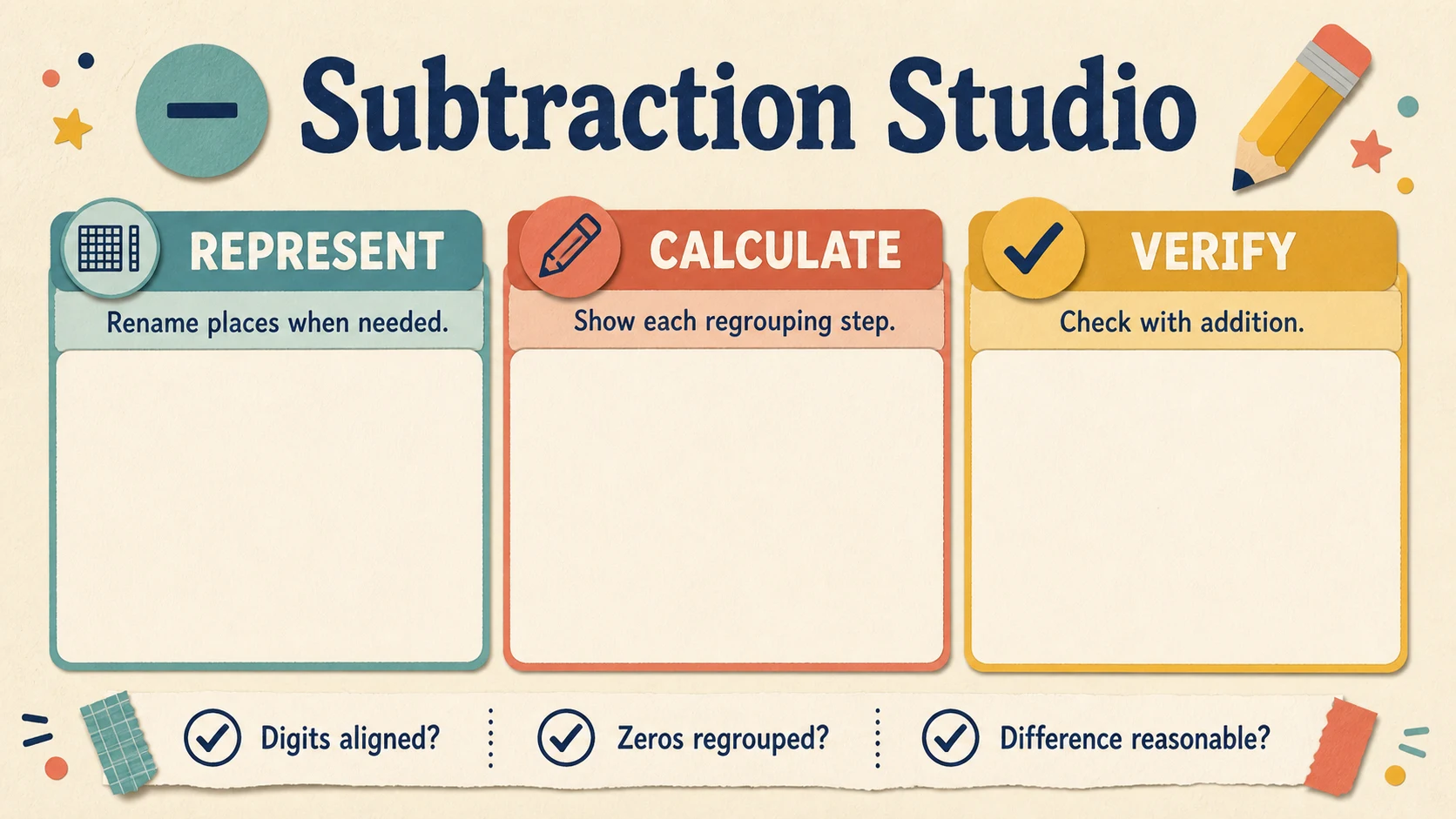
Each session combines a narrow focus with review so earlier learning remains active.
| Day |
Focus |
Suggested activity |
What to observe |
| 1 |
Initial check |
Sample facts, place value, one comparison problem, and one two-digit problem |
Which representation and number range are appropriate? |
| 2 |
Three subtraction meanings |
Model one take-away, one comparison, and one missing-part situation |
Does the learner identify the unknown quantity? |
| 3 |
Facts within 20 |
Use ten-frames and related addition facts |
Is the learner deriving facts or recounting from one? |
| 4 |
Subtract tens |
Solve examples such as 80−30, then connect to 8−3 |
Does the learner treat each ten as a unit? |
| 5 |
Two-digit subtraction without regrouping |
Use blocks, drawings, then equations |
Are tens and ones kept in their correct places? |
| 6 |
Mixed review |
Combine facts, meanings, and no-regrouping examples |
Which earlier error returns after a gap? |
| 7 |
Regrouping concept |
Trade one ten for 10 ones with physical blocks |
Does the learner understand that the value stays unchanged? |
| 8 |
Regrouping in writing |
Connect block actions to tens-and-ones notation |
Can the learner explain every written change? |
| 9 |
Strategy choice |
Mix decomposing, counting up, and related facts |
Does the strategy fit the numbers? |
| 10 |
Independent check and next-step decision |
Use a short mixed set plus one explanation |
Is the learner ready for more independence, or is focused review needed? |
Keep each day’s written load modest enough that you can examine the thinking. If Day 7 reveals that exchanging a ten is not understood, repeat concrete regrouping rather than advancing to a larger independent set. If the learner is already secure, increase variety through missing-number equations and mixed story structures instead of simply extending the number range.
Limitations and the Honest Next Step
A worksheet can provide useful, sequenced practice, but written answers alone may not reveal whether the learner understands subtraction, follows a memorized procedure, or guesses. It also cannot determine a universal pace or replace local curriculum requirements, direct observation, or responsive teaching.
This guide stays within the supplied 2nd Grade catalogue scope: subtraction meanings, facts, mental strategies, number sense, two-digit work, and regrouping. It does not claim comprehensive standards alignment, guaranteed outcomes, certification, or child-specific guidance.
The most useful next action is to give a brief mixed check, identify one recurring need, and choose practice for that need. If the learner is ready for foundational independent work, begin with a selected portion of the free 2nd Grade subtraction worksheet, review the answer key together, and use any error—not the page total—to choose the following lesson.