What 1st Grade Geometry Should Teach
The short answer: 1st Grade Geometry should help a learner reason about shapes, not simply memorize their names. The central work is to identify defining attributes, recognize shapes in different sizes and orientations, build and combine two- and three-dimensional shapes, and divide circles and rectangles into equal halves or fourths.
A learner should be able to explain ideas such as:
- “It is a triangle because it is closed and has three straight sides.”
- “Turning the square does not change its shape.”
- “Two triangles can be joined to make a larger shape.”
- “These are not halves because one part is larger.”
- “Four fourths make one whole.”
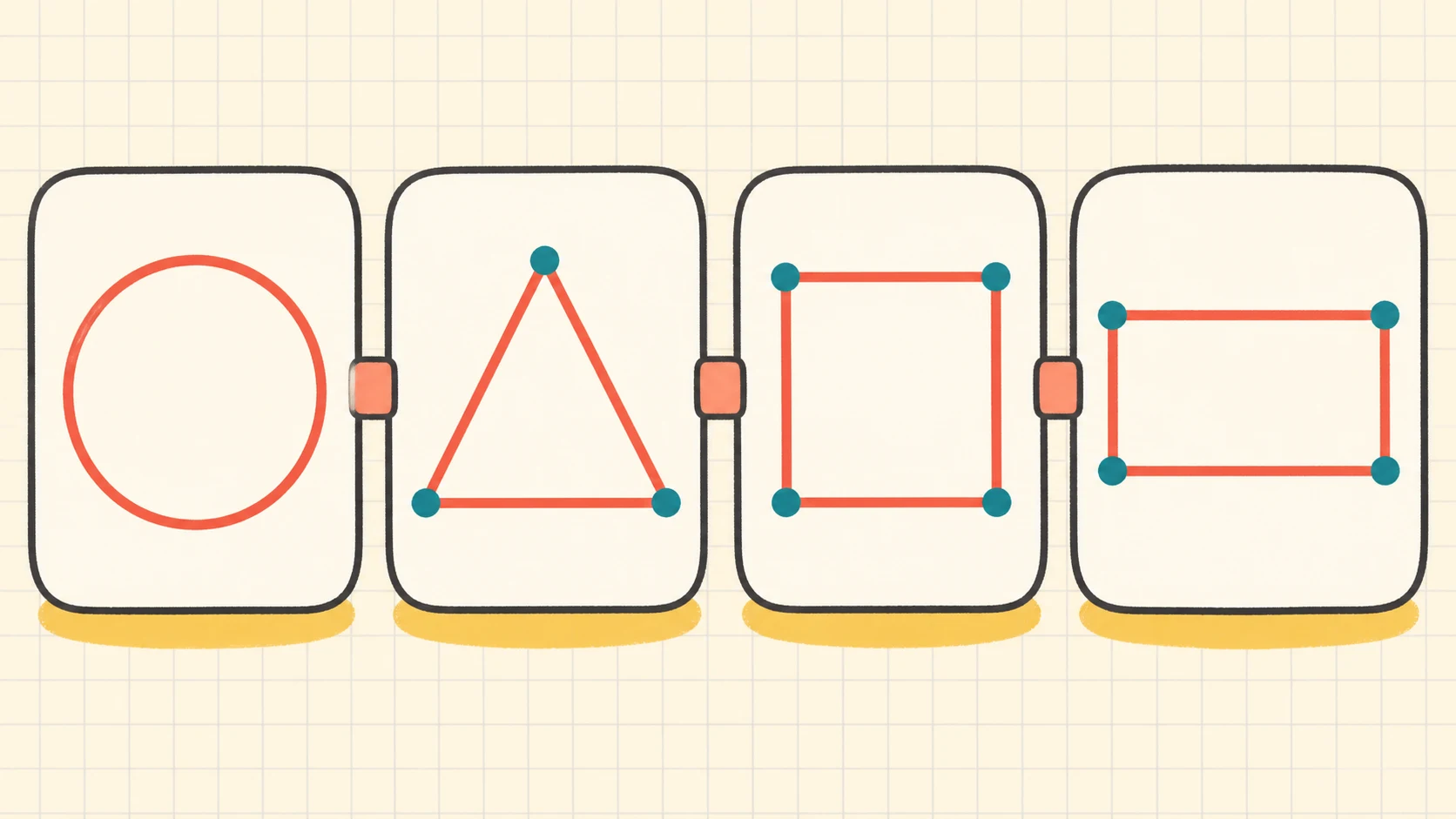
Shape names connect to attributes, composition, equal shares, and clear mathematical language.
The Common Core mathematics overview places reasoning about attributes and composing and decomposing shapes within first-grade mathematics. It also emphasizes understanding and age-appropriate explanation, not answers alone. Local curricula may organize these ideas differently.
Grade labels describe the intended practice level; local sequences differ. Use the learner’s observed work to determine where to begin and how quickly to move. A child who names familiar shapes but cannot explain their attributes needs different practice from one who can build composite shapes independently.
The wider 1st Grade Math collection can help coordinate geometry practice with the learner’s other current math work.
Define the Skill and Its Boundaries
First-grade geometry has four closely connected parts.
Identify shapes by defining attributes
A defining attribute tells what a shape must have. A triangle is a closed two-dimensional shape with three straight sides and three vertices. Its color, size, position, and orientation do not determine whether it is a triangle.
A useful test is: Could this feature change while the shape kept the same name? A blue triangle can become red and remain a triangle, so color is non-defining. A triangle cannot gain a fourth side and remain a triangle, so the number of sides is defining.
First graders can use corner while learning vertex and vertices. When counting, have the learner touch each side or vertex once. Visual guessing is less reliable than checking attributes.
Compose and decompose shapes
To compose means to join smaller shapes to make another shape. To decompose means to see or separate the smaller shapes within a larger one.
Examples include:
- Joining two compatible triangles to make a rectangle or another larger triangle.
- Joining two half-circles to make a circle.
- Using rectangles and triangles to make a picture, then naming the component shapes.
- Joining cubes or rectangular prisms to create a larger solid structure.
The important thinking is not the decorative picture. Ask what shapes were used, how they touch, and whether another arrangement is possible.
Recognize and work with solid shapes
Appropriate solid-shape work includes cubes, rectangular prisms, cones, cylinders, and spheres. Learners can compare visible properties informally: flat faces, curved surfaces, points, and whether an object rolls, stacks, or slides.
Avoid requiring formal vocabulary beyond the learner’s instructional sequence. For example, the Common Core first-grade notes do not require the formal name right rectangular prism. Clear descriptions such as “a box-shaped solid with flat faces” can support the concept while vocabulary develops.
Partition wholes into equal shares
Circles and rectangles can be divided into two equal shares called halves or four equal shares called fourths or quarters. Equal shares must be equal in amount, not merely equal in number.
Two pieces do not automatically make halves. Four pieces do not automatically make fourths. The learner must attend to equality.
What remains preview material
The catalogue worksheet includes shape identification, sides and vertices, geometric properties, perimeter, and area. However, the supplied progression places formal rectangle area and perimeter work in later grades. For a first grader, area and perimeter should therefore be treated as concrete previews, if used at all:
- Area preview: cover a small rectangle completely with equal square tiles and count them.
- Perimeter preview: trace or count equal units around a shape’s boundary.
Do not require formulas or assume mastery. Coordinate geometry, formal angle measurement, transformations, volume calculations, and complex shape classification are also beyond this guide’s instructional focus.
Check the Prerequisites Before Teaching
A brief hands-on check is more useful than asking, “Do you know your shapes?”
Give the learner a mixed collection of shape cards and solid objects. Include several orientations and sizes. Then ask the learner to:
- Name a circle, triangle, rectangle, and hexagon.
- Find two examples of the same shape that look different.
- Sort shapes into groups and explain the rule.
- Count sides and vertices by touching each one.
- Distinguish a flat shape from a solid object.
- Copy or build a simple shape from sticks, clay, blocks, or paper pieces.
- Divide a paper rectangle into two equal parts.
Watch how the learner decides. A correct name based only on a familiar visual prototype is less secure than an answer supported by attributes.
The most useful prerequisite evidence is whether the learner can:
- Follow positional language such as above, below, beside, and next to.
- Match shapes despite changes in size or orientation.
- Count a small set reliably.
- Compare pieces visually and by matching.
- Use or understand words such as side, corner, flat, curved, same, and equal.
- Manipulate simple paper shapes or blocks without losing track of the task.
If several of these are difficult, begin with matching, sorting, tracing, and building. If they are secure, move into explanation, composition, and equal-share problems.
Follow a Grade-Appropriate Progression
The progression below is an instructional sequence, not a universal timetable. Move forward when the learner can explain and apply the current idea across varied examples.
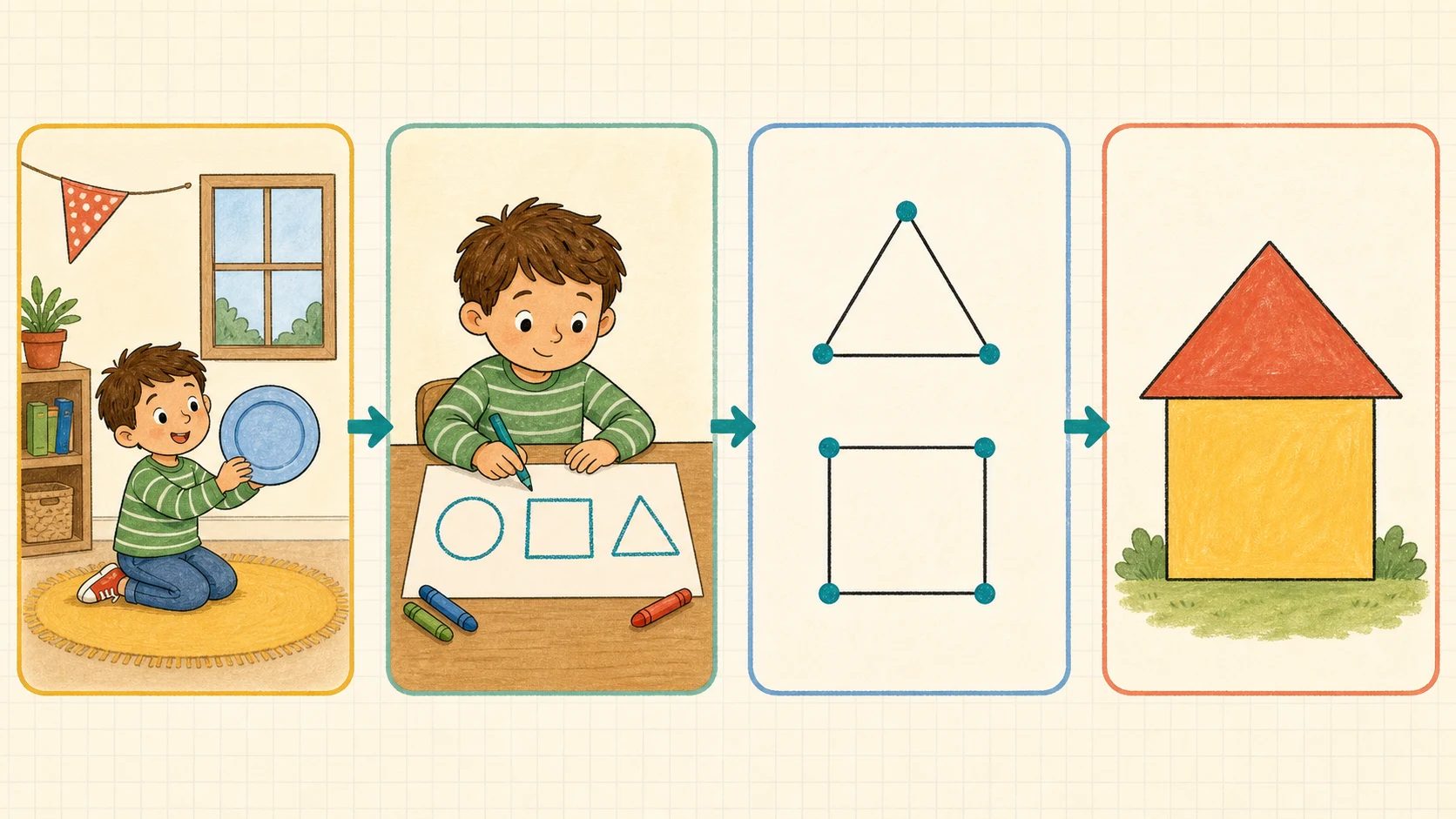
Support should fade only after the learner succeeds with varied examples.
| Stage |
Instructional focus |
Adult support |
Evidence to look for |
| 1. Match and name |
Familiar flat and solid shapes |
Offer a small choice set and model vocabulary |
Matches and names common examples |
| 2. Describe attributes |
Sides, vertices, flat faces, curved surfaces |
Prompt the learner to touch and count |
Describes rather than guesses |
| 3. Vary appearance |
Different sizes, colors, and orientations |
Ask what changed and what stayed the same |
Recognizes rotated and unusual examples |
| 4. Sort and justify |
Group shapes by a stated property |
Provide one example and one non-example |
Explains the sorting rule |
| 5. Build and draw |
Make shapes with sticks, clay, tiles, or drawings |
State a required attribute |
Produces a shape that meets the condition |
| 6. Compose and decompose |
Join shapes and identify parts within a whole |
Model one composition, then vary the pieces |
Names both components and composite |
| 7. Make equal shares |
Halves and fourths of circles and rectangles |
Use folding or matching before drawings |
Checks equality, not just piece count |
| 8. Apply independently |
Mixed identification, explanation, and construction |
Read directions only when needed |
Chooses a method and explains it |
The IES guide on teaching mathematics to young children recommends using a developmental progression, monitoring what children know, and helping them describe their world mathematically. That guide addresses preschool through kindergarten, so it offers high-level framing rather than a first-grade scope or a judgment of WorksheetWise materials.
Use Concrete and Visual Models Purposefully
Hands-on materials should make an idea visible. They should not become an unrelated craft activity.
Models for attributes
Use craft sticks for straight sides and small clay balls for vertices. Ask the learner to build a closed three-sided shape, then change its width or turn it. The shape remains a triangle because its defining attributes remain.
Shape cards should include:
- Wide, narrow, tall, and rotated triangles.
- Rectangles in several proportions and orientations.
- Large and small examples.
- Different colors and border styles.
- Non-examples such as an open three-sided figure or a shape with one curved side.
Models for composition
Pattern blocks, tangrams, cut paper shapes, and solid blocks allow the learner to test arrangements. Begin with a silhouette or outline. Later, remove the outline and give only a condition: “Use two triangles to make a new shape.”
Have the learner trace the finished composite and draw lines showing its parts. This connects manipulation to a semi-concrete drawing.
Models for equal shares
Paper folding is especially useful. Fold a rectangle so its edges match, open it, and trace the fold. For fourths, fold the whole into two equal parts and then divide each half equally again.
Place one piece over another when equality is uncertain. “They look close” is weaker evidence than matching pieces or using a regular grid.
Models for area and perimeter previews
Use equal square tiles for area preview and a string or equal-length sticks for perimeter preview. Keep the two actions visibly different: cover the inside versus go around the outside. Stop short of formulas.
The IES elementary mathematics intervention guide recommends systematic instruction, clear mathematical language, and carefully chosen concrete and semi-concrete representations for learners who struggle. Those recommendations support the general teaching approach here; they do not evaluate this topic page or its worksheet.
Work Through Fully Checked Examples
Example 1: Identify a shape from its attributes
Problem: A closed flat shape has three straight sides and three vertices. It is tilted so that one vertex points downward. What shape is it?
Work:
- Check whether the shape is closed: yes.
- Count the straight sides: 1, 2, 3.
- Count the vertices: 1, 2, 3.
- Ignore its orientation because orientation is not a defining attribute.
Answer: The shape is a triangle.
Check: A triangle must be closed and have three straight sides. Both conditions are met. Turning it does not change those attributes.
Boundary case: An open figure made from three segments is not a triangle because its sides do not form a closed shape.
Example 2: Decide whether a description defines a rectangle
Problem: Mia says, “This shape is a rectangle because it is large and blue.” Is her reason sufficient?
Work:
- “Large” can change without changing the shape’s name.
- “Blue” can also change without changing the shape’s name.
- Neither fact describes the shape’s required geometric structure.
- Mia should examine its sides and corners instead.
Answer: No. Size and color are non-defining attributes.
Checked explanation: A better first-grade response is, “I checked the shape’s four straight sides and four square corners.” The purpose is to replace appearance-based guessing with attribute-based reasoning.
Example 3: Compose a larger shape
Problem: Two matching right triangles are joined along their slanted sides. Their outside edges form a four-sided shape with four square corners. What composite shape was made?
Work:
- Begin with two triangles.
- Join the matching slanted sides completely, leaving that shared side inside the new figure.
- Trace only the outside boundary.
- The boundary has four straight sides and four square corners.
Answer: The two triangles compose a rectangle.
Check: Separate the pieces along the shared line. The rectangle decomposes back into exactly two triangles.
Boundary case: If the triangles touch at only one vertex, they do not form the same closed composite rectangle. How pieces meet matters.
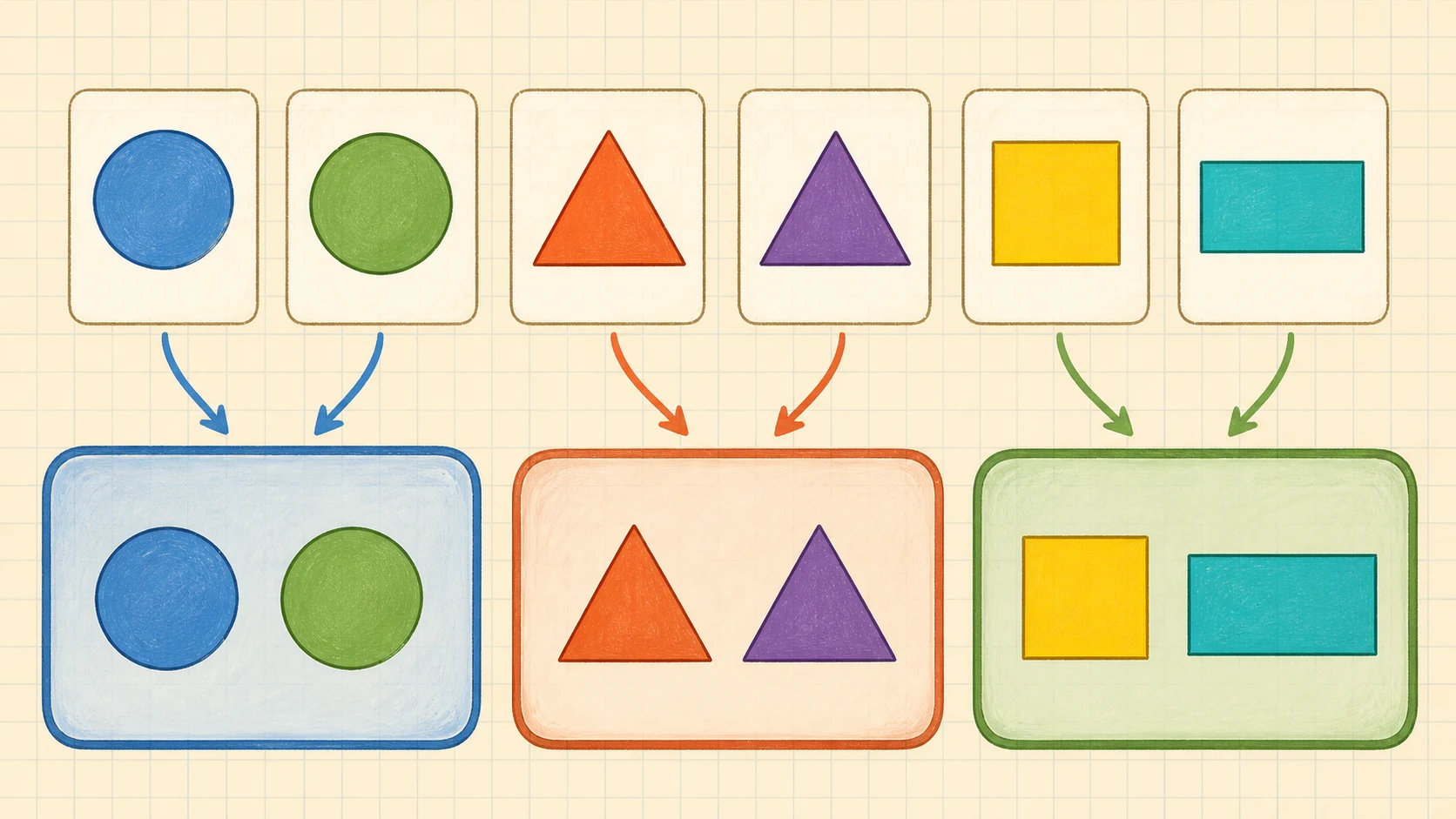
Building first makes the later drawing and explanation easier to verify.
Example 4: Distinguish equal and unequal shares
Problem: A rectangle is divided into two pieces. The left piece covers three columns of an equal-square grid, and the right piece covers one column. Are the pieces halves?
Work:
- There are two pieces.
- Count equal grid columns: one piece has 3; the other has 1.
- The pieces are not equal in area.
- Two pieces qualify as halves only when they are equal shares of the whole.
Answer: No. They are two unequal parts, not halves.
Check: If the four-column rectangle were divided after the second column, each part would contain two columns. Then each part would be one half.
Example 5: Compare halves and fourths
Problem: One same-size paper circle is divided into 2 equal shares. Another is divided into 4 equal shares. Which individual shares are smaller?
Work:
- In the first circle, each share is one of 2 equal parts: one half.
- In the second, each share is one of 4 equal parts: one fourth.
- Both circles represent the same-size whole.
- Dividing that whole into more equal shares makes each share smaller.
Answer: Each fourth is smaller than each half.
Check: Two fourths cover the same amount as one half, and four fourths rebuild the whole.
Example 6: Preview inside versus boundary
Problem: A small rectangle is covered by 6 equal square tiles arranged in 2 rows of 3. What does the count of 6 describe?
Work:
- The tiles cover the inside with no gaps or overlaps.
- Count the tiles: 3 in each row, so 3+3=6.
- The count describes the covered interior, not the distance around the edge.
Answer: The rectangle covers 6 square tiles.
Check: Tracing the outside boundary is a different action and would answer a perimeter-preview question. This example does not introduce an area formula.
Teach with a Short, Repeatable Routine
A compact routine can take about 10–15 minutes, but the learner’s attention and work should determine the actual length.
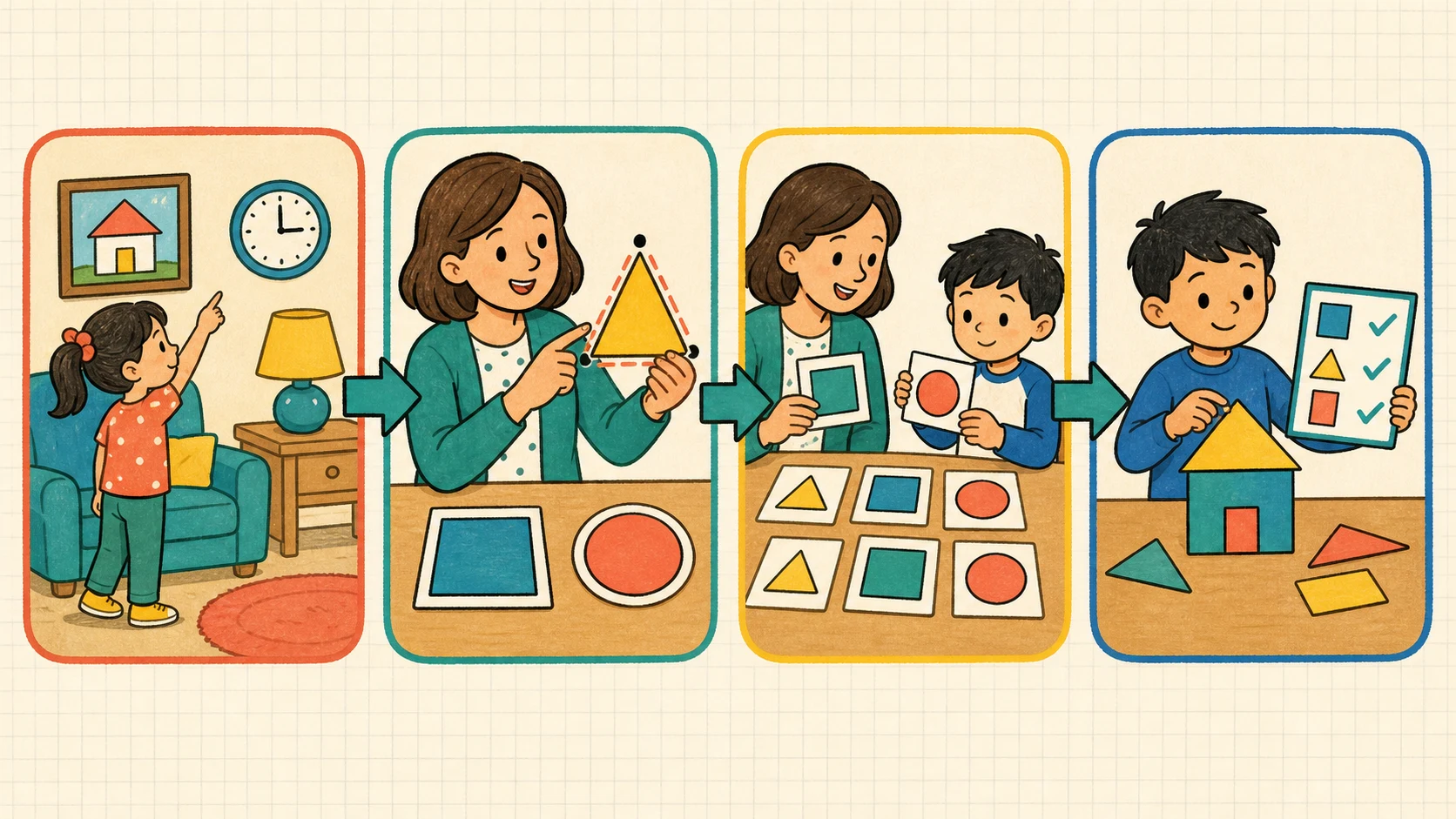
Each lesson moves from noticing to modeling, explaining, and a brief independent check.
Notice and retrieve
Show two or three shapes. Ask for one previously learned fact: “Which shape has three sides?” or “What stayed the same when I turned this rectangle?” Keep this portion brief.
Model one idea
Demonstrate the day’s target with an object or drawing. Think aloud using precise language: “I am checking the sides rather than the color.”
Solve together
Complete one example jointly. Ask the learner to touch, move, fold, trace, or count. Use prompts that reveal reasoning:
- “How do you know?”
- “Which feature matters?”
- “Can you prove the shares are equal?”
- “What shapes do you see inside the larger shape?”
Try independently
Give two or three carefully selected problems, including one that looks different from the model. Avoid a long page before the learner demonstrates the idea.
Close with an explanation
Ask the learner to explain one answer or correct one deliberately incorrect example. Record the response in a few words. That explanation is useful monitoring evidence.
Select Practice from the Learner’s Evidence
Choose practice by the error pattern, not by page count.
For a learner who relies on visual prototypes, select rotated shapes, different sizes, and non-examples. For one who miscounts sides, use uncluttered figures and require touch-and-count. For one who names shapes accurately but cannot explain, select sorting and “how do you know?” tasks. For one who understands attributes, move to building, composition, and equal shares.
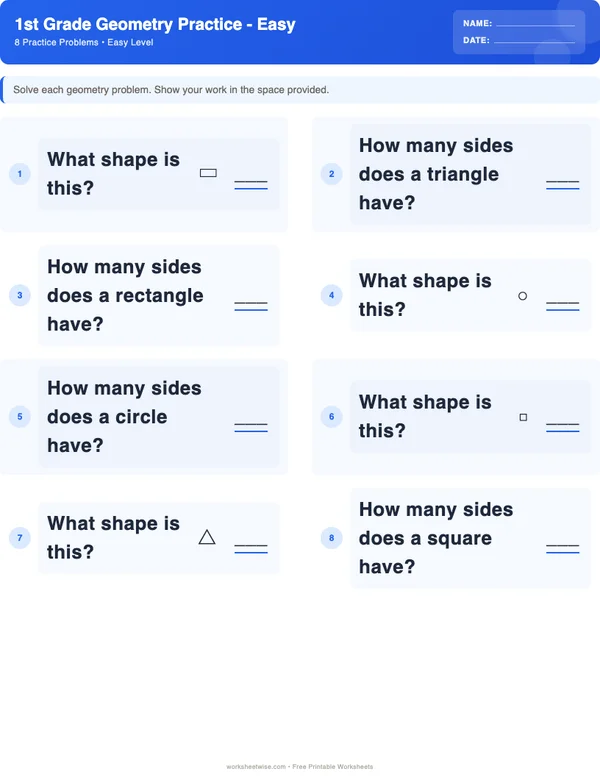
The 1st Grade Geometry topic page is the focused starting point. The free worksheet contains 20 easy-level exercises and a separate answer key. It can be used for classroom practice, homework, or homeschool review, but it should follow or accompany instruction rather than replace manipulation and discussion.
Differentiate support without changing the core idea
When more support is needed:
- Present three choices instead of a crowded page.
- Outline or color one side at a time while counting.
- Pair corner with vertex.
- Use matching pieces to verify equal shares.
- Keep the model visible during the first independent problem.
- Alternate one adult-led item with one learner-led item.
When the learner is ready for more challenge:
- Ask for two different shapes meeting the same condition.
- Include rotated and unfamiliar examples.
- Ask the learner to create a non-example and explain why it fails.
- Find more than one way to compose the same outline.
- Draw two different equal partitions of a rectangle.
- Compare two solutions and decide whether both are valid.
Do not accelerate merely because answers are quick. Check whether the learner can explain, construct, and transfer the idea to a new-looking case.
Diagnose Common Errors
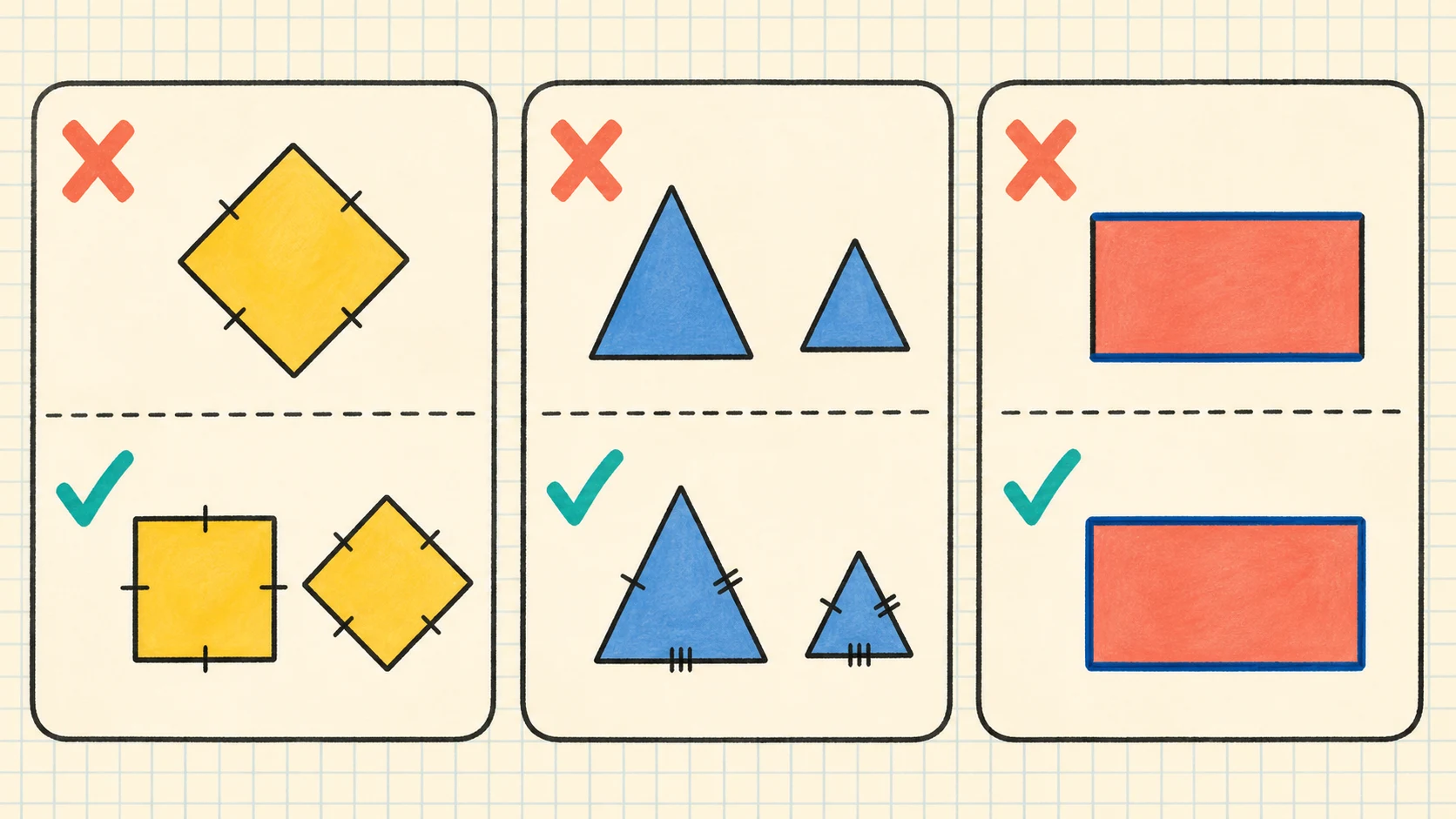
An error is evidence about the next teaching move, not just a mark to correct.
| Observed error |
Likely issue to investigate |
Teaching response |
| Calls a tilted square a “diamond” but recognizes an upright square |
Orientation is being treated as defining |
Rotate one square slowly and track its unchanged sides and corners |
| Rejects a narrow or upside-down triangle |
The learner knows only a familiar prototype |
Sort varied triangles alongside open or curved non-examples |
| Counts a side twice |
No consistent counting path |
Mark a starting side and move clockwise, touching each side once |
| Counts only sharp-looking corners |
Vertex identification is based on appearance |
Trace the full boundary and pause wherever two sides meet |
| Calls any two pieces “halves” |
Piece count is replacing equality |
Overlay, fold, or use a grid to compare the shares |
| Makes four pieces and calls them fourths although sizes differ |
Vocabulary is memorized without the equality condition |
Rebuild the whole, compare pieces, and revise the partition |
| Names a composite picture but cannot identify its parts |
Attention is on the object represented |
Cover parts one at a time and trace internal boundaries |
| Confuses a circle with a sphere |
Flat and solid categories are not secure |
Compare a paper circle with a ball: trace one and roll the other |
| Counts inside tiles when asked about the boundary |
Area and perimeter actions are mixed |
Use separate verbs: cover the inside; trace around the outside |
Do not infer a broad learning difficulty from one mistake. Change the orientation, wording, or model and try another item. A repeated pattern across several examples is more useful than a single response.
Monitor Understanding and Decide When to Move On
Use a small record with four columns: date, task, observed strategy, and next step. Record what the learner did, not a vague judgment such as “understands shapes.”
Useful notes include:
- “Named 5 of 5 familiar shapes; missed 2 rotated triangles.”
- “Counted sides accurately after marking the starting point.”
- “Made four parts but did not check equality.”
- “Explained that color does not determine shape.”
- “Composed the outline in two different ways without help.”
A practical readiness check uses three forms of evidence:
- Recognition: identifies or selects the shape.
- Production: draws, builds, composes, or partitions it.
- Explanation: states the relevant attribute or relationship.
Move forward when the learner succeeds across more than one example and orientation without a leading prompt. Review when success depends on copying the model, when explanations contradict answers, or when the same misconception returns after a short delay.
Use This Two-Week Practice Plan
This plan assumes ten short sessions, but it is not a universal timetable. Repeat, shorten, or reorder sessions according to observed work.
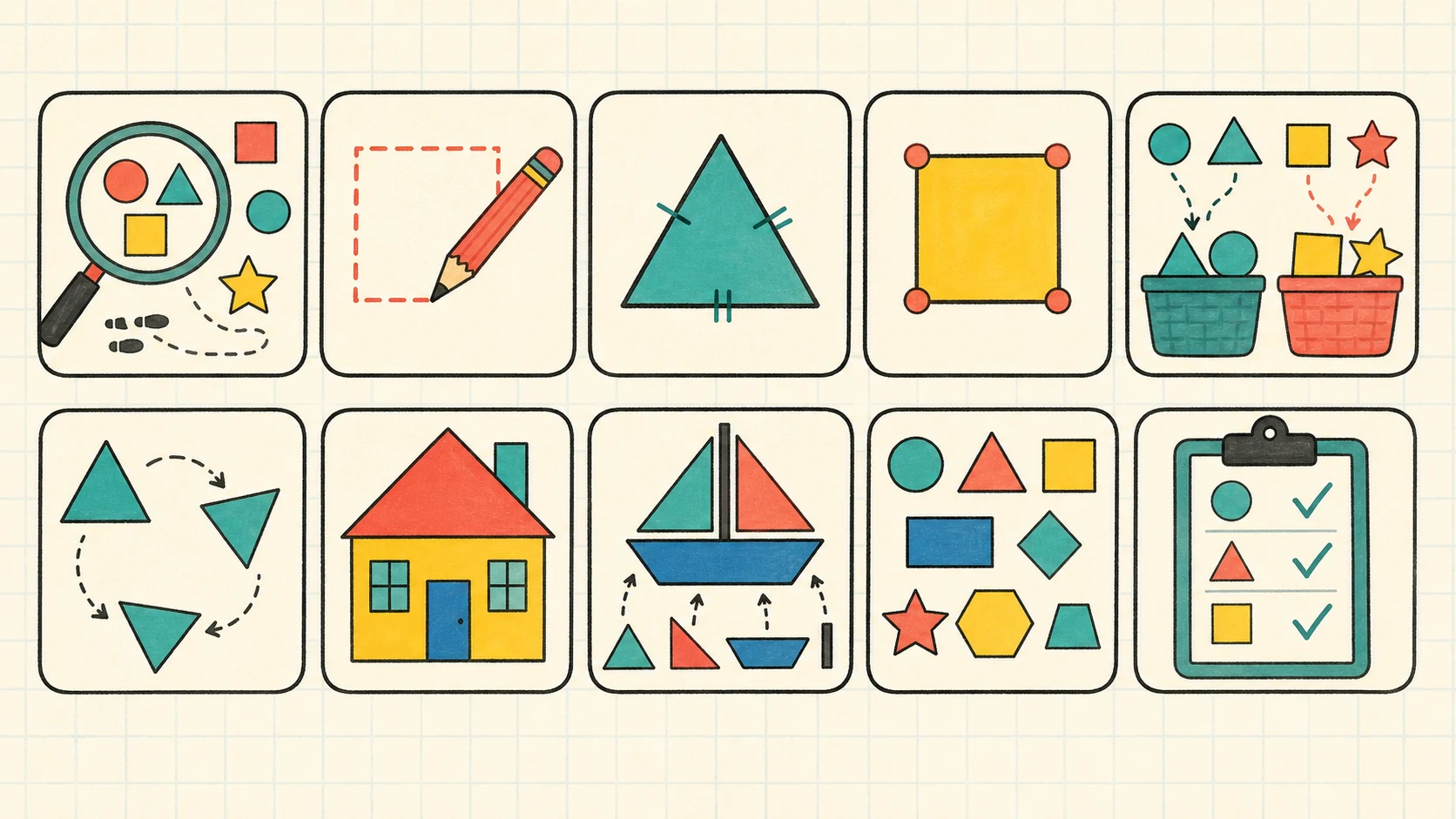
The sequence alternates new learning with retrieval, application, and review.
| Day |
Focus |
Suggested activity |
Quick evidence |
| 1 |
Baseline and vocabulary |
Sort flat shapes and solid objects; name sides, vertices, faces, and curved surfaces informally |
Record which distinctions are secure |
| 2 |
Defining attributes |
Build closed shapes with sticks and clay; create one deliberate non-example |
Learner explains why each example qualifies |
| 3 |
Orientation and size |
Rotate and resize shape cards while keeping attributes constant |
Recognizes shapes without relying on position |
| 4 |
Sorting and justification |
Sort mixed shapes by a stated rule, then invent a new rule |
States a consistent property |
| 5 |
Retrieval and worksheet practice |
Complete a short selection from the free easy geometry worksheet |
Note strategy and recurring errors |
| 6 |
Compose flat shapes |
Use paper pieces or pattern blocks to make larger shapes |
Names components and composite |
| 7 |
Decompose flat and solid forms |
Trace internal lines in composites; separate block structures into parts |
Identifies more than one component |
| 8 |
Halves |
Fold and draw equal halves of circles and rectangles; compare with unequal examples |
Uses equality as the deciding condition |
| 9 |
Fourths and quarters |
Make four equal shares and compare one fourth with one half of the same-size whole |
Explains that more equal shares are smaller |
| 10 |
Mixed independent check |
Include attributes, orientation, composition, and equal shares |
Choose the next target from observed evidence |
If Day 5 reveals that the learner is guessing from appearance, return to varied examples before composition. If equal shares are secure quickly, ask for another valid partition rather than moving to formulas. If manipulation is successful but drawings are not, add a bridge step: build, trace, remove the pieces, and explain the drawing.
Limitations and the Next Useful Step
No single worksheet can demonstrate the full range of geometric reasoning. Printed figures cannot replace folding, rotating, building, and comparing physical shapes. An answer key can verify a selected response, but it cannot show whether the learner counted systematically, noticed a defining attribute, or guessed.
The catalogue’s easy worksheet also includes perimeter and area items. Use those only as concrete previews when appropriate. Formal mastery of area and perimeter belongs later in the supplied progression. This guide does not claim comprehensive alignment with every state or local curriculum, guaranteed outcomes, or a schedule that fits every learner.
A useful next action is to choose four to six problems from the free 1st Grade Geometry worksheet, place paper shapes or blocks beside it, and record whether the learner recognizes, produces, and explains each idea. If that sample is consistently secure, continue with the focused 1st Grade Geometry pack; if not, reteach the specific error with concrete models before assigning more problems.