What 1st Grade Telling Time Means
In 1st Grade Telling Time, the central goal is to read and write times to the hour and half-hour on analog and digital clocks. A learner should connect the position of each clock hand with a written time such as 4:00 or 7:30, explain what the hands show, and distinguish the hour hand from the minute hand.
Teach the skill in this order:
- Explore what a clock measures and identify its parts.
- Read whole hours with the minute hand at 12.
- Read half-hours with the minute hand at 6.
- Match analog clocks, digital times, words, and familiar routines.
- Draw clock hands for stated hours and half-hours.
- Mix the two types and monitor whether the learner reasons or guesses.
The Common Core mathematics standards identify telling and writing time in hours and half-hours with analog and digital clocks as a Grade 1 measurement skill. That is a useful reference point, not a claim of comprehensive standards alignment. Grade labels describe the intended practice level, and local school, state, and homeschool sequences differ.
The learner’s observed work should determine the pace. If whole-hour answers are still uncertain, more half-hour pages will add confusion rather than useful challenge.
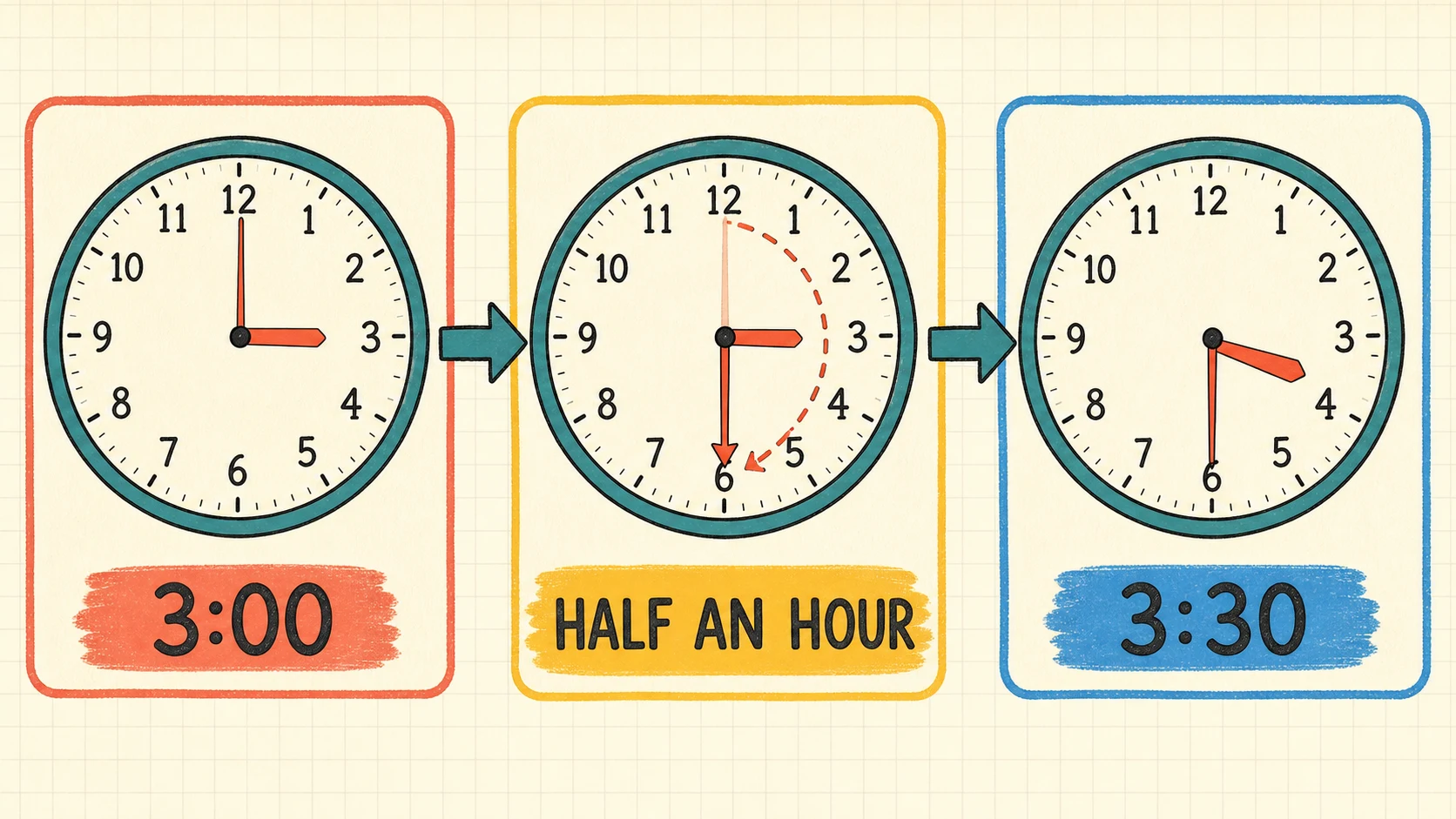
The core pathway connects clock parts, hand positions, spoken language, and written time.
The Ideas Behind Reading a Clock
An analog clock combines two related measurements. The short hour hand tracks the hour. The long minute hand tracks movement through the hour. At this level, learners usually work with two minute-hand landmarks:
- At 12, zero minutes of the new hour have passed: o’clock or :00.
- At 6, thirty minutes have passed: half past or :30.
The hour hand does not jump instantly from one number to the next. It travels gradually. At 3:00 it points to 3. At 3:30 it sits halfway between 3 and 4. This movement explains an important rule: at 3:30, the hour is still 3 because the hour hand has not reached 4.
A digital clock records the same information differently. In 3:30, the number before the colon names the hour and 30 means thirty minutes after that hour. The colon is a separator; it is not a decimal point or an instruction to calculate.
Time also has a repeating structure. After 12:00 comes 1:00, not 13:00 on the common 12-hour classroom clock. Yet the same displayed time can occur during the day and at night. A clock showing 7:00 does not, by itself, establish whether it is morning or evening. That is a boundary of what the clock face communicates.
Prerequisites and a Grade-Appropriate Progression
Before formal clock reading, check whether the learner can:
- Recognize numerals 1 through 12.
- Put those numerals in order.
- Distinguish longer and shorter objects.
- Use positional words such as above, below, between, and around.
- Understand before, after, first, and next in daily routines.
- Recognize a whole divided into two equal parts.
Skip-counting by fives can help later when reading five-minute intervals, but it is not necessary for reading only hours and half-hours. Do not make that later skill an unnecessary gate.
The IES guide on teaching mathematics to young children recommends using developmental progressions and monitoring what children know. Although that guide is directed primarily toward preschool and kindergarten, its high-level framing supports checking foundations and advancing from simpler representations to more complex ones.
| Stage |
Teaching focus |
Prompt |
Evidence to look for |
| 1 |
Clock purpose and parts |
“Which hand is longer?” |
Identifies the hour hand, minute hand, face, and numerals |
| 2 |
Whole hours |
“The minute hand is at 12. Where is the hour hand?” |
Reads and builds several :00 times |
| 3 |
Half-hours |
“The minute hand is at 6. Which hour has started?” |
Reads :30 without choosing the next hour |
| 4 |
Representations |
“Match 5:30 to the correct clock.” |
Connects analog, digital, and verbal forms |
| 5 |
Production |
“Draw 9:00.” |
Places both hands accurately |
| 6 |
Mixed use |
“Is this an hour or half-hour? How do you know?” |
Explains the minute-hand landmark before answering |
| 7 |
Application |
“Lunch begins at 12:00. Which clock shows that?” |
Uses time in a simple schedule without extra calculation |
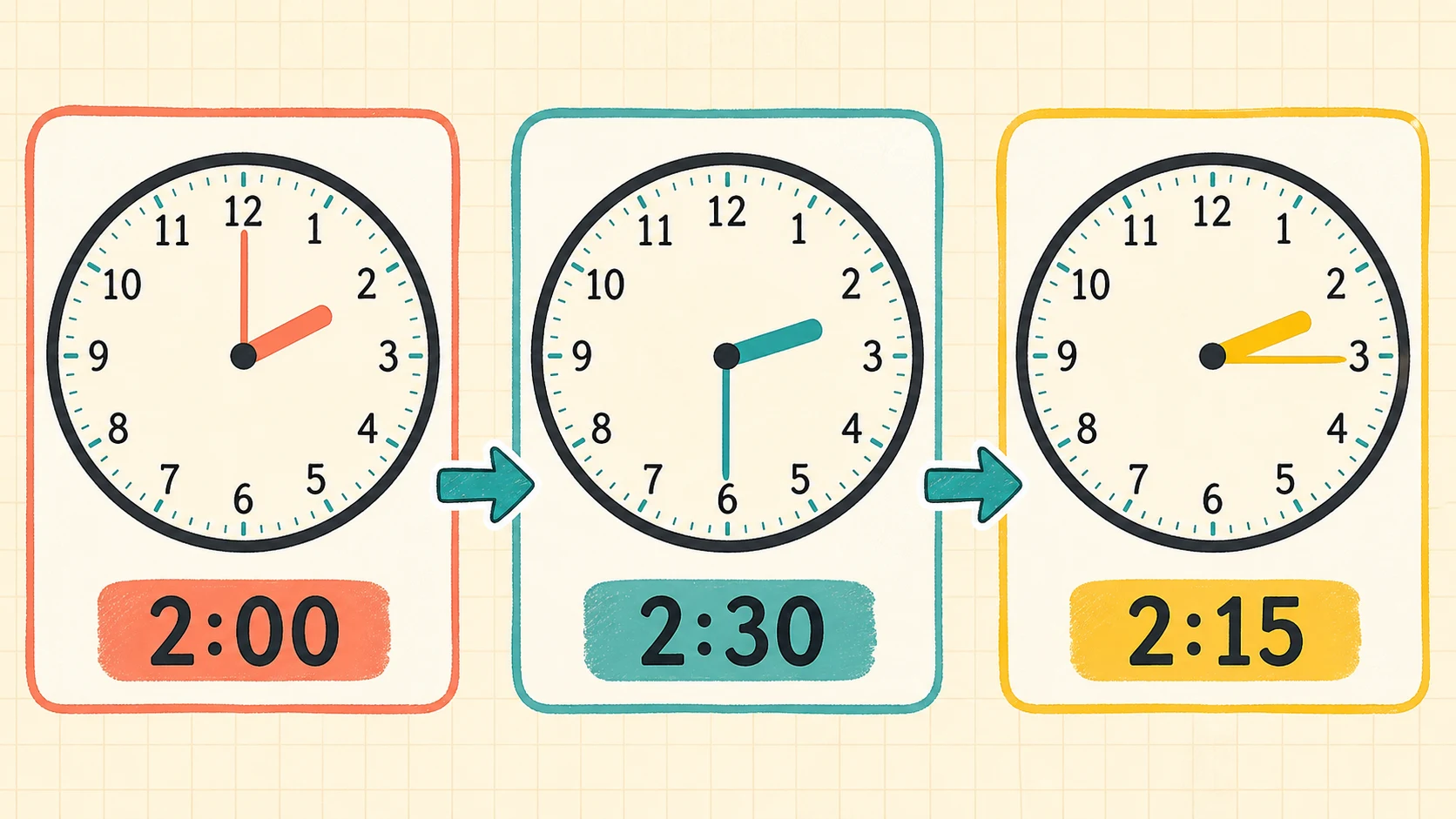
Support can fade from demonstration clocks and verbal prompts to mixed independent items.
A learner does not need perfect drawings before moving forward. Slightly uneven hand lengths are a drawing issue; consistently reversing their roles is a conceptual issue. Respond to the second problem first.
Concrete and Visual Models That Clarify the Skill
A geared demonstration clock
A demonstration clock with connected, or geared, hands is the strongest starting model available in the catalogue guidance. As the minute hand moves, the hour hand also moves gradually. This prevents the misleading impression that the hour hand remains fixed until the minute hand completes a full turn.
Move the minute hand from 12 to 6 while the learner watches the hour hand travel from 2 toward 3. Say, “The hour hand has left 2, but it has not reached 3. The time is 2:30.” Then repeat with a different hour.
If the model has independently moving hands, manually adjust both hands. Do not leave the hour hand directly on 2 while displaying 2:30 unless the worksheet’s simplified artwork uses that convention. Explain the difference between a simplified drawing and the motion of a real clock.
A one-hand clock
Temporarily cover or remove the minute hand. Ask which hour the short hand has reached or most recently passed. This focuses attention on the slower hand without requiring two decisions at once.
Next, expose the minute hand and use only two positions: 12 and 6. The routine becomes:
- Read the short hour hand.
- Check whether the long minute hand is at 12 or 6.
- Say and write the complete time.
A folded paper circle
Fold a paper clock face into two equal parts from 12 to 6. The fold makes “halfway around” visible. Trace the route from 12 to 6 and connect that half-turn with thirty minutes. This model supports the meaning of half past without requiring five-minute counting.
Analog, digital, and routine cards
Prepare three cards for one time:
- A clock face showing 7:30.
- A card reading 7:30.
- A routine card such as begin reading at 7:30.
Have the learner match the forms and explain the match. The routine is only context; it does not prove that every child reads at that time. Use events that are actually familiar to the learner.
Fully Checked Worked Examples
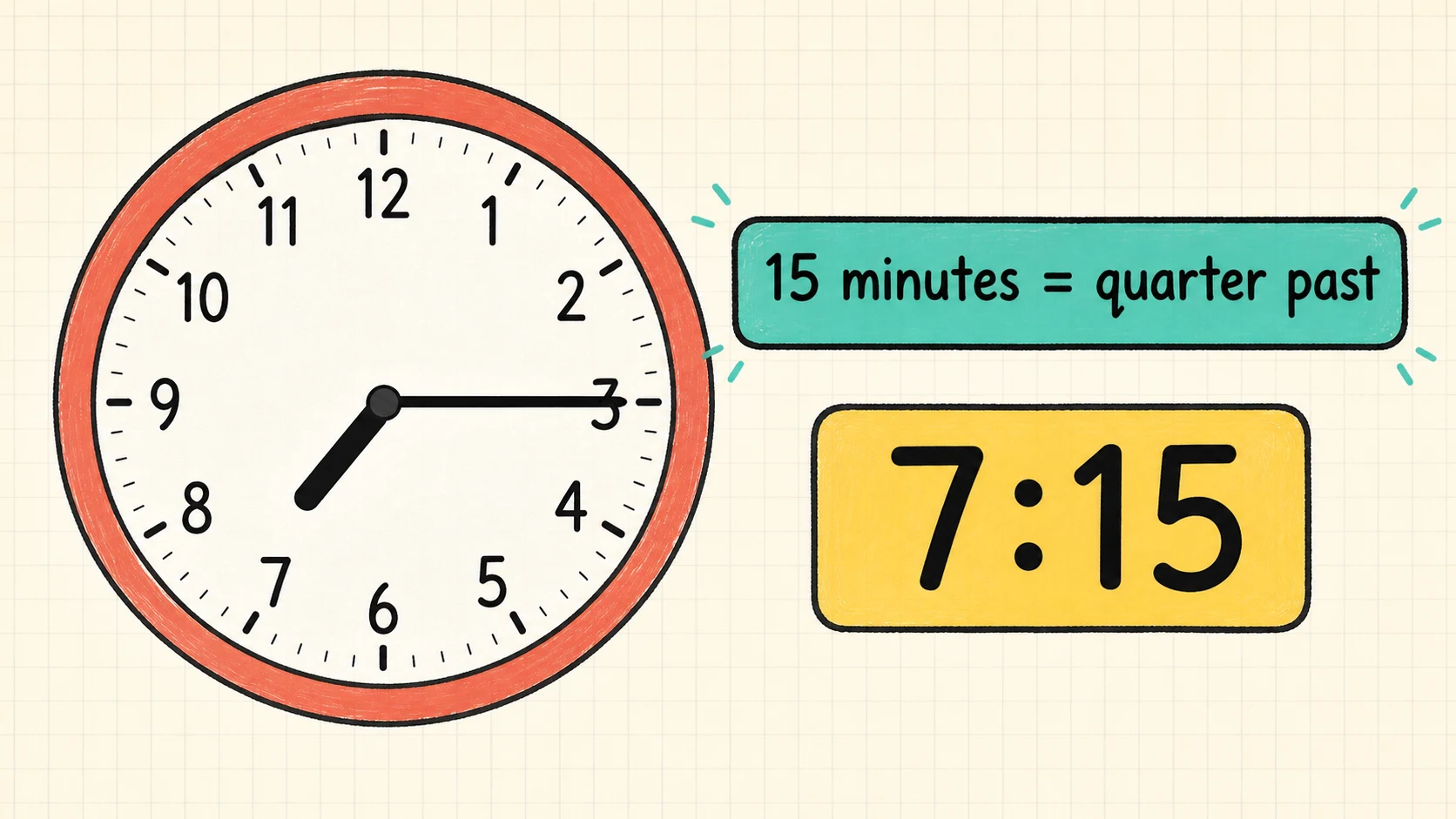
Each solution reads the hour hand, checks the minute-hand landmark, and verifies the result.
Example 1: Read a whole hour
Clock description: The short hand points to 4. The long hand points to 12.
- Read the short hand: the hour is 4.
- Read the long hand: at 12, it shows zero minutes past the hour.
- Write the time: 4:00.
- Say the time: four o’clock.
Check: At any :00 time, the minute hand must point to 12. It does, and the hour hand points to 4. The answer is 4:00.
Example 2: Read a half-hour
Clock description: The long hand points to 6. The short hand is halfway between 8 and 9.
- The long hand at 6 means thirty minutes have passed.
- The short hand has passed 8 but has not reached 9.
- The hour is therefore still 8.
- Write the time: 8:30, or say half past eight.
Check: At 8:30, the minute hand belongs at 6 and the hour hand belongs between 8 and 9. Both conditions are satisfied.
Example 3: Draw a stated time
Task: Draw the hands for 11:00.
- Read the digits before the colon: the hour is 11.
- Read the digits after the colon:
00 means zero minutes past.
- Draw the shorter hour hand pointing to 11.
- Draw the longer minute hand pointing to 12.
Check: The minute hand is at the whole-hour landmark, and the hour hand identifies 11. The completed clock shows 11:00.
Example 4: Match words and a digital time
Task: Choose the digital time that matches half past 5.
Options: 5:00, 5:30, 6:30
- “Past 5” identifies the hour that has already started: 5.
- “Half past” means thirty minutes after that hour.
- Combine the parts: 5:30.
Check: 5:00 is five o’clock, not half past. 6:30 is half past six. Only 5:30 matches both parts.
Example 5: Handle a boundary case
Clock description: The minute hand points to 6. The hour hand is halfway between 12 and 1.
The minute hand shows 30 minutes. The hour hand has moved past 12 but has not reached 1, so the time is 12:30.
Check: A 12-hour clock wraps from 12 toward 1. Writing 1:30 would name an hour the short hand has not yet reached.
These examples deliberately stay with hours and half-hours. Nearest-five-minute reading, nearest-minute reading, a.m./p.m., and elapsed-time calculations belong to later stages in the supplied topic progression.
A Short, Repeatable Lesson Routine
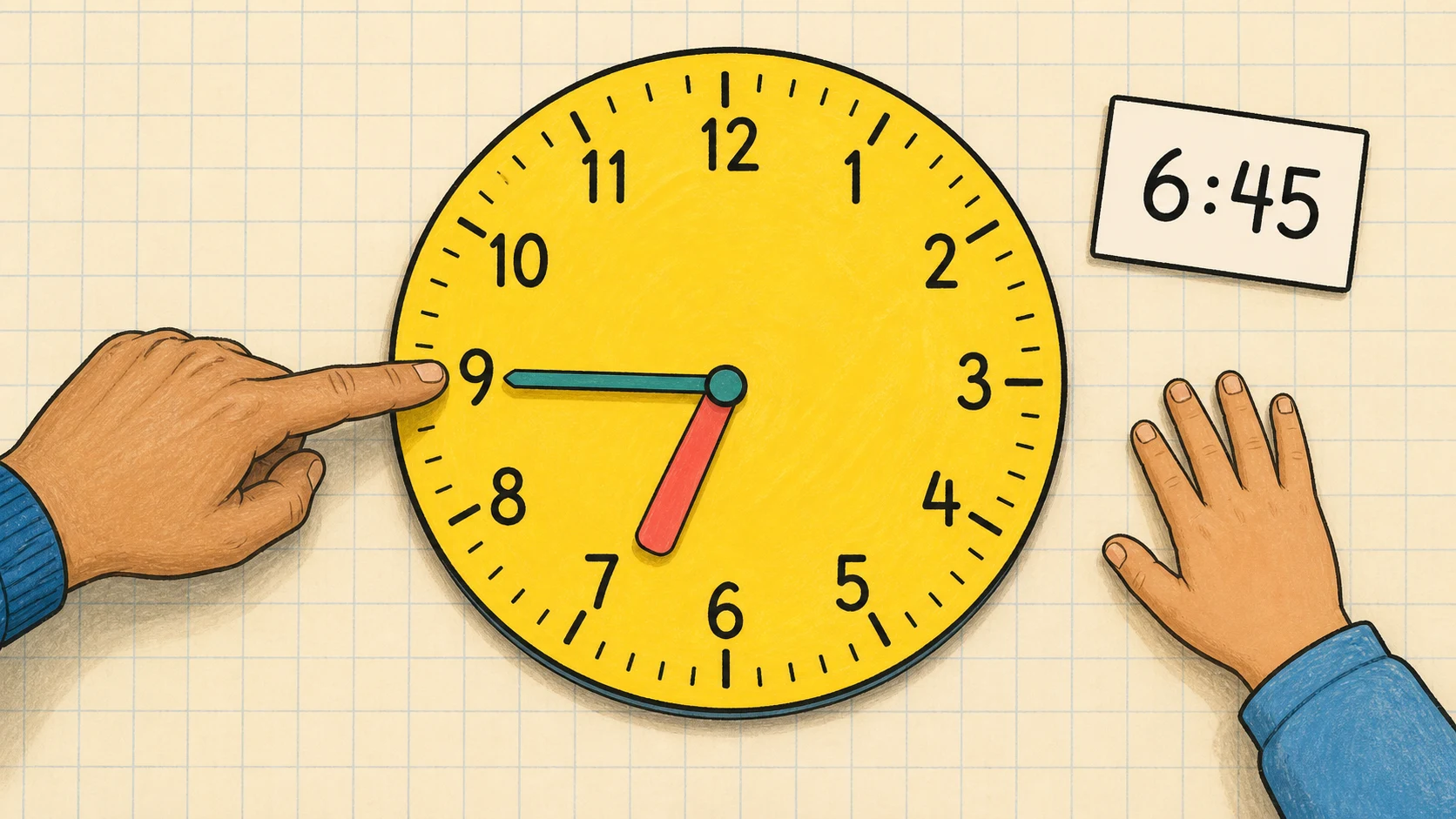
Brief cycles of modeling, explanation, and checked practice keep the learner’s reasoning visible.
Use a 10- to 15-minute routine as an instructional suggestion, not a universal timetable. Shorten or extend it according to the learner’s attention and observed accuracy.
Review one known time
Display a previously mastered clock. Ask, “What does the short hand tell us? What does the long hand tell us?” This reveals whether the learner remembers the process, not merely the answer.
Model one new example
Use a geared clock. Think aloud concisely: “The short hand has passed 3 but has not reached 4. The long hand is at 6, so thirty minutes have passed. It is 3:30.”
Solve together
Build another time with the learner. Ask for each hand separately, then connect the model to digital notation. Correct an error immediately by returning to the relevant hand.
Complete a small independent set
Give three or four items with one clear focus. A whole-hour lesson might include reading two clocks, matching one digital time, and drawing one clock. Avoid introducing difficult artwork or unrelated elapsed-time questions during initial instruction.
Close with explanation
Ask the learner to explain one answer and correct one deliberately incorrect clock. Record the error type, not just the score.
The IES elementary mathematics intervention guide recommends systematic instruction, clear mathematical language, and carefully chosen concrete and semi-concrete representations. Those are high-level instructional recommendations; the source did not evaluate WorksheetWise or this specific routine.
Choosing Practice That Matches the Learner
Begin with the 1st Grade Math worksheet collection when you need to compare telling time with other current math skills. Use the dedicated telling-time topic guide and resources when the learner needs focused clock practice.
For a learner just beginning
Choose pages that:
- Use only whole hours.
- Show large, uncluttered clock faces.
- Keep hand lengths visibly different.
- Ask the learner to read before drawing.
- Present one task type at a time.
Limit the visual field if necessary by covering later problems with blank paper. This is an instructional adjustment, not a change to the mathematics.
For a learner ready to consolidate
Mix :00 and :30 times. Include analog-to-digital matching, digital-to-analog drawing, and short explanations. Vary the hour so success does not depend on memorizing a repeated pattern.
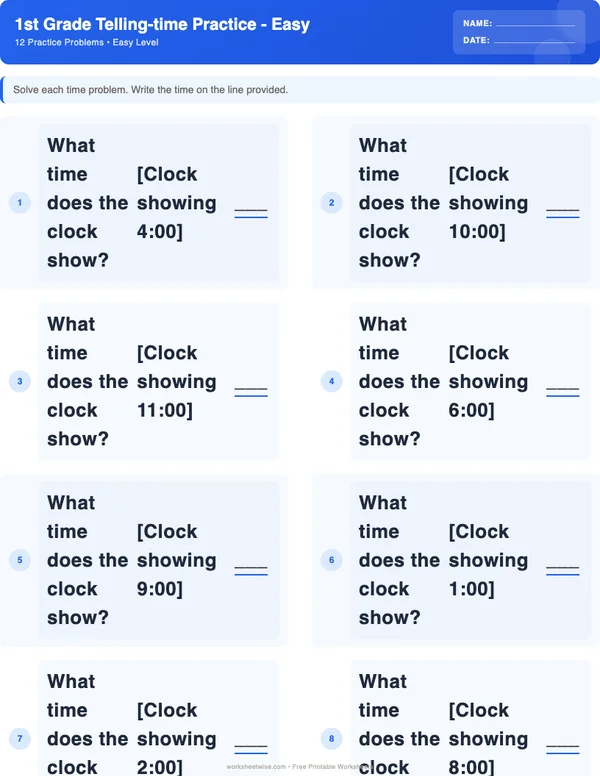
The free easy telling-time worksheet contains 12 exercises and has a separate answer key. Its catalogue description includes reading clocks, time intervals, and elapsed time, so preview the actual items before assigning them. Select only questions that match the learner’s current scope.
For a learner who is accurate but dependent on prompts
Fade one support at a time. First stop naming which hand to read. Later remove the “12 means :00, 6 means :30” reminder. Finally mix reading and drawing items. If accuracy drops sharply, restore the most recently removed support and collect more evidence.
For a learner who needs additional challenge
Ask for two representations and an explanation: “Build 6:30, write it digitally, and explain why the hour is 6.” Use simple schedules containing only hours and half-hours. Do not move automatically to five-minute intervals merely because one page was completed accurately.
For a larger volume of related material, the focused telling-time pack contains 18 worksheets. More pages are useful only when they provide the right kind of practice; they do not replace diagnosis or instruction.
Common Errors and Diagnostic Responses
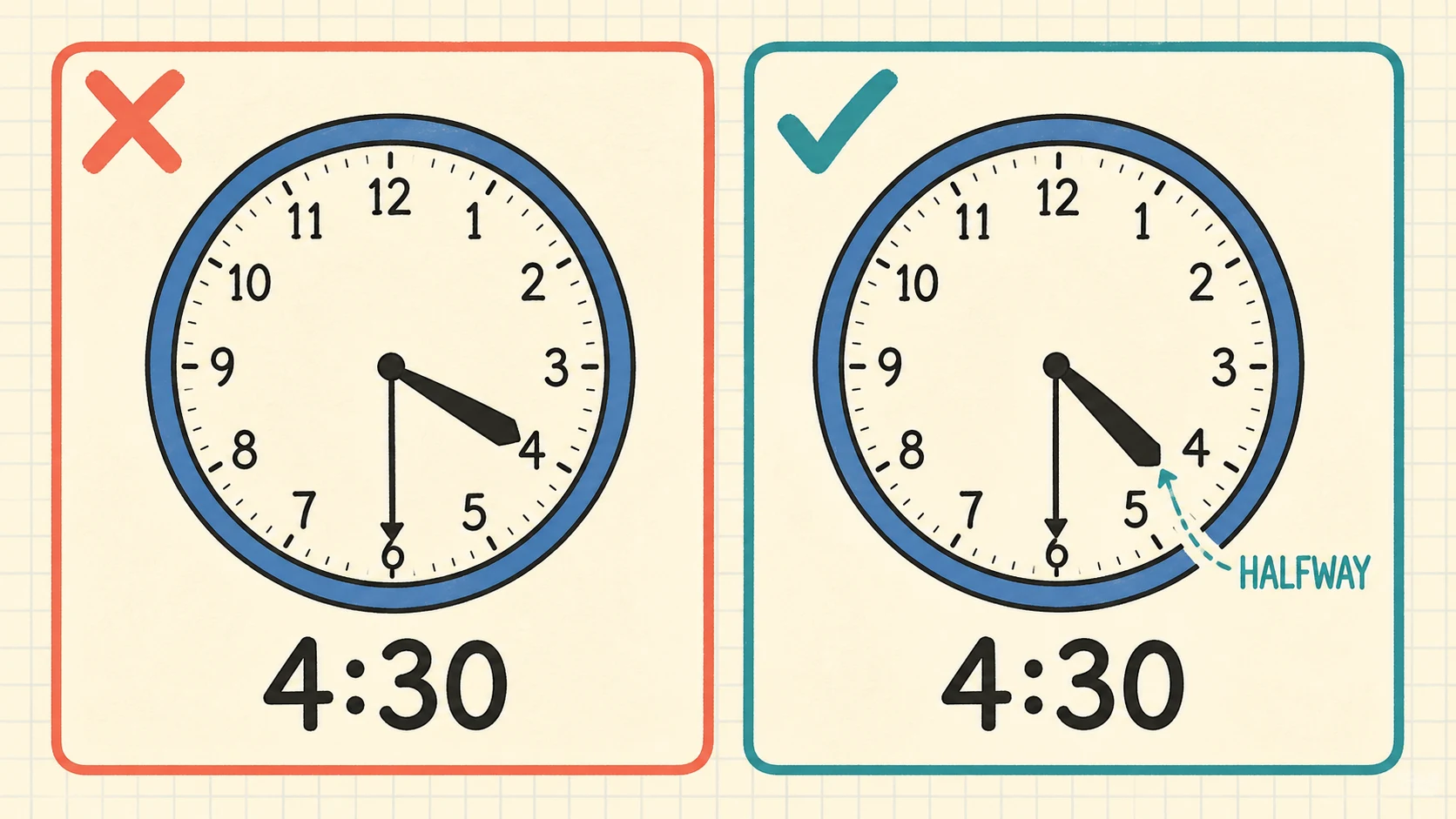
An error pattern points to the next teaching move more clearly than a total score alone.
| Observed response |
Likely issue to investigate |
Teaching response |
| Reads 3:30 as 4:30 |
Chooses the nearest numeral instead of the hour most recently passed |
Move a geared clock slowly from 3:00 toward 4:00; repeat, “It has not reached 4 yet” |
| Reads 6:00 as 12:30 |
Reverses the functions of the hands |
Compare hand lengths, name one hand at a time, and practice with the other hand covered |
| Writes 7:6 for a clock showing 7:30 |
Copies the numeral under the minute hand |
Reconnect position 6 with half the clock and thirty minutes |
Reads every clock as :00 |
Attends only to the hour hand |
Require the learner to state the minute-hand position before giving the complete time |
| Draws both hands the same length |
Understands the time but cannot communicate hand roles clearly |
Use contrasting colors and rehearse “short hour, long minute” |
| Places the hour hand on 9 for 8:30 |
Treats half-hour movement as a completed hour |
Build 8:00, move halfway, and compare “between” with “at” |
| Gives different answers to identical analog and digital times |
Has not connected representations |
Match clock, numeral, and words in sets of three |
| Answers accurately only when choices are provided |
May be recognizing rather than producing |
Alternate multiple-choice items with write-in and drawing tasks |
Do not infer a broad learning condition from one worksheet. Check whether the clock art is clear, the directions were understood, the learner was attentive, and the same error appears across several examples.
Language can also mask understanding. A learner might know that the long hand at 6 means :30 but not yet use the phrase half past confidently. Accept a correct demonstration, then model the precise language. Conversely, fluent clock vocabulary without correct hand placement does not demonstrate secure understanding.
Monitoring Progress and Deciding What Comes Next
Use a brief mixed check after instruction:
- Read two whole-hour clocks.
- Read two half-hour clocks.
- Draw one whole-hour time.
- Draw one half-hour time.
- Explain one answer.
Record results by skill: hour hand, minute hand, digital notation, drawing, and explanation. A mark such as “5/6” hides whether the missed item was a random slip or a repeated misunderstanding.
Look for stable evidence across more than one session. A practical instructional rule is to continue the current level when errors share a pattern, reduce support when the process is accurate and explainable, and advance when both reading and drawing remain secure in a mixed set. This is a teaching suggestion, not a sourced cutoff or guaranteed mastery rule.
Boundary cases deserve deliberate checks:
- 12:00: Both hands may point toward 12, with the shorter hand partly hidden.
- 12:30: The hour hand lies between 12 and 1.
- A crowded clock face: Decorative art can make hand length harder to judge.
- A simplified half-hour drawing: The hour hand may appear directly on the numeral rather than halfway toward the next one.
- An analog clock without context: It cannot establish morning or evening.
A Two-Week Practice Plan
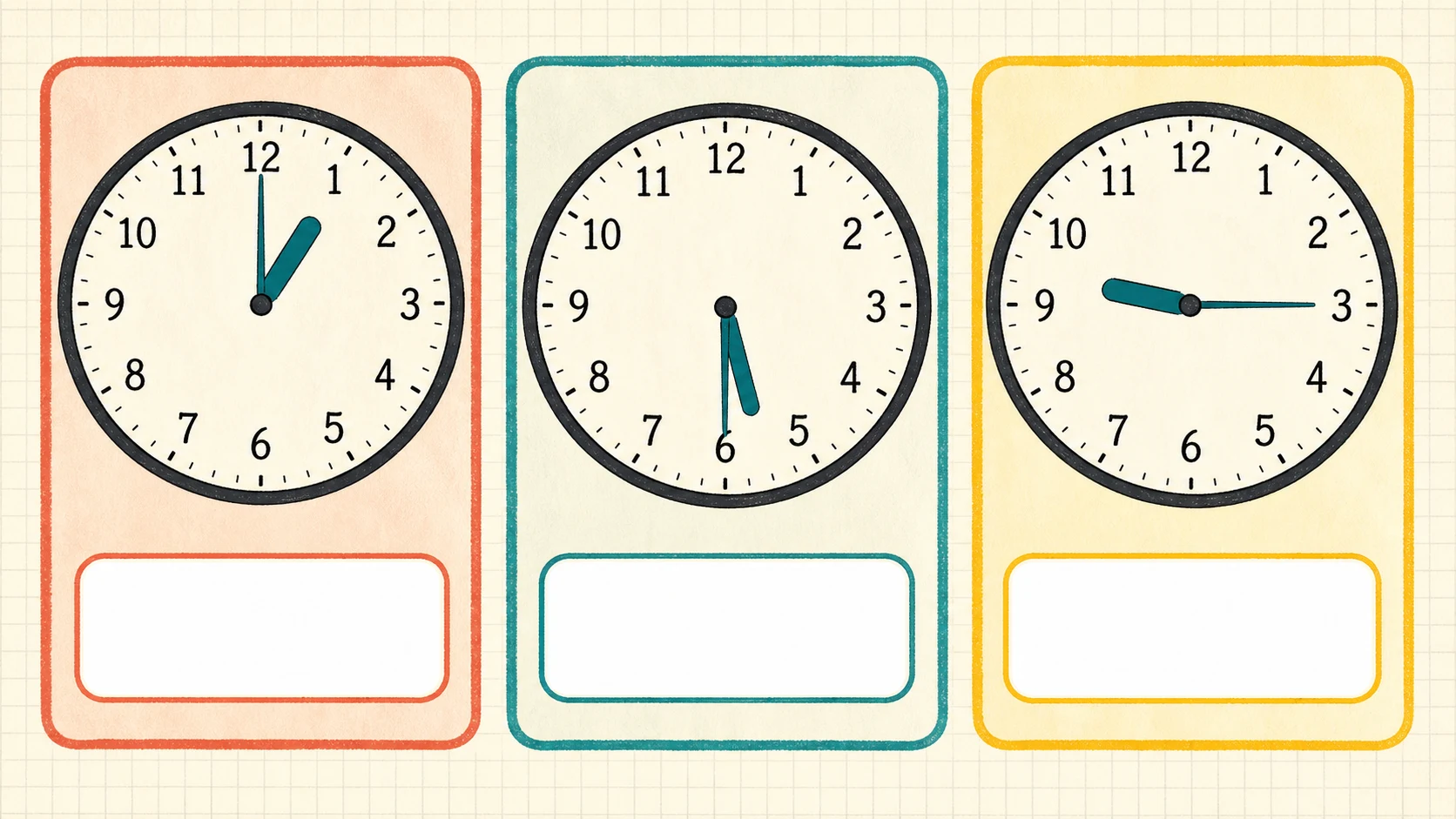
The plan alternates modeling, matching, drawing, application, and review.
This plan uses ten short sessions across two weeks. Adjust the schedule to the learner’s work. Repeating a session is appropriate when the evidence calls for it.
| Session |
Focus |
Suggested activity |
Quick check |
| 1 |
Clock parts |
Identify numerals, face, hour hand, and minute hand on real and paper clocks |
Names each part without guessing |
| 2 |
Whole hours |
Build and read five :00 times with a demonstration clock |
Explains why the minute hand is at 12 |
| 3 |
Whole-hour representations |
Match analog clocks to digital times and words |
Completes two new matches independently |
| 4 |
Draw whole hours |
Draw hands for four digital times |
Keeps hand roles distinct |
| 5 |
Whole-hour review |
Use a short mixed set and one familiar schedule |
Reads and draws without step-by-step prompting |
| 6 |
Meaning of half |
Fold a paper clock and move the minute hand from 12 to 6 |
Connects half a turn with thirty minutes |
| 7 |
Half-hours |
Build several :30 times with geared hands |
Names the hour most recently passed |
| 8 |
Mixed hours and half-hours |
Sort, match, read, and write :00 and :30 |
Checks the minute hand before answering |
| 9 |
Error correction |
Analyze incorrect clocks, including a next-hour error |
Explains what must change and why |
| 10 |
Independent review |
Read two of each type, draw two times, and explain one |
Shows which skill is secure and which needs review |
Keep successful items in later reviews. If the learner masters 4:00 on Session 2, return to it briefly on Sessions 5 and 10 while varying the other hours. If 4:30 is confused with 5:30, use several “between two hours” models before assigning another mixed page.
Daily life can provide additional examples: notice when an activity starts at an exact hour or half-hour, compare that time with a clock, and ask the learner to explain both hands. Do not force every routine into practice or claim a schedule is universal.
Limitations and the Honest Next Step
This guide covers the intended first-grade core of telling and writing time to the hour and half-hour. It does not fully teach five-minute intervals, one-minute intervals, elapsed-time arithmetic, time-unit conversion, or a.m./p.m. Those appear later in the broader topic progression. It also cannot account for every local curriculum, clock design, language need, or learner response.
A worksheet can reveal patterns and provide practice, but it cannot determine the cause of every error. Use the answer key to check accuracy, then examine how the learner reasoned. If the hour hand is still being misread, return to a movable clock rather than assigning more of the same printed item.
The most useful next action is to preview the free 1st Grade telling-time worksheet, choose the questions limited to the learner’s current skill, and complete the first few with a demonstration clock nearby. Use the resulting work—not the grade label alone—to decide whether the next session should review whole hours, introduce half-hours, or begin mixed practice.