Curated collectionAnswer keys includedPrint-ready PDFs
After-School Math Worksheets
Account for transition and fatigue with short tasks, clear stopping points and a print-plus-conversation routine.
Start with a real resource
Browse this worksheet collection
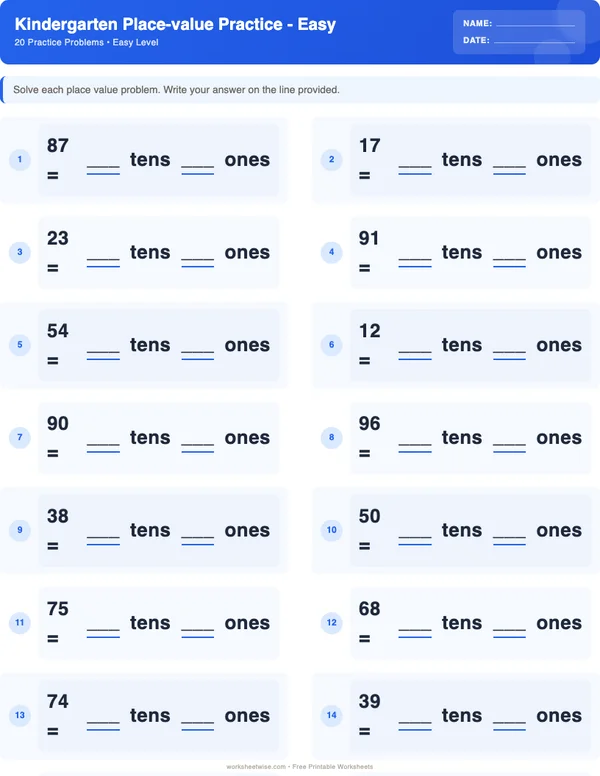
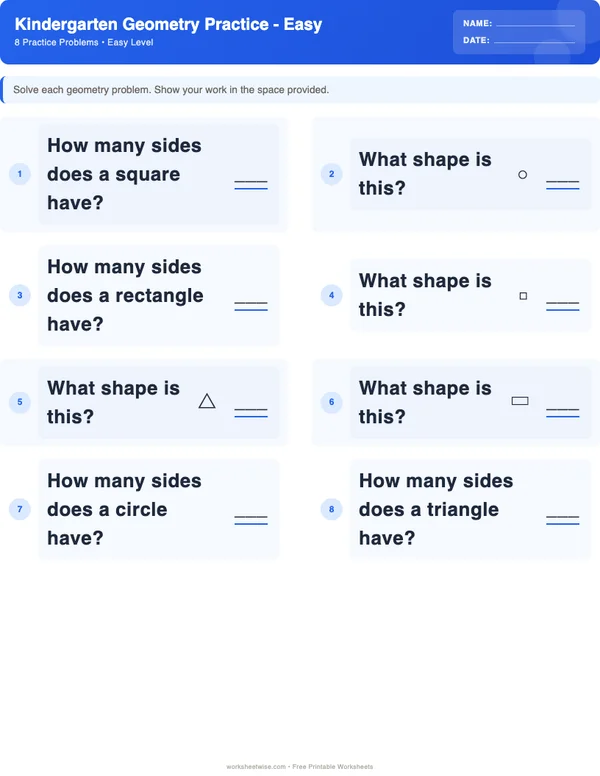
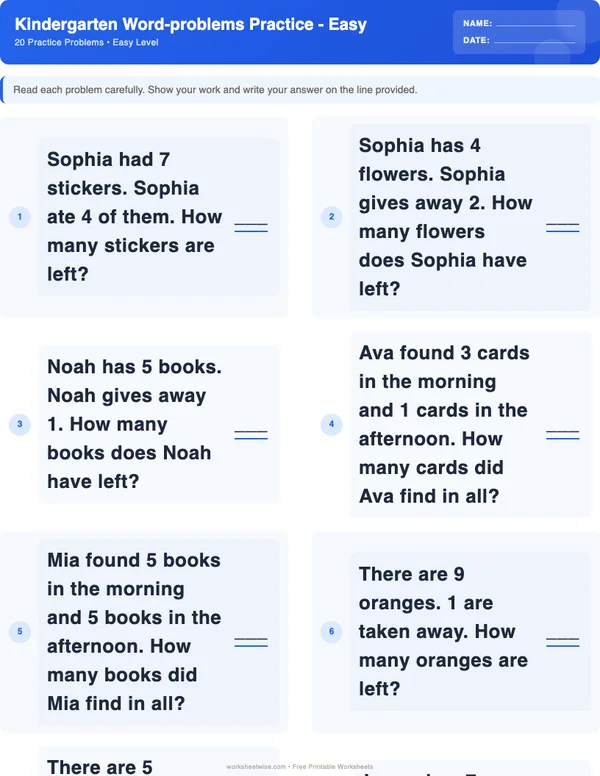
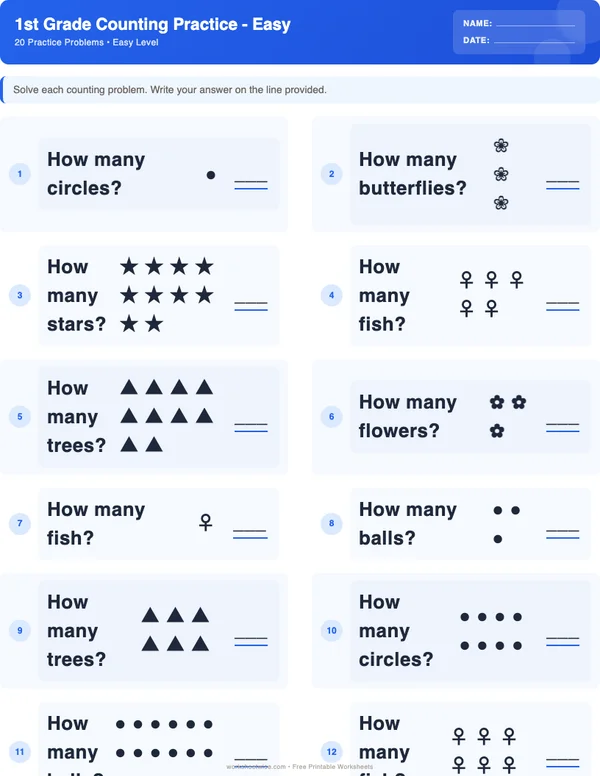
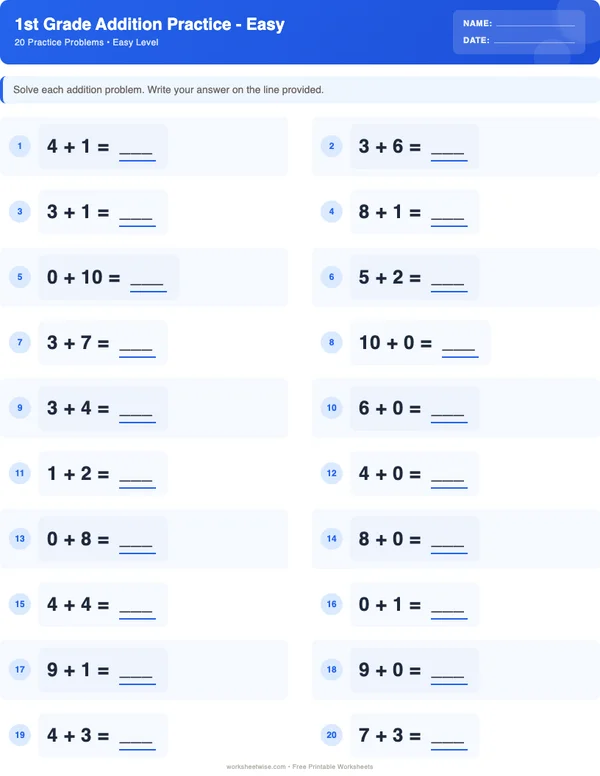
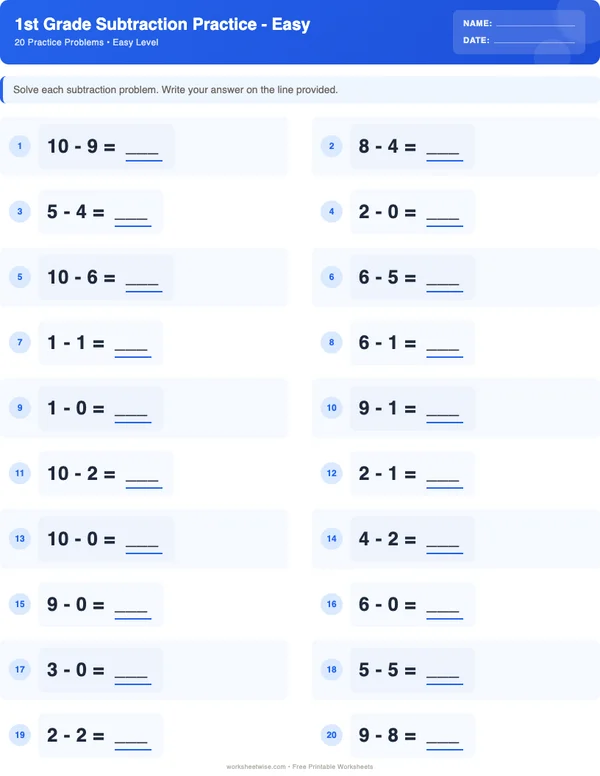
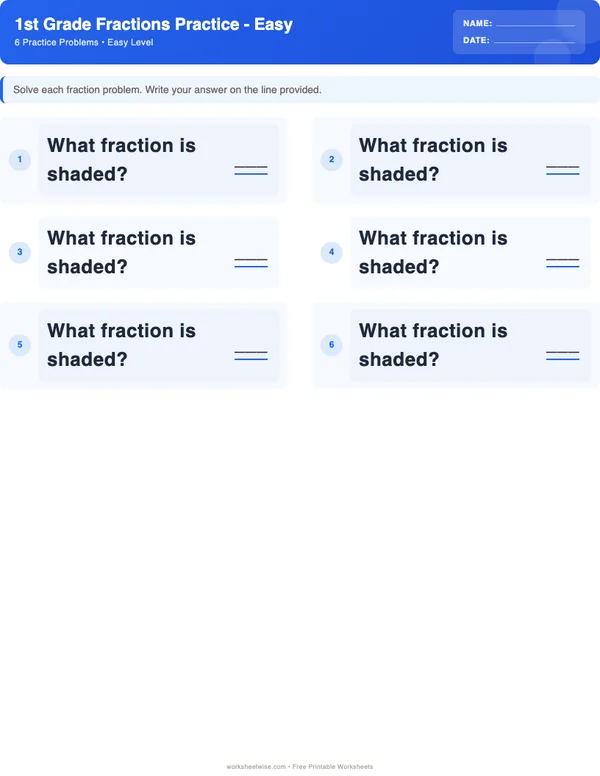
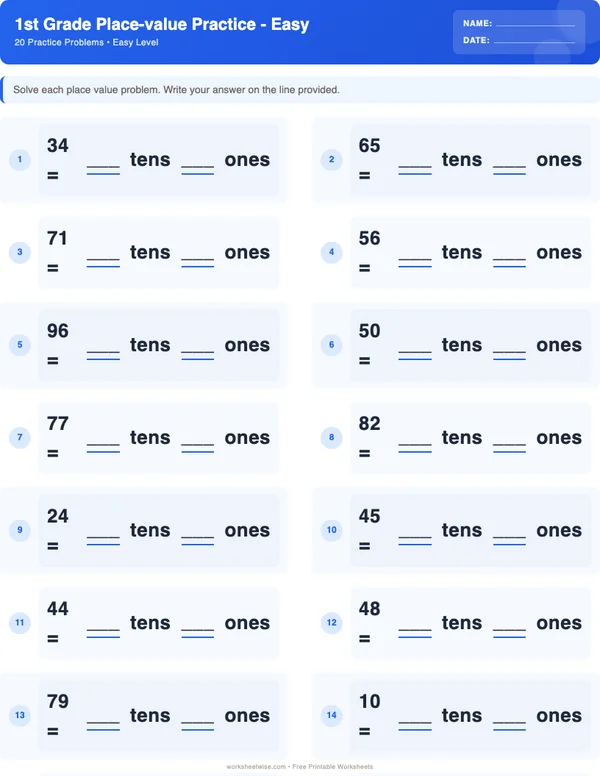
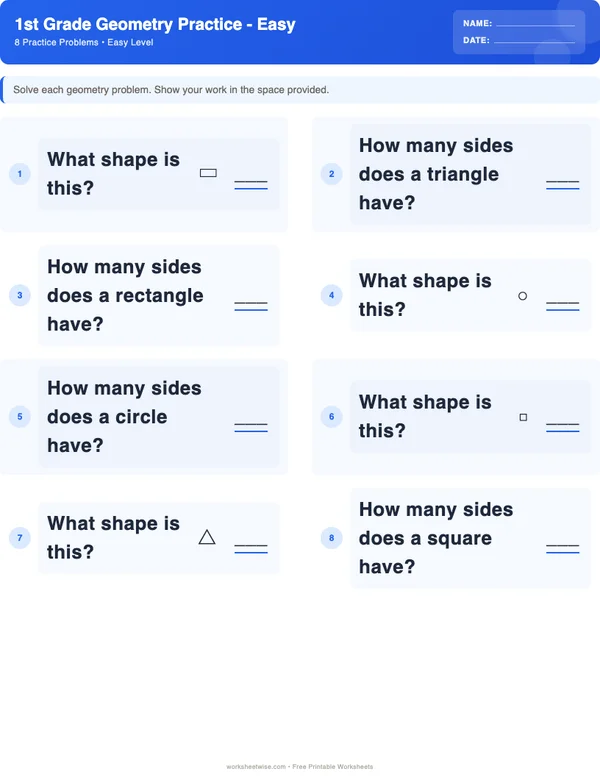
61 relevant free entry points are available. Each one includes a printable learner PDF and separate answer key.
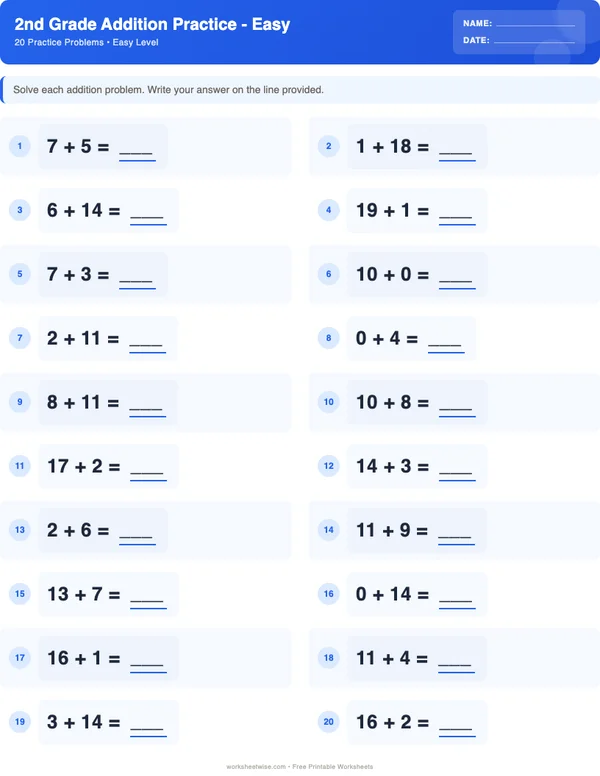
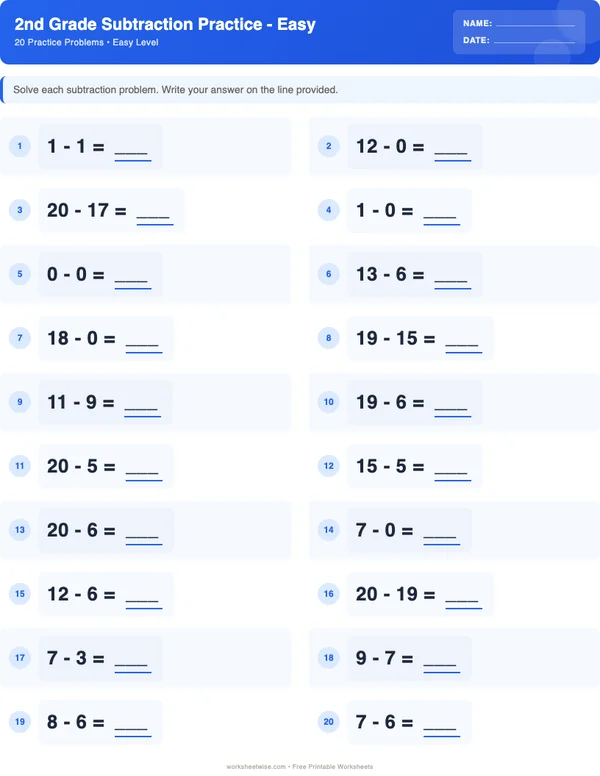
A useful practice loop
Print less. Observe more.
- Choose one skill and model the first item aloud.
- Use a short set and notice the learner’s strategy.
- Change the next task from the work you can see.
Need more than the free sheet?
Plus includes all 1098 matching catalogue variations where available, plus saved deterministic generators and the worksheet designer.
See Plus membershipComplete guide
How to teach and practise after-school math worksheets
3,321 words Updated 6 instructional visuals
Build the afternoon around one short mathematical decision
After-school math practice works best as a brief print-plus-conversation routine: choose one target, complete a small set of related items, stop at a visible checkpoint, and discuss one response before deciding what comes next. A tired learner does not need a second school day. They need a manageable opportunity to model a quantity, record an answer, explain a choice, and finish successfully.
WorksheetWise’s live math catalogue currently includes 1,098 variants, 61 free resources, eight grade filters, and 12 topics. Those options are useful only when the adult selects by task features rather than assigning a long sheet because its grade label appears correct. Grade labels describe intended practice levels; local curriculum sequences differ. Age is a discovery aid rather than a placement decision.
Use a worksheet as evidence, not as a verdict. A correct numeral can conceal guessing or an incorrect model. An incorrect answer can come from counting, notation, language, operation choice, or fatigue. The conversation after two to six items helps distinguish those possibilities and determines the next sheet.
Make the transition part of the math plan
Do not begin the moment a learner arrives home or leaves class. Allow a predictable transition: water, food if appropriate, movement, and a clear statement of the session’s endpoint. “We will do four problems, talk about one, and stop” is more usable than “Finish this worksheet.”
A practical session lasts only as long as the learner can still show mathematical thinking. The following routine is an editorial recommendation for using the catalogue; it is not a research finding or a guarantee of progress.
Reset, preview, and choose a stopping point
Spend the first two minutes away from the pencil. Ask a neutral question such as, “Did you use counters, a drawing, or numbers for math today?” The answer may reveal a familiar model without turning the transition into a quiz.
Then preview the page together:
- Name the mathematical action: count, combine, take away, compare, partition, or identify.
- Circle or mark a stopping point after a small group of items.
- Identify the response format: numeral, drawing, equation, match, or spoken explanation.
- Place one support within reach, such as counters, coins, a number line, or scrap paper.
- State that the marked checkpoint—not the bottom of the page—is today’s finish line.
A 20-problem page can become five four-problem sessions. A six-problem fraction page might become two sessions of three. The catalogue’s problem count describes the resource, not the amount that must be completed at once.
Work, talk, and close
Use this sequence after the preview:
- Adult models one item only when needed. Narrate the mathematical meaning, not merely the pencil movements.
- Learner completes two to six items. Keep the set short enough to compare responses.
- Adult selects one item for explanation. Ask, “How does your picture or number show the situation?”
- Learner checks one answer in another form. For example, recount objects, use a related addition fact, or place a fraction on a number line.
- Adult records one observation. Write a factual note such as “counts each object once when arranged in a row; recounts one object in a scattered set.”
- Stop at the marked point. Do not add bonus questions because the work went smoothly.
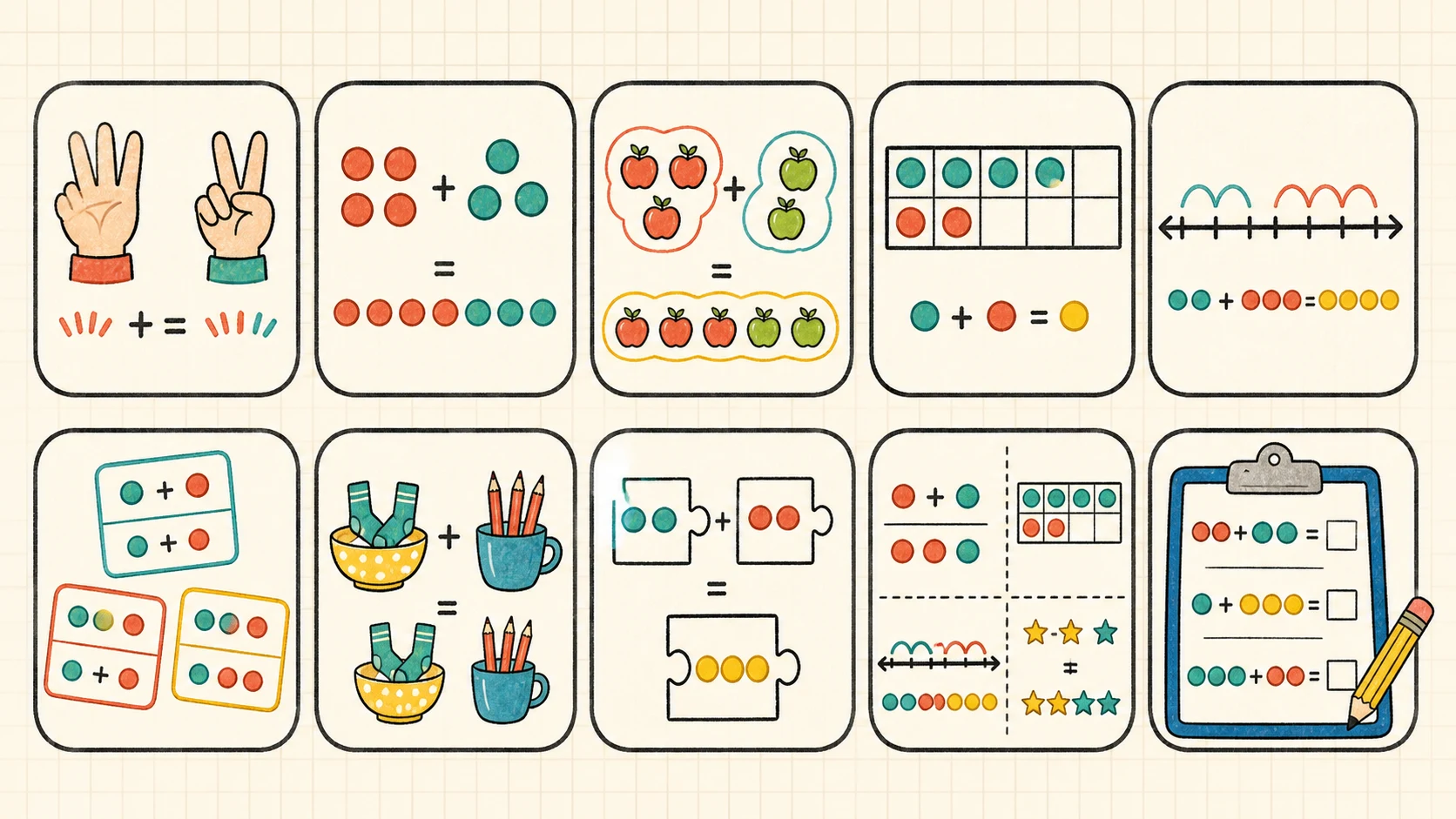
Use the first-grade addition plan as a scheduling map: distribute short attempts and review conversations rather than treating one printed page as one sitting.
Select the task by what the learner must do
Before printing, inspect four features: the quantity range, the model supplied, the response required, and the number of decisions in each item. These features define practical difficulty more accurately than a label alone.
The live free sheets listed as “easy” do not define a learner. Here, that level should be read through observable page features: smaller quantities, familiar representations, fewer steps, direct prompts, and limited response demands. A task becomes more demanding when it removes visual support, varies the position of an unknown, mixes operations, increases the quantity range, or requires an explanation in addition to computation.
Compare representative catalogue choices
The representative free resources reveal meaningful differences:
| Live resource | Page features to inspect | Suitable after-school use | Do not assume |
|---|---|---|---|
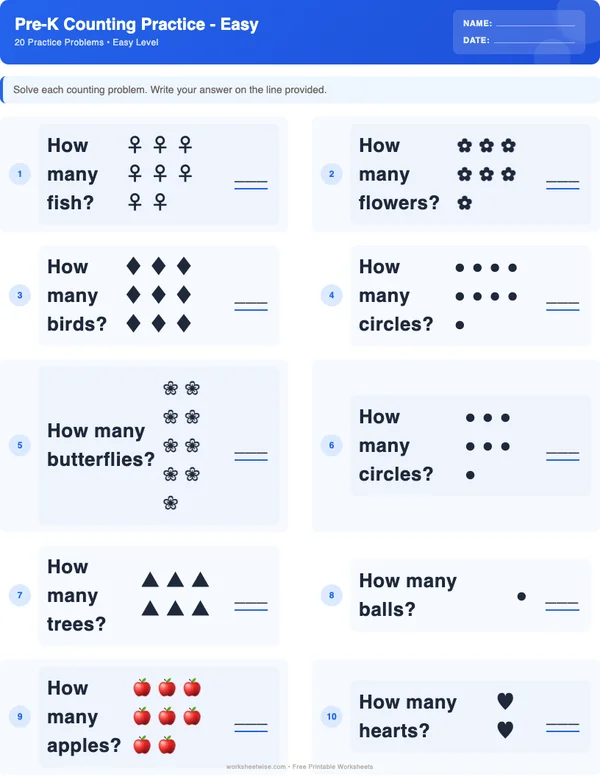
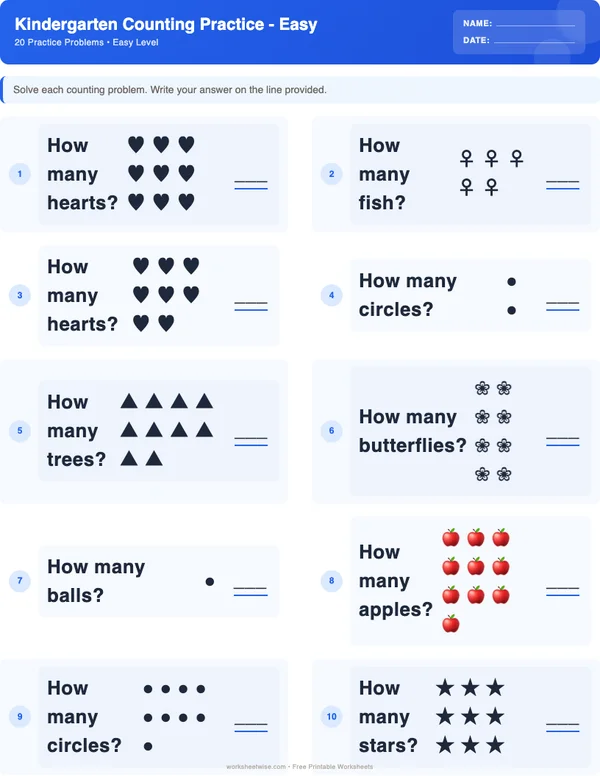
| Pre-K or kindergarten counting | 20 problems; sequences, missing numbers, or sets of objects may appear | A few oral or matching items supported by real objects | Reciting a sequence proves one-to-one counting |
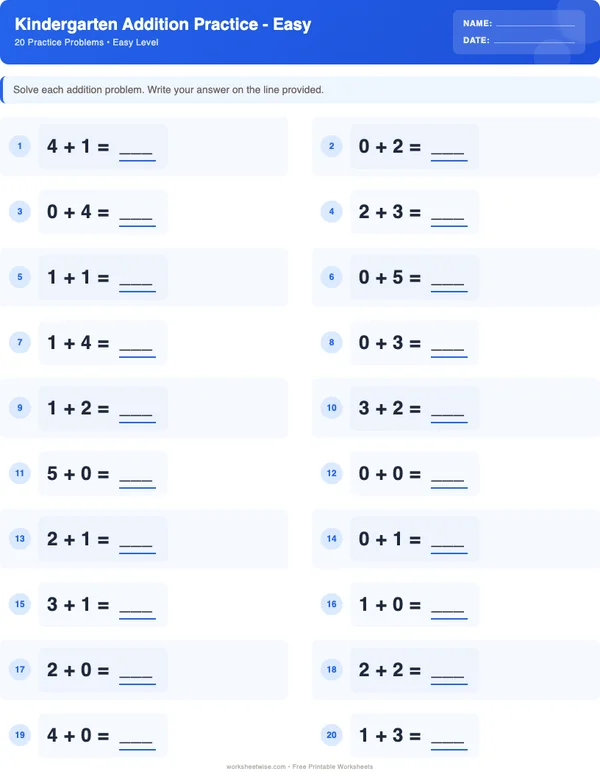
| Kindergarten addition | 20 problems; early work can involve objects, pictures, and sums within small ranges | Combine two groups, draw the result, then record a numeral | A correct sum shows which strategy was used |
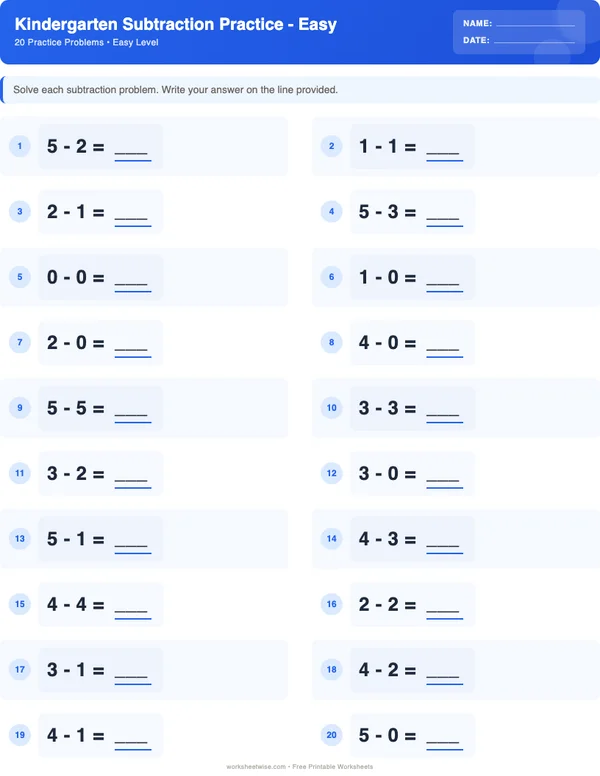
| Kindergarten subtraction | 20 problems; subtraction may represent removal, comparison, or a missing part | Contrast two story meanings using counters | Every subtraction prompt means “take away” |
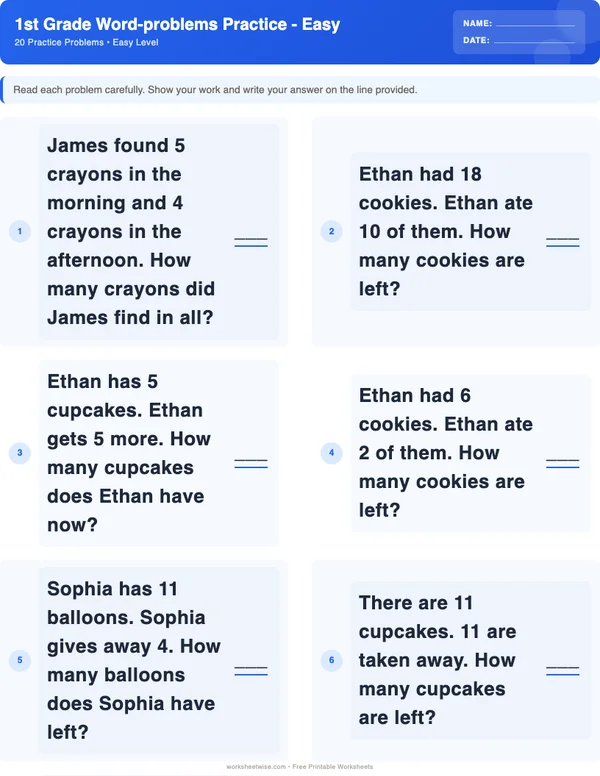
| Kindergarten word problems | 12 problems; reading, operation choice, setup, and calculation all contribute | One or two acted-out stories followed by a drawing | A computation error is necessarily an operation misunderstanding |
| First-grade fractions | Six problems; early fraction work concerns equal parts and fraction names | A short paper-folding or fraction-strip session | Any partition into the requested number of pieces is valid |
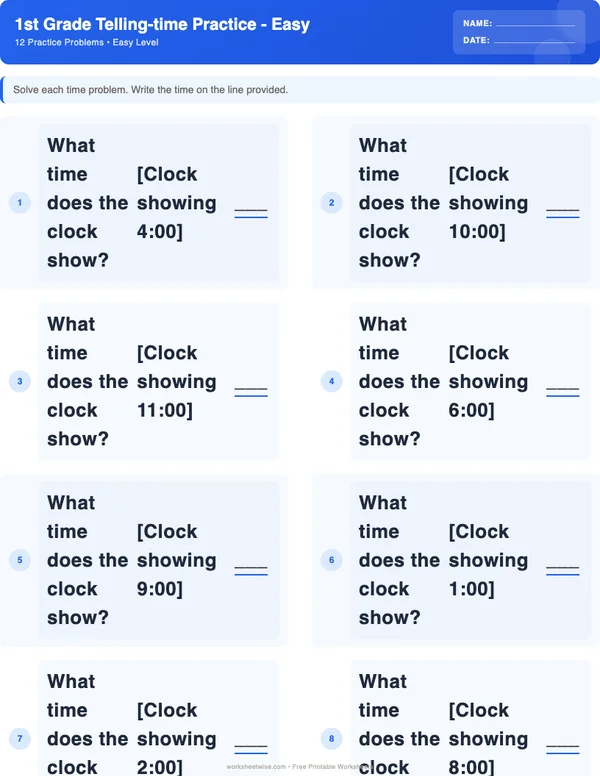
| First-grade telling time | 12 problems; clock reading adds hand identification and spatial interpretation | Read one clock, build the time on a demonstration clock, then explain | Confusing the hands is the same as not understanding time |
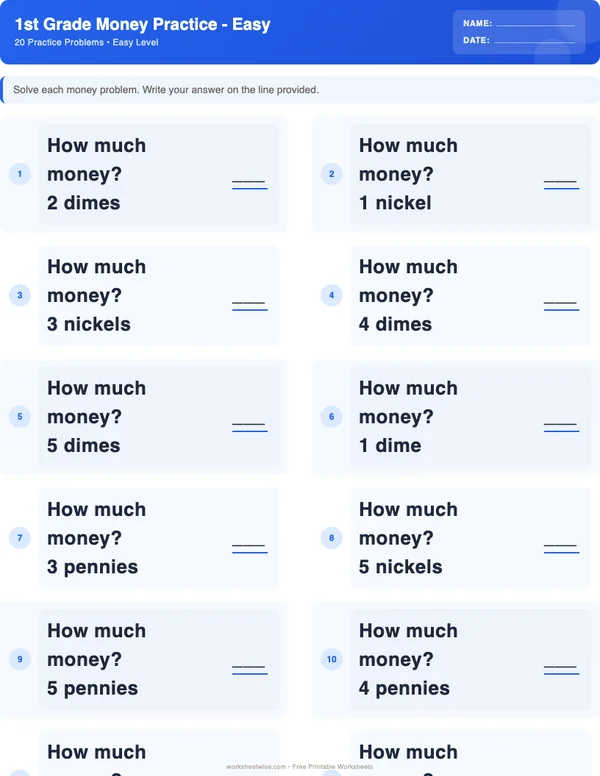
| First-grade money | 20 problems; coin recognition and counting may be combined | Handle real or realistic play coins before recording an amount | Coin size reliably indicates coin value |
This comparison matters after school because response load competes with mathematical attention. A learner may be ready to combine groups but too tired to copy ten equations. Preserve the combining target while reducing copying: let the learner say the equation while the adult records it, then have the learner write only the total.
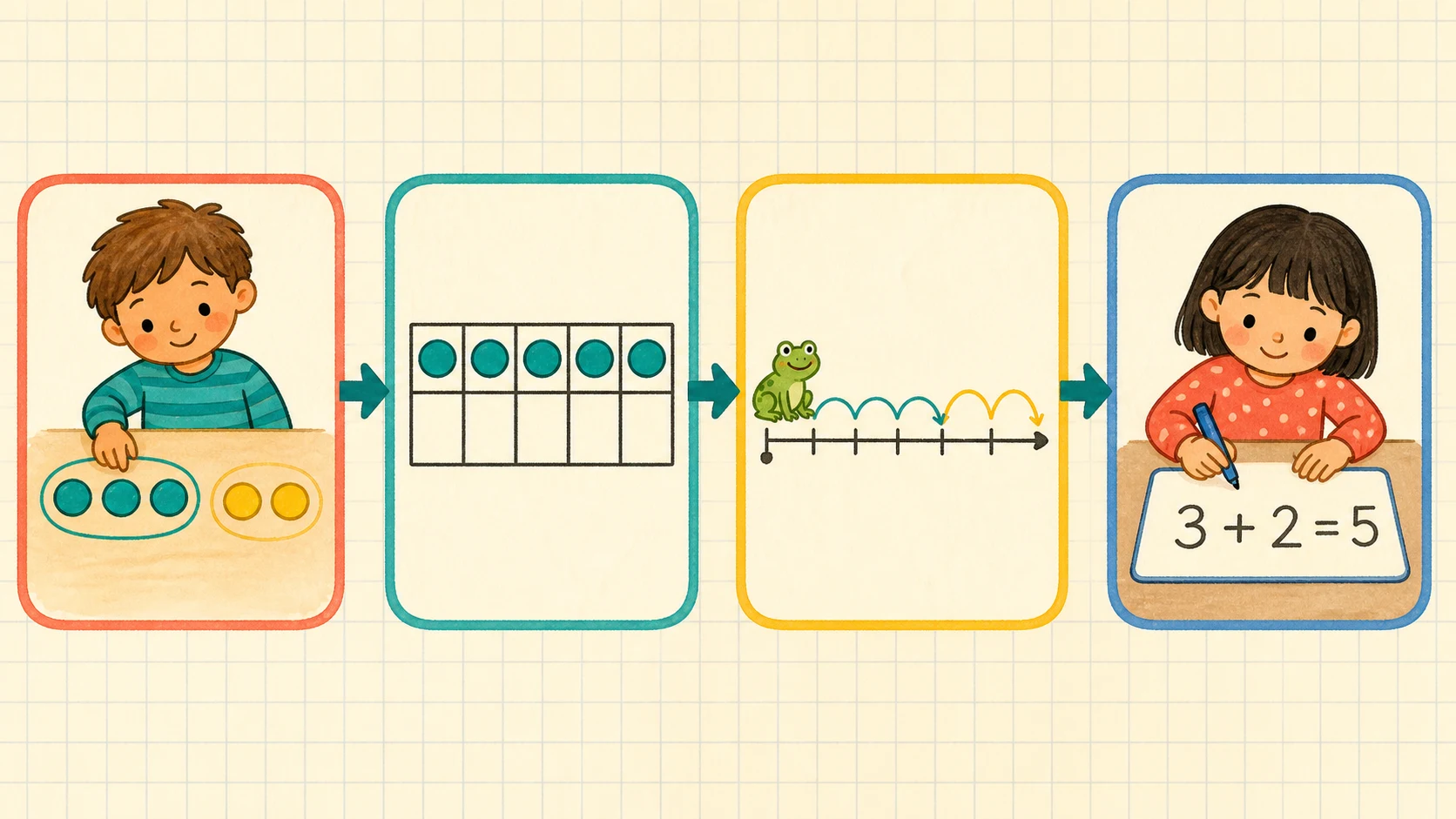
For first-grade addition, remove support in stages: physical groups, a drawn representation, and only then an independent number sentence.
Model the mathematics before correcting the notation
The IES guide for teaching math to young children recommends purposeful use of representations, attention to mathematical language, and regular opportunities to connect informal ideas with formal mathematics. That source did not evaluate WorksheetWise. Applied here, its guidance means an adult should connect the printed marks to objects, actions, pictures, and words.
Checked example: addition as joining
Suppose an early-addition item represents 6 objects joined with 3 more. Place six counters in one group and three in another. Slide the groups together and count: 7, 8, 9. Record:
6 + 3 = 9
Check it another way: begin at 6 and count on three numbers—7, 8, 9. Both methods give 9.
This example belongs here because the live kindergarten and first-grade addition resources each contain 20 problems, and the catalogue describes a progression from objects and pictures toward abstract number sentences. For an after-school session, use one modeled item and perhaps three independent items, not necessarily all 20.
If the learner writes 8, do not immediately say, “Try again.” Ask them to touch each counter while counting. If they count the initial six again instead of counting on, that is strategy information. If they physically show nine counters but write 8, the model may be secure while numeral recording needs attention.
Checked example: subtraction has different meanings
Use the equation 9 − 4 = 5 in two situations:
- Removal: Nine counters are present; four are moved away; five remain.
- Comparison: One group has nine counters and another has four; matching the groups leaves five unmatched.
The arithmetic is checked: 5 + 4 = 9. Yet the models answer different questions. This example belongs because the representative subtraction resources explicitly include removal, comparison, and missing-part situations. Alternating meanings prevents a learner from treating every minus sign as a command to perform an unexplained procedure.
For regrouping later, physical trading matters. The catalogue’s subtraction guidance gives the checked example 43 − 25 = 18: trade one ten so that 43 becomes 3 tens and 13 ones; subtract 5 ones to get 8 ones and 2 tens from 3 tens to get 1 ten. The answer is 18, and the inverse check is 18 + 25 = 43.
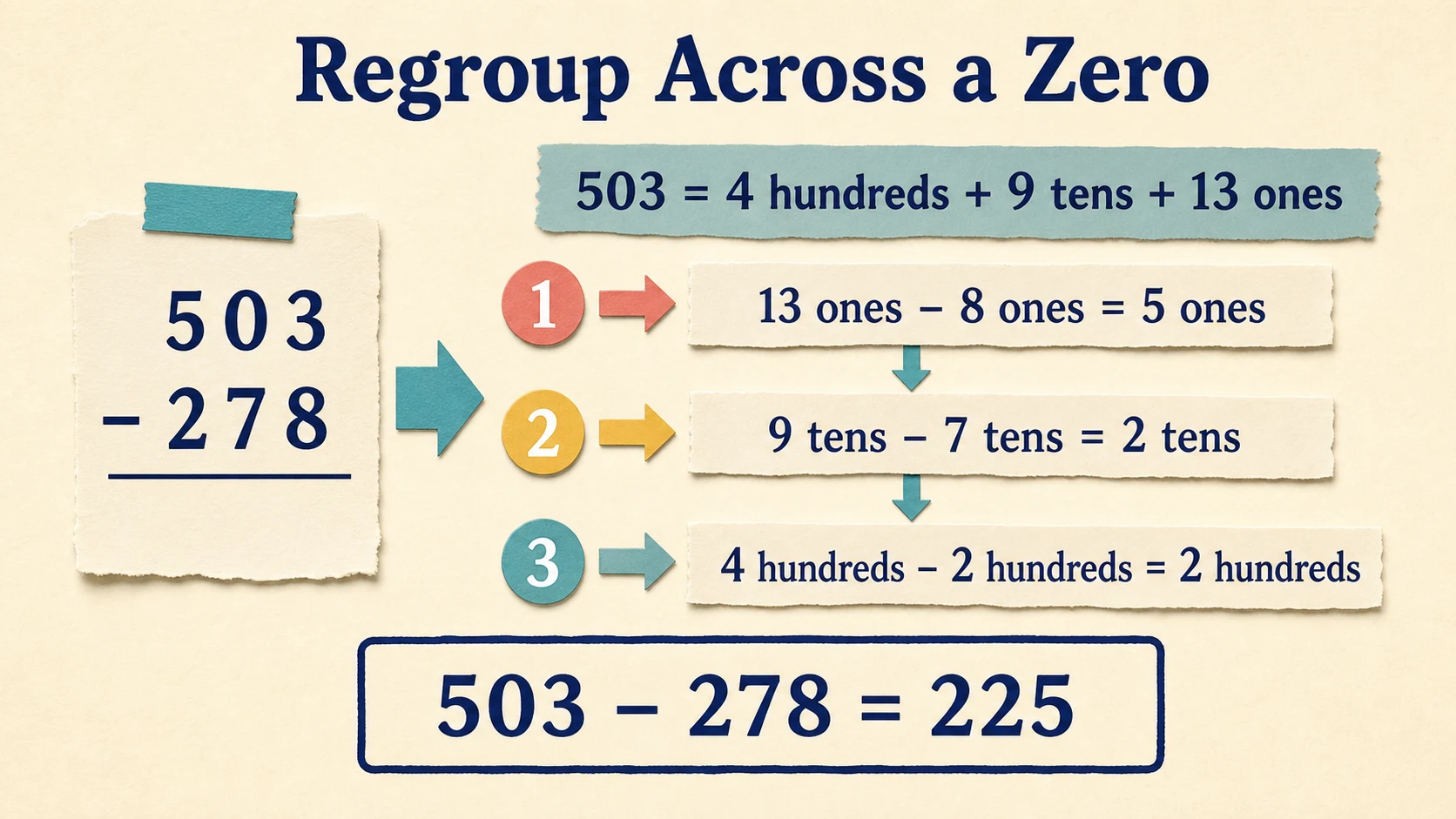
In upper-elementary subtraction, ask the learner to connect each written regrouping mark to an equivalent trade in the model.
Treat response formats as part of the task
A learner may understand the target while struggling with the requested response. Separate four possible demands:
- Choosing: circle or match a correct representation.
- Producing: write a numeral, symbol, equation, or time.
- Modeling: draw, build, fold, or arrange quantities.
- Explaining: state why the representation matches the problem.
Do not change all four at once. If a learner can model a sum but cannot write the equation, retain the quantities and supply an equation frame: __ + __ = __. If handwriting is the barrier, allow pointing or oral responses while keeping the mathematical choice intact. If reading is the barrier in a word problem, read the wording aloud without naming the operation.
The IES practice guide on assisting students who struggle with mathematics supports systematic instruction, clear mathematical language, representations, and attention to word problems. It does not diagnose an individual learner and did not test these worksheets. A home application is to keep instructions explicit and then ask the learner to connect the model, words, and notation.
Checked example: fractions require equal parts
Fold one paper strip into two equal sections and shade one. The shaded amount is 1/2. Fold a matching strip into four equal sections and shade two. The shaded lengths coincide, so 1/2 = 2/4.
Now draw a rectangle split into three visibly unequal pieces. Shading one piece does not establish 1/3, because thirds must be equal shares.
This example belongs because the live first-grade fractions entry contains six problems and begins with partitioning shapes into equal parts and naming fractions. Six items are already a shorter resource, but fatigue can still justify stopping after two or three. Preserve the target by keeping equal partitioning central; do not reduce the task to memorizing numerator and denominator vocabulary.
For older practice, estimation should precede exact calculation. In the checked sum 7/8 + 3/4, rewrite 3/4 as 6/8, giving 13/8 = 1 5/8. The result is between 1 and 2, so saying it is “close to 2” is reasonable. The exact calculation confirms that adding denominators—incorrectly producing 10/12—would not preserve the sizes of the parts.
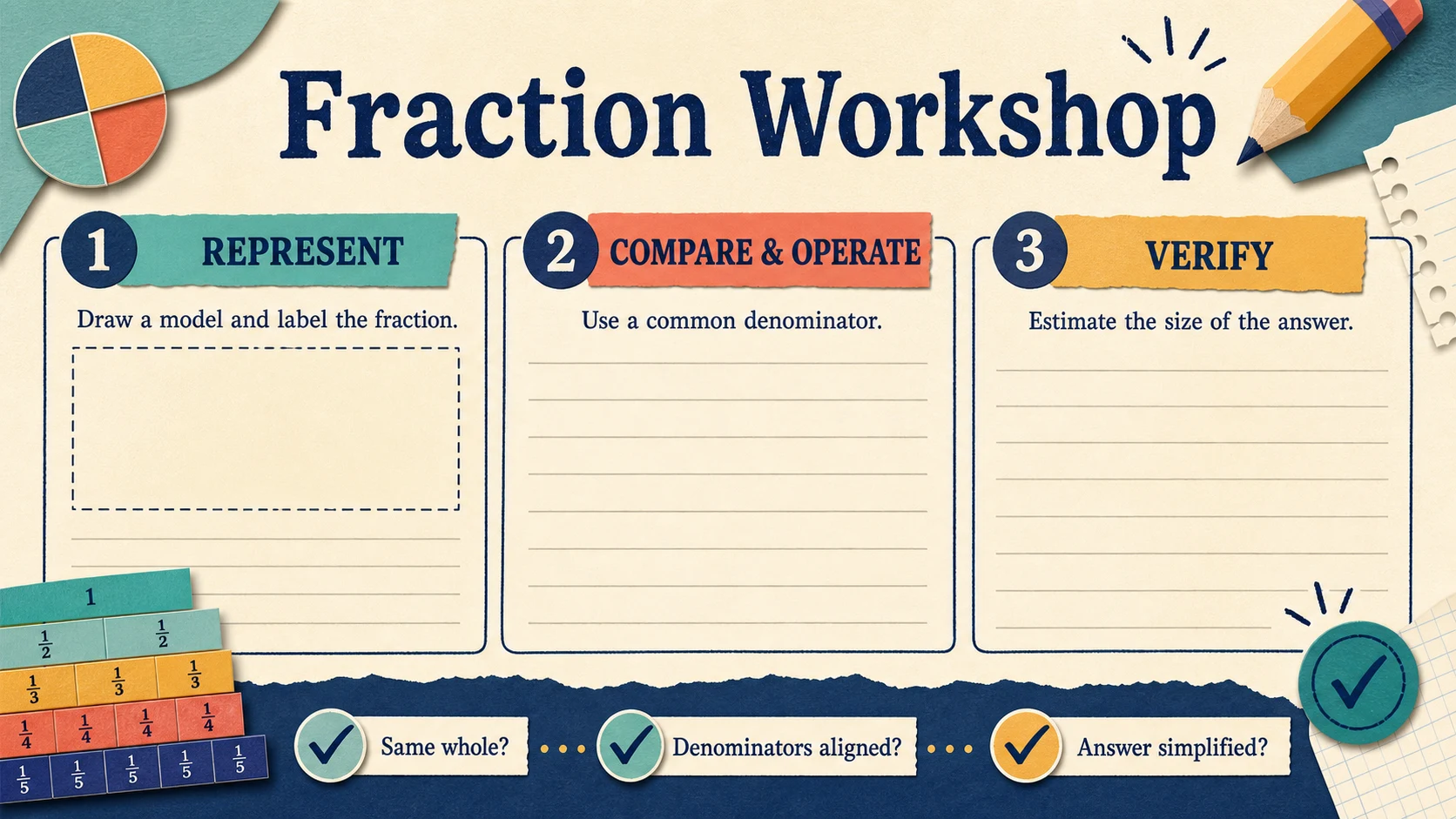
Use the fractions plan to alternate models, calculations, and review; repeated symbolic work alone may hide a denominator misconception.
Use conversation to expose word-problem decisions
A word problem combines language comprehension, mathematical modeling, operation selection, computation, and recording. Therefore, “wrong answer” is not a sufficiently precise observation.
Use this five-prompt conversation:
- “Tell the story without using the numbers.”
- “What quantities do we know?”
- “What are we trying to find?”
- “Build or draw the relationship.”
- “Which equation matches your model?”
Avoid keyword rules such as “left means subtract.” A word can occur in situations that require different operations. The catalogue guidance recommends understanding the action and relationship instead.
Checked example: model first, calculate second
“Sam has 8 stickers. Lee has 5 stickers. How many more stickers does Sam have?”
Match five of Sam’s stickers with Lee’s five. Three of Sam’s remain unmatched. The comparison equation is:
8 − 5 = 3
Check with the related addition fact:
5 + 3 = 8
This example belongs because the live kindergarten word-problem resource has 12 problems, while the subtraction description specifically identifies comparison as one meaning of subtraction. It tests the relationship between quantities, not merely whether the learner sees a subtraction keyword.
If the learner answers 13, ask for a retelling before discussing arithmetic. They may have combined the groups because they recognize both numbers but missed “how many more.” The next task should be another comparison with smaller quantities and a matching model—not a page of subtraction facts. If the learner chooses subtraction correctly but calculates 8 − 5 as 2, retain comparison problems and add counters or a number line.
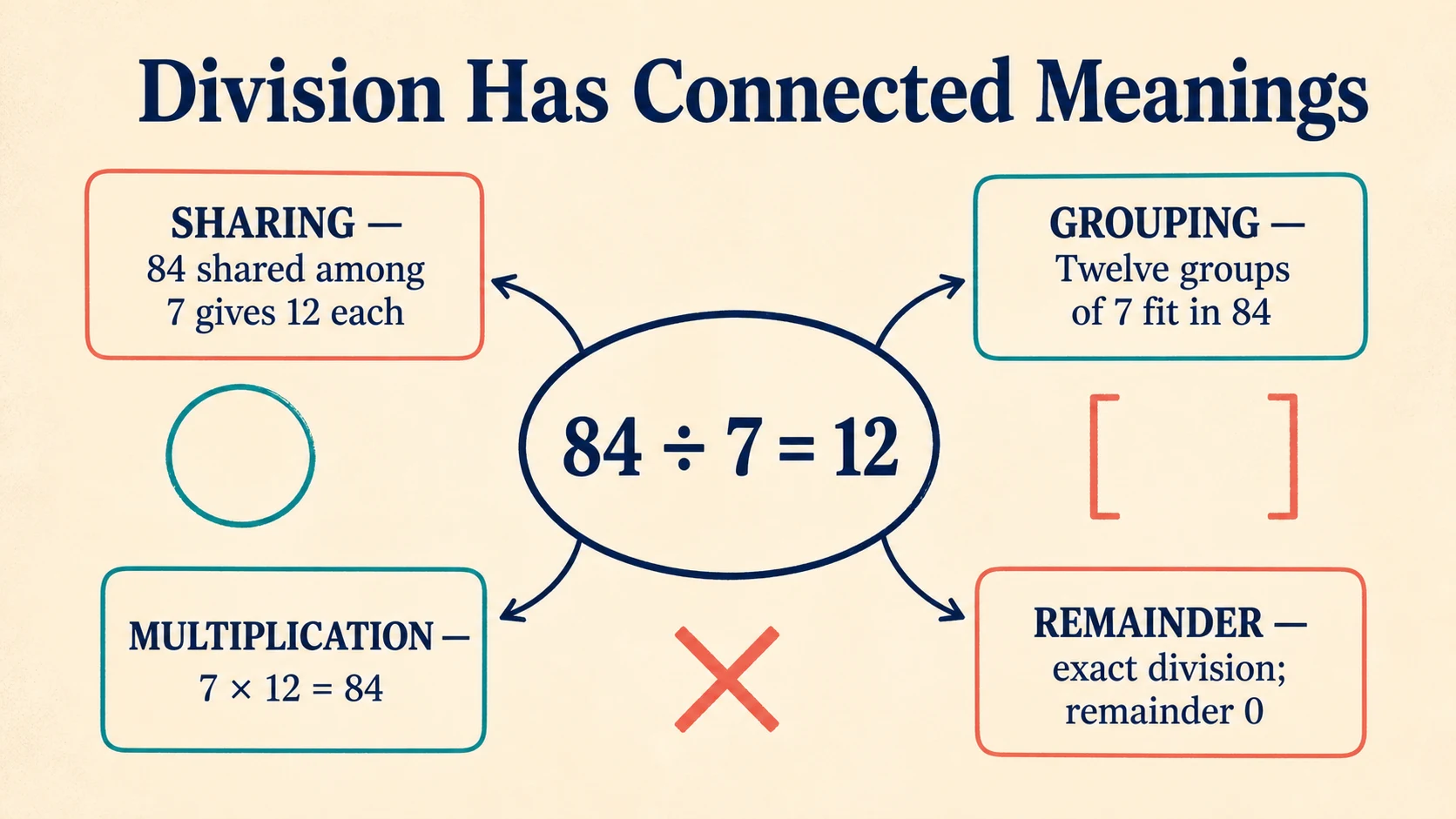
For third-grade division, distinguish equal-group and sharing models before asking for independent equations; the same quotient can arise from different stories.
Interpret errors before choosing the next sheet
Feedback should name what the learner did, test a possible explanation, and give one immediate revision. “You are close” and “Be careful” do not identify a mathematical action.
Use a three-column note after the session:
| Observed response | Quick check | Next sheet or support |
|---|---|---|
| Skips or recounts objects | Ask the learner to touch or move each object while saying one number | Keep the same counting range; use fewer, movable objects before pictures |
| Correct model, incorrect numeral | Ask the learner to say the quantity and choose between two written numerals | Keep the math target; reduce writing and include numeral matching |
| Correct facts, wrong operation in stories | Ask for a retelling and a drawing without calculating | Choose another sheet with one consistent story structure |
| Adds fraction denominators | Compare the answer with fraction strips or a number line | Return to equivalent parts and like-denominator models |
| Writes the larger digit minus the smaller in each column | Rebuild the number with base-ten blocks and trade one ten | Select fewer regrouping items with space to record trades |
| Counts mixed coins inaccurately | Have the learner identify each coin value before totaling | Separate coin recognition from mixed-coin counting |
| Stops being accurate late on the page | Recheck two early items after a break | Shorten the next session before changing the mathematical level |
These are instructional hypotheses, not diagnoses. One response does not establish a stable misconception. Look for the same pattern in more than one item and in a different representation.
Checked example: money reveals whether the issue is recognition or counting
Place one quarter, one dime, one nickel, and three pennies. Verify each value, then count from greatest to least:
25¢ + 10¢ + 5¢ + 3¢ = 43¢
A useful count-on sequence is 25, 35, 40, 41, 42, 43. The checked total is 43 cents.
This example belongs because the first-grade money resource has 20 problems and uses coin identification, mixed collections, price tags, and shopping contexts. It also demonstrates why errors need interpretation. Calling the nickel 10 cents is a recognition error; saying 25, 35, 40, 42, 43, 44 while counting three pennies is a one-to-one counting error. Those patterns require different next sheets.
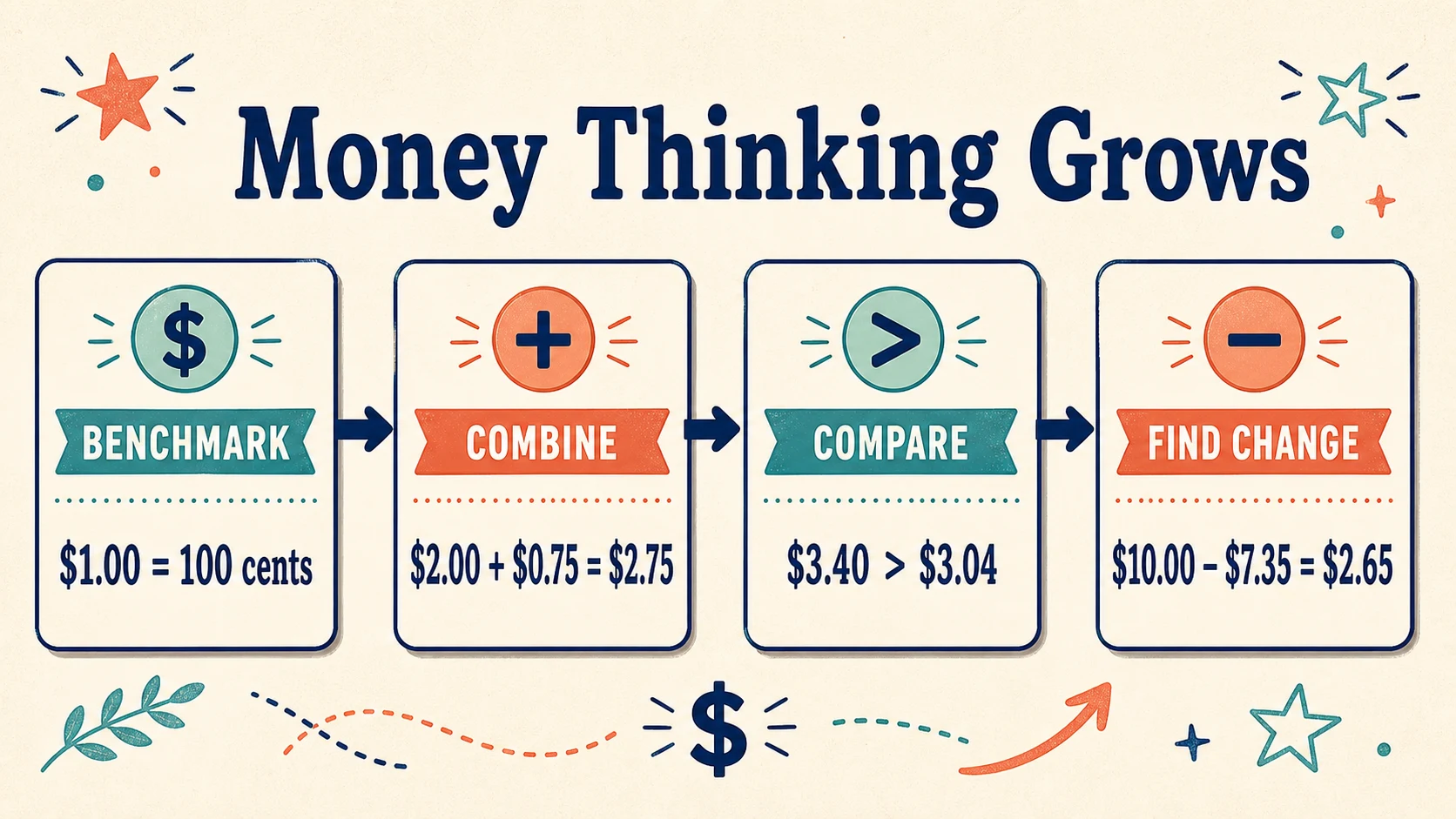
In third-grade money work, remove coin labels or counting supports only after the learner can explain the value and sequence used.
Adapt the workload without erasing the target
An adaptation preserves the mathematical decision while changing access, volume, or recording. Before altering a page, finish this sentence: “The learner still has to decide whether or how to ___.”
Useful adaptations include:
- Cover unused rows so only four items are visible.
- Cut or fold the page at the stopping point.
- Read directions and story text aloud while leaving operation choice to the learner.
- Replace drawn objects with movable counters, then return to the picture.
- Let the learner dictate an equation after building it.
- Supply a number line, ten frame, place-value chart, or coin-value reference.
- Enlarge clocks, diagrams, or response boxes.
- Alternate written responses with oral explanations.
- Use blank paper to isolate one item when visual density is distracting.
Avoid adaptations that supply the answer-producing decision. If the target is choosing an operation, do not underline a keyword and tell the learner what it “means.” If the target is recognizing coins, do not name every coin before the learner responds. If the target is equal partitioning, do not pre-draw all partition lines.
For ages three and four, prioritize brief adult-led oral, matching, manipulative, and movement work over desk work. A Pre-K counting page with 20 problems should function primarily as a source of prompts. Count three buttons by touching and moving each one, match a card showing 3, then take a movement break. The Pre-K Counting guide and free sheet can supply the visual prompt, but the adult-led object action should carry the session.
Match the next resource to the evidence
Do not automatically move “up” after correct answers or “down” after errors. Choose the next task according to what changed when support was added.
When to repeat, narrow, vary, or extend
Repeat the same task structure when the learner understood after one reminder and then completed similar items accurately. Change the numbers so the response cannot be recalled by position.
Narrow the task when multiple demands obscure the source of error. Separate coin identification from totaling, clock-hand identification from writing digital time, or story comprehension from calculation.
Vary the representation when an answer is correct but the reasoning is uncertain. Ask for counters after a written equation, a number line after fraction strips, or a comparison story after a removal story.
Extend the task when the learner answers accurately and explains the model without prompts. Extension should add a mathematical decision, not more of the same. For 6 + 3 = 9, ask, “What other two numbers make 9?” For 8 − 5 = 3, ask the learner to write a missing-part equation, 5 + __ = 8.
Pause and communicate with the classroom teacher when home practice repeatedly conflicts with the method or notation being taught, or when the learner cannot access the task even after the quantity, language, and response load are reduced. Bring specific work samples and observations rather than a diagnosis.
The Common Core mathematics standards can help adults understand how mathematical practice includes making sense of problems, using models, attending to precision, and explaining reasoning. They do not establish an individual placement from one worksheet. Local standards and instructional sequences may differ.
Keep clear boundaries around worksheet evidence
A worksheet can show what happened under particular conditions: time of day, wording, visual layout, available tools, adult prompts, and current energy. It cannot by itself establish mastery, a learning condition, motivation, or a grade placement.
Do not use the catalogue count as a reason to print more. The 61 free entry points and 1,098 variants increase choice; they do not prescribe dosage. Do not promise that completing a sequence will produce a particular outcome. Do not infer that a resource was reviewed or endorsed by IES or the Common Core authors. The authoritative sources cited here provide general instructional guidance, not assessments of WorksheetWise.
Also keep after-school work subordinate to essential routines. Stop when frustration prevents meaningful explanation, when physical needs are unmet, or when accuracy deteriorates because the session has run past its planned endpoint. Ending at the checkpoint is part of the instructional design.
Families coordinating several subjects can keep the same short-session boundary while changing the kind of conversation. The After-school Phonics Worksheets page is a separate subject route; its decoding decisions should not be treated as interchangeable with mathematical modeling. For school-day implementation or group instruction, use the Classroom Math Worksheets route instead.
Run tomorrow’s session from one observation
Choose one completed response from today and write a single factual note: “The learner built 8 and 5 correctly, added them, but could not model ‘how many more.’” That note makes tomorrow’s decision observable: select one comparison problem, provide two groups of counters, ask the learner to match them, and stop after the learner records and explains 8 − 5 = 3.
If no prior work sample exists, open the free deterministic worksheet generators, choose one math target, generate a page, and mark a stopping point after four items before the learner begins. Use the first two responses to decide whether the next session should repeat the structure, add a model, reduce the response load, or vary the representation.
Put it into practice
Use the guide with a real printable
Move from explanation to a short, observable practice task. Check the first item together, then adjust the next session from the learner's actual work.
Open the first free worksheetExplore a neighboring collection