What 1st Grade Fractions Means
For a first grader, fraction work should center on one idea: a whole can be divided into equal parts, and those equal parts can be named. A learner should be able to recognize a whole, decide whether it has been partitioned fairly, name halves and fourths, and explain that two halves or four fourths make the original whole.
The concise answer is this: begin with real objects and folded paper, move to pictures, and introduce fraction notation only when the learner can explain the equal parts. Choose practice from observed work. If the learner is still making unequal pieces, more symbols will not solve the problem.
The Common Core mathematics standards place first-grade fraction-related work within geometry: partitioning circles and rectangles into two and four equal shares, describing those shares with words such as halves, fourths, and quarters, and recognizing the full shape as two halves or four fourths. The standards also note an important boundary case: dividing a shape into more equal shares creates smaller shares.
Grade labels describe an intended practice level, not a promise that every local curriculum follows the same sequence. Local sequences differ, and an individual learner may need earlier concrete work or be ready for a carefully chosen extension.
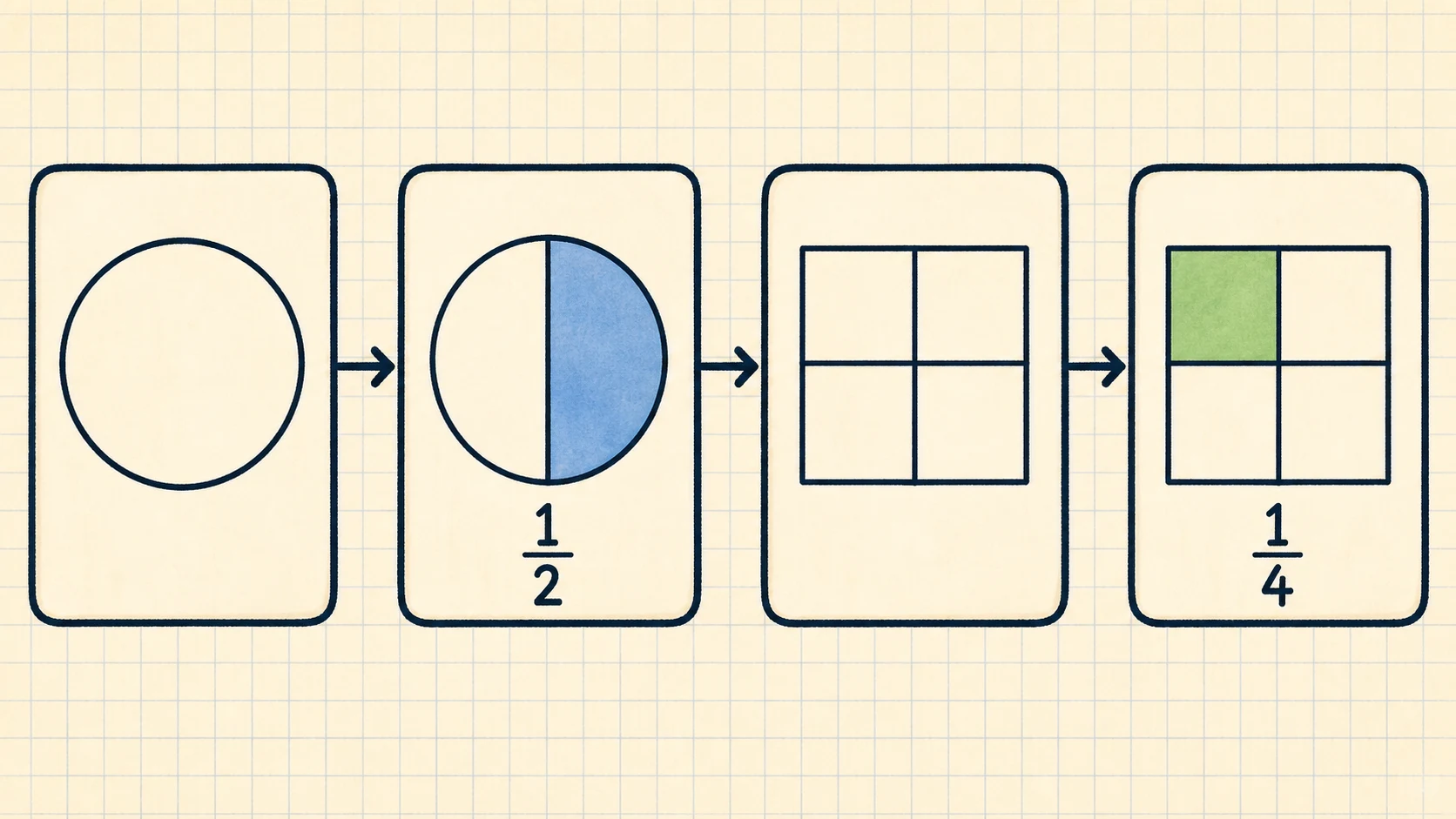
The central pathway runs from recognizing a whole to making, naming, and explaining equal shares.
Prerequisites to Check Before Teaching Fractions
Fraction activities can expose difficulties that are not really about fraction vocabulary. A quick prerequisite check helps identify what the learner needs.
Understanding a whole
Show one sheet of paper, one circle, and a pair of connected cubes. Ask, “What is the whole in this example?” The whole is the complete object or complete collection under discussion.
This matters because a half is always half of a specified whole. One apple can be a whole in one task, while a plate holding four apple slices can be the whole in another. Keep the whole fixed during early comparisons.
Matching and comparing parts
Before asking for halves, check whether the learner can:
- Match two shapes that are the same size and shape.
- Compare areas informally by covering or aligning pieces.
- Notice when one piece is visibly larger than another.
- Use words such as whole, part, same, equal, and different.
Exact measurement is not required for introductory work. The learner does need to understand that equal shares must represent the same amount of the whole.
Counting small groups accurately
A learner should be able to count two and four parts without skipping or counting one part twice. This supports statements such as “There are four equal parts” and “Three of the four parts are shaded.”
If counting is unreliable, reduce visual clutter and use touch-counting before interpreting the fraction model.
Following a partitioning direction
Try two simple directions:
- “Fold this strip so it has two equal parts.”
- “Draw one line to divide this rectangle into two equal parts.”
If the fold is imprecise, align the edges together. If the drawn line produces unequal areas, compare the pieces by tracing, folding, or cutting. Treat the result as information about what to teach next, not merely as a wrong answer.
A Grade-Appropriate Progression
The progression below keeps the first-grade emphasis on equal shares and shape models. It delays formal comparison, equivalence rules, number-line fractions, and operations until the underlying concepts are secure or the local curriculum specifically calls for them.
| Stage |
Learner action |
Useful model |
Evidence of readiness |
| 1. Identify the whole |
Points to the complete object or shape |
Paper sheet, cracker, rectangle |
Explains what counts as one whole |
| 2. Distinguish equal and unequal parts |
Sorts partitions into fair and unfair shares |
Folded paper, cut shapes |
Uses size, not just part count |
| 3. Make two equal shares |
Folds or partitions a whole |
Strips, circles, rectangles |
Produces and checks two equal parts |
| 4. Name halves |
Calls each of two equal parts one half |
Two-color paper model |
States that two halves make one whole |
| 5. Make four equal shares |
Partitions a whole into fourths |
Rectangles and circles |
Checks that all four shares are equal |
| 6. Name fourths or quarters |
Identifies each equal share |
Four-part shape models |
States that four fourths make one whole |
| 7. Describe selected shares |
Names one half, one fourth, or several fourths in words |
Shaded models |
Counts both equal parts and selected parts |
| 8. Explain share size |
Compares partitions of the same-size whole |
Matched paper strips |
Explains why fourths are smaller than halves |
| 9. Work independently |
Solves a short mixed set and explains one answer |
Pictures and simple notation |
Maintains accuracy without prompts |
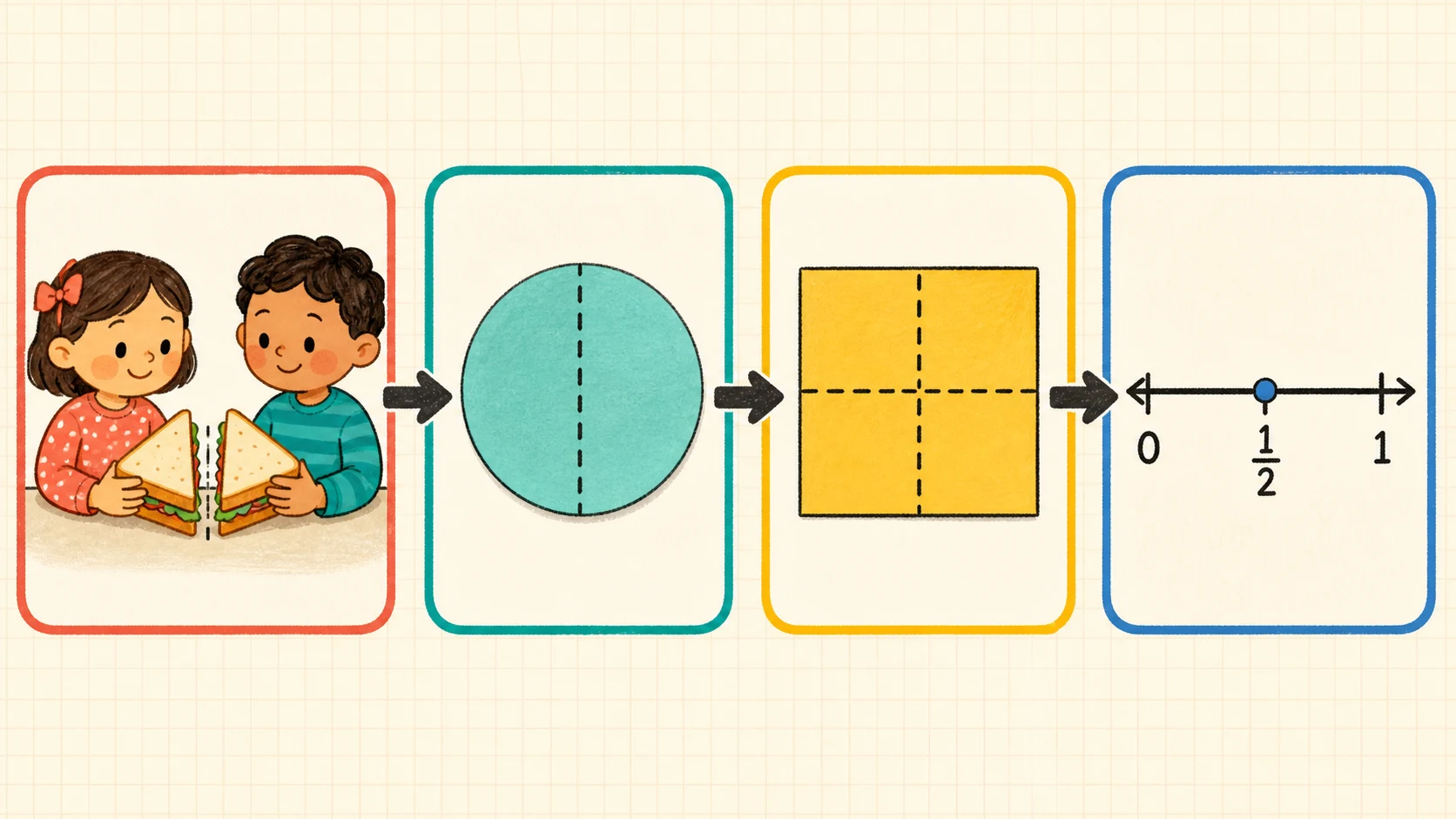
Each stage adds one demand while retaining the requirement that shares be equal.
Do not move forward solely because the learner completed one page. Look for stable explanations across differently shaped examples. A learner who recognizes halves only when a circle has a vertical line may be remembering a picture rather than understanding the concept.
Concrete and Visual Models That Clarify the Skill
The catalogue guidance emphasizes concrete and visual fraction models before symbolic notation. For first grade, paper folding, fraction circles, and fraction bars are especially useful because the learner can see or physically check whether the shares are equal.
The IES guide on teaching mathematics to young children provides broader instructional framing for purposeful mathematics teaching, progress monitoring, and helping children connect mathematical ideas to representations. It does not evaluate WorksheetWise materials or prescribe this exact lesson sequence.
Paper folding
Start with identical rectangular strips. Ask the learner to fold one strip into two equal parts and another into four equal parts. Aligning the edges gives an immediate check.
Open the strips and trace the fold lines. Label the parts with words first:
- each of two equal parts: one half;
- each of four equal parts: one fourth or one quarter.
Paper folding is useful because the learner creates the partition instead of merely viewing it.
Fraction circles and rectangles
Circles are familiar, but they can create a misleading shortcut: a learner may assume any line through a circle makes halves. Use examples in which the line is off-center so the two regions are unequal.
Rectangles allow several valid partitions. A rectangle can be split into two equal parts vertically, horizontally, or diagonally. Showing more than one arrangement helps separate “equal area” from “pieces that look identical in orientation.”
Fraction bars
Place two equal-length bars together. Divide one into halves and the other into fourths. The wholes must be the same length for the comparison to be valid.
Ask:
- Which bar has more parts?
- Which bar has smaller parts?
- How many fourths cover the same length as one half?
For first grade, the explanation matters more than writing an equivalence equation.
Collections as a cautious extension
A set can also be treated as a whole. Half of four counters is two counters when the four counters are divided into two equal groups. However, set fractions add a new demand: the learner must track equal groups rather than equal areas. Introduce this only after shape partitioning is secure.
Fully Checked Worked Examples
Use a repeatable sequence: identify the whole, count all parts, check that the parts are equal, identify the requested share, and explain the answer.
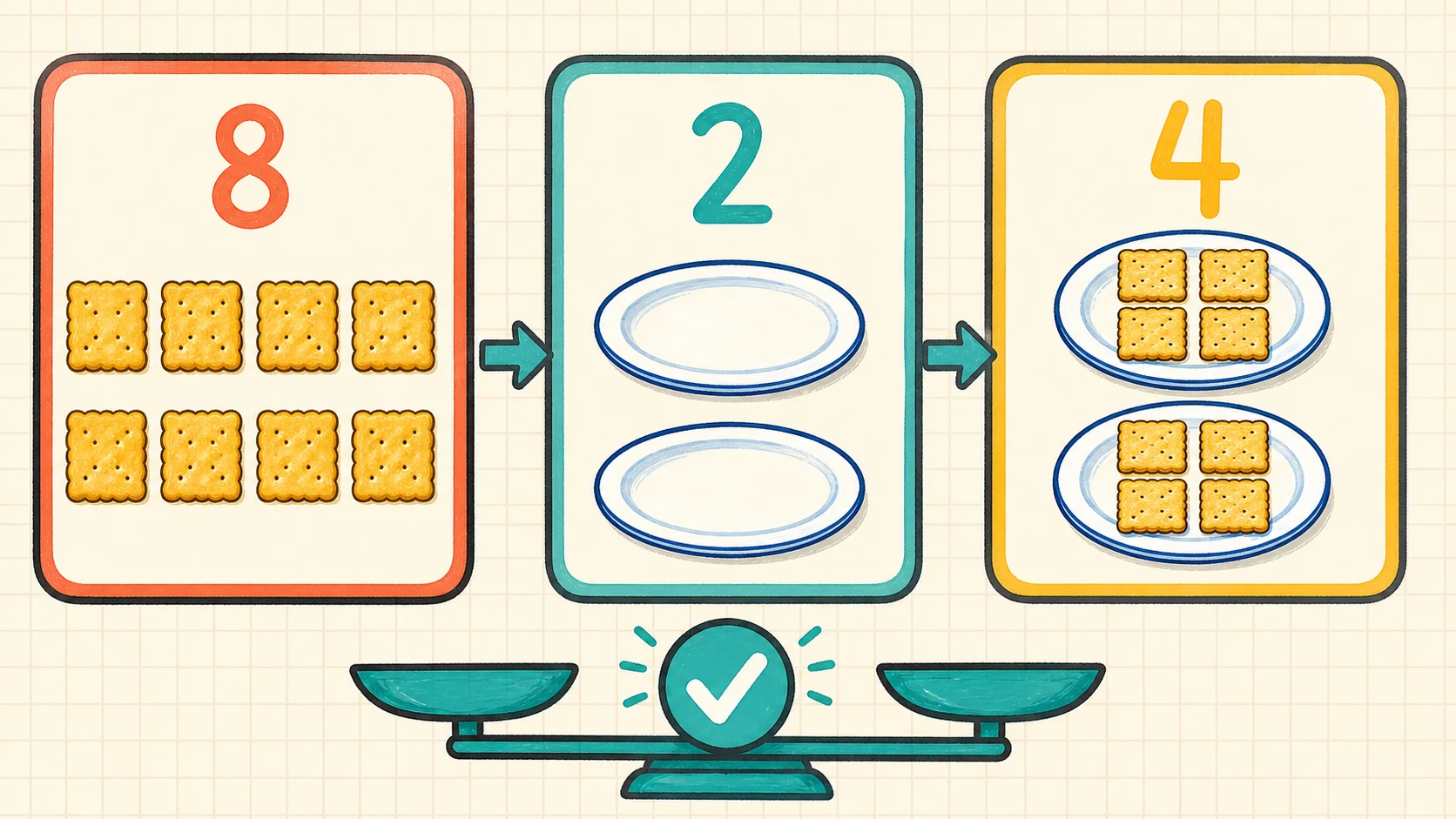
The answer is justified by the whole, the number of equal parts, and the selected share.
Example 1: Is the rectangle divided into halves?
Suppose a rectangle is divided down the center into two congruent smaller rectangles.
- The large rectangle is one whole.
- It has two parts.
- The two parts cover equal amounts of the whole.
- Therefore, each part is one half.
- Together, the two halves make the whole rectangle.
Checked answer: Yes. The rectangle is divided into halves because it has exactly two equal shares.
Boundary comparison: if the dividing line is close to one side, there are still two parts, but they are not halves because they are unequal.
Example 2: Name one shaded part
A circle is divided into four equal regions, and one region is shaded.
- The circle is the whole.
- There are four parts in all.
- The four parts are equal.
- One of those equal parts is shaded.
Checked answer: The shaded region is one fourth, also called one quarter, of the circle.
A response of “one out of four” describes the count but does not yet confirm that the learner understands the equal-share condition. Ask why the parts must be equal.
Example 3: Describe three selected shares
A rectangle is divided into four equal vertical strips. Three strips are colored blue.
- The whole is the complete rectangle.
- It has four equal parts.
- Three equal parts are blue.
- Each individual part is one fourth.
- The blue area consists of three fourth-size shares.
Checked answer: Three fourths of the rectangle is blue.
To keep the task grade-appropriate, accept a clear verbal explanation. Symbolic notation such as 3/4 may be introduced if it is already part of the learner’s instruction, but notation should not replace reasoning.
Example 4: Which shares are smaller?
Two identical paper strips represent equal-size wholes. Strip A is divided into two equal parts. Strip B is divided into four equal parts.
- The wholes are the same size.
- Strip A shares the whole between two parts.
- Strip B shares the same-size whole among four parts.
- Four equal shares must each be smaller than two equal shares of that same whole.
Checked answer: The fourths are smaller than the halves.
This conclusion depends on using equal-size wholes. A fourth of a very large sheet can be larger than a half of a small sheet.
Example 5: Find the faulty partition
Three squares are shown:
- Square A has a centered vertical line.
- Square B has a centered horizontal line.
- Square C has a vertical line close to its left edge.
Each square has two regions.
- Count alone cannot decide whether the regions are halves.
- In A, the regions have equal area.
- In B, the regions have equal area.
- In C, one region is smaller than the other.
Checked answer: A and B show halves. C does not.
This example confirms that position and orientation can change while the equal-share relationship stays the same.
Example 6: Half of a small collection
Four counters form the whole collection. They are separated into two groups with two counters in each group.
- There are four counters in the whole.
- There are two groups.
- Each group contains the same number of counters.
- Each group is one of two equal shares.
Checked answer: One half of the four-counter collection is two counters.
If the groups contain one and three counters, they are two groups but not equal groups, so neither group represents one half of the collection.
A Short, Repeatable Lesson Routine
A compact lesson can be more informative than a long page of repetitive items. The following routine is an instructional suggestion, not a universal timetable. Adjust its length according to attention, accuracy, and the learner’s explanations.
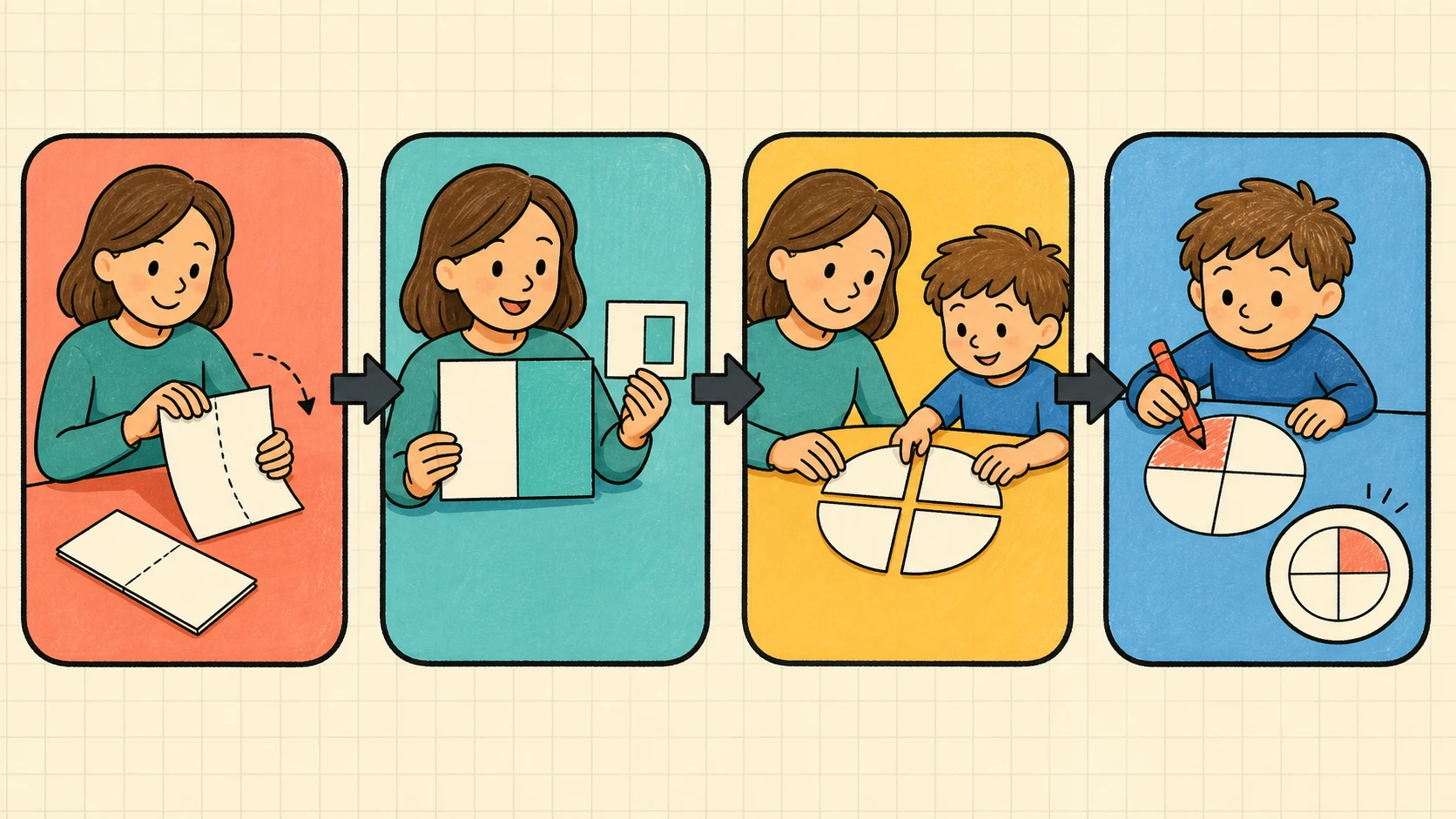
The routine moves through retrieval, modeling, guided explanation, independent work, and review.
1. Retrieve one known idea
Show a whole paper strip and ask, “What is the whole?” Then show two equal pieces and ask, “How could we check that these are equal?”
Keep this portion brief. Its purpose is to reveal whether yesterday’s concept is available today.
2. Model one new idea
Demonstrate one fold, drawing, or comparison. Narrate only the decisive features: “I see two parts. I checked that they are equal. Each part is one half.”
Include a near-miss, such as two unequal sections, so the learner sees why counting parts is insufficient.
3. Solve together
Let the learner handle the paper or point to the picture. Ask for a complete explanation:
- What is the whole?
- How many parts are there?
- Are they equal?
- What is each part called?
Prompt only as much as needed. Remove prompts on the next example.
4. Try a short independent set
Use three to six items with purposeful variation. Mix valid halves, invalid partitions, fourths, and differently oriented shapes. One carefully chosen item of each type reveals more than many nearly identical pictures.
5. Close with an explanation
Ask the learner to correct a false statement such as, “These are halves because there are two pieces.” A secure response adds that the two pieces must be equal.
Record the specific evidence: “Named halves accurately but accepted one unequal partition,” rather than “Needs more fractions.”
Selecting Practice From the Learner’s Work
The 1st Grade Math hub and the focused fractions topic guide can help adults locate related practice. Select a resource because its representations and demands match the next instructional step, not simply because its title contains the grade and topic.
When to choose concrete practice
Choose folding, cutting, matching, or covering when the learner:
- overlooks unequal shares;
- cannot identify the whole;
- uses part names by guessing;
- explains an answer only by counting pieces;
- succeeds with one familiar picture but not a changed orientation.
Concrete work should still include spoken reasoning. Handling paper without discussing the mathematical relationship can become a craft activity rather than fraction instruction.
When to choose picture practice
Use clear shape diagrams when the learner can make equal shares physically but needs to recognize them without touching or folding. Include circles and rectangles, centered and differently oriented partitions, and both examples and nonexamples.
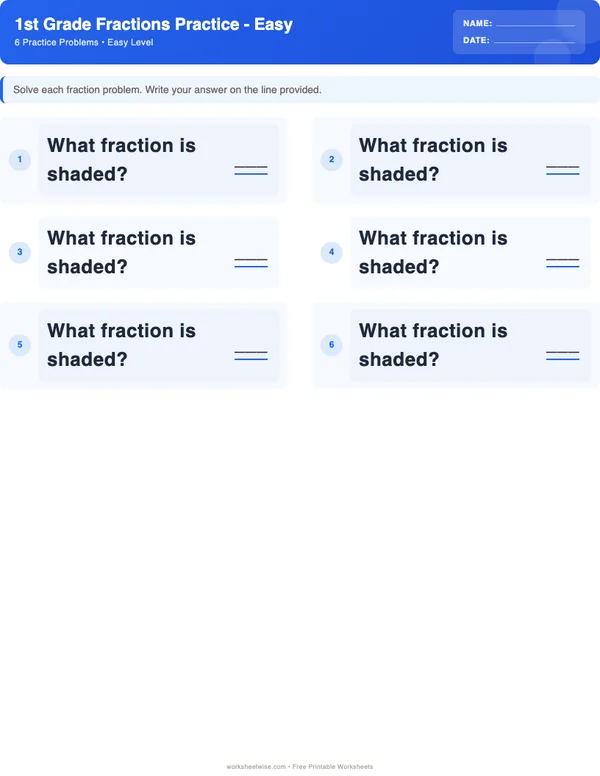
The free 1st Grade Fractions worksheet contains six easy-level exercises and has a separate answer key. Its catalogue description includes identification, comparison, equivalence, and operations. Those demands extend beyond the narrow first-grade partitioning emphasis in some sequences, so inspect each exercise and assign only items the learner has been prepared to solve.
When to introduce notation
Introduce 1/2 and 1/4 after the learner can reliably explain halves and fourths using objects and pictures. Say what each notation represents in the current model. Do not teach a numerator-and-denominator rule as a substitute for understanding equal shares.
If a task includes broader skills such as formal equivalence or fraction operations, check the local sequence and the learner’s preparation. The catalogue covers fractions across several grades, so not every listed fraction skill is automatically an appropriate first-grade target.
Differentiation Without Changing the Core Idea
Differentiation should change the support, representation, or response demand while preserving the mathematical goal.
For a learner needing more support
Use one whole at a time, high-contrast colors, and partitions with clear boundaries. Let the learner fold before judging a drawing. Begin with halves and wait to introduce fourths until equal sharing into two parts is stable.
Offer sentence frames:
- “The whole is ___.”
- “There are ___ equal parts.”
- “Each part is called ___.”
- “This is not a half because ___.”
The IES guide for assisting students struggling with mathematics offers high-level guidance concerning systematic instruction, mathematical language, representations, and attention to learner progress. It does not provide child-specific medical guidance or certify any WorksheetWise resource.
For a learner ready for more challenge
Keep the concept within reach while increasing reasoning:
- Ask for two different ways to divide a rectangle into fourths.
- Show equal shares with different shapes and ask whether they represent the same fraction of their respective wholes.
- Ask the learner to create an incorrect example and explain the error.
- Compare halves and fourths only when the wholes are equal in size.
- Introduce a simple set model after shape models are secure.
Avoid advancing automatically to fraction arithmetic. A richer explanation of equal shares is a more useful extension than premature procedures.
Common Errors and Diagnostic Responses
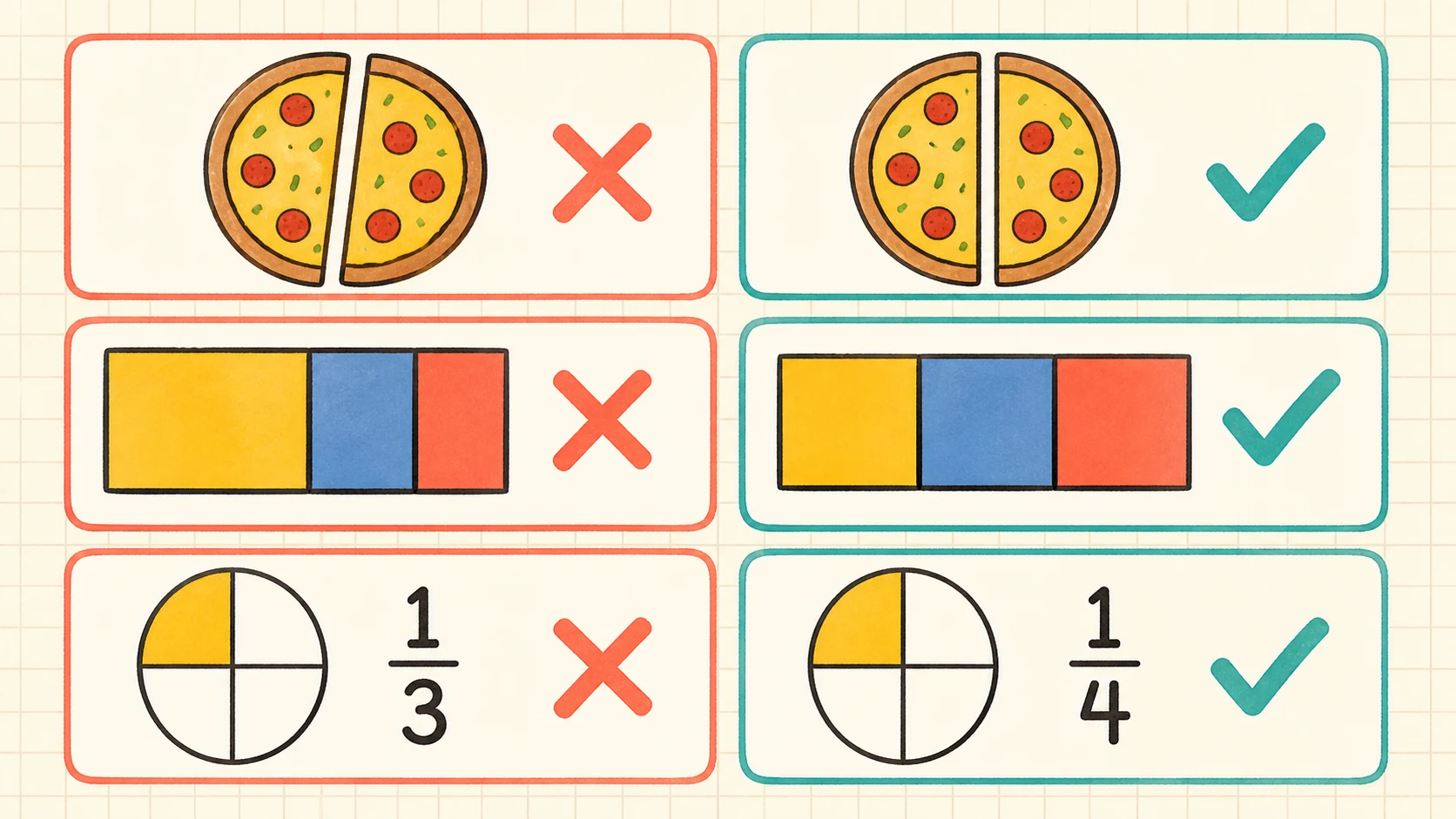
Each response targets the idea revealed by the error instead of merely repeating the question.
| Observed response |
Likely issue to investigate |
Teaching response |
| Calls any two pieces halves |
Counts parts but ignores equality |
Fold, cut, or overlay the pieces to compare them |
| Calls the larger of two unequal pieces a half |
Treats half as “a large piece” |
Contrast equal and unequal two-part partitions |
| Says fourths are larger because four is larger than two |
Applies whole-number thinking to part names |
Compare halves and fourths of identical strips |
| Rejects horizontal halves after seeing vertical halves |
Associates the word with one visual layout |
Rotate the whole and show several valid partitions |
| Counts three shaded parts but says “four fourths” |
Confuses all parts with selected parts |
Ask separately: “How many in all?” and “How many selected?” |
| Names one fourth when the whole is unclear |
Does not track the referent whole |
Outline or point to the whole before naming the share |
| Writes a symbol correctly but cannot explain it |
Relies on a memorized pattern |
Return to a model and request a full verbal explanation |
| Makes four parts of different sizes |
Interprets partitioning as drawing any four regions |
Fold first, then compare and trace equal shares |
Do not diagnose from one error alone. Repeat the idea with a changed shape or material. If the learner corrects the response independently, the first error may have been inattention. If the same reasoning persists across examples, reteach the underlying concept.
Monitoring Progress and Deciding When to Move On
Monitor both answers and explanations. A simple record can include the date, model used, prompt level, result, and one quotation or paraphrase of the learner’s reasoning.
Look for four forms of evidence:
- Recognition: identifies halves and fourths in several orientations.
- Construction: makes two or four equal shares.
- Rejection: explains why unequal partitions do not show halves or fourths.
- Transfer: applies the idea to a new shape without copying a familiar layout.
A practical readiness check might contain six items:
- identify the whole;
- choose a valid halves model;
- reject an unequal two-part model;
- name one part of a four-equal-part model;
- explain why fourths are smaller than halves of an equal-size whole;
- partition a rectangle into four equal shares.
This is an instructional checkpoint, not a standardized assessment. If the learner answers five items correctly but misses the unequal partition, reteach equality rather than repeating the entire sequence. If performance changes sharply when prompts disappear, continue guided-to-independent transitions.
A Two-Week Practice Plan
This plan assumes brief sessions on ten practice days. It is a flexible example, not a universal timetable. Pause, repeat, or shorten sessions in response to observed work.
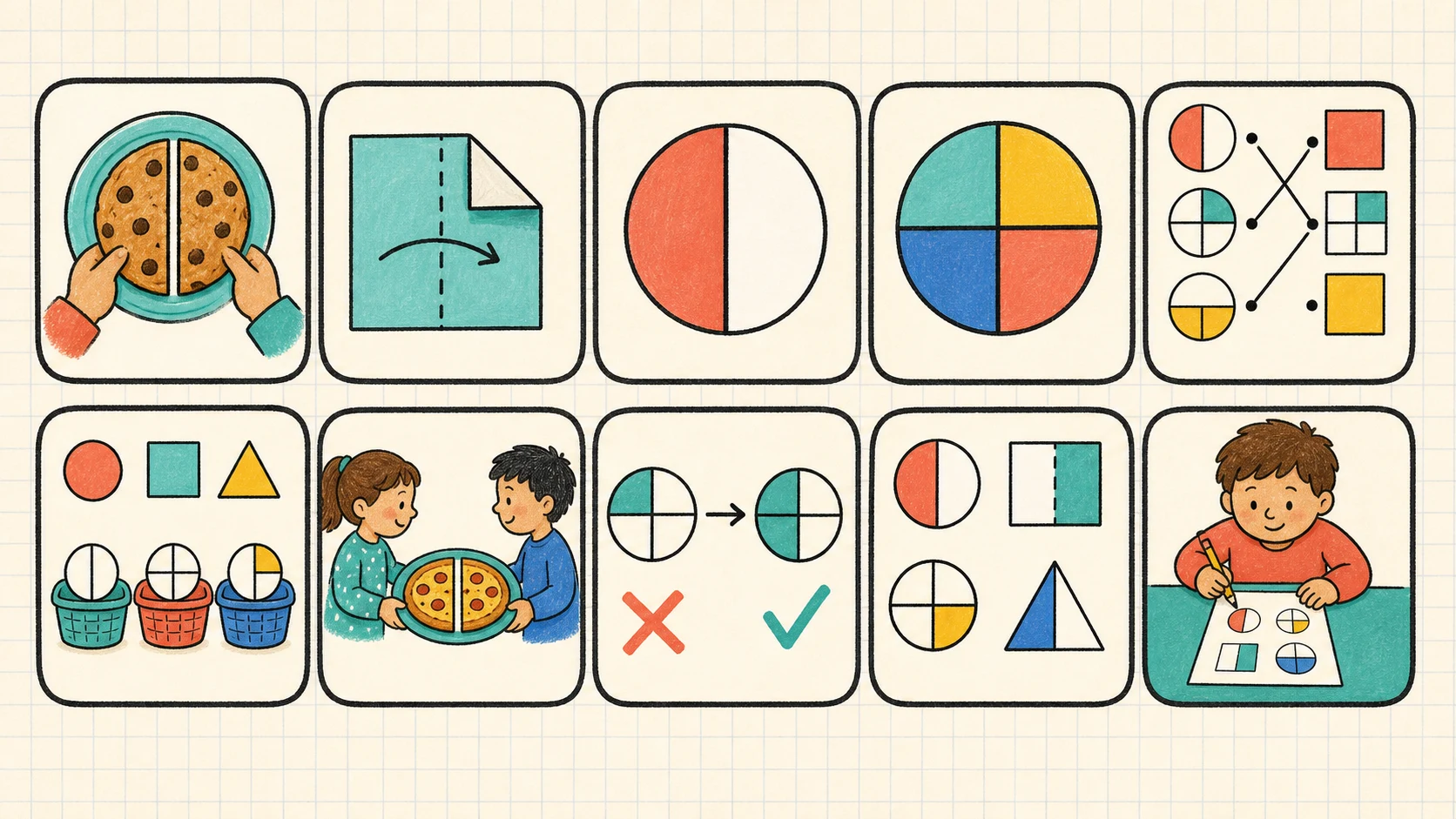
New representations are introduced gradually, with explanation and review built into each week.
| Day |
Main focus |
Suggested activity |
Evidence to record |
| 1 |
Identify the whole |
Sort examples of single wholes and collections |
Points to and names the whole |
| 2 |
Equal versus unequal |
Sort two-part shapes; justify each choice |
Mentions equal size |
| 3 |
Make halves |
Fold strips and rectangles into two equal shares |
Aligns edges and names halves |
| 4 |
Recognize varied halves |
Use vertical, horizontal, and diagonal partitions |
Generalizes across orientations |
| 5 |
Review halves |
Complete four mixed items and explain one error |
Works with fewer prompts |
| 6 |
Make fourths |
Fold identical strips twice to create four shares |
Counts four equal parts |
| 7 |
Recognize fourths |
Sort valid and invalid four-part models |
Rejects unequal partitions |
| 8 |
Halves versus fourths |
Compare identical strips divided into two and four |
Explains why fourths are smaller |
| 9 |
Mixed description |
Name one half, one fourth, and three fourths in pictures |
Separates total parts from selected parts |
| 10 |
Independent checkpoint |
Use six varied items, then revisit one error |
Shows recognition, construction, and explanation |
If Day 3 reveals persistent unequal folds, repeat the physical comparison before moving to fourths. If Day 8 is easy and explanations are clear, add a learner-created example rather than adding a large volume of repetitive questions.
The 1st Grade Fractions Worksheet Pack contains 18 worksheets and is listed at $4.79 in the supplied catalogue. A pack offers more practice choices, but the number of pages should not determine pacing. Select only the page or items that fit the learner’s current stage.
Boundaries and Limitations
First-grade fraction instruction is foundational. It does not need to cover the entire catalogue’s broader fraction progression. Number-line fractions, formal equivalence, mixed numbers, unlike-denominator calculations, and fraction multiplication or division belong to later stages in the supplied standards sequence.
A learner may encounter enrichment or a different local curriculum, but that does not make every advanced worksheet an appropriate next step. Inspect the actual task. Ask whether it requires a concept that has been taught and whether the learner can connect the notation to a concrete or visual model.
Worksheets can provide structured practice and convenient answer checking. They cannot independently reveal every reason for an error, replace dialogue, or guarantee mastery. An answer key confirms a result; the learner’s explanation shows how the result was reached.
This guide also does not provide medical guidance, certify instruction, guarantee outcomes, or claim comprehensive alignment with every school or jurisdiction. For curriculum decisions, use local requirements alongside direct evidence from the learner’s work.
The Next Useful Action
Begin with one paper strip and ask the learner to make two equal shares, name each share, and explain how the fold proves equality. Then try one off-center partition as a boundary case.
If the learner handles both tasks accurately, preview the free standard easy fractions worksheet and choose only the exercises that match the concepts already taught. If the learner still accepts unequal shares, stay with folding and visual comparison for another session. For custom follow-up practice, use the free worksheet generators to keep the item set short and focused on the specific evidence you need next.