Subtraction teaches students to find differences, compare quantities, and understand the inverse relationship with addition. Instruction begins with taking away objects within 5 and 10, develops through subtraction within 20 using strategies like counting back and using related addition facts, and progresses to multi-digit subtraction with regrouping (borrowing). Students learn that subtraction answers three types of questions: take-away, comparison (how many more/fewer), and missing addend. These worksheets provide systematic practice across all subtraction concepts with visual models and word problems.
Represent and solve subtraction problems using objects, drawings, and equations; fluently subtract within 5 (K) and within 20 (1-2); subtract within 100 using strategies based on place value (1-2); fluently subtract within 1000 using strategies and algorithms (2-3); fluently subtract multi-digit whole numbers using the standard algorithm (4).
The 1st Grade Subtraction Worksheet Pack includes every current theme and all three difficulty levels—18 worksheets and 18 answer keys in one private ZIP.
1st Grade Subtraction is the study of finding what remains, finding the difference between quantities, and finding a missing part—usually with numbers within 20. A learner should connect objects, drawings, spoken situations, and equations rather than treat subtraction as a page of isolated facts.
A useful sequence is:
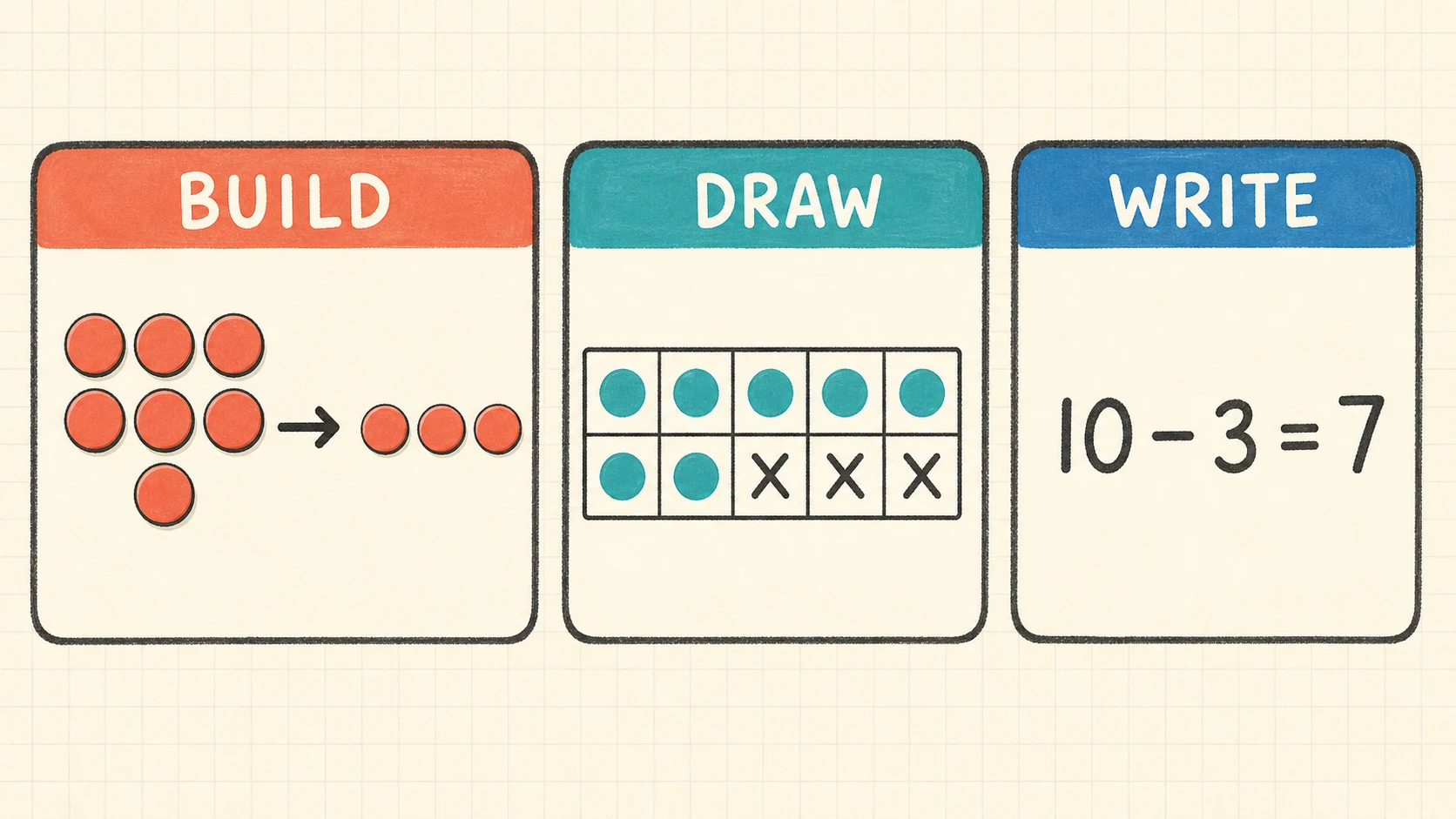
Act out subtraction with objects.
Draw or mark what happened.
Write a matching equation.
Explain the answer in words.
Develop efficient strategies for facts within 20.
Apply those strategies to varied word problems.
The goal is not simply fast answers. A learner needs to recognize when subtraction fits a situation, understand what the numbers mean, and check whether an answer is reasonable.
Subtraction connects quantities, situations, representations, equations, and addition facts.
Grade labels describe the intended practice level, not a fixed prescription for every child. Local curricula and instructional sequences differ. The learner’s observed work should determine whether to move ahead, stay with a model, or return to an earlier skill.
The Common Core State Standards for Mathematics place first-grade attention on representing and solving addition and subtraction problems, understanding the relationship between the operations, and working toward fluency within 20. This provides broad instructional context; it does not mean that every WorksheetWise resource covers every standard or that every school follows the same timetable.
Prerequisites to Check Before Teaching
Subtraction becomes much easier when its supporting number ideas are secure. Before expecting independent written work, check whether the learner can do the following:
Count a set accurately, touching or moving each object once.
Recognize that the last number counted tells how many objects are in the set.
Read and write the numerals used in the activity.
Compare two small groups and identify which has more, fewer, or the same number.
Count forward from a number other than 1.
Decompose a number into parts, such as seeing 8 as 5 and 3.
Understand that an equal sign means “the same amount as.”
Join two parts to make a whole using addition.
These are diagnostic checks, not entrance tests. If a learner can solve 7−2 with counters but cannot read the equation, the subtraction concept may be stronger than the symbol knowledge. If the learner loses track while counting six counters, counting accuracy—not subtraction—may be the immediate teaching need.
A brief readiness check
Place seven counters in a row and ask the learner to count them. Cover three and ask how many can still be seen. Then uncover the counters and ask how many were hidden.
Observe the method:
Does the learner know there are seven without recounting after the cover is placed?
Does the learner count only the visible counters?
Can the learner connect “seven, hide three, four remain” to 7−3=4?
Can the learner check with 4+3=7?
A learner who needs to recount everything is not failing. That behavior indicates that maintaining the whole and its parts needs more concrete practice.
The IES guide on teaching mathematics to young children supports broad practices such as using progressions, monitoring children’s mathematical understanding, and helping them connect representations. Those recommendations guide the instructional approach here; they are not an evaluation of this guide or its worksheets.
A Grade-Appropriate Subtraction Progression
The following progression helps an adult select the next useful task. It is not a universal calendar.
Stage
Main understanding
Suitable representation
Evidence of readiness to continue
Take away within 5
Removing objects changes the quantity
Counters, toys, fingers
Acts out and states what remains
Take away within 10
An equation records the action
Objects, crossed-out drawings
Matches a model to an equation
Compare quantities
Subtraction can find a difference
Matched rows, towers, ten-frames
Explains which group has more and by how many
Find a missing part
The unknown is not always the amount left
Covered counters, part-part-whole mat
Finds the missing part and checks with addition
Use strategies within 20
Known facts can replace counting every object
Ten-frames, number paths, equations
Chooses and explains a workable strategy
Solve mixed situations
The story determines the operation
Drawings, diagrams, equations
Identifies the quantities and explains the answer
Build independence
Accuracy and explanation continue without a supplied model
Short mixed practice
Solves, checks, and corrects errors independently
Move forward when the learner’s work shows understanding, not merely because a page is complete.
Three subtraction situations
First graders should encounter at least three meanings of subtraction.
Removal: There are 9 crackers. A child eats 3. How many remain? The amount changes because part of the group is removed.
Comparison: One tower has 9 cubes and another has 6. How many more cubes are in the taller tower? Neither group is removed; subtraction measures the difference.
Missing part: A box holds 10 crayons when full. It currently has 7. How many more crayons are needed? The total and one part are known, so the other part must be found.
A learner can calculate familiar take-away problems correctly and still struggle with comparison or missing-part situations. Teach the meanings explicitly instead of assuming that one type automatically transfers to the others.
Concrete and Visual Models That Clarify the Mathematics
Models should reveal the structure of a problem. They are most useful when the learner can explain what each object, mark, or movement represents.
Movable objects
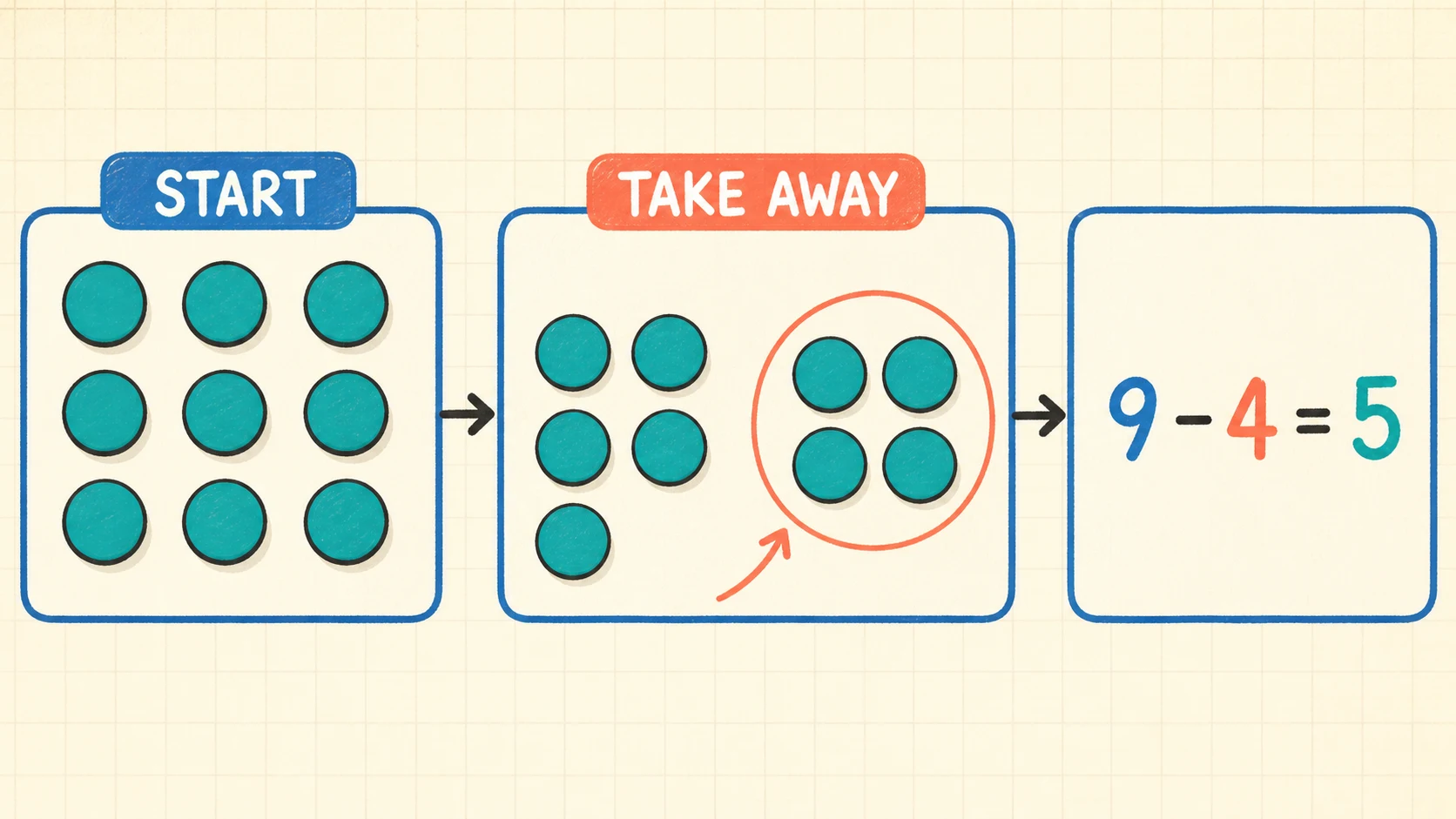
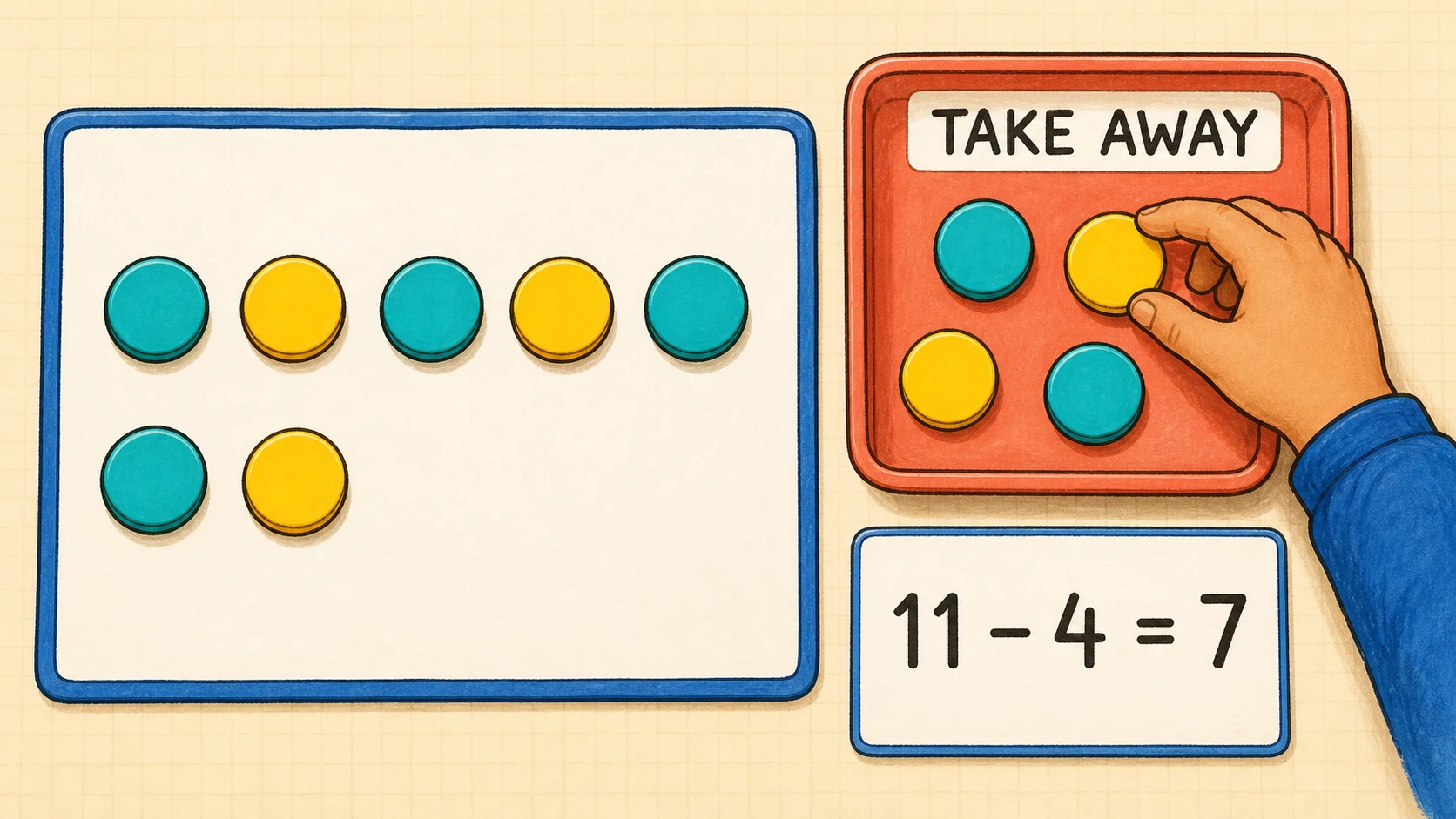
Counters, connecting cubes, buttons, and small blocks work well for take-away situations. Start with the whole set, remove the stated part, and count what remains.
For 8−3:
Make a group of eight counters.
Move three counters away.
Count the five still in the group.
State, “Eight minus three equals five.”
Put the groups together again to verify that 5+3=8.
Keep the removed objects visible at first. This makes the whole and both parts available for discussion.
Drawings and crossed-out pictures
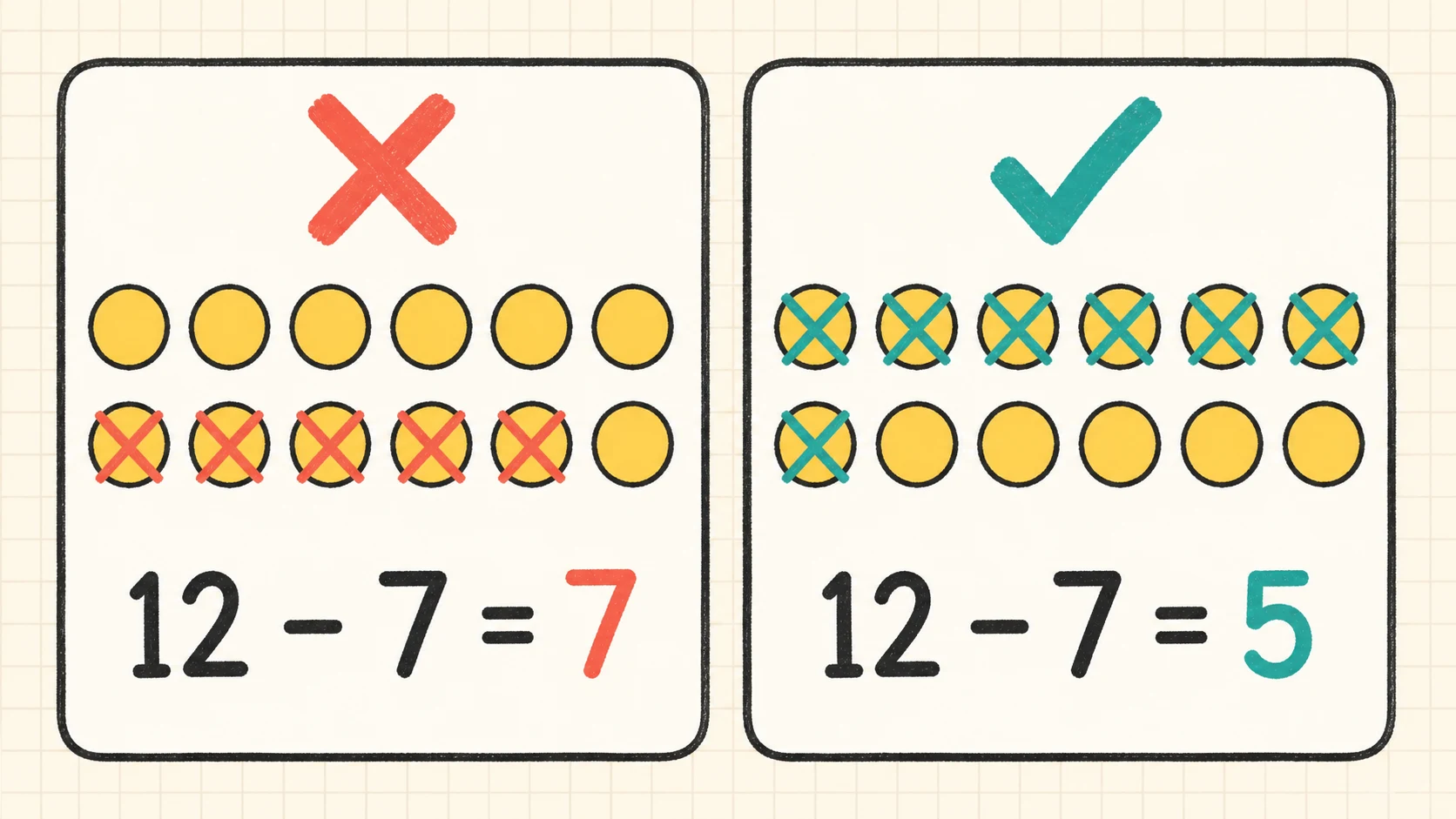
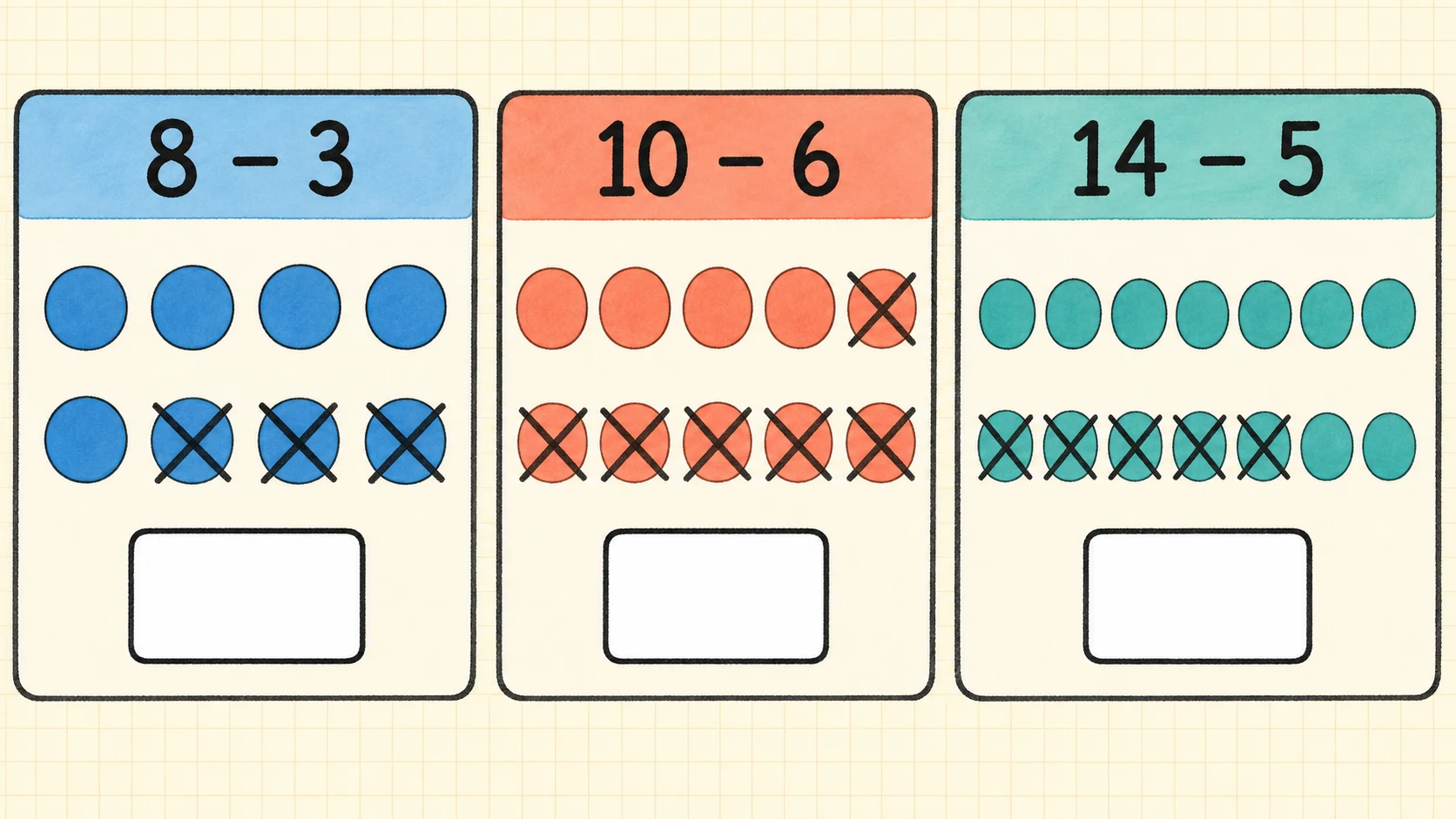
A learner can draw eight circles, cross out three, and count five uncrossed circles. This is a useful bridge between physical objects and equations.
Watch for decorative drawing that overwhelms the mathematics. Quick circles, dots, or tally-like marks are sufficient. If the child spends most of the lesson drawing detailed birds, supply simple printed marks or return to counters.
Ten-frames
A ten-frame highlights relationships to 5 and 10. To solve 10−6, fill the frame, remove six counters, and observe the four empty or remaining spaces according to the chosen action.
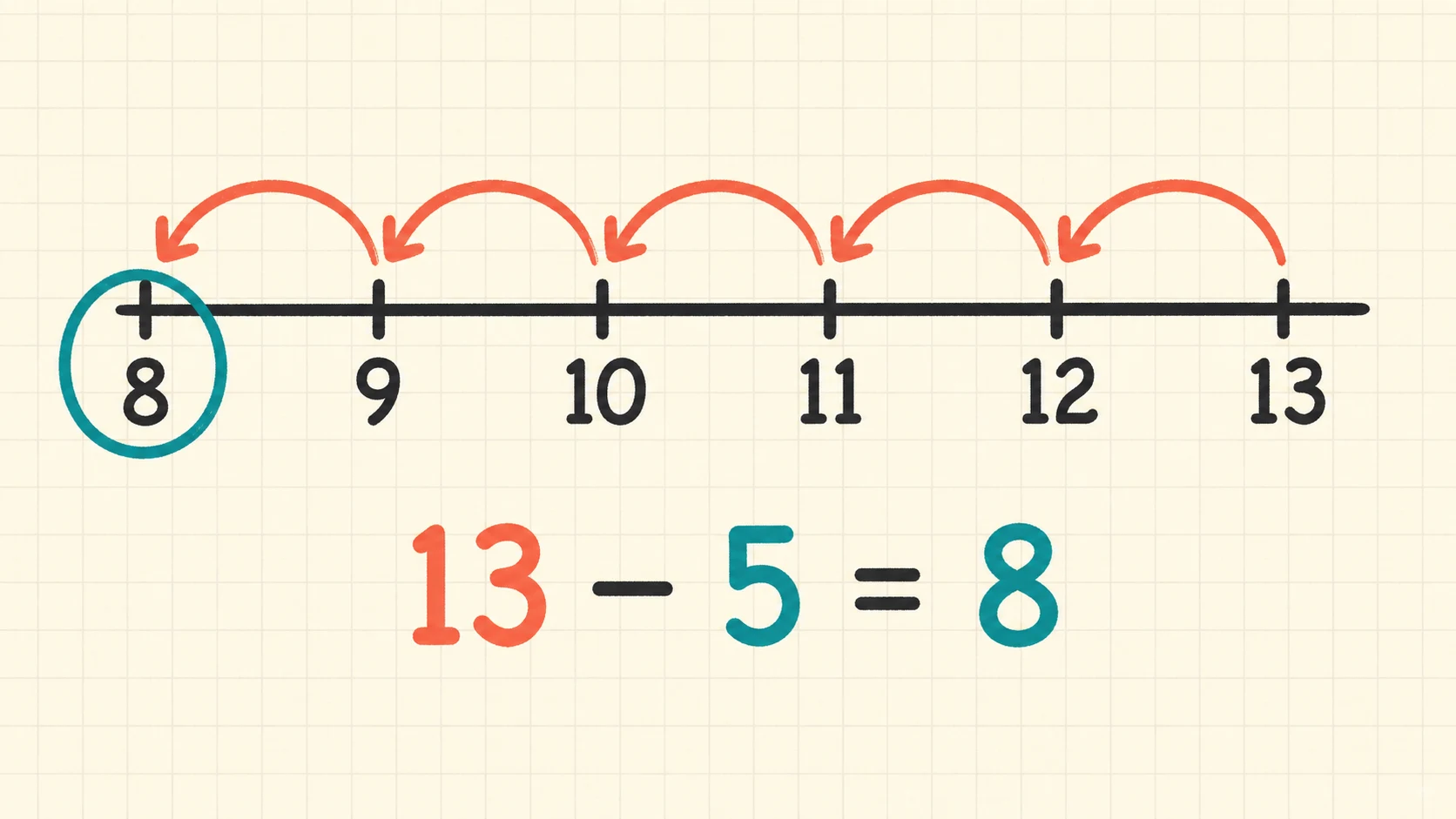
For 13−5, represent 13 as a full ten-frame and three additional counters. A learner might remove the three extras and then two from the full frame: 13−3=10, followed by 10−2=8. This “subtract to 10” strategy is more efficient than counting backward five steps once the learner understands it.
Number paths and number lines
On a number path, the learner can start at 12 and move back four spaces to land on 8. Mark every move so that four moves are made—not four numbers merely spoken.
Number lines are helpful, but they can hide misunderstanding. A correct landing point may result from an accidental off-by-one count. Ask the learner to show and count the jumps, then connect the jumps to 12−4=8.
Matched rows and towers
Comparison problems are clearest when quantities are aligned. Place nine cubes in one row and six directly beneath them. Match cubes one to one. The three unmatched cubes show the difference.
This is often clearer than physically taking six cubes away from nine because the model preserves both original quantities.
Fully Checked Worked Examples
The examples below move among actions, models, equations, and checks. The explanation matters as much as the calculation.
Example 1: Taking away within 10
Problem: Seven apples are on a plate. Two are eaten. How many remain?
Start with seven counters:
∙∙∙∙∙∙∙
Move or cross out two:
∙∙∙∙∙∙∙
Five counters remain, so:
7−2=5
Check by joining the two removed counters to the five remaining counters:
5+2=7
The check recreates the original whole, so the answer is consistent.
Objects establish the action; the equation records it; addition checks the result.
Example 2: Finding a difference
Problem: Ava has 9 blocks. Ben has 6 blocks. How many more blocks does Ava have?
Arrange the groups in matched rows:
Ava: ● ● ● ● ● ● ● ● ●
Ben: ● ● ● ● ● ●
Six blocks have partners. Three of Ava’s blocks do not. Therefore:
9−6=3
Ava has 3 more blocks.
Check:
6+3=9
This is a comparison problem. No blocks need to be removed from Ava’s collection in the story; subtraction measures the gap between the quantities.
Example 3: Finding a missing part
Problem: Ten seats are available. Seven are occupied. How many seats are empty?
The whole is 10. One part is 7 occupied seats. The missing part is the number of empty seats:
7+□=10
Counting on from 7 gives 8, 9, 10—three counts. Thus:
10−7=3
There are 3 empty seats.
Both equations describe the same relationship:
7+3=1010−7=3
This example shows why addition can be an efficient way to solve subtraction.
Example 4: Subtracting across 10
Problem: Solve 14−6.
Separate 6 into 4 and 2 because subtracting 4 reaches 10:
14−4=10
Two more still need to be subtracted:
10−2=8
Therefore:
14−6=8
Check with the related addition fact:
8+6=14
The decomposition is valid because 6=4+2. The full calculation can be recorded as:
14−6=14−4−2=10−2=8
Example 5: Using a known addition fact
Problem: Solve 13−5.
Think, “Five plus what equals 13?”
5+□=13
Since:
5+8=13
it follows that:
13−5=8
A fact family records the related equations:
5+8=138+5=1313−5=813−8=5
The numbers stay the same, but their roles change.
Boundary cases
Boundary cases reveal whether the learner understands subtraction or is following a mechanical routine.
Subtracting zero:8−0=8. Nothing is removed, so the quantity stays the same.
Subtracting the whole:8−8=0. Removing all eight leaves none.
Equal quantities: If both towers have six cubes, 6−6=0; the difference is zero.
Order matters:9−4=5, but 4−9 is not the same first-grade take-away situation. Do not teach the learner to reverse the numbers merely to avoid difficulty.
An unknown in a different position: In □−3=5, the unknown whole is 8 because 5+3=8.
These cases are especially useful in short oral discussions because they expose rules such as “subtraction always makes a number smaller.” Subtracting zero does not make the number smaller.
A Short, Repeatable Lesson Routine
A focused lesson can be brief. Stop before attention and accuracy collapse, and adjust the length to the learner rather than following a universal timetable.
Use the same predictable sequence while varying the numbers and problem situations.
1. Review one prerequisite
Spend a few minutes counting objects, composing a number, recognizing a ten-frame, or recalling a related addition fact. Choose the review from the previous session’s work.
2. Present one meaningful problem
Use a short story such as, “There were 11 toy cars. Four were put away. How many are still out?” Ask the learner to identify the starting amount, what changes, and what must be found.
3. Model and explain
Let the learner use counters or a drawing. Connect the representation to an equation. Introduce only one new strategy at a time.
An adult might say, “You removed one counter at a time. Can we split four into one and three so that 11 first becomes 10?”
4. Practice together
Solve two or three closely related problems. Prompt with questions, not answers:
What does this number represent?
Which part is known?
How many jumps did you make?
How could addition check the result?
5. Try independently
Give three to five problems that match the taught skill. Independence here means that the learner selects and carries out a method without step-by-step prompting. Concrete materials can remain available.
6. Close with explanation
Ask the learner to explain one answer or correct one error. Record a short note about accuracy, strategy, independence, and the kind of support needed.
Choosing Practice That Matches the Learner
Practice should be selected by purpose, not simply by grade label or page count. The 1st Grade math hub provides the broader subject context, while the subtraction topic guide keeps practice focused on this operation.
When to choose supported practice
Choose objects, pictures, or equations with small numbers when the learner:
Cannot explain what the minus sign means.
Recounts the starting group inaccurately.
Confuses how many were removed with how many remain.
Solves take-away stories but not comparisons.
Needs adult prompting on nearly every item.
Keep the numbers small enough that the mathematical structure remains visible.
When to choose fact strategy practice
Choose facts within 20 when the learner understands the situations but solves every problem by counting one object at a time. Group problems by a useful relationship:
Subtract 0 or 1.
Subtract to make 10.
Use doubles, such as connecting 12−6 with 6+6=12.
Use related addition facts.
Compare two quantities with a small difference.
Grouping by strategy supports noticing. Later, mix the fact types so the learner must choose a method.
When to choose a worksheet
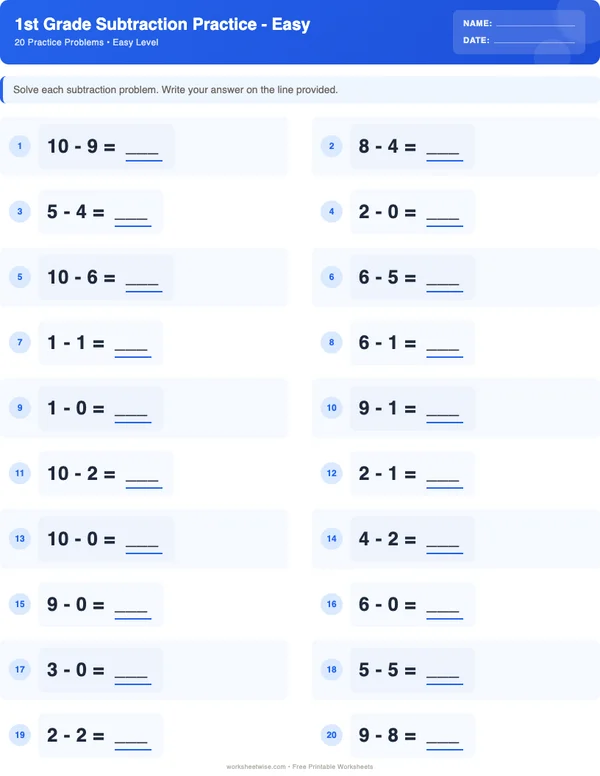
A worksheet is appropriate when the learner can interpret its notation and sustain accurate practice without constant intervention. The free easy subtraction worksheet contains 20 exercises and a separate answer key. Preview the problems before assigning them, especially because its catalogue includes subtraction facts, mental math, number sense, and regrouping among its listed skills. Select only material that matches the learner’s demonstrated readiness and local sequence.
For more sustained practice, the focused subtraction pack contains 18 worksheets. More pages do not automatically produce better learning; use a pack to select appropriate practice, revisit errors, and space review.
Differentiating Without Changing the Main Idea
Differentiation should preserve the subtraction concept while adjusting the numbers, representations, language, or amount of support.
For a learner who needs more support
Reduce the number range from within 20 to within 10 or 5.
Use real objects before drawings.
Present one problem type at a time.
Read word problems aloud without telling the operation.
Use matched rows for comparison.
Provide an equation frame such as 9−□=6.
Ask for fewer independent problems, then review each carefully.
Allow the learner to point, move, or draw while explaining.
The IES guide for assisting students who struggle with mathematics offers high-level guidance that includes systematic instruction, clear mathematical language, representations, and monitoring progress. Applying those principles here is an instructional choice, not a diagnosis or child-specific intervention.
For a learner ready for greater challenge
Increase reasoning before increasing digit size. Ask the learner to:
Solve one fact in two ways.
Write a story for 15−7=8.
Find the missing whole in □−6=9.
Decide whether two different drawings represent the same equation.
Sort problems into removal, comparison, and missing-part groups.
Find all equations with a difference of 4 using an agreed number range.
Explain why 12−5 cannot equal 8.
Multi-digit subtraction with regrouping belongs later in the broader subtraction progression. A first grader who is secure within 20 may explore place-value-based subtraction according to the local curriculum, but advancing should not replace unfinished work with basic meanings and facts.
Common Errors and Diagnostic Responses
Treat an error as evidence about the learner’s current method. Ask the learner to show the thinking before correcting the answer.
Match the response to the likely cause instead of assigning more of the same problems.
Observed work
Possible interpretation
Useful teaching response
8−3=3
Reports the amount removed
Act out the problem and label “removed” and “remaining”
9−4=6 on a number path
Counts the starting number as the first backward move
Draw and count four separate jumps
5−0=0
Treats zero as making every answer zero
Model removing no objects from a set of five
7−7=7
Repeats a number without representing the action
Remove the entire set and count what remains
13−5=9
Loses track while counting backward
Use a ten-frame or subtract to 10 in two parts
Uses addition for every story
Chooses an operation from familiar words or habit
Act out the situation before writing an equation
Cannot solve 10−7 but knows 7+3=10
Does not yet connect inverse facts
Build and record the complete fact family
Says the difference between 8 and 5 is 13
Joins quantities instead of comparing them
Align two rows and count unmatched objects
Changes 4−9 into 9−4
Assumes subtraction can be reversed
Discuss the role of the starting quantity and the order of numbers
Avoid relying on keywords such as “left” or “more.” The phrase “How many more are needed?” can describe a missing part, while “How many more does Mia have?” describes comparison. The learner should identify the quantities and their relationship.
Monitoring Understanding and Fluency
Monitoring should be light enough to use regularly and specific enough to guide the next lesson. A total score alone cannot show whether an error came from counting, notation, strategy, or language.
Track four features:
Feature
What to observe
Accuracy
Are answers correct, including zero and equal-quantity cases?
Representation
Can the learner model the problem with objects, drawings, or a number path?
Strategy
Does the learner count all, count back, make 10, or use a related addition fact?
Independence
How much prompting is required to begin, continue, and check?
A simple note might read: “Accurate on 8 of 10 take-away facts within 10; used counters independently; confused both comparison problems; addition checks required prompting.”
Use the note to choose the next session:
Continue the same skill if the method is unstable.
Change the model if the learner repeats the same misconception.
Mix problem types when each type is secure separately.
Reduce quantity if counting errors obscure the subtraction concept.
Increase independence before increasing difficulty.
Revisit a skill after a gap to see whether it was retained.
Fluency includes accuracy, reasonable efficiency, and flexible use of known relationships. Speed can be observed, but a timed score should not replace explanation or error analysis.
A Two-Week Practice Plan
This plan offers ten short sessions. It is an instructional suggestion, not a sourced or universal timetable. Shorten, repeat, or reorder sessions according to the learner’s work.
Each session combines review, one focused idea, a small amount of independent work, and observation.
Day
Focus
Suggested activity
What to record
1
Readiness and take-away within 5
Count, remove, and describe objects
Counting accuracy and meaning of “remain”
2
Take-away within 10
Model five problems; match each to an equation
Whether the removed and remaining parts are distinguished
3
Drawings
Replace counters with quick drawings and crossed-out marks
Whether the drawing matches the starting amount
4
Comparison
Build and align pairs of cube towers
Ability to identify and explain the difference
5
Missing parts
Cover part of sets totaling 5 to 10
Use of counting on or related addition
6
Review after a gap
Mix removal, comparison, and missing-part stories
Which situation still requires support
7
Facts near 10
Use ten-frames and subtract to 10
Whether decompositions are accurate
8
Related facts
Build fact families from three numbers
Connection between addition and subtraction
9
Mixed independent practice
Complete a carefully selected short worksheet section
Accuracy, strategy choice, and independence
10
Review and explain
Correct errors, solve boundary cases, explain one strategy
Retention and the next instructional need
On Day 9, do not require all 20 worksheet exercises if fatigue begins to reduce the quality of the work. A smaller, reviewed set may reveal more than a completed page with repeated errors.
At the end of two weeks, look for patterns rather than expecting universal mastery. If the learner handles take-away facts but struggles with comparisons, continue comparison models. If the concepts are clear but fact retrieval is slow, use brief, spaced strategy practice. If performance changes sharply when pictures disappear, continue bridging between concrete, visual, and symbolic forms.
Limits and the Next Useful Step
This guide cannot determine an individual learner’s curriculum placement, diagnose a learning difficulty, or guarantee a particular outcome. It also does not provide comprehensive standards alignment. Grade labels indicate intended practice level, and school, state, homeschool, and tutoring sequences may differ.
The most honest next step is to collect a small sample of observed work. Begin with the free 1st Grade Subtraction worksheet, preview the items, and select a short set that matches the learner’s current range. Keep counters and paper available. Record which problems are correct, which model or strategy the learner chooses, and where prompting becomes necessary. Use that evidence—not the page count—to choose the following lesson.
Put it into practice
Use the guide with a real printable
Move from explanation to a short, observable practice task. Check the first item together, then adjust the next session from the learner's actual work.