What 1st Grade Addition Means
1st Grade Addition is the process of joining quantities, finding a total, and representing that thinking with objects, pictures, words, and equations. A learner should progress from physically combining small groups to using efficient strategies for sums within 20. The goal is not merely to recite facts. It is to understand what addition means, choose a suitable strategy, explain the steps, and recognize when addition fits a situation.
A useful teaching sequence is:
- Add within 5 using objects.
- Add within 10 using objects and drawings.
- Connect models to equations.
- Count on from the larger addend.
- Use known facts, doubles, and near doubles.
- Compose 10 to solve sums within 20.
- Solve and explain simple addition situations.
- Practice facts until answers become accurate and increasingly efficient.
Grade labels describe the intended practice level; local school, district, state, and homeschool sequences differ. The learner’s observed work should determine where instruction begins and how quickly it advances.
The Common Core mathematics standards provide one widely used reference point: first-grade addition includes representing and solving addition situations, using properties and relationships between operations, and developing fluency within 20. The standards also emphasize both understanding and procedural skill. This guide uses that scope for orientation, but it does not claim universal or comprehensive standards alignment.
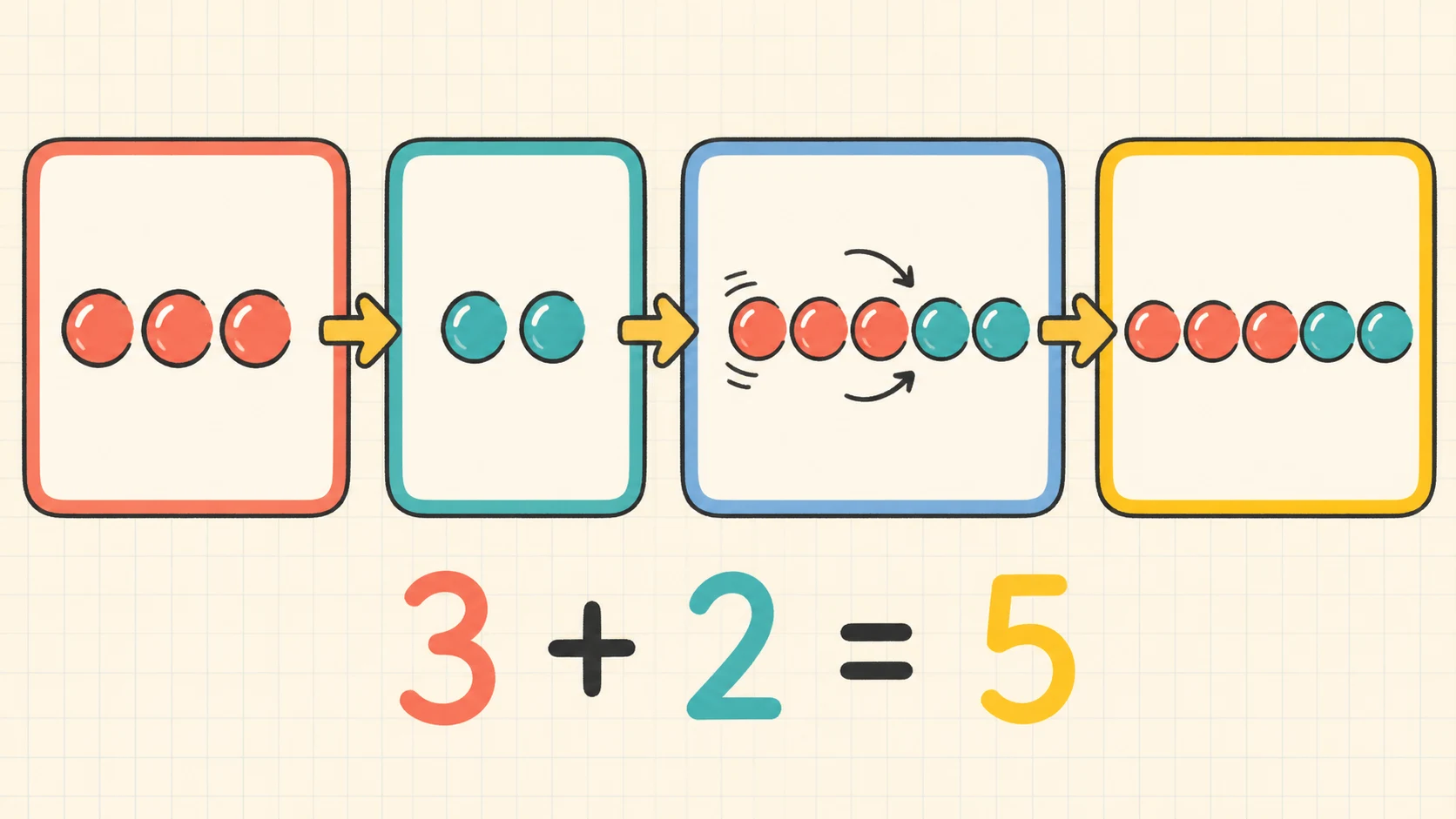
The skill develops from understanding quantities to selecting and explaining efficient addition strategies.
Prerequisites to Check Before Teaching New Facts
Addition becomes much harder when counting and quantity knowledge are unstable. Before assigning a full page of equations, observe the learner completing a few short tasks.
Counting and quantity
Check whether the learner can:
- Count a group of up to 20 objects, touching or moving each object once.
- Say the counting sequence without regularly omitting or repeating numbers.
- Recognize that the last number said tells how many objects are in the group.
- Make a requested set, such as “Give me seven counters.”
- Compare two small groups and identify which has more, fewer, or the same number.
- Recognize small quantities without recounting every object when the arrangement is familiar.
A counting error should not automatically be labeled an addition error. If a learner builds groups of 4 and 3 correctly but counts the combined group as 8, the immediate need is accurate one-to-one counting.
Composing and decomposing numbers
A learner is ready for flexible addition when numbers can be seen as combinations. For example:
- 5 can be 4 and 1, 3 and 2, or 5 and 0.
- 8 can be 5 and 3, 6 and 2, or 4 and 4.
- 10 can be 9 and 1, 8 and 2, 7 and 3, 6 and 4, or 5 and 5.
Ask, “Show 7 in two parts.” If the learner produces only one combination, model another with counters rather than demanding memorization.
The IES guide Teaching Math to Young Children addresses preschool, prekindergarten, and kindergarten rather than first grade. Its recommendations still offer relevant high-level framing for prerequisite instruction: teach number and operations through a developmental progression and use progress monitoring to build on what the child knows. Applying that framing here is an instructional bridge, not a claim that the guide evaluated this topic page or its worksheets.
Meaning of symbols and language
Confirm that the learner understands:
+ means two or more quantities are being joined or related additively.= means “has the same value as,” not “write the answer next.”- An addend is a number being added.
- The sum is the total.
- Zero represents no objects in a group.
Use ordinary language first: “There are 6 red cubes and 2 blue cubes. How many cubes altogether?” Then connect the situation to 6 + 2 = 8.
A Grade-Appropriate Addition Progression
The following progression is a decision guide, not a fixed calendar. Move forward when the learner is accurate, can explain the model, and does not depend on repeated adult prompts.
| Stage |
Instructional focus |
Example task |
Evidence for moving forward |
| 1 |
Join real groups within 5 |
Combine 2 counters and 3 counters |
Counts each object once and finds 5 |
| 2 |
Add within 10 with pictures |
Draw 4 dots, then 3 more |
Connects the drawing to 4 + 3 = 7 |
| 3 |
Count on |
Solve 6 + 2 |
Starts at 6 and says “7, 8” |
| 4 |
Use fact relationships |
Solve 5 + 6 from 5 + 5 |
Explains that one more than 10 is 11 |
| 5 |
Make 10 |
Solve 8 + 5 |
Decomposes 5 into 2 and 3, then finds 13 |
| 6 |
Solve addition situations |
Interpret a short word problem |
Selects addition and represents the quantities |
| 7 |
Build fluency |
Complete mixed sums within 20 |
Answers accurately with efficient strategies |
| 8 |
Transfer understanding |
Solve 7 + 4 = 5 + __ |
Treats the equal sign as balance and finds 6 |
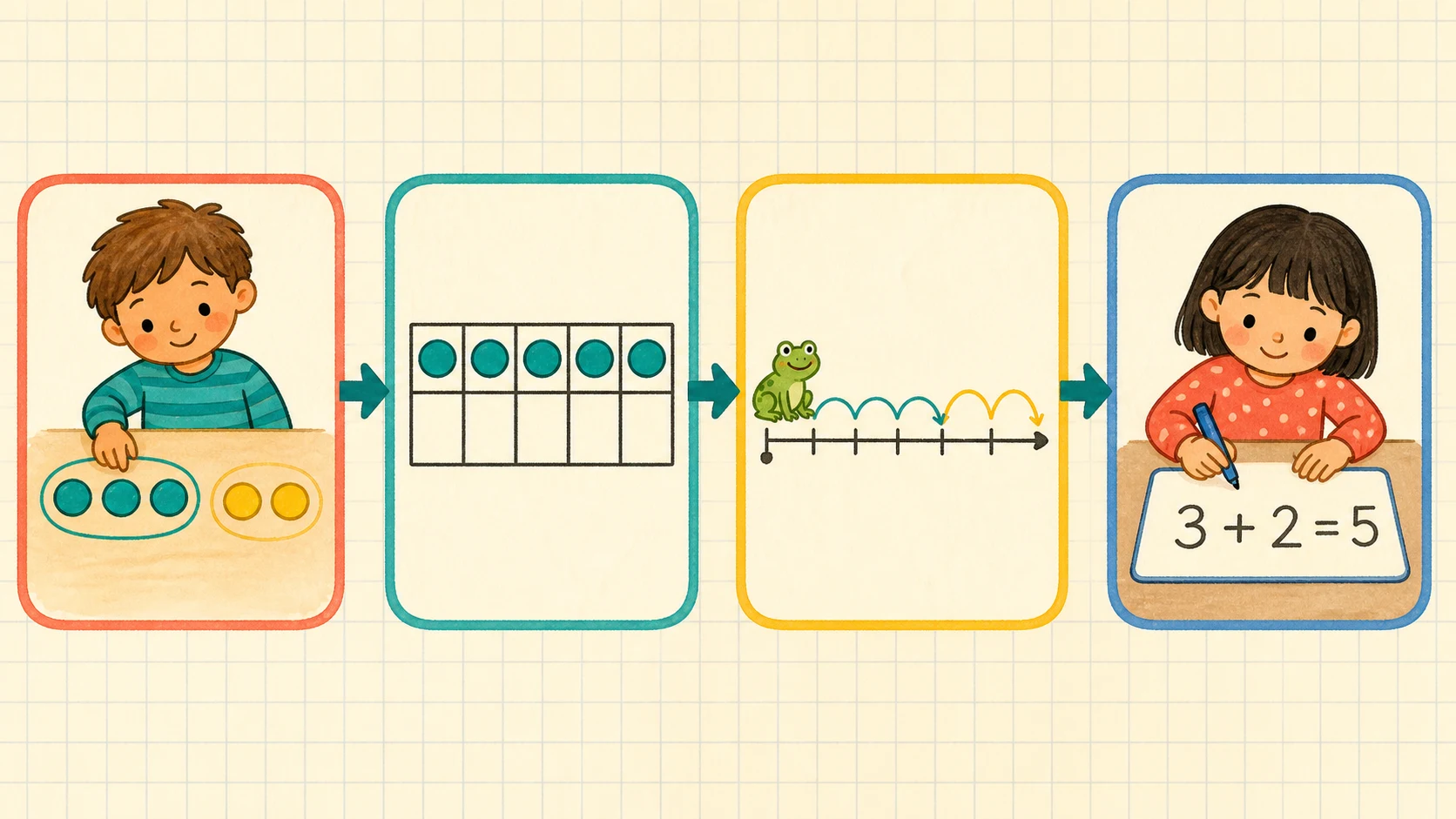
Support should fade as the learner demonstrates accurate, explainable, and increasingly efficient work.
Do not treat counting all as forbidden. It is a valid beginning method. The teaching task is to help the learner notice when a more efficient strategy is available. A child solving 2 + 3 with counters may be ready to count on; a child solving 8 + 7 by recounting 15 separate objects may need explicit work with 10.
Concrete and Visual Models That Clarify Addition
Models are useful when they make the quantities and their relationship visible. They become unhelpful if the learner performs a routine with the model but cannot explain what each part represents.
The IES guide Assisting Students Struggling with Mathematics recommends systematic instruction, clear mathematical language, carefully chosen concrete and semi-concrete representations, number lines, and deliberate word-problem instruction for elementary intervention. Those recommendations support the general model-to-symbol approach below; they are not reviews of WorksheetWise materials.
Counters and movable objects
Use identical counters, cubes, buttons, or other safe objects. Place the addends in separate groups before joining them.
For 3 + 2:
- Make a group of 3.
- Make a group of 2.
- Slide the groups together.
- Count the combined group: 1, 2, 3, 4, 5.
- Record
3 + 2 = 5.
Keeping the original groups visible helps the learner connect the addends to the total. Scattered objects can create unnecessary counting errors, so arrange them in rows or frames.
Five-frames and ten-frames
A ten-frame organizes quantities around 5 and 10. For 7 + 5, fill seven spaces, then add five counters. Move three of the new counters into the empty spaces, making 10; two remain. The display shows 10 + 2 = 12.
Ask three questions:
- How many spaces were empty?
- How did you break apart the second addend?
- What addition fact did the full frame create?
The teaching suggestion is to return to a ten-frame when a learner cannot yet compose or decompose numbers within 10. The model should remain available until the learner can describe the same relationship without moving every counter.
Drawings and number bonds
A drawing can replace physical counters once the learner understands what the marks represent. Circles, dots, tally-like marks, or simple bar models are sufficient; artistic detail distracts from the quantities.
A number bond shows a whole and its parts. For 9, the parts might be 6 and 3. Reverse its use for addition: if the parts are 6 and 3, the whole is 9.
Number lines
A number line represents addition as forward movement. To solve 5 + 3, start at 5 and make three equal jumps: 6, 7, 8. The answer is the landing number, not the number of marks passed.
Number lines are especially useful for diagnosing whether a learner:
- Starts at zero unnecessarily.
- Makes the wrong number of jumps.
- Counts the starting number as the first jump.
- Moves backward for addition.
- Confuses the endpoint with the jump count.
Equations and the equal sign
Connect every model to an equation, but vary the equation’s form:
4 + 3 = 77 = 4 + 34 + 3 = 5 + 26 + __ = 9
These forms prevent the misconception that the equal sign always points toward a final answer. Use “is the same value as” when reading equations aloud.
Fully Checked Worked Examples
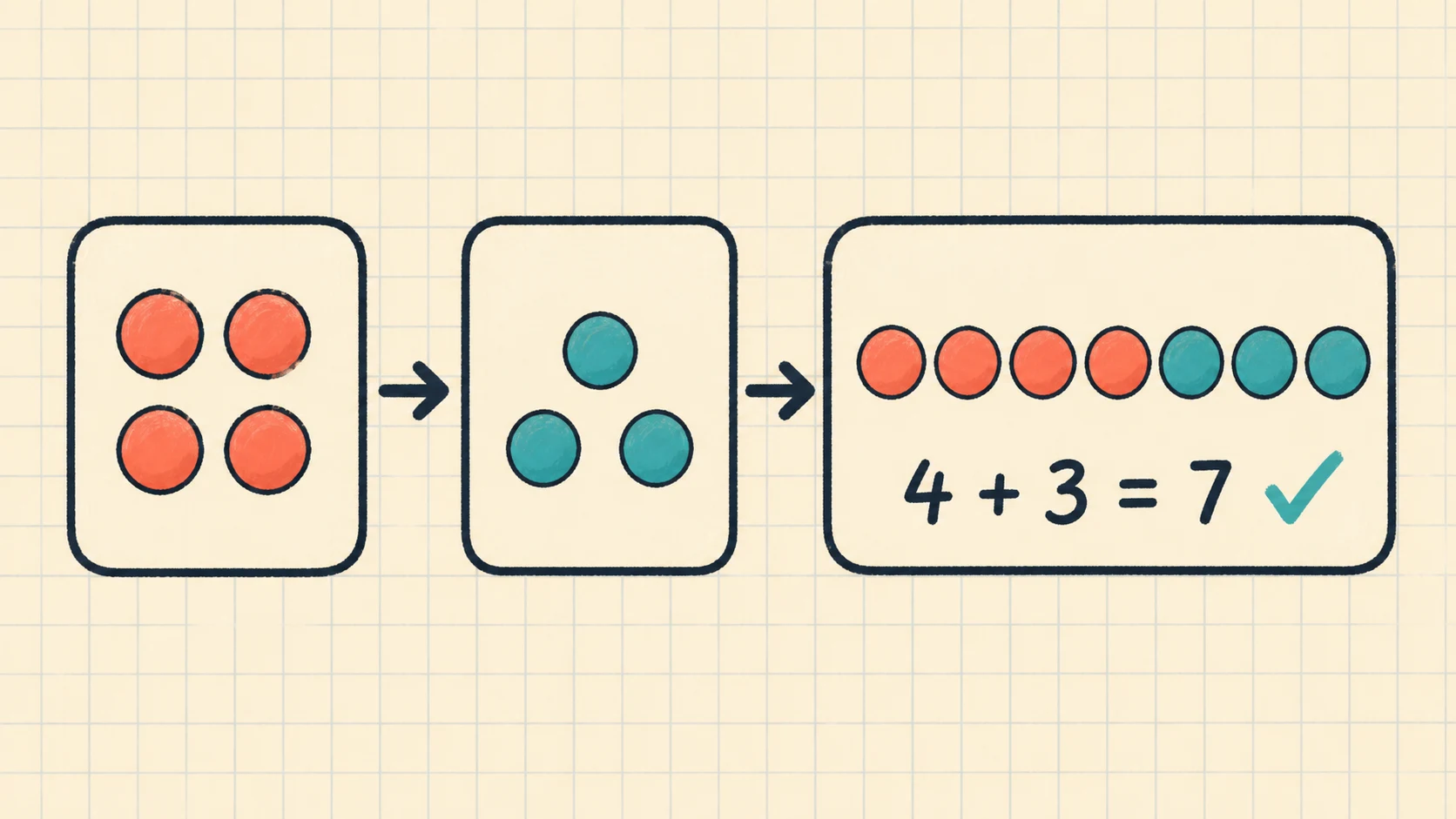
Objects and drawings should reveal the same number relationship later recorded with symbols.
Example 1: Joining groups within 5
Problem: Mia has 2 shells and finds 3 more. How many shells does she have now?
Make one group of 2 counters and another group of 3. Join them:
● ● and ● ● ● become ● ● ● ● ●.
Count the total: 1, 2, 3, 4, 5.
Equation: 2 + 3 = 5
Check: Begin with 3 and count on 2: 4, 5. Both methods give 5.
This example represents a change-add-to situation: the starting quantity increases.
Example 2: Counting on from the larger addend
Problem: 3 + 6 = __
Addition allows the addends to be considered in either order, so start with 6 rather than counting the smaller group first. Count on three numbers:
- Start at 6.
- One more is 7.
- Two more is 8.
- Three more is 9.
Answer: 3 + 6 = 9
Check: A group of 3 and a group of 6 contain 9 objects altogether. Reversing the addends gives 6 + 3 = 9.
The important distinction is that the learner says three new counting numbers after 6. Counting “6, 7, 8” as three counts would incorrectly produce 8 because the starting number was treated as a jump.
Example 3: Using a double
Problem: 6 + 7 = __
Use the known double 6 + 6 = 12. The second addend in 6 + 7 is one greater than 6, so the sum is one greater than 12:
6 + 7 = 6 + 6 + 1
12 + 1 = 13
Answer: 6 + 7 = 13
Check: Make 10 another way. Break 7 into 4 and 3:
6 + 7 = 6 + 4 + 3 = 10 + 3 = 13
Both strategies produce 13.
Example 4: Making 10
Problem: 8 + 5 = __
Eight needs 2 to make 10. Decompose 5 into 2 and 3:
8 + 5 = 8 + 2 + 3
8 + 2 = 10
10 + 3 = 13
Answer: 8 + 5 = 13
Check: Count on five from 8: 9, 10, 11, 12, 13.
A learner who writes 15 may know that 5 can be decomposed but have recombined the parts incorrectly. Return to five counters: move 2 to complete the ten-frame and confirm that 3 remain.
Example 5: A missing addend and equal-sign boundary case
Problem: 7 + 4 = 5 + __
First evaluate the left side:
7 + 4 = 11
Now find the number that makes the right side equal 11:
5 + 6 = 11
Answer: 7 + 4 = 5 + 6
Check: The left side has value 11, and the right side has value 11. Therefore, the equation is true.
Writing 11 in the blank would create 7 + 4 = 5 + 11, or 11 = 16, which is false. The blank is an addend, not necessarily the total.
Example 6: Adding zero
Problem: 9 + 0 = __
Zero means no additional objects are joined to the group of 9. The quantity remains 9.
Answer: 9 + 0 = 9
Check: Count nine counters, add none, and recount. There are still nine.
This is a useful boundary case because some learners assume addition must always make a number larger. Adding a positive amount makes it larger; adding zero leaves it unchanged.
A Short, Repeatable Lesson Routine
A focused lesson can be brief while still including explanation, modeling, guided work, and a check for understanding. The times below are an instructional suggestion, not a universal timetable.
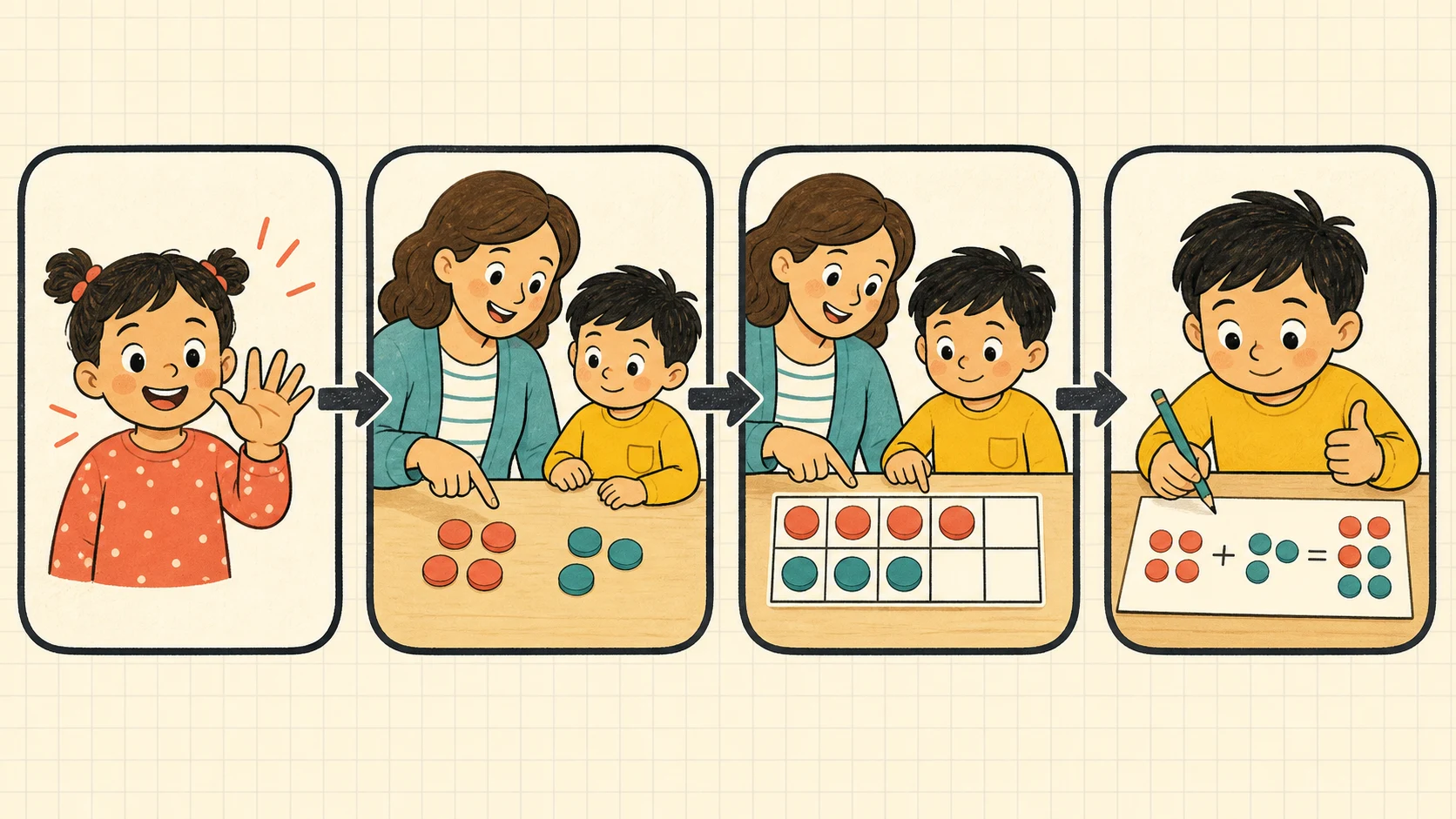
A consistent structure leaves room to adjust the numbers, model, and support from day to day.
| Phase |
Approximate time |
Adult action |
Learner action |
| Retrieve |
2 minutes |
Present two familiar facts or number combinations |
Answers and explains one |
| Model |
3 minutes |
Demonstrate one new or fragile idea |
Watches, predicts, and names quantities |
| Practice together |
4 minutes |
Solve two examples with prompts |
Builds, draws, or explains each step |
| Independent check |
3 minutes |
Give two or three carefully selected problems |
Solves without step-by-step prompting |
| Reflect |
1 minute |
Ask, “Which strategy helped, and why?” |
Describes the strategy in plain language |
Use one clear objective, such as “Today we will use a ten-frame to make 10.” Avoid mixing a new strategy, unfamiliar word-problem language, and a long set of facts in the same first lesson.
If the independent check shows confusion, do not simply assign more of the same page. Return to one example, reduce the numbers if needed, and reconnect the equation to a model. If the work is accurate and explainable, remove one support during the next lesson.
Choosing Practice That Matches the Learner
Practice should strengthen the next reachable skill. Page length, colorful formatting, or a nominal grade label cannot substitute for a good instructional match.
Match the task to the observed strategy
Choose:
- Adding within 5 with pictures when the learner cannot yet represent joining.
- Adding within 10 when counting is accurate but small combinations are not secure.
- Count-on tasks when the learner recounts every object for familiar sums.
- Ten-frame tasks when sums crossing 10 lead to guessing or lengthy counting.
- Doubles and near-doubles practice when doubles are known but not used to derive nearby facts.
- Mixed word problems when equations are accurate but the learner cannot decide whether a story calls for addition.
- Missing-addend or true-equation tasks when the equal sign is interpreted as an instruction to calculate.
- Mixed facts within 20 after strategies are understood and the learner needs greater fluency.
The 1st Grade Math collection can help an adult compare addition practice with related first-grade number work. The broader 1st Grade worksheet hub is useful when planning practice across subjects.
Sequence a worksheet deliberately
A 20-problem worksheet need not be completed in one sitting. Before beginning, inspect the items:
- Select four to six problems that match the lesson.
- Ask the learner to explain the first one.
- Watch for strategy use, not only answers.
- Stop if errors reveal a missing prerequisite.
- Save unused problems for spaced review.
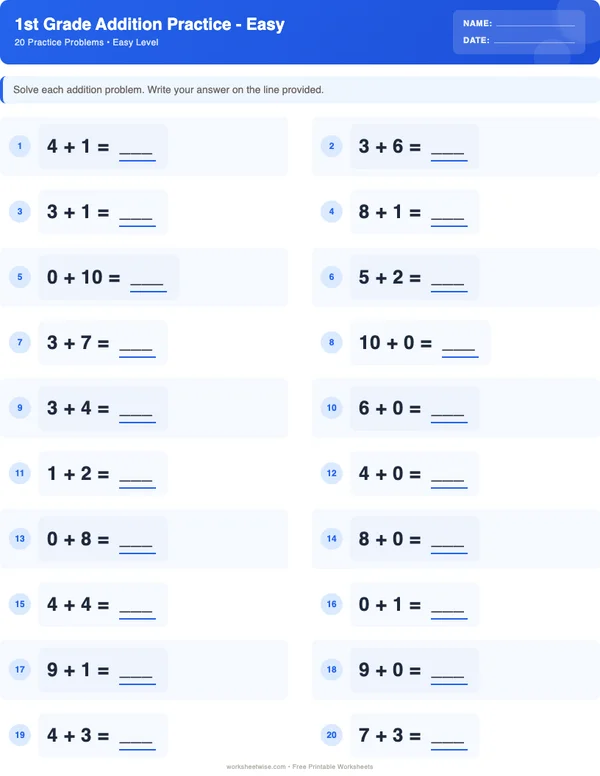
The catalogue’s free easy worksheet contains 20 addition exercises and includes a separate answer key. Its listed skills are addition facts, mental math, number sense, and place value. It may serve as classroom practice, homework, or homeschool work, but adults should still inspect the actual problems and select an appropriate amount.
Timed work is not the starting point for a learner who is still constructing meaning. The IES intervention guide includes timed activities as one possible fluency practice, while also recommending systematic instruction and representations. A sensible instructional application is to introduce any timed activity only after the target facts and strategies are understood, keep the set familiar, and use the result as one observation rather than a judgment about the learner.
Differentiation Without Lowering the Mathematical Goal
Differentiation changes access, quantity, or support. It does not require replacing meaningful addition with copying answers.
When the learner needs more support
Try one adjustment at a time:
- Reduce the range from within 20 to within 10 or within 5.
- Provide counters or a ten-frame.
- Present one problem at a time.
- Read the word problem aloud without interpreting it for the learner.
- Use consistent language: addend, sum, equal, same value.
- Ask the learner to build the problem before writing an equation.
- Alternate one modeled problem with one learner-solved problem.
- Practice one strategy across several examples before mixing strategies.
- Reduce the number of written items while preserving explanation.
If 8 + 5 is too demanding, determine why. A learner who cannot show 8 on a ten-frame needs different support from one who makes 10 correctly but forgets to add the remaining 3.
When the learner is ready for extension
Increase reasoning before increasing number size. Ask the learner to:
- Solve one fact in two ways.
- Write a story for
6 + 7.
- Find all pairs that total 10.
- Decide whether
8 + 4 = 7 + 5 is true and explain.
- Find the missing addend in
9 + __ = 14.
- Sort facts by useful strategy.
- Identify and correct a fictional learner’s error.
- Compare
5 + 8 with 5 + 9 without solving both from the beginning.
These tasks keep the work within first-grade addition while developing flexibility. Multi-digit written algorithms are not the automatic next step; place-value understanding must come first.
Common Errors and Diagnostic Responses
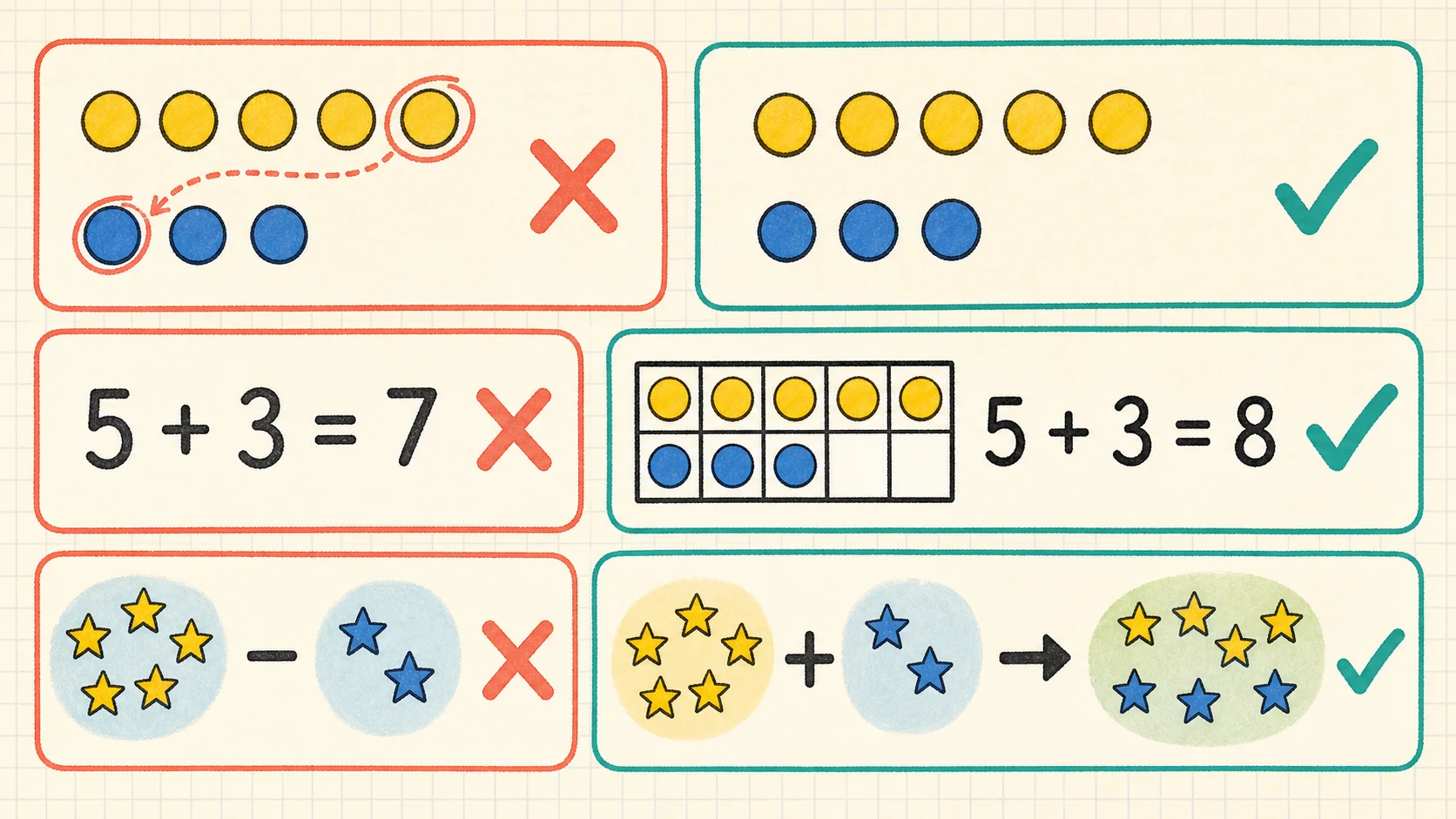
An incorrect answer is most useful when it leads to a specific test and teaching response.
| Observed work |
Likely issue to investigate |
Quick diagnostic |
Teaching response |
5 + 3 = 7 |
Counts the starting number as the first count |
Ask the learner to show three jumps from 5 |
Mark each jump and say 6, 7, 8 |
| Miscounts a joined group |
Unstable one-to-one counting |
Ask for a set of 9 counters |
Move each object into a counted row |
| Always starts counting at 1 |
Has not adopted counting on |
Compare methods for 2 + 8 |
Start at 8 and count two more |
8 + 5 = 12 after making 10 |
Loses a leftover counter |
Ask how 5 was split |
Record 5 = 2 + 3 before recombining |
6 + 0 = 0 |
Treats zero as erasing a number |
Build 6 and add no counters |
Emphasize that no new objects were added |
4 + 5 = 5 + 9 |
Reads = as “the answer comes next” |
Evaluate both sides separately |
Use a balance drawing and “same value as” |
| Adds every word problem |
Attends to keywords instead of relationships |
Ask what changes in the story |
Act out the quantities before choosing an operation |
| Correct answer, no explanation |
May be recalling or guessing |
Ask for a model or second method |
Accept recall, then verify conceptual connection |
| Accurate with objects, inaccurate with equations |
Model-symbol connection is incomplete |
Match a built model to two equations |
Label each group and write the equation immediately |
| Reverses a number when writing |
Numeral formation interferes with recording |
Ask for an oral answer and model |
Separate arithmetic feedback from numeral practice |
A “likely issue” is a hypothesis, not a diagnosis. Confirm it with a short task before changing instruction. Persistent difficulty can have many causes; this guide does not provide medical, psychological, or individualized special-education guidance.
Monitoring Progress and Deciding What Comes Next
Monitoring should collect enough evidence to make the next teaching decision. A score alone cannot show whether an answer came from understanding, efficient recall, laborious recounting, or guessing.
Keep a compact observation record
Once or twice each week, record:
- Number range used.
- Problems attempted and answered correctly.
- Strategy selected.
- Whether a model was needed.
- Whether the learner explained the steps.
- Type of error.
- Amount of prompting.
- A proposed next task.
For example: “Solved 5 of 6 sums within 10. Counted on accurately when the larger addend came first; counted all when it came second. Next: practice starting from the larger addend.”
Use decision rules, not a rigid timetable
Advance when the learner can usually:
- Represent the quantities accurately.
- Solve the selected type of problem.
- Explain why the strategy works.
- Repeat the performance on a later day.
- Handle a small variation in wording or equation form.
Continue at the same stage when understanding is present but accuracy or independence varies. Step back when the learner cannot represent the quantities, relies on frequent prompts, or repeats the same conceptual error.
One wrong answer does not require reteaching an entire unit. Conversely, one perfect row does not prove secure understanding. Compare work across several short sessions and include at least one delayed review.
A Two-Week Addition Practice Plan
This plan assumes short sessions on ten instructional days. Adjust the range and pace from the learner’s work; there is no universal two-week mastery schedule.
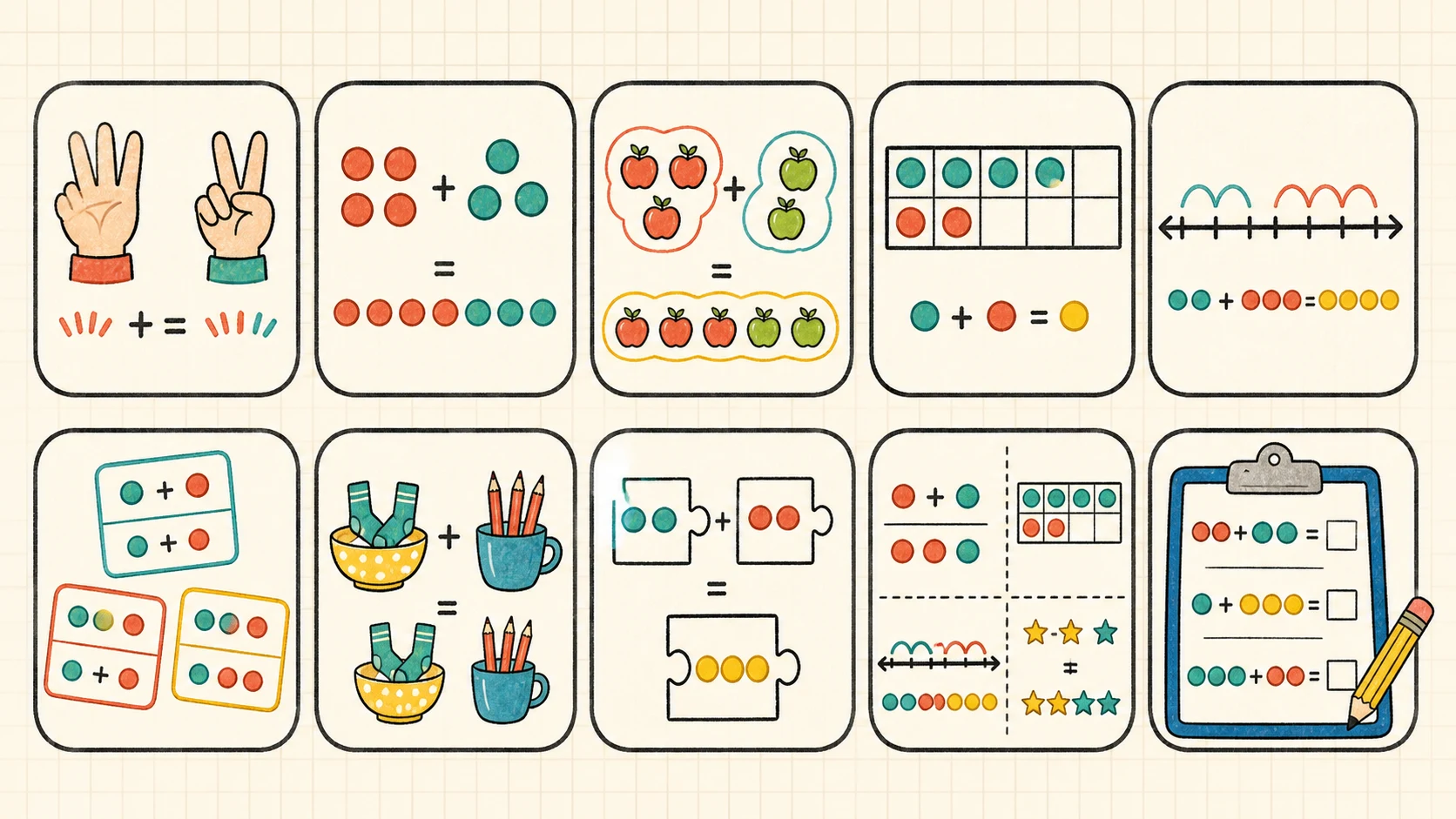
Each day combines a narrow focus with review, explanation, and a small independent check.
| Day |
Focus |
Suggested activity |
Evidence to record |
| 1 |
Establish a baseline |
Join groups within 5 and solve two sums within 10 |
Counting accuracy and model use |
| 2 |
Compose small numbers |
Show multiple ways to make 5, 6, and 7 |
Number decompositions found |
| 3 |
Connect models to equations |
Build, draw, and write four addition facts |
Whether addends match the model |
| 4 |
Count on |
Solve sums with an addend of 1, 2, or 3 |
Starting number and jump count |
| 5 |
Review and explain |
Mix Days 1–4; explain one strategy |
Independence after a one-day delay |
| 6 |
Doubles |
Build and record doubles through 10 + 10 as appropriate |
Known and modeled doubles |
| 7 |
Near doubles |
Derive facts such as 5 + 6 from a double |
Quality of the explanation |
| 8 |
Make 10 |
Use ten-frames for selected sums crossing 10 |
Accurate decomposition |
| 9 |
Addition situations |
Act out, draw, and solve short word problems |
Operation choice and representation |
| 10 |
Mixed check and next-step decision |
Solve a small mixed set without coaching, then discuss |
Accuracy, efficiency, and transfer |
Keep retrieval practice cumulative. On Day 8, for example, include one count-on fact and one double before introducing make-ten problems. If Day 5 reveals unstable counting, repeat concrete work instead of moving automatically to doubles.
A learner who progresses quickly can compare strategies or solve missing-addend equations. A learner who needs more time can repeat the same structure with smaller numbers and fewer problems. Neither adjustment changes the purpose: accurate, explainable addition.
Limitations and the Honest Next Step
This guide provides a practical instructional sequence, but it cannot determine an individual learner’s curriculum placement from a grade label or worksheet score. It does not guarantee outcomes, certify mastery, prescribe a universal timetable, or replace local curriculum requirements. The cited sources support broad instructional framing; they did not evaluate WorksheetWise, this guide, or the specific downloadable worksheet.
The most useful next action is to choose one narrow target from the learner’s observed work. If the learner can already count accurately and represent joining, use the free easy 1st Grade Addition worksheet as a brief independent check. Select four to six of its 20 exercises, ask for an explanation of one answer, and record the strategy used. If the work is accurate and independent, continue through the 1st Grade Addition topic guide and practice collection; if a consistent error appears, return to the matching model before assigning more problems.