Curated collectionAnswer keys includedPrint-ready PDFs
Formative Assessment Math Worksheets
Sample a defined skill, observe strategy and error patterns, and choose an instructional response; these are practice checks, not standardized or diagnostic instruments.
Start with a real resource
Browse this worksheet collection
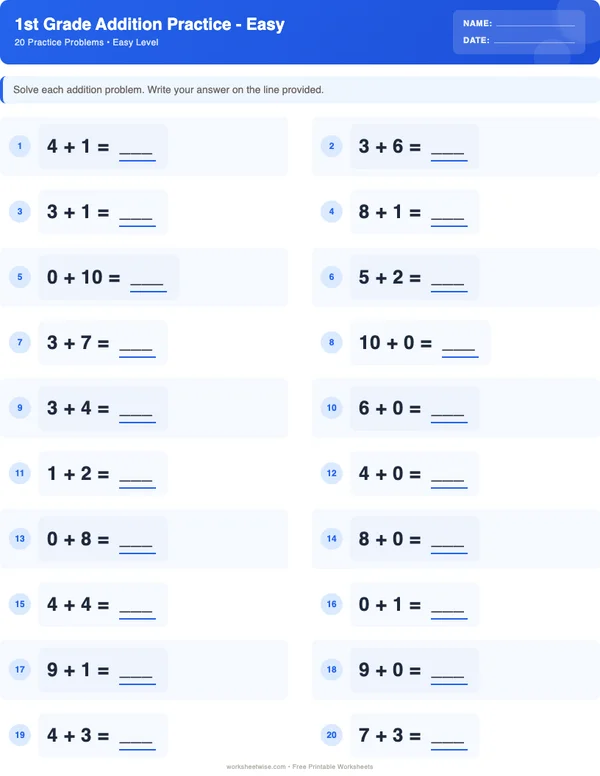
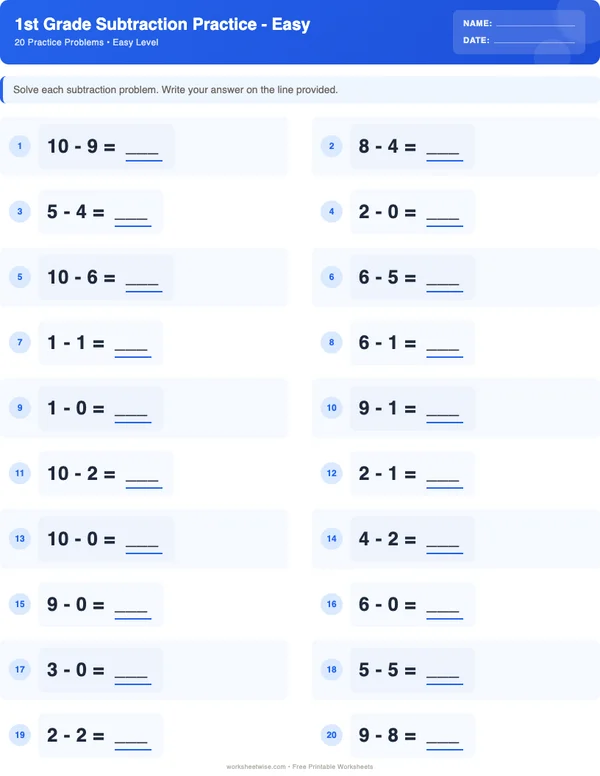
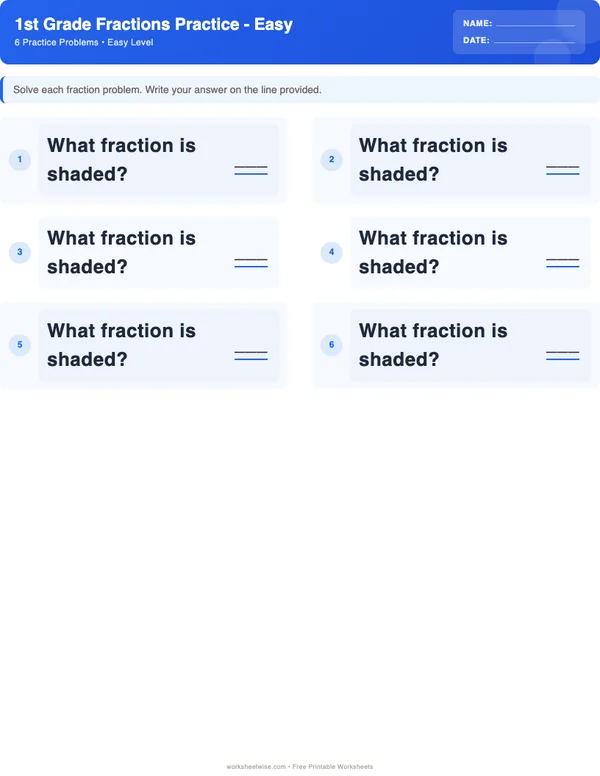
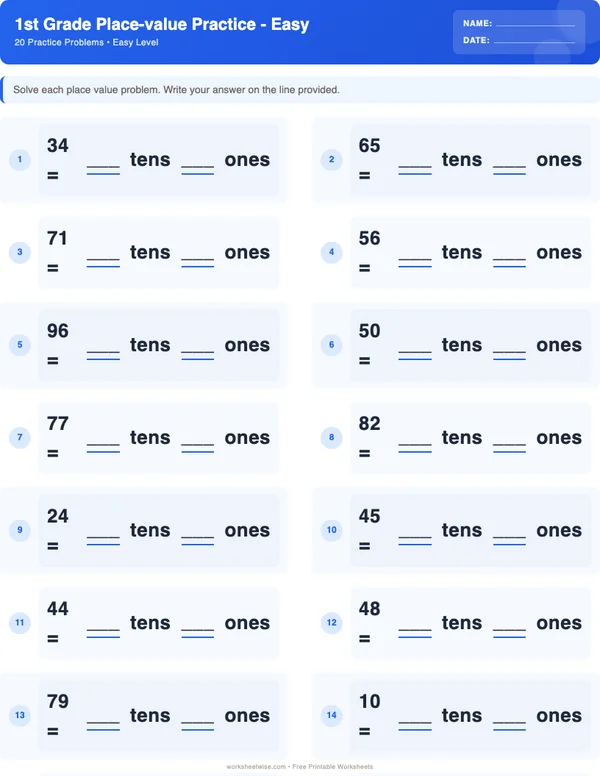
61 relevant free entry points are available. Each one includes a printable learner PDF and separate answer key.
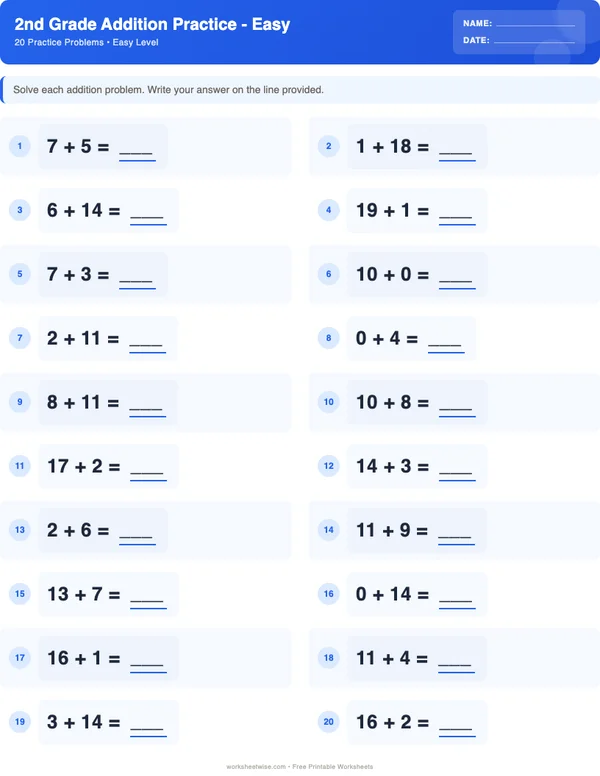
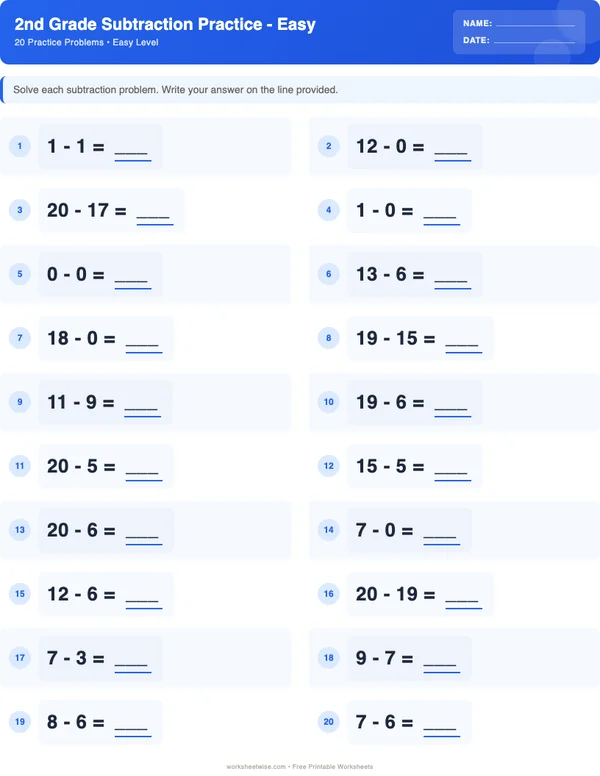
A useful practice loop
Print less. Observe more.
- Choose one skill and model the first item aloud.
- Use a short set and notice the learner’s strategy.
- Change the next task from the work you can see.
Need more than the free sheet?
Plus includes all 1098 matching catalogue variations where available, plus saved deterministic generators and the worksheet designer.
See Plus membershipComplete guide
How to teach and practise assessment math worksheets
3,637 words Updated 6 instructional visuals
Use each sheet to decide what to teach next
Formative assessment math worksheets are most useful when an adult selects one defined skill, watches how the learner represents and solves the problems, identifies a repeated error pattern, and chooses a specific instructional response. The score matters less than the evidence behind it: Did the learner count every object once? Model the quantities in a story? Regroup a ten correctly? Read the hour hand before the minute hand? Treat unequal pieces as fractions?
These sheets are practice checks, not standardized tests or diagnostic instruments. A single result should not determine placement, ability, a grade, or a diagnosis. Use it to make a smaller decision: whether the next experience should provide a concrete model, vary the response format, address a misconception, offer more examples of the same structure, or sample a closely related skill.
The live catalogue currently includes 1,098 math variants across eight grade labels and 12 topics, with 61 free resources. That breadth is valuable only when selection remains narrow. “Assess math” is not a workable objective. “Check whether the learner can represent a take-away story and connect it to a subtraction equation” is.
Grade labels describe the intended practice level, but local curriculum sequences differ. Age is a discovery aid rather than a placement decision. Choose from what the learner has actually been taught, then inspect the task features before using the sheet.
Define the mathematical evidence before printing
Begin with one sentence that names the skill and the evidence you want to see. A strong statement includes the mathematical action, the representation, and any relevant number range:
- “I want to see whether the learner can count a scattered set by coordinating one touch with one number word.”
- “I want to see whether the learner can solve addition within 10 and show whether they counted all, counted on, or used a known composition.”
- “I want to see whether the learner can distinguish equal fractional parts from merely having several pieces.”
- “I want to see whether the learner can represent a comparison story before choosing an operation.”
- “I want to see whether the learner can trade one ten for 10 ones during subtraction.”
This definition prevents a common interpretation error. If the intended evidence is mathematical modeling but the worksheet requires substantial independent reading, an incorrect answer may reflect language access rather than the target math. If the intended evidence is coin counting but the coin images are hard to distinguish, visual recognition can obscure the counting strategy. If the intended evidence is telling time but every item asks only for a written time, the sheet cannot show whether the learner can also construct a clock face.
The Common Core State Standards for Mathematics distinguish mathematical content from broader practices such as modeling, representing, explaining, and attending to precision. That distinction can sharpen a practice check even when a school uses a different curriculum: decide whether you are sampling an answer, a procedure, a representation, or an explanation. Do not claim standards alignment from a topic label alone.
Set a stopping rule
Decide in advance when you will pause. Useful stopping rules include three consecutive errors with the same structure, visible frustration, repeated guessing, or an inability to explain the first two examples. Continuing through 20 near-identical items after the error is already clear produces more incorrect practice, not better evidence.
A 20-problem sheet can therefore be a source of selected items rather than a requirement to complete all 20. A six-problem fractions sheet may be enough for a focused comparison because each response can be discussed and modeled. A 12-problem word-problem or telling-time sheet can be split across short sessions.
Choose difficulty by observable task features
The catalogue identifies the representative free sheets as “easy,” but that label should describe the task, never the learner. Inspect what makes a sheet more or less demanding:
- quantity size and number range;
- presence or absence of pictures, ten frames, number lines, or clock faces;
- one operation versus multiple possible operations;
- objects arranged in rows versus scattered arrangements;
- identical denominators versus unlike denominators;
- whole-hour times versus five-minute or one-minute intervals;
- a number sentence versus a written situation;
- recognition, matching, construction, computation, or explanation;
- one-step versus multi-step reasoning;
- familiar vocabulary versus additional reading demands;
- whether the unknown appears at the result, change, or starting quantity.
A less demanding counting check might show small, orderly sets with a response box. A more revealing check might use the same quantity in a scattered arrangement and ask the learner to move or mark each object while counting. The number does not need to increase for the reasoning demand to increase.
Likewise, supported division can show equal groups or an array, while independent division may provide only the equation or context. These formats are not interchangeable evidence.
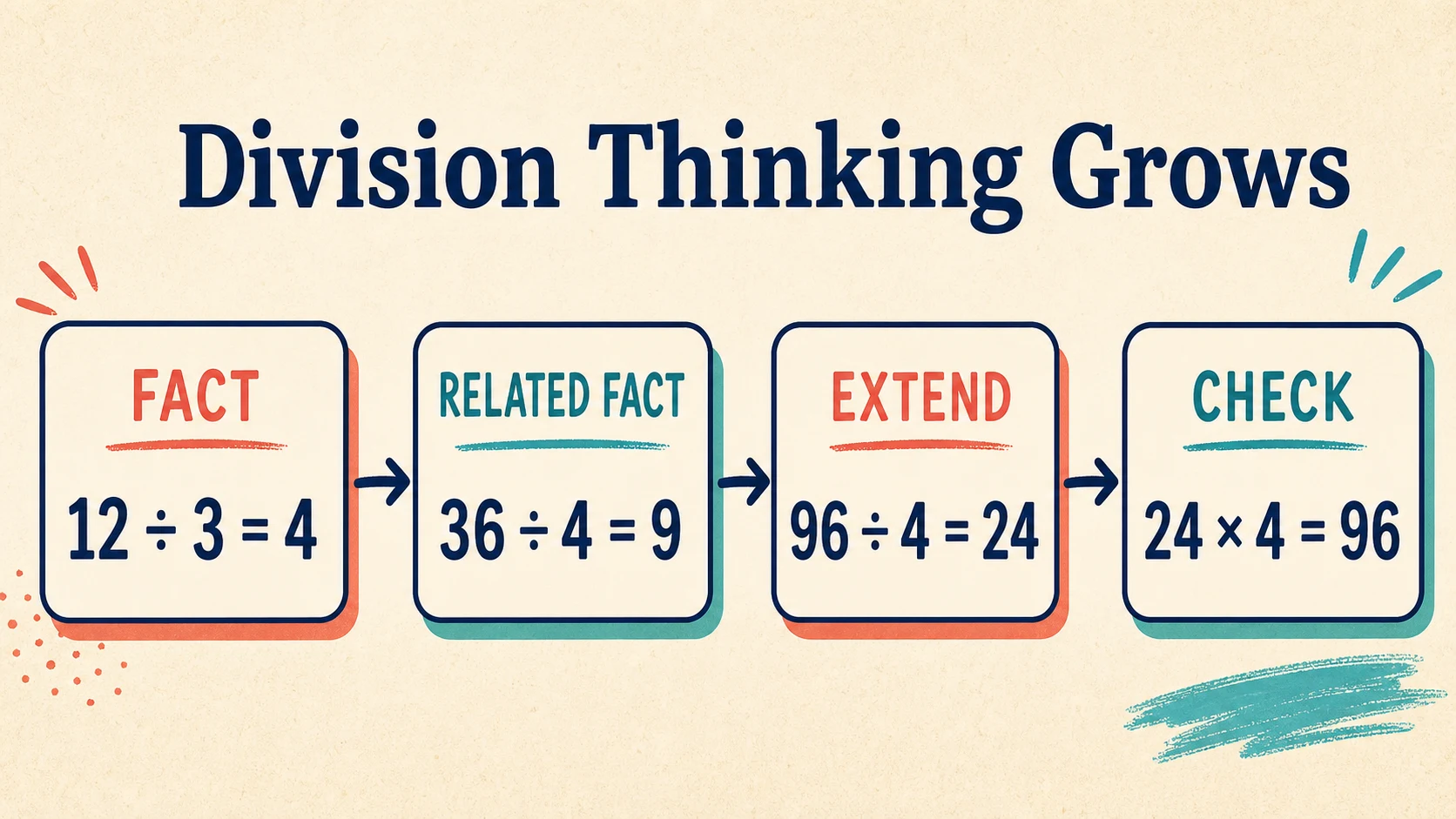
Use the division progression to choose the least support that still lets the learner reveal equal-group reasoning.
Select two to four task forms that sample the same target without adding several new demands at once. For example, if the target is division as equal sharing, move from counters shared into drawn groups, to a picture of groups, to a division equation. Do not simultaneously remove the model, enlarge the numbers, introduce remainders, and add complex reading.
Run a five-part observe-and-respond routine
A useful check can take 10 to 15 minutes. The adult’s role is to preserve the target, collect visible evidence, and avoid teaching during the initial sample.
1. Preview without solving
Scan the sheet for vocabulary, visual density, answer formats, number ranges, and prerequisite knowledge. Select a small representative set. For a 20-problem page, six items might include two direct examples, two that vary the representation, and two that are likely to expose the misconception you are checking.
Remove irrelevant obstacles where possible. Read directions aloud if decoding is not the target. Enlarge crowded print. Cover later rows. Supply ordinary classroom tools that are part of instruction, such as counters or a number line, but record which tools were available.
2. Ask for a brief independent sample
Give a neutral prompt: “Show me how you would solve these. You may draw, use counters, or write an equation.” Avoid hints such as “Remember to borrow” or “Look for the biggest coin.” Those prompts reveal whether the learner can follow a cue, not whether they selected the idea independently.
Watch for the starting move. Does the learner act out the quantities, count from one, count on, write an operation immediately, inspect the unit, or search for a keyword? Note pauses, revisions, and tool use without treating speed as the central result.
3. Change the response format
After two or three items, ask for the same mathematics in another form:
- build it with objects;
- draw a picture or bar;
- point to the relevant quantity;
- write an equation;
- explain why the answer is reasonable;
- create a matching story;
- choose between two completed models.
A correct numeral with an inconsistent model calls for a different response than a correct numeral supported by a coherent strategy. Conversely, a learner may understand the relationship but make a recording error. Multiple formats help separate these cases without diagnosing either one.
4. Probe one error neutrally
Use prompts that reveal thinking:
- “What does this number represent?”
- “Show where the groups are in your drawing.”
- “How do you know the parts are equal?”
- “Which hour has the short hand passed?”
- “Could you check this with addition?”
- “What would change if the unknown were at the beginning?”
Do not ask, “Are you sure?” after only incorrect responses; that teaches the learner to read adult tone rather than inspect mathematics. Ask for a check after correct and incorrect answers alike.
5. Record a next-sheet rule
Complete one sentence: “Because I observed ___, the next sheet will ___.” For example: “Because the learner counted an orderly row correctly but double-counted scattered objects, the next sheet will keep quantities within 10 and vary only the arrangement.” That is more actionable than “needs counting practice.”
The next sheet should respond to the error pattern, not simply move down a grade label or repeat the entire page.
Compare live skills by the evidence they reveal
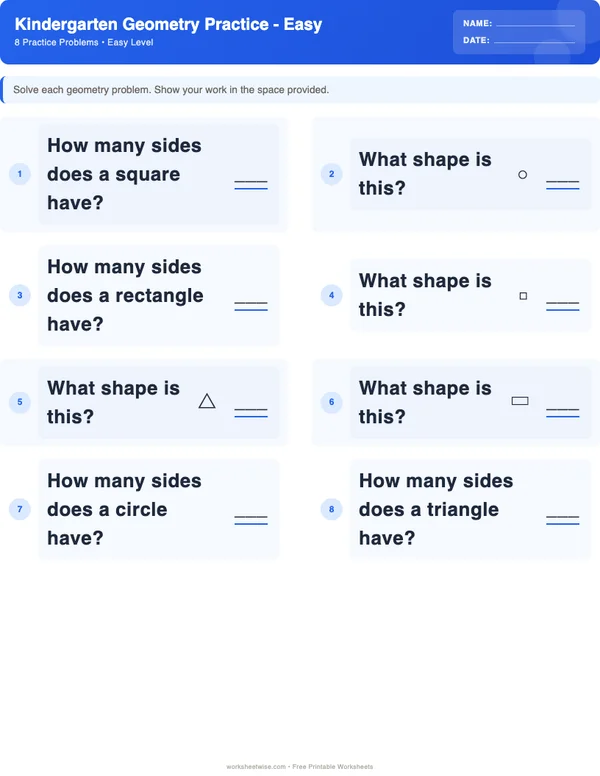
Representative resources on this page range from Pre-K counting to first-grade fractions, time, money, and word problems, as well as kindergarten arithmetic, place value, and geometry. Each exposes different mathematical decisions.
Counting: coordinate words, objects, and quantity
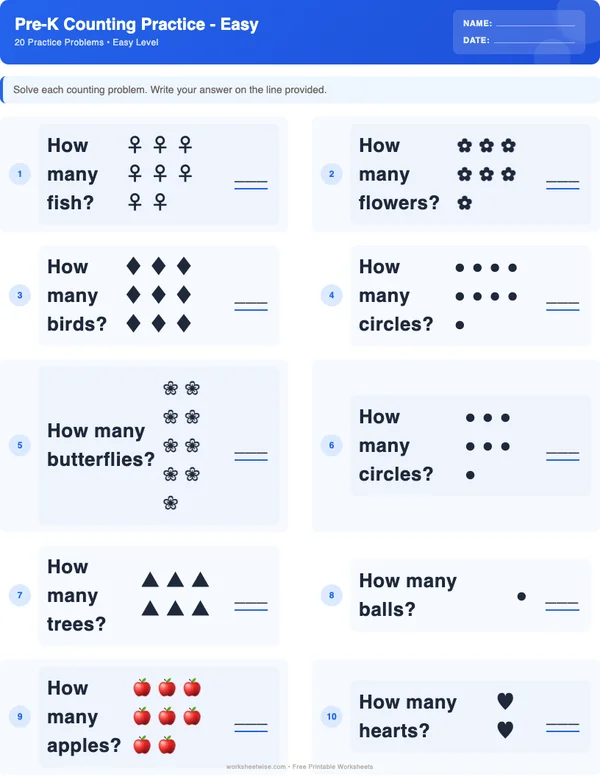
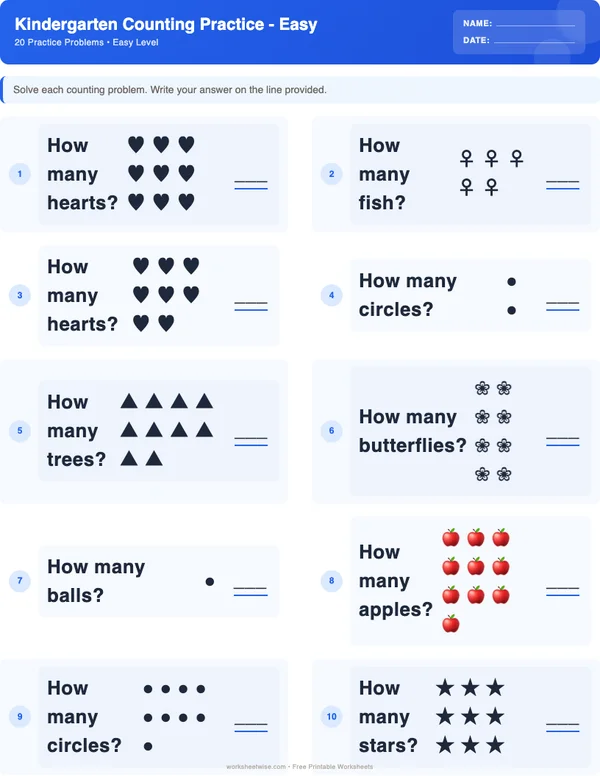
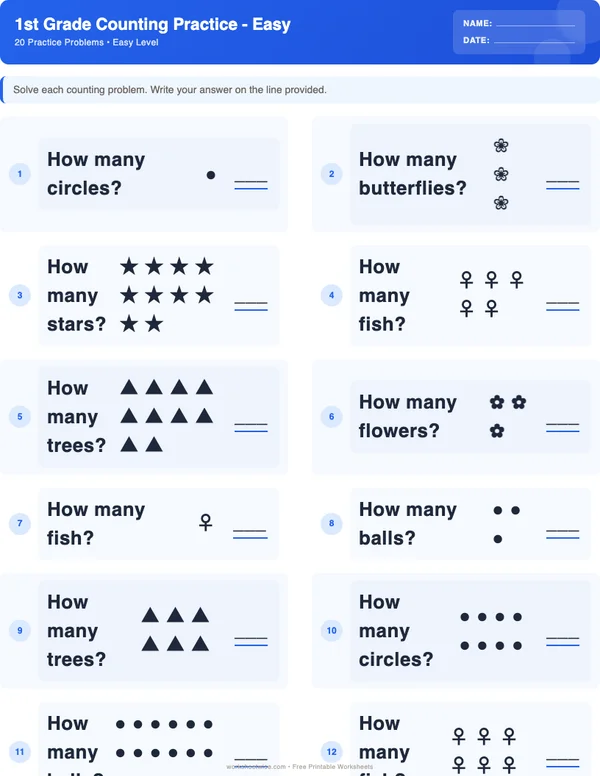
The Pre-K and kindergarten counting resources each contain 20 problems. Their catalogue description includes number sequences, missing numbers, and counting sets. These formats do not measure the same thing.
Consider seven counters scattered on a table. The learner says “one, two, three, four, five, six, seven” while touching each once, then answers seven when asked how many there are. This example belongs here because the catalogue specifically recommends scattered objects as a way to reveal one-to-one correspondence rather than mere recitation.
Now check the alternatives yourself:
- Saying the count sequence to seven without objects shows sequence knowledge but not one-to-one correspondence.
- Touching one counter twice while still saying seven shows that the spoken sequence and object tracking are not coordinated.
- Counting accurately, then restarting when asked “how many?” suggests the final count word is not yet being used confidently as the total.
The next sheet or activity should preserve the quantity and change the representation. If tracking is the issue, use movable counters placed into a cup one at a time. If the count sequence breaks, use a short number path and oral movement. If both are secure in a row but not when scattered, choose varied arrangements rather than larger numbers.
For ages three and four, prioritize brief adult-led oral, matching, manipulative, and movement work over desk work. A printed page can supply pictures for pointing or matching, but it should not turn an early counting observation into a long pencil session. The Pre-K Counting guide and free sheet is an appropriate entry point when the adult selects a few items and pairs them with real objects.
The IES guide Teaching Math to Young Children recommends intentional teaching through developmental progressions, monitoring children’s mathematical knowledge, and helping children view and describe their world mathematically. That sourced guidance supports short observations across objects, pictures, language, and numerals. The specific stopping rules and item selections above are editorial suggestions for using this catalogue.
Addition and subtraction: inspect the model, not only the operation
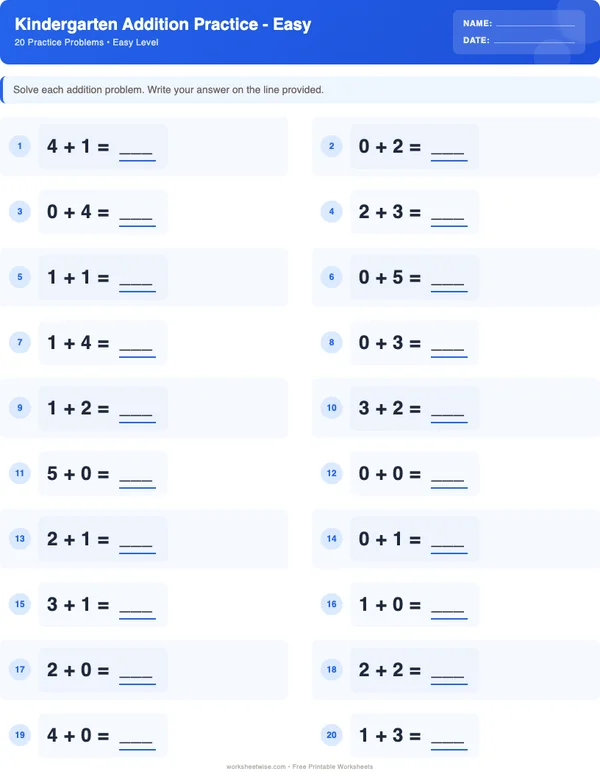
Suppose a learner solves by counting all 13 objects from one. The answer is correct. A second item, , is also answered correctly by counting every object. This belongs in a formative routine because the kindergarten and first-grade addition materials include progression from objects and pictures toward strategies such as counting on and making ten.
The observed evidence is not “addition mastered” or “addition failed.” It is: accurate totals, dependable one-to-one counting, and continued reliance on counting all. A suitable next sheet keeps sums within the taught range, includes ten frames or number bonds, and invites decomposition: . Check the arithmetic: 2 completes 10, and 3 remains, so the sum is 13. Feedback can be, “Your answer is correct. Show how the 5 can be split so 8 reaches 10.”
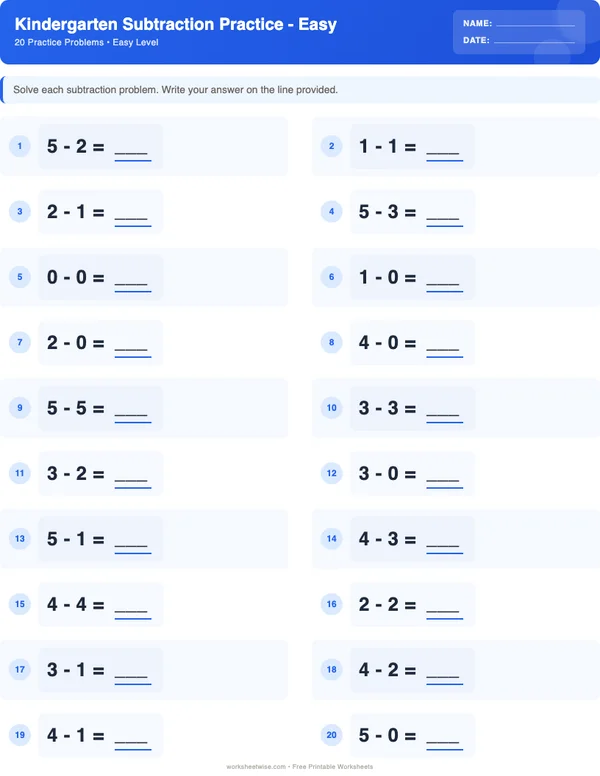
For subtraction, consider . A learner writes 22 by subtracting 3 from 5 and 2 from 4. Another common place-value error could produce 26 by subtracting the smaller digit from the larger in each column. Neither result matches the correct difference, 18: trading one ten changes 43 into 3 tens and 13 ones; , and .
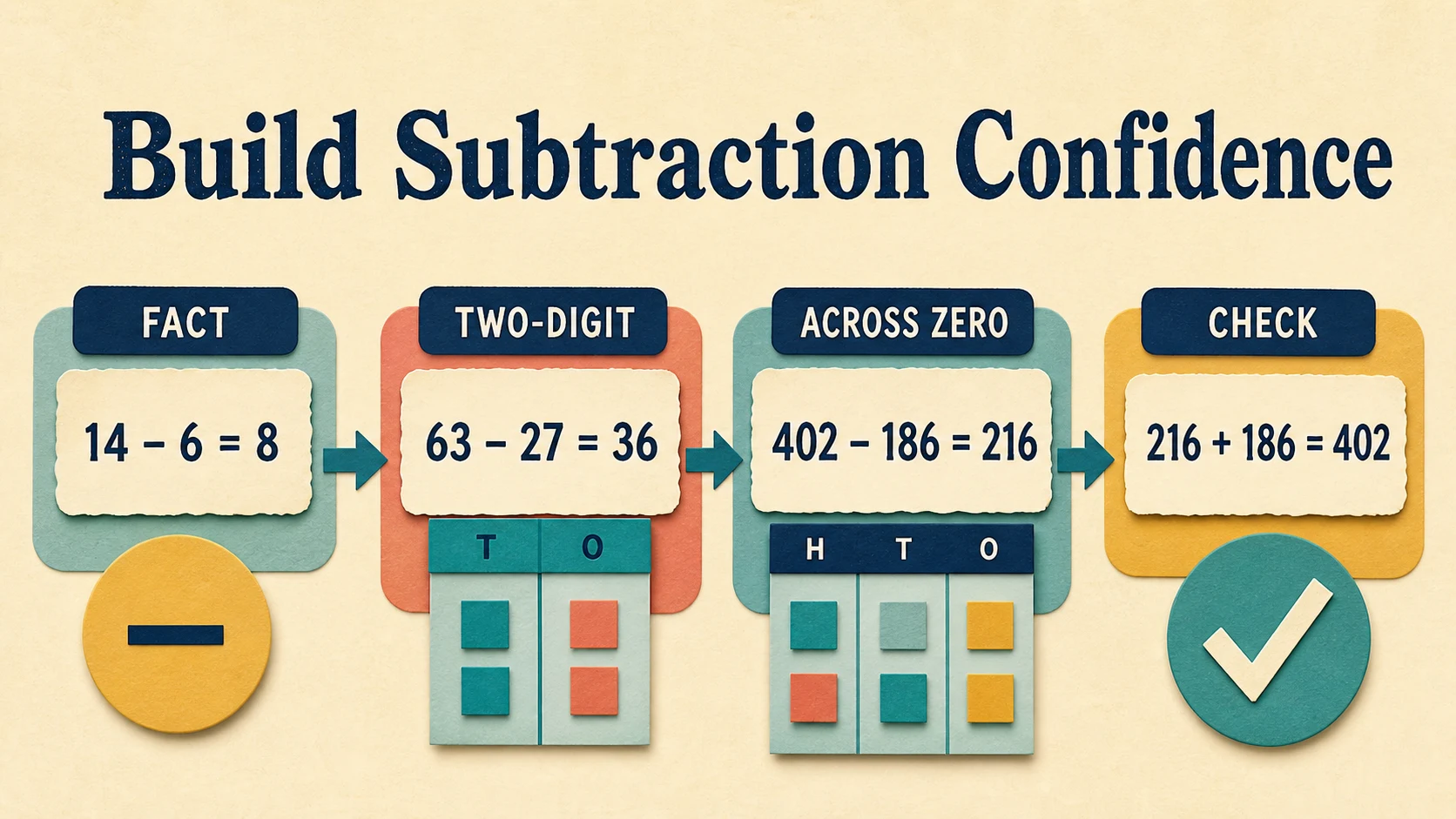
The subtraction progression helps an adult decide whether the next check should show the trade, prompt a drawing, or require independent recording.
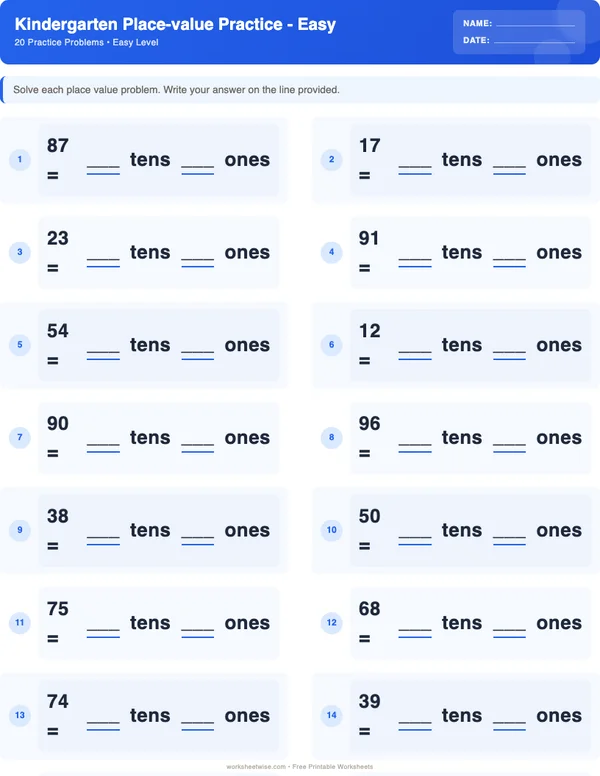
If the learner can build the trade with base-ten blocks but records it incorrectly, the next sheet should connect the model to written notation. If they cannot explain why one ten becomes 10 ones, return to physical trading before assigning another column of abstract problems. The Kindergarten Place Value guide and free sheet can provide an earlier composing-and-decomposing check without claiming that kindergarten placement is appropriate.
The IES practice guide Assisting Students Struggling with Mathematics supports systematic instruction, clear mathematical language, representations, number lines, and deliberate work with word problems. It does not assess WorksheetWise, and it does not turn one worksheet pattern into a diagnosis.
Telling time: vary reading, matching, and construction
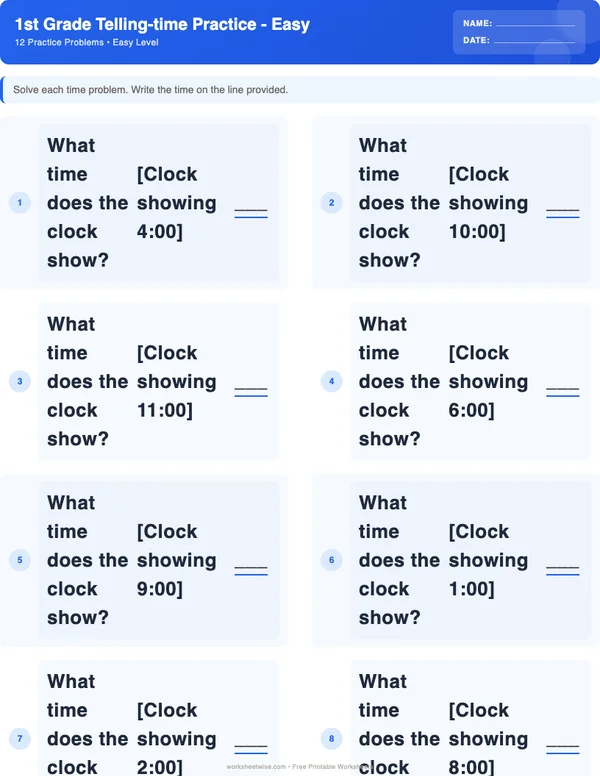
A first-grade telling-time sheet has 12 problems and may include matching, reading, or drawing clock hands. Suppose the minute hand points to 9 and the hour hand sits between 3 and 4. The time is 3:45, not 4:45, because the hour hand has passed 3 but has not reached 4.
This example belongs here because the catalogue identifies confusing the nearer hour after 30 minutes as a common error. Ask the learner to read the hour first, explain which hour has been passed, and then count minutes by fives to 45. If they know 45 minutes but select 4 as the hour, the next sheet should keep quarter-to times and emphasize the hour hand’s position. If they identify the hour but count the minute marks incorrectly, preserve the clock-reading target while adding a labeled skip-counting ring.
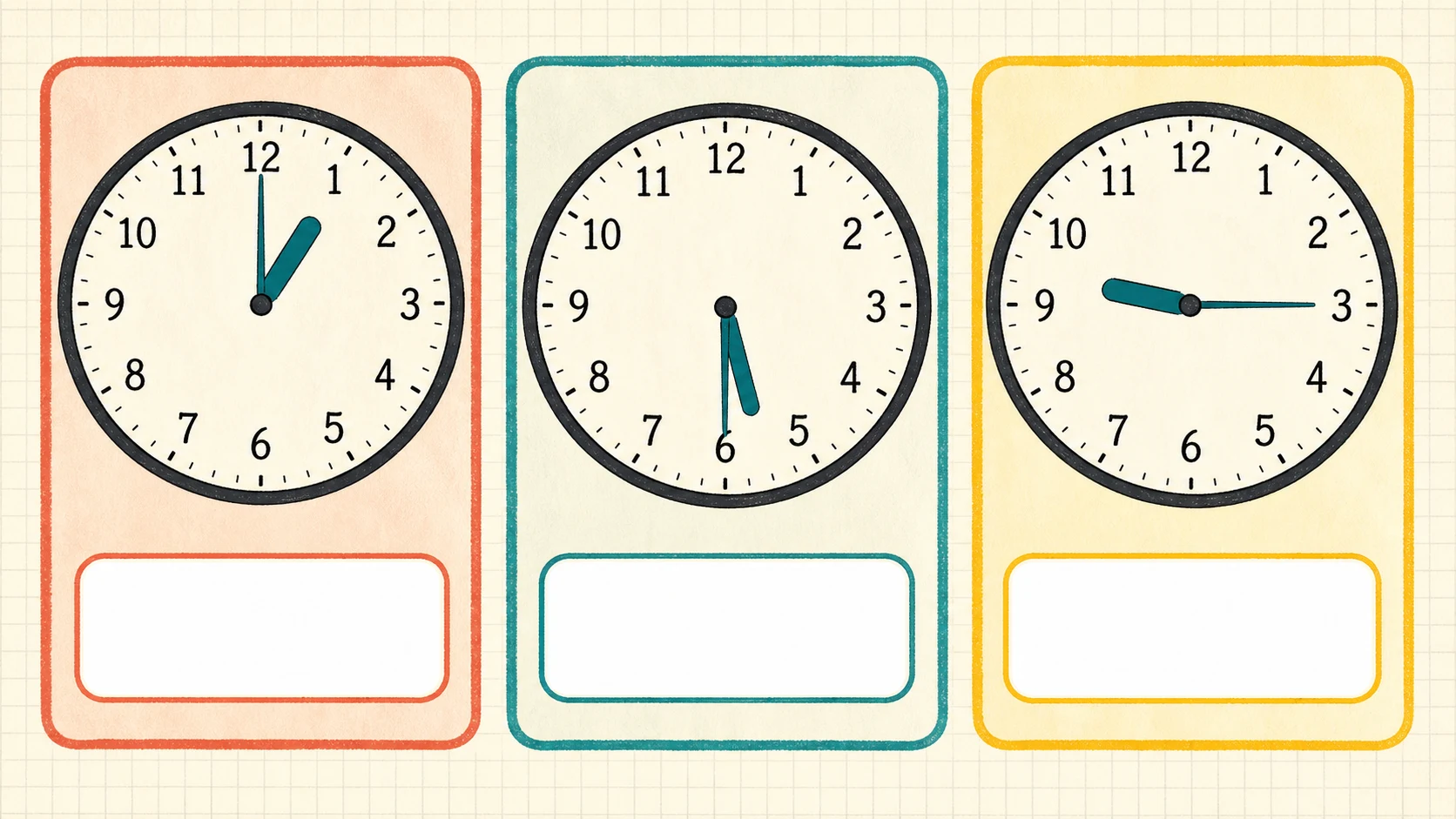
Use the two-week plan to revisit the same clock relationship through spaced reading, matching, drawing, and review rather than one long sitting.
Word problems: require a model before an operation
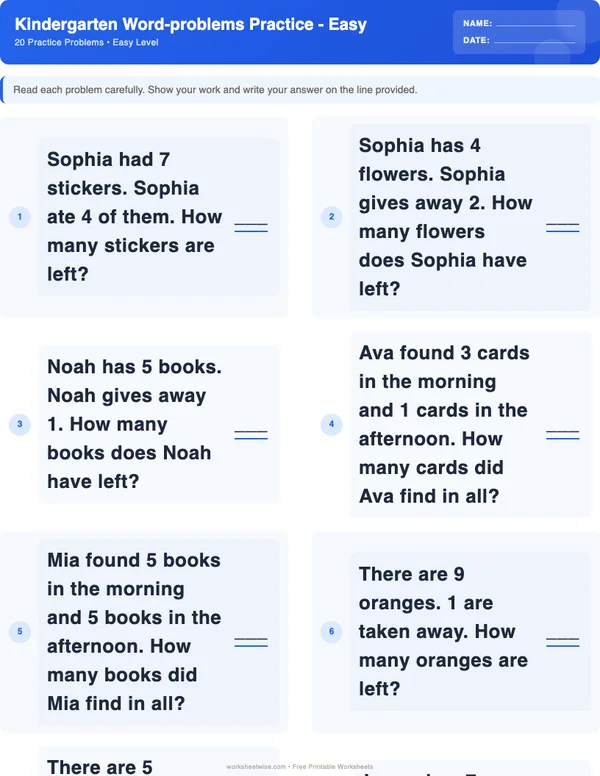
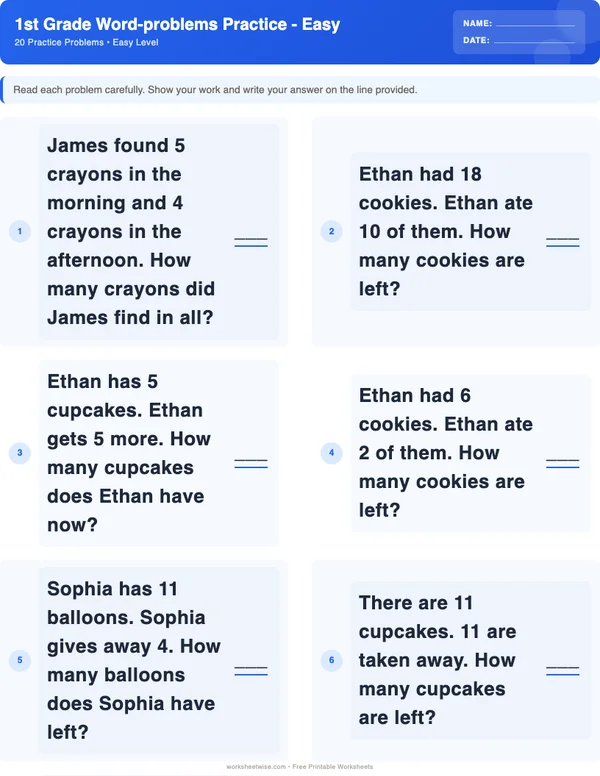
Consider: “Mia has 5 red blocks and 3 blue blocks. How many blocks does she have altogether?” A part-part-whole model shows parts 5 and 3 and an unknown whole. The checked equation is .
Now compare: “Mia has 8 blocks. Three are blue. How many are red?” The unknown is a part, so , or . The quantities are related, but the question changes the operation or equation form.
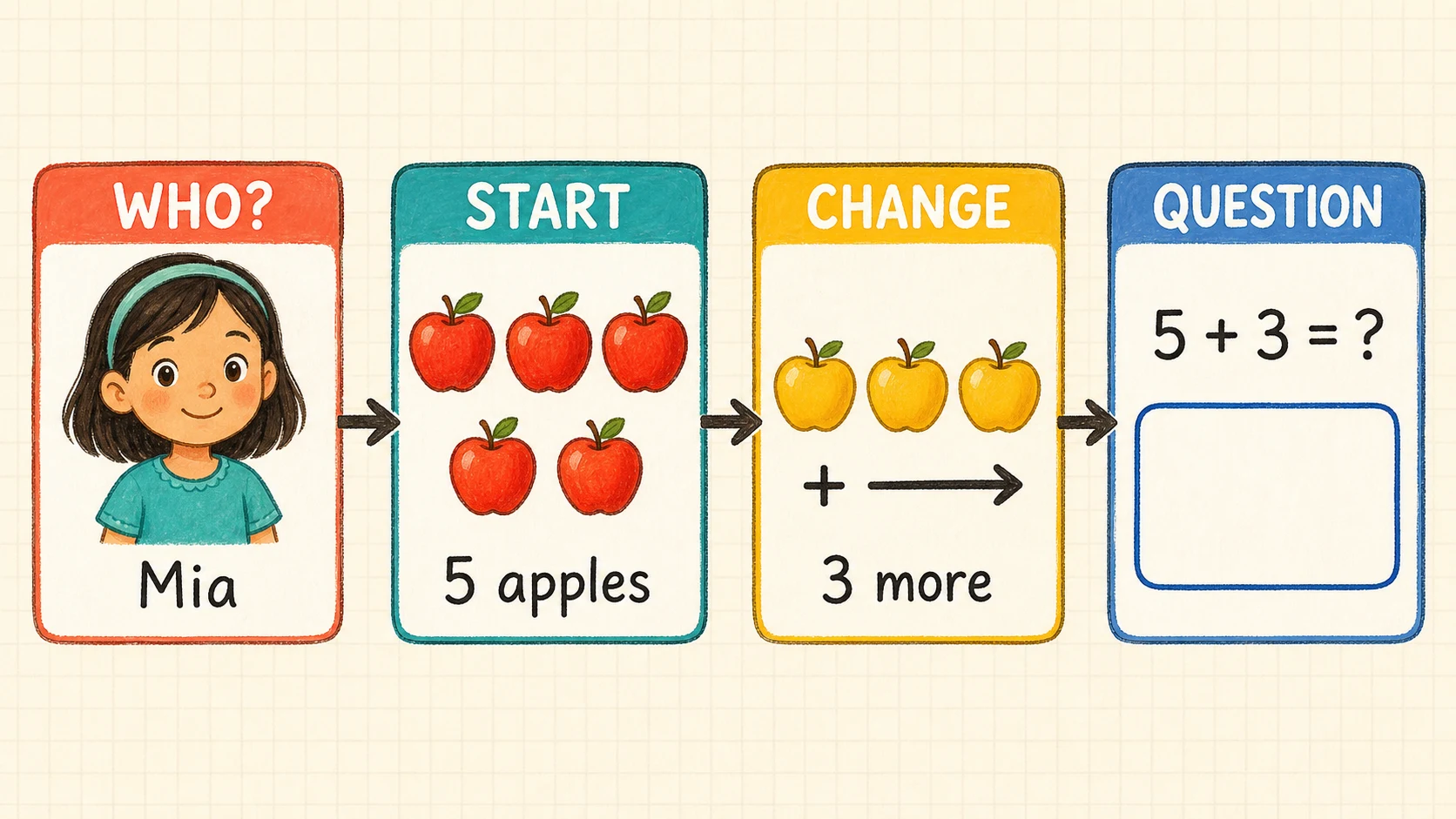
The word-problem map clarifies that reading, representing quantities, choosing a relationship, computing, and checking are separate observable actions.
These examples belong because the live word-problem materials explicitly span part-part-whole, comparison, and varied unknown positions. If the learner computes both equations when they are provided but chooses addition for every story containing “altogether,” the next sheet should present small numbers with contrasting story structures and require a drawing before an equation. Keep computation easy enough that it does not hide the modeling decision.
Feedback should name the relationship: “Your calculation is accurate, but your bar shows two parts when the story gives the whole and one part. Redraw what is known.” Avoid teaching isolated keyword rules. The catalogue guidance recommends retelling, identifying known and unknown quantities, modeling, solving, and checking.
Fractions: test equality of parts before notation
Show a rectangle divided into four equal parts with one shaded. The shaded amount is one fourth. Then show another rectangle divided into four visibly unequal pieces with one shaded. It is not valid to name the shaded region one fourth merely because there are four pieces; fourths must be equal shares.
This example belongs because the first-grade fractions sheet contains six problems and the topic begins with partitioning shapes into equal parts and naming fractions. A short six-item sheet can reveal whether the learner attends to equality, the number of parts, or only the shaded region.
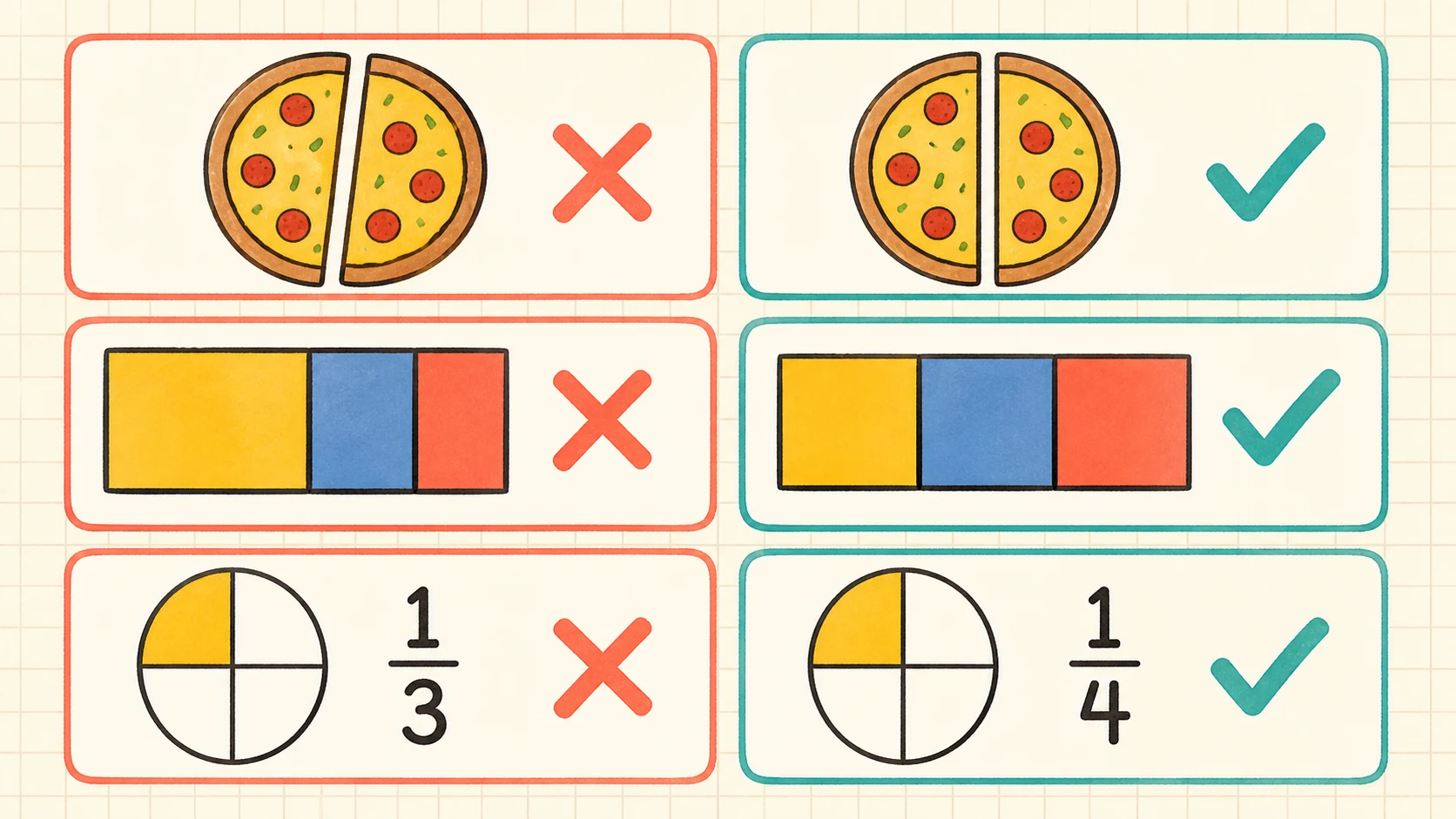
Treat the pictured responses as teaching prompts for common errors, not as clinical diagnoses or proof of a learner’s capability.
If equal and unequal partitions are both labeled one fourth, the next sheet should contrast fair and unfair shares using folding, matching, or sorting. If the learner recognizes equal shares but reverses numerator and denominator, keep the models and ask them to state, “four equal parts in all; one part selected,” before writing . If the symbols are correct only when a picture is present, the next step can match models to notation rather than jump to fraction computation.
Money: separate coin recognition from value accumulation
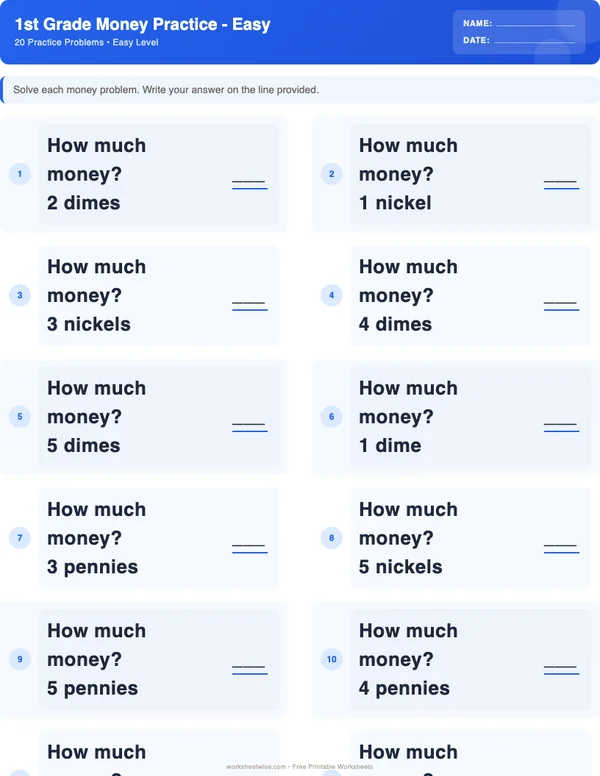
Suppose the learner counts one quarter, one dime, one nickel, and three pennies. Starting with the greatest value gives 25, 35, 40, 41, 42, 43 cents. The checked total is 43 cents.
This example belongs because the live money description includes coin identification, mixed collections, comparisons, and purchase situations. An incorrect total could come from several distinct sources: misidentifying a coin, losing the skip-count sequence, restarting at one for each coin, or failing to combine the subtotals.
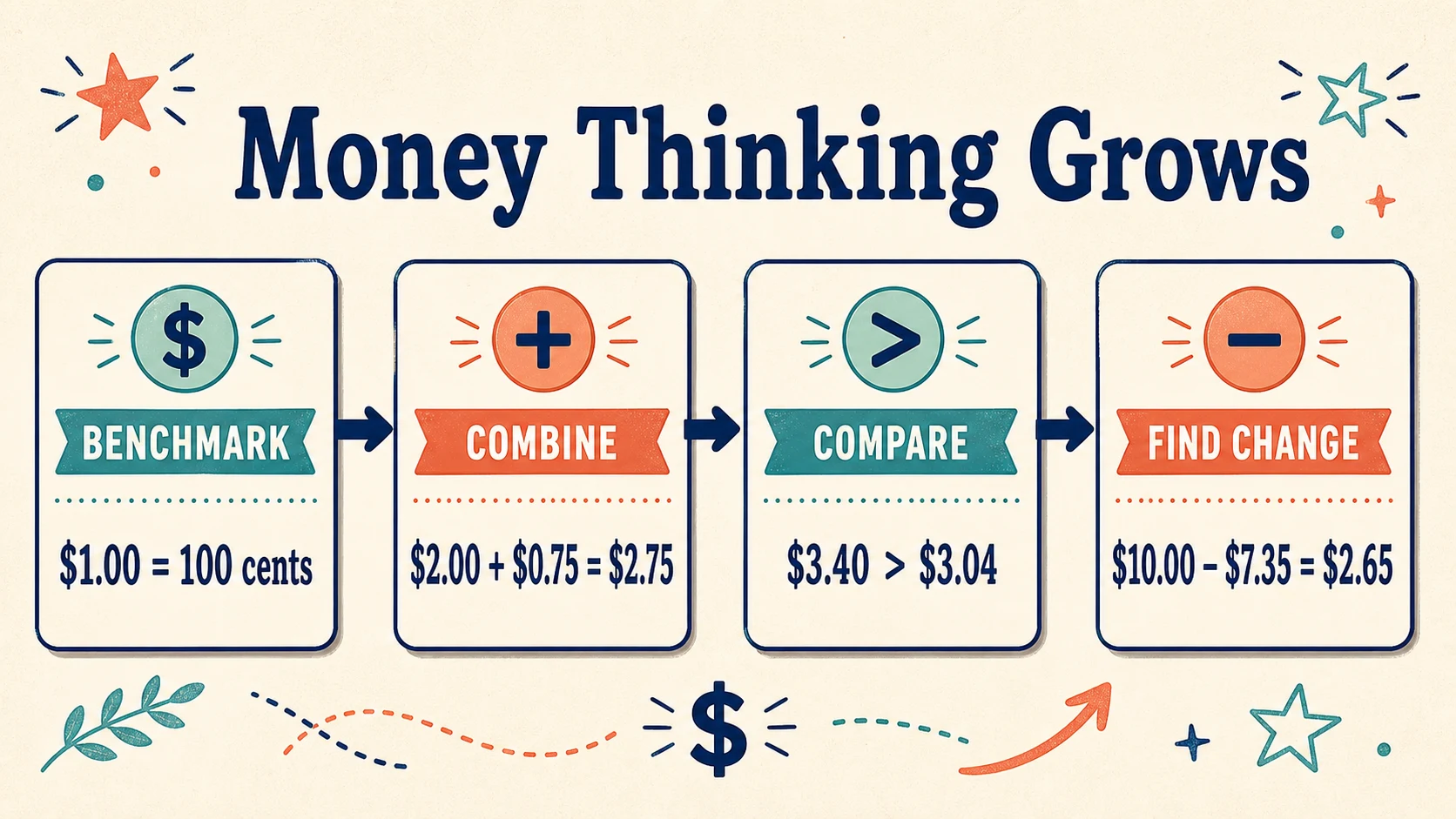
Use the money progression to isolate coin recognition, ordered counting, and independent purchase reasoning rather than treating them as one undivided skill.
If the learner names each coin and counts same-coin sets but falters on mixed sets, the next sheet should order coins from greatest to least and provide a running-total line. If coin names and values are confused, use real or realistic play coins for matching before returning to mixed calculations. If 43 cents is calculated correctly but written as “$43,” the next practice should preserve the arithmetic while contrasting cents notation with dollars.
Give feedback that changes the next attempt
Effective feedback is close to the evidence and limited to one actionable idea. It should not disclose every step before the learner has a chance to revise.
Use a three-part structure:
- Name what the representation or strategy shows.
- Identify the exact mathematical mismatch.
- Request one revision or check.
For : “You kept each column separate. In the ones column, 3 ones are not enough to remove 5 ones. Build 43 and show a trade before rewriting the equation.”
For the unequal fraction pieces: “You counted four regions. Fourths also require four equal shares. Sort these two shapes into fair and unfair partitions.”
For 3:45 read as 4:45: “You counted 45 minutes correctly. The hour hand has not reached 4, so mark the hour it has already passed.”
For a word problem with a correct computation but mismatched model: “Your equation equals 8, but the drawing does not show the two quantities in the story. Label where the 5 and 3 appear.”
Praise should remain evidence-based: “You checked the subtraction with addition” is more useful than “You’re a math star.” Record whether the learner used feedback on a parallel item. Immediate correction without successful transfer is not yet evidence that the misconception has changed.
Adapt access while preserving the math target
An adaptation preserves the intended mathematical decision while reducing an unrelated barrier. Read a word problem aloud when decoding is not being assessed. Let a learner point, speak, move counters, dictate an equation, or use enlarged clock faces. Reduce the number of visible items, add writing space, or alternate oral and written responses. Maintain the same quantities and relationships when comparing performance across formats.
Do not accidentally remove the target. If the target is selecting an operation from a story, supplying the operation changes the task. If the target is coin recognition, naming every coin changes the task. If the target is constructing equal groups, pre-drawing all groups may turn modeling into simple counting.
For an adult-led check at home, keep notes simple: item, response, strategy, tool, prompt, and next action. For classroom use, the Classroom Math Worksheets collection can support grouping by the observed skill, while the After-school Math Worksheets collection may suit shorter follow-up practice. Those contexts do not change the interpretation boundary: a practice response remains one sample under particular conditions.
Know what a worksheet cannot establish
A worksheet can show what happened on selected tasks at one time. It cannot establish a diagnosis, explain every cause of an error, prove durable mastery, or substitute for conversation and observation. Performance may change with language, attention, fatigue, familiarity, visual layout, available tools, or the way directions are delivered.
Do not average unrelated topics into a single “math level.” Accurate counting, uncertain word-problem modeling, and strong shape classification are three different observations. Do not infer that a learner lacks understanding because handwriting is slow, or infer conceptual understanding from a page of correct answers produced through an unexamined rule.
Repeat important observations with a parallel example, a different response format, and a later review. Seek appropriate school or specialist input when concerns are persistent or broader than the scope of ordinary instruction, but do not use these sheets to label the learner.
Turn today’s error into tomorrow’s sheet
End every session with one observable choice:
- If scattered-set tracking failed, keep the quantity small and use movable-object counting.
- If addition was correct only by counting all, choose ten-frame items that invite making ten.
- If subtraction regrouping was procedural but unexplained, return to place-value trades.
- If time errors changed the hour after 30 minutes, choose quarter-to clocks and hour-hand explanations.
- If word-problem computation was accurate but the operation was mismatched, use contrasting story structures with required models.
- If unequal regions were called fractions, sort equal and unequal partitions before adding symbolic notation.
- If mixed-coin totals failed after correct coin identification, add an ordered running total rather than harder purchase problems.
Write the next-step sentence before filing the page: “On the next check, I will keep ___ constant and change ___.” Then use the free deterministic worksheet generators to create a short parallel check with that controlled change—for example, the same subtraction range with visible place-value support, or the same coin values in a newly ordered collection. Observe the first strategy again before offering a prompt; that first move is the clearest evidence of whether the instructional response carried forward.
Put it into practice
Use the guide with a real printable
Move from explanation to a short, observable practice task. Check the first item together, then adjust the next session from the learner's actual work.
Open the first free worksheetExplore a neighboring collection