Curated collectionAnswer keys includedPrint-ready PDFs
Homework Math Worksheets
Select short, already-taught practice that a learner can understand at home and convert the returned work into next-day feedback.
Start with a real resource
Browse this worksheet collection
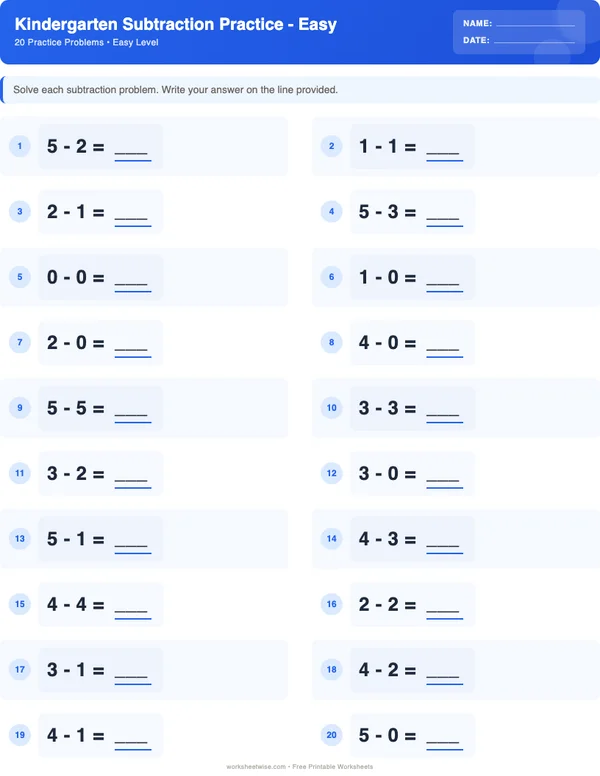
61 relevant free entry points are available. Each one includes a printable learner PDF and separate answer key.
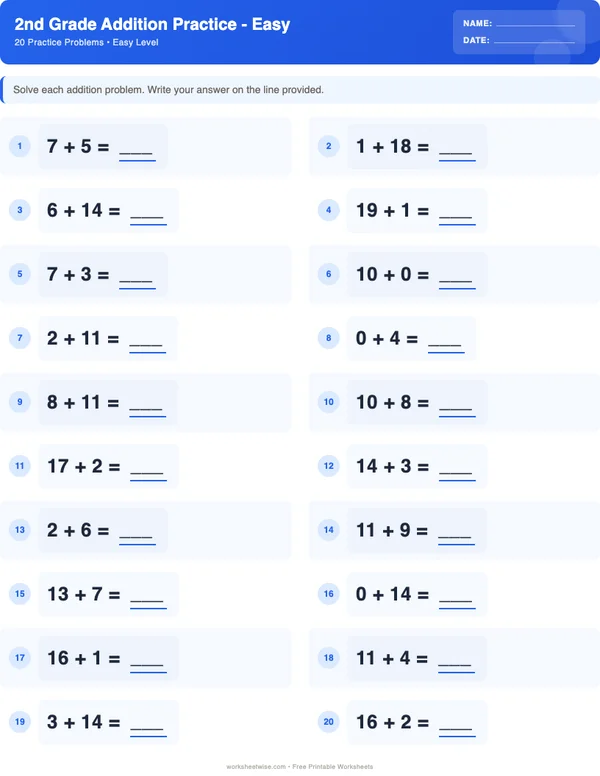
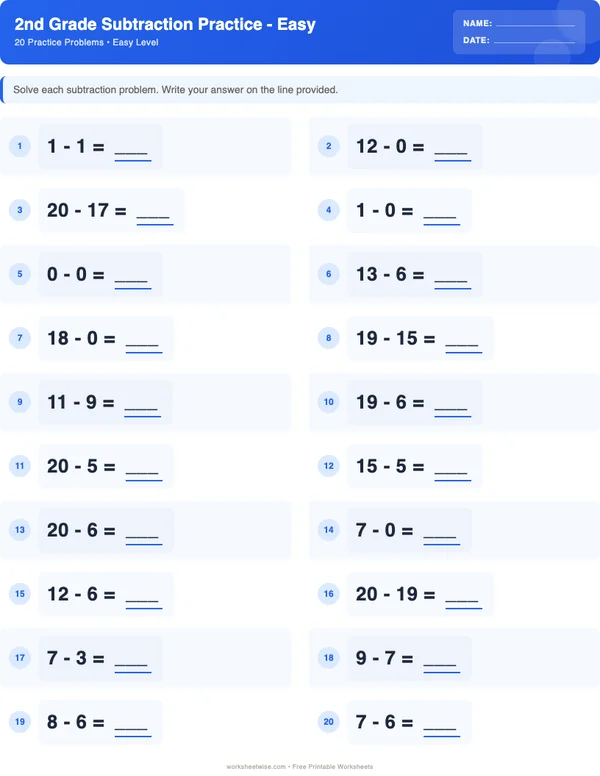
A useful practice loop
Print less. Observe more.
- Choose one skill and model the first item aloud.
- Use a short set and notice the learner’s strategy.
- Change the next task from the work you can see.
Need more than the free sheet?
Plus includes all 1098 matching catalogue variations where available, plus saved deterministic generators and the worksheet designer.
See Plus membershipComplete guide
How to teach and practise homework math worksheets
3,662 words Updated 6 instructional visuals
Choose homework that rehearses one taught idea
Homework math worksheets work best when they ask learners to revisit a familiar idea in a short, understandable format and give the adult or teacher useful evidence for the next lesson. The objective is not to introduce a new procedure at home or fill every available answer space. It is to see whether the learner can recognize the mathematical situation, choose or use an appropriate model, record an answer in the required format, and explain enough reasoning for an adult to interpret mistakes.
A practical selection rule is:
- Choose one skill already taught.
- Check that the worksheet uses familiar models and directions.
- Assign only the number of problems needed to reveal a pattern.
- Tell the learner what may be used: counters, a number line, a clock, drawings, or another familiar support.
- Review the returned work by error type, not just by score.
- Use the error pattern to choose the next sheet or a brief reteaching task.
WorksheetWise’s live math catalogue contains 1,098 variants, 61 free resources, eight grade groupings, and 12 topics. Those counts describe available choice; they do not mean that a learner should complete more pages. The valuable decision is which small sample will answer the teacher’s current question.
Grade labels describe the intended practice level, but local curriculum sequences differ. Age is a discovery aid rather than a placement decision. A worksheet listed for a particular age or grade may be useful only after its representations, vocabulary, number range, and response format have been taught.
Use task features to judge difficulty
The catalogue identifies the representative free sheets as “easy,” but that label should be interpreted through observable features rather than attached to a learner. A task is more supported when it uses a small number range, one familiar operation, visible objects or diagrams, repeated directions, and a direct response such as circling or writing one numeral. It becomes more demanding when it removes the model, changes the unknown’s position, combines operations, increases the number range, introduces irrelevant information, or requires an explanation.
Before assigning a page, inspect five features.
Mathematical demand
Ask what thinking each item actually requires. “Count the seven dots and write 7” requires one-to-one correspondence, knowledge of the counting sequence, and numeral recording. “Write the missing number: 14, 15, __, 17” removes the objects and asks the learner to track an abstract sequence. The topic is still counting, but the demands differ.
Similarly, 4 + 3 = __ and “Mia has 4 shells and finds 3 more” may share a calculation, yet the story problem also requires the learner to interpret the action and represent it. Do not select the latter merely because the arithmetic looks familiar.
Model and tool
Identify whether the sheet supplies pictures, ten frames, number lines, clocks, shapes, or place-value representations. Then decide whether those models match classroom instruction. A learner who was taught to build teen numbers with one bundle of ten and loose ones should not encounter an unexplained place-value diagram as homework and be expected to infer its meaning independently.
The IES practice guide for young children recommends building mathematical understanding through developmental progressions, monitoring what children know, and using representations and everyday contexts deliberately. That supports choosing a known model and observing how the learner uses it; it does not establish that any particular WorksheetWise page suits an individual learner. See IES, Teaching Math to Young Children.
Response format
Check how the learner must answer: write a numeral, complete an equation, circle a picture, draw clock hands, label a shape, show work, or write a sentence. Sometimes the response format creates the difficulty.
For example, a learner may say “half past three” correctly but draw the hour hand directly on 3 instead of halfway toward 4. That is not the same error as reading the clock as 2:30. One concerns how an analog clock represents elapsed movement; the other may concern identifying the hands or counting minutes.
Reading and visual load
Read every direction and sample item before sending the page home. Look for unfamiliar terms, crowded displays, small coin or clock images, and changes in directions halfway down the sheet. A math worksheet should not accidentally become an unsupported reading or visual-search test.
For a learner who understands an oral story but cannot independently read it, an adult may read the text exactly as written without explaining which operation to choose. That preserves the mathematical target while reducing an unrelated reading barrier.
Amount of practice
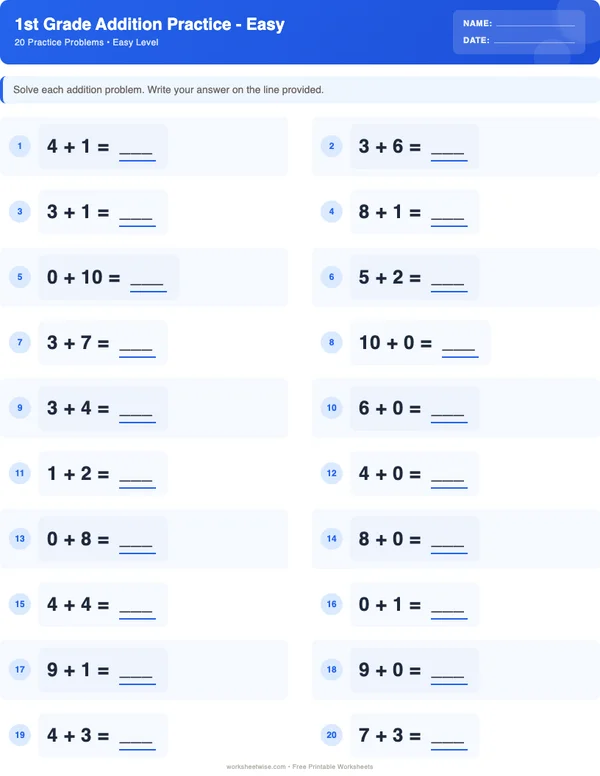
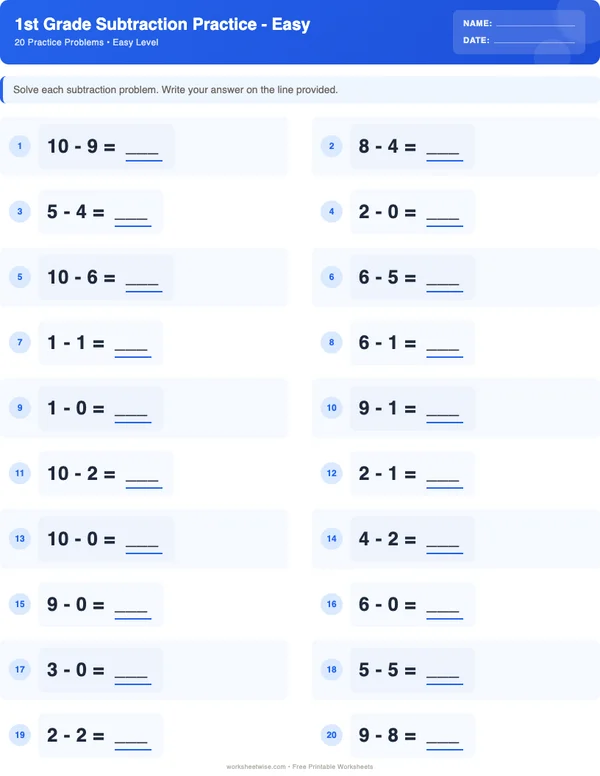
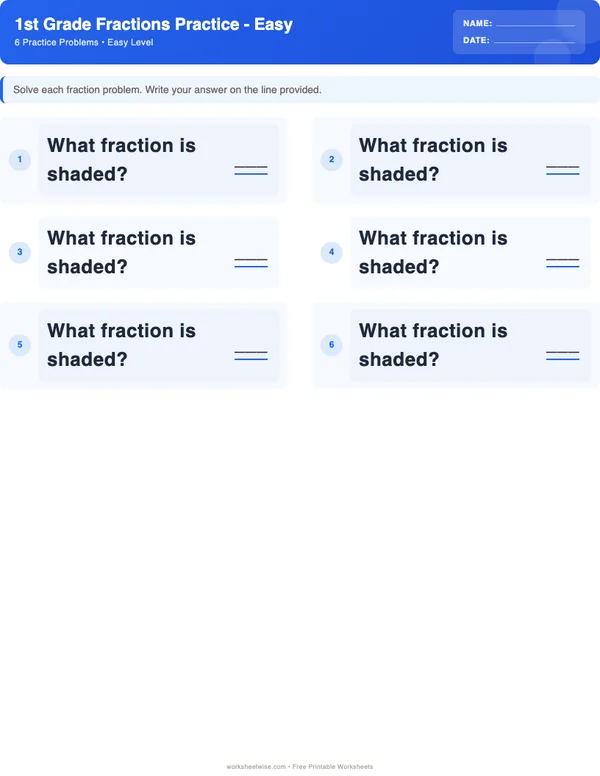
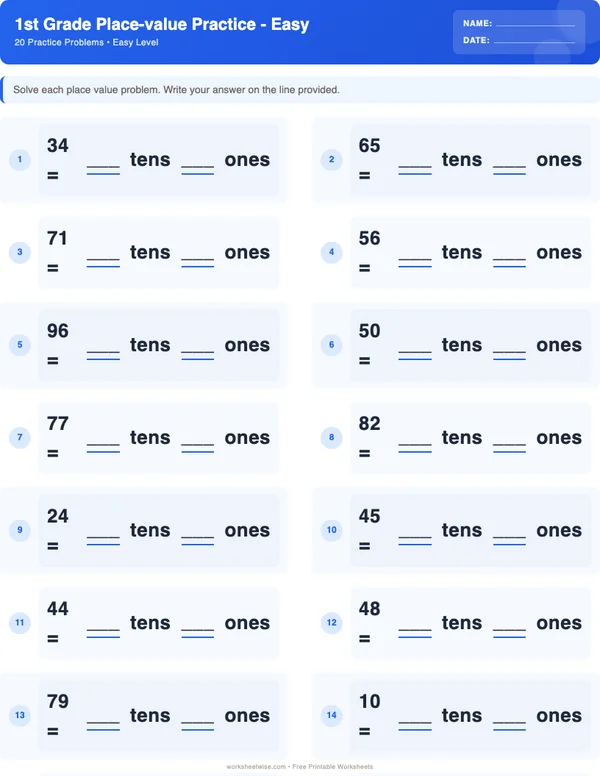
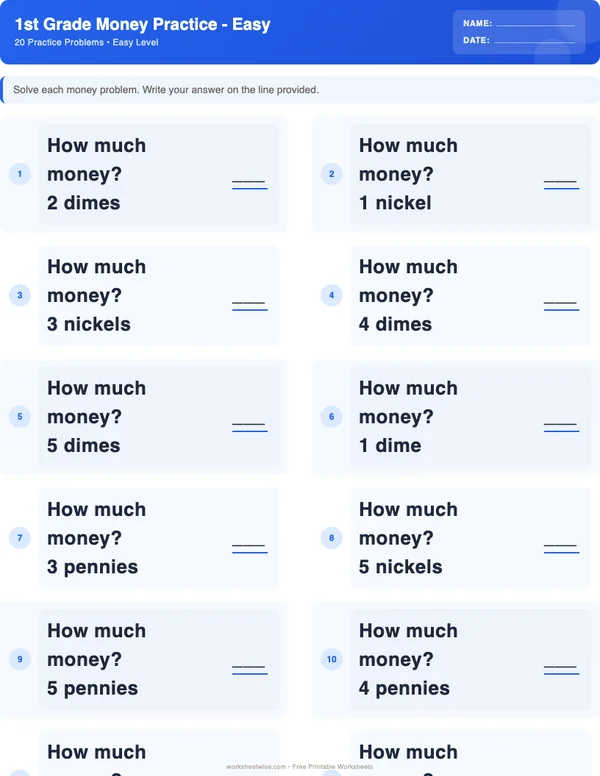
The representative catalogue resources contain different numbers of problems: the kindergarten word-problem sheet has 12, the first-grade fractions sheet has six, and many counting, addition, subtraction, place-value, geometry, and money sheets have 20. Treat the printed count as inventory, not a required dose.
If six carefully chosen items can reveal whether a learner understands equal parts, completing 20 unrelated items would add fatigue without clarifying the decision. Mark the assigned items or state a stopping point before the page goes home.
Match the worksheet to the lesson that already happened
A useful homework page should resemble the completed lesson closely enough that the learner can begin without home instruction. The examples, number range, model, vocabulary, and answer format should all be recognizable.
Counting: separate reciting from matching objects to numbers
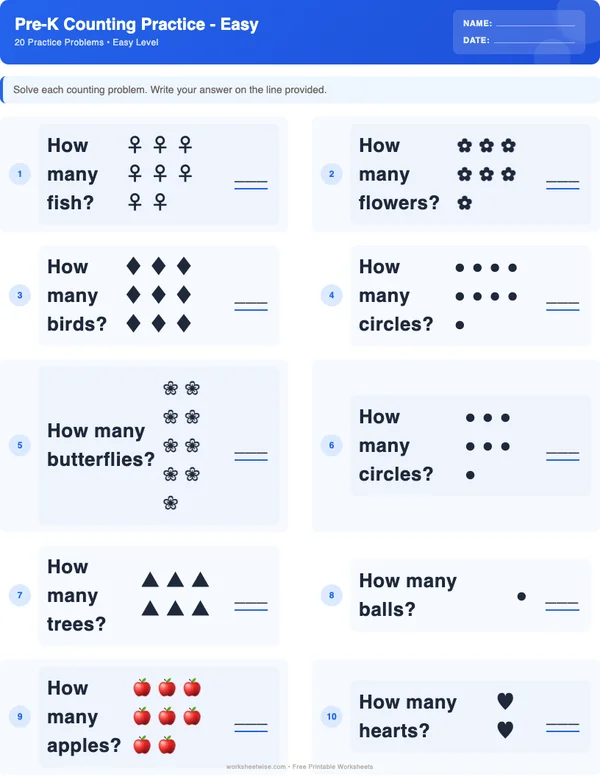
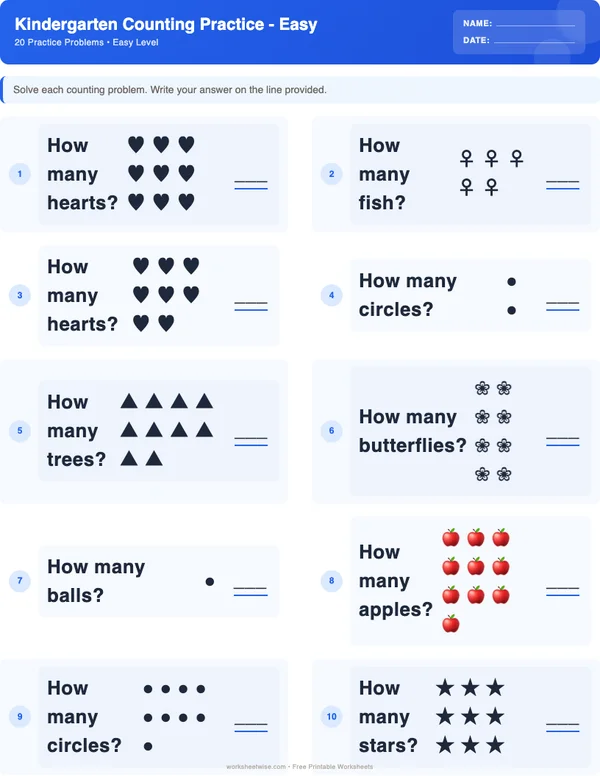
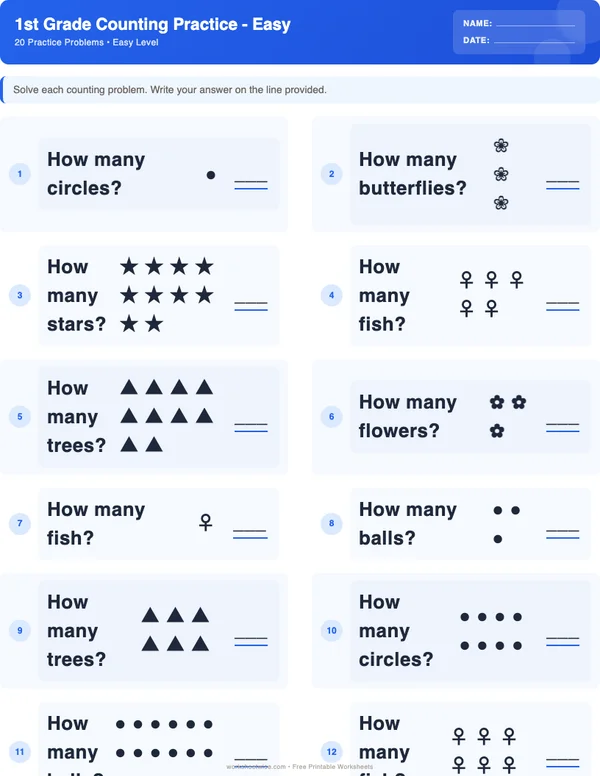
The live catalogue includes Pre-K, kindergarten, and first-grade counting resources, with 20 problems on each representative free sheet. Catalogue guidance recommends moving from concrete objects to pictures and then to abstract numerals, and having learners touch objects as they count.
A checked home example is a pictured set of eight objects. The learner touches each picture once, says “one” through “eight,” and writes 8. There are eight objects, so the checked response is 8. This example belongs on a homework math page because it combines a familiar model with a visible response and allows an adult to notice whether the count and the touching stay synchronized.
If the learner says the correct sequence but touches one object twice, the written 9 is not simply a fact to memorize again. The evidence points to one-to-one correspondence. The next task should use a smaller, movable collection—perhaps six buttons—so counted objects can be pushed aside. It should not immediately move to a longer missing-number sequence.
For ages three and four, prioritize brief adult-led oral, matching, manipulative, and movement work over desk work. An adult might place five blocks on the floor, invite the child to move each block into a cup while counting, and stop after two or three rounds. The Pre-K Counting guide and free sheet can be used as a source of pictures or matching prompts, but the full printed page need not become a seated assignment.
Addition: preserve the path from objects to symbols
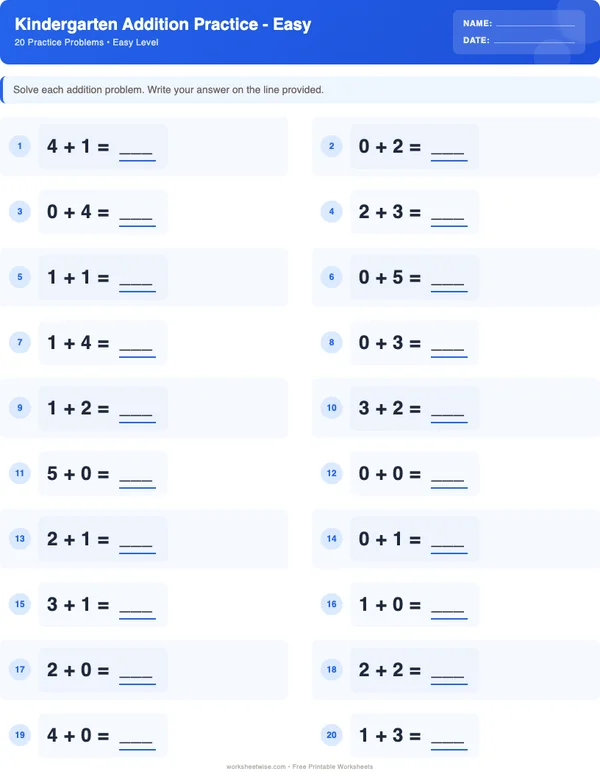
The catalogue describes an addition progression from physical manipulatives to drawings and then number sentences. A checked example is 8 + 5. With counters, the learner makes a group of 8 and a group of 5. With a ten frame, the learner can move 2 of the 5 counters to complete 10, leaving 3, so 8 + 5 = 10 + 3 = 13. The checked answer is 13.
This belongs here because the adult can observe more than correctness. A drawing of 8 dots and 5 dots, a completed ten frame, or the notation 10 + 3 shows how the learner found 13. A bare 12 provides less information.
For kindergarten practice, keep the number range and model consistent with what has been taught. The Kindergarten Addition guide and free sheet offers a relevant entry point, but inspect the actual items before assigning them.
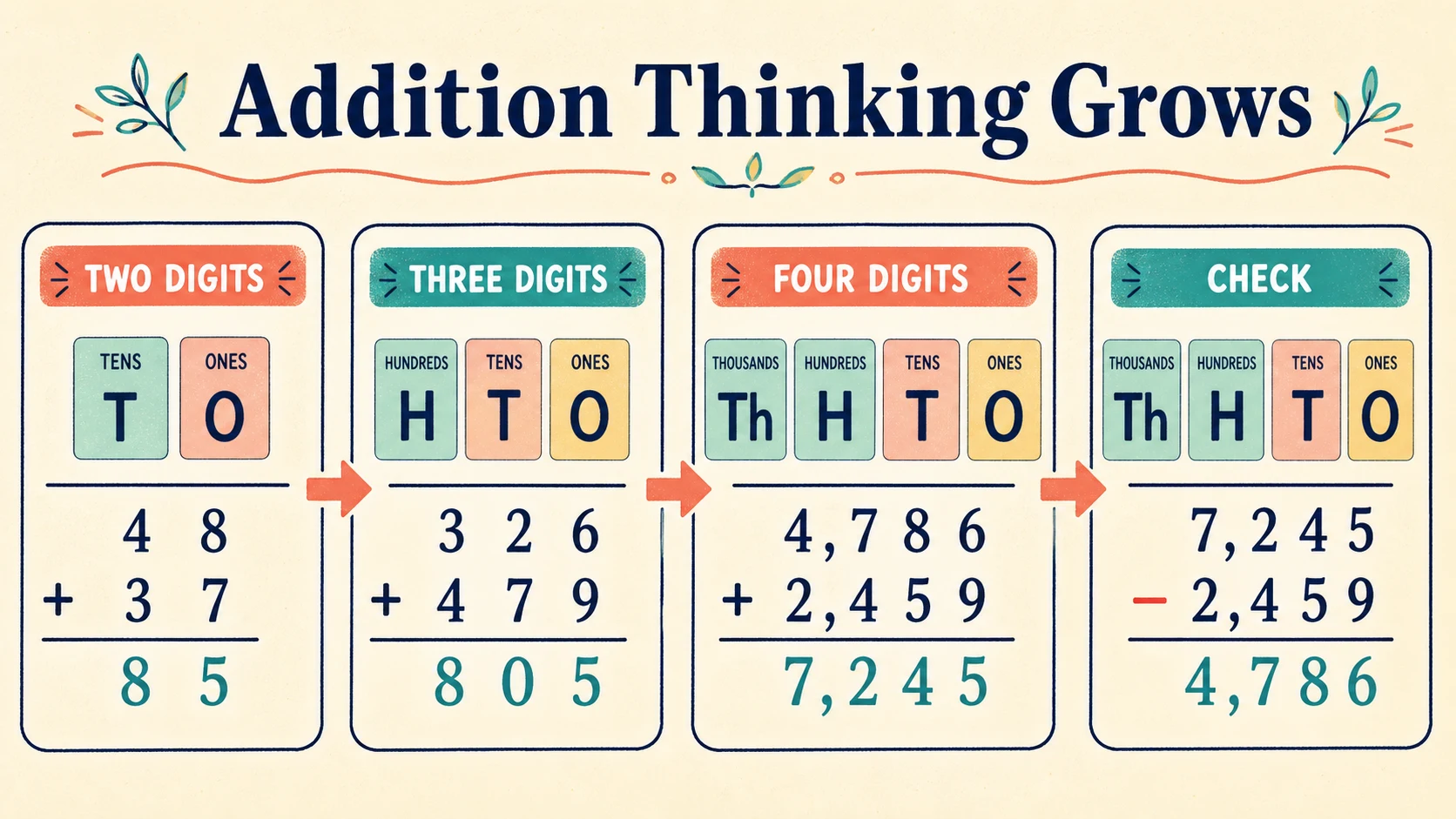
Use an addition progression to decide which support can be removed next, not to skip from a demonstrated model to unsupported computation.
Place value: require an explanation of what each digit means
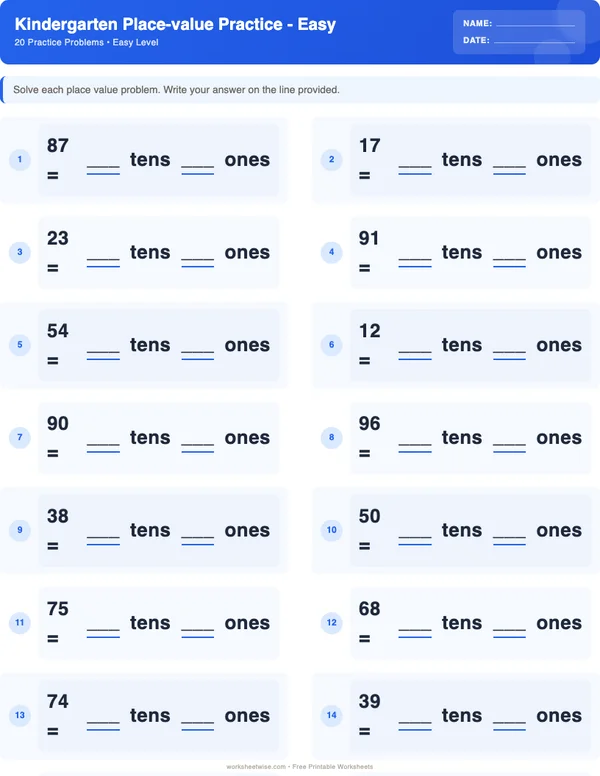
A checked early place-value example is 14. Build one group of ten and four single objects. Draw one ten and four ones. Then record 14 = 10 + 4. The checked decomposition is one ten and four ones—not four tens and one one.
This example belongs because reversing 14 to 41 can arise from several sources: numeral formation, listening order, or an incomplete understanding of tens and ones. The model distinguishes them. If the learner builds one ten and four ones but writes 41, the next activity should connect the model to numeral position. If the learner builds four tens and one one, return to bundling and trading.
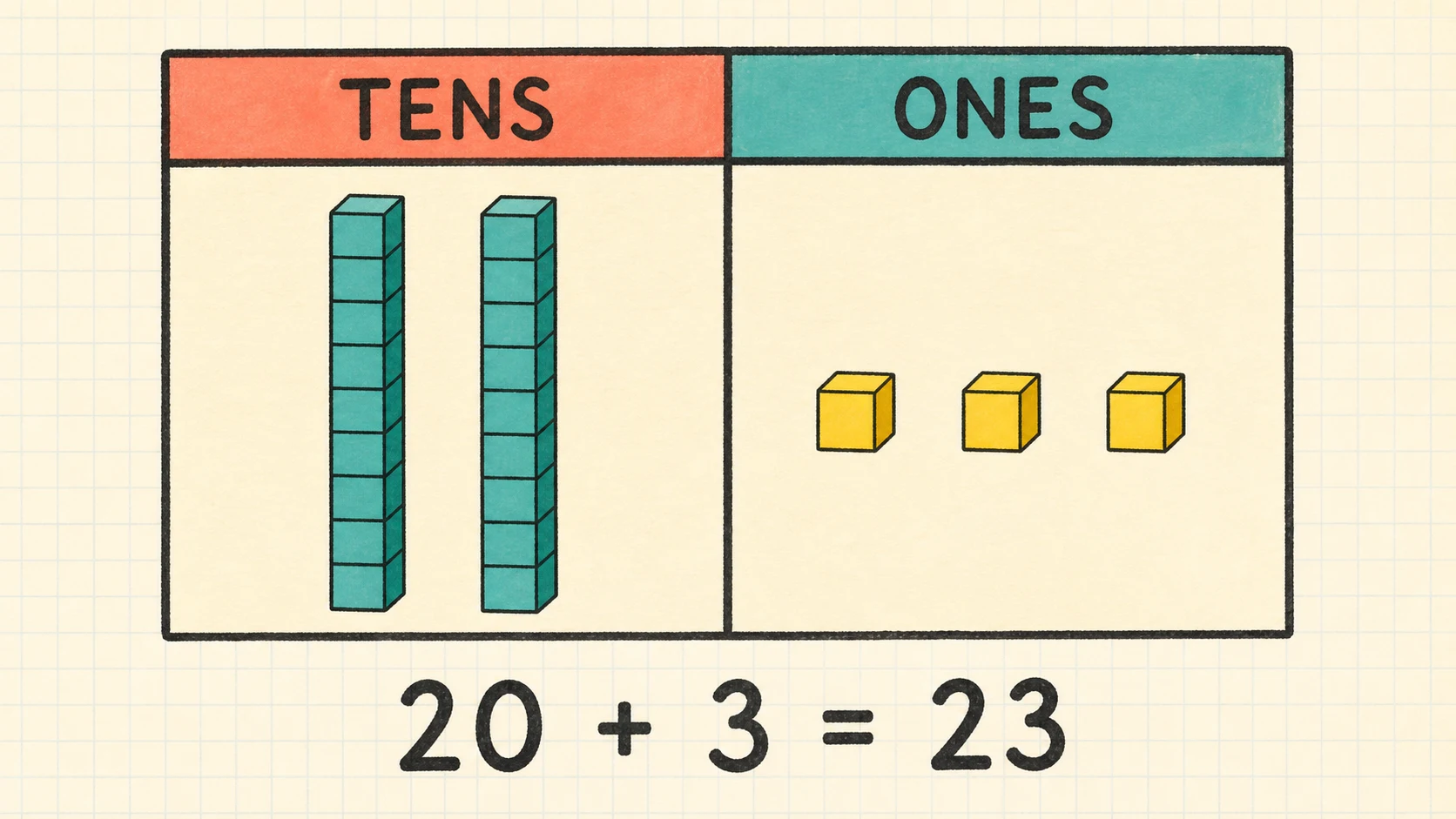
The useful evidence is the connection among the quantity, the tens-and-ones model, and the written numeral.
The Kindergarten Place Value guide and free sheet is a logical source when teen-number composition has already been taught.
For later practice, consider 352 = 300 + 50 + 2. The checked expanded form is 300 + 50 + 2. An answer of 300 + 5 + 2 suggests that the learner read the digits but did not preserve the value of the tens position. The next sheet should keep three-digit numbers and supply a place-value chart rather than increase the number of digits.
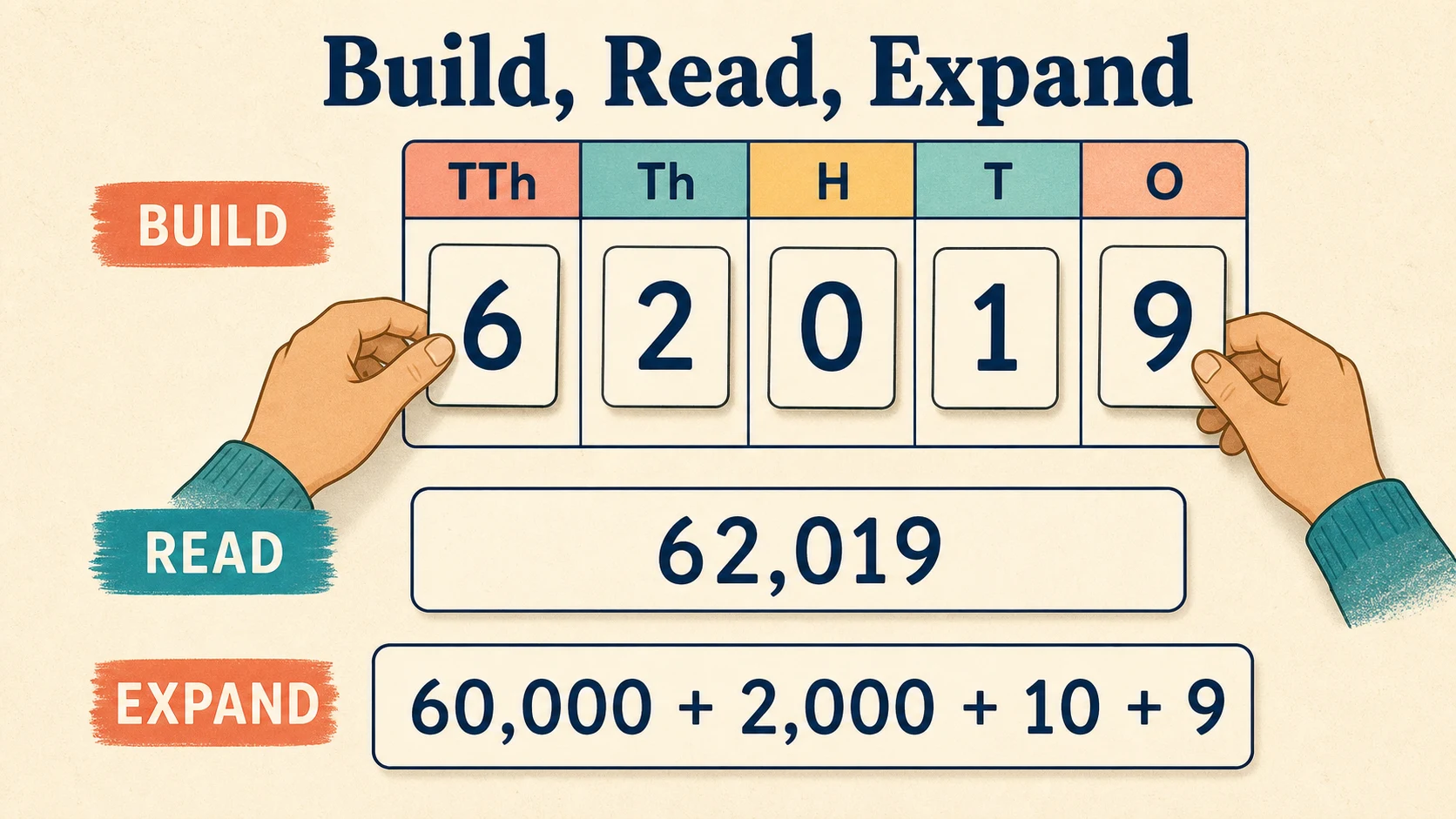
For homework, use the familiar portion of this routine and reserve new place-value language or regrouping for instruction.
Make word problems reveal mathematical modeling
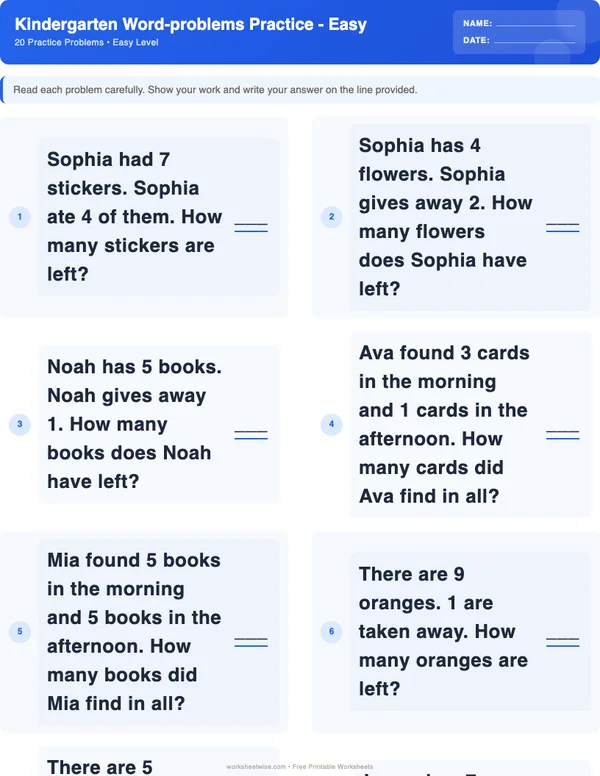
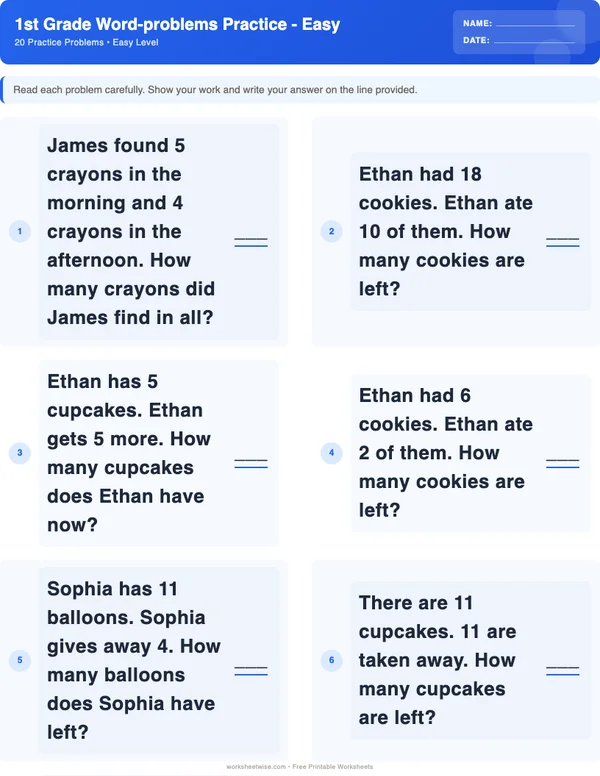
Word-problem homework should show whether the learner can make sense of a situation, not whether the learner can hunt for a keyword. The catalogue’s kindergarten representative has 12 problems and describes a progression from one-operation situations to more complex work. Catalogue guidance recommends reading, retelling, identifying known and unknown quantities, choosing a strategy, solving, and checking.
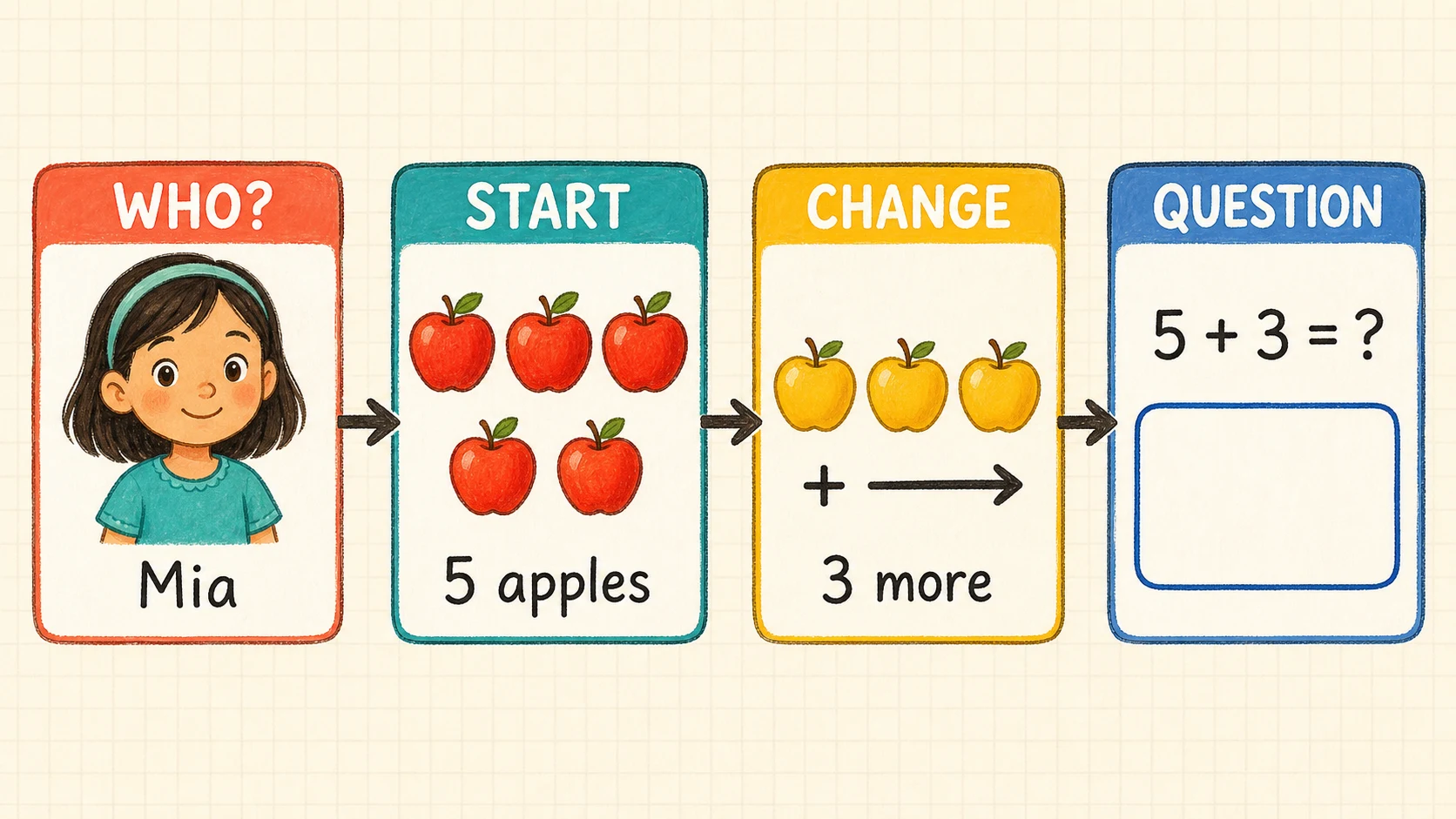
A word-problem response should connect the story, a model, an equation, and the meaning of the answer.
Consider this checked example: “Lena has 7 crayons. Omar has 4 crayons. How many more crayons does Lena have than Omar?” The quantities are 7 and 4, but the question asks for the difference. A matching comparison model has one bar of length 7 and one of length 4. The unmatched part is 3, so 7 − 4 = 3. Lena has 3 more crayons.
This example belongs because it exposes a common modeling issue. A learner who writes 7 + 4 = 11 may be computing accurately while representing the relationship incorrectly. Assigning more mixed addition and subtraction facts would not target that error. The next sheet should present comparison situations with a familiar bar or matching model and ask the learner to identify the unknown before calculating.
A second checked story is: “There were some birds on a fence. Three flew away. Five remained. How many birds were there at first?” The starting amount is unknown. Since the starting group consists of the 3 that left and the 5 that remained, 3 + 5 = 8. The checked answer is 8 birds.
This problem belongs because “flew away” may tempt a keyword-based subtraction response such as 5 − 3 = 2. The action includes removal, but the unknown is the starting quantity. Ask the learner to retell what existed before anything flew away and draw the whole with its two known parts.
The Common Core State Standards for Mathematics describe mathematical practice that includes making sense of problems, modeling, using tools strategically, and attending to precision. Those practices offer useful lenses for examining a response, but they do not prove local standards alignment for a worksheet. Confirm the specific expectations and sequence used by the learner’s school.
Keep home support helpful without taking over the mathematics
Adults need a clear role. “Help if needed” is too vague and often results in either no support or complete coaching.
Use this short home routine:
- Ask the learner to read or listen to the direction.
- Ask, “What is this asking you to do?”
- Make the familiar tool available.
- Let the learner attempt one item.
- If the learner is stuck, ask for a drawing, objects, or a retelling.
- Mark a small dot beside any item that required help.
- Stop at the assigned endpoint or after repeated confusion.
- Return the page with unfinished work and support marks intact.
Useful adult prompts include “Show me what each number means,” “Which part are you trying to find?” and “How could you check that?” Avoid prompts such as “This word means add” or “Put the bigger number on top.” Those hints may produce a correct answer while concealing the misconception the homework was meant to reveal.
An adult may read directions, enlarge a page, provide counters, or record a dictated explanation when writing is not the mathematical target. The adult should note the adaptation so the teacher can interpret the response accurately.
Adapt access while preserving the target skill
An adaptation is appropriate when it reduces a barrier without solving the central mathematical decision.
Geometry: change handling demands, not classification
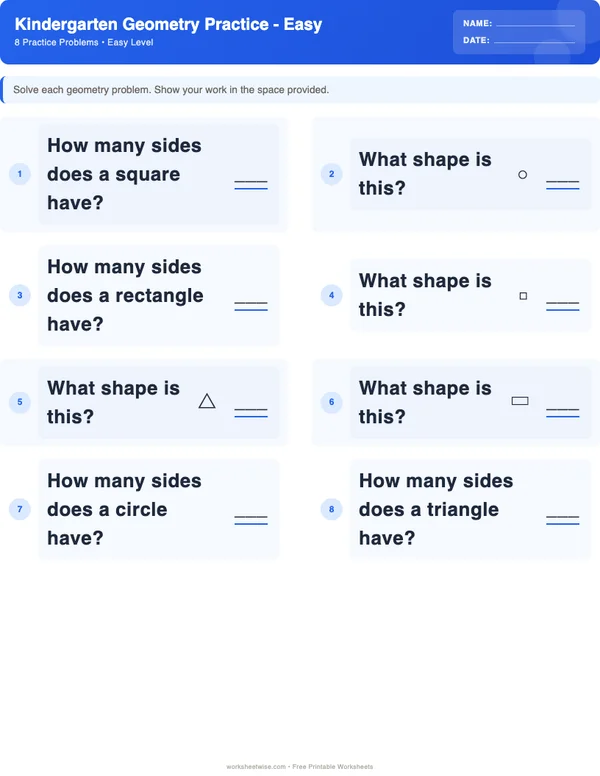
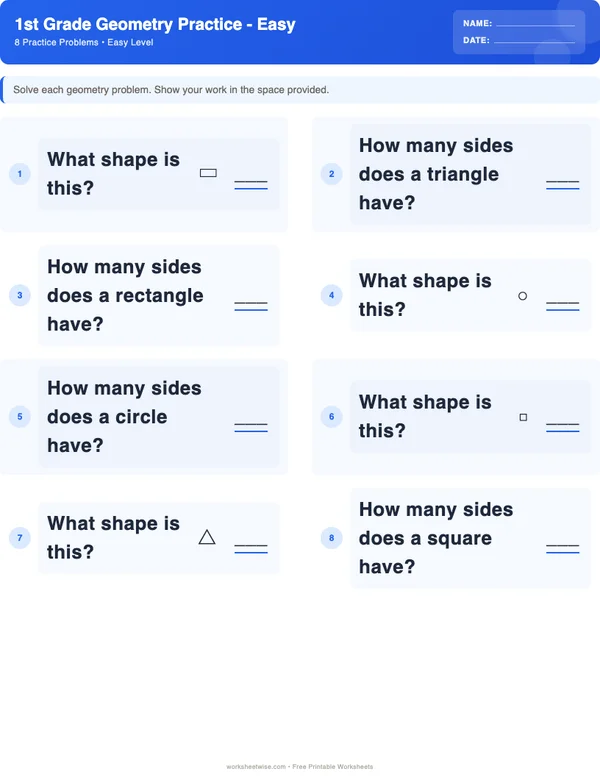
The catalogue’s early geometry resources include shape identification and description, while its guidance favors sorting, tracing, building, and seeing shapes in varied orientations.
A checked example is to show a typical triangle, a right triangle turned sideways, a square, and a circle, then ask which figures are triangles. The two triangles remain triangles because each is a closed two-dimensional figure with three straight sides. Orientation does not change that property.
This belongs because a learner may have memorized the appearance of an upright triangle without learning defining attributes. If cutting and pasting is difficult, let the learner point, circle, or place tokens instead. That changes the response action but preserves classification by properties.
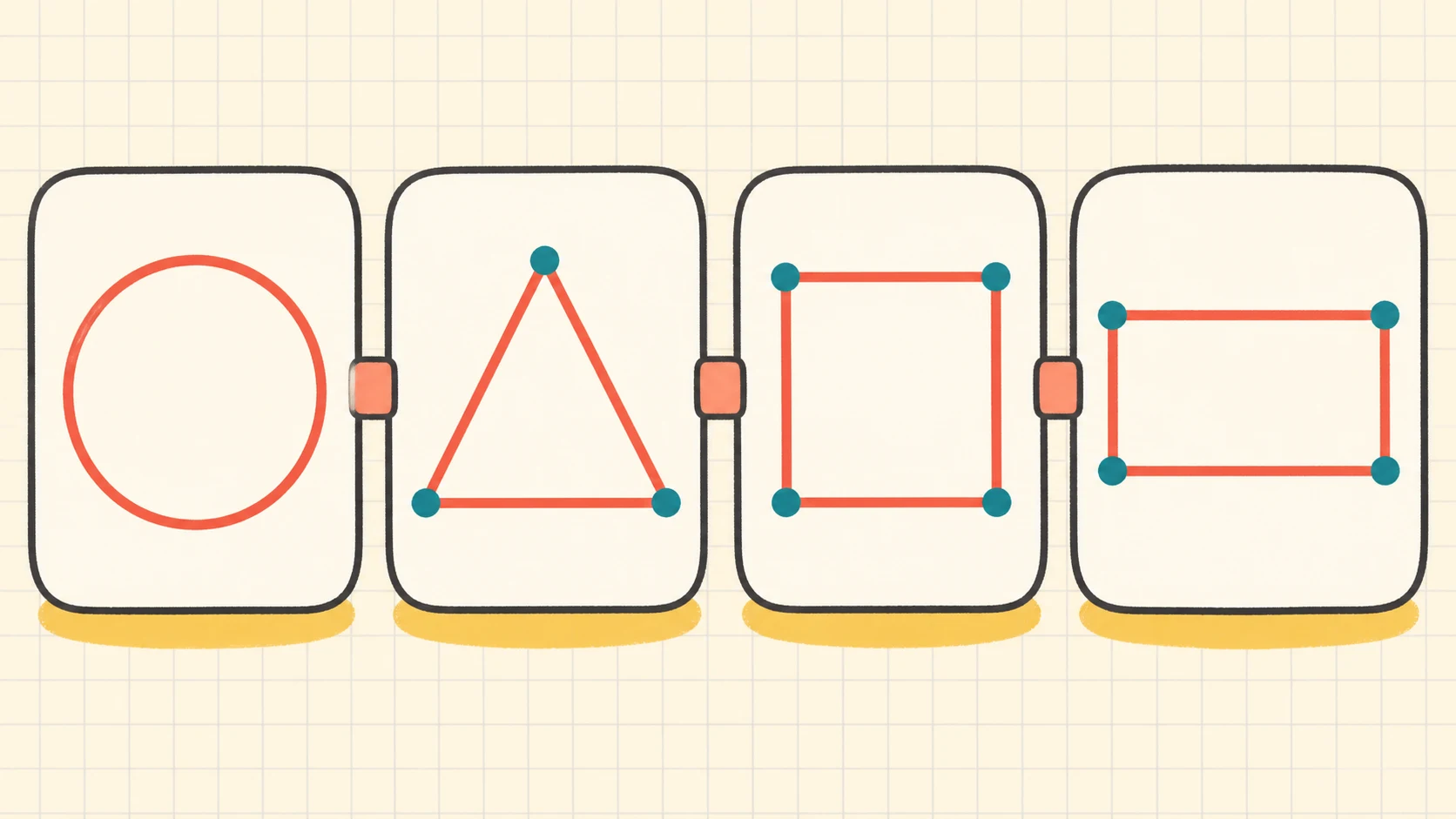
Vary orientation and response mode while keeping the geometric property under examination unchanged.
The Kindergarten Geometry guide and free sheet is a relevant starting place after the learner has sorted and described shapes with physical materials.
Telling time: preserve clock reading while reducing drawing load
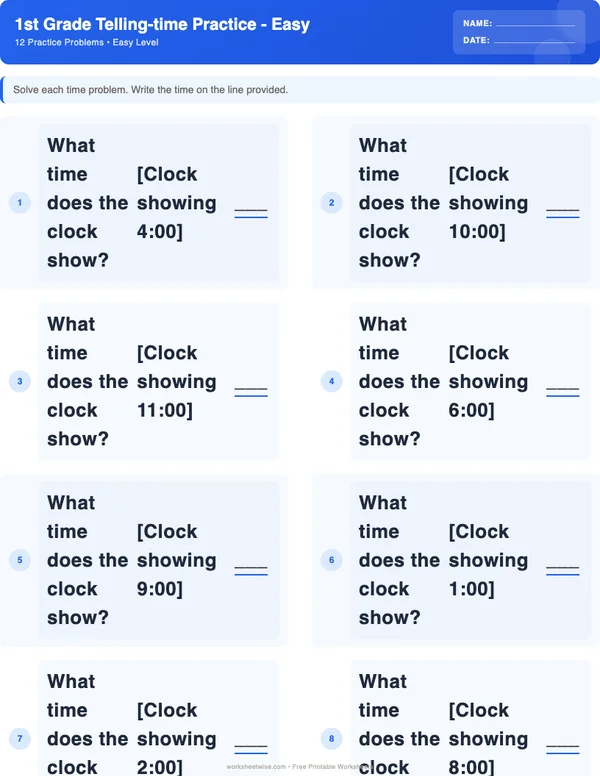
A checked example is an analog clock showing 3:45. The minute hand points to 9, representing 45 minutes. The hour hand is between 3 and 4 because the third hour is not complete. The checked time is 3:45, not 4:45.
If the learner identifies 3:45 orally but cannot draw precise hands, allow a matching response or movable clock. The target remains reading time. If the learner says 4:45 because the hour hand is near 4, use two clocks—3:30 and 3:45—and ask whether the hour hand has reached 4 yet.
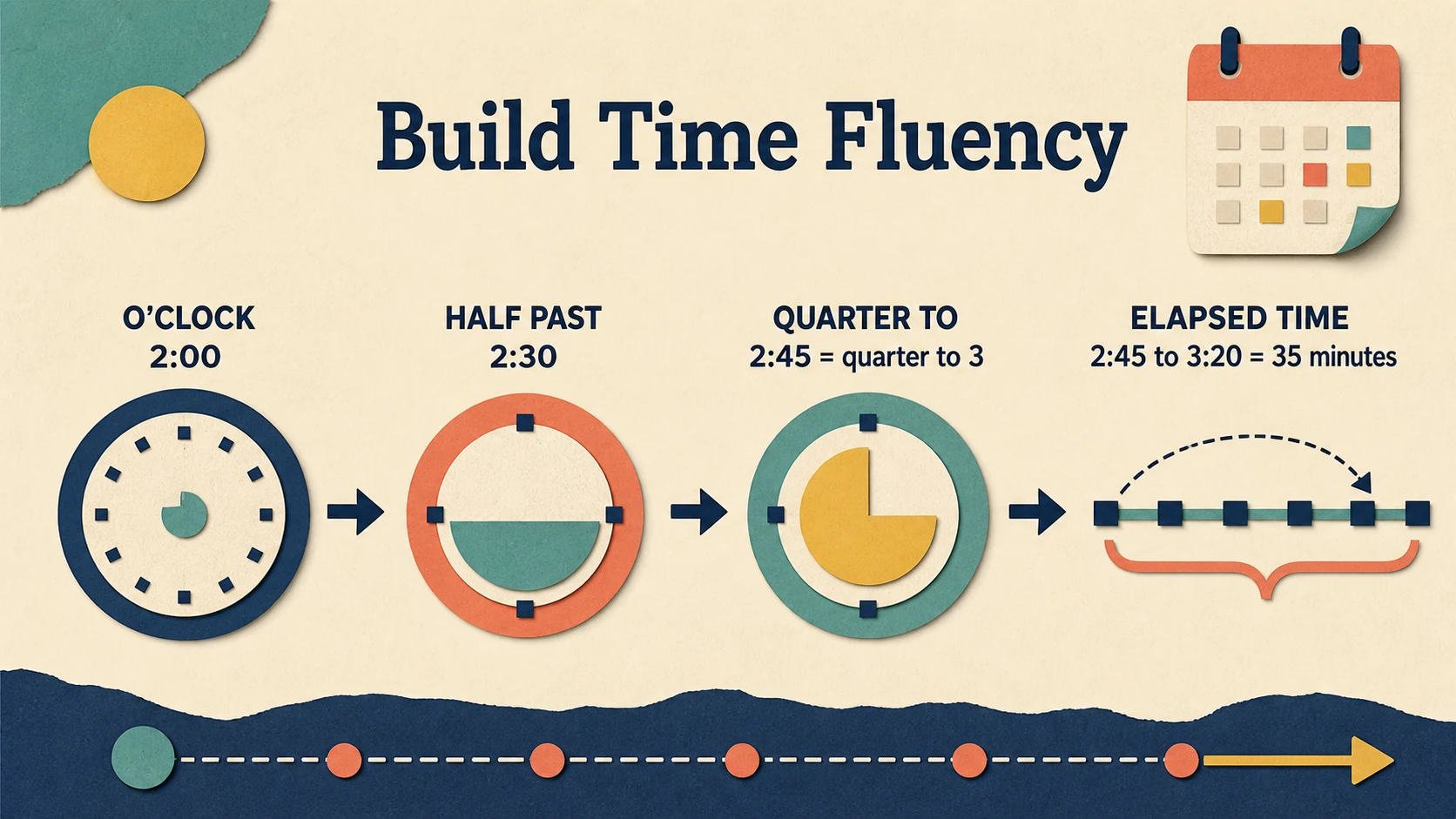
Remove clock supports only after the learner consistently coordinates the hour and minute hands.
Fractions: keep equal partitioning visible
The first-grade representative fraction resource contains six problems. A checked example is a rectangle divided into four equal parts with one part shaded. The shaded fraction is 1/4. If the four regions are visibly unequal, naming one shaded region 1/4 is not justified merely because there are four regions.
This belongs because the mathematical target is equal partitioning, not counting pieces alone. A learner who writes 1/4 for one of four unequal sections needs folding, matching, or overlay work with equal shares. A learner who recognizes the equal shares but writes numerator and denominator in reverse needs a focused connection between “one part selected” and “four equal parts in the whole.”
The IES guide on supporting learners who struggle with mathematics recommends systematic instruction, clear mathematical language, representations, number lines, and deliberate attention to word problems. These principles can guide teacher decisions after an error; they are not a diagnosis and do not mean that one incorrect page identifies a learning condition. See IES, Assisting Students Struggling with Mathematics.
Read returned work as evidence, not a verdict
A total score compresses unlike errors. Instead, examine the first incorrect response, a later response of the same type, and one correct response. Then classify what changed.
| Observable pattern | Plausible interpretation to check | Immediate check | Next-sheet decision |
|---|---|---|---|
| Counting words are correct, but objects are skipped or counted twice | One-to-one tracking may be unstable | Count six movable objects and push each aside | Use smaller pictured or concrete sets before abstract sequences |
| Addition answers are off by one and drawings contain the wrong number of marks | The representation may be inaccurate | Build one problem with counters before recording | Keep the number range; use organized frames or grouped pictures |
| Correct computation is paired with the wrong word-problem operation | The situation or unknown may be misidentified | Ask for a retelling and bar model without solving | Choose one problem structure at a time |
| Teen numbers are reversed after a correct model | Model-to-symbol mapping may be incomplete | Point to the ten and ones while writing each digit | Use place-value charts with teen numbers |
| Shapes are recognized only in a familiar orientation | Appearance may be overriding defining properties | Rotate the same shape and ask what remained true | Use varied orientations and attribute language |
| Analog times past half-hour are named as the next hour | Hour-hand movement may be misunderstood | Compare two nearby times on a movable clock | Keep times within one hour and coordinate both hands |
| Correct oral answer but incorrect written format | Recording may be obscuring mathematical understanding | Accept pointing or dictation for one comparison item | Preserve the skill while temporarily changing the response mode |
| Many unrelated omissions occur late on the page | Length, attention, or visual load may be interfering | Recheck two omitted items after a break | Assign a shorter marked set before changing skill level |
These are hypotheses to test, not diagnoses. A single wrong answer may reflect a slip, misunderstood direction, copying error, unfamiliar notation, or missing concept. Look for repetition and ask one neutral follow-up question before deciding.
Also examine correct answers. A correct total produced through a valid drawing may show useful understanding even if the method differs from the expected one. Conversely, a run of correct answers copied from an adult provides little independent evidence. That is why help marks and preserved work matter.
Turn each error pattern into next-day feedback
Feedback should tell the learner what mathematical relationship to reconsider and provide a near transfer opportunity. “Wrong,” “Try harder,” and a page covered in answer marks do not do that.
Use this sequence:
Name what is already sound
Be precise: “You counted in order,” “Your model shows seven and four,” or “You identified the minute hand correctly.” Do not praise correctness that is not visible in the work.
Point to the mathematical mismatch
Say, “Your bar model compares 7 and 4, but your equation joins them,” or “You built one ten and four ones, but the tens digit was written in the ones place.” This connects the error to the representation.
Rework one item with a familiar model
The learner should do the thinking. For 7 − 4, the adult might align seven counters above four and ask what is unmatched. For 14, the learner can place the bundle under “tens” and the loose objects under “ones.”
Give one closely related check
After correcting 7 − 4, try 8 − 5 in the same comparison form. After rebuilding 14, try 16 as one ten and six ones. A successful near example gives stronger evidence than recopying the corrected answer.
Choose the next sheet from the observed need
The decision should be explicit:
- If the model was accurate but the arithmetic failed, keep the model and provide focused calculation practice.
- If computation was accurate but the word problem was misrepresented, keep numbers small and vary the story structure.
- If a response-format barrier hid correct oral reasoning, modify the format and collect another sample.
- If errors appeared only after many items, shorten the assignment before lowering the mathematical demand.
- If the learner could not explain or begin several items, pause worksheet practice and reteach with objects, diagrams, or oral examples.
For a wider set of pages after that decision, use the full worksheet library. To create another narrowly controlled sample—for example, the same operation with a smaller number range—use the free deterministic worksheet generators.
Respect what homework cannot establish
A returned worksheet can show written responses under particular home conditions. It cannot, by itself, establish mastery, explain every cause of an error, measure the amount of adult help, or diagnose a learning need. It also should not be used to introduce an unfamiliar model that the learner must decode without teacher support.
Do not infer broad ability from a catalogue difficulty label, grade label, completion time, handwriting quality, or one score. Grade labels indicate intended practice level, and curriculum sequences vary. If work is persistently inaccessible despite matched instruction and familiar supports, document specific observations—such as “counts seven objects but touches two twice” or “reads 3:45 as 4:45 on four examples”—and share them with the learner’s teacher or support team. Avoid diagnostic language.
Homework is also not the right setting for prolonged struggle. A blank or partially completed page with an adult note can be more informative than answers obtained through repeated prompting. The teacher needs to know where independence ended.
Make tomorrow’s assignment answer one clear question
Before selecting the next page, write the question you want the work to answer. Examples include: “Can the learner match one count word to each object?” “Can the learner represent comparison stories without relying on keywords?” “Can the learner connect one ten and some ones to a teen numeral?” or “Can the learner coordinate both hands when reading times after 30 minutes?”
Then choose three to eight items that isolate that question, identify the permitted model, and tell the home adult how to mark assistance. Review the returned work by model, calculation, and response format before assigning anything further.
The practical next action is to open the free deterministic worksheet generators and create one short follow-up set that tests the single error pattern you observed today.
Put it into practice
Use the guide with a real printable
Move from explanation to a short, observable practice task. Check the first item together, then adjust the next session from the learner's actual work.
Open the first free worksheetExplore a neighboring collection