What 1st Grade Place Value Means
1st Grade Place Value is the understanding that a two-digit number is made from groups of ten and leftover ones. In 47, the 4 represents 4 tens, or 40, while the 7 represents 7 ones. A learner who understands this can build, describe, write, decompose, and compare two-digit numbers—not merely name their digits.
This understanding supports later work with multi-digit computation, expanded form, estimation, rounding, and broader number sense. In first grade, however, the central task is concrete: connect counted objects to groups of ten, connect those groups to written numbers, and explain what each digit represents.
A useful teaching sequence moves through four representations:
- Real objects grouped into tens and ones.
- Drawings or base-ten models.
- A place-value chart or equation.
- Numerals without a visible model.
Do not hurry through the first two stages. If a learner can complete a written exercise only by copying a procedure, return to objects and ask the learner to build and explain the number.
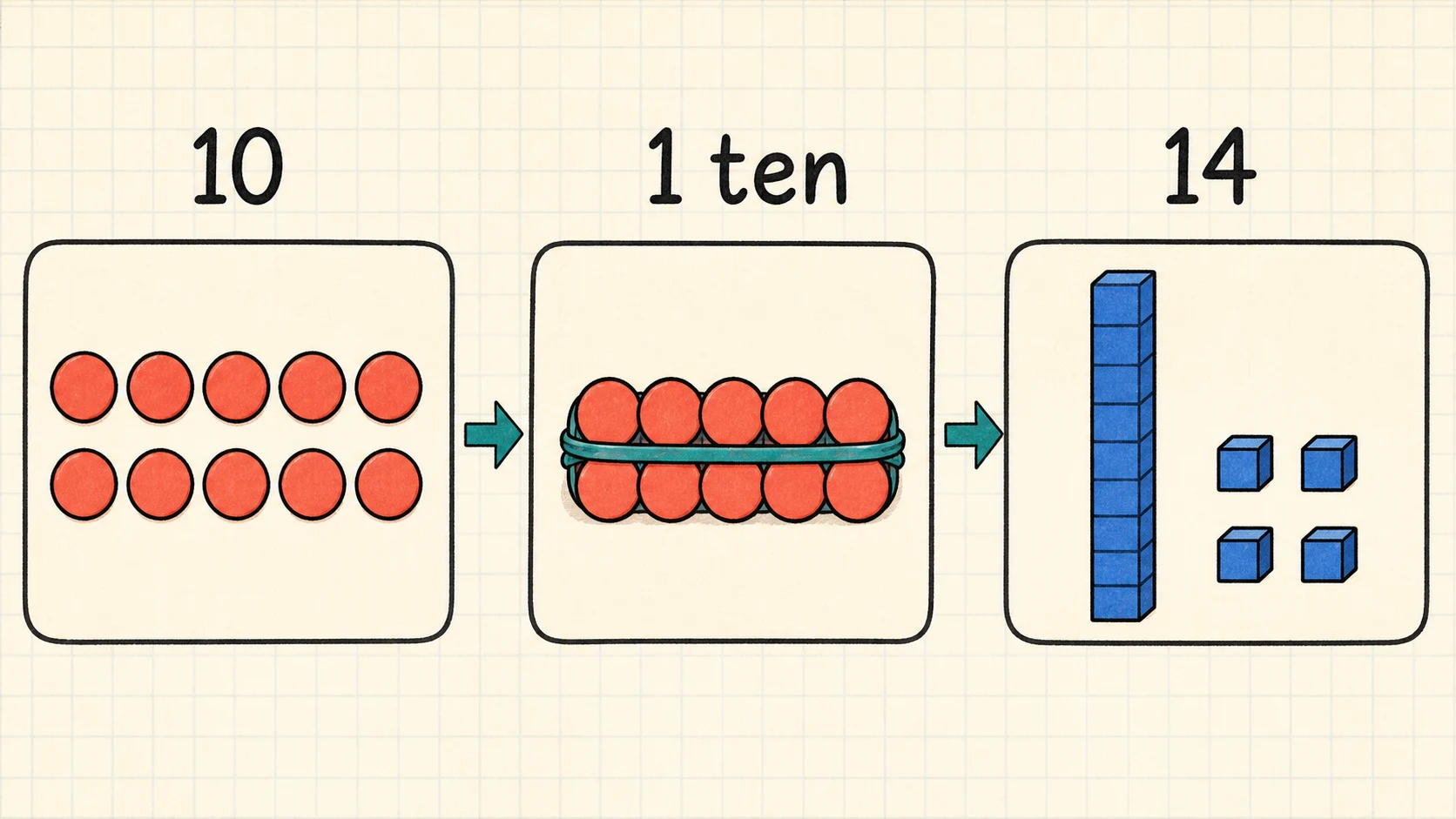
The central skill connects quantities, groups of ten, place-value language, and written numerals.
Grade labels describe the intended practice level, not a fixed timetable for every child. Local curricula and instructional sequences differ. Use the learner’s observed work to decide whether to review an earlier step, remain at the current step, or introduce a new representation.
Prerequisites to Check Before Teaching
Place-value difficulty sometimes begins with an earlier counting difficulty. A short prerequisite check prevents an adult from treating every wrong answer as a tens-and-ones problem.
Stable one-to-one counting
Give the learner 17 small objects. Ask, “How many are there?” Watch whether the learner:
- Moves or touches each object once.
- Says one counting word for each object.
- Knows that the final counting word tells how many objects there are.
- Can recount after the objects are rearranged.
If objects are skipped or counted twice, make the collection easier to organize. The learner can slide each counted object into a row or cup.
Reading and writing numerals
Check several familiar numerals, including single-digit numbers and two-digit numbers such as 12, 20, 31, and 45. Reversed numeral formation is not automatically a place-value misconception. Ask the learner to say the number and build it before deciding what the written reversal means.
Making a group of ten
Place 14 counters on the table and ask the learner to put exactly 10 into a cup or bundle. Then ask:
- “How many are in the group?”
- “How many are left outside?”
- “How many are there altogether?”
The learner should see that regrouping the objects does not change the total: 10 inside and 4 outside still make 14.
Understanding “more,” “less,” and “same”
Before introducing comparison symbols, check whether the learner can compare two visible collections. If the learner cannot reliably identify which group has more, continue with matched objects, counting, and spoken comparison sentences before using >, <, or =.
These checks need not become a formal test. Five attentive minutes with counters usually reveal more than a page of unexplained answers.
A Grade-Appropriate Progression
The Common Core State Standards for Mathematics place first-grade emphasis on counting within 120, understanding the tens and ones in two-digit numbers, and comparing two-digit numbers. That is a useful scope reference, not a claim that every local program follows the same order or that every WorksheetWise resource comprehensively aligns with every standard.
| Stage |
Learner action |
Useful model |
Evidence to look for |
| 1. Count collections |
Count and organize objects |
Counters, craft sticks, cups |
Counts each object once |
| 2. Make tens |
Bundle 10 objects as one group |
Sticks with bands, bags, cups |
States that one bundle contains 10 |
| 3. Build teen numbers |
Make 10 and some more ones |
One ten bundle and loose objects |
Describes 16 as 1 ten and 6 ones |
| 4. Build two-digit numbers |
Make several tens and ones |
Bundles or base-ten blocks |
Builds 42 as 4 tens and 2 ones |
| 5. Read place-value charts |
Record tens and ones by column |
Two-column chart |
Places each quantity correctly |
| 6. Decompose numbers |
Write tens plus ones |
Model and equation |
Writes 42 as 40 + 2 |
| 7. Compare numbers |
Compare tens, then ones if needed |
Models, charts, number line |
Explains why one number is greater |
| 8. Work without a model |
Solve and explain selected items |
Numerals and equations |
Uses place-value reasoning independently |
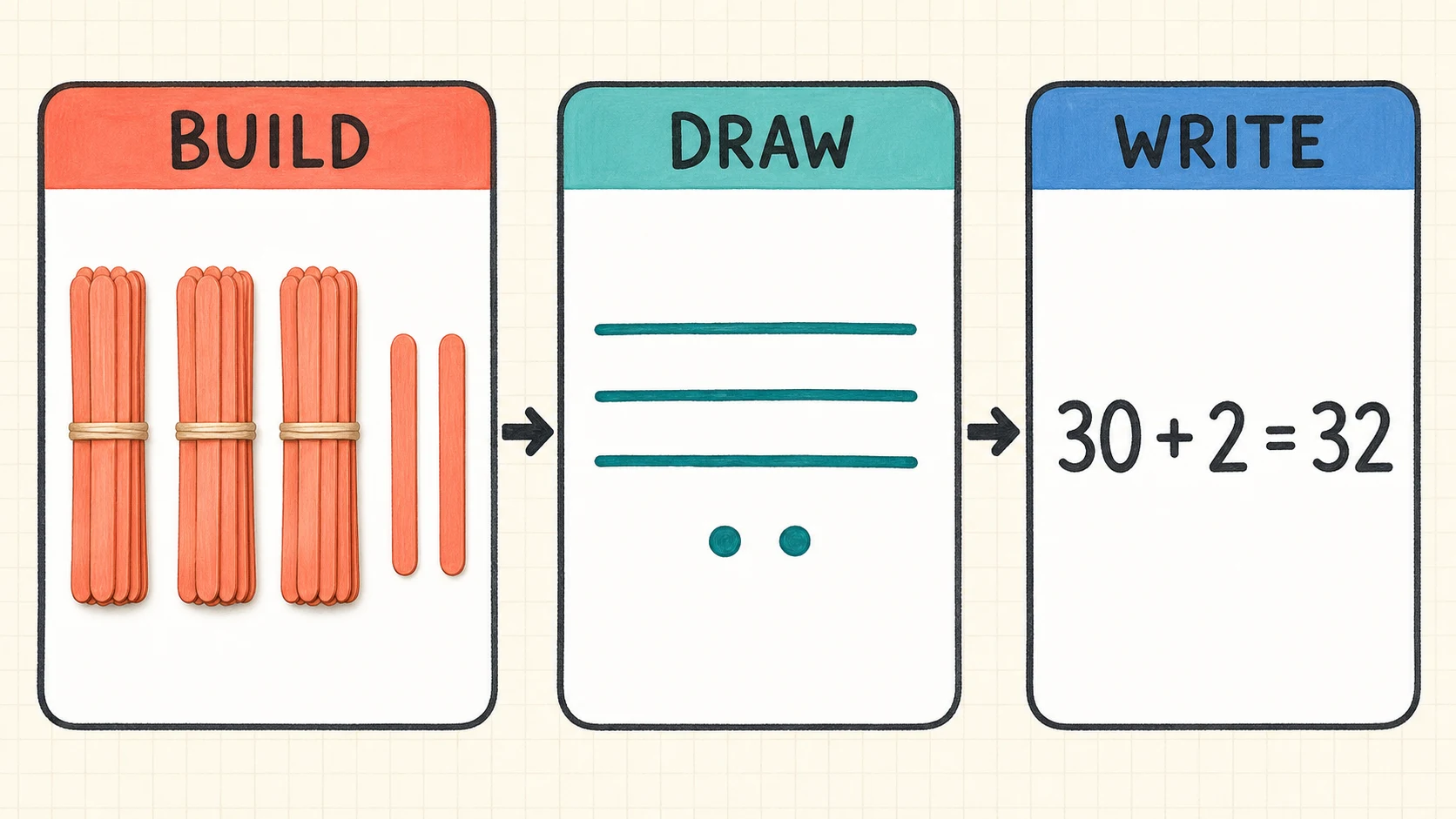
Move forward when the learner can explain the current representation, not merely finish it.
Teen numbers as the bridge
Numbers 11 through 19 are especially useful because each contains one complete ten and some ones. Build 13 as one group of 10 and 3 loose objects. Say both descriptions: “thirteen” and “one ten and three ones.”
The spoken names of some teen numbers do not present the ten first as transparently as “twenty-three” or “forty-six.” Concrete grouping keeps the quantity visible while the learner becomes familiar with the number words.
Zero ones
Numbers such as 20, 30, and 40 are important boundary cases. A learner may think both places must contain a nonzero digit or may describe 30 as “3 and 0.” Build 30 with 3 tens and no loose ones. Record:
- Tens: 3
- Ones: 0
- Expanded form: 30 + 0, usually simplified to 30
Zero holds the ones place and shows that no individual ones remain outside the tens.
Moving beyond teen numbers
Once one ten and some ones are secure, introduce two, three, and more tens. Mix examples rather than teaching only consecutive numbers. Building 24, 51, 38, and 60 requires the learner to attend to both positions instead of following a counting pattern.
Concrete and Visual Models That Clarify the Idea
The IES guide on teaching mathematics to young children supports instruction that develops mathematical ideas through purposeful activities, representations, and mathematical language. In this guide, that high-level recommendation informs the use of objects, drawings, number words, and numerals together. It does not mean IES reviewed this topic page or its worksheet.
Bundled objects
Craft sticks, straws, counters in cups, or connecting cubes can show why a ten is a unit made from 10 ones. The critical action is bundling: count 10 individual objects, join them, and then treat that collection as one ten.
Ask the learner to count the same quantity in two ways:
- “There are 32 individual sticks.”
- “There are 3 bundles of ten and 2 loose sticks.”
Both descriptions name the same total.
Base-ten blocks
A long rod can represent one ten, while a small unit represents one one. Before using the materials independently, verify that the learner understands the relationship. The ten rod is not worth ten merely because it is longer; it represents the same quantity as 10 unit blocks.
Occasionally place 10 units beside one rod and ask whether the quantities match. This keeps the model connected to grouping rather than color or shape.
Quick drawings
After working with objects, replace each ten with a long line and each one with a dot:
||| •••• represents 3 tens and 4 ones, or 34.
Agree on the drawing convention first. A quick sketch should reduce effort while preserving the tens-and-ones structure. It should not become an art task.
Place-value charts
Use two clearly labeled columns:
Read the chart in complete sentences: “There are 3 tens, worth 30, and 4 ones, worth 4. The number is 34.” This language connects position, quantity, and value.
Fully Checked Worked Examples
The examples below deliberately move between models, equations, words, and comparisons. Each answer can be checked by recomposing the tens and ones.
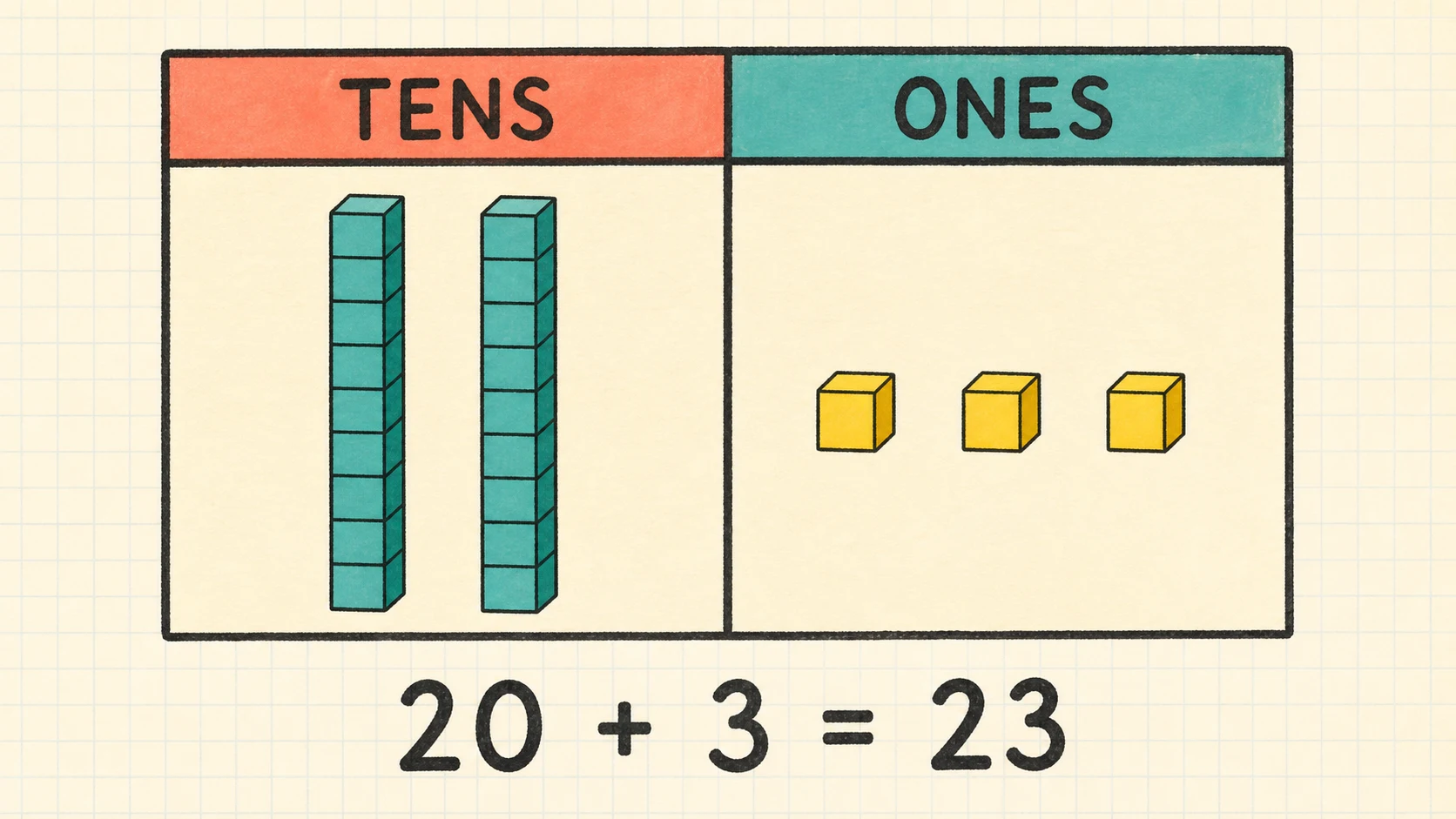
An answer is secure when the model, place-value statement, and numeral all agree.
Example 1: Compose a number from tens and ones
Problem: What number has 3 tens and 6 ones?
- Three tens are worth
3 × 10 = 30.
- Six ones are worth
6.
- Combine them:
30 + 6 = 36.
Answer: 36
Check: In 36, the digit 3 is in the tens place and represents 30. The digit 6 is in the ones place and represents 6. Also, 30 + 6 = 36.
Example 2: Decompose a two-digit number
Problem: Show 52 as tens and ones and write it in expanded form.
- The digit 5 is in the tens place, so it represents 5 tens.
- Five tens are worth 50.
- The digit 2 is in the ones place, so it represents 2 ones.
- Expanded form is
50 + 2.
Answer: 52 is 5 tens and 2 ones; 52 = 50 + 2.
Check: Count by tens—10, 20, 30, 40, 50—and add 2 more: 51, 52.
Example 3: Compare numbers with different tens
Problem: Compare 47 and 39.
- 47 has 4 tens and 7 ones.
- 39 has 3 tens and 9 ones.
- Four tens are greater than three tens.
- The ones do not reverse that result because one complete ten is larger than any collection from 0 through 9 ones.
Answer: 47 > 39.
Check: Expanded forms give 40 + 7 and 30 + 9. The first number contains one more complete ten.
A common mistake is to compare 7 and 9 first because 9 is the larger visible digit. Direct attention to the tens before comparing the ones.
Example 4: Compare numbers with equal tens
Problem: Compare 64 and 68.
- Both numbers have 6 tens.
- Because the tens are equal, compare the ones.
- Four ones are fewer than eight ones.
Answer: 64 < 68.
Check: Both numbers begin at 60. Moving 4 steps past 60 reaches 64; moving 8 steps reaches 68.
Example 5: Interpret zero ones
Problem: How many tens and ones are in 70?
- The 7 is in the tens place.
- Seven tens are worth 70.
- The 0 shows that there are no loose ones.
Answer: 70 has 7 tens and 0 ones.
Check: 70 + 0 = 70. Seven groups of 10 contain 70 objects altogether.
Example 6: Find the missing part
Problem: Complete 40 + ___ = 43.
- The number 43 contains 4 tens and 3 ones.
- The 40 already accounts for the 4 tens.
- The missing part must account for the ones.
Answer: 40 + 3 = 43, so the missing number is 3.
Check: Decompose 43: 43 = 40 + 3.
A Short, Repeatable Lesson Routine
A focused lesson can be brief, provided that the adult observes the learner’s reasoning. The IES practice guide for assisting students struggling with mathematics offers high-level support for systematic instruction, clear mathematical language, representations, and regular review. The routine below is an instructional suggestion based on those principles, not a universal schedule or a child-specific intervention.
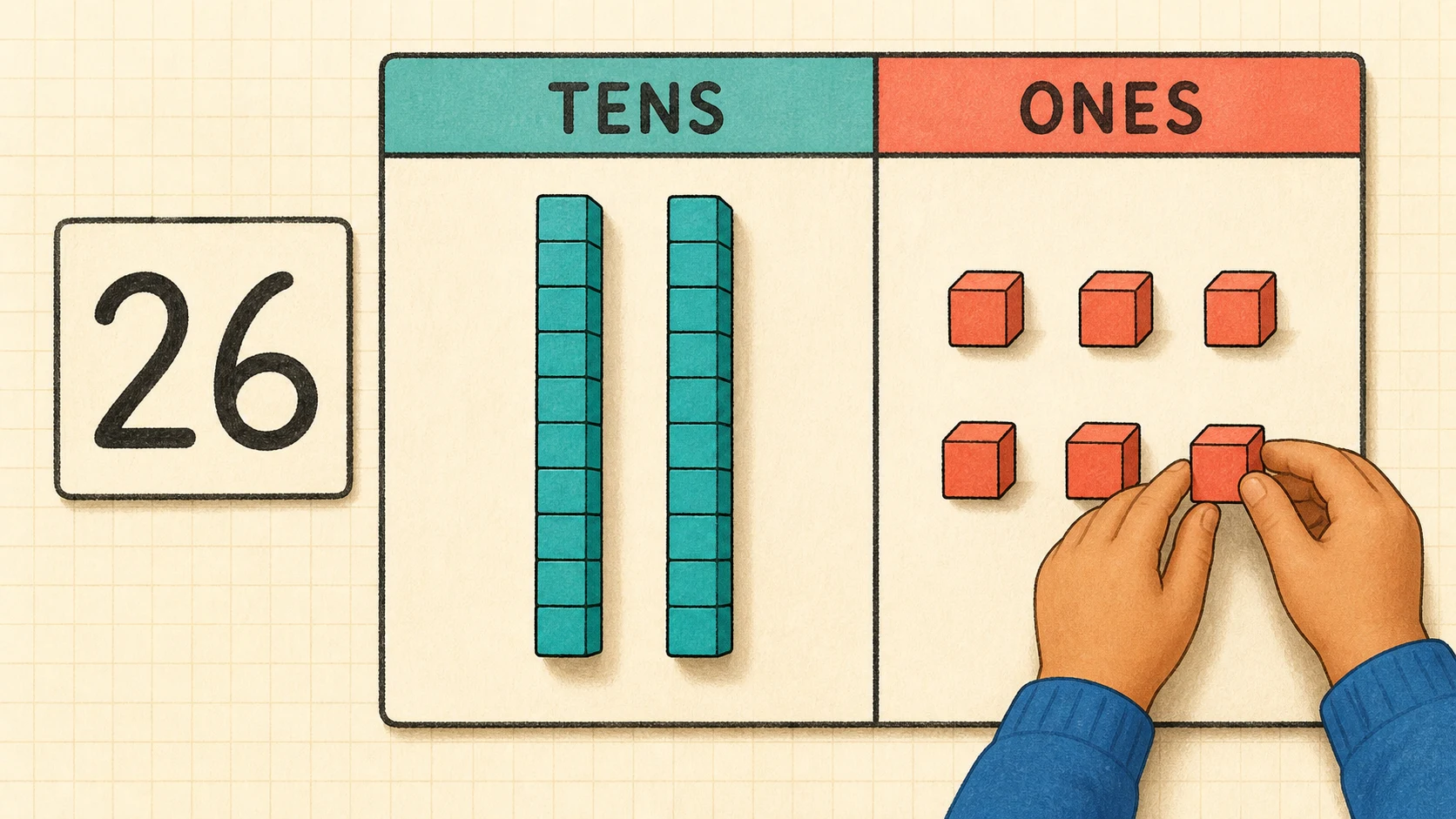
Build, explain, record, practice, and review in a consistent cycle.
1. Review one known idea
Spend two or three minutes counting a collection, making a ten, or reading a previously practiced number. Choose something the learner can usually do correctly.
2. Model one new connection
Build a number such as 26. Say: “I have 2 tens, worth 20, and 6 ones. Twenty plus six is twenty-six.” Record the model in a place-value chart and as 20 + 6 = 26.
Keep the explanation narrow. Do not introduce comparison symbols, expanded form, and several new number ranges in the same demonstration.
3. Solve together
Ask the learner to build a nearby example, such as 31. Prompt with questions rather than supplying each move:
- “How many tens do you need?”
- “How many ones?”
- “What is the value of the tens?”
- “How could you write the number as an addition equation?”
4. Try independently
Offer two to four items that use the same idea but different numbers. Watch the first response. If the learner guesses or waits for a cue, return to one shared example rather than assigning a longer page.
5. Close with an explanation
Ask the learner to explain one completed item. A useful closing prompt is: “How do you know the first digit represents tens?” Save one successful item for the next lesson’s review.
Selecting Practice That Matches the Learner
Practice should reveal and strengthen reasoning. More problems are not automatically better.
Use the 1st Grade Math collection to place place-value work alongside related first-grade number practice. The broader 1st Grade worksheet hub can help adults coordinate math practice with other subjects without assuming that every learner needs the same daily workload.
Choose practice by representation
Select items according to what the learner can currently do:
- Objects to numerals: Best when grouping is still developing.
- Pictures to numerals: Appropriate after physical bundling is understood.
- Numerals to models: Reveals whether the learner can construct meaning rather than merely recognize a picture.
- Numerals to expanded form: Useful after tens and ones are secure.
- Comparison: Introduce with models, then remove them gradually.
- Mixed practice: Use only after individual formats are reasonably stable.
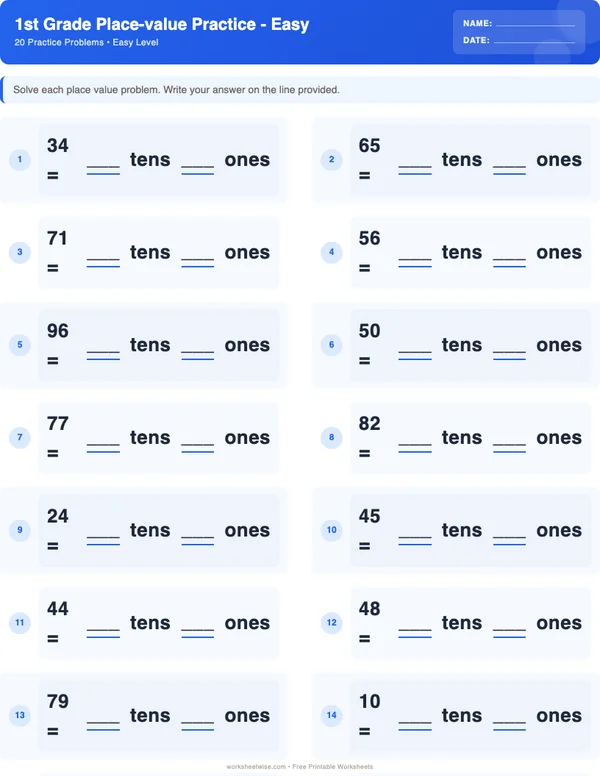
The free easy place-value worksheet contains 20 exercises and an answer key. Its catalogue scope includes identifying place values, expanded form, number comparison, and rounding. Preview the items and select only those that fit the learner’s current instruction. The presence of a skill on a worksheet does not mean that every learner should practice it immediately.
Adjust quantity before difficulty
A learner may understand the mathematics but tire during a full page. Try four carefully selected problems and request an explanation for one. If those are accurate and independently completed, add a few more. If errors appear, examine their pattern before increasing the workload.
Use rounding cautiously
Rounding appears in the catalogue for the easy worksheet, but first-grade place-value instruction should first establish tens, ones, composition, decomposition, and comparison. Local sequences differ. If rounding has not been taught in the learner’s program, omit those items rather than teaching an isolated rule simply to finish the page.
When rounding is introduced in a local sequence, use a number line and visible benchmarks so the decision is connected to distance. Do not let a memorized marking trick substitute for number meaning.
Differentiation Without Changing the Core Idea
Differentiation should alter support, number range, representation, or response demand while preserving the mathematical goal.
When the learner needs more support
- Work within teen numbers before using several tens.
- Keep objects available throughout the task.
- Use one consistent model until its meaning is clear.
- Ask the learner to match a prepared bundle-and-ones model to one of two numerals.
- Reduce writing by allowing an oral explanation or number-card response.
- Contrast only two examples, such as 24 and 42, and build both.
When the learner is ready for more
- Ask for two representations of the same number.
- Present a model containing an incorrect number of ones and ask the learner to repair it.
- Use missing-part equations such as
___ + 7 = 57.
- Compare numbers with equal tens, then numbers with different tens.
- Ask the learner to create a number that is greater than 45 but has 4 tens.
- Mix zero-ones cases such as 30 with numbers such as 33 and 36.
Extension should deepen explanation, not merely introduce larger numbers. A learner who can justify why 58 is greater than 49 is demonstrating more useful understanding than one who races through unfamiliar three-digit notation without a secure model.
Common Errors and Diagnostic Responses
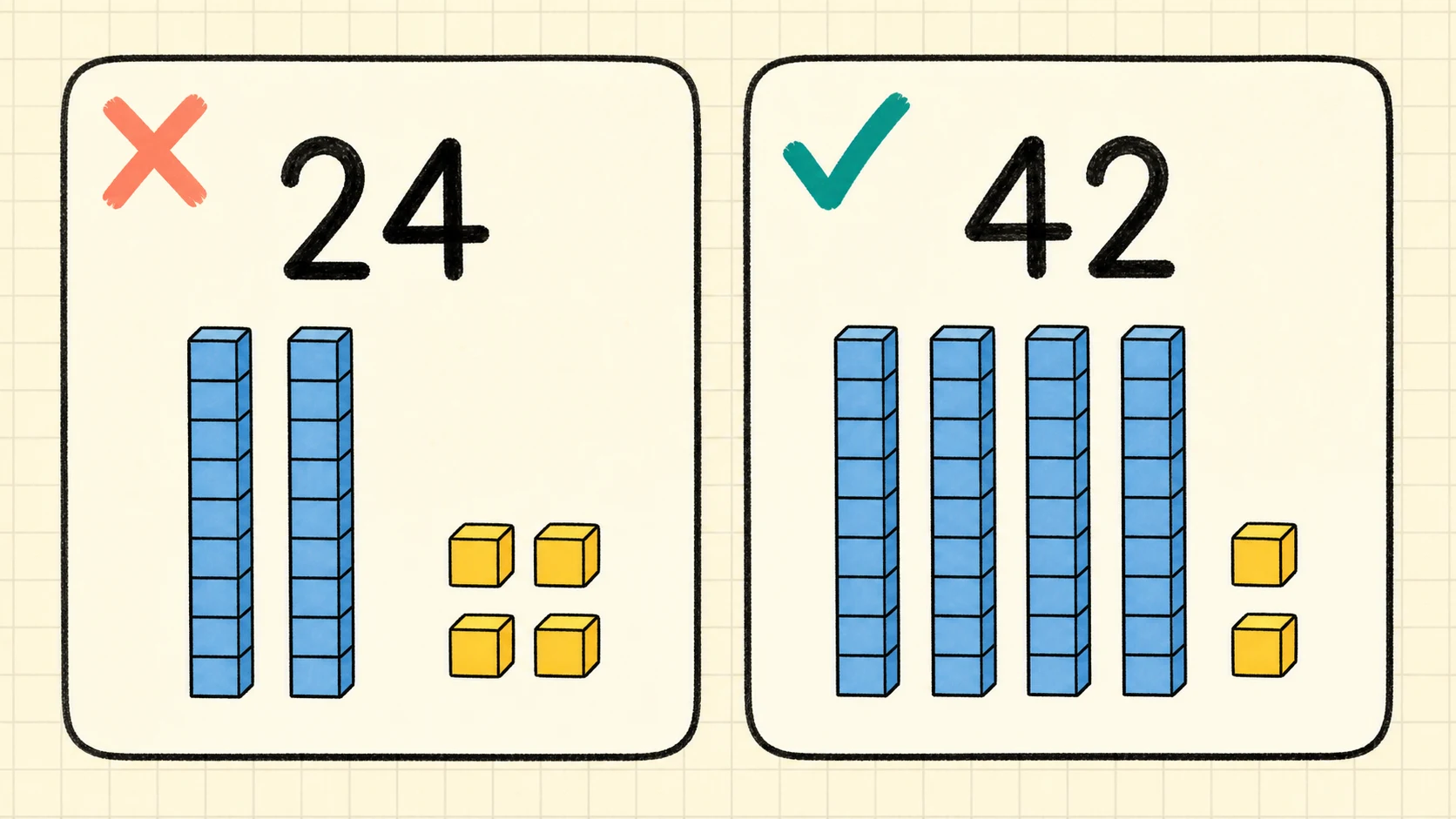
Treat an error as evidence about the learner’s current strategy, then choose the smallest helpful response.
| Observed error |
What to check |
Teaching response |
| Says 42 is 4 ones and 2 tens |
Whether place names or positions are confused |
Build 42, place each part in a labeled chart, and read the full statement |
Writes 46 = 4 + 6 |
Whether digit names are being confused with digit values |
Match 4 tens to 40, then write 40 + 6 |
| Says 29 is greater than 31 because 9 is greater than 1 |
Whether the learner compares ones first |
Compare the tens models before uncovering the ones |
| Counts a ten rod as one object worth 1 |
Whether the model’s value was established |
Match one rod with 10 individual units |
| Builds 35 with 3 tens and 5 more tens |
Whether “ones” has meaning |
Use different containers or shapes for tens and loose ones |
| Reads 50 as 5 tens and “nothing,” then omits the zero |
Whether zero’s placeholder role is understood |
Contrast 5, 50, and a chart showing 5 tens and 0 ones |
| Gets different totals when objects move |
Whether one-to-one counting is stable |
Organize counted objects and recount slowly |
| Completes examples but cannot explain any |
Whether a visual pattern or cue is driving answers |
Present the number in a different representation |
Do not infer a lasting learning difficulty from one response. Repeat the idea with a changed number and representation. A consistent pattern across several items is more informative than a single mistake caused by attention, handwriting, or an unclear direction.
Monitoring Progress and Deciding What Comes Next
Keep a simple record of what the learner did without help, with a prompt, and after a model. Avoid recording only a percentage.
A weekly note might include:
| Skill |
Independent |
With model or prompt |
Not yet secure |
| Builds a stated two-digit number |
✓ |
|
|
| Names tens and ones |
✓ |
|
|
| Writes expanded form |
|
✓ |
|
| Compares different tens |
✓ |
|
|
| Compares equal tens |
|
✓ |
|
| Explains zero ones |
|
|
✓ |
Consider a skill reasonably secure when the learner can demonstrate it on different numbers, in more than one representation, and after a delay—not only immediately after watching an example.
Move ahead when the learner can:
- Build and describe several two-digit numbers accurately.
- Explain the value of each digit.
- Move between a model, numeral, and expanded form.
- Compare numbers by attending to tens before ones.
- Handle boundary cases such as 10, teen numbers, and multiples of ten.
Return to an earlier representation if accuracy depends on hints, the learner cannot explain an answer, or the same misconception reappears.
A Flexible Two-Week Practice Plan
This plan is an instructional option, not a universal timetable. Shorten, repeat, or pause a day according to observed work. Each session can remain brief and should stop before fatigue obscures what the learner understands.
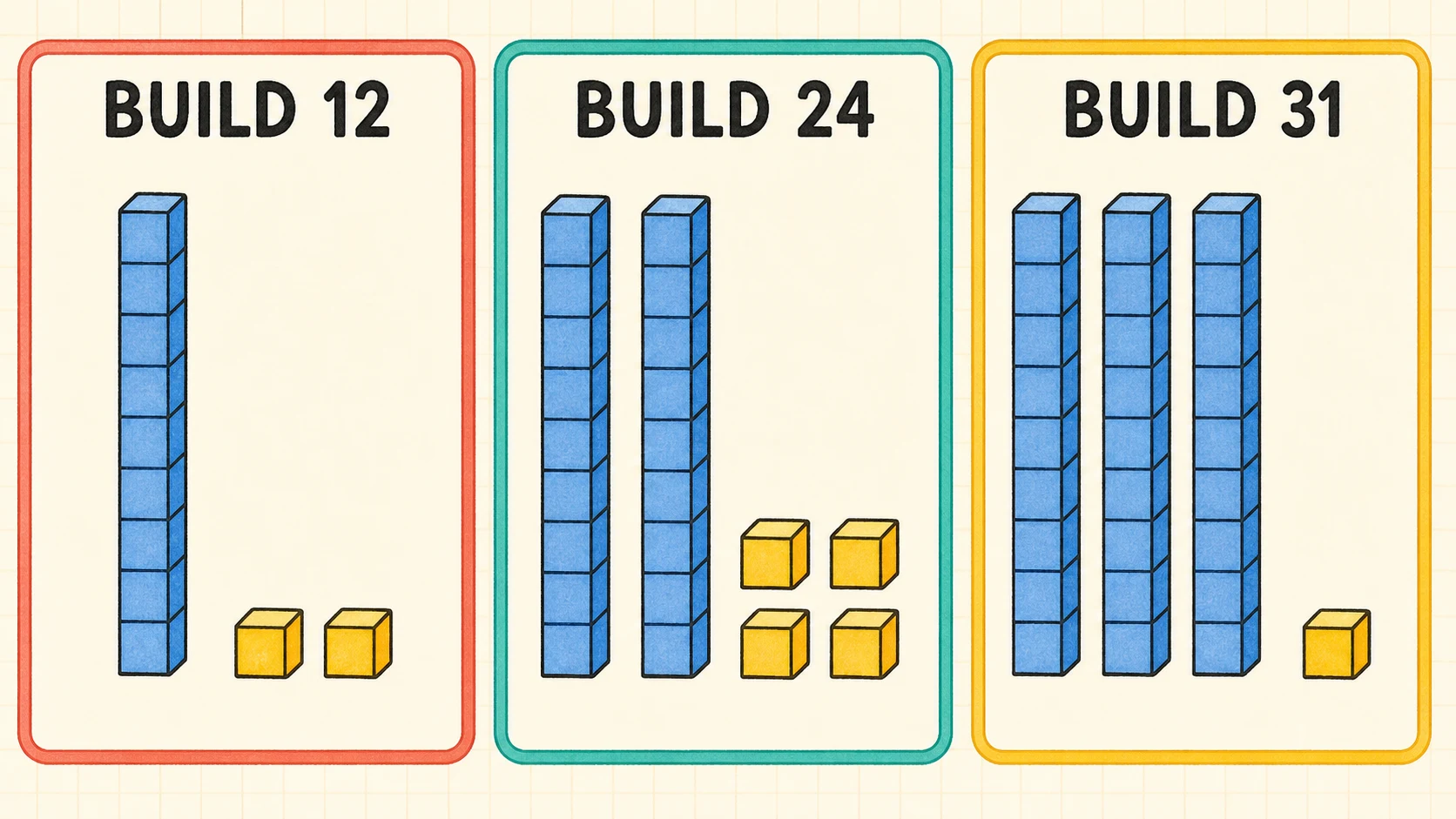
The second week revisits earlier representations while adding comparison and independent practice.
| Day |
Main focus |
Suggested activity |
Evidence to record |
| 1 |
Count and group |
Count collections and bundle one group of 10 |
Counts each object once |
| 2 |
Teen numbers |
Build 11, 14, 17, and 19 |
Says “1 ten and __ ones” |
| 3 |
Exact tens |
Build 10, 20, 30, and 40 |
Explains zero ones |
| 4 |
Several tens and ones |
Build selected numbers from 21–59 |
Matches model to numeral |
| 5 |
Review |
Mix teen numbers, exact tens, and other two-digit numbers |
Identifies any recurring error |
| 6 |
Place-value chart |
Move models into tens and ones columns |
Records each digit correctly |
| 7 |
Expanded form |
Connect models to equations such as 40 + 3 = 43 |
Uses tens values, not digit names |
| 8 |
Compare different tens |
Compare pairs such as 27 and 34 |
Checks tens first |
| 9 |
Compare equal tens |
Compare pairs such as 52 and 58 |
Uses ones after tens match |
| 10 |
Mixed application |
Complete a short selected set and explain two answers |
Works across representations |
If Day 7 reveals that the learner writes 4 + 3 for 43, repeat model-to-equation work before comparison practice. If Day 8 is easy but equal-tens comparisons are not, spend another session on Day 9’s distinction. The calendar serves the learner; the learner does not serve the calendar.
Limitations and an Honest Next Step
A worksheet can provide organized practice, but it cannot by itself show why an error occurred. An answer key identifies whether an answer matches; observation and conversation reveal whether the learner counted inaccurately, reversed the places, misunderstood the model, or applied an unsuitable shortcut.
This guide also does not establish certification, guarantee an outcome, provide medical guidance, or claim comprehensive alignment with every local curriculum. Its progression is intended to help an adult make defensible teaching choices within the supplied first-grade place-value scope.
For the next session, ask the learner to build 34, describe its tens and ones, and write 30 + 4 = 34. If all three representations agree without prompting, select four to six matching items from the free 1st Grade Place Value worksheet. If the learner needs a model, return to bundling before adding more written practice. For broader repeated practice after the core skill is secure, review the focused 1st Grade Place Value pack or create a narrowly targeted set with the free worksheet generators.