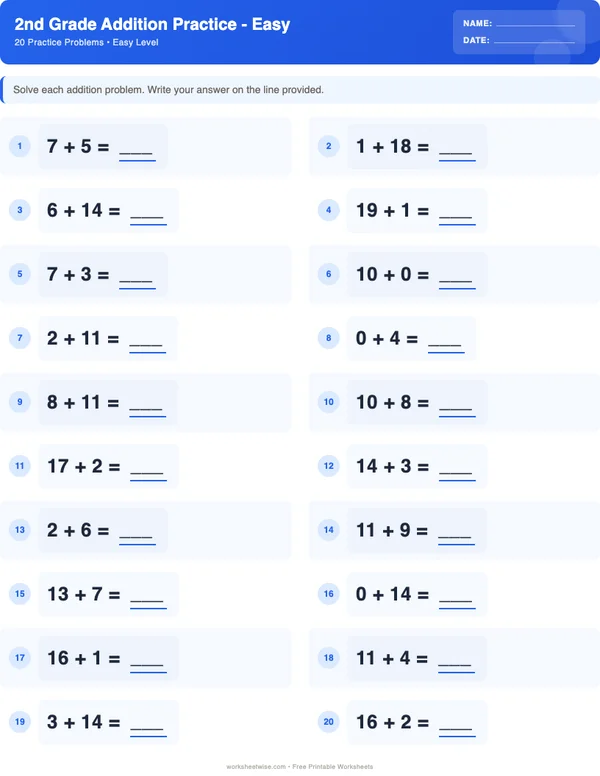
What 2nd Grade Addition Includes
Direct answer: Second-grade addition should move from secure facts within 20 to adding within 100 with place-value strategies, including problems that require composing a new ten. Learners should use objects, drawings, number lines, mental strategies, and equations—not just a memorized written procedure. The learner’s observed work should determine when to add complexity or return to an earlier model.
A useful instructional sequence is:
- Confirm that quantities, numerals, and the meaning of addition are secure.
- Strengthen flexible addition within 10 and 20.
- Connect ones and tens to two-digit addition.
- Separate problems that do not compose a new ten from those that do.
- Apply addition to equations and word problems.
- Build accuracy, explanation, and gradually greater independence.
The Common Core State Standards for Mathematics describe second-grade work that includes fluency within 20 and addition within 100 using strategies based on place value and properties of operations. They also place this work in a longer progression toward adding within 1,000. These are useful reference points, but they do not establish a universal timetable for every learner.
Grade labels describe the intended practice level; local curricula and teaching sequences differ. A learner may need first-grade fact work while reasoning well about two-digit numbers, or may be ready for selected larger-number examples while still building fluency within 20.
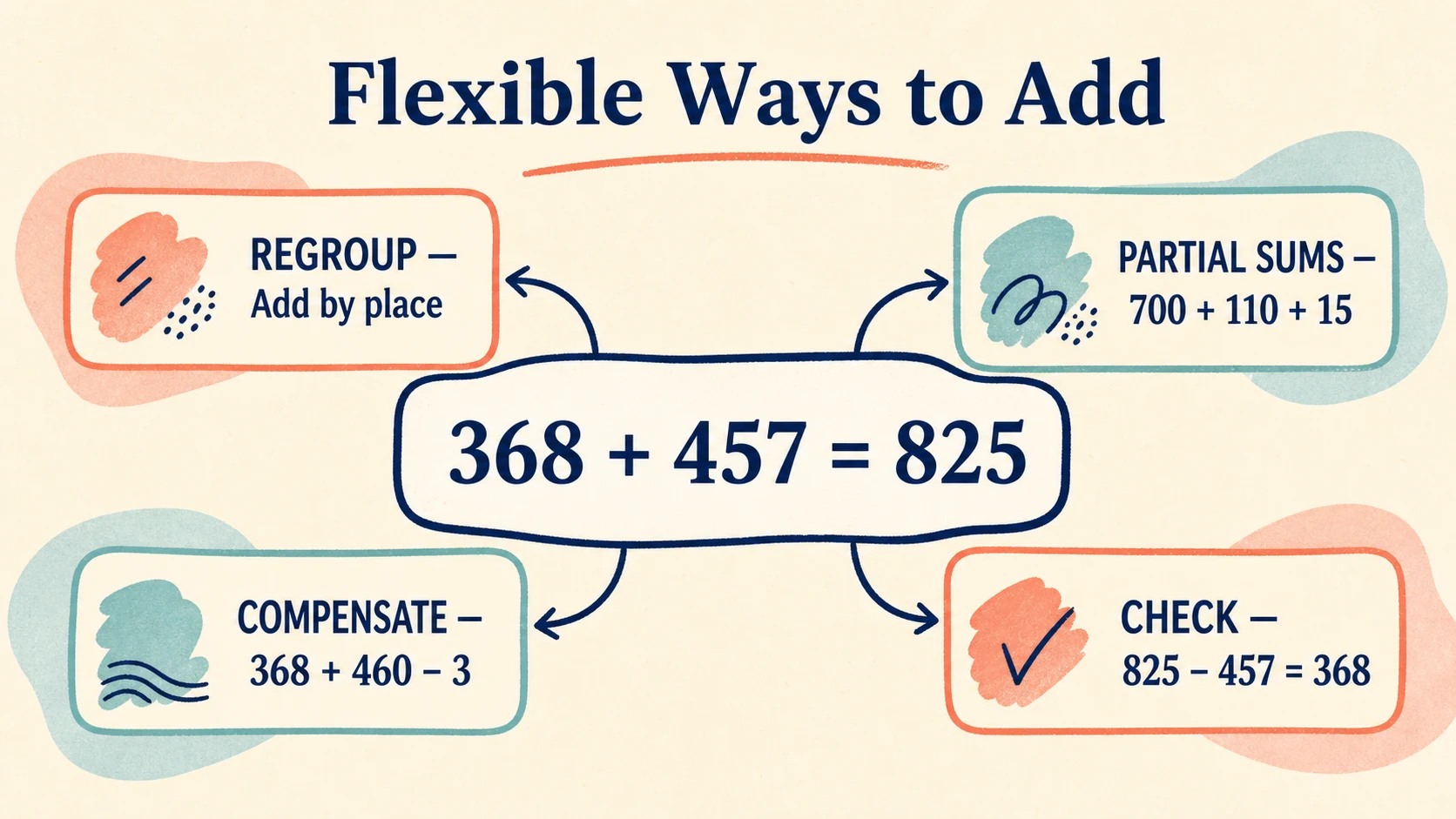
The skill develops through connected work with facts, place value, representations, equations, and applications.
Prerequisites to Check Before Teaching New Work
Addition becomes much easier to interpret when the learner can connect a written number to a quantity. Before emphasizing two-digit calculations, observe a few short tasks rather than relying on a grade label alone.
Quantity and number relationships
Check whether the learner can:
- Count a set accurately, touching or moving each object once.
- Recognize that the last count tells how many objects are in the set.
- Compare two small quantities.
- Show a number in more than one way, such as 8=5+3 and 8=6+2.
- Recognize zero as a quantity and as a numeral.
- Explain that addition joins quantities or increases an amount.
A learner who recounts both groups in 6+3 is demonstrating a valid early method. The next instructional step may be counting on from 6 rather than replacing the method immediately with memorization.
Composition within 10
Composing and decomposing 10 supports both fact strategies and later regrouping. Ask the learner to complete examples such as:
- 7+□=10
- 10=4+□
- 9=5+□
- 8+6=8+2+□
If these relationships are slow or uncertain, use counters or a ten frame before assigning many two-digit problems that cross a ten.
Place value
For two-digit addition, the learner should understand that 34 means 3 tens and 4 ones. Check this with objects, drawings, or oral prompts:
- Build or draw 26 as 2 tens and 6 ones.
- Explain the value of the 5 in 52.
- Compare 29 and 32 using tens and ones.
- Rewrite 47 as 40+7.
A learner can sometimes produce correct answers by following a written routine without understanding why 10 ones become 1 ten. That is not yet a secure foundation for independent regrouping.
A Grade-Appropriate Addition Progression
The progression below is a teaching guide, not a fixed calendar. Advance when the learner is accurate enough to focus on the new idea and can explain the current one with reasonable independence.
| Stage |
Main mathematical work |
Useful model |
Evidence to look for |
| 1. Meaning of addition |
Join, add to, and combine quantities |
Counters and simple drawings |
Connects a situation, model, and equation |
| 2. Facts within 10 |
Count on, use known pairs, compose and decompose |
Five frames, ten frames, number bonds |
Uses a strategy without recounting every item |
| 3. Facts within 20 |
Make ten, doubles, near doubles |
Double ten frame and open number line |
Explains how a fact was transformed |
| 4. Two-digit addition without composing |
Add tens to tens and ones to ones |
Base-ten blocks and expanded form |
Preserves place value |
| 5. Two-digit addition with composing |
Exchange 10 ones for 1 ten |
Base-ten blocks and place-value drawings |
Explains the new ten |
| 6. Application |
Solve equations and word problems |
Bar models, drawings, equations |
Chooses addition from the situation |
| 7. Independent consolidation |
Mix familiar forms and strategies |
Mostly symbols, with models available |
Works accurately and checks results |
This sequence follows the catalogue progression from concrete materials to representations and then abstract notation. The IES guide on teaching mathematics to young children provides broader evidence-based instructional framing for building early mathematics along developmental progressions and monitoring learners’ mathematical understanding.
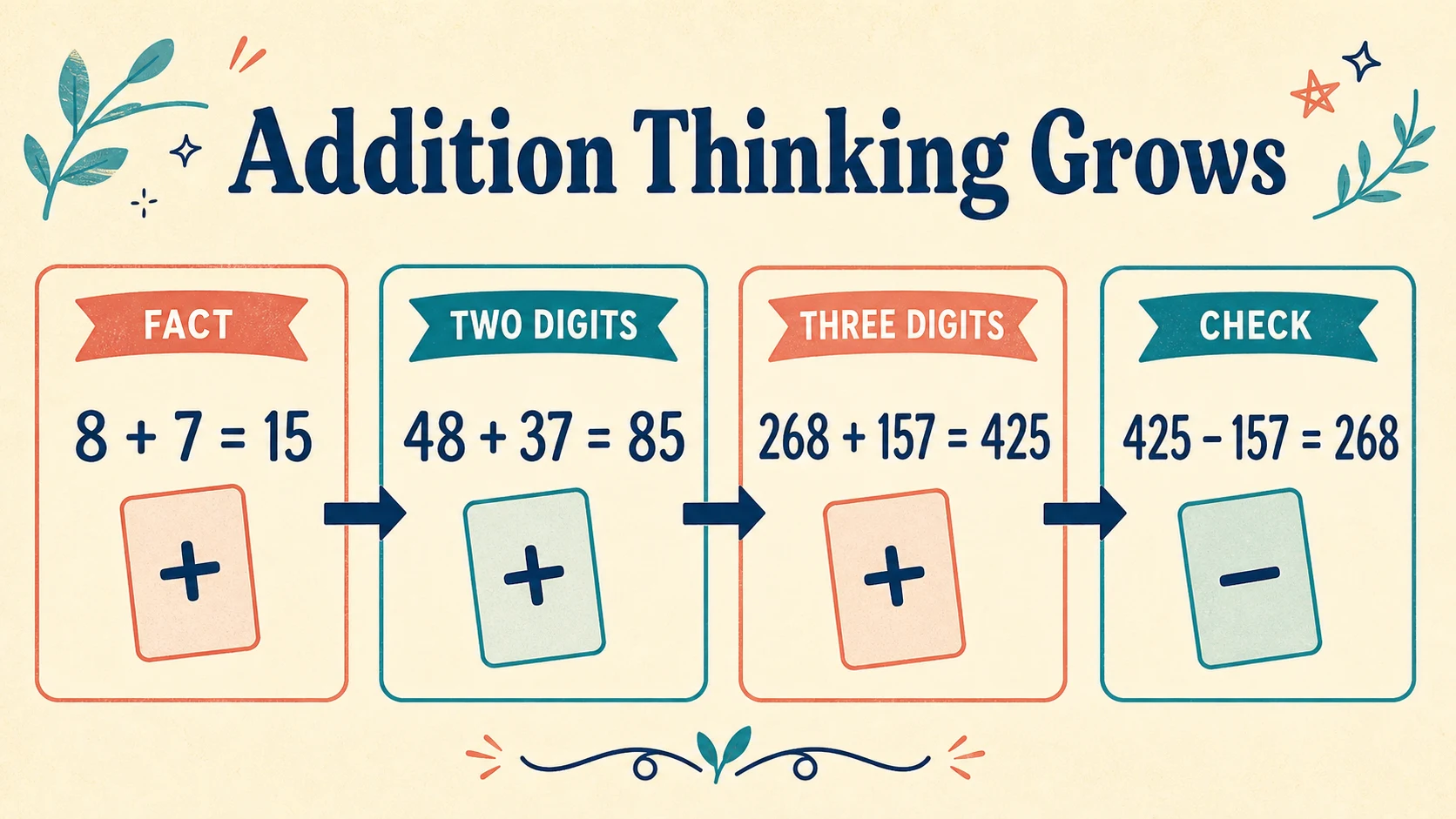
Support should fade as the learner connects quantities, drawings, place value, and equations.
Do not treat “with regrouping” as simply the next worksheet category. First establish what is being composed: 10 ones become 1 ten, while the total value remains unchanged.
Concrete and Visual Models That Clarify the Mathematics
Models are most useful when the adult explicitly connects each part of the model to the equation. Handling blocks without discussing the tens, ones, and total can become an activity disconnected from the calculation.
Counters and ten frames
Counters make joining visible. For 5+3, place five counters, add three, and find the total. A ten frame adds useful structure because learners can see how close a number is to 10.
For 8+5:
- Show 8 counters on a ten frame.
- Move 2 counters from the group of 5 to fill the frame.
- Notice that 3 counters remain.
- Record 8+5=10+3=13.
This is an instructional suggestion derived from the supplied teaching progression. It is not a claim that one representation works best for every learner.
Base-ten blocks and place-value drawings
Use tens rods and ones units for two-digit addition. For 24+31, combine 2 tens with 3 tens and 4 ones with 1 one:
20+30=50
4+1=5
50+5=55
A quick drawing can replace physical blocks once the learner understands the objects: lines may represent tens and dots may represent ones. Require a clear key so a line is not mistaken for one.
Number lines
An open number line supports adding in parts. For 36+22, begin at 36, jump 20 to 56, and then jump 2 to 58. The jumps should be labeled so the drawing records the strategy rather than merely decorating the page.
Number lines also expose errors. If a learner starts at 36 but counts the starting number as the first of two jumps, the landing point will be one too small.
Number bonds, bar models, and equations
A number bond can decompose 47 into 40 and 7. A bar model can show two parts joining to form a total. The equation records the same relationship symbolically:
47+25=(40+20)+(7+5)
Moving among these forms helps reveal whether the learner understands the quantities or is only copying a layout.
Fully Checked Worked Examples
The examples below use different strategies because flexibility matters. A correct method should preserve the value of each number, reach the correct sum, and be explainable.
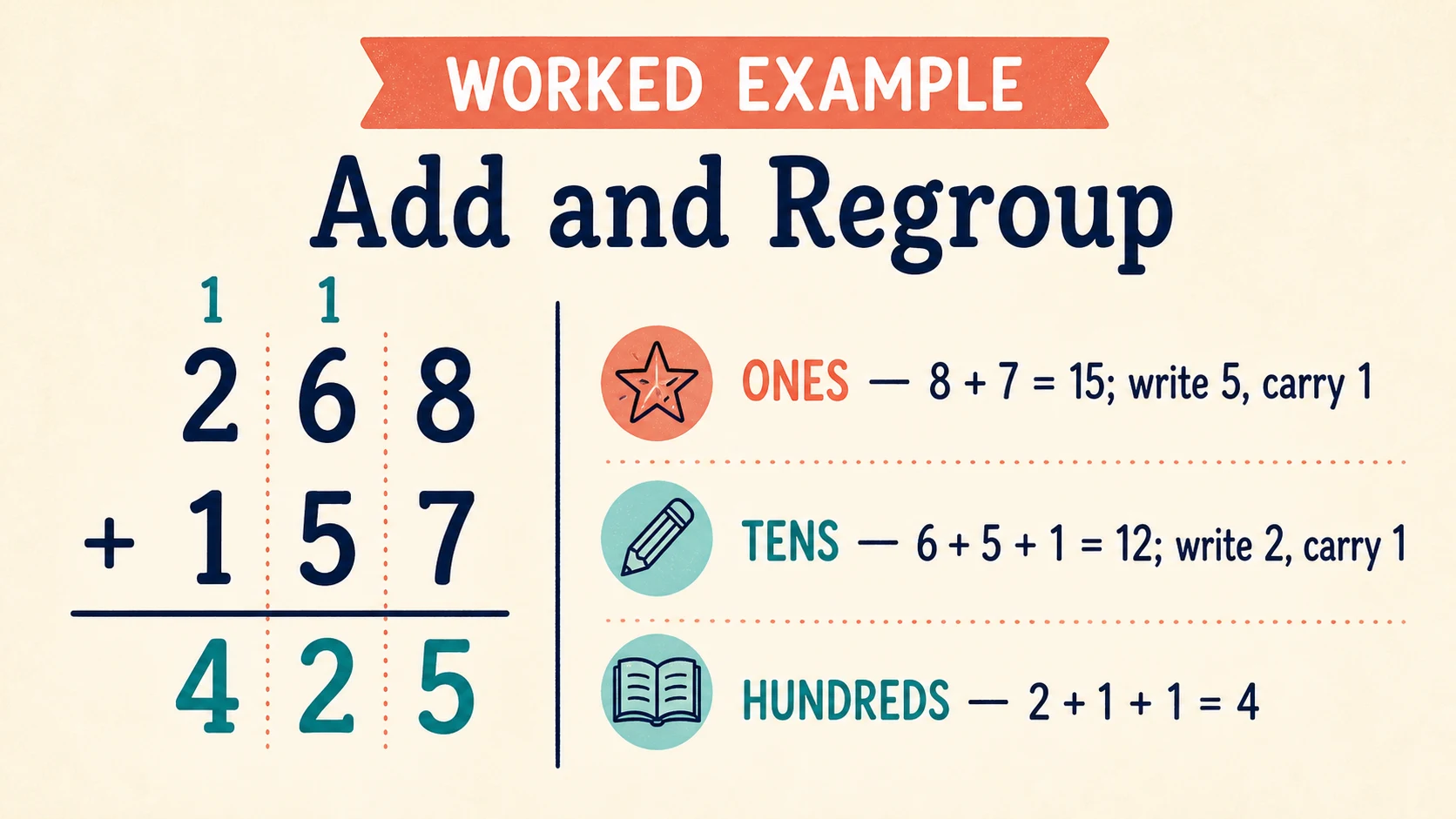
The equation should name the same quantities and actions shown by the model.
Example 1: Make ten within 20
Solve 8+7.
Decompose 7 into 2 and 5 because 8 needs 2 to make 10:
8+7=8+(2+5)
=(8+2)+5
=10+5
=15
Check: Count on 7 from 8: 9, 10, 11, 12, 13, 14, 15. Both methods give 15.
The important idea is not merely “move 2.” The 7 was decomposed into 2+5, so its value did not change.
Example 2: Two-digit addition without composing a new ten
Solve 46+23.
Break each number into tens and ones:
46=40+6
23=20+3
Add like place values:
40+20=60
6+3=9
Combine the partial sums:
60+9=69
Therefore:
46+23=69
Check: Subtract one addend from the total: 69−23=46. The addition is consistent.
No new ten is composed because 6+3=9, which is fewer than 10 ones.
Example 3: Two-digit addition with composing a new ten
Solve 27+35.
Represent the addends as tens and ones:
27=20+7
35=30+5
Combine the ones:
7+5=12
Twelve ones are 1 ten and 2 ones. Combine all tens:
20+30+10=60
Then include the remaining 2 ones:
60+2=62
Therefore:
27+35=62
Check with a different grouping:
27+35=27+30+5
=57+5
=62
Both strategies give 62. The new ten comes from the 12 ones; it is not an unexplained extra digit.
Example 4: Add on an open number line
Solve 38+47.
Start at 38. Decompose 47 into 40 and 7:
38+40=78
Then add 7:
78+7=85
Therefore:
38+47=85
Check by making a friendly number: Move 2 from 47 to 38:
38+47=40+45=85
The total remains unchanged because 2 was transferred from one addend to the other.
Example 5: Find a missing addend
Solve 29+□=54.
Add from 29 to reach 54:
29+20=49
49+5=54
The total added was:
20+5=25
Therefore:
29+25=54
Check:
29+25=(20+20)+(9+5)=40+14=54
The missing addend is 25.
Example 6: Use three addends strategically
Solve 16+9+4.
Addition allows the addends to be grouped in a helpful way. Combine 16 and 4 first:
16+9+4=(16+4)+9
=20+9
=29
Check in the original order:
16+9=25
25+4=29
Both groupings produce 29.
Boundary Cases Worth Teaching Explicitly
Boundary cases prevent learners from forming rules that work only on typical worksheet items.
Adding zero
43+0=43
Adding zero does not change the quantity. A learner who answers 0 may be treating every operation involving zero as though the answer must be zero.
An addend with fewer digits
For 7+25, align or represent values by place:
7=0 tens+7 ones
25=2 tens+5 ones
Then:
7+25=32
Writing the 7 under the 2 would incorrectly treat it as 7 tens.
A sum exactly equal to a new hundred
68+32
Combine ones:
8+2=10
That makes 1 new ten and 0 ones. There are then 6+3+1=10 tens:
10 tens=100
So:
68+32=100
This case is useful because both the ones and tens columns end in zero.
A story with irrelevant surface clues
“Luis has 24 red counters and 13 blue counters. How many counters does he have altogether?”
The colors do not create separate operations. “Altogether” describes the total of two joined quantities:
24+13=37
Learners should still explain the action in the situation rather than choosing addition from one word alone.
A Short, Repeatable Lesson Routine
A focused lesson can be brief without being rushed. Adjust the length and number of problems according to the learner’s attention, accuracy, and explanations.
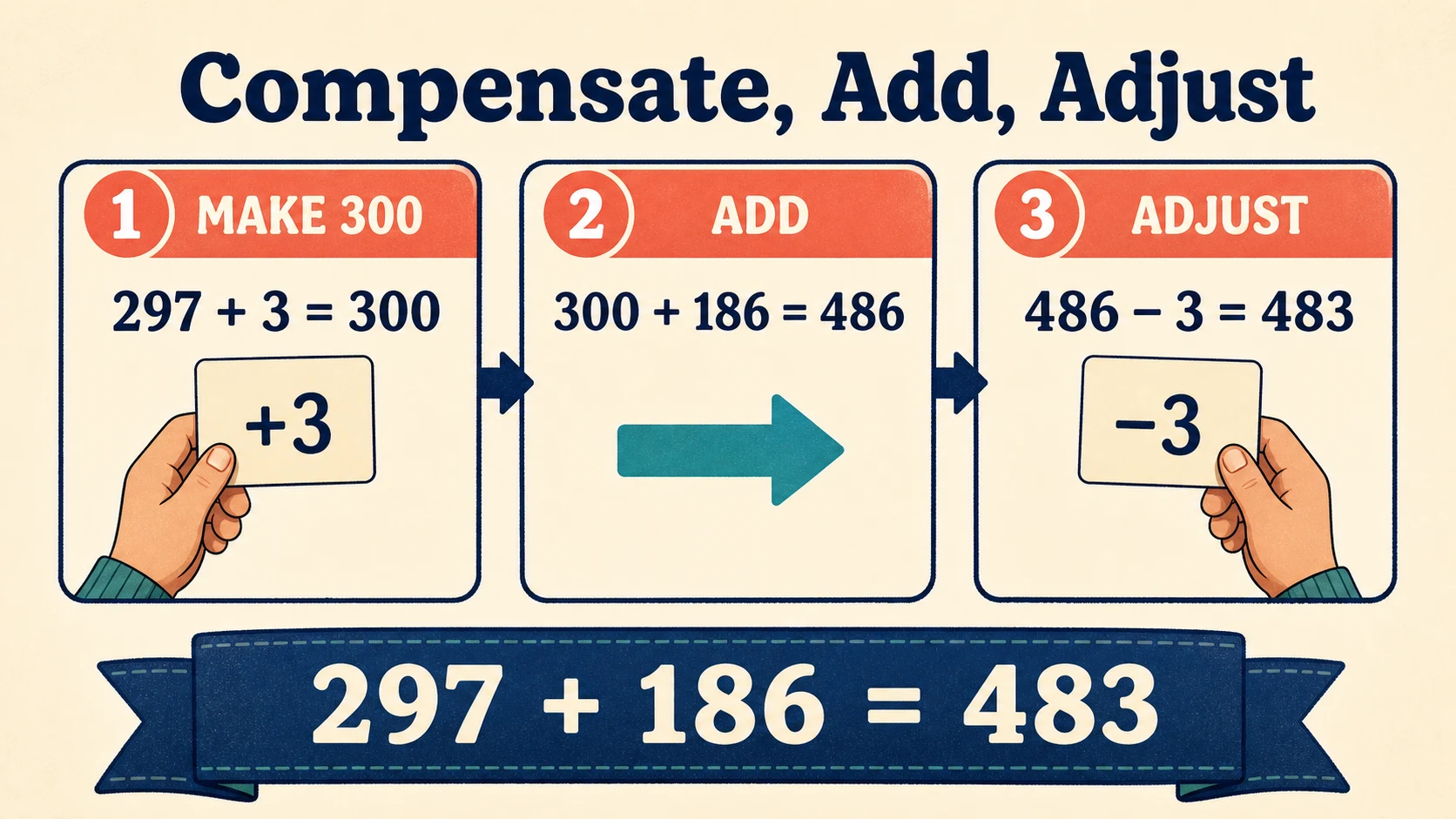
Each lesson connects prior knowledge, a visible model, guided reasoning, independent work, and a quick check.
1. Retrieve a prerequisite
Use two or three oral or visual prompts, such as 6+4, 8+□=10, and “Show 34 as tens and ones.” This is a readiness check, not a timed test.
2. Model one new example
Demonstrate a single carefully selected problem. Name what each object, mark, and numeral represents. For 28+16, explicitly connect 8 ones plus 6 ones to 14 ones, then exchange 10 ones for 1 ten.
3. Solve one together
Let the learner make decisions: which addend to decompose, where to begin on the number line, or whether a new ten will be needed. Ask for a reason after a step rather than explaining every step in advance.
4. Try a small independent set
Use three to five problems with the same main structure. Include enough variation to reveal understanding, such as changing the position of the larger addend or including a sum with 0 ones.
5. Review one piece of work
Ask the learner to point to the tens, ones, and total or to verify the answer another way. Record the specific observation that should guide the next lesson.
Selecting Practice and Differentiating Support
Practice should match the next teachable need. A page labeled “easy” may be useful for one learner’s independent consolidation and another learner’s guided instruction.
The free 2nd Grade Addition worksheet contains 20 easy-level exercises covering addition facts, mental math, number sense, and place value, with a separate answer key. Preview several items before assigning the whole page. Decide whether their number range, visual demand, and need for regrouping match the learner’s current work.
For broader browsing, use the second-grade math hub or the Addition topic guide.
When more support is needed
Use fewer problems and keep a concrete or visual model available. You might:
- Return from two-digit regrouping to composing 10 with counters.
- Use color to distinguish tens from ones.
- Provide partially drawn base-ten models for the learner to complete.
- Alternate one modeled problem with one learner-solved problem.
- Keep addends within 20 while the learner explains make-ten strategies.
These are instructional options, not diagnoses or child-specific prescriptions. Persistent difficulty may require assessment and support beyond what a worksheet or general topic guide can provide.
The IES guide for assisting students struggling with mathematics offers high-level guidance on systematic instruction, mathematical language, representations, number lines, and appropriately designed practice. It does not evaluate WorksheetWise materials or prescribe a single response for an individual learner.
When the current work is secure
Increase reasoning before simply increasing number size. Ask the learner to:
- Solve one problem in two ways.
- Decide which of two strategies is more efficient.
- Find and correct an intentionally incorrect solution.
- Write a word problem for a given equation.
- Find a missing addend.
- Estimate whether a sum should be greater or less than a benchmark such as 50 or 100.
The 2nd Grade Addition Worksheet Pack contains 18 worksheets and is listed at $4.79. Select from it by skill need rather than assigning every page in order.
Common Errors and Diagnostic Responses
An incorrect answer is most useful when the adult examines the method that produced it.
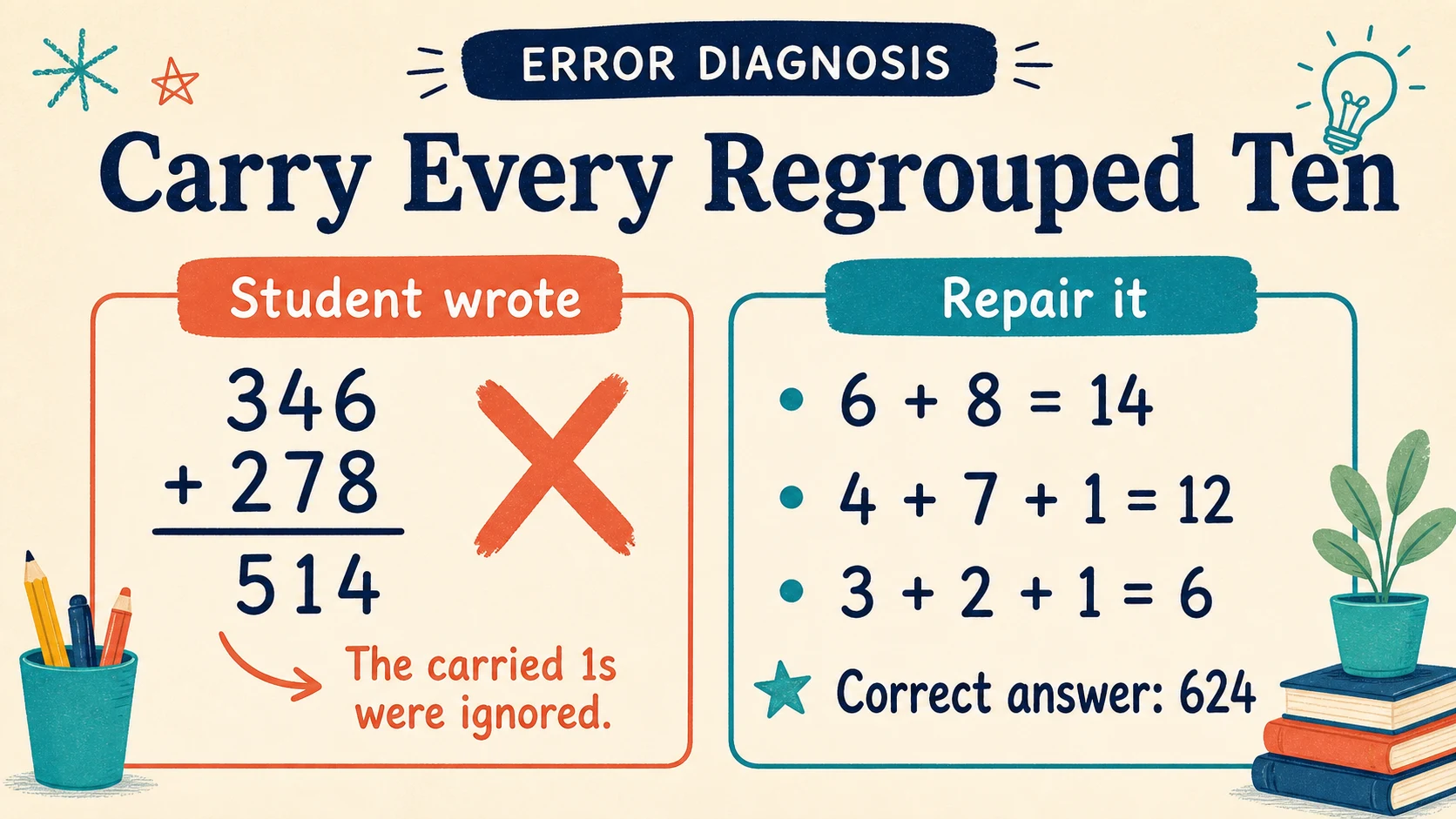
The same wrong answer can have different causes, so inspect the learner’s representation and explanation.
| Observed work |
Possible mathematical issue |
Short diagnostic task |
Teaching response |
| 8+7=14 |
Counting-on error or insecure composition |
Ask the learner to show 8+7 on a ten frame |
Rebuild 8, fill 2 spaces, and account for the remaining 5 |
| 46+23=96 |
Ones and tens were not kept distinct |
Ask what the 4 in 46 represents |
Rebuild both numbers with tens and ones |
| 27+35=512 |
Partial results were concatenated |
Ask what 7+5 equals and what 5 tens mean |
Combine 12 ones into 1 ten and 2 ones, then total all place values |
| 38+47=75 |
A jump or fact was miscalculated |
Have the learner label each number-line jump |
Separate +40 and +7, then verify each landing point |
| 7+25=95 |
Digits were aligned by left edge |
Ask the learner to identify the ones place |
Write 7 as 0 tens and 7 ones |
| 43+0=0 |
Zero rule was overgeneralized |
Model 43 objects, then add no objects |
Connect the unchanged set to 43+0=43 |
| Correct answers with no explanation |
Procedure may be disconnected from meaning |
Ask for a drawing of one completed problem |
Connect each written step to tens, ones, and the total |
| Accurate model but incorrect numeral |
Recording rather than reasoning error |
Ask the learner to read the model aloud |
Reconnect counted tens and ones to the written number |
Avoid responding to every error with “be more careful.” That instruction does not identify what should change. A short diagnostic example—preferably with the learner explaining each step—usually provides more useful evidence.
Monitoring Progress Without Rushing Pacing
Monitor three dimensions: accuracy, strategy, and independence. A learner may be accurate with blocks but not yet independent, or quick with facts but unable to explain a regrouping step.
Use a simple record after a lesson:
| Date |
Problem type |
Accuracy |
Strategy observed |
Level of support |
Next instructional choice |
| Example |
Two-digit, new ten needed |
3 of 4 |
Combined ones, then exchanged |
One prompt |
Repeat with one model and two independent examples |
Look across several sessions before drawing a conclusion from one score. Record whether errors repeat and whether the learner can correct them after a neutral prompt.
Possible evidence of readiness to advance includes:
- Accurately representing the addends.
- Choosing a reasonable strategy.
- Explaining why 10 ones can be renamed as 1 ten.
- Solving a short set without step-by-step adult direction.
- Checking an answer with another representation or inverse relationship.
- Applying addition in a simple situation without being told which operation to use.
Speed can be observed, but it should not replace evidence of understanding. Timed fact practice belongs after the relevant relationships and strategies are established, consistent with the supplied teaching guidance.
A Two-Week Practice Plan
This plan assumes ten short sessions. It is an adaptable example, not a universal timetable. Repeat, shorten, or replace a day according to the learner’s observed work.
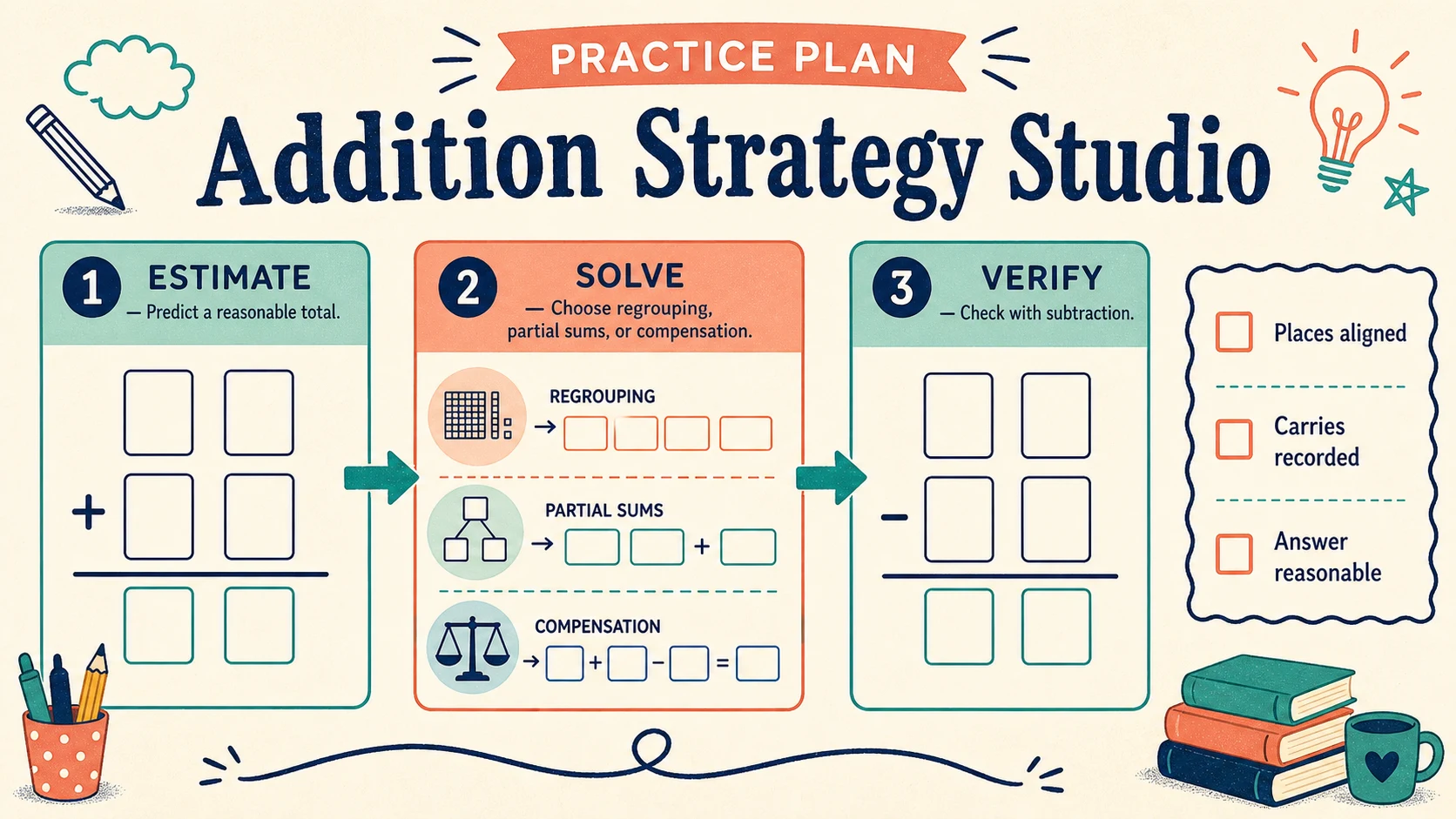
The plan alternates new learning, supported application, diagnosis, and review.
| Day |
Focus |
Suggested activity |
Evidence to record |
| 1 |
Readiness |
Check pairs that make 10, facts within 10, and tens-and-ones representations |
Which prerequisite needs review |
| 2 |
Make ten |
Model and solve facts such as 8+6, 9+5, and 7+7 |
Whether decompositions preserve the addend |
| 3 |
Addition within 20 |
Mix counting on, doubles, and make-ten examples |
Strategy choice and explanation |
| 4 |
Two-digit addition without a new ten |
Use blocks, drawings, and expanded form |
Correct separation of tens and ones |
| 5 |
Independent review |
Complete a short mixed set; discuss one error or efficient solution |
Accuracy and level of prompting |
| 6 |
Compose a new ten |
Build examples such as 27+35 with base-ten blocks |
Whether 10 ones are exchanged correctly |
| 7 |
Connect representations |
Solve one problem with blocks, a drawing, and an equation |
Consistency across representations |
| 8 |
Number-line strategy |
Add tens, then ones, on an open number line |
Labeled jumps and accurate landing points |
| 9 |
Application and boundary cases |
Include zero, unequal digit lengths, missing addends, and a word problem |
Whether the learner identifies the structure |
| 10 |
Cumulative check |
Use a small mixed set and ask for one second method |
Retention, flexibility, and next need |
If Day 6 shows that the learner cannot explain the exchange, Day 7 should not become harder written work. Repeat the concrete model with different numbers. If the learner is secure, Day 7 can emphasize comparing strategies rather than adding more routine items.
Limitations and the Honest Next Step
A general guide cannot determine an individual learner’s instructional level, explain every persistent difficulty, or replace local curriculum decisions. A worksheet sample also cannot by itself establish durable understanding. Written answers may hide counting, guessing, copying, or a sound mental strategy, so observe at least some live problem solving.
The catalogue identifies this topic’s progression and the intended second-grade practice level, but it should not be interpreted as comprehensive standards alignment, certification, a guaranteed outcome, or medical or diagnostic guidance. The cited IES guides and mathematics standards support broad instructional framing; they have not reviewed this guide, the WorksheetWise catalogue, or a particular worksheet.
A practical next action is to open the free easy 2nd Grade Addition worksheet, choose four representative problems, and watch how the learner solves them. Record the strategy, any place-value confusion, and the amount of prompting needed. Use that evidence to select the next lesson from the progression above. If a more precisely targeted set is needed, create one through the free worksheet generators.