Curated collectionAnswer keys includedPrint-ready PDFs
Summer Learning Phonics Worksheets
Maintain selected skills through a light spaced schedule, learner choice and short review loops rather than recreating a school day.
Start with a real resource
Browse this worksheet collection
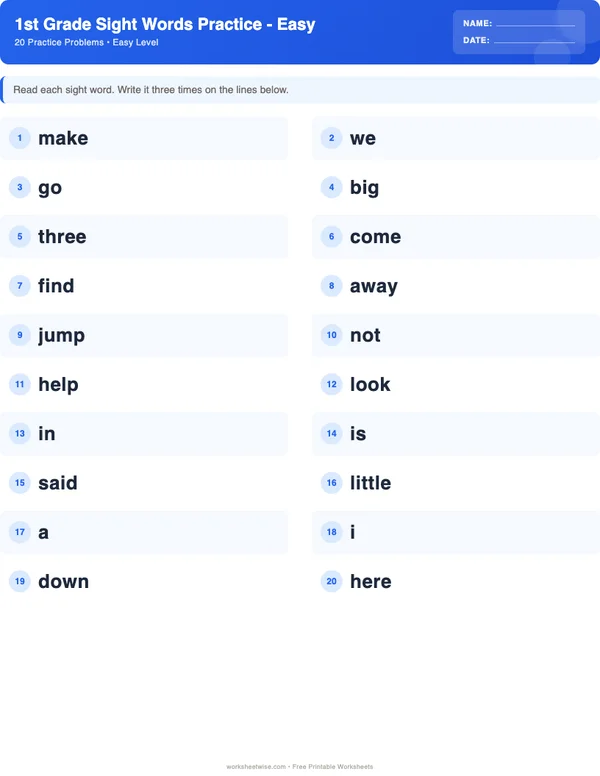
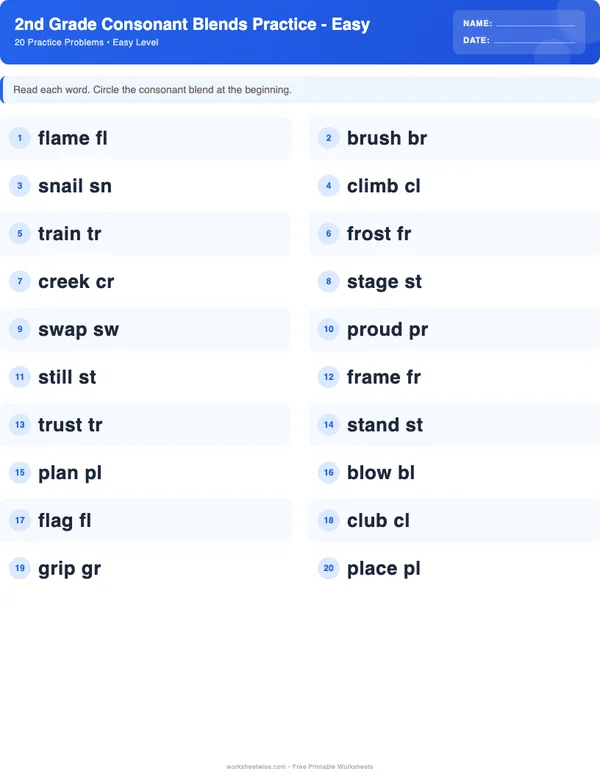
22 relevant free entry points are available. Each one includes a printable learner PDF and separate answer key.
A useful practice loop
Print less. Observe more.
- Choose one skill and model the first item aloud.
- Use a short set and notice the learner’s strategy.
- Change the next task from the work you can see.
Need more than the free sheet?
Plus includes all 396 matching catalogue variations where available, plus saved deterministic generators and the worksheet designer.
See Plus membershipComplete guide
How to teach and practise summer-learning phonics worksheets
3,244 words Updated 6 instructional visuals
Keep phonics alive without turning summer into school
Use summer phonics worksheets as short practice samples, not as a daily stack to finish. Choose one skill the learner has already encountered, model it aloud, complete only enough items to reveal a pattern, and revisit that pattern several days later. A useful session lasts about 10–15 minutes for many elementary learners and ends while attention is still available. That duration is a practical suggestion, not a sourced requirement.
The WorksheetWise catalogue currently offers 396 phonics variants across four grade labels and seven topics, including 22 free resources. Those numbers create choice, but choice only helps when an adult narrows it. Do not rotate through CVC words, blends, digraphs, word families, short vowels, long vowels, and sight words merely because all are available. Select the sheet whose response format lets you observe the exact skill you want to maintain.
The central summer loop is:
- Reconnect with a known sound or spelling pattern.
- Model one example while saying what the letters are doing.
- Let the learner choose between two suitable response formats.
- Complete a short sample.
- Review errors by type, not just by score.
- Choose the next sheet from the error pattern.
- Recheck the skill after a gap.
This approach is consistent with the broad direction of the IES foundational reading practice guide, which recommends connecting speech sounds with letters, teaching learners to decode and analyze word parts, and including connected-text reading. IES did not assess WorksheetWise, prescribe this summer schedule, or endorse any worksheet described here.
Start with evidence from the learner, not the grade menu
Grade labels describe an intended practice level; local curriculum sequences differ. Treat “Pre-K,” “Kindergarten,” and “1st Grade” as catalogue navigation, not proof of what a learner should know. Age is also a discovery aid rather than a placement decision. A learner’s current response to a carefully chosen task is more informative than a birthday or upcoming grade.
For ages three and four, prioritize brief adult-led oral, matching, manipulative, and movement work over desk work. You might show three picture cards, say map, and help the child move a token for /m/, /ă/, and /p/. A printed sheet can supply pictures or words, but the adult should carry the reading and directions. A full 20-item page is not the goal.
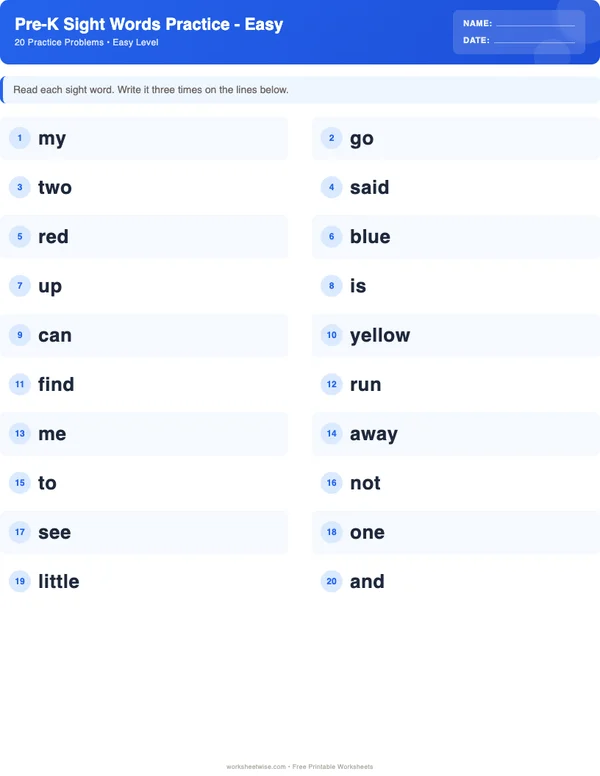
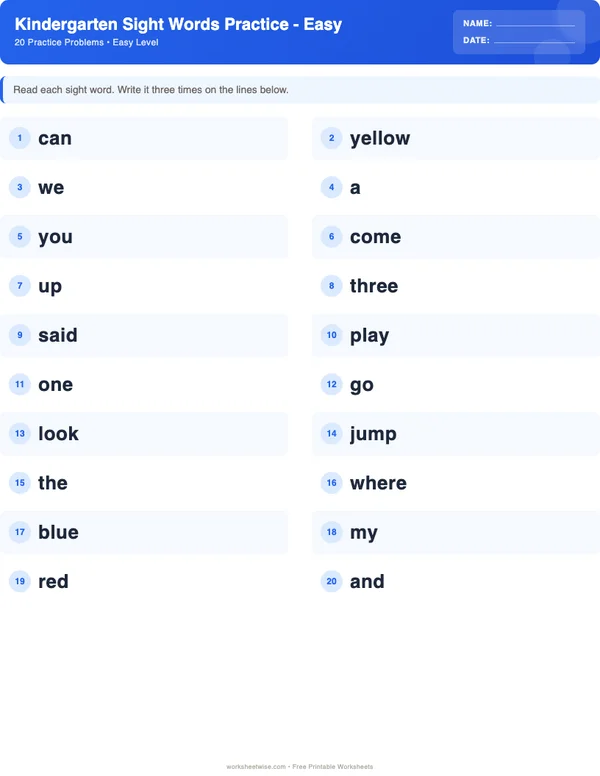
Every representative free sheet supplied for this page is labelled “easy” and contains 20 problems. Here, “easy” must be understood through observable task features, not as a label for a learner. Look for features such as familiar one-syllable words, one clearly repeated target pattern, picture support, limited writing, a small number of choices, or a direct match between a sound and a spelling. A task becomes more demanding when it mixes several patterns, removes picture cues, requires independent reading of directions, asks for spelling from dictation, or embeds words in sentences.
Before printing, use three quick checks:
- Knowledge check: Has the learner encountered this sound-spelling relationship before? Summer maintenance is not the best setting for independently introducing an entire unfamiliar pattern.
- Response check: Will the learner read, sort, match, build, or spell? These actions reveal different information.
- Contrast check: Does the sheet isolate one pattern, or mix it with a useful comparison? Isolation helps rebuild access; contrast shows whether the learner can discriminate.
Choose among live skills by the decision you need to make
The representative catalogue resources are related, but they are not interchangeable. Select them according to what you need to observe next.
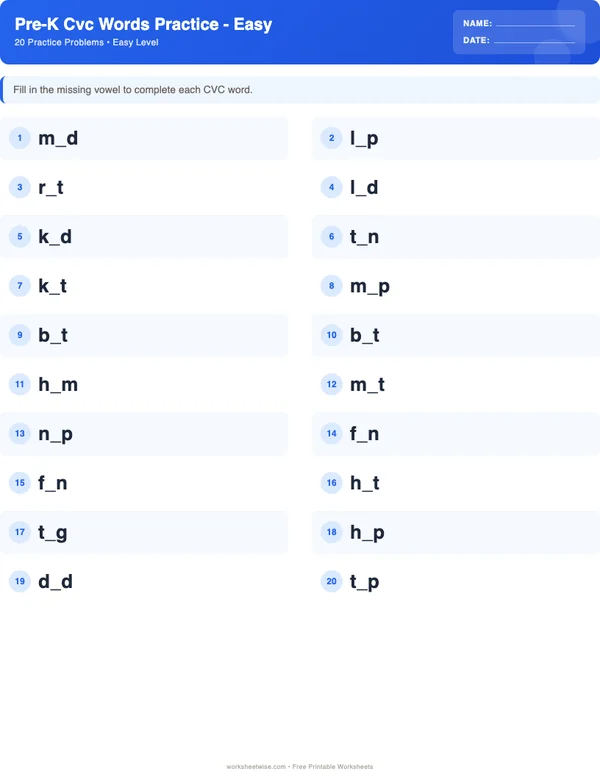
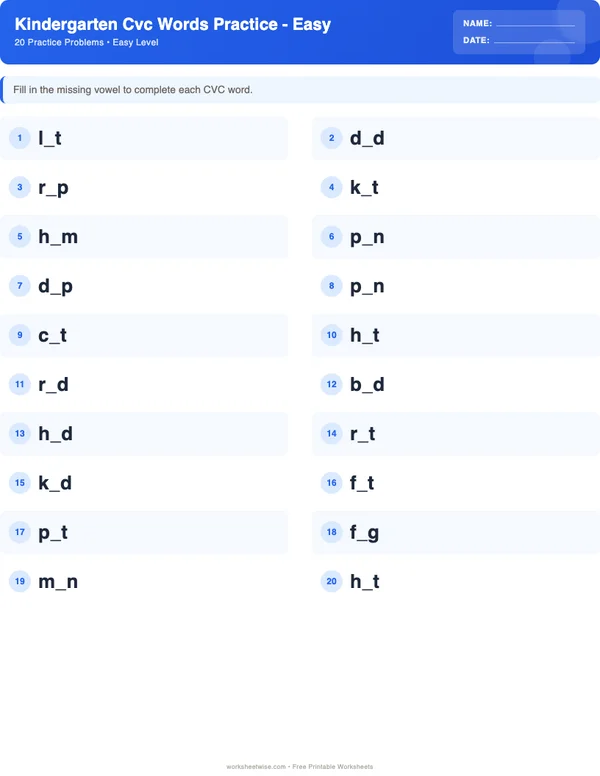
CVC words: Can the learner blend three sounds into a word?
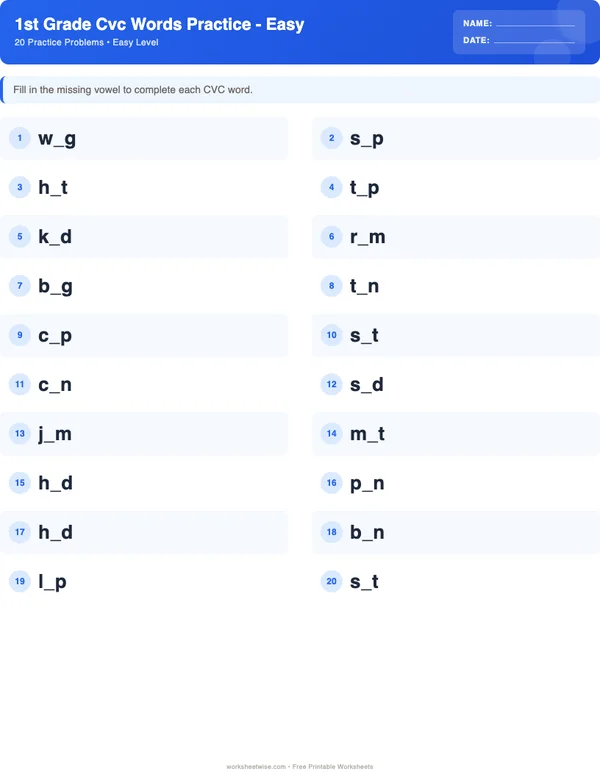
The Pre-K, Kindergarten, and 1st Grade CVC resources all represent three-sound words such as cat, pin, and hug. Available activities include word building, picture matching, fill-in-the-blank work, and reading. The corresponding free sheets have 20 problems.
Choose CVC work when the learner knows several consonant sounds and a short vowel but reads one sound at a time without arriving at the whole word. Adult modeling should make the blend audible: point beneath map and move continuously from /mmm/ through /ă/ to /p/, then say map. Avoid inserting extra vowel sounds, such as “muh-a-puh,” because those additions obscure the word.
A checked word chain is cat → mat → map. Each change affects one consonant while the short-a vowel remains stable: cat changes initial /k/ to /m/, then mat changes final /t/ to /p/. This example belongs here because it tests whether the learner notices and blends the changed letter rather than reciting a memorized family.
Use Kindergarten CVC Words guide and free sheet when you want a direct entry point for this pattern. Use the Pre-K CVC Words guide and free sheet when the response needs more adult mediation or concrete matching.
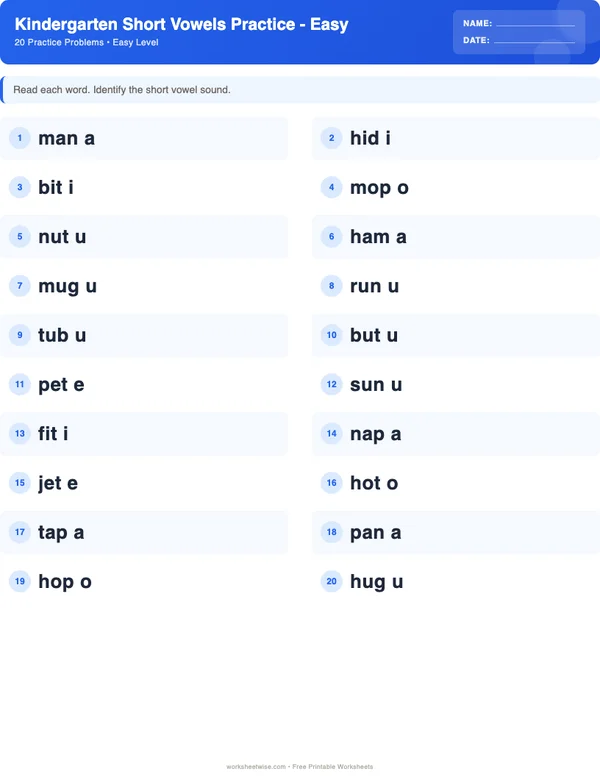
Short vowels: Can the learner hear the middle sound?
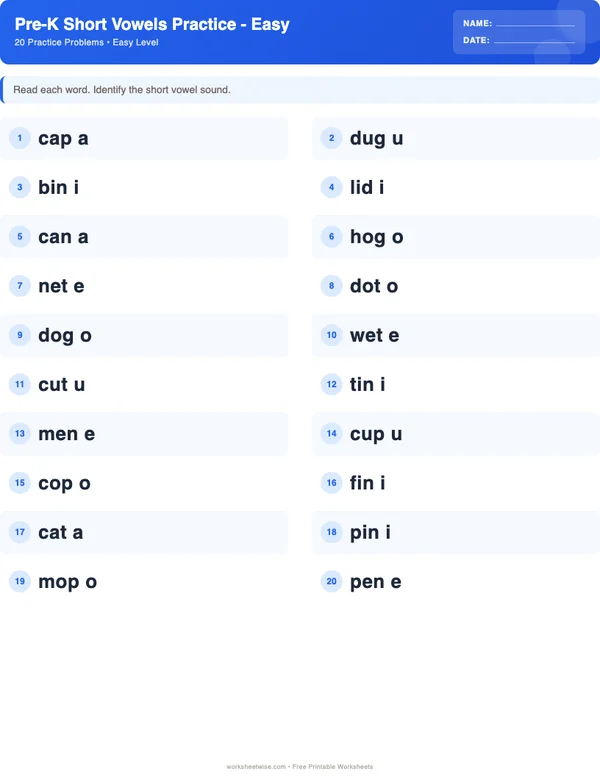
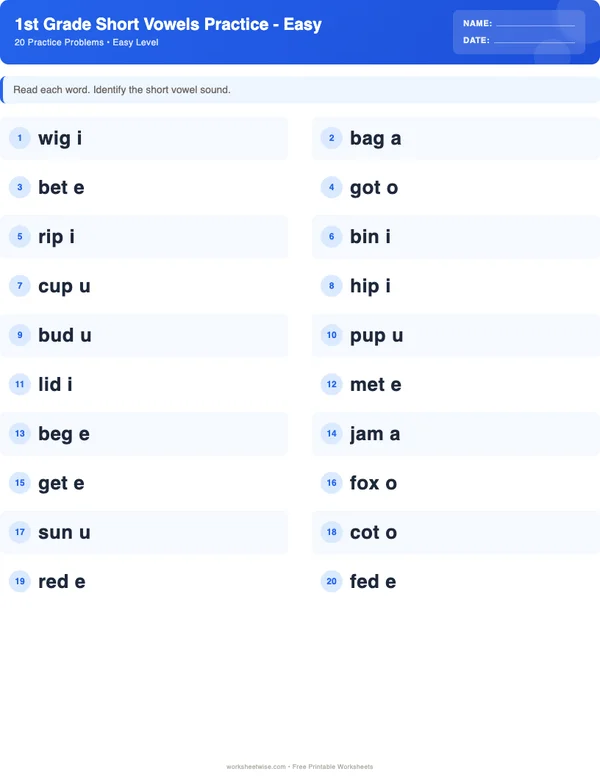
Short-vowel work asks for finer discrimination than merely recognizing three-letter word shapes. The catalogue identifies a in apple, e in egg, i in itch, o in octopus, and u in umbrella, with practice through picture sorting, word reading, spelling, and fill-in-the-middle activities.
Choose a single-vowel sheet when blending is effortful or the learner has recently lost confidence. Choose a two-vowel sort only when you need to test a specific confusion. For example, pen/pin, set/sit, and bed/bid are checked minimal-pair contrasts: each pair retains the same opening and closing consonants while the middle vowel changes from short e to short i. They belong here because a wrong response cannot be explained by a different initial or final consonant.
Say the two words naturally, then slowly. Ask, “Which word has the middle sound in itch?” If the learner cannot hear the difference, do oral pointing or picture sorting before requiring letters. If the learner hears it but writes the wrong vowel, keep the oral contrast and add letter choices.
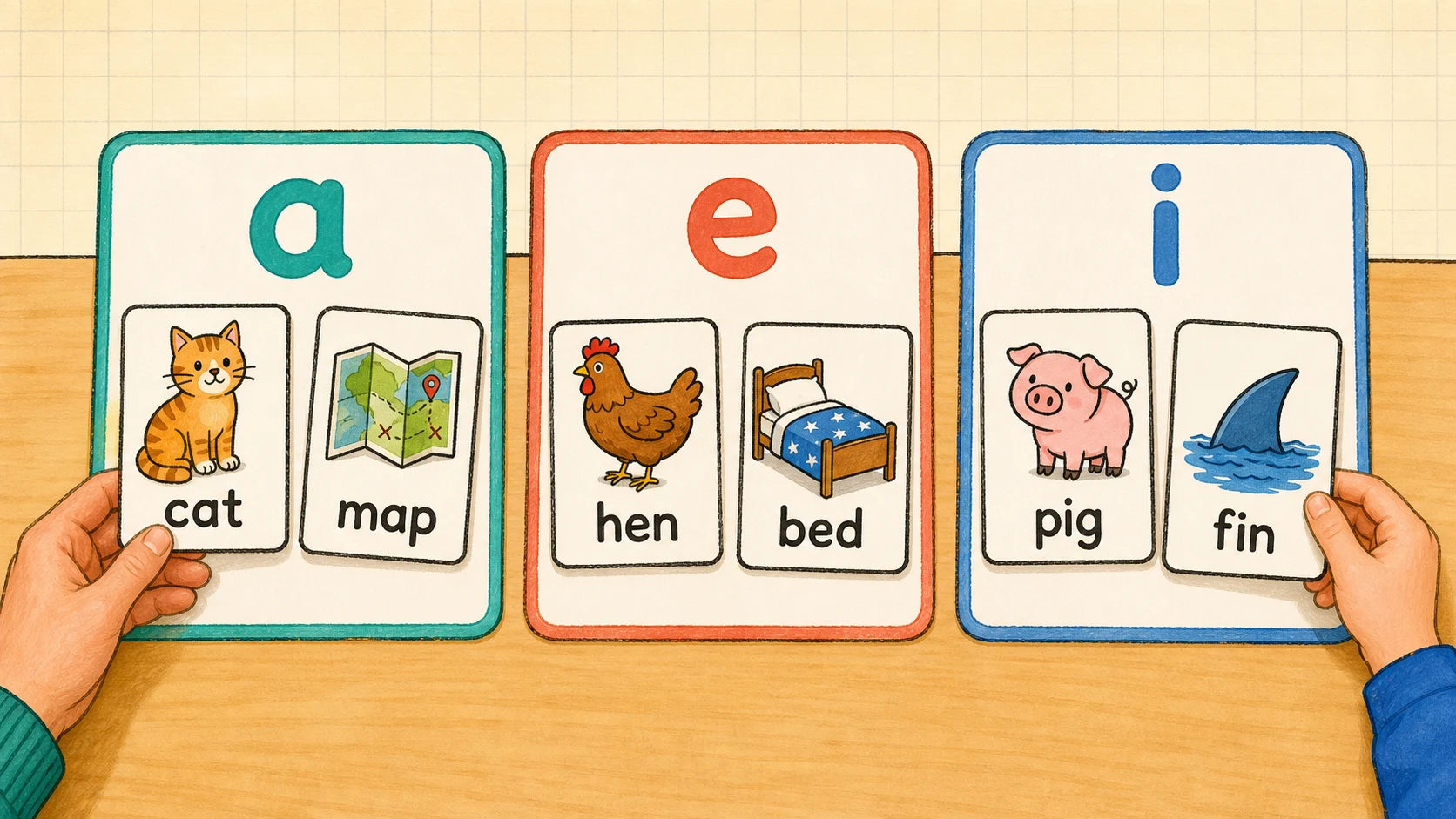
Use the short-vowel routine as a compact cycle: hear the vowel, identify it in a word, respond, and check the same contrast again later.
Word families: Can the learner preserve a known ending while changing the onset?
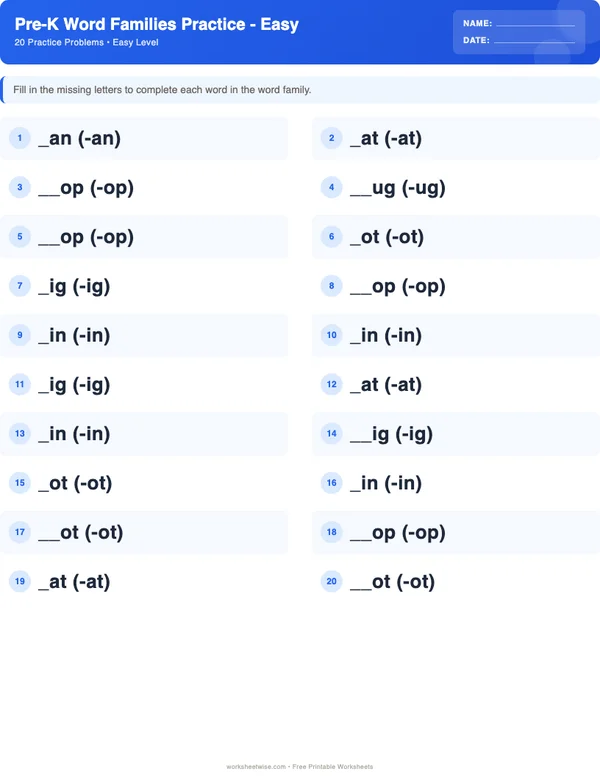
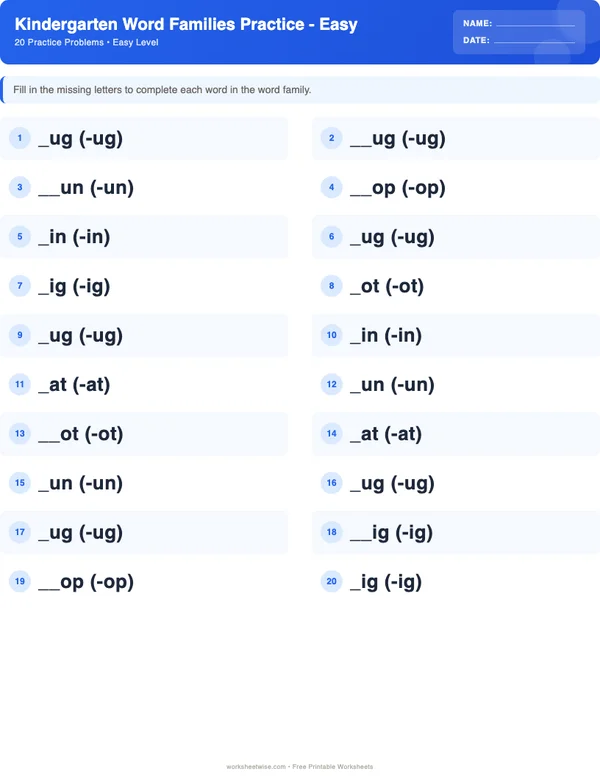
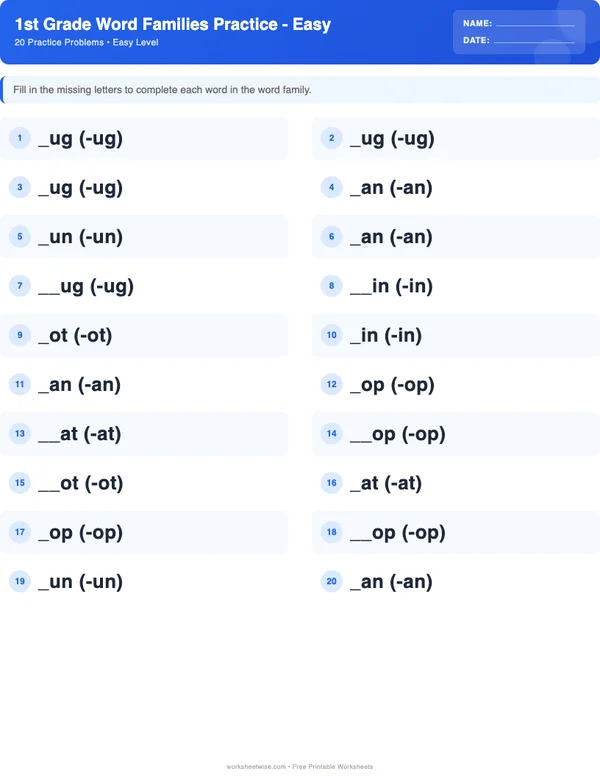
Word-family sheets group words by a shared ending, such as -at in cat, bat, hat, mat, and sat, or -ig in big, dig, fig, pig, and wig. The representative activities include building, reading, sorting, word wheels, rhyming, and sentence reading.
Choose word families when a learner can blend but expends so much effort on every letter that repeated chunks are not yet useful. Keep -at visible and swap only the first letter. Ask the learner to read each whole word, not merely name the new initial sound.
The sentence “The fat cat sat on a mat” is checked: fat, cat, sat, and mat share the -at rime, while the, on, and a do not. It belongs here because it moves the pattern from an isolated list into a meaningful sentence without pretending every word belongs to the family. Do not teach word families as a substitute for attending to all letters; a learner who guesses hat for hot needs vowel contrast, not more rapid family recitation.
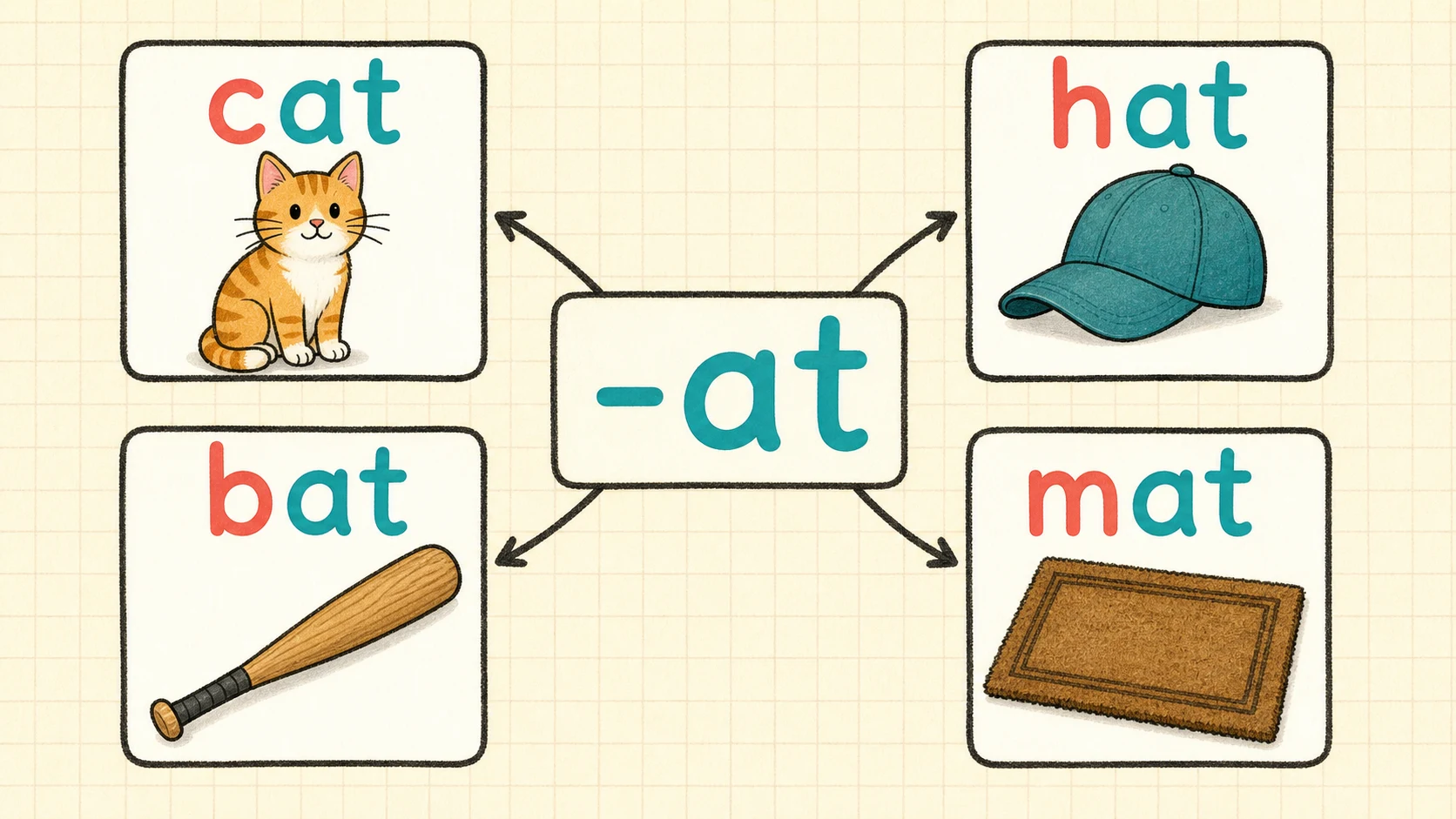
This map helps an adult connect onset changes, stable rimes, sorting, word building, and sentence reading without treating them as separate summer assignments.
Digraphs and blends: Does the learner understand what the letters do together?
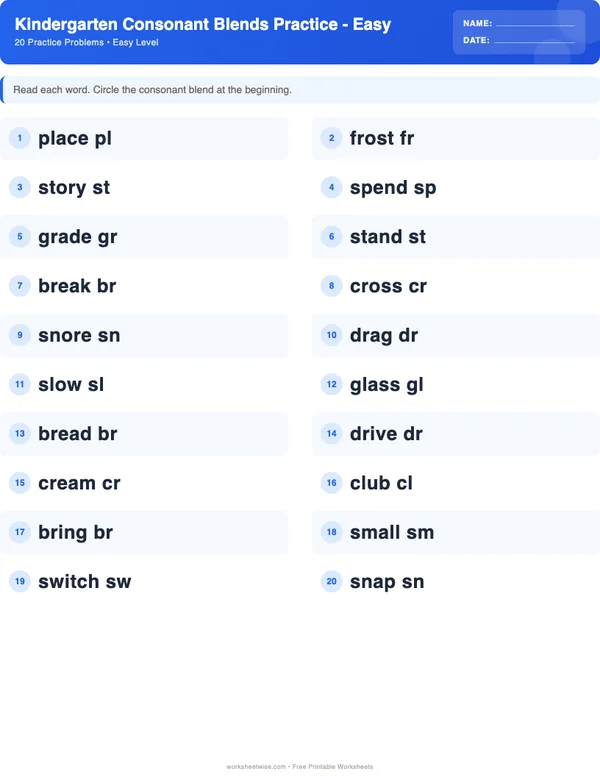
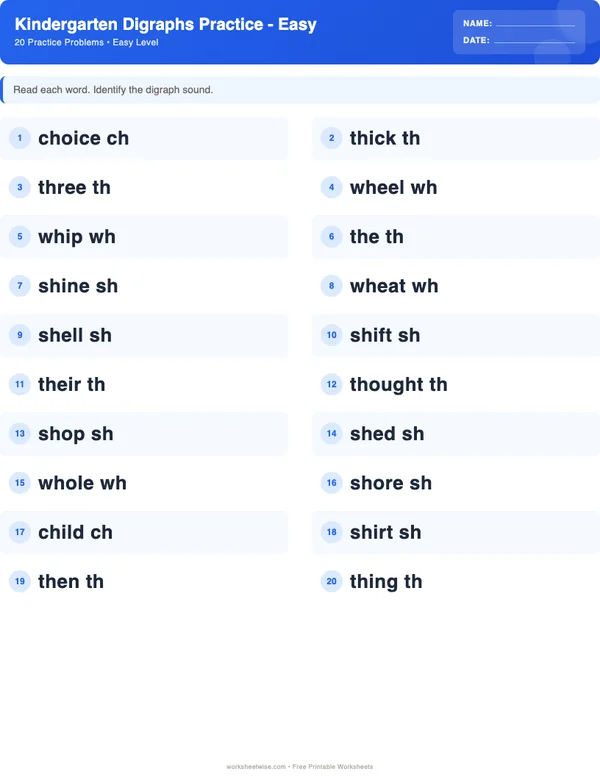
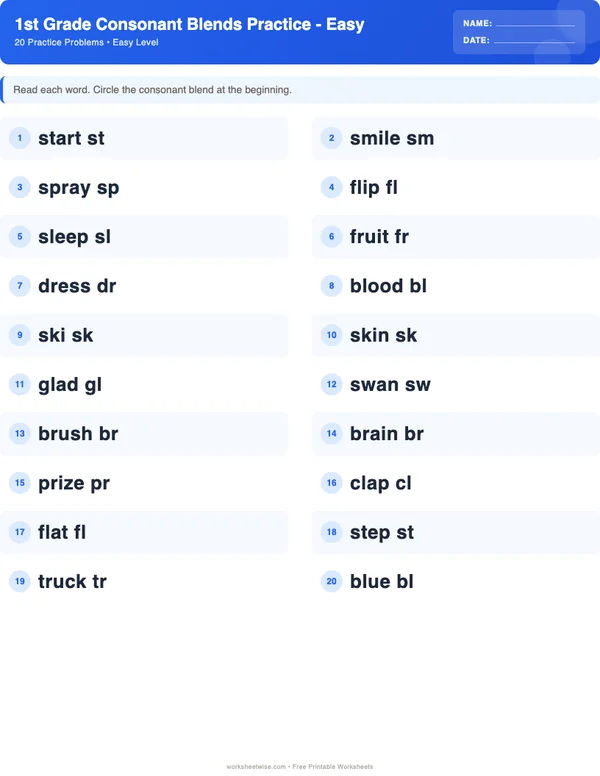
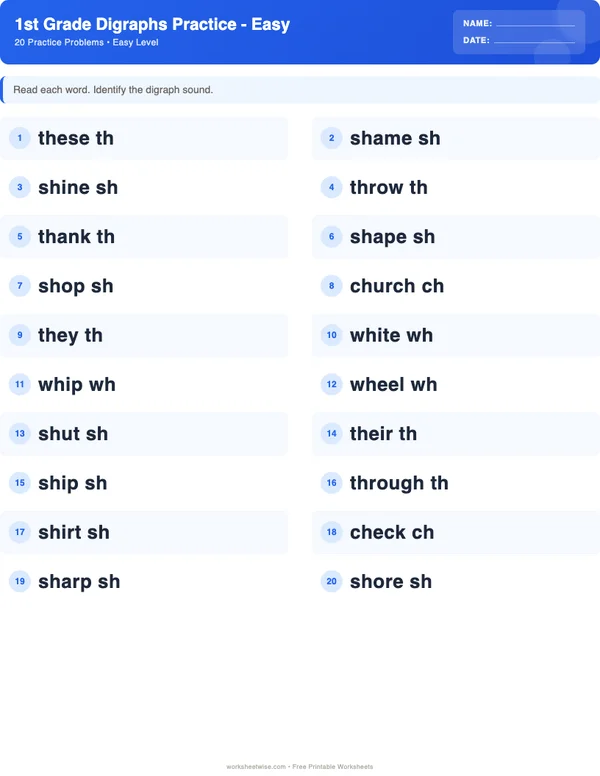
A blend retains both consonant sounds: st in stop contains /s/ and /t/. A digraph uses two letters for one sound: sh in ship represents /sh/. That distinction determines both modeling and correction.
Choose Kindergarten Consonant Blends guide and free sheet if the learner reads stop as sop or tent as ten. Choose digraph practice if the learner separates sh into two unrelated sounds or confuses sh and ch. Do not describe sh as “two sounds pushed together”; hold two fingers together and explain that the two letters work as one spelling unit.
A checked comparison is ship/wish: sh appears at the beginning of ship and the end of wish, but represents /sh/ in both. Chin/much provides the same positional comparison for ch. These examples belong here because they reveal whether the learner recognizes a digraph independent of position.
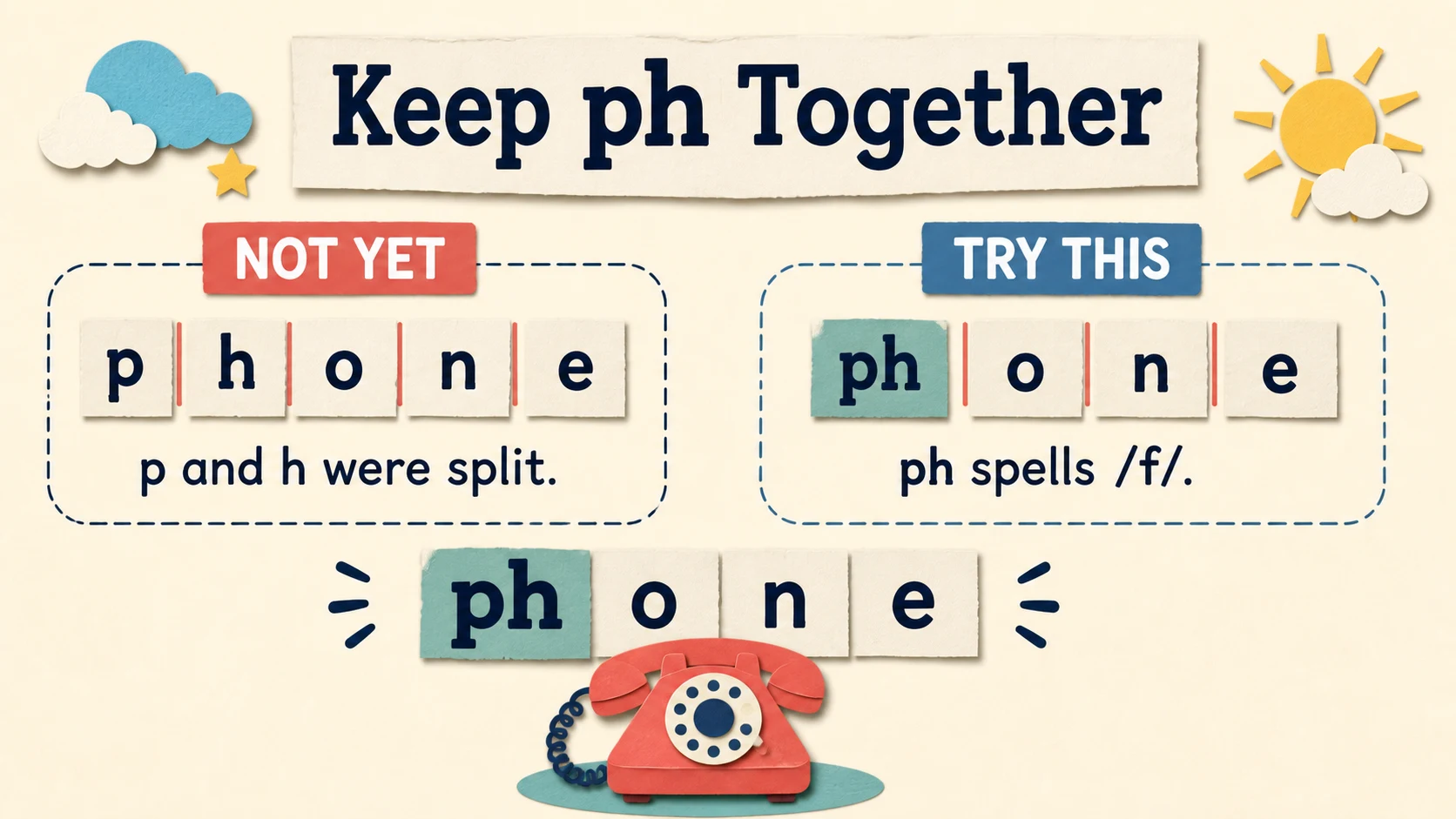
Use the error-response pairs to decide whether the next move should isolate one digraph, contrast two digraphs, or return to sound-by-sound blending.
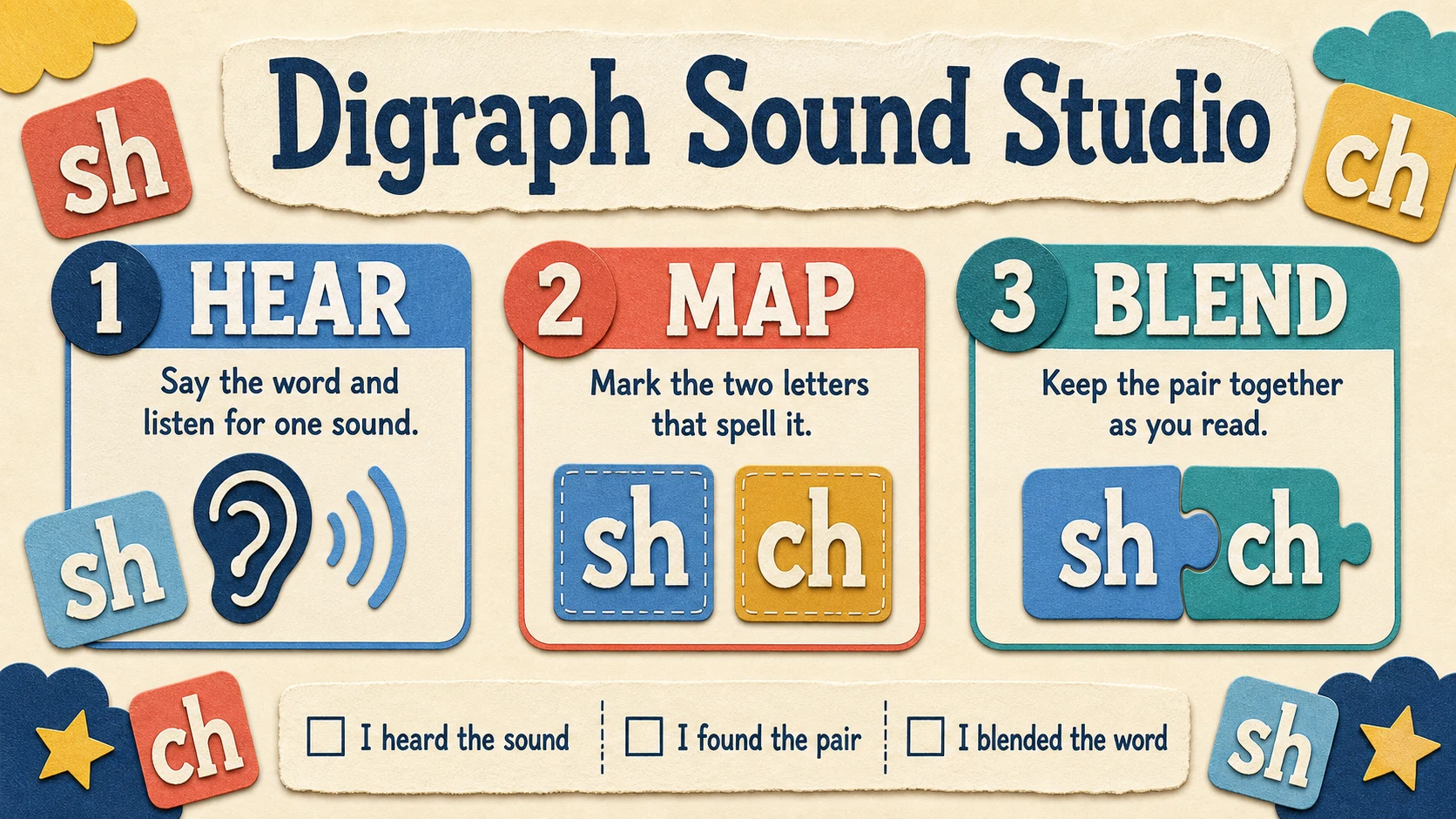
The two-week view keeps digraph review spaced and cumulative instead of assigning a new full sheet every day.
Long vowels: Can the learner contrast CVC and CVCe patterns?
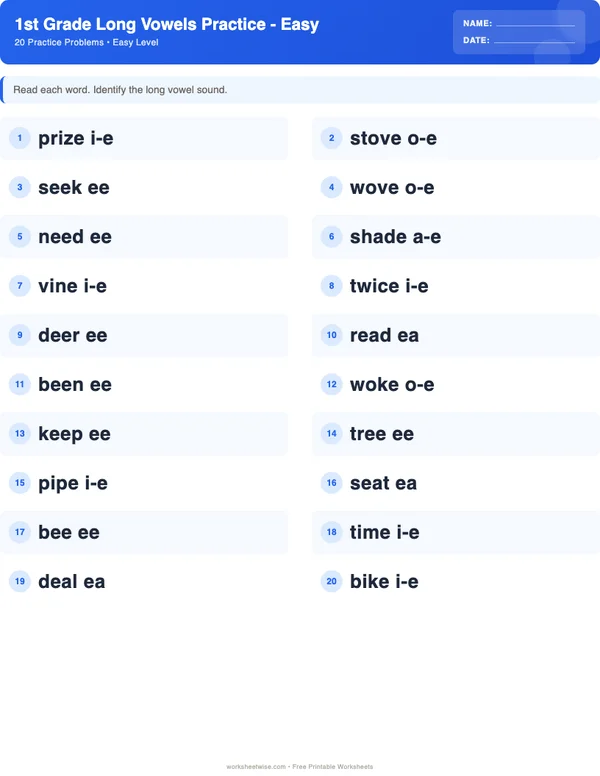
The representative 1st Grade long-vowel resource covers silent-e, vowel teams, and open syllables through sorts, reading, and encoding. Because those categories contain several spelling patterns, first determine whether the learner is maintaining one known contrast or confronting unfamiliar material.
Begin with a checked CVC/CVCe pair such as cap/cape, pin/pine, hop/hope, or cub/cube. In every pair, final e changes the preceding vowel from its short sound to its long sound while the basic consonant frame remains visible. These examples belong here because the learner can compare one controlled written change with one audible vowel change.
Model by marking the vowel and final e, reading both words, and asking what changed. Then mix pairs rather than presenting only CVCe words. A learner who sees ten silent-e words in a row may follow the page pattern without discriminating.
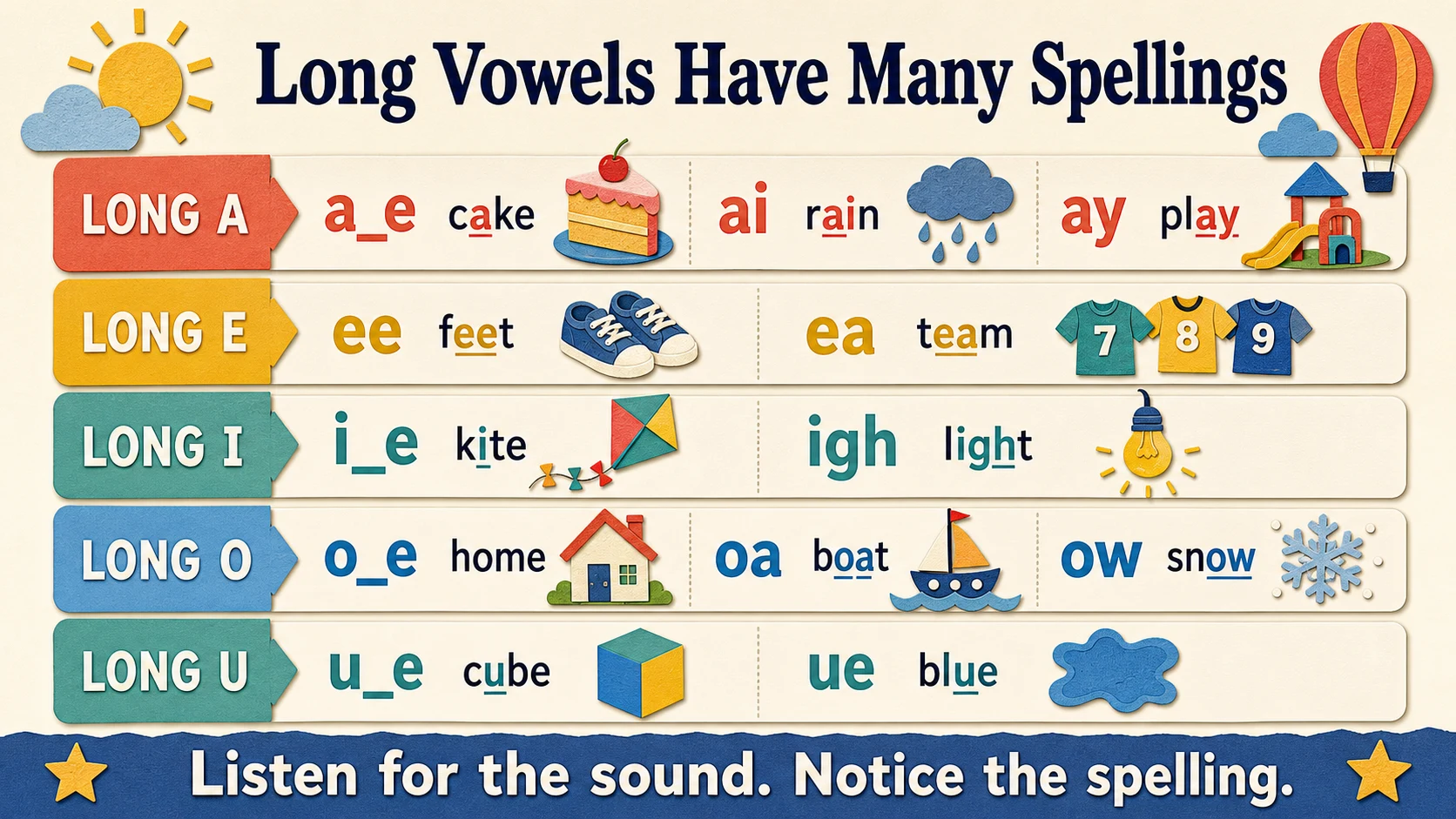
Use this map to keep long-vowel spelling patterns connected to reading, sorting, contrasting, and spelling rather than reducing the lesson to a slogan.
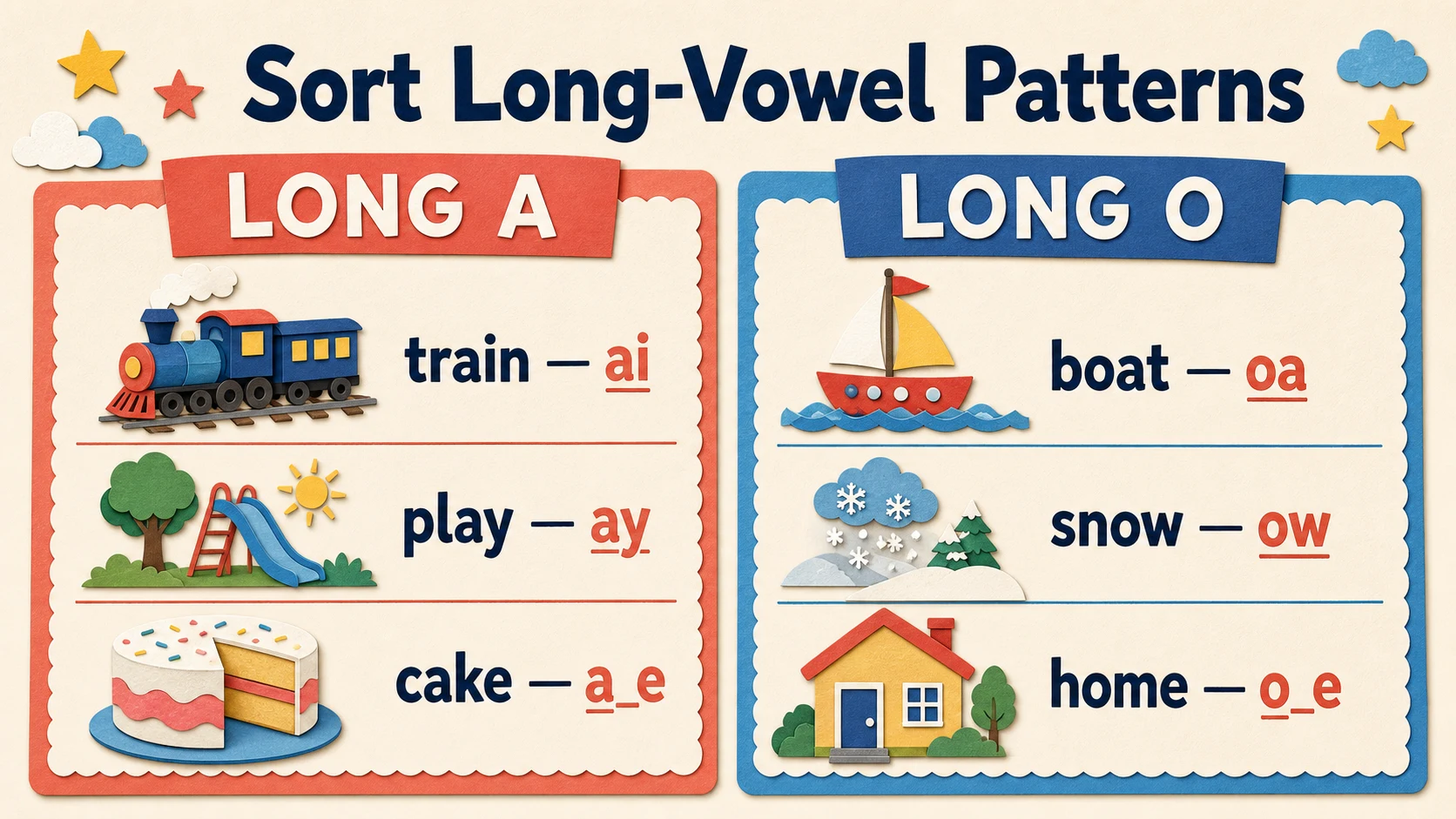
This routine clarifies how a brief model, a controlled contrast, learner practice, and a delayed check can fit into one light summer cycle.
Run a 12-minute model–choose–respond–review session
The following routine is a WorksheetWise editorial recommendation for summer use. It is not a research-prescribed dosage.
Minute 1–2: Retrieve one known pattern
Show two previously practiced words without giving a rule speech. Ask for a read, a sort, or a quick build. For long vowels, show hop and hope. For digraphs, show ship and wish. If both responses are uncertain, reduce the day’s task immediately: model one word and work orally.
Minute 3–4: Model one complete response
Say what you notice, what you do, and how you check:
“I see sh together at the start of ship. Those two letters represent /sh/. I blend /sh/ /ĭ/ /p/: ship. I check that I used the sound represented by both letters.”
The learner should hear the target relationship, not a vague direction to “sound it out.” On a picture-match sheet, model how to say the picture name before choosing its printed word. On a spelling item, stretch the spoken word and map sounds to letters before writing.
Minute 5–9: Offer bounded choice
Let the learner choose between two formats that preserve the same target:
- circle or point;
- build with tiles or write;
- read six items or sort six cards;
- answer the top row or the bottom row.
Choice concerns how to respond or which small set to complete—not whether to replace short-vowel discrimination with coloring. Stop after roughly five to eight revealing responses. A 20-problem sheet can support two or three sessions; completion is not evidence of better practice.
Minute 10–11: Correct one pattern, not every imperfection
Mark correct responses neutrally. For an error, use a short prompt:
- “Say the whole word.”
- “Touch one box for each sound.”
- “Do these two letters represent one sound or two?”
- “Compare the middle sounds.”
- “Read both choices and check the picture.”
Have the learner retry the item and then complete one fresh item with the same relationship. Do not supply the answer and immediately move on; that tests imitation, not retrieval.
Minute 12: Record the next-sheet decision
Write one observable note: “Read 5/6 short-a CVC words; guessed map from picture before looking at letters,” or “Read ship and wish; separated ch in chin.” Avoid labels such as “weak reader” or “advanced.” The note should describe what happened and identify the next contrast.
Make response formats reveal different parts of phonics
A worksheet’s topic title does not tell you what the learner must actually do. Match the format to your question.
Picture matching lowers the demand for independent reading but can invite guessing. Ask the learner to read the printed choice before pointing. If the learner selects a cat picture after seeing cat but cannot read cat without the image, record that difference.
Sorting reveals discrimination. A short-e/short-i sort is useful only if each word or picture is named consistently. If a picture is ambiguous to the learner, supply its name; otherwise you are testing vocabulary or image interpretation.
Word building makes sound-letter changes visible. Use three boxes for map: /m/ | /ă/ | /p/. Use three sound boxes for ship as well: /sh/ | /ĭ/ | /p/. Although ship has four letters, it has three phonemes in this analysis because sh represents one sound.
Reading tests decoding from print. Cover pictures when you need to know whether letters are driving the response.
Dictation or spelling reverses the direction: the learner hears a word and produces its spelling. The IES elementary writing guide includes spelling and handwriting among the transcription skills learners should develop fluently. It does not say that copying a completed word is equivalent to spelling from sound, so distinguish those tasks in your notes.
Sentence reading checks whether the skill carries into connected text. The IES foundational guide recommends daily connected-text reading in classroom instruction. During a light summer session, that could mean one decodable sentence containing the practiced pattern, not a lengthy passage. The sentence must not depend heavily on patterns the learner has never been taught.
Let the error choose the next sheet
A total such as 14/20 conceals the instructional decision. Group errors by what the learner did.
| Observed response | Likely task-level issue to test | Immediate feedback | Next sheet or format |
|---|---|---|---|
| Reads stop as sop | One sound in the blend was dropped | Tap /s/ /t/ /ŏ/ /p/, then blend | Initial s-blend word building before mixed blends |
| Reads tent as ten | Final consonant was omitted | Contrast ten/tent and touch the final sound | Final-blend matching or dictation |
| Sorts pin with short e | Short e and short i are not yet reliably distinguished in this task | Say pen/pin and compare the middle sound | Two-vowel oral sort, then a written e/i sort |
| Reads ship as separate s and h sounds | The digraph is not being treated as one spelling unit | Join two fingers and model /sh/ | One-digraph sh sheet in initial and final positions |
| Reads cape as cap | Final e is not affecting the vowel during decoding | Read cap/cape side by side | CVC/CVCe contrast sheet, not a broad vowel-team sheet |
| Reads every -at word correctly but guesses hot as hat | Family pattern is overriding attention to the vowel | Compare hat/hot letter by letter | Mixed short-a/short-o discrimination |
| Matches from pictures but cannot read covered words | The image may be carrying the response | Cover pictures and model one print-first read | Word reading with reduced picture support |
| Reads words but cannot spell the same pattern from dictation | Recognition is stronger than production in this sample | Segment, map, and rebuild one word | Short dictation or word-building task on the same pattern |
These are instructional hypotheses, not diagnoses. One error may be a lapse, an unclear picture, unfamiliar vocabulary, fatigue, or misunderstanding of directions. Confirm a pattern with at least one fresh item before changing topics.
If errors scatter across several skills, reduce the number of items and observe aloud. A mixed sheet may be too broad to identify the cause. Return to the last stable contrast rather than moving automatically to a lower grade label.
Space practice across two light weeks
A practical two-week plan uses three short sessions each week, with days between them:
Week one: establish the pattern
- Day 1: Model the target; complete five or six isolated items.
- Day 3: Retrieve two old items; use a different response format for four to six new items.
- Day 6: Mix the target with one previously secure pattern; read one short sentence.
Week two: check transfer and retention
- Day 9: Recheck without showing the earlier answers.
- Day 11: Use spelling or word building if earlier work emphasized reading, or reading if earlier work emphasized matching.
- Day 14: Sample three old items and three contrast items. Choose the next sheet from the error type.
For a learner reviewing sh, Day 1 might match and read ship, shop, fish, and wish. Day 3 might build shop and fish. Day 6 might mix sh words with known CVC words. Day 9 should include fresh sh examples rather than an identical page remembered by position. This is a suggested implementation of spaced review, not a claim about a guaranteed result or ideal universal interval.
Adapt access without replacing the phonics target
A useful adaptation changes how the learner sees, hears, or records the answer while retaining the required sound-spelling decision.
- Read directions aloud while leaving target words for the learner to decode.
- Cut a 20-item page into short strips.
- Cover unrelated rows to reduce visual load.
- Let the learner point, move a token, or select letter tiles instead of writing.
- Enlarge print without changing the letter sequence.
- Name an unclear picture while withholding the answer word.
- Let the learner stand, step once per phoneme, and then blend.
- Alternate adult and learner turns on the same pattern.
- Use a blank card to reveal one item at a time.
Do not call it phonics practice if the adaptation removes the relationship being tested. Reading every target word aloud and asking the learner to copy it no longer tests decoding. Spelling a word for the learner and asking for tracing no longer tests sound-to-letter mapping. Letting a child color every picture beginning with sh may become an art or vocabulary activity unless the learner also says the word, identifies /sh/, and connects it with the letters.
The Common Core ELA standards organize literacy expectations by grade while also emphasizing reading, writing, speaking, listening, and language. They can help adults understand why response modes matter, but they do not establish that a particular WorksheetWise page matches a local curriculum. Use local school guidance when standards alignment or instructional sequence matters.
Know what worksheets cannot tell you
A worksheet is a sample of performance under particular conditions. It cannot establish a diagnosis, explain every error, determine instructional placement by itself, or promise maintenance. It may also introduce confounds: an unfamiliar picture, small print, unclear directions, limited pencil control, regional pronunciation, or a word the learner does not know orally.
Pause and seek guidance from the learner’s teacher or an appropriately qualified professional when difficulties are persistent across oral and printed tasks, when the learner becomes distressed, when speech or hearing concerns are already present, or when school-provided intervention instructions conflict with a general worksheet routine. Describe observable responses rather than proposing a condition.
Also protect summer reading from becoming only word work. Phonics supports word reading; it is not the whole of literacy. Read enjoyable books aloud, talk about them, and let the learner choose texts. If writing is appealing, pair one decoded word with a short message or caption, but do not turn every phonics review into a composition assignment.
Make the next printable earn its place
At the end of the next session, record three things: the target, one exact response, and the next contrast. For example: “Target: initial s-blends. Response: read stop as sop twice, then included /t/ after tapping. Next: build and read stop, step, and stem alongside sop.”
Then use the free deterministic worksheet generators to make the next practice set match that observed need: one target, one deliberate contrast, five to eight revealing items, and a later recheck.
Put it into practice
Use the guide with a real printable
Move from explanation to a short, observable practice task. Check the first item together, then adjust the next session from the learner's actual work.
Open the first free worksheetExplore a neighboring collection